



Abstract
U.S. colleges and universities have been demonstrably ineffective at facilitating scholarship among their students. To become effective, psychological science suggests institutions must tap students’ intrinsic motivations and address their core values from Day 1 through graduation. This article describes a science-based, integrated set of solutions, labeled H2O-centered education, which creates and sustains instructional environments in which students develop and implement well-defined goals aligned with their intrinsic motivations and values, and the institution’s goals. The objective of H2O-centered education is to create educational environments that tap students’ genuine interest, resulting in meaningful student self-exploration and development and enduring and transferable learning.
Students often graduate from high school or college with less interest in learning than when they entered and with little long-term retention of what they learned there (Duncan, 2011). Education experts have documented the ineffectiveness of the U.S. educational system, including higher education (e.g., Dragoset et al., 2017; Klein, 2011; Leef, 2013; Ravitch, 2016; Smith, 2004). This article describes a way of understanding why this is happening and an integrated approach for restructuring collegiate courses to address these concerns. The essence of this restructuring is the development of a well-defined mission and well-defined goals and activities. Restructuring requires that goals align with the mission of the course and that, in turn, activities align with the goals. It requires that students actively embrace the mission, goals, and activities of the course.
Once these elements are in place, the focus shifts to assessment of goal achievement and overcoming barriers to goal achievement. Finally, this course restructuring focuses on an effective reward for overcoming barriers and achieving goals. The shorthand title for this approach is H2O-centered education (H2O is an acronym for Helping Oneself and Others). H2O-centered education marries course content with students’ interests and values. Its democratic classroom approach facilitates knowledge acquisition by tapping students’ intrinsic motivation and linking that motivation to the course whenever possible. The H2O-centered education experience is grounded in a cultural and scientific context, which will be described next. Next, preliminary evidence for the effectiveness of the approach is provided. Finally, the eight specific components of H2O-centered education are detailed.
Principles That Support the Eight Components of H2O-Centered Education
The eight H2O-centered education components just mentioned and which will be detailed later, reflect the cultural and scholarly context in which we and our students are imbedded. The components of that context, including research related to the scholarship of teaching and learning, will be described next.
Foundations
Our approach reflects current trends in U.S. higher education, including learner-centered teaching (e.g., Bain, 2004; Delbanco, 2012; Smith, 2004; Weimer, 2013), the rights asserted in the Declaration of Independence and the American Psychological Association’s (APA, 2017) ethical code, whose principles of beneficence and nonmaleficence, fidelity and responsibility, integrity, justice, and respect for people’s rights and dignity serve as part of the foundation for our approach. Although not necessarily limited to U.S. culture and U.S. citizens, our approach is quintessentially American. U.S. higher education is at the center of American life (Delbanco, 2012, p. 28). The right to life, liberty, and the pursuit of happiness, which are asserted in the Declaration of Independence and which align with APA’s ethical code, are the same rights that should be advanced through a U.S. college education. So, we contend that a U.S. college or university’s mission should be to help student fulfill these inalienable rights of citizenship. This approach may generalize to other cultures and peoples, and we hope that it does. However, assuming it will in the absence of evidence is imprudent. So, we wish to be clear that our work is a reflection of (and perhaps limited to) U.S. culture.
What H2O-Centered Education Does
Encouraging students to be authentic
The H2O-centered classroom supports Education Excellence by fostering regular and increasingly-accurate feedback between students and between students and their instructors. This is facilitated by encouraging authenticity through collaboration and classroom objectives that focus on the student’s self-expression.
The H2O-centered classroom has a collaborative nature designed to promote authenticity. In this classroom, the instructor models congruence, empathy, and regard to create an atmosphere in which students feel comfortable revealing their goals, values, and interests. A study of instructors’ verbal behavior found that during lectures, award-winning instructors frequently self-disclosed and gave personal narratives that were relevant to the course material (Downs, Javidi, & Nussbaum, 1988). In an experimental study, students anticipated higher levels of motivation, effective learning, and positive classroom environment when instructors modeled self-disclosure through a social media platform (Mazer, Murphy, & Simonds, 2007).
When instructors encourage authenticity in the classroom, they facilitate students’ genuineness with instructors, classmates, and themselves. Promoting student authenticity can help students reflect on (a) what motivates them, (b) when and where they are comfortable, (c) barriers they wish to overcome, and (d) evidence-based ways they might overcome those barriers. Self-evaluation in teens has been linked with better academic performance. Providing students with an opportunity to self-evaluate is associated with students’ self-efficacy and persistence-related motivation. Along with the guidance received from their instructors, students’ motivation, responsibility, and self-concept were significantly associated with their self-evaluation process (Cambra-Fierro & Cambra-Berdún, 2007).
In the H2O-centered classroom, all parties are encouraged to collaborate and to develop student self-evaluation through honest communication about goals, values, and interests. Students have many opportunities to co-create classroom experiences, thereby helping to shape their environment and increasing their motivation for learning. Stressing the importance of the learning process, providing choices, and allowing self-direction have been found to enhance intrinsic motivation because they increase one’s sense of autonomy (Deci & Ryan, 1985; Young, 2005).
Students who restrict their authenticity may exhibit behaviors that are prevention motivated and risk-aversive. Prevention motivation (which is the motivation to stop bad things from happening) can inhibit memory recall, creative production, and insightful solutions to problems (Friedman & Förster, 2001). H2O-centered education encourages promotion motivation, which is the motivation to keep good things happening. Students driven by promotion motivation are more likely to seek novel alternatives. Promotion motivation predicted increased performance on an insight problem-solving task (Friedman & Förster, 2001).
Helping students to pursue their own primary objectives
H2O-centered education’s primary focus is on students’ goals, values, and interests. The H2O-centered education syllabus begins with course criteria, around which self-evaluation and activity revolve. The first objective of the course is to “Learn (rather than simply memorize, then forget) basic principles related to the course that are meaningful to you.”
The H2O-centered educator helps students prioritize material related to their goals, values, and interests because students are less likely to exhibit high levels of initiative and performance when driven to act by an external demand or contingency. Autonomous motivation (motivation that is internally regulated) is positively and directly correlated with initiative, and initiative is positively and directly correlated with performance. Furthermore, the positive relationship between initiative and performance is strongest when autonomy is high and control is low (Ryan & Deci, 2000b). Students taught with a controlled-motivation approach lose initiative and learn less effectively (Amabile, 1996; Grolnick & Ryan, 1987; Utman, 1997).
Linking course content with autonomous motivation increases student initiative, engagement, performance, and learning quality (Ryan & Deci, 2000b). Self-determination theory suggests that students are highly motivated to achieve tasks that are intrinsically motivating and to perform activities that are integrated with their values, even if such activities are not intrinsically enjoyable (Ryan & Deci, 2000a). This allows educators to facilitate behaviors that are not intrinsically enjoyable but are useful and necessary (Ryan & Deci, 2000b).
Students who can focus on their own values and expectations have higher interest, greater long-term knowledge acquisition, and are more likely to endorse pro-social goals (Bandura & Schunk, 1981; Lee, McInerney, Liem, & Ortiga, 2010; Lüftenegger et al., 2012; Murad, Coto-YglesiasVarkey, Prokop, & Murad, 2010). Students operating from uncontrolled motivations tend to execute more effective strategies, such as management, concentration, and self-testing (Wijnia, Loyena, & Derous, 2011). Focusing more on the student’s expectations and values reduces several problems caused by controlled motivation and content-driven education, including the maintenance of gender disparities in academic subjects, decreased motivation, learned helplessness, reduced productivity, maladaptive social behaviors, self-handicapping, and undermined learning (Bandura & Schunk, 1981; Butler, 2006; Chen, Wu, Kee, Lin, & Shui, 2009; Lüftenegger et al., 2012; Oortvliet & Darnon, 2010; Tavakolizadeh & Qavam, 2011).
H2O-centered education builds from the foundation of the student’s goals, values, and interests to reduce damage inflicted by more conventional approaches.
Encouraging openness to change and experience
To thrive in a changing world, students should develop and practice adaptability, which result from openness to change and new experiences (Skordoulis & Dawson, 2007). An example of student adaptability is collaborative grading, which increases student engagement in the goals of the course and the validity of assessment (Educational Testing Service, 2003). Self-grading, which is a part of collaborative grading, provides immediate feedback, a benefit that positively influences learning (Edwards, 2007). Self-grading provides the opportunity for students to deepen their understanding of subjects and to better understand why an answer is incorrect (Sadler & Good, 2006). Self-grading improves class attendance, creates a friendlier and more cooperative environment, increases student productivity, reduces student–teacher conflict, and decreases student anxiety (Edwards, 2007; Strong, Davis, & Hawks, 2004). The atmosphere created by H2O-centered education changes the student’s motivational focus from a prevention (defensive) motivation focus to a promotion (appetitive) motivation focus (Friedman & Förster, 2001).
Increasing appreciation of complexity
Each step of the H2O-centered education system is designed to increase cognitive complexity and to enhance intellectual engagement. Discovery and innovation exist on the border between what is known and not yet known, so embracing complexity is vital to learning. Students experience complexity, including dynamic systems, when the number of interacting variables exceeds their current ability to use the variables to make predictions, or when students cannot reduce the complexity to manageable levels (Raia, 2005). Cognitive complexity can be enhanced through focus and repetition, but students often avoid cognitive complexity and overly rely on linear and mono-causal approaches. This overreliance should be addressed in the learning process (Raia, 2005).
H2O-centered education rewards students for engaging in complex thinking and nurtures them as they practice applying cognitive processes for understanding complex systems, a practice consistent with findings reported by Papageorge, Gershenson, and Kang (2016). As students clarify their personal goals, values, and interests and learn to evaluate the effectiveness of their attempts to integrate course material, they encounter complexity. Students in the H2O-centered classroom regularly experience ideas, memories, and impulses that challenge their preexisting beliefs and expectations.
Helping students to trust their experience
Reflective observation is an essential part of learning (Poikela, 2004). H2O-centered education provides many opportunities for reflective observation to determine what students want to learn, how to learn it, how to overcome barriers to learning, and how to evaluate progress. Encouraging students to rely on their own experience versus the judgments of experts, increases learning, creativity, and insight (Barzouka, Sotiropoulos, & Kioumourtzoglou, 2015). When researchers randomly assigned participants to attend to their experience of a problem that requires divergent thinking or an insightful solution, they solved problems more frequently than those not assigned to attend to their experience. They were able to list more obscure features of objects involved than control group participants, especially the essential characteristics required for the problem’s solution. The treatment group generated more ideas and more novel ideas while solving complex problems (McCaffrey, 2012).
Five Factors Individuals Need to Implement Educational Excellence
We have identified five factors (i.e., social support, time perception, enjoyment, accessibility, and motivation, or STEAM; see Higley, Heesacker, Mistler, & Farinelli, 2012, pp. 14-17; Higley & Tucker 2000) that help explain goal success versus failure. In an experiment with 182 MTurk workers, Bolshakova, Alvarado-Gomez, Marin, & Heesacker (2016) found STEAM levels powerfully predicted goal success versus failure (Cohen’s d = 1.36, a large effect). Lack of STEAM may explain why H2O-centered education is not implemented, even when it is desired. Thus, we recommend that administrators and educators interested in implementing H2O-centered education utilize STEAM Training throughout the curriculum (see Heesacker, Higley, & Elimelech, 2015).
Social support
The more effectively people are supported by others, the more likely they are to perform desired activities (Bandura, 1982; Catz, Kelly, Bogart, Benotsch, & McAuliffe, 2000; Duncan & McAuley, 1993; Gavin, 1988). Awareness of different types of social support, recruitment of effective types of support, and minimizing exposure to ineffective types of support are all critical to goal achievement (see Russell & Cutrona, 1987).
Time perception
The belief that one does not have time to perform an action is a significant barrier (Higley, 2006; Pizzari, McBurney, Taylor, & Feller, 2002). Students in our classes often report spending many hours per week on activities they perceive as less-desirable, time they could have used to perform more-desired activities. In other words, one’s perception of time availability may not mirror reality (Jones & McAuley, 2005) but instead may reflect misalignment of actions and priorities.
Enjoyment of the process
The performance of desired activities is often linked with a certain level of enjoyment of those activities (Ryan & Deci, 2000a; Wankel, 1993). Many people who we have worked with are often surprised to find out that enjoyment is often more under their control than they realize. For example, the book Flow: The Psychology of Optimal Experience (Csíkszentmihályi, 1992) lists methods of increasing the probability that one will enjoy desired activities more.
Accessibility to materials and training
Failure to engage in desired activities is often associated with insufficient access to information and materials related to the performance of these activities (Gavin, 1988). People who become skilled at obtaining needed resources ahead of time often find themselves performing more of their desired activities more frequently. In an experiment in which participants were randomly assigned to recall goals they achieved versus failed to achieve, Bolshakova et al. (2016) reported that the five STEAM elements—including accessibility—strongly predicted goal success versus failure.
The motivation for desired activities
Failure to perform desired activities is associated either with failure to anticipate rewards for engaging in those activities or failure to anticipate punishments for not doing so (Bandura, 1982; Guillet, Sarrazin, Carpenter, Trouilland, & Curry, 2002; Loehr & Schwartz, 2003; Ryan & Deci, 2000a; Williams & Bond, 2002). When individuals are internally motivated, they are more motivated to engage in desired activities and more confident their efforts will produce beneficial results (Harrolle & Moretz, 2010). Extrinsic rewards have limited impact on performance (e.g., Bénabou & Tirole, 2003; Pink, 2011). Pursuing intrinsically motivating goals and engaging in intrinsically rewarding activities results in more activity and goal achievement (Ryan & Deci, 2000a).
Initial Evidence for the Effectiveness of H2O-Centered Education
Three sources of evidence provide initial support for the effectiveness of this approach. The first is two small quasi-experimental studies we recently completed. The first study compared two sections of an undergraduate personality psychology class taught in the same institution during the same semester and with the same textbook. One class used an H2O approach, including the STEAM packet, WATER Game Scorecard, and the Mission Fulfillment System from Excellence University. The other class was taught traditionally. At the end of the semester, research participants from the H2O class (n = 37) reported significantly higher academic self-efficacy than quasi-control group participants (n = 12). The size of the effect was medium to large (Cohen’s d = 0.61, p = .038). The second quasi-experiment (Sanchez, Catuogno, Heesacker, & Higley, 2019) took the same approach, with a larger sample and a focus on SMART goals. H2O class participants (n = 93) reported writing SMART goals more often than quasi-control participants (n = 124, Cohen’s d = 0.53, a medium-sized effect), reported writing subgoals more often than quasi-control participants (Cohen’s d = 0.59, a medium-sized effect), and they reported achieving their class-related SMART goals more frequently than quasi-control participants (Cohen’s d = 0.35, a small to medium-sized effect).
A second source of evidence is from a journal article we authored (Heesacker et al., 2015) describing an H2O-centered all-undergraduate research lab, which students enroll in as an academic course. In addition to describing the H2O components of the lab and research that informs the approach, we included a section entitled “Evidence of Success,” in which we quote current and past lab members about their experience, report that 73% of 67 students in the lab course went onto or were then applying to graduate or professional schools (mostly doctoral training programs), reported that only one person we were aware of was unsuccessful in seeking admission to graduate or professional schools, reported that from 2012 to early 2015, nine lab members had completed lab-based senior theses (with most garnering highest honors), all of those nine went onto doctoral training programs. Also from 2012 until early 2015, lab members submitted five empirical research manuscripts to journals and presented original research from the lab class at many research conferences.
Finally, a host of faculty peer evaluations, student evaluations, and teaching awards garnered as the first two authors have used the H2O-centered approach suggest that people respond favorably to this approach. For information on our plans for further assessment of the effectiveness of this approach, see the Future Directions section of Heesacker et al. (2015).
Components of H2O-Centered Education
This section describes the following eight components of H2O-centered education:
(a) course objectives, (b) collaborative assignments, (c) collaborative grading, (d) the WATER Game Scorecard, (e) STEAM Training, (f) the Mission Fulfillment System, (g) an H2O-centered final experience, and (h) the promotion of education as a “Meaningful Adventure.” Some of these components may be similar to methods utilized in other approaches to teaching, but the way the components are conceptualized and implemented may differ markedly from other approaches. Educators can implement all of the components or only those most useful to them.
In implementing H2O-centered education, we rely on the online resource Excellence University, pioneered by Dr Brian Higley. Excellence University provides “ . . . a robust set of assessment, tracking, and training tools focused on helping educators and students achieve more of their educational and personal goals. . . these tools help instructors to manage their classrooms in ways that help produce truly meaningful learning for their students. (http://www.excellenceuniversity.net/educators.php)
We use it because, we have seen it work in our classrooms and undergraduate research labs (e.g., Heesacker et al., 2015). It helps faculty members and students (a) hold themselves accountable for articulating a scholarly mission, (b) develop clear and aligned goals, (c) execute those goals, (d) overcome barriers to achieving goals, and (e) effectively reward goal achievement.
H2O-Centered Course Objectives
As with all aspects of the H2O-centered classroom, course objectives are created in collaboration with students. After years of the first two authors working with students on what they, students, thought would be the best use of their time and energy, it became clear that most students wanted to learn “meaningful things.” Also emerging from our experiences with students was the importance of promoting student accountability for learning. Evaluating the degree of positive impact on a student’s life is best assessed with the inclusion of the student, so another objective that has emerged from classroom experience is that students become skilled at self-evaluation. Finally, many students have commented on the importance of being treated with respect by instructors and classmates to learning, which also requires them to reciprocation of that respect to others in the classroom. The result of this multi-year collaboration with students across many classes is the following four H2O course objectives, which can be applied to any academic subject matter.
With recognition that meaningful, self-directed learning cannot be forced, this course is designed to provide students with the opportunity to:
(a) Learn, rather than simply memorize, then forget, basic principles related to the course that are meaningful to you;
(b) Be accountable for your own learning, rather than projecting that accountability onto others or things outside of your control;
(c) Become proficient in evaluating your own learning and accountability, rather than passively waiting for others to do so;
(d) Collaborate in a professional, civil, mature manner with the instructor and your classmates to determine a grade based on your learning and accountability levels demonstrated throughout the entire semester, rather than a portion of the semester, meaningless learning, or simple memorization.
Course objectives that are related to learning meaningful things, accountability for learning, proficiency at self-grading, and professional interactions with others all facilitate authentic, regardful, and empathic engagement in the classroom. Choosing what one learns and carefully contemplating the grade deserved can be useful for promoting an internal locus of evaluation (Rogers, 1959; Rogers, Lyons, Jr., & Tausch, 2014). This personal agency in learning and grading can also promote more appeal to personal reason and experience, rather than to an authority.
A Collaborative Assignment Process
Collaborating with the course instructor to create assignments and decide how many points assignments are worth gives students the opportunity to provide authentic input on how learning should be demonstrated and documented. This process promotes an internal locus of control and a feeling of shared classroom ownership. It encourages students to pursue what they value and to experiment with different kinds of learning. Through this process, students can discover which learning experiences are most effective for them (Black & Deci, 2000) and to experience firsthand that comfortable experiences may not produce as much learning as constructive difficulties (Pashler, McDaniel, Rohrer, & Bjork, 2010).
After presenting the H2O-centered education course objectives to the class, the educator engages in a collaborative process to determine how these objectives will be fulfilled. Learning activities are aligned with course objectives and co-developed with students. Negotiations focus on determining which activities would help students learn meaningful things and convince the instructor that learning is likely to have occurred. This collaborative process can be done by the educator (in smaller courses), by teaching assistants (in larger courses), or by students trained by the instructor (in larger courses without teaching assistants).
A Collaborative Grading Process
Like a collaborative assignment process, a collaborative grading process can promote authentic engagement, a more internal locus of control, and more ownership in students (Pellegrino, Chudowsky, & Glaser, 2001). It can also facilitate openness to the experience of grading and awareness of the complexity required to assess what constitutes a high-quality learning experience with an education professional, rather than simply waiting for an authority figure to determine grades.
The collaborative grading process begins with a class discussion to determine which learning criteria should be met in learning activities to garner grade points. After many discussions of these criteria with students across the years, we have found that the following criteria are typically agreed upon: (a) professionalism, (b) text-based knowledge, (c) use of peer-reviewed, primary science, and (d) integration. Students can choose how many and which of these learning criteria they showcase in their activities, with more criteria resulting in more points earned. Also included in this H2O-centered education grading process is a “Learning Record Discussion,” where the student and instructor attempt to reach consensus on the degree to which the learning criteria were demonstrated in learning activities. The collaborative grading process can be done by the educator, teaching assistants, or trained students.
The WATER Game Scorecard
H2O-centered education facilitates the development of a learning community focused on accomplishing course objectives, one whose characteristics could later generalize to students’ lives after graduation. The WATER Game Scorecard, which the first two authors use in our classes, is a rubric that helps students assess their success in forming a high-functioning learning community (see Figure 1 and http://www.excellenceuniversity.net/educators.php for details about the WATER Game Scorecard, as well as about STEAM Training and the Mission Fulfillment System, which are addressed in the next two sections). Using the scorecard, students evaluate (a) how well defined the class’s vision is (typically, this vision is communicated at least in part through course objectives), (b) how well defined the class’s goals are (e.g., assignments and attendance requirements), (c) how well-aligned the class’s goals are with its stated vision (e.g., the degree to which assignments help achieve course objectives), (d) how well-aligned students’ planned activities are with the class’s goals (e.g., whether students are spending enough time reading course texts to achieve course goals), and (e) how effectively students overcome barriers (such as procrastination) to the completion of activities that lead to accomplishing class goals (and realization of the class’s vision). Students evaluate themselves or their entire class (depending on instructor preference) on the WATER Game components, using a six-point rating scale that ranges from “Little or No” to “Outstandingly.” Their evaluations are guided by brief descriptions of each of the six levels for each component located on the scorecard and online articles that further describe each component.
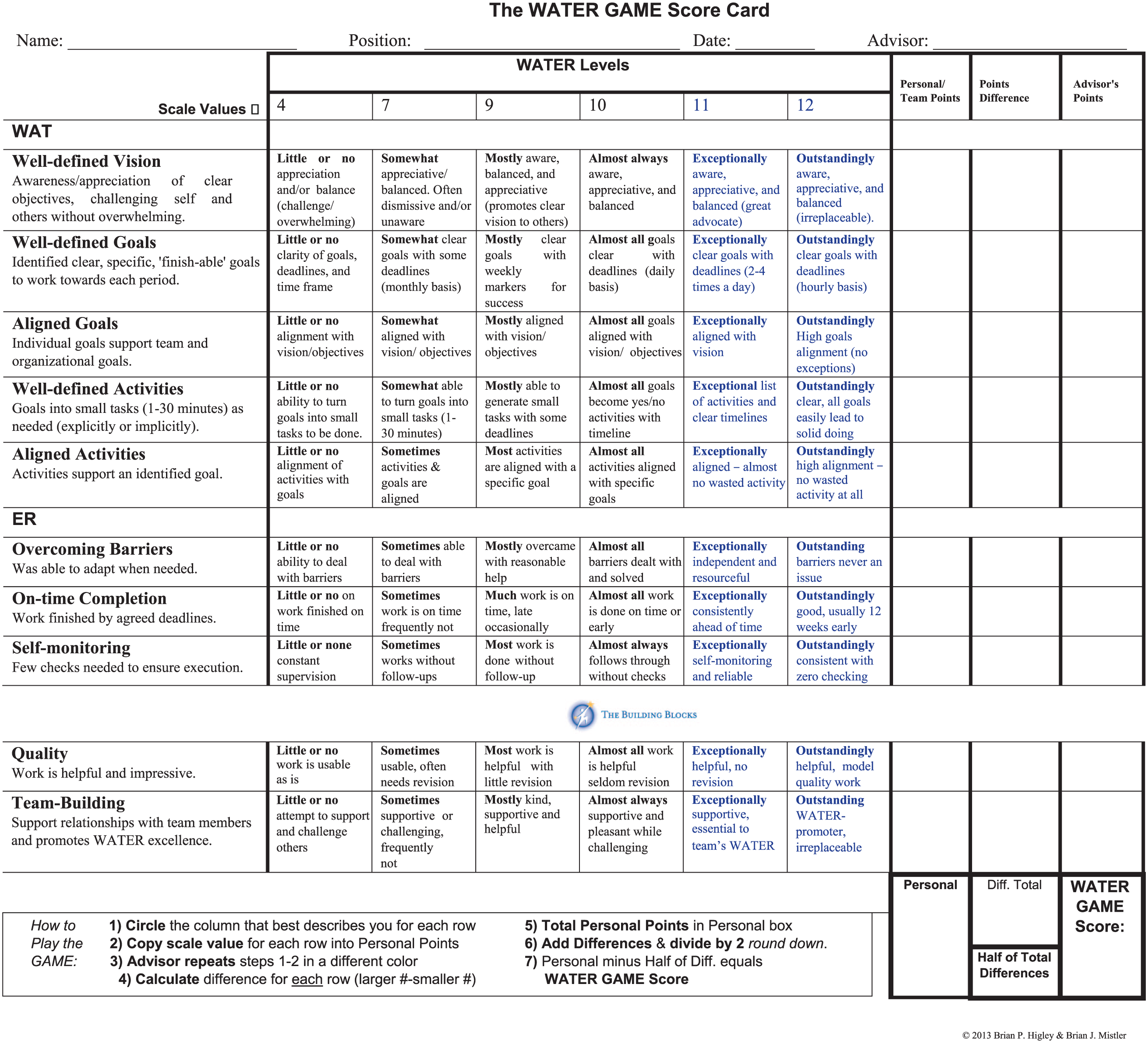
The WATER GAME Scorecard.
Incorporating exercises like the WATER Game Scorecard is another way to encourage students to provide their opinions on the classroom experience, facilitate an internal locus of evaluation for students, and promote ownership in the classroom. WATER Game Scorecard discussions can be done in class or online. Throughout the exercise, students are encouraged to take leadership in creating a learning community that is enjoyable and effective, a process that encourages a regardful and empathic openness to others’ definitions of a pleasant and effective learning environment. This process encourages students to give their authentic opinions respectfully and actively listen to the opinions of others.
STEAM Training
STEAM Training consists of a 37-page manual and 52 online articles that train students and educators in evidence-based methods of identifying and achieving their most important goals. Topics include evidence-based methods of (a) clarifying, focusing time and energy on, and enhancing motivation for important objectives, goals, and activities, (b) analyzing how time is currently spent on one’s most important activities versus how time would ideally be spent, and (c) reducing time spent on less important activities and increasing time spent on more important activities.
The Mission Fulfillment System
The online mission fulfillment system helps students and educators identify, prioritize, and monitor the achievement status of their course-related goals. This system, in conjunction with STEAM Training, helps students and educators to develop course-aligned “SMART goals” (specific, measurable, agreed-upon, realistic, and timebound) and to identify some of the common barriers to achieving these goals. Students and educators can use this system to (a) keep track of goal deadlines and completion rates, (b) assess the degree to which goals are well defined and executed on time during Water-Game Scorecard Discussions, and (c) measure how well course objectives are being accomplished by the entire class. This system also allows all members of a class to provide others with social support. Participation on the mission fulfillment system can be facilitated by the educator, teaching assistants, or students trained by the educator.
An H2O-Centered Final Educational Experience
An objective of the H2O-centered final experience is to for students to evaluate how effectively they used the course to enhance their abilities to achieve a satisfying personal and professional life. Openness to learning and change and readiness to deal with the complexity of a constantly changing world are reemphasized in this component of H2O-centered education.
This H2O-centered classroom final is a thoughtful review of students’ learning activities and how these activities have had meaningful impacts. Instead of “cramming” information during the final days of the course, students reflect on how they may have changed in meaningful ways and share their reflections with the class. Students are also asked to share how others have impacted them and to analyze how the course structure and material are related. This experience allows students to consolidate what they have learned throughout the semester, share it with others, learn from other students’ important takeaways, appreciate the class’ empirically-based structure, and suggest ways the experience may be improved for future semesters.
A typical H2O-centered final includes the following instructional elements: (a) identify four important changes that students wish to make in their lives after having experienced the course, (b) review the learning activities and identify four quotes from these learning activities that they believe will be useful as they move toward life changes, (c) listen to other students as they share one or two changes and quotes with the class, and (d) identify and share one aspect of the course that relates to what was learned in the course. For example, scoring can be based on how effectively the student and instructor believe the student’s quotes will help them make these important changes in their lives. This scoring method is designed to help students understand that every course can be meaningful to them in some aspect of their lives if they actively work to align their work with their personal objectives.
Promotion of Education as a Meaningful Adventure
For many students and instructors with whom we have spoken, classroom education has become a chore characterized by busywork. Students in the H2O-centered classroom are encouraged to think about their education as a meaningful adventure; an adventure in that education is a process of discovery, and meaningful in that some of these discoveries could result in students’ improved ability to live in a more satisfying way. The first author (B.P.H.) tells a story that lasts throughout the semester to connect what is happening with students in the classroom to a heroic journey, weaving the notion of meaningful adventure into the fabric of the semester. Viewing education as a meaningful adventure produces a variable-ratio schedule of reinforcement for students. What is most reinforcing is the profound learning experience that is possible at any moment, with the extrinsic reinforcement of points and grades facilitating, rather than dominating, the process.
Conclusion
H2O-centered education (a) promotes education excellence (resulting in living one’s life mission with high quality), (b) facilitates development of the whole person and the community by enhancing students’ self-mastery, interpersonal expertise, and achievement of personal and collective objectives, and (c) inspire promotion of education excellence through learning communities focused on students’ and educators’ health and well-being. It nurtures intrinsic interests and self-exploration of students by creating authentic, open classroom learning communities. H2O-centered education is based on scientific principles shown to produce cognitive restructuring, enduring behavior change, increased personal effectiveness, and enhanced life satisfaction. It is designed to enhance meaningful instructional activity and to make grading personally relevant to learners. H2O-centered education is collaborative, carefully structured, and grounded in (a) the science of learning, behavior change, and personal growth; (b) the principles detailed in APA’s Ethics Code; and (c) the Declaration of Independence. This approach was developed to help postsecondary educators produce lifelong scholars and empathic, effective, satisfied citizens.
Footnotes
Acknowledgements
The authors want to thank Sara Frick, Joel Johnson, and Luc Loyola for their contributions to earlier versions of this article.
Declaration of Conflicting Interests
The author(s) declared no potential conflicts of interest with respect to the research, authorship, and/or publication of this article.
Funding
The author(s) received no financial support for the research, authorship, and/or publication of this article.
