



Abstract
Hip-hop began in the 1970s as an artistic response to social, political, and economic oppression within African American communities in the United States. This artivist movement allowed community members to convey social inequities through music. Decades later, educators have begun using hip-hop as an educational tool. Our study examined whether hip-hop, as an educational pedagogy, could be a catalyst for perceived community change, inside and outside a collegiate classroom. Results suggested that hip-hop pedagogy can be a positive tool in student learning and community change, creating a safe educational space encouraging inclusion, self-expression, and student/instructor engagement.
Introduction
Hip-hop was established in the 1970s as an artistic response to social, political, and economic oppression within African American and Hispanic communities. This artivist movement, or activism through art, allowed community members to communicate and critique social inequities through music (Asante, 2008). Since its South Bronx inception, hip-hop has become “the voice of youth culture worldwide with enormous, albeit often untapped, potential for social and political change” (Hall, 2011, p. 1).
The introduction of the book Can’t Stop, Won’t Stop: A History of the Hip-Hop Generation (Chang, 2005) illustrates how parties had acquired a significant status in the Bronx and become a “rite of passage” for many. He shares as time passed, younger generations began to add their own style, flare, and beat to the layout he had originated. The result was a cultural revolution that came to be known as hip-hop.
Fast-forward several decades, university instructors have begun using hip-hop as an educational tool. Educators began using hip-hop songs to engage students in class and to relay instructional content to their students. What is more, students began to use hip-hop as a way to complete their assignments. Noticeably, hip-hop became a useful tool from both sides of the classroom. However, for our study, it offers the question: “Can hip hop pedagogy be used as a catalyst for leadership development and perceived community change, inside and outside a collegiate classroom?”
Literature Review
Hip-Hop Culture
Perkins (1996) and Kitwana (2003) identified hip-hop culture as containing rich stories of how Black youth, living in poverty, developed strategies for adapting to their situation. It provided an outlet for marginalized voices where young people could spontaneously express their views or simply vent frustration regarding issues such as interracial violence, poverty, and unemployment (Bennett, 2008; Lipsitz, 1994). Alridge and Stewart (2005) emphasize that hip-hop is much more than just a music genre; it is also a way of dressing, speaking, and looking at the world, reflecting reality for many youth. They argue that hip-hop, as a culture, consists of at least four essential elements: disc jockeying, break dancing, graffiti art, and rapping (emceeing) (Alridge & Stewart, 2005).
As a voice of the community, rappers often sing about issues relevant to their personal lives. These artists contribute to and embrace hip-hop culture, forged from areas of oppression and poverty and providing credence to the saying “something from nothing.” Banks (2015) highlights the origin of this saying: Hip-Hop was produced in a crucible that collided cultural richness with severe economic marginalization [ . . . ] [but] even in the absence of financial capital, hip hop celebrates the cultural capital of the residents, of its birthplaces, making something from something and flipping the dominant culture’s notion of “nothing.” (p. 246)
With this in mind, the emotional and cultural authenticity that lies within the lyrics of a hip-hop track makes it relatable to a broad audience.
At the same time, the artist can raise awareness for significant issues foreign to other audiences. This awareness is a form of activism and education through art, recounting the lived experience of day-to-day oppression. Correspondingly, hip-hop has provided many young people a support system; one where they realize they are not alone and are valued for what they feel, experience, and think. For this reason, hip-hop has the potential to play key role in how youth are educated (Emdin, 2010).
Hip-Hop in Education
Due to its popularity and relatability, hip-hop has slowly been infused into public education. Within the last decade, it has been incorporated into the curricula of many elementary, middle, and high schools (Hall, 2011). However, the unique emotional and intellectual development students experience during higher education makes it an ideal platform for educational integration. For this reason, our research pertains specifically to the way hip-hop has influenced students in higher education.
It is important to note that opportunities to utilize hip-hop in higher education have continued to grow as student population increase in size and diversity (Tienda, 2013). The Hip-Hop Center for Research and Teaching at New York University estimates that globally, there are more than 300 courses on hip-hop currently being offered at colleges and universities (Hall, 2011). Likewise, there are hip-hop archives at institutions such as Harvard, Stanford, and Cornell, and recently, A.D. Carson, a doctoral student in rhetoric, communication, and information design, decided to create a 34-track rap album for his dissertation at Clemson University.
Conceptual Framework
Our conceptual framework provides a foundation for how hip-hop can be used as an educational tool to enhance student learning and sense of belonging while also addressing social disparities within higher education. It has been argued that student identity and academic success are heavily shaped by one’s educational environment and personal experiences at the university (Tinto, 2003). Schlossberg’s (1989) transition theory supports this assertion, identifying student involvement and engagement as a key factor for college student success. According to Schlossberg (1989), students feel marginalized when they feel as if they do not fit in, causing them to feel self-conscious and depressed.
We argue that one method to enhance students’ educational experience is hip-hop pedagogy. This pedagogy enhances classroom experience by providing culturally responsive curriculum that deals with concepts, principles, and ideas across ethnic groups (Gay, 2018). It acknowledges student experiences and contributions authentically referencing culturally responsive pedagogy as a primary foundation for teaching and learning (Thompson, 2004).
Adjapong and Emdin (2015) define hip-hop pedagogy as a way of “authentically and practically incorporating the creative elements of hip hop into teaching, inviting students to have a connection with the content while meeting them on their cultural turf . . .” (p. 67). Emdin and Adjapong (2018) argue that not only do hip-hop educators use this tool to move youth to the center of the discourse on teaching and learning, but they also aid them in developing their own hip-hop identity and sensibility by studying their culture and finding their own entry point.
Instructors implementing hip-hop pedagogy work to ensure they are not identified as the only producers of knowledge, but consistently showcase the expertise of each stakeholder (Emdin & Adjapong, 2018). Through this instructional process, educators shift from presenter to facilitator (Emdin & Adjapong, 2018). In addition, instructors become cultural brokers, their distinct roles being cultural organizers (freedom to express culture in the educational environment), cultural mediators (engage in critical conversations surrounding cultural conflict), and orchestrators of social contexts for learning (infuse student sociocultural frames into the educational curriculum) (Diamond & Moore, 1995; Gay, 2018; Gentemann & Whitehead, 1983). This contrasts with what Tinto (2003) and Hains and Smith (2012) argue is the predominant student experience—faculty lecture.
Research Questions
The focus of our inquiry was to examine whether or not hip-hop, as an educational pedagogy, could be a catalyst for perceived community change, inside and outside a collegiate classroom.
More specifically, the research subquestions for this study are as follows:
Method
To effectively examine the research questions, a qualitative design was created. Our study focused on the unique experiences of students and instructors who utilized hip-hop as a pedagogy for learning and community engagement. As such, holistic case study analysis was deemed most appropriate (Patton, 2015).
Educational Setting
Our unit of analysis was a “Lyricism and Leadership” course taught within the College of Agriculture, Food and Environment at the University of Kentucky during Spring 2018. During the course, students critically evaluated and explored the origins and effects of hip-hop lyrics on community engagement and leadership. Porfilio and Hickman (2011) and Mitchell (2013) argue that hip-hop pedagogy, encouraging student critique of community dynamics as part of a community-engaged course, is a form of critical service learning. Aside from this, students evaluated community issues, designed, created, and produced a professional hip-hop album focusing on positively impacting (university’s) campus and the surrounding community.
As the semester advanced, the class was divided into two major working teams: lyricists and marketing. In this dynamic, some students worked on creating the lyrics and vocals for the songs based on their individual experience, whereas the marketing team took the album’s concept and brought it to life through the use of social media.
Finally, students selected a local nonprofit organization to work with and donate album proceeds to. This project-based (Bell, 2010) service learning course allowed students to not only critically analyze community issues where they lived, but also take action in addressing those issues through hip-hop.
Participant Selection
The study population consisted of 25 undergraduate students and two instructors. Student ages ranged from 18 to 22; 10 students were female and 15 were male. Participants came from diverse ethnic and sociocultural backgrounds—African American, Latinx, White Caucasian, and multiracial. The two instructors were also distinct. One instructor was an associate professor with expertise in community education and community development. The other was an established hip-hop artist and social activist within the local community. Co-teaching was purposeful to create a culturally relevant educational setting (Gay, 2018).
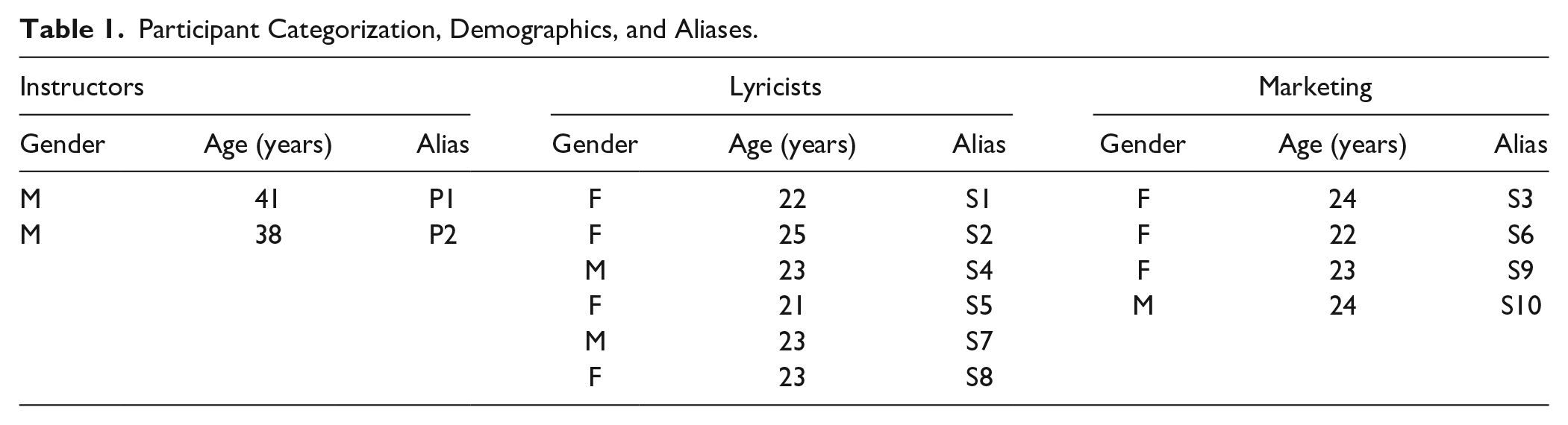
Ten students and two instructors were purposely selected as the study sample, for maximum variation based on sociocultural, ethnic, and educational backgrounds (Patton, 2015). Prior to study implementation, researchers obtained approval from the institution’s Human Subjects Committee. To maintain confidentiality, the names of the interviewees will not be identified and aliases will be used (Table 1).
Participant Categorization, Demographics, and Aliases.
Data Collection
Three data collection methods were utilized in this study: participant observation, semi-structured interviews, and a collection of course artifacts. Bernard (2011) posed that participant observation involves getting close to people and making them feel comfortable enough so you can observe and record information about their lives. Likewise, it involves the process of immersing yourself in a culture and learning to remove yourself to intellectualize what you’ve seen and heard. The study was conducted by a researcher who, while not part of the course, participated in and observed a majority of the classes and events.
Schensul and Lecompte (2013) argue semi-structured interviews should be used to highlight personal experiences and thoughts of the respondent, and that questions be predetermined and relate specifically to the study questions and domains. The interview protocol and method were pilot tested prior to data collection for content and contextual accuracy. Given the permission of the participants, the interviews were audio-recorded to ensure accuracy. Interviews lasted no more than 20 min each.
Finally, the researcher collected course artifacts, assignments, syllabi, and documents to triangulate data acquired from the interviews and observations, as well as providing a more in-depth holistic account of the classroom experience. Artifacts were created by the participants during the course and included initial leadership surveys, draft and final lyrics, social media accounts for album promotion, and the album itself.
Data Analysis
Recordings from the 12 interviews were transcribed and divided into two separate groups: students and instructors. Researcher notes and class artifacts, taken from the participant observation, were then organized to coincide with the sequence of the class. Data were triangulated to enhance credibility and confirmability.
Data were coded separately by two researchers, to ensure inter-rater reliability. Data were analyzed using first cycle, provisional coding, and second cycle, in vivo coding. In regard to provisional coding, Miles and Huberman explain that it establishes a predetermined list of codes, prior to undertaking fieldwork (as cited in Saldaña (2016)). In this case, the codes were generated from the primary research question and correlating subquestions.
Limitations
Due to the unique time and place of the study, findings cannot be generalized to broader populations. In addition, the study has not been replicated to examine commonalities among design. Still, it does provide a unique window for examining course innovations with instructor collaborations through a unique context—hip-hop.
Results and Discussion
Our scholarly journey focused on whether or not hip-hop, as an educational pedagogy, could be a catalyst for student leadership development and community change. In an effort to best represent results, data are presented by overall research question and then subquestions. In addition, data are differentiated between participant context—instructors and students—to highlight the experience from the instructor’s perspective and cross-examine how the course was perceived by students.
Primary Research Question
Examine whether or not hip-hop, as an educational pedagogy, could be a catalyst for leadership development and perceived community change, inside and outside a collegiate classroom.
Leadership development, a new era: Instructors’ perspectives
Data analysis revealed that both instructors had a clear vision as to how hip-hop could enhance student leadership development. For instance, Professor 2 (P2) expressed that he wanted to challenge the students to lead by kind of crawling outside of their comfort zone, outside of their box . . . so if these kids are able to engage in something they’ve never engaged in before and something that’s very difficult, in order to impact a community . . . then they could do anything.
Aside from this, he stated that he wanted the students to understand that prior leadership structures, as it has historically been presented, are no more. In 2018, all you have to do to lead is to find your strengths and take advantage of your opportunities.
At the same time, Professor 1 (P1) agreed that “a lot of times when class is heavily dominated by the instructor, there’s no context to pull students together and have them talk . . . hip hop was what allowed them to do it.” In addition, P2 expressed his hope for students to take an active part in the course, he didn’t want it to be seen as “instructors on the pedestal telling you what’s right or wrong. I want us to be on the same playing field, using my experience to guide and mentor but ultimately we’re in this together.” As can be seen, both instructors prioritized engaging the students and creating an “internal motivator for our students rather than an externally driven grade. So, we’ve shifted the responsibility to the students and the students have overcome that” (P1).
Leadership development, cultural stretching, and rapport: Students’ perspectives
From the students’ perspective, Student 1 (S1) relayed how it was “interesting being able to branch out, take the class and learn about other people.” But specifically, she recalls that, just like P2 envisioned, it has “helped with just putting me out of my comfort zone.” On that same note, Student 4 (S4) and Student 5 (S5) coincided on how this class helped them to become more open, talk more to others, and be ready to hear others’ opinions. Similarly, Student 6 (S6) shared how the experience . . . just stretches you and allows you to think differently. But I think it also allows people to get more involved with their education, just because they’re taking a class they care about and that they’re interested in.
Furthermore, Student 8 (S8) mentioned how it’s been “really cool to see the tangible change with how close our class has gotten and just how excited everyone is to be writing about things that matter to them..” All in all, when considering leadership development, students really felt the course allowed them to step out of their comfort zone and grow closer to classmates through constructive dialogue.
Hip-hop is a catalyst for community change: Instructors’ perspectives
As previously stated, hip-hop rose to prominence as being a voice of the voiceless (Banks, 2015), and it is “directly connected to people because it’s so personal, so I think it puts it in a position to make an impact” (P2). Nonetheless, when seeking to create community change, one needs to get to know the community, listen to them, develop relationships, and establish dialogue. In the same way, Professor 1 (P1) articulated that the beauty of hip-hop, regarding community change, lies in the fact that it’s the voice of the people who talk about what actually is happening: time and place. So, when you do that, community will listen because you’re representing them in a positive way. But here’s the deal: the artist better listen to the community too and that’s why they can’t talk about things that they don’t know anything about.
Because hip-hop is already so intimately tied to community, one of the main purposes of this project was to return hip-hop “to its original roots as a form of activism, education, outreach, attention-getting . . . it’s always been an activist form of art” (P1).
Hip-hop and community connection: Students’ perspectives
The project’s influence on student beliefs was illustrated by S1, who expressed that “. . . seeing how our class put an album together with just like different issues and different things we’ve gone through; I think that it can change communities now.” Along these same lines, S8 remarked that “For so many of these songs, you’re coming together with so many different people and collaborating, and if you can translate that into the setting of community, then I think you can make a change.” In essence, what students were seeing was the powerful voice that is brought about when, “you join forces with others to speak about injustice and seek common purpose” (S2).
Research Subquestion 1
Can hip-hop create a safe creative space that allows for inclusion, self-expression, and engagement within the classroom?
When hip-hop is utilized as a tool to promote leadership development and community change, people are led to communicate and connect with others, which in turn creates an environment where trust, closeness, and openness become the norm and free of judgment. Three themes were highlighted when considering hip-hop as an educational space: inclusivity, genuine self-expression, and creativity.
Inclusivity: Instructors’ perspectives
When reflecting on the class, P1 expressed that this particular course allowed students to have a much deeper connection to their instructor and peers, rather than just showing up during class hours and taking an exam. In addition, P2 shared that the fact that they had to create hip hop music, which nobody in the class has done, put everybody on the even playing field so immediately people were able to connect under the umbrella of “this is new for us.”
Correspondingly, the educationally inclusive environment which touted tolerance and a seeking for understanding allowed students from diverse backgrounds to share in the excitement and nervousness of creating an album with people from diverse races, ethnicities, sexualities, and genders. P2 asserted that he believed the students were now more open and sensitive to people different from them as a result of participating in this collaborative class. Similarly, P1 added that the diversity in the classroom produced a lot of tension at times with students, and “that tension was beautiful because they believed passionately in their own piece and they had to work through that tension in order to move forward, and that’s life, right?” In addition, P2 stated that when you have racially different poor communities that are constantly separated, but dealing with the same issues, they never realize they’re dealing with the same thing. “This class helped put the students in the mentality of ‘we’re all different but we’ve got some of the same challenges.’ Ultimately, we hope that translates into community.”
Inclusivity: Students’ perspectives
In the same way, S1 confirmed that the instructors “. . . made it really easy to feel included because they’re very different but then our class is also very different, like diverse. So, I think that it adds to just people feeling included and represented.” Even though S1 had been challenged by her peers, she went on to say that, she had “never been a minority in a class before so it’s kind of interesting.” Correspondingly, S4 explained that when they have “. . . deep discussions, people are more open about their story so then you can kind of understand where people are coming from. Like maybe if they feel a certain way you understand it because you’ve heard.” This openness, as P1 stated, was established the first day of classes when P2 asked everyone to introduce themselves and answer the question: “What challenge are your currently overcoming?” In relation to this, S5 emphasized how vital this was, as it was that “one question that kind of opened us to feel good and let us know each other as classmates and people and not just somebody that you seat next to for an hour and 45 minutes.”
In like manner, Student 7 (S7) advocated that he believes that in class “we’ve changed a lot of the narrative about how we feel towards each other, so it’s been really good.” He attributed this to the fact that “In other classes you don’t connect like that as much because you’re not worried about like, you know, the social interaction You’re worried about the grade.” Likewise, through semester-long participant observation, it was noted that the classroom dynamics had shifted significantly since the first day of class: From carefully formed cliques who knew each other previously to a mix and match of students who collaborated on song lyrics, joining unique stories to create a meaningful song. During the creative writing process, students were seen pacing freely around the classroom, approaching different classmates, sharing ideas, and listening attentively to the other’s lyrics. The marketing team would document this process through pictures, videos, and boomerangs, identifying strategies to reach more people.
Genuine self-expression and vulnerability: Instructors’ and students’ perspectives
Not only can hip-hop create a space where one feels safe and included, but another key element was the authenticity and vulnerability that comes with being able to express oneself completely. P1 explains it was healing for a lot of folks because first impressions, as we discussed the first day of class, are blown out of proportion . . . this class really put us in a situation where we got to know each other on a much more emotional and spiritual level. I think hip hop was the context and the catalyst to do so.
When contemplating the reasons why they were able to be so vulnerable with each other, S1 noted both instructors would constantly advocate the necessity to “just be real and talk about real things.” In the same fashion, S4 explained how this class “allows you to open up and just let loose and be your natural self, because that’s what everybody wants for you.”
At the same time, students felt the instructors were accepting of their concerns, criticism, and creativity which allowed them to leave behind the notion of being “mere spectators” in class. This is illustrated by S5 who remarked that they would let “us voice our opinions in a way that we’ve never been allowed to voice them before in school and that’s what really made me feel like it was a safe place.” S6 explained that this provided an avenue for people to be honest and open with one another through their lyrics, as well as their active participation in the class. Similarly, Student 9 (S9) asserted that being able to express how you feel in a more lyrical way impacted them and made them a better person.
This self-expression and vulnerability was observed in the recording process. Observational notes reflect how comfortable everyone felt in each other’s presence, how students could go from joking one second to participating in a moment of respectful silence before somebody prepared to sing. Moreover, when someone finished recording, the rest would explode in applause, cheering them on, giving feedback, and expressing how in awe they felt with the performance.
Hip-hop enhances creativity: Instructors’ and students’ perspectives
One of the main advantages of utilizing hip-hop pedagogy had to do with the creative outlet it provided for students and how it revolutionized the classroom experience through student involvement. P2 explained how the class was created to challenge the students artistically and open up their minds. Similarly, P1 explained, this had to do with the fact that hip-hop has never been censored and that’s the beauty of it, as there is no right or wrong way and one can speak their mind freely. This is highlighted by S8 who mentioned that “P2 has done a really good job of making it a point that there’s not a wrong style of hip hop.”
Observation highlighted students finding inspiration through their headphones while listening to other artists, they would share ideas with their classmates, constantly scratching out their rhymes and bars. Moreover, “there’s so much more sharing of ideas . . . there’s not as much passion in other classes. I feel like here people can really see the differences but unite them in the hip hop class” (S8). S3 noted that “hip hop can create an environment that’s just not so rigid and you have a creative outlet to share your ideas and your concepts.” She saw it as a creative outlet that helped her express herself in a way that she didn’t know she could.
S2 pointed out that it gave students a different method of learning, if you have people that are more in their creative side, it’s a different way for them to be able to have a class to really enjoy and learn well if traditional learning methods aren’t something they’re really strong in.
Consistently, S10 shared how “it’s just non-traditional and I’m not a traditional learner so I don’t do well in a lot of my courses because of that, but this approach is really nice for someone who thinks like I do.”
Research Subquestion 2
Can hip-hop assist students in constructing meaning and making sense of the world?
Besides being an educational context and space, hip-hop has also distinguished itself as being part of individuals’ identities. Whether discovered as a young kid or throughout this class, hip-hop had aided students in constructing meaning and making sense of the world.
Identity and meaning: Instructors’ perspectives
The themes of “heart,” “passion,” and “belief” were exemplified in both interviews with the instructors. For instance, P1 illustrated that in class he was able to see how the students put their heart and soul into this project even if they didn’t sing on the album. They’re putting their heart and soul because it’s something that they believed in so it made it real.
In addition, P2 mentioned that he is a hip-hop artist and through hip-hop he found his true passion, which was community development: “So maybe this will help them to open up their heart with passion and purpose and they can use their confidence from hip hop to say ‘okay . . . this is what I really want to do.’” P1 would note that students would sometimes not show up to other classes, but that they would show up specifically for this one because “they believed in it and it was an art form that they felt that they could contribute to.”
Equally important, the themes of “connection,” “culture,” and “voice” were highlighted in the instructors’ interviews. The unity that resulted in the classroom was something that became extremely meaningful to P2, who remarked that one of the best things about this class was “being able to connect with them.” Similarly, P1 shared that the course not only bonded students and instructors, but also shifted the learning responsibility to the students by giving them voice.
As P2 reflected on his own experience with hip-hop, he relayed how it “gave me a space to celebrate my culture, where I come from, my upbringing and my personal challenges.” Furthermore, when he reflected about where, as a young kid, he had the ability to speak on things important to him, his family or community, he realized it was hip-hop that gave him this opportunity. Ultimately, this became very powerful for him.
Identity and meaning through unity and relatability: Students’ perspectives
One of the main student themes reflected was that of “unity” experienced from the class and how it added to the personal meaning that hip-hop had brought to their lives. In particular, S6 mentioned how hip-hop “really does bring people together, especially in our generation. I think that it’s a big avenue for change and it’s an avenue that I think is untapped.” Likewise, S1 explained that “writing these poems and listening to it being put to a beat, you learn a lot about people. I feel like it’s helped unite the group.”
Aside from unity, being able to “relate” was also a recurrent theme in the interviews. S2 expressed how she really loved hip-hop because it tells a story, “so there’s always someone out there who’s saying what you’re feeling and . . . you feel like, ‘okay, I’m not alone.’” There’s that “one certain song or artist that makes us really relate and makes us feel like we’re actually being stood up for” (S5). S5 added that “it’s like a big representation for us people that don’t get represented in history books.” Finally, S10 illustrated how he was able to relate to things he heard in hip-hop because it was like somebody was telling a story “that I didn’t want to tell myself, but it was empowering hearing somebody else tell it. Also, it helps me understand another person’s context because a lot of the content in hip hop music isn’t my lived experience.”
Another key point was how hip-hop helped “expand horizons,” “open minds,” and “understand others.” S9 proposed that hip-hop is great for networking and for knowing who you are. “It’s great if you are afraid of public speaking and it allows you to either understand what other people are going through and to have a different perspective with different issues that you once had a bias towards.” Moreover, S5 believed that the beats and the lyrics in hip-hop open your mind, allowing you to look at the world in a whole new way. She expressed that she hasn’t traveled much in her life, but when she hears the music it’s like “Wow, what’s beyond the street? What’s beyond down the block? It allows you to open a world and see the world and hopefully change it too in the same light.”
Research Subquestion 3
Does the student learning community feel hip-hop can enhance community change?
Besides being a medium, a space, and an identity, the interviews unveiled the power of hip-hop for positive change. When considering the impact students could have highlighted, themes included “voice,” “represent,” “contribute,” “challenge,” and “diversity.” It was noted by P1 that hip-hop allowed students to take active part in their education and cocreate the course with the instructors. Furthermore, he explained the overall purpose of this class was to give back to community: What’s even more beautiful is that now they’re contributing to the greater society by choosing a nonprofit to donate proceeds from their album. Working side by side with a non-profit that’s meaningful to these students is how we’ve bridged town and gown. We’ve . . . just created a highway for love between a course and a nonprofit organization each will benefit from the project.
For some, being stretched outside of their comfort zone posed challenges. P2 explained these challenges, as he believed that often, to make an impact in community, you have to do things you’re not comfortable doing. “I think that’s the first objective: how can we get them to think outside the box for the betterment of community?” (P2).
P2 shared that the number one rule in class was that the hip-hop music they made had to be socially conscious, “something relevant to underserved communities so it challenges them in a different way, not just with the content but in the way that they’re engaged in the content, it’s a challenge all the way around.” P1 also pointed out how the student had to have personal connection with the topic(s) they contributed to; this included students in the marketing team.
Hip-hop is a catalyst for broader community change: Students’ perspectives
When analyzing course artifacts, students expressed a positive hope that hip-hop could indeed bring people together and bring attention to salient issues. At the same time, they believed their feeling of solidarity within their community was brought about by relating to a common struggle and standing up for it collectively.
The students expressed a desire to inspire others with their music, to open people’s eyes, to reflect unity, and to show that, regardless of their background, a diverse group of students could produce an album and speak on topics that affected them. For instance, S7 emphasized how they’re “creating a conversation for people who don’t have that power and it brings people together to talk about issues and create change from the bottom to the top.” Moreover, it was noted by S8 (In) no other class would I have the courage to say some of the things that I’ve said here. What I’m about to rap about, gun control and school shooting . . . some of those things like people feel things about them and they might have like smaller conversations . . . it’s just not as common for students to raise their voice. Whenever they do, a lot of the times they get a negative light shone on them.
At the same time, students believed that to create change one needed to first connect and relate to the community they are trying to reach: Hip hop was initiated to be the voice of the voiceless, so I feel like this is a perfect example, since we are talking about things that are relatable to college students to middle school students to even elementary kids. (S5)
Finally, S3 believed that the trust, unity, courage, learning opportunities, and voice she was given in this class was “something I will utilize for the rest of my life trying to teach youth the powerful message that hip hop can have.”
Conclusion and Recommendations
Hip-hop has been infused into 21st century higher education, showcasing its importance as an innovative educational tool (Hall, 2011). Hip-hop pedagogy has been developed and utilized by teachers to critically evaluate contemporary societal issues (Mitchell, 2013; Porfilio & Hickman, 2011), maintain student interest, increase content application and relatability, and provide a shared learning environment between instructors and students through culturally responsive teaching (Emdin & Adjapong, 2018; Gay, 2018). This leaves one pondering, what other applications there are for this type of instruction? As such, the focus of our inquiry was to examine whether or not hip-hop, as an educational pedagogy, could be a catalyst for perceived community change, inside and outside a collegiate classroom.
Our results indicate that hip-hop, as a pedagogy, can serve as a positive agent in student learning and community change. It can create a safe educational space that encourages inclusion, self-expression, and student engagement. Students shared that dynamics between the students and instructors made them feel like they were able to express themselves, and they weren’t being judged or excluded. Furthermore, diversity among students created a cross-cultural learning environment that exposed students to diverse cultures and opinions and pushed them outside their comfort zones (Gay, 2018). Still, the transparency and openness showcased by the instructors assisted in forging student unity rather than division (Emdin & Adjapong, 2018). Reasonably, when provided with an environment such as this, students are much more motivated and likely to deeply engage deeply, as opposed to more traditional pedagogy (Tinto, 2003).
Another value behind utilizing hip-hop pedagogy is the “learner-centeredness” of the approach. There is significant research (Felder & Brent, 2017; Hains & Smith, 2012; Hains et al., 2013; Haley, 2004) that attests to the salience of utilizing learner-centered approaches within the classroom. This approach has several benefits for students—students feel they are being heard, they feel a part of something meaningful, and they are able to direct their learning experience. A further benefit of hip-hop pedagogy is the connection students make through the music and culture. Many students can relate to hip-hop either directly or indirectly as it is the voice of their community; furthermore, participants were able to make it individually impactful by writing lyrics that come straight out of their own lives. Similar to what is recommended by Zepke and Leach (2010), finding unique ways to engage students in the classroom benefits everyone involved.
What is more, by encouraging the creative process—identifying a community issue experienced by the student; writing, “rapping,” and recording the lyrics; collaborating with a nonprofit organization within the community; then marketing and promoting the project—students open up artistically and become more civic-minded. For many decades, researchers such as Howard Gardner (2008) have articulated the value of appealing to a variety of intelligences. When utilizing hip-hop as a creative process in the classroom, this allows the instructor to broaden the appeal of the educational process to a more diverse student population.
Relative to our second subquestion, it was confirmed that students feel they can make meaning and sense out of their world through hip-hop. Not only were students empowered by each other to make meaning within the classroom space, they also made meaning about challenging social themes by relating with each other, similar to what is argued by Emdin and Adjapong (2018). Often, students struggle to find meaning or relate to what is being shared in the average classroom. To utilize hip-hop as the connector encourages students to make their own associations and meaning behind what is being taught. Interestingly, for some, hip-hop is one of the few ways they can connect their personal life experiences with others within their educational cohort. Furthermore, students expressed this was a way they could be heard—which is also linked to feeling like they can encourage change or make their world a better place.
As a segue way into the final research subquestion, by being heard, many students started the course with a feeling of hope that hip-hop can be a catalyst for community change. Part of the challenge when encouraging change with any audience is the need to create a feeling of “buy-in.” By allowing students to shape their own educational experience through hip-hop, you are not only creating this feeling of “buy-in” but also encouraging them to develop solidarity and agency among their cohort. Both of these concepts play an important role in undertaking change—and are actually byproducts of the overall educational process. It is in the development of aspects such as solidarity, agency, and a sense of community where hip-hop pedagogy links students with successful community change.
Our study provided a small window into the rich dynamics of hip-hop pedagogy. The interwovenness of a learner-centered classroom, diverse students and instructors, and focus on highlighting community inequities through hip-hop provided a unique opportunity to examine hip-hop pedagogy in higher education. While this was just a snapshot of one semester, many future studies need to be conducted to evaluate the multifaceted applications of hip-hop pedagogy and its impact on both students and instructors. In addition, hip-hop pedagogy should also be examined within diverse instructional contexts; this includes the possibility of expanding it beyond the social science context, into possibly biological or physical science courses further enhancing student knowledge and application for the 21st century. As hip-hop has become the number one music genre in 2018 (Ryan, 2018), there is great promise in its future application in higher education.
Footnotes
Acknowledgements
Special thanks to Devine Carama for his contributions and passion for hip-hop and students. His influence will continue to positively impact lives within our community.
Declaration of Conflicting Interests
The author(s) declared no potential conflicts of interest with respect to the research, authorship, and/or publication of this article.
Funding
The author(s) received no financial support for the research, authorship, and/or publication of this article.
