



Abstract
The outcome-based learning for graduate employability in higher education has been an important research topic among the policymakers, academicians, and researchers over the years. Yet, no bibliometric review on this topic has been published. This study, for the first time, examines bibliometric analysis on this topic examining current research trend and future research agenda. The bibliometrix package in R software and VOSviewer software are used for visualization and interpretation of results. A content analysis is performed to manually examine the bibliometric results.
Keywords
Introduction
Graduate employability has been the core attraction for higher education providers for a long time (Clarke, 2018; Jorre de St Jorre & Oliver, 2018; Maxwell & Armellini, 2019; Nghia et al., 2019; Peng, 2019; Wilkes & Burns, 2019). Today, industry-integrated outcome-based learning has been moved to the forefront of higher education for ensuring graduate employability. The challenges for graduates to enter into the job market not only rely to their own limitations to carryover the given work in workplace but also trace back to the higher education providers (Ahmad et al., 2012; Clarke, 2018; Finch et al., 2013). Universities must design a course for higher education so that graduates find the course supportive to achieve a placement because of the course not because of the degree. The content of that course must equip the graduates in a way that the employer finds a ready-made employee for their organizations. The challenges and dynamics of 21st-century job market must be addressed while designing a course through outcome-based learning so that graduate employability laidback to the expected level.
A growing body of literature exists on outcome-based learning and graduate employability (Arkoudis & Doughney, 2016; Henderson & Trede, 2017; Jorre de St Jorre & Oliver, 2018; Lloyd & Griffiths, 2008; Peng, 2019; Smith & Worsfold, 2015; Sweetman et al., 2014; Tucker et al., 2018; Warraich & Ameen, 2010; Whelan, 2017; Young & Keup, 2018). A major part of outcome-based learning for employability literature has examined work integrated learning in the light of graduate employability. Since both the objectives—outcome-based learning and work integrated learning—are focusing to the common goal of graduate employability, this study examines both as part of review literature. A part of work integrated learning is also outcome-based learning (Schuster & Glavas, 2017). Work integrated learning can be explained as the combination of common effort from students, academic supervisors, and industry (Raelin, 1997). The objective of work integrated learning is to incorporate industry experience for the students during their higher education period through work placement so that students get real life experience (Smith & Worsfold, 2014). Thus, in an umbrella terminology, work integrated learning is also a form of outcome-based learning.
The literature of outcome-based learning and graduate employability can be characterized as having limitation for prolific authors as well as dedicated journals in the field to carry out the objective achieving graduate employability through knowledge development. The findings suggest that the success factor of higher education among the universities and educational institutions is outcome-based learning. Fleming and Haigh (2017) examined stakeholders view of work integrated learnings in a triangle experiment among students, workplace supervisors and academic supervisors. The findings reveal that students in modern age corporate environment needs to be prepared more dynamically assuming what changes may happen in future organizations. Thus, outcome-based learning is essential criteria more than ever in higher education.
The remaining of this paper is organized in additional five chapters. Chapter 2 describes the methodology followed by the analysis of the results from bibliometric analysis in chapter 3. Content analysis of most prolific journal sources and model development of the literature have discussed in chapter 4. Chapter 5 provides discussion and findings. Conclusions and implications are discussed in chapter 6 and chapter 7.
Methodology
Several literature review techniques have been applying—systematic review, structured review, review for developing model, framework-based review, meta-analysis, theory-based review, and bibliometric review. Each technique has unique merits and demerits. Despite differences in techniques, the aims of literature review are either to summarize existing literature for suggesting future research agenda (Avella et al., 2016) or to contradict any literature against existing theory or school of knowledge (Laughton, 2012). This paper employs a hybrid literature review technique—first bibliometric review and second content analysis—to critically examine the existing literature and propose future research agenda.
Searching documents for conducting a review study is the most important activities among others (Hevner et al., 2004). This study examines published documents from Scopus database related to employability of post-graduate students and outcome-based learning. For document search, the SALSA—Search, Appraisal, Synthesis, and Analysis—method is used (Papaioannou et al., 2010). First, the search (data collection) includes search for relevant keywords to document titles, abstracts, and keywords so that no potential document gets ignored. The scopus database is used with keywords “employability” OR “employment,” which has identified total 276,133 documents. Then it was filtered using “learning outcomes” OR “learning outcome” OR “outcome-based learning”, which resulted in 435 documents. Second, the appraisal stage helps to correct the dataset which has achieved in the first stage. It is evident that a wide range of subject areas had been covered in the given topic. All documents are kept since this study topic is applicable in all relevant fields. However, through filtration of the acquired articles, review articles, and book chapters only which resulted with 280 documents. Finally, filtering this dataset to only English language resulted in a total 270 published documents for the study. Third, for the synthesis stage, the bibliometrix package in R programming language (Aria & Cuccurullo, 2017) and VOSviewer software as a bibliometric tool (Hevner et al., 2004). Finally, a content analysis is exercised for identification of potential literature gap manually. Figure 1 presents the stepwise SALSA method.
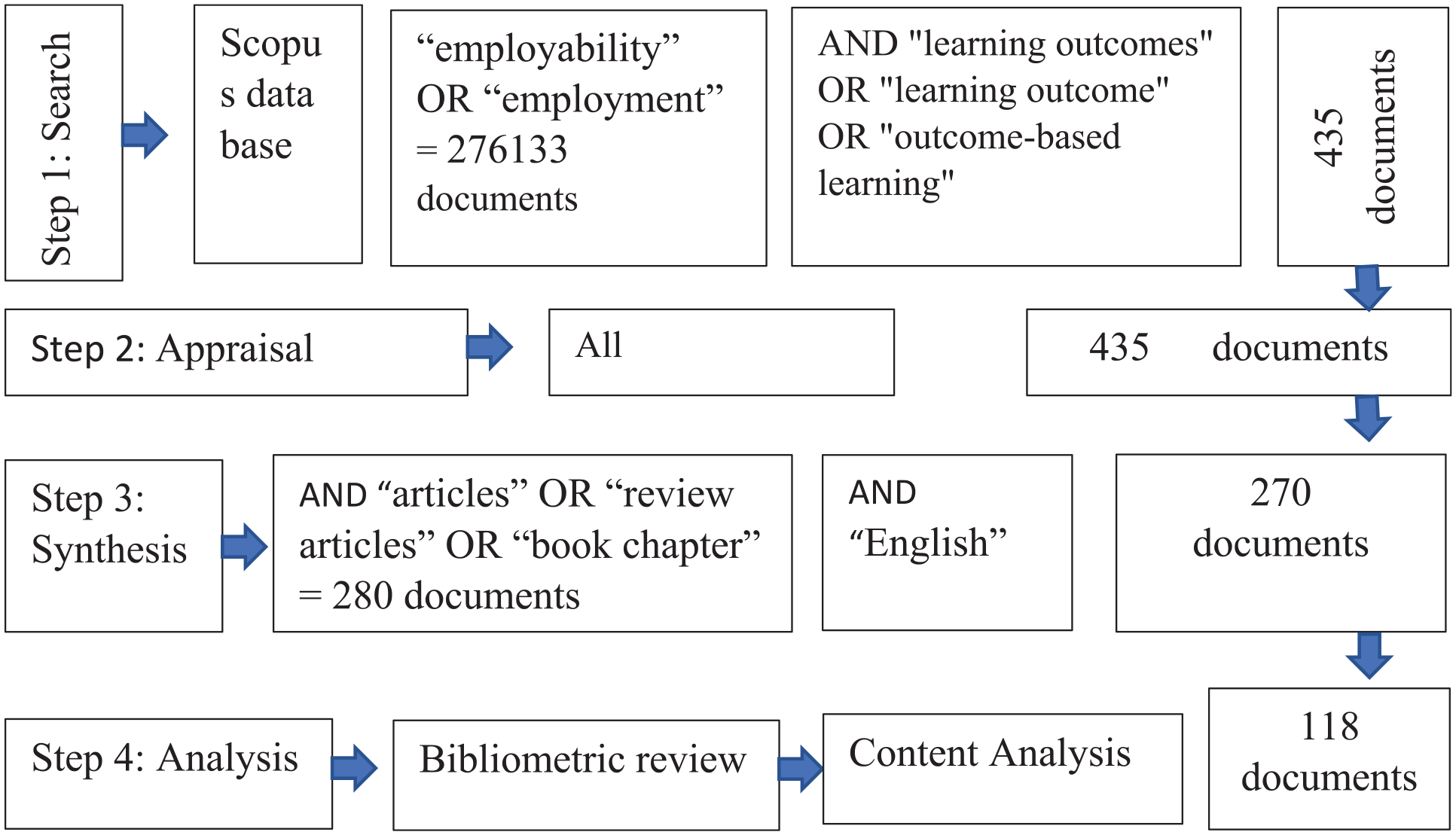
SALSA steps of data selection and analysis procedure.
Bibliometric Results
The general information of the selected 270 documents is summarized in this subsection. These documents have been published in 191 different Scopus index journals over the years 1983 to 2020. Total author appearance is 696. Among them, only 64 (9.1%) authors have produced 67 (24.8%) single author documents indicating a multidisciplinary nature of this study field. The importance of this topic can be highlighted from the average citation per document which is 7.37.
Publication and Citation Trends
According to this dataset, the first document was produced in 1983 by Rockhill (1983) and afterword for over a decay there was no publication until 1996. From then on, this topic has been gaining research interest with an annual production growth rate of 11.8%. It is evident that the main aim of today’s higher education relays on employability (Smith & Worsfold, 2014). To equip higher education with the charm of high level of employability, outcome-based learning has been playing a significant role around the world (Aamodt & Havnes, 2008; Jackson et al., 2009; Smith & Worsfold, 2015). Figure 2 depicts the trends of annual publication, mean total citation per article, and mean total citation per year of this literature. Clearly, the pic of publication as well as mean total citation per article was in 2005. Afterward, with the gradual increase in annual publication, average citation per article has been decreasing which signifies that research has been concentrating in only a few areas of this topic.

Publication and citation trend.
Figure 3 presents the three-field analysis of this bibliometric data. The left field stands for top authors, middle field presents keywords and right field presents the journals. From the author and journal parts, it is evident that there is no concentration in authors as well as journals. About 15 authors have been parallel in production which is the same for journals. These summarize the limitation for prolific authors as well as dedicated journals in the field of higher education, employability, and outcome-based learnings. About the keywords, the top key words can be summarized in three major groups. Besides the employability and employment keywords, researchers have found a strong connection on higher education with entrepreneurship. None of the top authors in this list have produced any document so far connecting this keyword. However, for future research this specific field may guide to greater findings. The major keywords which are related to outcome-based learning are skill, work-integrated learnings, graduate attributes, and curriculum. Finally, among the general topic, the three-field plot suggests that journals gave been producing documents on strategy and engineering education connecting the topic of this study.

Three-fields plot.
Source Impact
Employability of higher study students has received limited journals’ attention despite of its increasing interest among the researchers. Source impact identifies the key sources of knowledge in this given topic so that both researchers and academicians can look for future references in the same topic. Table 1 presents the top 20 journal sources in this field highlighting their h-index, g-index, m-index, total citations (TC) and total number of publications (NP). The most influential journal is Journal of Communication Disorders with the highest 10 publications, 304 total citations. Out of 10 publications, Stuttering and the International Classification of Functioning, Disability, and Health (ICF): An update alone scored 124 citations. It also has the highest h index of 8, g index of 10, and m index of 0.421. The common objective among these documents is mostly how outcome-based learning can help disable people. Similarly, all students in higher education can achieve their goal conveniently if the higher education appropriately follow a holistic view of outcome-based learning. The h-index implies that if a journal has x citations each for x documents the h-index of that journal is x. Considering the h-index, only 3 journals have at least 3 citations. Remining all 188 journals have maximum 2 citations. This finding reveal that so specific journal has been serving this important area of socioeconomic development taking the important seriously. Though Emerald emerging markets case studies has published the highest number of documents so far (30), the impact of those documents has not been visible. Relevant authors and researchers have not found any connection of their studies with these publications. Thus, a topic specific journal could improve the depth of this knowledge area by facilitating relevant and impactful documents to be published in a single source. The g-index identify the growth of h-index which indicates which journals is progressing at a higher rate than others in case of knowledge development. Table 2 briefly presunts a summary of the review papers published on outcome-based learning and students emaployability.
Source Impact.

Note. TC = total citations; NP = total number of publications.
Summary of Review Articles on Outcome-Based Learning and Students’ Employability in Higher Education.

Topic Trend
Trend topic identifies the yearly frequency of keywords applied by the authors in their research. Figure 4 presents a trend topic description of the selected 270 documents over the year of 2004 to 2018. This figure applies keyword plus and minimum frequency in a year of 5. It reveals that over the years the key term employability or employment has been completely ignored. Only in 2009, employment has been applied 13 times in the research. Similarly, for outcome-based learning which has never been the buzz topic as it shown in trend topic. However, the major trend topics have been gender issues (male, female, human, adult etc.) in 2009 to 2010. Apart from these, different sectoral issues (i.e., medical education, engineering education, leadership, teaching etc.) have been the core of this study field.

Trend topic.
Conceptual Structure
A co-occurrence network graphically presents and visualize any underlying relationship between words, authors, or documents creating clusters using any specific unit of documents. This study examines the 867 author’s keywords with a condition of minimum number of occurrences in a paper for 5 times resulting total 15 keywords that achieves the threshold. Figure 5 presents the co-occurrence network of authors’ keywords along with 4 clusters, 37 links, and 74 link strengths. Cluster 1 consists of the keywords like “employability,” ‘work-integrated learnings “learning outcomes,” ‘generic skills’ and “engineering education.” The highest occurrence was between employability and learning outcomes with 8 link strength. From cluster 1, the word employability alone has 11 links, 34 link strength and 41 occurrences. Cluster 2 consists of the words like “assessment,” ‘curriculum “education” and “learning.” Cluster 4 consists of the words like “higher education,” ‘graduate attributes,’ and “employability skill.” Figure 5 reveals that cluster 2 is highly linked with cluster 4. Again, cluster 4 is mostly linked with cluster 1. It is evident that literature strongly presents the co-occurrences of employability with higher education and higher education with curriculum. Cluster 3 consists of keywords like “strategy, ‘employment” and “entrepreneurship” the outcome of above three clusters.

Co-occurrence network of author keywords.
Intellectual Structure
Co-citation network describes the relationship among the documents based on citations among themselves. If two documents have been cited simultaneously by a third document, this intellectual link is called co-citation. Figure 6 presents co-citation network in this topic based on authors connectivity. Out of 12497 authors, only 13 authors have met the threshold criteria of minimum citation 14 times. Findings reveal that these 13 authors have been classified in three major groups. Cluster 1 consists of Jackson, D; Oliver, B; Boud, D; Smith, C; Biggs, J; James; R and Billett, S. Among them Oliver B receives the highest link strengths with 104 and citations of 30. Among all of them, only Smith C has 3 publications in this same study field. Remaining authors have only one publication. However, their findings contributed so much that publications in this topic cited their names in couples. Overall, these authors have examined curriculum development and assessment for the evaluation of outcome-based learnings in higher education. Goldberg et al. (2016) has been a key attention, among others.
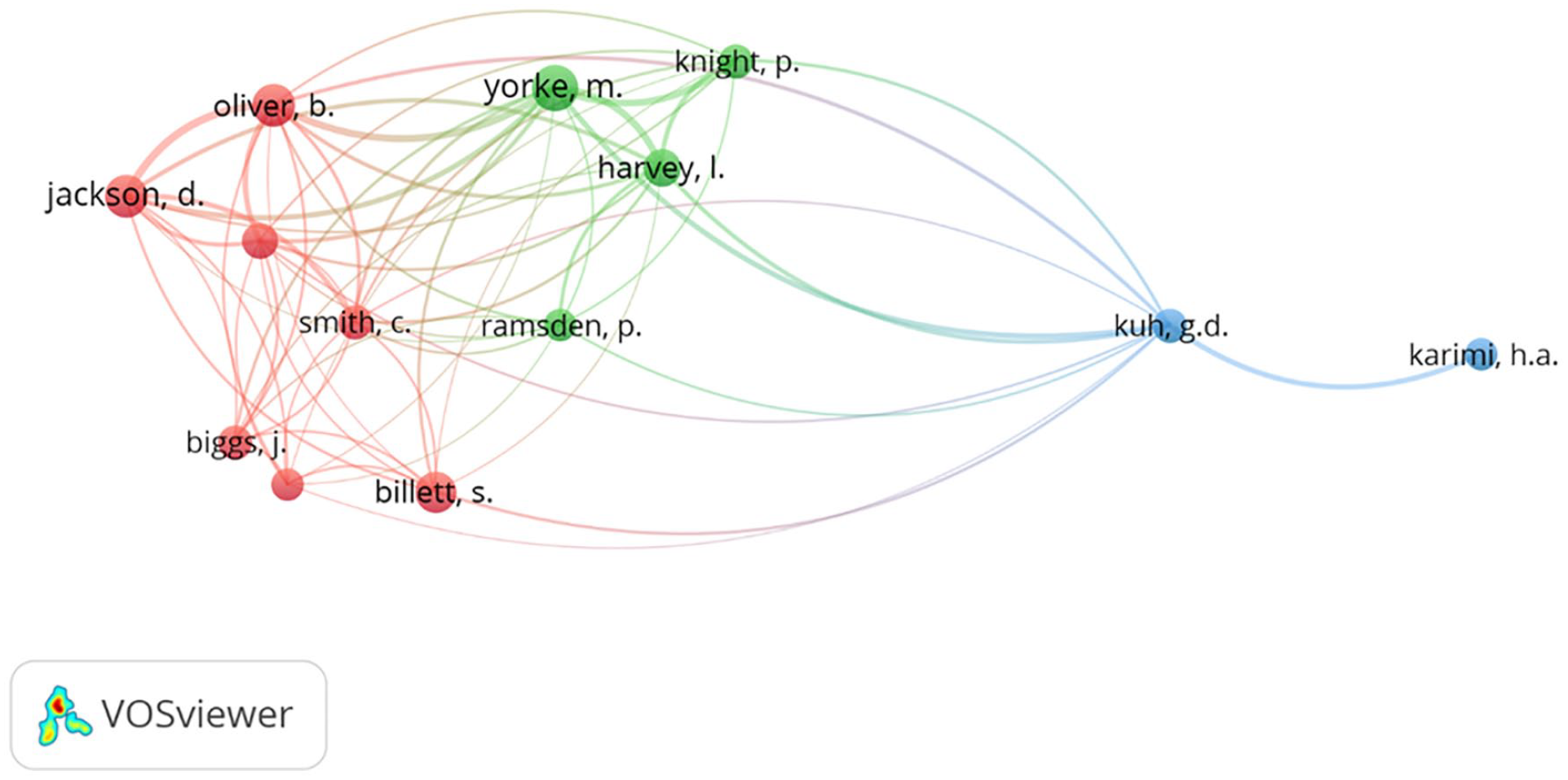
Co-citation network of cited authors.
Bibliometric Coupling
Bibliometric coupling occurs when one documents is cited with two documents in common. It assumes that these two documents are bolometrically connected and they are linked to any subject matter. In this study, out of 270 documents, only 87 documents have met the criteria of minimum citation of 5 times. Figure 7 presents the top 22 documents and their bibliometric couplings in four major clusters, 53 links and with total link strength of 116. Cluster one has 7 documents in its parameter (Billett, 2015; Clouder & Toms, 2008; Fleming & Haigh, 2017; Henderson & Trede, 2017; Hunt et al., 2012; Ramsgaard & Østergaard, 2018; Smith & Worsfold, 2014, 2015). Among them the highest citation (34) has been received by (Smith & Worsfold, 2014). Two main characteristics of this cluster can be identified as all these documents are recently published and all of them have examined the capacity of outcome-based learning in actual employability situation. According to their common findings, work-integrated learning the success factor of higher education among the universities and educational institutions. For instance, Fleming and Haigh (2017) examined stakeholders view of work integrated learnings in a triangle experiment among students, workplace supervisors and academic supervisors.

Bibliometric coupling of documents.
The bibliometric coupling also reveals that students in modern age corporate environment needs to be prepared more dynamically assuming what changes may happen in future organizations. Thus, outcome-based learning is essential criteria more than ever in higher education. A number of studies have examined the capacity of existing outcome-based learning and employability across the disciplines and proposed different models as shows in cluster 2 (Aamodt & Havnes, 2008; Chan & Fong, 2018; Clarke, 2018; Jorre de St Jorre & Oliver, 2018; Sweetman et al., 2014). Among others, Clarke (2018) examined current outcome based learning among the Australian and UK universities and proposed a framework which includes human capital, social capital, individual attributes, individual behaviors, perceived employability and labor market factors. Clarke (2018) received the highest 78 citations with 19 links in this cluster. In connection to cluster 1, Clarke (2018) has direct link with the highest citated document (Smith & Worsfold, 2015). Cluster 3 consists of documents which are relevant to methodological and experimental studies in learning-based outcomes (Bratton & Gold, 2015; Finch et al., 2013; Jackson et al., 2009; Kyndt et al., 2014; Perrot et al., 2014). These documents, however, did not get links with other clusters indicating that these are linked with each other within this cluster but not so much connected with the main clusters 1 and 2. Similarly, in cluster 4, documents are mostly linked with each other within the cluster examining assessment issues in outcome-based learning (Mercer-Mapstone & Kuchel, 2015; Sandri et al., 2018a, 2018b; Treleaven & Voola, 2008).
Content Analysis
Summary of Review Documents
Among the earlier review studies on graduate employability and outcome-based learning, only one study has deployed systematic literature review on 22 published documents (Schuster & Glavas, 2017). They summarized their findings in four types of typologies: technology-supported, technology-facilitated, technology-blended, and technology based. Table 3 summarizes the key features of earlier review studies on employability and outcome-based learning. According to their findings, technology either can be in leading position or in follower position. They emphasized on categorizing the possible approaches of using technology in transforming graduate attributes through curriculum. However, a major literature gap has yet to examine which one would be the best for achieving the objectives. Seemingly, this comparative analysis should also be tailored examining the contextual variables, that is, country outlook, development, sociocultural context since, contextual variable can significantly influence the outcome of curriculum development for graduate employability (Clarke, 2018; Natvig, 2007). Among other future research directions, literature on graduate employability and outcome-based learning need a bibliometric analysis (Schuster & Glavas, 2017).
Profile of Journals Selected for Content Analysis.

Among the remaining review studies, contextual review (general review) technique was in common. All the remining review studies have examined student feedback through internship or graduate report after or during their work-placement or work-integrated learning period. The focus of these studies was to examine graduate employability considering outcome-based learning by exercising students’ report/survey, academic supervisor feedback and host response in the workplace. It is evident from the findings of these review studies that students have been appreciating their scope of exercising academic abilities and qualities is real life action (Schaefer et al., 2019). However, based on country level context, students in Vietnam sees internship as a scope for future placement (Bilsland et al., 2019; Parsons et al., 2005).
Earlier review studies also explicitly emphasize on partnership between industry and university for ensuring the right track of graduate employability curriculum for outcome-based learning (Jauhari, 2013; Parsons et al., 2005). Though current graduates have found to be happy with academic performance, assessment quality and outcome-based curriculum, workplace supervisors seems to more incline to industry-university partnership at faculty level so that the objective of transforming students with job required attributes become goal oriented rather general (Halibas et al., 2020). All these studies have focused on response from students, academic facilities of workplace supervisors, future studies should also include alumni so that comparison between pre- and post-education can be achieved. Apart from these future scope of studies, longitude study, programmatic nature (e.g., structured and planned or happenstance) studies, teaching and learning methods, assessment approaches and country specific contextual examination of graduate employability may be examined.
Content Analysis of Documents From Top Journal Sources
The results of a content analysis largely depend on the selection of documents (Ingwersen & Christensen, 1997). The selected 270 documents in this study were prioritized using the Bedford’s law (Nicolaisen & Hjørland, 2007). The Bedford’s law categorizes the sources in core zone and others. For content analysis, only 91 documents from 18 sources were selected which fall under core zone of bibliometric analysis. The Emerald Journal of Case Studies and Journal of Teaching, Computers in Education Journal, International Journal of Engineering Education and Learning for Graduate Employability journals were manually deducted from the list because of their fewer contribution in terms of H-score. Finally, content analysis is performed using only 29 documents from the top 12 journal sources (Table 3).
Table 4 presents key features of content analysis and future research agenda. The major characteristics of literature in graduate employability and outcome-based learning can be highlighted as develop country centric and focused on either model development for assessing the impact of work-integrated learnings (Hammer et al., 2018; Maxwell & Armellini, 2019) or evaluate the graduate attributes from student, academic supervisors and host workplace supervisors (Clarke, 2018; Holdsworth et al., 2020; Nghia et al., 2019; Peng, 2019). Only a few studies have focused on assessment quality and process of outcome-based learning for relating the objective- graduate employability with perceived versus actual performance (Jorre de St Jorre & Oliver, 2018). However, some of the studies have emphasized on curriculum development in light with expected graduate attributes (Bilsland et al., 2019; Halibas et al., 2020).
Content Analysis of Documents From Most Impactful Sources.

Note. TPB = Theory of planned behavior; GAAT = graduate attribute assessment tool; STC = Systematic text Condensation.
Discussion and Findings
The findings reveal that the most applied methodologies in graduate employability literature are case studies, semi-structured questionnaire, and content analysis (Bilsland et al., 2019; Holdsworth et al., 2020; Jorre de St Jorre et al., 2019; Nghia et al., 2019; Sandri et al., 2018a; Schaefer et al., 2019). Only a few studies have used theoretical review technique (Clarke, 2018; Ramsgaard & Østergaard, 2018) and thematic analysis (Halibas et al., 2020; Hammer et al., 2018). Application of regression (Smith & Worsfold, 2015; Whelan, 2017) and factor analysis are also limited (Peng, 2019). Though they are limited, their findings are very pinpoint as well as problem highlighting. Future studies may consider application of advance quantitative methodological tools for examining and problem-solving graduate employability issues in higher education. Most of the studies have focused on a limited number of participants. In future, graduate employability studies with big data in multicriteria decision making approach (MCDM) can be applied to solve national level issues and development of holistic curriculum (Chiang, 2015; Ho et al., 2006; Mustafa & Goh, 1996). Most importantly, future research must examine online perspective of curriculum integration since education is becoming more digital than ever before after Covid’19 pandemic (Leung et al., 2020).
Among the selected documents, only a few studies have included associated theoretical involvement in their findings (Holdsworth et al., 2020; Peng, 2019). Results also reveal that the variables of examining graduate employability and graduate attributes are very limited. Most of the studies have concentrated their studies on graduate attributes (Clarke, 2018; Holdsworth et al., 2020; Maxwell & Armellini, 2019). However, a few studies have examined graduate employability in the presents of entrepreneurial pedagogy (Huq & Gilbert, 2017; Ramsgaard & Østergaard, 2018).
Jorre de St Jorre et al. (2019) critically examined the assessment process of graduates and found that there is potential mismatch in what expectations universities have and how they wish to achieve those. Their findings reveal that there should be four principles which will assess the achievements of universities in graduate employability and outcome-based learnings: opportunities for demonstration of distinct and personalized achievement, assessment to foster evaluative judgment, multiple portrayals of achievements, and meaningful evidence of the achievement. On the contrary, Clarke (2018) proposed a model for examining graduate employability incorporating economic factor as a mediating role from perceived graduate employability to actual graduate employability.
Conclusion
This study examines the literature on outcome-based learning and graduate employability using bibliometric analysis and content analysis for identifying the existent body of literature and proposes future research agenda. So far, several studies have examined the capacity of existing outcome-based learning and employability across the disciplines and proposed different models (Aamodt & Havnes, 2008; Chan & Fong, 2018; Clarke, 2018; Jorre de St Jorre & Oliver, 2018; Sweetman et al., 2014). Regarding evaluation model, Clarke (2018) examined outcome based learning among the Australian and UK universities and proposed a framework which includes human capital, social capital, individual attributes, individual behaviors, perceived employability, and labor market factors.
The findings of this study reveal several potential research fronts. Future research should undertake the key aspects of underdeveloped areas of graduate employability and outcome-based learnings. Among others, the key areas of future research agendas are longitudinal research on entrepreneurship pedagogy, post-graduation (alumni) feedback, entrepreneurship focused rather job placement, cross-sectional (interdisciplinary) comparison rather small focus group studies and case studies, development of more practical and integrated assessment and reward system for examining the purpose of learning outcomes, active participation of employers in curriculum design, research based teaching and learning environment, and last but not least, student satisfaction. Overall, work ethics, sustainable education and moral perspective of higher education have potential research gap.
Implications
The outcome-based learning and graduate employability are evidently progressing to meet the challenges of 21st-century higher education. Future research would seemingly improve the strength of identifying employer need more accurately and transmitting them to students through upgraded curriculum and outcome-based learning initiatives. The following practical implications may achieve from the results of this study:
Higher education providers would create active partnership with appropriate graduate market or industry not only to ensure job placement but also to (a) update the existing curricula which will achieve expected graduate attributes and (b) to receive regular update from the host employers about their students who has received the outcome-based learning.
Universities would consider evaluating and reassessing their existing approach of graduate assessment. Since only a curriculum cannot ensure outcome-based learning, unjustified assessment quality may give false hope to the students as well as the stakeholders.
Universities in developing countries would define their own curriculum based on their own need. Just copy and paste of an improved curriculum would not be a solution for any different contextual setting.
Government must collectively examine the curriculum of higher education in a country and stabilize the economic factors to meet the expected employability through the outcome-based learnings.
Finally, students should play their actual role in this context. Self-motivation for being a readymade worker for the economy should enrich their graduate skills more than an outcome-based learning system can expect.
As a final remark, the universities, academic supervisors, and students must realize ‘‘adult educators need to understand that just hearing information is the least effective way of learning. Hearing, and seeing is better. And hearing, seeing, and doing is best of all’’ (Langer, 2002, p. 895).
