




Abstract
There has been an ongoing debate on the effectiveness of spaced and massed distribution instruction in second/foreign language learning. A number of studies in the literature have investigated the impacts of spacing effect on English as a Foreign Language (EFL) learners’ vocabulary acquisition. This study aims to expand the body of existing research by exploring the impact of spaced versus massed distribution instruction on EFL learners’ vocabulary recall and retention. To this end, the Oxford Quick Placement Test (OQPT) was administered to 120 Iranian EFL students to determine their level of English proficiency. Accordingly, 75 intermediate students were selected and randomly assigned to three equivalent groups: two experimental groups, namely spaced instruction (n = 25) and massed instruction (n = 25), and one control group (n = 25). After administering a pretest, the participants in both experimental groups received two different modes of instruction. The massed instruction group attended one intensive session to learn each set of target vocabularies; the spaced instruction group, on the contrary, had three sessions at irregular time intervals to learn the same vocabularies. The control group studied the same vocabularies but received no vocabulary-focused instructions. Overall, 180 vocabularies were taught to the students during a 12-week period (15 vocabularies per week). The instructions in each group took 60 min each week. Using a pretest, posttest, and delayed posttest design, the students first took a receptive vocabulary pretest before the treatment. One week after the treatment, a receptive vocabulary posttest was administered. Finally, after a 4-week interval, the students took the delayed posttest. The results revealed that the spaced instruction group significantly outperformed the massed instruction group on both immediate and delayed posttests. The findings lend support to the modulation of spaced instruction into the curricula in instructional settings as a valuable vocabulary instruction technique to promote vocabulary learning in real classroom environments.
Keywords
Introduction
Learning outcomes are heavily influenced by different instructional techniques, including spacing effect, that is, the presentation of learning items within different time units (Rogers, 2017). A significant body of research has attempted to establish whether the heterogeneity in the nature of the distributed instruction creates a difference in learning outcomes. Carpenter et al. (2012) stated that a majority of teachers and students are concerned with the distribution of learning materials within varied time spans and believe that spacing effect and optimal timing of instructional items can boost language acquisition. Most of the studies in this regard support the positive impacts of spaced instruction through splitting long sessions into two or three smaller time units rather than having one session of massed distribution instruction (Miles, 2014; Namaziandost & Nasri, 2019).
Concerning the English as a second language (ESL)/English as a foreign language (EFL) learning and teaching, specifically regarding the improvement in linguistic competence, providing students with repeated and frequent examples of language use is of paramount importance (Azadi et al., 2018; DeKeyser, 2007; Mashhadi et al., 2017; Segalowitz, 2003). Nevertheless, it is not fully understood whether the repetition of input ought to be employed in a spaced or massed process (Rogers, 2017; Segalowitz, 2010). In cognitive psychology, learning better takes place in spaced sequences, as sufficient reiterations of the items to be learned are made, rather than in large or concentrated presentations (Hosseini et al., 2017; Pagan & Nation, 2019; Segalowitz, 2010). Despite numerous benefits of spacing effect in learning, few longitudinal practical experiments have investigated the impact of spaced instruction on ESL/EFL learning and teaching (Namaziandost & Nasri, 2019; Serrano, 2012). Moreover, luminaries in ESL research such as Ellis (2006) and Rogers (2017) have specifically stressed the lack of investigation into spacing effects in language learning environments.
One of the most controversial issues in ESL/EFL research is teaching vocabulary. However, the investigations into spaced instruction and its predominance over massed instruction have mostly focused on linguistic structures and language proficiency (e.g., Mashhadi et al., 2017; Namaziandost, Hashemifardnia, & Rahimi Esfahani, 2018; Nasri & Biria, 2017; Serrano & Munoz, 2007; Stoltzfus & Sukseemuang, 2018). Only a few studies, on the contrary, have investigated whether similar supremacy relates to teaching vocabulary specially in EFL classrooms (e.g., Schuetze, 2015; Sobel et al., 2011). Ellis (2006) concluded that the problem of massed versus spaced instruction in second language vocabulary acquisition has remained unanswered. Therefore, further research is required to explore the topic in ESL research.
Although teachers spend a large amount of time teaching vocabulary, many newly taught vocabularies are not recalled after some weeks or months. Therefore, the learners simply forget the instructed words. Allen (1983) found that foreign language teachers ought to develop additional knowledge of vocabulary instruction so that they could help their learners learn the words and retrieve them easily. Cameron (2001) observed two difficulties with the instruction of vocabularies in second language contexts. The first problem refers to learners’ encountering and understanding the new words. The next and a more complicated problem is the permanent or long-lasting retention of words. Cameron maintained that learners must utilize memorization exercises immediately after learning new vocabularies to master new terms. Cameron also suggested that students revisit the learned words periodically within intervals. While the existing body of research agrees that newly taught words should be repeated during the course, it is not clear how such reiterations should be practiced in foreign language classrooms.
Spacing effect refers to the distribution of learning items within specified time spans. There are two main types of spacing effect, spaced and massed instructions. In spaced distribution instruction, learning items are presented over two or three short sessions (e.g., three 20-min sessions). In massed distribution instruction, on the contrary, learning items are presented over long sessions (e.g., one 60-min session). As spacing effect applies to memory and retention, a great number of psychological studies have taken the topic into consideration (e.g., Bjork, 1975; Goossens et al., 2014; Ur, 2012). These studies have found that spaced distribution instruction, in contrast to massed distributed instruction, improves memory, enhances retention, and promotes learning (Cepeda et al., 2006). In what follows, first the theoretical underpinnings of spacing effect are discussed and then the review of related literature is presented.
Literature Review
According to Greene (1989), the encoding of variation and deficient processing are presented as main explanations for the functional dominance found in the spaced distribution. The assumption called encoding of variation points out that contents presented in spaced distribution are more quickly retrieved compared with massed resources, because every display in spacing distribution is treated as a new form and thereupon offers the learner additional clues. In reality, as stated by Anderson and Bower (1972) and Namaziandost et al. (2018), this theory focuses on the function of the actual form and suggests that an entry included in a context is codified along with definition. Furthermore, the notion of deficient elaboration indicates that massed distribution cannot result in sufficient content production, as held by Challis (1993). All contents in massed distribution are offered simultaneously and the student has to remember the latest material superficially. In comparison, where a subject is introduced after some intervals and certain practices have been implemented, the learners benefit from an enhanced processing capacity (Mashhadi et al., 2017; Nasri et al., 2018).
The distributed effect of instruction or spacing refers to the hypothesis that allocated processing in spaced distribution contributes to greater retention than massed distribution does (Dunlosky et al., 2013). More than 300 studies have been published on distributed training (Cepeda et al., 2006). The primacy of spaced over massed instruction has been confirmed in varied research areas including verbal recall tasks (e.g., Cepeda et al., 2006), rereading (e.g., Rawson & Kintsch, 2005), and vocabulary learning (e.g., Sobel et al., 2011).
Meanwhile, it is also validated in a number of earlier studies on L2 grammar learning (Mashhadi et al., 2017; Miles, 2014), awareness of reading (Namaziandost, Hashemifardnia, & Rahimi Esfahani, 2018), language morphology (Suzuki & DeKeyser, 2017), and second language vocabulary acquisition (Bahrick et al., 1993; Çekiç & Bakla, 2019; Chukharev-Hudilainen & Klepikova, 2016; Goossens et al., 2012; Kornell, 2009; Lotfolahi & Salehi, 2016; Nakata, 2015; Sobel et al., 2011) that spaced distribution instruction exerts a more profound impact on learning than massed distribution instruction. Remarkably, although these experiments have demonstrated the impact of spacing effect on vocabulary acquisition, the findings differ from one approach to another with respect to context of use and practical application of the methodology adopted. The purpose of this study is to draw practical conclusions from real educational circumstances to provide a clear correlation between research and classroom practice.
In Sobel et al.’s (2011) study, a group of 11-year-old students were asked to learn eight new English words at two separate sessions. Children in the given terms mastered vocabulary learning via writing explanations and creating novel phrases. Learning sessions accompanied by 1-min and 1-week intervals were considered for massed and spaced instructions, respectively. After the final test at 5 weeks, children could remember 20 vocabularies, 15 of the spaced distributed word meanings and 5 of the massed word definitions, confirming dominance of spaced effect over massed distribution instruction.
In a similar study carried out by Goossens et al. (2012), 48 students from primary school received 15 new phrases during a massed learning strategy and another 15 new words in the spaced method. The marked terms were arranged in three groups, each one containing five terms, and students studied every group three times in just one of the triple sessions. Regarding the spaced situation, students learned the vocabularies through three repetitions successively, and every word was practiced in each session once. Seven days and 35 days following the treatment, a retention assessment measured children’s memorization in a posttest and a delayed posttest, respectively. In both assessments, the findings showed that the retrieval of spaced instruction was more effective than massed instruction retention.
Learners have also developed awareness of spacing effect. For instance, Lotfolahi and Salehi (2016) investigated students’ perspectives on the application of spacing effects in language learning classes. The perceptions of learners on massed and spaced programs were studied. The researchers taught 30 students 24 English–Farsi pairs of words using two types of spacing methods. Later on, they gave students a questionnaire to study their views regarding mass and spacing schedules. The results confirmed that spaced instruction was considered by the learners to be more effective than massed one.
Kornell (2009), in a similar study, observed the dominance of the retention of 20 vocabularies and their equivalents in spaced instruction over massed instruction. The spaced learning group surpassed the massed group substantially in recalling the group of word pairs.
Mashhadi et al. (2017) in another study tried to explore this topic in a public school by employing 72 Iranian EFL juniors. The students were randomly assigned to three different groups: spaced distribution (n = 24), massed distribution (n = 23), and control (n = 25). The massed distribution group was given a learning-intensive session (i.e., the positive, negative, and questioning forms of simple present tense) to study the target grammatical aspects, the spaced distribution group was marked with three sessions at atypical timely breaks, whereas the control group was not exposed to any kind of instruction. An error correction test was applied to the subjects 3 times to gather information on the retention and preservation of learning content as a pretest, an immediate posttest, and a delayed posttest. The findings indicated that the participants in the spaced distribution group did substantially better on the delayed posttest compared with their counterparts in the other two groups. On the contrary, there was no significant difference in the immediate posttest between spaced and massed distribution groups. The authors suggested that EFL professionals use spacing in their curricula and teaching practice as an educational approach to help the recall and retention of English structures.
The effect of spaced and massed distribution related to synonym and antonym learning was also investigated by Nakata and Suzuki (2018). They recruited 133 students from Japanese universities to study 48 pairs of words in English-Japanese based on two different modes of instruction: spaced and massed. One-half of the vocabularies included related meaning and the other half did not. While the scores of posttest for related and unrelated semantic elements were not significantly different, semantically connected items led to more interference than unconnected ones. Furthermore, contrary to the researchers’ hypothesis that spacing would serve as a more helpful technique for semantically related elements than for unrelated elements, spacing showed more benefits in retrieval of unrelated semantic elements.
The impact of various spacing instruction on learning L2 incidental vocabulary was recently explored by Çekiç and Bakla (2019). A sample of 77 Turkish English participants with a medium level of language ability were assigned to three groups and were provided with 20 intended terms extracted from short texts in reading. All groups received similar content but different schedules. The initial group was given reading texts and intended vocabulary for 9 weeks (permanent spacing group). There were reading texts and target vocabularies in the second group for the first 7 weeks with a break of 2 weeks (spaced massing with regular intervals) and the third one had similar intervention in various distribution designs: 3 times a session with 1-week breaks (spaced massing with expanded intervals). Immediately after participation in particular stages of the study, a vocabulary knowledge scale and a multiple-choice questionnaire were administered. The findings confirmed that the permanent spacing group outperformed the spaced massing with regular intervals and spaced massing with expanded intervals groups.
The results of recent studies on spacing effect in ESL research, however, have yielded inconsistent results. Some studies, therefore, have left an unclear image of the presenting materials in a massed or spaced manner, whether in empirical or in realistic contexts. Some investigations have found massed instruction superior to spaced instruction (e.g., Namaziandost et al., 2019; Serrano, 2011; Serrano & Munoz, 2007; Stoltzfus & Sukseemuang, 2018). On the contrary, as stated above, some evidence also shows that spaced distribution instructions are more efficient than massed distribution instructions in retaining target language systems. In an attempt to fill this gap and to make a contribution to the spacing effect instruction research, this article aims to examine the impact of spaced and massed instructions on EFL learners’ vocabulary learning. Therefore, the following research questions were addressed:
Method
Participants
The participants of this study were 75 intermediate language learners who were selected from a group of 120 Iranian EFL learners at Parsian Private English Language Institute in Ahvaz, Khuzestan, Iran. The participants were all male and their age range was from 18 to 21 years (M = 19.23 years, SD = 1.02). They were selected based on nonrandom convenience sampling. Moreover, they had been studying EFL for at least 5 years. Their level of English language proficiency was determined on the basis of their scores on the Oxford Quick Placement Test (OQPT). The learners were randomly divided into two experimental groups (EGs), namely, spaced instruction group (SIG, n = 25) and massed instruction group (MIG, n = 25), and a control group (CG, n = 25).
Instruments
The first instrument which was used in this study to ensure the homogeneity of the participants in terms of their language proficiency level was the 60-item OQPT. According to this test, the learners whose scores were between 30 and 47 (out of 60) were considered as the intermediate learners. The reliability of original test was reported as 0.9 for the 60-item test and 0.85 for the 40-item test (Geranpayeh, 2003). İt lasted 40 min for students to complete the test.
The second instrument was a vocabulary pretest. To realize the participants’ current vocabulary knowledge level, a researcher-made pretest was designed based on the content in students’ course book. It was a vocabulary test of 50 objective items. Each item received 0.5 point. The validity of the pretest was confirmed by five English experts who taught English for more than 10 years. Moreover, it was piloted on a similar group from another institute. It should be mentioned that the reliability index of the pretest was calculated through Kuder–Richardson Formula 21 (KR-21) (r = .889).
The third instrument of this study was a researcher-made vocabulary test which was administered as both the immediate and the delayed posttest. It was similar to the pretest mentioned above. Like the pretest, the immediate and delayed posttests also included a receptive vocabulary knowledge test with 50 multiple-choice items. To reduce order-effect bias, the items and the choices in the delayed posttest assessment were modified. It should be mentioned that the time interval between the immediate posttest and the delayed posttest was 4 weeks; thus, it seemed unlikely that the participants could recall the content of the test. Like the pretest, the validity of the posttest was confirmed by those five English experts who validated the pretest. Moreover, the posttest was piloted on a similar group from another institute. The reliability of this test was computed through KR-21 as r = .897 for the immediate posttest and r = .968 for the delayed posttest.
Data Collection Procedure
To conduct this study, the researchers attended the above-mentioned institute and gave the OQPT to 120 Iranian EFL learners to determine their level of English proficiency. The researchers selected 75 intermediate students and randomly divided them into two EGs: SIG (n = 25) and MIG (n = 25), and one CG (n = 25). The homogeneity of participants in terms of language proficiency across conditions was then assured. Moreover, their L2 receptive comprehension of vocabulary was assessed by the researcher-made pretest of vocabulary mentioned above. After that, the researchers placed the respondents of each group in three separate teaching modes. The students in three groups of the study received the same content in their classes, but in diverse spacing distribution patterns. The students in two EGs received spaced and massed distribution instructions. For both groups, 60 min was set as the instructional time. The words were introduced to the learners during a single 60-min weekly session in the massed instruction class. In the spaced instruction class, the 60 min was split into three 20-min sessions given at regular intervals during the week. To produce three separate sessions over a 7-day week, the 20-min sessions were spaced with two intermediate days between sessions. Every session presented new activities to sustain the enthusiasm of the participants and to include a broader variety of sample sentences for the intended vocabularies. The 60-min per week period of training for both EGs contained three main sections: presentation and clarification, activities and quizzes, and use of words in communicative tasks. The entire treatment lasted for 12 weeks. The three classes received equitable teaching in terms of the time spent on assigned words. Primarily, each of the three classes spent a total of 720 min of instruction. For 12 weeks, 180 words suitable to the intermediate level were taught to all three classes. In each weekly session, the massed instruction group was taught 15 words (60 min for each session). On the contrary, 15 words a week (five words in the first short session [lasted 20 min], five words in the second short session [lasted 20 min], and five words in the last short session [lasted 20 min]) were also taught to the spaced instruction group. The control group was in the standard curriculum, and with no unique delivery of instruction, they got the same number of target terms. The first posttest was administered 1 week after the treatment. This allowed the researchers to explore students’ immediate recall of the vocabularies after the treatment. The delayed posttest was offered to the participants in both EGs and the control group after a 4-week delay to determine the retention and preservation of the vocabulary information of the participants.
Data Analysis
The collected data through the aforementioned procedures were analyzed and interpreted according to the objectives of the study. First, Kolmogorov–Smirnov (K-S) test was used to check the normality of the gathered data. Then, the descriptive statistics were calculated. Finally, a mixed analysis of variance (ANOVA) was run to determine the effectiveness of different modes of instruction on Iranian EFL learners’ vocabulary retention and recall.
Results
Preliminary Analyses
Before conducting any analyses on the pretest, posttest, and delayed posttest, it was necessary to check the normality of the distributions. Thus, K-S test of normality was run on the data obtained from the above-mentioned tests. The results did not show any deviations from normality assumption. Prior to the treatment, a one-way ANOVA was run on three groups’ pretest scores to ensure homogeneity of the groups regarding vocabulary knowledge. The results did not show any statistically significant differences among the three groups, F (2, 72) = 0.021, p = .974, η² = .001. The descriptive statistics of the EGs and CG are presented in Table 1. Having gathered the data, a mixed ANOVA was run to probe within-group and between-group sources of variance. Moreover, mixed ANOVA allowed the investigation of experimental conditions’ interactions with time (pretest, posttest, and delayed posttest). The descriptive statistics and the results for mixed ANOVA are presented below. Cohen’s (1988) benchmarks for magnitude of the effects were used to interpret the effect size estimates. Accordingly, the effects were defined as small (partial η2 = 0.01), medium (partial η2 = 0.06), and large (partial η2 = 0.14). All statistical analyses were performed using SPSS v. 25.
Descriptive Statistics of Groups on Variables of the Study.
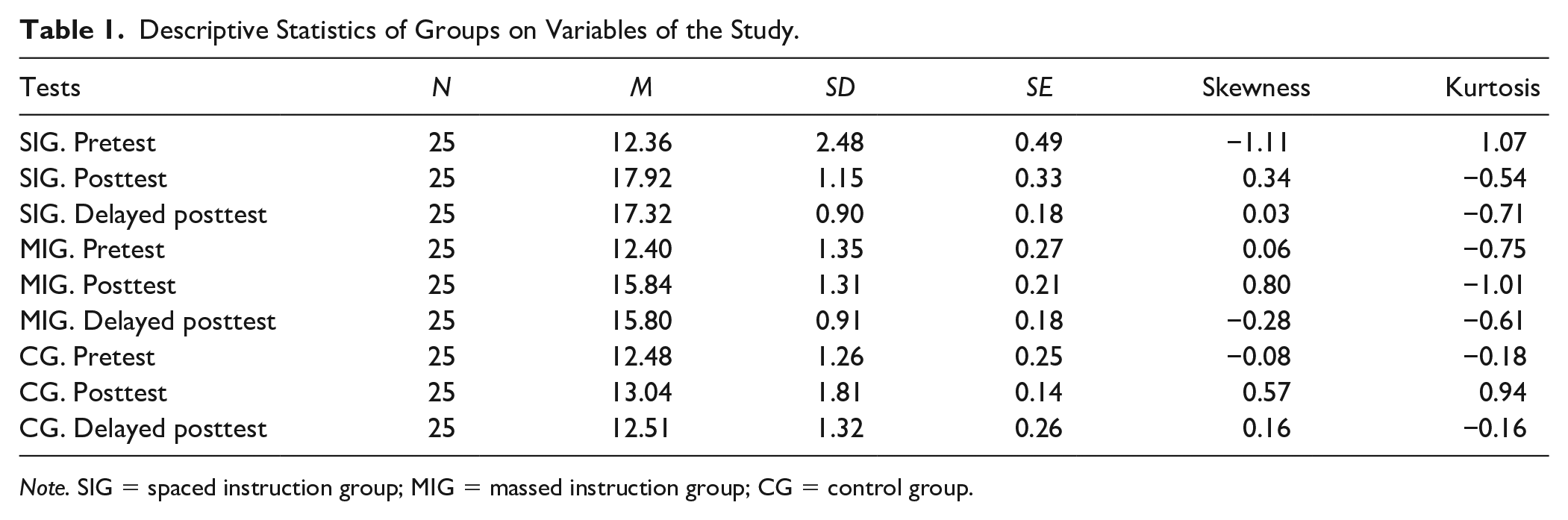
Note. SIG = spaced instruction group; MIG = massed instruction group; CG = control group.
Main Analyses
The descriptive statistics of the groups regarding their scores on pretest, posttest, and delayed posttest are presented in Table 1.
To inspect the three groups’ between- and within-group differences closely, a mixed design ANOVA with one between-group independent variable (SIG, MIG, and CG) and one repeated-measures independent variable (pretest, posttest, and delayed posttest) was conducted to compare the results. Also, the language proficiency (OQPT) was entered as the covariate in the analyses. Prior to the main analyses, assumptions of normality, homogeneity of variance, and sphericity were investigated. The results obtained from K-S test, Levene’s test, and Mauchly’s test of sphericity did not show any violations of the assumptions. The results of mixed ANOVA in terms of between-group and within-group differences are presented in Tables 2 and 3, respectively.
Results of Mixed ANOVA: Tests of Between-Group Effects.
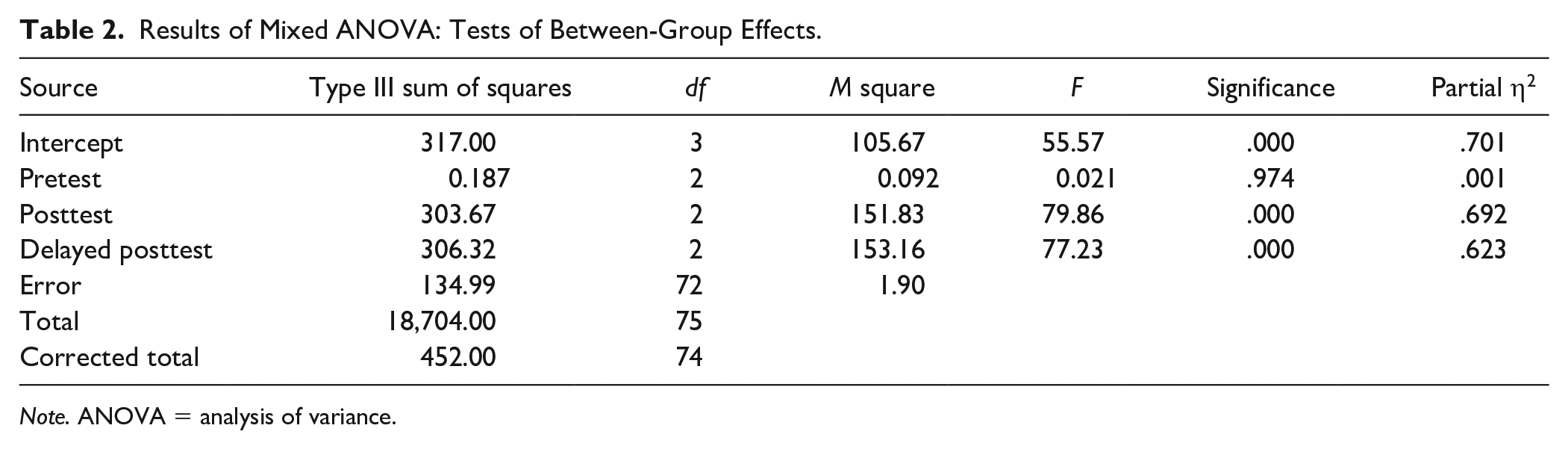
Note. ANOVA = analysis of variance.
Results of Mixed ANOVA: Tests of Within-Subjects Effects.
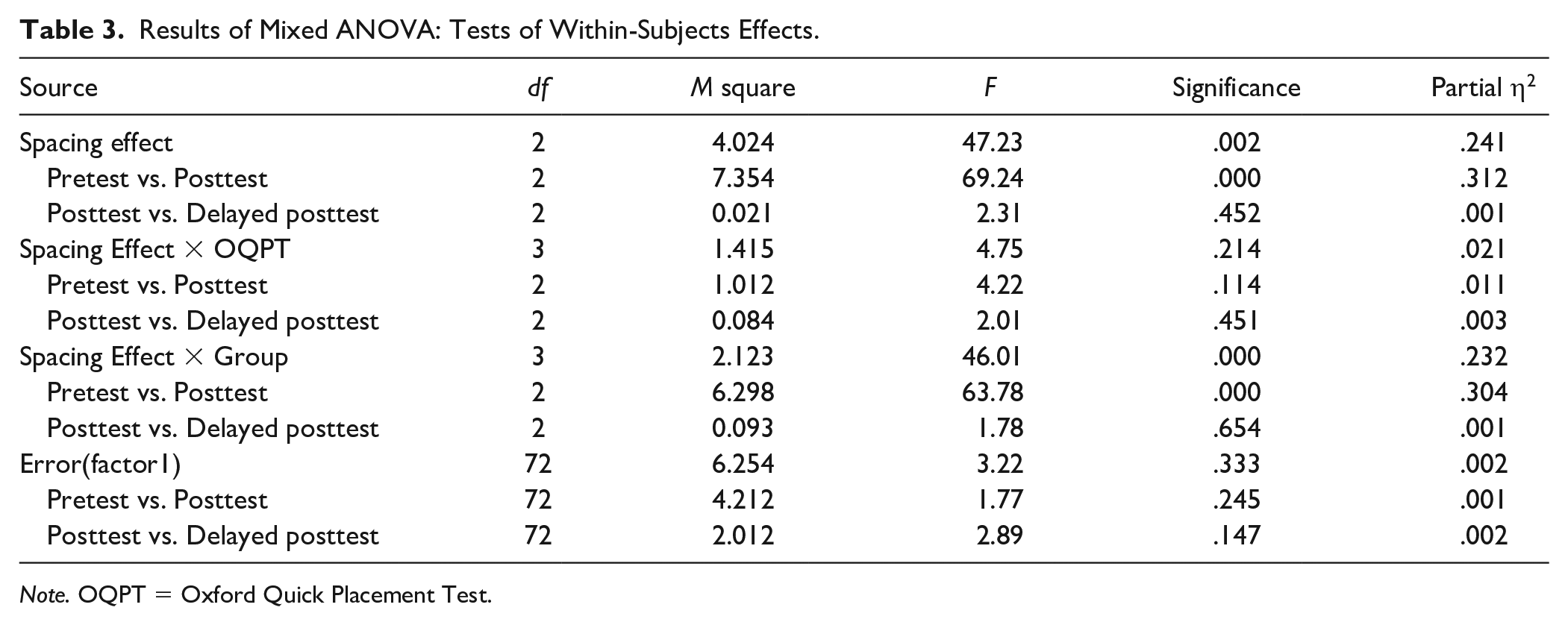
Note. OQPT = Oxford Quick Placement Test.
The analyses indicated that there was a significant main effect of spacing effect, F(3, 72) = 55.57, p < .001, partial η² = .701 (large effect size), Mpretest = 12.36, Mposttest = 15.60, Mdelayed posttest = 15.21).
Considering the three groups’ scores on the immediate posttest, the test of between-groups effect was significant, F(2, 72) = 79.86, p < .001, partial η² = .692 (large effect size). Therefore, the performance of the three groups did significantly differ on the immediate posttest, and the treatment affected their performance. Bonferroni post hoc tests were run to explore group differences. The results showed that the difference between SIG (M = 17.92) and MIG (M = 15.84) was statistically significant. Similarly, CG learners’ mean score CG (M = 13.04) was significantly lower than those of SIG. These findings suggest that both spaced and massed instructions could have a significant effect on the long-term retention of words. Yet, spaced distributed instruction proved to be more effective than massed distributed instruction.
Considering the group differences on the delayed posttest, there was a significant effect, F(2, 72) = 77.23, p < .001, partial η² = .623 (large effect size). The post hoc tests indicated that similar to the immediate posttest scores, the SIG (M = 17.32) outperformed MIG (M = 15.80) on the delayed posttest scores. CG (M = 12.51) obtained the lowest mean score on the delayed posttest.
Table 3 shows the tests of within-subjects and interaction effects. If the assumption of sphericity was met, the values in the rows labeled Sphericity Assumed are reported (Field, 2009).
The analysis of the within-group effects revealed that spacing effect was statistically significant, F (2, 72) = 47.23, p < .01, partial η² = .241. Pairwise comparisons of the pretest, immediate posttest, and delayed test showed that the scores of pretest substantially varied from the scores of immediate posttest, F (2, 72) = 69.24, p < .001, partial η² = .312. There was, however, no significant difference between the scores of immediate posttest and delayed posttest, F(2, 72) = 2.31, p = 452, partial η² = .001. Therefore, it is safe to say that the instruction was effective; however, time interval did not have any effects on the performance of groups in delayed posttest.
Considering the interaction between spacing effect and the covariate, language proficiency (OQPT), no significant within-subject effects were observed, F(3, 72) = 4.22, p = .214, partial η² = .021. Moreover, tests of within-subject contrasts did not show any significant differences between pretest, posttest, and delayed posttest assessments.
Considering the Spacing Effect × Group within-subjects effects, significant differences were observed, F(3, 72) = 46.01, p < .001, η² = .232. Specifically, within-subjects contrast between pretest and immediate posttest showed statistically significant differences, F(2, 54) = 63.78, p < .001, η² = .304. However, the within-subjects contrast between the immediate posttest and the delayed posttest did not show any significant differences, F(2, 72) = .093, p = .654, η² = .002.
In sum, the analyses revealed that that spaced distribution instruction was an effective technique for vocabulary retention and recall. Spaced and massed distribution instructions were both effective; however, spaced instruction showed to be more effective than massed instruction. In addition, there were no substantial differences between the delayed posttest scores and the immediate posttest scores, implying that the retention of the instructed vocabularies remained virtually the same after a 4-week period.
Discussion and Conclusion
This investigation explored the impact of spacing effect on EFL learners’ retention and recall of vocabulary. This study also intended to determine what kind of delivery of instruction (spaced vs. massed) would have a more important impact on EFL learners’ vocabulary recall and retention. Having analyzed the data, the findings divulged that the spaced instruction group progressed on their immediate posttest relative to their pretest scores. In particular, the findings showed a substantial difference between the massed and the spaced instruction groups’ recall of target words in favor of the spaced instruction group. The spaced instruction group showed further improvement on the immediate posttest. In addition, the findings disclosed that the spaced group also surpassed the massed group on the delayed posttest when assessed at a 4-week interval. The results suggest that spaced distribution instruction will have positive and long-standing impacts on EFL learners’ vocabulary acquisition and retention. Such findings are in line with those reported in some previous studies in the realm of cognitive psychology (e.g., Carpenter et al., 2012; Pavlik & Anderson, 2005; Seabrook et al., 2005), lending support to the primacy of spaced distribution instruction over massed distribution instruction. Furthermore, there are some previous studies that have demonstrated how spaced distribution instruction can enhance learning foreign languages (e.g., Miles, 2014; Pavlik & Anderson, 2005; Rohrer & Pashler, 2007).
The results confirm, in accordance with the theoretical assumptions of the present research, that spacing between two or three cases helps the learners encode the thought units separately and consequently be able to memorize the learning items more easily and retrieve them with less cognitive effort (Anderson & Bower, 1972). Therefore, the presentation of learning materials in spaced instruction helps the learners boost their memory and recall the newly taught vocabularies with ease (Mashhadi et al., 2017). Furthermore, when teaching at intervals, the additional retrieval processes assist the learners promote the learning process through decoding manageable elements and remembering smaller learning units. On the contrary, participants in spaced instruction would be able to divide the same amount of attention to learning items instead of having to pay an intensive amount of attention to several objects at once, as is the case with massed distribution instruction.
Such findings are also in line with research in second language acquisition, which has indicated that the spaced instructions are preferable to massed conditions in learning different aspects of language such as L2 grammar learning (Mashhadi et al., 2017; Miles, 2014), awareness of reading (Namaziandost, Hashemifardnia, & Rahimi Esfahani, 2018), and language morphology (Suzuki & DeKeyser, 2017). Miles (2014), for instance, noted that the spaced distribution group outperformed two massed and control groups in grammar items administered in immediate and posttest conditions. Miles (2014) notes that one of the benefits of learning grammar through spaced distribution instruction is giving the learners a better opportunity to retain a sufficient amount of knowledge gained from instruction presented at multiple time intervals.
In addition, Pavlik and Anderson (2005) and Rohrer and Pashler (2007) concluded that sessions relating to spaced instruction were more useful for sustaining maintenance at longer intervals, but spaced and massed modes of instruction in these two studies seemed to be comparable in terms of immediate recall.
According to the principle of encoding variability theory (Anderson & Bower, 1972), the more distant the learning components are presented, the greater the probability that they are coded in the minds of participants. Spaced instruction, in this regard, offers a more effective possibility to encode the newly taught materials through smaller manageable thought units. Furthermore, spaced instruction provides easier decoding and retention of learned items (Rohrer & Pashler, 2007). This kind of processing, in fact, makes acquiring and recall of new knowledge simpler. As a result, the students do not have to devote unnecessary attention to the stimuli. Through spaced instruction, the students are exposed to learning items in brief sessions extended over sufficient time intervals.
In particular, the findings of the present investigation confirm the previous body of research conducted on vocabulary acquisition and second language vocabulary acquisition (e.g., Bahrick et al., 1993; Çekiç & Bakla, 2019; Chukharev-Hudilainen & Klepikova, 2016; Goossens et al., 2012; Kornell, 2009; Lotfolahi & Salehi, 2016 ; Nakata, 2015; Smolen et al., 2016; Sobel et al., 2011). Conversely, as posttest scores in our study showed no significant differences with delayed posttest scores, the findings are incompatible with previous experiments (Collin & White, 2011; Lee & Choe, 2014; Miles, 2014; Snoder, 2017).
Ultimately, our results corroborate previous research by showing the benefits of the spaced instruction effect in learning vocabulary and solidify the assumption that students take more advantage of distributed spaced instructions than compact massed presentations. It can be inferred that learners can properly encode and preserve new information through spaced distribution instruction. Spaced distribution instruction can equip learners with more occasions to relax, to think, and to study, which may explain students’ dramatically increasing L2 vocabulary growth due to extra processing time, neurological regeneration during spaced training (Smolen et al., 2016), and input diffusion in diverse periods. It seems that multiple short-time tasks result in timely memory reinforcement. In reality, the production of declarative knowledge is more probably promoted by doing exercises. Structuring drills via spaced distribution throughout daily sessions and short-term instruction improves learning and is beneficial in strengthening early declarative knowledge (Suzuki & DeKeyser, 2017). Therefore, the division of larger declarative information into smaller and more manageable units can boost the retention of learned items.
The findings of this study offer some implications for EFL professionals. Most notably, contents presented in spaced distribution instructions could be used to introduce new vocabulary items. In addition, teachers may implement cumulative assessments and tests within spaced time intervals. Cumulative assessments and tests offer a strong opportunity for learners to study material themselves and apply sufficient repetition and supplementary activities to improve their newly acquired skills. More importantly, students can attend spaced sessions to boost their learning over time. Teachers would be able to arrange classroom tasks based on a spaced instruction method to successfully improve students’ performance in the exams. In conclusion, as a spacing schedule showed to have a potential effect on the long-lasting retention of vocabularies, curriculum developers and material designers can tailor materials to the demands of spaced distribution instruction. The spacing strategy, therefore, has the potential to be integrated into designing curricula and teaching resources as an instructional technique.
The present investigation was subject to some limitations. The selected method of sampling in this research was in accordance with access to subjects. Moreover, the participants of the study were all 19- to 21-year-old males. Further research with diverse sampling methods is therefore highly recommended to ensure the generalizability of findings. It is also recommended that future research recruit males and females with different age groups. Another limitation of the study was the limited scope of the investigation in terms of language proficiency level of participants. This research was undertaken with pre-intermediate students only. More research is needed to study the topic across different language proficiency levels. One major limitation of the study is that the investigation mainly concerns with vocabulary retention and recall. It would be interesting to conduct similar studies on other aspects of language acquisition. Finally, this study explored the issue within a 12-week period. Future experiments can replicate the study with longer spans of time and more time lapse between the immediate and delayed posttests.
Footnotes
Declaration of Conflicting Interests
The author(s) declared no potential conflicts of interest with respect to the research, authorship, and/or publication of this article.
Funding
The author(s) received no financial support for the research, authorship, and/or publication of this article.
