




Abstract
Ahmedabad University has evolved a framework “ENABLE.” Through ENABLE, concepts are taught from the context of real world. Industry projects are assigned to groups of students where they get engaged in real scenarios. Theoretical concepts are introduced as and when needed during the project implementation. Faculty serve as facilitators rather than teachers. Grasping and understanding complex concepts become much easier through ENABLE. Students are evaluated continuously through quizzes, presentations, class participation, assignments, peer feedback, and so on. In this article, the detailed implementation of ENABLE for the course Database Management System has been described.
Introduction
The teaching must be modified according to the needs of the taught.
The education ecosystem is changing as there are new inventions introduced to its stakeholders. Several pedagogical changes can be observed as we have moved from traditional one-way chalk and talk method to interactive classrooms. As there are advances in technologies, where audience can view the content on demand, at their own pace and according to their need, the education system also has to shift its focus from teacher-centered methods of teaching to student-centered learning environment. Such environment allows the students to control the learning process as per their own pace and need. To develop the student-centered learning environment, many educational institutes are experimenting with new pedagogies such as Active learning, Interactive learning, and Inquiry-based learning; all of which encourage students for active participation and develop their skill of asking questions.
Considering current education scenario where each individual is surrounded by distractions, it is important to involve students in the learning process; else they can easily drift away from learning and get lost in the world of gizmos and gadgets. Also, with the easy accessibility of tremendous information on internet (where not every bit of information is correct or relevant), the young minds may tend to lose the contact from the learning environment and slide into the shell. This sometimes leads to a situation where student has the self-learning capability and good academic performance but is not capable of working in the team. It is not easy for him or her to listen to ideas of peer and adapt it. However, the real-world scenario is different where most of the projects target the societal problems and are implemented as a team. Hence, it is the need of time that today’s education focuses on the real-world problems and help students in developing their team work skills.
In the traditional learning method, student learns the theoretical concepts without knowing its context in the real-world scenario. Project-based learning unlike traditional method makes student work for solving the real-world problem using the theoretical concepts. This not only helps them to map the concepts with context but also develops the skills like analytical thinking, team collaboration, communication, and decision making.
In next section, different student-centered pedagogies that are practiced in the current education system are explained followed by section that explains the ENABLE 1 framework.
Student-Centered Learning Pedagogies
The student-centered learning keeps students in the center of the learning process. It is designed to allow students to take hold of the learning process and learn at their own pace. Unlike traditional teaching methods where faculty plays the role of instructor and decides the content to be delivered in the limited time, in student-centered approaches faculty plays a role of facilitator who is responsible for providing guidance to the students during their individual learning process. The techniques such as class discussions, simulations, role plays, collaborative tasks, and group projects can be used for successful implementation of student-centered approaches.
Different Student-Centered Learning Approaches (Froyd & Nancy, 2008):
Inquiry-based learning—This technique encourages students to ask questions unlike traditional method where usually there is one-way communication from teacher to students (Edelson et al., 1999).
Collaborative learning—It is an approach where students are made to work and learn in groups thereby developing their skill of team collaborations (Dillenbourg, 1999).
Cooperative learning—This technique focuses on how students interact with each other rather than individual student or interaction of faculty and student. Students are encouraged to work together and solve a problem (Slavin, 1980).
Problem-based learning—This approach helps in developing the skill of critical thinking and problem-solving. Group of students are engaged in complex problems which can come from cross-disciplinary platforms (Awang & Ramly, 2008; Steinemann, 2003).
Active learning—Students are actively involved in the learning process through continuous interaction, role plays, and simulations rather than passive listening (Johnson et al., 1998).
Project-based learning—An approach in which students explore real-world complex problems and gain knowledge while trying to solve them (Blumenfeld et al., 1991; Doppelt, 2003; Thomas, 2000).
Just in time learning—Learning is available on demand and student can use it as and when required (Growthengineering, 2019).
ENgagement and Application-Based Learning and Education (ENABLE) Framework @ Ahmedabad University 2
A Pedagogical style that is both engaging and displays freedom and tolerance is the essence of academic freedom.
ENABLE is the Ahmedabad University’s framework adopted from Project-Based Learning methodology. It is a proprietary methodology developed to enable students to engage better with and appreciate the context of what they learn, and apply their learning more effectively. This framework makes learning engaging and practical rather than being theoretical monologue. Figure 1 shows five phases of ENABLE as explained below. However, there is no fixed sequence in which the phases are executed. They can vary as per the requirement of the course and most of the times they are iteratively executed.
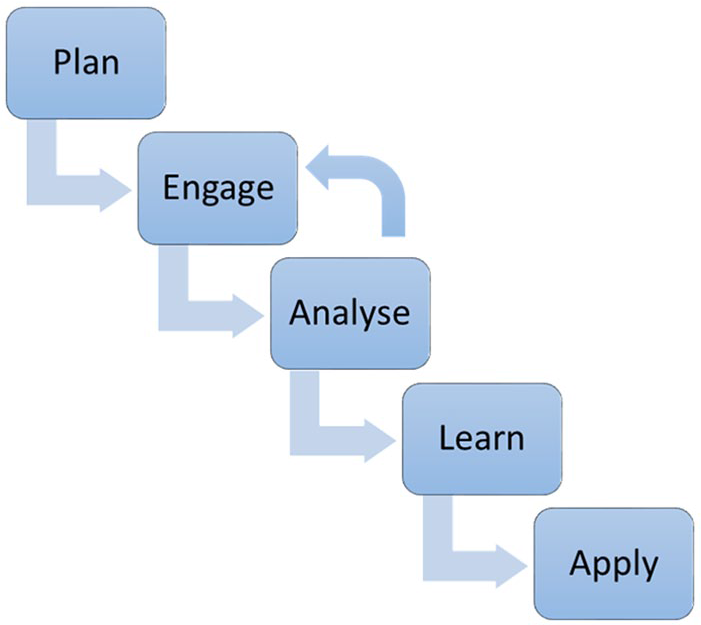
Phases of ENABLE.
Plan—In this phase students try to understand the objective of course and list the learning outcomes (more specifically practical knowledge) that they aim to achieve by learning the course. At this very stage, students also brainstorm about the real-world context where the concepts learnt through the course are applicable.
Engage—This is the phase of ENABLE where students undertake any project or complex problem on which they work throughout the course tenure. This phase is aimed at helping students to better understand the context of the course and realize the need of theoretical concept to solve the problem.
Analyze—In this phase, students are expected to analyze and reflect on the learnings of Engagement phase. During this phase, students can introspect about their contribution to the project, know the views of peers and discuss how they can improve as a team.
Learn—This is a phase where students can map theoretical concepts of the course with the practical observations.
Apply—As by now students have already mapped the theoretical concepts with the practical observations, they can apply the concepts on the real-world projects/situation/problems for solving them.
Implementation of ENABLE in the Course “Database Management System”
In this section, the implementation of ENABLE framework in “Database Management System (DBMS)” course is explained.
Course Description
This is a foundation course which covers basic and advanced concepts of database management such as database designing, transaction management, and database side programming in Oracle RDBMS.
Course Objective
The course is aimed to make students realize the importance of structured database design thereby developing their skill of database designing and management which can be applied in real-time software development. The goal is to acquaint students with concepts of relational database, Structured Query Language (SQL), transaction processing, database recovery, and security.
Outcomes
As outcome of the course, students are expected to use the knowledge of basic and advanced concepts of database management and design well-structured database for the real-world project. In addition, the data stored can be retrieved and manipulated using fourth-generation language SQL and scripts with procedural language PL/SQL. During all the data retrieval and manipulation, transaction management and concurrency control is done for simultaneous transactions.
Expectation From Students
As the pedagogy is student centered, it is expected that students take the lead and decide their pace for learning. It is very crucial for students to understand the project from the real-world scenario and visualize the data being used in the proposed system. This information which is generated after analyzing the requirements can be further used to integrate relational database management system (Naik, 2014) concepts and design a data model for the project.
Types of Project
To bring out the essence of ENABLE pedagogy and map the context of theoretical concepts with the real-world scenario, students are made to work on the complex projects which are obtained from companies from various domains. Below are some of the projects on which students have worked:
General Development Control Regulations (GDCR) Guide—The aim of the project was to provide in-depth analysis of GDCR of real estate under Municipal Corporation or City’s Urban Development Authority limit. It was designed as ultimate mobile guide for builders, architects, surveyors, property estimators, banks, prospective property buyers, and construction industry students. This application was developed to help user to get instant information of very important regulations like Floor Space Index (FSI), built-up area, building height, building use, margins, common plot, and parking.
Maa Store—The online store of local Kirana shops and Street vendors. This system was designed for general public (more specifically working people) who purchase their daily essentials using smartphone. The idea behind the project was to employ house wives as the manager of the group of Kirana stores in their area and make the purchase on behalf of customers such that the best quality goods are made available to the customers in reasonable price. Hence, customers do not have to take the trouble of visiting multiple stores and placing the orders.
Course Outline
The complete course was project driven and delivered in 40 sessions of 1.5 hr each. The detailed plan of the course is given in Table 1.
Detailed Course Outline From Project Implementation Perspective.

Note. DBMS = database management system; SQL = structured query language; PL/SQL = procedural language for SQL.
The flowchart of project activities throughout the course is shown in Figure 2 and described below.
Introduction about projects—Faculty explained objective of the course and expected outcomes from the project implementation
Group formation—The students had to work in team for project. The team size was of 3 to 5 students. The groups were formed by keeping in mind the student’s academic background and interest, gender, skills, and pace of learning.
Assign projects to groups—The projects were assigned according to the group size, that is, smaller group was assigned relatively small project. Students worked on real-time projects which were assigned by three software companies. The well-defined problem definitions were provided by the companies.
Students started working (Engage) on the project. • Understand the problem definition—Students were allocated two sessions for understanding the project definition provided by the company. During this phase, they met the company representative and collected requirements by using means such as interviews, questionnaires, company manuals, and project documents. These requirements were discussed with the faculty to get required inputs. • Prepare draft of User Requirement Document—The System Requirement Specification (SRS) Document was prepared by the team as initial draft. • Finalize the project requirements—Here, the teams refine the requirements as per the discussion done with faculty, with their peers and company. After consensus, they finalized the SRS document. • Build process flow model—To understand the project functionalities and flow of the system, teams were asked to build the Data Flow Diagrams (DFD). • Conceptual/Semantic Model—To implement the functionalities identified through process flow model, structured data storage and retrieval is required. For this purpose, abstract or visual representation of the system’s data need to be designed. Teams have generated Entity Relationship Diagram (ERD) which depicted association among entities, constraints, and attributes which could be further converted into relational database design. • Logical and physical database design—The above designed conceptual model was further converted into database design (Tables). The tables were documented as Data Dictionary which contained table description, attributes and their description, entity and referential integrity constraints, other constraints, and format. • Data manipulation using SQL—After tables were created, data were stored and manipulated using fourth-generation database query language—SQL. Besides this, students learned database programming to develop stored procedures, functions, and triggers. • Connect database with user interface—Here, teams learned procedure to connect database with user interface (UI) using ODBC/JDBC (Open Database Connectivity/Java Database Connectivity).
During project implementation, teams were asked to refer the provided reading/reference material and relate the theoretical concepts with its real-world context. Although major role of faculty was of facilitator, as and when required the theory sessions were conducted in addition to class discussions.
Project presentations—Regular presentations were done by teams to demonstrate their progress and to showcase tangible outcomes of project.
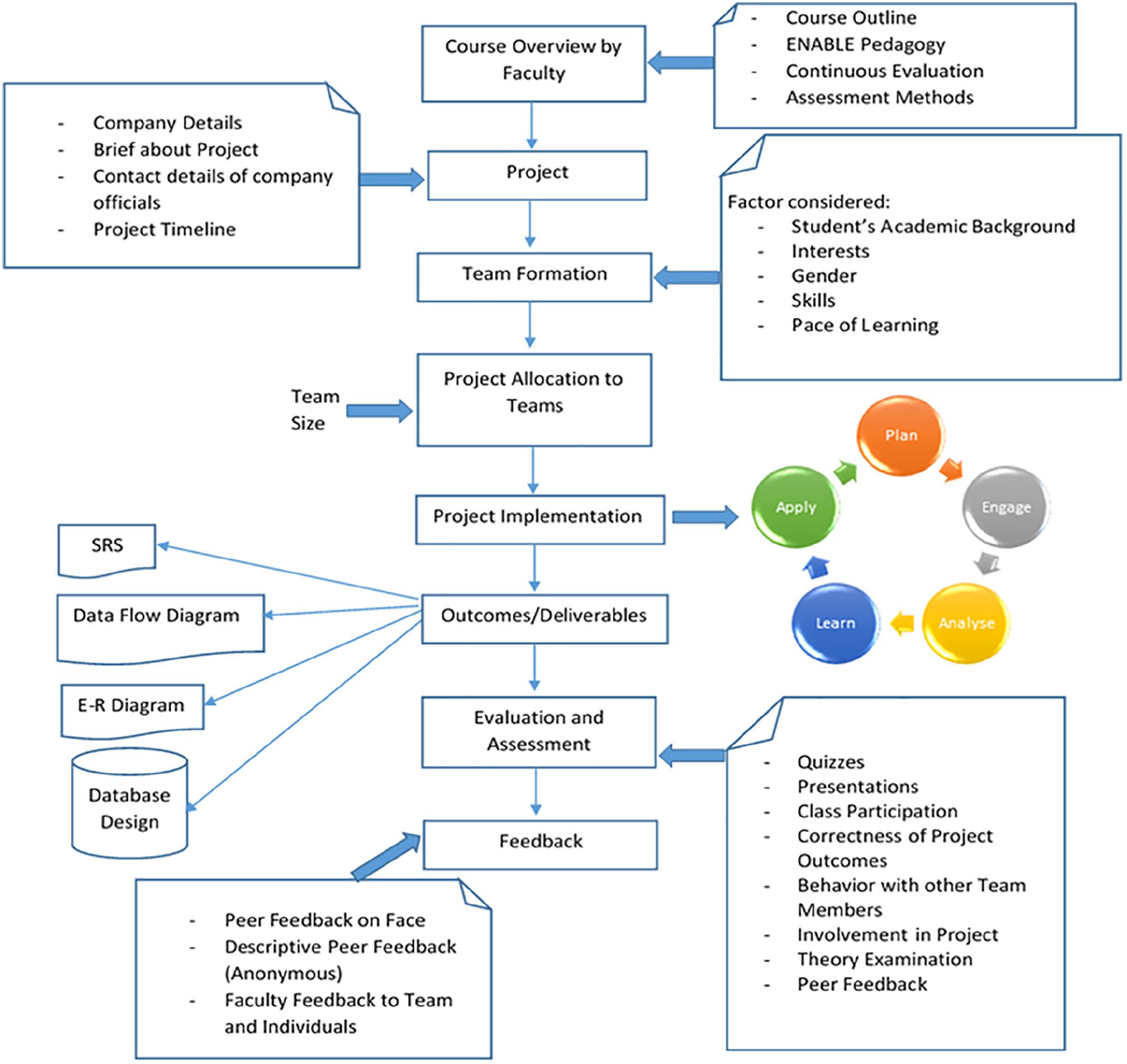
Flowchart of activities in the Project.
Tangible Outcomes of Project
The tangible outcomes of the implemented project were SRS, ERD, and the Database which was created using any Relational Database Management system (RDBMS). The project report prepared by teams included the following details:
Project definition
Stakeholders and their role in the system
System Requirement Specification Description about scope of the system Problems in existing system Functional requirements of the system Non-functional requirement of the system
Study of competitive existing systems
Project implementation Entities Entity-Relationship Diagram Data dictionary with constraints and data types of attributes Reports which were generated through SQL queries Stored procedures for project functionalities Triggers applied on the tables for validations Transaction management and concurrency control mechanism applied for project
Assessment and Evaluation
The assessment and evaluation of students was based on following criteria. Faculty gave final grades by combining all the following criteria. Each criteria had due weightage which contributed in students’ final grades. Maximum weightage was given to “Project” as it is the essence of this pedagogy.
Class Participation: Faculty had monitored each student during sessions and noted down the points such as how much they were contributing in the team, their behavior with other team members, involvement in the project, activities done inside the class, how much time they had spent on project besides regular sessions, and so on. To know about this, faculty regularly interacted with whole team and team members.
Continuous Evaluation through Quizzes and Presentations: During the semester, four surprise quizzes were conducted to assess students’ understanding of project and concepts. That is, whether students were able to relate real-time context with the theory concepts or not. Faculty gave inputs and guided them if they were deviated from the actual learning. Besides this, four intermediate quick presentations were given by teams about their project. They were assessed on the basis of their project progress.
Mid Semester Project Review: Each group was given time of 30 min to present the project to showcase and to explain project outcomes—SRS document and ER diagram. Teams were evaluated on the basis of correctness of the documents and understanding of the concepts related to these documents.
Peer Feedback—Qualitative and Quantitative (Anonymous), Face to Face (not considered for evaluation): Peer feedback was one of the important components of assessment. During mid-semester, each team member shared their views about their peer team members on face. The purpose of this feedback was to let each student know what his or her peers’ opinion about him or her. This feedback was not counted in the final grade of the student, but its purpose was to help student improve as an individual and as a team member. The anonymous qualitative and quantitative feedback was taken at the end of the semester. The tool “Teammate” was used for this. In qualitative feedback, students were asked to submit half page description about each of their team members. The qualitative (descriptive) feedback given by “Student 2” for “Student 3” is as follows: She was a silent group member of our group in starting. She was not giving ideas for the project but slowly she started giving ideas and also used to submit the work that was given to her. But sometimes she used to delay the work in starting. In the last phase of our project the group leader assigned us to make forms. So the work given to her was completely done on time by her. So as a good partnership with her in making forms I was never disappointed. She is a cooperative member in the group. She helped in preparing data dictionary and rough idea about requirements. She has a good knowledge in database so helps a lot in setting relationships. With the help of her normalization of the tables was done perfectly. Overall it was nice to work with her.
Each student had also given quantitative feedback for their peer team members including himself or herself on the scale of 100. In this method, student can give marks out of 100 to each team member, but the overall total must be 100. On the basis of standard deviation in marks, the final grade of an individual may be upgraded or downgraded. The final decision was taken by faculty after checking the genuineness of the feedback. The sample matrix of quantitative feedback is given in Table 2.
From Table 2 it is clear that, “Student 5” is not honest in giving feedback because he has given highest feedback to himself which deviates a lot from the feedback given to him by other team members. But “Student 4” has given honest feedback. Even he has given the lowest marks to himself! Also, the deviation of the marks in the case of “Student 2” is the lowest, which shows that she got the most genuine feedback by others. Ultimately, faculty analyzes all these things to upgrade or downgrade the final grades.
End Semester Project Review: At the end of the semester, the final project review for each team was conducted. Students had showcased and explained database prepared by them in detail with its relevance to theory concepts. They had also submitted project report in word document for which marks were given to them.
Theory and Practical Examination: Theory examination was held to evaluate whether students were able to apply concepts learnt on other applications (projects). They were given small problem definition and asked to prepare SRS, ER diagram, Database design, and execute queries on the database. The problem was given by keeping in mind the exam time duration. They were allowed to bring their Course Workbook 3 during the examination in which they had maintained details of project, session wise work done, concepts learnt from the project, and so on throughout the semester.
Quantitative Feedback Matrix.

Digital and Other Tools Used Throughout the Course
Various software tools were used by students and faculty during the course for different purposes. The brief details of these tools are given below:
Teammate: This is an open access tool which was used to keep details of teams, to conduct surveys and to take quantitative feedback.
Piazza: It was used for online and offline discussion outside the class. Students and faculty can post questions and answers on this platform which registered users can view.
Moodle: The learning management system “Moodle” was used to share documents, assignments and to conduct online quizzes.
Google Drive: It was used to share documents which are required to be edited by many users in parallel.
Google Form: It was used to record qualitative feedback.
ENABLE Workbook of Ahmedabad University: This workbook which is copyrighted document of Ahmedabad University was given to each student at the beginning of the course. It has predefined templates and forms which students may fill up and refer as per their requirement. The workbook was not checked by faculty as purpose of creation of this book was to provide students freedom of expression. The screenshot of page filled up by one of the student is given in Figure 3.

Screen shot of ENABLE workbook.
Evaluating ENABLE Pedagogy for the Course “Database Management System”
In this section, the evaluation and impact of ENABLE framework in “Database Management System (DBMS)” course is explained.
Methodology Used
To evaluate the effectiveness of ENABLE, the offline anonymous feedback was taken on paper from the students. The feedback contained questions which could be answered in the form of rankings or comments. The date and time of feedback taken was not known to the faculty because it was conducted by the administrative staff of the University. It was highly confidential. The detailed analysis of quantitative answers of the questions was done and sent to the faculty after declaration of result at the end of the semester. The filled feedback was also handed over to the faculty so that faculty could review the descriptive comments for improvisation of the course content and delivery.
Students enrolled in the course filled up the feedback voluntarily. There were total 12 questions in the form out of which nine questions were quantitative (ranking based) and three were qualitative (descriptive comments based). Figure 4 shows snapshot of feedback form in which these questions are visible.

Snapshot of feedback form.
Result of Feedback Analysis
After the feedback was collected from the students, the detailed analysis was done by the program office and was shared with the faculty in the excel file at the end of the semester. For each question, average of ranking and standard deviation was computed. Figure 5 shows the analysis of feedback for two semesters. As shown in Figure 5, the standard deviation for all the questions is less than 1 which implies that the feedback given by the students is genuine. The average of standard deviation of the question related to the pedagogy, that is, Q6 is 0.64 which depicts that there is very less variation in each student’s response and almost all the students agree that the pedagogy used was very effective.

Feedback analysis for the course Database Management System for Winter Semester 2017 and Winter Semester 2018.
From the feedback analysis given in Figure 5, it is clear that most of the students enjoyed learning this course as rating for each specific question related to course and faculty is approximately 4.5 out of 5 which shows that the satisfaction level of students for the course and faculty is almost 90%. The average rating of question related to pedagogy used in the course is 4.52 out of 5 which shows that students’ satisfaction level for ENABLE pedagogy is above 90% and hence learning through ENABLE is very effective. Also, average overall ratings for the course and faculty is more than 4.5 out of 5 which shows that the faculty has successfully adapted and implemented the ENABLE pedagogy which has enhanced students’ learning.
Figure 6 shows average of ratings for all the questions in percentage for Winter Semester 2017 and Winter Semester 2018. The average rating of questions is 89.72% with minimum of 84.96% and maximum of 96.58%.

Average rating in percentage for each feedback question for Winter Semesters 2017 and 2018.
The feedback form also contained descriptive questions where student had expressed their thoughts. The descriptive feedback was also very positive. In all, the feedback is excellent which shows that students were highly satisfied with the pedagogy.
Benefits of ENABLE Over Traditional approach
In traditional approach, students attend lectures during which sometimes they lose concentration. This results into rot learning without understanding and applicability of the concept in real life. There is no freedom of expression in this method. In contradiction, ENABLE is a student-centered approach which allows them to express, self-learn, work on real-time projects with their peers and learn to solve actual problem. They can come with multiple solutions for the same problem as different persons in a group have different perspective to see and analyze the problem. Students become fearless in expressing their ideas because of frequent presentations and discussions. Because of this their confidence increases.
Learning through ENABLE is very rigorous as students are learning the concepts by doing it. Theory is not taught directly. To understand the project and theory behind the implementation, they have to refer lots of reading material which cultivate reading habits. As they read a lot, they learn more concepts than what is actually prescribed in the syllabus. The whole process demands more time than traditional approach.
Students devote more time in discussions, reading, learning, and problem-solving rather than sitting idle during sessions.
Learning by doing make them learn the concepts forever because they have applied the concepts in real time (Felder & Brent, 2003).
Students become more adaptive toward any problem and ready to face the problem with confidence. They develop habit to understand the problem first, rather than start doing it blindly.
The projects assigned are always novel and unique, so there is no scope of copying.
Apart from learning the core concepts, other skills that are required to work upon real-life problems are also developed such as Communication, Good level of confidence, Analytical and logical ability, Personal growth, and Appreciation and respect for peers. Their horizon widens as they work with different people as a team.
ENABLE—Challenges and Their Solutions
The challenges are listed on the basis of anonymous feedback given by students and faculty who taught the courses through ENABLE pedagogy.
Challenges
Project Selection and Assignment: Because every course has time bound, it is challenging for faculty to select the proper project. Before assigning project to the students, the sessions should be planned meticulously, else it creates chaos in the class.
Long contact hours: Students and Faculty both have to devote more time to do the project and to solve queries, respectively. This results in long contact hours.
Difficult to handle a big class: It is difficult to handle and to guide the students if the class size is big.
Syllabus is compromised: Sometimes it may happen that more concentration is given to project which may result into skipping theory concepts that are totally descriptive and that do not have direct application related to the assigned project.
Difficult to keep students motivated: If the given project is very complex and students are not able to find solution for any intermediate problem, motivation level of few group members will go down.
Conflict in group members: Because of different point of views, ego, and same level of intelligence, conflict may occur among group members, which divide a group into small groups. These kinds of situations delay the actual project.
Lack of activity: The group members who are not motivated enough sit idle. They do not get involved in the project activities, which other members do not accept.
Isolation of a group member: Because of nature of a team member or less involvement in the project or slow pace of learning, other team members do not care for that member. In a way, they isolate the person.
Weak communication: The students who are very good in problem-solving and applying the knowledge on real-time projects may not be able to explain the work done by them or communicate effectively during presentation which mislead faculty during assessment.
Strategies Adopted to Overcome Challenges
Strategies to overcome challenges of teaching through ENABLE are given in Table 3.
Strategies Adopted to Overcome Challenges of Teaching Through ENABLE.

Faculty and Student Experiences
The following experiences are shared by the faculty members who had taught courses through ENABLE pedagogy. The feedback given by faculty was recorded by the program office: After teaching the course Database Management System through ENABLE for last two years, I experienced improvement in students’ problem solving skills; boosted self-confidence, betterment in presentation and written skills, Respect towards peers and their opinions, Team management, etc. apart from learning core concepts. Learning by doing made them learn the concepts forever with development of self-learning capacity. (Course Author) ENABLE is a major shift for faculty and students as the pedagogy has to be transformed in such a way that it is student centered rather than teacher centered. Assigning a project for the course was not a new thing to me, as I had been doing it for my courses earlier. However the concept of allowing the students to work on the project and introduce them to the required concepts while implementing the project was very interesting. ENABLE framework gave each individual in the class flexibility to learn in their own way. As a facilitator, I witnessed improved team collaboration, analysis, decision making and communication skills. Also, this methodology kept hold of students’ attention and they were less distracted compared to traditional lecture sessions. (Course Co-Faculty) The power of human cognitive mind pursues wide spectrum of knowledge and thinking abilities if one is exposed to learning by doing, which I observed and accomplished when I experimented through ENABLE pedagogy for one of my courses—“System Design for Societal Problems” at Ahmedabad University. The ENABLE pedagogy at Ahmedabad University is experiential learning framework developed to enhance students learning and engagement. To name a few, traits such as team-dynamics, time management, sense of inquiry and responsibility were observed during the course. (Faculty of other course)
The following experiences are shared by the students who had enrolled for the course Database Management System. The responses of the students are recorded through the anonymous feedback. The feedback was taken by the program office of the University: Learning Database Management System through ENABLE did not only help me to understand the concept of the subject but it also allowed me to understand its importance. I realized its actual need in the outer world. I find myself to be lucky that I got an opportunity to learn this subject as an ENABLE course. (Student A, Student of Winter Semester 2017) It was smart thing to provide us with some real work like project in the very second year. It gave me a very nice idea of how I need to work when actually in the industry. The steps we were told to follow were very well planned as I am still able to use those for my project work. (Student B, Student of Winter Semester 2017) It gave me an experience of working in groups where each member have their own perspective regarding a problem and to come to a solution which everyone can agree. This course gave me a unique experience and I enjoyed this “Learning while Doing” way of teaching. (Student 1, Student of Winter Semester 2018) ENABLE—where we can learn things by experimenting the concepts which is quite different from the regular classroom classes while here we can engage with our teams, experiment and analyze the project given. The ENABLE course “Database Management System” is aimed to develop the techniques and skills of database designing which can be applied in real time software development. It was a classroom led by students and guided by Course Author and Course Co-faculty. They both were engaging the students very well and were willing to solve the problems every time. (Student 2, Student of Winter Semester 2018)
The feedback from students was taken through various modes such as (a) anonymous feedback was taken through the tool “Teammate.” Using this tool, students have written descriptive feedback for their group members as well as faculty. (b) Informal face-to-face peer feedback from each student for their group members and for the faculty was taken during mid-semester. This feedback was not considered for the grading. It was a frank feedback that helped both students and faculties to improve their work. (c) At the end of the course, anonymous feedback from the students was taken on paper for the course faculty by the coordinator of Teaching-Learning Center of the University. Later, the analysis was shared with faculty for improvement.
To measure the effectiveness of methods used in teaching through ENABLE, at the end of the course, faculty feedback was taken in the form of questionnaire that included objective and descriptive responses based on results of students, tangible outcomes, and students’ continuous feedback. From the responses, it was clear that students appreciated the pedagogy very much and it was reflected in the learning. They learned the concepts very well through real-time project development. The students who had chosen to learn Database Management System through ENABLE opted for courses in their next semesters which were based on this pedagogy. From the graphical representation generated by the tool piazza (Halevy et al., 2003) and Google, it was clear that students worked through the semester very rigorously and deeply involved in self-learning by doing which is the main aim of this pedagogy.
Discussion
The main objective of study is to share teaching-learning experience through the ENABLE pedagogy and to share ideas on pedagogical innovation in higher education. It reflects detailed implementation of ENABLE 4 pedagogy in teaching the course Database Management System. The course that is taught through traditional methods such as chalk and talk (Becker & Michael, 1996) provides conceptual knowledge through lectures, but no experience of real-time application could be taught through traditional methods. Students just have to imagine the implementation of the concepts. Interaction during the lectures is very limited as many students feel shy to express their thoughts though they are very good thinkers. There is almost no link between learning outcomes and assessment. Learning pace of all the students is not same, but faculty has to teach through constant pace assuming all the students are learning at a given speed. Because of this, slow learners lose interest from the course. Learning is same for all the students in the traditional approach (Dimitrios, 2013) because they don’t experience application-based learning (McParland et al., 2004). Students have low attention span in traditional lecture-based method. Students are evaluated on the basis of concepts they learnt that results in mugging up the concepts which they generally forget in few months. On the contrary, teaching through ENABLE help students learn on their own pace through interactions and discussions by working on real-time project. Real-time project requires practical solutions which they could found through in-depth understanding of the concepts. Sometimes students may find novel way to solve the problem which leads them toward research. Although learning through ENABLE is rigorous and demanding in terms of more contact hours, students gain knowledge of other domains also as real-time problems/projects (Mills & Treagust, 2003) require knowledge of multiple disciplines. Apart from learning the course, ENABLE helps in inculcating reading habit in students because they have to refer a lot of reading material, improving their thought process, developing competencies like collaboration and critical thinking, boosting self-confidence through discussions and presentations, working as a team and helping peers, cultivating formal writings, and so on. Thus, after teaching the course through ENABLE, faculty and students both agree that “Doing after learning is good, but learning by doing (Hackathorn et al., 2011) is better.”
Conclusion
The aim of this article was to present the ENABLE framework adopted by Ahmedabad University. This framework enables the students to map the theoretical concepts with the real-world context. However, in certain scenarios, the traditional lecture session could be the need of time. Hence, this framework even though being a student-centered approach provides flexibility to facilitator where they can interrupt in the project implementation and introduce some critical concepts to the students. In this way, ENABLE is not the replacement of good old classroom teaching and does not compromise on the rigor of the course.
The implementation of student-centered pedagogies is not an easy task as major shift is required from faculty as well as student perspective. This approach forces the students to step out of their comfort zone and think about critical problems thereby applying their knowledge to solve them. On the contrary, faculty also faces challenges such as maintaining the rigor of course, motivating students, and preparing them for the shift.
Given the challenges faced due to shift in pedagogy, it is still the recommended learning method for students as it not only helps in learning concepts and professional skill development but also encourages them to think about the societal problems at the young age and find ways to solve them. The article could be concluded in one statement “Experience is the best teacher.”
Footnotes
Declaration of Conflicting Interests
The author(s) declared no potential conflicts of interest with respect to the research, authorship, and/or publication of this article.
Funding
The author(s) received no financial support for the research, authorship, and/or publication of this article.
