



Abstract
The aim of this study is to investigate the role of academic optimism in classroom management and job burnout of elementary school teachers. The method of this research is a descriptive correlational study. The statistical population in this study included all primary school teachers in Baneh who were teaching in this city during the academic year 2017–2018. The number of teachers in Baneh was 800, of whom 457 were female teachers and 343 were male teachers. According to Krejcie and Morgan table, the sample size was 260 people. The sampling technique in this study was cluster sampling. To collect data, the following questionnaires were used; Beard et al.’s academic optimism, the attitudes and beliefs of teachers regarding classroom management of Martin and Sass and Maslach Burnout. Data analysis was performed by Amos software. The results showed that the paths of scientific emphasis on behavior management, trust in education management, self-efficacy in behavior management, and education management were statistically significant. Also, the results showed that the paths of scientific emphasis on emotional exhaustion, depersonalization and personal success; confidence in emotional exhaustion, depersonalization, and personal success; and self-efficacy to emotional exhaustion, depersonalization, and personal success are statistically significant.
Introduction
The teachers’ community is the main source of knowledge production and is the main asset and resource of education in any country, and so the knowledge and mental and physical condition of teachers should be properly managed. Teachers, more than any other specialist in school affairs, play role in identifying students’ educational aspects and establish a daily relationship with them based on education and ethics. The teacher is at the forefront of contact with students and plays a very important role in the improvement of the educational system (Kaveh et al., 2011). On the contrary, elementary school teachers play the most important role in the education system because it is their responsibility to create the basis of education. Due to the type of their duties, these people sometimes suffer from fatigue and job burnout. Job burnout is a part of today’s stressful life. It can be said that job burnout and fatigue are among the common problems today, which show symptoms in the workplace. Job burnout affects work, family life and social relationships (Mehrabizadeh Honarmand et al., 2010).
In the work environment of teachers, they face many challenges about education and civilization of students, and job burnout is a phenomenon that affects their performance. Job burnout is a persistent and debilitating symptom associated with physical, psychological, behavioral, and social problems; it is a feeling that is expressed by a person in different ways, such as weak mentality and a strong desire to rest and sleep (Saremi, 2015). The concept of job burnout was first introduced by Freedenberg in the late 1940s, and its emergence and growth owes to his efforts in New York and California (Mirsapasi, 1998). Maslach and Jackson (1981) consider job burnout as a decrease in a person’s ability to adapt to stressors. It is a syndrome consisting of emotional and physical fatigue, which leads to a negative self-image, negative perception of job, and lack of communication with colleagues and clients while on duty (Saatchi, 2009).
Why do teachers and people who works in education system suddenly become exhausted and burned out? They go through some steps to reach the point of job burnout. In the first step, there is excitement, high hope, and even a sense of mission. Talented teachers are often busy with their students and have unrealistic expectations about what they can do. They often miss rest and lunch times and cancel vacations because they feel high necessity of work. The reality gradually thwarts their unrealistic expectations and they begin to doubt their goals, practices, and values, then get more and more angry and complainant and then feel worthless and depressed. Finally, they come to the conclusion that “I cannot be such a person, something is wrong” and this is when he gets angry and then indifference comes (Sarason & Sarason, 2013).
On the contrary, the realization of effective teaching in educational institutions depends on different conditions and contexts. Classroom management is one of the most important contexts. If the teacher does not have classroom management skills, despite his scientific abilities, he will not be able to manage the classroom properly and the realization of effective teaching in a classroom that lacks proper management procedures will face difficulties (Shirzadi, 2016). Classroom management is a variable of the classroom that covers a wide range of classroom processes and interactions. That is, in addition to education, it includes all students’ interactions with the teacher and with each other and the socio-cultural and psychological environment of the classroom (Amin & Aali, 2009).
In general, classroom management is one of the main areas of concern expressed by teachers at all levels. A number of studies show that teachers’ personal beliefs influence their choice of classroom management approach. Classroom management is a rotational process which includes advanced design, performance, continuous assessment, and final evaluation that considers factors related to children and their environment and promotes learning activities and the emotional health of children in the classroom and promotes learning activities and the emotional health of children in the classroom. Gordon and Dembob (2006) define classroom management as: Classroom management is the art of applying specialized knowledge and using classroom skills in managing students toward the desired goals of students and society. Wolfgang and Glickman (1986) provide a comprehensive and accurate definition of classroom management. According to them, “classroom management means all the teacher’s efforts to supervise classroom activities, including social interactions, students’ behavior, and learning.” In this definition, several basic aspects of classroom management are assumed, one of which is discipline or behavior management; class management therefore includes discipline; while not limited to it (Amin & Aali, 2009).
Another simple and comprehensive definition of this concept is provided by Martin et al. (2006), according to which classroom management is a multifaceted construct that includes three broad dimensions: personality, teaching, and discipline. Personality dimension includes the teacher’s beliefs about the students’ personality and also includes the actions taken by the teacher and contribute to the students’ personal development. This dimension is related to the teacher’s perceptions of the general nature of students’ abilities, motivation, and psychological climate. Teaching dimension includes all the actions that the teacher takes related to learning activities in the classroom, the arrangement of space, and use of time. The third dimension, discipline, includes actions that the teacher takes to establish appropriate standards of classroom behavior (Vafaie Mehr et al., 2015).
A variety of factors can affect teachers’ classroom management and burnout. Such factors can be individual or organizational, and each of these factors in turn can increase or decrease burnout in teachers. Teachers’ academic optimism can be considered as one of these influential factors that can affect the classroom management of teachers. It can either increase or decrease teachers’ job burnout.
Teachers’ attitudes toward the organizational climate and their relationship with students are referred to as academic optimism. The teacher can either make education a process of joy and success or a fruitless process. In other words, no desirable scientific development or innovation can be achieved in education unless teachers are already equipped as real agents with desirable and effective attitudes and beliefs. One of these effective beliefs is optimism. This seems necessary because today, in a situation where a new innovation emerges from the creative mind of humans every day, more and more human beings are subjected to pessimism and depression. A pessimistic nation cannot make the most of the opportunities that the 21st century offers. Pessimists perform worse than optimists in three ways: the first is that they were much more depressed, the second was that they were less talented at work, school, community, and so on, and the third was that their physical health was lower than that of optimistic people (Mazarei, 2010).
Academic optimism was first suggested by Hoy, Tarter, and Hoy in 2006. They considered academic optimism as a school characteristic that affects students’ academic achievement (Hoy et al., 2008). This emerging construct stems from research in Social Capital Theory by Coleman (1990), learned optimism in Seligman’s (1998) positive psychology, social cognitive theory, and self-efficacy theory by Bandura (1977–1986) and studies by Hoy et al. (1991) in the field of school culture and climate (Beard et al., 2010). Academic optimism consists of the collective characteristics of academic emphasis, trust, and efficiency of the teacher, which is confirmed at the organizational (school) and individual (teacher) level. Academic emphasis means that teachers prioritize educational work and have high expectations of student success. In other words, academic emphasis represents the time when the student engages in effective educational activities. A trusting relationship includes a sense of benevolence, trustworthiness, competence, honesty, and receptivity. Whenever teachers are optimistic, they will rely on their ability to teach and on parents to support the classroom. Teachers’ willingness to trust students and their parents is very important. Whenever teachers feel interdependence between themselves, students, and parents, it will be possible to accelerate learning beyond the school walls into homes. A teacher’s sense of effectiveness is defined by his or her judgments about his or her ability to achieve the desired outcomes in terms of participation and learning, even in the case of stubborn or unmotivated students and is closely related to student progress on one hand and enthusiasm in teaching on the other hand (Badri Gargari et al., 2015).
Numerous researches have been conducted in the field of the role and relationship between academic optimism and various variables. The results of Abay and Raju (2018) showed that there is a relationship between teachers’ classroom management beliefs and academic optimism. It also showed that there is a relationship between the components of academic optimism (self-efficacy, trust, and academic emphasis) with teachers’ classroom management. In another study, Lynn (2013) investigated job burnout and its relationship with academic optimism, teacher socialization, and teacher cohesion. The results showed that academic optimism and cohesion have a negative and significant relationship with emotional exhaustion and depersonalization; but academic optimism and cohesion had a positive relationship with a sense of personal effectiveness. Kılınç (2013) in a research investigated the relationship between teacher optimism and school climate in teachers of turkey. The results showed that the teacher’s sense of academic optimism was positively and significantly related to the components of the school climate.
The results of Hamidi and Memari (2017) research showed an inverse correlation between the component of environmental awareness with noninterference management style and interactive management style. There was also a positive and significant relationship between the components of academic emphasis with intervention management style and interactive management style. The research of Mohseni et al. (2016) showed that there is an inverse relation between optimism and job burnout. There is also a relationship between the components of emotional intelligence and job burnout. Stepwise regression of the staff’s results showed that emotional intelligence is able to predict job burnout. Makhtumnejad (2015) showed that academic optimism has an effect on noninterventionist style, academic optimism has an effect on interventionist style, academic optimism has an effect on academic attitude, and interventionist style has an effect on noninterventionist style. Also, the indirect effect of academic optimism mediated by interventionist style on academic attitude, academic optimism mediated by noninterventionist style on interventionist style, and noninterventionist style mediated by intervention style on academic attitude was confirmed. The results of Badri Gargari et al. (2015) showed that there is a significant positive relationship between job satisfaction, dimensions of academic optimism, and mastery. The variables of academic optimism and goal orientation explain an important part of teachers’ job satisfaction. Among the exogenous variables of research, trust, and academic emphasis have a direct effect on job satisfaction, and self-efficacy predicts job satisfaction only indirectly and through the orientation of the goal of mastery. Functionalism has not contributed to job satisfaction prediction.
The results of Hassanzadeh (2013) research showed that the total score of academic optimism of teachers and students has a positive and significant relationship with teaching style. There is also a positive and significant correlation between teachers’ and students’ academic optimism and the components of teachers’ academic optimism can explain and predict the type of teaching style. Borazjani (2009) showed that the teacher’s academic optimism was able to predict classroom management, aggression, and its dimensions. The teacher control core was also able to predict general and relationship aggression of student.
Therefore, it can be said that academic optimism is one of the most promising achievements of educational psychology; because it enables the teacher and the school, to build a positive relationship with students and their parents by relying on their positive belief in the ability to educate all students of all social and economic levels, despite the low socio-economic level of the weak students; and by emphasizing on doing homework, engage them as much as possible in the learning process (Kordalivan, 2014). Given the above, this study aims to determine whether academic optimism plays a role in classroom management and job burnout of elementary school teachers, the conceptual models of which are presented in Figure 1.
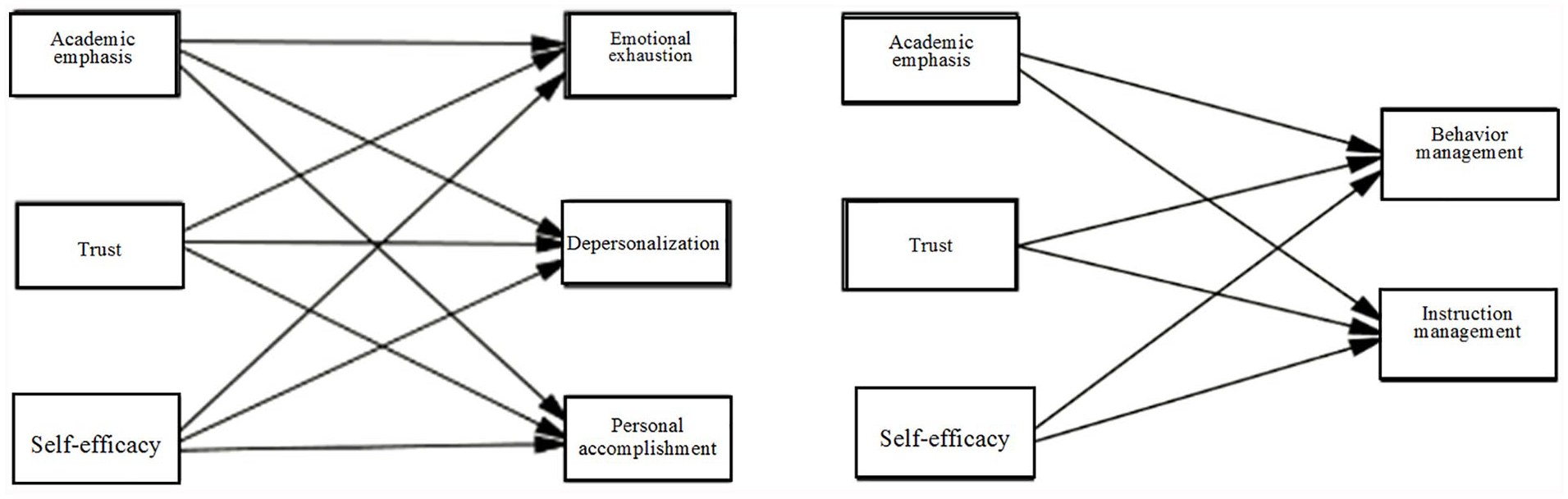
The conceptual model of the role of academic optimism in classroom management and teachers’ job burnout.
Method
In terms of purpose this research is applied, in terms of nature and method, is descriptive correlational survey, and in terms of time is cross-sectional. The statistical population of this study included all elementary school teachers in Saqqez who were teaching in this city in the academic year 2017–2018. According to the statistics received from the Education Department of Saqqez, the number of teachers in Saqqez was 800, of whom 457 were female teachers and 343 were male teachers. According to Krejcie and Morgan table, the sample size was 260 people. In order to distribute the questionnaires among the sample, cluster sampling method was used. Thus, 30 schools were randomly selected from the elementary schools of Saqqez and the questionnaires were distributed among the teachers of those schools. Research data were collected using the following questionnaires.
Academic Optimism Questionnaire
In this research, to measure teachers’ academic optimism, Beard et al.’s (2010) academic optimism questionnaire, which has 11 items, was used. This questionnaire has three subscales of collective teacher efficacy (4 items), trust in parents and students (4 items), and academic emphasis (3 items). All questions are scored on a 5-point scale from very low to very high. Abbasian et al. (2012) measured the construct validity and reliability (based on Cronbach’s alpha) for each of the subscales of collective teacher effectiveness, trust in parents and students and academic emphasis eqaul to 0.70, 0.89, and 0.87, respectively, and the reliability of the questionnaire using Cronbach’s alpha was 0.789.
Teachers’ Attitudes and Beliefs on Classroom Management Questionnaire
This questionnaire has been constructed by N. K. Martin and Sass (2010) and has 12 items and responding to its items is based on the 5-points Likert-type scale as strongly disagree (1) to strongly agree (5). The person score in this questionnaire ranges from 12 to 60. This questionnaire measures two subscales of instruction management and behavior management, in which instruction management indicates interactive and noninterfering style of teacher, and behavior management indicates teacher’s intervention style. In the study of N. K. Martin and Sass (2010), the validity and reliability coefficient of this questionnaire has been evaluated as appropriate. Dinipour (2016) obtained Cronbach’s alpha coefficient for instruction management equal to 0.71 and for behavior management equal to 0.78. The reliability of the questionnaire in this study was calculated using Cronbach’s alpha equal to 0.862.
Maslach Job Burnout Questionnaire
The job burnout questionnaire was developed for teachers in 2001 by Maslach et al. (2001). This questionnaire is used to measure the rate of job burnout in the staff of different organizational jobs and also to compare the levels of burnout of organizational staff as well as different individuals and research groups. The Maslach burnout questionnaire has 22 questions. Answering to job burnout questionnaire is based on a 7-point Likert-type scale from 0 (never) to 6 (very high). The Maslach job burnout questionnaire has three subscales, which are: the subscale of emotional exhaustion, the subscale of depersonalization, and the subscale of reduced personal accomplishment. Maslach and Jackson reported the internal reliability coefficient for emotional exhaustion, depersonalization, and reduced personal accomplishment equal to 0.9, 0.79, and 0.71, respectively. The validity and reliability of this questionnaire has been confirmed for the first time in Iran by Fillian (1992). The reliability of the questionnaire in this study was calculated using Cronbach’s alpha equal to 0.747.
Path analysis was used to analyze the data. Data analysis was performed using Amos software version 18.
Findings
Academic Optimism Has Effect on Elementary School Teachers’ Classroom Management
In order to test this hypothesis, path analysis was used. The concepts of path analysis are best explained through a path diagram that reveals possible causal relationships between variables. Two types of variables must be defined to form a path diagram: (a) exogenous variables (independent) which in this analysis are components of academic optimism and (b) endogenous variables (dependent) which in this analysis are components of teachers’ classroom management style.
Figure 2 shows the final model of the role of academic optimism in teacher classroom management. Table 1 shows the nonstandard and standard effects for each of the paths.
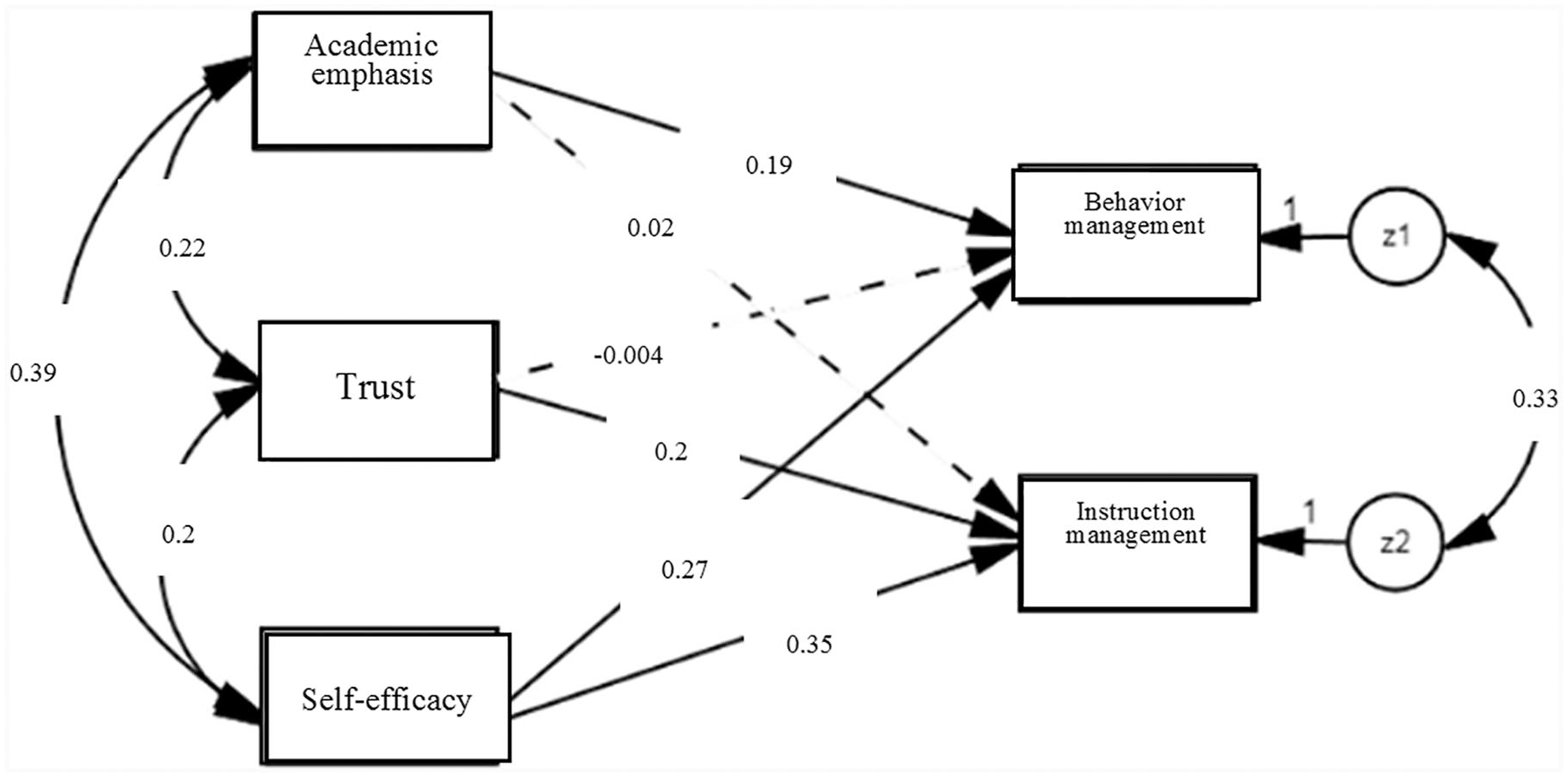
The final model of the role of academic optimism in teacher classroom management.
Nonstandard and Standard Effects’ Coefficients of Academic Optimism on Classroom Management by Elementary Teachers.
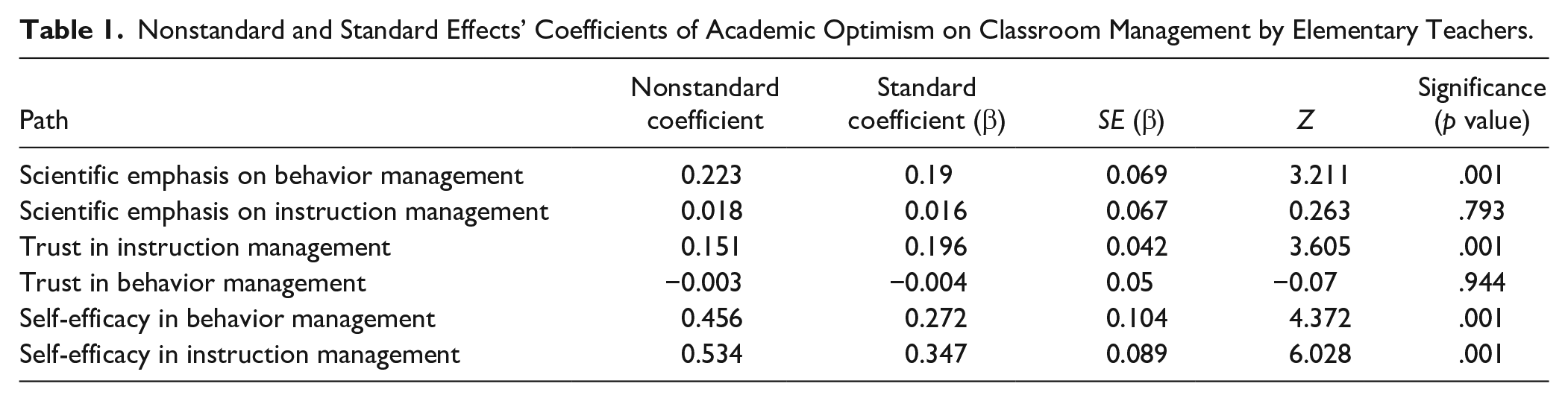
Table 1 shows the nonstandard and standard effects coefficients of academic optimism and classroom management styles of teachers. As it is obvious, the standard coefficients of scientific emphasis on behavior management (β = 0.19), trust in instruction management (β = 0.196), self-efficacy in behavior management (β = 0.272) and self-efficacy in instruction management (β = 0.347) are statistically significant (p < .01). However, the paths of scientific emphasis on instruction management and trust in behavior management have were not significant (p > .05).
Table 2 shows the model fit indexes of the academic optimism effect in teacher classroom management. According to this table, in case the values of χ2/df index is less than 3, root mean square error of approximation (RMSEA) index is less than 0.08 and normed fit index (NFI), goodness of fit index (GFI), and adjusted goodness of fit index (AGFI) indexes are higher than 0.90, that the data fit well with the conceptual model. Here the values of χ2/df index is equal to 0.036, RMSEA is equal to 0.001, NFI, GFI, and AGFI are equal to 1, 1, and 0.999, respectively. Therefore, it can be said that the model fits well.
The Indexes of Fit for the Model of Academic Optimism Effect on Classroom Management of Teachers.

Academic Optimism Has Effect on Job Burnout of Elementary School Teachers
Path analysis was used in order to test this hypothesis too. Exogenous variables (independent) in this analysis are components of academic optimism and endogenous variables (dependent) in this analysis are components of teachers’ job burnout.
Figure 3 shows the final model of the role of academic optimism in teachers’ job burnout. Table 3 shows the nonstandard and standard effects for each of the paths.
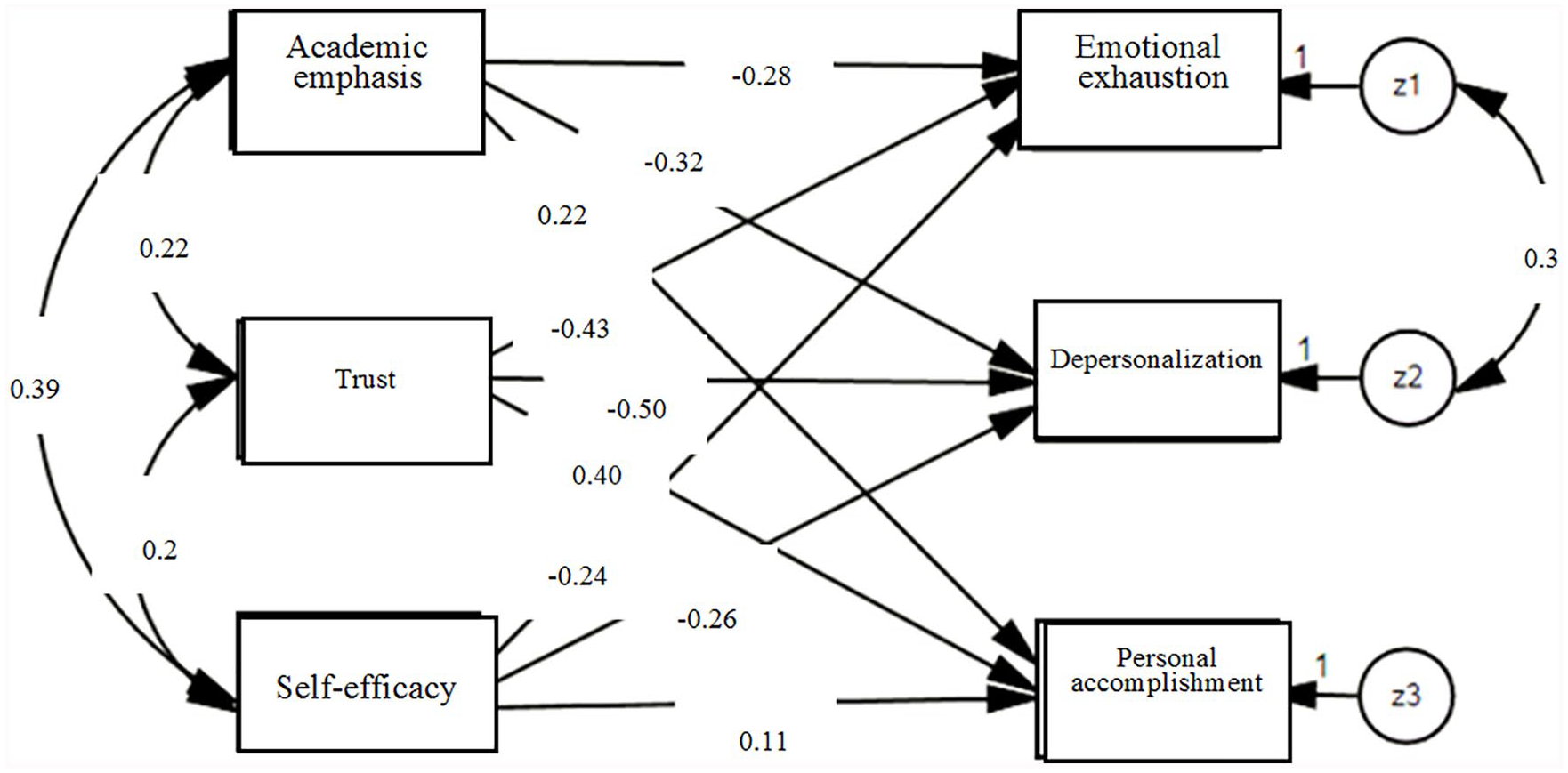
The final model of the role of academic optimism in teachers’ job burnout.
Nonstandard and Standard Effects’ Coefficients of Academic Optimism on Teachers’ Job Burnout.
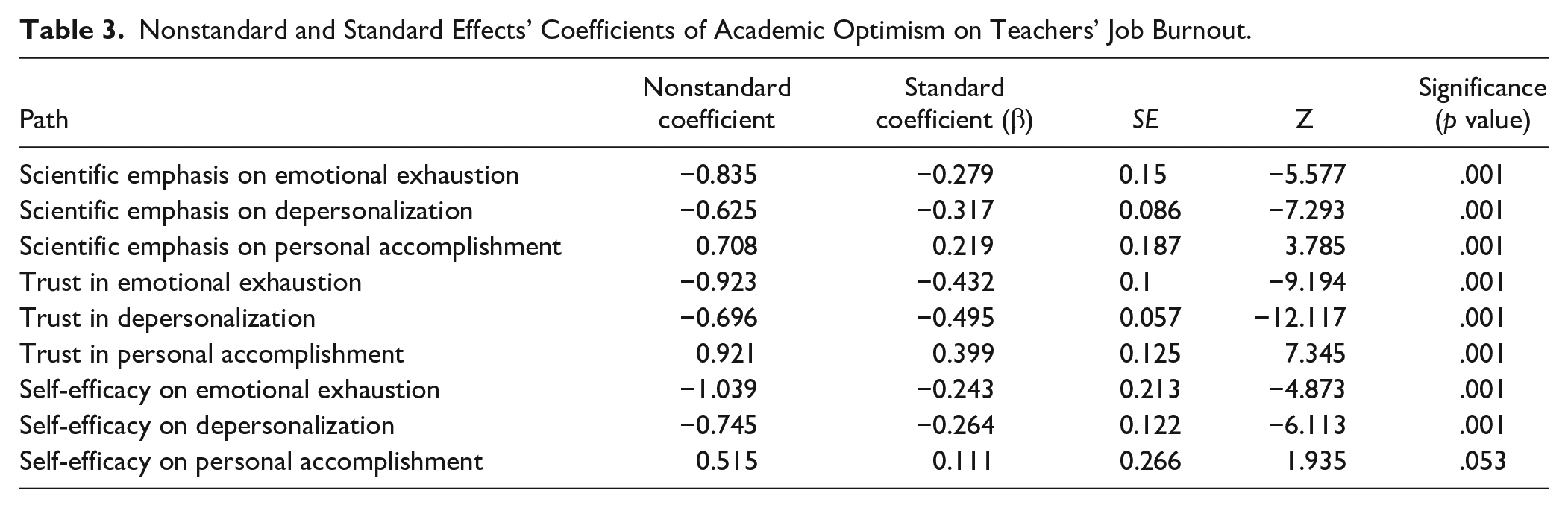
Table 3 shows the direct and indirect impact coefficients of academic optimism on teachers’ job burnout. As it is obvious, standard coefficients of scientific emphasis on emotional exhaustion, depersonalization, and personal accomplishment are 0.279, 0.317, and 0.219, respectively. Also, standard coefficients of trust in emotional exhaustion, depersonalization, and personal accomplishment are 0.432, −0.495, and 0.399, respectively, and standard coefficients of self-efficacy on emotional exhaustion, depersonalization, and personal accomplishment are −0.243, −0.264, and 0.111, respectively, which show all are statistically significant (p < .05).
Table 4 shows the model fit indexes of the academic optimism effect in teachers’ job burnout. As it can be seen the values of χ2/df index is equal to 2.388, RMSEA is equal to 0.074, NFI, GFI, and AGFI are equal to 0.992, 0.994, and 0.935, respectively. Therefore, it can be said that the model fits well.
The Indexes of Fit for the Model of Academic Optimism Effect on Teachers’ Job Burnout.

Conclusion
The aim of this study was to investigate the role of academic optimism in classroom management and job burnout of primary school teachers. Path analysis was used to investigate the research hypotheses. According to the analysis of the first hypothesis, the components of academic optimism was as exogenous variable (independent) and the components of teachers’ classroom management style was an endogenous variable (dependent). The results of this investigation showed that the paths of scientific emphasis on behavior management, trust in instruction management, self-efficacy in management, and self-efficacy in instruction management were statistically significant. But the paths of scientific emphasis on instruction management and trust in behavior management were not significant.
This findings are consistent with the results of research by Abay and Raju (2018), Hamidi and Memari (2017), Makhtumnejad (2015), Hassanzadeh (2013), and Borazjani (2009). Whenever the teacher has optimistic belief, he or she emphasizes on teaching and learning and believes in his or her abilities and capacities, and besides, trusts the student, so in his or her classroom management style, with complete confidence in the student and attention to individual differences, acts only as a guide and never restricts the student’s freedom and does not try to achieve educational goals by exercising control and emphasizing classroom rules. Optimistic teachers in a classroom context focus on the quality of positive classroom management and school students and their interactions. Also, S. D. Martin (2004) believes that the more positive and optimistic teachers are about the class, the more successful they are at teaching and managing the class. Also, it seems that in an optimistic classroom, teachers emphasize the proper use of opportunities and better facilities (Hoy et al., 2008). According to these results, it can be said that teachers who have high score in the component of scientific emphasis in the management of their classrooms are more inclined to manage the behavior of their students. Teachers who manage student behavior tend to be more interventionist. Exerting pressure by teachers and determining high and, of course, achievable goals for students claims a regular and serious learning environment, that is, an environment in which students are encouraged and value academic achievement (Hoy et al., 2006); Therefore, it can be a good predictor of interventionist management style because the interventionist teacher emphasizes control and has more supersession over students’ activities and behavior and classroom rules and discipline to achieve educational goals.
The positive effect of trust in parents and students indicates that in case of teachers who care more about students’ academic improvement, along with increasing the trust in them, their awareness of their school and classroom also increase, and their classroom performance also enhanced. It seems that these teachers enthusiasm for teaching has increased, their control over students and enforcing classroom rules has enhanced, and they are more confident in students’ and their parents. In fact, teachers who trust students and their parents’ use instruction management or interactive style in their classroom management. The positive correlation between teachers’ self-efficacy and both behavioral and instruction management styles indicates that such teachers believe in their abilities in their classroom and tries to instill in students the belief that they can do their tasks well, they ask good questions from students, and convince students to follow class rules.
According to the analysis of the second hypothesis of the research, the components of academic optimism is as exogenous variable (independent) and the components of teachers’ job burnout is as endogenous variable (dependent). The results of this study showed that the paths of scientific emphasis on emotional exhaustion, depersonalization, and personal accomplishment; trust in emotional exhaustion, depersonalization and personal accomplishment; and self-efficacy in emotional exhaustion, depersonalization, and personal accomplishment were statistically significant. Therefore, it can be said that the components of academic optimism have a negative effect on emotional exhaustion and depersonalization and have a positive effect on personal accomplishment.
This finding can be considered consistent with the results of research by Lynn (2013), Mohseni et al. (2016), and Norouzi (2015). Optimists believe that they can manage adversity and problems successfully, rather than trying to use unusual and abnormal methods to solve problems. Optimists have a correct interpretation of the behavior of others and understand what they mean by their behavior. When people face adversity and problems, they experience a variety of emotions that ranges from arousal and passion to anger. Emotional exhaustion is the main dimension of job burnout, which is more pronounced than other dimensions. Whenever people explain job burnout in relation to themselves or others, their main purpose is emotional exhaustion during which in that person’s emotional forces are gradually depleted. This dimension represents the basis of personal stress, which not only destroys the motivation in the person but also reduces personal emotions and excitement in the person in such a way that doing work becomes tedious for the person, but teachers with academic optimism try to overcome emotional exhaustion in their job by improving their own self-efficacy, trust in students and parents, and academic emphasis. Academic optimism, on one hand, makes teachers to feel no gap between themselves and their students, enhances their abilities, and makes them interested in their job. On the other hand, optimism is a generalized expectation that good consequences will come out when dealing with important life problems. Job burnout is a consequence of constant and frequent job stress. In such a way that, the person feels tension in his work environment due to internal and external factors, and this tension is continuous and frequent, and eventually turns into a feeling of burnout. Burnout includes physical, mental, and emotional exhaustion and also negativity toward work and life is also a mental symptom of burnout. Thus, academic optimism helps in reducing teacher job burnout.
According to the results of the research, it is suggested that teachers be encouraged to hold monthly meetings with students’ parents to be confident of their cooperation, which increases teachers’ morale and motivation and influences their teaching styles. Considering that academic optimism and its components are related to teacher classroom management styles, this knowledge can be given to teachers during teacher training courses or during work and mid-career training. Courses. Considering that academic optimism is negatively related to teachers’ job burnout, we should try to spread a sense of optimism among teachers. It is necessary to create job security for teachers and other employees of the organization and also it is necessary to know the causes of stress and its complications and provide services to reduce it. Establishing and maintaining human relationships in the organization and emotional support for teachers is necessary too. It is also suggested that the future researches investigate the role of academic optimism, teaching style, and job burnout in students’ academic achievement.
Footnotes
Declaration of Conflicting Interests
The author(s) declared no potential conflicts of interest with respect to the research, authorship, and/or publication of this article.
Funding
The author(s) received no financial support for the research, authorship, and/or publication of this article.
