



Abstract
This article investigated possible solutions to disengagement from schools by ethnic minority learners in Botswana. Disengagement is a concern for educationists and researchers. The study used qualitative approach to investigate the problem. The reason for disengagement include cultural misfit. The theory of social integration was used to understand the problem under study. The findings indicated that there must be consultation with farm owners and they use local languages for teaching. The article concludes that there is a need to liaise with stakeholders to review certain practices to encourage retainment in schools such as mobile schools and the use of indigenous languages.
Introduction
Disengagement from school in ethnic minority groups is a concern for educationists, researchers, and the society in rural and remote area primary and secondary schools of Botswana. Scholars view disengagement from schools as a loss to the economy of the country because once at home, the school dropouts become a burden and depend on food baskets provided by the government. However, the problem is prevalent in rural and remote area dweller settlements (RADS) primary and secondary schools. These are areas where San children and other ethnic minority groups attend. For this article, the term San is used as accepted by the Working Group of Indigenous Minorities’ (WIMSA). These are groups of indigenous people who primarily relied on hunting and gathering in Southern Africa. The term is used in academic circles instead of Bushmen and Basarwa which are deemed derogatory (Hays, 2006).
This article focuses on two San groups in two different districts of Botswana—Ghantsi and Central. Other ethnic minority groups mentioned are used to share their experiences and also support the argument with secondary data such as Baherero and San in Tsumkwe. The two groups: San in the Central and Ghantsi districts are different not only due to their geographical space but also in terms of language, culture, and history. For example, the San in the Central District—around Serowe are marginalized. Some of them have lost their identity as they do not speak the San languages and are not competent in Setswana—the national language. Most of the time, they work as herdsmen for the dominant groups in and around Serowe. Their children struggle to attend and complete their education due to social factors and stigmatization in public schools. To date, they do not have any political leadership or representative of their own. This study followed females who disengaged from school, whose children disengaged, and San parents whose children are still attending school to provide possible answers.
In Ghantsi, there are various groups of San who are still marginalized and struggle in educational circles. Some of them stay in farms owned by farmers and do not go to school. There are multiple reasons on why some children have not been sent to schools while others disengaged. The significant difference in this region is that there are educated San who were assisted by the San Research Center from the University of Botswana to achieve educational goals and personal development. It is the educated group of San that this research targeted. This particular group of San managed to complete their education despite the daily hardships they faced. They have lived the experience of disengaging from school and being readmitted. Similarly, they witnessed the disengagement from school by their brothers and sisters. Again, some of them hold high positions in some governmental departments, Nongovernmental organizations and some are political representatives of their communities. Therefore, the selected group was more likely to provide solutions to the prevailing problems they faced on daily basis and are still prevalent.
The Botswana Government has built hostels in some primary and junior secondary schools to retain ethnic minority learners in schools. This solution is not sustainable in the long run. Learners still run away from the hostel and school. In this regard, the learners’ education, economic, and other social aspects are jeopardized by disengaging from school. Dropping out of school leaves the ethnic minority learners having not completed their education and trailing behind other ethnic groups who successfully completed their studies. Hence, this study investigated the solutions from the affected groups in two regions. It has also used narratives of education officers and San Research Center who have consistently experienced and witnessed the high school dropout rates while they were working for the government.
Review of Literature
Botswana Education System and the San Groups
In Botswana, theoretically, it is mandatory that learners must go through free primary schooling from Standard 1 to 7 to complete primary education (Republic of Botswana, 1994). Standard 1 to 4 is lower primary, while Standard 5 to 7 is upper primary (Republic of Botswana, 1994). Learners have to pass with Grades A to D to be admitted to Junior Secondary School. This is where they enroll into Form 1 and move to Form 2 after 1 year and complete in the third year. If students pass with good or better grades A to D, they are admitted to Senior Secondary School which prepares them for tertiary education (Republic of Botswana, 1994).
However, San children have always been left behind. Research indicated that when learners register at lower primary, after 1 to 2 years, half of the students who initially registered are more likely to have dropped out of school (Mokibelo, 2014). Le Roux (1999) indicated that San children are driven away from school by the language barrier and consequently pushed to their poverty-stricken areas. Other researchers also pointed out that at one primary school in the Central District, 20 to 25 San children drop annually at Standard 1 and 2 (Mokibelo & Moumakwa, 2006). In a tracer study that followed, students admitted at a Junior Secondary school it was observed that 17 learners dropped out annually from Form 1 to 3 (Mokibelo, 2010).
Teachers speculated about the reasons why learners dropped out of school. Scholars consistently affirmed that ethnic minority group cultures are different from the school culture and hence, learners do not easily adapt to the school environment. The learners lacked interest in school and have a negative attitude toward school. Another tracer study that followed the learners in their respective homes and destinations indicated that children drop out of school in Standards 1 and 2 for various reasons, such as language barrier, corporal punishment, and cultural issues such as wanting to settle down with their partners, lack of understanding English, and being nostalgic (Mokibelo, 2014). To further support the latter, Polelo (2006) observed that San girls in the Kweneng District disengaged from school due to pregnancy and cultural misfit. In addition, S. Molosiwa and Moswela (2012) argued that high school dropouts are influenced by factors such as student’s ethnicity, socioeconomic status, home life, poor attendance, and failing grades.
Nguluka and Gunnestad (2011) indicated that in Gantsi, 30% of the San children dropout every year at primary school level. In a shocking incident in Gantsi, one of the employees (San origin) working for a nongovernmental organization was alerted by the school head at a junior secondary school that half of the learners disserted school all at once leaving the school a disserted place (Saul, 2018). The idea was for him to assist by coming to school to address those who are remaining to stay in school and also strategize on how they could bring back those who disserted. This situation has been debated in various forums such as workshops and seminars, and no solution to the problem has been found. Ethnic minority group learners consistently disengage from school at different levels of education. The critical concern is that most of them drop out of school at the beginning of their academic life—primary school level. Again, those who manage to go to secondary school, disengage before they complete the 3-year junior secondary schooling duration. Once learners disengage, it is not easy to draw them back to school. The school authorities do not seem to make much effort to bring them back to school because it is “their choice” to drop out of school. This article does not claim that the government of Botswana is not doing enough, but it attempts to explore possible solutions to the high rate of disengagement using lessons from other countries to suggest possible measures to address the problem.
Mobile Schools
This section discusses what other countries are currently doing to address high rate of children who do not go to school. Some countries are assisted by United Nations International Children’s Emergency Fund (UNICEF), an organization created for humanitarian purposes for children who have been disadvantaged by war by providing health care services and food. The scenarios used are context-specific, hence, the solutions depend on the culture and lifestyle of the children in the respective countries. The section uses documentation from five countries to draw lessons from Sudan, Kenya, Belgium, India, and Tsumkwe (Namibia).
Sudan has mobile schools that come from long way back. In 1990, a partnership was set up between the government, UNICEF and the nomadic communities to offer nomadic children education. The purpose of the mobile schools was to ensure that nomadic youth received the same educational opportunities as other Sudanese children who attend formal school. The first mobile schools in Darfur and Kordofan were set up in tents or temporary structures made of straw and bamboo. Some schools simply used the shade of large trees. Educational and teaching materials were availed to the schools. In addition, the schools were equipped with solar lamps to facilitate evening classes for both children and adults. Today, there are more than 200,000 nomadic children enrolled in some 1,500 government nomadic schools in almost every state in Sudan. Despite the effort by the government to engage all learners, there are still some children who are not attending school due to their nomadic lifestyle, but majority of them are absorbed by the mobile schools and not jeopardized by their cultural lifestyle.
In Kenya, mobile schools take into consideration the mobile lifestyle of nomadic communities that are always on the move to look for water and grass for their livestock; hence, having pastoralist constant resettlements. Mobile schools and communities are provided with the necessary equipment and tools as well as the manpower (Slavin, 2011): a camel to transport portable chalkboards, tin of books, and materials. As communities move and resettle in another area, they are followed and education is provided. Teaching is multigrade to ensure all children in the community benefit. The established mobile schools, while focused on basic literacy and numeracy skills, equally cater for the Muslim religious traditions of the communities. The schools also house two teachers, a ‘dugsi’—traditional Qu’ranic teacher and a mobile school teacher who is selected by the community and trained by Education for Marginalized Children of Kenya (EMACK) and Nomadic Heritage Association (NOHA). The main objectives of EMACK are to improve access and retention rates for primary school students in historically underserved groups. Most of these learners are found in Nairobi, Coast and North Eastern provinces. It also supports improved school management which ranges from developing mobile libraries for nomadic communities’ schools to teacher training and small grants for school improvement in urban settlements. The project also trains teachers on how to manage large class sizes; promote active learning and also to provide guidance and life skills training to upper primary students. EMACK’s approach engages parents and community stakeholders in children’s learning processes, develops a community of reading, and supports identification of school challenges and solutions by School Management Committees (Slavin, 2011). In addition, NOHA is a local NGO based in Northern Kenya, a marginal area. NOHA aims to address education as a child’s right and is currently piloting a mobile school concept in its project area. It is supported by EMACK. A total of 12 children have transited from a nomadic pastoralist setting to a boarding school in a year’s period. It has also trained some children in the area as advisory council in its project on child rights, bringing relevant stakeholders together.
Slavin (2011) states that teachers who work under EMACK and NOHA continue to live and move with the community and provide continuous education for pastoralist children. The mobile schools in Kenya have been designed to suit the needs of the nomadic lifestyle and the religious needs of the learners and community members. However, from this text, it is not clear how the learners are assessed and whether or not all learners eventually proceed to secondary and tertiary education. It is not clear whether students from the Christian community are affected by the same problem and if so, how are they catered for. The crux of the matter is that children are receiving basic education which is suited to their nomadic lifestyles and integrated into their cultural values. Slavin (2011) provides evidence that over 80 children, including 28 girls have benefited from the three mobile schools in Wajir and acquired basic education. Girls are specifically mentioned because cultural issues disadvantaged them. They had to get married hence limiting their chances of enrolling in school. Some had a bonus of transitioning to boarding schools to complete their primary education. In this regard, the mobile schools mark a significant step forward in providing culturally appropriate education to those who are marginalized because of traditional lifestyles (Slavin, 2011).
Belgium addresses the problem of high-school dropout by street children through mobile schools (Vlieghe & De Troyer, 2009). The country has developed mobile school carts and educational materials and also trained local street workers to increase efficiency of outreach. The idea behind having mobile schools in Belgium was to assist children to discover and unlock their talents and to regain a positive self-image (Vlieghe & De Troyer, 2009). The equipment used is an extendable blackboard on wheels that comes with more than 300 educational panels ranging from literacy to street business, health, and hygiene. The educational panels can be easily attached on the mobile blackboard with plastic screws (Vlieghe & De Troyer, 2009).
Children’s Hope in India started a mobile school in 1992 to travel to areas in the outskirts of Delhi where children do not have easy access to school (Charanji, 2018). The project was launched in partnership with Salaam Balak Trust, an organization with extensive experience in working with street children. The traveling team included two teachers, one social worker, one coordinator, and a driver. It targeted 172 enrolled children. The bus route included areas in Mansarover Park, Shastri Park, and Vivek Vihar. The bus stop in each area for 2 hours and include lessons in Mathematics, Science, English, Hindi, and Social Sciences. In addition, the teachers play games and lead discussions and prayers with the children. A snack is also provided to each child.
The mobile schools discussed above serve different needs of children who are disadvantaged such as having no access to school, street children, nomadic children, and children from low-income households. In these instances, some learners have not disengaged from school but where they are, they were unable to access education. Second, transportation used is different depending on the country. Buses and camels which are local resources and are accessible are used. Third, teachers are trained from the local communities or street trained workers and those belonging to a religious group. The children are taught by teachers of the same religion as theirs. In addition, India has a unique scenario where the mobile bus leaves with additional manpower such as a social worker, a coordinator and a driver. The bus stops at different stations where children have registered. There are no stationed buildings. In Sudan the classrooms are built with local materials such as bamboo and straw. The government of Sudan has to be praised in this case because the mobile schools are government owned. Kenya emphasizes educating the girl-child because the education system has been focusing on the boys. Finally, the mobile schools here contextualize the design and structure of the schools to the lifestyle of the children.
Of interest is the Tsumkwe case in Namibia which the researcher observed during the Nyae Nyae Conservancy visit with San Research Center in 2012. Nyae Nyae Conservancy designed some schools to address the problem of disengagement from school. The schools are located in areas where San people have projects such as a living museum, processing of devil’s claw, and subsistence farming. In areas where there are schools, there are local teachers. The San teachers are provided with tents, sleeping stretchers, radios, stationery, and other necessary tools to assist them in their teaching. The teachers are paid a salary and at month end, they are given an opportunity to go for shopping in the main village. The San children who attend these schools have school cards. As they move from one place to another, arrangements are made for their progression and they carry their cards with them to present them to the next school. Teachers indicate what the child is currently learning so that they continue where they left in the next school. Therefore, even if there is movement, it does not disadvantage the children because there is continuation of lessons where ever they go. The teachers report to the school principal in Tsumkwe and collect teaching and learning materials from him or her. In essence, San children in Tsumkwe do not stop learning, they continue with their education wherever they go. There is linkage and networking among teachers and school principal. The teachers share the same culture with learners and therefore understand their socioeconomic problems much better.
In Botswana, the disengagement from school is multifaceted. For example, in Ngamiland District, there is a cultural practice by San in which parents and children follow animals during the hunting season. The researcher observed these practices during National Service in 1982 in a school she was teaching on part-time basis. The children disserted school for 2 to 3 months and came back to school after the hunting season or disengage forever. Another problem noted by teachers was that there is another group of children who are not San but belong to the Herero tribe, when it is time to vaccinate their cattle, the boys leave school to go and help their parents collect the stray cattle for vaccination. This is not an easy exercise because the cattle would be scattered in different places and the exercise may take 3 weeks to a month. Other Herero boys may decide to go back to school while others prefer not to go back because they would have missed a lot from school (Teacher from School A).
From the researcher’s experience and observation from 20l6—to date, there are other children who go with their parents to cut grass in the Central District. These could involve different ethnic groups, the San included. The elderly people cut the grass and sell it to passersby to earn a living. When the parents locate a place where there is plenty of dry grass, they put up temporary shelters and stay there for months or years. The relatives would provide food and water when necessary. However, other people have found a way of making a living by selling water and food to these people. They also collect their grass and put up in bundles and charge them a fee for transportation. Of late, the accommodation structures seems to be permanent because they sell the grass from where they have settled and they have decided to make grass brooms and other small businesses such as selling traditional medicines to passersby. Something common about these scenarios is that the movement from one place to another is influenced by the parents’ lifestyle: hunting, cattle rearing, and grass cutting.
Theoretical Framework
The Concept of Social Integration
The concept of social integration is used in this article as a yardstick to relate the theory to the main concern of this article—possible solutions to the high rate of disengagement from school by learners of ethnic minority groups. The social integration theory is a sociological theory crafted by Emile Durkheim in 18th century. The concept of integration was first studied by Park and Burgess in 1921 through the concept of assimilation. Other scholars who contributed toward the theory were Peter Blau (1960), Ferguson (2008), and Beresneviciute (2003).
Integration covers conceptions of conflict as well as order, so the same concept could be applied to forms of stability of social relations and compensation of balance among different social units and groups (Vida Beresneviciute, 2003). In the broadest sense, the term integration is used to define developments that determine connections of related diverse elements into the social whole, system, community, or other unit. The concept of integration is a fundamental one in functionalist theories, and it defines a mode of relations of the units of a system by virtue of which, on one hand, they act to avoid disrupting the system, and on the other hand, they cooperate to promote its functioning as a unit. The concept of integrity is important in other theoretical perspectives that use other concepts such as: consensus, solidarity, and correspondence (Beresneviciute, 2003).
Different types of social integration theories were developed by Durkheim, Weber, Comte, and Blau. However, this article uses the basic principles of the theory derived from some of the scholars who contributed toward its development such as Beresneviciute (2003). The author defined social integration theory as a process of interpenetration and fusion in which persons and groups acquire the memories, sentiments, and attitude of other persons and groups and, by sharing their experience and history.
The social integration is relevant to this article because ethnic groups are often confronted by new requirements emerging from redefined citizenship, civic loyalty, knowledge of the state language, value changes, participation in the newly formed bodies of the private or nongovernmental sectors, and education systems (Beresneviciute, 2003). In this regard, ethnic groups had to respond in a more active or passive way or avoid adaptation through emigration, segregation, or life in closed communities. Beresneviciute (2003) argued that both minorities and majorities went through multiple processes conceptualized in different terms, such as adaptation, acculturation, assimilation, or integration.
Social integration can be defined as the process of promoting the values, relations, and institutions that enable all people to participate in social, economic and political life on the basis of equality of rights and opportunity, equity, and dignity (Blau, 1960). Social integration was defined as the process of fostering societies that are stable, safe and just and that are based on the promotion and protection of all human rights, as well as on nondiscrimination, tolerance, respect for diversity, equality of opportunity, solidarity, security and participation of all people, including disadvantaged and vulnerable groups and persons. (Ferguson, 2008)
Social integration indicates principles by which individuals such as actors, agents, or subjects are bound to each other in the social space and it refers to relations among the actors, that is, how the actors (agents) accept social rules (Beresneviciute, 2003). Social integration describes the process of building institutions that promote a society for all on the principles of social justice.
There are strong instrumental reasons for promoting social integration such as deep disparities, based on wealth, region, gender, age or ethnicity reduce social mobility (Watkins, 2007). These, in turn, lead to de facto fragmentation of society and has negative impacts on growth, poverty reduction, democracy and conflict avoidance (Watkins, 2007). Priorities for promoting social integration include: taking a “people-first” view of what people and communities need, using evidence about their actual experiences and life outcomes; developing policy through integrated, problem-solving projects which draw together all relevant agencies and knowledge; and developing programs within a comprehensive social inclusion framework, researching and understanding the links between programs operating on the ground, and working across all levels of government, including through the Council of Australian Governments, to join up service delivery in strategic as well as practical ways (social inclusion principles of Australia). Policies and programs should be focused on long-term sustainable improvement. To do this, it is important to ensure that interventions build an individual’s capacity and develop protective factors that will enable them to self-manage through life-course events.
One of the social integration principles are about making societies more equitable. The key challenge for policymakers promoting this agenda of social integration is ensuring cross-sectorial coherence and a set of policies that are mutually compatible in terms of promoting equality and well-being for disadvantaged groups. Equity objectives stress the importance of a fair distribution of resources and burdens. They are about economic and social aspects, and about quantitative and qualitative dimensions. The objectives for equity are considered as guaranteeing minimum standards; supporting living standards; reducing inequality; and promoting social integration.
The second critical principle is that of recognition (Ferguson, 2008). This principle is seen as a key challenge for policymakers to identify a coherent set of policy instruments that can take into account processes of recognition, redistribution, and representation across different sectors. Policies need to increase access to services without undermining recognition, support forms of participation that lead to redistribution of socio-economic resources, and identify redistribution policies that are likely to gain broad support and, consequently, political commitment for implementation. It requires actions to renegotiate and redefine existing social contracts which define the rights and responsibilities of citizens. Without efforts to address intolerance and discriminatory social norms and practices, other antidiscrimination measures can reinforce a devalued difference rather than promoting positive changes in cultural status (Ferguson, 2008).
Furthermore, the concept of social integration first of all requires language skills that are perceived as a prerequisite for the ability to engage in relevant transactional, social, and educational exchanges. Language is another important variable to access the degree of the target group’s social integration. A higher level in grasping local language results in more chances to communicate with local people and a better understanding of local culture.
Education and the promotion of bilingualism and literacy are core tools in multiculturalism. The implementation of linguistic policies in education should enable training of indigenous groups without requiring them to relinquish their ethnic identity, language, and culture are increasingly being implemented (Ferguson, 2008). The education system has to provide equal opportunities for learners to retain them in school. In response to the latter, a problem such as high rate of disengagement from school needs to be renegotiated and redefined by the existing system in place that can allow San learners retention in school or allow them to complete their education one way or the other. Retaining them in school does not necessarily mean keeping them in government public schools. Wherever they are, as long as they are learning and acquiring knowledge and skills, following a robust, specially tailored program for them is another way of getting them educated. In this regard, the current school system conflicts with their own interests and values and therefore, it is vital to reflect on what ethnic minority learners’ need, what are their experiences and life outcomes. The social integration concept challenges the Ministry of Education and Skills Development to come up with problem-solving educational projects that would include them in the education system. The solutions for high rate of disengagement should be focused on long-term sustainable development for ethnic minority groups. Currently, the high rate of disengagement disrupts the education system; it is an eye sore that contributes toward educational goals not totally being achieved because other learners are left out. The disengagement from school only leads to exclusion. Instead of education promoting values that enable ethnic minority groups to participate in education, society, and politics of Botswana society on the basis of equal rights and opportunities, it has already kicked them out. Therefore, the concept of social integration contravenes the current experiences of learners who drop out of school. Hence, universal access to services, including education and health, as well as social protection packages are critical elements of policies to promote social integration.
The mobile schools above are different. However, they have a common goal, to educate children who for one reason or another are unable to complete their education or attend formal school.
Research Methodology
This study adopted the qualitative approach to investigate the possible solutions that could assist in addressing the problem of high rate of disengagement from primary and secondary schools in remote and rural areas from 2018 to 2019. The study involved participants who came from Central and Ghantsi Districts of Botswana and are working in different areas. The convenient sampling used involved male San participants from Ghantsi. The male participants have completed their Bachelor or Masters’degrees. The four participants carefully chosen are part of the San community, they have the firsthand information, have experienced the problems and or have seen what their brothers, sisters, and cousins went through in the schooling process. Some participants have bachelor degrees. Two of the participants have Masters Degrees, one in Linguistics and one in Adult Education, while the other one did not complete a Degree in Business Management. Their ages range between 30 and 45. Their participation in this study was vital as it involved the issues that are at their fingertips. Therefore, the choice of participants was crafted by the researcher to get as much information as possible from them.
To balance gender issues, six female San participants from the Central District were interviewed to get firsthand information about the problem under study. Convenience sampling was used as participants were followed in their homesteads. Most of the participants disengaged from school or their children and relatives disengaged from school especially at primary and secondary school level and had families and school going children. Their ages ranged from 25 to 40. The motive behind their selection was that they are part of the problem and therefore they should be part of the solutions.
The other interviewee was a former principal education officer (PEO) who worked in Ghantsi region as a teacher and school principal in the early years of his career and had the feel of the high rate of disengagement from school. Also, he worked in the Central District where there are ethnic minority groups that disengaged from school. The former PEO has a wide range of experiences as a teacher, school principal, and education officer in the Department of Basic Education and was in a position to share his or her experiences. Another participant was from the San Research Center from the University of Botswana who deal with San issues and could provide solutions from his experiences with San learners in and outside the university. All in all, the participants were 12, six males and six females.
Interviews, experiences by the researcher and information from previous research on San education and other ethnic groups were used as data. In other words, participants were interviewed and have answered the same open question: How do you think the high rate of disengagement from primary and secondary schools can be addressed for San children to complete their education in Botswana? This was an open question that allowed the participants to say their views about the research problem looking at the different reasons why San learners dropout. The question allowed the researcher to tease out information from the participants depending on their responses, hence, the interviews were rich and informative.
The interviews were unstructured to allow the participants to freely discuss the possible solutions on what could be done to address the prevalent problem. The researcher asked questions about the children in farm ranches and villages, those whose parents were cutting grass, those who still go for hunting and gathering with their parents and those whose parents go to the lands or fields during the plowing season to address these different situations. The researcher had an opportunity to make a follow-up through emails and telephone calls with the participants to fill the gaps from the interviews.
The study also used brief documentations on mobile schools from other countries such as Kenya, Sudan, Belgium, and Tsumkwe to see how they addressed the problems of learners, who for one reason or another, are unable to attend formal school. The information used provided useful information that Botswana government could benchmark.
The participants’ responses were analyzed according to thematic statements. The common answers were regarded as major themes. The focus of the themes was on possible solutions on the high rate of disengagement from school. Therefore, the discussion section pinpoints to the possible solutions provided by the participants as well as literature review from the four countries used.
Limitations of the Study
The study has limitations because not all districts of Botswana with similar problems were covered. Furthermore, not all stakeholders were involved. Again, the study had a limited number of participants who were carefully chosen to provide realistic answers from firsthand information. The study does not intend to generalize the information to other areas or districts not studied but to share information with educational authorities, researchers, scholars, and other stakeholders on what the people affected by the problem think should be done to address the problem under study.
The Results of the Study
This section presents the responses of the participants in the study in Ghantsi and Central Districts and their responses have been categorized accordingly. The responses have been tabulated according male and female for better understanding. Most of the reported data were verbatim allowing participants to give clearer views of what they thought about the possible solutions (Figure 1).
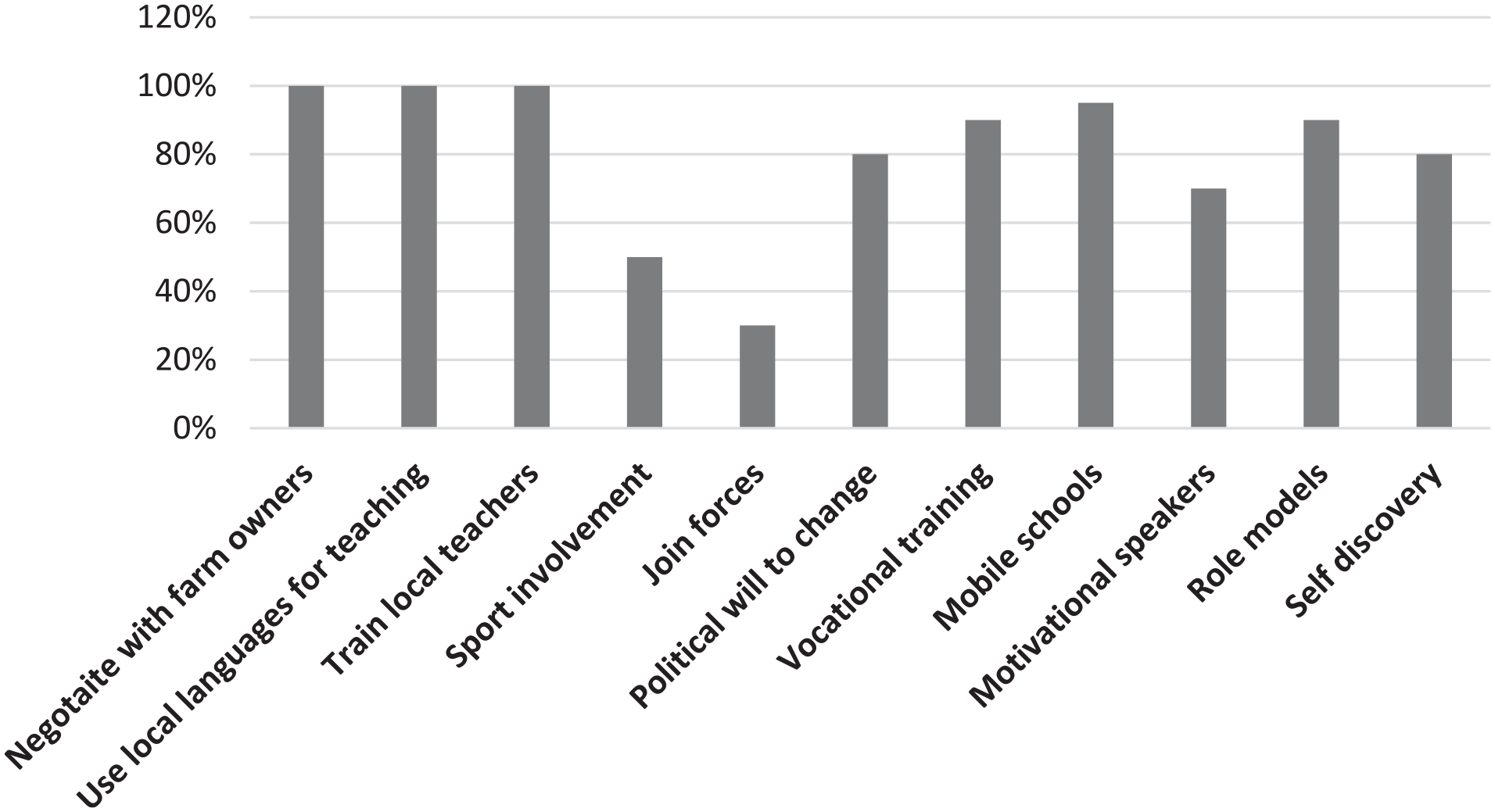
Male San participants from Ghantsi.
The male responses above seem to be influenced by the core issues they experienced in the Ghantsi region. For example, all the participants reported that there are children who dropped from school but stay in farms and therefore the government and other stakeholders should negotiate with farmers to allow mobile schools in their farms. The solution of negotiating with farm owners to allow mobile schools in their farms was suggested by all participants because they believed it might address part of the problem.
Furthermore, all participants reported that the government should allow the use of home languages in schools. This suggested that the issue of language barrier in schools was still prevalent. In addition to the latter, all participants reported that training of teachers in local languages should be initiated. This could suggest that learners may not be compatible with teachers who do not speak their languages.
Also, most of the participants reported that they needed role models in their communities for San children to look up to. Furthermore, most participants reported that the most important thing for San learners to do is self-discovery. If they do not discover themselves nothing would change. Again, most of the participants reported that there must be a political will to change the situation. This suggested that the participants are aware that the government may not be putting enough effort to address the disengagement from school problem.
San Research Center Administrator Results for Ghantsi
The San Research Center administer responded on behalf of San in Ghantsi, hence, they shared the same sentiments as San male participants. The administrator reported that there must be negotiations between the government and farmers on how San who stay in farms could access education even after dropping out of school. The Center administrator has had an opportunity to move around in farms where learners lived with their parents to see their lifestyle and encouraged some children to go back to school.
The administrator also reported that it would be important to introduce mobile schools in farms after negotiations. He said that time could be scheduled when the school could start business of the day for the farms to be opened. This suggested some reforms as regards farm owners, their cattle herders as well as their children as it is difficult for learners to be educated.
Finally, the administrator reported that the introduction of indigenous languages where necessary would be ideal to cater for San language speakers as they do not speak the school languages. The suggestions above indicated the intention to change the status quo and give San children a life that is fulfilling.
The above suggested possible solutions indicated a long standing problem that may take years to resolve. This is not to say there may not be short-term solutions, but for farmers to strike a compromise to release their cattle herders to go to school, could be something difficult to adhere to (Figure 2).

Responses from Central District: Female participants.
The responses from the female participants seemed to be influenced by the tangible issues the participants experience in the Central District. For example, 80% of the participants reported that entertainment should be provided in schools especially boarding schools. This suggested that learners get bored while they are closed up in hostels, at least entertainment could break the nostalgic feeling for some time. In addition, a further 90% reported that hostels should be supervised and monitored by authorities. This suggested that so much could be going on at the hostels that needs leadership to be in control and this could be a contributory factor to disengagement. A further, more than average of the participants reported that the government should provide adequate vocational training schools to absorb learners who are interested in arts and crafts. The participants suggested that some San children are good at art and crafts and therefore their potential should be explored. More participants reported that the law should be reinforced on their parents if they do not encourage their children to go back to school, hence their parents should be imprisoned. This could mean that parents encourage truancy and dropping out of school for their children. On the same breathe, a limited number of the participants reported that dropouts too should be imprisoned and attend school in a prison designed for schooling. Similarly, the participants reported that the school dropouts should be imprisoned in schools where they should not be allowed to leave school until they complete their education. This could be a sign of being tired of children who disengage, since the participants are now parents, they do not want their children to disengage.
There is no mention of language barrier or training of local teachers who speak the children’s languages in the Central District as compared to the Ghantsi region. This is not to say that the issue of language barrier is not prevalent among the San in the Central District. There has been an indication that English drives them away from school among other things (Mokibelo, 2014).
PEO’s Results
The PEO, a man, reported that using boarding schools to retain students could be a possible solution for latest emerging cases of children who go with their parents to cut grass. The officer reported that keeping children in boarding schools could encourage learners to learn, it will give them space for learning and the environment would be suitable for learning. This suggests that the officer still has hope in hostel accommodation despite the fact that ill treatment has been reported.
Again, the PEO alluded that training of local teachers for San in the central district may not be a solution because San people in the central district undermine each other. In addition, they have lost their languages and therefore it could be a dilemma on which indigenous language of instruction to use for them. This suggests that there is so much assimilation that has taken place.
Discussion of Findings
Consultation Between Farm Owners and Government
The findings indicated that the government could consult and liaise with farm owners to sensitize them about the importance of the absent learners in the classrooms to continue their education. The participants from Ghantsi District, who are faced by this unique situation believed that it would soften and enable the farmers to allow mobile schools inside their farms and also contribute either in kind or financially toward the development of such schools. This effort requires government commitment to address the problem under study. From the literature, there is a pattern emerging from all the schools designed to address the school dropouts by children in different countries. Social integration theory requires actions to renegotiate and redefine existing social activities which define the rights and responsibilities of citizens. It is the right for Botswana citizens to get education and therefore keeping them in farms limits and hinders them from going to school.
The pattern observed was that governments of different countries commit themselves to change the status quo by putting up measures in place to address communities’ needs as regards dropouts. The governments used evidence from learners and parents’ actual experiences and provide relevant and appropriate interventions to suit the lifestyle of the children. While communities are also willing to educate their children, it started first with the government commitment, there was the desire to change the status quo and bring life to children who disengaged from school. As such there should be willingness and commitment on Botswana government to change the lives of the San by educating them with appropriate and relevant measures to their lifestyle by consulting and convincing the farmers to change their attitude and allowing mobile schools inside their farms. The big question is what school model can be used to remedy learner dissatisfaction and withdrawal? This consultation could be done by the educated San themselves as a way of paying back to their communities.
Concerted Effort by a Team of Specialists
Research indicated that government should commit themselves to creating mobile schools. All the participants from the Ghantsi District agreed that whatever interventional strategy used to address disengagement from school, it should follow learners where they are while the learners are stationed in their destinations, hence, mobile schools. Therefore, learners should not be separated from their parents because this conflicts with their home lifestyle and culture. Charanji (2018) from India indicated that building teams of specialists for mobile school visits worked for them. While teaching the school dropouts was necessary, it should not be central to the schools only, other people should be involved such as parents, doctors, psychologists, politicians, motivational speakers, guidance, and counseling teachers and other educated San who could be role models to young learners. Charanji (2018) argued there is evidence of team building and team work among the people involved. The governments of various countries make provision to support the lifestyle of learners who have disengaged from school and not to dismantle it. Like the social integration theory advocates, the government has to prioritize by taking a “people-first” view of what people and communities need, using evidence about their actual experiences and life outcomes. The government could develop policies through integrated, problem-solving projects which draw together all relevant agencies, knowledge, and skills as well as developing programs within a comprehensive social inclusion framework. Where possible teachers could come along with a team of other specialists to address ailments of different kinds that could be found in the learners. This means that the high rate of disengagement requires concerted effort from all stakeholders because it is a society’s problem not an individual’s. The issue that has not been mentioned by the participants about the teams but was gathered from review of literature was that of religion. It was not clear from the participants whether San people belonged to any of the religions that exist in Botswana, what was emphasized was the cultural issue. Probably, the San have their own cultures that are different from other ethnic groups that could be shared by the teachers who come from the same ethnic groups as the learners. In Sudan, the teachers read the Quran with learners, but with San, it could be the chance to share traditional practices such as healing dance and so on. As such elderly people who know about the San cultural practices could accompany the team to transmit the culture to the young learners and maybe engage in healing processes should they identify some ailments, as a way of playing games with their teachers.
The Use of Home Languages for Teaching and Learning
In one voice, the participants from Ghantsi advocated for the use of learners’ home languages for teaching and learning. The language barrier in remote and rural schools is not a new phenomenon in Botswana especially where indigenous groups are involved (Bolaane & Saugestad, 2006; Le Roux, 1999; Motshabi, 2006; Nyati-Ramahobo, 1999, 2000). According to the participants, there was an indication that the target school languages are part of the contributory factors that drive learners away from school, hence, it is critical that the language issue be addressed. The learners can be described as “silently excluded” because they experience little to no learning at all. They remain bored in schools or classrooms. Their attendance was characterized by unexplained excuses for absenteeism (Marumo & Pansiri, 2016). There was an indication from all participants that learners should be taught in their indigenous languages simultaneously with English. Only two participants mentioned that Setswana (the national language) be taught at a later stage to allow learners to conceptualize concepts in their own languages. Participants recognized Setswana for official use and communication purposes across the country. However, from the Central District, there was no mention of the use of home languages although from the previous study by Mokibelo (2014), there was an indication that English acted as a barrier to communication in classrooms. Reflecting on Tsumkwe case, the learners were taught in their local languages and English simultaneously. Teaching learners in their home languages assisted in conceptualization and cultural transmission and hence, learners better comprehended and understood concepts. The concept of social integration first of all requires language skills that are perceived as a prerequisite for the ability to engage in relevant transactional, social, and educational exchanges. In this regard, the education system has to provide equal opportunities for learners to be retained in schools through the use of languages that would enable them to acquire basic language skills. In essence, all the participants saw the benefits of starting schooling with learners’ indigenous languages. Ironically, the retired PEO from the Central District does not think the use of San local languages was necessary because most young San learners do not speak their languages due to assimilation into Bangwato and Ikalanga tribes. Therefore, there were cases where learners do not speak San languages and were also not competent in languages spoken in the region—Setswana and Ikalanga. Hence, it was a common phenomenon to find such groups who have “lost their languages and cultures” and were just in the middle of existing cultures due to assimilation (Chebanne, 2002).
Teachers From Ethnic Minority Groups
Findings demonstrate that learners should be taught by teachers from same ethnic groups, hence teachers from the same ethnic groups as learners should be trained. Participants argued that the government should take the responsibility to train teachers from various ethnic groups especially form five leavers who are unemployed for them to assist in teaching at lower primary. Such teachers could be in a position to translate and interpret concepts in an English lesson. The voices of the affected groups cannot be ignored if the goal of teacher education programs toward achieving education as a “human right” and “education for all” is to be realized. In this regard, disengagement has to be seriously addressed. According to the participants, local teachers could share with learners their cultural experiences in their communities to enrich their acquisition of knowledge and skills. Hence, the teachers suggested in this study are those teachers who share the same norms and values with the children, share the same cultures, religions, and understand their problems. One participant emphasized that the trained teachers could be placed strategically in places where they fit well and go along with the people they are posted to after certain processes and procedures have been followed. Teachers from other groups have been found to use pedagogical approaches that do not promote democratic education (Jotia, 2011). This is a challenge to the government of Botswana because training of teachers comes with costs and serious surveillance of such teachers who are willing to pull their ethnic groups out of poverty. Campaigns, liaison and networking with village chiefs, politicians and elderly people in such villages are necessary. Despite the latter, one of the participant was of the view that the San children in the Central District could not be taught by other San because they undermine each other, this requires further investigation. The participant believed that somebody from outside should be engaged to teach the school dropouts. This is a completely different view from what all the other participants reported, this could be because in the Central District, the issue of language barrier is rather a complex one that needs to be addressed with its own specific measures tailored to suit the problem of language barrier. More emphasis was placed on teachers by participants from the Central District, they reported that teachers should visit learners’ homes, should be in the fore front to orchestrate learners’ completion of their education. This is an indication that teachers should go an extra mile and understand that they are dealing with a unique environment. Darling-Hammons (2006) argues that a teacher is the single most powerful variable that determines educational success of learners, hence, who the teacher is in this article is critical. It is the responsibility of teachers to guide learners’ academic activities and individually assist learners to partake and engage in practical activities of the lessons (Jotia, 2011).
Providing Funds for Training and Purchasing Materials
From the findings, participants from Ghantsi and Central District believed that the government should provide vocational training. It is clear that whatever measures are taken to address the problem, the government should be prepared to spend money on the exercise. Costs should not be regarded as losing money but an investment in education or on human capital. From other countries that have mobile schools, teachers are trained, they are provided with the necessary tools and equipment such as tents, transportation, stationery, drivers, meals, medication, counseling procedures, and other things to implement the mobile school policy. This is a critical step for the government of Botswana to benchmark from Kenya, Sudan, Tsumkwe, and Belgium. In fact, teaching services provided could go along with a mobile clinic because the San people in some of the cattle-posts travel long distances to seek medical attention. In some cases, the San communities prefer the use of traditional medicine only because accessibility and availability of modern medicine is far from their reach. Also, it means the marginalized should also pay for transport costs to reach medical centers which might not be possible due to poverty.
Self-Discovery by Learners
Participants indicated that another possible solution is an issue that has to start with San learners themselves, hence motivational speakers can encourage students. According to the participants, learners have to discover themselves, they have to understand who they are, what they want in life and promote that, otherwise whatever measures put in place would still fail. According to the participants, it is not that the learners do not want to learn, but they need to explore who they are through the help of guidance and counseling officers and psychologists. From the Central District, two participants argued that there should be self-determination and commitment from individual learners. In Botswana for example, learners from indigenous groups disengage at a tender age at the initial stages of learning. They are still too young to think for themselves and therefore as they develop and mature they could be in a position to develop their talents and further explore what they want to be in life—guidance and counseling teachers, motivational speakers, and role models could play a critical role here. Learners should see schools as places that could give them hope for a better life. The schools could help them look at the world from a different and better perspective. The schools could even help learners to reflect on their lifestyle and make effort to change for the better. In this regard, role models and motivational speakers could make a difference.
Boarding Schools
Findings indicated that it would be worthwhile to accommodate learners in boarding schools through the assistance of social workers. Participants emphasized monitoring, supervision, and care for learners. In addition, entertainment such as televisions should be provided in all the schools and hostels attended by indigenous children. However, boarding schools have always been a challenge for San learners in various regions of the country. It has been significantly noted that San learners become nostalgic, are abused physically and sexually, they miss their parents and therefore, it may be a nonstarter for learners who dropped out because it may be the same reason why they dropped. Incidents of a huge number of learners who have been pushed out of the school system by harsh conditions of boarding are found in some studies (Pansiri, 2011). From the literature review, there is no mention of taking the school drop outs to boarding schools; therefore, this issue may not work well for other learners. It is vital not to overlook the advantages of a boarding school such as strong academic opportunities, intense connection with students and teachers, good sporting facilities, learning to be responsible, personal growth and development, fewer distractions and learning independently. For ethnic minority groups studied in this article, boarding schools have failed them because of cultural differences and misfit. In this regard, such a move, would have to completely change the way boarding schools are managed especially at primary school level for learners to see the boarding facilities as an advantage for keeping them in school. Closer supervision with a hawk’s eye could address some of the problems emerging from school hostels.
Political Will to Educate the Drop Outs
Another interesting issue raised by the participants was that there must be a political will to educate San children. This is the authority, capacity, and legitimacy of key decision-makers or reformers to use their powers to change and commit themselves to the changes they want to achieve. Although the high school dropout is a concern to most stakeholders and researchers, the participants argued that the government seem not to give it special attention; hence, it has dragged into decades without a possible solution to the problem (Polelo, 2006). The participants agreed that where there is a political will to change the situation, things can change for the better, the San children can be retained in school, they can be educated with relevant and appropriate strategies and mechanisms. In this regard, a culturally sensitive education, well-resourced education that is aligned to the needs of learners, prioritizing the use of their languages, and using appropriate pedagogy to shape and improve the learners’ understanding are necessary to realize the dreams of the school dropouts. Also, this requires the review of education policies that allow participation and consent by the San. The political will to educate should not resort to assimilation. Furthermore, the political will would also include the will to use their traditional knowledge in the teaching and learning process and this require a well-crafted curricula that is inclusive. In addition, it is the government that has to blow the trumpet that education is a right, and it can socially and economically change the lives of the marginalized. In support of the political will, declarations and conventions have been made since 1953 on the use of mother tongue education and integrating their languages and cultures, these initiative should be revived and resurfaced to the people who keep a deaf ear to the ground (United Nations Educational, Scientific and Cultural Organization, 1953).
Imprisonment of Defaulters
Findings indicated that the participants raised a rather unique solution where they believed that learners who default should be imprisoned for disengaging from school. The participants raised this issue because they were fed up with learners who drop out and go home to idle. The participants argued that children who dropped out should be imprisoned, but this should not be a normal prison where criminals are locked up, but it should be a prison with a primary and a secondary school where the dropouts are locked up until they complete their primary and secondary education and released after completion to attend tertiary education. According to the participants, a high thick fence with high security should be built for learners not to dream of going out. A closer look at this suggestion means costs. The government should be prepared to build such infrastructure for learners, teachers, and ancillary and or support staff. Furthermore, a desirable name for the school should be crafted to avoid stigmatization.
A similar point was also raised by one of the participants that the parents should also be reported to the police or be arrested if they have children at home who have disengaged and are not encouraging them to go back to school or reporting them to school authorities. According to the participants, this effort will make the parents aware that education for their children is important and that they should play their role as parents. This solution is rather unique and unforeseeable, but it came from the bottom of the hearts of participants because they were concerned about the high school dropouts. This is food for thought for both educational authorities and parents themselves to rethink their role in their children’s education.
Parental Care
Findings also revealed that parents should look after their children in various ways by giving them money, attending parents–teachers association meetings and also visiting them at school during the school term. According to the participants lack of parental care leads to learners looking for money by engaging in relationships with older men who would give them money, and this happens at a tender age while learners are at primary school. Furthermore, the female participants also indicated that when the school asks for contributions for the school and they are not able to subscribe because their parents do not have money, they feel left out, and embarrassed. Furthermore, the parents should stay with their children at home and not go to drinking spots or cattle posts to monitor their learners’ behavior and encourage them always. This is a serious challenge to the parents who leave their children alone at home and stay far away in cattle posts. It leaves a gap at home where children have the freedom to do what they want. At their tender age, they cannot make concrete decisions that would develop and make them better people.
In brief, the discussion of findings above does not easily blend with the concept of social integration because the prevailing situation and the possible solutions are supposed to foster a stable, safe society, a society that is tolerant, that respects diversity and provides equal opportunities for its citizens in the education system (Ferguson, 2008). However, all these expectations seem a long-term solution. Again, the social integration demands new requirements emerging from redefined citizenship and among other things knowledge of the state language, value changes, participation in the newly formed bodies of the private or nongovernmental sectors and education systems (Beresneviciute, 2003) which the San dropouts seem not to appropriately fit in. Stakeholders seem not to prioritize the problem of disengagement from school by San children. Giving the San people, equal opportunities in the education system as their counter parts and saving their dignity (Blau, 1960) seem a far-fetched phenomenon even though scholars have orchestrated the problem for decades.
Conclusion
This study investigated possible solutions to the high rate of disengagement from primary and junior secondary schools attended by ethnic minority groups. In one voice, the participants recognized that the problem is a concern and therefore needs a shift of status quo, commitment, and dedication by the government to network with farm owners who keep such children in farms and also train teachers from ethnic minority groups to educate their own children using their own languages while sharing cultural knowledge and experiences with them. Of course the possible solutions come with a cost to effectively address the problem, something that educational authorities need to consider as an investment rather than a cost. The solutions provided could be food for thought for all stakeholders to take some baby steps toward addressing the problem. The left out school dropouts need to be integrated into society for them to contribute toward their self-development and growth as well as the development of the country.
Footnotes
Declaration of Conflicting Interests
The author(s) declared no potential conflicts of interest with respect to the research, authorship, and/or publication of this article.
Funding
The author(s) received no financial support for the research, authorship, and/or publication of this article.
