



Abstract
This study investigated the effects of science, technology, engineering, and mathematics (STEM) applications carried out with the purpose of supporting the integrated knowledge of prospective science teachers on the scientific process skills and STEM education orientation skills of prospective teachers. According to the results, the STEM application was effective on the scientific process skills of the prospective teachers in the experiment group in comparison to those in the control group; however, it was not effective on their levels of orientation towards STEM education. The prospective teachers stated that Algodoo is a good tool for integration of STEM disciplines.
Keywords
Introduction
Rapid changes in technology in parallel with scientific developments have also changed some of the characteristics that the 21st century business world expects from individuals (Partnership for 21st Century Learning, 2016). As a result of this change, the need for individuals who think scientifically, question, solve problems, work interdisciplinary, who are productive, critical, creative and able to work in collaboration has increased (Akaygün & Aslan Tutak, 2016). In order to achieve these skills, different learning models and paradigms have to be used (Akgündüz et al., 2016).
STEM Education, which has become a state policy especially in USA in recent years, is one of these paradigms (Akgündüz et al., 2015). The STEM, which emerged in the 1990s and defines the integration of the disciplines of Science, Technology, Engineering and Mathematics, is the abbreviation of the initials of these disciplines (Dugger, 2010; Gonzalez & Kuenzi, 2012). STEM Education is shaped by the life experiences and interests of students and teachers and is the teaching of special knowledge and skills for the central discipline by being integrated with at least one other STEM discipline (Çorlu et al., 2014). The aim of STEM education is to learn and teach the knowledge and skills of mathematics and science with an interdisciplinary perspective in contexts suitable for the knowledge-based life of the 21st Century (Çorlu, 2016). By being student-centered, supporting the high-level thinking skills of students, and providing students with problem solving skills, STEM education enables students to retain the information they learn for a longer period of time (Smith & Karr-Kidwell, 2000).
The reason for the adaption of STEM education in many countries and the changes in the educational policies of these countries in order to improve the quality of STEM education is that STEM education supports the development of skills expected from individuals in the 21st century (Furner & Kumar, 2007; Stinson et al., 2009). Countries have made changes especially in science curricula. This is because they think that science education plays a key role in instilling 21st century skills to individuals. However, science education alone is not enough to educate individuals equipped with these skills. The relationship between science education and other disciplines should be determined and it should be taught integrated with these disciplines (Yildirim & Selvi, 2017). At this point, the prominence of STEM education emerges, and the countries focus on STEM education (Moore et al., 2014).
Studies on STEM education in Turkey began in 2005. The name of the science course has been changed to Science and Technology course (Ministry of National Education-MNE (MEB - Milli Eğitim Bakanlığı), 2006). With this change, it was aimed to bring science and technology together and to transition to STEM education. Since the beginning of 2012, the number of studies has increased, studies have been carried out in many state and private universities and they are still being carried out (Demirci Güler, 2017). A STEM Training Report was published by the MNE in 2016 (Ministry of National Education-MNE (MEB-Milli Eğitim Bakanlığı), 2016).
Science and Engineering Applications have been added from the fourth grade to the eighth grade in 2017 Science Curriculum. With the unit titled Applied Science, the students are expected to “be aware of the problems related to the topics discussed in the previous units, identify the problems, come up with alternative solutions, compare these solutions, identify the most suitable ones, produce a product and present this product in the most effective way.” By doing so, a gradual transition to STEM education has been made.
STEM education, popularized by US educators, has become widespread in other developed and developing countries of the world over time. Although the concept of STEM education is not new, the integrated use of STEM disciplines in K-12 has become widespread in recent years. It is realized that there is a need to focus on STEM education and careers (Friedman, 2005). Realizing the importance of STEM education, successive reports have been published and reforms have been defended for purposefully integrating STEM (Kelley & Knowles, 2016). The decrease of American students’ interest in science, especially in mathematics and engineering areas has played a role of the spread of STEM education (Ostler, 2012). As a result of the growing concern of lagging behind other countries in terms of economics and technology, the importance of giving importance to engineering education has been established. In the report of the National Academy of Engineering (National Academy of Engineering, 2004b), the importance given to engineering education in the K-12 system has been introduced. In the content of the report, some results have been mentioned about the fact that the engineers trained by the US education system should be renewed because they cannot provide education corresponding to the needs of 21st century society and economy. Five years after the first report, a new report was published by the National Academy of Engineering in the United States in the name of “Engineering in K-12 Education” (Katehi et al., 2009). With this report, various engineering education programs have been launched in the National Science Foundation in order to promote and improve the quality of engineering education in the K-12 education system and the existing programs have been revised (Aydeniz & Bilican, 2018). While these developments were going on, a curriculum called The Next Generation Science Standards which directed science education in the USA was published. It is emphasized that the most important feature of this curriculum is to explain science in a way that is blended with mathematics and engineering. With this program, engineering-related research and program development studies have gained pace. Impact of globalization, most countries were affected by the STEM education in the USA or by the trend, have developed various STEM programs, allocated high budgets, established STEM Centers. However, it is seen that the applications and the understandings obtained from STEM differ from country to country. The belief that having a stronger economy will be driven by an increase in STEM professions implies that STEM education will also find its place in the years to come.
Algodoo Software
Algodoo software is an educational software with a 2D free and simple interface developed for Physics subjects. Today, with the use of smart boards, there are many ready-made simulation programs that can be used in science courses. However, students can design their own simulations with the Algodoo software. Students can create their simulations using the drag and drop method using various tools in the program without the need to write code. Thanks to this program, students can learn by testing their hypotheses about physics concepts in a virtual environment. Although Algodoo is a physics-based software, it can also be applied in fields such as chemistry, biology, astronomy, depending on the imagination of the users.
Problem of Research
In the 21st century, knowledge-based life problems like traffic, cancer, global warming, and machine-people have a rather complex and dynamic structure, and gaining expertise in different fields is considered to be beyond the competence of individuals. This situation necessitates the collaboration of individuals. Today’s professionals not only need to be experts in their fields, but also need to be familiar with the expertise of individuals whom they have to work together, and be open to learning. When different studies are examined, it is seen that the professionals who work in developed countries or are in constant cooperation with their colleagues in these countries have achieved success (Çorlu & Callı, 2017). STEM is the integration of science, technology, mathematics and engineering. However, especially the results of national and international examinations show that there is no interdisciplinary collaboration in each of the courses in STEM, and handling each of these disciplines separately leads to the creating of a learn-by-rote generation rather than production-oriented individuals (Akgündüz et al., 2016). Many studies have shown that particularly science, technology, mathematics and engineering should be taught in an integrated manner (Çorlu et al., 2014; Gencer, 2015; Yamak et al., 2014). However, it is not practical to expect students to acquire certain skills and achievements in an environment where even the teachers do not have a full grasp of the integrated curriculum due to various reasons (structural limitations of the school, lack of educational materials, reluctant cooperation between STEM teachers and school administrators not believing that integrated approaches will improve student achievements in STEM disciplines). Therefore, the first step to be taken is to conduct studies for teachers and prospective teachers to become effective STEM practitioners.
The number of activities under the STEM education in Turkey is increasing rapidly. The studies carried out; secondary school students (Baran et al., 2016; Ceylan, 2014; Ercan, 2014; Ercan & Şahin, 2015; Gökbayrak & Karışan, 2017; Irkıçatal, 2016; Keçeci et al., 2017; Koç, 2017; Koyunlu Ünlü & Dökme, 2016; Marulcu & Höbek, 2014; Pekbay, 2017; Yamak et al., 2014; Yıldırım, 2016) science teachers (Eroğlu & Bektaş, 2016), prospective science teachers (Bozkurt Altan et al., 2016; Hacıoğlu, 2017; Marulcu & Sungur, 2013; Yıldırım & Altun, 2015), science and mathematics prospective teachers (Yenilmez & Balbağ, 2016; Yılmaz & Pekbay, 2017), science teachers and prospective science teachers (Sungur Gül & Marulcu, 2014) and chemistry and prospective mathematics teachers (Akaygün & Aslan Tutak, 2016; Aslan-Tutak et al., 2017) were selected as the sample.
It is seen that most of the studies are carried out with secondary school students. In the studies conducted with secondary school students, the effect of activities towards STEM education on students’ academic achievement, problem solving skills, creativity, views of STEM, attitudes towards science course, scientific process skills, critical learning skills, and retention of knowledge has been investigated. In studies conducted on teachers and prospective teachers, the views of teachers and prospective teachers on STEM and its activities, STEM awareness, attitude towards STEM, engineering design perspectives, critical thinking tendencies, scientific process skills and scientific creativity skills have been investigated.
When it is considered that in order for the students to acquire the desired skills through STEM education, the teachers should have sufficient knowledge about this subject first; there is a need for supporting the integrated teaching knowledge of teachers and prospective teachers, and case studies on what needs to be done in the future so that the teachers become good STEM practitioners. This study was planned for this need. In this study, it has been tried to develop prospective science teachers’ integrated teaching knowledge using Algodoo software which is a simulation program and to use STEM in four disciplines. 1 When they design the simulations they also integrate their content knowledge, mathematics knowledge and technology knowledge. In this respect, the study is envisaged as a STEM application. With the study conducted, prospective teachers did not only use STEM disciplines in active form, but also created a simulation pool which could be used in science education. Thus, it was hoped that the prospective teachers would contribute to the integrated teaching knowledge.
Research Focus
With this study, the effect of the conducted STEM application on the scientific process skills of prospective teachers, their integrated STEM teaching orientation levels, and views on STEM Education were investigated.
In this study, Algodoo computer program was used and it was aimed to support the integrated teaching knowledge of prospective teachers via a different STEM application case. In addition, the prospective science teachers were aimed to have information on STEM disciplines outside their field after these activities, as well as field knowledge and field training information.
This study aims to answer the following questions: 1. What is the effect of STEM activities conducted with an aim of supporting the integrated teaching knowledge of prospective science teachers on their scientific process skills? 2. What is the effect of STEM activities conducted with an aim of supporting the integrated teaching knowledge of prospective science teachers on their orientation towards STEM education? 3. What are the views of the prospective science teacher on the STEM activities that have been realized?
Methodology
This study was conducted within the framework of a mixed method in which quantitative and qualitative methods are used together. Cresswell and Plano Clark (2007) stated that the mixed method is a combination of qualitative and quantitative data and allows the research problem to be understood better than any single method. The study was carried out in scope of the mixed method design of convergent parallel design. The researcher equates the quantitative and qualitative methods with the converging parallel pattern of the mixed method, these steps keep separate from each other during analysis and combine the results in interpretation, the final stage (Cresswell & Plano Clark, 2007). In this research, qualitative and quantitative data were carried out together. Qualitative data were collected from prospects’ diaries and interviews of 31 prospective science teachers in the experiment group. Quantitative data were collected using Scientific Process Skills Test (SPST), Integrated STEM education Orientation Scale (ISEOS) and Problem Solving Inventory Test (PSIT). This article includes a section of the master thesis. Quantitative data were collected at the beginning and end of the study. Prospects’ diaries were kept throughout the process. Interviews were collected at the end of the research simultaneously with the post-tests.
Study Group
The sample of the study was determined according to the parallel mixed method sample using the same sample which was created by using the probabilistic and purposeful sampling procedures in order to obtain common data for both quantitative and qualitative sequences. STEM applications in the study require content knowledge. Basic content knowledge subjects are generally taught the first and second grade level in the faculty of education programs in Turkey. According to the purpose of the sampling method, third grade prospective science teachers were selected. Third grade prospective teachers were assigned to the experimental and control groups using random sampling method. In order to test the consistency of the groups, t-test was performed for the related samples according to year-end grade averages of the prospective teachers in the experimental and control groups. There was no statistically significant difference between the end-of-year grade point average scores of the prospective teachers and the end-of-year grade points of the experimental group and the control group according to the t-test results, t (30) =.403, p > .05. This finding indicates that the experiment and control group is equivalent. It was conducted with a total of 62 prospective science teachers including 11 males and 51 females who were studying at a state university in the province of Elazığ, Turkey in the academic year of 2016–2017.
Application Process
The study took place in the academic year 2016–2017. Experiment and control groups were determined in the first week of the application and pre-tests were applied. Throughout the process, the current program has been implemented without any intervention in the control group. In the second week of the practice, STEM Education and Integrated Teaching Knowledge were explained to prospective science teachers in the experimental group and the importance of integration of different disciplines was mentioned. Then, Algodoo software to be used in STEM application to be realized in order to support integrated teaching information was introduced and various designs were made using Algodoo software. Prospective teachers in the third, fourth, fifth, sixth, and seventh week of the application designed the simulation by using the Algodoo software and selecting the desired theme from the fifth, sixth, seventh, and eighth grade subjects of the Science Curriculum. The prepared simulations have been presented by the members of each group at 8, 9, and 10th weeks with micro-teaching technique. The videos shot during the micro-education were given to the groups and prospective teachers made necessary arrangements in the direction of peers and instructor criticism. Prospective teachers shot two videos for the simulations they designed. The first video simulation contains the steps of how simulation was designed. In the other video, the subject was narrated according to the selected subject using the simulation designed. A YouTube channel has been created for the videos that were taken, and it is therefore intended to reach wider masses (https://www.youtube.com/channel/UCHpLI321ho1Xl3FODeMAIRA). In the 10th week, prospective teachers were subjected to post-tests. During the 11th week of the practice, an individual interview for 20–25 minutes with all the prospective teachers in the experimental group was conducted to determine what the opinions of the experimental group on the STEM application in support of the integrated teaching information of the prospective teachers. Interviews were recorded using a voice recorder.
Using Algodoo in STEM Training
Algodoo software was chosen for the integration of different disciplines in this study which was carried out in order to support integrated teaching knowledge of prospective teachers. Algodoo software is software that can make physics simulations. Therefore, there are tools for physics in the context of the program. Prospective teachers are freed to choose any information learning area to design a simulation. Although the program is physics-based, prospective teachers are also designed of simulation for the chemistry and biology branches. In addition to field knowledge for designing simulations with Algodoo, prospective teachers need technology knowledge, engineering knowledge and mathematics knowledge. Prospective science teachers were asked to convert their science knowledge into simulation examples. In this process, pre-service teachers used simulation techniques such as computer engineer. When they design the simulations they also integrate their content knowledge, mathematics knowledge and technology knowledge. In this respect, the study is envisaged as a STEM application. Any lack of knowledge in any of these four disciplines will adversely affect the design of the simulation. Throughout the process, the prospectıve scıence teachers have been helped by their colleagues and department chiefs in science, technology, engineering and mathematics dimensions when designing simulations.
The explanations of STEM disciplines used by prospective teachers are as follows:
Science discipline
Prospective teachers have to use field knowledge in designing simulation in science education. The prospective teacher will not be able to design the simulation if the field information is missing. Therefore, during the course of the study, prospective teachers updated and developed their field information.
Technology discipline
Prospective teachers need to be a technology literate to use the program. The prospective teachers who are using the Algodoo software, which is one of the software samples of the recent years, will be able to control the software and use the computer related equipment in this process.
Engineering discipline
Prospective science teachers had to use the Algodoo software to master the program like a computer engineer and develop simulation. This process helped the prospective to develop themselves in engineering. In particular, they have understood the logic of the algorithm.
Mathematics discipline
Prospective science teachers made calculations by using mathematical information while designing simulation by using Algodoo software, calculated angles of geometric shapes, calculated diameters and they made scaling studies while adapting the field information to the simulation. Thus, the mathematical dimension was completed.
Data Collection Tools
As a data collection tool in the study; Scientific Process Skills Test (SPST), Integrated STEM Education Orientation Scale (ISEOS) and via interviews with the prospective science teachers in the experiment group were used.
Scientific process skill test has been developed by Burns et al. (1985) which is used to determine the scientific process skill levels of prospective science teachers. Geban et al. (1992) translated and adapted to the Turkic. The scale consists of sub-dimensions such as defining variables, defining and understanding hypotheses, describing research, designing, interpreting data and graphing. It consists of five sub-dimensions in total and 36 items with four options.
Integrated STEM education orientation scale (ISEOS) is adapted to Turkish by Hacıömeroğlu and Bulut (2016) originally developed by Lin and Williams (2015) in order to determine tendencies towards teaching science, technology, engineering and mathematics of prospective science teachers. Cronbach’s alpha coefficient for the overall instrument was calculated as .94, respectively. The adapted questionnaire includes 31 items placed on a 7-point likert type scale. The factor loading among the sub-scales were same for the five dimensions. Two sub-scales, perceived behavioral control, and behavioral intention were merged in adapted version of the questionnaire. The adapted instrument includes five sub-scales: knowledge, value, attitude, subjective norm, perceived behavioral control and behavioral intention.
While the interview questions were being prepared, the Faculty of Education has been checked by the3 faculty members in Mathematics and Science Education, Science Teacher Department. In addition, five students from the science teacher’s third grade prospective teachers who would be applied to the study were asked to indicate points that were not understood. Interview questions were made with the aim to determine what the views of the prospective teachers were for “STEM practice for supporting of integrated teaching knowledge.” Individually interviews with 31 prospective teachers in the experimental group lasted between 20 minutes and 25 minutes on average. During this time interviews were recorded with voice recorder. Prospective teachers’ feelings and thoughts during the interview were arranged and analyzed without any changes.
Analysis of Data
In this study, SPSS 23 package program was used to analyze quantitative data. A descriptive statistical analysis was conducted on the data of each variable for the experimental group and the control group. Arithmetic means, SD, kurtosis coefficient, skewness coefficient, minimum and maximum values of the data belonging to the groups were calculated. Descriptive statistical results were used to have an opinion on the data and to check the assumptions before analysis.
In the literature, the application of the Shapiro–Wilks test is recommended if the group size is less than 50 to examine the normality of the scores (Büyüköztürk, 2015; Rovai et al., 2014). In this direction, the Shapiro–Wilks test was conducted to see if the scores were normal.
One-way covariance analysis (ANCOVA) was performed to test research questions in the study. Because it is a technique that combines ANCOVA, regression, and analysis of variance (ANOVA), the stated assumptions of both approaches must be met (Bayram, 2015; Büyüköztürk, 2015). These assumptions have been tested and found to be met.
Sound recordings obtained from interviews with prospectıve science teachers’ were transferred to the computer environment. A descriptive analysis approach was used in the analysis of these data. Descriptive analysis is often used in studies where the conceptual structure of the study is clearly defined beforehand (Çepni, 2014).
Findings
This study investigated the effects of STEM applications carried out with the purpose of supporting the integrated knowledge of prospective science teachers on the scientific process skills and STEM education orientation skills of prospective teachers. A STEM application was carried out with the prospective teachers in the experiment group for one term within the scope of the Science Teaching Laboratory Application course. In order to investigate the research questions of the study, two headings were created; “Descriptive Statistics” and “Inferential Statistics.” In Descriptive Statistics section, frequency and percentage distributions of study groups are given. In addition, gender-related frequency and percentage distributions of the groups and the average of the tests were given. In the inferential statistics section, statistical results were given for the relationship between dependent and independent variables and analyzes of the research questions of the study were made. In addition, are given the findings obtained from the interviews with the experimental group students at the end of the application.
Quantitative Data
Descriptive Statistics of Pre-test and Post-test Scores of Scientific Process Skill Test of Prospective Science Teachers.

As shown in Table 1, before the application, the average of the pre-SPST score (23.06) in the experimental group is very close to the average of the post- SPST (23.00) of the control group. It seems that the scientific process skills among the groups are close to each other before the application.
There was the more difference (4.58) between the pre-SPST score (23.06) and post-SPST (27.64) scores in the experimental group, while the control group had a smaller difference (2.58) between the pre-SPST score (23) and post-SPST scores (25.58).
Descriptive Statistics of Pre-test and Post-test Scores of Integrated STEM Education Orientation Scale of Prospective Science Teachers.
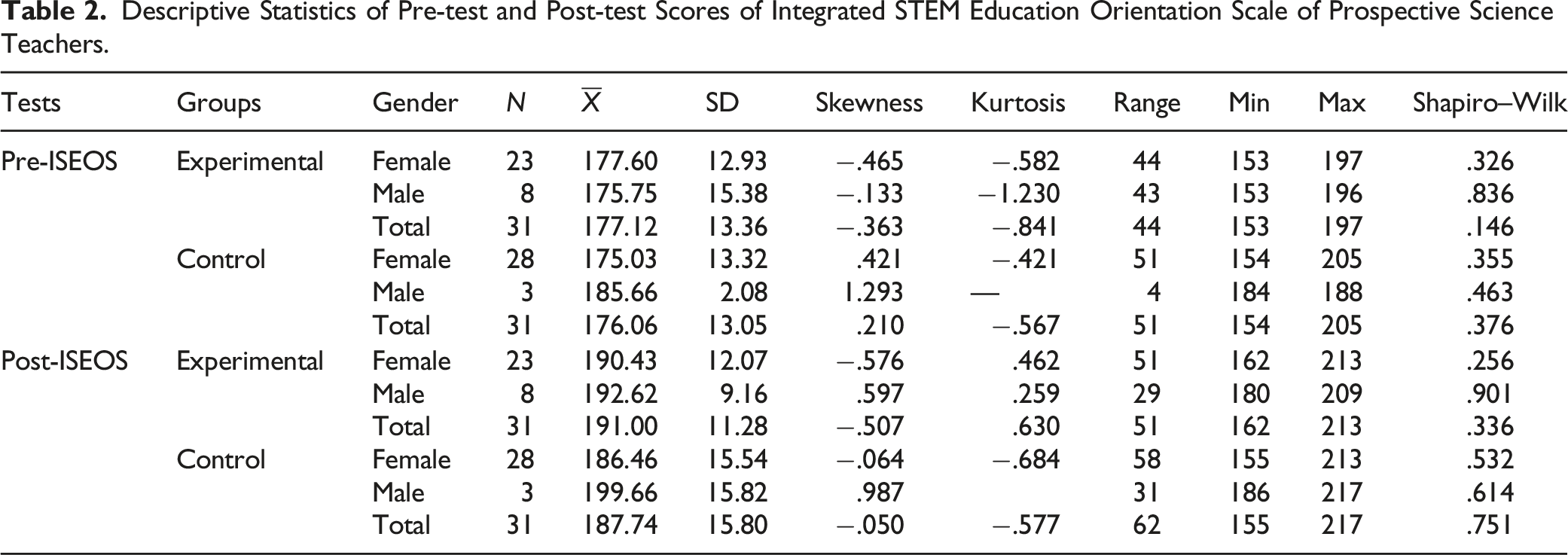
As shown in Table 2, before the application, the average of the pre-ISEOS score (177.12) in the experimental group is very close to the average of the post-ISEOS (176.06) of the control group. It seems that the integrated STEM education orientation scale among the groups are close to each other before the application.
There was the smaller difference (11.68) between the pre-ISEOS score (176.06) and post-ISEOS score (187.74) in the control group, while the experimental group had the more difference (13.88) between the pre- ISEOS score (177.12) and post-ISEOS scores (191).
Inferential Statistics Results
ANCOVA (one-way covariance analysis) was performed to test research questions in the study. This section is made up of three subsections. The first part is the determination of the covariates, the second part is the suppositions of the ANCOVA and the third part is the ANCOVA analysis.
Determination of common variables (covariates)
Relationship between Dependent and Independent Variables.
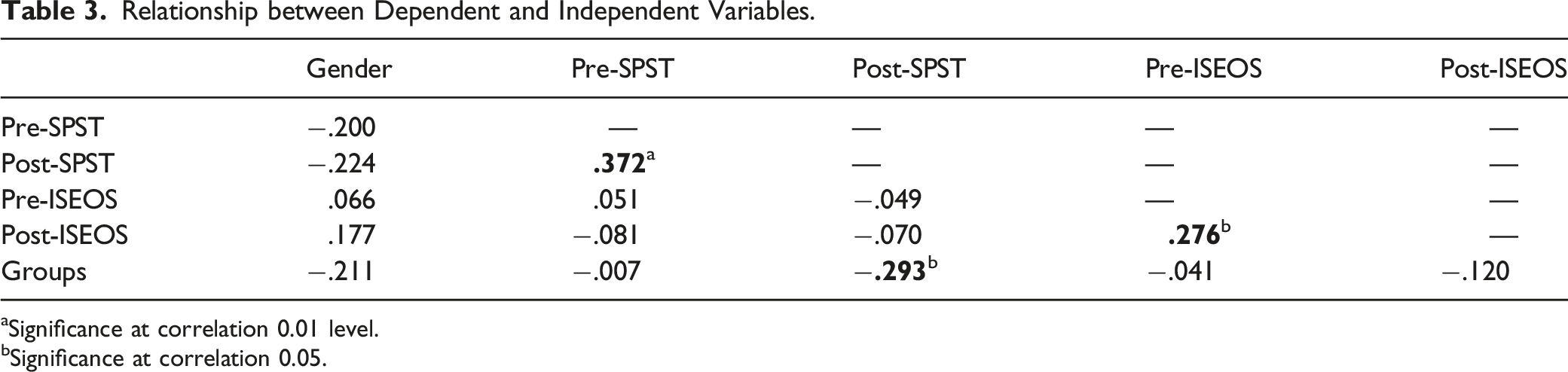
aSignificance at correlation 0.01 level.
bSignificance at correlation 0.05.
When Table 3 is examined, it is seen that there is a significant relationship between pretest scores to be used as a common variable and at least one posttest score. According to these results, it was decided to use as a common variable in ANCOVA analysis of the pre-SPST and pre-ISOES test scores.
Findings Related to ANCOVA Analysis
The dependent variable of the study is post-SPST and post-ISEOS. The independent variables are group, gender, pre-SPST and pre-ISOES. Pre-SPST and pre-ISOES from the independent variables were used as common variables. Results of the ANCOVA analysis on whether the difference between the posttest scores were meaningful when the pretest scores of the experimental and control groups were controlled at the end of experimental application were included.
ANCOVA Results Regarding Post-SPST Scores of Experimental and Control Groups.
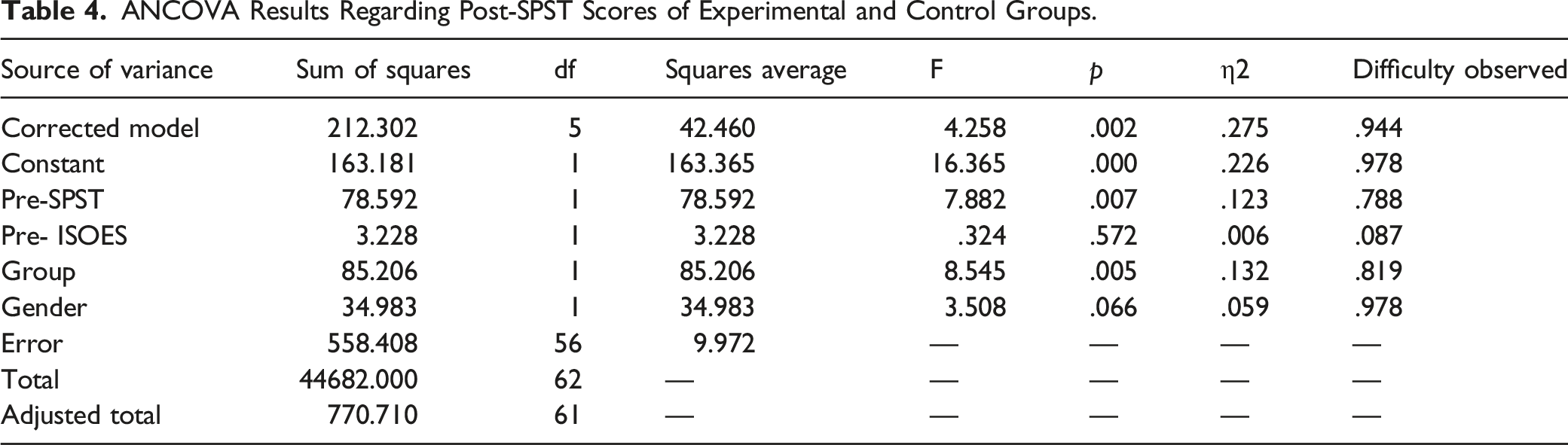
When Table 4 is examined, it is seen that STEM application has a statistically significant effect on post-ISEOS scores (F (1,56) = 8.545; p = .005<.01). Moreover, gender variable does not seem to have a significant effect on post-SPST scores (p > .05). The obtained eta-square value is interpreted in the direction of the Cohen d index, one of the effect size indices. The effect size is defined as small, medium and large, respectively, corresponding to values .01, .06 and .14 (Büyüköztürk, 2015). The group variable has moderate effect on the post-SPST scores (partial η2 = .132) and 13.2% of the change in the dependent variable is due to the applied method.
ANCOVA Results Regarding Post-ISEOS Scores of Experimental and Control Groups.
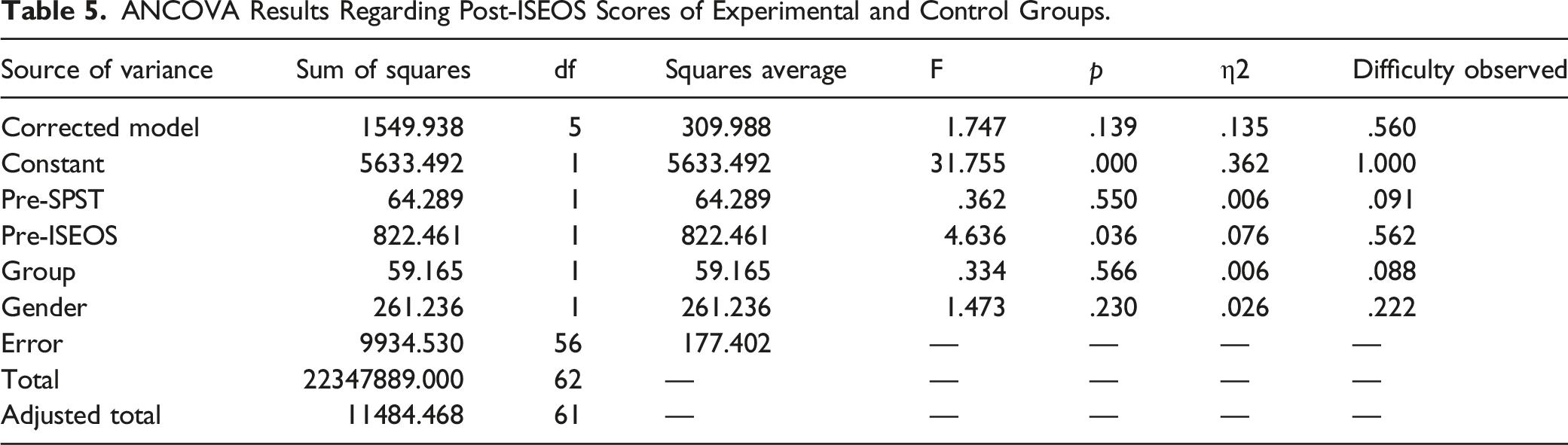
When Table 5 is examined, it is seen that STEM application does not have a statistically significant effect on the post-ISOES scores (F (1,56) = .334; p = .566>.01). It is also seen that gender variable has no significant effect on post-ISOES scores (p > .05). The group variable has a low level of effect on the post-ISOES test scores (partial η2 = .006).
Qualitative Data
In the third problem of working in this department, answer searched the question “What are the views of the prospective science teacher on the STEM activities that have been realized? In this context, face-to-face interviews were conducted with the aim of identifying the prospective science teacher’s thoughts on STEM practice and assessing the implementation. When interviews were analyzed, the similar answers given by prospective teachers were treated in the same category. In this process, the answers of the prospective teachers have been tried to be given in a way that their meanings will not be spoiled.
There were interviews with 8 male and 23 female students in the experimental group. The questions directed to the prospective teachers, frequency distributions for responses they give and answers of some prospective teachers are given below.
Frequency and Percentage Distribution of Answers to Considerations about Algodoo Software of Prospective Teachers.

The answers of prospective science teachers to the question “what do you think about Algodoo software used to support integrated teaching knowledge?” are like that: interesting (n = 21), beneficial (n = 20), enjoyable (n = 19), difficult (18), instructive (16) and boring (n = 3). The answers of some of the prospective teachers are given below: Student 10: We could direct as we wanted because it was a practice without boundaries about imagination. So it was both fun and interesting. Student 2: A really instructive program. But it is so hard. Student 3: The application was difficult for me. But I think I have developed in the field of science, mathematics and technology through practice. Student 9: We tried to design a material with Algodoo and we did not just use our science. I have a hard time using the computer, but it is a really useful program. Student 7: Algodoo software has a different format. It’s obviously fun and interesting, but I’m very hard on field knowledge. Student 27: It is software for designing content that can be useful for students and teachers who are fun to use and quite useful. It allows multi-dimensional thinking, designing and transferring to the person who wants to develop simulation through software.
Frequency and Percentage Distribution of Answers to Benefits of Implemented Practices of Prospective Teachers.
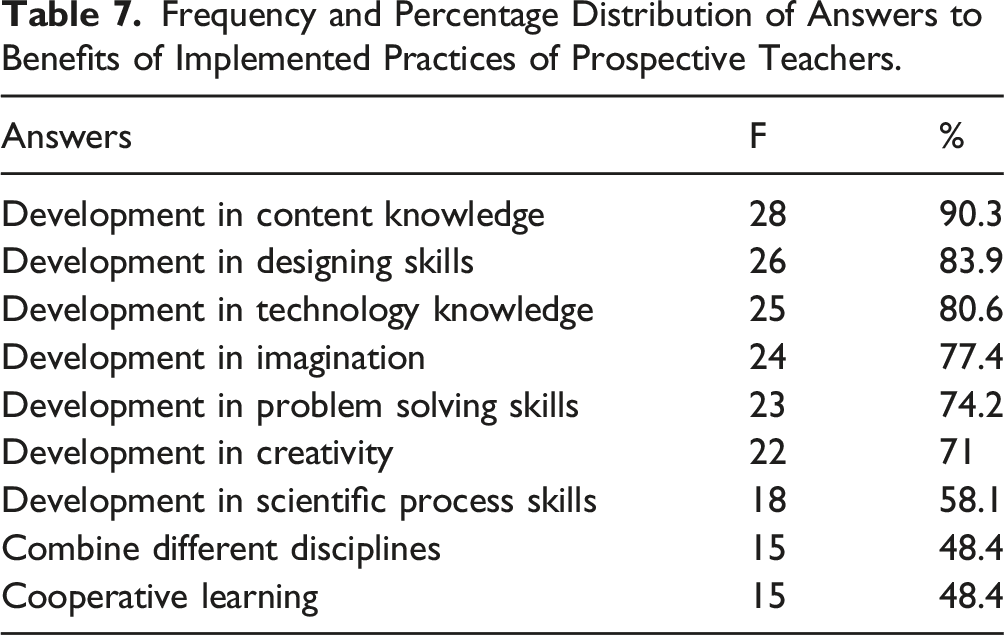
The answers of prospective science teachers to the question “What benefits are there for you during the process? Can you explain? “are like that: development in content knowledge (n = 28), development in designing skills (n = 26), development in technology knowledge (n = 25), development in imagination (n = 24), development in problem solving skills (n = 23), development in creativity (n = 22), development in scientific process skills (n = 18), combine different disciplines (n = 15), and Cooperative Learning (n = 15). The answers of some of the prospective teachers are given below: Student 26: At first, it was difficult to select the subject and we are missing information in the subject we choose, so we thought that we could not get anything out. We solved this problem first. We then made what we wanted to do on paper and we made changes by stating our thoughts on paper. Then we combined the final shape with technology. Because the program is physics-based, it is quite difficult to do the things we want to do and we tried to find alternative solutions. It was an excellent group study. Student 22: Throughout the process, we worked with friends in different groups in the group, combined our imagination and completed our missing field knowledge. Student 19: I think I have developed especially in terms of creativity and imagination. Student 16: A program that combines different disciplines to produce a product. We used together science information and technology information in particular. We have shaped our choice according to the imagination. Student 13: I was starting to use technology better. I used different areas together. I have the knowledge, although it is not very good in other areas other than science. Student 29: I can say that the program tests the field knowledge and technology knowledge. Especially I developed myself in the field. We faced many problems as a group and everyone had their own guesses to find a solution. We tried to choose the most reasonable one by making evaluations.
Frequency and Percent Distribution about Contributions to Student of Algodoo Software of Prospective Teachers.
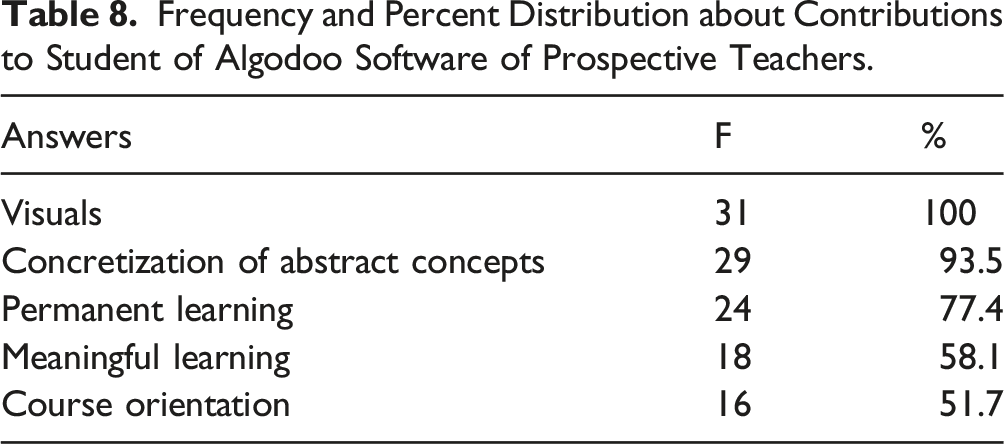
The answers of prospective science teachers to the question “What is the contribution of the Algodoo application to the students of the interviewed prospective teachers?” are like that: visuals (n = 31), concretization of abstract concepts (n = 29), permanent learning (n = 24), meaningful learning (n = 18) and course orientation (n = 16). The answers of some of the prospective teachers are given below: Student 31: I think it increases the permanence of your information because it addresses visual memory. Student 13: It provides course orientation for attract interesting of student. Student 16: First, concrete abstract concepts. So I think that it increases both the persistence and meaningful learning. Student 27: A very rich application in terms of visuality. Students are very influenced by their attitudes towards fence. They will contribute much more if they are directed to design like us. Student 22: Visual memory always provides more persistence than learning.
Frequency and Percentage Distribution of Answers to the Most Challenging Parts When Designing Simulation of Prospective Teachers.
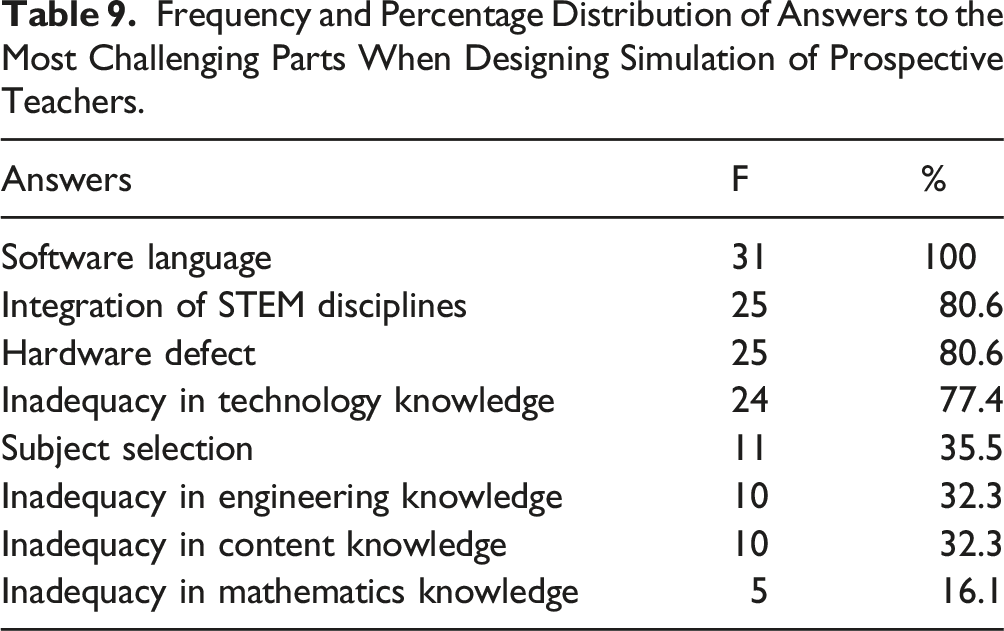
The answers of prospective science teachers to the question “What was the most difficult part of designing a simulation in Algodoo software? Can you explain?” are like that: software language (n = 31), integration of STEM disciplines (n = 25), hardware defect (n = 25), inadequacy in technology knowledge (n = 24), subject selection (n = 11), inadequacy in engineering knowledge (n = 10), inadequacy in content knowledge (n = 10) and inadequacy in mathematics knowledge (n = 5). The answers of some of the prospective teachers are given below: Student 19: I was having difficulty in field knowledge and technology knowledge when designing simulation. It was not easy to produce a product that dominated the STEM disciplines. Student 21: My lack of space, my lack of technology, and the language of the software required me to spend more time. Student 12: The Algodoo process was a painful process for me. My lack of technology, my lack of space and the uncertainty in the choice of topic caused me to be very hard. It was really hard to put a product on top of all this. Student 31: I have never used the program before. When designing the most shapes, I realized I had no engineering knowledge at all. Student 5: I think I can not transfer exactly what I designed in my dream because of the lack of technology knowledge. Student 2: I realized that my field information was incomplete. I also have difficulty integrating knowledge of field and technology.
Frequency and Percentage Distribution of Answers to Contribute to Field Information of Implemented Practices of Prospective Teachers.
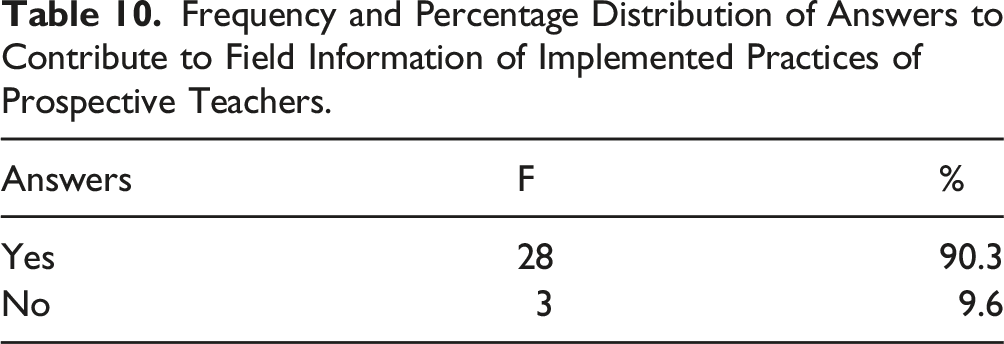
The answers of prospective science teachers to the question “Do you think that the applications they participate in contribute to the field knowledge?” are like that: yes (n = 28) and no (n = 3). The answers of some of the prospective teachers are given below: Student 29: It certainly happened. In addition, while I was doing micro-teaching, I followed my friends’ presentations and added a lot of knowledge to me. Student 30: The theme of each group was different. I think I have completed my shortcomings in each of the topics presented. Student 1: I can say that it is relatively additive. Student 16: There was no contribution. Student 5: In order to prepare a detailed design, I had to learn the subject in depth. My knowledge was not enough.
Frequency and Percent Distribution of Answers to Using Algodoo Simulations in their Professional Life of Prospective Teachers.
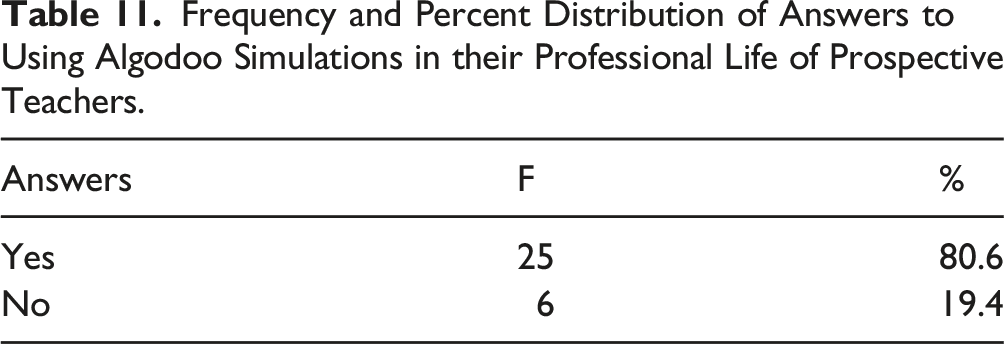
The answers of prospective science teachers to the question “Do you think to use simulations with Algodoo in your career?” are like that: yes (n = 25) and no (n = 6). The answers of some of the prospective teachers are given below: Student 29: I do not think. It can be difficult in crowded classes to use many skills together. It takes a lot of time to design them, which can be a problem. Student 8: I am definitely thinking of using it. I need to develop myself a bit more on this. I really want to have them done if there is time. Student 18: I do not think. Student 19: I’m definitely thinking. Because I think that some of the talents should be acquired by the younger students. The new generation is better than us in the field of technology in particular and has a different perspective. Student 25: I would like to use it but I do not know how convenient it will be for the course time. Student 28: Yes I use. They are using the new generation technology very well and I am convinced that their involvement in the course with technology is very interesting.
Frequency and Percentage Distribution of Responses of Prospective Teachers to Which Disciplinary Judge a Science Teacher Should Have.
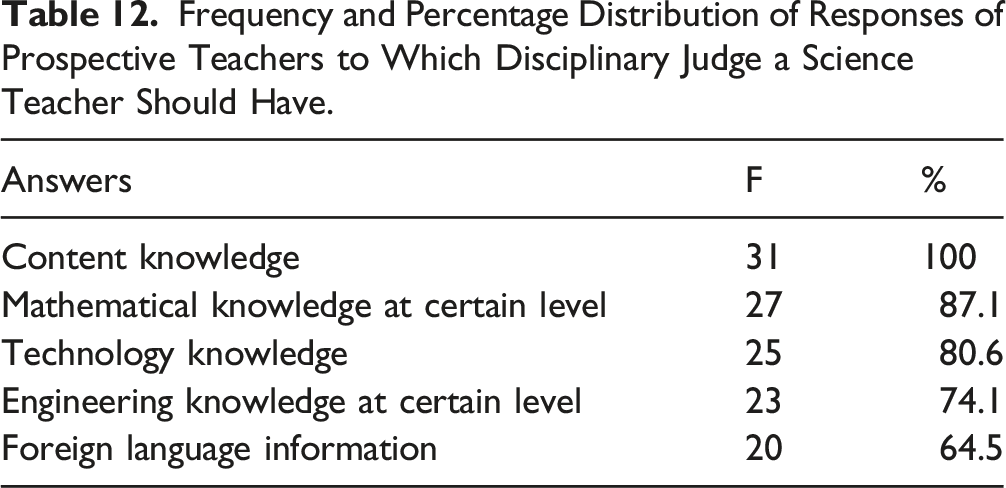
The answers of prospective science teachers to the question “What disciplines should be mastered in teaching a science? Can you explain?” are like that: content knowledge (n = 31), mathematical knowledge at certain level (n = 27), technology knowledge (n = 25), engineering knowledge at certain level (n = 23) foreign language information (20). The answers of some of the prospective teachers are given below: Student 8: If I had not participated in this activity, I am sure that it was only field knowledge. But now I understand how important it is to integrate each of the STEM headers. Of course, foreign language is important. Student 31: He must have the disciplines of mathematics, science and technology. Student 12: Apart from my own field knowledge, especially with Algodoo I understood that science, technology, mathematics and engineering are a whole. Student 19: Field knowledge, mathematics knowledge and technology knowledge should be dominated enough. Student 27: A science teacher must master the fields of mathematics, technology and engineering that are linked to this field as well as field knowledge.
Frequency and Percent Distribution of Responses to the Definition of Integrated Teacher Knowledge of Prospective Teachers.
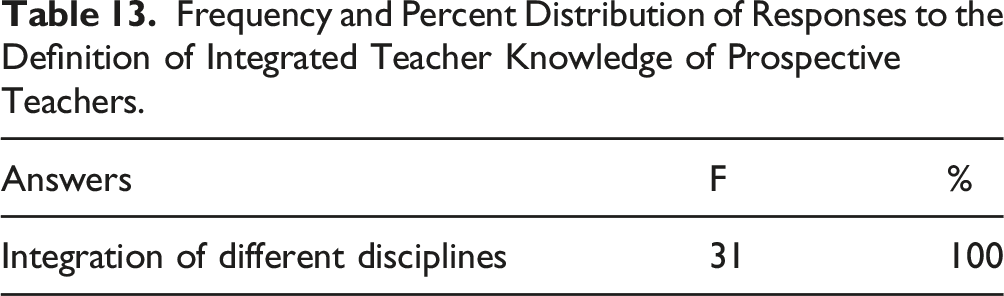
Prospective teachers seem to respond to the integration of different disciplines in response to the question “Can you explain what the integrated teaching knowledge is?” The answers of some of the prospective teachers are given below: Student 15: It is the interaction of close disciplines. Student 9: A teacher has knowledge about other disciplines outside his/her field. It is to consolidate information in different disciplines that it possesses in order to create a product. Student 18: To be knowledgeable about side areas. For example, the ability of a science teacher to be competent in technology, mathematics and engineering, besides his/her field, is in interaction with experts of other disciplines. Student 25: The integration of STEM disciplines with each other. We actually did this when we were designing a simulation in Algodoo, for example. We tried to make materials by using science, technology, mathematics and engineering.
Discussion
The STEM approach is seen as important in improving the scientific process skills of individuals (Strong, 2013). However, in order to be able to use and transmit such approaches aiming to improve the scientific processes of individuals, teachers and prospective teachers must have these skills. When the relevant literature is examined, it is seen that a small number of studies have been conducted to investigate the effect of STEM education on the scientific process skills of students. Bozkurt (2014), investigated the effect of an engineering design based science education course on the scientific process skills of prospective science teachers and found that the scientific process skills of prospective teachers improved with engineering design based science education. As a result of Gökbayrak and Karışan (2017b) applications, the students of the experimental group who participated in STEM-based science laboratory activities and the students of the control group who participated in all the inductive science laboratory applications found that there was a significant difference; found a significant difference in favor of the experimental group among the scientific process achievement test scores of the groups. Duygu (2018), in his study, found out that STEM education in a simulation-based interrogative learning environment had a positive effect on the development of scientific process skills of prospective science teachers. It is seen that the results of the study coincide with the results of studies with similar sample groups. The results of similar studies performed with different sample groups in the literature review also coincide with the results obtained from the study. Sullivan (2008) concluded that STEM applications have a positive effect on students’ scientific process skills as a result of their study with 26 secondary school students attending the robotic course. In his studies, Cotabish et al. (2013), investigated the effect of STEM Education on the scientific process skills of primary school students. Based on the results of this study, a significant increase was found in the experimental group compared to the control group. Yamak et al. (2014), examined the effect of STEM activities on the scientific process skills of fifth grade students, and found that the activities positively affected the scientific process skills of the students. Açışlı (2016) examined the effects of robotic applications on seventh grade students’ science, technology, mathematics, engineering, and scientific process skills. As a result of various robotic applications, it has been determined that students’ scientific process skills develop in a positive way.
Development of the acquisition of scientific process skills has a very important place in the education programs and curricula developed in Turkey in recent years. The STEM application conducted in this study is thought to be effective in reaching the program targets.
Assessments and discussions towards education are in the agenda of Turkey more than ever. In order to educate the younger generation in accordance with the rapidly changing conditions in the world and in our country, developments and breakthroughs have been made in Turkey in many areas. These are important reforms on education such as; weekly course schedules, educational programs, physical environments, technological infrastructure, textbooks and other educational tools. However, the reality is that teachers have a key role in education. Any reform initiative that a teacher does not adopt and cannot internalize fails to succeed and therefore these reforms cannot be transferred to the classroom environment. The reason why prospective teachers were selected as the sample of this study was to introduce STEM education, which became popular in recent years, to prospective teachers, to enable STEM adoption and support integrated teaching information. This study has helped prospective teachers to understand the difference between STEM education and the current education system by increasing their awareness of STEM education. In addition, prospective teachers, particularly while designing a simulation using the Algodoo software, have received help from friends and instructors in the fields of science, technology, engineering and mathematics. In this way, prospective teachers were allowed to face their shortcomings of the STEM disciplines.
Conclusion and Recommendations
In this study, which is conducted with an aim to support integrated teaching information of prospective science teachers, the effects of STEM applications on scientific process skills, orientation levels towards Integrated STEM teaching, and views of prospective science teachers were examined.
The scientific process skills of prospective science teachers in the experimental group in which the STEM application was performed were found to be significantly higher than the prospective science teachers in the control group. Based on this result, we can say that the STEM application conducted with an aim to support the integrated teaching knowledge of prospective science teachers is effective in developing the scientific process skills of the prospective science teachers. Findings obtained from the analysis of the interviews with the prospective teachers after the application show that the scientific process skills of prospective teachers developed after the application. Prospective teachers worked in groups throughout the process and communicated with their peers in different departments. In preparing their simulations, they updated the content information when their content information was inadequate. In this process, they have used basic scientific process skills actively. They had to use high-level scientific process skills especially in areas requiring computer engineering skills, tried different variables, set up hypotheses, and defined and interpreted the data. In order to solve the difficulties they faced while using the program, they contacted their peers in the computer engineering department and produced solutions. In this respect, the increase in the scientific process skills of the prospective teachers at the end of the application was found meaningful. Prospective teachers who did not know Algodoo software before have used many disciplines integrated in solving their problems. Prospective teachers did not conduct a scientific study in a laboratory. However, they used scientific research methods on the computer.
No difference was found in the orientation of prospective science teachers towards integrated STEM teaching between the experiment and control group. In this case, it can be said that the STEM application conducted with the aim of supporting the integrated teaching information of prospective teachers is in effective in developing the orientation of prospective teachers towards integrated STEM teaching. There was an increase between the pretest and posttest scores in the experimental group after the application, but this difference was not significant according to the ANCOVA results. It is important to note that the STEM application had many positive effects on prospective teachers (improvement in field knowledge, improvement in design skills, improvement in technology knowledge, improvement of imagination, improvement of problem solving skills, improvement of creativity, improvement of scientific process skills, integration of different disciplines and cooperative learning) based on the analysis of quantitative and qualitative data. This research was applied over short time of one semester. When it is aimed to support integrated teaching skills, it is recommended that the duration be longer than one semester.
Preparing simulations using Algodoo software helped prospective teachers the opportunity to work in integrated STEM disciplines. Prospective teachers evaluated the use of Algodoo as interesting, beneficial, enjoyable, instructive and difficult at the same time. The fact that the language of the software was not in the native language of the prospective teachers, and the hardware that is more suitable for the subjects of physics, caused difficulties in the implementation of Algodoo. Prospective teachers stated that, despite the difficulties they faced, lecturing with Algodoo would be beneficial for the students to embody abstract concepts, and the software would contribute to the permanent and meaningful learning of the students. 80% of prospective teachers stated that they would use Algodoo in professional life. These results suggested that using Algodoo software is a good tool in STEM education.
Footnotes
Declaration of conflicting interests
The author(s) declared no potential conflicts of interest with respect to the research, authorship, and/or publication of this article.
Funding
The author(s) disclosed receipt of the following financial support for the research, authorship, and/or publication of this article: Thanks to Scientific Research Projects Coordination Unit of Fırat University for supporting this thesis research.
