



Abstract
The author develops a conceptual framework that defines characteristics of critically conscious institutions and proposes their effectiveness in the promotion and strengthening of resilience in black students. Black students’ development within an anti-black society is framed as a sustained and continuous adversity, and this article expands the critical consciousness conversation by shifting the focus from changes in student characteristics to institutional change, mirroring the shift in resilience literature from a critique of individuals’ characteristics to a critique of the interactions between individuals and the proximal and distal environments with which they engage.
“To be a negro in this country and to be relatively conscious is to be in a rage almost all the time.” A well-known quote by James Baldwin, which speaks to the oft-documented reality of the black experience in the United States and continues, “So that the first problem is how to control that rage so that it won’t destroy you.” This portion of the quote, while less widely repeated, arguably describes the struggle in which black people spend the majority of their lives engaged. Controlling the rage as an act of self-preservation is the birthright of black people in a world that centers power in anti-black systems and populations. As students of color navigate these systems, particularly the educational institutions with which they engage, they carry the additional burden of self-preservation within a traditionally hostile environment (Kohli, 2018; Kohli & Solórzano, 2012). This understanding exposes that, at their core, the educational experiences of students of color are inequitable from the start. Expectedly, the literature on inequity in education is expansive with much of it historically focusing on gaps in achievement through the lens of success indicators such as graduation rates and test scores (Cohen et al., 2006; Reardon, 2013) and considering circumstances, such as poverty and class, in a way that recognizes the disproportionate impact on black communities but does not centralize race as a factor for consideration (Ladson-Billings & Tate, 1995; Omi & Winant, 2014).
As such, when Ladson-Billings and Tate (1995) built upon the idea found in Critical Race Theory (CRT) proposing “an assumption that racism is not a series of isolated acts, but is endemic in American life, deeply ingrained legally, culturally, and even psychologically” (p. 52), they pushed for the inclusion of race for race’s sake in the conversation of education equity. However, exploring inequity through the lens of adversity specific to black bodies existing in an anti-black world is not nearly as common as it should be in the education literature considering the “endemic” nature of racism. When adversity is defined in this way, it opens a door to considering the resilience of black students across the country, surviving (and often thriving) in a system built and sustained by their own dehumanization. It is this resilience that is the result of Baldwin’s allusion to controlling the rage to prevent destruction and it is this resilience that should not be put solely on the backs of black students to nurture and strengthen.
Historically, black people have survived environments catastrophic to both their physical and material well-being. Even in just the narrow view of black people in the United States, the community has survived chattel slavery, legal dehumanization, and state-sanctioned violence. Despite the layered systems of oppression with which they interact daily, black students exhibit a tenacity and strength that suggest the efforts to develop “grit” and “perseverance” in daily character lessons in an attempt to prepare black students to “overcome the achievement gap” may be misappropriated (Golden, 2017). The insistent focus of the education community on the “achievement gap” and the skills students need to overcome it is what stands in the way of us addressing what Ladson-Billings (2006) called the education debt, further conceptualizing it as the historical, economic, socio-political, and moral debt we have constructed and neglected as a society. Realigning our effort on conceptualizing the responsibility of the system to adapt; to change itself and to begin the payment of its debt to black students versus asking its students to develop skill sets to survive its ills, is potentially a more ethical direction for our considerations around reform.
Purpose of the Study
The author’s purpose is to present an explication of theory by developing a conceptual model that illustrates the impact of educational institutions that exhibit defined characteristics of critical consciousness on the resilience of black students dealing with the sustained adversity of functioning within anti-black systems. This model is informed by a social-ecological model of resilience and, in part, uses Ungar et al. (2013) principles of equifinality, differential impact, and contextual and cultural moderation to support a focus not on resilience of students as individual traits that make them invulnerable, but on the potential for growth and resilience mitigated by the characteristics of the environment in which students learn. The paper’s author seeks to propose a theory that informs a focus on ‘institutional change as intervention’; encouraging resilience in black students through development of more critically conscious policies and leaders rather than through individual student development of “survival” skills, such as grit, to overcome adversity. It is also the purpose of the article to set the stage for further research that seeks to consider the narratives of current and former black students, who were educated in institutions that exhibit varied levels of critical consciousness, to explore the impact—if any—of these institutions on the resilience of the students.
Significance of the Study
The centralization of the endemic nature of anti-blackness in our society exhibits the significance of this study in that it demands intervention in the name of equity and leads to the author’s proposition that a student’s blackness naturally places them not in a position of deficiency but of adversity within schools which, by design and historical context, mirror that anti-blackness. In an attempt to broaden the discussion around resilience in education, this study will offer a framework that is informed by Ungar’s (2011) model by considering the interactions that influence individual development with a specific focus on the impact of the nested systems first defined by Bronfenbrenner (1979). By conceptualizing the impact of critically conscious systems on individual development, this article proposes a theoretical rationale for shifting the focus of developing critical consciousness as an equity-forward intervention. The prevailing theme within the critical consciousness literature in education tends to centralize the intervention as a method for improving black students’ ability to navigate adversity. The significance then of this article lies in its attempt to lay the theoretical framework that supports turning our attention outward instead and intentionally holding institutions accountable for displaying critically conscious characteristics as evidenced through the policies and leadership behaviors they exhibit. This shift in perspective should, as supported by the review of the literature to come, enable our assessment of the interactions between students and their environment; specifically, the environment’s quality and capacity for nurturing the resilience of its black students.
Literature Review
Shifting the Perspective Outward: A Social-Ecological Model of Resilience
Michael Ungar (2011) describes a social-ecological model of resilience which finds its roots in an ecological theory of human development that suggests a child’s environment is composed of several interconnected systems and that the interactions between those systems are a crucial deciding factor in the child’s development (Bronfenbrenner, 1979). In shifting the landscape of human development from solely the child to the interactions of the child and their environment, Bronfenbrenner’s work sparked a shift that later occurred in the study of resilience. Defined by Ungar et al. (2013) as “a particular subset of processes associated with human development: those that enhance the experience of well-being among individuals who face significant adversity” (p. 348), the field of resilience focuses in on a specific component of human development; that which is relevant when individuals suffer adversity. Borrowing from Bronfenbrenner (1979), an understanding of interactions between nested systems of differing proximity has provided a bridge to a social-ecological lens through which researchers can consider the factors that affect individual characteristics of resilience. According to Ungar (2011), much of the resilience literature in education include “microsystem interactions, with family, peers, and teachers being the foci of most studies” (p. 3), followed by the mesosystem interactions which consist of interactions between microsystems that “determine the nature of the developmentally supportive resources available to individuals that influence their capacity to thrive” (p. 3). Exosystems, which are “the institutional environments in which children’s caregivers interact and services and policies are designed and delivered” (p. 3), have been relatively absent in resilience research and when highlighted, is outside the realm of education and instead focused on community and child interactions during natural disasters (Ungar, 2011). Finally, “the laws, customs, and cultural practices that provide opportunities for children’s positive development under stress” (p. 3) is termed the macrosystem (Ungar, 2011). Historically, much of resilience research has approached resilience through a narrow lens that uses measurements easily contributed to an individual, such as intelligence, attachment, educational performance, as indicators of resilience (Gonzalez & Padilla, 1997; Meiklejohn et al., 2012; Perez et al., 2009). Although definitions of resilience are varied, the socio-ecological shift suggest that the spotlight moves from the aforementioned work focused on the individual to work that focuses on the environment and moves toward a potential for more systemic work (Betancourt & Khan, 2008).
Ungar et al. (2013) propose three principles that inform this interpretation of resilience: equifinality, differential impact, and contextual and cultural moderation. Equifinality speaks to the idea that within certain circumstances, some processes become more influential than others. This highlights the impact of environment even within the context of individual factors because changing odds through environmental changes contributes more change to the outcomes than individual changes. Furthermore, this principle suggests that the question of resilient children is more rooted in the environments’ level of quality than any specific trait the children possess. Differential impact contends that the influence of proximal processes on development is affected by a variety of factors including the nature of risks and the quality and perception of resources. This principle can be applied to view behaviors that have differential impact on communities (positive, negative, or neutral) based on the risks they face (Dei et al., 1997). Differential impact also lives within the principle of contextual and cultural moderation which suggests that in the field of resilience, differences in context and culture are crucial in accessing the processes associated with resilience. Ungar (2008) states that “by implication, projects that work well with youth in one context are not necessarily going to work well in another” (p. 234) in a statement that critiques approaches to resilience that are without cultural and contextual emphasis.
Anti-blackness as Adversity
In the many definitions of resilience, the overcoming of some adverse condition is central to the concept (Condly, 2006; Ungar, 2012). Anti-blackness, or more specifically, the ingrained presence of anti-blackness within our society can be conceptualized as the adversity to which black students must respond and “do well” despite to be labeled resilient. In defining anti-blackness, it “refers to a broader antagonistic relationship between blackness and (the possibility of) humanity” (p.429) and is based on afro-pessimism, a theory which frames black people as property in the social consciousness and suggests that the right to live, move and breathe for self is contrary to that role (Dumas & Ross, 2016). The concept of anti-blackness is differentiated from racism in that it speaks specifically to an inevitable struggle between blackness and humanity that is permanent and pervasive (Dumas, 2013). Dumas (2016) built upon the idea of the permanent and ingrained nature of anti-blackness to suggest that it should and can be used as a tool of analysis when contending with the institutional interactions at play in society. By conceptualizing anti-blackness, one is able to both identify and respond to an otherwise ignored or silenced key factor in education policy which Dumas (2016) emphasizes as he advocates for the mere awareness of anti-blackness within educational spaces.
The idea of awareness of anti-blackness stands in direct contrast (and response to) the postracialism that drives much of the diversity initiative and multicultural nature of education. Theorized as a de-contextualization of racism, postracialism separated the concept of racism from societal organization and leaves it within the realm of thinking (Curry, 2015). It is the desire to remove racism from true consideration that supports much of the colorblind ideology that exists within our educational institutions. Matias and Liou (2015) speak on the presumptions that white teachers bring to schools in urban spaces, or specifically those that serve black populations, such as the need to save an inherently deficient community. However, using a lens informed by awareness of anti-blackness, it can be further communicated that the desire to save black children from who they are while championing a colorblind perspective is to suggest that to be worthy and to be saved, ones blackness must be discarded, or at the least, dismissed as irrelevant (Dumas, 2013).
The evidence; however, shows us that blackness is extremely relevant. Even when controlling for teacher-rated student behavior level, teacher ethnicity, and level of disruptive behavior in the classroom as a whole, black students are still significantly more likely to receive office disciplinary referrals than their white peers (Bradshaw et al., 2010). Even more telling is the finding that Bradshaw et al. (2010) discussed showing that ethnic match between teachers and their students did not reduce the risk for referrals. And so what is it other than the blackness of students that results in this finding? “Black as the problem” is a common refrain in education reform and within the realm of education policy, it exists as the reality against which we, of all races, often push. Dumas (2016) uses the significant example of school desegregation as institutional policy that regarded black as the problem to be solved and resulted in a dramatic dismantling of the black educational community and the continuation of anti-black housing, funding, and educational policy that still served to protect others from the black. It is within this anti-black reality that we ask students to succeed, in essence requiring constant resilience against an adversary that is deeply ingrained into the systems themselves.
Critical Consciousness as Intervention for Resilience
Paulo Freire (2000), a Brazilian educator, first termed critical consciousness as a way to encourage the ability of the Brazilian working class to recognize, question, and challenge the social realities that result in the social structure that consistently reproduces a lower class populated by the same groups of people. Since then, researchers have used the concept to explore its place and potential beneficial nature for groups of marginalized communities. In education, there has been significant interest in the usefulness of critical consciousness as not only a trait in students from marginalized communities that provides a sense of agency and allows for them to critique the inequities of the society in which they live, but also as a necessary component of education that strives to be equitable and ethical (Kumagai & Lypson, 2009; Ladson-Billings, 1995; Watts et al., 1999).
Kumagai and Lypson (2009) summarize the critical consciousness concept well as quoted here: . . . critical consciousness posits that the thinking subject does not exist in isolation but, rather, in relationship to others in the world. The development of critical consciousness involves a reflective awareness of the differences in power and privilege and the inequities that are embedded in social relationships—an act that Freire calls “reading the world”— and the fostering of a reorientation of perspective towards a commitment to social justice. The development of this type of consciousness—a process that Freire calls “conscientization”—is both cognitive and affective and leads to engaged discourse, collaborative problem-solving, and a “rehumanization” of human relationships. (p. 783)
The latter portion of the quote begins to speak to a two-dimensional definition of critical consciousness that incorporates not only the ability of a person to critically analyze structural oppression but also the collective action that is taken to impact the inequitable realities. The dual nature of critical consciousness, a concept which is expounded upon throughout the literature (Diemer et al., 2017; Windsor et al., 2014), has guided much of its use in education through a lens of the benefits its development could encourage in students historically underserved by the education system. Luter et al. (2017) studied a program guided by critical pedagogy to develop critical consciousness in students and its impact on academic factors. It was found that the program resulted in positive changes in attendance, tardiness, suspension rates, and standardized scores for students scoring in the lowest scoring categories. However, changes in standardized test scores were not reflected in class grades, and Luter et al. (2017) suspected this being due to teacher bias. This finding is reflective of the fact that the barriers to equitable educational experiences reach beyond what we can manipulate in solely the student. Gay and Kirkland (2003) refer to this idea by highlighting the need for developing critically conscious teachers during preservice, while Ladson-Billings (1995) discussed the impossible task of developing critically conscious students without teachers who are also critically conscious. This pattern is consistent throughout the literature as the discussion circles around what schools can do to develop the critical consciousness of their students, and sometimes teachers. However, even when these interventions operate as planned, as in with a student referred to by El-Amin et al. (2017), a key puzzle piece tends to be missing. Terrance, a student at One Vision said the following in response to his participation in a project meant to encourage the development of critical consciousness: I wanted opportunities to speak openly with my peers about the things that we see every day. Crime rates, drug rates, riots. I had the chance to put the past in conversation with the future. I watched a documentary that showed how police brutality and issues like that have been going on for a long time . . . [and that black] children back in the day didn’t have the opportunity to come to a school like One Vision. I consider that a challenge. Sometimes I want to leave One Vision. Sometimes I want to leave so bad. But I know deep down in my heart why I’m here, so I buckle down and do my homework . . . I see the bigger picture. (p. 18)
Although you see aspects of the reflective and action-oriented nature of Freire’s (2000) critical consciousness in Terrance’s description of his experience, a gaping hole exist in the discussion. Why does he want to leave One Vision so badly? What is happening at the institutional level at the same time that they focus on developing Terrance’s ability to recognize and address the inequity around him? Jemal (2017) notes in their review of the critical consciousness literature that the definitions currently in use “exclude oppressors and may inadvertently support the proposition that oppression is a problem for the oppressed to solve” (p. 15). In systems of inequity, it is vital for the oppressor to also engage in critical consciousness to leverage their intrinsic power.
Explication of Theory
The literature surrounding resilience, anti-blackness, and critical consciousness provides the foundation for this explication of theory explaining the impact of critically conscious institutional environments, within which black students’ “caregivers interact and services and policies are designed and delivered” (pg. 3), on the resilience of black students (Ungar, 2011). Ungar’s (2013) proposition that the quality of environmental interactions have more of an impact on resilience for individuals facing sustained adversity suggest that in assessing and intervening to improve the resilience of black students operating within anti-black systems, it is even more necessary to consider the quality of their environments, including their schools. That anti-blackness is embedded in the very systems in which black students exist, resulting in a constant tension between their blackness and the possibility of humanity on a daily basis, is sustained adversity specific to that group of students. Further referencing Ungar (2013) would require that we assess both black students’ and their environments’ competence in sustaining their well-being within that adverse environment. This article proposes critical consciousness as the evaluating measure, a characteristic that can be assessed that would be expected to increase the competence of both the individual (black student) and its environments, in nurturing resilience in response to anti-blackness. The model conceptualized in Figure 1 infers that critical consciousness at any level within a black student’s nested systems would be beneficial to the resilience of the student and therefore, serves to define the characteristics that can be used to evaluate critically consciousness institutions. Since there is an identified gap in the literature that highlights the lack of assessment of institutional competence in any meaningful way (Jemal, 2017; Ungar, 2011), this model can be used to support assessment of quality environments for black students and to then measure the impact of those environments on resilience in further studies.
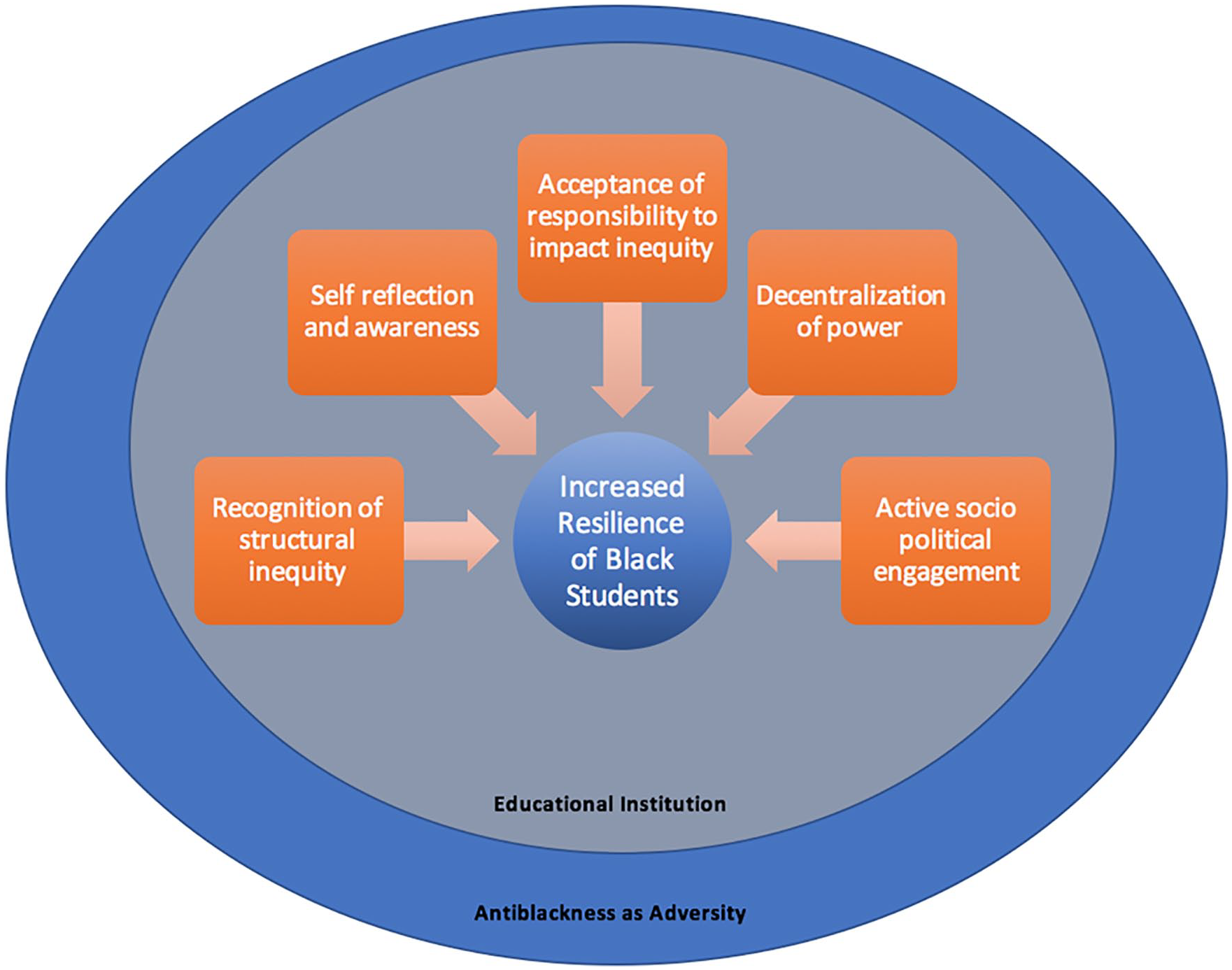
Conceptual model depicting the characteristics and impact of critically conscious institutions.
This theory is informed by frameworks put forth by several sources that all operationalize critical consciousness and seek to define characteristics that might be observed when it is present. Morrison et al. (2008) highlight the following strategies for engaging in critical consciousness in students within the classroom: (a) critical literacy, (b) engaging students in social work, (c) making explicit the power dynamics of mainstream society, and (d) sharing power in the classroom. The Wisconsin Department of Public Instruction (2017) also developed and published a model to inform culturally responsive practices which included several components that can be categorized as critically conscious characteristics. Specifically, (a) accepting institutional responsibility, (b) leading, modeling, and advocating for equity practices, (c) becoming self-aware, and (d) examining the system’s impact on families and students. Diemer et al. (2017) developed and validated a scale for critical consciousness that used (a) critical reflection: perceived inequality, (b) critical action: socio-political participation, and (c) critical reflection: egalitarianism as primary categories for critically conscious characteristics. Figure 1 depicts a conceptual model depicting the characteristics that make up a critically conscious institution that uses these varied sources to support the proposition that those characteristics result in increased resilience in black students.
Institutions that exhibit these characteristics would in turn be providing a more quality environment for black students by operating as a type of buffer to the consequences of anti-blackness for students, resulting in increased resilience. Figure 2 defines each characteristic of the model along with possible indicators of the characteristic in practice.
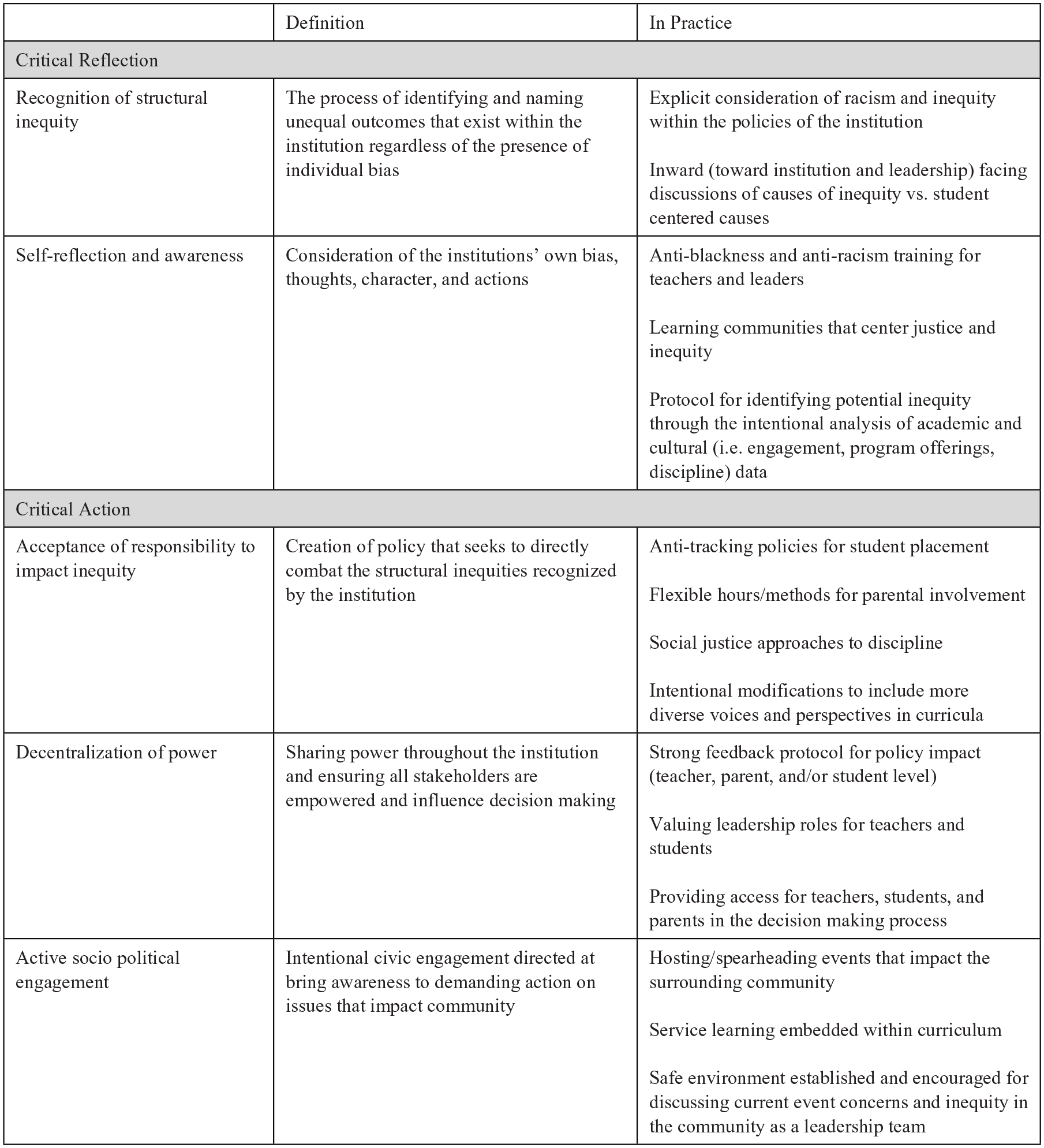
Definitions and practical examples of characteristics of critically conscious institutions.
The duality of critical consciousness theory is embedded within this model as (a) recognition of structural inequity and (b) self-reflection and awareness reflect the critical reflection component while (c) acceptance of responsibility to impact inequity, (d) decentralization of power, and (e) active socio-political engagement reflect the critical action component. The benefit of developing critical consciousness in students is well documented and shown to result in increased autonomy and desire to engage in addressing identified inequity, increased academic achievement, decreased feelings of isolation, shame, and lowered impact of stereotype threat (Cabrera et al., 2014; Cammarota, 2007; Carter, 2008; Dee & Penner, 2016; Diemer et al., 2017). However, this theory provides an opportunity to further expand these benefits by shifting the focus of assessing critical conscious characteristics in students, to an analysis of leadership action and policy. The shift in perspective proposed by this theory taps into the potential of institutions to act as buffering environments for their black students and to expand the positive impacts of critical consciousness by ensuring that it is also a component of the environment with which students interact the most.
Discussion
Ungar et al. (2013) provides a model of resilience that he characterizes as ecological in nature and discusses “that we assess resilience as both the quality of the interaction between the child and the child’s environment, and the competence of each side of the individual x environment equation to provide what is necessary to sustain well-being” (p. 351). However, the nested nature of the systems with which individuals interact, that Ungar (2011) uses to support his socio-ecological model, suggest a more complex equation and allows scrutiny at varying levels when considering the competence of the environment side of the interaction. Through this lens, it is both feasible and logical, in our attempts to assess and impact resilience of black students, to ask whether the environments in which they operate are competent enough to “provide what is necessary to sustain well-being” (p. 351) (Ungar et al., 2013). And the time has certainly come because we have had our share of emphasis on the competence of the individuals themselves. In schools specifically, the highlighting of grit as a character trait to be developed has built upon the idea that it is the primary, if not sole, responsibility of the student to sustain their well-being (Gorski, 2016). When we do extend our focus past the individual, the environments we critique tend to be those directly adjacent to the child; the parents, teachers, and the ways in which they interact. In what Bronfenbrenner termed the micro- and meso-systems, assessment of resilience and the quality of individual × environment interactions has stalled in many ways. As Ladson-Billings (2006) discussed, the conversation orbits around the education deficit, or the oft-mentioned achievement gap, resulting in a never-ending conversation about what can be done to improve the characteristics of those on the losing end of it: black students. However, what is less readily addressed is the “education debt,” or the historical, socio-political, moral, and economic debt accumulated through the actions of our society. This is a debt that is ingrained in the very institutions and policies that have become the education system most black students operate within today. Understandably, it is reasonable to consider that the anti-blackness that permeates the world we live in is recognizable as a significant indicator of that debt. As with any debt, not addressing it does not result in its disappearance and no matter the magnitude of the attempt to affect the deficit, the debt will always hang overhead until addressed and paid. Accordingly, to un-stall the assessment of resilience of black students, we must shift our attention from focusing only on the deficit, or the outcomes of the students, to the debt. It could be argued that as components of the environment for black students, a focus on teacher and parent interactions represents that shift. For example, the call for culturally relevant pedagogy (Brown-Jeffy & Cooper, 2011; Howard, 2003) specifically attempts to address the impact of an anti-black society on student resilience. But even here, the focus falls solely back on preparing the student and the teacher, without addressing changes in the institution itself. If anti-blackness is a major component of the education debt we must pay, how do the systems in which black students interact with their immediate environments address it?
To answer this question, this article proposes that informing practices of educational institutions using the characteristics depicted in Figure 1 can potentiate the ability of those institutions to intentionally design environments that are more competent in providing the aforementioned needs that would assist in sustaining well-being, or resilience, in black students. In essence, this train of thought can push for action that serves as a response to a shift in “responsibility” for the positive development of students of color from the individual students’ traits to the characteristics of the environments with which they interact throughout their schooling. As highlighted in a review of the resilience literature, the idea that children exposed to more adversity rely more heavily on the quality of their environments and the resources available to them is well explored (Ungar et al., 2013). However, this article seeks to supplement the academic discourse by applying this social-ecological model of resilience in a context that specifies the reality of attending schools in an anti-black society as sustained adversity. By framing the conversation using anti-blackness, we are able to address the adversity that all black students face, even those who do not come from the poverty stricken, undereducated communities we often conflate with blackness. If resilience should be considered with cultural and contextual moderation (Ungar, 2008), it is then vital to consider expanding the context of adversity in the resilience field to include an essential component of the black experience, coping with anti-blackness. It is necessary to acknowledge that a failure to provide quality environments to black students perpetuates an inequitable system, given that they would be expected to more heavily rely upon said environment. Since the adversity in question is specific to a black person’s experience with anti-blackness, it follows that the characteristics of the “quality” environment should be geared specifically toward providing the resources needed for the students to sustain well-being, in regards to their own humanity. This specificity is crucial to highlight for the same reasons discussed by Dumas and Ross (2016) when advocating a Black Critical Theory (BlackCrit). As they write, Understanding this distinction between a theory of racism and a theory of blackness (in an anti-Black world) is key: whereas the former may invoke Black examples, and even rely on Black experience of racism in the formation of its tenets, only critical theorization of blackness confronts the specificity of antiblackness, as a social construction, as an embodied lived experience of social suffering and resistance, and perhaps most importantly, as an antagonism, in which the Black is a despised thing-in-itself (but not person for herself or himself) in opposition to all that is pure, human(e), and White. (pg. 416)
Once anti-blackness is recognized and theorized as a very specific threat to well-being and the adversity to be overcome, one using Ungar et al.’s (2013) model hoping to affect the resilience of black students would need to look past the individual’s competence for providing what is needed for well-being. As Baldwin expressed in the paper’s opening quote, black students’ ability to control rage and plan for survival is embedded within their very selves. Even the very outcomes used to suggest a lack of resilience within the population can be conceptualized as indicators of resilience. Researchers have explored dropping out and found it to be the result of a developmental process that in many cases serves to remove black students from a school environment that threatens their racial identity (Dei et al., 1997). Exemplifying the principle of differential impact (Ungar et al., 2013), dropping out can be viewed as black students showing competence in their ability to sustain their own well-being. Although by no means a complete explanation of the complexity of student disengagement, it is not a stretch to suggest that black students are exceptionally competent in sustaining their own well-being within anti-black spaces because they have simply survived.
So if the individual’s competence is not the focus, the environment’s competence must be. The issue then becomes, how do we change the institution so that resistance and disengagement is no longer necessary to sustain the well-being of black students? How do the exosystems in which students interact with their caregivers shift and become more competent in sustaining the well-being of black students? Freire’s (2000) conceptualization of critical consciousness has been used across the education spectrum as a tool in shifting perspective. Culturally relevant pedagogy has highlighted it as a key skill to develop in students of color (Ladson-Billings, 1995). Literature has also emphasized the importance of teachers who are critically conscious to even hope for classrooms that equip students with the quality education we are seeking (Gay & Kirkland, 2003). However, this work still fails to extend to exploring the impact of critically conscious institutions for the purpose of not only assessing their competence in supporting the well-being of black students in an anti-black society but also to inform the shifts needed in all educational institutions, from schools to districts to school boards, from which the policies that students and their caregivers must interact within originate. Given that critical consciousness not only calls for questioning social conditions such as anti-blackness and its impact on black populations, but also challenging those conditions through action, informing a shift in institutions to become more critically conscious could also initiate the repayment of the aforementioned “education debt.” When those who hold the power, question that power themselves and begin to take action to negate that power, the debt can begin to be repaid. Furthermore, for black students, when the institutions that make up their exosystem become more competent in ensuring what is necessary to sustain their well-being, specifically in identifying and addressing the impact of anti-blackness within itself, the quality of the students’ environment naturally increases. For black students, this means they are no longer bearing the burden of resilience within an anti-black world alone.
Footnotes
Declaration of Conflicting Interests
The author(s) declared no potential conflicts of interest with respect to the research, authorship, and/or publication of this article.
Funding
The author(s) received no financial support for the research, authorship, and/or publication of this article.