



Abstract
Adverse childhood experiences (ACEs) are associated with disparate health and educational outcomes. The objective of this systematic review and meta-analysis is to determine the relationship between ACEs and academic performance among U.S. children and adolescents. A total of 20 articles were included for a descriptive synthesis and 11 articles were included in the quantitative synthesis. Among the 11 studies, we found a weak, negative correlation between ACEs and academic performance. Further research is needed to explore all the potential adverse exposures that could impact academic outcomes and factors that might mediate the effects of ACEs on academic performance.
Introduction
Adverse childhood experiences (ACEs) are any experiences occurring during the first 18 years of life that could be traumatic (Felitti et al., 1998). According to the National Survey of Children’s Health, which is conducted in the United States of America, 23.4% of children have been exposed to parents or guardians being separated or divorced, 7.5% had a parent or guardian serve time in jail, 5.6% witnessed violence within the home, 8.1% lived with someone who was mentally ill, and 8.5% lived with someone who endorsed substance abuse (Child and Adolescent Health Measurement Initiative, 2020; Initiative, 2020). These early life exposures can have intense and lasting effects on health, education, and social outcomes (Hinojosa et al., 2019).
Individuals exposed to ACEs are at an increased risk for poor academic performance (Hinojosa et al., 2019). Those exposed to ACEs are more likely to repeat a grade, not complete homework, and are often less engaged in their schoolwork (Bethell et al., 2014; Crouch et al., 2019; Hinojosa et al., 2019; Robles et al., 2019). Learning and behavior problems have also been associated with ACE exposures (Burke et al., 2011). Furthermore, as the number of ACE exposures increase there is a decrease in language and literacy skills, math skills, and an increase in attention problems, social problems, and aggression (Jimenez et al., 2016).
Children exposed to violence within the home are more likely to have declining academic achievement (King & Mrug, 2018; Margolin et al., 2010). Among females, below-average grades have been reported for those who were exposed to housing instability, parental incarceration, and living with someone with substance-abuse problems (Duke, 2020). Among males, below-average grades were reported for those who were exposed to any form of neglect, abuse, household dysfunction, and resource hardship (Duke, 2020). Children exposed to abuse and neglect during early developmental periods have a decrease in academic achievement as compared to unexposed peers (Holmes et al., 2018). In measures of reading, spelling, arithmetic, and abstract reasoning, those who were exposed to abuse and neglect were found to perform lower than those unexposed (Mills et al., 2011). However, one study found that academic grades were not affected by psychological or physical victimization within a dating relationship (Foshee et al., 2013).
As described above, individual original research studies have found an association between ACEs and academic performance. To the best of the authors’ knowledge, a systematic review and meta-analysis on ACEs and academic performance has not been described. Specifically, a review is needed to summarize results from studies which used standardized assessments and school reports, to reduce the potential for recall bias and/or socially desirable responses. Therefore, the purpose of this systematic review and meta-analysis was to assimilate the available evidence describing the association between ACEs and objective measures of academic performance in a population of U. S. children and adolescents.
Methods
A protocol for this systematic review and meta-analysis was registered with Open Science Framework. The 2020 PRISMA (Preferred Reporting Items for Systematic reviews and Meta-Analyses) writing guidelines was utilized throughout the writing process (Page et al., 2021).
Eligibility Criteria
Original, peer-reviewed and grey literature research (i.e., dissertations and theses) was included if it met the following criteria: (1) children and adolescents who were enrolled in formal primary and secondary education (grades K-5 through 12) within the United States, (2) exposures of ACEs included physical, emotional, or sexual abuse; emotional or physical neglect; household dysfunction, including parental incarceration, parental mental illness, parental substance abuse, or intimate partner violence towards the mother, (3) outcome measures of academic performance which were objectively obtained from school reports (e.g., grade point averages or course grades) and standardized assessments such as American College Test and/or Scholastic Achievement Test (ACT or SAT), (4) assessment of the relationship between ACEs on academic performance outcomes through an observational design, and (5) written in English, with full text available. Literature was restricted to U.S. studies only as the U.S. school system is modeled differently and grades are obtained differently than in other countries along with sociological factors that are specific to the U.S. Studies were excluded if the article focused on a diagnostic sub-group of children, for example, individuals born with a congenital, neurodevelopmental, or genetic disorder as these factors could exacerbate the effects of learning outcomes (Glinianaia et al., 2021; Kortekaas-Rijlaarsdam et al., 2019; Mealings et al., 2017).
Information Sources and Search Strategy
A comprehensive search of the literature was developed with a research Librarian using, MEDLINE (Ovid), CINAHL (EBSCO), PsycINFO (EBSCO), and ERIC (EBSCO). These databases were selected based on consulting published reviews on a similar topic for databases to search. Thus, it was determined that the utilization of these four databases was sufficient and that the addition of other databases would not have yielded meaningful additions to the literature search. Controlled vocabulary, truncation, and key words were used to develop comprehensive search strings across the databases. The database searches were conducted on February 12, 2021 and a final search was conducted on April 9th, 2022. A complete search string can be found in Figure 1. Retrieved articles were imported into EndNote X9, and duplicates removed. Hand searches of included study references were completed to ensure all relevant articles were identified. Sample search string.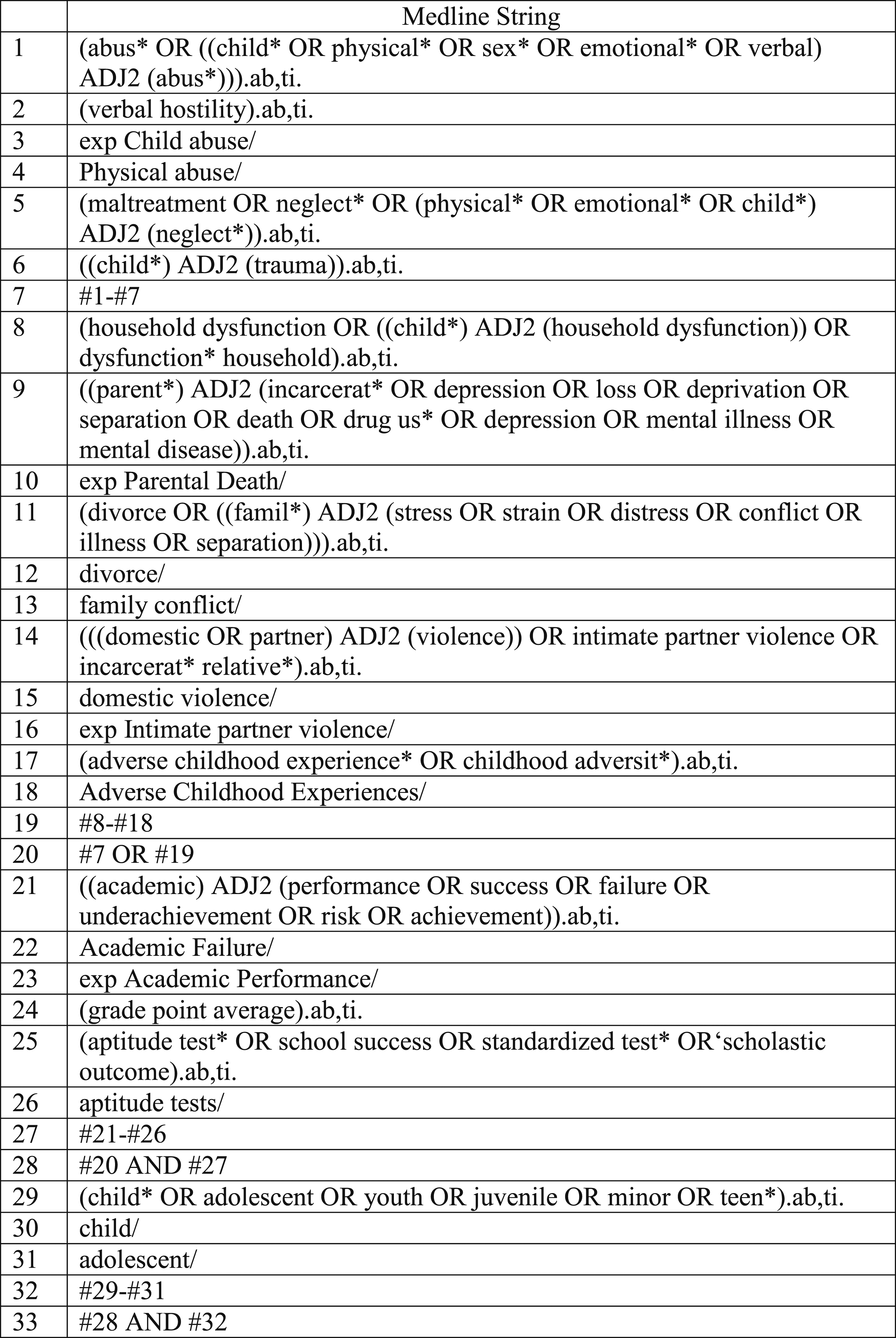
Selection Process
The retrieved articles were exported from EndNote into Rayyan for the screening process (Ouzzani et al., 2016). Two reviewers conducted title/abstract screening independently and did not discuss their screening decisions with a third reviewer settling conflicts. Two reviewers conducted full- text review and conducted the quality assessment with a third author settling conflicts. The authors provided the responses of “yes,” “no,” “cannot determine (CD),” “not applicable (NA),” or “not reported (NR)” for each item. Following the assessment methodology of Musshafen et al., (2021), questions 5 through 7, 10, and 12 through 13 were reported as NA for cross-sectional study designs and question 4 was divided into two parts: part “a” assessed for subject selection and part “b” assessed for the inclusion and exclusion criteria (Perrett et al., 2020). The overall quality rating was based on the number of “yes” responses divided by the total number of applicable questions. The following descriptive rating was applied to the score of each article: poor (≤60%), adequate/fair (60-69%), good (70-79%), and strong (≥80%) (Linde et al., 2020; Sangsawang et al., 2019). Articles that were found to have a poor (≤60%) rating were further excluded from the study due to their greater likelihood of bias.
Effect Measures
To measure the relation between an ACE on an academic performance outcome, means, correlations, coefficients of determinations, odds ratios, and risk ratios were extracted from each article. When available, adjusted effect measures are reported. Unadjusted measures are reported for the following articles: Kinard (1999) and Claessens (2015). The following effect size numerical representation was defined as follows: negligible correlation (.00-.10), weak correlation (.10-.39), moderate correlation (.40-.69), strong correlation (.70-.89), and very strong correlation (.90-1.00) (Schober et al., 2018).
Synthesis Methods
Comprehensive Meta-Analysis (CMA), version 3.3, was used to synthesize the effect size measures across the included studies. Effect size data that compared the unexposed and exposed on the outcome measures of interest was included in the synthesis of data.
When necessary, hand calculations were performed to transform standard errors into standard deviations (Boutron et al., 2023). These hand calculations were performed on the following articles: Eckenrode, Laird, and Coohey and colleagues. When adequate data was not available, an email was sent to the corresponding author requesting additional information (Blodgett & Lanigan, 2018; Fantuzzo et al., 2011). The determination of summary measure type was based on the most frequently used measures within included studies.
To assess the relationship among all of the included ACE exposures (physical abuse, sexual abuse, neglect, maternal violence, caregiver mental illness, and caregiver substance abuse) and academic performance measures, the core meta-analysis consisted of one overall analysis. Parental incarceration was unable to be included in the core analysis as the data type was not in a useable format to be converted to a correlation coefficient.
Three sensitivity analyses were performed to assess differences in the effect measure. The first sensitivity analysis assessed differences in study designs between cross-sectional and cohort studies. The second sensitivity analysis assessed the difference in quality rating by excluding studies that were rated as “adequate/fair.” The third sensitivity analysis utilized the one-study removed method in which effect measures that were outside of the 95% confidence interval of the original model were removed (Nielsen et al., 2020).
The random-effects model was used for all analyses given the greater likelihood of heterogeneity across observational studies (Borenstein et al., 2010). To assess for heterogeneity within and between the included studies, t2 and I2 estimates were considered. Publication bias was assessed via Duval and Tweedie’s trim and fill. For summary estimates showing significance, classic fail-safe N estimates were gathered to assess the number of articles required to bring the p-value to alpha.
Results
Study Selection
A total of 3316 articles were retrieved across the four searched databases: MEDLINE (n = 485), CINAHL (n = 518), PsycINFO (n = 1379), and ERIC (n = 934). After the removal of duplicates, 2623 articles underwent title and abstract screening. After this, 2535 articles were excluded. A total of 88 articles underwent full-text screening with 68 being excluded based on the following reasons: available as an abstract only (n = 2), no objective outcome measure (n = 24), no exposure(s) of interest (n = 26), did not include the population of interest (n = 4), and poor-quality rating (n = 12). Of the final 20 included articles, 11 met criteria for the quantitative synthesis. Figure 2 denotes the PRISMA flow diagram for further detail. PRISMA flow diagram.
Study Characteristics
Characteristics of Individual Studies.

The total sample size across the studies included 40,781 participants. Among the studies, a total of 38,821 participants were described with race and ethnicity. In total, 46.31% were White, 33.31% were black, 14.11% were Hispanic, and 6.30% reported as other. Among the studies, a total of 40,633 participants were described by sex, with 50.04% of the sample being female.
The grade level varied between elementary, junior high, and high school. Seven studies (n = 33,762) included only students in elementary school. One study (n = 417) included only junior high students. Three studies (n = 391) included only high-school students. Four studies (n = 440) included elementary and junior high students. Five studies (n = 5590) included students throughout elementary to high school.
The primary measure of ACE exposure was captured via substantiated reports from organizations records (i.e., stage agency reports, registries records, therapy records, police records, and/or court records). Four of the studies obtained the exposure variables via standardized measures/scales. Three of the studies obtained the exposure variables via self-reported survey responses.
For the exposure of abuse, eight assessed physical abuse and seven assessed sexual abuse. Seven studies assessed the exposure of neglect. For exposures among household dysfunction, one study assessed caregiver incarceration, two assessed caregiver substance abuse, one assessed maternal intimate partner violence, and two assessed caregiver mental illness.
All included studies reported objective measures of academic performance. Seven studies reported performance on standardized tests. Seven studies reported school records of GPA and/or final grades across curriculum. Six studies incorporated a combination of standardized tests and GPA and/or final grades.
Risk of Bias
NIH Quality Assessment Tool for Cohort and Cross-Sectional Studies for Included Full Text.
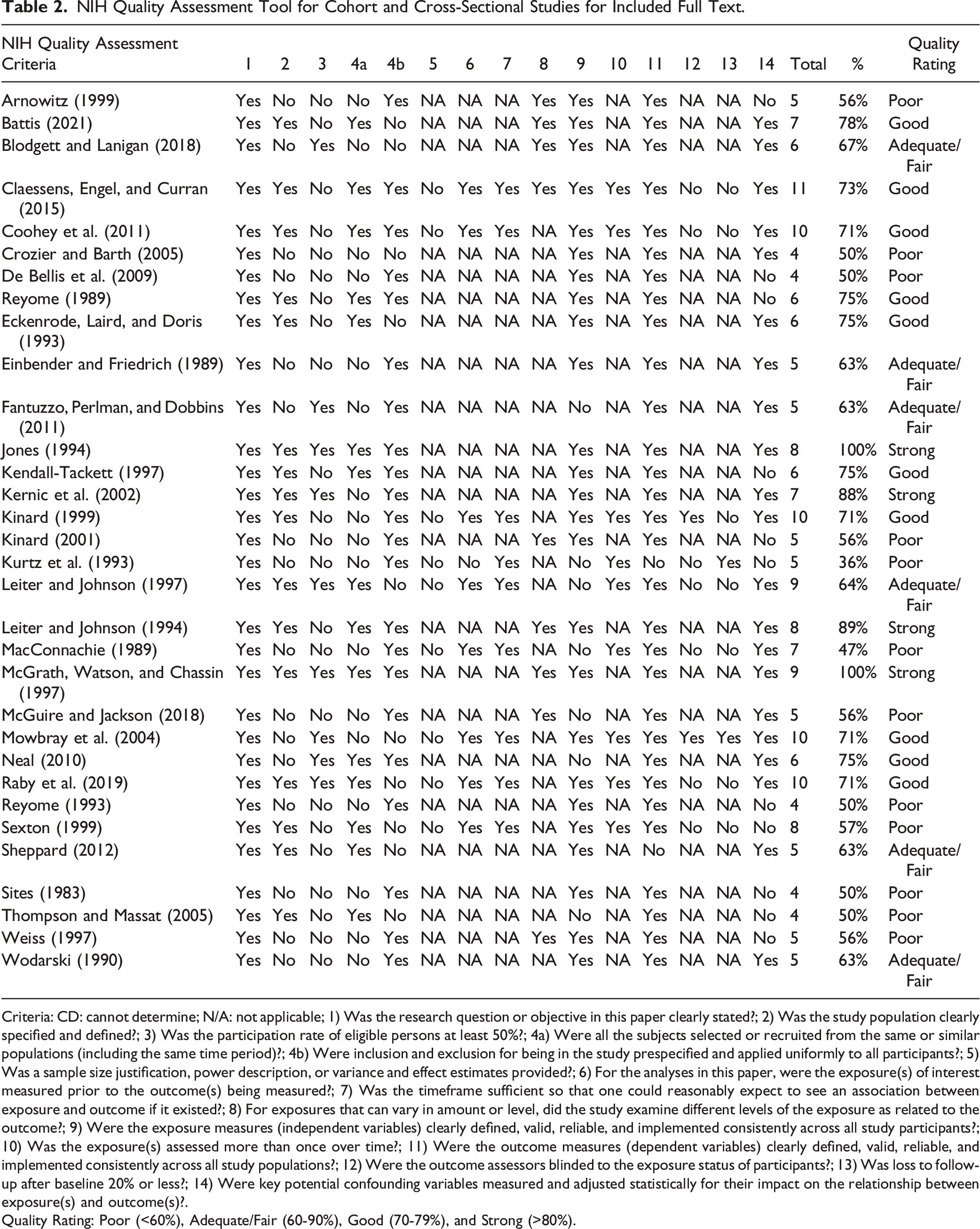
Criteria: CD: cannot determine; N/A: not applicable; 1) Was the research question or objective in this paper clearly stated?; 2) Was the study population clearly specified and defined?; 3) Was the participation rate of eligible persons at least 50%?; 4a) Were all the subjects selected or recruited from the same or similar populations (including the same time period)?; 4b) Were inclusion and exclusion for being in the study prespecified and applied uniformly to all participants?; 5) Was a sample size justification, power description, or variance and effect estimates provided?; 6) For the analyses in this paper, were the exposure(s) of interest measured prior to the outcome(s) being measured?; 7) Was the timeframe sufficient so that one could reasonably expect to see an association between exposure and outcome if it existed?; 8) For exposures that can vary in amount or level, did the study examine different levels of the exposure as related to the outcome?; 9) Were the exposure measures (independent variables) clearly defined, valid, reliable, and implemented consistently across all study participants?; 10) Was the exposure(s) assessed more than once over time?; 11) Were the outcome measures (dependent variables) clearly defined, valid, reliable, and implemented consistently across all study populations?; 12) Were the outcome assessors blinded to the exposure status of participants?; 13) Was loss to follow-up after baseline 20% or less?; 14) Were key potential confounding variables measured and adjusted statistically for their impact on the relationship between exposure(s) and outcome(s)?.
Quality Rating: Poor (<60%), Adequate/Fair (60-90%), Good (70-79%), and Strong (>80%).
Results of Individual Studies
Results of Individual Studies Assessing the Relationship Between Adverse Childhood Experiences and Academic Performance.

Results of Synthesis
Effects of Adverse Childhood Experiences on Academic Performance
The overall meta-analysis (Figure 3) incorporated data from all 11 studies (Battis, 2021; Blodgett & Lanigan, 2018; Claessens et al., 2015; Coohey et al., 2011; Einbender & Friedrich, 1989; Jones, 1994; Kinard, 1999; McGrath et al., 1997; Raby et al., 2019; Sheppard, 2012; Wodarski et al., 1990). Overall, the summary estimate shows a weak, negative correlation between ACEs and academic performance (r = −.11, 95%CI −.22, −.01, p = .04). This can be interpreted as ACEs are associated with decreased academic performance outcomes. Significant heterogeneity was found between the studies (I2 = 94.65), and minimal heterogeneity was found within each study (t2 = .03). The fail-safe N is 130, indicating that 130 additional “null” studies would be required to exceed p = .05. Effects of adverse childhood experiences on academic performance.
In the first sensitivity analysis, four articles (Blodgett & Lanigan, 2018; Einbender & Friedrich, 1989; Sheppard, 2012; Wodarski et al., 1990) were removed based on their quality rating and yielded minimal changes to the effect measure (r = −.10, 95%CI −.17, −.03, p = .01); however, a slight decrease in heterogeneity was found between the studies (I2 = 77.25) and trivial changes were found within the studies (t2 = .01). The second sensitivity analysis assessed differences across the cross-sectional and cohort study designs. The cross-sectional studies (Battis, 2021; Blodgett & Lanigan, 2018; Einbender & Friedrich, 1989; Jones, 1994; McGrath et al., 1997; Sheppard, 2012; Wodarski et al., 1990) yielded a similar effect measure; however, an increase in the confidence interval and heterogeneity was found as well as a non-significant p-value (r = −.09, 95%CI −.28, .11, p = .36, I2 = 93.71, t2 = .06). The final sensitivity analysis utilized the one-study removed method and zero of the studies effect measure, when removed, fell outside of the original models 95% confidence interval.
Reporting bias
When modeling for the overall effects of adverse childhood experiences, under the random-effects model, the point estimate and 95% confidence interval for the combined studies is r = −.11 (95% CI −.22, −.01, p = .04). Upon visual inspection, the funnel plot appeared to be asymmetrical with more studies to the left of the mean (see Supplemental Figure 4). Duval and Tweedie’s Trim and Fill method was used to further statistically assess for missing studies and no additional studies were found. Therefore, the estimate remained unchanged. Publication bias was not found for the relationship between adverse childhood experiences on academic performance.
Discussion
The purpose of this systematic review and meta-analysis was to examine the association between ACEs and academic performance outcomes among U.S. students. Overall, this meta-analysis found that there is a weak, significant negative correlation (r = −.11) between ACEs and academic performance. Given that the estimated fail-safe N = 130, indicating that 130 studies showing a negative or null finding would be necessary to reverse this finding, the summary measure is a robust estimation that highlights the negative effects of ACEs on academic performance. Although this effect is small, the cumulative effect of this disadvantageous academic performance across time remains unknown and needs to be further explored.
All studies (n = 20) included adverse childhood experience exposures, such as physical abuse, sexual abuse, neglect, caregiver mental illness, caregiver substance abuse, caregiver incarceration, and violence towards the mother. Four of the studies had a strong quality rating (Jones, 1994; Kernic et al., 2002; Leiter & Johnsen, 1994; McGrath et al., 1997); ten had a good quality rating (Battis, 2021; Claessens et al., 2015; Coohey et al., 2011; Eckenrode et al., 1993; Kendall-Tackett, 1997; Kinard, 1999; Mowbray et al., 2004; Neal, 2010; Raby et al., 2019; Reyome, 1989); and six had an adequate/fair quality rating (Blodgett & Lanigan, 2018; Einbender & Friedrich, 1989; Fantuzzo et al., 2011; Leiter & Johnsen, 1997; Sheppard, 2012; Wodarski et al., 1990). Findings of significance were dispersed evenly throughout the quality rating scores; therefore, the quality of the studies did not impact significance level. However, of the non-significant studies, six (Battis, 2021; Kernic et al., 2002; Neal, 2010; Reyome, 1989; Sheppard, 2012) were cross-sectional designs and one (Fantuzzo et al., 2011) was a cohort design. Of these non-significant studies, two were included in the meta-analysis (Battis, 2021; Sheppard, 2012).
This review of the literature only included objective measures of academic performance to reduce the potential for response and recall bias (Althubaiti, 2016). While this study was not limited to objective exposure reports, a large majority of the studies included substantiated reports of abuse and/or neglect or standardized measures or scales for clinical outcomes. Therefore, the effect measures found in this meta-analysis were based primarily off objective exposure and outcome variables.
The results of the pooled effect size consisted of seven exposures: including all ACEs exposures to include, physical abuse, sexual abuse, neglect, caregiver substance abuse, violence towards mother, and caregiver mental illness. An additional exposure of caregiver incarceration was not included in the pooled analysis as the effect size was not provided in a useable format. While this meta-analysis sought to be inclusive of as many ACE exposures as possible, there are other known exposures that were not included in this analysis which have been found to be adverse, including parental divorce, parental death, food insecurity, housing instability, and discrimination (Duke, 2020; Hinojosa et al., 2019; Hu et al., 2021). Therefore, this pooled effect size does not encompass all potential adverse experiences that could be included to measure their effects on academic performance.
Our finding of a negative correlation between ACEs and academic performance justifies concerns for students who experience ACEs and should be considered in light of research exploring other exposures which can negatively impact academic performance. Similar to this review, it has been demonstrated that sleep hygiene and oral health also impact academic outcomes. A recent systematic review and meta-analysis found that students’ sleep quality has a significant correlation with academic outcomes (r = .089; 95% CI 0.027, .151; p = .005). In addition, students with poor oral health (i.e., tooth pain related to dental caries) demonstrate poorer academic performance (Ruff et al., 2019). Social determinants of health have also been associated with academic performance (Duke, 2020; Hinojosa et al., 2019; Shankar, 2017). This includes academic difficulties in the presence of food insecurity (Duke, 2020; Shankar, 2017), housing instability (Duke, 2020), and exposure to discrimination and economic hardship (Hinojosa et al., 2019).
Interpreting the findings from these previously published studies and the results presented here as a whole, it is apparent that there are many factors which negatively influence academic performance and are potentially to be related to each other. When considered individually, each factor (i.e., sleep, oral health, social determinants, food insecurity, housing instability, discrimination, and economic hardship) exerts a negative impact on academic success; however, the impact of multiple factors experienced simultaneously has not been described. The additive or multiplicative nature of the effects also needs to be further explored and described in future research.
Limitations
There is a lack of standardized variables that are inclusive to the term “adverse childhood experiences.” Therefore, the effect measures found in this study may not encompass all potential variables that could be related to poor academic performance. Exposures such as discrimination, housing instability, and economic hardship have been found to impact academic performance but were not included in this study (Duke, 2020; Hinojosa et al., 2019; Hu et al., 2021). There may also be covariates that have not been accounted for that could impact the relationship between ACEs and academic outcomes. Secondly, while this study excluded medically complex participants, this study does not account for developmental delays which could have exacerbated the participants’ learning potential in school. It is well demonstrated that children who have a developmental delay are at an increased risk for developing learning difficulties during school (Enlow et al., 2012; Oh et al., 2018; Sylvestre et al., 2016). Thirdly, the included studies were conducted in the United States only which reduces our results generalizability of the effects of ACEs and academic performance among other countries. Finally, we were unable to account for the severity or timing of the exposures which could have an effect on a student’s academic performance. While the results of the individual studies have various grade levels, all but three of the articles described their results across all students, regardless of grade level. For the three studies that did stratify the grade levels, the cut-points were different, making the exploration of a moderating effect impossible through meta-analytic techniques. Future studies should assess the effects of ACEs at various grade levels to determine if there is a critical age where the effects described here are more pronounced.
Implications for Practice
This systematic review and meta-analysis contributes to the currently available literature that ACEs can impact academic performance. We found an association between ACEs and poorer academic performance. Future longitudinal research is needed to fully capture ACEs as students’ progress through school, thus providing a more accurate account of the effects of ACEs on academic performance outcomes throughout the school years. Therefore, school-based interventions are needed to screen, diagnose, and treat children who are impacted by ACEs. While not a variable in this study, past interventions have found that teachers are often engaged and receptive to professional development about ACEs and effective management strategies (King et al., 2021; Whitaker et al., 2019). Pre-service and professional development training could be considered, by incorporating aspects of ACEs to include practical classroom and individual student strategies that can lead to a reduction in the effects of ACEs. In addition, trainings that utilize a trauma-informed approach, including mindfulness and resiliency, have demonstrated promise when improving teacher-child relationship within the classroom (Chesak et al., 2019; Forster et al., 2017; King et al., 2021). These evidence-based interventions can assist in the early identification of ACEs to mitigate the negative impacts as early as possible in their academic trajectory. Finally, future studies should incorporate educators as stakeholders in the development of interventions to better assess the teacher-student relationship and its potential impact on addressing the effects of ACEs on student academic performance.
Conclusion
Interpreting the findings from these previously published studies and the results presented here as a whole, it is apparent that there are many factors which negatively influence academic performance and have the potential to be related to each other. When considered individually, each factor (i.e., sleep, oral health, social determinants, food insecurity, housing instability, discrimination, and economic hardship) exerts a negative impact on academic success; however, the impact of multiple factors experienced simultaneously has not been described. The additive or multiplicative nature of the effects also needs to be further explored and described in future research.
Supplemental Material
Supplemental Material - Adverse Childhood Experiences and Academic Performance Among U.S. Students: A Systematic Review and Meta-Analysis
Supplemental Material for Adverse Childhood Experiences and Academic Performance Among U.S. Students: A Systematic Review and Meta-Analysis by Rachel S. Tyrone, Lauren M. Fletcher, Courtney S. Walker, Caroline Compretta, Paul Burns, and Jennifer C. Reneker in Journal of Education.
Footnotes
Declaration of conflicting interests
The author(s) declared no potential conflicts of interest with respect to the research, authorship, and/or publication of this article.
Funding
The author(s) received no financial support for the research, authorship, and/or publication of this article.
Contributor’s Statement
Drs. Walker, Compretta, and Burns conceptualized and designed the study, reviewed data for accuracy, reviewed the manuscript for important intellectual content, and revised the manuscript. Drs. Tyrone, Reneker, and Mrs. Fletcher designed the data collection instruments, screened for inclusion/exclusion of the articles, carried out the initial analyses, and drafted the initial manuscript. All authors approved the final manuscript as submitted and agree to be accountable for all aspects of the work.

Supplemental Material
Supplemental material for this article is available online.
References
Supplementary Material
Please find the following supplemental material available below.
For Open Access articles published under a Creative Commons License, all supplemental material carries the same license as the article it is associated with.
For non-Open Access articles published, all supplemental material carries a non-exclusive license, and permission requests for re-use of supplemental material or any part of supplemental material shall be sent directly to the copyright owner as specified in the copyright notice associated with the article.
