




Abstract
This study investigates the perspectives of pre-service and newly qualified elementary teachers on the use of comics in science education. Drawing on interviews with 19 participants, it reveals positive views of comics as engaging and inclusive tools that support conceptual understanding and student competencies. However, their effective use is seen as dependent on careful pedagogical planning and contextual adaptation. Participants identified external barriers, such as limited resources, curriculum constraints, and time pressure, as well as internal challenges, including traditional beliefs and insufficient training. The findings highlight the need for investment in teacher education and resources to support meaningful comic integration.
Keywords
Comics represent a unique multimodal medium that combines sequential images with textual elements to create distinctive storytelling and communication experiences. While historically marginalized as children’s entertainment, comics have gained recognition as both an art form and legitimate educational resource in recent decades (Humphrey, 2020; Lopes, 2006). This evolving perception has sparked increased interest in their educational applications, particularly given their capacity to offer innovative pedagogical approaches across diverse learning contexts.
The integration of comics in educational settings is supported by compelling theoretical and practical arguments. Morrison et al. (2002) identify three primary rationales: their connection to popular culture enhances student relatability, their visual storytelling format develops critical media literacy skills, and their inherent appeal to young audiences creates natural engagement and motivation. Yang (2003) further emphasizes comics’ advantages over audiovisual content, particularly their permanence and reader-controlled pacing, which enables more effective processing of complex information. Additionally, comics can serve as conceptual bridges, connecting abstract academic concepts with more accessible, familiar representations.
Within this broader educational context, science comics emerge as a specialized category explicitly designed to communicate scientific knowledge (Tatalovic, 2009). Unlike general comics that explore diverse themes, science comics prioritize educational objectives over pure entertainment. To achieve this, science comics often integrate humor and storytelling techniques to enhance engagement and motivation (Faria et al., 2024; Lin et al., 2014). Additionally, the use of clear and accessible visuals aids understanding by breaking down complex information into simpler parts (Eilam & Poyas, 2010). By combining narrative, visuals, and a focus on content, science comics make scientific concepts more relatable and engaging, thereby enhancing students’ comprehension and retention (Faria et al., 2024).
The educational potential of comics in science learning can be understood through the interaction of several dimensions. Their multimodal nature allows information to be conveyed through complementary channels, reducing cognitive load. Their sequential format supports self-paced learning, while their familiar and engaging character enhances motivation and emotional involvement. This structure also supports the development of visual and sequential literacy. Together, these interrelated dimensions contribute to improved understanding of scientific concepts and processes.
Despite this potential, the use of comics in science education remains limited. Understanding teachers’ perceptions is crucial because these attitudes shape pedagogical decisions and classroom practices. This study aims to explore how pre-service and newly qualified elementary science teachers perceive the use of comics in educational settings. By examining their attitudes, perceived advantages and constraints, and the pedagogical conditions they consider important for successful implementation, we seek to better understand the potential of science comics as instructional tools. These findings may inform the design of teacher education programs and the development of more targeted resources to support comic integration in science education.
Literature Review
Comics and Science Learning Outcomes
Contemporary research increasingly supports comics’ educational efficacy, particularly in science education. Multiple studies demonstrate their capacity to enhance conceptual understanding and memory retention, while also highlighting positive effects on students’ attitudes towards science (Aleixo & Sumner, 2017; Hosler & Boomer, 2011). For example, Hosler and Boomer (2011) examined the use of a purpose-designed biology comic with undergraduate non-science majors and found that students’ content knowledge improved to levels comparable to those achieved with traditional instructional materials, while attitudes towards biology improved significantly, particularly among students with lower prior content knowledge. In a controlled experimental study, Aleixo and Sumner (2017) compared comic-based and text-only presentations of biopsychology content and reported higher memory scores in the comic condition, suggesting that the integration of visual and verbal information can support learning when both elements are coherently aligned.
Comics have also been shown to support affective and identity-related dimensions of science learning. Spiegel et al. (2013), in an intervention with secondary school students, demonstrated that science comics can increase engagement with scientific topics and support the development of science identity, understood as how much students think of themselves as interested in and good at science. This effect was particularly pronounced among students with weaker science identities, who typically lack confidence in their abilities, struggle to envision science careers, or feel disconnected from the field. However, the educational value of comics depends significantly on how they are implemented. Students with lower scientific literacy, those with limited familiarity with scientific concepts and vocabulary, may benefit particularly from well-designed comics, yet uncritical use risks oversimplifying concepts or reinforcing misconceptions. These challenges underscore the crucial role of teachers in integrating comics effectively and the need to examine their perceptions and strategies in science education (Aleixo et al., 2021).
Teachers’ Attitudes Toward Educational Comics
Although research on teacher attitudes toward educational comics remains limited, existing studies offer important insights into both opportunities and barriers. Across educational levels, teachers tend to express general openness to using comics, particularly in language instruction (Ali, 2021; Lapp et al., 2012). However, this openness is often undermined by practical constraints such as limited access to materials, lack of instructional models, and insufficient preparation on how to integrate comics pedagogically. These barriers are compounded by uncertainty about the pedagogical value of comics (Ali, 2021) and concerns regarding their effectiveness for advanced readers who may not need the visual scaffolding (Lapp et al., 2012). While these survey-based findings provide a broad overview of teacher perspectives, they reveal little about the underlying reasoning behind teachers’ hesitations or enthusiasm.
Qualitative studies have provided more nuanced insights into the complexity of teachers’ attitudes toward comics. Lewkowich (2019), through in-depth interviews with 15 high school English teachers, identified a clear divide in perspectives: while some embraced comics for their potential to foster student engagement, develop multimodal literacy, and promote critical thinking, others hesitated due to institutional constraints, limited professional development, and persistent perceptions of comics as less serious literature compared to traditional texts. Similarly, Aleixo et al. (2021) conducted focus group discussions that revealed three main perspectives among teachers: viewing comics primarily as children’s entertainment rather than educational tools; believing they could support struggling students; and recognizing their underutilization due to resource limitations. As a result, comics were frequently regarded as a “missed opportunity,” a medium with clear educational potential that remains largely underexplored in school settings due to a combination of institutional, pedagogical and attitudinal barriers.
Despite these contributions, current research on teacher attitudes toward educational comics presents notable limitations. Most studies focus on language education, particularly in promoting literacy and multimodal comprehension, leaving other subject areas relatively unexamined. This narrow focus overlooks the broader pedagogical possibilities of comics across disciplines and the specific challenges related to their integration in different curricular contexts. In particular, science education represents a promising yet underexplored area for comic implementation. However, little is known about how (future) teachers perceive the role and value of comics in science teaching.
Method
Participants
We conducted interviews with a purposive sample of 19 participants. The recruitment of participants followed a multi-step and progressive approach. Rather than inviting all participants at once, recruitment occurred gradually, alongside data collection. Initially, invitations were sent to graduates of two teacher education programs, utilizing the first author’s professional network and knowledge of potential candidates. As the study progressed, colleagues from another institution recommended additional participants, and some participants suggested others who might be interested, creating a snowball effect. The recruitment process was designed to ensure diversity in institution and program enrollment, gender, and familiarity with comics, dimensions that could meaningfully influence participants’ perceptions. To further enhance diversity, pre-service teachers who had not yet graduated were also invited.
The final sample included both pre-service teachers (n = 9), all of whom were in their final year of preparation, and newly qualified teachers (n = 10). Gender distribution was 8 males and 11 females, and participants’ ages ranged from 22 to 47 years. Participants also varied in their engagement with comics: five currently read comics, eight had read them in the past but no longer did, and six had never read comics.
Participants came from three higher education institutions and were enrolled in or had completed three teacher education programs qualifying them to teach all subjects in grades 1–4 in Portugal. In addition to this primary qualification, 15 participants had or were completing a Master’s program also certifying them to teach Mathematics and Natural Sciences in grades 5–6; 2 had a Master’s additionally qualifying them to teach Portuguese and History and Geography of Portugal in grades 5–6; and 2 were enrolled in a Master’s program additionally qualifying them to work in Preschool. Further demographic details and participants’ engagement with comics are provided in Supplemental Materials.
Data Collection
Participants were initially contacted by email with information about the study, its aims, and participation criteria. Only two invitees were unable to participate due to workload. All semi-structured interviews were conducted online via Zoom by the first author, ensuring consistency and flexibility. Interviews lasted between 26 and 49 minutes (average 34 minutes), following a standardized guide with core questions for all participants and tailored follow-up prompts to explore individual perspectives in depth.
The interview guide covered key themes including participants’ reading habits and engagement with comics, their perceptions of comics as an educational resource, attitudes toward using comics in the classroom, and factors influencing these attitudes. Participants were also asked about the preparation needed to effectively integrate comics into science education. A full version of the interview guide is provided in Supplemental Materials.
All participants provided informed consent prior to the interviews. Ethical approval was obtained from the Ethics Commission of the Institute of Education of the University of Lisbon. Participation was voluntary, with the option to withdraw at any time, and all data were anonymized to protect participants’ confidentiality.
Data Analysis
Each interview was audio-recorded, transcribed verbatim, and imported into NVivo. Analysis followed an inductive content analysis approach (Krippendorff, 2019). The first author conducted an initial round of open coding during data collection to identify recurring ideas and monitor thematic saturation, the point at which no new insights were emerging from the data (Guest et al., 2006), which informed the conclusion of participant recruitment. After data collection, codes were reviewed and refined in three additional rounds: (1) reviewing and refining initial codes, (2) grouping codes into sub-categories, and (3) into categories.
To ensure the trustworthiness of the analysis, the second author independently reviewed the transcripts and the codebook to verify the consistency and accuracy of the coding process. This review involved systematically examining the application of codes across interviews to identify any inconsistencies or ambiguities in how codes were defined or applied. Any disagreements between the authors were discussed and resolved through consensus, leading to adjustments in code definitions and re-examination of relevant transcript segments where necessary. Additionally, NVivo software was used to systematically organize and analyze the data, ensuring transparency and traceability in the coding process. The count numbers presented in the findings represent the number of participants who explicitly mentioned a given category during the interviews. The frequency of occurrence provides an indication of the relative prominence of each category across the sample.
Findings
The analysis of the interviews with pre-service and newly qualified elementary teachers reveals that most participants expressed a general openness to using comics in their teaching. However, for six participants, this interest only emerged during the interview itself, as they admitted they had never previously considered comics as an educational resource. As one of them explained, “I had never heard of it. I never assumed the use of comics. Imagine, I might think of using videos, games, or even books or opinion articles, but comics had never crossed my mind. I had no reference for that” (P2). Even among those who showed a favorable disposition, their openness was often accompanied by reservations or specific conditions: two participants said they would consider using comics only if appropriate materials were available; two others mentioned they would do so only with certain age groups; and another two expressed doubts about having the necessary knowledge to use comics effectively. It is worth noting that only one participant explicitly stated that she did not intend to use comics in her future teaching and was not open to considering this possibility, an exception that underscores the generally positive, though sometimes cautious, attitudes expressed across the sample.
To better understand the nuances of participants’ perspectives, the findings are organized around three interrelated categories that emerged from the data: (1) the perceived pedagogical potential and challenges of comics, (2) the barriers identified by participants regarding their integration in science education, and (3) insights for the development of a teacher education program on the educational use of comics in science teaching.
Pedagogical Potential and Challenges of Comics in Science Education
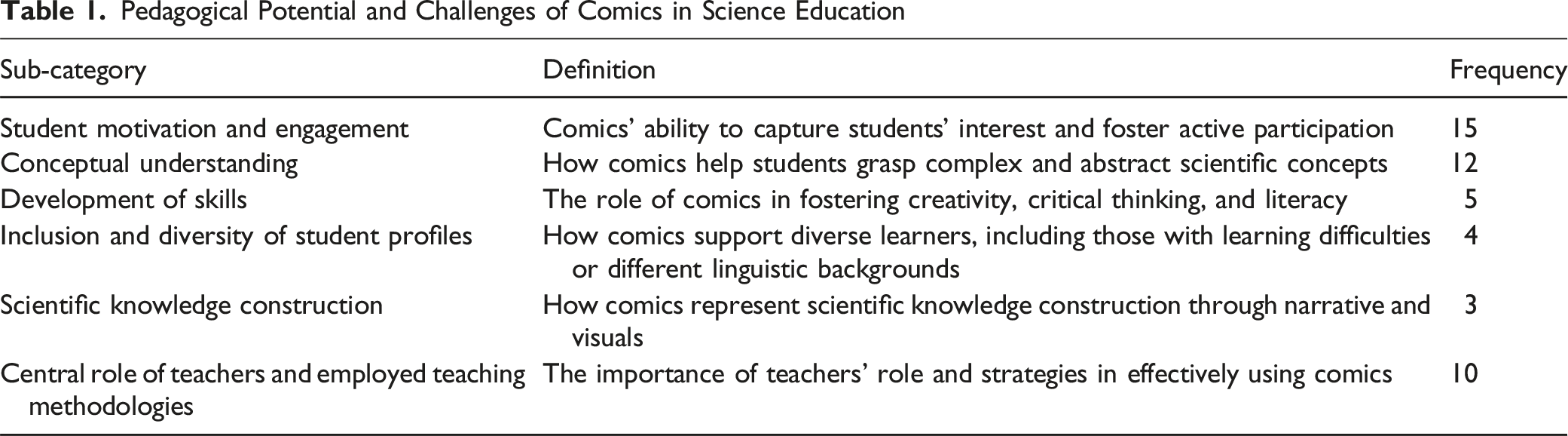
Pedagogical Potential and Challenges of Comics in Science Education
Student Motivation and Engagement
Comics were consistently identified as powerful tools for capturing student motivation and engagement, with 15 out of 19 participants highlighting this as a key advantage. Participants emphasized that comics are perceived as more appealing because of the visual dimension: “If I give them a bunch of words to read, it’s really boring… But if it’s an attractive comic, with colors and good design, they’ll read it” (P18). This appeal is further reinforced by the use of humor and narrative elements that capture students’ interest. Moreover, comics were seen as innovative resources that can break the monotony of lecture-style lessons: “I think it can draw them in, because it’s something new – it’ll be new for them and might spark their interest” (P15). However, some participants also pointed out potential limitations. One concern was that not all students might relate to the comic format or could associate it primarily with language subjects, reducing its effectiveness in science education. As one participant explained: Perhaps the fact that students may not enjoy comics that much or may not identify with certain types of comics… and the fact that they might associate comics with Portuguese subject could then become a barrier to learning science, and also the fact that they might simply have other interests (P19).
Two participants also raised the broader issue of students’ motivation to read. One of them, while recognizing comics as a strategy to spark interest, highlighted the inherent challenge of engaging students with any reading material. He described this as somewhat contradictory: “It’s a bit contradictory ... it’s reading, and students nowadays are not used to reading, I think it’s always a challenge to get their attention, even if it’s just those little speech bubbles” (P15). These reflections suggest that, while comics are seen as engaging, their effectiveness may still be conditioned by students’ general (lack of) reading habits and motivation.
Conceptual Understanding
Of the 19 study participants, 12 (63%) commonly acknowledged comics’ strengths in facilitating memorization and comprehension of complex, abstract concepts. Text-image integration was seen as offering multimodal representations that make difficult ideas more accessible: “It helps students understand, as I mentioned, once they have both the text and the image, making the connection between them becomes much easier” (P19). Participants recognized that visual elements could enhance comprehension where traditional verbal instruction might fall short, as one noted: I think it can help, because as they really like the visual part, it can help them understand some content that perhaps if we are just saying, talking, has no meaning, but perhaps if it's a comic about some subject we are teaching, perhaps it even gets into their heads more (P14).
Despite these perceived advantages, participants also expressed concerns about comics’ capacity to promote accurate conceptual understanding. One participant highlighted potential issues with scientific accuracy in existing comics: In comics that already exist, that are already written... Perhaps the question of scientific integrity, whether that is really completely correct, because sometimes the stories end up tending to change things a little bit, because sometimes it makes more sense for the story (P07).
Others worried about comics’ ability to convey fundamental scientific concepts: When we are attributing characters, I also have concerns. When we talk, for example, about cells, I think many of them don't understand well the dimension and the concept itself. Comics can help with this, but it also has this factor that they don’t get to the essence, the real concept of, for example, the cell or the chloroplast, [comics might] create other dimensions... they already have a very wrong idea of the dimension of cells and other concepts, and if we use comics... I don’t know if it helps in that aspect (P02).
Additionally, two participants also identified risks that attractive visual elements might distract from intended learning objectives. As one participant observed: “I think the main disadvantage is that in the first few minutes they might get distracted, they’ll focus on the characters, and if the theoretical part isn't substantial enough, or the text isn't very well distributed, they can get lost” (P13). These concerns highlight a fundamental pedagogical tension between necessary simplification for accessibility and maintaining scientific rigor, a challenge that requires specific mediation skills that many teachers may not currently possess.
Development of Skills
A smaller subset of participants (5 out of 19, 26%) valued both the creation and interpretation of comics as pedagogical strategies that foster a range of competencies, including creativity, critical thinking, literacy, and interdisciplinary learning. As one participant noted: “Creating science comics can be an excellent way to apply what they know, in a creative way” (P03). Another added: “It’s a way to introduce a different type of reading” (P08). Simultaneously, five participants acknowledged that comics comprehension demands specific interpretive skills that students may not inherently possess, including sequential reading abilities, visual cue interpretation, and inferential reasoning beyond literal text. As one participant explained: “Because the content shouldn’t be overly explicit, the challenge lies in encouraging readers to go beyond the surface of words and achieve genuine comprehension. This requires much more deliberate and reflective exploration” (P05). Notably, two participants highlighted comics as a medium for developing competencies while also acknowledging that these same competencies are prerequisites for effective comics comprehension, revealing an inherent pedagogical tension in implementation. This recognition underscores the need for intentional pedagogical scaffolding to develop students’ visual literacy and interpretive competencies when implementing comic-based instruction.
Inclusion and Diversity of Student Profiles
While other potential benefits such as engagement and comprehension can indirectly support inclusion, four participants explicitly identified comics as having direct inclusive potential. They particularly emphasized benefits for students with learning difficulties or whose first language differs from the instructional language: “It helps students with more difficulties or a different mother tongue because they can easily associate the text with the image” (P19).
Scientific Knowledge Construction
Three participants also highlighted comics’ narrative structure as effective means for representing scientific knowledge construction through dramatizing historical scientific discoveries or simulating investigative processes: “You can make a comic about how the cell was discovered, with scientists talking and making discoveries” (P03). However, participants noted this potential isn’t automatically realized; it depends on storyline quality, learning objective clarity, and scientific content alignment: “It really depends on the comic - how it’s built. It has to be a well-thought-out, cleverly designed resource” (P05). From the participants’ perspective, this underscores the need for intentional pedagogical design when using comics to teach science. The analysis across all these dimensions reveals a consistent pattern: while participants widely recognized comics’ educational potential, they also acknowledged that this potential is not automatically realized. More than half of the participants (10 out of 19, 53%) consistently identified that effective comic integration depends on critical implementation conditions. A key recurring idea was the central role of teachers and employed teaching methodologies, with comics viewed not as automatic solutions but as resources whose educational value depends largely on implementation approach: “I think it depends a lot on how we use the resources” (P17). Participants also highlighted the importance of adapting comics to student interests, profiles, and motivations, tailoring resources to particular classroom contexts. Finally, they stressed that pedagogical impact relies on careful comic construction, narrative quality, coherence, and learning objective alignment. This cross-cutting insight underscores that the realization of comics’ pedagogical potential requires intentional pedagogical design and skilled mediation by educators.
Barriers to Implementation (External and Internal)
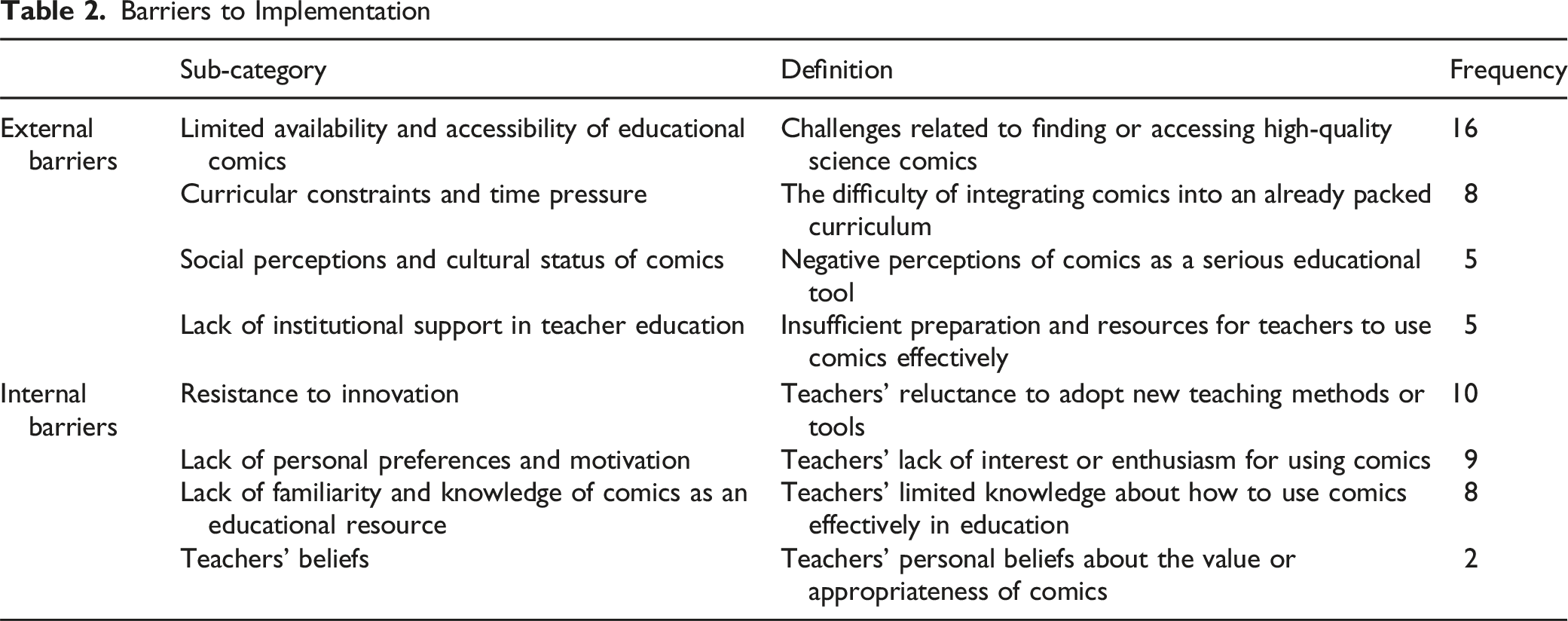
Barriers to Implementation
Limited Availability and Accessibility of Educational Comics
A major challenge reported by 16 participants was the scarcity of suitable science comics. Globally, participants expressed a widespread lack of awareness about existing science comics, with some categorically stating: “I think they don’t exist. I, at least, have never seen any” (P03). However, even among those who acknowledged the possible existence of science comics, significant concerns emerged regarding content alignment with curricular requirements. One participant exemplifies this challenge the following way: “There must be comics related to science, but perhaps not addressing exactly the content that needs to be covered (...) I probably wouldn’t find any comic that had exactly the topics I needed” (P04). This dual challenge—the perceived lack of resources and their potential inadequacy for specific curricular objectives—represents a key barrier to implementation. Participants highlighted not only the lack of science comics but also the absence of a centralized database or repository that would facilitate access to science comics by specific themes or topics. According to one participant: I don't know, and I haven't had anyone tell me about a database where there were comics intended for science by themes ... not having this database probably contributes to teachers not wanting to work with comics because it involves time searching (P06).
This organizational gap is compounded by poor discoverability, with participants reporting that “if we search for a topic, a comic resource is not immediately available” (P10) and that “if they exist, access is poorly publicized” (P03). These observations indicate that potentially suitable resources may remain invisible to teachers due to ineffective distribution and indexing systems, creating additional barriers even when materials might theoretically be available. Given this scarcity, participants identified creating their own resources as a significant challenge demanding specific skills and additional time: “It’s necessary (...) not only for the teacher to master comics (...) to master scientific concepts (...) and to be able to connect them to create a story” (P03). The combination of limited time and lack of ready-to-use materials seems to generate a reinforcing cycle: because few comics are available, teachers must create them; yet, the time and expertise required to do so make this unlikely, which in turn sustains the scarcity of resources.
Despite the identified limitations, some participants recognize the potential of new technologies to overcome these barriers. For example, one participant, a future teacher who had used comics during her teaching practicum, mentioned the use of artificial intelligence for creating comics: “we were helped by artificial intelligence (...) technology nowadays, when it’s well used and when we know how to use it, makes things much easier for us” (P06). This approach represents a possible solution to resource scarcity, although it still requires specific technical skills and considerable preparation time from teachers.
Curricular Constraints and Time Pressure
Of the 19 teachers who participated in the study, 8 explicitly mentioned curricular constraints, highlighting the systemic nature of the problem. Participants reported feeling pressure to cover extensive content within tight timeframes, which left little space for pedagogical innovation: Maybe also in relation to the classroom time we have, at least it’s something I’ve been feeling a lot now. It's all very rushed. Sometimes I don't even have enough time to answer students' questions about science, because they have many questions. I often feel pressed for time, so maybe doing a comic or addressing something related to that would be harder (P04).
Additionally, science is often allocated less instructional time than subjects more directly linked to national assessments. This imbalance contributes to its marginalization within the curriculum. According to participants, these constraints reduce teachers’ flexibility to experiment with alternative pedagogical tools like comics, reinforcing existing barriers to their integration in science instruction.
Social Perceptions and Cultural Status of Comics
Five participants explicitly identified the social perception of comics as a significant barrier to their adoption in science education. The data reveals that future teachers and newly qualified elementary teachers recognize multiple forms of resistance that may arise from parents, colleagues, and educational institutions regarding the use of comics as a pedagogical resource. One of the primary concerns centers on the devaluation of comics as a legitimate educational tool since comics are often perceived as simplistic or intellectually undemanding. According to one participant “There’s a tendency to see comics as something simplistic, like a crutch for people who can’t really read a proper text” (P03). This perception often aligns with the idea that comics do not meet the standards of “good literature,” which leads to their exclusion from more culturally valued pedagogical practices. “It gives off the impression of poor literature, like it’s just for entertainment. But it can be an intelligent resource, with complete vocabulary and even literary richness” (P03). This social resistance includes anticipated reactions from parents, who may see comics as disconnected from academic purposes: “When we talk about comics, the first thing that comes to mind is not education. It’s like… Uncle Scrooge. I think many parents wouldn’t take it seriously” (P01). Nonetheless, some participants believed that this resistance could be overcome by demonstrating the educational potential of comics through concrete practice. “If well explored, I think they’d end up liking it. But the first reaction might be negative” (P01).
Comics are also frequently affected by stereotypes related to student age. Participants noted that comics are still widely associated with young children, which hinders their use with older students: “There’s a stereotype that comics are for kids. It’s like we’re not allowed to use them with older students, even if the content fits” (P16). In addition, two participants pointed out that comics tend to be viewed exclusively as resources for language education, which prevents comics from being recognized as versatile tools that can support learning across a variety of subjects. Despite the challenges identified, participants proposed strategies to shift existing perceptions and foster broader acceptance of comics in education. These strategies rely on social validation through practice, that is, making the educational value of comics visible to others in the school community.
Lack of Institutional Support in Teacher Education
A related but distinct issue, mentioned spontaneously by five participants, concerns the invisibility of comics within initial teacher education. These participants stressed that comics were never addressed in their courses. In some cases, participants also expressed broader criticisms of their teacher education, pointing to a disconnect between theory and practice and to missed opportunities for sharing concrete strategies and classroom-tested resources. This perceived gap was seen as limiting not only the use of comics, but pedagogical innovation more broadly.
When asked directly, only 2 out of the 19 participants reported any reference to comics during their preparation program. While most participants had no exposure to comics in their preparation, one participant offered a contrasting example, underscoring the power of initial teacher education in legitimizing certain approaches. She argued that if certain approaches or tools are not addressed during initial teacher education, they are unlikely to be recognized as pedagogically valuable. Drawing on her own experience, where comics were discussed during her teacher preparation, she reflected: “If no one had ever talked to me about comics, even if they appeared in a textbook, I wouldn’t have paid attention. But now I do, because it was discussed in my teacher education” (P06). Her account highlights how visibility and encouragement in formal education can help future teachers view comics as legitimate educational resources, and how the lack of such exposure can function as a barrier.
Resistance to Innovation
Ten participants recognized that many teachers tend to stay within their comfort zones and avoid adopting new approaches or materials such as comics. As one participant explained, familiarity plays a big role in shaping teaching choices: We always have more difficulty going for what’s new… We tend to stay in our comfort zone. I use a lot of games in my classes because I already know them. I don’t go for other things, like comics, because I don’t know them that well (P04).
Lack of Personal Preferences and Motivation
Nine participants also mentioned the lack of personal interest in comics, which influences motivation to explore or consider them as educational tools. According to one participant: “I have no interest in comics, and if no one had talked to me about it, it would never have crossed my mind” (P02). Another participant also acknowledged the weight of personal taste: “It comes a lot from personal preferences. As teachers, we’re human, and our ideas come from our experiences. If I hadn’t had a brother who liked comics, I would never have thought of an activity using them” (P09).
Lack of Familiarity and Knowledge
Another internal barrier identified by eight participants was their limited knowledge and lack of familiarity with comics as an educational resource. This unfamiliarity was often rooted in their personal trajectories as students and future teachers, where comics were almost invisible. Without prior exposure, many struggled to imagine how comics could be used meaningfully in science education. It’s much easier to think of using PowerPoint or a video, because you see that it is being used all the time. Since I’ve never seen anything like comics being used, it never even occurs to me to use them to teach. (P08) Even if I find a comic online, if I don’t know how to use it or what activity to pair it with, I’d still struggle. It’s more about knowing how to use them. (P15)
According to some participants, these constraints do not stem from a lack of interest, but rather from the absence of preparation, practical guidance, and pedagogical support that could help them use comics confidently and purposefully in their teaching.
Teachers’ Beliefs
Only two participants mentioned that teachers’ underlying beliefs about teaching, learning, and the role of educational materials could also serve as internal barriers. Some people are more focused on content acquisition, and they tend to rely on more mechanical learning and traditional resources. But someone who is really concerned with the development of the whole person will seek out more complex resources and try to relate different things. (P03)
This perspective suggests that the perceived legitimacy of comics as a pedagogical tool may depend on how teachers conceptualize learning—whether as the transmission of discrete knowledge or as a process of meaning-making that integrates different forms of representation and supports broader educational goals. In addition to broader beliefs about teaching and learning, two other participants revealed specific perceptions about comics themselves that may function as constraints. One participant articulated this view clearly: “In my mind I associate comics more with entertainment themes, social commentary, and not so much with scientific things” (P11).
Insights for the Development of a Teacher Education Program on the Educational Use of Comics in Science Teaching
In addition to their perceptions about the use of comics in science education, participants also offered concrete suggestions on how an effective teacher education program in this area should be structured. Their proposals addressed both the content to be covered and the methodologies to be adopted, revealing a clear and critical understanding of their own preparation needs. Based on participants’ contributions, an ideal teacher education program on the use of comics in science education should combine theoretical grounding with substantial practical components.
A recurring concern among participants was the need to begin with a clear conceptual understanding of what constitutes a comic. As one participant noted, it is essential to clarify “the structure, the components, and how it differs from other genres such as picture books” (P16), suggesting the importance of conceptual clarity to effective pedagogical use. Participants also stressed the importance of articulating the educational relevance of comics, particularly in primary education. They emphasized that teacher preparation should not only present comics as engaging resources, but also explore their potential to promote motivation, inclusion, and comprehension, especially among diverse student populations. This pedagogical justification was considered essential for legitimizing their use in formal educational settings.
Another dimension frequently raised was the need for greater exposure to existing comics that are appropriate for educational contexts. Many participants reported limited access to, or awareness of, suitable materials, and expressed a desire for guidance on how to select, evaluate, and apply these resources effectively in their teaching. In addition to accessing materials, participants highlighted the importance of concrete examples and case studies that illustrate how comics have been used in science education. They valued opportunities to learn from others’ experiences, including what has worked well, the challenges encountered, and how such practices might be adapted to different classroom realities. A strong emphasis was placed on the inclusion of practical activities within the preparation program, such as creating comics, designing learning tasks around them, and experimenting with these approaches in real or simulated classroom settings. This hands-on dimension was considered essential for understanding the potential and limitations of comics in teaching. The idea of “learning by doing” emerged repeatedly, reflecting a shared belief that active engagement would support both teacher confidence and pedagogical competence.
Participants also called for tools and strategies that would enable the creation of comics without requiring advanced drawing skills. This concern points to the need for inclusive and accessible approaches that demystify the creative process, making it feasible for all teachers and students to engage with comic creation. Finally, participants expressed interest in follow-up support after the initial preparation, particularly in the form of mentoring or in-school assistance. They felt that such support would facilitate the adaptation of what was learned to the specific demands and contexts of their classrooms, thereby increasing the likelihood of meaningful and sustained implementation.
Discussion
The findings of this study reveal a broad and multifaceted appreciation of comics as educational tools for science teaching, both among student teachers and recent graduates. This appreciation was not limited to participants with prior interest or familiarity with comics but extended also to those who had little personal engagement with the medium, suggesting that their perceived pedagogical potential can transcend personal preferences. One of the most consistently mentioned aspects was the motivational value of comics, particularly their ability to capture and sustain students’ attention. This aligns with previous studies (e.g., Morrison et al., 2002; Yang, 2003), which highlight comics’ intrinsic appeal and connection to popular culture as key drivers of engagement in educational contexts. However, participants’ perspectives extended beyond mere motivation. Many emphasized comics’ potential to support conceptual understanding, attributing this to their hybrid communicative format that blends visual and textual elements, a characteristic known to support comprehension and memory retention (Eilam & Poyas, 2010; Hosler & Boomer, 2011).
Participants also highlighted comics’ inclusivity, noting that their multimodal nature can facilitate access for students with different learning needs or difficulties. This observation resonates with the literature on multimodal design and differentiated instruction (Lin et al., 2014), which points to the capacity of comics to support diverse cognitive profiles. Equitable learning opportunities are central to the aims of science education, which must address the diversity of students’ cultural, linguistic, and cognitive backgrounds (Matuk et al., 2021). Promoting fairness in access to learning involves legitimizing multiple ways of expressing ideas and valuing students’ existing knowledge, experiences, and identities. From this perspective, comics can act as meaningful entry points for learners who might otherwise feel disconnected from science, as they integrate narrative and visual dimensions that bridge informal and formal discourses. In this way, comics can contribute to more inclusive and equitable participation in science education (Aleixo & Sumner, 2017; Matuk et al., 2021). Yet, equitable access depends on more than the use of multimodal resources. If used uncritically, comics may reproduce stereotypes, trivialize complex scientific issues, or overlook underrepresented perspectives. Ensuring genuine inclusion therefore requires a reflective and intentional pedagogical approach that uses comics to engage all students meaningfully and respectfully, while avoiding simplification and bias.
Furthermore, the perception that comics foster transversal competencies, such as creativity, critical thinking, and literacy, reinforces earlier findings (Lapp et al., 2012; Lewkowich, 2019) and underscores their potential for promoting broader educational goals. A particularly noteworthy contribution of this study lies in the recognition by some participants of comics’ potential to support epistemic learning, that is, learning about the nature and processes of scientific knowledge production. According to these participants, the narrative affordances of comics enable the representation of research contexts, scientific dilemmas, and processes of discovery, thus offering a contextualized and humanized vision of science. Participants’ recognition of this epistemic dimension opens new avenues for considering how comics might contribute not only to learning science, but also to learning about science (Lederman & Lederman, 2014).
It is worth highlighting that the perceived benefits of comics do not arise as vague or scattered opinions. On the contrary, they seem grounded in a relatively stable set of structural features of the medium, namely, multimodality, narrativity, and novelty. These three dimensions operate as transversal explanatory mechanisms that help to make sense of the various educational affordances identified. This finding aligns with Morrison et al. (2002) theoretical framework, which emphasizes comics’ connection to popular culture, visual storytelling format, and inherent appeal as key educational rationales. Nevertheless, this widespread appreciation coexists with a critical and reflective attitude among many participants. Several emphasized that the positive effects of comics strongly depend on the quality of the resource, the pedagogical intentionality with which it is employed, and how well it is aligned with curricular goals. Such caution reveals a critical awareness of the risks posed by technicist or instrumental approaches and points to the need for thoughtful, strategically designed use. This critical stance echoes Tatalovic’s (2009) distinction between science comics that prioritize educational objectives over entertainment, suggesting that participants intuitively understand the importance of purposeful design in educational comics.
Within this context, certain pedagogical tensions emerge and warrant attention. The first concerns the balance between accessibility and scientific rigor. While simplification is often necessary to communicate effectively, it may lead to superficial or inaccurate representations, requiring careful mediation by the teacher. This tension directly reflects the core challenge identified by Faria et al. (2024) and Lin et al. (2014), regarding how science comics must balance engagement through humor and storytelling with accurate transmission of scientific content. Drawing on Vygotskian perspectives, effective learning occurs when support is provided within the learner’s zone of proximal development (Vygotsky, 1978). From this standpoint, well-designed comics can act as scaffolding tools that combine visual and textual modes to reduce cognitive load and provide alternative entry points into scientific ideas. As participants in this study emphasized, simplification must be used critically, since oversimplified or poorly designed visuals may distort meaning or hinder comprehension. These risks highlight the crucial mediating role of teachers in selecting and using comics thoughtfully to ensure accessibility without compromising conceptual depth.
A second tension lies in the interplay between emotional engagement and interpretative complexity: although narratives can enhance engagement, they also demand skills such as sequential reading, visual literacy, and inferential reasoning, which not all students possess. This duality aligns with Kress and van Leeuwen’s (2001) theory of multimodality, which emphasizes that meaning in a medium such as comics emerges from the interaction of multiple semiotic modes (verbal, visual, and spatial). While this combination can enrich learning and make scientific ideas more accessible, it also places interpretative demands on students, who must learn to navigate and integrate these modes effectively. As participants in this study noted, comics’ educational potential depends on thoughtful design and pedagogical scaffolding to develop multimodal literacy. Without such guidance, engagement may remain superficial, limiting the depth of learning.
A final tension relates to the interplay between motivation and reading culture. While the visual and narrative features of comics can make learning more engaging and enjoyable, their effectiveness ultimately depends on students’ reading habits and their perceptions of comics as a legitimate educational medium. As some participants noted, the seemingly “light” nature of comics may not be sufficient to overcome a general lack of motivation to read, particularly in contexts where reading is not deeply rooted in students’ everyday experiences. This tension resonates with the Self-Determination Theory (Deci & Ryan, 1985), which highlights the importance of satisfying learners’ needs for autonomy, competence, and relatedness to foster intrinsic motivation. From this perspective, comics can act as catalysts for engagement, but their educational potential will be fully realized only when integrated into broader pedagogical strategies that cultivate a sustained culture of reading and critical engagement with texts.
The findings also reveal that, despite recognizing the pedagogical potential of comics in science education, multiple barriers hinder their effective integration, operating at both external and internal levels and reflecting systemic issues as well as individual attitudes and experiences. External Barriers mainly relate to structural and organizational challenges. Material scarcity emerged as a primary concern, with participants noting that while science comics may exist, they often fail to address specific curricular requirements. This creates a reinforcing cycle: the lack of ready-to-use materials necessitates teacher-created resources, yet the time and expertise required make this unlikely, perpetuating resource limitations. These findings extend the barriers identified by Lapp et al. (2012) and Ali (2021) by revealing how content-specific requirements in science education compound general resource accessibility issues. Curricular constraints also proved significant, with participants citing time pressures and extensive content coverage that leave little space for pedagogical innovation. This mirrors institutional limitations found in previous research (Lewkowich, 2019), but participants revealed how science education’s marginalized curricular position, often allocated less time than assessment-linked subjects, creates particular integration challenges.
Participants in this study reported encountering widespread stereotypes that comics are simplistic or intended primarily for entertainment. These social and cultural perceptions, documented in previous research among teachers (e.g., Aleixo et al., 2021; Lewkowich, 2019), act as significant external barriers that undermine the legitimacy of comics as serious educational tools. This marginalization is further reinforced by the lack of institutional support during teacher education programs, where comics are rarely introduced or discussed. As shown by participant experiences, formal teacher preparation can play a decisive role in legitimizing and promoting the use of innovative pedagogical tools such as comics.
The internal barriers identified reflect common challenges in adopting educational innovations. Participants’ preference for familiar methods and resistance to materials like comics align with research showing teachers tend to remain within their comfort zones (e.g., Hargreaves, 2005). They reported that lack of personal interest and limited prior exposure to comics reduced their motivation to use them. Furthermore, many emphasized insufficient knowledge on how to effectively integrate comics in teaching as a significant barrier. This suggests that mere awareness of comics is insufficient; participants highlighted the need for targeted preparation and practical guidance to build confidence and competence in using comics as educational tools.
Participants indicated that teacher preparation for integrating science comics should address both theoretical and practical dimensions. They stressed the importance of understanding what comics are and how they differ from other mediums, along with seeing their educational value for motivation, inclusion, and understanding. Participants highlighted the need for practical activities like making comics and designing lessons, as well as access to ready-to-use resources. They also emphasized ongoing support to help them implement and adapt comics effectively in diverse classrooms. Some suggested that emerging technologies, such as AI-assisted comic creation, could ease practical difficulties if accompanied by proper preparation.
Limitations and Directions for Future Research
Although this study provides valuable insights into pre-service and newly qualified teachers’ perceptions of science comics, some limitations should be acknowledged. First, participants were primarily drawn from a teacher education program, focused on mathematics and natural sciences education, and their perspectives may therefore reflect disciplinary orientations as well as institutional particularities or shared curricular experiences. Second, the study relied exclusively on self-reported perceptions, which, while offering rich qualitative insights, may not fully capture how teachers actually implement comics in real classroom contexts. Future research could therefore adopt complementary approaches, such as classroom observations, design-based interventions, or longitudinal studies that follow teachers from initial preparation into professional practice. In addition, expanding the focus to other subject areas and educational levels would allow a more comprehensive understanding of the pedagogical potential of comics across the curriculum. Comparative studies between science and non-science domains could be particularly valuable in clarifying how disciplinary cultures influence teachers’ acceptance and use of comics as educational tools.
Implications for Practice
The findings of this study hold several implications for teacher education and classroom practice, as articulated through participants’ perspectives. Rather than demonstrating the effects of an intervention, the results highlight conditions, needs, and possibilities identified by participants regarding the pedagogical use of comics in science education. Based on the insights provided by participants, we propose the following design principles and practical guidelines for integrating comics into science education: - Incorporate multimodal and narrative-based pedagogies into teacher education programs. Teacher education curricula could explicitly address the use of multimodal resources, such as comics, as part of science teaching. This may include providing opportunities for student teachers to critically analyze, design, and use comics during their preparation. Such activities can potentially enhance their confidence and competence in employing comics as educational tools in authentic classroom contexts. Adequate allocation of time, access to relevant materials, and trained mentors were identified by participants as important to support these activities. - Develop accessible, curriculum-aligned science comics with supporting materials. To address the scarcity of suitable resources highlighted by participants, it is important to create high-quality science comics that align with curricular objectives. These comics could be accompanied by teaching notes or exploration guides that provide practical suggestions for classroom use, helping teachers bridge the gap between the creative potential of comics and the demands of curricular implementation. - Encourage reflective discussions on the epistemic and ethical dimensions of science communication. Teacher education programs and professional development initiatives could encourage teachers to critically reflect on how comics represent scientific knowledge, uncertainty, and diversity. This can help teachers adopt a more nuanced and inclusive approach to science education, ensuring that comics are used to promote accurate and ethical representations of scientific concepts. - Leverage emerging technologies for comic creation. New technologies, such as AI-assisted tools for comic creation, offer promising opportunities for expanding teachers’ repertoires of multimodal resources. Their integration into teacher education should focus on developing pedagogical skills for creating curriculum-aligned, supported by critical reflection to ensure pedagogical rather than merely technical use. - Provide ongoing support and professional development. To ensure the successful implementation of comics in science education, teacher education programs could offer follow-up support, such as mentoring or communities of practice. Institutional commitment was perceived as important to provide the necessary time, resources, and structures that allow teachers to adapt what they have learned to their specific classroom contexts and overcome potential barriers.
Conclusion
In conclusion, this study provides evidence that future and newly qualified elementary teachers recognize comics as pedagogical tools with significant potential in science education. Rather than expressing uncritical enthusiasm, participants articulated a considered appreciation of the medium’s strengths, particularly its capacity to engage students, support inclusion, and convey complex scientific ideas, while also demonstrating awareness of the contextual conditions necessary for its effective use.
The challenges identified throughout the study appear to be less about the medium itself and more closely linked to systemic constraints that limit pedagogical innovation. These include the scarcity of high-quality, curriculum-relevant comics, limited preparation in multimodal and narrative-based pedagogies, and insufficient curricular space to explore alternative instructional approaches. Such constraints suggest that comics remain underutilized in science education not due to resistance, but because of limited visibility and institutional support.
These findings point to the need for a more deliberate and systemic approach to integrating comics into both teacher education and classroom practice. This would involve incorporating multimodal literacy into teacher preparation and enabling curricular flexibility to support experimentation and innovation. Under these conditions, comics may serve as valuable tools for fostering a more inclusive and engaging, approach to scientific literacy. Another promising avenue is the development of comics accompanied by exploration guides (detailed suggestions for classroom integration and activities) which would position these materials as concrete didactic resources. This approach opens up possibilities for creating new educational comics and enriching existing ones, making them more accessible and useful for teachers. While broader curricular flexibility and institutional support remain important, focusing on such resource development offers a more immediate and actionable strategy within educators’ reach.
Supplemental Material
Supplemental Material - Turning the Page on a Missed Opportunity: Science Comics Through the Eyes of Future Elementary Teachers
Supplemental Material for Turning the Page on a Missed Opportunity: Science Comics Through the Eyes of Future Elementary Teachers by Bianor Valente and Cláudia Faria in Journal of Education
Footnotes
Funding
This research was developed within the project “ECOSCOMICS” (ID KA220-SCH-D325A38D), funded by ERASMUS+, KA220-SCH – Cooperation partnerships in school Education. Moreover, this work was supported by National Funds through FCT-Portuguese Foundation for Science and Technology, I.P., under the scope of UIDEF - Unidade de Investigação e Desenvolvimento em Educação e Formação, UID/04107/2025,  .
.
Declaration of Conflicting Interests
The authors declared no potential conflicts of interest with respect to the research, authorship, and/or publication of this article.
Supplemental Material
Supplemental material for this article is available online.
References
Supplementary Material
Please find the following supplemental material available below.
For Open Access articles published under a Creative Commons License, all supplemental material carries the same license as the article it is associated with.
For non-Open Access articles published, all supplemental material carries a non-exclusive license, and permission requests for re-use of supplemental material or any part of supplemental material shall be sent directly to the copyright owner as specified in the copyright notice associated with the article.
