




Abstract
This qualitative case study examines how two doctoral students in a Curriculum and Instruction program negotiated scholarly identity through sustained participation in a faculty-led Elementary Education Special Interest Group (SIG). Guided by a situated framework of scholarly identity, the study analyzes mentoring transcripts and participant reflections to examine how scholarly participation and positioning were mediated within a practice-based research context. Findings identify five themes across three domains: entry into scholarly practice, collaborative engagement, and evolving scholarly identity. The study offers implications for mentoring structures that support practitioner-scholars in non-traditional or part-time doctoral pathways.
Doctoral programs are designed to cultivate opportunities for students to engage in communities of scholarly participation and to develop scholarly identities expressed through research, publication, and dissemination. Many support this development through fellowships and assistantships that socialize students into academic communities (Austin, 2002). However, students who work full-time or attend part-time often lack access to these opportunities and may require additional scaffolding to build scholarly capacity (Cotterall, 2011; McAlpine & Amundsen, 2009). These students frequently experience fragmented forms of socialization into academic practice (Caffarella & Barnett, 2000; Sweitzer, 2009). When program structures are misaligned with student needs and expectations, identity development can suffer (Golde & Dore, 2001).
These challenges are not unique to education doctoral programs in the United States. Globally, scholars have drawn attention to the ways doctoral education reproduces dominant norms of knowledge production and values certain forms of expertise over others (Grant, 2005; Manathunga, 2007). Students from historically excluded backgrounds, whether due to race, class, language, or career trajectory, often encounter structural barriers to participation in academic discourse communities (Gardner, 2009; Lee, 2008; McAlpine & Amundsen, 2009). These students require mentoring structures that affirm their positionalities, foster agency, and integrate scholarly growth with professional practice.
Literature Review
This literature review synthesizes scholarship on doctoral identity development, practitioner-scholars in non-traditional doctoral pathways, and the role of structured mentoring and seminar-based learning in supporting scholarly development. Together, these bodies of work situate the present study within existing research while highlighting the need for closer examination of practice-based, voluntary research contexts that mediate scholarly identity formation.
Doctoral Identity Development and Socialization
Doctoral education has long been understood as a process of socialization into scholarly communities through which students learn not only research skills but also the norms, values, and identities associated with academic work (Austin, 2002; Gardner, 2009; McAlpine & Amundsen, 2009). Increasingly, scholarly identity development is conceptualized as socially situated and relational rather than as the linear acquisition of competencies (Boud & Lee, 2005; Sweitzer, 2009). However, much of this foundational literature centers on full-time doctoral students in research-intensive contexts, where assistantships, laboratory work, and disciplinary immersion serve as primary sites of socialization (Golde & Dore, 2001). Doctoral students who are enrolled part-time, work full-time, or remain embedded in professional practice often require alternative forms of scaffolding and support for scholarly identity development (Caffarella & Barnett, 2000; Cotterall, 2011).
Practitioner-Scholars and Non-Traditional Doctoral Pathways
Doctoral programs in education increasingly serve practitioners who pursue doctoral study while remaining embedded in K–12 or other professional settings. These practitioner-scholars may seek to deepen research use in practice, engage in inquiry addressing local problems, or explore transitions into academic or research-oriented roles (McAlpine & Amundsen, 2009; Sweitzer, 2009). Yet, persistent research-practice tensions remain, as academic research is often perceived as misaligned with classroom realities or inaccessible to practitioners (Broekkamp & Van Hout-Wolters, 2007; Gore & Gitlin, 2004). Research on teacher-researchers and practitioner inquiry highlights the potential of practice-based research to bridge this divide, while also documenting challenges related to navigating academic norms, methodological expectations, and scholarly discourse (De Vries & Pieters, 2007; Farley-Ripple et al., 2018). Across this literature, terms such as scholar-practitioner, practitioner-scholar, and teacher-researcher are often used interchangeably, though they reflect differing assumptions about proximity to practice, epistemic authority, and the purposes of research engagement. This distinction is analytically important in the present study, where participants remained embedded in K–12 classrooms while developing scholarly identities through sustained research participation.
Structured Seminars, Mentorship, and Identity Development
A related body of literature has examined how structured seminars and collaborative learning spaces support doctoral identity development, particularly among future teacher educators. Self-study research in teacher education documents how participation in seminars, critical friendships, and collaborative inquiry can foster pedagogical, affective, and intellectual growth as doctoral students negotiate new professional identities (Butler et al., 2014; Logan & Butler, 2013; Martinelle & Martell, 2024). Across these studies, dialogic spaces emerge as central sites for reflecting on identity tensions. However, this work is largely situated within formal coursework, teaching assignments, or self-study designs focused on doctoral students transitioning into teacher educator roles. Less attention has been given to voluntary, practice-based research contexts that operate outside required coursework and prior to dissertation work, particularly for doctoral students who remain embedded in K–12 classrooms. Additionally, existing studies tend to emphasize reflective practice rather than sustained participation in collaborative research processes, such as study design, institutional review navigation, data analysis, and scholarly dissemination.
Locating the Present Study
Taken together, these bodies of literature underscore the importance of mentoring structures that support doctoral identity development through participation, discourse, and relational engagement. Yet, there remains limited empirical work examining how practitioner doctoral students negotiate scholarly identity through sustained involvement in faculty-led, practice-based research communities outside of formal coursework. The present study addresses this gap by examining how elementary education doctoral students articulated and negotiated their scholarly identities through participation in a Special Interest Group (SIG) that functioned as a mediating context for research engagement.
This study is situated within a Curriculum and Instruction PhD program at an independent, teaching-oriented Carnegie R2 university, one of many institutions offering flexible, practice-based doctoral pathways beyond traditional, full-time, research-intensive models. In response to the lack of structured research opportunities beyond coursework, faculty designed and piloted a cross-cohort initiative embedded within six scheduled face-to-face doctoral class days. This initiative included multiple faculty-led SIGs convened for 1 hour at the end of the instructional day, along with workshops, structured mentoring, and panel discussions held during the scheduled lunch break between classes.
Although several SIGs were launched during this 1-year pilot, this manuscript focuses on a single Elementary Education SIG that began during the pilot year and continued, at the participants’ choosing, across two academic years. In this study, the SIG served as a participatory structure through which participants engaged in practice-based inquiry and negotiated emerging scholarly identities. These structures were intended to create access to scholarly participation by making research norms, practices, and expectations visible and negotiable within a collaborative, practice-based space (Lee & Boud, 2003; Manathunga, 2007). Similar calls for embedded, inclusive mentoring structures appear in global doctoral education scholarship, emphasizing approaches that adapt to diverse learner needs and support researcher identity development alongside disciplinary engagement (Halse & Bansel, 2022; Zhang et al., 2020).
Using a qualitative case study approach, this study examines the developmental research perspectives of two participants in the Elementary Education SIG. Specifically, we explore how these doctoral students understood and articulated their identities as emerging researchers and identify features of the SIG context that shaped that development. While the broader study included session transcripts, reflections, and artifacts, this manuscript centers on dialogic exchanges during mentorship meetings and written reflections, which most directly captured participants’ sense-making, positioning, and identity negotiation as scholars.
Theoretical Framework
Prior research on doctoral identity development has largely focused on full-time students positioned as emerging academics (McAlpine & Amundsen, 2009; Zygouris-Coe & Roberts, 2019). Parallel scholarship on teachers transitioning into teacher educator roles documents identity tensions as practitioners enter academic spaces, but typically centers coursework, reflective practice, or postdoctoral transitions rather than sustained collaborative research prior to dissertation work. Zygouris-Coe and Roberts (2019) developed a situated framework to guide faculty in preparing doctoral students for scholarly roles within and beyond academia. Central to their framework is the assertion that doctoral students enter programs with established identities shaped by prior professional, cultural, and educational experiences, which influence how they engage with scholarly work and doctoral expectations. Rather than viewing doctoral development as a uniform or linear process, the framework emphasizes the role of mindset, expectations, and relational context in shaping scholarly identity formation.
This framework aligns with broader scholarship that conceptualizes doctoral education as a dynamic, socially situated process of identity formation, scholarly agency, and transformation (Boud & Lee, 2005; Halse & Bansel, 2022; Sweitzer, 2009). Research on doctoral supervision further emphasizes its pedagogical and discursive nature, highlighting how mentoring relationships shape doctoral students’ understandings of autonomy, legitimacy, and participation within academic communities (Grant, 2005; Lee & Boud, 2022; Lee & McKenzie, 2011; Pyhältö et al., 2022). Across this literature, scholarly identity development is understood to unfold through participation in research communities, peer interaction, and reflective practice rather than through cognitive acquisition alone (Gardner, 2009; Mezirow, 1997).
Although originally developed within an education doctoral context centered on full-time, traditionally enrolled students, the Zygouris-Coe and Roberts framework provides a useful lens for examining how scholarly identity is mediated within part-time, interdisciplinary, and practice-based doctoral programs that depart from conventional full-time pathways. Guided by this framework, we examined how doctoral students negotiated scholarly participation and identity through sustained involvement in a faculty-led SIG, understood here as a mediating context rather than a programmatic outcome. The following research questions shaped our inquiry: (1) How do doctoral students negotiate and articulate their emerging scholarly identities through sustained participation in a faculty-led SIG? (2) How do doctoral students describe changes in how they understand their roles, positioning, and participation as scholars through classroom-based research within the SIG context?
Method
This case study explores the scholarly development of doctoral students in a SIG focused on elementary education. Participants were selected through purposive sampling from a broader initiative designed to strengthen doctoral student engagement in scholarly inquiry, writing, and dissemination during the 2021–2022 academic year. A case study methodology supported in-depth examination of students’ growth within authentic research settings, allowing us to trace both individual trajectories and shared themes (Yin, 2017). This study was approved by the university’s Institutional Review Board (IRB Protocol #H22-01006) and adhered to all ethical guidelines for research involving human participants.
Participants and Researcher Roles
This study centers on two doctoral students, Courtney and Anya (pseudonyms), who sustained active participation in the Elementary Education SIG across two academic years. Both were enrolled in the Curriculum and Instruction PhD program at a private, mid-sized Carnegie R2 university in the southeastern United States. Throughout this study, students were in various stages of program completion, from early coursework to candidacy.
Courtney
At the project’s outset, Courtney was a first-year doctoral student interested in a tenure-track faculty role. She worked as an ESOL resource teacher across two rural elementary schools and later became an adjunct professor at a nearby master’s-level public university focused on teacher preparation. Courtney identifies as a White, heterosexual, married woman and remains active across both K–12 and higher education.
Anya
Anya began participating in the SIG as a second-year doctoral student. She teaches second grade at a Title I school in the state’s largest district. Anya identifies as an Asian, heterosexual, married mother of two and has expressed sustained interest in research-practice roles outside the tenure track, particularly related to developmentally appropriate practice in the early grades.
Other SIG Participants
Two additional doctoral students participated in the Elementary Education SIG for limited periods during the pilot year. One disengaged after participation shifted from a programmatic expectation to a voluntary activity, while the other joined later to support data analysis and a conference presentation but did not continue beyond the pilot. These patterns highlight an important boundary condition of this case: sustained engagement was tied to participant interest, readiness, and alignment with professional goals rather than to programmatic scaffolding alone. Accordingly, these participants are not treated as comparative cases, and the analysis centers on Courtney and Anya, whose sustained participation enabled an in-depth examination of scholarly identity negotiation within the SIG context.
The Research Team
The research team included an associate professor of education (Allee) who facilitated the SIG and served as the primary mentor, an assistant professor of psychology (Seccia) who contributed qualitative methodological expertise, and a doctoral student and teacher educator (Wooten) who supported data management and analysis. The first and second authors were involved in the design and facilitation of the Elementary Education SIG, while the third author provided an external analytic perspective. Given the authors’ dual roles as faculty mentors and researchers, we engaged in reflexive practices, including collaborative coding and peer debriefing, to attend to power dynamics and strengthen analytic trustworthiness.
Program Context and Design
Doctoral coursework in the Curriculum and Instruction program included a sequence of courses focused on scholarly writing, curriculum theory, learner-centered pedagogy, assessment, and introductory and advanced qualitative and quantitative research methods. While coursework provided foundational exposure to research concepts and, in some cases, course-based projects or hypothetical study design, opportunities for sustained, independent research engagement were not structurally embedded and were typically deferred until the dissertation phase. As a result, students’ research experiences beyond coursework varied depending on instructor emphasis and individual initiative. The SIGs, part of the larger pilot, emerged as a supplemental structure intended to provide continuity, voluntary participation, and collaborative engagement around a shared research agenda. Unlike coursework, the SIGs supported extended inquiry across semesters and participant-driven engagement with research processes, including IRB development, data collection, analysis, and dissemination. The SIG functioned as a complementary context for enacting scholarly practice beyond coursework and became the primary site of sustained research participation for these students.
The Elementary Education SIG examined in this study emerged from this broader faculty-led pilot initiative designed to support doctoral research development through cross-cohort mentoring. While several SIGs were launched during the pilot year, the Elementary Education SIG was the only group that continued beyond the conclusion of the initiative, sustained by participant interest and voluntary engagement. The Elementary SIG evolved organically into a collaborative research space in which participants engaged in shared inquiry, mentorship, and dialogue as they navigated research design, data analysis, and scholarly writing. During the initial phase (October 2021–April 2022), the group met monthly for structured sessions focused on literature review, conceptual frameworks, and methodology as part of the broader pilot structure. A second phase (January–July 2023) shifted toward more flexible, participant-driven, largely asynchronous participation supported by shared digital workspaces and individualized feedback, accommodating the participants’ roles as full-time educators.
Their Study
As part of their continued participation in the Elementary Education SIG, Courtney and Anya each designed and implemented parallel case studies grounded in a shared theoretical and methodological framework. Drawing on social constructivism, culturally responsive pedagogy, social-emotional learning (SEL), and literacy development, they conducted research within their own elementary classrooms. Both received district-level IRB approvals and served as the teachers of record for their student participants. Their parallel studies focused on the use of Reader’s Theater and game design to enhance reading comprehension, foster SEL skills, and support culturally and linguistically responsive instruction for Multilingual learners (MLs). Their shared research question asked: What types of reflection-based conversation does Reader’s Theater, culturally and linguistically responsive texts, and game design elicit with ML students? At this time, Courtney and Anya have presented their work at three conferences and are working on a co-authored manuscript for publication. Their collaboration reflects the SIG’s broader goal of integrating theory, practice, and scholarly dissemination.
Our Study
Following Yin’s (2017) guidance on collective case study design, this study defines the case as the sustained engagement of Courtney and Anya in the Elementary Education SIG. While other students contributed intermittently to early planning or data analysis, only these two participants engaged across both phases and completed full research cycles. The bounded case includes their classroom-based interventions, mentorship interactions, and written reflections generated through the SIG experience.
Data Collection and Sources
Timeline of SIG Activities and Milestones
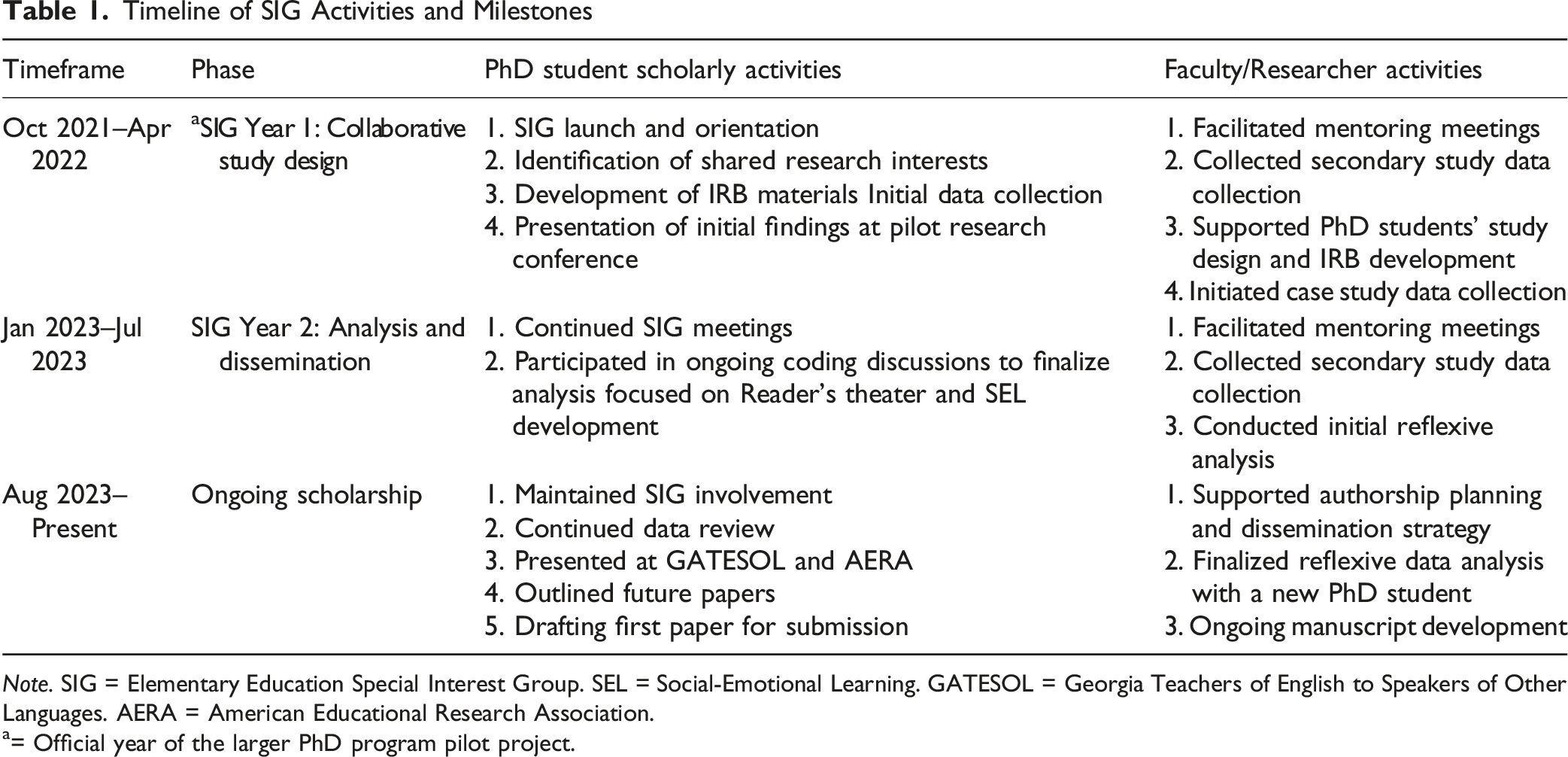
Note. SIG = Elementary Education Special Interest Group. SEL = Social-Emotional Learning. GATESOL = Georgia Teachers of English to Speakers of Other Languages. AERA = American Educational Research Association.
a= Official year of the larger PhD program pilot project.
Data sources included transcripts from 15 faculty-led SIG meetings, recorded and transcribed across two academic years (six meetings in Year 1 and nine in Year 2). These dialogic sessions captured responsive mentoring practices and co-constructed learning processes characteristic of authentic scholarly engagement (Boud & Lee, 2005; Lee, 2008). In addition, participants submitted structured written reflections (2–3 pages) at the conclusion of each semester, documenting their evolving goals, challenges, and perceptions of scholarly development. These reflections provided insight into participants’ metacognitive awareness and identity negotiation over time. Finally, a corpus of student-generated research artifacts, including IRB materials, literature reviews, research proposals, analytic memos, draft manuscripts, and data visualizations, served as evidence of students’ engagement with ethical research practice, methodological decision-making, and scholarly dissemination.
Although we reviewed all three data sources, this paper centers on the analysis of the mentorship meeting transcripts. These dialogic exchanges most directly captured how doctoral students made meaning of research, navigated challenges, and internalized feedback, key components in the development of scholarly identity and self-efficacy. By focusing on these interactions, we highlight how identity formation emerged through collaborative, practice-based inquiry. Analyses of reflections and artifacts will be shared in future manuscripts to further examine scholarly growth and application.
Data Analysis
Data were analyzed using Braun and Clarke’s (2006) thematic analysis through iterative, collaborative coding. Allee & Seccia developed and refined a priori codes aligned with the Zygouris-Coe and Roberts (2019) framework, incorporating in vivo coding and analytic memoing (Saldaña, 2016). A subset of transcripts (20%) was double-coded to establish consistency, followed by consensus-building discussions and third-researcher (Wooten’s) review. This process resulted in five final themes representing patterns across mentorship transcripts and reflections. Supplemental Item A provides a summary of coding frequency and distribution.
Findings
The findings illustrate how doctoral students negotiated and articulated scholarly participation and identity through sustained participation within a faculty-led SIG. Rather than reflecting a linear progression or discrete stages of development, participants’ experiences were characterized by engagement with research practices, reflective dialogue, and collaborative mentorship. Across meetings and artifacts, students articulated shifts in how they understood research, scholarly norms, and their own positioning within academic spaces. These patterns prompted us to revisit our guiding theoretical framework to examine how scholarly identity is mediated within practice-based doctoral contexts.
Our adapted framework (Figure 1) builds on Zygouris-Coe and Roberts’ (2019) model of doctoral socialization and is used here as an analytic lens rather than a developmental sequence. While the original framework foregrounds the interplay of mindset, expectations, and identity across the doctoral journey, our adaptation situates these constructs within the specific context of a faculty-led SIG. The framework highlights three interrelated domains of participation that were salient in participants’ experiences: (1) engagement with practice-based research discourse and processes; (2) articulation and negotiation of scholarly identity and positionality; and (3) collaborative scholarly engagement through mentoring and apprenticeship. These domains are overlapping and mutually constitutive, not hierarchical or sequential. Conceptual model of scholarly identity development in a practice-based doctoral SIG.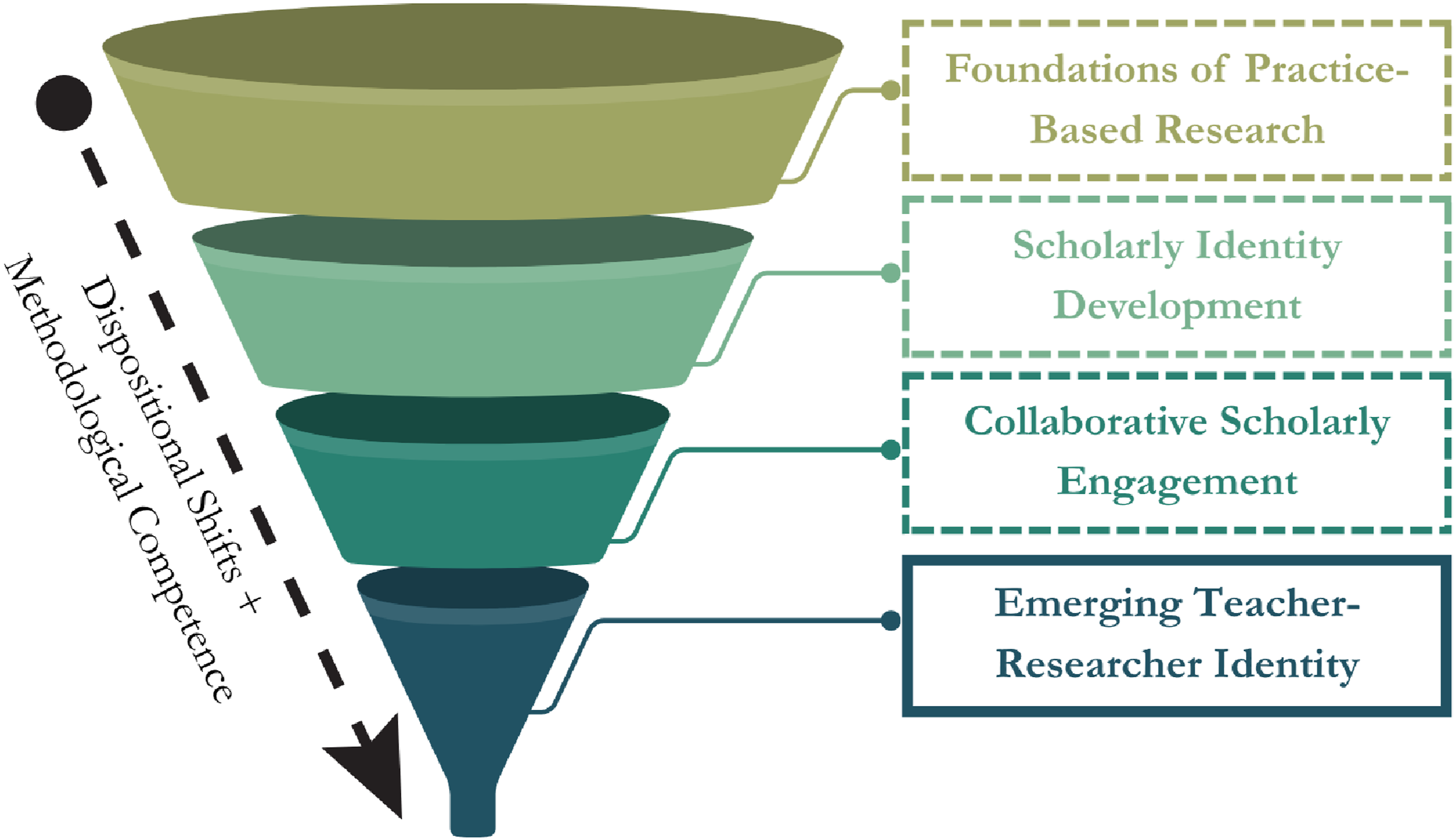
Figure 1 illustrates how identity work unfolded through participation in research discourse, relational mentoring, and collaborative inquiry rather than through the accumulation of competencies or completion of predefined phases. Thematic analysis revealed five interconnected themes that align with and extend Zygouris-Coe and Roberts’ (2019) framework by illuminating how scholarly identity is shaped through situated participation in practice-based contexts. Themes 1–3 address our first research question by examining students’ engagement with research discourse, practices, and collaborative work, while Themes 4–5 address our second research question by foregrounding how participants articulated evolving scholarly identities, values, and positioning. Each theme is discussed below; Supplemental Item B presents the corresponding codes.
Theme 1: Entry into Scholarly Practice Through Research Discourse
The most foundational theme to emerge concerned how doctoral students entered scholarly practice by engaging with research discourse, norms, and expectations, which functioned as an initial site of scholarly identity mediation within the SIG. Early sessions focused on initiating K–12 research (e.g., via crafting IRB protocols, securing district permissions, and navigating consent processes), requiring students to engage with ethical and institutional expectations rarely encountered in coursework. As the SIG progressed, participants increasingly positioned themselves in relation to different methodological paradigms, often contrasting quantitative and qualitative approaches. Anya remarked, “In education, pre- and post-tests have a lot of... [pumps fist] UMPH!... I feel like they prioritize data and numbers,” while emphasizing qualitative inquiry’s classroom relevance. “As an educator... I value that qualitative piece because it’s informing me as I interact with specific students.”
Students increasingly engaged with research-specific terminology as they tested and negotiated their participation in scholarly discourse. This shift reflects how participants navigated the boundary between practitioner knowledge and scholarly discourse, domains often differentiated by specialized language (e.g., Seccia & Cameron, 2021). As their comfort grew, doctoral students self-monitored and verified their vocabulary use. For example, Anya asked, “I kind of want to do program evaluation. Is that the correct term?” This prompted an organic discussion and expansion of her research repertoire. From design planning to data interpretation, students demonstrated significant growth in fluency with concepts including terms such as “pilot study,” “in vivo coding,” and “operational definition.” Across design planning and data interpretation, students’ evolving language reflected ongoing negotiation of scholarly norms and expectations. Rather than marking skill mastery, these moments functioned as discursive sites where participants tested legitimacy and articulated emerging scholarly identities.
Theme 2: Envisioning Scholarly Trajectories Through Research Dissemination
Across mentorship meetings, students increasingly conceptualized research as a multi-stage process involving both tangible scholarly products and longer-term professional trajectories. For example, Courtney described organizing her work around potential dissemination outlets, explaining that she tracked journals and conference opportunities as part of her research planning. Over time, these conversations expanded beyond immediate outputs to include aspirational scholarly roles, such as publishing, proposal development, and peer review. Reflecting on this shift, Courtney noted, “I’ve done class work… papers… and this is more of like, okay, what else is there?” Similarly, Anya expressed interest in learning to review academic work, prompting discussion of pathways from conference proposal reviewing to journal peer review. Together, these exchanges illustrate how the SIG supported students in envisioning research not only as a discrete task (e.g., dissertation) but as a sustained scholarly endeavor with multiple forms of participation over time.
Theme 3: Relational Positioning and Scholarly Belonging
A central theme concerned how doctoral students positioned themselves relationally within scholarly work, navigating collaboration, responsibility, and recognition through sustained participation in the SIG as they encountered and enacted the tacit norms that structure academic research. One consistent challenge was organization, with SIG meetings frequently addressing how to structure project notes, manage collaborative documents, and coordinate drafts. Over time, both students developed personalized systems. Courtney proposed, “Do you think it’d be okay to make a Google Sheet in the shared drive? … We can keep it pretty organized and…structured.” While this may seem minor, it reflects students’ assumption of responsibility for coordinating shared scholarly work, an important marker of legitimate participation in research communities. Through regular, open dialogue, students participated in an academic apprenticeship that made the hidden curriculum of research visible, including how to identify appropriate journals, select conferences, and distinguish between a résumé and a curriculum vitae (CV). For example, Anya worried, “I have more of a résumé than a CV,” which led to a discussion of purpose, format, and academic expectations for each document. The faculty mentors also shared their own CVs at various career stages to demystify academic progression.
As the SIG progressed, students began initiating decisions independently, signaling shifts in how they positioned themselves as decision-makers within the research process. In one exchange, Courtney proposed revising a research question to better capture SEL goals, and Anya suggested a deeper review of the SEL data. These exchanges illustrate changes in relational positioning, as students increasingly engaged as co-investigators rather than solely as guided learners. Courtney emphasized the importance of collaborative growth, reflecting that “even more valuable than the knowledge I have gained have been the relationships I have formed with fellow researchers…,” noting in particular how she learned to “use other people’s strengths, delegate, and utilize collaborative writing when writing for publication.” Anya simply wrote, “I loved collaborating with Courtney!” After 2 years of partnership, both students articulated trust and interdependence, hallmarks of sustained scholarly collaboration. The SIG also provided space for reflection, something often absent in traditional research methods training. In one reflection, Anya shared, “I started the semester with a Google document with coded data. Now, I have an NVivo portfolio... and a start to a research article.” She later exclaimed during a SIG meeting, “I am a researcher! [emphasis in original].” These moments illustrate how students came to recognize themselves as legitimate contributors to scholarly work.
Theme 4: Articulating Values, Commitments, and Methodological Stance
As doctoral students engaged more deeply in scholarly practice, they began articulating beliefs, values, and preferences that shaped their understanding of research and scholarship, reflecting an evolving researcher identity grounded in personal commitments and professional contexts. Anya, for example, shared during a discussion on future careers, “I want my next position to be a very passion-driven position... [where I] love going to work.” In her written reflection, she affirmed her emerging identity as an advocate for practice-based research, stating, “I find that this is important work, and I will always advocate for young learners, culturally relevant texts, and play-based pedagogy.” Such statements, similarly echoed by both students, reflect how participants articulated emerging commitments that informed how they understood themselves and their work as scholars. Their reflections also revealed growing methodological preferences. Anya recognized the appeal of both paradigms, noting, “In education, there are so many variables that cannot be quantifiably measured,” while Courtney expressed a clear affinity for quantitative methods, simply stating, “I am a quant person.” These comments illustrate how participants articulated methodological preferences as part of defining a scholarly stance grounded in their professional contexts.
Theme 5: Negotiating Researcher-Teacher Identity Tensions
This theme reflects how doctoral students grappled with tensions between emerging researcher identities and their ongoing commitments as classroom teachers. Rather than resolving these tensions, participants navigated competing expectations related to rigor, relevance, and responsibility to students. Participants consistently framed their research in relation to their elementary students’ needs, foregrounding classroom relevance as central to their scholarly decision-making. Anya, for example, described her ML students’ excitement. “They want to come to my table so badly [to engage in the research study]… ‘Can we be part of your special project and help it grow?’”
Misalignments also surfaced. Courtney noted, “As a doc student, I feel like I tend to prioritize the quantitative measures so that I can make it [the research] a little more generalizable,” while acknowledging that this orientation can feel disconnected from her teaching role. These moments illustrate how participants negotiated tensions between methodological commitments associated with academic research and the values shaping their classroom practice. This aligns with a teacher-researcher model grounded in inquiry rather than academic abstraction. Their sustained mentoring experience supported this evolving identity, providing space for participants to integrate researcher and teacher identities without fully resolving the tensions between them.
Synthesis
Collectively, these themes demonstrate how the SIG functioned as a mediating context in which doctoral students integrated multiple dimensions of scholarly identity. Through engagement with research discourse, collaborative inquiry, dissemination planning, and reflective negotiation of teacher-researcher tensions, participants moved toward more agentic and relational forms of scholarly participation. Rather than progressing through discrete stages, identity development unfolded recursively through sustained mentoring, dialogue, and inquiry.
Discussion
This discussion situates the study’s findings in relation to existing scholarship on doctoral identity development, practitioner-scholar pathways, and structured mentoring in doctoral education.
Mediating Scholarly Identity in Practice-Based Doctoral Contexts
Practice-based doctoral programs increasingly serve practitioner-scholars with varied professional aims, including those seeking to deepen research use within their current educational roles as well as those exploring transitions into academic research positions. This study extends a situated framework of scholarly identity by illustrating how sustained participation in a faculty-led SIG functioned as a mediating context for doctoral students’ scholarly identity development. Rather than operating as an intervention to be evaluated, the SIG served as a relational space through which scholarly participation, identity, and agency were negotiated over time.
Drawing on Zygouris-Coe and Roberts’s (2019) framework and theories of participation, the findings demonstrate how doctoral students negotiated entry into scholarly practice and articulated methodological stances and professional values. They also positioned themselves relationally within collaborative research work and navigated tensions between emerging researcher identities and enduring commitments as classroom teachers. Consistent with scholarship on doctoral identity as socially situated, participants described the SIG as a space characterized by affirmation, belonging, and transparency regarding scholarly norms (Gardner, 2009; Pyhältö et al., 2022; Stubb et al., 2011). Through collaborative inquiry and dialogic mentoring, students engaged with the often-unspoken expectations of doctoral education, including dissemination practices, authorship, and methodological rigor (Margolis, 2001). Rather than resolving research-practice tensions, the SIG functioned as a context in which practitioner-scholars integrated research as both meaning-making and method, constructing hybrid teacher-researcher identities grounded in professional practice (Halse & Bansel, 2022; Manathunga, 2007).
Relational Mentorship and Legitimate Participation
Consistent with literature on structured seminars and mentoring as sites of identity development, the SIG functioned as a relational space that made scholarly norms visible, negotiable, and actionable. Echoing literature on structured mentoring and collaborative scholarly participation (Boud & Lee, 2005; Penuel et al., 2020), these identity negotiations were resonant with principles commonly associated with research-practice partnerships, in which researchers and practitioners collaborate as equals to co-construct usable knowledge (Penuel et al., 2020). Participants’ reflections demonstrated how research could be reframed not as an abstract academic pursuit but as a form of advocacy and praxis rooted in their own communities.
These developmental trajectories also extend prior work on doctoral education as a process of enculturation into disciplinary norms (McAlpine & Amundsen, 2009) but suggest that for working professionals in part-time or non-traditional programs, mentorship models must be both rigorous and relational. The SIG structure allowed for personalized feedback, scaffolded risk-taking, and critical reflection that nurtured identity development alongside skill acquisition. These findings align with Mezirow’s (1997) theory of transformative learning, in which disorienting dilemmas, such as the perceived mismatch between academic and practitioner logics, prompt reexamination of assumptions and the emergence of new professional selves. The SIG created space for these dilemmas to be explored, not avoided, leading participants to reconstruct their identities in ways that were personally meaningful and professionally authentic. These findings also call to mind Ralph and Walker’s (2013) Adaptive Mentorship framework, which emphasizes responsive, learner-centered guidance over static supervision models (Grant, 2005; Mezirow, 1997).
It is also important to acknowledge that sustained participation in the SIG was not evenly distributed across all students. The two focal participants entered the experience with different, but complementary, forms of readiness for scholarly engagement. One brought prior research experience and strong writing preparation, while the other’s sustained participation appeared more closely tied to relational trust, topic alignment, and high levels of professional agency. Continued involvement likely reflected a combination of academic preparation, relational proximity to faculty, and alignment with longer-term scholarly aspirations. Doctoral students with different career trajectories, heavier professional constraints, or less connection to research-oriented goals may reasonably have chosen not to continue once the SIG became fully voluntary. These dynamics suggest that while relational mentoring structures can mediate scholarly identity development, participation in such spaces is shaped by differential forms of access, readiness, and alignment.
Limitations and Future Research
As a qualitative case study with two participants from a single doctoral program, the findings are context-specific. While the depth of qualitative data provides insight into participants’ scholarly identity development, the limited sample constrains the range of perspectives represented. In addition, the close mentoring relationships between researchers and participants, central to the apprenticeship model, introduce potential bias. To address this, we engaged in collaborative coding, maintained detailed analytic records, and used ongoing reflexive dialogue to surface assumptions.
Additionally, this study centers doctoral students who sustained voluntary engagement in the SIG across two academic years. Both participants entered the experience with comparatively strong academic preparation, including prior exposure to research discourse, and established relationships with faculty. Their continued participation likely reflects alignment with professional aspirations as well as prior academic socialization that positioned them to take advantage of voluntary mentoring opportunities. Doctoral students with different career goals, heavier professional or caregiving responsibilities, less familiarity with academic norms, or fewer relational connections to faculty may experience additional barriers to sustained engagement in such contexts. Accordingly, the findings should not be interpreted as evidence that relational mentoring structures alone are sufficient to support all practitioner doctoral students. Future research should examine how structured research communities can be designed to reduce structural and relational barriers to participation.
The scope of this manuscript is intentionally narrow, centering on mentorship meeting transcripts and participant reflections. Although additional data sources were collected and analyzed, they are not included here due to space constraints. Future analyses will examine these materials to further explore research competencies and the enactment of scholarly practices in classroom contexts. Additional research should investigate SIG models across diverse institutional settings, particularly programs serving working doctoral students or those without access to traditional assistantships. Longitudinal studies with larger cohorts may clarify how relational mentoring structures shape identity development over time and under varying structural conditions.
Scholarly Significance
This study contributes to scholarship on doctoral education by extending Zygouris-Coe and Roberts’s (2019) situated framework to part-time, practice-based doctoral contexts. The findings foreground scholarly identity formation as a relational and iterative process shaped through discourse, mentoring, and participation within a faculty-led SIG. Prior research has documented enduring tensions between research and practice in education (Broekkamp & Van Hout-Wolters, 2007; Gore & Gitlin, 2004; Vanderlinde & Van Braak, 2009). Rather than resolving these tensions, this study examines how practitioner-scholars navigate them as part of their identity work when conducting inquiry in their own classrooms. By tracing how doctoral students made sense of research, legitimacy, and agency within a collaborative SIG context, the study offers insight into scholarly identity development in non-traditional doctoral programs. It underscores the importance of mentoring structures that support belonging, recognition, and negotiated participation in diversifying doctoral pathways.
Conclusion
This qualitative case study illustrates how sustained, practice-based mentoring shaped the scholarly identities of two doctoral students in a Curriculum & Instruction PhD program. Through dialogic mentorship, classroom-based inquiry, and collaborative engagement, participants moved beyond compliance-driven learning to become confident, reflective teacher-researchers. Building on Zygouris-Coe and Roberts’s (2019) framework, the study introduces an adapted model (Figure 1) that emphasizes the recursive and contextual nature of identity development in practice-grounded doctoral settings. As doctoral education expands to serve working professionals, this study underscores the importance of attending to how students are invited into scholarly communities, not only through coursework, but through meaningful, situated participation that affirms their identities as educators and emerging scholars.
Supplemental Material
Supplemental Material - Identity Mediation in Doctoral Education: Extending a Situated Framework of Scholarly Identity
Supplemental Material for Identity Mediation in Doctoral Education: Extending a Situated Framework of Scholarly Identity by Karyn A. Allee, Amanda Seccia, and Katie Wooten in Journal of Education.
Supplemental Material
Supplemental Material - Identity Mediation in Doctoral Education: Extending a Situated Framework of Scholarly Identity
Supplemental Material for Identity Mediation in Doctoral Education: Extending a Situated Framework of Scholarly Identity by Karyn A. Allee, Amanda Seccia, and Katie Wooten in Journal of Education.
Footnotes

Funding
The authors received no financial support for the research, authorship, and/or publication of this article.
Declaration of Conflicting Interests
The authors declared no potential conflicts of interest with respect to the research, authorship, and/or publication of this article.
Supplemental Material
Supplemental material for this article is available online.
References
Supplementary Material
Please find the following supplemental material available below.
For Open Access articles published under a Creative Commons License, all supplemental material carries the same license as the article it is associated with.
For non-Open Access articles published, all supplemental material carries a non-exclusive license, and permission requests for re-use of supplemental material or any part of supplemental material shall be sent directly to the copyright owner as specified in the copyright notice associated with the article.
