



Abstract
Modern patients walk a tightrope between respecting medical authority and acting as knowledgeable advocates regarding health issues, with the agency and responsibilities that come with this. This article uses conversation analysis to explore this balance in relation to patient disclosures of medical misdeeds in video-recorded primary care medical visits (e.g., taking another’s prescription medication or failing to adhere to a healthy lifestyle or prescription regimen). We focus on patient-initiated disclosures. We show that disclosures are used (1) where patients are seeking physician assessment of their behavior, (2) where patients are proposing the etiology of a health problem, and (3) where patients are lobbying for a particular treatment outcome. We argue that disclosures of medical misdeeds are an important but understudied domain of conduct in which patients show awareness of their own agency over, and responsibility for, their healthcare and respect for the physician’s medical authority.
Keywords
Empirical research on physician-patient interaction has long documented that physicians in modern medicine exercise significant medical authority and that patients are sensitive to its exercise (Byrne and Long 1976; Heritage 2006; Peräkylä 1998; but see also Maynard 1991). Early research proposed that such an asymmetry was not harmful and was perhaps even necessary to a successful doctor-patient relationship (Arrow 1963; Balint and Shelton 1995; Bloom 1963; Parsons 1951). However, following an ideological shift in attitudes towards the patient’s role in healthcare and a corresponding shift in perspective on the importance of the patient’s voice in healthcare (Barry et al. 2001; Mishler 1984), there has been a growing consensus in the health services and health policy communities in favor of a more agentive role on the part of the patient and a more egalitarian physician-patient relationship (Anderson and Zimmerman 1993; U.S. Department of Health and Human Services 2000). High patient involvement models of the physician-patient relationship have dominated the scene, particularly in chronic care, for many years (Brody 1980; Emanuel and Emanuel 1992; Kassirer 1994).
Yet even well after the golden age of physician authority (Potter and McKinlay 2005; Roter 2000; Shorter 1986; Starr 1982), in the age of the correspondingly more assertive patient, sociology of health scholars interested in provider-patient interaction continue to document ways that patients tread carefully in what they treat as the physician’s domain, particularly illness diagnosis and treatment. Patient carefulness manifests itself in myriad ways including patient reticence to offer diagnostic theories (Heritage and Robinson 2006; Stivers 2002b), respond to diagnostic theories (e.g., Heath 1992; Peräkylä 1998), and propose treatments (Stivers 2005). However, this is not to say that patients are as passive as Parsons or even some of his critics proposed (Parsons 1951; Szasz and Hollender 1956). Although cautious about overstepping their boundaries with physicians, modern patients/parents can and do make requests for treatment (Kravitz, Bell, and Franz 1999; Kravitz et al. 2005; Peyrot et al. 1998; Stivers 2002a), offer diagnostic theories (Beach 2001; Gill 1998; Gill, Pomerantz, and Denvir 2010; Stivers 2002b), and resist diagnoses (Gill and Maynard 1995; Gill et al. 2010; Heath 1992; Stivers 2007) and treatment recommendations (Robinson 2001; Stivers 2002a, 2005, 2006)—each behavior asserts patient agency and challenges physician medical authority.
Although we know that the modern physician-patient relationship is more egalitarian than the physician-patient relationship of 60 to 100 years ago, we are still mapping the territories for respective levels of physician authority and patient agency. In this paper we look at another behavioral indicator of patient agency—the disclosure of a medical misdeed. When patients disclose misdeeds they are frequently disclosing either the taking of medication that was not previously recommended (e.g., a family member’s antidepressants, antibiotics, or pain killers) or a failure to adhere to physicians’ recommendations (e.g., taking more or less of a prescribed medication or not taking it at all). In addition to medication-related disclosures there are disclosures about failures to maintain a healthy lifestyle (e.g., smoking, drinking too much, eating improperly, or not exercising).
We suggest that with and through their disclosures, patients are frequently lobbying for a particular treatment recommendation or proposing that their behavior has caused some unfavorable health outcome. In all cases disclosure is an assertive behavior in the sense that the patient is reporting acting in a way that is out of line with medical advice. Moreover, inherent in the act of disclosure is an assertion of patient autonomy alongside a reframing of patient obligation. At the same time, however, a disclosure invokes a clear sense of the patient’s moral accountability to do his/her best to maintain good health, harking back to Parsons’ analysis of illness as a form of deviance and the associated patient obligation, if sick, to cooperate with professionals to get well (Parsons 1951). In what follows we discuss what we mean by a patient disclosure of a medical misdeed, the sequential contexts in which disclosures occur, the medico-interactional tasks that are prosecuted through disclosures, and physicians’ responses to disclosures. We argue that through disclosures we gain insight into the ways physicians and patients navigate patient agency and physician authority.
Background
Research on patient disclosure is relatively scant. Where it exists, definitions are often absent. However, in their review of the literature on disclosures, Saiki and Lobo defined patient disclosure as “the act of seeking care by revealing personally significant information that exposes the bearer to the risk of rejection or negative judgment” (2011: 2719). This definition, particularly the senses of revealing personal information and risking negative judgment, seem to cut across much of the literature on disclosures. For instance, when patient disclosure is discussed, it is primarily concerned with disclosures of sensitive psychosocial issues, notably past abuse (e.g., Rhodes et al. 2007), mental health issues (e.g., Chew-Graham et al. 2009), and risky lifestyle behaviors (most commonly sexual behaviors) (e.g., Scandell et al. 2003).
A primary goal of research on disclosure thus far has been to understand what predicts and motivates patient disclosures. In a sample comparing African American and white parents talking with white physicians, for instance, Wissow and colleagues (2003) showed that parental race, education, and age as well as physician gender were associated with differential rates of parent disclosure of psychosocial information in pediatric visits, particularly early in a physician-parent relationship. In other studies, qualitative researchers have asked patients about their motivations for disclosing or withholding information and found that patients cite reasons not only to do with differences in age, sex, culture, or language of the physician but also cite reasons related to fear (e.g., of retribution), anxiety, embarrassment, physician time constraints, and physician-patient rapport (Julliard et al. 2008). Physician behavior, including both vocal and nonvocal behavior, has also been argued to be predictive of patient disclosure (Duggan and Parrott 2001; Mishler 1984).
Problems surrounding failures to adhere to clinical regimens or self-initiations of medication regimens as well as other departures from habits that are generally regarded as healthy lifestyle practices have largely been the topic of studies of adherence in this area. However, this literature has also primarily focused on predictors of adherence and motivations for non-adherence, with an eye towards improving adherence. For instance, Benson and Britten (2002) examined reasons hypertensive patients gave for and against taking their prescribed anti-hypertensive medications. This has left relatively neglected questions of whether and how physicians come to be informed of a patient’s non-adherence or other sorts of medically relevant misdeeds.
A rare exception is an interview study of disclosure of non-adherence among HIV-positive adults who are not taking their prescribed antiretroviral treatment (Kremer and Ironson 2006). Kremer and Ironson (2006) found that among patients who had decided not to continue treatment, one of the primary accounts for disclosing non-adherence was that the physician asked whether the patient was taking his/her medication (30% of cases). Other reasons reported were that the physician would be able to identify non-adherence based on markers in various tests (14%) and a variety of moral arguments that the physician ought to be told (56%). Kremer and Ironson’s study suggests that (1) a primary account for disclosure is that the patient has been interactionally “cornered” by a physician’s question since answering the question requires the patient to either disclose non-adherence or lie, to a greater or lesser extent and (2) there is some degree of moral pressure to disclose unhealthy behavior choices. However, Kremer and Ironson examine reports of disclosures; they do not assess disclosures as they occur in medical interaction, nor do they examine what sort of additional functions such disclosures might have in the clinical context. Moreover, they investigate a very specific patient population.
In this study we examine how and when patients disclose medical misdeeds, broadly conceptualized, to their primary care physicians. These disclosures are consistent with the definition provided by Saiki and Lobo (2011) in that disclosures of medical misdeeds both reveal personal patient information and are treated by patients and physicians as risking negative physician judgment. Although sometimes patients report a wrongdoing without being aware that it is a wrongdoing, in this paper we focus on cases where patients report wrongdoings in ways that show them to be aware that their behavior is at least potentially problematic from a medical perspective. We show that through disclosures of medical misdeeds patients work to secure physician assessment of their behavior; indicate the cause of, and claim responsibility for, some unfavorable health outcome; or lobby for a specific treatment recommendation.
Data and Method
The data used for this study are video-recorded primary care medical encounters involving both acute care and routine care adult patients from two geographical areas in the United States: Southern California and Wisconsin. These data were collected at various points between 1987 and 2004. All data were approved by the UCLA and University of Wisconsin institutional review boards and patients gave written informed consent for participation. Disclosures of misdeeds occurred more frequently than initially supposed. Relying on a corpus of 268 video-recorded primary care visits, we identified 57 visits in which at least 1 patient-acknowledged misdeed is disclosed to the physician with some visits having more than 1 disclosure. In total, 66 disclosures were identified. We observed that these disclosures were more prevalent in routine visits for chronic conditions than in acute care visits, though this was not systematically investigated for this study.
Each encounter was transcribed according to standard conversation analytic conventions (Hepburn and Bolden 2012; see also Appendix A). All examples shown in this paper were retranscribed by the authors to ensure the validity of the transcription. Instances of disclosure were analyzed relying on conversation analysis (see Heritage 1984; Sidnell and Stivers 2012).
In this study we are concerned with patients disclosing medical misdeeds. We examine where this practice is done in primary care visits and the function each disclosure has inside the larger interaction. In this article, we necessarily focus on only a subset of the cases in the larger collection. The cases shown here are representative of cases in the larger collection and were selected because they are particularly clear and concise examples.
Analysis
Patients report a wide array of personal behaviors to their physicians. In this paper we are interested in patient reports of their own behavior that they treat as (1) medically relevant and (2) problematic or possibly problematic. Only reports that met these two criteria were identified as disclosures of medical misdeeds and included in our sample. Reports of behavior that patients treated as problematic included reports that the patient took (or stopped taking) medication against the physician’s prior recommendation, that the patient engaged in risky behavior, or that the patient failed to control his/her diet or lifestyle in accordance with physician advice or known healthy behavior (e.g., exercising consistently). The behaviors are context dependent. For instance, a report of weight gain could be announcing the patient’s successful adherence to a weight gain regimen or disclosing the patient’s failure to adhere to a weight loss regimen. We considered only the latter as a disclosure of a medical misdeed.
In the next section we begin by documenting ways in which reported behaviors are treated as misdeeds by patients. We then show the contexts in which reports of misdeeds are offered. Finally, focusing on patient-initiated disclosures, we show that patients disclose medical misdeeds in three main environments—when patients are taking an equivocal stance towards their health behavior, thus making relevant physician assessment of the behavior; when patients are proposing causality and culpability for their health problem, making relevant the physician’s endorsement or acknowledgment; and when patients are lobbying for a particular treatment outcome, making relevant the provision of that treatment by the physician.
Results
How Patients Orient to Reported Behaviors as Misdeeds
Patients convey that they view their behavior as problematic in two key ways—their word choices to describe the behaviors and dysfluencies in their reports. First, when disclosing misdeeds, patients characterize their behavior using negatively valenced words. In Extract 1, the patient uses the phrase “addicted to” to describe his use of nasal spray medications (line 13).

In contrast with the neutral “using,” “addicted to” treats his use of nasal sprays as excessive and inappropriate. Similarly, in Extract 2, the patient uses the word “confession.” Like the use of “addicted,” “confession” orients to the behavior (in this case taking his wife’s leftover antidepressants) as inappropriate and problematic. It is not a neutral report.

Patients also commonly exhibit speech dysfluencies when reporting behavior as problematic (hesitant speech, stretching sounds, stuttering, pauses, reformulations, etc.). Conversation analytic research has documented that “dispreferred actions” such as disagreeing with another’s assessment of some person, place, or thing (Pomerantz 1984) or not providing an answer to a request for information (Heritage 1984; Stivers and Robinson 2006) tend to be delayed, commonly have production hitches and perturbations, frequently include hedging and mitigation, and are more likely to be subsequently accounted for (Heritage 1984; Pomerantz 1984; Pomerantz and Heritage 2012). All of these features convey an iconic reluctance to move forward. These features are also frequent in disclosures, suggesting here too a reluctance to progress through the turn—evidence that speakers are oriented to the reported behavior as problematic.
We can see this in the two cases we have examined. In Extract 1 there are multiple hitches in the production of the turn: “I could-” is repeated three times (line 11). There is hedging with “prolly” and delay with the “Ya know” and “I could honestly tell you.” There is also a visible indication of reluctance to complete the disclosure with a turn final shrug. In Extract 2 there is delay through the form of the first Turn Constructional Unit (TCU) (Sacks, Schegloff, and Jefferson 1974) “
We see this pattern again in Extract 3 where there is substantial delay getting to the “
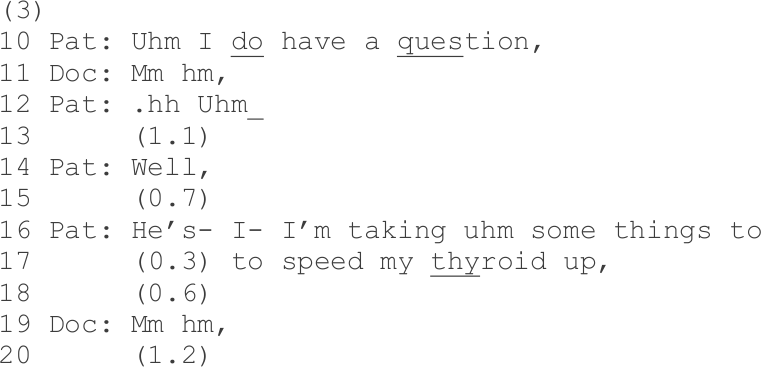
In this instance, the patient foreshadows his question rather than simply launching it and thus again shows some difficulty moving forward. It has also been shown that turns that foreshadow questions in this way mark the forthcoming question as delicate (Schegloff 1980). Additionally, there is the 1.1 second silence at line 13, the “Well,” and then the 0.7 second silence at line 15. The disclosure is at lines 16–17. We see the hitches in the cut off of “He’s-” and the restarts from “He’s-” to “I-”, the cut off of “I-”, the redoing of “I’m”, and then the hesitation marker “uhm” and the 0.3 second silence all in the middle of the TCU.
Finally, in Extract 4, following the physician’s question about whether the patient is using gloves to handle concrete, the patient discloses that he does not use them regularly but only “sometimes.” In this case not only do we see the familiar markers of hesitation, but we also see an account provided for his problematic behavior: “but it’s .hh they just get in the way.”

This constellation of features in the turn suggests that the patient is reluctant to report the behavior and thus provides further evidence of the patient’s orientation to these reports as disclosures of misdeeds. Taken together, patients’ word choices and production reticence provide evidence that patients orient to their behavior reports not as neutral reports but as disclosures of problematic behavior.
The Context of Patient Disclosures
The disclosures in this dataset come in two main contexts: those that answer a direct inquiry about a problematic behavior (physician-initiated disclosures) and those that are offered as patient-initiated announcements. Fifty-three percent of patient disclosures in our dataset (35/66) were in response to a physician’s direct question regarding some potentially problematic behavior (e.g., “how’s your diet”; “you still smokin’?”). In the study of HIV-positive patients, Kremer and Ironson (2006) found that 30 percent of the time patients reported that the reason they disclosed treatment non-adherence was because a physician asked. Extract 4 shown above illustrates a physician-initiated disclosure. The physician directly asks whether the patient uses gloves while working with concrete—a material the patient often handles at work. The doctor has suggested in previous turns that a rash that the patient has on his hands may have been caused by chemical exposure, and thus “not wearing gloves” has become recognizable as a possible misdeed. The patient responds to the question by informing the doctor of his behavior and, as discussed earlier, does so in a way that suggests that he recognizes his behavior as problematic. When physicians ask patients about such behavior this could be thought of as interactionally “cornering” the patients since patients should relevantly answer the question and thus disclose a medical misdeed.
By contrast, Extracts 1 to 3 illustrate patient-initiated disclosures, which constitute 47 percent (31/66) of our cases. In these cases it is not a physician’s question that engenders patient disclosure. Rather, the patient topicalizes a recognized misdeed. In Extract 5, although the disclosure follows a physician’s general question, it was analyzed as a patient-initiated disclosure because the physician’s question does not refer to any possibly problematic behavior and it is the patient who initiates a topical shift to the potentially problematic medication adjustment.
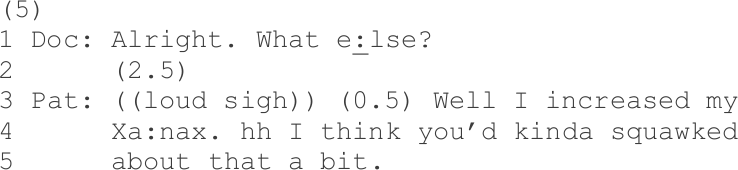
The sense of interactional cornering that physician-initiated disclosures represent partially solves the puzzle of what accounts for a patient’s disclosure of a medical misdeed. In interviews Kremer and Ironson (2006) found that many patients reported feeling that they had a moral obligation to disclose the truth of their medical misdeed. However, when patients are not under direct pressure to disclose a misdeed in a given turn of talk, what accounts for their disclosure? Even if we accept Kremer and Ironson’s reports that patients feel a moral obligation to inform physicians about health-relevant information, this sense of morality may nonetheless be deployed in systematic ways and to systematic ends. In what follows we identify three distinct projects in which patients deploy patient-initiated disclosures.
Patient-Initiated Disclosures of Medical Misdeeds
Patients exhibit agency on two distinct levels when they offer patient-initiated disclosures of medical misdeeds. First, patients display agency insofar as they are providing a report of new information that has not been explicitly requested by the physician. Second, patients exhibit agency in having performed some medically relevant action against or without medical advice. The question then becomes how these agentive actions fit into broader patient projects and affect the physician-patient dynamic within the visit.
In these data, patients offered self-initiated disclosures in relation to three main projects. The first concerns what we term testing the waters with the physician. The disclosure implicates physician assessment of some possibly problematic patient behavior; implied in this project is the patient’s willingness to change his/her behavior conditional on the physician’s assessment. This is the least common type of disclosure in these data (n=4). The second project concerns proposing the etiology of a poor health outcome (n=13). In these cases, patients causally relate the misdeed to a health problem and imply that the misdeed was not medically warranted. The third project is negotiating treatment. Here, patients treat the disclosed misdeed as medically warranted and imply that the problematic behavior may continue contingent on the treatment outcome. This is the most common type of disclosure in these data (n=14). In what follows we discuss each of these projects in turn.
Testing the Waters
In this first type, patients assert an equivocal stance towards the misdeed, suggesting that they may be willing to alter their behavior. In this way, patients appear to be “testing the waters” with the physician to see what sort of reception their disclosure elicits. Only four instances were identified, but as a set, they nonetheless appear distinct. Returning to the case originally shown in Extract 3, in Extract 6 the patient reviews some of the changes he has made in his lifestyle: a diet change and the addition of a trainer at the gym. The physician has positively assessed the diet at line 4. He has not indicated any particular stance towards the trainer, but that unit of talk is also delivered as prefatory to another piece of news. The disclosure then follows at lines 16–17—that he is using “some things” to speed up his thyroid.
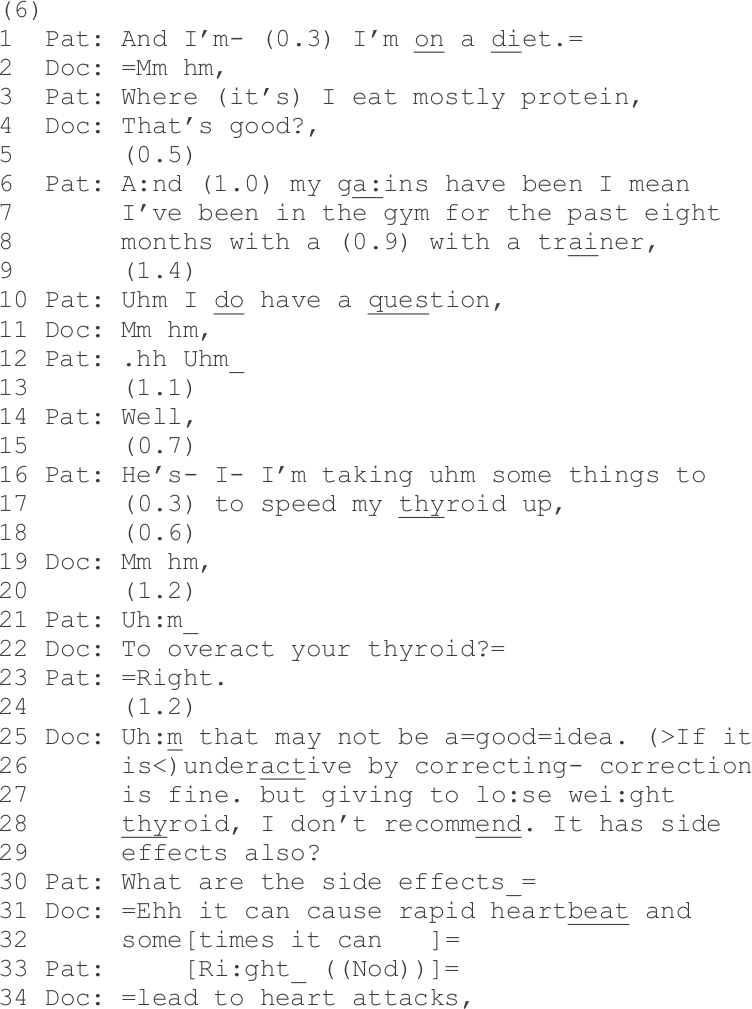
After the physician’s continuer at line 19 the patient declines to continue, thus implicating physician response to the disclosure. The physician requests confirmation of a slightly different formulation of the patient’s behavior: Instead of “to speed … up” the physician formulates the behavior as “to overact,” which more clearly treats the behavior as problematic. At line 23 the patient nonetheless confirms this. The physician adopts a strong negative stance towards the patient’s behavior (lines 25–29). In response the patient asks a question at line 30: “What are the side effects.”
This type of disclosure is distinct from others in that the patient’s stance is neither that the misdeed was unwarranted (as we will see in the next set of cases), nor that the misdeed was warranted by other factors (as we will see in the third set of cases). Rather, in testing the waters cases the patient treats the behavior as something that s/he is not committed to, thus implicating physician assessment. In Extract 6, the patient orients to his behavior as possibly problematic as implied by his question about the use of thyroid enhancers. Also, he asks this question just following the physician’s admonition, suggesting that the answer will be relevant to shaping his behavior. At the position he asks his question, the patient certainly could have affiliated with the physician and indicated that he would stop the problematic behavior immediately, but that is not something he does. Nonetheless, the position of the inquiry suggests that he is willing to consider stopping, contingent on the answer to this question. By contrast, as we will see, in other sorts of disclosure cases patients behave as though they know the risks and have made an informed decision, even if that is to behave in a medically ill-advised way. Thus, in these testing the waters cases, disclosures appear to be concerned with eliciting the physician’s assessment of the behavior after which patients make a more informed decision about the behavior. Both Extract 6, above, and Extract 7, below, elicit physician evaluations of the behavior.
Not all disclosures are met with a negative evaluation or admonishment. In Extract 7 the disclosure is that the patient neglected taking her pills for one day (line 10). Insofar as she characterizes her behavior as “didn’t take my pills,” she orients to the behavior as a misdeed; however, the “one day” time frame mitigates the problem, and in this way the patient adopts an equivocal stance towards the action. Missing a day here and there with certain medications may be more problematic than with others. The disclosure is said in a context of reporting on one of the patient’s improvements—that the Metamucil has helped with the bloating that she was having.
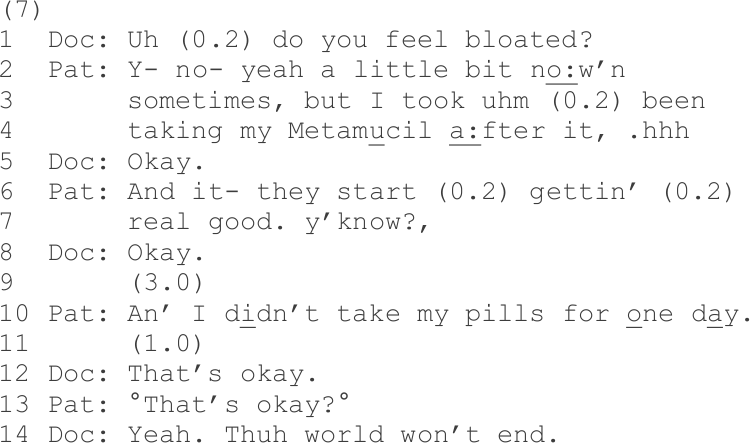
The physician initially offers no uptake (line 11) but then absolves the patient of wrongdoing with “That’s okay.” in line 12. After the patient requests confirmation that this is really okay (line 13), the physician confirms with “Yeah.” (line 14) and then contextualizes this with “Thuh world won’t end.” suggesting that although the patient was right to treat missing the dose as a medical misdeed, the gravity of it is minimal (line 14). As in Extract 6, here too the patient offers the disclosure in a way that allows for the physician to admonish the patient and assert that it is very important that she take the pills daily but also orients to the misdeed as minor for which admonishment may not be necessary (“for one day”). With the patient’s request for confirmation that this is really okay (line 13), the patient conveys a concern with the physician’s evaluation of her behavior and implies some openness to adjust her behavior if needed. In these ways the patient “tests the waters” for how problematic this behavior is.
Proposing Etiology
With this type of disclosure, patients propose that their medical problem was at least in part caused by the misdeed they are reporting; in this way patients imply that their misdeed was not medically warranted (this in contrast with the treatment negotiation cases, as we will see later). Patient introductions of candidate explanations for illness have been discussed previously both in terms of potential conflicts between physicians and patients (Gill and Maynard 2006) and where patients raise possible explanations but then discount them, thus using the explanations as a foil to push the physician toward an alternative diagnosis (Gill et al. 2010).
Here, we focus on the disclosure, observing that disclosures can be relied on to propose the etiology of the patient’s problem. By identifying the misdeed as causally linked to their health problems, patients can both reinforce proposed diagnoses and indicate culpability for the problem. For instance, in Extract 8, the patient discloses that she had a pedicure (lines 6–8). She offers this disclosure as part of proffering the pedicure as the etiology of the fungal infection diagnosis and thus proposes culpability for that infection. This is most directly stated when she says, “this is like the fourth time this has h

The physician ultimately proposes a possible bacterial infection, although his addition of as well suggests that there is some measure of endorsement of the patient’s diagnostic explanation (a fungal infection). Here, in contrast to testing the waters cases, the patient is definitive in her view that having the pedicure was not medically warranted and was unwise. She is not seeking an evaluation of her decision to have a pedicure. Rather, she uses the disclosure to propose the etiology of the fungal infection. Moreover, through her disclosure, the patient claims some measure of culpability for the infection. In this case, despite knowing that pedicures frequently lead to fungal infections, she nonetheless chose to have one to “p
Extract 9 shows a second case of a patient’s disclosure proposing the etiology of a health problem. In this case the physician is looking over results of the patient’s blood work. General guidelines suggest that cholesterol levels above 240 are considered high. Normal levels should be below 200. This patient’s cholesterol level is 300. The physician then identifies her blood sugar level as also very high, suggesting that this patient’s diabetes is not under control (a normal fasting level would be under 130 and even a non-fasting level should be less than 180; the patient’s blood sugar level is 300). In the context of these two problems the patient speculates about whether it was a fasting sample (data not shown). At line 25 the patient asserts that she does not have an explanation for the problem. However, immediately upon completion she discloses “°I haven’t bee:n (0.8) really all that careful with my d
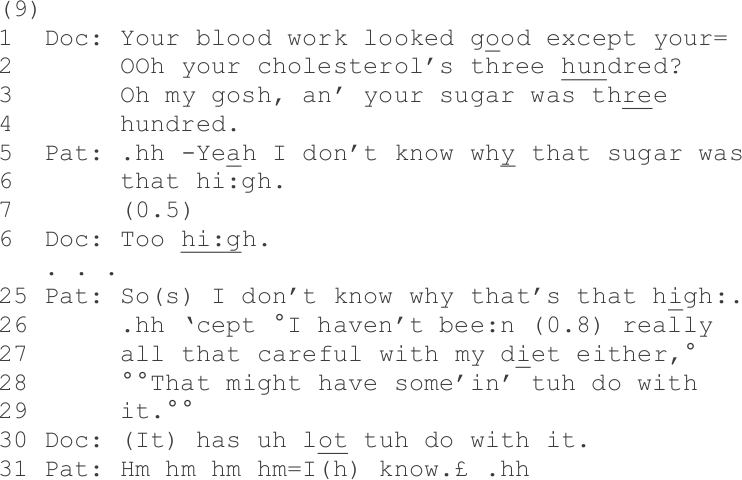
The patient implies causality between her diet and her poor health outcome through the word except, which poses a contrast between “I don’t know why that’s that h
Patients who disclose medical misdeeds in a diagnostic context typically propose a causal connection between the misdeed and the poor health outcome being diagnosed. Moreover, these disclosures consistently describe behaviors that lie well within the patient’s domain of responsibility. In this way they claim some measure of culpability for their condition. The way that patients convey this culpability suggests that they are oriented to a set of obligations as patients including following physicians’ recommendations and adhering to a healthy lifestyle. Knowingly behaving in ways that neglect these obligations is treated as failing to be a good patient. Articulating an awareness of the link between a misdeed and a poor health outcome may help to preempt physician reprimands.
Treatment Negotiation
The third and most common disclosure type in these data was that of treatment negotiation. In this section we examine the ways in which patients and doctors orient to disclosures about medication usage as a form of treatment negotiation. Here patients assert as misdeeds behaviors such as adding, stopping, or altering the dosage of a medication. However, unlike testing the waters and proposing etiology cases, patients here adopt a stance towards this behavior as medically warranted. Furthermore, intimated in these disclosures is that the patient may persist with the behavior, contingent on the treatment outcome. The sequential context of these disclosures is also different from the other two types we have examined in that here the disclosure is not offered in the context of a patient concern that the physician can adjudicate (as in testing the waters cases), nor is the disclosure in the context of self-blame and problematic clinical signs (as in the proposing etiology cases). Rather, in these cases disclosures are being introduced as part of patient negotiations for particular treatments. We will show evidence for this from both patient and physician behavior. For instance, in Extract 10 (shown earlier in Extract 5) the patient discloses two aspects of her usage of Xanax that are problematic: She has increased the dosage (lines 3–4); and she is taking it as a nightly sleeping aid rather than as an as-needed treatment for panic attacks, as prescribed (lines 8–9). Both constitute misdeeds, but both are treated as having some medical warrant.
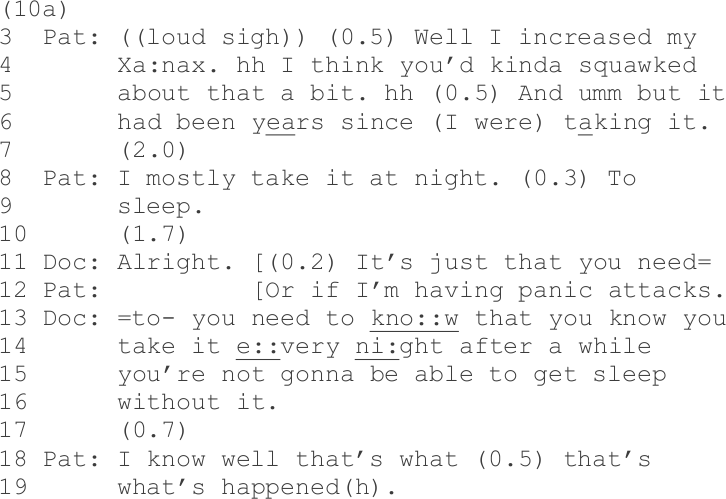
Following the physician’s admonition that the patient should not be taking the Xanax in the way that she is, the physician initiates a discussion of “Safer m
Additional support for the claim that the patient’s disclosure is being leveraged to negotiate for Valium is found in the patient’s subsequent turns. In lines 27/29 the patient builds on her argument in favor of Valium over Xanax, arguing that the difference between Xanax and Valium is not trivial because “then it’s good for] my t
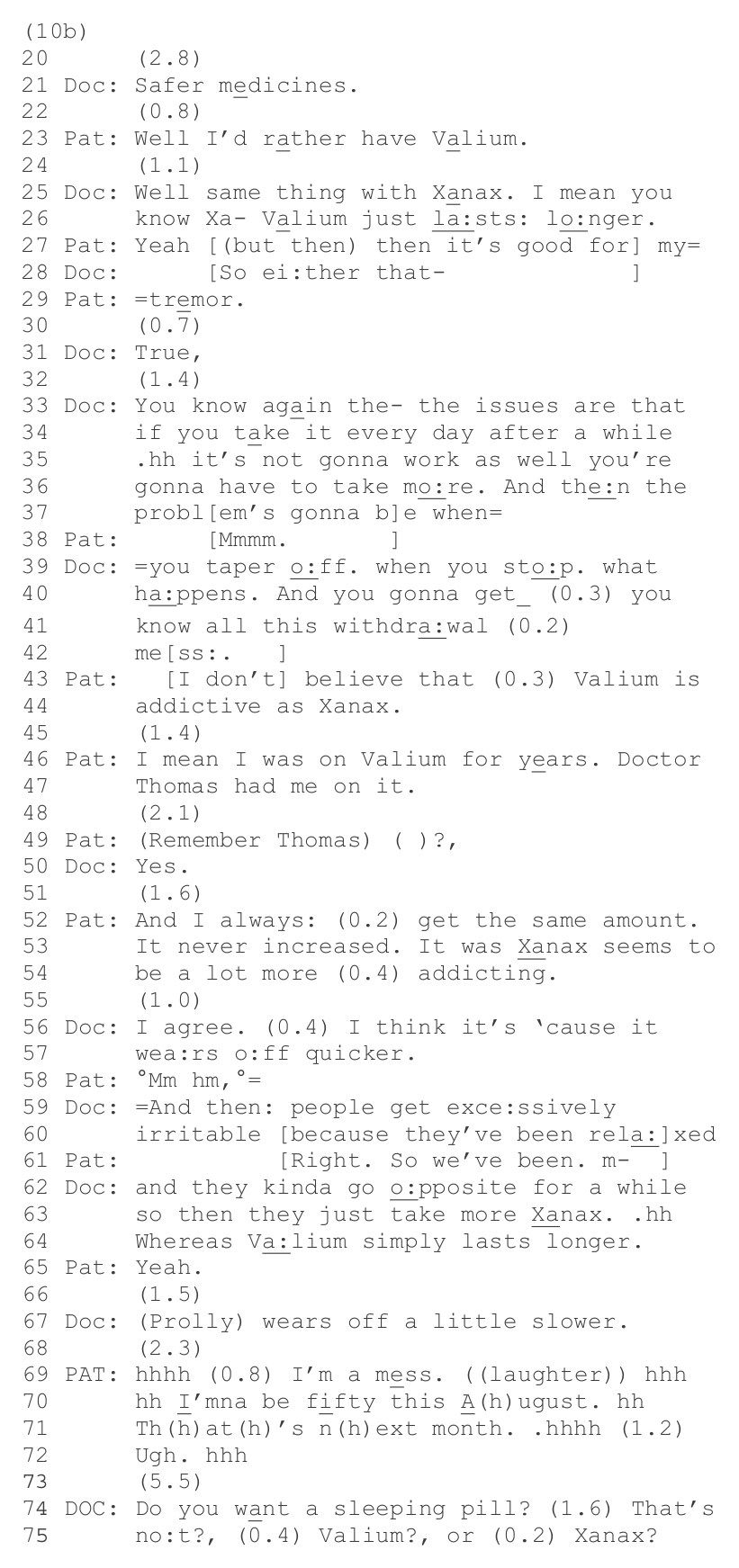
The physician again resists the patient’s lobbying for Valium, this time arguing that this will nonetheless create an addiction, the problem he initially pointed out with respect to Xanax (lines 11/13–16). The patient resists this line as well, asserting first that Valium is not as addictive as Xanax and that she was on Valium “for y
The physician then agrees with the patient’s differentiation between Xanax and Valium (line 56) and expands on it (lines 56–57, 59–60, 62–64, 67) . Although the patient was using this difference as a way to advocate for Valium, the physician here builds from this to an offer of “a sleeping pill? (1.6) That’s no:t?, (0.4) Valium?, or (0.2) Xanax?” (lines 74–75). The form of this offer is significant here. According to Curl (2006), offers typically take one of several forms. The form “Do you want me to X” (in contrast with “I can give you X”) is a form that is generally dedicated to solving a problem that has been “educed” from the conversation. Notably, and consistent with Curl’s argument, this offer for a sleeping pill does not come immediately following line 23, a direct bid for Valium. Rather, it comes after the physician has built a case against both Valium and Xanax. With this form he designs the offer as responsive without being acquiescent.
Extract 10 illustrates how a patient escalates from a disclosure of a medical misdeed to more overt forms of treatment negotiation, suggesting that the disclosure of problematic behavior is a launching pad for the patient’s bid for a particular treatment, in this case Valium. This is a particularly coercive form of treatment negotiation since patients can imply a plan to continue the unhealthy behavior unless they secure what they want, which may be unhealthy as well and may be suboptimal in the physician’s eyes but may nonetheless be an improvement on their current practice(s). Part of the coerciveness of this behavior stems from the warrants that patients provide for the misdeeds. In this case, the warrants for misusing the medication were to enable the patient to sleep and to avoid panic attacks.
This case is also interesting with regard to the delicate balance between patient agency and physician authority. Both in the patient’s disclosure and in her more direct bids to secure Valium, she demonstrates her ability to exhibit agency over her own healthcare decisions. When the physician offers a prescription in lines 74–75, the offer represents, on the one hand, a yielding to the patient’s agency and a ceding of authority. On the other hand, the offer does not come purely in response to the patient (e.g., not at line 23) but only after the physician has built his own case against Valium and Xanax, thus preserving a significant degree of medical authority.
A second illustration is shown in Extract 11 in which the patient presents his problem with a candidate diagnosis of a sinus infection (line 5) (Stivers 2002b). The physician agrees with this diagnosis (line 6). Following a question-answer sequence about having had sinus infections before, the patient discloses his addiction to nasal sprays (lines 12–15).
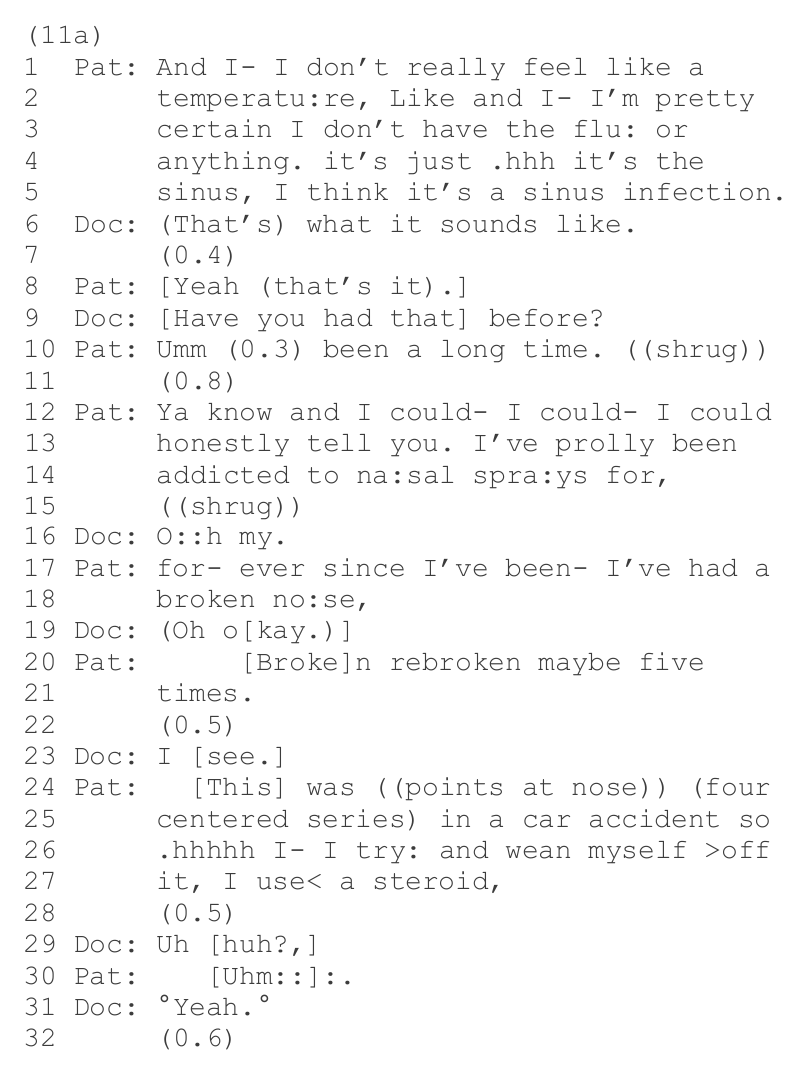
In contrast to the cases where the patient proposes the etiology of a problem, here the patient has already secured physician agreement on a diagnosis. Thus, in this sequential position the disclosure is not concerned with the cause of the problem. In response to the disclosure, the physician negatively evaluates the behavior (line 16), though the patient does not appear to be seeking evaluation as evidenced by his expansion of how and why he came to be addicted. The physician goes on to acknowledge the patient’s ongoing contextualization of the disclosure (lines 17–18, 20–21, 24–27).
Following closure of the telling, the patient returns to the nasal sprays, this time to state what he is currently taking. Again the puzzle the physician must solve is what a mention of the medication he is currently taking might be doing at this point in the medical visit. What the mention initially occasions is a search for the identity of the medication. From there the patient states that in contrast to the two medications that the physician has mentioned, an alternative medication, Nasacort, worked best. With this (lines 44–46) the patient has now made relevant a specific nasal spray treatment for a condition that he has in a context in which he has disclosed an addiction to nasal sprays. As such, while not an overt request for the treatment, the patient is clearly hearable as lobbying for Nasacort. His behavior represents a series of escalations towards a direct request, thus providing, once again, support for the claim that disclosures can function as powerful launching pads for treatment negotiation.
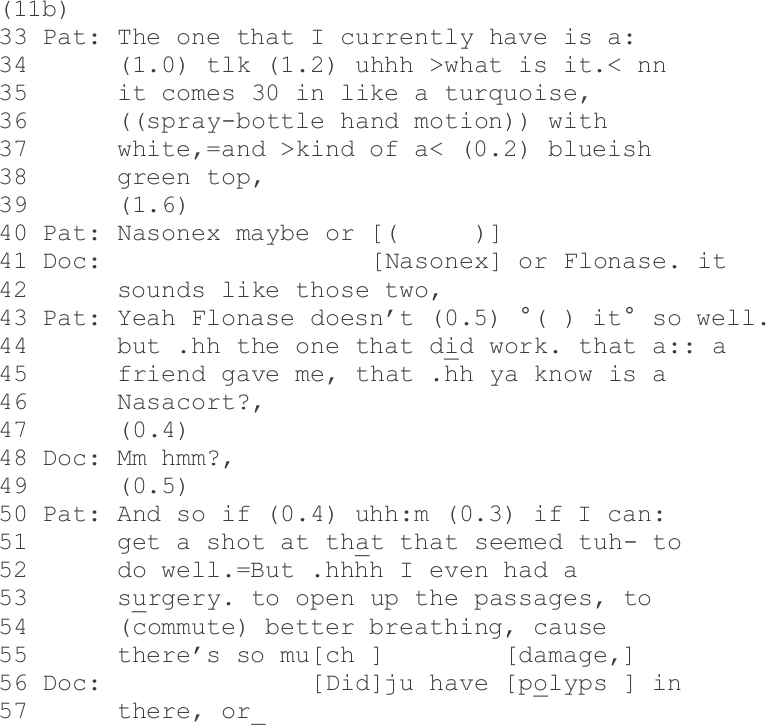
Following the patient’s clear but indirect negotiation in favor of Nasacort, the physician offers a delayed continuer, treating the telling as unfinished and facilitating the patient’s continuation. At this point the patient escalates, this time to a conditional request: “And so if (0.4) uhh:m (0.3) if I can: get a shot at that that seemed tuh- to do well.” (lines 50–52). This conditional request is prefaced with “And so.” Both elements of this preface are important here. The and preface has been shown to be a tying device conveying that this request is part of what was being done previously (Heritage and Sorjonen 1994). The so preface marks what follows as an upshot of what he has been saying (Raymond 2004). Together, this provides patient-side evidence that the disclosure was in the service of treatment negotiation.
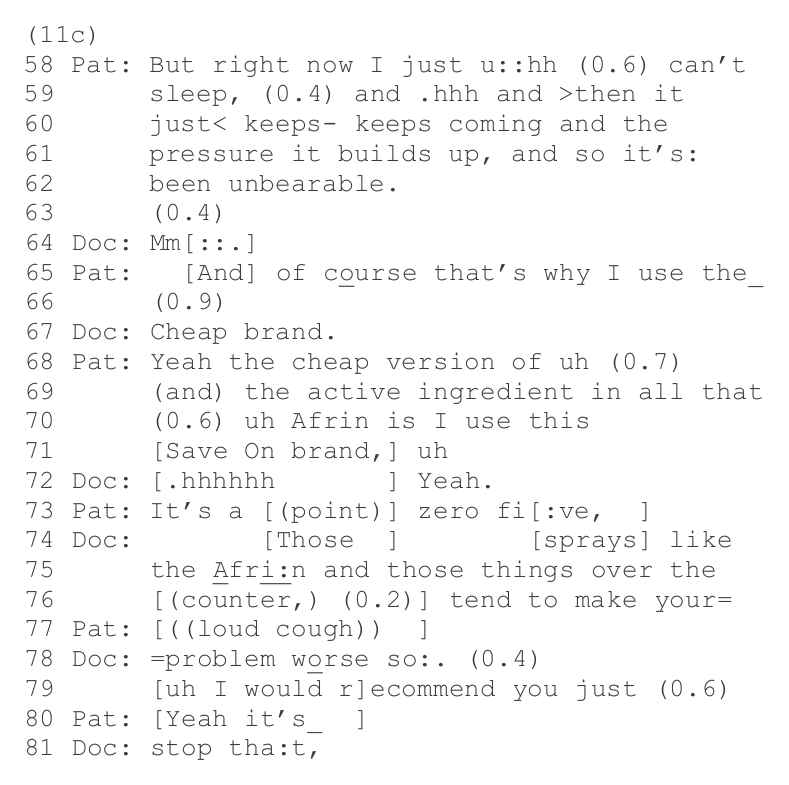
Substantially more treatment negotiation follows slightly later in the visit with overt orientations to the warrant for misusing the medication—the patient argues that he “can’t sleep,” that the pressure is “unbearable” and then leverages a further disclosure of using cheap, short-acting, over-the-counter nasal sprays in a regular way (lines 65/68–71). The physician admonishes the patient for this behavior and directly recommends that he stop that (lines 74–76, 78–79).
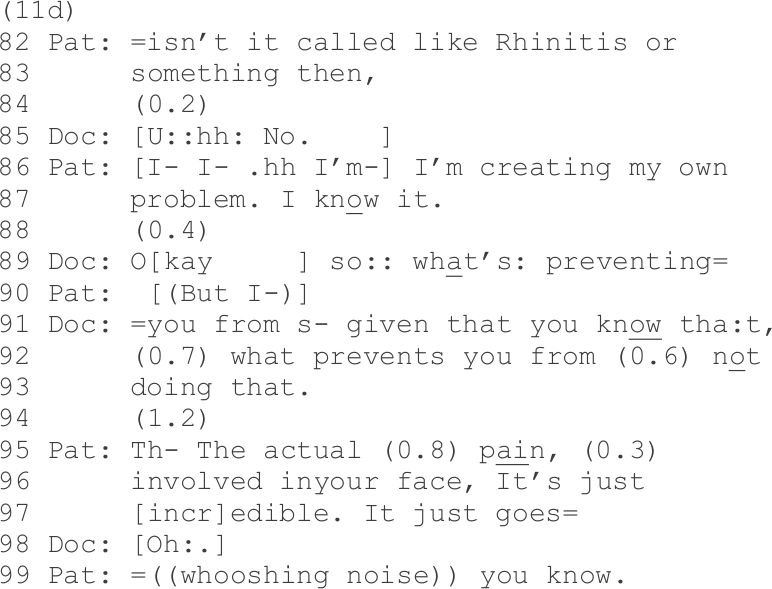
This second disclosure, now in addition to the first, puts substantial pressure on the physician to provide Nasacort treatment. Should the physician fail to do that, the patient has indicated that he could get the Nasacort from a friend (insofar as he originally got it that way—lines 44–45) or that he will persist in using the short-acting versions that are available over the counter in a regular way. The patient shows keen awareness of his own responsibility for the problem (lines 86–87), which the physician capitalizes on, requesting an account for the patient not stopping (lines 89/91–93). However, the physician is then faced with yet another form of strong negotiation for treatment—that the patient experiences significant pain without treatment (lines 95–97/99).
Substantially later in the encounter, the patient initiates further lobbying, this time indicating that he has done everything he could to address his problem, including having spent $24,000 on nasal surgery (data not shown). In this context, which invokes the many sequences of negotiation we have examined, the physician offers a prescription (lines 9/11–12).
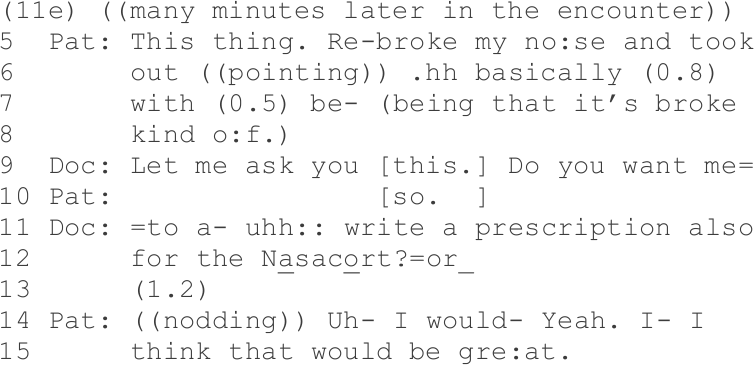
Again consistent with Curl’s (2006) argument, here the offer for Nasacort does not come immediately following a direct bid for treatment but comes near the end of the medical visit. As such, the offer can be designed as less directly responsive to the patient and thus less acquiescent while nonetheless appearing responsive to the patient’s needs, something that helps to downplay the weighty role that the patient has played in this treatment outcome.
This case has shown patient-side evidence that disclosures of medical misdeeds may be in the service of treatment negotiation through the patient’s escalation from disclosure to increasingly more direct forms of negotiation, as well as physician-side evidence that he is offering treatment in a responsive way, albeit not in an “interactionally generated” manner. The next and last case in this section provides even stronger evidence that physicians recognize disclosures, when produced in certain contexts, as a form of pressure to prescribe some given medication. Here, the patient initiates the negotiation sequence not with a disclosure but with a problem presentation—the patient’s seizure pills are still giving her headaches (line 10). The doctor acknowledges the complaint and the reference to previous complaints, but no more (line 11). The patient then escalates shifting from her description of “h
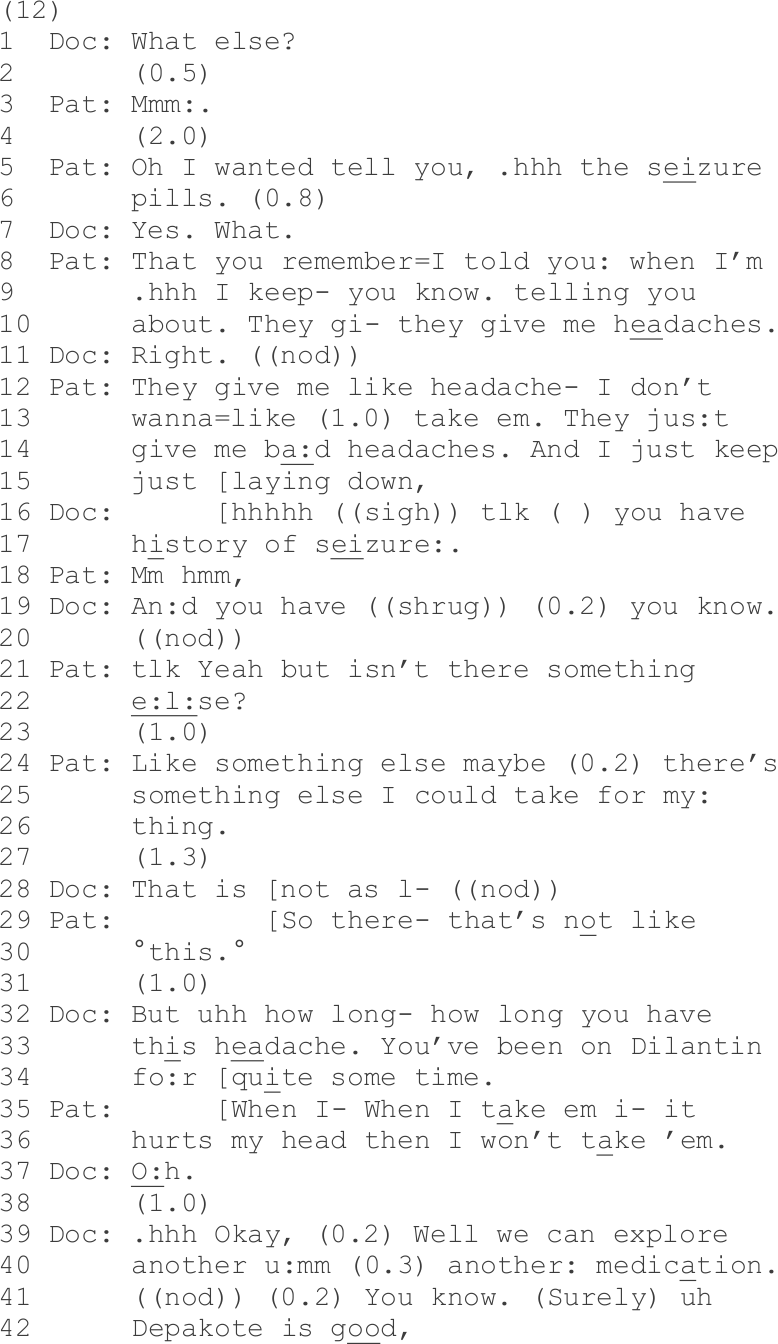
After substantial delay (line 23), patient pursuit of a response (lines 24–26), and further delay (line 27), the physician begins a response but is overlapped with further pursuit of the physician’s response (lines 29–30). The physician’s response at line 32 challenges the presupposition implicit in the patient’s question that it is the Dilantin that is causing her headaches (lines 32–34). In this highly adversarial context, the patient escalates her treatment negotiation, this time disclosing a medical misdeed: that she has not been taking her seizure medication regularly (lines 35–36). She states that when she takes the medication, it hurts her head, “then I won’t take ’em.” In escalating from a complaint about medication to a medication request and only then to a disclosure of medication-related misdeed, the patient orients to the disclosure of a misdeed as a very strong form of treatment negotiation.
Additionally, this case provides physician-side evidence that disclosures can function as a strong form of treatment negotiation in the utter reversal the physician makes in his treatment recommendation. Whereas prior to the disclosure the physician has been consistently resistant to the patient’s efforts to secure an alternative medication, following the disclosure the physician reverses his stance, offering the patient the option to “explore another u:mm (0.3) another: medication.” Notable, too, is the physician’s immediate response to the disclosure; physicians rarely use “Oh” in response to patients. As Heritage suggests, doing so might suggest that a patient’s response is “unexpected” (Heritage 2004: 127), a stance the physician is here prepared to take.
Together these cases illustrate how disclosures of medical misdeeds can be used to negotiate for a particular treatment. These cases almost exclusively involve problematic medication usage. In the cases shown here we saw that patients who were not initially offered the treatment escalated from the disclosure to more overt negotiation strategies. Conversely, physicians orient to this pressure. The offer format “Do you want” was not uncommon as a formulation for proposing a treatment recommendation in the disclosure cases despite offers being generally rare in treatment recommendations.
Types of Disclosures
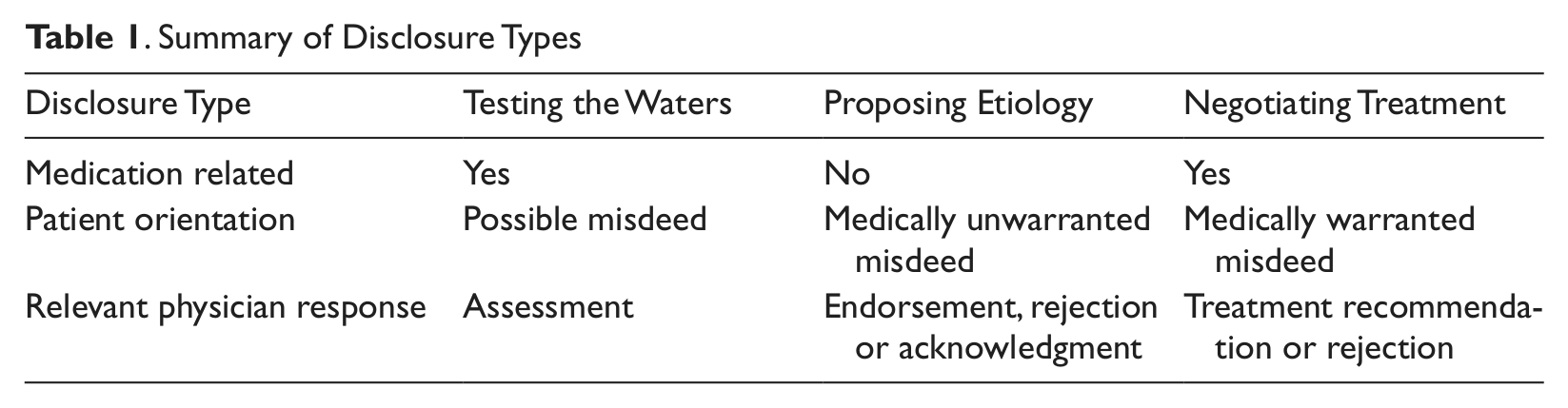
In this paper, we have argued that the three types of disclosures (testing the waters, proposing etiology, and negotiating treatment) are discrete not only in terms of the unique patient projects in which they are used but also in terms of the stance the patient takes towards the misdeed and the type of behavior disclosed. Testing the waters cases involve patients taking an equivocal stance towards their behavior, proposing etiology cases involve patients treating their behavior as problematic and not necessarily medically warranted, and negotiating treatment cases typically involve patients lobbying for treatment and orienting to their behavior as medically warranted. In addition, while testing the waters cases and treatment negotiation cases tend to be medication related, cases of proposing etiology generally involve risky behaviors not related to the self-regulation of prescription medications (e.g., poor diet). These differences are summarized in Table 1.
Summary of Disclosure Types
These generalizations hold for nearly all of our data. When they do not, we see that the departure is nonetheless in line with the general analytic claim. Consider Extract 13. In this instance, a man is being seen for arthritis problems. The disclosure concerns him cutting back on some prescribed arthritis medication. Uniquely, this medication-related misdeed is being offered as part of proposing the etiology of his recent arthritis flare-up.
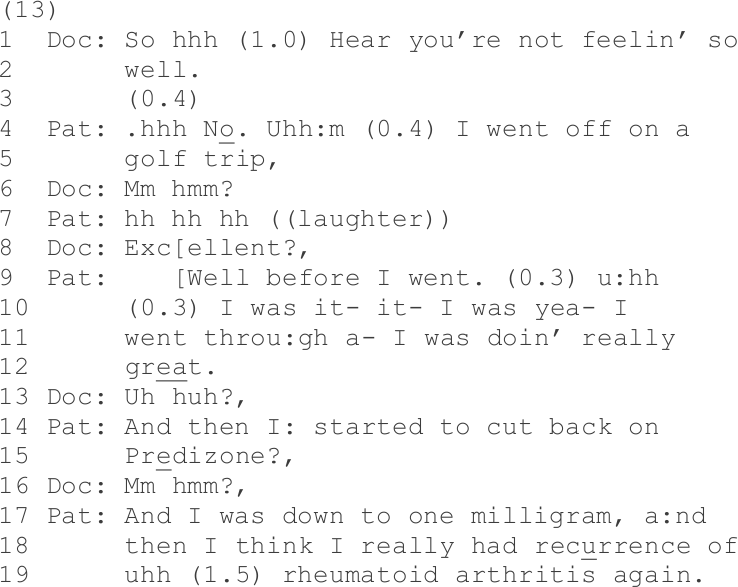
The patient offers the disclosure early in problem presentation (lines 14–15). Ultimately, he characterizes his problem as having “had a recurrence of uhh (1.5) rheumatoid arthritis again.” Our interest is in the patient’s report that he “started to cut back on Prednizone.” The patient’s use of “then” (both at line 14 and again at line 18) causally ties the cutting back of medication to the recurrence of arthritis. In this way, the patient’s disclosure indicates a causal link between his actions and the unfavorable health outcome. The patient acknowledges his culpability here.
Of our 13 etiology proposal cases, only 2 were disclosures of medication-related misdeeds. What ties these etiology proposal cases together is not the content of the disclosure itself but rather the proposal that one’s actions are to blame for some unfavorable health outcome and that the action was broadly unwarranted. Thus, although medication-related misdeeds are more typically treated as medically warranted and are used in negotiating treatment, when they appear in this type of disclosure they are still in the service of proposing that the patient’s action has caused a health problem and possibly minimizing physician rebuke.
Discussion
At the outset of the paper, we asked what might account for a patient’s reporting a medical misdeed. We observed that although the most common explanation is that the physician interactionally “corners” the patient by asking about the relevant behavior, nearly half of all disclosures are patient initiated. These pose a puzzle since patients are, of their own volition, disclosing behaviors that they orient to as unhealthy and medically problematic. We showed that there are three situations in which patients offer disclosures: (1) when they are testing the waters with a physician, (2) when patients are proposing a causal relationship between their behavior and an undesirable health outcome, and (3) when they are negotiating for a particular treatment outcome.
Taking the collection of patient-initiated disclosures as a whole, we suggest that these disclosures are yet another way in which patients assert agency over their healthcare in interaction with physicians. Through this practice patients convey that they are willing to make unsanctioned lifestyle choices, alter their treatment regimens without seeking their physicians’ advice, disregard physician recommendations, propose causal explanations for health outcomes, and lobby for alternate treatment recommendations. Medication-related disclosures as seen in treatment negotiation cases are particularly agentive insofar as patient self-regulation of prescription medication constitutes an assertion of control over disease (Conrad 1985). As a practice then, disclosures of medical misdeeds can be added to a growing list of patient behaviors during medical visits through which patients assert themselves including offering candidate diagnoses, blocking physician questioning trajectories, questioning diagnoses, and questioning treatments (Stivers 2007).
Yet at the same time, in the way that patients design these disclosures, they exhibit reluctance to tread into the physician’s domain of authority. This is evident in their reticence to disclose medical misdeeds—a characteristic shared by other agentive patient behaviors. In over half of the cases the patient does not disclose the misdeed until there is some direct prompting by the physician. The disclosure itself tends to be delayed in the turn as well as in the greater interactional context of the visit. Patients’ reluctance to tread in the physician’s domain is also evident in their continued orientation to persons’ obligations with respect to the sick role (Parsons 1951). Specifically, Parsons (1951) argued that persons should avoid the sick role and, if in the sick role, work to get out of it as soon as possible. To this end, all individuals have an obligation to (1) behave in ways that will help to maintain their health and, if sick, to (2) cooperate with advising physicians to get well. In these data we see that patients’ disclosures are highly moralistic precisely because there appears to be a shared understanding of these obligations. When patients believe that they have brought a particular medical condition on themselves, they treat this as problematic (e.g., the pedicure, the overuse of nasal sprays). But equally problematic is when they are using medications in potentially harmful ways, including taking medications that were not prescribed or stopping medications they were told to take. Patients show themselves to be oriented to their lack of cooperation as inappropriate but do it nonetheless. Thus, contemporary patients exhibit an ambivalence about the role they want to and should play in their own healthcare, somewhere between passive patient and proactive consumer yet not quite a shared decision-making equal either.
Conclusion
With the multitude of complementary and alternative medications as well as over-the-counter medications available today, securing information about what patients are and are not doing that is medically relevant is critical to quality healthcare. As described earlier, research on disclosures has concentrated on psychosocial issues of relevance to the diagnosis and treatment of the patient. While such issues are naturally important, this study identifies a more proximate form of disclosure that has thus far been largely neglected—the disclosure of medical misdeeds. In an era when patients are virtually mandated to be proactive in order to obtain high-quality healthcare, and when patient informedness has reached an all-time high, courtesy of the Internet, it is important to continue to empirically assess physician and patient roles in medical care. Disclosures represent potentially significant information. Understanding what is associated with patient disclosure, how disclosures are taken up by physicians, what effect disclosures have on diagnostic and treatment outcomes, and what sorts of physician responses to disclosures have beneficial outcomes for patients are important topics for further research.