



Abstract
The double disadvantage hypothesis predicts that adults who hold more than one disadvantaged status may experience worse health than their singly disadvantaged and privileged counterparts. Research that has tested this thesis has yielded mixed findings due partly to a failure to examine the role of discrimination. This article uses data from the National Survey of Midlife Development in the United States (N = 2,647) to investigate the relationship between multiple disadvantaged statuses and health, and whether multiple forms of interpersonal discrimination contribute to this association. The results suggest that multiply disadvantaged adults are more likely to experience major depression, poor physical health, and functional limitations than their singly disadvantaged and privileged counterparts. Further, multiple forms of discrimination partially mediate the relationship between multiple stigmatized statuses and health. Taken together, these findings suggest that multiply disadvantaged adults do face a “double disadvantage” in health, in part, because of their disproportionate exposure to discrimination.
Health scholars have increasingly argued that individuals’ health cannot be fully understood by examining it within one system of stratification in isolation (e.g., racial disparities in health) (Schultz and Mullings 2006; Williams et al. 2012). Investigations of a single disadvantaged status miss important within-group variation in the health of minority communities (Ailshire and House 2011; Erving 2011). Disadvantage means the constraints imposed on a social group’s life chances and quality of life due to its stigmatized status in society (Link and Phelan 2001). Of particular concern is the potential elevated risk for poor health faced by individuals who belong to more than one stigmatized group. For example, black women—by virtue of their stigmatized racial and gender statuses—may face additional disadvantages in health compared to both their singly disadvantaged (i.e., white women and black men) and privileged (i.e., white men) counterparts. However, research testing this proposal, known as the double disadvantage hypothesis (Dowd and Bengston 1978), has yielded mixed findings (Cummings and Jackson 2008; Meyer, Schwartz, and Frost 2008; Ryff, Keyes, and Hughes 2003).
Ferraro and Farmer (1996) argue that the inconsistent findings regarding “double disadvantage” may be due to a failure to examine the social factors and conditions that link social statuses to health. In particular, they note that scholars tend to assume, rather than explicitly investigate, whether multiply disadvantaged individuals face more discrimination than singly disadvantaged and privileged individuals. Thus, multiple disadvantaged statuses should not be treated as interchangeable with multiple forms of discrimination (Best et al. 2011).
Researchers have extensively documented an inverse relationship between self-reported discrimination and health (see Mays, Cochran, and Barnes 2007; Paradies 2006; Pascoe and Richman 2009; Thoits 2010; Williams and Mohammed 2009; Williams, Neighbors, and Jackson 2003 for reviews). While promising for the potential association between multiple disadvantaged statuses and health, little research has examined experiences of more than one form of discrimination. Scholars overwhelmingly focus on one form of discrimination, especially racial discrimination, in isolation from other forms (e.g., gender discrimination) (Pascoe and Richman 2009). Preliminary research suggests that experiencing multiple forms of discrimination may have a greater negative impact on adults’ health (Gayman and Barragan 2013; Seng et al. 2012; Stuber et al. 2003; also see Grollman 2012 for youth).
This article uses data from the National Survey of Midlife Development in the United States (MIDUS), a nationally representative survey of adults ages 25 to 74, to investigate the relationships among multiple disadvantaged statuses, multiple forms of discrimination, and mental and physical health. Three questions are addressed in this study. First: Are multiply disadvantaged adults at greater risk for poor mental and physical health compared to singly disadvantaged and privileged adults? Second: Do multiply disadvantaged adults face more forms of discrimination than their more privileged counterparts? Finally, to what extent do experiences of multiple forms of discrimination explain the relationship between multiple stigmatized statuses and health?
Background
The Double Disadvantage Hypothesis
Social scientists have increasingly recognized that individuals’ lives are not shaped and constrained by a single system of stratification (Cho, Crenshaw, and McCall 2013). Rather, scholars are encouraged to employ the theoretical framework of intersectionality, in which their central focus is the interlocking and mutually reinforcing relationships among multiple systems of oppression, or the matrix of domination (Collins 2000; Crenshaw 1989, 1991). Because each individual exists on multiple axes of privilege and disadvantage, researchers must attend to their unique social location at the intersection of these systems.
However, little consensus exists regarding the empirical application of intersectionality, particularly in quantitative research (Cho et al. 2013; Choo and Ferree 2010; MacKinnon 2013; McCall 2005). Early formulations of the intersectional framework focused heavily on the dual disadvantages or double jeopardy of race and gender faced by black women (Crenshaw 1989, 1991; King 1988). Contemporary intersectionality scholars have cautioned against this “additive” approach because it still treats individuals’ statuses as independent (Bowleg 2008; Browne and Misra 2003). For example, the wage inequality faced by black women is not merely the sum of the racial wage penalty and the gender wage penalty (Greenman and Xie 2008). Yet a number of scholars seek to assess the impact of the simultaneity of disadvantage (i.e., double disadvantage) (Beale 1970; Browne and Misra 2003; St. Jean and Feagin 1998). One specific concern is the potential “double disadvantage” in health faced by multiply disadvantaged individuals (Bowleg 2012; Stuber and Meyer 2008). These individuals may be at greater risk for poor mental and physical health due to the collective impact of multiple stigmatized statuses.
Prior research, however, has not provided consistent evidence of a double disadvantage in health. Studies on older racial minorities suggest that the presence of the dual disadvantages of age and race depends on the health outcome considered (Brown, O’Rand, and Adkins 2012; Dowd and Bengston 1978). Yet, research on the intersections among race, gender, and sexual orientation has consistently yielded evidence of a double disadvantage. In general, black women and black sexual minorities experience worse health than their more privileged counterparts (Cummings and Jackson 2008; Mays et al. 2002; Meyer et al. 2008; Ryff et al. 2003).
But little work has documented the social factors that contribute to these disparities. Discrimination, especially exposure to multiple forms, may be a key factor in the relationship between multiple disadvantaged statuses and health (Ferraro and Farmer 1996; Meyer et al. 2008; Ryff et al. 2003). Best and her colleagues (2011) offer an important clarification between multiple disadvantaged statuses and multiple forms of discrimination; while these two components of the intersectional framework are related, they should not be treated as synonymous. Thus, the “double jeopardy” that multiply disadvantaged individuals may face is the cumulative burden of the forms of discrimination associated with their stigmatized statuses, rather than the statuses themselves.
Multiple Forms of Discrimination and Health
Discrimination is broadly understood as unfair treatment on the basis of one’s social group membership (Thoits 2010). Thus, a core component of discrimination is the social status upon which such treatment is based (e.g., gender)—that is, the particular form of discrimination. Forms of discrimination vary in prevalence, distribution, and their impact on health (Kessler, Mickelson, and Williams 1999; Seaton et al. 2008; Stuber et al. 2003). While some overlap exists, each form has qualitatively distinct aspects (Sue 2010). For example, one central theme of racial discrimination is the assumption of blacks’ inferiority to whites, which results in racial exclusion in hiring and promotion. Similarly, gender discrimination often entails the sexual objectification or harassment of women in the workplace. A number of scholars have overlooked the dimension of form(s) of discrimination, either by measuring “unfair treatment” without an explicit reference to its form or by failing to include the form(s) of discrimination in their analyses (Pascoe and Richman 2009). Such studies may yield inaccurate estimates of the prevalence and distribution of discrimination, and may misspecify the discrimination-health relationship (Krieger 2012). Further, this and other lingering methodological and conceptual issues may contribute to the inconsistent findings regarding the contribution of discrimination to health disparities (Schnittker and McLeod 2005; Williams and Mohammed 2009).
Approximately one-fifth of adults in the United States report facing more than one form of discrimination (Best et al. 2011; Puhl, Andreyeva, and Brownell 2008). Preliminary research suggests that the health-harming effect of multiple forms of discrimination does, in fact, exceed that of facing only one form (Mays and Cochran 2001; Seng et al. 2012). Using longitudinal data, Gayman and Barragan (2013) found adults’ reports of multiple forms of discrimination were associated with greater risk of mental health problems compared to only one form or no experiences of discrimination. However, the authors did not examine the distribution of these experiences nor whether they contribute to mental health disparities. Grollman (2012) found similar patterns for depressive symptoms and self-rated health among youth, and found that multiple forms of discrimination partially explained the relationship between multiple disadvantaged statuses and health. This article builds on these studies to investigate the relationships among multiple disadvantaged statuses, multiple forms of discrimination, and mental and physical health among adults. Further, it assesses whether the effect of multiple forms on health is driven by two other dimensions of discrimination: the increased frequency and perceived severity of these experiences (Grollman 2012; Mays and Cochran 2001). Discriminatory treatment likely consists of multiple dimensions (Feagin and Eckberg 1980), which should be identified to determine how discrimination affects health (Williams and Mohammed 2009). Indeed, preliminary research hints that the impact of multiple forms of discrimination on health is driven by these other dimensions (Grollman 2012; Mays and Cochran 2001).
Hypotheses
Based upon prior research, the following patterns are expected for the present study. By virtue of holding more than one stigmatized status, multiply disadvantaged adults may report facing more forms of discrimination than their singly disadvantaged and privileged counterparts (Meyer et al. 2008). For example, black lesbian, gay, and bisexual people face the possibility of racist and homophobic discrimination in society, as well as racist discrimination in predominantly white lesbian, gay, and bisexual communities, and homophobic discrimination in predominantly heterosexual black communities (Choi et al. 2013; Cohen 1996; Green 2005). In turn, multiply disadvantaged individuals are expected to report facing discrimination more frequently (Grollman 2012); that is, their exposure to multiple forms of discrimination increases the likelihood that they will be exposed to discriminatory treatment. Finally, in turn, they may appraise these experiences as more stressful (Mays and Cochran 2001). By virtue of exposure to multiple forms of discrimination, and facing such treatment more frequently, multiply disadvantaged adults may find these experiences to be more distressing relative to more privileged adults’ experiences. Taken together, these experiences are expected to explain multiply disadvantaged adults’ elevated risk for poor mental and physical health.
This article uses a nationally representative sample of adults to test this proposal—that multiply disadvantaged adults face a double disadvantage in mental and physical health because of their disproportionate exposure to interpersonal discrimination. In particular, this study examines whether adults who hold multiple stigmatized status report facing more forms of discrimination than their singly disadvantaged and privileged counterparts. It also examines whether two additional dimensions of discrimination—chronicity and perceived stressfulness—drive the health-harming effects of multiple forms of discrimination. Finally, this study assesses the extent to which these experiences of discrimination mediate the relationship between multiple disadvantaged statuses and health.
Data and Methods
Data
I use data from MIDUS Wave 1 (Brim et al. 1996a), a project of the MacArthur Foundation Network on Successful Midlife Development. MIDUS is an ideal survey because of its inclusion of a wide array of mental and physical health indicators and an extensive assessment of experiences with discrimination (see Kessler et al. 1999). MIDUS is a national probability sample of noninstitutionalized, English-speaking adults ages 25 to 74 in the coterminous United States. Oversamples of men and older adults (ages 65–74) were collected. The survey was carried out in two phases in 1995–1996. First, respondents were recruited from a random-digit-dial sampling frame for computer-assisted telephone interviews lasting an average of 34 minutes (70 percent response rate). Second, respondents were invited to complete a mail-in self-administered questionnaire. Approximately 87 percent of interviewed respondents completed the self-administered questionnaire, yielding an overall response rate of 61 percent (3,032 adults). This article uses data from the 2,647 respondents who provided valid information for sociodemographics and experiences with discrimination. 1 Analyses are based on weighted data, which adjust for sociodemographic differences between the MIDUS sample and the U.S. population (Brim et al. 1996b).
Measures
Mental Health
This study examines two indicators of mental health. Psychological distress is measured using a scale that assesses how often (none of the time = 0 to all of the time = 4 for each) in the past month respondents felt: (1) sad, (2) nervous, (3) restless, (4) hopeless, (5) worthless, and (6) that everything was an effort. These six items were scaled additively yielding a Cronbach’s alpha of .86 and a range from 0 (no psychological distress) to 24 (high psychological distress). In addition, a dichotomous variable was used to indicate whether respondents met the Diagnostic and Statistical Manual of Mental Disorders, third edition, revised (American Psychiatric Association 1987) criteria for diagnosis of Major Depressive Disorder (yes = 1) in the past year. A diagnosis of major depression requires a period of two or more weeks of either depressed mood or anhedonia nearly every day, most of the day, and a series of four or more associated symptoms (e.g., problems eating, sleeping, and concentrating; low energy and self-worth; suicidality).
Physical Health
Two physical health outcomes are examined. Self-rated physical health measures respondents’ assessments of their current physical health, ranging from poor (0) to excellent (4). Self-reports of health have been found to be reliable predictors of adults’ objective health status (Ferraro and Farmer 1999; Idler and Benyamini 1997). Functional limitations is a binary indicator of whether respondents report any health-related limitations in activities of daily living (e.g., bathing or dressing, walking, climbing stairs) (any limitation = 1). 2
Interpersonal Discrimination
Respondents were asked how frequently they faced major events and day-to-day occurrences of discriminatory treatment (Williams et al. 1997). Major lifetime discrimination accounts for the number of times in their lives they have faced 11 distinct discriminatory events in which their livelihood and life chances were threatened (e.g., fired, hassled by police, denied a loan). Responses for each discriminatory event range from never (0) to five or more times (5) each; the overall frequency of major lifetime discrimination ranges from 0 (no discrimination) to 55 (five or more times of all 11 events), with a Cronbach’s alpha of .72. Everyday discrimination captures how frequently respondents are exposed to 9 less severe, yet chronic occurrences of discrimination in daily interactions (e.g., treated with less respect, called names or insulted). Responses for each occurrence of discrimination range from never (0) to often (4); the overall frequency of everyday discrimination ranges from 0 (no discrimination) to 36 (experience all 9 events often), with a Cronbach’s alpha of .93.
Respondents were also asked to note the main social group membership or status upon which these experiences were based: age, gender, race, ethnicity or nationality, 3 religion, weight or height, some other aspect of one’s physical appearance, physical disability, and sexual orientation. 4 Although respondents were allowed to provide multiple attributions, the survey asked for the “main reason” that they faced discrimination; such question wording may yield a conservative estimate of experiences of multiple forms of discrimination. Number of forms of discrimination is a count of the number of attributions respondents offered for their exposure to discrimination (0–8). Finally, respondents were asked to appraise how much discrimination has interfered with their lives (not at all = 0 to a lot = 3) and how much harder their lives have been because of discrimination (not at all = 0 to a lot = 3). These ratings were summed to capture the perceived stressfulness of discrimination faced, thus ranging from 0 (not at all) to 6 (a lot for both), with a Cronbach’s alpha of .91.
Sociodemographic Characteristics
This study examines the additive effects of multiple disadvantaged statuses on discrimination and health. I selected those statuses that (1) MIDUS included as a basis for respondents’ experiences of discrimination and (2) reflect a disadvantaged group that, based on prior research, faces a disproportionate amount of discrimination relative to the respective privilege group. Four social statuses met these two criteria: race, gender, sexual orientation, and weight. Race is measured by dichotomous variables for blacks (yes = 1) and other nonwhites (yes = 1), with whites used as the reference group for each. Binary indicators are used for gender (women = 1 and men = 0) and sexual orientation (sexual minority = 1 and heterosexual = 0). Weight is measured by a dichotomous variable where obese = 1 (i.e., body mass index ≥ 30) and nonobese = 0 (i.e., body mass index < 30). These sociodemographic characteristics were summed as the number of disadvantaged statuses that respondents hold among racial minority, woman, sexual minority, and obese. Because the sample does not include respondents who hold all four stigmatized statuses, this count ranges from 0 (privileged) to 3 (triply disadvantaged). See online supplement Appendix B for the race-gender-sexuality-weight–specific subgroups.
Additional sociodemographic controls are included. Age is measured in years (25–74). Socioeconomic status is captured by the level of education completed (less than middle school = 0 to graduate degree = 8) and the natural log of income for the past year (raw M = $22,581 [1995 dollars]). Nativity is a binary indicator of whether respondents were born outside of the United States (immigrant = 1, U.S.-born = 0). Finally, marital/partner status is measured by dichotomous variables for single, never married respondents (yes = 1) and divorced, widowed, or separated respondents (yes = 1), with partnered/married respondents (yes = 1) as the reference group.
Analysis Plan
The analyses presented here include the following steps. First, negative binomial regression modeling is used to investigate the association between respondents’ number of disadvantaged statuses and each dimension of discrimination—number of forms, frequency of everyday and major lifetime discrimination, and perceived stressfulness. In particular, this step examines whether multiply disadvantaged respondents face disproportionate levels of these dimensions of discrimination. It also examines whether reports of multiple forms of discrimination are associated with more frequent discrimination and, in turn, greater perceived stressfulness. Second, the effects of the number of disadvantaged statuses are estimated for psychological distress (ordinary least squared regression), major depression (binary logistic regression), self-rated physical health (ordinal logistic regression), and functional limitations (binary logistic regression). These analyses include models that include controls for number of forms, frequency, and perceived stressfulness of discrimination to assess whether they contribute to explaining the relationship between multiple disadvantaged statuses and health.
Results
Descriptive Statistics
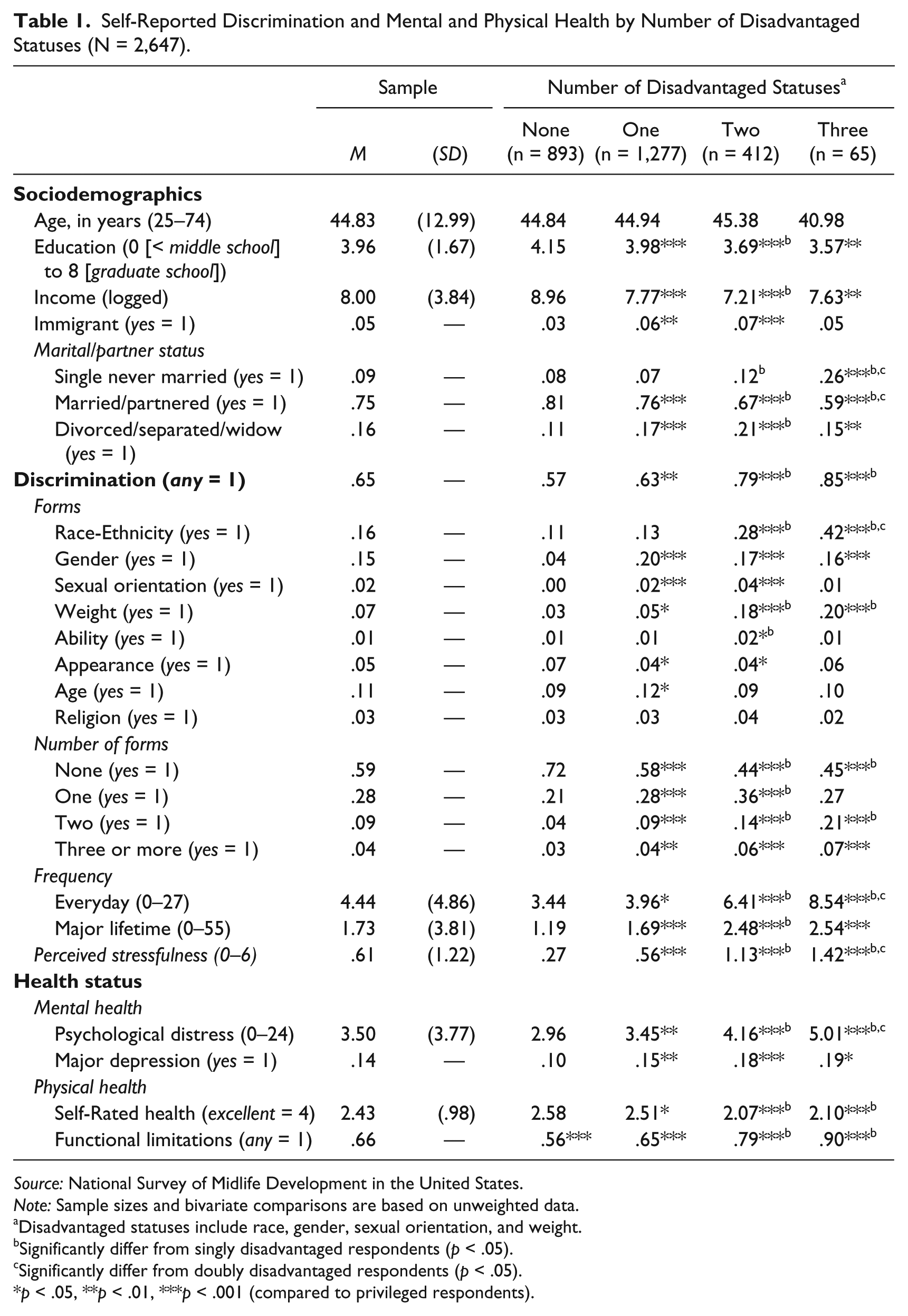
Table 1 displays the descriptive statistics for the MIDUS sample. It also presents the reports of each form, number of forms (0–3+), frequency (every day: 0–27; major lifetime: 0–55), and perceived stressfulness (0–6) of discrimination, as well as mental and physical health. Similar to prior estimates (Kessler et al. 1999), approximately two thirds of adults (65 percent) report any experience of discrimination. The prevalence of each form of discrimination varies, ranging from 1 percent who report ability-based discrimination to 16 percent who report race discrimination. While 28 percent of respondents report only one form of discrimination, 13 percent report multiple forms, including 9 percent reporting two forms and 4 percent reporting three or more forms. 5 This proportion of adults who report multiple forms of discrimination is similar to prior research using MIDUS data (Puhl et al. 2008) and other national surveys (Pavalko, Mossakowski, and Hamilton 2003; Stuber et al. 2003). On average, experiences of everyday (M = 4.4) and major lifetime (M = 1.7) discrimination are rare, and respondents rate these experiences as minimally stressful (M = .61, M = .94 among those reporting discrimination).
Self-Reported Discrimination and Mental and Physical Health by Number of Disadvantaged Statuses (N = 2,647).
Source: National Survey of Midlife Development in the United States.
Note: Sample sizes and bivariate comparisons are based on unweighted data.
Disadvantaged statuses include race, gender, sexual orientation, and weight.
Significantly differ from singly disadvantaged respondents (p < .05).
Significantly differ from doubly disadvantaged respondents (p < .05).
p < .05, **p < .01, ***p < .001 (compared to privileged respondents).
Table 1 also presents these descriptive statistics by respondents’ number of disadvantaged statuses. (See online supplement Appendix A for self-reports of discrimination by each status.) There are a number of significant bivariate differences in reports of discrimination. First, singly disadvantaged respondents (63 percent) are more likely to report any discrimination than privileged respondents (57 percent). Specifically, they are more likely to report discrimination based on gender, sexual orientation, weight, appearance, and age. Also, they are more likely than privileged respondents to report facing multiple forms of discrimination. Singly disadvantaged respondents also report significantly more frequent exposure to both everyday and major lifetime discrimination and appraise these experiences as more stressful. Finally, for all four health outcomes—psychological distress (0–24), major depression (yes = 1), self-rated physical health (excellent = 4), and functional limitations (any = 1)—singly disadvantaged adults report significantly worse health than privileged adults.
The estimates for doubly and triply disadvantaged adults suggest that they face a greater burden of discrimination than both privileged and singly disadvantaged adults. First, multiply disadvantaged adults are the most likely to report discrimination, including discrimination based on race, gender, and weight. In general, they report significantly more forms of discrimination and more frequent everyday and major lifetime discrimination, and they appraise these experiences as more stressful. Also, they are significantly more likely to report poor health than more privileged adults (with the exception of major depression). These estimates offer preliminary evidence of a double disadvantage in both discrimination and health for multiply disadvantaged adults.
Reports of Dimensions of Discrimination
The first set of multivariate analyses assesses the distribution of the three dimensions of self-reported discrimination. Table 2 presents the negative binomial incidence risk ratios (IRRs) for the effect of the number of disadvantaged statuses on each dimension of discrimination using binary indicators for number of disadvantaged statuses: number of forms (Model 1), frequency of everyday (Models 2–3) and major lifetime (Models 4–5) discrimination, and perceived stressfulness (Models 6–8). Controls for other sociodemographic characteristics (i.e., age, education, income, nativity, and marital/partner status) are included. Subsequent models add controls for number of forms (i.e., Models 3, 5, and 7) and frequency (i.e., Model 8) to assess the relationships among the dimensions of discrimination.
Negative Binomial Incidence Risk Ratios for Number of Disadvantaged Statuses a on Number of Forms, Frequency, and Stressfulness of Discrimination (N = 2,647).

Source: National Survey of Midlife Development in the United States.
Note: Exponentiated coefficients with 95 percent confidence intervals are in parentheses. Privileged respondents are the reference group. Controls include age, education, income, nativity, and marital/partner status.
Disadvantaged statuses include race, gender, sexual orientation, and weight.
Significantly differ from singly disadvantaged respondents (p < .05).
Significantly differs from the effect of one form of discrimination (p < .05).
Significantly differs from the effect of two forms of discrimination (p < .05).
Significantly differs from the effect of everyday discrimination (p < .05).
p < .05, **p < .01, ***p < .001 (two-tailed test).
In Model 1, singly disadvantaged (IRR: 1.7), doubly disadvantaged (IRR: 2.4), and triply disadvantaged (IRR: 2.4) adults report significantly more forms of discrimination than privileged adults. Further, multiply disadvantaged respondents report significantly more forms than both their singly disadvantaged and privileged counterparts. In general, similar patterns hold for the other two dimensions of discrimination as well (Models 2, 4, and 6). Disadvantaged adults report significantly more chronic exposure to everyday and major lifetime discrimination and appraise these events as significantly more stressful than do privileged adults. Further, multiply disadvantaged respondents generally report greater levels of these dimensions of discrimination than both their singly disadvantaged and privileged counterparts. It is noteworthy, however, that doubly and triply disadvantaged adults do not significantly differ in reports of discrimination.
The next set of models in Table 2 (Models 3, 5, and 7–8) test whether number of forms contributes to the disproportionate frequency and perceived stressfulness of discrimination faced by multiply disadvantaged adults. Negative binomial regression modeling is used to assess the frequency of everyday discrimination (Model 3) and major lifetime discrimination (Model 5) as well as perceived stressfulness (Model 7), net of the effect of number of forms of discrimination. Model 8 also controls for the frequency of discrimination to assess whether it contributes to the effect of number of forms on the perceived stressfulness of these experiences. Again, multiply disadvantaged adults report significantly more frequent everyday discrimination (Model 3) and appraise these experiences as significantly more stressful (Model 7) than do their more privileged counterparts; however, the effect of number of disadvantaged statuses on major lifetime discrimination is nonsignificant (Model 7). For both everyday and major lifetime discrimination, respondents who face multiple forms report significantly more frequent exposure to discrimination (Models 3 and 5). In fact, the relationship between number of forms reported and frequency appears to be linear: Respondents who face three forms report significantly more chronic exposure to discrimination than those facing fewer forms. In Model 7, respondents who face multiple forms of discrimination appraise these experiences as significantly more stressful than those who face only one form; this difference becomes nonsignificant upon controlling for the frequency of discrimination (Model 8).
Post hoc Sobel tests (Sobel 1982) were used to investigate the extent to which multiple forms of discrimination mediate the relationships of number of disadvantaged statuses with frequency of everyday and major lifetime discrimination and perceived stressfulness. Multiple forms of discrimination partially explain the effects of number of disadvantaged statuses on frequency of everyday discrimination (Z = 10.4, p < .001) and major lifetime discrimination (Z = 10.3, p < .001) as well as the perceived stressfulness of these experiences (Z = 10.4, p < .001). Finally, everyday discrimination further mediates the relationship between number of disadvantaged statuses and perceived stressfulness (Z = 12.7, p < .001). Taken together, these findings suggest that multiply disadvantaged adults face more forms of discrimination and more frequent exposure to discrimination and experience these events as more stressful compared to both their singly disadvantaged and privileged counterparts. In fact, because they face more forms of discrimination, multiply disadvantaged adults experience more chronic discrimination and, in turn, appraise these experiences as more distressing compared to their more privileged counterparts. These patterns generally support the multidimensional conceptualization of interpersonal discrimination proposed in this article.
Multiple Dimensions of Discrimination and Health
The final set of analyses investigates whether number of forms, frequency, and perceived stressfulness of discrimination help to explain the potential relationship between multiple disadvantaged statuses and health. Table 3 presents the effect of number of disadvantaged statuses on psychological distress (Models 1–4) and major depression (Models 5–8). Table 4 presents its effect on self-rated health (Models 1–4) and functional limitations (Models 5–8). Whereas reports of discrimination did not differ significantly between doubly and triply disadvantaged respondents, the two groups are combined and are compared to singly disadvantaged respondents, with privileged respondents as the reference group for each. In addition, I use dichotomous indicators for no forms, one form, and one and multiple forms of discrimination because preliminary analyses do not suggest significant differences between two and three forms (available upon request; also see Gayman and Barragan 2013; Grollman 2012). All models control for other sociodemographic characteristics. Subse-quent models add controls for dimensions of discrimination: number of forms (Models 2 and 6), frequency of everyday and major lifetime discrimination (Models 3 and 7), and perceived stressfulness (Models 4 and 8). Preliminary analyses suggest each dimension of discrimination is significantly associated with all four of the health outcomes when considered separately (available upon request).
Effect of Number of Disadvantaged Statuses a on Psychological Distress and Major Depression.

Source: National Survey of Midlife Development in the United States.
Note: Privileged respondents are the reference group. Controls include age, education, income, marital/partner status, and nativity.
Disadvantaged statuses include race, gender, sexual orientation, and weight.
Ordinary least squares regression estimates, with standard errors in parentheses.
Binary logistic odds ratios, with 95 percent confidence intervals in parentheses.
Significantly differ from singly disadvantaged respondents (p < .05).
Significantly differs from the effect of one form of discrimination (p < .05).
p < .05, **p < .01, ***p < .001 (two-tailed test).
Effect of Number of Disadvantaged Statuses a on Self-Rated Physical Health and Functional Limitations.

Source: National Survey of Midlife Development in the United States.
Note: Exponentiated coefficients, with 95 percent confidence intervals in parentheses. Privileged respondents are the reference group. Controls include age, education, income, nativity, and marital/partner status.
Disadvantaged statuses include race, gender, sexual orientation, and weight.
Ordered logistic regression.
Binary logistic regression.
Significantly differ from singly disadvantaged respondents (p < .05).
Significantly differs from the effect of one form of discrimination (p < .05).
p < .05, **p < .01, ***p < .001 (two-tailed test).
In Model 1 (see Table 3), the effect of number of disadvantaged statuses on psychological distress is significant. Multiply disadvantaged adults report significantly more distress in the past 30 days than both their privileged and singly disadvantaged counterparts (p < .05). These findings support the hypothesis of a “double disadvantage” in mental health for multiply disadvantaged individuals (Ferraro and Farmer 1996). Interestingly, singly disadvantaged respondents’ reports of distress do not differ significantly from those of privileged respondents. In Model 2, reports of one form and multiple forms of discrimination are associated with significantly greater psychological distress than reports of no forms (p < .05); however, the effect of multiple forms on distress does not significantly exceed that of only one form. Upon including number of forms of discrimination, the effect of multiple disadvantaged statuses is reduced by 26 percent (comparing coefficients in Models 1 and 2). Further, post hoc Sobel tests for mediation confirm that number of forms of discrimination significantly mediates the effect of number of disadvantaged statuses on distress (Z = 5.9, p < .001).
Models 3 and 4 add the remaining dimensions of discrimination—frequency and perceived stressfulness, respectively—to determine whether they drive the effect of number of forms of discrimination on psychological distress. In Model 3, more frequent everyday and major lifetime discrimination are significantly associated with greater psychological distress (p < .05). The inclusion of the chronicity of discrimination further reduces the association between multiple disadvantaged statuses and distress; also, the effect of number of forms of discrimination on distress is reduced to nonsignificance. In Model 4, perceived stressfulness of discrimination is significantly and positively associated with distress, wherein respondents who appraise their experiences as more stressful report greater psychological distress. The effect of multiple disadvantaged statuses is reduced to nonsignificance.
Post hoc Sobel tests suggest that the frequency of major lifetime (Z = 4.2, p < .001) and everyday (Z = 6.4, p < .001) discrimination significantly mediate the effect of number of forms on psychological distress. Further, the effects everyday (Z = 4.5, p < .001) and major lifetime (Z = 5.4, p < .001) discrimination significantly mediate the effect of perceived stressfulness on distress. Taken together, these findings suggest that multiply disadvantaged adults face more forms of discrimination and, in turn, face discrimination more frequently and, in turn, appraise these experiences as more stressful than do their more privileged counterparts. Collectively, these dimensions of discrimination partially explain multiply disadvantaged adults’ disproportionately high level of psychological distress.
Models 5 through 8 display these relationships for likelihood of meeting Diagnostic and Statistical Manual of Mental Disorders criteria for major depression. In Model 5, both singly (odds ratio [OR]: 1.4) and multiply (OR: 1.6) disadvantaged adults are significantly more likely to have major depression than their privileged counterparts. Yet there is no significant additional risk for depression for multiply disadvantaged adults. In Model 6, multiple forms of discrimination (OR: 1.8) are associated with significantly greater risk for depression than facing one or no forms. Interestingly, the effect of facing only one form (OR: 1.1) does not significantly differ from facing no forms. Upon including number of forms of discrimination, the effect of disadvantaged statuses on major depression is reduced to nonsignificance. Post hoc Sobel tests for mediation confirm that number of forms of discrimination significantly mediates the effect of number of disadvantaged statuses on major depression (Z = 3.8, p < .001). The frequency of major lifetime (but not everyday) discrimination is significantly and positively associated with depression in Model 7, and its inclusion slightly reduces the effect of multiple forms of discrimination. Post hoc Sobel tests confirm that major lifetime discrimination significantly mediates the association between number of forms of discrimination and major depression (Z = 2.0, p < .05).
Table 4 displays the ORs for self-rated physical health (Models 1–4) and functional limitations (Models 5–8) on number of disadvantaged statuses. For both outcomes, there is evidence of a double disadvantage in physical health. Multiply disadvantaged individuals report significantly worse health (OR: .4) and are significantly more likely to experience functional limitations (OR: 3.4) than both their privileged and singly disadvantaged counterparts. In fact, singly disadvantaged adults’ self-rated health does not differ significantly from that of privileged adults (OR: .95).
The remaining models on Table 4 assess the effect of the three dimensions of self-reported discrimination on physical health. Models 2 and 5 add number of forms of discrimination, which is significantly associated with poorer physical health. In particular, exposure to multiple forms of discrimination significantly predicts worse self-rated health (OR: .6) and functional limitations (OR: 1.9) than facing one or no forms. The physical health of respondents who report facing only one form of discrimination does not significantly differ from that of respondents reporting none. In comparing the coefficients for multiple disadvantaged statuses in Models 1 and 5 to those in Models 2 and 6, respectively, the inclusion of number of forms of discrimination reduces the effect on self-rated health by 12 percent and on functional limitations by 9 percent (available upon request). Post hoc Sobel tests for mediation confirm that the number of forms partially mediates the effects of disadvantaged statuses on self-rated physical health (Z = −4.4, p < .001) and functional limitations (Z = 3.9, p < .001).
Finally, the frequency of everyday discrimination is significantly associated with self-rated physical health in Model 3, wherein respondents who face more chronic exposure to discrimination report worse health than those who face it less frequently. The effect of number of forms of discrimination on self-rated health is reduced; in fact, Sobel tests suggest that it is significantly mediated by the frequency of everyday discrimination (Z = 2.7, p < .01). The effects of major lifetime discrimination and perceived stressfulness are nonsignificant in the remaining models. The extent to which discrimination—namely, the number of forms—explain the relationship between multiple disadvantaged statuses and physical health is small relative to its contribution to explaining mental health disparities.
In summary, these findings provide evidence that multiply disadvantaged individuals are at significantly greater risk for psychological distress, poor physical health, and functional limitations. These disparities in mental and physical health are explained, in part, by the number of forms of discrimination that adults face. In addition, the health-harming effects of multiple forms of discrimination on distress and self-rated health are partially driven by the greater frequency of these experiences relative to facing only one form. Taken together, by virtue of facing more forms of (and more chronic) discrimination, multiply disadvantaged adults experience a double disadvantage in psychological distress and physical health relative to their singly disadvantaged and privileged counterparts.
Discussion
Medical sociologists have begun to heed the call for greater attention to the intersections among various systems of oppression, namely, racism, sexism, heterosexism, and classism (Schultz and Mullings 2006). One central concern is the health status of individuals who belong to multiple stigmatized groups, who may face a “double disadvantage” in health compared to both privileged and singly disadvantaged individuals (Bowleg 2012; Dowd and Bengston 1978; Stuber and Meyer 2008). To advance research on the health of multiply disadvantaged adults, this article used a nationally representative sample of adults to examine the relationships among multiple disadvantaged statuses, multiple forms of discrimination, and mental and physical health. In particular, I examined whether holding multiple stigmatized statuses is linked with facing multiple forms of discrimination and, in turn, places multiply disadvantaged adults at greater risk for poor health. Further, I assessed whether two additional dimensions of discrimination—chronicity and respondents’ appraisal of these experiences as stressful—drive the health-harming effect of multiple forms of discrimination. The results suggest clear relationships among multiple disadvantaged statuses, interpersonal discrimination, and poor health.
This study offers three key findings. First, the results provide clear support for the double disadvantage thesis on three health outcomes: psychological distress, self-rated physical health, and functional limitations. Respondents who hold more than one of the disadvantaged statuses considered—racial minority, woman, sexual minority, and obese—were more likely to experience distress and poor physical health compared to their privileged and singly disadvantaged counterparts. In fact, on two outcomes—psychological distress and self-rated health—singly disadvantaged adults’ health did not differ from that of privileged adults. Thus, single-status investigations of health and well-being, even when controlling for other statuses, miss the elevated risk for health problems among multiply disadvantaged adults. Given the number of adults who hold more than one stigmatized status (18 percent of the MIDUS sample), the health status and experiences of this group should be further examined in future research.
Second, multiply disadvantaged adults are disproportionately burdened by exposure to interpersonal discrimination. The majority of adults reported experiencing discrimination, with 13 percent reporting exposure to multiple forms; however, experiences of discrimination appear to be infrequent and minimally stressful, on average. For each dimension of discrimination—number of forms, frequency, and perceived stressfulness—multiply disadvantaged adults reported greater levels than both their singly disadvantaged and privileged counterparts. It is noteworthy that the findings do not suggest a linear relationship between disadvantaged statuses and discrimination. In particular, self-reports of discrimination did not differ between doubly and triply disadvantaged individuals, though this may be partially due to the small subsample sizes. In general, while marginalized groups face more discrimination than privileged groups, individuals who belong to multiple stigmatized groups face the greatest burden of these experiences (Grollman 2012; Meyer et al. 2008).
The final key finding is the unequal distribution of these dimensions of discrimination, which contributed to the double disadvantage in health for multiply disadvantaged adults. Accounting for the three dimensions of discrimination, especially number of forms, partially explained the relationship between number of disadvantaged statuses and health. Thus, by virtue of their disproportionate exposure to discrimination, multiply disadvantaged adults are at greater risk for psychological distress and physical health problems. An important clarification of the double disadvantage thesis, then, is that individuals who hold multiple stigmatized statuses are at greater risk for poor health partially because of their disproportionate exposure to social stressors, including discrimination. Researchers should continue to delineate what experiences and resources (or lack thereof) are associated with particular social statuses, rather than focusing solely on the statuses themselves (Ferraro and Farmer 1996).
As noted above, the contribution of discrimination to explaining physical health disparities is relatively small compared to mental health. The effects of number of disadvantaged statuses on self-rated health and functional limitations remained strong and significant, albeit slightly explained by discrimination. This differential effect may be a product of the unique pathways through which discrimination affects mental and physical health (Broman, Mavaddat, and Hsu 2000; Krieger and Sidney 1996). The association between discrimination and health may be weaker or take a longer time to develop for physical health (Gee 2002; Pavalko et al. 2003). In addition to investigating the complex, multidimensional nature of discrimination, researchers should continue to document how such experiences affect health (Krieger 2000).
Overall, the findings of this article stand in stark contrast to prior research on discrimination and health. Research that examines a single form of discrimination may actually misspecify the discrimination-health relationship by ignoring the impact of other forms of discrimination. In particular, it appears that exposure of multiple forms of discrimination is driving the health-harming effects of these experiences; the health status of individuals facing only one form of discrimination did not differ from those facing none (also see Gayman and Barragan 2013; Grollman 2012). These patterns highlight the possibility that forms of discrimination represent distinct, yet overlapping social stressors, rather than a singular stressor. As such, forms of discrimination are an important dimension of discrimination that should not be overlooked in research; further, various forms cannot be treated as interchangeable or studied in isolation. Future research should account for the cumulative impact of multiple forms of discrimination—as well as other dimensions—on health and well-being.
A few limitations of this study should be noted. First, this article relies on subjective reports of discrimination. Numerous scholars have delineated specific concerns regarding the validity and reliability of self-reported discrimination: “hypervigilance” for or “minimization” of discrimination, recall bias, race-of-interviewer effects, and social desirability (Major, Quinton, and McCoy 2002; Williams and Mohammed 2009). However, MIDUS respondents completed a mail-in, self-administered questionnaire about multiple discriminatory events across various contexts, thus minimizing such concerns. Also, there is evidence that self-reports reflect actual experiences of discrimination (Coleman, Darity, and Sharpe 2008; Gee, Pavalko, and Long 2007; National Research Council 2004). Most importantly, perceptions of discrimination have consistently been linked to observable health consequences (Mays et al. 2007), regardless of their basis in “objective” events (Quillian 2006; Schnittker and McLeod 2005).
A second limitation is the cross-sectional nature of the data; the direction of relationship between discrimination and health could not be assessed. However, prior research using longitudinal data suggests that experiences of discrimination predict poorer mental and physical health; no evidence exists for the reverse effect (Paradies 2006; Schafer and Ferraro 2011; Williams and Mohammed 2009). Prior research on the double disadvantage thesis that considers age as one disadvantaged status has yielded mixed findings (Brown et al. 2012; Ferraro and Farmer 1996). Yet the insights from work on the accumulation of disadvantage over time are useful for future research on discrimination and health. For example, some disadvantaged groups (e.g., black women, lesbian and bisexual women) are more likely to become obese and/or disabled in their lifetime than their more privileged counterparts (Ailshire and House 2011; Fredriksen-Goldsen, Kim, and Barkan 2012). Individuals who already hold one or more stigmatized statuses, then, may be more likely to accumulate new disadvantaged statuses and, as a result, are at risk for increasing exposure to discrimination (Carr and Friedman 2005; Schafer and Ferraro 2011). A crucial next step, then, is to employ longitudinal data to consider the relationships among statuses, discrimination, and health over time.
A third limitation is the limited range of disadvantaged statuses that were considered. I included four statuses—race, gender, sexual orientation, and weight—because each was included in MIDUS as a basis for respondents’ exposure to discrimination and encompasses a disadvantaged group that faces more discrimination than the respective privileged group. While the additional statuses that were included as controls in the analyses (i.e., age, education, income, nativity, and marital/partner status) do not meet these criteria, they are important in prior and future discrimination nonetheless. Social-class-based discrimination, in particular, warrants further investigation. While prior research suggests greater self-reports of discrimination among more highly educated adults yet the opposite pattern for income, few researchers have explicitly asked respondents about their exposure to discrimination on the basis of social class (Kessler et al. 1999; Krieger 2000; Pascoe and Richman 2009). Further, socioeconomic status and other statuses not considered in this article likely shape one’s exposure to discrimination in ways that are missed when simply controlling for their effect (Miller, Rote, and Keith 2013).
Finally, it should be noted that this study does not directly test intersectionality. This is partially due to the complexity of applying this framework to quantitative analyses (Penner and Saperstein 2013). In its earliest formulation, the intersectionality framework was developed as a perspective on discrimination in which “the intersectional experience [of black women] is greater than the sum of racism and sexism” (Crenshaw 1989:140). Contemporary intersectionality scholars caution against an “additive” approach that merely sums individuals’ statuses and identities (e.g., “black plus woman plus lesbian”) (Bowleg 2008; Choo and Ferree 2010; MacKinnon 2013). These scholars stress the importance of attending to individuals’ lives, experiences, and well-being at unique intersections. In light of the multiple empirical approaches to intersectional research, Choo and Ferree (2010) suggest that researchers draw on the method that is most appropriate for their research questions. Whereas this study investigates multiple forms of disadvantage and discrimination, and their cumulative impact on victims’ health, an additive approach is, indeed, the most appropriate.
Beyond these limitations, the intersectional framework itself is somewhat limited for quantitative assessments of discrimination and health. One major concern is that applying an intersectional approach becomes much more complex with three or more statuses and forms of discrimination. Supplemental analyses of reports of discrimination and health for the 16 race–gender–sexual orientation–weight subgroups highlight possible variation across these intersections (available upon request). However, the small subsample sizes of these groups hinder meaningful comparisons. Another concern is that the hesitation of many intersectionality scholars to consider quantitative variation across intersections of statuses misses the disproportionate levels of quantifiable disadvantage (McCall 2005). In particular, limiting one’s investigation to the qualitatively distinct experiences of discrimination among black women fails to account for their potentially disproportionate exposure to race, gender, and gendered-racial discrimination (King 2003). This, in turn, misses the consequential impact on their health compared to their more privileged counterparts. Moving forward, the theoretical framework of intersectionality could be strengthened by drawing on the insights of the double disadvantage concept, and vice versa.
The aforementioned limitations considered, this study offers promising new directions for research on discrimination and health. It advances a multidimensional conceptualization of discrimination that more clearly assesses the extent to which interpersonal discrimination contributes to mental and physical health disparities. In particular, this study emphasizes the central importance of the particular form(s) and the number of forms of discrimination that individuals face. These dimensions, in turn, influence how frequently one is exposed to discrimination and how distressing one finds these experiences. Future work should account for these multiple dimensions in assessments of interpersonal discrimination. The present study also contributes to a growing body of research that emphasizes the urgency of attending to the intersections among health disparities. It is neither feasible nor necessary to abandon single-status investigations of health and well-being. Yet, more work must attend to within-group heterogeneity as well as individuals’ intersecting identities.
Footnotes
Acknowledgements
I am grateful to Brian Powell, Peggy Thoits, Eliza Pavalko, Pamela Jackson, Christy Erving, Dana Prewitt, and Long Doan, as well as the JHSB editor and anonymous reviewers for their helpful feedback and encouragement throughout the development of this paper. An earlier version of this paper was presented at the 2013 American Sociological Association meeting.
Funding
This study was partially supported by a Ford Predoctoral Fellowship awarded to the author.
Notes
Author Biography
References
Supplementary Material
Please find the following supplemental material available below.
For Open Access articles published under a Creative Commons License, all supplemental material carries the same license as the article it is associated with.
For non-Open Access articles published, all supplemental material carries a non-exclusive license, and permission requests for re-use of supplemental material or any part of supplemental material shall be sent directly to the copyright owner as specified in the copyright notice associated with the article.
