



Abstract
Our understanding of health and social stratification can be enriched by testing tenets of cumulative inequality theory that emphasize how the accumulation of inequality is dependent on the developmental stage being considered, the duration and stability of poor health, and the family resources available to children. I analyze longitudinal data from the British National Child Development Study (N = 9,252) to ask: (1) if child health is a source of cumulative inequality in academic achievement, (2) whether this relationship depends on the timing and duration of poor health, and (3) whether trajectories are sensitive to levels of family capital. The results suggest that the relationship between health and academic achievement emerges very early in life and persists and that whether we observe shrinking or widening inequality as children age depends on when we measure their health and whether children have access to compensatory resources.
Scholars studying social stratification now recognize that the reproduction of intergenerational inequality begins at a very young age (Jonsson 2010). Socioeconomic inequalities in children’s learning are present at the beginning of the school years, a troubling fact given strong correlations among achievement, completed schooling, and economic status (Duncan, Ziol-Guest, and Kalil 2010). Economic disadvantage and the risk of poor health go hand in hand, and socioeconomic inequality in child health is present at birth and increases throughout childhood (Finch 2003; Link and Phelan 1995). The appearance of health inequality so early in life has important implications for patterns over the life course and across generations. Child health is a strong determinant of both short-term opportunities for upward mobility in the form of skill development and academic progress, as well as longer-term risk of downward mobility in the form of job loss, declining income, and prohibitive health care costs (Conley, Strully, and Bennett 2003; McLeod, Uemura, and Rohrman 2012; Palloni 2006).
Despite increasing understanding of the effects of health on social processes, much existing research considers health and the skills that stem from it at isolated points in time. Such a perspective obscures a complete understanding of how the relationship between health and academic inequality emerges as children age and how health acts as a pathway in the intergenerational reproduction of disadvantage. Guided by cumulative inequality theory (Ferraro, Shippee, and Schafer 2009), this article advances research on health and social stratification by linking the dynamic nature of health in the early life course with trajectories of academic achievement. Using longitudinal data from the United Kingdom, I test the following ideas: (1) Child health is not only an early but also a variable and accumulating source of inequality in academic achievement—the timing, duration, and stability of poor health are important in predicting changes in academic inequality through the school years, and (2) high levels of family capital buffer the influence of poor health on academic trajectories. Ultimately, a cumulative inequality perspective reveals that the role of health in producing academic inequality depends on when and for how long children are in poor health and whether children have access to compensatory resources.
Background
Health and Academic Achievement: Insights from Cumulative Inequality Theory
The association between child health and social resources and relationships over the life course is striking. Child health, often measured by birthweight, affects youths’ educational achievement/attainment and adults’ earnings and labor force participation (Boardman et al. 2002; Haas and Fosse 2008; Jackson 2009). Though most research examines longer-term effects, there is growing attention among sociologists to the role of academic disparities in linking poor child health to adults’ socioeconomic status (Crosnoe 2006; Jackson 2010). Health in a sensitive period of human development affects children’s readiness to learn and effectively participate in academic curricula, producing early inequalities in skill development and learning.
Few studies examine how health influences the development of academic inequality, with those that do suggesting an important cumulative process that begins early and grows over time (Cheadle and Goosby 2010). Cumulative inequality theory is a useful framework for examining the role of children’s health in enabling or compromising achievement trajectories. Cumulative disadvantage theory has long emphasized the persistent and compounding nature of intra-cohort inequality, whereby a particular social circumstance affects initial levels of a resource and produces widening gaps over time (Diprete and Eirich 2006; Merton 1968; Willson, Shuey, and Elder 2007). Combining tenets of cumulative disadvantage and life course theories, cumulative inequality theory emphasizes how the accumulation of inequality is sensitive to developmental processes and availability of compensatory resources (Ferraro and Shippee 2009).
A key principle of cumulative inequality theory is that early life circumstances and their timing play a key role in producing compounding inequality into adulthood (Ferraro et al. 2009). Despite this possibility, most research on health and academic trajectories considers birthweight as the sole indicator of child health. I consider the possibility that the accumulation of academic inequality depends on the timing, duration, and stability of a child’s state of poor health. Because the early life cycle, particularly the prenatal period through age three, is a highly sensitive period of brain development, I expect that: (1) the influence of poor prenatal/infant health should become more negative—achievement disparities should compound—as children age (Knudsen 2004). Poor health very early in life, reflected by children’s birthweight or by unhealthy exposures during the prenatal/infant period, may affect mechanisms responsible for skill development. Smoking during pregnancy reduces blood and oxygen flow to the placenta and exposes fetuses to nicotine (Wakschlag et al. 2002). Low birthweight is negatively related to both early academic achievement and achievement trajectories (Cheadle and Goosby 2010; Conley et al. 2003). Some research even suggests that exposures in utero can permanently “program” aspects of physical and cognitive development despite compensatory behaviors by parents and schools (Gluckman and Hansen 2006). Overall, existing evidence suggests a bio-social interaction linking early health to achievement whereby large baseline inequalities in learning compound as children lag behind their peers in successive assessments.
After the sensitive period of early childhood, school-aged youth in poor health also exhibit delayed learning (Crosnoe 2006). Children with school-age health problems may not participate as fully in the education system due to school absence or reduced educational expectations (McLeod and Fettes 2007). To the extent that age-specific health problems have short-term disruptive effects from which children can rebound, however, achievement disparities may not grow over time. This possibility suggests that: (2) poor school-age health, reflected by acute or chronic conditions that limit functioning at a particular age, should have a less negative relationship with achievement trajectories than poor prenatal/infant health.
In addition to its focus on early life course circumstances and their timing, cumulative inequality theory emphasizes the importance of duration and stability processes for understanding how inequality is generated over the life course (Ben-Shlomo and Kuh 2002; Diprete and Eirich 2006; Ferraro and Shippee 2009). A long duration of obesity is related to health decline in adulthood, for example (Ferraro and Kelley-Moore 2003). Deteriorating health throughout childhood, driven by either the accumulation of health problems or the progression of one chronic condition, may have a particularly detrimental impact on academic learning, as compared to an acute illness or condition, or even to a chronic condition that is well managed. To the extent that the duration and stability of health conditions limit opportunities for academic participation and progress, I expect that: (3) when the duration of poor health is longer or when health declines to the point that it limits normal functioning (via one or more conditions that accumulate or deteriorate), the influence of school-age health on academic trajectories should be more negative than when poor health is transitory. This hypothesis focuses on health during the school years, not particular combinations of prenatal, infant, and school-age health.
Finally, cumulative inequality theory emphasizes the importance of resource availability in shaping the accumulation of inequality (Ferraro et al. 2009; O’Rand 2009). Among children, families are a central institution in which resources are redistributed, daily activities are managed, and relationships are formed. The quantity and content of financial and time-related resources within families constitute “family capital” that is instrumental to children’s development and may offset other forms of disadvantage (Dufur, Parcel, and McKune 2008; Wagmiller et al. 2006). High levels of family capital can be mobilized to buffer against the negative academic effects of poor health. While parental education and family income indicate parents’ ability to provide high-quality services and information to their children via financial and human capital, parents’ time use with children and their involvement in educational activities are markers of family social capital that may be more proximately related to children’s academic performance and that provide parents with a way to transmit their human capital to children (Dufur et al. 2008). Family social capital is indicated by the time that parents spend interacting with and monitoring their children. Children whose parents are able to spend time on educational activities benefit from constructive social relationships that provide an additional opportunity for learning (Crosnoe and Cavanaugh 2010).
Research examining the moderating influence of family capital on the relationship between health and achievement has yielded mixed findings. There is evidence that parental income blunts the negative educational effects of low birthweight, though other work suggests that the home environment—including the frequency of mothers’ reading to young children—does not reduce the negative academic effects of low birthweight (Cheadle and Goosby 2010; Conley and Bennett 2001; Power et al. 2006). Little is known about whether family capital compensates for markers of health other than birthweight and for poor health later in childhood. I will test the hypothesis that: (4) high levels of family social capital weaken the negative influence of poor prenatal, infant, and school-age health on early achievement disparities and achievement trajectories.
Data and Methods
Data
The goal of this research was to use cumulative inequality theory as a framework for examining child health as a variable and accumulating predictor of academic trajectories as well as the possible buffering influence of family capital. This effort required longitudinal measures of child health coupled with longitudinal measures of academic learning, data that few prospective surveys of youth provide for the duration of childhood. I used data from the National Child Development Study (NCDS) in the United Kingdom, a survey of the 1958 birth cohort providing information at birth and ages 7, 11, 16, 23, 33, 42, 46, and 50. The ongoing survey follows every baby who was born in England, Scotland, and Wales on a particular week in 1958 (almost 17,500 children). The NCDS includes information on health, cognitive and social development, educational progress, income, and family relationships.
In this analysis I used data from the prenatal period through age 16. Previous research with NCDS data documents the effects of child health on educational attainment and socioeconomic status in mid-adulthood (Case, Fertig, and Paxson 2005; Jackson 2010). I take the strong relationship between health and educational attainment in these data as understood and focus on the early life course to reveal how the relationship between health and persistent academic inequality emerges. Though more contemporary surveys provide excellent data on shorter periods of the early life course (early childhood, adolescence), representative data with large enough samples to follow children from the prenatal period through the end of secondary schooling are rare. NCDS data provide an unparalleled resource for the questions considered here in that they include medical exams at each age surveyed and permit observation of health, achievement, and social environments at multiple points during childhood.
Mid to late twentieth-century Great Britain provides a useful context in which to examine health as a source of cumulative achievement inequality. The structured educational system during that period made learning assessments a particularly important gatekeeping mechanism for eventual educational attainment. Educational opportunity in the United Kingdom has historically been determined at a young age through a tracking process. Though tracking has decreased substantially since the mid 1970s, the educational system was still deterministic during the time period considered here. After completing primary school at age 11, students took “eleven plus” exams that determined (along with school performance and an interview process) entrance into an academically rigorous grammar school or a vocational secondary school focused on basic training (Kerckhoff, Haney, and Glennie 2001). Students in grammar schools took “O-level” achievement exams at age 16 and, depending on the result, continued until age 18, when they took “A-level” university entrance exams. Students in the non-university track generally left school at age 16. In this context, early learning differences had strong consequences for educational progression.
Measures
Health
NCDS children received a medical exam at each survey wave, permitting measurement of many specific health conditions. However, the small number of children with any particular health problem necessitates combining specific conditions into broader markers of health. This limitation should be balanced against the benefit gained from having comparable measures across multiple ages, however, which permits longitudinal measurement of child health. To measure prenatal and infant health, I examined infants’ low birthweight status and whether the mother smoked after the fourth month of pregnancy. I differentiated among no, medium/variable, and heavy levels of smoking, as reported by mothers. 1 Low birthweight is defined as weight below 5.5 pounds, a widely used threshold (Conley and Bennett 2001).
Table 1 shows that about 5% of children in the analytic sample had a low birthweight. About a third of mothers smoked after the fourth month of pregnancy, with 12% of mothers smoking heavily during this period. Despite the existence of the National Health Service (which began in 1948) at the time of this cohort’s birth, socioeconomic disparities in health and behavior in these data are similar in size to patterns in the contemporary United Kingdom, as well as in the United States (Marmot et al. 1978). One important exception to this pattern is a weak socioeconomic patterning to smoking. Beginning in the early 1970s, following the U.S. Surgeon General’s Report in 1969, women’s smoking prevalence declined steeply and became more strongly related to socioeconomic status (Townsend, Roderick, and Cooper 1994). Prior to that decline, smoking was common among women in all socioeconomic groups, with only a weak class gradient and no media emphasis on communicating the dangers of smoking while pregnant (Fertig 2010; Graham 1994).
Descriptive Characteristics of Birth to Age 16 Sample: National Child Development Study, 1958–1974 (N = 9,252).
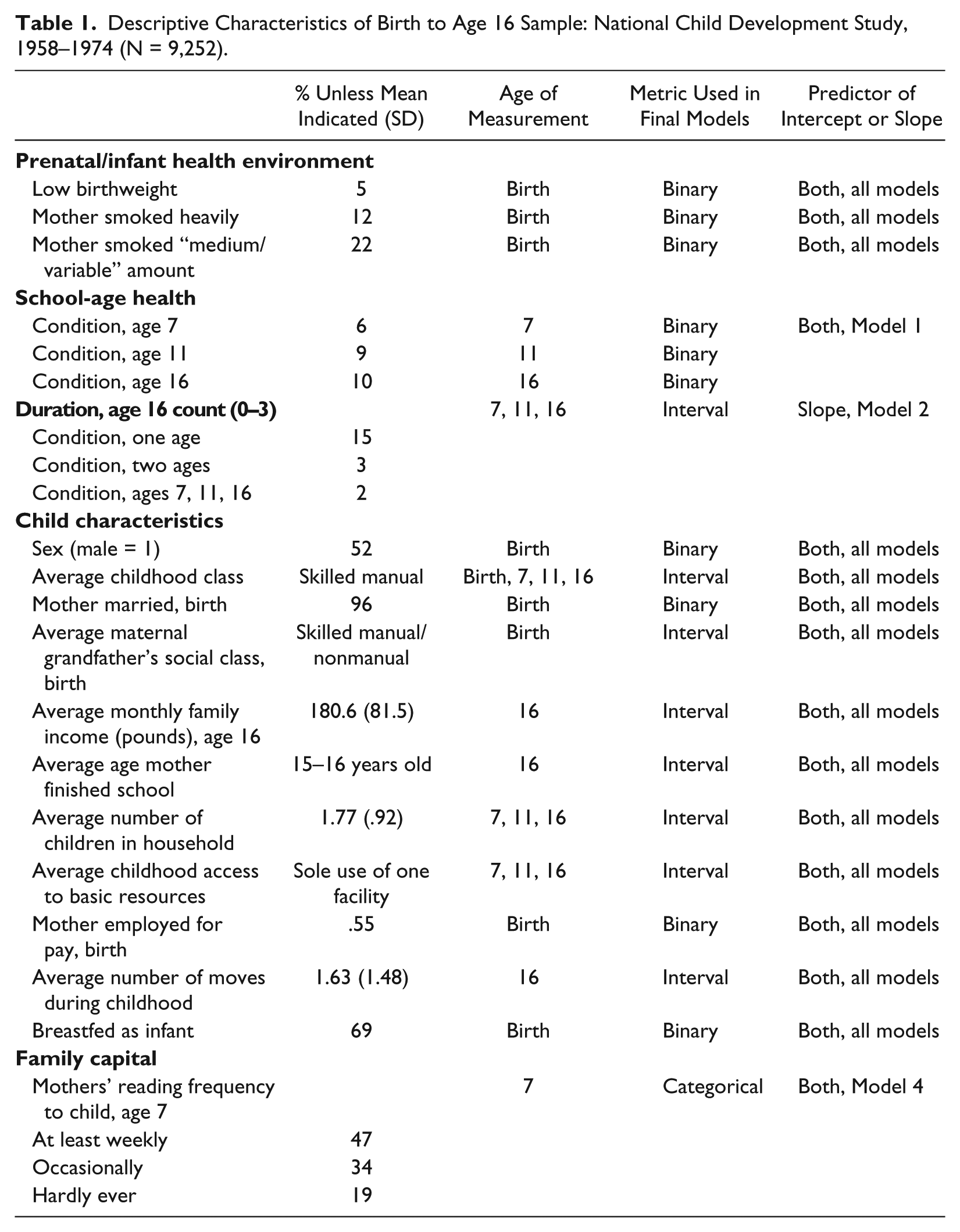
To measure school-age health I used physicians’ diagnoses of whether children have a physical or mental/emotional health condition at each age. Conditions, diagnosed during a medical exam, reflected a slight, moderate, or severe condition impeding normal functioning. Physical health conditions included systemic conditions (heart, respiratory, blood conditions), genetic conditions, and physical abnormalities (spinal or limb disfiguration). The most common physical health condition was asthma. A sensitivity analysis excluding children with physical abnormalities did not produce substantively different findings, so I included these children in the analytic sample. Mental health conditions included emotional and behavioral problems—I excluded children with mental retardation.
I used these measures in three ways: (1) to create age-specific measures of health, (2) to create a measure of the duration of poor health during the school years, and (3) to measure the duration and stability of poor health during the school years using a latent variable framework. First, age-specific measures of poor health indicated whether children have a physical or mental health condition at ages 7, 11, and 16. Second, I created a cumulative count measure of the duration of poor school-age health that differentiated among a health condition at no school ages, only one age, two ages, or ages 7, 11, and 16. The count measure ranged from 0 to 3 and used information from ages 7, 11, and 16. Children with a condition at multiple ages had a higher count score, though they did not necessarily have the same condition at each age. Because disaggregation into particular conditions was not possible, this measure could not identify the potentially different effects of a long duration of poor health due to one chronic condition or several conditions that lead to poor health at multiple ages. Third, I used the age-specific measures of health in a latent variable framework to provide a more dynamic measure that accounted for duration and stability—I describe this approach in greater detail in the methods section.
Table 1 shows that about 6% of children in the analytic sample had an age 7 health condition, with this number increasing gradually during childhood to 9% at age 11 and 10% at age 16. Examining the count measure of duration revealed that by age 16, 15% of children have experienced poor health during at least one age, 3% at two ages, and 2% at all ages. Sensitivity analyses separating physical and mental health conditions yielded very similar patterns, though I did not present these results because of small sample sizes.
Academic Achievement
The NCDS administered standardized reading and math achievement assessments to all children at ages 7, 11, and 16. I examined reading and math scores to indicate achievement rather than using assessments of cognitive ability. Achievement at age 7 was measured by scores on the Southgate Reading Test (word recognition and comprehension) and the Problem Arithmetic Test (Pringle, Butler, and Davie 1966; Southgate 1962). At ages 11 and 16, reading and math assessments were constructed specifically for the NCDS by the National Foundation for Education Research. Because the age 7 reading test was designed to be able to identify “backward” readers, about 20% of children at this age attained perfect scores. The distribution of scores on the age 7 math test and on the math and reading tests at ages 11 and 16 were very bell-shaped (also see Currie and Thomas 2001). Because of the unique design of the age 7 reading test, more attention should be paid to the results for math achievement. Analyses of both reading and math scores yielded highly similar results, however.
I used z-scores to measure performance relative to the sample mean at each age. Using standardized scores means that a flat trajectory reflects a child who consistently falls in the middle of the distribution and that growth patterns will reflect changes in a child’s position within the reading or math score distribution with age. This analytic approach is common (Cherlin, Chase-Lansdale, and McRae 1998; DiPrete and Jennings 2011).
Family Social Capital
To examine whether family capital moderates the influence of child health on academic achievement, I examined a measure of family social capital, specifically the frequency of mothers’ time spent reading to children at age seven. I created two categories: hardly ever/never/occasionally and at least weekly. Table 1 shows that 47% of mothers read to their child at least once weekly at age seven. 2
Other Childhood Characteristics
The NCDS permits measurement of many factors correlated with both children’s health and academic progress. I controlled for sex and region within the United Kingdom at birth (Wales, Scotland, and England—the reference category). The sample was overwhelmingly white (over 98%), making it unnecessary to control for race-ethnicity. For questions asked in multiple waves, after numerous sensitivity analyses I created within-child averages that used information from multiple waves, through age 16. 3 Table 1 lists the ages included in each within-child average as well as the metric for each variable in the final models. Father’s social/occupational class follows the registrar general’s class scheme and indicated employment in professional, intermediate, skilled nonmanual, skilled manual, partly skilled, or unskilled professions, as reported by the primary caregiver (usually the mother) at birth. I included maternal grandfather’s social class at birth as a measure of the child’s family background using the same measurement scheme. Because the results did not differ when father’s and grandfather’s social class was measured categorically versus quantitatively, I measured both variables quantitatively in the final models. Children’s access to basic resources in each year indicated sole access to hot water, a bathroom, and indoor lavatory (higher score equals less access). Binary variables measured mothers’ paid work outside of the home at birth and her marital status in 1958—the results were not sensitive to the inclusion of these measures at older ages or to including a more detailed measure of mothers’ employment status. I measured the number of children in the household at each wave, and the number of times each child moves between birth and age 16 (measured at age 16). Finally, I measured whether children were breastfed, given the correlation of this maternal behavior with prenatal/infant health and cognitive development. Analyses with and without breastfeeding did not produce different results, so I included this measure in the final models.
Table 1 shows that most mothers were married (96%) at the time of their child’s birth. The average social class of children’s fathers was a skilled manual position, and the average social class of maternal grandfathers at birth was a skilled manual/nonmanual position. On average, mothers and fathers finished school between ages 15 and 16. About half of mothers worked outside of the home during childhood, and most children experienced a residentially stable childhood environment (average of 1.63 moves).
Attrition and Missing Data
Like all longitudinal surveys, the NCDS has experienced attrition. Response rates are high, however, especially given the length of the panel. Of the 17,415 children in 1958, 14,647—about 84%—participated in any module at age 16 (1974), and I limited the sample to those present in all waves between birth and age 16 (over 9,200 children). If the unhealthiest children drop out over time, the remaining sample could be positively selected on health, and the observed influence of poor health on achievement may be downwardly biased. I examined differential attrition by health and socioeconomic status and found little evidence of a systematic pattern. Low birthweight children were more likely to drop out before age seven, but this pattern does not persist in subsequent waves or for maternal smoking during pregnancy or school-aged health. Attrition was also not systematically higher among children in socioeconomically disadvantaged families—though those who dropped out by age 16 were slightly more likely to be from disadvantaged backgrounds, measurable differences between the two groups are very small. These patterns of attrition were very similar to those reported in other research with these data (Case and Paxson 2005).
Rather than drop children missing information from a particular module within a wave, I used multiple imputation (five imputations, estimation via chained equations in Stata) to replace missing values on independent and dependent variables, based on predictions from the independent variables described previously (Allison 2002). Values were not imputed if a child is entirely missing from a wave.4
Analysis
I used latent growth curve models to examine the association of poor child health with reading and math trajectories. Growth curve models captured not only initial variation in achievement but also variation in achievement growth or decline over time within individuals (Bollen and Curran 2006). An individual-specific (i) intercept (α), linear time-specific (t) slope (β), and some error (ε) captured each child’s trajectory:

Growth models also allowed children’s trajectories to vary as a function of not only time but of covariates that vary across individuals:


In this study, x indicated children’s health, sociodemographic characteristics, and family capital. The metric for time was the survey wave. The intercepts and slopes for reading and math achievement were regressed on prenatal/infant health, school-age health, and sociodemographic/family measures in order to reveal group differences in the means of the growth factors. Table 1 lists the particular variables that predicted the intercept and slope in each model. This framework permitted a test of the first two hypotheses: (1) the influence of poor prenatal and infant health should become more negative—achievement disparities should compound—as children age, but (2) school-age health should have a less negative longer-term relationship with achievement than poor prenatal/infant health (Model 1). 5
To test the third hypothesis—when the duration of poor health is longer, or when health declines, the influence of school-age health on persistent academic inequality should be more negative than when poor health is transitory—I extended the analysis described previously to examine the duration and stability of poor health. First, to measure the duration of school-age health, I regressed achievement intercepts and slopes on the count measure whereby a condition at more ages increases the duration score (Model 2). Second, I used a latent variable framework to dynamically capture the stability of poor health (Model 3). Here, latent school-age health trajectories became predictors of latent achievement trajectories. This multivariate latent growth curve model, or “parallel process” model, captures propensity rather than absolute presence/absence of health at a particular age. Modeling health trajectories as predictors was therefore equivalent to modeling a change in the propensity for poor health. Because the metric for the latent variable underlying the observed dichotomous measures for poor health at each school age was assumed to be z-distributed, the units on both sides of the equation were standardized units (Bollen and Curran 2006). In order to provide an intuitive interpretation, I used the means and variances from each model’s normal distribution to compute 95th percentile bounds (
The final model tested the fourth hypothesis from cumulative inequality theory: (4) High levels of family capital weaken the negative influence of poor child health on early achievement disparities and achievement trajectories (Model 4). Here I interacted health (prenatal/infant, age 7 health, duration at ages 11 and 16) with family social capital—mothers’ time spent reading with young children—to test the moderating influence of family capital on academic trajectories. For ease of interpretation, I present these results using the count measure of duration, though results using latent duration/stability did not differ substantively. In all models, I relied on three common fit indices to guide model choice: the Comparative Fit Index (CFI), the Tucker-Lewis Index (TLI), and the root mean square error of approximation (RMSEA). An ideal fit for the CFI and TLI was 1 and for the RMSEA less than or equal to .05 (Bollen and Curran 2006).
Results
Early Health, Timing, and Cumulative Inequality in Academic Achievement
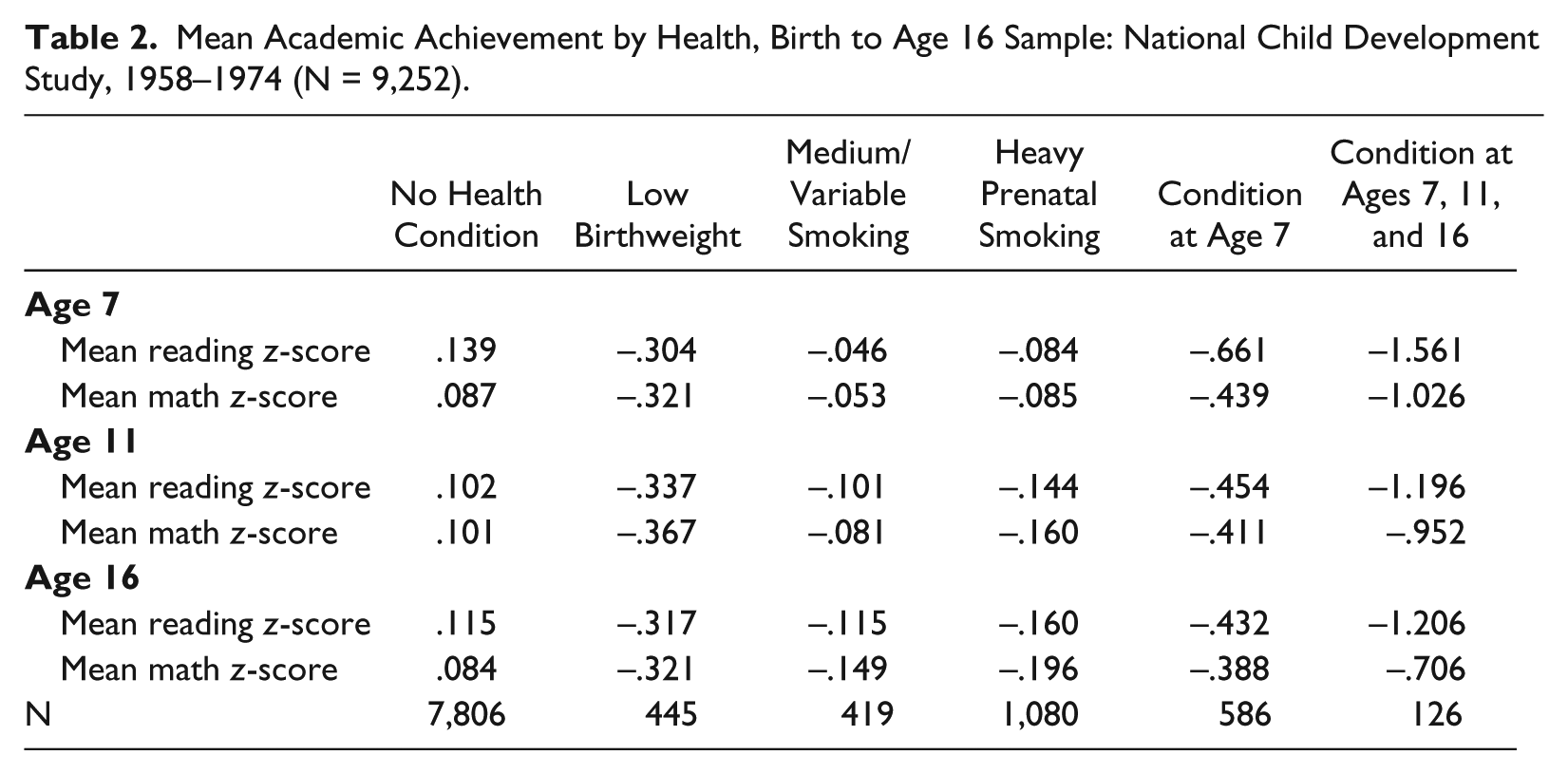
Table 2, which disaggregates average achievement by health status and age, reveals clear variation in reading and math achievement across health categories. Respondents with no childhood health conditions score highest on reading and math assessments at all ages. In contrast, low birthweight respondents, those exposed to heavy prenatal smoking late in utero, and those with early school-age health limitations perform more poorly, ranging from .10 to .5 of a standard deviation below average. Children with health conditions at all school ages perform nearly a full standard deviation lower in math and reading. 6
Mean Academic Achievement by Health, Birth to Age 16 Sample: National Child Development Study, 1958–1974 (N = 9,252).
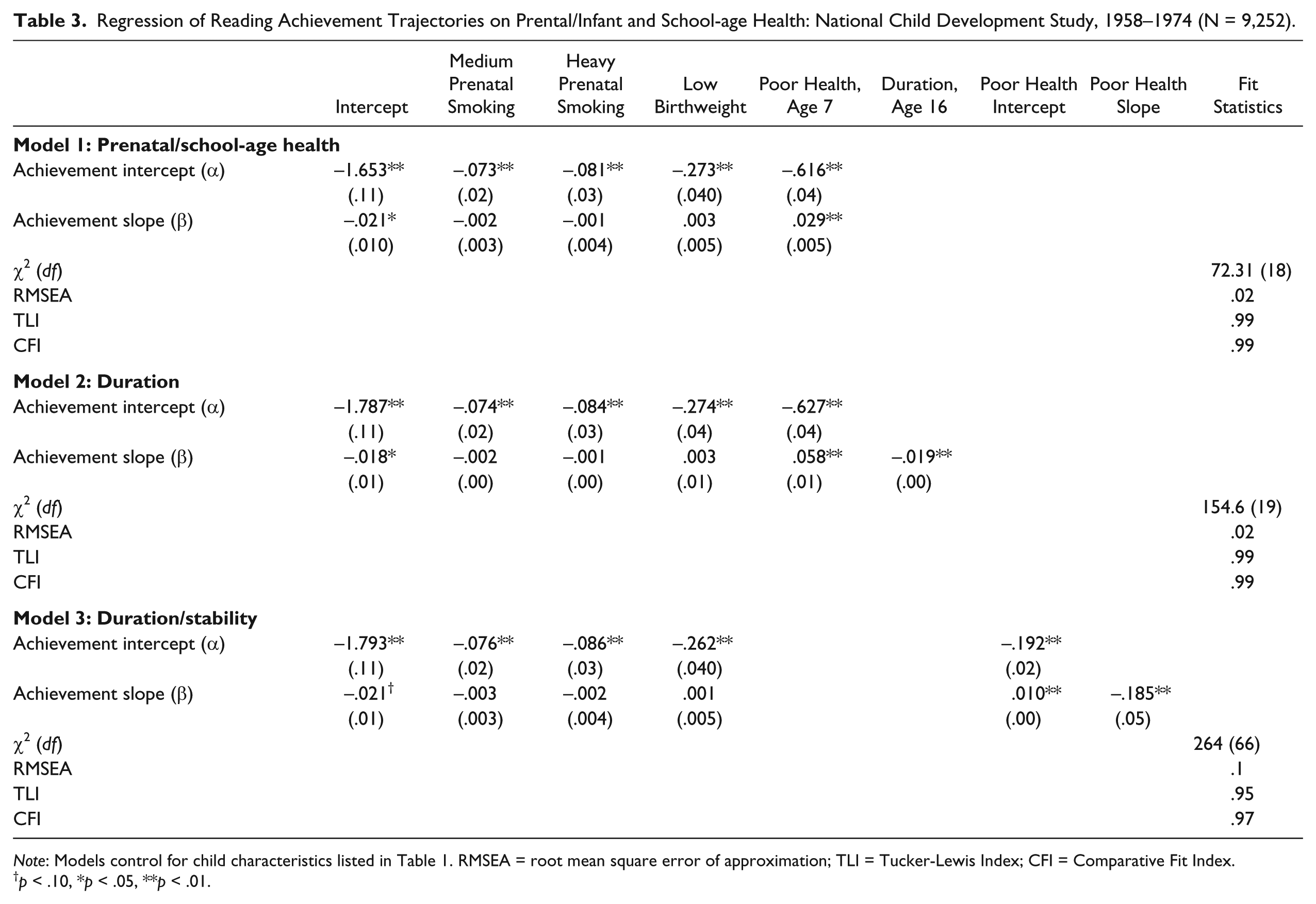
Next, I examine these trajectories within a multivariate framework. Tables 3 and 4 show the influence of prenatal/infant and school-age health on reading and math achievement trajectories, respectively, controlling for the child, family, and household characteristics in Table 1 (except for maternal reading behavior). Each panel shows the results for separate models, with primary independent variables listed across the columns. Within each panel, the achievement intercept row shows the relationship between each predictor and age 7 achievement, while the achievement slope row shows each predictor’s relationship to achievement trajectories between ages 7 and 16. The tables reveal first, that prenatal/infant health is related to age 7 achievement: Low birthweight is associated with significantly reduced reading and math achievement at age 7 (.273 and .304 z-score units, respectively), as is exposure to late prenatal smoking in medium and heavy amounts. Second, poor health at age 7 is related to significantly lower age 7 reading and math performance (.616 and .411 standardized units, respectively).
Regression of Reading Achievement Trajectories on Prental/Infant and School-age Health: National Child Development Study, 1958–1974 (N = 9,252).
Note: Models control for child characteristics listed in Table 1. RMSEA = root mean square error of approximation; TLI = Tucker-Lewis Index; CFI = Comparative Fit Index.
p < .10, *p < .05, **p < .01.
Regression of Math Achievement Trajectories on Prental/Infant and School-Age Health: National Child Development Survey, 1958–1974 (N = 9,252).

Note: Models control for child characteristics listed in Table 1. RMSEA = root mean square error of approximation; TLI = Tucker-Lewis Index; CFI = Comparative Fit Index.
p < .10, *p < .05, **p < .01.
Providing evidence for Hypotheses 1 and 2—whether child health is associated with persistent and accumulating academic disadvantage—requires examination of not only the latent intercepts (differences at age seven) but also the slopes. Model 1 in Table 4 shows that the association between prenatal smoking exposure and math trajectories is negative, at .006 z-score units/year for medium smoking exposure and .007 units/year for heavy smoking exposure. Although the direction of the relationship between smoking and reading trajectories is similar, it is not significant. Math achievement gaps stemming from low birthweight compound over time, but this is not the case for reading. Turning to school-age health, Model 1 in Tables 3 and 4 shows that the relative academic disadvantage associated with poor health at age seven is predicted to decline over the course of later childhood/adolescence—the reading and math achievement slopes become more positive over time (.029 and .021 z-scores per year, respectively), revealing that these children partially catch up as they age.
The magnitude of these relationships over time is easiest to visualize in the form of predicted values that depict trajectories for a child with otherwise average characteristics. Figures 1A and 1B display the predicted math and reading z-scores between ages 7 and 16, disaggregated by prenatal/infant health (prenatal smoking exposure and birthweight) and age 7 health—all other sample characteristics are held constant at their means. The graphs show the slightly widening inequalities in math achievement predicted from prenatal smoking exposure. A child not exposed to heavy smoking late in the mother’s pregnancy, with otherwise average characteristics, is predicted to perform significantly higher than a child with heavy exposure at age 7 and to increase in his or her relative math performance with age compared to a more stable predicted pattern of relative achievement for a similar peer exposed to heavy smoking. By age 16, the difference for this hypothetical child is expected to be almost .2 of a standard deviation.

Predicted Achievement Trajectories by Prenatal/Infant and School-Age Health.
In contrast, disaggregating by age seven health reveals a significantly lower level of math achievement at age seven for children in poor health (about .5 of a standard deviation) but a declining gap as children age. That is, an average child with a health condition is predicted to experience an improvement in relative math achievement compared to an otherwise similar but healthier peer. Overall, the findings in Tables 3 and 4 and Figure 1 provide some support for Hypotheses 1 and 2. An unhealthy prenatal health environment, indicated by exposure to smoking, is associated with early and growing achievement disadvantage, while early school-aged poor health is associated with early but stable or declining achievement disadvantage. The findings for low birthweight are consistent with the predictions of Hypothesis 1 for math but not reading.
The Duration and Stability of Poor Health
Next, I test a more nuanced prediction from cumulative inequality theory—academic trajectories are dependent on not only the timing of health disadvantage but also its duration and stability. Model 2 in Tables 3 and 4 presents findings using the count measure of duration that increases with poor health at multiple ages. Model 2 and Figures 2A and 2B show how a longer duration of poor health can alter the achievement trajectory that would otherwise be predicted from shorter-term poor health. Figure 2A shows that while children with a condition only at age 7 partially catch up to their healthier peers in reading achievement by age 16, this pattern is weaker for those with a health problem at both ages 7 and 11 and does not exist for those in poor health at ages 7, 11, and 16. Figure 2B shows a similar pattern for math achievement—children in poor health at all school ages do not catch up to their peers to the same degree as their peers with shorter-term poor health. By age 16, those in poor health at all ages perform about .7 and .5 standard deviations lower than their healthiest peers in reading and math achievement, respectively.
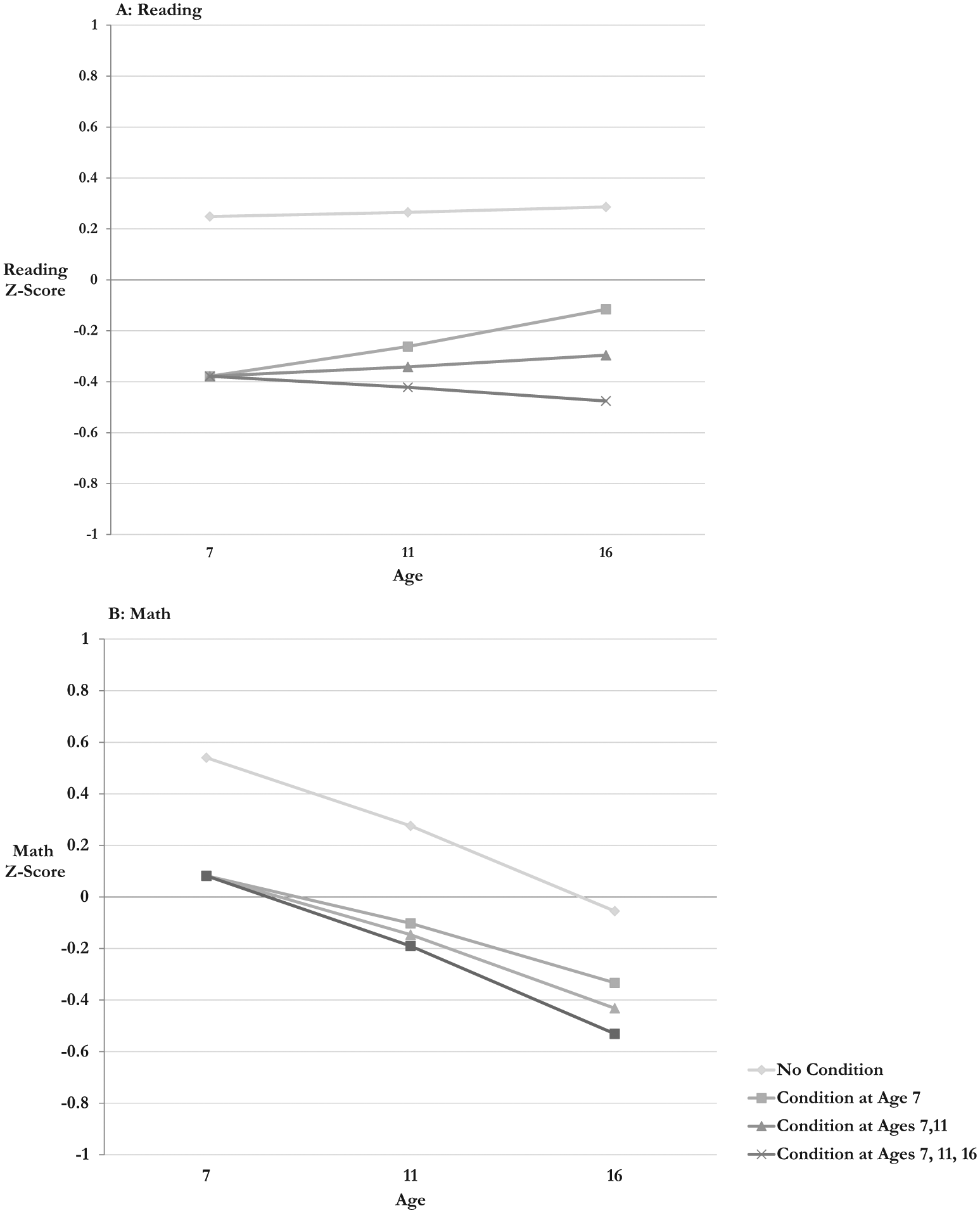
Predicted Achievement Trajectories by Duration.
Model 3 in Tables 3 and 4 presents complementary findings from an alternative measure of duration that better measures the stability and ordering of poor health. I examine how latent school-age health trajectories predict latent reading and math trajectories—this approach captures a change in the propensity for poor health during the school years rather than simply modeling the presence or absence of a condition at a particular age. Examining parallel trajectories of poor health and achievement reveals a strong relationship whereby a standardized unit increase in the propensity for poor health between ages 7 and 16 (“poor health slope”) is related to a significant annual reduction in reading and math z-scores (–.185 and –.154 reading and math standardized units, respectively).
A more intuitive interpretation is again permitted by examining predicted values. Using the models’ implied trajectories, I take the 95th percentile bounds from the latent variable’s normal distribution and compute implied trajectories for three groups of children—those who are continuously healthy (“low illness propensity,” those at the bottom of the distribution at each age), continuously unhealthy (“high illness propensity,” those who remain the high end of the distribution), and increasingly unhealthy (“low to high illness propensity,” those moving from the low to the high end of the distribution). Children’s other characteristics are again held constant at their means. Figures 3A and 3B show these predicted values for reading and math achievement. Figure 3A shows that a standard unit increase in the propensity for poor health is related to about a .185 z-score decrease in reading achievement per year: by age 16 this is predicted to result in a substantial decline in achievement (almost a full standard deviation) relative to a peer who is continuously healthy. Those in continuously poor health (high illness propensity) are predicted to remain steadily disadvantaged in reading achievement relative to their peers who experience the onset of poor health or who are continuously healthy. Figure 3B presents similar patterns for math achievement.
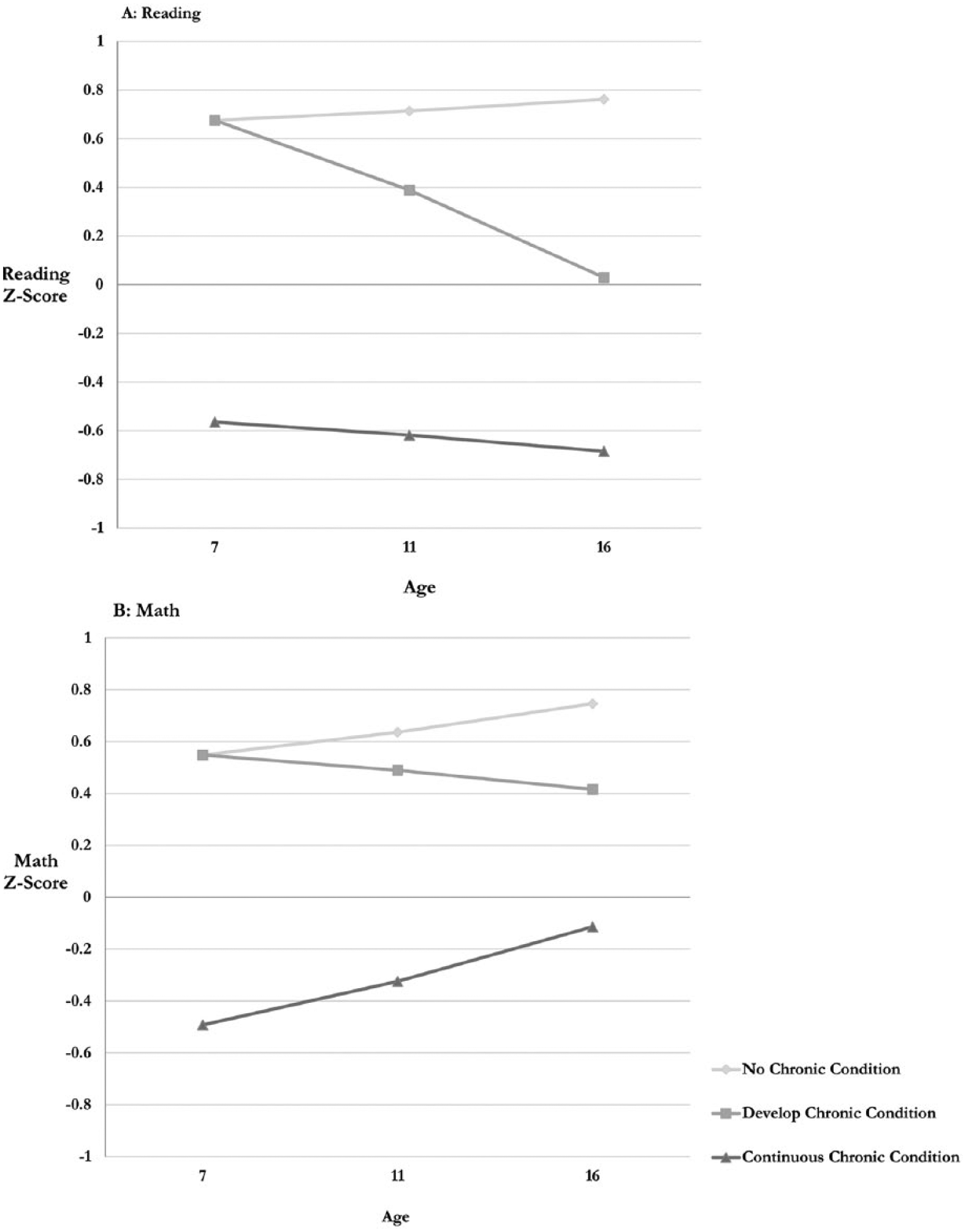
Predicted Achievement Trajectories by Latent Duration/Stability.
The findings summarized in Figures 2 and 3 are generally consistent with the predictions of Hypothesis 3 and provide evidence for the importance of duration and stability—when poor health spans multiple ages, or when health declines, its relationship with persistent academic inequality is more negative than when poor health is transitory. It is also worth noting that after measuring duration, prenatal smoking continues to be associated with early and growing achievement gaps, and poor health at age seven is associated with early but declining achievement disadvantage. In other words, the association of exposure to late prenatal smoking with academic trajectories may not simply reflect the tendency of unhealthy young children to become unhealthy adolescents.
The Moderating Influence of Family Capital
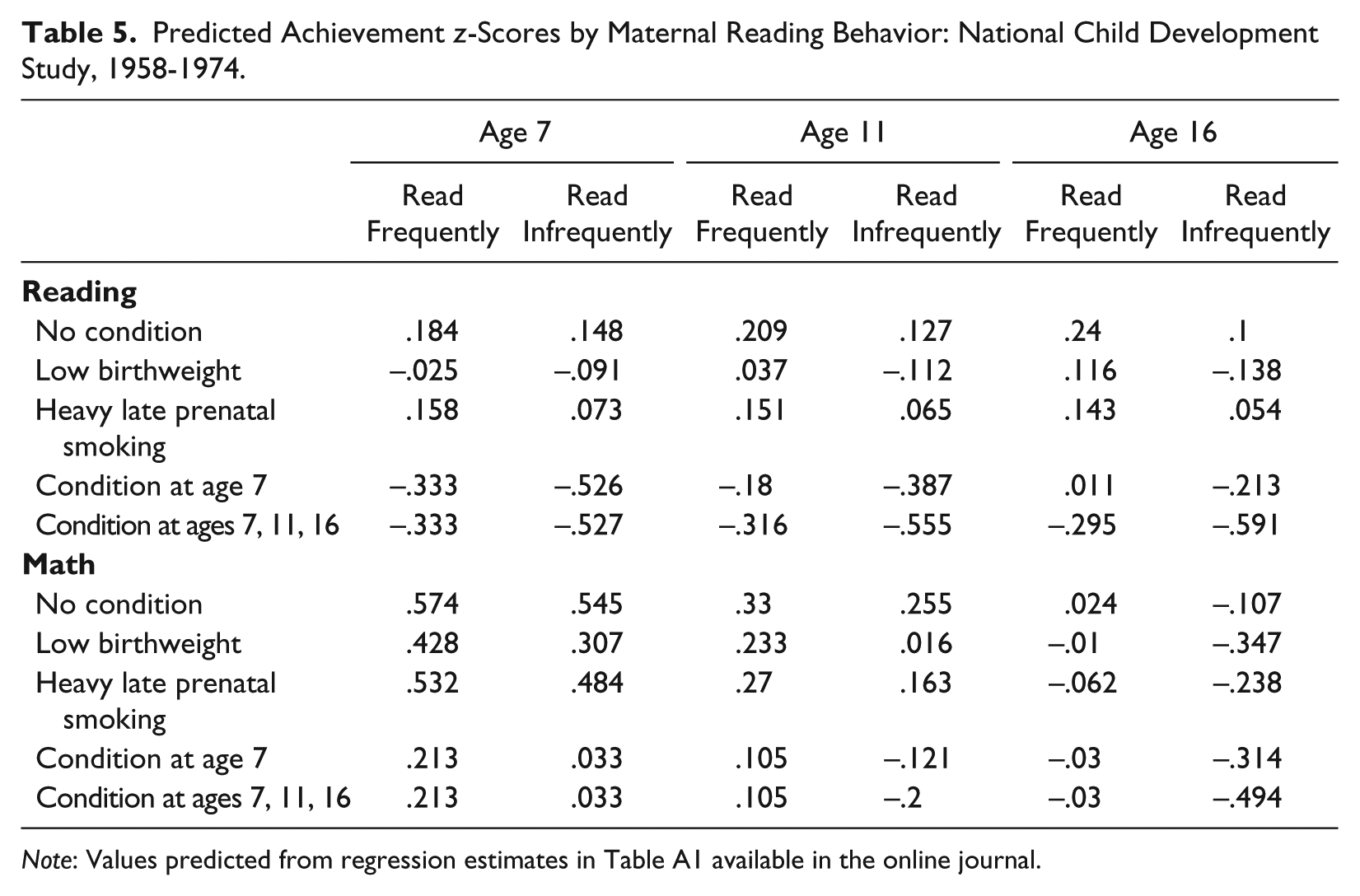
Finally, I examine the possibility that family capital buffers the negative influence of poor health on academic trajectories. I extend the findings in Tables 3 and 4 to test the moderating influence of family social capital—mothers’ time spent reading with children—on reading and math trajectories. Table 5 summarizes these findings in the form of predicted values, with the full findings reported in Table A1 available in the online journal (available at http://hsb.sagepub.com/supplemental). In line with the earlier analyses, children with no health conditions consistently achieve the highest reading and math scores. Moreover, consistent with the small body of existing research, there is little evidence that family capital moderates the influence of prenatal/infant health. Though children with unhealthy prenatal and infant environments have higher age seven achievement when they are in higher-capital families, these differences are small and derive from insignificant regression coefficients.
Predicted Achievement z-Scores by Maternal Reading Behavior: National Child Development Study, 1958-1974.
Note: Values predicted from regression estimates in Table A1 available in the online journal.
There is stronger evidence, however, that family capital partially compensates for the negative influence of poor school-age health on achievement and that this buffering is particularly pronounced in the early school years. Though they still lag behind their healthier peers, children in poor health at age seven whose mothers frequently spend time reading with them have stronger age seven reading and math achievement than their peers: .193 standard deviations (–.333 vs. –.526) for age seven reading achievement and .18 for math. These differences remain fairly stable during the remainder of the school years, suggesting that the compensatory influence of family capital may have a shorter-term impact on the degree of inequality in achievement. This is notable, though, since early academic learning provides a base for additional learning.
Additional Analyses
I perform several supplementary tests (not shown) to address the possibility that the observed influence of health may reflect unobserved differences in the quality of children’s environments as they age. First, I examine whether unhealthy parenting behaviors throughout childhood explain the academic influence of prenatal health environments and find that they do not. Controlling for health-related parenting behaviors later in childhood, including preventive doctor’s visits and parents’ immunization decisions, does not explain the influence of prenatal/infant health environments. Second, I estimate models with child fixed effects to examine whether changes in health predict changes in achievement, net of unobserved, time-invariant differences between children. A significant relationship remains in this analysis, suggesting that unobserved, time-invariant differences between children are not the sole driver of the association between child health and academic trajectories. In a related approach, I estimate a model that centers time-varying health and sociodemographic variables around their child-specific means. This model, which produces both within- and between-child estimates, generates coefficients for the cluster mean of school-age health (the proportion of ages at which a child has a health problem) and for the deviation of an age from the cluster mean of health. These two coefficients, respectively, compare different children with and without health problems and the effect of changing health status within a child over time. This multilevel model yields very similar findings for the direction and significance of the relationship between health and achievement: (1) For the “between-child” coefficient, children in poor health perform lower than their peers at age 16, and (2) for the “within-child” coefficient, children who acquire a health problem perform more poorly at age 16 than those who do not.
Discussion
Efforts to equalize educational opportunity among school-aged children have long been a priority in industrialized nations, motivated by the importance of educational attainment for social mobility. Adding complexity to this research and policy focus is the recognition that skill-based inequality emerges very early in the life course. From a convincing body of research we have learned how child health is an important determinant of early achievement inequality as well as eventual educational attainment and income. Here I argue that our understanding of the role of health in the social stratification process is enriched by testing several tenets of cumulative inequality theory: (1) that inequality accumulates as children age, (2) that the degree to which achievement gaps accumulate is specific to the developmental stage being considered, (3) that this process depends on the duration and stability of poor health, and (4) that children’s family resources play an important moderating role.
Informing the study of health and social stratification with insights from cumulative inequality theory reveals several findings that deepen our understanding of when and how health is related to the emergence of academic inequality. I find some evidence for the first two hypotheses: Low birthweight, prenatal smoking exposure, and poor school-aged health are negatively related to early academic achievement, and measured statically, poor school-age health is not associated with widening achievement inequality during the school years—its impact becomes less negative over time. In contrast, children exposed to late prenatal smoking increase their achievement at a slower pace relative to their otherwise similar peers who experience a healthier prenatal environment. These results are consistent with the idea that early life adversity negatively impacts life course processes and that the accumulation of inequality is tied to age-specific developmental processes. Health disadvantage occurring early in life, during key developmental periods, may produce large baseline inequalities in learning that compound as children age, whereby children lag behind their peers in successive learning. Because prenatal smoking and birthweight reflect both children’s and mothers’ environments, the results also suggest that cumulative inequality is tied to the intergenerational transmission of disadvantage.
The results also reveal the importance of the duration and stability of poor health for achievement trajectories. Though a static conceptualization of school-age health suggested only a short-term negative impact on achievement, measuring the duration and stability of poor school-age health highlights the more persistent impact of the accumulation of poor health on achievement trajectories. Children with a longer duration of poor health are less likely to catch up in academic performance to their healthier peers than children with shorter-term poor health. Moreover, the learning advantage that healthy children begin with early in the school years is predicted to decrease substantially by adolescence if they acquire conditions as they age. This finding suggests that children’s cumulative experience of poor health is important for understanding how academic—and subsequently, socioeconomic—inequality is generated.
Finally, testing whether family capital buffers the negative influence of poor child health on academic trajectories yields mixed findings. Children in poor health but with high levels of family capital—measured by mothers’ time reading with children—have stronger reading and math achievement in the early school years than their peers in the lower-capital group. It is important to note, however, that all children in poor health lag behind their healthier peers in achievement, regardless of family capital levels. That these differences remain stable during the remainder of the school years suggests that family capital may have a shorter-term impact but that family resources in the early school years may aid less healthy children in acquiring a stronger base for learning. It is notable that the compensatory role of family capital is weaker for children with unhealthy prenatal and infant exposures. On the surface, this finding suggests that it may be more difficult to compensate for adversity experienced very early in life. However, the magnitude of academic gaps stemming from unhealthy early exposures is also smaller than those related to poor school-age health.
The results from the measure of family capital used here should motivate future work examining a greater number of family resources that can be observed as children age. Parents may adjust their behaviors with children as they age, for example, in response to their performance and to the severity of their health conditions. When data permit, it will be useful to examine parents’ economic and educational behaviors toward children at more time points, including in the years prior to school entry, and to examine how these behaviors are sensitive to the accumulation of health conditions. Forms of capital outside of the family also merit consideration, as children encounter institutions beyond the family as they age, and the resources within these other contexts (e.g., schools) may provide important resources that can help children maintain strong performance despite a health condition.
The merits of the data and approach used here should be weighed against some limitations. First, these broad measures of school-age health do not isolate the influence of any particular condition. Error in the measurement of the true construct of “health” may produce an underestimated influence of health. Though I combine conditions to maximize sample size and maintain measurement consistency over time, in supplementary analyses, I separately analyze broad categories of mental and physical health and find that both domains have strong associations with achievement trajectories. Greater detail in the measurement of school-age health is certainly an important task for future research. Despite imperfect measurement, examining health longitudinally permits observation throughout the early life course, which is often not possible when examining a particular condition, and affords examination of cumulative inequality processes. Relatedly, while the results in this research offer improved measurement of duration and stability, many additional questions will merit examination as life course data beginning in childhood become increasingly available. For example, is the accumulation of new health conditions equivalent to the experience of one continual chronic condition?
Second, as with any statistical model applied to observational data, the empirical approach used here does not permit causal claims. Though I observe a rich set of individual, family, and household characteristics, these findings are upper-bound and potentially indirect estimates (though the imperfect measures of health used here may produce lower-bound estimates). For example, I cannot fully disentangle the effects of mothers’ prenatal smoking from those of mothers’ smoking during childhood. Though I control for mothers’ smoking during children’s adolescence, it is possible that the prenatal smoking coefficient partially reflects the influence of correlated behaviors during childhood that remain unmeasured in these data.
Finally, though not a limitation of the analysis, it is nonetheless useful to situate these findings in their historical context. A third of mothers in 1950s Britain smoked late in pregnancy, for example. This is not an anomaly, instead reflecting a particular historical context in which today’s strong socioeconomic and parenting gradients in smoking and health behaviors were far weaker. Though it is possible to speculate about implications for contemporary patterns in different climates of “healthy parenting,” these results may differ from what would be observed in contemporary Britain. The stronger socioeconomic gradients that are observed today in both health behaviors and parenting behavior related to cognitive development (e.g., Schaub 2010) suggest that in the contemporary United Kingdom and United States, parental behaviors are increasingly a marker for socioeconomic status. This could mean that a stronger compensatory role of family capital may be observed in more contemporary settings as parents with high-achieving children are increasingly those with the highest levels of capital. This possibility merits consideration in future work and will be increasingly possible as respondents in contemporary nationally representative surveys become old enough to be observed during the entirety of the school years. More generally, these results among members of the late “baby boom” generation in the United Kingdom may differ from what would be observed in other contexts and periods.
The study of child health and academic achievement is of central relevance to our understanding of educational inequality given increasing recognition of the early reproduction of educational and socioeconomic inequality, longstanding evidence documenting sensitive periods of child development for skill development and effective learning, and the demonstrated sensitivity of skill and achievement to unhealthy exposures and poor health. Models of cumulative inequality predict compounding group differences over time, emphasizing the ways in which the accumulation of inequality should be sensitive to timing and duration and the ways in which it may be reversible in favorable environmental circumstances. This analysis advances our understanding of health and social stratification by suggesting not only that the relationship between health and academic achievement emerges very early in life but that whether we observe contraction or widening of inequality as children age depends on how and when we measure their health and environments. Revealing how this relationship unfolds during the school years is essential for developing an understanding of when and how to intervene.
Footnotes
Acknowledgements
I greatly benefited from conversations with Dennis Hogan, Scott Lynch, Susan Short, and Michael White at various stages of this research.