



Abstract
Sleep is a restorative behavior essential for health. Poor sleep has been linked to adverse health outcomes among older adults; however, we know little about the social processes that affect sleep. Using innovative actigraphy data from the National Social Life, Health, and Aging Project (N = 727), we considered the role of marriage, positive marital relationship support, and negative marital relationship strain on older adults’ (ages 62–90) self-reported and actigraph-measured sleep characteristics. We found that married older adults had better actigraph-estimated but not self-reported sleep characteristics than the unmarried. However, among the married, those who reported more negative aspects of their marital relationship reported more insomnia symptoms, with the association reduced when psychosocial characteristics were added to the model. The married who reported more positive aspects of their marital relationship showed better actigraph-estimated sleep characteristics; taking characteristics of the physical and mental health and home environment into account reduced this association.
On average, people spend from one third to one fourth of the 24-hour day sleeping. Adequate sleep is vital for individual health and well-being (Cappuccio et al. 2009; Knuston et al. 2006; Mallon, Broman, and Hetta 2002; Phillips and Mannino 2007; Schwartz et al. 1998). While sleep is an important health behavior with dramatic consequences for health and functioning, it has received relatively little attention from social scientists. This appears to have changed recently; in a series of papers, Burgard and Ailshire show that those with strained family relationships report more sleep problems (Ailshire and Burgard 2012), and differences in family responsibilities generate substantial gender gaps in sleep outcomes, including reports of more interrupted sleep and longer self-report sleep duration in women (Burgard 2011; Burgard and Ailshire 2009, 2013).
While these studies offer considerable insights into the role of family in sleep, marriage has not been a focus. Since marital status and relationship quality are strongly associated with mental and physical health and health behaviors (Umberson et al. 2006; Waite 1995; Waite and Gallagher 2001), there is every reason to believe that they are associated with sleep. Furthermore, most prior studies pay little attention to the mechanisms through which family relationships influence sleep, and all used sleep characteristics as reported by the individual. Sleep is a multidimensional behavior, some aspects of which may not be captured in self-reports. Finally, many of the prior studies focus on adults younger than 65 (Ailshire and Burgard 2012; Arber, Bote, and Meadows 2009; Burgard 2011; Burgard and Ailshire 2013; Hale 2005; Hill, Burdette, and Hale 2009; Knudsen, Ducharme, and Roman 2007). Older adults compose 13% of the U.S. population, and the share is expected to rise to 19% by 2030 (Population Reference Bureau 2011). Sleep disorders and complaints about sleep are more common among older adults (Neikrug and Ancoli-Israel 2010), and poor sleep at older ages has been linked to many adverse cognitive and physical outcomes (Brassington, King, and Bliwise 2000; Faubel et al. 2009; Phillips and Mannino 2007). Understanding the social determinants of older adults’ sleep may also have practical significance in promoting the health and well-being of U.S. older adults.
This study investigates the role of marital status and relationship quality and sleep characteristics among older adults. As relatively few older adults are cohabiting (n = 25, 3.5% of the sample), we combine cohabitors with the married throughout and, for brevity, refer to them as “married.” This paper makes two unique contributions. First, we use sleep characteristics as measured by actigraphy (Lauderdale et al. 2014) in addition to self-assessments given in response to survey questions. Second, we theorize the processes through which marriage influences sleep and carefully consider characteristics that may mediate or confound the association between marital status, relationship quality, and characteristics of older adults’ sleep. Results from this study contribute to our understanding of the social context of health among older adults and to a broader conceptualization of the social nature of human sleep.
Background
An Introduction to Sleep
Sleep is a universal human behavior characterized by reduced consciousness and relatively suspended sensory activity of the body. All humans require sleep, which provides energy for the brain and for physical activities, although the physiological functions of sleep are not fully understood. Thus, sleep is one of the most important restorative behaviors for an individual’s health and well-being. While it seems intuitively obvious that sleep is essential to life, defining what constitutes a good night’s sleep is not straightforward. Sleep is a complicated behavior with multiple dimensions that include duration, consolidation, and restfulness. A good night’s sleep may mean adequate sleep time, few or no awakenings during the night, or feeling rested in the morning. While feeling rested requires self-evaluation, other sleep characteristics, such as duration and consolidation, are better obtained through direct assessments. Further, recent evidence suggests that characteristics of sleep as reported by the individual are not strongly associated with similar characteristics measured by actigraphy for that person (Chen et al., 2015). This suggests that a comprehensive evaluation of human sleep could be strengthened by investigation of people’s subjective evaluation of their sleep experience and external measurement of their sleep.
Sleep behaviors and outcomes often change with age. Complaints among older adults related to sleep are common, especially complaints about difficulty falling and staying asleep (Ancoli-Israel 2009). A community study of 9,000 adults age 65 or over found that nearly half of the respondents reported at least one insomnia symptom (Foley et al. 1995). The prevalence of sleep complaints at older ages may result from the biological aging process (Espiritu 2008; Pace-Schott and Spencer 2011; Vitiello 2006), the burden of physical illness at old ages (Foley et al. 2004), or changes in the social environment and relationships over the life course (Ailshire and Burgard 2012; Burgard 2011; Burgard and Ailshire 2013). However, because of the difficulty in measuring multiple dimensions of sleep in surveys, the vast majority of sleep research with direct assessments of sleep outcomes is clinic based, includes a nonrepresentative patient population, and collects sleep data in a clinical sleep laboratory. We thus know more about the role of the human aging process and physical illness in older adults’ sleep outcomes than about the effects of social conditions. While a few studies suggest that older adults’ sleep outcomes are influenced by social processes and environment (Zepelin, McDonald, and Zammit 1984; Wilcox and King 1999), our knowledge of the social correlates and determinants of sleep remains limited.
Social processes, however, do not directly affect sleep in most cases. They determine sleep via their influence on key proximate factors of sleep, which include the physical environment and individuals’ own physical and mental health status. Yet, relatively few prior studies have considered the roles of these proximate factors in linking social processes and sleep. Furthermore, we propose that social processes can affect multiple dimensions of sleep. Prior studies on health point to the powerful role of social factors in shaping various dimensions of the same health construct. For example, studies have found that social relationships influence self-perceived stress and objective assessment of stress by cortisol level (Kawachi and Berkman 2001; Seeman et al. 1994), although the strength of association varies. It is quite likely that marriage influences multiple aspects of sleep outcomes. However, since our purpose is to understand how marital status influences sleep in a general way instead of comparing different aspects of each dimension of sleep in the older population, we use “sleep” as an overarching concept in the discussion of our conceptual framework. In the following section, to better understand the role of marriage on older adults’ sleep, we mobilize theoretical perspectives on marriage and health to argue that marriage can exert powerful effects on proximate factors of sleep, which in turn affect sleep characteristics of older adults.
Theoretical Perspectives on Marriage and Sleep: The Resource Model
Marriage is a key social relationship that affects almost every aspect of individual well-being over the life course, including emotional and physical health. One theoretical perspective links the social institution of marriage to health through the resources it brings to the partners. The long-term commitment and shared fate that lie at the core of the marriage bargain—which is recognized socially, legally, and religiously—foster shared resources. In literature, the discussion of resources often distinguished material and time resources from social and emotional resources associated with marriage. Since these two types of resources appear to affect sleep through different mechanisms, we discuss them separately.
Material and Time Resources
Marriage brings material resources and time investments in each other. Thus, the married tend to gain greater financial well-being and companionship through increasing time in shared activities, such as eating, leisure activities, and sexuality, compared to the unmarried (Waite 1995; Waite and Gallagher 2001). The better material conditions of the married reduce exposure to many kinds of risks and stress and increase their ability to deal with stressful or unexpected events. Material resources tend to buffer against or decrease health consequences of unexpected events. Many of these benefits also accrue to cohabiting couples, although perhaps to a lesser extent (Waite and Gallagher 2001). Recent research has also pointed to the benefits of marriage for the order and cleanliness of the household through greater role clarity and specialization compared to other living arrangements (Cornwell 2014), suggesting a favorable physical environment as another resource that is available for married people.
The greater resources that tend to be available to the married can be deployed to achieve better physical and mental health, which may improve sleep outcomes. Married individuals have better physical health outcomes than the unmarried, including fewer chronic conditions and mobility limitations at midlife and lower levels of both depressive symptoms (Hughes and Waite 2009) and loneliness (Hawkley et al. 2008). Because many chronic diseases or conditions affect sleep quantity and quality, older adults with fewer medical problems are less likely to report insomnia symptoms (Foley et al. 2004). In addition, marriage reduces risky health behaviors. Having a spouse to look after you matters for health behaviors. Prior studies observe a reduction of excess alcohol consumption and tobacco use associated with marriage (Duncan, Wilkerson, and England 2006; Fleming, White, and Catalano 2010; Leonard and Rothbard 1999). Clinical and epidemiological studies indicate that regular alcohol abuse and smoking can disrupt sleep (Roehrs and Roth 2001; Zhang et al. 2006). The lower level of risky health behaviors may also lead to better physical outcomes at older ages, which in turn may promote better sleep. Taken together, the spousal relationship is expected to improve older adults’ sleep outcomes because the material and time resources it brings into the relationship promote better physical health and health-related behaviors.
Furthermore, the resource model suggests that the spousal relationship directly influences the housing environment in which older adults live. Married people tend to live in cleaner, quieter, tidier houses in better repair than the unmarried (Cornwell 2014). A disordered home environment can directly affect the residents’ sleep. In addition, married people are wealthier than the unmarried (Waite 1995; Wilmoth and Koso 2002) such that they tend to live in better neighborhoods. A large literature has documented the importance of neighborhood social conditions for individual health (Ross and Mirowsky 2001), including sleep (Hill et al. 2009). As such, the environment of the home itself and of the neighborhood in which it is situated may be an important mechanism through which marriage promotes better sleep.
Emotional and Social Resources
A second set of resources brought by marriage is emotional support and social integration. Aside from material, time, and physical resources, the better health outcomes of married people also come from the provision of a sense of companionship and belonging. Married people are much more likely to have a confidant than the unmarried and to have someone who listens to them and is concerned with their health and well-being. For a married man, this person is usually his wife (Umberson 1992). Being able to talk to another person about things that are bothering oneself reduces the effects of stress for both mental and physical health (Holt-Lunstadt, Birmingham, and Jones 2008; Thoits 2011). Because individuals’ social networks shrink with age, older adults often have relatively few confidants (McPherson, Smith-Lovin, and Brashears 2006; Schnittker 2007). Older adults are less close to their network members, on average, and have fewer nonprimary group ties than younger adults (Cornwell, Laumann, and Schumm 2008). Thus, older adults tend to be more dependent on their spouse or partner for social support and companionship, and reliance on marriage or marriage-related networks increases with age (Curran, McLanahan, and Knab 2003). As the primary focus of social relationships gradually shifts with age, spousal relationships play a vital role in providing instrumental and emotional support and a sense of social integration. In fact, a large literature has pointed to the importance of spousal relationships for the health of older adults (Warner and Kelley-Moore 2012). As for younger adults, those who are married or live with a partner are in general healthier and happier and live longer due in part to the emotional support and companionship that marriage provides (Hughes and Waite 2002; Lund et al. 2002; Michael et al. 2001; Sarwari et al. 1998).
The provision of emotional support makes marriage an important determinant of psychological well-being (Brown 2000; Gove, Hughes, and Style 1983; Kim and McKenry 2002), which in turn promotes good sleep at night. A spouse or partner also offers companionship, which tends to reduce feelings of loneliness, depressive symptoms, and social isolation (Hawkley et al. 2008). Clinical and epidemiological studies demonstrate that loneliness undermines sleep quality (Cacioppo et al. 2002; Kurina et al. 2011). The companionship provided by a spouse may support better sleep. Furthermore, a spouse or partner may provide emotional support, a sense of security, or information that buffers the effects of stressful events (Thoits 2011), which seems to be particularly the case for mental health outcomes (Pearlin and Johnson 1977). While a lack of sleep may contribute to depression, it is well documented that depression leads to sleep problems (Lopresti, Hood, and Drummond 2013). Additionally, given that insomnia is an important symptom of poor mental health (Harvey 2001), this may be an especially important pathway from marriage to sleep outcomes: marriage may affect sleep via its influence on psychological well-being and mental health. Finally, a high level of social integration is tied to greater social control, which can promote positive health behaviors as well as better sleep habits (Umberson 1987), which may also promote better sleep outcomes of older adults.
Theoretical Perspectives on Marriage and Sleep: The Stress Model
While being married tends to provide material and other resources, emotional support, and sense of social integration, all of which are important inputs to health, the quality of the relationship matters a great deal for both the resources and support available to the married and for their exposure to and recovery from stress. This leads to another theoretical perspective on marriage and health, the stress perspective, which points to the dark side of marriage. Poor-quality marriages produce less specialization, less investment, and less companionship and are themselves a source of stress due to conflict and demands, with consequences for immune function, illness, and self-rated health (Coyne and Delongis 1986; Levenson and Gottman 1985; Seeman 2000). In addition, a poor spousal relationship seems to interact with the aging process to accelerate the decline of self-rated health with age (Umberson et al. 2006) and to amplify the impact of physical illness and functional limitations on mental health (Bookwala and Franks 2005; Warner and Kelley-Moore 2012).
From this perspective, while marriage can promote better sleep outcomes, the effect is conditional on marital quality. A negative marital relationship could also undermine sleep through its influence on physical health, psychological well-being, and the household environment. Relational conflicts and demands represent a major source of stress and diminish mental as well as physical health. Poor marital quality is associated with anxiety and depression (Cascardi, Langhinrichsen, and Vivian 1992; Choi and Marks 2008). Being in a poor marital relationship also increases the chances of functional impairment, inflammation, injuries, and poor self-rated health (Cascardi et al. 1992; Choi and Marks 2008; Donoho, Crimmings, and Seeman 2013; Umberson et al. 2006). In addition, conflictual or stressful interactions between spouses may lead to household disorder and make the household environment generally less favorable. All these changes can damage sleep and reduce sleep quality. Moreover, some studies suggest that the negative aspect of social relationships may be more consequential than positive dimensions for individual health (Ailshire and Burgard 2012). Thus, we expect that the relationship strain and demands that accompany poor marital quality increase the chances of sleep disturbances and sleep problems.
These theoretical perspectives linking marriage and health point to the powerful but complex processes through which marital relationship and relationship quality can affect health. These processes, as we have argued, also affect older adults’ sleep characteristics and sleep quality. In summary, previous studies suggest that better marital quality will improve sleep and poor marriage quality will harm sleep. Since marital relationship can be a source of support or strain, these theoretical perspectives provide little guidance on the overall direction of the association between partnership status and sleep characteristics. Finally, given the strong evidence on the link between marriage and factors proximate to sleep, including physical health, psychological well-being, and the household environment, we expect that the associations between marital status, relationship quality, and sleep will be, to some extent, mediated or confounded by these factors. Figure 1 illustrates and summarizes these mechanisms. 1
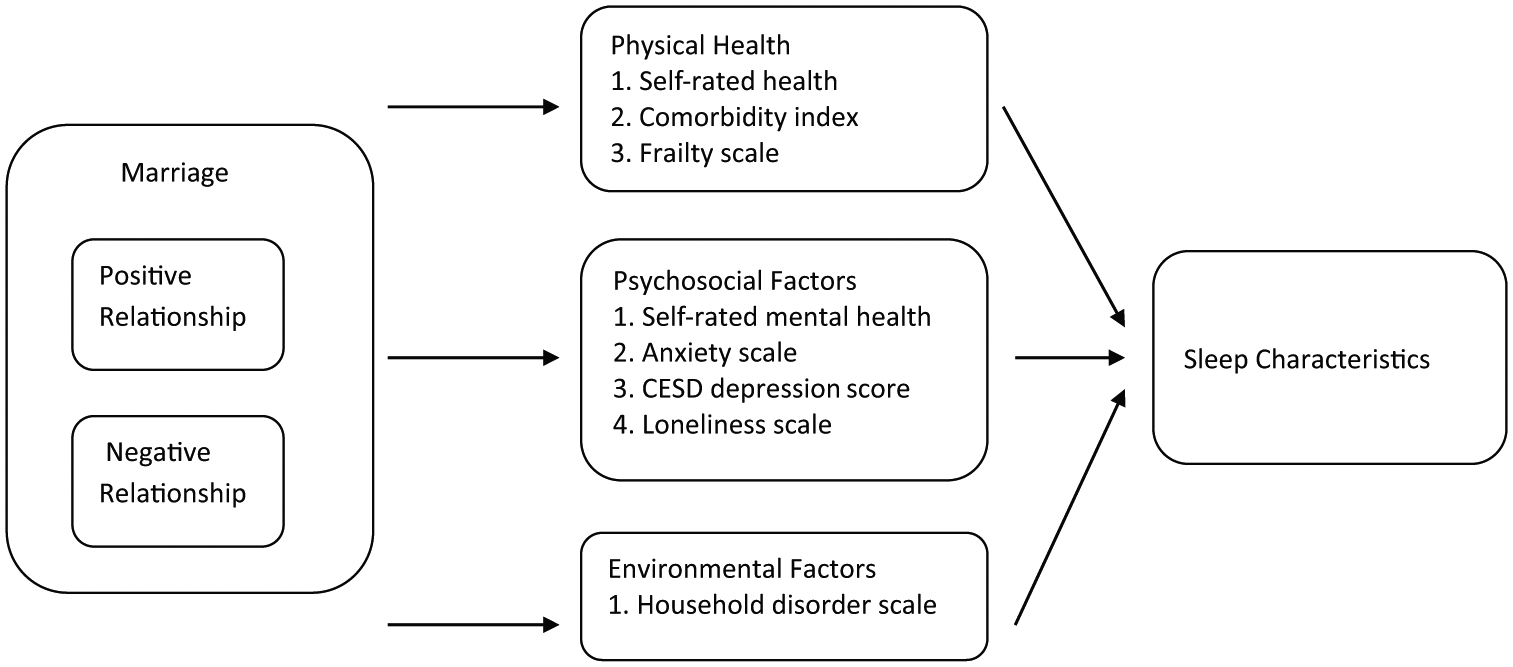
Proposed Pathway of Influence: Marriage to Sleep Characteristics.
Data and Methods
National Social Life, Health, and Aging Project (NSHAP)
NSHAP is a population-based, longitudinal study of health, social life, and well-being among older Americans (Waite et al. 2010). A nationally representative probability sample of community-dwelling individuals ages 57 to 85 was selected from households across the United States screened in 2004. African Americans, Latinos, men, and the oldest old (75–84 years at the time of screening) were oversampled. The first wave of data collection was conducted in 2005 to 2006, and the second wave was conducted in 2010 to 2011. The second wave of data collection also extended the sample to include the spouses and cohabiting partners of Wave 1 respondents. This yielded a total of 3,377 individuals (1,539 men and 1,838 women) with completed Wave 2 interview data.
The second wave of NSHAP included a new module on daytime activity and sleep, with a randomly selected one third of the primary respondents and their spouses. Of 1,117 selected individuals, 897 agreed (220 refused) to participate. A wrist actigraph and activity and sleep booklet then were mailed to each participant to collect information about the respondent’s sleep and activity levels over three full days (72 hours total). Eventually, 819 individuals completed this substudy, with usable actigraphy data obtained for 780. We exclude the 53 spouses or partners younger than 62 or older than 90 as not representative of U.S. older adults in our target age range, yielding a sample of 727 individuals ages 62 to 90. Detailed sociodemographic data on individuals were obtained from the Wave 2 master file and linked to the corresponding actigraphy data.
Measures
Self-reported Sleep Characteristics
Survey measures of sleep characteristics included self-reported hours of sleep and sleep quality. First, each respondent was asked to report his or her usual bedtime and wake-up time separately for weekdays and weekends: “What time do you usually go to bed and start trying to fall asleep?” and “What time do you usually wake up?” 2 Using this information, we calculated each respondent’s usual sleep duration for weekdays and weekends separately. Next, we multiplied weekday sleep duration by 5 and weekend sleep duration by 2 and divided by 7 to obtain an estimate of self-reported average weekly total sleep time. Second, NSHAP also included four questions on sleep quality, each asking about the frequency of a sleep characteristic. These four questions, drawn from the sleep questions module in the Health and Retirement Study (HRS), were “How often do you have trouble falling asleep?” “How often do you have trouble with waking up during the night?” “How often do you have trouble with waking up too early and not being able to fall asleep again?” and “How often do you feel really rested when you wake up in the morning?” Response categories for these questions were “most of the time” = 2, “sometimes” = 1, and “rarely or never” = 0. Factor analysis showed that these four items loaded onto a single factor. We created a troubled sleep scale, ranging from 0 to 8, by summing all items (after reverse coding the question about feeling really rested). We standardized the score based on our final sample. The troubled sleep scale has a Cronbach’s alpha of .66.
Actigraph-estimated Sleep Characteristics
NSHAP used actigraphy to measure sleep characteristics of respondents. Actigraphy is a valid and unobtrusive approach to measuring sleep without disrupting routine behavior; sleep characteristics measured by actigraphy are moderately to highly correlated with those measured by polysomnography (Ancoli-Israel et al. 2003; Blackwell et al. 2008). The Actiwatch (Philips/Respironics, Andover, MA) records intensity and frequency of movement using a piezoelectric linear accelerometer with 15-second epochs. The Actiwatch continually registers wrist movements, and the sum of all wrist movements during each 15-second epoch is saved as an activity score. Data from the Actiwatch were downloaded and analyzed using the manufacturer’s Actiware software Version 5.59 (Philips/Respironics 2010). In the present study, we focused on four actigraph-estimated sleep characteristics that have often been used in previous studies (Chen et al. 2015; Lauderdale et al. 2014): (1) total sleep time (defined as the total duration of all epochs scored as sleep within the major sleep interval, that is, the time from the first epoch scored as sleep to the last epoch scored as sleep for the primary sleep interval in each 24 hours); (2) percentage sleep (defined as the percentage of the sleep interval that is actual sleep); (3) sleep fragmentation index (ranging from 0 to 100), an indicator of sleep disruption that is the sum of two percentages: the percentage of the sleep interval spent moving and the percentage of immobile periods (i.e., contiguous epochs with no movement) that are no longer than one minute; and (4) wake after sleep onset (defined as the total minutes awake during the sleep interval). Percentage sleep, sleep fragmentation, and wake after sleep onset are sleep quality indicators as measured by the actigraph. For each of the actigraph-estimated sleep characteristics, we calculated an average value over three nights for each respondent.
Marital Status and Relationship Quality
Each respondent was asked whether he or she lived with a spouse or unmarried partner in the household. The answer was used to create a binary indicator of marital status. Since cohabitation was rare in this population (n = 25, 3.5%), we combine the cohabiting with the married and simply refer to them all as “married.” We also performed sensitivity analyses that omitted the cohabiting. We followed the approach developed by Warner and Kelley-Moore (2012) and modified by Galinsky and Waite (2014) to create two factor scales of marital quality. These two scales were derived from nine items. Each married respondent answered a series of questions assessing his or her marital relationship. These are (1) “How often can you open up to your spouse if you need to talk about your worries?” (2) “How often can you rely on your spouse for help if you have a problem?” (3) “How often does your spouse make too many demands on you?” (4) “How often does your spouse criticize you?” and (5) “How often does your spouse get on your nerves?” The four response categories ranged from hardly ever or “rarely” = 1 to “often” = 4.
In addition, all partnered or married respondents were asked (6) how close they felt their relationship with their spouse was, with answer options “not very close,” “somewhat close,” “very close,” and “extremely close;” (7) how happy their relationship with their spouse was, with answers ranging from “very unhappy” (coded as ‘1’) to “very happy” (coded as ‘7’); (8) how they liked to spend their free time, with options including “doing things together with the spouse,” “doing some things together,” and “doing things separately”; and (9) how emotionally satisfying they found their sexual relationship with their spouse or partner to be, with options of “extremely satisfied,” “very satisfied,” “moderately satisfied,” “slightly satisfied,” and “not at all satisfied” (Kim and Waite 2014).
To form relationship quality scales, we performed exploratory factor analysis, which loaded these nine items into two factors. We referred to the first factor as positive marital relationship (α = .68) and the second factor as negative marital relationship (α = .58). The positive relationship scale included six items: (1) rely on partner, (2) open up to partner, (3) relationship happiness, (4) relationship closeness, (5) emotional satisfaction, and (6) time with partner. The negative relationship scale included three items: (1) partner criticizing, (2) making demands, and (3) getting on nerves. Two factor scales were derived from the factor analysis.
Physical Health Indicators
We have included three indicators of older adults’ physical health: self-rated health, a modified Charlson comorbidity index, and a frailty scale. First, the self-rated health was assessed with the question, “Would you say your health is excellent, very good, good, fair, or poor?” We treated the variable as a continuous measure. Higher values indicated better health. Second, NSHAP included a wealth of information on respondents’ chronic conditions. During the interview, each participant was asked, “Has a medical doctor told you have (had) [condition]?” The list of conditions included heart attack/myocardial infarction, congestive heart failure, procedure for coronary artery disease, stroke/cerebrovascular disease, diabetes, leukemia/lymphoma, metastatic cancer, COPD/asthma, rheumatoid arthritis, and Alzheimer’s dementia or another form of dementia. These chronic conditions were combined into a modified Charlson comorbidity index following the procedure described by Vasilopoulos et al. (2014). The original Charlson comorbidity index was developed to assess the severity of comorbid conditions based on its power to predict mortality. Conditions that were associated with higher mortality were given more weights in the calculation of the index score (Charlson et al. 1987). The index can be produced by review of medical record or questionnaire. The questionnaire version of the Charlson index is highly correlated with the medical record–based version and allows for the assessment of the comorbidity of the general population of older adults (Katz et al. 1996). Our modified index ranged from 0 to 16. Higher values indicated more serious conditions with higher mortality risk. Finally, there are several functional assessments in the NSHAP survey. Respondents were asked how often over the past week they felt (a) everything was an effort and (b) they could not get going. Response categories included “rarely/none of the time,” “some of the time,” “occasionally,” and “most of the time.” Respondents who answered “occasionally” or “most of the time” to at least one of the questions were coded as having exhaustion. Respondents were also asked to report their frequency of participation in vigorous activity or exercise (defined as 30 minutes or more of sports, exercise classes, or physical labor). Answer choices included “five or more times per week,” “three or four times per week,” “one to two times per week,” “one to three times per month,” “less than one time per month,” and “never.” Respondents were considered as low physical activity if they reported “one to three times per month,” “less than one time per month,” or “never.” In addition to the two survey questions, NHSAP included two direct assessments of respondents’ functional status: gait speed assessment and chair stand assessment. Detailed information of these two tests was described elsewhere (Huisingh-Scheetz et al. 2014). Drawing information from these survey questions and assessments, we created a four-point frailty scale (Huisingh-Scheetz et al. 2014). Higher scores indicated a greater level of frailty.
Psychosocial Factors
The present study focused on four psychosocial factors: self-rated mental health, anxiety, depressive symptoms, and loneliness (Payne et al. 2014). First, respondents were asked to rate their mental health as “excellent,” “very good,” “good,” “fair,” or “poor.” We treated this as a continuous variable, recoding it so that higher values indicated better mental health. Second, NSHAP included seven anxiety items from the Hospital Anxiety and Depression Scale (Zigmond and Snaith 1983). Higher values indicated high level of anxiety. Next, NSHAP included a shortened version of the Center for Epidemiologic Studies Depression Scale (CESD-10). The CESD-10 score ranges from 0 to 30 and is a widely used instrument for the identification of major depression in older adults (Irwin, Artim, and Oxman 1999). Finally, NSHAP included items from the short loneliness scale developed by Hughes et al. (2004). Detailed analysis of these scales can be found in a recent study by Payne et al. (2014).
Household Environment
Last, we included an indicator of household disorder. At the end of the interview, every interviewer was instructed to rate the respondent’s housing conditions on the following dimensions: cleanliness, neatness and tidiness, noise, spaciousness, clutter, and odor. Ratings ranged from 1 to 5 for each dimension. We constructed a household disorder scale by summing all these items (positive items were reverse coded). This scale is a modified version of household disorder scale developed by Cornwell (2014) and has high reliability.
Other Covariates
Respondent’s education was categorized as less than high school, high school or equivalent, some college education, or bachelor’s degree or higher. Race-ethnicity distinguished white, African American, Hispanic, and other. A dichotomous variable indicated whether the respondent was retired at the time of the interview. Log household income and log household assets were used as indicators of respondents’ economic standing. We also controlled for gender and age. 3
Analytic Strategy
We began with weighted descriptive statistics of older adults in the NSHAP sample. Next, we examined the relationship between marital status, relationship quality, and sleep characteristics adjusted for social and demographic characteristics using survey weighted ordinary least square regressions and clustered by families to account for the nesting of individuals within households. Because members of the same household (in this case, a husband and a wife) influence each other, this might violate the assumption of independent observations in traditional linear models, which results in underestimation of standard errors. However, multilevel models were not ideal for NSHAP data for two main reasons. First, NSHAP data are not multilevel by design. Household is not a unit in the sample selection process. In the second wave, the survey team sampled eligible older adults, and if the selected respondent lived with a spouse or a partner, he or she was also invited to participate in the survey. As such, NSHAP did not have weights for households. Furthermore, since the sampling unit was individuals, not households, the average number of Level 1 observations per Level 2 unit was very small. Here we had 727 older adults residing in 585 households. This resulted in an average of only 1.2 observations per household, leading to “data sparseness” when fitting the multilevel model. The problem of data sparseness can lead to overestimation of standard errors and reduce the ability to detect significant associations between explanatory variables and outcome variables (Clarke 2008; Clarke and Weaton 2007). Because of these issues, instead of fitting the data using multilevel models, we employed survey weighted least square regression models with clustering by households.
We performed two sets of analyses. The first set assessed the associations between marital status and self-reported and actigraph-estimated sleep characteristics. The second set of analyses examined the associations between relationship quality (as measured by positive relationship and negative relationship scales) and sleep characteristics among those married or partnered. We used multiple imputation to account for potential biases resulting from missing data in the control variables and mediators. Multiple imputation involved replacing missing values with predictions based on other observed variables using Monte Carlo techniques (Rubin 1987). In contrast to single imputation, which replaces each missing value with a predicted value, multiple imputation replaces several missing values with repeated imputations using available covariates, creating several complete data sets. The combined results produced better estimates of the missing values that created uncertainty around the missing data (Allison 2001; Hawkley et al. 2014). All regression analyses were survey weighted using Stata 13 (StataCorp 2011).
Results
Descriptive Statistics
Table 1 presents weighted descriptive statistics. The first column shows the descriptive statistics for 727 respondents. About 54% of the sample were female. The average age was 72. A majority of respondents were white (83%), were retired (74%), and had at least a high school level of education (86%). The respondents had a median household income of approximately $40,000 and median household assets of approximately $250,000. The great majority of respondents reported their physical and mental health as good, very good, or excellent.
Weighted Descriptive Statistics: National Social Life, Health, and Aging Project, 2010 to 2011 (N = 727).
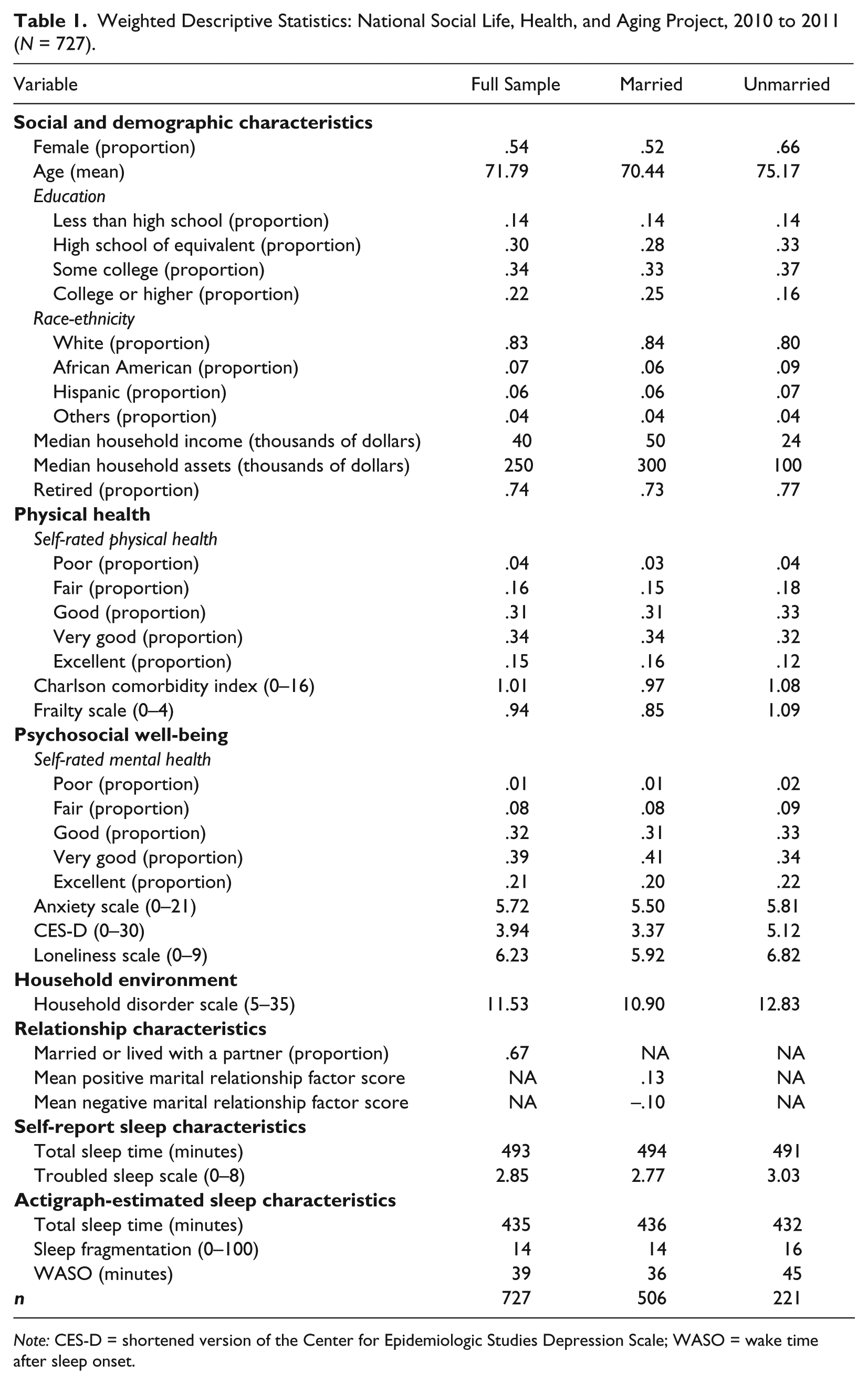
Note: CES-D = shortened version of the Center for Epidemiologic Studies Depression Scale; WASO = wake time after sleep onset.
On average, respondents reported bedtimes and wake times that produced a usual total sleep time of 493 minutes (or 8.27 hours). The mean troubled sleep scale score was 2.85 on a scale from 0 to 8. Turning to the actigraph-estimated sleep characteristics, we found the average sleep duration was 435 minutes (or 7.25 hours), respondents spent 82% of the sleep interval asleep (percentage sleep), the average wake time after sleep onset was 39 minutes, and the mean sleep fragmentation index was 14 on a scale from 0 to 100. Two thirds of respondents were currently married or living with a partner. Among those married or living with a partner, the average factor score of positive relationship quality was .13 and of negative relationship quality was -.10.
The second and third columns show descriptive statistics for the married and unmarried samples in the actigraphy substudy. The married sample is younger, with a higher proportion of males, a higher proportion of college graduates, and a lower mean score on the frailty index. Differences between the samples in health are modest, and differences in income and assets can be accounted for by household size. The married sample shows lower scores on scales of anxiety, depressive symptoms, loneliness, and household disorder. Differences in sleep characteristics are small to moderate. The married also show higher median income and household assets.
Marital Status, Relationship Quality, and Sleep
Table 2 presents results of regressions of self-reported sleep characteristics on being married versus not married. The first model includes marital status and controls for all previously described demographic variables. The second model adds the three sets of mediators: physical health and health behaviors, psychological health, and characteristics of the household environment. Our estimates show that being married is associated with self-reported sleep duration but not associated with the troubled sleep scale. Adding demographic variables and mediators does not change the results. Married older adults report longer sleep duration but not better sleep quality. Similar to prior studies using samples of young adults, we found that marriage correlates significantly with self-report sleep duration, and the association became insignificant with the inclusion of proximate factors; nevertheless, we did not find the significant association between being married and better sleep quality, as has been reported in prior studies of younger adults (Arber et al. 2009; Hale 2005).
Effects of Marital Status on Self-report Sleep Characteristics: National Social Life, Health, and Aging Project, 2010 to 2011 (N = 727).

Note: Figures shown are coefficients with standard errors in parentheses. All regressions were survey weighted and clustered by households. WASO = wake time after sleep onset; CES-D = shortened version of the Center for Epidemiologic Studies Depression Scale.
p < .10, *p < .05, **p < .01, ***p < .001 (for two-tailed test).
Table 3 presents estimates of the associations between marital status and actigraphic sleep measures. Associations for these actigraphic measures were stronger: married individuals had longer total sleep time and less time awake after sleep onset than the unmarried. Here we found significant associations for both sleep duration and sleep quality. The associations were statistically significant after the inclusion of demographic variables. While marital status was not associated with better self-reported sleep quality, those with a spouse or partner actually had longer total sleep time and better sleep quality as indicated by actigraphic measures. However, the patterns remained almost unchanged after the inclusion of the series of mediators. There was little statistical evidence that the relationship between marital status and sleep characteristics measured by actigraph was mediated by physical health, psychological well-being, or the household environment.
Effects of Marital Status on Actigraphic Sleep Characteristics: National Social Life, Health, and Aging Project, 2010 to 2011 (N = 727).
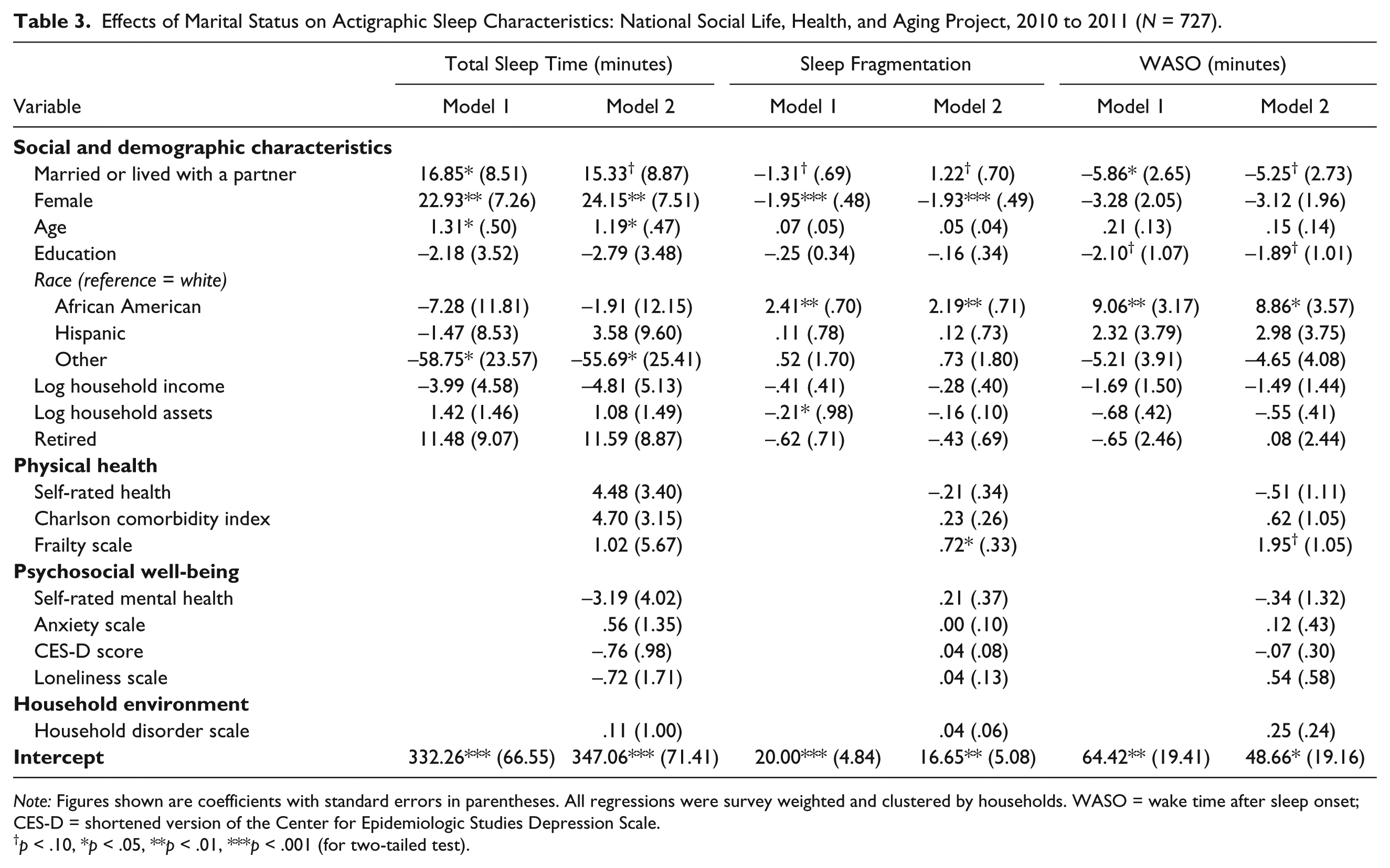
Note: Figures shown are coefficients with standard errors in parentheses. All regressions were survey weighted and clustered by households. WASO = wake time after sleep onset; CES-D = shortened version of the Center for Epidemiologic Studies Depression Scale.
p < .10, *p < .05, **p < .01, ***p < .001 (for two-tailed test).
We turn next to the association of relationship quality and sleep characteristics among those with a spouse or a partner. Table 4 and Table 5 present the results. As Table 4 shows, neither positive relationship quality nor negative relationship quality was associated with self-reported sleep time. Yet, we observed some interesting patterns for self-report sleep quality. Married older adults who reported more negative aspects of their relationship showed higher scores on the troubled sleep scale. This is consistent with the stress model of the relationship between marriage and health, in which poor marital quality is a source of stress, which interferes with sleep. Psychosocial characteristics—particularly, self-rated mental health, depression, and loneliness—explained this result. This result is consistent with the emotional support perspective on marriage and health. However, positive relationship quality showed no association with scores on the troubled sleep scale. Thus, among married older adults, negative features of the marital relationship were more consequential than positive aspects for self-reported sleep quality, and the association between negative relationship quality and the troubled sleep scale was attenuated when measures of psychosocial well-being were added to the model.
Effects of Relationship Quality on Self-report Sleep Characteristics among Married and Partnered Older Adults: National Social Life, Health, and Aging Project, 2010 to 2011 (N = 506).

Note: Figures shown are coefficients with standard errors in parentheses. All regressions were survey weighted and clustered by households. CES-D = shortened version of the Center for Epidemiologic Studies Depression Scale.
p < .10, *p < .05, **p < .01, ***p < .001 (for two-tailed test).
Effects of Relationship Quality on Actigraphic Sleep Characteristics among Married and Partnered Older Adults: National Social Life, Health, and Aging Project, 2010 to 2011 (N = 506).
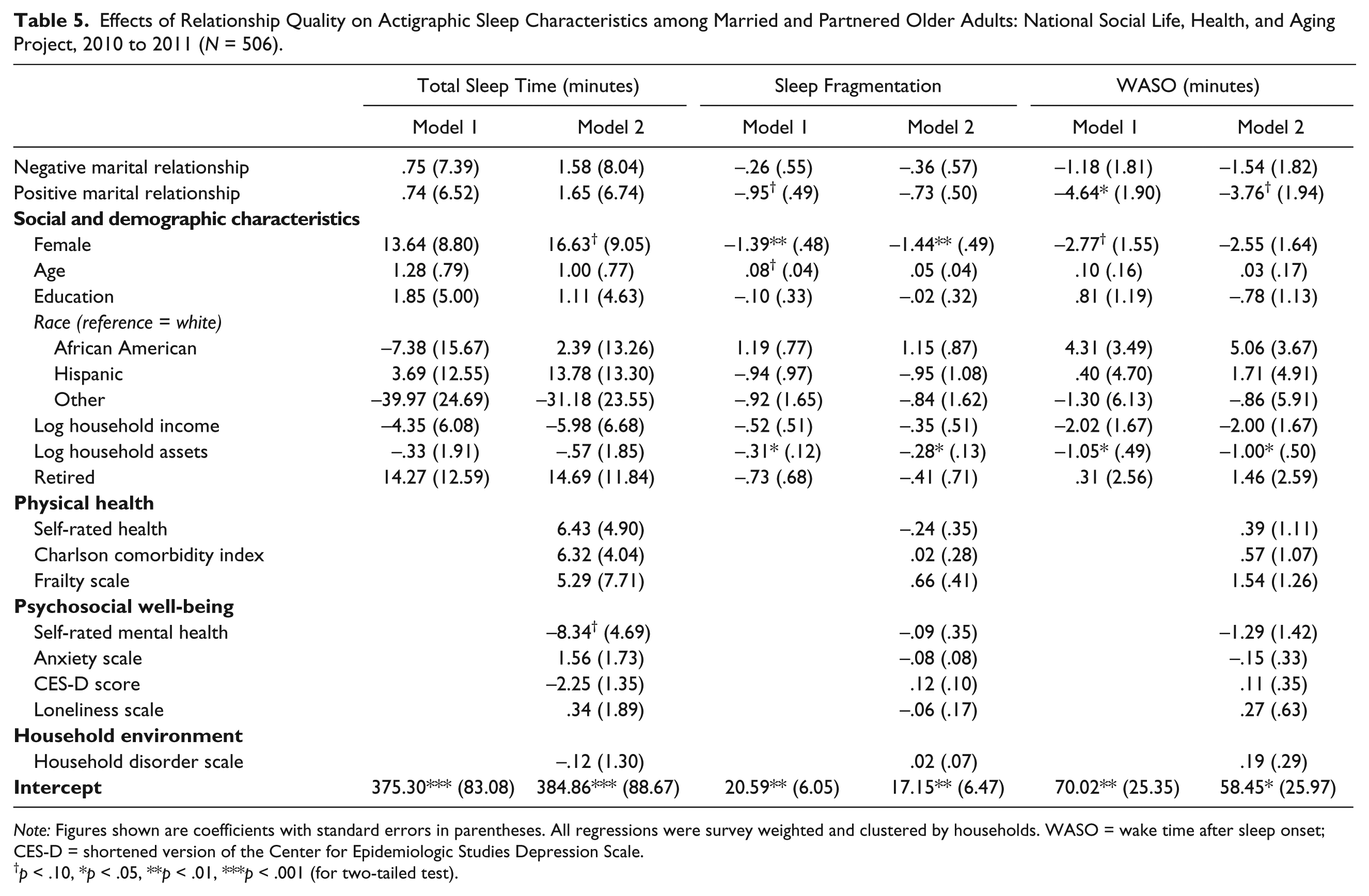
Note: Figures shown are coefficients with standard errors in parentheses. All regressions were survey weighted and clustered by households. WASO = wake time after sleep onset; CES-D = shortened version of the Center for Epidemiologic Studies Depression Scale.
p < .10, *p < .05, **p < .01, ***p < .001 (for two-tailed test).
Turning to actigraph-estimated sleep characteristics (Table 5), we observe different patterns. First, although we hypothesized a negative effect of poor marital relationship on sleep outcomes, our estimates showed no statistically significant associations between the negative relationship quality scale and actigraph-estimated sleep characteristics. A poor marital relationship did not appear to compromise sleep time or sleep quality. Second, as expected, positive relationship quality was associated with more favorable sleep outcomes. Specifically, those who reported higher levels of spousal support also showed less sleep fragmentation and lower levels of wake time after sleep onset. Third, the significant association between relationship support and wake time after sleep onset was partially explained by the mediators. Spousal support remained negatively associated with wake time after sleep onset after physical health, psychosocial characteristics, and the household environment were taken into account. However, the association between positive relationship and sleep fragmentation was substantially reduced with the inclusion of proximate factors, particularly, home environment. This is consistent with the model of marriage and health in which financial resources and the spousal relationship facilitate household order. Taken together, these findings suggest that negative aspects of the relationship are more consequential for subjective sleep quality than are positive features among partnered older adults. For sleep quality measured by actigraphy, we observed the opposite: positive relationship quality is more influential than negative relationship quality. Thus, relationship quality seems to influence perceptions of sleep problems and actigraph-measured sleep quality in quite different ways.
Additional Analysis
We included positive and negative aspects of marital relationships in the same models. We replicated all models with positive relationship quality but not negative aspects, and with negative relationship quality but not positive aspects, because of the correlation between them. Coefficients of these measures were relatively unchanged, suggesting that both dimensions of marital quality have independent effects on older adults’ sleep. Finally, a few prior epidemiologic studies suggest that long sleep duration or short duration are risk factors for poor health and mortality. 4 As such, the relationship between marital status and relationship quality and total sleep time may be U shaped rather than linear. To address this issue, we first transformed self-reported and actigraph-estimated total sleep time into ordinal variables with three categories: short sleep duration, intermediate sleep duration, and long sleep duration. We then used multinomial logistic regression to examine the association of marital status and relationship quality with the odds of short sleep duration and long sleep duration and found no association for either marital status or the relationship quality measures for either self-reported or actigraph-estimated measured sleep duration.
Discussion and Conclusion
This study provides an examination of the links between marital status, relationship quality, and measures of multiple dimensions of sleep—both subjective experience of sleep and direct assessment of sleep characteristics using actigraphy—in a nationally representative population of older adults. While sleep is a universal health behavior, the effect of the social world on the quantity and quality of sleep is too often overlooked. The innovative design of NSHAP allows for an in-depth investigation of the association between marital relationships and multiple dimensions of sleep characteristics at older ages. The present study adds actigraph-measured characteristics of sleep in a nationally representative population of older adults to the prior literature that has focused mostly on survey reports about sleep among younger adults.
Motivated by theories and prior studies of marriage and health, we explored several research questions. First, we asked whether marriage is associated with sleep outcomes among older adults. Second, we asked whether positive aspects of the marital relationship were associated with more optimal sleep outcomes and whether negative aspects of the marital relationship undermine sleep. Finally, we also examined whether the associations of marriage and relationship quality with sleep were reduced by the addition of important proximate factors, including physical health, psychosocial well-being, and the household environment.
We found that older adults with spouses or partners had, on average, longer sleep duration and better sleep quality than those without. The associations might be explained by the theoretical models we discussed earlier, in particular, the resource model; however, the associations were observed only for actigraph-measured sleep characteristics. More specifically, the married showed longer total sleep time, less sleep fragmentation, and less wake time after sleep onset than the unmarried but did not differ in the self-assessments of their sleep. Further, the proposed proximate factors explained only a small proportion of the association between marriage and better actigraph-measured sleep outcomes. Hence, while we found positive associations between marriage and sleep, we found no strong evidence that this association worked through the proximate factors we considered.
We also found that among married older adults, reports of troubled sleep were more prevalent among those with higher negative relationship quality but were not less prevalent among those in more positive and supportive relationships. Yet, for actigraph-measured sleep outcomes, it was different. Higher scores on the scale of positive relationship quality were associated with better sleep quality as indicated by less wake time after sleep onset, whereas the negative relationship scale showed little impact on any sleep characteristics measured by actigraphy. Further, we found proximate factors explained the relationship between negative relationship quality and self-report sleep quality and partially explained the relationship between positive relationship quality and actigraphic sleep characteristics. These appeared to partially support the proposed pathways of influence by both models: resources, emotional connection, and stress. Finally, comparing Table 2 with Table 4, and Table 3 with Table 5, we found it appeared that the benefits of marriage for sleep primarily came from positive aspects of the marital relationship. The effects were manifested in actigraph-measured outcomes instead of subjective sleep experience. However, since the second set of analyses involves married older adults only, direct comparison across tables must be done with care.
What might explain why we found marriage benefits for measured sleep but individuals did not report them? One reason could be that marriage at old ages benefited sleep consolidation, which respondents were less likely to report. Prior studies suggest that the survey questions and the actigraph measures are not equivalent to each other, even when they seem to measure the same thing. Specifically, the question about waking up during the night would seem to be similar to the number of minutes awake after sleep onset as measured by actigraphy, and they are correlated (Chen et al. 2015). However, there is a key difference in that the actigraph measure sums up all episodes of being awake during the night, which could include many shorter awake bouts of which the individual is unaware in the morning, whereas the survey response may correspond to long awake intervals only. If at older ages marriage has a greater influence on the type of sleep, whether it is deep sleep or light sleep, than on sleep behaviors, then one might see this pattern. Evidence from neuropsychology suggests that even among the healthy elderly, sleep architecture—the episodic pattern of deep sleep, light sleep, and REM sleep throughout the night—becomes more and more fragile as people age (Espiritu 2008; Pace-Schott and Spencer 2011; Vitiello 2006). As people age, time in deep sleep (i.e., slow-wave sleep) shortens, and the distribution of this sleep stage across the sleep interval is more concentrated in early sleep than throughout the night, as is more the case for young adults (Lombardo et al. 1998). Short awake bouts are unlikely to occur during deep sleep. If the benefits of marriage for older adults’ sleep are primarily to strengthen amount of time in deeper sleep, then actigraph measures of sleep consolidation (fragmentation and wake after sleep onset) would show an effect when the survey questions about sleep quality do not. Thus, even though married older adults do not perceive that they sleep better, their sleep outcomes may be better specifically in ways captured by actigraphy.
A second possible reason is that being married or, more specifically, co-sleeping might directly influence how people experience and report their sleep. Note that virtually all those with partners usually sleep with that person, making it impossible to separate the two. The presence of a spouse may influence older adults’ perception of their own sleep in a number of ways. Married older adults may be more likely to remember sleep disturbances than those without a partner because, while they are awake, they notice their spouse’s breathing, snoring, or getting up, to which they may, correctly or incorrectly, ascribe their own wakefulness. This could also be related to why negative relationships are related to perceptions of sleep problems but not to worse measured sleep quality. Married older adults also may judge their own sleep experience compared to their spouse’s sleep. In contrast, single older adults rely solely on their own experience and memory in answering these questions. As such, married older adults may be more sensitive and have a lower bar for sleep problems as compared to single older adults, resulting in smaller differences between married and singles’ self-reports of sleep outcomes than if everyone were using the same standards in answering the questions. To the extent that this is the case, our estimates of the effects of marriage on self-report outcomes are attenuated, and prior sociological studies of sleep using self-report measures may underestimate the impact of various social relationships and factors on human sleep. While this hypothesis deserves further exploration, we were unable to examine it as this moment. Nearly 90% of married older adults co-slept with their spouses in the NSHAP sample. The high degree of collinearity makes us unable to explore further the role of co-sleeping on sleep at the same time. Further data collection with larger samples and better information of sleep habits may allow for a detailed investigation of this hypothesis.
Our findings that positive aspects of the marital relationship are more consequential for older adults’ actigraphic sleep characteristics are consistent with, and also add to, the emerging literature on the link between marital quality and changes in health at older ages (Liu and Waite 2014; Umberson et al. 2006). One key feature of the last third of life is loss of function, particularly, declines in physical health, sensory function, mobility, and social connections. Successful aging entails coping well with these losses. Those in high-quality marriages seem to adjust to loss of functional health better than those in poor-quality marriages (Warner and Kelley-Moore 2012), to be less likely to show poor quality of life in the face of loss of vision (Bookwala 2011), and as our results show, to sleep better at older ages, when sleep often becomes problematic. Together, these findings point to the particular importance of high-quality marriage in the later period of life.
Seen through this lens, our results are not unexpected. Instead, these findings have broad implications for the sleep literature in particular and for medical sociology more generally. The emerging field of sociology of sleep has documented strong associations between precarious employment, women’s caregiving responsibilities, and poor sleep outcomes using qualitative or quantitative approaches (Burgard 2011; Burgard and Ailshire 2009, 2013; Venn et al. 2008). Here, we advance the literature by providing a life course and sociobiological approach by taking the aging process and physiologic aspects of sleep into consideration. Our findings suggest that the study of human sleep needs to consider the nature of change in dimensions of sleep that individuals cannot report but that may be consequential for health. Marriage may have the potential to strengthen the structure of sleep at older ages as manifested in its associations with actigraphic measures of sleep consolidation. With this in mind, it is not difficult to place our findings in relation to prior sociological studies of sleep that found a protective effect of marriage on self-report sleep outcomes among adults (Arber et al. 2009; Hale 2005; Knudsen et al. 2007). The relationship between marriage and sleep may not be static over the life course. Strong associations among young adults may not indicate the same associations at older ages. As such, this study not only fills the gap in the sociology of sleep literature but also points to the need for a more sophisticated theoretical model that includes the changing nature of social processes and sleep over the life course.
More importantly, results from this study point to the need for a reconsideration of the relationship between social processes and health in research design and theory in medical sociology. Earlier works in medical sociology predominantly focus on self-report health outcomes. During the past few years, researchers are, to an increasing extent, combining disparate types of data to address complex questions. For example, full neuropsychological testing has been done on subsamples of the Health and Retirement Survey in the ADAMS study (Crimmins et al 2011), and biomeasures administered to NSHAP respondents have been used to address the effects of marital loss on inflammation (Sbarra 2009) and the role of social networks in the development and treatment of hypertension (Cornwell and Waite 2012). The growing number of surveys with innovative biomedical data shifts medical sociologists’ focus to more objective health measures with the goal to further understand how social processes affect human physiology. However, for sociologists, it is too simplistic to argue that these external measures are of greater theoretical importance than self-report measures. On the one hand, for social processes to influence health, they must affect physiologic processes, either directly or indirectly. On the other hand, biology is not destiny. A comprehensive definition of health encompasses psychological and social well-being and not merely the absence of morbidity (e.g., World Health Organization 2012). As such, neither the focus on self-report outcomes nor the emphasis on objective measures is adequate to understand the role of social processes in human health. The increasing availability of both subjective and objective measures of health in data sets offers great potential for in-depth examination of the complex web of social mechanisms that chart the movements of health over the life course. Our study serves as an example by revealing the differential roles of marriage in affecting older adults’ subjective sleep experience and sleep architecture.
Despite the strength and novelty of these findings, we acknowledge several limitations of the study. First, the results should be interpreted as associational rather than causal. While the study controlled for a wide range of confounders, we cannot establish a causal relationship with cross-sectional data. Sleep quality may affect as well as be affected by relationship quality. To the extent that poor sleepers are also more difficult to live with because they are often tired and cranky, poor sleep quality may lead to an increase in relationship demands or conflicts or a decline in emotional support.
Second, because older adults living in institutions were not included in the survey, results from the present study cannot be generalized to that population (O’Muirchaitaigh et al. 2014). This also means that respondents in NSHAP are relatively healthy as compared to those in clinical studies of older adults. Thus, we might have fewer respondents with severe sleep problems, which could mean weaker associations between explanatory variables and sleep outcomes. However, this would give us conservative estimates. And these data offered the opportunity to examine sleep outcomes in a representative sample of community-dwelling older adults. Nevertheless, we had only cross-sectional data. The lack of sleep measures in Wave 1 data precluded our taking full advantage of the longitudinal feature of NSHAP. Future studies may update our analysis with the availability of longitudinal data on older adults’ sleep.
Third, some of the coefficients between control variables and sleep variables appeared to be in unexpected directions as compared to coefficients reported in previous studies. For example, we found that women got less disrupted sleep, which was opposite of the findings of some previous studies (e.g., Burgard 2011; Burgard and Ailshire 2013). However, we wanted to point out that many of the seemingly unexpected coefficients were found in our analysis of actigraphic sleep characteristics. Since all previous sociological studies used self-report sleep outcomes, we did not consider they were contradictory findings. In contrast, we believed these results pointed to the fact that future research of sleep needs to attend to the multidimensional nature of human sleep and the possibility that social processes may act on different aspects of sleep differently.
Finally, as previously discussed, health can act as either a mediator or a confounder of the relationship between marriage and sleep. With only one wave of data, we were unable to distinguish empirically between these alternatives. However, our results suggested that the associations between marriage and sleep generally changed very little with the inclusion of measures of health. Thus, health seems to act neither as a mediator nor as a confounder. Instead, results suggest that it is the home environment and emotional and social support that play a greater role in explaining the relationship between marriage and sleep.
In summary, in this study, we brought together theoretical and empirical research on marriage and health with innovative measures of sleep outcomes to highlight the importance of marital status and relationship quality for older adults’ sleep. We found that relational status was strongly associated with older adults’ actigraphic sleep patterns in spite of the fact that we saw no significant differences in their self-reported sleep outcomes. Among the married, relationship quality mattered but affected perceptions of sleep and actigraph-measured sleep characteristics differently. Thus, this study makes important contributions to research on marriage and health at old ages by extending the ideas to sleep outcomes. Since none of the proposed mechanisms fully mediated the relationship between marital status and sleep, we leave unanswered the questions posed about the processes through which marriage promotes better sleep. Furthermore, the findings suggest that older adults’ sleep is amenable to social interventions. Interven-tions that aim to promote marital quality may have additional benefits on sleep among the elderly. As sleep is a complicated behavior with health implications, future studies and data collection are warranted to fully understand the social nature of human sleep at older ages.
Footnotes
Acknowledgements
This research was supported by R01AG042164 from the National Institute of Aging (NIA), the Basic Behavioral and Social Sciences Research Opportunity Network (OppNet) National Institutes of Health, R37AG030481 MERIT Award from the NIA, R01AG033903- 01 for NSHAP Wave II Partner Data Collection from the NIA, and P30AG012857 for Center on the Demography and Economics of Aging, NORC, and University of Chicago from the NIA. The sleep data collection received additional support from Philips Respironics and the Health and Retirement Survey. We have no conflict of interest to disclose.

Notes
Author Biographies
References
Supplementary Material
Please find the following supplemental material available below.
For Open Access articles published under a Creative Commons License, all supplemental material carries the same license as the article it is associated with.
For non-Open Access articles published, all supplemental material carries a non-exclusive license, and permission requests for re-use of supplemental material or any part of supplemental material shall be sent directly to the copyright owner as specified in the copyright notice associated with the article.
