



Abstract
We use an empirically grounded simulation model to examine how initial smoking prevalence moderates the effectiveness of potential interventions designed to change adolescent smoking behavior. Our model investigates the differences that result when manipulating peer influence and smoker popularity as intervention levers. We demonstrate how a simulation-based approach allows us to estimate outcomes that arise (1) when intervention effects could plausibly alter peer influence and/or smoker popularity effects and (2) across a sample of schools that match the range of initial conditions of smoking prevalence in U.S. schools. We show how these different initial conditions combined with the exact same intervention effects can produce substantially different outcomes—for example, effects that produce smoking declines in some settings can actually increase smoking in others. We explore the form and magnitude of these differences. Our model also provides a template to evaluate the potential effects of alternative intervention scenarios.
Even with recent declines, a fifth of high schoolers identified as smokers in 2009, while nearly half reported ever having smoked (Centers for Disease Control and Prevention [CDC] 2010). The vast majority (80%) of adult smokers first smoked as adolescents (Kessler et al. 1997), making this a critical point in the life course. During this period, adolescents begin to spend less time with family and more time with friends (Larson and Richards 1991). Sociological research provides ample evidence that social networks and health behaviors each influence the other (House, Landis, and Umberson 1988; Smith and Christakis 2008). Specifically, friendship networks are a key contributor to developing and habituating health behaviors (Haas, Schaefer, and Kornienko 2010), including smoking (Kobus 2003). Moreover, the schools adolescents attend are an important context that provides behavioral norms and peer influences that shape health trajectories (Gest et al. 2011).
Interventions have increasingly leveraged friendship-based mechanisms to improve health outcomes (Valente 2012). While peer-based approaches have proven beneficial, their implementation is often limited to a few locales at a time. Recent work on structural interventions has demonstrated that contextual conditions can moderate interventions’ effectiveness, leading the same intervention to have substantially different effects across sites (Sambrano et al. 2005). In particular, the initial prevalence of a targeted behavior or outcome can substantially alter an intervention’s effectiveness (Tobler et al. 2000). This raises the specter that interventions developed in a limited set of contexts may not generate the same beneficial outcomes when carried into new settings. Effects of network interventions, in particular, may be subject to moderation by initial prevalence. For example, when direct peer influence is strong, adolescents tend to adopt their friends’ behavior. However, when peer influence is weaker, other sources of influence, such as global norms, can wield more power. In such a situation, the prevalence of the behavior in the broader environment is likely to carry greater consequence. This highlights the need to understand how contextual moderators can help anticipate when and how the same interventions can produce differing results and when different intervention approaches may be necessary to evoke the same desired outcomes.
We extend previous work that examines how variation in the strength of peer influence and smoker popularity effects cumulate to affect smoking outcomes. Research demonstrates that adolescent friendship dynamics and smoking behavior are closely intertwined (Green et al. 2013; Mercken et al. 2010; Pearson, Steglich, and Snijders 2006; Schaefer, Haas, and Bishop 2012). Friendships provide pathways to smoking via “peer influence” as adolescents adopt behaviors exhibited by their friends (Haas and Schaefer 2014). Conversely, smoking is a salient aspect of “friend selection,” with adolescents often selecting friends whose smoking behavior matches their own (Schaefer et al. 2012). Here, we explore how smoking interventions that target these peer-based processes might differ in effectiveness depending on the initial prevalence of smoking.
Social scientists—including sociologists—have demonstrated the unique capacity of simulations to work out the implications of precise, theoretically motivated mechanisms in ways that are hard to isolate in empirical observations of complex systems (for a recent review, see Bruch and Atwell 2014). Drawing on this tradition to examine our research questions, we develop a series of empirically grounded simulations based on a statistical model that estimates the coevolution of network change and smoking behavior (Steglich, Snijders, and Pearson 2010). These models allow us to isolate the key factors of a network-based intervention—that is, peer influence on smoking behavior, effects of smoking by popular teens on others in the school, and friendship selection processes (Schaefer et al. 2012)—and apply them to a wider range of schools than would be feasible in field experiments. We parameterize these models with data from the first two waves of the National Longitudinal Study of Adolescent Health (Bearman, Jones, and Udry 1997).
Background
Health behaviors are influenced by the contexts and social networks that surround individuals (Haas et al. 2010; Valente 2010). In particular, recent work has sought to disentangle the complex ways that social networks and smoking behaviors are intertwined (Christakis and Fowler 2008; Lakon, Hipp, and Timberlake 2010). Numerous processes contribute to the observed associations between one’s own smoking behavior and that of their peers (Hoffman et al. 2006); key among those are peer influence, homophilous selection, popularity, and social norms (Green et al. 2013; Steglich et al. 2010). We begin by briefly describing each of these processes in turn.
Smoking Peer Effects
Peer influence is the process by which individuals change their behaviors over time to more closely resemble the behaviors of their friends (Brechwald and Prinstein 2011; Mercken et al. 2010). Evidence suggests that peer influence on smoking operates both for uptake (Ennett et al. 2006) and cessation (Christakis and Fowler 2008), with recent work suggesting the strength of these processes is asymmetric (Haas and Schaefer 2014). Moreover, adolescents may be more susceptible to such peer influences because of the rapid changes in smoking behavior at that point in the life course (Mayhew, Flay, and Mott 2000). These dynamics are especially important to understand as the teen years are key for setting later trajectories of potential tobacco use (CDC 2008).
While similarities among peers’ smoking behaviors have frequently been attributed to interpersonal influence, recent work has highlighted the importance of homophilous selection in accounting for these patterns (Green et al. 2013; Hall and Valente 2007; Schaefer et al. 2012). Homophilous selection occurs when individuals select others who are similar to themselves on various characteristics (McPherson, Smith-Lovin, and Cook 2001), including smoking (Mercken et al. 2010). While one could approach this as a source of endogeneity requiring controls to uncover true influence effects (Manski 1993), homophilous selection has become a process of primary interest among social network scholars (Shalizi and Thomas 2011; Steglich et al. 2010).
Beyond processes of influence and selection that create similarities between friends, smoking is also often associated with popularity (Moody et al. 2011; Valente, Unger, and Johnson 2005). In some schools, smokers may be unpopular (i.e., less likely to be chosen as friends than nonsmokers), whereas in other school contexts, smokers are more popular than nonsmokers as friends. Smoking-based friendship selection can facilitate smoking diffusion, for instance, if nonsmokers follow the lead of more popular friends who smoke (Brechwald and Prinstein 2011; Lakon et al. 2010; Valente et al. 2007; Valente and Pumpuang 2007).
Peer-based Interventions
Noting the importance of friendship processes in adolescent smoking dynamics, intervention efforts have increasingly targeted friendship mechanisms (Valente 2012). For example, school-based interventions have focused on reducing adolescent susceptibility to peer influence (Campbell et al. 2008; Lynam et al. 1999; Peterson et al. 2000), with varying levels of success (Hwang, Yeagley, and Petosa 2004; Lantz et al. 2000; Wiehe et al. 2005). Similarly, interventions have identified popular adolescents, or “opinion leaders,” within school contexts for targeted interventions (Valente and Davis 1999; Valente and Pumpuang 2007). “Information-based” interventions (Lynam et al. 1999) can also alter peer influence, selection, and popularity effects if the popularity derived from smoking decreases as peers learn about the harms of smoking.
Contextualizing Peer Effects
Contextual prevalence of a behavior can shape individual behaviors in a number of ways. It can alter how often individuals encounter a behavior in their environment, alter the social norms about the behavior (Mollborn, Domingue, and Boardman 2014), change how peer effects function (Alexander et al. 2001; Zhang et al. 2015), and can even alter genetic influences on behavior (Boardman et al. 2008). Directly, when prevalence is greater, the chances increase that the members of one’s network have engaged in the behavior, increasing one’s exposure to it. In low-prevalence settings, this might mean the difference between having one smoker as a friend versus none, as compared to having some versus mostly smoking friends in higher-prevalence settings. These exposure differences can lead to differential likelihood of peer influence–based adoption (or cessation), even if all teens were equally (un)susceptible to peer influence. Indirectly, social norms about smoking within school contexts have been shown to vary directly with the prevalence of observable smoking (Eisenberg and Forster 2003; Gest et al. 2011). As such, exploring the differential effects of initial prevalence on potential intervention rollouts is informative. Naively, one might expect that enhancing the strength of influence and popularity processes would simply exacerbate the effects of initial prevalence. We have learned from a number of systems science approaches, however, that such naive extrapolations are often overly simplistic (Levy et al. 2010). This realization has led to an increased focus on identifying critical thresholds (i.e., at what point do models transition from generating increases to decreases in targeted behaviors) and understanding the shape of those trajectories (e.g., not just direction but shape and magnitude of any such differences).
A primary way that simple prevalence-based extrapolation of effects may not hold is that empirically, smoking is associated with a number of individual, contextual, and relational factors, for example, age, race, gender, other substance use (Lakon, Hipp, and Timberlake 2010; Pearson et al. 2006), and aspects of network position (Haas and Schaefer 2014; Valente et al. 2005). For instance, smokers are more likely to cluster together in schools with higher smoking prevalence (Alexander et al. 2001). We must consider these associations to be certain that any generated outcome differences derive from prevalence differences themselves, not from other factors confounded with prevalence. Below, we ensure this via a combination of two steps. First, these associations inform the strategy for producing initial smoking prevalence conditions, which we elaborate in modeling step 1 below. Second, we evaluate the robustness of our primary findings to these initial condition assumptions by conducting a follow-up analysis using two alternative strategies.
In addition to direct exacerbation and confounding, initial prevalence can shape smoking outcomes in a number of other ways that moderate the peer-based effects described above. For instance, diffusion and network clustering constitute two processes of theoretical importance, with substantial complexity in their relationship to outcomes (Koopman 2004). Most diffusion processes follow an S-shaped curve marked by initially slow growth, followed by a phase of relatively rapid diffusion, then a plateau at or near some threshold of maximal diffusion (Rogers 1995). While influence and popularity processes shape the steepness of the increase observed in the growth phase of any diffusion process (Valente 1995), differences in initial prevalence influence how early that take-off phase is encountered and how much of the population is ultimately reached by any diffusing characteristic (Rossman 2012). Moreover, empirical networks exhibit high levels of clustering (Snijders 2011), which can substantially alter how widely any observed behavior diffuses (Salathe and Jones 2010). As such, it is key to identify at what point(s) similar effects may generate divergent outcomes (e.g., increasing versus decreasing) in diffusing behaviors of interest, that is, identify the “tipping points” that arise from varying initial prevalence levels (Valente 1996). The key theoretical aim therefore is to isolate the effects of particular factors, like initial prevalence, which are not empirically separable in “real-world” contexts. Finding ways to do so will allow estimation of the independent effects of initial prevalence differences on any generated outcome differences.
Evaluating the potential effects of an intervention across a full range of contexts poses a number of challenges. Practically, interventions are often limited in the number of contexts in which they are implemented, making rigorous statistical comparisons of the multitude of important contextual factors impossible (Valente 2012). This makes it difficult for any single observed intervention effect, or linear models based upon observational data, to account for stochastic perturbations in outcomes that arise from these clustering patterns or other similarly complex dynamic processes. One solution is to make certain that intervention contexts contain heterogeneity on key factors that are predetermined. However, our theoretical knowledge of which contextual factors are most important is notably incomplete (Valente 2012), making it difficult to ensure that included sites represent the relevant dimensions of heterogeneity. Moreover, even if theoretically identifiable, social network data—especially those needed for estimating models to assess peer-based interventions—are costly to gather (Marsden 2011). It is therefore rare that such efforts have been evaluated in more than a few locations at a time.
Simulating Interventions across Multiple Contextual Conditions
Computer simulations are a promising strategy for overcoming some of these limitations (Bruch and Atwell 2014). Simulations allow researchers to investigate and understand the impact of manipulating key attributes of complex systems while holding other features constant (Homer and Hirsch 2006; Levy et al. 2010; Maglio, Sepulveda, and Mabry 2014). Simulations provide the unique capacity to individually isolate the multitude of mechanisms that typically constitute an intervention by selectively manipulating single conditions at a time, which would not be feasible in real-world intervention studies (Levy et al. 2010; Mabry et al. 2010; Maglio et al. 2014). For this article, we employ agent-based models (ABMs), which allow us to generate initial behavior prevalence conditions, then model how friendship and behavior dynamics unfold over time. This is critical for considering how interventions—developed and implemented in particular settings—might unfold differently when extended to settings with divergent initial conditions. The 85 Add Health schools that we use in the analyses provide such variation, exhibiting differences in initial smoking prevalence ranging from 15% to 55% (mean = 35%).
While we can tailor simulations to specify precise intervention effects, simulations are occasionally criticized for their weak empirical basis. This drawback can be addressed by informing ABMs with empirically derived conditions and parameter estimates (Ip et al. 2013). That is, simulation “rules” can be tailored to reflect effect magnitudes measured in the natural world (Bruch and Atwell 2014). In an example that guides our approach, Snijders and Steglich (2015) show how the stochastic ABM (SABM) can be used to derive estimates of friendship behavior dynamics from observed data. SABMs have been used to examine the complex processes linking smoking and friendship in empirical contexts, particularly separating selection from influence processes (de la Haye et al. 2013; Green et al. 2013; Snijders, van de Bunt, and Steglich 2010; Steglich et al. 2010). Because the algorithm used to fit an SABM is a form of ABM, simulations that manipulate key rules or conditions are a natural extension of fitting an SABM (Mercken et al. 2010; Schaefer, adams, and Haas 2013; Snijders and Steglich 2015). This process requires taking an existing set of model parameters and exploring the implications of an alternative set of parameter values and/or initial conditions. This is the approach we employ for seeding our ABMs with empirically grounded estimates of secular changes in smoking behavior, structural and individual initial conditions, and effect sizes for smoking-based selection and peer influence.
Data and Methods
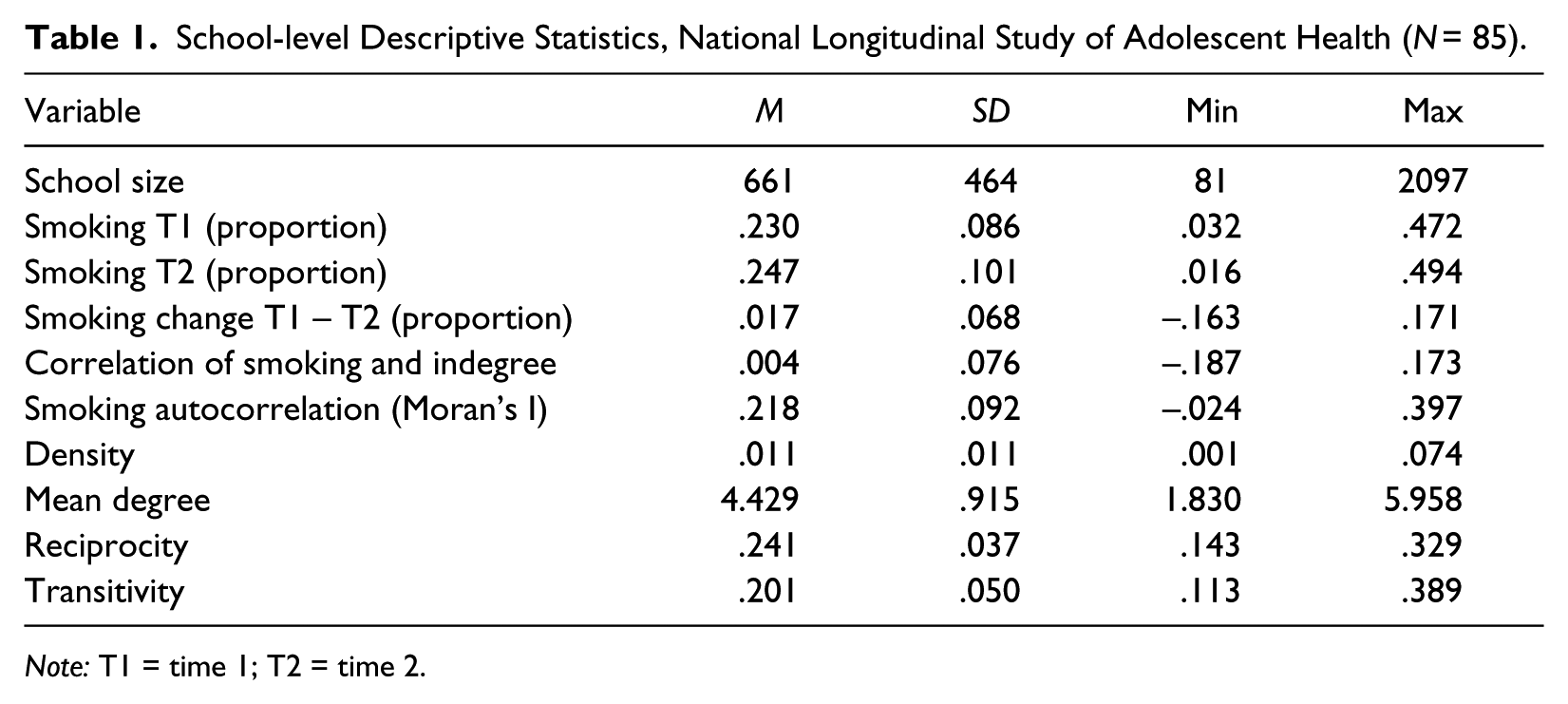
We used data from the National Longitudinal Study of Adolescent Health (Bearman et al. 1997). Add Health data contain information on complete networks for more than 100 schools at one wave and 16 schools at three waves. Each wave of data also contains information on adolescent smoking and other individual attributes. Following Schaefer et al. (2012, 2013), smoking behavior was specified by three levels of reported smoking frequency in the past 30 days: 0 = “never,” 1 = “1 to 11 days,” 2 = “12 or more days.” We used one school with longitudinal network data, with two waves one year apart, to fit an SABM. For extending the model developed by Schaefer et al. (2013; SAH hereafter), we identified Add Health schools with complete network data, acceptable response rates (>75%), and sufficient presence of smoking (>15% ever smoked). This resulted in a sample of 85 schools with cross-sectional network data, from which we generated the empirical distribution of smoking and its association with friendship networks. Table 1 presents descriptive statistics for this sample of schools on the key smoking and network variables included in our models.
School-level Descriptive Statistics, National Longitudinal Study of Adolescent Health (N = 85).
Note: T1 = time 1; T2 = time 2.
Modeling Approach
Our model was a direct extension of SAH, which used an SABM reported by Schaefer et al. (2012) to simulate how smoking outcomes would differ if actors in one school followed slightly different rules for choosing friends and being influenced by friends’ smoking behavior. These rule manipulations were intended to reflect the peer-based intervention scenarios described above that generate alterations in the strength of peer influence and/or smoker popularity effects. SAH demonstrated a strategy for modeling how such social network–based interventions alter trajectories of population-level smoking prevalence, initiations, and cessations. We applied this same sort of model to a wider range of initial smoking prevalence conditions to examine how those differences moderate the effects of peer influence and smoker popularity effects on smoking outcomes. Our model proceeded in four steps, which correspond to theoretical concerns about such models elaborated by Bruch and Atwell (2014):
Generate baseline conditions to represent a range of prevalence distributions.
Fit the SABM model to obtain parameter estimates for simulated intervention rules.
Manipulate peer influence and smoker popularity across baseline conditions.
Record outcome(s) of interest for each simulation of network and smoking co-evolution.
1. Generate Baseline Conditions
This step was the key analytic focus of our article and therefore is the only step in the modeling process that differs significantly from SAH. We needed to establish a means for generating smoking prevalence and frequency distributions, which represented what Bruch and Atwell (2014) characterize as “input uncertainty” aspects of the model. As mentioned above, we must be mindful of the association between smoking and other factors, particularly those related to friend selection and influence. Ideally, these smoking prevalence inputs would vary while leaving associations between smoking and other factors constant. We examined how these school-level measures varied according to the prevalence of smoking in our sample of Add Health schools. We found that network autocorrelation on smoking (i.e., smoking homophily) increases with greater prevalence (Figure S2 in the online supplement), and the correlation between smoking and popularity ranges from negative in middle schools to positive in high schools (Figure S3 in the online supplement). In other words, smoking prevalence itself was highly correlated with many other factors incorporated in the model we develop below.
Stemming from this observation, we relied on a set of empirically observed networks as baseline conditions to fix these associations as they are distributed within the cross-sectional sample of 85 schools from Add Health described above. This approach had the advantage of also fixing associations between smoking and any important factors that are unobserved. These schools naturally varied in smoking prevalence and represent a range of associations between smoking and network structure (see Table 1). Below, we also report robustness checks for our results that relied on two alternative strategies for generating initial conditions.
2. SABM Estimation
Step 2 allowed us to ensure our model appropriately replicates the SABM from Schaefer et al. (2012) to specify what Bruch and Atwell (2014) label agent behavior. Briefly, the goal was to model endogenous changes in network characteristics and smoking behavior. The SABM contained a “behavior” function to model change in smoking due to individual and network factors (i.e., friends’ smoking) and a network function to model change in friendships based on individual factors, dyadic attributes (e.g., homophily), and network processes (e.g., reciprocity). This estimated SABM empirically derived the strength of parameters associated with observed changes in smoking and friendships for those individuals who were observed over time. More details of the general SABM approach are available from Snijders and colleagues (Mercken et al. 2010; Snijders et al. 2010; Steglich et al. 2006) and for the replicated model from Schaefer et al. (Schaefer et al. 2012). We estimated all SAB and simulation models in RSiena 1.1-232 (Ripley et al. 2014).
One finding of the replicated SABM model was that “adolescents influenced each other’s smoking frequency and selected friends with similar levels of smoking. Thus, both selection and peer influence contributed to similarity on smoking among friends” (Schaefer et al. 2012:e16). Of primary interest was the peer influence effect, which is estimated as 2.89. All else being equal, this indicates how a one-unit difference in smoking similarity between ego and his or her friends corresponds to change in the log odds of adjacent levels of smoking behavior. For example, if increasing one’s smoking behavior increases the similarity between oneself and one’s friends by one, then the odds of increasing smoking are 4.24 times greater (exp [beta / smoking range] = exp[2.89 / 2]; see Ripley et al., 2014) than maintaining one’s current smoking level. Turning to smoker popularity, we replicated the finding that students with higher levels of smoking were more likely to be selected as friends than students with lower smoking levels (beta = .14). The smoker popularity parameter can also be interpreted as the effect of a one-unit difference, this time in alter’s smoking level on the log odds of a tie. The observed parameter of .14 indicates that the odds of befriending a moderate smoker are 1.15 (exp[.14]) times greater than befriending a nonsmoker (or a regular vs. moderate smoker), all else being equal. Full details of this model are reported in the online supplement (Table S1) and described in Schaefer et al. (2012).
Our simulation used these effects and corresponding parameter estimates from the estimated model as the rules governing changes in friend selection and smoking behavior. With two exceptions (detailed below in step 3), the actors in our simulations base their friend selection and smoking-level decisions on the same factors as adolescents in the observed school. This allowed us to estimate how differences in baseline smoking prevalence moderate the effects produced by the same model-based mechanisms.
3. Parameter Manipulation and Simulation
This step isolated the manipulations of peer influence and popularity effects that approximate the intervention scenarios described above. Doing so allowed us to properly control the aspects of model uncertainty included in the ABM (Bruch and Atwell 2014). We use the parameters from the model fit in step 2. We then manipulated the targeted “intervention” parameters (altered peer influence and smoker popularity effects) in the same manner described by SAH, ensuring that values (a) were centered on observed values from Schaefer et al. (2012), reported above; (b) included zero, to account for the possibility of null effects; (c) allowed for negative values on the smoker popularity effects, to account for the possibility of smokers being less popular than nonsmokers; and (d) extended an equal distance in the positive direction (i.e., estimating substantially stronger than observed effects). This resulted in modeled peer influence ranging from 0 to 6 in increments of 1, with higher values indicating a stronger tendency to adopt a smoking level closer to one’s friends’ average. Smoker popularity effects ranged from –.4 to .8 in increments of .2, where values indicate the association between peers’ smoking behavior and their likelihood of being selected as a friend. During the simulation, actors were given multiple opportunities to change their network ties and smoking based on the model and parameter estimates from the observed data, and manipulations for peer influence and smoker popularity parameters, described above. Applying this model to a single school, Schaefer et al. (2013:29) found that, changes in [peer influence] and smoker popularity can affect smoking behavior, but their effects are contingent on one another. Changing smoking-based popularity only affected smoking prevalence when [peer influence] was present. Likewise, the impact of changing the [peer influence] effect was dependent on the strength of smoker popularity. Higher levels of [peer influence] increased smoking when smokers were popular, but decreased smoking when smokers were unpopular.
With one exception, all other parameters are held constant at the values from the observed school estimated in step 2. The exception accounts for the simulated change in smoking prevalence in each school if all other effects were absent (i.e., the linear and quadratic effects in the smoking function). These are fixed to set each school’s default change in smoking prevalence to zero, rather than reproducing the level of change from the observed school.
4. Outcomes
We conducted 100 simulation runs over each combination of peer influence and smoker popularity (seven levels each, producing 49 combinations). For each simulation run, our outcome measure was change in smoking prevalence, which was computed as the difference in the proportion of adolescents who smoke at time 2 compared to time 1, which corresponded to the year over which the observed network dynamics were estimated in step 2. This recorded range of outcomes allowed us to identify how robust our model’s results are to stochastic variability within the model (Bruch and Atwell 2014).
Results
Figure 1 presents the simulated change in school-level smoking prevalence obtained by extending the combination of parameter estimates from the fitted SABM (peer influence = 3, smoker popularity = .2) to the initial conditions of all sample schools—each point represents the resulting mean change in smoking prevalence for a single school (with whiskers denoting the 95% confidence intervals [CIs]). The schools are arranged along the x-axis according to their initial smoking prevalence. This figure in essence shows how smoking prevalence would change in the full sample of schools if they each were subject to the observed influence and popularity effects from the school in Schaefer et al. (2012). Two details are worth highlighting. First, the school from which the model was derived (filled circle) generated no change in smoking prevalence. Remember that the aim here is to isolate the differences generated solely from the manipulated (peer influence and smoker popularity) parameters, keeping other observed factors constant (i.e., applying the same intervention effects across settings). In the observed school, without holding those other factors constant, a 5% smoking increase was observed. The simulated model generates no change in smoker prevalence when those other factors are held constant, and the targeted intervention scenarios (peer influence and smoker-popularity) are held at their observed values. In other words, this simulated data point allows us to confirm that we can successfully isolate the effects of peer influence and smoker popularity in the desired ways, which can in turn be applied to the other initial conditions. Second, the results for the other schools foreshadow the general pattern in the full results—the same process unfolding under different initial conditions leads to divergent smoking outcomes. In this case, schools with lower initial prevalence show declines in smoking prevalence, whereas schools with the highest initial prevalence show little simulated change.
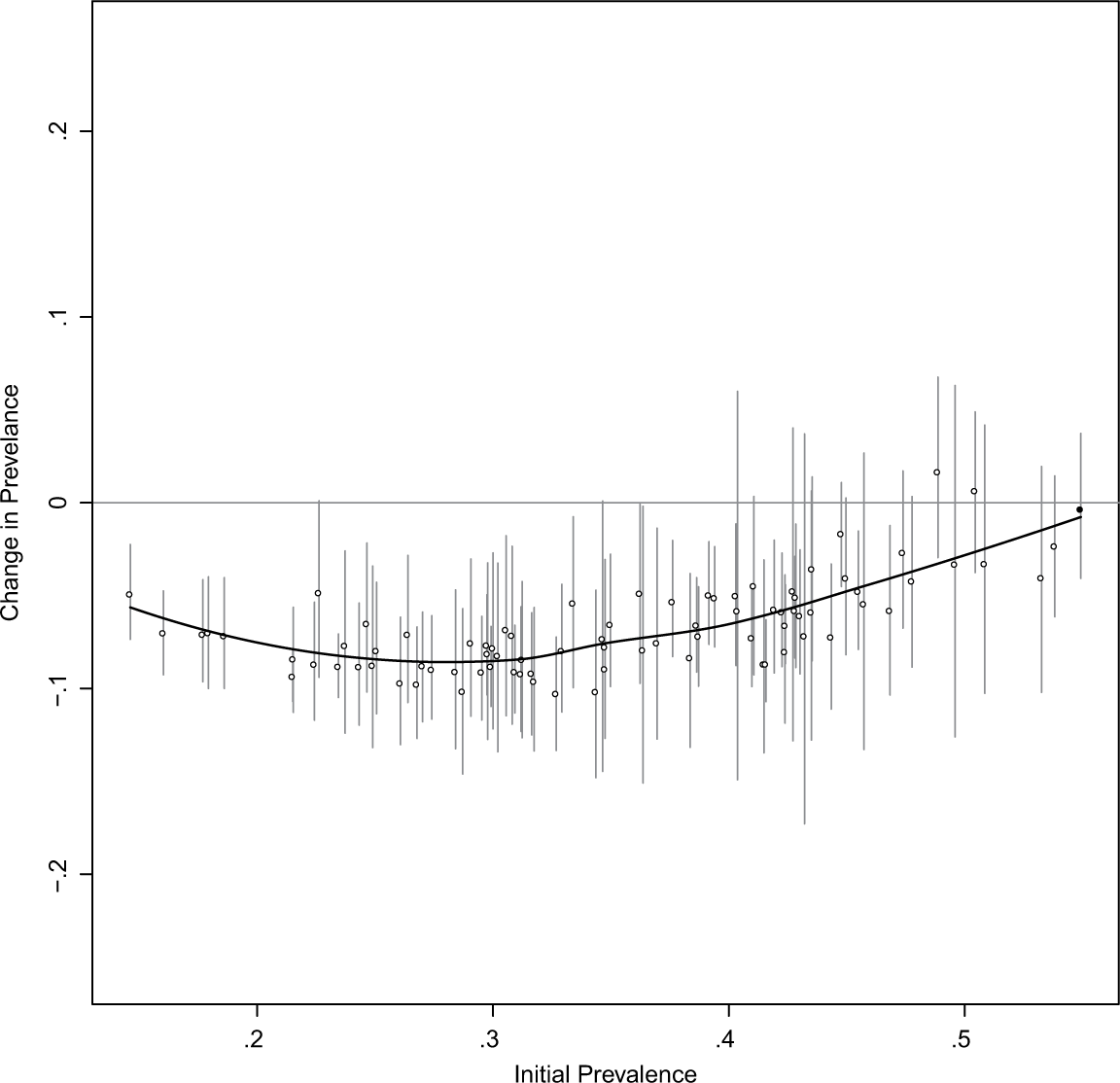
Smoking Changes from Applying Observed Peer Influence and Popularity Effects to 85 Schools.
Figure 2 provides results for a selection of 16 manipulated parameter effect combinations (results for all 49 parameter combinations are presented in the online supplement). This figure can be interpreted two primary ways. First, focusing within any one panel addresses our primary question: how does the same combination of simulated peer influence and smoker popularity parameters produce differing results when applied to varying initial smoking conditions? Second, comparing results down the columns or across the rows demonstrates how smoking outcomes vary depending on different manipulations of intervention-based parameters (peer influence in the letter-labeled rows and smoker popularity in the numeric-labeled columns). These cross-panel comparisons are meaningful both for individual schools (e.g., the relative differences for the filled circle in each plot replicate SAH model results) and for differences between the distributions.
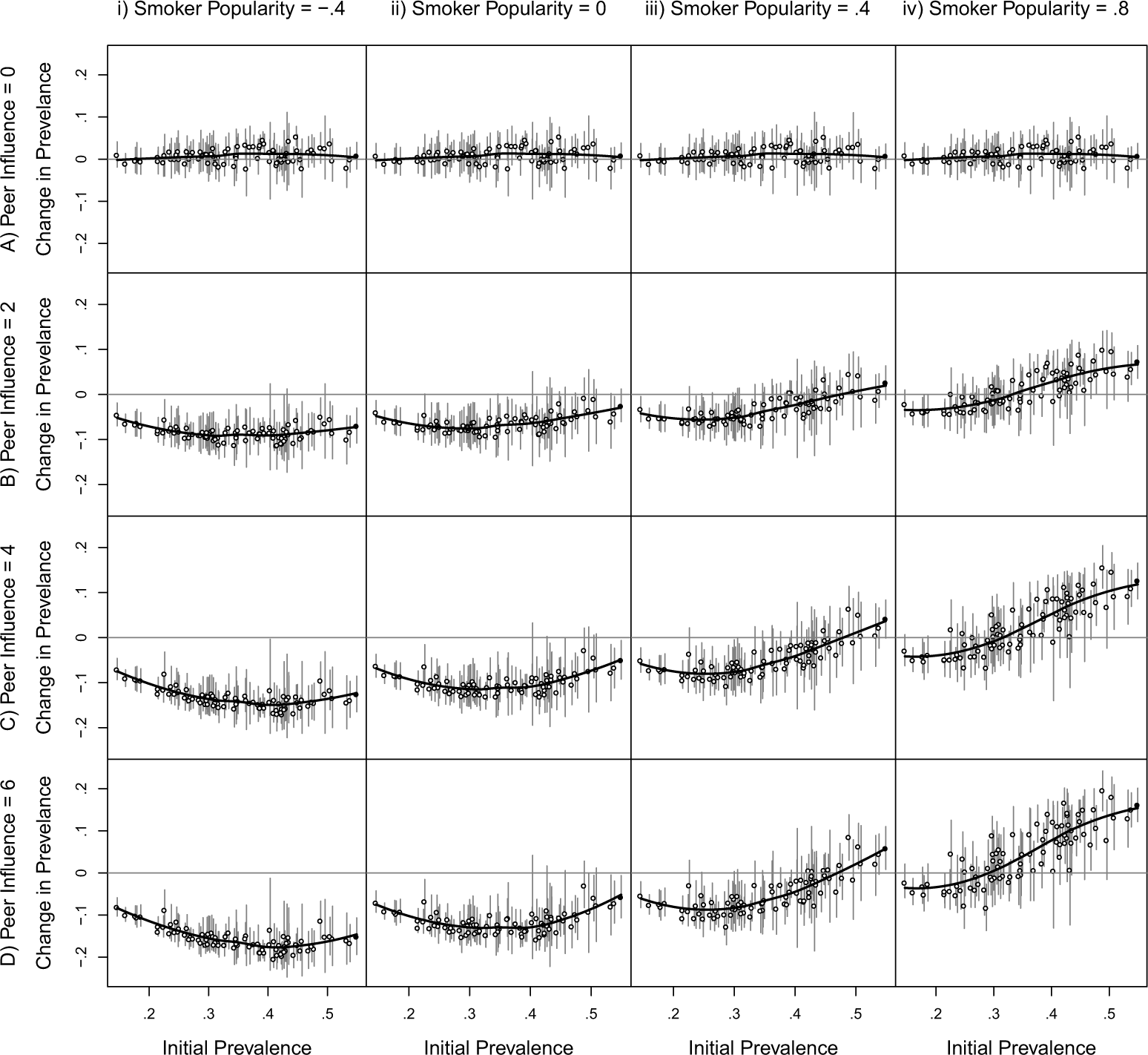
Simulated Smoking Prevalence Changes from Intervention Scenarios Combining Peer Influence and Population Effects.
Focusing on the first interpretation, Panel Aii represents when both peer influence and smoker popularity effects are absent. Under these conditions, simulated prevalence remains virtually unchanged—both for the school on which the model is based (filled circle) and across most of the other observed school conditions (73 of 85 CIs include zero and mean values are each relatively close to zero). Comparing Panel Aii to the others in row A reveals that when peer influence is absent—regardless of the strength of smoker popularity effects—smoking prevalence remains unchanged for nearly all schools. Turning to the rest of column ii (null smoker-based popularity selection effect), smoking prevalence declines across most initial conditions as peer influence is introduced. This prevalence decline is stronger at moderate than extreme levels of initial smoking as indicated by the “U-shape” curves. Moreover, the strength of this decline intensifies with increases in the peer influence parameter (the deepening of the U shape moving down the column).
Moving away from outcomes when one (or both) manipulated effect(s) is null, we find that differing initial smoking conditions produce substantially divergent smoking outcomes for several combinations of peer influence and smoker popularity effects. Models with modest negative smoker popularity effects (column i) retain the general pattern from the model with null smoker popularity effects—smoking declines, marked by a consistently below-zero U-shape pattern, which amplifies as peer influence increases. For each of the combinations where peer influence and smoker popularity effects are both positive (rows B–D, columns iii–iv), differences in initial smoking prevalence lead to smoking outcomes marked by an inflection point: low-smoking-prevalence schools (less than ~30% initial prevalence) exhibit declines, higher-smoking-prevalence schools (above ~40%) experience increases, and schools with more moderate initial smoking prevalence exhibit no significant changes. Across these four panels, stronger effects change the amplitude but not general pattern of this S curve.
The second way to interpret Figure 2 is to compare single schools across panels, which reveals three distinct patterns: (1) In low-prevalence schools (less than ~20%), smoking almost always declines, with stronger peer influence amplifying those declines (comparing down the columns). (2) Smoker popularity modifies that effect comparatively little (comparing across the rows). At moderate levels of initial smoking (between ~20% and 40%), effects are mixed between declines and no changes. High peer influence and low/null smoker popularity parameter combinations (i.e., rows B–D, columns i–ii) generate some of the largest declines. However, for these schools, increasing smoker popularity effects (across rows) shifts observed outcomes, from prevalence declines to changes mostly indistinguishable from zero. For schools with low or moderate levels of initial smoking, no combination of modeled effects produce significant smoking increases. (3) Schools with the highest initial smoking prevalence (greater than ~40%) generate a complex combination of outcomes. When manipulations made smokers unpopular (column i), in the presence of peer influence (rows B–D), smoking decreased and more strongly as peer influence increased. By contrast, when smokers were relatively more popular, we observe the only instances where smoking prevalence increases. Looking down column iv, as peer influence strengthens, increases in smoking prevalence become more pronounced. This pattern is also evident in column iii, where smoker popularity is weaker, but the CIs indicate that changes are mostly indistinguishable from zero.
Finally, a related way to examine these results is to ask how much initial smoking is necessary for prevalence to increase or decrease (i.e., where are the inflection points), and how does this vary based on the strength of peer influence and smoker popularity. At the highest levels of smoker popularity and peer influence (e.g., cell Div), schools can experience prevalence increases even though the initial smoking prevalence is quite low (i.e., less than one third initial smokers)—a combination of initial conditions that includes most of the schools found in Add Health with strong popularity associations and/or autocorrelation with smoking (see Figures S2 and S3 in the online supplement). As smoker popularity decreases, smoking change either stagnates (in low-peer-influence settings) or declines (in high-peer-influence conditions). At the lowest levels of peer influence or popularity effects, no threshold pattern emerges, with smoking consistently stagnating in the former and decreasing in the latter. Finally, returning to high influence and popularity effects (bottom right panels of Figure 2), the initial prevalence actually exhibits a threshold that differentiates schools showing smoking declines (initial low prevalence) from those generating increases (high initial prevalence); this threshold shifts dependent on both popularity and influence effects. Moreover, initially moderate smoking prevalence is most common among Add Health schools that exhibit strong initial peer-smoking associations. In other words, those schools with the strongest initial peer-smoking associations are likely to straddle the critical threshold of initial prevalence, leading small (intervention-based) changes being capable of tipping the scales in either direction.
Robustness Check
Our approach to manipulating prevalence was to use empirically observed school network and smoking distributions to specify initial conditions. This strategy has the advantage of retaining the associations between targeted prevalence levels and other contextual characteristics, either known or unknown, that may affect the processes we investigate. To examine how robust the pattern of results described above are to this approach, we explored two alternative strategies for setting initial conditions that rely on slightly different sets of assumptions.
The (a) random assignment condition uses time 1 data from the school used in SAH and randomly assigns individual smoking behavior to match the target initial smoking prevalence conditions. We base these conditions on a combination of smoking-related factors observed in the sample of 85 Add Health schools. First, initial prevalence conditions range from 15% to 75% initial smokers in increments of 10%, which extends the observed distribution to incorporate some potential range of measurement error. Second, for a given prevalence level, we specify the number of nonsmokers (identified as smoking level 0) and distribute smokers across levels 1 and 2 to create a target distribution. We took an empirical approach to creating the distribution rule. For each Add Health school in our sample, we calculated the proportion of students at each of the three smoking levels. From the observed proportions, we regressed the proportion of students at smoking level 1 on the proportion of nonsmokers, obtaining a reasonable fit (r2 = .61). We then fed each target level of nonsmokers into this model to predict the number of smokers at level 1. To illustrate, the estimated model has the form Smokers1 = .48 – .39(Smokers0). For prevalence level .75, in which the proportion of smokers at level 0 is .25, this evaluates as .48 – .39(.25) = .38, indicating that the proportion of smokers at level 1 should be .38. The remaining 37% of actors are at smoking level 2 (i.e., 1 – .25 – .38 = .37). Once we have these target distributions, random assignment of smoking status to match the distributions of initial smoking prevalence is a straightforward approach. However, random assignment ignores any empirically observed associations between smoking and network structure as well as correlations between smoking and other individual attributes.
The (b) model-based approach seeks to identify key structural patterns, then reproduce them when manipulating baseline conditions. We identify two classes of associations: (1) correlations between smoking and other individual attributes and (2) associations between smoking and network structure. To maintain associations with other individual attributes, we fit a multinomial model that predicts smoking based on sex, age, alcohol use, and grade point average. For each actor, we use this model to calculate the predicted likelihood of being at each smoking level. For a given target smoking distribution, actors with the greatest probability of being nonsmokers are assigned smoking level 0; actors with the greatest probability of being at smoking level 2 are thus assigned, and the remaining actors are assigned smoking level 1. This assignment contains a stochastic element; thus, an actor with a low probability of being a smoker may still be assigned to be a smoker. After assigning the smoking distribution, we check that the assignment had its intended effect of maintaining the correlation between smoking and these individual attributes (if correlations fall outside the observed 95% CI, the assignment is rejected and a new distribution of smoking values is generated).
Then, to maintain the observed association between smoking and network structure, we fit an exponential random graph model (ERGM; Robins et al. 2007) to the observed school. The ERGM provides estimates of purely structural properties (e.g., triadic closure, reciprocity) and associations between smoking and the network (smoking autocorrelation and smoker popularity). These estimates provide parameters from which we create a distribution of networks with the same number of actors, ties, and key properties as the observed network. From this distribution, we retain those networks where density, smoking autocorrelation, and the correlation of smoking and indegree fall within the 95% CI of the observed distributions of associations.
Figure 3 compares these two additional strategies for setting initial conditions to the results presented above; for simplicity we present only the fitted LOESS curves for mean values. The full set of results, with 95% CIs and all 49 parameter value combinations, are available in Tables S4 through S6 in the online supplement. By and large, the results are robust to the strategy employed for generating the initial conditions. The lone exception is that the model-based conditions produce somewhat different effects at the highest levels of peer influence and smoker popularity effects (lower right cells of Figure 3). Namely, the shape and magnitudes of the curves across conditions remain relatively similar; however, the model-based condition exhibits increases in smoking prevalence at lower levels of initial prevalence than the other two conditions. This suggests that in schools with the same structural features as those from observed schools, but lower initial smoking prevalence (e.g., derived from the population declines in smoking prevalence observed since Add Health data were collected), we may observe smoking increases similar to those in the higher prevalence schools observed in these data. Alternatively, this deviation for the model-based condition could also indicate that the model is missing one or more important aspects of structure—aspects that are captured by the empirically based conditions.
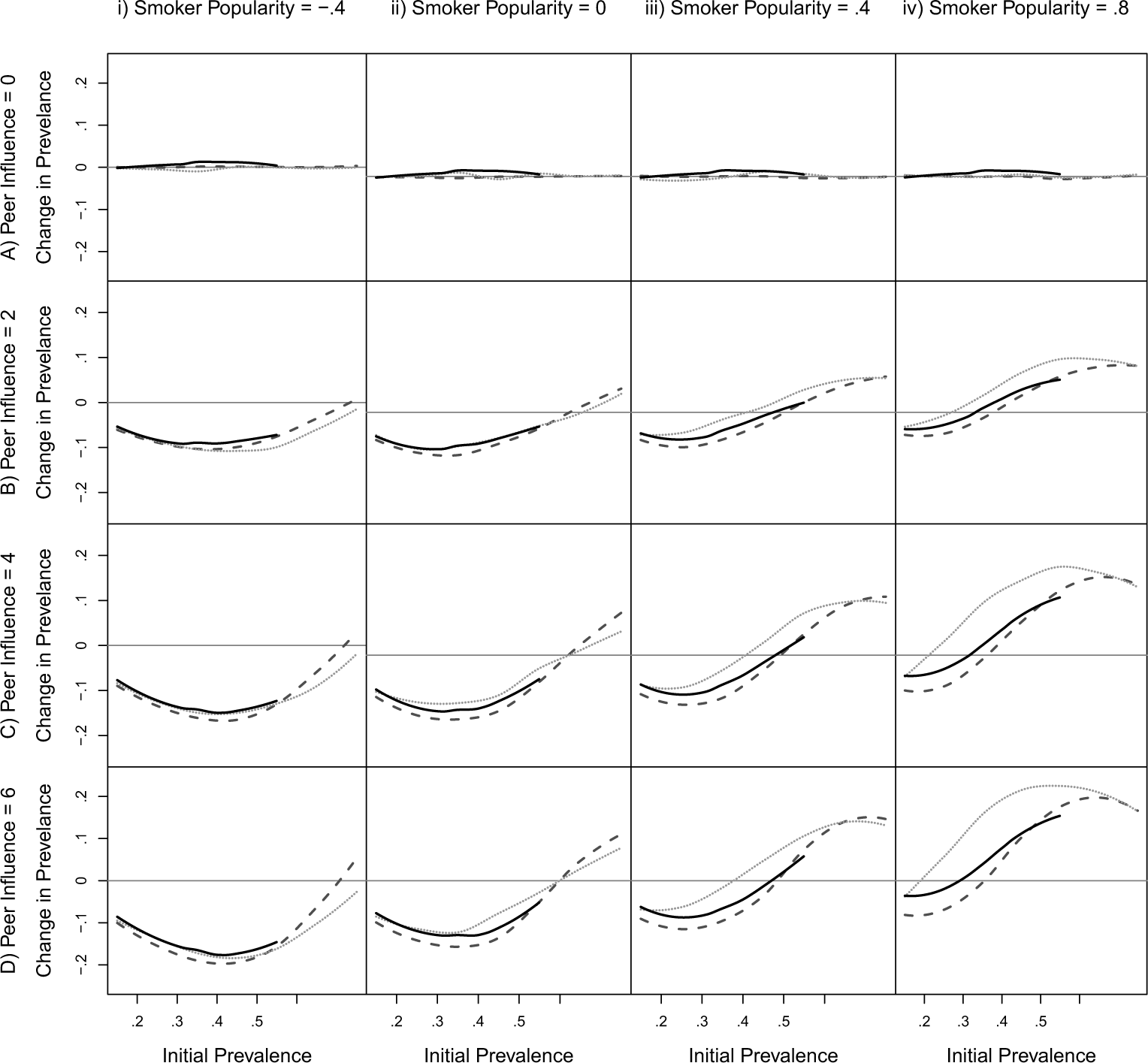
Comparison of Different Baseline Assumptions for Simulated Smoking Prevalence Changes from Intervention Scenarios.
Discussion
Frequently, fielded interventions intentionally target sites that differ in strategic ways (e.g., to see if they can produce similar health improvements in “high” and “low” risk settings). Short of massive-scale intervention rollouts, in which contextual factors are carefully matched, we are limited in our efforts to disentangle differences in targeted intervention effects from differences generated by contextual variation. The combination of empirical and simulation models demonstrated here enhances our capacity to isolate the precise mechanisms driving behavior changes. In essence the logic of our approach is that if only contextual factors vary across settings—while intervention mechanisms operate identically—any differences in outcomes are attributable to those differences in contextual factors. This allows more principled consideration of the potential range of effects that can be anticipated from intervention efforts and assists in identifying the (combinations of) factors that are likely to provide the greatest probability for desirable outcomes. Our results show that reaching similar health outcome targets in different initial contextual conditions may require very different intervention designs.
SAH demonstrated the utility of SABMs for anticipating outcomes of peer network interventions targeted at observed friendship network and smoking dynamics for a single school. Here, we explore how those same intervention effects can generate differential consequences dependent upon initial conditions. Our key finding is that even if an intervention could generate the exact same mechanistic change across schools (e.g., altering peer influence in exactly the same way), the effects on smoking outcomes could substantially differ, depending on initial prevalence. The differences we identify are not simple extrapolations from one school to another: effects that reduce smoking in some school conditions can lead to increases in others. Moreover, it was not simply the case that initially predominate behaviors ultimately take over. Rather, prevalence seems to moderate the effects of peer influence and smoker popularity changes. For example, in schools with relatively low initial smoking prevalence (<~25%), an intervention designed to reduce peer influence susceptibility would be detrimental to smoking reductions. This is because in low-prevalence schools, peer influence can serve a protective function by preventing (or reducing) smoking.
The consequences of manipulating these intervention levers are quite different in contexts with high initial smoking prevalence. Contrasting above, interventions designed to reduce adolescents’ susceptibility to peer influence would have beneficial results in schools that start with higher smoking prevalence. If high initial prevalence were coupled with high smoker popularity, then reducing peer influence would inhibit the spread of smoking (a positive population health outcome). In such a situation, smokers are relatively more influential because the network positions they occupy provide greater connectivity to others. Thus, weakening the magnitude of peer influence, thereby making actors more autonomous, restricts smoking diffusion. Contrastingly, in a similarly high-prevalence context, but lacking strong smoker popularity effects, reducing peer influence would generate more modest smoking declines because smokers do not occupy the same influential network positions.
If interventions could alter peer influence and popularity effects simultaneously, then the outcomes are even more complexly related to the initial conditions in the school. For example, an intervention designed primarily around demonstrating the harmful effects of smoking might be expected to reduce both smoker popularity (e.g., by stigmatizing the behavior) and peer influence effects (by increasing the weight given to information vs. peers in decision making). The potential outcomes from such a case can be estimated by comparing a single school’s outcomes moving diagonally up and to the left across Figure 2. For schools with the highest initial smoking prevalence, this would produce the most consistently health-promoting shifts. However, for schools with low to moderate initial smoking prevalence, such shifts appear to have little impact. Indeed, in schools with low to moderate initial smoking, amplifying the effectiveness of peer influence appears to be the more health-beneficial approach. In sum, neither the initial conditions nor the manipulated parameters solely accounted for the generated outcomes. This suggests that interventions must be tailored to contextual conditions to which they are to be applied, in ways that are aware of the initial prevalence of smoking behavior.
Beyond the scope of the particular questions here, these results also reemphasize the need to consider how context shapes observed behavioral patterns and may shape the efficacy of any interventions designed to improve health behaviors and outcomes. ABMs provide a framework to isolate particular components of such models in ways that are not available in real-world interventions. This can be especially useful for predicting the implications of interventions that target those modeled characteristics (El-Sayed et al. 2012, 2013). In a network context, the SABM approach used here could also be extended to examine multiple behaviors at once, for example, how smoking and alcohol use are interrelated (Kiuru et al. 2010). While these are important advances for network scholarship and understanding health behaviors, there are also important implications for intervention work. In particular, future interventions could maximize their desired outcomes by targeting contexts where the model suggests the most beneficial outcomes. That is, if an existing intervention is able to produce identifiable peer influence (Campbell et al. 2008) and/or popularity effects (Valente and Pumpuang 2007), our models can be used to identify initial smoking prevalence conditions in which those effects would maximally decrease smoking outcomes. More generally, as future health interventions are developed, a simulation modeling strategy like the one developed here can help identify optimal intervention rollout scenarios that would best leverage the effects any particular intervention is able to generate.
Limitations and Extensions
By combining principled simulation scenarios with an empirical basis in a large, nationally representative sample of schools, we demonstrate how different initial conditions lead to different intervention outcomes, even when derived from the same behavioral mechanisms. We emphasized smoking prevalence as a key contextual moderator of known peer influence processes. The relative consistency in our findings across the different initial prevalence conditions in our follow-up analysis (which included natural, systematic, and random manipulation of prevalence) demonstrates the robustness of our findings. However, prevalence is only one of many contextual factors that may shape the efficacy of smoking outcomes. Of utmost importance is further theoretical development regarding the contextual factors that moderate friendship behavior dynamics, coupled with empirical tests. The model and framework developed here could be readily extended to evaluate the effects of initial smoking prevalence versus other contextual factors.
Our modeling strategy can also be extended to consider alternate intervention scenarios. First, our manipulations are based on relatively blunt-instrument intervention levers thought to alter peer and, in turn, smoking outcomes. More nuanced intervention levers should be explored, for example, interventions administered to subsets of students—perhaps based upon particular characteristics, such as being an opinion leader (Valente et al. 2007; Valente and Pumpuang 2007). The results here present only the cumulative aggregation of net change across the simulated scenarios, masking the fact that even the scenarios producing the largest smoking decreases contain some initiations, and those with large increases include some cessations. Moreover, recent work demonstrates that smoking cessation and initiation may function via different processes (Haas and Schaefer 2014). The current model could be extended to manipulate peer influence and/or smoker popularity effects separately for smoking cessation and smoking initiation. This would be especially useful given that interventions aimed at developing “refusal” skills likely have a stronger effect on inhibiting increases in smoking than on promoting smoking cessation.
Second, our observed change statistics represent only one year’s duration. Extending the amount of time over which we allow smoking and friendships to evolve within the model may alter some of the similarities/differences we observe across examined scenarios. Unfortunately, we need more and different data than are frequently available to inform data-based models for such longer duration effects. Third, given secular decreases over the past two decades, we can speculate that the low-prevalence schools from the Add Health era more closely represent the conditions present in schools today. However, the adolescent smoking landscape may have changed enough over this time that even apparently similar conditions may embody different friendship-smoking dynamics that would produce dramatically different outcomes than we can estimate.
Conclusion
Researchers cannot simply export an intervention developed in one (or a few) context(s) into other locales and assume that it will produce the same outcomes, even if the mechanisms are reproduced in the same way. Simply stated, context matters. The environments within which adolescents adopt health-relevant behaviors are governed by different sets of behavioral and peer-based norms. As such, altering peer processes, such as peer influence and/or smoking-based friend selection—even if changes could be reproduced identically across schools—can produce widely divergent smoking outcomes, depending on the schools’ initial smoking levels. This contextual conditioning of potential intervention effects has implications for anyone attempting to alter adolescent smoking or health behavior more generally. One must know both the assumed mechanisms by which the intervention is expected to function and the initial contextual conditions to which they are targeted, if interventions’ potential effects are to be adequately predictable. We have demonstrated an empirically grounded, simulation-based approach useful for estimating models that include such conditions and dynamic smoking and peer effects. We encourage other researchers to extend and modify this approach to investigate friendship behavior processes that depart from those examined here (e.g., through other targeted intervention mechanisms).
Footnotes

Funding
This research was funded by the Eunice Kennedy Shriver National Institute of Child Health and Human Development (R21-HD071885) and a Loan Repayment grant from the National Institute of Minority Health and Health Disparities (L60-MD003181).
Author Biographies
References
Supplementary Material
Please find the following supplemental material available below.
For Open Access articles published under a Creative Commons License, all supplemental material carries the same license as the article it is associated with.
For non-Open Access articles published, all supplemental material carries a non-exclusive license, and permission requests for re-use of supplemental material or any part of supplemental material shall be sent directly to the copyright owner as specified in the copyright notice associated with the article.
