



Abstract
This article explores the “exposure experience” of participants who received their personal results in a biomonitoring study for perfluorooctanoic acid. Exposure experience is the process of identifying, understanding, and responding to chemical contamination. When biomonitoring studies report results to participants, those participants generate an exposure experience that identifies hidden contaminants and helps level informational imbalances between polluters and affected communities. Participants welcomed the opportunity to learn their exposure results, reporting no psychological harm following report-back. They wove health, economic, and political considerations into their interpretation of results and their present views of past impact. Participants framed their experiences by a half-century of dependence on the chemical industry’s economic benefits, leading them to considerable acceptance of chemical exposure as a tradeoff for jobs and the local economy. Our findings show that the exposure experience is an ongoing process that influences social action, with new activism being generated by exposure and health studies.
Keywords
Residents of the Ohio River Valley have been exposed to a toxic chemical, perfluorooctanoic acid (PFOA), commonly known as C8, used at DuPont’s manufacturing plant to make Teflon, a nonstick coating used in many products from cookware to computers. Two studies were conducted to monitor levels of the chemical, and residents were informed of the results. While the biological and health effects of toxic exposure were well studied, we know little about the personal and emotional impact of learning that they had been exposed to the chemical. This article employs interviews with biomonitoring participants in one of those studies to explore their “exposure experience” (Altman et al. 2008), the process by which people come to identify, understand, and respond to chemical contamination.
Individual biomonitoring report-back allows participants to learn about contaminants in their bodies and helps level informational imbalances between polluting sources and affected communities. The main imbalance is the actual community residents’ levels of PFOA in their blood, data unavailable from DuPont. Another imbalance is the way that the community partners keep the public updated on the study’s progress and the manner in which information is disseminated. Those are all features of environmental health research that affected people rarely have control of. The analysis reported here is the first to examine a report-back study in which the participants are directly economically connected to the polluter and hence deepens our understanding of what such dependence means for exposure experience. The exposure experience concept can be used to study both people’s personal understanding of exposure inside their bodies for present and future health and people’s actions to change personal behaviors and take collective action. People weave health, economic, and political considerations into their interpretation of results and their present views of past impact (Adams et al. 2011; Altman et al. 2008). Prior work primarily emphasizes the “embodied” nature of exposure experience, focusing on personal and emotional impacts (Altman et al. 2008). Adams et al. (2011) extend that work to shows the difference in expectations based on location—people living on the fenceline of a refinery expected pollution, while people in a wealthy rural area were surprised to learn of contamination from personal care and household products. This is highly relevant for the place-based nature of a resource-dependent community like the Mid-Ohio Valley, where there is a sharp contradiction between people taking action on known contamination yet hoping their response does not cause the polluter to move away.
It is important to understand the psychosocial consequences of learning about toxicant exposure. Understanding what people think and do about contaminant information they receive helps researchers learn how to provide risk communication and assess the effectiveness of public health interventions. In line with both public input and funding agency mandates, research is becoming more bidirectional, with community members having extensive input into research design, analysis, and communication rather than just being disempowered subjects. Such attention is often seen as “environmental health literacy” (Finn and O’Fallon 2014). These directions lead to the need for researchers, government agencies, and Institutional Review Boards (IRBs) to know about participant experiences in order to provide a more democratic participation in science and encourage greater research and policy participation by the public. This case also tells us how people respond to conflicting constraints—a need to protect one’s health contrasted with economic dependence on the very corporations that may damage it.
Background
Contamination Discovery
The Ohio River Valley has been an important center for chemical production since the early 1800s (Cantrell 2004; Harbour 2012). Teflon, a nonstick coating used in many products from cookware to computers, was manufactured using perfluorooctanoic acid at DuPont’s Washington Works Plant in Washington, West Virginia. Its leaching extensively polluted the groundwater in several counties in Ohio and West Virginia. PFOA is an important emerging contaminant 1 because of its environmental persistence and health effects, such as cancer of the kidney and testicles, hypercholesterolemia, pregnancy-induced hypertension, ulcerative colitis, and thyroid disease (C8 Science Panel 2011, 2012a, 2012b, 2012c, 2012d; U.S. Environmental Protection Agency 2009; Post, Cohn, and Cooper 2012).
On June 27, 1978, DuPont learned from 3M that elevated C8 levels were found in the blood of 3M worker (Lyons 2007). On March 20, 1981, 3M informed DuPont of a 3M study that found that C8 caused birth defects in rats (Lyons 2007). This prompted DuPont to reassign potentially exposed female employees to other production jobs. A company memo dated May 23, 1984, shows that detectable levels of C8 were found in the water supplies of three communities, including Little Hocking (Lyons 2007). While DuPont knew of this contamination early on, residents did not learn of it until at least 2000. 2
Local residents may never have learned about C8 contamination had it not been for the case of the Tennett family, farmers who sold some of their land in 1980 to DuPont, which used it as a chemical landfill. Shortly after, the Tennetts began to see signs of environmental harm, such as the lack of minnows in the stream and strange diseases in their cattle. By the early 1990s, there were no survivors of a herd that the family had tended for decades. After working unsuccessfully with state and federal regulators, the Tennetts sued DuPont in 1998. During the legal discovery process, their lawyer Robert Bilott uncovered DuPont’s documentation of C8 contamination in groundwater and plant workers. While this suit ended in a sealed settlement that silenced those involved, Bilott’s legal team launched a class action lawsuit against DuPont on behalf of over 50,000 people. This reopened the discovery process, allowing the lawyers to use DuPont’s knowledge of contamination as leverage. DuPont settled in 2004, and the settlement funds were used to conduct the C8 Health Study, one of the two biomonitoring studies of C8 contamination in the area. The second study, on which our research was focused, was a community-based participatory research (CBPR) project stemming from community concern about C8 in the water and was carried out jointly by academics and community partners. The planning and some of the conduct of the “EJ Study,” so called because it received an $800,000 Environmental Justice grant from the National Institute of Environmental Health Sciences (NIEHS), preceded the legal settlement that mandated the C8 Health Study. While our research focused on the EJ study, we found that all of our participants had participated in both the EJ Study and the much larger C8 Health Project and often conflated and/or confused them.
The Environmental Justice (EJ) Study
The EJ Study began in 2003 when the University of Pennsylvania partnered with the Decatur Community Association (DCA) to test a stratified random sample of 370 community members who received water between 2004 and 2005 from the community-owned Little Hocking Water Association (LHWA). Researchers reported individual exposure levels of PFOA in blood to participants as well as a comparison to their municipality’s average before the results were released to the community or published in peer-reviewed journals (Emmett, Shofer, et al. 2006). PFOA levels were 60 to 75 times higher than the national average, 3 and drinking water was the primary exposure source (Emmett, Shofer, et al. 2006). PFOA exposure was associated with higher cholesterol levels (Emmett, Zhang, et al. 2006), lower birth weight and preterm birth (Nolan et al. 2009), and pregnancy-induced hypertension (Nolan et al. 2010). On the day EJ Study results were made public, DuPont announced delivery of free bottled water to LHWA municipalities, implicitly recognizing their role in the contamination and representing an important gain for the residents. Follow-up testing two years later showed that PFOA concentrations fell 26%, a change attributed to the report-back, as 76% of those retested changed their water use behavior within three months of results dissemination (Emmett et al. 2009; Tillett 2007).
The C8 Health Project
The C8 Health Project (C8 Study) grew out of the 2004 class action settlement that gave funds for a large-scale biomonitoring study that tested over 69,000 people between 2005 and 2007 (Frisbee et al., 2010; Lyons 2007). It included a health survey and qualitative self-reports with extensive laboratory testing for both health markers and 10 different PFC (perfluorinated compound) blood levels to explore relationships with health outcomes (Frisbee et al. 2009; Steenland et al. 2009a). The project provided free testing to a medically underserved area of Appalachian Ohio and injected roughly $70 million in the area through study compensation, jobs, and related economic activity (Lyons 2007). When researchers identified health risks such as high cholesterol or dangerously poor organ function, the C8 Study could be credited for saving lives (Lyons 2007). The C8 Study produced 38 articles 4 on the relationship between PFOA exposure and health outcomes, including hyperactivity (Stein and Savitz 2011), liver function (Gallo et al. 2012), pregnancy outcomes (Savitz et al. 2012; Stein, Savitz, and Dougan 2009), and thyroid function (Lopez-Espinosa et al. 2012). Furthermore, the C8 Science Panel identified significant associations between PFOA exposure and kidney cancer, testicular cancer, ulcerative colitis, thyroid disease, pregnancy-induced hypertension, and hypercholesterolemia (C8 Science Panel 2011, 2012a, 2012b, 2012c, 2012d). Based on these findings, the court appointed a Medical Monitoring Panel to develop monitoring protocols for these diseases. Class members with these “probable link” diseases are able to sue DuPont for compensation, and over 3,500 have already done so.
Theoretical and Conceptual Framework
We frame our work around two bodies of literature. The first area, a longer established field—community response and environmental justice—situates the study site in a context of many other communities that have faced contamination. The second, exposure experience, is a relatively recent approach and helps explain people’s interpretations of biomonitoring. In each of these literatures, research has examined both the individual and community levels of experience. Individual-level experience includes personal health concerns, psychological awareness of toxic trespass, assigning of responsibility, and decisions about personal levels of change such as product use. Community-level experience includes collective action in the form of public protest, litigation, pressure on government, and pressure on those parties held responsible for contamination.
Community Response and Environmental Justice
Rural areas have been very significant in the history of communities concerned with toxic contamination. The founding work in this field was Erikson’s (1976) study of a human-caused mining waste dam collapse in rural Kentucky that killed 125 and wounded many hundreds, destroyed entire hamlets, and left psychological scars as well. Many key community organizing efforts that formed the basis for the environmental justice movement began in rural, largely African American areas of Louisiana’s Cancer Alley between New Orleans and Baton Rouge (Lerner 2006; Timmon Roberts and Toffolon-Weiss 2001). Additionally, those Cancer Alley activists were among the first to employ lay community monitoring via the Louisiana Bucket Brigade, whose inexpensive community monitoring devices demonstrated widespread petroleum-based contamination that was otherwise not monitored or reported by official sources (Allen 2003).
Victims of toxic contamination were among the first laypeople to develop research collaborations with scientists. Such partnerships offer the potential for both individual and community empowerment, thus mitigating some of the negative effects (Brown and Mikkelsen 1997; Minkler and Wallerstein 2008). There has been a long trajectory of community-based participatory research approaches (Minkler and Wallerstein 2008), coupled with resident-identified contamination through “popular epidemiology” (Brown and Mikkelsen 1997) and “street science” (Corburn 2005), yielding various ways to deal with that contamination. While it is true that EJ Study participants did not collaborate on research with sympathetic academics, and while their community organization was not an environmental justice group, they knew they were funded by an environmental justice grant mechanisms and the academic principal investigators (PIs) provided much education in such matters. The Decatur Community Association was a necessary partner even if not an activist one in the usual sense. The community partners were very involved in the “community-first communication” approach in that they defined how the research would be disseminated. That included the Community Advisory Council and the community meeting (where 400 people attended) having the first reports of the findings, in contrast to the traditional method of journal publication being the first dissemination (Emmett et al. 2009).
It is also useful to consider the connections between local and global economies. The Mid-Ohio Valley’s contamination, like that of any other industrial production, is connected to international flows of raw materials and finished goods. Murphy’s (2008:696) attention is on petroleum connections: “The intensification of production and consumption in recent decades has yielded a chemically recomposed planetary atmosphere to alarming future effect, while it has penetrated the air, waters, and soils to accumulate into the very flesh of organisms, from plankton to humans.” But the phenomenon is similar, meaning that people’s bodies receive toxic trespass from contaminant sources far from their locality—through biomagnification in the food chain, fate and transport in oceanic and atmospheric currents, and product usage (Altman 2008). Local communities often grasp such connections, as was the case with the Cancer Alley groups mentioned earlier. Interestingly, affected people are able to benefit from the global flows by incorporating allies who might be far removed from the local contamination.
In addition to the literature we have noted on community response, we also note that other types of communities—workplaces—have their own unique response to contamination. Workers in the most hazardous occupations will accept high levels of risk even when they are well aware of them in exchange for job security that will support their families (Nelkin and Brown 1984). Environmental activists trying to build labor-environment alliances have frequently found similar concerns about “job blackmail” (Mayer 2008). We view the same tradeoffs in the Mid-Ohio Valley, reflected in people’s relation to both DuPont and the whole industrial chemical sector in their region.
Exposure Experience
Exposure experience describes the process by which people come to identify, understand, and respond to chemical embodiment (Altman et al. 2008). It builds on the concept of “illness experience” developed by medical sociologists to explain the multifaceted, often ambiguous issues relating to understanding and living with disease, challenging diagnostic definitions and treatment approaches, and the effect of social structure (Bell 2008; Lawton 2003). Illness and exposure experiences include the public’s understanding of science as people assign meaning to daily experiences from a wide array of sources, including personal history, interaction with experts, and the media (Irwin and Wynne 1996). Most past sociological research on responses to toxic chemicals, metals, and air pollution involves individuals and communities where they see visible contamination in forms such as chemical spills, explosions, soot deposition, seeping materials, and clouds of pesticide spray. The presence of such external contamination does not, however, show if it entered people’s homes and bodies. Household exposure offers the possibility of seeing what toxicants entered people’s living and working spaces, and biomonitoring offers the potential to better see fate and transport of toxicants not just through the outside environment but through the internal human environment (Brody et al. 2007). Bodily exposure to contaminants makes people more aware of the ubiquity of those substances in the world around them and of the near impossibility of avoiding exposure by moving elsewhere.
Due to advances in analytical chemistry and the rise of CBPR models that employ biomonitoring (Morello-Frosch et al. 2009), more communities are able to access these techniques in order to study chemical body burdens. Community-based biomonitoring projects help level information disparities between polluting industry and surrounding communities, creating access to otherwise inaccessible exposure data. Such research allows communities greater agency as they develop understandings, assert meanings, and respond to their exposure (Brody et al. 2007, 2014; MacKendrick 2010; Washburn 2014) and use it for legal purposes (Hall, Iles, and Morello-Frosch 2012). Our interest is in how the report-back process of biomonitoring results shapes the overall exposure experience, especially in a local setting where the political-economic domination by the polluting firm was so important.
People’s experiences of household exposure and biomonitoring are shaped by place-based awareness of external contamination as well as by the embodied experience resulting from testing of their homes and bodies. For example, Adams et al. (2011) found that low-income residents bordering an industrial facility were unsurprised at high levels of contaminants from the facility but were surprised to learn about contaminants from consumer products. Residents of a more rural area who assumed their environments were more pristine and had tried to shop for healthy products were even more surprised to learn about hormone disruptors in their household air and dust. Similarly, Altman et al. (2008) found participants in a household exposure report-back study interpreted their individual results through a shared history of living in an area that is considered to be a contaminated place and had to rethink conceptions of pollution as they learned about contaminants in their homes coming from consumer products rather than a nearby military base. In the present case, the participants’ direct economic connection to the polluter shaped their experience in a unique fashion, combining criticism and litigation with support of the company’s importance to the region. By paying attention to these seemingly incompatible experiences, we gain insight into the complexities of exposure experience in diverse locations.
Also important is that people’s experience of exposure can occur outside of a research study, just as illness experience occurs outside of organized medical encounters. Indeed, public awareness of widespread contamination has grown due to research projects, government surveillance, activist efforts, and publications addressed to a broad public audience. The residents of the Mid-Ohio Valley have been the focus of much national attention from lawyers, journalists, regulators, and activists.
Data and Methods
This analysis was part of a larger Personal Exposure Report-Back Ethics (PERE) project that examined eight biomonitoring studies to learn how researchers report back data, how IRBs evaluate such protocols, how participants understand and use results, and how to develop best practices for studies to report personal data. Our research team of academic and community-based organization research partners has been among the first to report individual and community data to participants for emerging contaminants (Adams et al. 2011; Brody et al. 2007, 2009; Brown et al. 2012; Morello-Frosch et al. 2009). Study selection was based on existing collegial and research relationships; we reached out to PIs of biomonitoring projects whom we felt understood our project goals, which would increase our likelihood of accessing participants, researchers, and IRBs since it required considerable support from each PI. In each of those eight studies, we interviewed participants, researchers, and IRB representatives. Though 10 years had passed since the collection of biosamples for the EJ study, we were able to interview three researchers, three IRB members, and 16 participants.
While we recruited people who participated in the EJ Study, all of them also participated in the larger C8 Health Project, something we had not intitally expected. Due to IRB limitiations based on a National Institutes of Health Certificate of Confidentiality protecting participants from legal subpoena, we were not able to directly contact EJ Study participants. Instead, EJ Study researchers contacted participants, using 10-year-old contact information, and asked if they were interested in participating in our study. 5 Their characteristics are shown in Table 1. Those who agreed were contacted by a research assistant who conducted the interviews in person. Additional data came from the scientific literature on PFOA and related compounds, media coverage of PFOA exposure and legal action, publically accessible legal documents, ethnographic observations from four trips to the area, interviews with involved lawyers, and findings from a prior sociological field study of the EJ biomonitoring project (Altman 2008).
Summary of Interviewee Attributes and Characteristics.
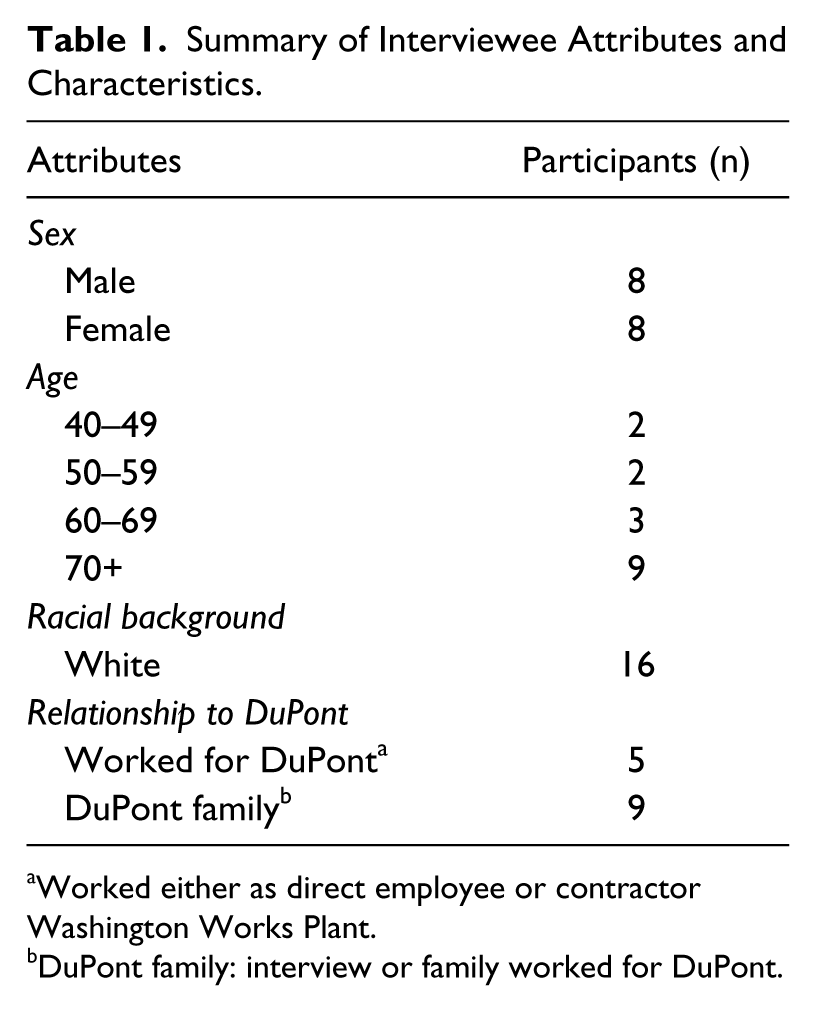
Worked either as direct employee or contractor Washington Works Plant.
DuPont family: interview or family worked for DuPont.
We transcribed the interviews and used NVivo 10 software to code the data, using themes from the interview protocol and the literature on exposure experience and biomonitoring report-back. Initial themes included levels of trust in research relationships, difficulties with uncertainty, and the nature of report-back procedures. Additional codes were developed as new themes emerged during the analysis, specifically economically based and place-based concerns that were important in framing the exposure experience. All uncited extracts and quotes came from our interviews.
We were mainly unable to differentiate people’s response between the two studies since most interviewees confused or conflated the studies and many answers apply to both. When we refer to opinions of the “EJ participants,” that is because those are the only people we set out to interview, and all of them also participated in the larger C8 Study. It is possible that this confusion arises partly from the passage of a decade, but public confusion over multiple studies in the same location is common (Scammell et al. 2009). Still, a number of studies show 80% to 90% accurate recall, compared to archival material and medical records, on simple sociodemographic information and physiological events even after 50 years (Berney and Blane 1997). Further, the C8 Study is more recent than the EJ Study and thus might be more at the forefront of people’s memories. In addition, the health diagnoses provided by the C8 Study were more salient than the EJ Study’s exposure data because health effects are better understood and more visibly experienced than chemical exposures. Still, we think the EJ Study helped inform recollections because it involved a level of closeness and trust between the smaller number of participants and their CBPR-oriented research partners.
The impact on people’s responses over a long-term gap between original participation and our interviews deserves some explanation. For various reasons, other studies of participants’ response to biomonitoring and household exposure studies have the same issue of long-term recall. In some studies, researchers, such as this team, come in later to examine something that the original researchers did not think to study; this was also true for Hoover’s (Hoover et al. 2015) work on the Akewesasne Mohawk community. In some studies, recollection was complicated by a combination of long waiting periods for both laboratory results and public health officials’ resistance to allowing it, as with an exposure study on Cape Cod (Brody 2014). For our purposes, it was important to examine people’s current understanding of exposure data because that is what drove them to presently reflect on the meanings and implications (e.g., future health concerns, long-term economic security, changes in purchasing and usage of products, public policy activities). Indeed, the whole history of community response to contamination told us that contamination episodes are a very long-range phenomenon, often stretching into one or even two decades because of the amount of time involved in research, corporate delaying tactics, public agency investigations, and litigation (e.g., Brown and Mikkelsen 1997; Fagin 2013). Further, sociologists highlight the centrality of “chronic technical disasters” that unfold over a long time as opposed to singular occurrences such as natural disasters (Kroll-Smith and Couch 1990).
Results
Overall, the majority of participants found the studies and report-back useful personally and/or for the community as a whole. People’s conceptualization of usefulness is influenced, as with many aspects of the exposure experience, by personal context, such as medical history and issues of place. Most notably, we found that participants largely framed their biomonitoring experiences around concerns for the local economy, which has long depended on the chemical industry for jobs and related economic developments. In discussing exposure experience that results from biomonitoring, we note that some responses seem to not be about biomonitoring. Clearly some people experienced their research participation more in terms of benefits of health screening for diseases and conditions (only part of the C8 Study) than for exposure measurements of PFOA. But this is not surprising in that there would not have been C8 Study health screening separate from biomonitoring; both were part of the same process established by the lawsuit. We group our analysis by these four themes: participants’ desire to receive their results, usefulness of learning results, accepting risk in a resource-dependent community, and hoping for safety in an unsafe environment.
Participants’ Reactions to Receiving Their Results
While IRB representatives have expressed concern that reporting exposure results back to study participants may cause undue distress, research in this field finds that such psychological responses are not at all common (Brown et al. 2010; Saxton et al. 2015); we found overwhelmingly that people want their results, even when the health implications are unclear (Tables 2 and 3). All participants we interviewed chose to receive their results from both studies. No participants expressed any emotional harm or panic caused by reportback. Only two respondents, a husband and wife who had strong ties to the DuPont plant, reported a strong emotional response when asked about learning their biomonitoring results. These emotions were not directed at the study or researchers but rather to those who had allowed the contamination:
[It made me] Mad.
Why?
Because we lived here for so many years and nobody had told us. In all these years we breathed this air and drank this water and nobody bothered to let us know.
It’ll make you mad angry and like she said you wonder why that you wasn’t informed of something like that.
And we still don’t know why.
Now I never go to the faucet to run a glass of water out, and that really don’t come to your mind. I was thinking there this morning I made coffee to see if you’d want coffee and I thought maybe you wouldn’t want to drink coffee with this water in this area.
Emotional Responses to Learning Results.

Usefulness of Personal Report-Back Studies.

More commonly, respondents reported that they were mainly surprised by the high levels of C8 found in their blood or that the results raised either health or economic concerns. For example, a DuPont retiree said: “Well, I was surprised that a lot of people’s [C8 levels] were higher than mine; had nothing to do with the plant down there.” As reflected in this quote, surprise is at least partially tied to meaning-making; as respondents made comparisons of their levels, they tried to explain the reason for the differing levels. The exposure itself raised concerns, but the resulting actions such as comparing results, reaching out to physicians, and attending community meetings were information-gathering activities rather than panicked responses. As one elderly woman said: “It wasn’t doomsday.” Furthermore, interviewees drew meaning of their results from their eco-social experience of living and working in a chemical production area. For example, several respondents expected to find C8 in their blood,
6
as one father commented: The thing I remember distinctly was, I expected them [C8 levels] to be elevated, there’s not any surprise in that really. But what surprised me was how high my . . . fairly small boy’s levels were compared to my wife’s and I.
This man went on to describe how his health history raised his concerns for what C8 exposure meant for his children and that having the results gave them information that could be useful to his children in the future. Overall, the sentiment is similar with most of our respondents—surprise gave way to meaning-making. The majority were pleased with their participation and felt that learning their exposure results was useful.
Impacts of Learning Results
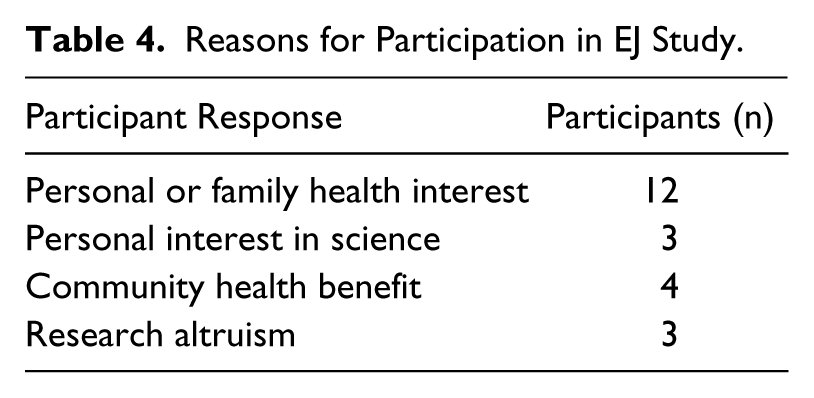
Usefulness, however, must be further explored, as each interviewee’s interpretation draws on personal and community contexts slightly differently (Table 4). For example, a married father of two and DCA member related that the information informed his curiosity but also grew to have more meaning only as more contextual information was applied to interpret it: As far as how useful that information was to me, I was just curious about the results, and as the study continued and things were going on, to try to understand what the levels were high and if there was evidence of risk. . . I mean health effects. Because remember, we first got the results and it was just “Here’s your number” but nobody really knew what that number meant in terms of potential harm, so more work needed to be done on that. So the number we originally received was sort of in a vacuum and as time went on more information was gathered and shared, then your numbers began to have some meaning to it.
Reasons for Participation in EJ Study.
Unlike previous report-back case studies, participants in the two C8 studies initially received personal exposure results and then later received additional study-wide results showing links between exposure and health outcomes, adding new interpretations to the individual results. This experience of iterative interpretation is a result of the community-first report-back model, and it is common in cohort studies, which keep in communication with participants over many years (Brody et al. 2014; Rudel et al. 2003).
The perceived usefulness of new information depends on how people perceive risk. When asked about the personal usefulness of learning her results, a local business owner responded, “It put my mind at ease. Other than that? No. I mean if it had been something alarming, yeah, it would have been useful. But it wasn’t.” Respondents also made useful connections between the report-back data and health issues, as with the aforementioned father of two, who had survived testicular cancer: Well, yes, in terms of maybe helping me understand that there might be a link to testicular cancer and might help me understand a little bit better why I came across it. More so, at least it’s given heightened awareness for us to keep an eye out on our boys and so in that regard it was very useful because at this day and age if testicular cancer is caught early and you can really do a pretty good job of taking care of it. . . . But at the same time without becoming obsessed about, I think we’ve been able to balance that because we don’t sit around and stew about it. As a result of the study we know there’s a possibility, so you just make yourself keep an eye on things and do the self-exams and make sure the doctors check you every year, that’s what you can do about it. You can’t sit around and let it dominate your life by any means. But you can certainly keep it on the radar.
A mother whose family was employed by DuPont spoke of the health benefits of the study for her family and the community:
7
Yeah, they actually found our son . . . in his early 40s, he was a diabetic and didn’t even know it. So actually, quite a few people who were in this area benefited from the testing. . . . It was real good because people had been to the doctor and had tests that had never been tested before, and had no reason. They felt good all their life so why go to the doctor?
Indeed, the C8 Study was an opportunity for people in a medically underserved area to access medical screening that otherwise would not have been sought out. Another mother in a “DuPont family” (the term often used to denote the participant or someone in their family working for the company) commented:
8
Personally it [the testing] settled in my mind what was thought to be a problem and what wasn’t. . . . My cancer marker was high. So my doctor said we’ll wait, and she checked me again in three months and it had gone up again! So she ran the scans—three ultrasounds—and there was no cancer. But I did have a blocked artery to my kidney, which saved my kidney! . . . I would’ve lost the kidney. There had been no symptoms. And I know people who didn’t know they had diabetes, so the study was really helpful in a lot of different ways.
When asked about the impact of the EJ Study on the community, responses were similarly positive, often linking the biomonitoring studies directly with the water clean-up. One DuPont retiree stated: Well they cleaned up our water, that’s one thing. We’ve been on this water ever since Little Hocking water started and before that we had a well and so I think that was a real plus to get the water cleaned up.
Participants’ belief in the usefulness of the biomonitoring studies somewhat differs from their reason for participation in these studies. As noted previously, equally large numbers of people thought the usefulness of the study was to inform personal and family health interests and to be useful to the community. But in response to why they participated, the dominant response was for personal or family health, with minimal interest in the EJ Study’s overall community health impacts and other social benefits. This makes sense in that people predominantly had personal health interests in the first place, even though they understood the utility of the research could also help the community.
When asked about the goals of the EJ Study, participants overwhelmingly believed that the main goal was to determine health effects, though none thought a goal was to determine exposure sources (Table 5). These responses do not mirror the EJ Study’s stated goals, which were to establish PFOA levels in blood, establish PFOA exposure source(s), establish links to health effects, and report results and exposure reduction strategies to the community, medical providers, and relevant authorities (Emmett et al. 2009). Further, due to the close proximity of the studies, it is understandable that participants might be confusing or conflating the EJ study with the C8 Study, which, as part of a lawsuit, could be more threatening to DuPont. Finally, as shown in Table 6, most expressed the importance of DuPont and the larger chemical industry to the local economy.
Participant Report of EJ Study Goals.

Need for Chemical Industry.
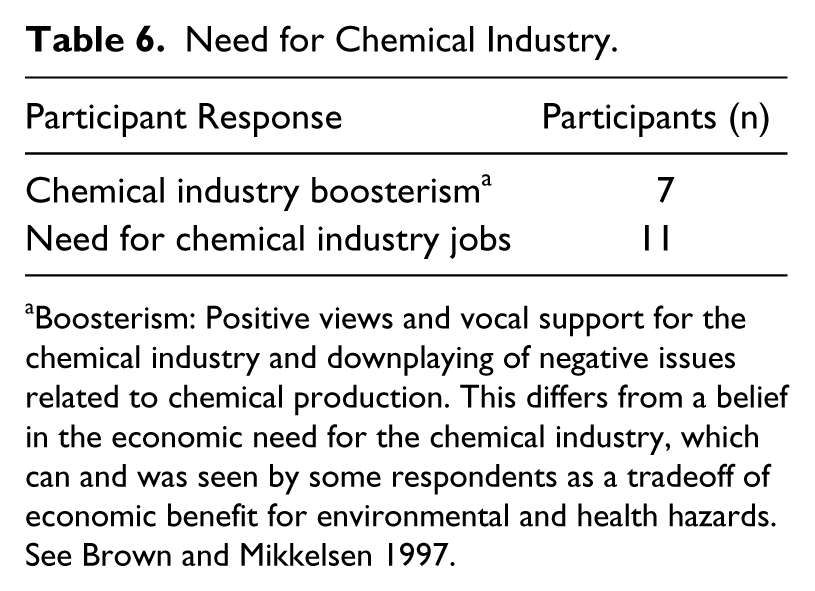
Boosterism: Positive views and vocal support for the chemical industry and downplaying of negative issues related to chemical production. This differs from a belief in the economic need for the chemical industry, which can and was seen by some respondents as a tradeoff of economic benefit for environmental and health hazards. See Brown and Mikkelsen 1997.
As Table 7 shows, most respondents attended one or more community meetings; spoke to their friends, neighbors, and other participants; but only three contacted the research team with questions. Instead, most took their results directly to their personal physicians, something not seen in the other studies we are analyzing for the larger PERE project. The expressed reasons for doing so were to provide their physician with potentially useful information relative to their health, which in turn would provide meaning to the information. 9
Participant Responses to Learning Exposure.
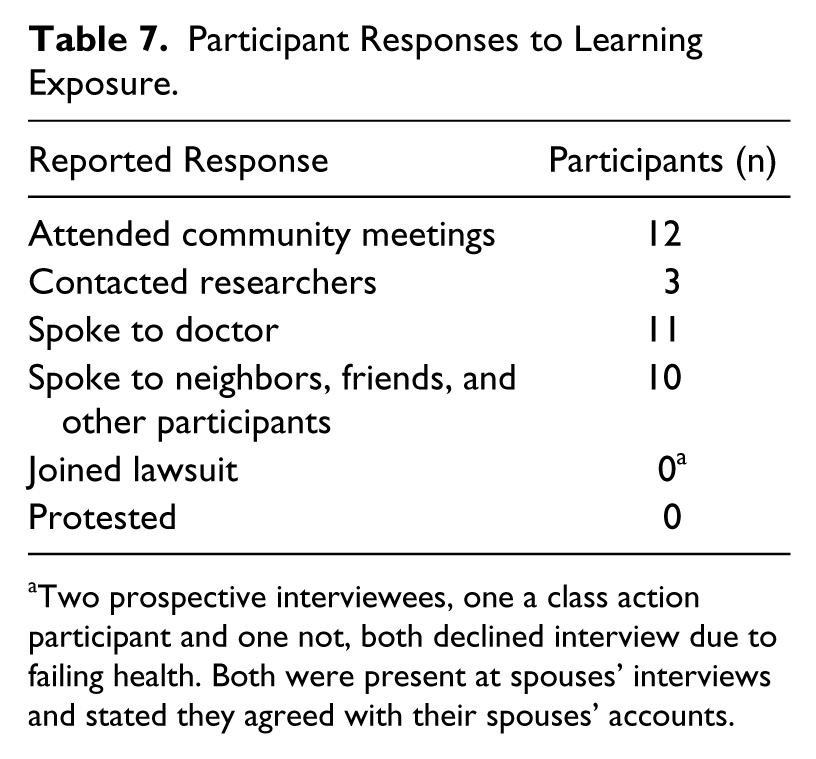
Two prospective interviewees, one a class action participant and one not, both declined interview due to failing health. Both were present at spouses’ interviews and stated they agreed with their spouses’ accounts.
Unfortunately, participants’ doctors were not that helpful in making sense of their results. Though the EJ Study researchers told participants that their physicians could contact the researchers for consultation, only two participants reported that their doctors were interested in the chemical exposure information. One remembered her doctor saying that it was “bullshit that DuPont would dump that without paying for health care upfront.” Another doctor explicitly instructed his patient “not to drink the water.” While we cannot know the physicians’ actual understanding and full response to their patients’ exposure data, physicians generally are under-educated about environmental health issues (Gehle, Crawford, and Hatcher 2011), though affected individuals often seek their guidance (Altman et al. 2008; Brown and Kelley 1996).
Accepting Risk in a Resource-dependent Community
EJ Study participants accepted a high degree of risk because of their dependence on the economic resources brought by DuPont, the larger chemical industry, and the sensibility of DuPont being central to the broader community. As one local business owner recounted:
10
Well to me, the study is looking to see if there is a culpability on a part of the industry causing problems and if they don’t determine there is a problem I hope they will not further harass our employers . . . I think a great deal of the paranoia about the exposure to chemicals is far overblown. I feel that . . . for example the . . . business about the organically-raised produce as opposed to that for which fertilizers are used and so forth. I think that is a great deal of a sham. I think that if were not for commercial fertilizer and so forth that our farm industry would not be nearly as productive as it is. I think pesticides are necessary. Having run a golf course, I know that they’ve [regulators] really made it extremely difficult to maintain a healthy course. Some of the requirements are understandable and some of them are slightly ridiculous.
A mother whose daughter worked in the chemical industry and whose son worked for DuPont commented:
It sounds like they was trying to prove DuPont in the wrong but, you know, what would our community have done without DuPont being down there . . . to have work for the guys?
Can you expand on that?
Well I think it’s a big thing that just like when they were trying to shut down Alchem. I mean our community depended on these companies. So we can support our families. I don’t know what we’d do if DuPont would be shut down. I really don’t.
Knowledge of explosions in other similar plants did not phase a former DuPont contractor, who worried the study would only harm DuPont: We cannot afford to lose DuPont . . . DuPont came here because no place else in the United States would accept them. Because their Teflon plants, they built three of them: one in Scotland, one in Germany, and one in West Virginia. And the ones in Scotland and Germany both blew up and . . . West Virginia was the only state in the union that would accept them. . . . The stuff is violent . . . the Teflon building were built three sides brick facing inland so to speak; the fourth side facing the river is plywood so that if it blows up it would blow out towards the river. . . . They’ve had one or two . . . I think one explosion. It occurred up high enough in the tower it blew one piece of metal up two miles or something. . . . This is very definitely a hazardous . . . so I was afraid that the study might cause them to pack off and leave so I did not look for local benefit to the study.
A DuPont retiree affirmed the culture of accepting hazardous externalities: That’s about the biggest employer I would imagine in the area. And there’s a lot of concern about this and what effect it might have on DuPont. A lot of these plants are closing down and there’s a lot of concern about it. You know I guess it’s just like coal miners. They go in the coal mines every day knowing that there is a danger there. It’s just about the same way with this; maybe there’s a problem there, maybe there’s a danger, but we got a make a living. So they still go through it.
This defense was also expressed by those who are not part of a “DuPont family”: I mean I do hope that the C8 problem will be taken care of, I do not have any ill feelings towards DuPont because . . . without them we would be hurting for jobs. So, if they will address the problem, which they seem to be.
Like coal mining, the chemical industry creates externalities that prompt interaction or even tradeoffs between health and economic well-being, and members of the exposed communities apply different values in their calculus, as a DuPont family respondent commented:
Well, you know, it [the chemical industry] does supply a lot of people with good paying jobs. You know, nobody wants to work minimum wage fast-food restaurant jobs all the time. And yet, you know, Washington County is considered one of the worst air-polluted counties there is, so we pay a price for that.
So you see it as a tradeoff?
An unfortunate tradeoff.
Concern for the well-being of DuPont showed up in people’s responses for the question of what they thought the research goals were. Surprisingly, three people said that the study was created to damage the chemical industry. Local context helps to explain these responses. In 2003, when the study started, legal action was underway against DuPont and local water services including Little Hocking had issued reports of PFOA water contamination to their members. Residents’ exposure to PFOA-contaminated water was confirmed at this time, so it is understandable participants would not cite this as a study goal. Residents were taking a public notion of risk that differs from a calculated risk, such as epidemiologists might measure. In thinking about and acting on the tradeoff of potential chemical exposure in exchange for job and community economic security, residents were indeed taking a common approach to risk. That is, even if people don’t call something a risk, they are making risk calculations.
Hoping for Safety in an Unsafe Environment
One way in which participants dealt with this balancing act between knowledge of pollution and reliance on the polluters’ economic impact was to put faith in safety and mitigation efforts, both at the individual level and at the corporate level of DuPont’s safety efforts. At the individual level, a father with a professional degree spoke of conscious decision making based on known exposure factors when it came to choosing where to live: Well it was kind of ironic because when we moved here . . . west of town, we purposefully looked for a home out west because, the reason being we wanted to mitigate to some degree the poor air quality. We wanted to be upstream of the plants and the prevailing current usually is west to east and so we wanted to be west of the plants so we didn’t get the stuff being blown in our direction. And I found it almost laughable, if you will, in terms of the irony that we successfully moved to an area that we perceive to have better air quality and ended up right in the middle of a site with contaminated drinking water.
Similarly, a local businesswoman spoke of the necessity to take personal precautions due to the presence of the chemical industry when asked about the concentration of chemical production in the area: Well, chemical plants . . . because there is water, transportation, and then you had West Virginia who wasn’t too picky about the environment. And evidently Ohio wasn’t either, because there’s a bunch of ’em here; and it’s really the base of our economy. Ah, I do worry about . . . the blow up. I probably wouldn’t want to live within the area that would evacuated—one of the reasons we live over the hills . . . we had to evacuate one time when the Shell plant caught fire . . . they took extra precautions. I can say it was overblown, but they feared the worst. So that’s what you do, you take precautions. And we did.
The previous quotes express how respondents negotiated the contradictions of living in an area one believes to be contaminated. Interestingly, the previous two answers were given by perhaps our most financially successful respondents based on their employment—an academic professional and a successful business owner, neither with direct or family connections to DuPont—and who had the luxury of mobility should they want to leave.
We would expect loyalty to DuPont to be directly related to one’s personal relationship with the company, yet results were mixed. Only two former DuPont workers were active boosters for DuPont. Two other DuPont contractors spoke of personal experience with safety failures at DuPont, but only one continued to see the company as unsafe.
One former DuPont contractor, a “non-booster,” talked of getting “a Teflon high” while working in the Teflon Division: That’s the only place I’ve ever got hurt. I worked forty-some years, and I was working in their powerhouse, and we were working on some pumps right inside the boiler house, and the guy who was working with me, we were up towards the control room. Well, we noticed two people down towards the outside doors had fainted. So I went to the control room and told ’em that we need medical down there, and so they came and got him and took him. And there probably wasn’t another twenty minutes, two more guys that were working there, we seen they were passed out. . . . It was what they called “high boiler off of Teflon.”
Another contractor spoke of a similar contradiction between DuPont’s pronounced safety precautions and their actions: Well, I’ve been in so many safety meetings and stuff that they’ve always went over different chemicals . . . the different ways you could be exposed, so I had an idea about how different chemicals do and I knew that before they ever come out with a study. So my only thing was, did they just pump the stuff in the ground for it to get in the groundwater. . . . Yeah, I didn’t understand how they done it.
These expressions of distrust, especially coming from two people who had worked under those conditions, are striking when counterpoised with the fact that seven of the respondents, including the contractor with the “Teflon high,” expressed trust in DuPont’s safety concerns, arguing that the firm “went overboard” so much that “you just can’t hardly work down there anymore.”
Another DuPont retiree echoed this change from the less safe past to the safer future and also pointed a finger at a split between formal employees and contractors: Well, when I first started down there it was pretty well kind of like a family-oriented company. It was a good place to work even when I left there. But I know since then things have tightened up, you know. Things are tight everywhere. And probably some shenanigans that we pulled back then would get you out the gate real quick, although we did do our work. And as far as any lost time accidents, there were darn few. I was impressed with their safety. I think it was a good thing. I know all the time I was there they had people working on construction and people with different labor unions working in there and some of those guys didn’t like all that safety, they liked to do it their way. But they had to or they wouldn’t be working.
This trust that DuPont takes safety seriously was also expressed by those with no direct connection to DuPont, such as a local business owner: I think they are very safety-minded, because they want to keep these plants open. And I think they will do everything possible to be safe. I mean they want to make the product and I don’t want them to go overseas.
People were thus able to acknowledge past failures and hold on to a justification that gives hope that new practices, technologies, and beliefs will prevent future failures.
Beyond safety, participants have a clear sense that even when they are criticizing DuPont, the company is a central component of their community. They were willing to litigate and criticize even though they also depended on the company for clean water and for overall economic support. Similar to Auyero and Swistun’s (2007) study of the exceedingly polluted Flamable neighborhood of Buenos Aires, people found themselves enmeshed in a situation where they couldn’t see clearly beyond the intense contamination and developed a fatalistic acceptance of their environment. In such situations, perhaps a clear recognition of the extent of contamination can be too threatening, especially if people cannot easily move away. Hence this hoped-for safety is a type of normalization of the situation since in reality much contamination remains and a new activist group has been formed with its eponymous title, “Keep Your Promises DuPont.” The local residents are very tied to their area, and it is unlikely that many of them could move. Even if they could, they might be aware of the problem faced by Woburn residents who left that well-known contamination episode with its childhood leukemia cluster; a number of residents moved to diverse locations and discovered they were in the midst of a new contamination episode and that there was truly “no safe place” (Brown and Mikkelsen 1997).
Discussion
There were several limitations to this research. We had to rely on the research team of the original study to do recruiting for us, and they lacked sufficient resources, so we were only able to interview 16 of the 20 participants we sought (the PERE Study sought 20 respondents from each of eight biomonitoring studies). Given the difficulty of reaching participants, we sought the first 20 that the original study team could locate, so there was no attempt at random selection. Nor do we know how many participants contacted by the original team refused the invitation for our interview. Because this study took place 10 years after the initial study, people’s memories were less clear, and some people responded with both current and past perspectives. Such conflation appears to us as quite typical of the nature of memory, which is constantly reshaped by a continuing sequence of occurrences in the contamination episode. In fact, the very nature of our broader project on biomonitoring studies is to see how people reflect back on something that occurred in the past and for which they were not initially told would be revisited later on. Each development in the case—for example, initial discovery of the problem, recruitment into the study, resolution of part of the litigation, DuPont’s ongoing failure to comply—would affect people’s revised understanding. Further, people often conflated the EJ Study we focused on with the larger C8 Study. But in some ways, the limitation of the long time between study and our interview is a potential benefit in yielding a historical component of being able to access such a long-range perspective. Indeed, it is quite possible that long-term reflection, even on top of confusion over the two studies, yields an understanding of how people presently understand the severe contamination in their community that is a long-term reflection that takes into account various things that have happened since the original research began. Another facet of the long time frame is that the relative lack of health concern we found stems from the fact that people normalized that concern over the 10-year duration.
Overall, participants’ experience of receiving personal exposure results was positive, supporting the usefulness of individual and community report-back as a tool to balance informational disparities between contaminated communities and corporate polluters. Report-back information was interpreted by individuals through existing contexts, especially the local economy. Personal beliefs and issues of place can greatly influence the meanings people assign to biomonitoring data and the responses to contamination they construct. In future studies, researchers may wish to consider this context in decisions about how they communicate results, for example by providing more clarity about study goals to assure people that the intent is to support the community, not hurt it economically. Additionally, it will help to suggest solutions that are economically viable.
Future studies could more directly address people’s views of the relationship between their personal situation and their view of living in a contaminated place. In our own work (Adams et al. 2011), we conducted pre-interviews, and that provided valuable information on people’s eco-social history and prior activism as well as their expectations of what the study could provide them. Here, we were constrained by the fact we were retrospectively examining people’s responses to another study that we did not initiate. Future studies of place-based contamination provide opportunities for participants to voice the often unspoken beliefs about their surroundings, including their understanding of the local economy, important social groups and institutions, public discourse, and thoughts about the future.
The place-based history that provided context for our participants’ exposure experience reflects the long history of tradeoffs between livelihood, health, and environmental concerns in Appalachia, as noted by the participant who compared the need for jobs in the polluting chemical industry to the well-known history of coal miners carrying on in the nation’s most hazardous occupation. This former DuPont worker tied chemical jobs to the deep history of Appalachian industrial culture: the sacrifice of lives and landscapes for often temporary economic production. This cultural narrative is seen in the state’s marketing the “West Virginia Edge,” selling itself as the cheapest place to produce chemicals in North America due to low regulation and state-funded special chemical production zones offering tax and cooperative incentives (Harbour 2012). Even though Little Hocking members live across the river, they are subject to this political economic investment, which has provided both jobs and contamination. For many of our respondents, the economic need of the community seems to have trumped health and environmental concerns.
Political economic decisions that create tradeoffs between health and economic benefit are emblematic of the history of unequal industrial relationships in Appalachia. While this leads scholars like Gaventa (1982) to argue that this systemic industrial power led to quiescence on the part of Appalachian residents, others highlight that it leads to resistance through alternative forms. Cable (1993) argues that in Appalachia, individual forms of resistance are common but they may not always form into collective resistance because actors interpret their situation as too constrained to have the desired effect. Cable’s study of chemical contamination of Yellow Creek, Kentucky, found that people made complaints and attempted to work through institutional channels for years before structural changes by the environmental movement made collective action seem more viable.
In Little Hocking, one can see similar responses. The Tennetts’ initial grievances were first taken to unresponsive authorities and finally expressed through a lawsuit. The discovery period for this initial lawsuit found proof of widespread PFOA contamination in DuPont’s own documents, making class action litigation against DuPont a viable legal strategy. The class action lawsuit provided a -personally- and collectively-based strategy to directly address the polluting party, get information about the meaning of one’s exposure, and gain access to resources. The lawsuit itself was an act of resistance to DuPont, an individual act that the later class action lawsuit formed into a collective action. The settlement of this lawsuit led to the C8 Health Project, another form of institutional response through which individuals could gain exposure information. LHWA residents also joined the EJ Study, and the culmination of both studies is a body of scientific information that balances the informational disparity between community and industry.
In reporting individual results, the EJ Study developed an approach that was largely shaped by community partners, making the process more user-friendly. Yet most health researchers have not been sensitized to the need to consider such issues of community role at all points in the study process. In following the NIEHS grant mechanism requirement of having a social scientist on the project, the EJ research team included an ethnographer who made evaluations of the community response and attitudes, though she did not specifically study people’s understanding of the report-back process. We suggest that in future biomonitoring studies researchers include that type of analysis as a central concern.
Our findings also suggest a need to look more directly at the interaction between participants and their personal physicians in studies that report personal exposures. While the EJ study provided access to contact study experts including physicians involved in the study, only 3 participants took advantage of this offer, compared to 12 who contacted their own doctor. However, the EJ Study team reports that a significant number of participants spoke with the team’s physician. The EJ team did Grand Rounds on the study at the local hospital, but few physicians attended. The team also went to what were at the time unprecedented efforts to provide results interpretations to the patients. This contrasts with the C8 Study, which included many tests for which there was no satisfactory meaning for community application. Since medical professionals overall are not well trained in chemical exposure response, we see four necessary components for future study. First, reaching out to medical professionals, both personal and study related, should be addressed more systematically through future research to see if physicians’ lack of environmental health knowledge is typical. Second, researchers should explain to their research participants that personal physicians may not have the requisite expertise and offer participants other sources for information. Third, medical education should include chemical exposure and medical response. Exposure is a ubiquitous reality, not a surprising phenomenon, and health care systems need to better prepare for dealing with contamination and any resulting effects. Expanded education on environmental factors in disease can help, but more importantly, physicians need workshops and other training in how to engage with patients on these issues. One model is the Pediatric Environmental Health Specialty Unit program, which offers physician education and consultation. Fourth, specific research projects should examine how physicians interact with patients in terms of environmental exposure.
In summary, biomonitoring has rapidly expanded as a tool for documenting people’s exposure to pollutants, but with emerging contaminants such as PFOA, scientists’ ability to measure exposures has preceded their ability to understand health implications for those affected. Biomonitoring in contaminated communities will prompt interpretation through local place-based contexts. In this study, biomonitoring data became something more than just a blood level; it became a health indicator but also a potential economic threat. In this way, biomonitoring science becomes inherently sociological, transitioning from numbers on a page to both embodied and embedded place-based meaning.
Footnotes
Funding
The authors disclosed receipt of the following financial support for the research, authorship, and/or publication of this article: “Ethical and Legal Challenges in Communicating Individual Biomonitoring and Personal Exposure Results to Study Participants: Guidance for Researchers and Institutional Review Boards.” 1R01ES017514 - 01A1 National Institute of Environmental Health Sciences (NIEHS). NIEHS is a government agency that funds research in the public interest. J. Matthew Judge, Phil Brown, Julia Brody, and Serena Ryan received funding from the grant. “Perflourinated Chemicals: The Social Discovery of a Class of Emerging Contaminants.” SES 1456897 National Science Foundation (NSF). NSF is a government agency that funds research in the public interest. J. Matthew Judge and Phil Brown received funding from the grant.