



Abstract
Using longitudinal survey data from the Socio-Economic Panel Study (N = 3,003 respondents with 22,165 individual-year observations) and exploiting temporal and regional variation in state-level unemployment rates in West Germany, we explore differences in trajectories of individuals’ self-rated health over a period of up to 23 years after leaving education under different regional labor market conditions. We find evidence for immediate positive effects of contextual unemployment when leaving education on individuals’ health. We find no evidence for generally accelerated or decelerated health deterioration when leaving education in high-unemployment contexts. We find, however, that individual unemployment experience when leaving education is associated with worse health and with more accelerated health deterioration in high-unemployment contexts. The cumulative experience of unemployment after leaving education does not mediate the influence of early labor market experiences for long-term health outcomes. In addition, our analyses indicate no gender differences in these results.
The most recent financial and economic crisis of 2007 through 2008 has hit young adults hard through severe labor market insecurities and high unemployment rates in many Organisation for Economic Co-operation and Development (OECD) countries. 1 On the one hand, this has raised concerns of persisting disadvantages for a “lost generation” (e.g., Bell and Blanchflower 2011; Scarpetta, Sonnet, and Manfredi 2010). On the other hand, evidence suggests that recessions may have positive outcomes, such as reductions in concurrent overall mortality (Ruhm 2000). It is unclear, however, whether these concurrent positive health effects translate in lasting health advantages over the life course, and there is an ongoing debate about possible negative long-term consequences of the experience of economic adversity—especially at the transition from education into employment—for various dimensions of adult health (e.g., Burgard and Kalousova 2015; Cutler, Huan, and Lleras-Muney 2016; Suhrcke and Stuckler 2012). Taking a multilevel and life course perspective, our study contributes to this debate, focusing on the contextual unemployment rate when leaving education and its long-term consequences for self-rated health in Germany. To this end, we draw on microdata from the German Socio-Economic Panel Study (SOEP) and exploit temporal and regional variation in state-level unemployment rates between 1992 and 2015 in West Germany to estimate longitudinal growth curve models of individuals’ self-rated health up to age 49.
Our study brings together two complementary and often-used theoretical perspectives on individuals’ health (and health inequalities): a life course perspective (e.g., Bauldry et al. 2012) and a contextual perspective (e.g., Diehl and Schneider 2011). We build on the cumulative (dis)advantage framework to understand how individual experiences and contextual conditions early in the life course have distant, long-term consequences for individuals. This framework suggests that initial relative disadvantage results in systematic divergence in life course trajectories over time, because an initial unfavorable relative position becomes a detriment that produces further relative disadvantages (e.g., DiPrete and Eirich 2006). With regard to health, many empirical studies provide strong evidence for permanent effects of adverse conditions early in life (e.g., Brandt, Deindl, and Hank 2012; Haas 2008; van den Berg, Lindeboom, and Lopez 2009). Such unfavorable circumstances may be determined by micro- (such as individuals’ biographical experiences), meso- (such as the family of origin’s socioeconomic status), or macro-level conditions (such as contextual unemployment) and their interplay. We develop expectations and examine how micro- and macrolevel conditions at the transition from education to employment interact to shape the subsequent health trajectories into mid-adulthood.
This issue has been addressed by a nascent literature based on European and U.S. studies, which provide inconclusive evidence regarding health outcomes of adverse economic conditions when leaving education (e.g., Cutler, Huan, and Lleras-Muney 2015; Hessel and Avendano 2013; Maclean 2013). However, these results are exclusively based on cross-sectional snapshots of individuals’ health at single points in time. Our study extends this literature in three important respects. First, we consider how economic conditions when leaving education affect individuals’ dynamic health trajectories into prime working age. To this end, we complement previous snapshot results with longitudinal analyses using growth curve models, which have not yet been utilized in this literature. This allows us to make a second contribution by examining separately whether adverse economic conditions when leaving education are immediately associated with health and/or whether initial adverse economic conditions persistently affect health over time. Third, and most innovatively, we examine how individual (un)employment experiences over time mediate and/or moderate the consequences of initial exposure to adverse economic conditions when leaving education and may link adverse economic conditions when leaving education to individuals’ health dynamics over time. To this end, we build on the literature on unemployment scarring effects (e.g., Gangl 2004).
Background
Previous Empirical Evidence
Few studies have assessed the relationship between economic conditions when leaving education and later-life health. On the one hand, Maclean (2013) reports that at age 40, U.S. men who left school when the state unemployment rate was high had worse mental and physical health than men who did not, whereas their female counterparts had fewer depressive symptoms. In a sample of Europeans ages 50 to 74, Hessel and Avendano (2013), on the other hand, detect better physical functioning in men but worse health in women who graduated in an economic situation characterized by a high national unemployment rate. While Garrouste and Godard (2016) also suggest a damaging effect of leaving school in a bad economy (namely, the 1970s recession in the United Kingdom) on women’s health, they do not find any evidence indicating a beneficial effect for men. The study by Cutler et al. (2015), which is based on several rounds of Eurobarometer data, is the only one reporting no statistically significant gender differences. They find that among men and women ages 25 to 55, higher unemployment at graduation is associated with poorer subsequent general health, lower life satisfaction, and riskier health behaviors, such as a higher probability of obesity, smoking, and everyday drinking. Maclean (2015), however, shows that U.S. middle-aged men—but not women—who left school in an economic downturn consumed more alcoholic drinks and were more likely to report heavy and binge drinking than otherwise similar men.
In summary, the results of this small number of studies are inconclusive. Further research is needed to assess (1) whether economic conditions when leaving education matter for later-life health, (2) how this depends on individuals’ own employment situation, and (3) what the temporal processes are that underlie the cross-sectional pieces of evidence in prior literature.
Why and How Do Economic Conditions When Leaving Education Affect Health Trajectories?
A life course framework: Health trajectories
Building on a general cumulative (dis)advantage framework (see DiPrete and Eirich 2006), we first concentrate in our study on the role of macrolevel labor market conditions at the time of leaving education for individuals’ health trajectories. Leaving education and entering the labor market are crucial aspects in the transition to adulthood, playing a particularly important role in determining future opportunities in the labor market and elsewhere (e.g., Buchmann and Kriesi 2011; Haas, Glymour, and Berkman 2011). In this phase, individuals may be particularly prone to stress and risky health behaviors. Recent evidence suggests that—from a life course perspective—individual experience of unemployment early in life is particularly harmful, whereas spells of unemployment experienced after age 23 were shown to have little bearing on self-reported health at age 50 (Bell and Blanchflower 2011). Next to health outcomes, previous research has also shown that those leaving education in a bad economy suffer from long-run earnings declines and higher rates of non-employment (e.g., Oreopoulos, von Wachter, and Heisz 2012; Raaum and Røed 2006).
We expect that adverse economic conditions when leaving education are associated with worse health throughout the life course. This association may be due to direct and indirect effects of economic conditions: adverse labor market prospects may directly initiate negative health trajectories, for example, due to lower well-being and worse health behaviors when leaving education (see below for more details). This initial negative shock may persist over one’s life course independent of adult socioeconomic status (“latency model”). Following the latency model, one would mainly expect an “initial-level effect”—that is, a shift in intercepts, of adverse labor market conditions when leaving education on individuals’ health (see Figure 1, left panel). However, due to cumulative (dis)advantage processes, the initially lower level of health may aggravate over time, leading to “accelerated-deterioration effects”—that is, more negative time gradients, also independent of adult socioeconomic status (see Figure 1, right panel). Such accelerated deterioration would also be expected based on the “pathway model,” which predicts that economic conditions and poor health in young adulthood may impact later life health indirectly through impaired adult socioeconomic attainment, for example, individual unemployment experience.
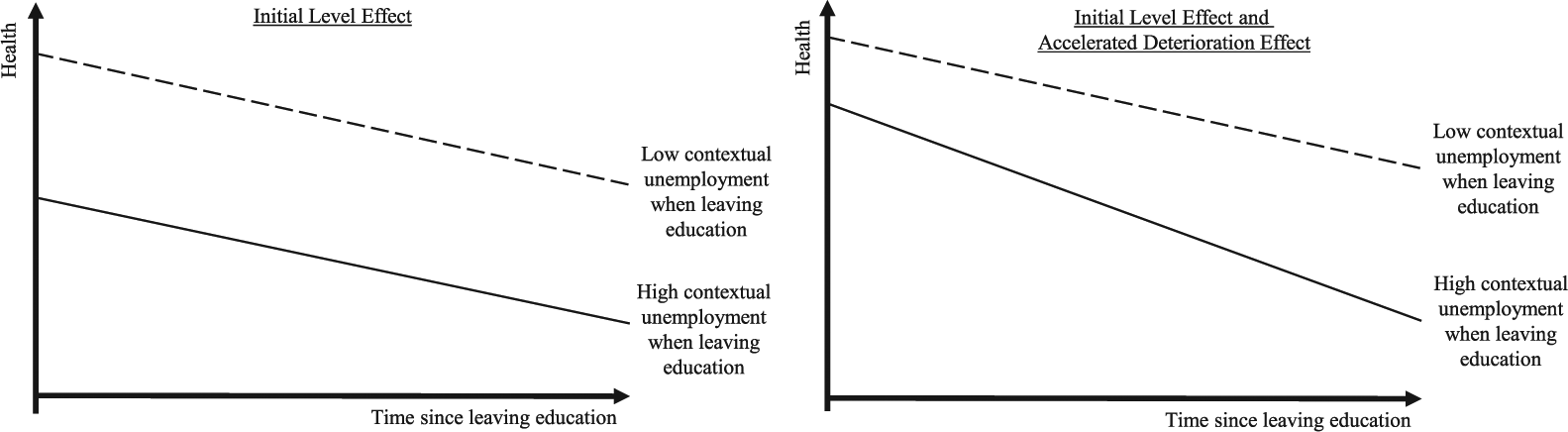
Hypothetical Initial-level Effect and Accelerated-deterioration Effect of Contextual Unemployment When Leaving Education on Health.
In the following, we discuss initial-level effects in more details. We then elaborate on the development of health over time and accelerated-deterioration effects. We finally combine the overall economic situation and concomitant individual experiences and how the latter may mediate and moderate the initial experience of adverse economic conditions.
Labor market conditions when leaving education and health: Initial-level effects
At the macrolevel, high contextual unemployment at graduation may be detrimental to all individuals, regardless of individuals’ characteristics (e.g., Kahn 2010; Raaum and Røed 2006). One can think of several channels through which such a negative impact may occur immediately at the time of leaving education. If, for example, the aggregate unemployment rate is high, the number of unemployed individuals in one’s social networks who are personally affected may also be high, imposing network strain. In addition, individuals become aware of the economic recession and high unemployment due to media coverage and word of mouth. This awareness of adverse labor market conditions may lead to an increase in distress, anxiety, and anticipation of a worse employment situation, which may reduce subjective well-being and result in lower health regardless of one’s own employment status (Sverke, Hellgren, and Näswall 2002). Several studies support the notion of a negative correlation between high contextual unemployment and several indicators of well-being and health (e.g., Luechinger, Meier, and Stutzer 2010; Novo, Hammarström, and Janlert 2001). There is also evidence for negative effects of earlier economic downturns at ages 45 through 59 for health in ages 60 and above (Hessel and Avendano 2016; see also Coile, Levine, and McKnight 2014).
In contrast, many studies have also found procyclical fluctuations of general mortality in the United States (Ruhm 2000, 2005), Germany (Neumayer 2004), and other OECD countries (Gerdtham and Ruhm 2006) using aggregate data. In other words, economic downturns are found to be associated with less mortality at the population level. Potential explanations are, for instance, a smaller number of traffic accidents, less air pollution, less work stress, and reduced smoking if the economy contracts (Burgard, Ailshire, and Kalousova 2013). The consumption of healthy foods, however, decreases in economic downturns (e.g., Ásgeirsdóttir et al. 2014). Moreover, even though individuals’ time spent on recreational exercise seems to increase during a recession, their total physical activity might still decrease (e.g., Colman and Dave 2013). Evidence also has been found for a positive association of the contextual unemployment rate and the occurrence of psychological problems at the aggregate level (Ayers et al. 2012). The latter finding indicates that by focusing on mortality, which of course is a highly important but limited measure of health, the negative consequences of economic downturns may be underestimated (Burgard et al. 2013).
Expectations for the consequences of transitioning from education to employment in a context with high unemployment could be formulated in a positive and a negative direction. For young people, the negative consequences of high contextual unemployment at leaving education may outweigh potential protective effects when considering a subjective health measure, as we do in the current study, and not mortality. This is even more so because young people face higher hurdles to find employment than more experienced workers (Madsen et al. 2013), and stress and anxiety among young people may therefore be considerably higher, leading to worse health.
Long-term development of health and accelerated-deterioration effects
Once individuals’ health has been initially reduced after being exposed to adverse economic conditions when leaving education, cumulative (dis)advantage may lead to accelerated deterioration of health over time. Thus, an initial health shock—especially if it occurs during a critical period of the individual’s life course—may directly trigger additional health problems and increasingly worse health (e.g., Haas 2008). In other words, prior bad health leads directly to current bad health. There may be manifold processes linking prior and current health. For instance, early obesity has been found to be related to later-life disability, even if individuals are no longer obese (Ferraro and Kelley-Moore 2003).
Furthermore, accelerated-deterioration effects in health may also be due to the negative consequences of contextual unemployment when leaving education for socioeconomic attainment, consistent with the pathway model of indirect effects of contextual unemployment. Previous literature has shown that leaving education and entering the labor market in times of high unemployment rates is associated with higher prevalence of unemployment over individuals’ life courses (e.g., Kahn 2010; see also Coile et al. 2014). Previous research has found the effects of leaving education during periods of high unemployment to be more detrimental for men’s than for women’s long-term labor market outcomes (Taylor 2013). This may be due to typical male occupations, mostly in the private sector, being more affected by economic downturns than typical female occupations (Şahin, Song, and Hobijn 2010).
Individual unemployment, which is likely to follow from entering the labor market in times of high unemployment rates, is likely to negatively affect individuals’ health (e.g., Burgard et al. 2013; Burgard, Brand, and House 2007; for an analysis of the reverse causal relationship from health to unemployment, see Arrow 1996). First, unemployment is a stressful life event that reduces individual well-being, which in turn affects individuals’ health. Second, unemployment may further affect health through a lack of social and economic resources (Coile et al. 2014). Individual unemployment experiences may thus mediate the effect of contextual unemployment at graduation on later-life health. These effects of individual unemployment may be long-lasting but are likely to depend on the context in which individuals experience unemployment, as shown in the literature on unemployment scarring effects for labor market outcomes, such as income (Gangl 2004).
Theoretically, the accelerated-deterioration effects need not be linear throughout the life course. A stressful phase at labor market entry may just have a short-term effect on individuals’ health deterioration. If increased anxiety over job security diminishes once the entry in the labor market has been managed successfully, the accelerated-deterioration effect may vanish, leading to similar age gradients for those with and without exposure to high unemployment rates when leaving education. However, empirical evidence contradicts this expectation, as unemployment has been shown to exert long-term negative influences on subjective well-being, and individuals mostly do not return to baseline levels (e.g., Clark et al. 2008).
Interaction between contextual unemployment and individual unemployment
Individual unemployment may not only mediate the effect of contextual unemployment but may also interact—as recently discussed by Calvo, Mair, and Sarksian (2015) and Pearlman (2015)—yielding a joint effect. In a simple model, both disadvantages may just add up; that is, in times of tight labor market conditions, unemployed individuals have the worst health outcomes. In an interactive model, for instance, the unemployed may be more stressed if they additionally face a bleak overall labor market situation. Thus, contextual unemployment at the time of leaving education may have a more negative and long-lasting effect on individuals’ health if the individual is unemployed. This will lead to more negative initial-level effects of contextual unemployment. It may also contribute to increased health deterioration over time because of cumulative disadvantage, where initial adversity triggers increasingly worse health.
However, aggregate unemployment may also attenuate the effect of individual unemployment. For example, high unemployment rates may destigmatize the individual experience of unemployment and reduce its negative health effects (e.g., Buffel, Van de Velde, and Bracke 2015; Clark 2003). Empirical research is inconsistent. Findings reported by Flint et al. (2013) suggest that in Britain, higher local unemployment rates seem to protect individuals from the negative psychological effects of unemployment. Drydakis (2015) reports that being unemployed during the financial (and labor market) crisis in Greece resulted in a higher deterioration of health than before the crisis. Exploiting U.S. data, Noelke and Avendano (2015) suggest that recessions may be protective in the absence of job loss but hazardous in the presence of job loss.
Hypotheses
We formulate hypotheses about initial-level effects—that is, differences in subjective health directly after leaving education (differences in intercepts; see Figure 1, left panel)—and time gradients—that is, how subjective health changes over time after leaving education (differences in slopes; Figure 1, right panel). We hypothesize that higher contextual unemployment rates when leaving education will result in a negative initial-level effect on health independent of individuals’ own experience of unemployment when leaving education (Hypothesis 1). This initial health shock is supposed to be worse for those who are unemployed in the first year after leaving education (Hypothesis 2). Moreover, we assume that cohorts leaving education under adverse labor market circumstances will exhibit accelerated-health-deterioration effects—that is, more negative time gradients (Hypothesis 3). We expect that, due to the intensifying effect of contextual unemployment on individual unemployment experience, accelerated-health-deterioration effects over time are more negative for those who are unemployed in the first year after leaving education in high-unemployment contexts (Hypothesis 4). The accelerated-health-deterioration effects are suggested to be partially mediated by individual experience of unemployment over the life course in accordance with the pathway model (Hypothesis 5). Finally, we expect the general pattern of initial negative health shocks and accelerated deterioration to hold for both genders but to be more pronounced for men than for women (Hypothesis 6).
Data and Methods
Data and Sample
We used longitudinal data from the German SOEP (version 32.1; Wagner, Frick, and Schupp 2007), a household panel study in which all household members ages 17 and older are interviewed annually through face-to-face and self-completion questionnaires. The SOEP commenced in 1984 with several supplementary samples added to the panel over time. Since 1992, self-rated health, our outcome of interest, has been measured (with a gap in 1993). We used all available data until 2015, the most recent observation year available.
We focused on respondents who left education in West Germany (excluding Berlin), because the distinct economic conditions in East Germany since reunification make it difficult to compare contextual unemployment between both parts of the country. 2 Beginning in 1992, we started following respondents if they were age 17 or older from their first interviews after they left education. We did not consider respondents who left education unusually late (i.e., after age 30; similar to Maclean 2013). We continued following respondents until they either permanently dropped out of the panel, reached age 49, or were censored in 2015 (the last observation year). The median age in our sample was 28 years. We lost less than 5% of individual-year observations due to missing data. Our analytical sample included 3,003 respondents with 22,165 individual-year observations. We used an unbalanced panel in which the number of observations per respondent varied. For 96 respondents, only one observation was recorded. For half of the respondents, at least 10 measurements were recorded. For 108 respondents, 23 yearly repeated measurements were observed.
Measures
Our outcome of interest was self-rated general health (see Table 1 for descriptive statistics), which was based on the following question: “How would you describe your current health?” We reversed the answer categories so that they ranged from “bad” (1) to “very good” (5). Self-rated general health is the most widely used health indicator in population surveys and has been shown to be a strong predictor of objective health outcomes, such as mortality (e.g., Idler and Benyamini 1997), even if other measures of current health are controlled (for a critical discussion, see Ploubidis and Grundy 2011).
Descriptive Statistics.
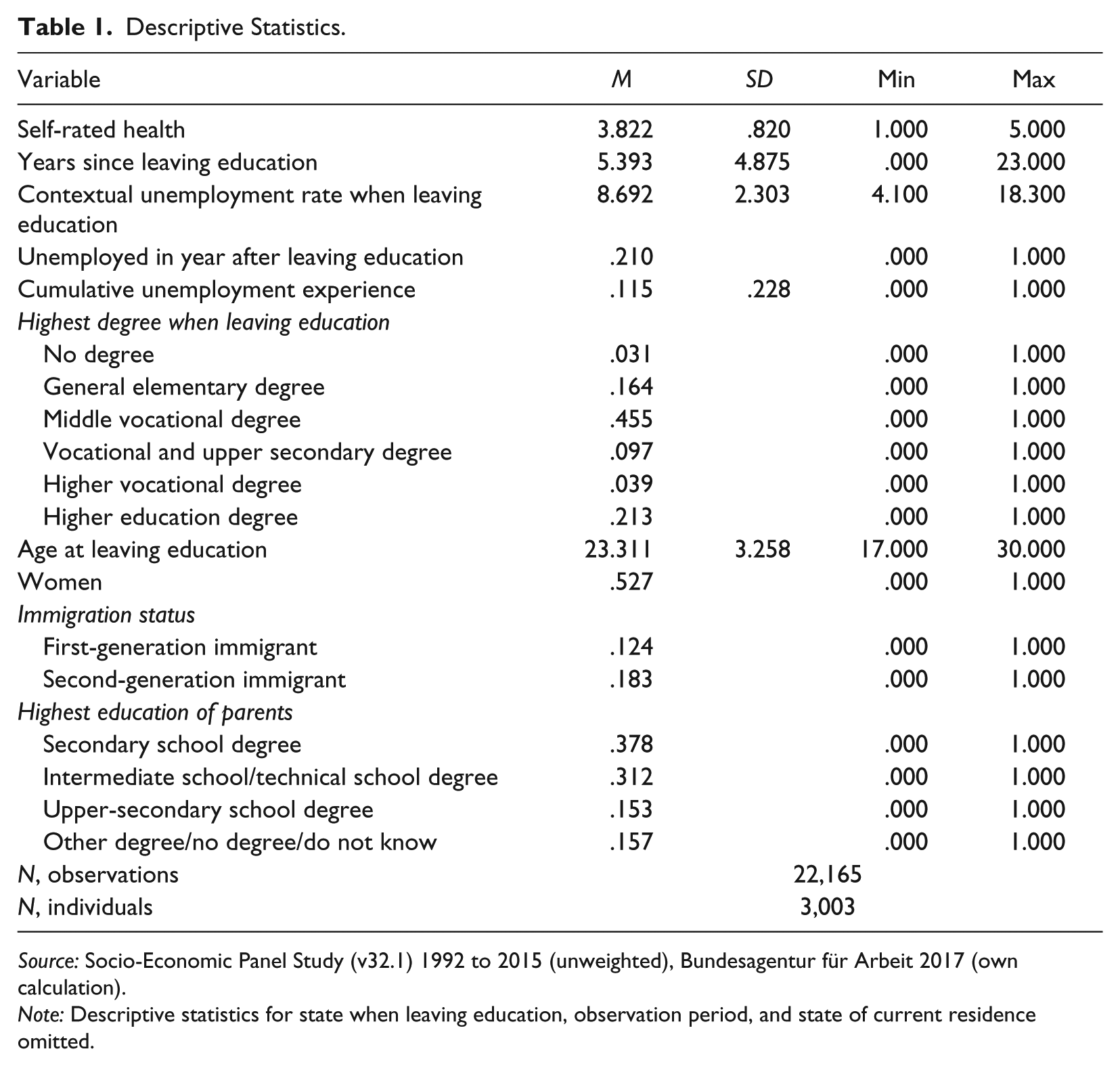
Source: Socio-Economic Panel Study (v32.1) 1992 to 2015 (unweighted), Bundesagentur für Arbeit 2017 (own calculation).
Note: Descriptive statistics for state when leaving education, observation period, and state of current residence omitted.
The main explanatory variable was the contextual unemployment rate in the year respondents left education, which we drew from official sources (Bundesagentur für Arbeit 2017) and matched to the SOEP data at the level of 10 West German federal states, excluding Berlin. The year of leaving education was defined as the year in which the first exit from education (which may have been from secondary school, vocational training, or tertiary education) was observed that was followed by a period out of education (which may have included unemployment, employment, being out of the labor force, or other noneducational statuses) of at least one calendar year (for an overview of typical ages at which education is left, see OECD 2015:590). Military service, which was compulsory for men for most of our study period, was treated as being in education. Note that respondents may have left education by dropping out without obtaining a degree. Figure 2 illustrates the variation in unemployment rates across federal states and years of leaving education that we observe in our data. 3 Note that Germany fared comparatively well during the global economic crisis after 2007–2008. We report robustness checks with alternative contextual unemployment measures below.

Variation in Unemployment Rates across Federal States and Years of Leaving Education in West Germany.
We used years since leaving education to capture variation in self-rated health over time (time gradient), where 0 indicated the initial year after having left education. In addition, we used two measures of individual unemployment experience. To test Hypothesis 2 about a stronger health shock among the initially unemployed, we created a binary indicator of unemployment when leaving education. This variable was coded 1 if respondents had experienced any unemployment for at least one month during the first calendar year after leaving education and was coded 0 otherwise. 4 To test Hypothesis 5 about the mediation of the accelerated-health-deterioration effect through individual experience of unemployment over the life course, we created a cumulative measure of monthly unemployment experience, which indicated the share of months respondents had been unemployed since they entered their first job. For instance, a value of .05 indicated that a respondent had been unemployed for 5% of the time since entering his or her first job. Those who had not yet entered their first job were coded 0.
We included the following time-constant control variables: highest degree obtained when leaving education (based on the International Standard Classification of Education 1997: no degree, general elementary degree, middle vocational degree [reference], vocational and upper-secondary school degree, higher vocational degree, higher education degree), 5 age at leaving education, women (men [reference]), immigration status (no immigration [reference], first-generation immigrant, second-generation immigrant), and highest school degree of both parents (secondary school [reference], intermediate school/technical school, upper-secondary school, other degree/no degree/do not know). We also included two sets of fixed effects for 10 federal states of leaving education and for 23 survey years (1992, 1994 through 2015).
Methods
We estimated linear growth curve models with random intercepts and random slopes to predict self-rated health over time (Singer and Willett 2003:45ff). 6 Our fully specified model to test Hypothesis 1 and Hypothesis 3 was of this type:
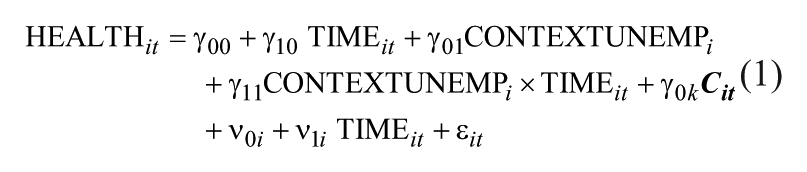
where HEALTH it is the self-rated health status of respondent i at time t, and γ00 is the average intercept, with the random coefficient ν0i capturing individual-specific variation in intercepts. Such variation may occur if unobserved characteristics of individual respondents are related to consistently higher or lower self-rated health across all observed time points. We assumed that such unobserved characteristics were uncorrelated with the other variables in the model. TIME it is the years since leaving education. The related coefficient γ10 may vary across individuals by including the random coefficient ν1i in the model. We allowed the random coefficients ν0i and ν1i to be correlated. Thereby, unobserved, time-constant characteristics of individuals may have simultaneously modified the initial level and over-time change in self-rated health. We included the time since leaving education as a linear term in our models following previous research (Bauldry et al. 2012). CONTEXT-UNEMP i is the contextual unemployment rate when leaving education at the level of federal states. 7
After first reporting a benchmark model without interaction, we then included an interaction between years since leaving education and the contextual unemployment rate when leaving education. Thereby, the effect of contextual unemployment may vary over time to test Hypothesis 1 and Hypothesis 3.
To test Hypothesis 2, on differences in initial-level effects, and Hypothesis 4, on differences in health deterioration effects of contextual unemployment between those unemployed in the first year after leaving education compared to those not unemployed, we included a three-way interaction of the time since leaving education, the contextual unemployment rate, and the individual unemployment status in the year of leaving education. This three-way interaction allowed to separate effects of being unemployed on the intercepts and slopes of individual-specific growth curves conditional on the contextual unemployment rate. We expected a negative interaction term between the contextual unemployment rate and the individual unemployment status, indicating a lower intercept for the unemployed in states with high unemployment rates (Hypothesis 2). We also expected a negative three-way interaction term indicating a more negative time slope for the unemployed in states with high unemployment rates (Hypothesis 4). To test Hypothesis 5, we included a measure of the cumulative unemployment experience of individuals. We expected that when controlling for this variable, the hypothesized negative interaction effect between years since leaving education and the contextual unemployment rate when leaving education would be reduced.
Results
Main Results
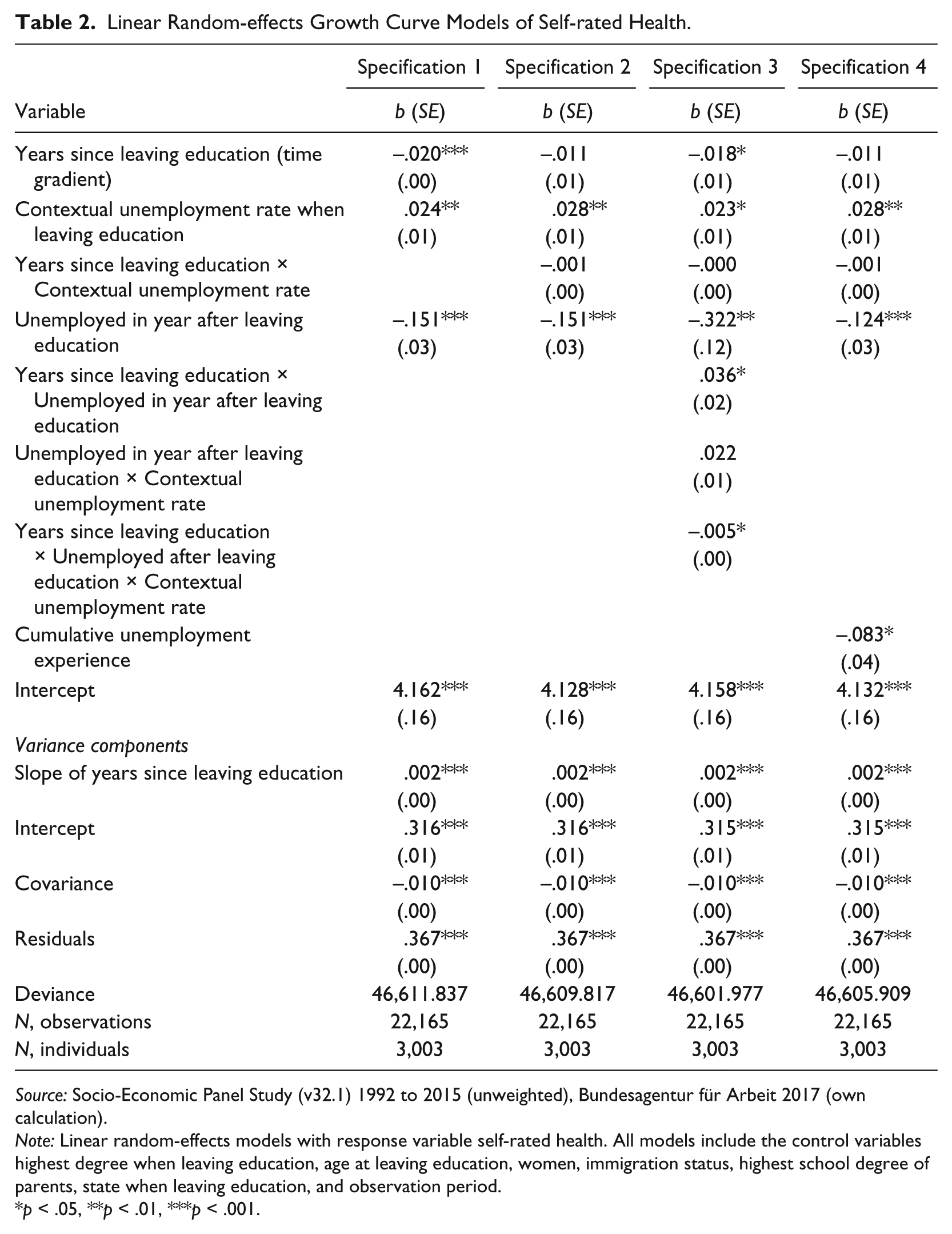
Table 2 shows estimation results from random-effects growth curve models predicting self-rated health since leaving education. Specification 1, in which the contextual unemployment rate is not yet interacted with the years since leaving education to separate initial-level from time-gradient effects, suggests that years since leaving education is associated with worse health. Against our expectations, the contextual unemployment rate is positively associated with self-rated health. A 1-percentage-point higher contextual unemployment rate at graduation improves self-rated health by .024 points, on average, pooling all years since leaving education and controlling for the individual unemployment experience when leaving education. The estimated effect for contextual unemployment remains similar when not controlling for individual unemployment experience (not shown).
Linear Random-effects Growth Curve Models of Self-rated Health.
Source: Socio-Economic Panel Study (v32.1) 1992 to 2015 (unweighted), Bundesagentur für Arbeit 2017 (own calculation).
Note: Linear random-effects models with response variable self-rated health. All models include the control variables highest degree when leaving education, age at leaving education, women, immigration status, highest school degree of parents, state when leaving education, and observation period.
p < .05, **p < .01, ***p < .001.
We use Specification 2 to test Hypothesis 1 about a negative initial-level effect independent of individual unemployment and to test Hypothesis 3 about accelerated-health-deterioration effects when leaving education in high-unemployment contexts (Table 2). In this specification, we allow the estimated effect of contextual unemployment when leaving education to vary over time by including an interaction between years since leaving education and the contextual unemployment rate. The main effect of the contextual unemployment rate now indicates the shift in intercept associated with higher contextual unemployment at zero years since leaving education, that is, the initial-level effect. Against our expectations in Hypothesis 1, our model indicates a positive initial-level effect, as already evident in Specification 1. Individuals who leave education in states with higher unemployment have initial self-rated health that is .028 points better than individuals leaving education in states with lower unemployment. The estimated effect is substantially small, in particular when comparing to the coefficient for being unemployed in the year after leaving education (–.151). The estimated interaction effect of years since leaving education (time gradient) with the contextual unemployment rate when leaving education is negative but not statistically significant at the 95% confidence level. The estimated interaction effect is also substantially small and has little effect on self-rated health over time. This is in contrast to Hypothesis 3.
To illustrate our results, we show the predicted growth curves for self-rated health based on Specification 2 in Figure 3 for two hypothetical contexts when leaving education with low (one standard deviation below the mean) and high (one standard deviation above the mean) unemployment, respectively. The figure shows the substantially small but statistically significant differences in the growth curves by contextual unemployment rates at the time of leaving education. About eight years after leaving education, the difference between individuals from high- and low-unemployment contexts is no longer statistically significant in our data. Note again that the slopes for both predicted growth curves are not statistically significantly different from each other.
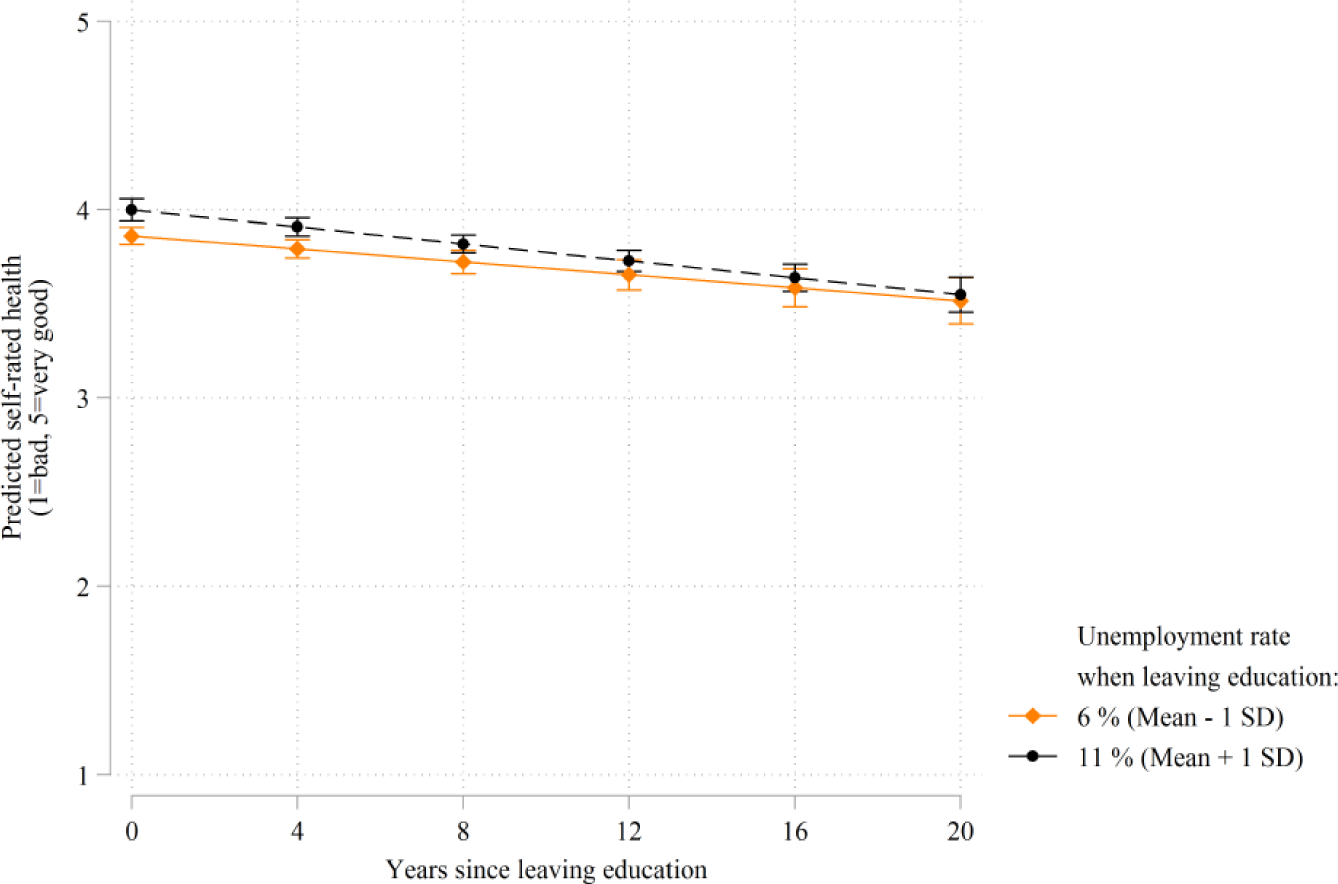
Predicted Growth Curve of Self-rated Health by Contextual Unemployment Rate When Leaving Education.
We use Specification 3 in Table 2 to test Hypothesis 2, about a worse initial health shock for those who are unemployed in the first calendar year after leaving education. Hypothesis 2 is rejected as we do not find a significant negative interaction effect between the contextual unemployment rate and being unemployed in the year after leaving education, conditional on years since leaving education being zero. Thus, within the first year after leaving education, the contextual unemployment rate has a similar estimated effect on subjective health for those unemployed in the first year after leaving education and for those not unemployed.
To test Hypothesis 4, we examine the three-way interaction between contextual unemployment, individual unemployment, and time since leaving education in Specification 3. This interaction is statistically significantly negative, in line with the hypothesis, but substantially small. We plot predicted growth curves illustrating these interactions in Figure 4. The predicted growth curves show that those with individual unemployment experience who leave education in low-unemployment contexts close their health gap, relative to those without individual unemployment experience from similar contexts over time. In contrast, when originating from high-unemployment contexts, those with individual unemployment experience when leaving education have a growing health gap compared to individuals without individual unemployment experience over time, due to accelerated deterioration of their health. This health gap remains statistically significant at the 95% confidence level even 20 years after leaving education.
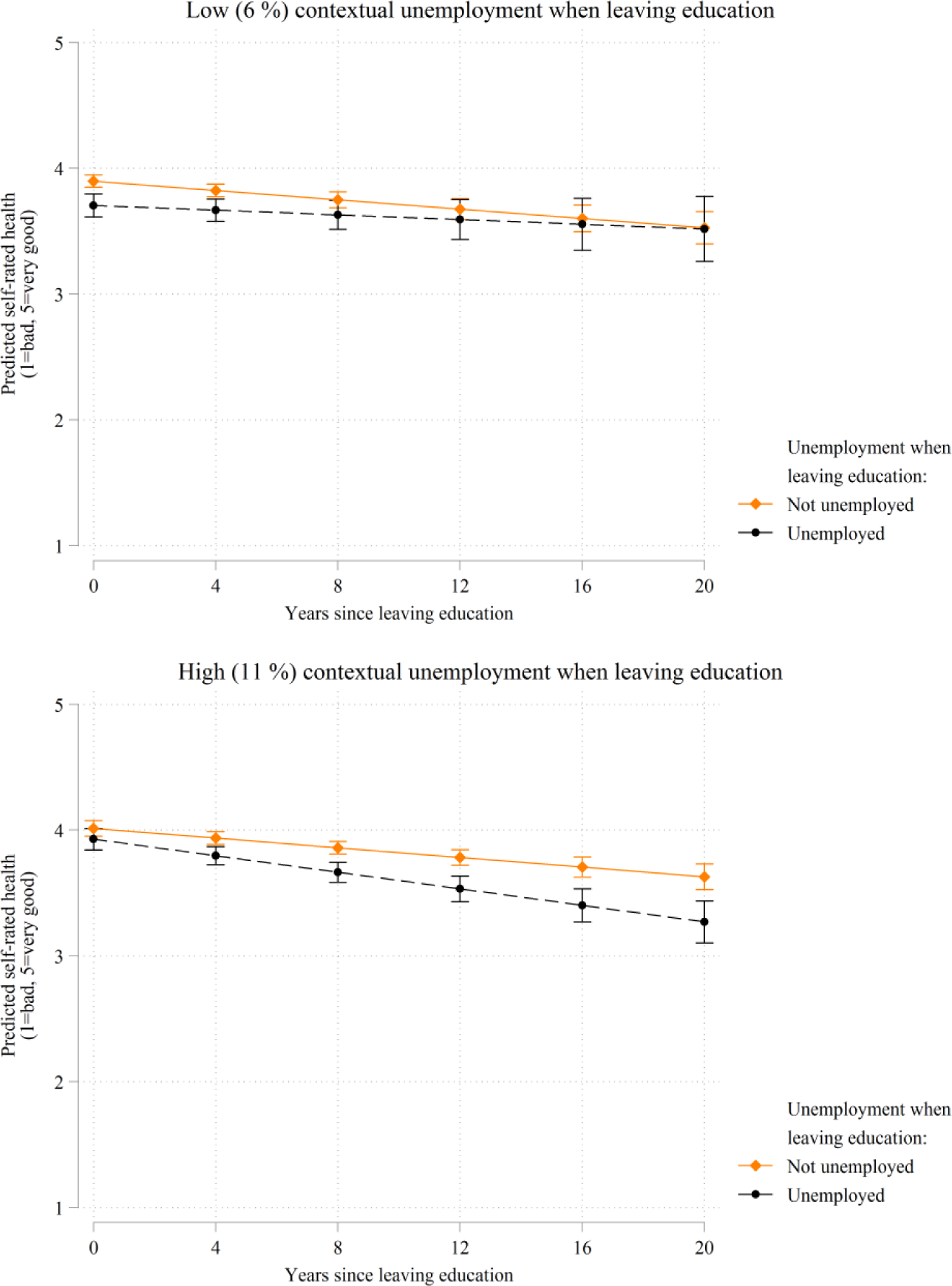
Predicted Growth Curve of Self-rated Health by Contextual Unemployment Rate and Individual Unemployment When Leaving Education.
Specification 4 in Table 2 provides a test of Hypothesis 5, about the partial mediation of the accelerated-health-deterioration effects through the experience of individual unemployment over the life course. We expected to find a reduction in the interaction effect between years since leaving education and the contextual unemployment rate once we included the individual unemployment experience as a potential mediator. However, we already established that the interaction between years since leaving education and the contextual unemployment rate is statistically nonsignificant. We do not find any change in the estimated interaction effect between years since leaving education and the contextual unemployment rate when leaving education after including our measure of cumulative unemployment experience. Based on these results, we reject Hypothesis 5 as the individual cumulative unemployment experience is not able to “explain away” at least part of the interaction between years since leaving education and contextual unemployment. We find that those individuals with a longer unemployment duration since they entered their first job have worse health. Noteworthy, cumulative unemployment experience explains part of the estimated negative effect of being unemployed in the first year after leaving education.
Finally, we reestimate Specification 2 from Table 2 separately for women and men and test for gender differences in coefficients, as we expected to find more pronounced effects for men in Hypothesis 6 (see Table 3). Against our expectations in Hypothesis 6, we do not find significant differences for the main explanatory variables, indicating that the consequences of contextual unemployment for health are similar for women and men.
Linear Random-effects Growth Curve Models of Self-rated Health by Gender.
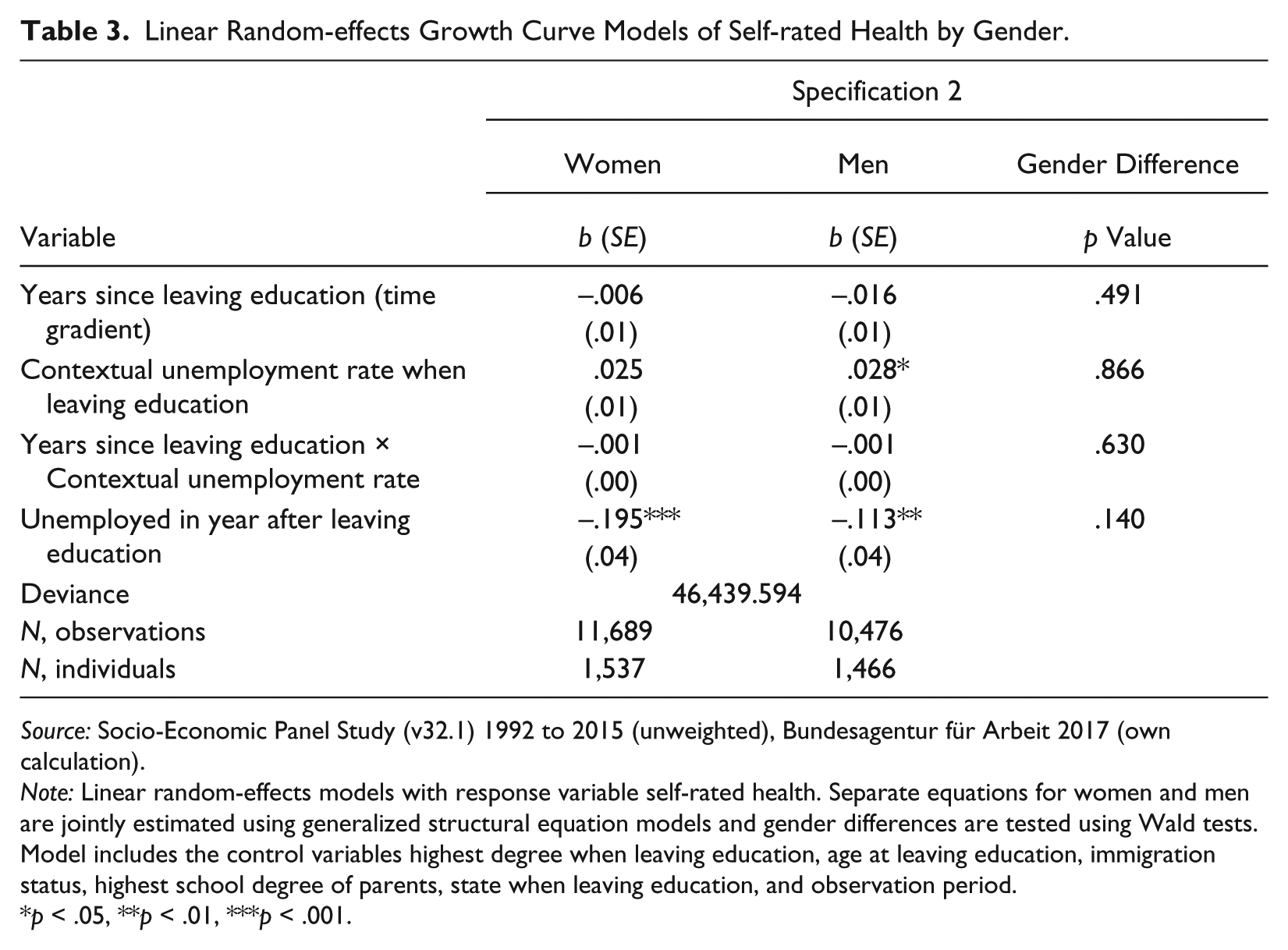
Source: Socio-Economic Panel Study (v32.1) 1992 to 2015 (unweighted), Bundesagentur für Arbeit 2017 (own calculation).
Note: Linear random-effects models with response variable self-rated health. Separate equations for women and men are jointly estimated using generalized structural equation models and gender differences are tested using Wald tests. Model includes the control variables highest degree when leaving education, age at leaving education, immigration status, highest school degree of parents, state when leaving education, and observation period.
p < .05, **p < .01, ***p < .001.
Alternative Measures of Contextual Unemployment
The contextual unemployment rate in the main analysis is based on the general state-level unemployment rate in the year respondents left education. In Table 4, we examine a number of alternative measures of contextual unemployment using Specification 3 to revisit Hypothesis 1 through Hypothesis 4. 9 First, the decision to stay in or leave education may be endogenous to the contextual unemployment, such that individuals continue schooling in contexts with high unemployment. To address this, we followed Cutler et al. (2015) and replaced the actual, self-chosen age of leaving education with two alternative ages. We choose age 18 (the youngest age at which Germans can legally leave education) and the median age at leaving education for respondents’ highest educational degree obtained. We then matched contextual unemployment rates for these alternative ages. Second, we examined moving averages over three years for the general contextual unemployment rate at the state level. Third, we used the yearly state-specific deviations from the West German average unemployment rate in a given year. Fourth, we examined the state-specific deviations from the average state-level unemployment rates in the last three years. 10 Finally, we used the contextual youth unemployment rate (ages 15–24) at the state level, instead of the general unemployment rate.
Linear Random-effects Growth Curve Models of Self-rated Health with Alternative Contextual Unemployment Measures.

Source: Socio-Economic Panel Study (v32.1) 1992 to 2015 (unweighted), Bundesagentur für Arbeit 2017 (own calculation).
Note: Linear random-effects models with response variable self-rated health. All models include the control variables unemployed in year after leaving education, highest degree when leaving education, age at leaving education, immigration status, highest school degree of parents, state when leaving education, and observation period.
Age at leaving education is set to 18, time gradient is years since age 18, contextual unemployment rate is measured at age 18.
Age at leaving education is set to median age for highest educational degree when leaving education, time gradient is years since median age of leaving education, contextual unemployment rate is measured at median age of leaving education.
p < .05, **p < .01, ***p < .001.
For the main effect of the contextual unemployment rate, the results are inconsistent across alternative unemployment measures (Table 4). While the estimated effects are mostly positive and have similar effect sizes, only when using a three-year moving average does the estimated effect reach statistical significance at the 95% confidence level. Similarly, for the interaction of years since leaving education and the contextual unemployment rate, we find inconsistent effects where most estimated effects are negative but mostly statistically insignificant. Again, we find no convincing evidence that the consequences of contextual unemployment differ by individual unemployment experience within the first year after leaving education. Only for the three-way interaction of the years since leaving education, contextual unemployment rate, and individual unemployment do we find clear and consistent evidence across five out of six contextual unemployment measures for negative estimated effects. Individual unemployment when leaving school is also consistently estimated to have a negative effect on subjective health. The only exceptions are when using unemployment measures for age 18 and the median age, but in these models, individual unemployment when leaving education and the contextual unemployment rate are not measured concurrently. In sum, the evidence from alternative measures of contextual unemployment supports only Hypothesis 4. The conclusions from these alternative findings are overall in line with our main results.
Discussion
Against the background of considerable public and academic concerns about possible short- and, more importantly, long-term health disadvantages for young people resulting from the most recent economic crisis (e.g., Burgard and Kalousova 2015), our study took a multilevel and life course perspective to investigate the extent to which such concerns are warranted. To do so, we exploited temporal and regional variation in West German state-level unemployment rates between 1992 and 2015 to estimate random-effects growth curve models of the association between contextual unemployment when leaving education and individuals’ self-rated health up to age 49, also considering individuals’ own unemployment experience.
Three main findings emerge from our empirical analysis. First, for the specific country case considered here, our study provides evidence for positive initial level effects of contextual unemployment when leaving education on individuals’ health. However, this result is sensitive to model specifications. We find no evidence for generally accelerated or decelerated health deterioration when leaving education in high-unemployment contexts. These results are good news. In the West German context (further discussed below), economically adverse circumstances at the beginning of one’s occupational career seem not to be as damaging to individuals’ health as proposed in some of the previous literature and formulated in our expectations.
Second, we do find, however, that individual unemployment experiences when leaving education are associated with initially poorer health, independent of the state-level unemployment rate. While we find some evidence that the initial health disadvantage after individual unemployment fades over time, there seem to be long-lasting scarring effects of individual unemployment when leaving education for individuals’ health. We do not find evidence that the accelerated deterioration of self-rated health when leaving education in high-unemployment contexts is mediated by individuals’ cumulative unemployment experience over their life courses. Thus, through their effect on population composition, with larger proportions having been unemployed at early stages of their employment careers, economic recessions may lead to health declines for large subgroups in society even in the absence of a negative main effect of contextual unemployment on individuals’ well-being.
Third, and adding to the last finding, we show that those who were unemployed in a high-unemployment context when leaving education constitute a particularly vulnerable group in that they are characterized by a steeper health deterioration trajectory over time compared to their counterparts from low-unemployment contexts. This innovative result is consistent with findings from other strands of literature suggesting that the strength of scarring effects of unemployment on individuals’ subsequent labor market outcomes is context-dependent (e.g., Brandt and Hank 2014; Gangl 2004). Whereas the size of this estimated effect in our study is small, it is robust and statistically significant across a wide range of alternative measures of contextual unemployment. Despite the small effect size, we think that the effect is substantially important, because it shows that the scarring effect of individual unemployment for health is persisting and even compounded when leaving education in high-unemployment contexts. We find no evidence for gender differences in our analysis.
Against our theoretical expectations, but aligned with most prior literature on the concurrent effects of the economic cycle on mortality (e.g., Neumayer 2004; Ruhm 2000), we find that the contextual unemployment rate when leaving education is associated with modest health advantages. This finding is also in line with part of the prior literature on health consequences of contextual unemployment when leaving education (for women, Maclean 2013; for men, Hessel and Avendano 2013). Previous literature has suggested several explanations for such a relationship. For instance, economic downturns may lead to fewer traffic accidents, less pollution, and less work stress (Burgard et al. 2013). Health may also be better in high-unemployment contexts because of a concurrent increase in health-promoting behaviors, such as reduced smoking during economic downturns (Ólafsdóttir, Hrafnkelsson, and Ásgeirsdóttir 2015).
Our study leaves open the question of why individual unemployment when leaving school in interaction with contextual unemployment is negatively associated with health through time. Building on the pathway model, we hypothesized that subsequent unemployment experience may explain the persisting association but found little evidence for this mechanism. At this point, we can only speculate about alternative explanations. For instance, lower incomes, more turbulent careers, and underemployment as likely consequences of individual unemployment and contextual unemployment (Taylor 2013) may be other mechanisms to explore in future research. Initial stress and health disadvantages from unemployment experienced when leaving school may also directly be associated with poorer health later in life through cumulative disadvantage. For instance, early obesity following from unhealthy eating during economic downturns (Ásgeirsdóttir et al. 2014) may lead to later-life disability (Ferraro and Kelley-Moore 2003).
Beyond these open questions, our study is limited in several ways. First, whereas self-rated health is a widely used and generally accepted summary measure of how people perceive their overall health status, recent studies also suggest that there may be differences in how individuals assess (or report) their health depending on their sociodemographic characteristics (e.g., Ploubidis and Grundy 2011). Still, we prefer self-rated health as our main outcome over alternative health measures as it (1) is a good overall measure capturing different aspects of individuals’ health, (2) offers more variation than most other health outcomes available in the SOEP, and (3) is measured at more interviews than most other health indicators in the SOEP. This is crucial for our analysis, which builds on following individuals over a long observation period.
Second, one might argue that (some) West German federal states are too large to capture relevant regional contexts for individuals and federal states may not overlap with labor market regions. However, previous research has underlined the relevance of long-standing regional differences between federal states in Germany to understand spatial variation in health and mortality (e.g., Neumayer 2004). Third, even if states represent appropriate contexts, with only 10 contexts, we have relatively little regional variation in unemployment rates. The small number of states also limits the statistical power of our analysis, increasing the chances of type II errors at the contextual level. Future research may investigate smaller regional entities—such as districts (e.g., Diehl and Schneider 2011)—to address these shortcomings.
Fourth, there may be limits to the generalizability of our findings to other societal contexts in two respects. State-level unemployment rates in West Germany during our relatively long observation period (1992–2015) varied between 4% and 18%, whereas, for example, the national unemployment rate in Greece doubled abruptly from about 10% before the most recent economic crisis to 21% in 2010 through 2013 (Drydakis 2015:44). It is possible that even the most adverse labor market situation when leaving education observed in our study was not severe and abrupt enough to have a substantial effect on school leavers’ health.
Additionally, concerning generalizability, whether or not a specific level of unemployment (at the time of leaving education) has consequences for individuals’ health is likely to depend on the welfare state context. The conservative (West) German welfare state, for example, has a tradition of strong unemployment insurance and regulations of labor markets through employment protection policies but is relatively weak in its active labor market policies (Gangl 2004). In such an institutional setting, the evidence provided here suggesting that young adults with individual unemployment experiences tend to suffer health disadvantages probably provides a lower-bound estimate compared to leaner welfare states. It is worth noting, however, that even under such relatively favorable circumstances, we still find negative health consequences. Cross-nationally comparative research on the interplay between individual and contextual unemployment experiences at the transition from education into work is needed to gain a better understanding of the institutional conditions shaping health trajectories.
In sum, we contribute innovative evidence in at least three respects to the growing literature on the health consequences of leaving education when the labor market is tight. To begin with, we showed that in the relatively generous welfare state of (West) Germany, initial experience of contextual unemployment is protective for self-rated health of young adults. We also showed that cross-sectional evidence at specific points during individuals’ life courses may provide an inaccurate picture of the overall consequences of leaving education during high unemployment for some subgroups. Only a longitudinal perspective can distinguish the initial-level effect from the development in health over time. In this regard, our results indicate that the interplay between contextual unemployment and individual unemployment when leaving education triggers persisting health disadvantages that grow with age. This highlights how individual life course health trajectories vary with contextual conditions. Hence, our analysis shows that processes of cumulative (dis)advantages may be fully unpacked und understood only when considering the social and economic conditions in which individual biographies unfold.
Footnotes
Notes
Author Biographies
References
Supplementary Material
Please find the following supplemental material available below.
For Open Access articles published under a Creative Commons License, all supplemental material carries the same license as the article it is associated with.
For non-Open Access articles published, all supplemental material carries a non-exclusive license, and permission requests for re-use of supplemental material or any part of supplemental material shall be sent directly to the copyright owner as specified in the copyright notice associated with the article.
