



Abstract
This study uses recent data to investigate if smoking initiation diffuses through friendship networks over the high school period and explores if diffusion processes differ across schools. One thousand four hundred and twenty-five racially and ethnically diverse youth from four high schools in Los Angeles were surveyed four times over the high school period from 2010 to 2013. Probit regression models and stochastic actor-based models for network dynamics tested for peer effects on smoking initiation. Friend smoking was found to predict adolescent smoking, and smoking initiation diffused through friendship networks in some but not all of the schools. School differences in smoking rates and the popularity of smokers may be linked to differences in the diffusion of smoking through peer networks. We conclude that there are differences in peer effects on smoking initiation across schools that will be important to account for in network-based smoking interventions.
Most adult smokers start using cigarettes before they are 18 years of age (Giovino et al. 1995), making adolescence a critical stage for prevention. Data from the National Youth Tobacco Survey indicate that youth cigarette smoking rates in the United States have declined in the past decade, but despite these encouraging changes, there remain several concerning trends, particularly among high school students who have not shown significant declines in smoking since 2009 and whose rates of smoking remained stable (9.2%–9.3%) between 2014 and 2015 (Dutra and Glantz 2017).
Although risk factors for youth smoking are complex, influence from peers and friends has been identified as a consistent and important predictor of smoking initiation and cigarette use among early and late adolescents (Ennett et al. 2006; Fujimoto and Valente 2012; Go et al. 2012; Green et al. 2013; Haas, Schaefer, and Kornienko 2010; Kobus 2003). Longitudinal social network studies that model social selection and social influence effects jointly (Alexander et al. 2001; Go et al. 2012; Green et al. 2013; Haas and Schaefer 2014; Hall and Valente 2007; Kiuru et al. 2010; Lakon et al. 2015; Mercken et al. 2009; Ragan 2016; Schaefer, Haas, and Bishop 2012; Steglich, Snijders, and Pearson 2010; Valente et al. 2013) found that youth tend to select friends whose smoking behaviors are similar to their own (controlling for other characteristics predicting friendship choices, such as gender; Green et al. 2013; Haas and Schaefer 2014; Kiuru et al. 2010; Mercken et al. 2009; Schaefer et al. 2012) and that youth were also influenced by their friends in some (but not all) studies, adopting smoking (or nonsmoking) practices that were similar to their friends’ behaviors (Go et al. 2012; Green et al. 2013; Haas and Schaefer 2014; Ragan 2016; Schaefer et al. 2012). Friends’ smoking has also been identified as a strong predictor of smoking initiation such that youth rarely initiated smoking without exposure to smoking friends (Haas and Schaefer 2014).
These studies have also linked popularity within peer social networks to youth smoking, albeit with mixed findings. Some research has found smoking to be associated with social isolation or having few friends (Copeland, Bartlett, and Fisher 2017; Ennett et al. 2006; Valente, Unger, and Johnson 2005), while other studies have shown smoking is positively associated with popularity (Alexander et al. 2001; Valente et al. 2005), with evidence that popularity can lead to smoking (Valente et al. 2005) and that smoking can enhance adolescent popularity over time (Haas and Schaefer 2014; Schaefer et al.2012; Valente et al. 2013). The extent to which smoking is associated with social status in a given setting, such as a school, is likely to be an important feature of the social-ecological system that shapes social selection and influences processes (Green et al. 2013; Lakon et al. 2015; Osgood et al. 2013; Schaefer, adams, and Haas 2013). When popular youth smoke, it is a behavior associated with social status, and it is likely to have increased “norm salience” (Dijkstra and Gest 2015). This can increase the salience of smoking as a characteristic on which to base friendship choices, and youth may be more motivated to adhere to the smoking norms of their friends (Green et al. 2013; Mercken et al. 2009; Rambaran, Dijkstra, and Stark 2013). Positive associations between popularity and smoking can also make this behavior more visible to network members and lead to biased prosmoking norms because of the “majority illusion” (Lerman, Yan, and Wu 2016). Network simulation studies have provided valuable insight into the interaction between smoking prevalence and the social status of smokers: Studies suggest that the strength of the effect that smoking has on friend selection has little impact on overall smoking rates (Lakon et al. 2015) but that lower associations between popularity and smoking can lead to lower smoking prevalence when there is peer influence (Schaefer et al. 2013). The PROSPER intervention also showed that by reducing the peer network centrality of students who engaged in “problem behaviors” (that included substance use and smoking), the overall rates of problem behaviors within school districts declined (Osgood et al. 2013). They attributed this result to having reduced the “peer influence potential” of students engaging in problem behaviors by limiting their social status in their peer network.
Limitations of these studies are that (1) all of the data were collected prior to the year 2010 (with the majority collected in the 1990s), when smoking rates were higher and smoking norms differed; (2) the majority of these studies tracked youth for just one year; (3) some of these samples lacked racial and ethnic diversity; and (4) about half of the studies cited relied on data from just one or two schools, limiting the ability to explain if different settings gave rise to different peer and smoking dynamics. The PROSPER study is an exception to many of these limitations; it assessed 28 school districts over four years, beginning in the early 2000s, although this sample was predominantly rural and white (Osgood et al. 2013; Ragan 2016). Given the changes in youth smoking rates in the past decade as well as current trends in high school smoking rates among youth of color (Dutra and Glantz 2017), it is valuable to investigate the role of friends and peers in the diffusion of smoking initiation among high school students from racially and ethnically diverse communities, using recent data, and considering how these social processes unfold over the full high school period across multiple high schools. The current study addresses these gaps by investigating the diffusion of smoking initiation among 1,425 racially and ethnically diverse high school students from four U.S. high schools and tracking changes in their friendships and smoking behaviors over four time points. This investigation is warranted because there are differences in smoking rates and norms since the 1990s and early 2000s and in low-income communities and communities of color that may give rise to different smoking dynamics in peer networks. For example, as smoking rates have decreased and smoking cigarettes has become less socially accepted, it is plausible that the association between smoking and popularity has waned. This could decrease the norm salience of smoking and thus its importance as a basis for youths’ friendship choices as well as their motivation to adopt the (rarer) smoking behaviors of their peers. Lower smoking rates would also result in fewer opportunities for youth to be exposed to friends who smoke and may dampen the diffusion of smoking initiation through peer networks. Indeed, simulation studies suggest that when rates of risk behaviors are low in a social network, peer influence tends to have an overall effect of promoting nonadoption of the behavior (adams and Schaefer 2016).
Although these changes may have lessened the diffusion of smoking through peer networks in the past decade, we anticipate that there will continue to be some evidence that friend smoking influences the initiation of cigarette smoking in high school students and that youth will also select their friends based on similarity in smoking behaviors given the consistent evidence for these phenomena in the literature. However, although the participating high schools come from one low-income urban neighborhood, there are demographic differences between the schools that may lead to different smoking rates and social dynamics linked to smoking. Based on the literature reviewed, we anticipate that school smoking rates and the social status associated with smoking could impact the salience of smoking for friendship selection, motivations to adopt the smoking behaviors of peers, and the peer influence potential of smokers. We will therefore explore school differences in network dynamics linked to smoking initiation and characteristics of schools that may be linked to these differences.
Data and Methods
Procedure
Data for this study were drawn from a larger cohort study investigating the social networks and substance use of 10th- through 12th-grade students from all five high schools located in one eastern Los Angeles County neighborhood. In 2010, this neighborhood had a population of 113,484 (living within 9.6 square miles), and the community was characterized as low income and predominantly Hispanic/Latino. Students who were enrolled in Grade 10 in the fall of 2010 at these five high schools were invited to participate in the study. Of the 2,290 Grade 10 students, 78% (1,795) obtained parental consent and provided personal assent to participate in the study. Baseline (Wave 1) assessments occurred in the fall of students’ Grade 10 year, Wave 2 in the spring of 10th grade, Wave 3 in the spring of 11th grade, and Wave 4 in the spring of 12th grade. Students new to the school at Wave 3 who were in Grade 11 were also recruited and enrolled in the study using the same protocols employed at baseline. The study protocol was approved by the University of Southern California’s Committee for the Protection of Human Subjects.
The current analyses focus on data from four of the five high schools (N = 1,425 students) because one of the schools opted to withdraw from the 11th-grade assessment, resulting in too much missing data for the longitudinal network modeling procedure. Study participants (n = 365) in this omitted school were similar to students from the four schools retained in this analytic sample in terms of demographics (45% female, 83% Hispanic), but this school had a higher smoking rate (31% of students had ever smoked at Wave 1).
Participants
Only students who completed at least two of the four study assessments were included in this analytic sample. All students were in Grade 10 at baseline. Of the total sample, 51.2% (729) were female, and 76.4% (963) were Hispanic/Latino.
Measures
Participants completed self-report measures via paper-based survey at all four study waves (see Appendix A in the online version of the article for additional detail). Measures of smoking were taken from the U.S. Center for Disease Control’s Youth Risk Behavior Surveillance System and assessed lifetime cigarette smoking (1 = initiated cigarette smoking, 0 = has not initiated cigarette smoking) and past-month cigarette smoking (1 = smoked cigarettes on one or more days, 0 = zero days).
Friendship networks were measured using a roster of all students in the participating grade cohort at the school (including photos and names) and asking participants to nominate 7 of their best friends who were in their same grade at school and up to 12 additional close friends. They completed this same measure at each assessment. Both best friend and close friend nominations were coded as friendships (thus a maximum of 19 friendships were measured at each wave), and an adjacency matrix of friendships was generated for each school at each assessment period where 1 = a directed friendship nomination between a given pair of students and 0 = the absence of a friendship nomination.
Control variables
Participants reported on their gender (male/female), race-ethnicity (1 = Latino/Hispanic), and socioeconomic status (SES; 1 = family owns its home; 1 = child receives a free school lunch). At each wave, they reported their typical school grades (1 = lowest grades, 5 = highest grades), parent/caregiver smoking
Analytic Methods
The extent to which high school student friendship networks predict smoking initiation was tested using two modeling strategies: a probit regression (Wooldridge 2010) with lagged exposure that tested if adolescent exposure to friends who had initiated smoking predicted adolescent’s own smoking initiation, and a stochastic actor-based model (SABM) for network dynamics (Snijders, Steglich, and Schweinberger 2007) that modeled more nuanced social selection and network influence processes. We first fit a pooled probit model for all schools and then explored school differences by estimating separate probit models and SABMs for each school. Analyses were conducted using R (R Core Team 2017), and figures were generated using netdiffuseR (Vega Yon et al. 2017).
Probit regression model
The probit model (Wooldridge 2010) predicted smoking initiation conditional on time-constant covariates (gender, Latino/Hispanic, SES proxied by the indicator variables free lunch and own home, sibling smoking, parent smoking) and a time-varying predictor: lagged exposure to smokers, defined as the proportion of friends who had initiated smoking in the previous wave. While network exposure was calculated using all observations, in the estimation procedure, we only included individuals who either initiated smoking during the study or were never observed as having initiated smoking and thus explicitly exclude individuals who had initiated smoking prior to Wave 1. This model was estimated both as a pooled regression using all schools adding fixed effects per school and separately for each school to explore school differences. The model also included fixed effects for year. For each estimate, we report probit coefficients as well as average marginal effects as the latter estimates the average difference in probability for the outcome Y given a unit change in the predictor variable (estimated using the margins postestimation command in Stata13; StataCorp 2013).
In this probit model, network exposure was explicitly exogenous as we are using lagged exposure rather than contemporaneous exposure. One potential problem is the existence of unobserved covariates that codetermine smoking initiation and network structure. Hence, if friendship selection depended on some unobserved covariate that also predicted smoking initiation, our estimates would be biased because we would not be able to disentangle selection from influence (Shalizi and Thomas 2011).
SABM for network and behavior dynamics
SABM for network and behavior dynamics (Snijders et al. 2007; Snijders, van de Bunt, and Steglich 2010) were applied to identify temporal processes most likely to give rise to the observed social networks and differentiate social selection and social influence effects related to smoking. SABMs are implemented in the RSiena package in R (Ripley et al. 2017), and technical descriptions of the models are available from several sources (Snijders et al. 2007; Steglich et al. 2010). The current analyses implement SABMs for network diffusion, which extends the SABM framework as a hazard model for outcomes that are dichotomous and nondecreasing and estimates the time to an event (hazard rate; Greenan 2015). Models were estimated using a method of moments procedure, and specification of the models was based on a forward selection approach to parameter selection described in Snijders et al. (2010).
Parameters of the SABMs were specified to predict both friendship network dynamics and smoking initiation dynamics and were tested for significance based on a t-ratio (estimate divided by the standard error). Parameters predicting changes to the friendship network included effects of student smoking, student covariates, and endogenous effects of the network structure. Three effects were specified for lifetime smoking: (1) the effect of adolescents’ smoking on their tendency to nominate friends (smoke ego), (2) the effect of peer smoking on the tendency for adolescents to nominate them as a friend (smoke alter), and (3) an effect capturing if adolescents and school peers with the same smoking behavior were more likely to nominate each other as friends (smoke same). The ego, alter, and same (or similarity for continuous variables) effects were also estimated for covariates known to predict adolescent friendships (gender, race-ethnicity, school grades, and SES). An effect of being in the same home group class (class same) was also included as a predictor of friendship choices. The structural effects predicting friendship choices were selected based on empirical and theoretical evidence of endogenous network effects in friendship networks and assessments of model fit.
Effects predicting smoking initiation included exposure to friends who smoked and covariates. Friend influence was tested using a parameter that assessed the impact of friends’ average smoking (average exposure) on changes to adolescent smoking (i.e., a change from having never smoked to smoking initiation) that was based on the average of similarity scores between actors and their friends (Ripley et al. 2017). The following covariate effects on smoking initiation were also included in the models: gender, race-ethnicity, SES, academic grades, parent smoking, and sibling smoking.
Assumptions of heterogeneity in the parameter estimates across time were tested using the RSiena TimeTest function (Lospinoso et al. 2010), and dummy variables for time periods (i.e., the period of time between two consecutive study waves) were included for parameters with evidence of differences in effects across time. Model goodness of fit (GOF) was assessed using the sienaGOF function in RSiena (Ripley et al. 2017).
Results
Descriptive Statistics
Participant characteristics
Table 1 summarizes participant smoking, demographics, and covariates. Within each school, roughly half of participants were female, and the proportion of Hispanic/Latino students varied from 53.4% (School 3) to 95.6% (School 4). Often the minority of students (26%–53%) came from households where their parents/caregivers owned the home that they lived in, and the vast majority (84% to 97%) received free or reduced-priced lunch. Rates of parent smoking and sibling smoking varied across schools (11%–30% and 7%–15%, respectively).
Descriptive Statistics of Student Demographics, Covariates, and Smoking.

Note: Survey data were collected from four high schools in one Los Angeles neighborhood from 2010 to 2013. M = mean; SD = standard deviation; SES = socioeconomic status.
Academic grades: 1 = F, 2 = D, 3 = C, 4 = B, 5 = A.
The number of participants that smoked for the first time between Wave 1 and Wave 4 was 56 in School 1, 40 in School 2, 47 in School 3, and 52 in School 4.
At baseline, about one in four students had smoked cigarettes in their lifetime, although this percentage ranged from 19.7% in School 3 to 27.4% in School 2. Over the high school period, the rates of participants that had ever smoked increased so that between one third and one half of participants had initiated smoking by the end of high school. Again School 2 had the highest rates, with 47.6% of students having tried smoking by the end of high school. Rates of past-month smoking were much lower, ranging from 4.9% (School 1) to 7.3% (School 2) at baseline, and increasing negligibly (<2%) by Wave 4 in all schools except in School 2, where there was a small decline (1.7%). Descriptive statistics for past-month smoking are provided to characterize the study sample, but this variable is not included in the subsequent analyses, which focus on smoking initiation.
Network characteristics
Characteristics of the school friendship networks are summarized in Table 2. On average, students nominated 2 to 6 friends at each wave, although the full range was from 0 to 19 friends. The range of friend nominations received by students was 0 to 23. Across all waves and schools, about 1 in 3 friendship nominations were reciprocated (reciprocity index). The friendship networks changed substantially over the three years of high school (and four study waves): On average, during each period transition between two study waves, approximately one quarter of friendship ties remained stable, one third of friendships were newly formed, and 40% of friendships were dissolved. Observed similarities on lifetime smoking behavior among friends, or network autocorrelation, is also described in Table 2 using Moran’s i. Coefficient values for this measure of spatial correlation that are close to 0 indicate that connected individuals (i.e., friends) are not more similar on smoking than would be expected if they were randomly paired, and values close to 1 indicate that connected individuals are very similar. Friend similarities on smoking were typically found to increase over time and were lowest in School 2.
Descriptive Statistics of the School Friendship Networks.

Note: Survey data were collected from four high schools in one Los Angeles neighborhood from 2010 to 2013. M = mean; W = Wave, P = time period between two consecutive study waves.
Outdegree is the number of friend nominations made by a student.
Indegree is the number of friend nominations received by a student.
Transitivity index represents the proportion of friendship two paths (where A nominates B as a friend and B nominates C) that formed friendship triads (where there are friendship ties between A, B, and C).
Moran’s i is a measure of spatial correlation where coefficient values close to 0 indicate that connected individuals (i.e., friends) are not more similar on smoking than would be expected if they were randomly paired and values close to 1 indicate that connected individuals are very similar.
The Jaccard index measures the amount of change between consecutive waves and is used to express quantitatively whether the data collection points are not too far apart. Values of .2 to .3 and greater are desired to meet assumptions that the network change process is gradual (Snijders et al. 2010).
Probit Regression Models Testing Effects of Exposure to Friend Smoking on Adolescent Smoking Initiation
Probit regression models tested if friend smoking predicted adolescent smoking. The results are summarized in Table 3. The lagged exposure term, capturing exposure to friends that had initiated smoking, was strongly and significantly associated with adolescent smoking initiation in the full sample (all schools). The average marginal effect of exposure to friend smoking in the full sample indicates that a unit change in exposure (i.e., moving from 0% of friends who smoked to 100% of friends who smoked) increased the chance of a student initiating smoking by 16 percentage points. In models fit to schools individually, this effect was significant in School 1 and School 4 but not in School 2 and School 3. The average marginal effects of exposure to friend smoking indicate that moving from no exposure (0% of friends) to full exposure (100% of friends) increased the chance of a student initiating smoking by 20 percentage points in School 1 and 28 percentage points in School 4. Two covariates fairly consistently and significantly predicted smoking initiation: Across all schools, students were more likely to initiate smoking if they had lower academic grades and siblings who smoked (significant in School 3 and School 4).
Results of Lagged Probit Model for Smoking Initiation.

Note: Standard errors in parentheses: Robust standard errors are reported with PE, and standard errors estimated using the Delta-method are reported with the ME. Year fixed effects included but not reported. Survey data were collected from four high schools in one Los Angeles neighborhood from 2010 to 2013. ME = average marginal effect; PE = parameter estimate.
p < .10, *p < .05, **p < .01.
SABM for Friendship Network and Smoking Initiation Dynamics
SABM results for the effects of primary interest are summarized in Table 4. A description of results for the full model are provided in Appendix B and Supplementary Table B1 (available in the online version of the article). These models were fit to identify the most probable temporal processes within school social contexts, including mechanisms of social selection and network influence, which gave rise to the observed dependencies between friend smoking and adolescent smoking found in the probit regression models. Because of the school differences in network effects identified by the probit models, a separate SABM was fit to each school.
Results of Stochastic Actor-Based Models of Friendship Network and Smoking Initiation Dynamics.

Note: Parameter estimates that are not included in the table were all tested during the forward selection approach used to specify the models and were excluded from the final model because they were not marginally or statistically significant. Results of the full model are provided in the Supplemental Files available in the online version of the article. Survey data were collected from four high schools in one Los Angeles neighborhood from 2010 to 2013. PE = Parameter estimate; SE = standard error.
p < .10, *p < .05, **p < .01.
Predictors of friendship network dynamics
Generally, friendship choices were not predicted by student’s lifetime smoking status over and above the effects of network structure and covariates that were included in the model. In all four schools, students were not found to select friends who were similar to them in lifetime smoking (smoke same), and lifetime smoking status did not predict the students’ tendency to nominate friends (smoke ego). Smoking was associated with popularity: In School 1, students who had tried smoking became more popular (positive smoke alter), and this effect was also positive but not statistically significant in School 3 and School 4; however, in School 2, there was a significant but opposite effect indicating that students who had tried smoking became less popular (negative smoke alter).
Effects of covariates and network structure that also predicted the friendship network dynamics are described in Appendix B in the online version of the article. In brief, students preferred to befriend peers who were similar to them in terms of gender, school grades, and race-ethnicity. In School 1, 2, and 4, students with lower school grades attracted more friendship nominations, while in School 3, students with higher school grades attracted more friendship nominations.
Predictors of smoking initiation
Controlling for effects predicting friendship selection in the SABM, smoking initiation among students was predicted by network effects and student attributes (covariates). Initiating smoking was significantly predicted by exposure to friends who had tried smoking in their lifetime (positive average exposure to friends’ smoking) in School 1 and School 3, and this effect was marginally significant (p = .06) in School 4 (see Figure 1 for a visualization of diffusion of smoking initiation in one school network). By exponentiating the estimates of the friend exposure effect and multiplying this by the average rate of change across time periods (see Supplementary Table B1 in the online version of the article), we can interpret them as division factors for participant-specific times until adoption of smoking initiation (with one unit of time being the average time period between each observation of the study; i.e., 10 months), under different exposure scenarios (Greenan 2015). 1
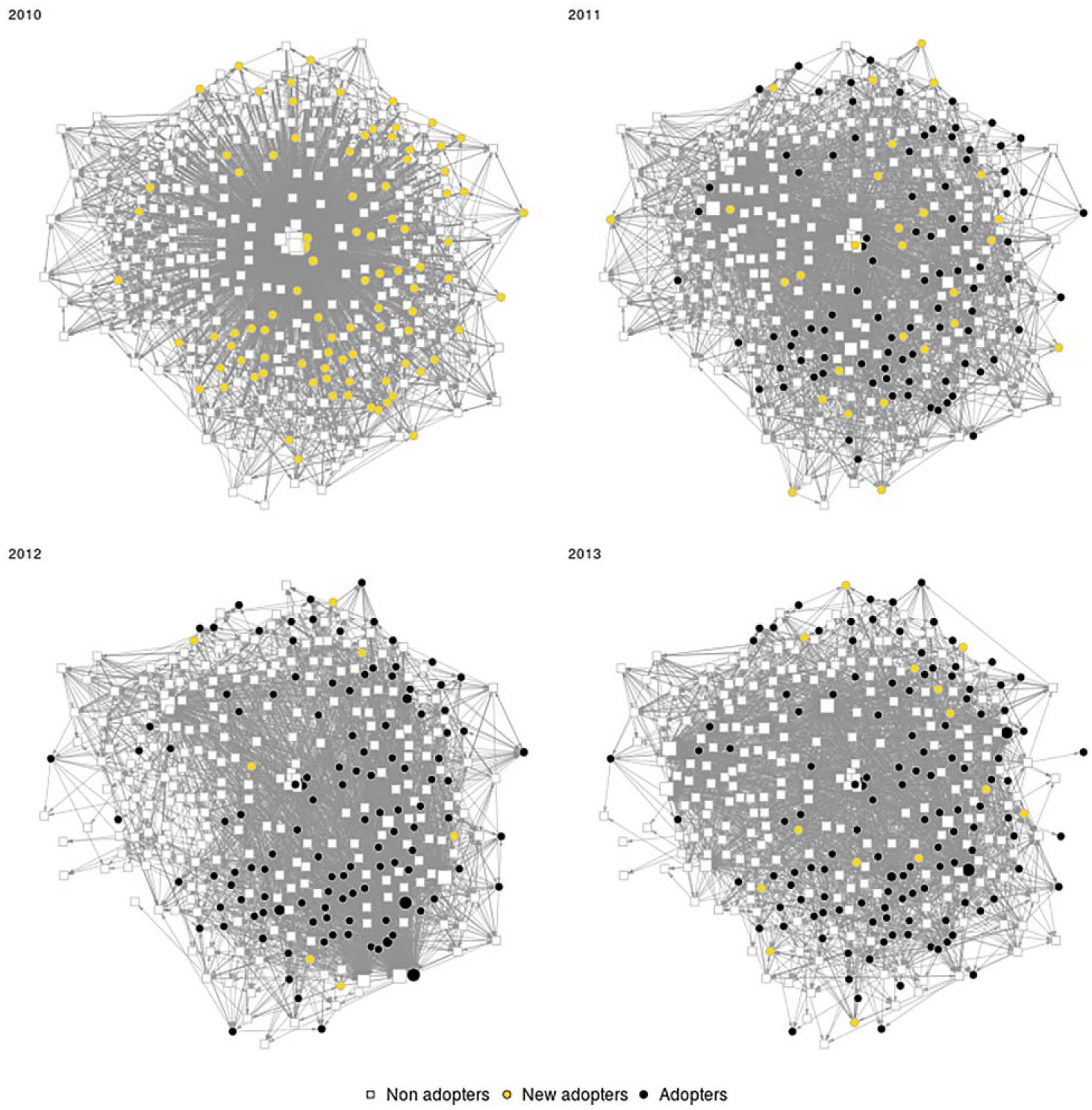
Diffusion of Smoking Initiation through the School 1 Friendship Network (N = 449).Note: Each node represents a student, and directed ties between nodes represent friendship nominations. Node color is based on lifetime smoking where yellow = initiated smoking in the time since the last observation, black = initiated smoking prior to the last observation, and white = have not initiated smoking. Isolates (nodes with no friendship nominations) are not included in the visualization (This figure appears in colour online).
For a nonsmoking student to adopt smoking in School 1, it would take 20.2 years if their friends’ average lifetime smoking was 0 (i.e., none initiated smoking), 4.3 years if their friends’ average lifetime smoking was .5 (i.e., half initiated smoking), and .9 years if their friends’ average lifetime smoking was 1 (i.e., all initiated smoking). The corresponding participant-specific times until smoking initiation in School 3 are 13.2 years (no friends initiated smoking), 3.3 years (half of friends initiated smoking), and .8 years (all friends initiated smoking); and in School 4, they are 19.2 years (no friends initiated smoking), 3.4 years (half of friends initiated smoking), and .6 years (all friends initiated smoking).
The effect of friend smoking on adolescent smoking initiation was not significant in School 2.
Males were significantly more likely than females to initiate smoking in School 4 (negative effect of female). Students with lower school grades were significantly more likely to initiate smoking than students with higher grades in School 1, and there was a similar but nonsignificant trend in School 2. No other covariates significantly predicted smoking initiation.
GOF
GOF for the SABMs was assessed using a method that compares auxiliary statistics of the observed networks to the simulated values at the end of each time period (Ripley et al. 2017). The differences are assessed by combining the auxiliary statistics using the Mahalanobis distance, a measure of the distance between an observed statistic P from a simulated distribution of that statistic D. We assessed four key auxiliary GOF statistics (indegree distribution, outdegree distribution, triad census, and geodesic distribution), and the Mahalanobis distance scores are summarized in the Supplemental Table B2 (available in the online version of the article). In all four schools, the model fit was adequate for the indegree distribution, outdegree distribution, and the majority of the triad censuses. Model fit for the lowered end of the geodesic distribution was good, but the upper end of this distribution (geodesics of 4 and 5) had inadequate fit (a common challenge with SABMs). The addition of other structural parameters did not improve model fit or resulted in models that would not converge. The different specifications of these models did not result in different findings for our study hypotheses.
Discussion
This study found evidence of smoking initiation diffusing through friendship networks over the high school period in some but not all of the schools included in our sample. This parallels the mixed findings of peer influence on smoking in previous research (Alexander et al. 2001; Go et al. 2012; Green et al. 2013; Haas and Schaefer 2014; Hall and Valente 2007; Kiuru et al. 2010; Lakon et al. 2015; Mercken et al. 2009; Schaefer et al. 2012, Steglich et al. 2010; Valente et al. 2013). Probit models found evidence of associations between exposure to friends who had smoked and adolescent smoking initiation in two schools (Schools 1 and 4), while SABMs that modeled dynamics of the friendship network and adolescent smoking found evidence that smoking initiation was positively predicted by exposure to friends who had smoked in Schools 1, 3, and 4 (this effect was marginally significant in School 4), accounting for processes that predicted network dynamics.
In the three schools where friend’s lifetime smoking predicted or marginally predicted smoking initiation in the SABMs (Schools 1, 3, and 4), students who had not tried smoking but who were friends with smoking initiators were more likely to experiment with smoking themselves relative to nonsmoking students who were not friends with smoking initiators. In these same three schools, we did not find evidence that students befriended peers who were similar to them in lifetime smoking status, and so students who had not tried smoking were likely to become friends with both students who had and who had not initiated smoking. This mixing would have increased opportunities for nonsmokers to be exposed to lifetime smokers and the diffusion of smoking initiation through the friendship network.
Additionally, in these three schools, there was mixed evidence that trying cigarette smoking influenced students’ popularity during high school: Initiating smoking increased students’ popularity in School 1, and this was a nonsignificant but similar trend in School 3 and School 4. This combination of selection and influence effects may give us insights into the underlying mechanisms of peer influence in these schools. It seems plausible that students who initiated smoking could be motivated by goals to fit in with their close friends or attain popularity and social status among their school peers (particularly in School 1). Additionally, the mechanisms of interpersonal influence may be complex: Youth may copy the smoking behaviors recently modeled by their friends based on social learning processes, and/or they may be motivated to adopt an identity of “someone who has tried smoking” if this is the norm among their friends.
There was one school (School 2) in which smoking initiation was not influenced by the friendship network, where having friends who had tried smoking in their lifetime did not predict smoking initiation over the course of high school (in the probit and SABM). Despite being in the same neighborhood, this school had notably higher lifetime smoking rates than in the other three schools (47.6% had tried smoking by the end of high school). Additionally, students in this school had notably lower SES, with just 26.4% of students living in homes that their parents owned and 97% of students receiving free or reduced-price school lunch. There were also differences in the social meaning of smoking in this school: Students who had initiated smoking were unpopular.
The higher rates of smoking initiation at this high school, even at the beginning of Grade 10, may have arisen because youth with lower SES are more likely to smoke (Melotti et al. 2011). Because higher smoking rates can amplify network diffusion (adams and Schaefer 2016), smoking initiation may also have diffused through these networks earlier, with the early stages of the adoption curve playing out before high school for these students. It is possible that the negative association between smoking initiation and popularity was something that emerged at the later stages of diffusion, after the “innovators” and early majority adopters had already tried smoking (Valente 2005). In this scenario, the negative association between popularity and smoking initiation may be a result of smoking having already been adopted by a majority of students rather than being a protective feature of the social system that could limit smoking influence in the earlier stages of diffusion (Schaefer et al. 2013). This could be a topic for future longitudinal research that follows the full adoption curve.
In this specific school context, nonsmoking students may not be influenced to smoke by their smoking friends given the apparent social disincentive to experiment with smoking and low norm salience of this behavior because it is performed by unpopular youth (Dijkstra and Gest 2015). Alternately, because students who had tried smoking were less popular, smokers may have had less peer influence potential because they had fewer friendship connections and were less central in the friendship network (Osgood et al. 2013). The results from the PROSPER intervention found that reducing the centrality and peer influence potential of risky youth in middle school could decrease problem behaviors among peers overall. However, this mechanism may need to be implemented in the early stages of the adoption curve as it does not appear to be at play in School 2, which had the highest rates of lifetime and current smoking.
To better understand school differences that may be linked to peer effects on smoking initiation, we conducted ad hoc analyses exploring differences in participants’ perceived pro-tobacco norms (assessed at Wave 1 and Wave 2 only) across schools. This measure was an average score of four items (e.g., “How many of your five best friends think it’s OK for someone your age to smoke” scored on 4-point scales), where scores of 1 reflected the weakest pro-tobacco norms. Prosmoking norms at Wave 1 were indeed the highest in School 2 (M = 1.9, SD = .8) and were significantly higher than norms in School 1 (M = 1.7, SD = .8) and School 3 (M = 1.6, SD = .7), although not significantly higher than School 4 (M = 1.8, SD = .7). A similar trend (although without statistically significant differences) was found at Wave 2. This suggests that pro-tobacco norms were initially higher School 2, yet initiation of smoking came with a cost of decreased social prestige.
Finally, friendship network effects were notably one of the most consistent significant predictors of smoking initiation, while other covariates such as gender and school grades were less consistently predictive.
Limitations
The measures used in this study have some limitations. Friendship nominations were restricted to school peers who were in the same grade, a network sampling strategy that was based on practical motivations to bound the sample on one grade cohort in each school and measure them as they transitioned through the high school period. This sampling strategy misses potentially influential friends in higher or lower grades or outside of the school. Also, because we did not measure a broad range of cognitions that may have mediated the social influence and selection mechanisms, such as motivations to comply with peer norms and changes in beliefs about smoking identities, we could not explicitly test these as mediators in this study.
A further limitation is that this study was not designed to test for school- or network-level characteristics that explain differences in network dynamics given the sample of four school networks. Finally, one assumption of the SABMs that can be problematic for larger social networks is that actors consider the state of the complete network (i.e., the ties and attributes of all other actors) when making choices to change or maintain friendship ties or behaviors. This is a limitation of the models when applied to the large school friendship networks in this study.
Conclusions
Based on recent longitudinal data from four urban U.S. high schools with racially and ethnically diverse students, the current study finds evidence that smoking initiation diffuses through adolescent friendship networks over the high school period in some schools but not in others. Although these four schools were based in the same neighborhood and school district and thus represent a fairly homogenous subset of the overall population of high school students in the United States, we observed differences in school characteristics and smoking norms that may result in variations in peer networks effects on smoking. These results point to mechanisms—such as smoking rates, the popularity of smokers, and the stage of diffusion for the initiation of smoking—that should be explored in future work as possible moderators of peer smoking dynamics using a large and representative sample of high school friendship networks.
The two modeling approaches adopted—probit regression models and SABMs that simulate and estimate network and smoking dynamics (Snijders et al. 2007, 2010)—provide valuable insights into temporal dependencies between networks and smoking initiation and unfolding social processes that give rise to these dependencies, respectively. The network dynamics models point to social processes whereby smoking is linked to popularity and social status, and this co-occurs with the diffusion of smoking through peer networks.
Identifying the dependencies between peer and adolescent smoking as well as social processes that give rise to conditions under which smoking diffuses through adolescent social networks, is important to understand and intervene on in smoking prevention initiatives (Valente 2012). Simulation studies show that for interventions that target peer influence processes to effectively reducing smoking, they will need to be tailored to the initial smoking rates and the popularity of smokers (adams and Schaefer 2016). For example, engaging opinion leaders in contexts where smoking behaviors are not (or are positively) associated with popularity may be effective to dampen peer effects on smoking (Campbell et al. 2008), and this may be particularly effective in contexts with higher smoking rates (vs. those with lower rates, where peer influence has an overall effect of promoting nonsmoking; adams and Schaefer 2016). However, we must also be mindful that if the risk behavior gives rises to popularity, recruiting popular students to promote smoking abstinence may actually reduce their popularity and social influence. In contexts where smoking is negatively associated with popularity, opinion leader interventions may not be effective, and segmentation strategies (that target at-risk peer groups) may be more appropriate (Valente 2012).
Overall, network interventions for smoking prevention in youth are likely to be important given the pervasive effect of smoking diffusion in peer networks (Go et al. 2012; Green et al. 2013; Haas and Schaefer 2014; Schaefer et al. 2012), but tailoring strategies to local norms and social environments may also be essential. One social size does not fit all settings.
Supplemental Material
de_la_Haye.Online_Supplement.FINAL – Supplemental material for Smoking Diffusion through Networks of Diverse, Urban American Adolescents over the High School Period
Supplemental material, de_la_Haye.Online_Supplement.FINAL for Smoking Diffusion through Networks of Diverse, Urban American Adolescents over the High School Period by Kayla de la Haye, Heesung Shin, George G. Vega Yon and Thomas W. Valente in Journal of Health and Social Behavior
Footnotes
Acknowledgements
Drafts of these results were presented at several annual meetings of the International Network for Social Network Analysis, and we thank attendees for comments on our preliminary findings.
Supplemental Material
Appendices A and B and Table B1 are available in the online version of the article.
Funding
The authors disclosed receipt of the following financial support for the research, authorship, and/or publication of this article: This study was supported by NIH grant number RC1AA019239 from the National Institute on Alcohol Abuse and Alcoholism and R01CA157577 from the National Cancer Institute.
Notes
Author Biographies
References
Supplementary Material
Please find the following supplemental material available below.
For Open Access articles published under a Creative Commons License, all supplemental material carries the same license as the article it is associated with.
For non-Open Access articles published, all supplemental material carries a non-exclusive license, and permission requests for re-use of supplemental material or any part of supplemental material shall be sent directly to the copyright owner as specified in the copyright notice associated with the article.
