



Abstract
Based on the premise that treatment changes people in ways that are consequential for subsequent treatment-seeking, we question the validity of an unrecognized and apparently inadvertent assumption in mental health services research conducted within a psychiatric epidemiology paradigm. This homogeneity assumption statistically constrains the effects of potential determinants of recent treatment to be identical for former patients and previously untreated persons by omitting treatment history or modeling only main effects. We test this assumption with data from the 2001–2003 Collaborative Psychiatric Epidemiology Surveys; the weighted pooled sample is representative of noninstitutionalized U.S. adults (18+; analytic n = 19,227). Contrary to the homogeneity assumption, some associations with recent treatment are conditional on past treatment, including psychiatric disorder and race-ethnicity—measures of need and treatment disparities, respectively. We conclude that the widespread application of the homogeneity assumption probably masks differences in the determinants of recent use between previously untreated persons and former patients.
Mental health services research conducted within the psychiatric epidemiology paradigm typically employs a medical model of mental illness qua illness, not as metaphor or social construction, that emphasizes the determinants of treatment at one point in time and overlooks the progression of treatment over time—a serious omission given that the prolonged and recurrent course of many disorders may create ongoing or cyclical need. 1 If treatment or mental health service use changes people therapeutically, its raison d’être, or through unintended social and psychological ramifications, such as stigmatization, then the factors that affect whether former patients reenter treatment may differ from the factors that influenced their initial entry. By extension, these determinants are likely to be dissimilar for former patients and previously untreated people because the latter by definition have not had the potentially transformative experience of treatment.
However, existing research on the determinants of recent treatment, including tests of sociological theories, rarely take treatment history into consideration or apply statistical models that constrain these determinants to have identical effects among persons with prior treatment and those without. We contend that this unrecognized equivalency, which we refer to as the homogeneity assumption, is not warranted theoretically and is demonstrably incorrect.
Background
Mental Health Service Use: The Psychiatric Epidemiology Paradigm
Our thesis applies to a psychiatric epidemiology paradigm that informs much of population-based research on mental health service use among the noninstitutionalized adult population—its prevalence, social distribution, and determinants. In the United States, this line of research originated with the five-site Epidemiologic Catchment Area studies (ECA, 1980–1985; Regier et al. 1993) and continued through the National Comorbidity Survey (NCS, 1990–1992; Kessler et al. 1999) and the Collaborative Psychiatric Epidemiology Surveys (CPES, 2001–2003; Pennell et al. 2004), the data source for the current study. Our thesis also applies to more recent and similar studies that use data from prevalence surveys of substance use disorders (SUDs; e.g., National Epidemiologic Survey on Alcohol and Related Conditions-III [NESARC-III]; Evans-Polce and Schuler 2016), equivalent approaches in other countries (e.g., ESEMeD/MHEDEA 2000 Investigators 2004), and comparable studies of youth (e.g., Merikangas et al. 2011). Its implications beyond epidemiology include tests of sociological theories, such as self-labeling theory (e.g., Thoits 2011).
Research conducted within this paradigm characteristically employs a common set of methods, including the use of prominently large probability samples that are representative of the general population (e.g., Kessler et al. 1999, 2005), or select subpopulations, such as specific racial-ethnic groups (e.g., Jackson et al. 2007). Survey data typically are collected with structured, computer-assisted interviews conducted by lay interviewers. These interviews assess research diagnostic criteria for psychiatric disorders and ask about lifetime and recent utilization of mental health services.
This body of work shows that mental health services utilization in the United States has increased since the ECA (Kessler et al. 1999, 2005), but less than half of those who meet research diagnostic criteria for a psychiatric disorder, a frequently used indicator of need for treatment, actually receive treatment (Kessler et al. 2005; Walker et al. 2015; Wang, Lane, et al. 2005). Low utilization is not necessarily synonymous with unmet need because psychiatric disorder can be mild, nondisabling, and self-remitting (Mechanic 2003), and some people obtain informal help instead of professional care (Thoits 2011) or prefer to solve problems on their own (Kessler et al. 2001; Mojtabai et al. 2011). Even so, a history of mood, anxiety, or substance use disorder is strongly associated with perceived need for professional help (Villatoro et al. 2018).
Especially low rates of utilization relative to need may reflect restricted access to services and signify disparities when linked with social, economic, and/or environmental disadvantage (Office of Disease Prevention and Health Promotion 2016). As a case in point, relative to non-Hispanic whites, members of many other racial-ethnic groups tend to have lower rates of service use that are not fully explained by correspondingly low rates of psychiatric disorder or sociodemographic characteristics (e.g., Alegría et al. 2002, 2008; Harris, Edlund, and Larson 2005; Maura and de Mamani 2017). If these patterns do not apply equally to initial and repeated treatment, then our understanding of the determinants of racial-ethnic disparities in service use may be compromised, along with the effectiveness of public health interventions to reduce those disparities.
The Homogeneity Assumption Explained
The behavioral model of health services utilization, a sociological framework developed and expanded by Andersen (1968, 2008), has been widely used in mental health services research to examine the determinants of treatment utilization. The model denotes that treatment use is a function of predisposing factors, such as education; enabling factors, like knowing someone who has had treatment; and need, as manifest, for instance, in signs and symptoms of psychiatric disorder (Andersen 1968, 2008). Despite its prominence in the mental health services literature, sociological scholars like Pescosolido (1992) have criticized the static nature of the help-seeking process as outlined by this model and argued for frameworks that place conceptual importance on more dynamic processes that consider why and how people enter and exit treatment. In response, the network episode model (NEM) was developed to conceptualize help-seeking as a social process managed by interactions with social networks, the mental health treatment system, and other social service agencies or institutions (Pescosolido and Boyer 1999). Thereby, the NEM recognizes that entering and exiting treatment is not linear in progression but rather is complex and influenced by prior exposure to help-seeking within different contexts.
The sociological literature describes the social and psychological consequences of treatment, including the enactment of the sick role (Parsons 1951), and models to explain the way illness careers develop and extend over time (Perry and Pescosolido 2012). Early work in this area includes Goffman’s (1959) delineation of the systematic changes in how people view themselves during the passage from person to mental patient and then former patient, known as a “moral” career, and Scheff’s (1966) contested assertion that societal reactions to stereotypes of persons treated for mental illness result in a stable career as a chronically mentally ill person. More recent illness career models describe the transformative impact of outpatient treatment on the self-concept, the disillusionment that accompanies relapse and recurrence, the repeated entry into and exit from treatment for some people as their need for care ebbs and flows, and the course of untreated disorder for other people (Aneshensel 2013; Karp 1996; Karp and Birk 2013). These sociological frameworks convey that the receipt of treatment, or lack thereof, fundamentally changes persons with mental illness, resulting in diverging illness careers for those experienced with treatment compared to those without treatment history.
Most studies conducted within a psychiatric epidemiology paradigm and that utilize these sociological frameworks examine recent utilization, usually within the past year (e.g., Alegría et al. 2008; Kessler et al. 1999), or lifetime (e.g., Keyes et al. 2008), with exceptions (e.g., Wang, Bergland, et al. 2005). These methodological approaches have been criticized as static misrepresentations of a dynamic process that extends over time (Pescosolido, Boyer, and Medina 2013). However, measures of recent and lifetime use obscure the boundaries separating groups defined by disparate patterns of treatment use over time, as illustrated in Figure 1a—the basis of the homogeneity assumption. For any lifetime treatment, persons with no history of treatment—non-patients (A)—are contrasted with an indivisible conglomeration of former and current patients (C + D), including ex-patients who have discontinued earlier treatment (C), new patients who have recently begun treatment for the first time (D), and veteran patients who have past and recent treatment histories (D). This hodgepodge of patients renders interpretation of recent treatment in mental health services research opaque because new patients are indistinguishable from veteran patients and assumed to engage in similar processes in seeking treatment. Similarly, for any recent treatment in Figure 1a, persons with no recent treatment are conflated with non-patients (A) and ex-patients (C), while persons with recent treatment are comprised of new and veteran patients (D).
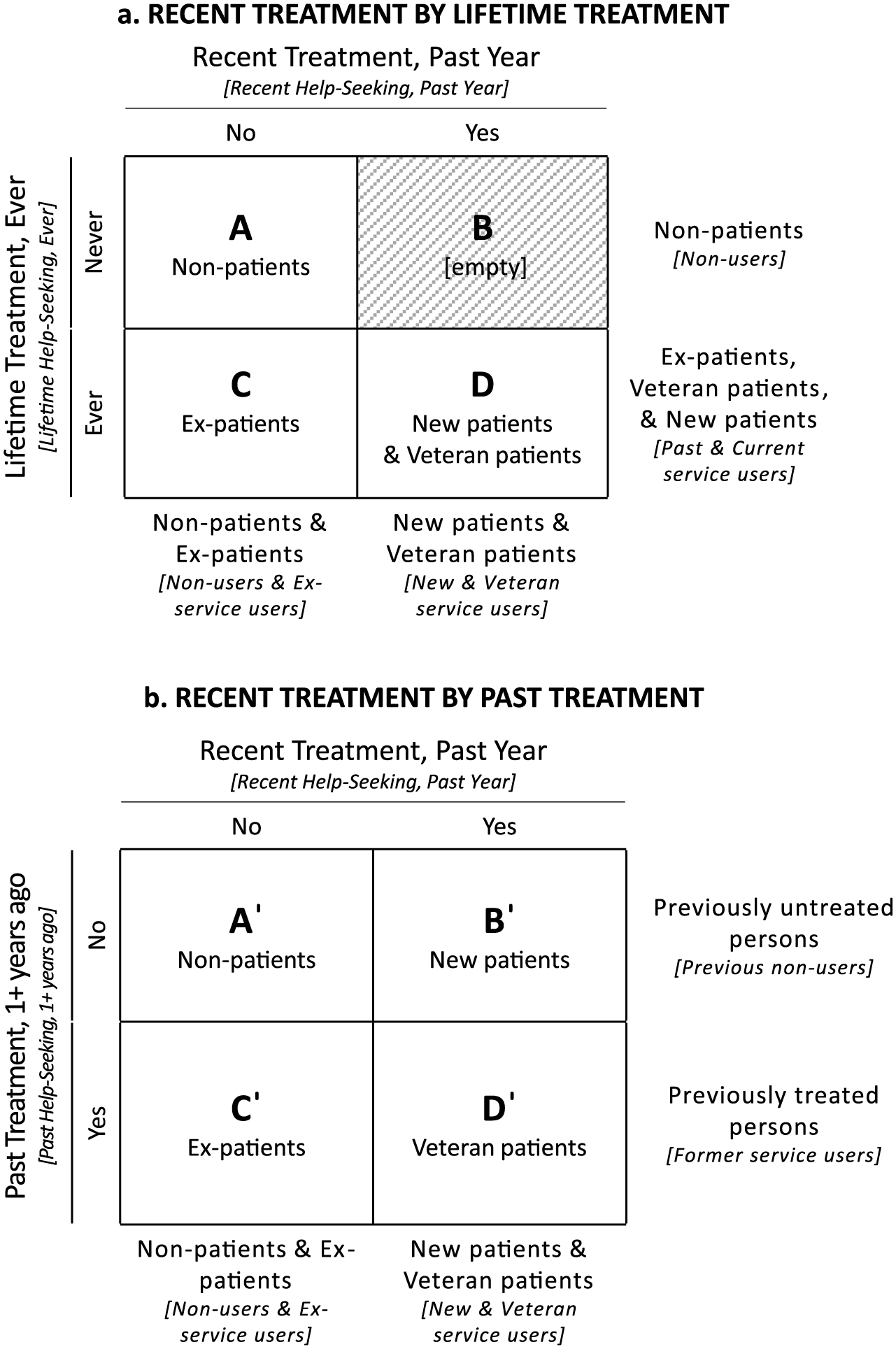
Conceptual Cross-Classification of Recent Treatment Utilization by Lifetime Treatment or Past Treatment Utilization.
This murkiness is clarified by contrasting recent treatment within the past year with past treatment prior to the past year (see Figure 1b). This approach separates new patients (B′) from veteran patients (D′) among recent treatment users and by doing so, explicates the homogeneity assumption that is present in Figure 1a. This cross-classification makes it clear that recent treatment use by itself is conflated by two separate processes among two distinct subpopulations of past treatment users: initial treatment among persons without past treatment prior to the past year—previously untreated persons (Aʹ + Bʹ)— and repeated treatment among persons with past treatment before the past year—previously treated persons (Cʹ + Dʹ).
Existing research typically does not make these distinctions and often does not even assess history of past use. A rare exception tested self-labeling theory and the NEM. In this study, Thoits (2011) controlled for past treatment while testing conditional effects between social support and number/severity of psychiatric disorders for outcomes of recent voluntary, pressured, and coerced utilization of mental health services (relative to no recent utilization). Past treatment had a strong unconditional or main effect on each recent treatment outcome. Although outside the scope of the original study, it is noteworthy that the default statistical model constrained the effects of both social support and psychiatric disorder on recent treatment to be the same among persons who had treatment in the past and those who had not.
Ignoring these distinctions does not seem to be an intentional assertion that they are inconsequential, although it may be the product of deliberate study design considerations, such as allocation of limited interview time, or concern about recall failure. Alternately, this omission may be inadvertent oversight or scientific myopia. Regardless, the homogeneity assumption permeates existing research on recent treatment that either omits past treatment entirely or statistically models only its main effect. 2
Two exceptions examined conditional effects and provide evidence that this assumption lacks validity, although neither study is cast in epistemological terms. Albizu-Garcia and colleagues (2001) examined gender differences in the determinants of recent treatment and coincidentally found a gender by past treatment interaction. Grella and Stein (2013) examined the impact of baseline treatment history on the determinants of remission from substance use disorder during follow-up and found that treatment history modified the effects of some factors on both remission and subsequent treatment. Although both studies provide grounds for questioning the homogeneity assumption, neither tests it for treatment in general for the population at large.
A Theoretical Framework for Questioning the Homogeneity Assumption
Many studies on mental health service utilization are descriptive or apply theories that emphasize initial entry into treatment to the neglect of subsequent transitions into and out of treatment (Pescosolido et al. 2013). Our approach addresses one overlooked relationship in such treatment careers by outlining how the social and psychological consequences of initial treatment may alter the impact of psychiatric disorder on subsequent treatment. These consequences uniquely differentiate repeated from initial treatment on the one hand and former patients from previously untreated persons on the other hand. Psychiatric disorder is a strong test case because it favors the homogeneity assumption over the study premise insofar as it signifies need (albeit imperfectly) and therefore should be strongly associated with both initial and repeated treatment.
We contend that treatment should alter how former patients with a recurrent or chronic psychiatric disorder make sense of their abnormal states in ways that increase their likelihood of seeking treatment again. Self-labeling theory (Thoits 1985, 2011) asserts that people seek voluntary treatment after they apply pejorative stereotypes and labels to themselves, such as psychologically “disturbed,” because they realize that their emotional reactions to stressful circumstances are deviant—too intense, prolonged, and recurrent. If a person begins treatment, then derogatory stereotypes and labels about psychiatric patients in particular become personally relevant and threatening (Thoits 1985). Although self-labeling theory does not explicitly address repeated treatment, people who see themselves as needing professional help at one point in time should be inclined to make the same assessment again under similar circumstances, although this tendency may be dampened by internalization of stigma about being a psychiatric patient.
Thoits (1985) described societal conditions necessary for self-labeling in general, a perspective we apply to the therapeutic microcosm in particular to identity how treatment could intensify and cement a propensity to seek treatment. Specifically, we contend that patients are socialized by those who provide their care into a “cultural” system of beliefs about the nature of their abnormal experiences. As part of this process, patients learn to recognize when treatment is needed to successfully manage these states and become motivated to conform to the expectations of providers to regain and maintain normalcy. As a case in point, Karp (1996) described how psychiatric patients become increasingly committed to a medical model of depression over the course of treatment, although this allegiance may be abandoned if treatment fails to fulfill expectations. Remission or recovery validates people’s initial self-selection into treatment. These experiences can prompt renewed help-seeking in the event of relapse or recurrence, generating a self-reinforcing cycle that amplifies the impact of psychiatric disorder on subsequent treatment, or can lead to disillusionment and withdrawal from treatment instead (Karp 1996).
In addition, labeling can separate psychiatric patients from the rest of society in ways that diminish the substitution of social support for treatment. Both labeling theory (Scheff 1966) and modified labeling theory (Link and Phelan 2013) delineate how having a socially devalued characteristic like being a psychiatric patient translates into experiencing stigma, including labeling, stereotyping, and social distance from the patient. Moreover, internalization of stigma and anticipation of social rejection can lead psychiatric patients to be secretive, withdraw from social relationships, and become socially isolated (Link and Phelan 2013; Thoits 2011). Patients’ social ties can then become insufficient to take the place of treatment, or patients with severe disorders may experience social pressure to enter treatment (Thoits 2011). These occurrences may in turn foster reliance on mental health professionals to cope with chronic or recurrent disorder, so-called purchased social support (Thoits 1985).
These social psychological consequences of treatment should strengthen the association between disorder and subsequent treatment among former patients, but countervailing forces could weaken it instead. Notably, people who found treatment ineffective and those who had negative treatment-related experiences are likely to reject starting treatment again as a means of coping with chronic or recurrent disorder. Likewise, treatment-related stigmatization may deter subsequent treatment-seeking rather than increasing reliance on service providers. And, relapse or recurrence can foster doubts about treatment efficacy or a permanent cure, producing disillusionment and leading to rejection of further treatment (Karp 1996). Taking these considerations into account, the net effect of past treatment on the impact of psychiatric disorder on subsequent treatment will depend on the relative strength of any processes that amplify it and any processes that dampen it.
In contrast, the impact of psychiatric disorder on recent treatment should be diluted somewhat among persons who have never had treatment. Persons who did not interpret earlier abnormal states as signs of psychological problems requiring treatment are unlikely to self-label in response to similar abnormal states at a later time, other things being equal, effectively eliminating treatment as a perceived remedy. Along the same lines, the continued use of familiar coping strategies that led away from treatment in the past (e.g., denial) is likely to do so thereafter. Also, recovery from an earlier untreated disorder should foster the belief that a subsequent disorder will self-remit too. Lastly, many persons who are favorably disposed toward treatment have already been selected out of the current pool of untreated persons, which means that the residual pool contains a relatively high density of persons who are disinclined to use services under any circumstance.
The consequences of past treatment outlined previously have the potential to reshape disparities linked to race-ethnicity. As one sign, African Americans have more favorable attitudes than whites toward professional mental health care in the absence of prior treatment but less favorable attitudes than whites in the presence of prior treatment (Diala et al. 2000). On the one hand, treatment may reinforce self-labeling most among whites due to a greater general tendency to see oneself as needing professional help compared to other racial-ethnic groups (Villatoro et al. 2018). On the other hand, whites may benefit least from overcoming barriers to treatment in the past because of comparatively low exposure to such obstacles. For racial-ethnic minority groups, exposure to bias and discrimination within the treatment setting can lead to early treatment termination (Mays et al. 2017), which may deter subsequent treatment-seeking. Alegría and colleagues (2010) suggested that these disparities may be driven by differences in culture and context in mental health treatment at multiple levels. More generally, the impact of treatment-related stigma on subsequent treatment-seeking may differ by race-ethnicity as a consequence of cultural variation in the intensity of stigmatization (Jimenez et al. 2013).
Lastly, our critique of the homogeneity assumption presupposes that the consequences of treatment persist long after treatment ends, but there may be few severe or lasting consequences for most patients (Gove 2004; Thoits 1985). If normalcy can be regained, then this assumption may be valid in general or under some circumstances.
Hypotheses
Existing research that omits treatment history or models only its main effect is predicated on two unstated and untested null hypotheses that correspond to aspects of the homogeneity assumption: Treatment history is (1) unrelated to recent treatment and (2) does not alter the determinants of recent treatment, respectively. Based on the considerations outlined previously, we test two alternatives:
Hypothesis 1: Past treatment is positively associated with recent treatment, with former patients receiving treatment more than previously untreated persons net of need in the form of psychiatric disorder and sociodemographic characteristics that might account for this association.
Hypothesis 2: The effects of at least some determinants of recent treatment are conditional on past treatment, specifically psychiatric disorder and race-ethnicity as indicators of need and disparities, respectively.
Data and Methods
Sample and Study Design
We tested the homogeneity assumption by conducting secondary analysis of data from the Collaborative Psychiatric Epidemiology Surveys (CPES; n = 20,013)—three related studies that used a common set of research methods for study-specific target populations: (1) National Comorbidity Survey-Replication (NCS-R), all racial-ethnic groups (Kessler et al. 2005; n = 9,282); (2) National Survey of American Life (NSAL), African Americans and Afro-Caribbeans (Jackson et al. 2004; n = 6,082); and (3) National Latino and Asian American Study (NLAAS), Latinos (Cuban, Mexican, Puerto Rican, and other Latino) and Asian Americans (Chinese, Filipino, Vietnamese, and other Asian descent; Alegría et al. 2008; n = 4,649).When pooled across studies, the weighted sample is representative of the noninstitutionalized U.S. adult (18+) population in 2001 to 2003.
Several types of respondents were excluded from the current study (n = 481, including five dropped for multiple reasons) as follows. The “other” race-ethnicity category (n = 284) was too small to analyze separately and too diverse to combine with other groups. The few respondents with past-year psychiatric hospitalizations (n = 133) were dropped to limit analysis to recent outpatient treatment. Reports of “talking” to a provider at preschool ages (<5 years; n = 69) were considered a distinct subpopulation (e.g., possible developmental disorders). Lastly, dropping respondents with missing/invalid data on study measures (n = 305) yielded an analytic sample of 19,227.
CPES study procedures are detailed elsewhere (Pennell et al. 2004). In brief, respondents were interviewed using a computer-assisted structured questionnaire administered by trained lay interviewers. All studies interviewed respondents in English; NLAAS participants also were interviewed in Spanish, Mandarin, Cantonese, Tagalog, and Vietnamese. We used only measures common to all three CPES studies to maintain the maximum sample size and the representation of members of racial-ethnic groups oversampled in the NSAL and NLAAS.
Measures
The presentation of the homogeneity assumption, thus far, has been framed within the context of formal mental health treatment or service use that renders individuals engaging in these help-seeking behaviors to be labeled as patients. However, we recognize that treatment/service use for mental health concerns in reality is wide ranging, including trained mental health professionals (e.g., psychiatrists, medical doctors), alternative medicine providers (e.g., acupuncturists, traditional healers), and informal supports (e.g., support groups, religious leaders). In our test of the homogeneity assumption, we broadly conceptualize treatment/service use to incorporate these providers and use the help-seeking label to characterize the expansive landscape of mental health providers. Correspondingly, we describe persons who engage in help-seeking as service users (users) rather than patients and their counterparts as non-service users (non-users) rather than non-patients. When discussing the theoretical and practical implications of the study results, we use the terms treatment, patients, and non-patients.
Help-seeking
The help-seeking variables compiled responses across multiple questions. First, regardless of their current or past mental health need status, all respondents were asked whether they had ever talked to a list of mental health and non–mental health providers for “problems with your emotions, nerves, or your use of alcohol or drugs?” The listed providers included psychiatrists, psychologists, social workers, counselors, any other mental health professionals, general practitioners or family doctors, any other medical doctors, other health professionals (e.g., nurse), religious or spiritual advisors, and any other healers (e.g., herbalist, chiropractor). Multiple providers could be selected. For each provider mentioned, respondents reported age at first use and the last time the provider was seen, coded as “in the past month, 2 to 6 months ago, 7 to 12 months ago, or more than 12 months ago?,” or “in the past 12 months?” coded as “yes” or “no.” 3 Second, respondents who met diagnostic criteria for a psychiatric disorder were asked similar questions about their lifetime (yes/no) and past-year use (yes/no) of professionals (doctors, counselors, spiritual advisors, herbalists, acupuncturists, or other healing professionals) for each disorder using the Composite International Diagnostic Interview (CIDI), World Mental Health Survey Initiative version.
The dependent variable was recent help-seeking, coded 1 = talked to one or more providers within 12 months of the interview, 0 = did not talk to any provider within this timeframe. Referring to Figure 1b, the positive category included new patients (B′; i.e., new service users) and veteran patients (D′; i.e., veteran service users), while the negative category included non-patients (A′; i.e., non-users) and ex-patients (C′; i.e., ex-service users). Recent help-seeking did not necessarily begin within the past 12 months; it may have begun earlier and continued uninterrupted into this interval, which is an inherent quality of recent help-seeking in general and not a limitation of this measure in particular.
The primary independent variable was any past help-seeking, defined as seeking help from any of the aforementioned providers prior to the 12-month interval covered by the dependent variable. This variable was created by: (1) subtracting age at first use from age at interview for each provider mentioned, (2) calculating the maximum difference across providers, and (3) dichotomizing the difference score at a cut-point of one year or less into codes of 0 = no past help-seeking whatsoever and 1 = any past help-seeking (i.e., two or more years). Coding a one-year difference as “no” compensated for rounding error due to ages recorded in whole years but inevitably produced undetectable false negatives. However, this coding favors the homogeneity assumption over study hypotheses by diluting apparent differences between the previously untreated (A′ + B′; i.e., previous non-users) and previously treated (C′ + D′; i.e., former service users) groups. For the same reason, general recall failure for lifetime reports favor the homogeneity assumption because the likely error is failure to report previous help-seeking, not claiming help-seeking that did not occur.
There are some cases where recent and past help-seeking values appear to be logically inconsistent, but there is insufficient information to resolve these cases, or doing so entails using the dependent variable to clean the independent variable, or vice versa, thereby contaminating the two measures. Only some kinds of inconsistencies are detectable, which means that dropping suspect cases or including an indicator in the analysis would likely bias parameter estimates. Instead, we assess the probable magnitude of such errors with an independent data set (see Discussion).
To address continuing help-seeking and imprecision around the interstitial period separating recent from any past help-seeking, we constructed a chronological help-seeking initiation variable coded: (a) any proximal initiation—first use two to five years before interview for any provider mentioned, (b) distal initiation only—first use six or more years before interview for all providers mentioned, and (c) no past help-seeking. The proximal category should capture a high proportion of those continuing help-seeking and rounding error, while the residual distal category is more likely to capture help-seeking that ended prior to the past year.
Psychiatric disorder
Research diagnostic criteria were assessed for the fourth edition of the Diagnostic and Statistical Manual of the American Psychiatric Association (DSM-IV; 2000) using the CIDI. For the current study, psychiatric disorder was defined as a mood (major depression and dysthymia), anxiety (generalized anxiety, agoraphobia, social phobia, panic attack, and panic disorder), or substance use (alcohol and/or drug abuse/dependence) disorder. Coding gave priority to recent disorder while also accounting for past disorder: (a) any recent disorder—at least one disorder within 12 months of interview, (b) past disorder only—all disorders more than 12 months before interview, and (c) no lifetime disorder.
Race-ethnicity
Respondents self-reported race-ethnicity, which was coded as non-Latino white (hereafter white), Latino (Mexican American, Cuban, Puerto Rican, and other Latino), black (African American and Afro-Caribbean), and Asian American (Chinese, Vietnamese, Filipino, and other Asian).
Sociodemographic characteristics
The following variables were assessed with standard survey measures and coded as shown in Table 1: gender, age (also analyzed as a continuous variable), education, marital status, and employment status.
Percent Distribution of Sample Characteristics, Total Sample and by Any Past Help-seeking, Collaborative Psychiatric Epidemiology Surveys (CPES), 2001–2003.

Note: DNA = does not apply.
Test of the null hypothesis that proportion (×100) does not differ by past help-seeking.
p ≤ .001.
A Logistic Regression Model for Testing the Homogeneity Assumption
This section outlines a statistical test of the homogeneity assumption for logistic regression, a statistical technique with widespread application in mental health services research because outcomes often are dichotomous. 4 The approach we critique typically uses a main effects model of recent help-seeking that does not include help-seeking history,

where Y is coded 1 = any help-seeking in the past year; 0 = no help-seeking in the past year; p is the probability that Y = 1; p/(1–p) is the odds that Y = 1; ln[p/(1–p)] is the log odds or logit of Y = 1; X1. . .Xk are independent variables; b0 is the logit when all independent variables equal 0; b1 is the difference in the logit for a one-unit difference in X1 (e.g., 1 = recent psychiatric disorder, 0 = no disorder), all other independent variables held constant; and so on for the other independent variables. 5
For the current study, two assumptions of this statistical model in Equation 1 are critical:
Assumption 1: The model is correctly specified; no important variables are omitted.
Assumption 2: The impact of an independent variable on the logit is constant irrespective of the values of other independent variables.
However, we contend that Equation 1 violates Assumption 1 because it omits past help-seeking, which can be tested by adding past help-seeking (T) to the model,

where T is coded 1 = help-seeking before the past year (i.e., former service user) and 0 = no help-seeking before the past year (i.e., previous non-user). Hypothesis 1 is supported if bt is significantly greater than zero, which means that the Equation 1 model is incorrectly specified and its parameter estimates may have omitted variable bias.
Assumption 2 is a statement of main effects and pertains to all variables in Equations 1 and 2. It operationalizes the homogeneity assumption when applied specifically to T in Equation 2: The impact of any other independent variable, such as a one-unit difference in X1 (e.g., 1 = recent psychiatric disorder, 0 = no disorder), on the log odds of recent help-seeking is constrained to be the same at T = 0 and T = 1. (Equation 1 obscures this assumption by omitting T.)
To test whether this assumption is justified, the effect of X1 is allowed to vary across the values of T by adding the product interaction term X1T,

where b2 is the difference in the effect of a one-unit difference in X1 (e.g., 1 = recent psychiatric disorder, 0 = no disorder) on the logit between the two help-seeking groups. In general, the homogeneity assumption is rejected and Hypothesis 2 supported if b2 is significantly different from zero. In practice, the signs of the coefficients for X1, T, and X1T will also matter if the direction of the conditional relationship is specified (e.g., amplification).
Rearranging the terms in Equation 3 yields


where b1 is the effect of a one-unit difference in X1 (e.g., 1 = recent psychiatric disorder, 0 = no disorder) on the logit for previous non-users; for former service users, this effect is b1 + b2.
Because the logit lacks an intuitive meaning, these coefficients usually are transformed by taking their exponents, which are then interpreted as odds ratios (ORs). This transformation yields exp(b1b2) as the OR for X1 among former service users; exp(b1) is the OR among previous non-users, and exp(b2) is the ratio of these two ORs. These ORs are proportional to a specific reference (in the running example, no disorder).
Interactions can be interpreted using the predicted probability of recent help-seeking for select values of covariates. In this approach, effects can be operationalized as absolute differences across values of the independent variable within groups (e.g., recent psychiatric disorder minus no disorder among previous nonusers), and conditional effects can be tested using the same between-group difference of difference test (e.g., former service users minus previous non-users) used in multiple linear regression.
Statistical Analysis
Models were estimated using the STATA SE 14 survey procedures (StataCorp 2015), which adjust for the complex sample design. Robust standard errors (SEs) were calculated using Taylor series approximation. Analyses used sample weights unless otherwise noted. The logistic regression models described previously were estimated with: recent help-seeking as the dependent variable; psychiatric disorder, race-ethnicity, and other sociodemographic characteristics as the independent variables; and past help-seeking as a moderator.
Hypothesis 1 was tested with the coefficient for T in Equation 2. Hypothesis 2 was tested with the coefficient for the product interaction term in Equation 3 between past help-seeking and either (a) race-ethnicity or (b) psychiatric disorder. Interactions with multiple terms were tested as a set using a modified Wald test; if significant, individual coefficients were tested. For these conditional models, the logistic regression coefficients from Equation 3 pertain when past help-seeking equals zero—previous non-users; when past help-seeking equals one—former service users, the linear combination procedure in STATA 14 was used to generate these coefficients and their transformation into ORs, indicated in the following as post hoc tests.
Statistically significant interactions were interpreted using the predicted probability of recent help-seeking, which was obtained using the margins command in STATA 14 with covariates set to their means. The difference of difference method was used to test conditional effects for race-ethnicity and psychiatric disorder.
Statistical significance was set to a minimum value of p ≤ .05. Slight discrepancies between estimated and calculated values were due to rounding error. Given space constraints, some results are summarized, and nonsignificant tests are identified but not detailed.
Results
Sample Characteristics
When the sample is weighted to represent the population, whites are the largest racial-ethnic group, followed by Latinos, blacks, and then Asian Americans (Table 1). There are slightly more females than males, and there is considerable variation around an average midlife age (M = 44.653, SD = 17.459). High school graduation is the mode, and about one in four persons graduated from college. The majority is married, with approximately equal representations of never married and formerly married persons. About two in three are employed.
The distribution of all sociodemographic characteristics differs significantly by past help-seeking (Table 1). The following characteristics are disproportionately concentrated among the former help-seekers group: white, female, mid- to late-middle age, postsecondary education, formerly married, and out of the labor force. The previous non-user group has a disproportionally high concentration of members of all racial-ethnic minority groups, men, persons at both ends of the age range, individuals with less than a high school education, the married, and the unemployed.
Roughly one in two persons in the general population had ever had a mood, anxiety, or substance use disorder, and of these persons, about one in two had a past-year disorder (Table 1). Former service users are much more likely than previous non-users to have had a psychiatric disorder, both recently and in the past, and also are much more likely to have had recent help-seeking.
Referring to Figure 1b, the largest group in our data by far is non-users (A′: 59.1%), followed by ex-service users (C′: 25.6%), veteran service users (D′: 12.7%), and new service users (B′: 2.7%). Of those who sought help in the past year, most had engaged in help-seeking before then (82.6%). The majority of recent service users met lifetime and past-year research diagnostic criteria for a mood, anxiety, or substance use disorder (82.0% and 58.6%, respectively); of the remainder, some undoubtedly met criteria for disorders that were not assessed.
Racial-ethnic Differences in Recent Help-seeking
We consider first the implications of omitting past help-seeking from the statistical model for the identification of racial-ethnic groups that may experience disparities in mental health services. Model 1, Table 2 (see Equation 1) represents the type of model critiqued previously and contains the main effects of race-ethnicity, other sociodemographic characteristics, and psychiatric disorder but excludes past help-seeking. Of these variables, only education is not significantly associated with recent help-seeking.
Logistic Regression of Recent Help-seeking on Race-Ethnicity: Main Effects and Conditional Effects of Any Past Help-seeking.

Note: OR = odds ratio; CI = confidence interval; (/. . .) = reference category; DNA = does not apply.
Tests the null hypothesis that coefficients for the added term(s) jointly equal 0; adjusted Wald test.
p ≤ .05, **p ≤ .01, ***p ≤ .001.
The test that the coefficients for race-ethnicity jointly equal to zero is statistically significant, F(3, 178) = 23.00, p ≤ .001. Relative to whites, all other groups have significantly smaller odds of recent help-seeking (see Model 1) net of need in the form of psychiatric disorder—a crucial consideration in the concept of disparity—and also net of other sociodemographic characteristics that might account for racial-ethnic differences. Post hoc tests of all other between-group comparisons also are statistically significant: Blacks have greater odds of recent help-seeking than Asian Americans (OR = 1.611; 95% confidence interval [CI] = 1.248, 2.079) and Latinos (OR = 1.176; 95% CI = 1.001, 1.381), and Latinos have greater odds than Asian Americans (OR = 1.370; 95% CI = 1.048, 1.791).
To test Hypothesis 1, Model 2 in Table 2 (see Equation 2) additionally includes the main effect of any past help-seeking, which is statistically significant. Other factors held constant, the odds of recent help-seeking are more than six times greater among former service users than previous non-users.
The overall test for race-ethnicity in Model 2 is significant, F(3, 178) = 9.71, p ≤ .001, but unlike Model 1, only four of the six between-group comparisons are significant. As shown in Model 2, Table 2, Latinos and Asian Americans, but not blacks, have significantly lower odds of recent help-seeking than whites. In post hoc tests, the odds of recent help-seeking are greater among blacks than Asian Americans (OR = 1.471; 95% CI = 1.143, 1.893) and Latinos (OR = 1.287; 95% CI = 1.083, 1.530), but Latinos do not differ significantly from Asian Americans.
To test Hypothesis 2, Model 3 in Table 2 (see Equation 3) contains the interaction between race-ethnicity and any past help-seeking—a statistically significant addition that contradicts the homogeneity assumption. Figure 2 graphs the predicted probability of recent help-seeking by race-ethnicity and past help-seeking at average levels of model covariates. This probability is highest for whites among previous non-users and for blacks among former service users; it is lowest for Asian Americans and Latinos for these two help-seeking history groups, respectively.

Predicated Probability of Recent Treatment by Race-ethnicity and Any Past Help-seeking.
Racial-ethnic differences in the predicted probability of recent help-seeking within the two help-seeking history groups (Δ) differ significantly between these two groups (Δ′) for two of the six possible comparisons, providing partial support for Hypothesis 2. First, the white minus black comparison is significantly different from zero for previous non-users (Δ = .022; SE = .005; p ≤ .001) but not former service users (Δ = –.026; SE = .019; p = .313). This pattern yields a significant difference between these two past help-seeking groups for this comparison (Δ′ = .048; SE = .019; p = .014). Second, the black minus Latino comparison is significant for former service users (Δ = .06; SE = .020; p = .003) but not previous non-users (Δ = .001; SE = .005; p = .987), yielding a significant difference between the two past help-seeking groups for this comparison (Δ′ = .063; SE = .021; p = .003). No other racial-ethnic comparisons differ significantly by help-seeking history.
To assess whether the homogeneity assumption is problematic for race-ethnicity only or applies to other sociodemographic characteristics too, interactions with any past help-seeking were tested individually for each of the other sociodemographic characteristics in these models. Three of the five interactions are significant—age, education, and employment status—a pattern that is consistent with Hypothesis 2. But, the two interactions that are not significant—gender and marital status—align with the homogeneity assumption.
Psychiatric Disorder and Help-seeking History
Any past help-seeking
Psychiatric disorder has a significant main effect on recent help-seeking when past help-seeking is ignored (Model 1, Table 2) and when it is taken into consideration (Model 2, Table 2). It also has a significant conditional effect (Model 4.1, Table 3), which supports Hypothesis 2. The fractional values for the interaction terms indicate smaller ORs for persons who have had help-seeking before than those who have not. These comparisons are shaped importantly by the exceedingly low estimated odds (.019) for the combination of the two reference groups, that is, no disorder coupled with no prior help-seeking.
Logistic Regression of Recent Help-seeking on Psychiatric Disorder Conditional on Any Past Help-seeking or Chronological Help-seeking Initiation.

Note: OR = odds ratio; CI = confidence interval; (/. . .) = reference category; DNA = does not apply. Models contain the same sociodemographic variables shown in Table 2.
Model 4.1 and Model 4.2 are nested with and compared to Model 2; they are not nested with Model 3 or each other. Tests the null hypothesis that psychiatric disorder is not conditional on any past help-seeking or on chronological help-seeking initiation.
p ≤ .001.
The predicted probability of recent help-seeking derived from Model 4.1 is graphed in Figure 3a for covariates set to their means. “Past disorder only” minus “no disorder” (Δ) is significantly different from zero among both previous non-users (Δ = .024; SE = .006; p ≤ .001) and former service users (Δ = .062; SE = .016; p ≤ .001). Testing Hypothesis 2, this difference is significantly greater among the former service users than previous non-users (Δ′ = .038; SE = .016; p = .018). Second, “any recent disorder” minus “no disorder” (Δ) is significant for both previous nonusers (Δ = .170; SE = .018; p ≤ .001) and former service users (Δ = .323; SE = .018; p ≤ .001); it is significant and much greater among those who have had help-seeking before than those who have not (Δ′ = .152; SE = .023; p < .001). These tests support Hypothesis 2.

Predicted Probability of Recent Help-seeking by Psychiatric Disorder and Past Help-seeking.
Chronological help-seeking initiation. 6
A more stringent test of Hypothesis 2 uses the chronological help-seeking initiation variable that separates the wholly distal initiation of help-seeking from any proximal initiation. The interaction between this variable and psychiatric disorder is statistically significant overall and for three of its four components (Model 4.2, Table 3). The fractional values for the interaction terms connote smaller ORs for all positive help-seeking history groups than the previous non-user group. The very large OR and wide CI for proximal initiation (relative to no prior help-seeking) among persons without a disorder suggests that this combination captures substantial continuous help-seeking for reasons other than a mood, anxiety, or substance use disorder.
The predicted probabilities derived from Model 4.2 are graphed in Figure 3b for distal help-seeking initiation compared to no prior help-seeking at average levels of model covariates. First, “past disorder only” minus “no disorder” (Δ) is significantly different from zero for both those who initiated help-seeking six or more years before interview (Δ = .065; SE = .016; p ≤ .001) and those who had never had sought help before (Δ = .024; SE = .016; p ≤ .001). Testing Hypothesis 2, this difference is significantly greater among the distal initiation group (Δ′ = .041; SE = .016; p ≤ .013). Second, “recent disorder only” minus “no disorder” is significant among both those who initiated help-seeking long before the interview (Δ = .335; SE = .016; p ≤ .001) and those without help-seeking in the past (Δ = .177; SE = .018; p ≤ .001). For Hypothesis 2, this difference is substantially and significantly greater among former service users (Δ′ = .158; SE = .029; p ≤ .001). These patterns are inconsistent with the homogeneity assumption.
Discussion
This study casts doubt on the validity of a “homogeneity assumption” that is implicit in much of the mental health services literature. Despite the recognized importance of past treatment in the illness careers of persons with psychiatric problems, the homogeneity assumption may have escaped notice because it is ensconced within the methods routinely used in mental health services research, including the omission of past treatment from surveys and statistical models, and the use of main effects statistical models. The findings of this study suggest that prior research on mental health services utilization may be flawed by omitted variable bias and the incorrect specification of statistical models. Moreover, the results have considerable implications for how mental health services research should be conducted in the future within the psychiatric epidemiological and sociological paradigms.
Hypothesis 1 tested the main effect of past treatment, operationalized as past help-seeking, and it is fully supported: The odds of recent help-seeking are substantially higher among former service users than previous nonusers net of need and sociodemographic characteristics. Therefore, models of recent treatment that omit past treatment are likely to provide biased estimates of the effects of at least some independent variables on recent treatment. As a case in point, inferences about racial-ethnic variation in our analyses of recent help-seeking are sensitive to whether past help-seeking is included in otherwise identical main effects models.
Hypothesis 2 tested an alternative to the homogeneity assumption, and it too is supported: The association between recent help-seeking and some (but not all) independent variables is conditional on past help-seeking, including psychiatric disorder as an indicator of need and race-ethnicity as an indicator of disparities. Age, education, and employment status also have significant conditional associations, which support Hypothesis 2, but gender and marital status do not. Because the homogeneity assumption is tantamount to a null hypothesis, it cannot be empirically validated by data that are consistent with it. It can, however, be empirically invalidated by a test supporting Hypothesis 2. For this reason, the evidence in support of Hypothesis 2 is more convincing than tests that are consistent with the homogeneity assumption.
ORs for psychiatric disorder based on these interactions are smaller among former service users than previous non-users because ORs are proportional and the odds for the denominator (the omitted reference category of persons without a disorder) are very small among persons without past help-seeking. Predicted probabilities, however, show greater absolute differences among former service users, suggesting a stronger tendency to seek help in response to abnormal states and experiences among people who have done so in the past.
Strengths and Limitations
The rejection of the homogeneity assumption on empirical grounds requires confidence that the test itself is valid, a consideration that directs attention to study limitations. The cross-sectional design is foremost because the theoretical framework derives from potential social and psychological repercussions of prior treatment, which calls for a longitudinal test. In the absence of data that track the same person over time, we compared persons without prior help-seeking and former service users as proxies for “before” and “after” initial help-seeking, recognizing the limitation that participant recall of help-seeking for mental health lacks perfect correlation with administrative records (e.g., Rhodes and Fung 2004) and can both over- and underestimate timing and frequency of service use (e.g., Bhandari and Wagner 2006). In particular, there is inconsistency between self-reported information and recorded service use where timing of help-seeking for medical, inpatient, and social service agency use has superior agreement with self-report data when compared to emergency room visits (Killeen et al. 2004) and there is better concordance for those with less frequent utilization (Glass and Bucholz 2011; Killeen et al. 2004) and lower symptom severity (Killeen et al. 2004; Rhodes and Fung 2004; Rhodes, Lin, and Mustard 2002). Although not ideal, existing research is also largely cross-sectional, mitigating this consideration somewhat because findings apply to this large body of work. Additionally, our test of the homogeneity assumption does not rest on the precise dates of help-seeking: As long as the participant accurately classified help sought within the past year versus prior to the past year, our accuracy and ability to test the hypothesis remain valid. We rounded conservatively when creating categories of those who sought help, in a direction that would favor the null hypothesis.
The independent variables tested in this study do not capture many constructs central to sociological theories of service use, such as social support, because measures of many theoretically relevant constructs were not standardized across studies. In addition, the time-ordering of independent and dependent variables was ambiguous in many instances because past year help-seeking could have and often did begin prior to the past year. Consequently, the models presented here are vulnerable to omitted variable bias, the criticism we direct at existing studies that neglect past treatment. The open-ended nature of the onset of recent treatment has not garnered much attention in prior research, making it difficult to evaluate whether existing studies contain independent variables that occurred subsequent to treatment onset—the roadblock we encountered. Nevertheless, psychiatric disorder provides a strong test of the homogeneity assumption for reasons given previously, and race-ethnicity speaks to potential disparities in treatment.
Along the same lines, the treatment measures fall short of providing all of the information needed to fully map treatment pathways across time, especially around the interstitial period separating recent from past treatment. Apparent rounding error and respondent recall error generate inconsistencies between any past help-seeking and recent help-seeking that cannot be resolved with the available data. Therefore, we assessed the magnitude of likely errors in the current study with independent data from NESARC-III. We reproduced the calculation of past treatment and then compared it to a “gold standard” question that directly asked about treatment “prior to the past 12 months” for subsets of respondents meeting screening criteria for one or more disorders. We assessed internal consistency as the proportion of true positives for past treatment because it sets to the side the extremely large numbers of true negatives, which otherwise generate near perfect accuracy. We also counted missing as errors. Across eight disorder categories, accuracy ranged from .906 to .954 (M = .927). These values are reassuring but also sound a note of caution and identify research on this aspect of instrumentation as a pressing priority.
The chronological treatment initiation variable should concentrate both rounding errors and ongoing help-seeking in its proximal category, in effect removing many of these cases from the distal category. Therefore, the significant interaction between distal initiation only and psychiatric disorder provides a more stringent test of the homogeneity assumption: It fails the test.
Although study findings are consistent with our premise that treatment facilitates subsequent treatment-seeking by reinforcing self-labeling and fostering dependence on service providers to cope with abnormality, we lack the data needed to test these putative mechanisms. Nor are we able to determine whether these dynamics differ by race-ethnicity.
Nonetheless, the study has several strengths that partially mitigate these limitations. Most notably, the study breaks new ground by identifying an unwarranted assumption that is pervasive and unrecognized in sociological studies and provides an empirical test that discredits this homogeneity assumption. We identify a disjuncture between (a) theory that disproportionally focuses on the initiation of care for the first time (Pescosolido et al. 2013) and (b) empirical studies of recent treatment that in actuality tap continued and repeated treatment more so than initiation. Future research would benefit from the development of theory that elaborates the impact of the social and psychological consequences of initial treatment for subsequent treatment because these consequences uniquely separate initial from repeated treatment and previously untreated persons from former patients.
Methodological strengths include the large, nationally representative probability sample, which provides excellent external validity and contains large subsamples of multiple racial-ethnic groups that are essential for estimates of disparities. In addition, we explain how a default specification of the logistic regression model—the main effects model—implements and obscures the homogeneity assumption, present a conditional model that allows the impact of potential determinants of recent treatment to vary by past treatment, and illustrate the interpretation of effects conditional on past treatment for this statistical model.
Whatever the flaws of the CPES data for testing the homogeneity assumption, these flaws are also found in many existing studies of recent treatment that use psychiatric epidemiologic survey data like the CPES. The CPES is the sole study that we could identify that contains sufficient information to create measures of recent and past (as distinct from lifetime) treatment for the entire sample. We excluded data sets that limited the assessment of treatment to persons who meet screening or diagnostic criteria, and we did not limit analysis in this way because a large proportion of those who have had treatment do not meet such criteria.
Conclusions
Balancing these considerations, we conclude that the homogeneity assumption, which statistically equates the determinants of initial treatment among previously untreated persons with the determinants of repeated treatment among former patients, is probably unwarranted for at least some determinants of recent treatment use, including prominently psychiatric disorder. Furthermore, this finding has implications to sociological theories on help-seeking as it further solidifies the importance of past treatment experiences in generating disparate illness careers of persons with psychiatric problems. The lack of differentiation between these two processes and subpopulations impedes our understanding of the use of mental health services as it unfolds over the course of the illness career. As a case in point, racial-ethnic differences in recent treatment appear to vary as a function of whether the person has had treatment before. These results imply that public health interventions to promote treatment when needed should take past treatment into consideration in formulating strategies and selecting targets, including efforts to eliminate treatment disparities. Finally, medical sociologists often use data generated by other disciplines and therefore need to be especially cautious about assumptions that are built into the methods routinely used in those disciplines.
Footnotes
Funding
The author(s) disclosed receipt of the following financial support for the research, authorship, and/or publication of this article: This study was funded by grants from the Academic Senate and the Fielding School of Public Health, University of California, Los Angeles (Carol S. Aneshensel, Principal Investigator). Alice P. Villatoro was supported by a National Institute of Mental Health postdoctoral training grant (5-T32-MH 13043; Ezra Susser, Principal Investigator) and the Latino Research Institute, University of Texas at Austin.