




Abstract
Adolescent girls with overweight or obesity are less socially integrated than their thinner peers. We examine racial-ethnic differences in girls’ weight-related friendship patterns, especially noting Black–white distinctions given their different norms about the ideal feminine form. We also test whether schools with more Black students see diminished weight-related differences in peer integration for all girls and/or for Black girls. Using 1994–1995 data from the National Longitudinal Study of Adolescent to Adult Health, we predict the number of friendship nominations girls receive conditional on their weight status, race-ethnicity, and school’s racial composition. Both white and Black girls with overweight or obesity are less integrated than their thinner peers regardless of the school’s Black enrollment rate. Hispanic girls with overweight are more integrated than white girls with overweight, particularly in schools with low Black enrollments. The relative consistency of girls’ weight-related friendship patterns demonstrates the ubiquity of dominant feminine thinness norms.
In the United States, adolescent obesity prevalence has nearly quadrupled since the late 1970s (Ogden and Carroll 2010). Although physicians typically focus on physical comorbidities of overweight and obesity (Deckelbaum and Williams 2001), adolescents in these weight categories are also at risk of reduced peer integration. American adolescents with overweight or obesity are less likely to be selected as a friend relative to their thinner peers (Crosnoe, Mueller, and Frank 2008; Simpkins et al. 2013; Strauss and Pollack 2003; Valente et al. 2009), even after accounting for friendship selection processes (i.e., homophily, or the desire to associate with people like ourselves; Schaefer and Simpkins 2014). This is problematic because the quantity and quality of adolescents’ social ties are positively associated with their sense of self-worth and academic performance and negatively associated with their risk for depression (Crosnoe 2011; Rubin, Bukowski, and Parker 2006). Furthermore, social integration is associated with improved physical and mental health across the life course (Berkman et al. 2000). Thus, the social marginalization of American youth with overweight or obesity is likely connected to a host of negative outcomes.
Yet the social consequences of overweight and obesity could differ by race-ethnicity in the United States, especially for Black girls.1 When asked to evaluate abstracted silhouettes of women’s bodies, Black adults (Cachelin et al. 2002; Chin Evans and McConnell 2003; Hebl, King, and Perkins 2009; Kronenfeld et al. 2010; Malpede et al. 2007) and Black youth (Adams et al. 2000; Jones, Fries, and Danish 2007; Nollen et al. 2006; Thompson, Sargent, and Kemper 1996) are consistently more accepting of larger, more curvaceous female forms than non-Hispanic whites. From these racial differences in individual attitudes, one could theorize that (1) Black adolescent girls with overweight or obesity would be more socially integrated than their same-weight female peers of other races and (2) schools with more Black students would foster a cultural setting that reduces weight stigma. There is limited research on either scenario. One study found that Black girls with obesity experienced greater peer integration than non-Hispanic white girls with obesity (Cunningham, Vaquera, and Long 2012). Regarding differences across racialized contexts, prior research finds that Black women attending predominantly white institutions (PWIs) personally value thinness more than Black women attending historically Black colleges and universities (HBCUs; Sanderson, Lupinski, and Moch 2013), yet other research suggests that Black women attending HBCUs and PWIs similarly reject dominant thinness norms (Sanderson et al. 2013) and have similar body image assessments and feelings about weight gain (James and Bonds 2006).
It remains unclear whether racial differences in individuals’ abstracted weight-related attitudes could generate a divergent cultural model supporting alternate weight norms and peer-related behaviors in contexts with significantly more Black individuals. First, attitudes do not readily translate into behavior (Fishbein and Ajzen 1975). Second, individual attitudes could be orthogonal to a setting’s institutionalized values (d’Andrade 2008; Jepperson and Swidler 1994). Third, minoritized groups face notable hurdles in cultivating organizations with different norms (Ray 2019). Yet America’s long history of school segregation for Black and white students may have inadvertently created distinct normative environments for girls’ body weight.
Drawing from an intersectionality perspective, the insulation hypothesis, and the concept of cultural models, we explore whether and how American junior and high schools with a greater prevalence of Black students potentially alter local norms regarding weight stigma and, thus, the peer integration of adolescents with overweight or obesity. We focus on adolescent girls and test whether, regardless of their own racial-ethnic identity, girls with overweight or obesity attending schools with higher Black student enrollment experience relatively greater peer integration than those attending predominantly white schools. Finally, we explore whether the peer integration of Black female students with overweight or obesity varies across schools with low, medium, and high Black enrollments. In summary, we examine whether social contexts with different racial compositions can alter girls’ social penalties of being overweight or obese.
Background
Race-Ethnicity, School Cultures, and the Stigmatization of Obesity
Heavier bodies are highly stigmatized (Brewis 2014; Carr and Friedman 2005). Individuals with obesity experience discrimination, exclusion, and lowered social status (Link and Phelan 2014). Furthermore, environmental conditions can limit stigmatized individuals’ opportunities due to differential social policy, laws and institutional practices, and shared negative attitudes (Hatzenbuehler, Phelan, and Link 2013; Link and Phelan 2014). Schools can be sites of structural stigma because students attending the same school co-construct and reinforce shared social attitudes and norms (Hallinan and Williams 1990). Furthermore, school-based peer dynamics influence students’ weight-related norms and behaviors (Ali, Amialchuk, and Heiland 2011; Crosnoe et al. 2008; Mueller et al. 2010). We postulate that the school’s racial composition could influence the relative stigma of female obesity and, therefore, the peer integration of girls with obesity or overweight.
The social significance of body weight is heightened for girls and women compared to boys and men, as demonstrated in historical (Farrell 2011) and modern qualitative accounts (Taylor 2015), but the meaning of weight for girls and women also likely varies across race-ethnicity. Intersectionality theory (Crenshaw 1989) draws our attention to the multiple axes of privilege and the intersection of gender and race-ethnicity. Empirically, this is most clearly demonstrated in Black women’s preferences for a more exaggerated hourglass shape in comparison to white women’s preferences for an overall thin frame (Malpede et al. 2007; Overstreet, Quinn, and Agocha 2010). African Americans’ greater acceptance of abstract curvaceous feminine body silhouettes signals the existence of alternative body norms that depart from dominant thinness norms.
Feminine body weight norms could also vary for Hispanic, Asian, and other racial or ethnic categories, but the empirical evidence for these groups is more limited and less settled. Some evidence suggests a lack of difference from white norms. For example, Hispanic-American and Asian-American women’s assessments of abstracted silhouettes of the female form do not significantly differ from non-Hispanic white women’s assessments (Cachelin et al. 2002). Hispanic girls have statistically similar perceptions of their objectively measured body weight as non-Hispanic white girls (Martin, May, and Frisco 2010). Based on this evidence, we interpret Hispanics’ similar weight perceptions and assessments of abstract feminine forms as indicative of similar thinness norms among Hispanic and non-Hispanic white adolescent girls. Thinness norms for Asian American girls, though, may differ from white girls’ norms given they are more likely than non-Hispanic white girls to see themselves as “overweight” at objectively lean body weights (Martin et al. 2010). Asian American girls’ frequently misaligned self-perceptions could signal stronger commitments to thinness norms, particularly for those tracing their ancestry to Asia versus the Pacific Islands (Latner, Knight, and Illingworth 2011).
As a result, one could envision a thinness norm spectrum, with Asian American girls most strongly adhering to thinness norms, followed jointly by non-Hispanic white and Hispanic girls, and lastly Black girls with the weakest adherence to thinness norms. In turn, these potential differences in feminine body norms could correspond to racial-ethnic differences in girls’ weight-related friendship patterns, especially given the strong tendency toward racial-ethnic homophily in adolescent friendship networks (Quillian and Campbell 2003).
Hypothesis 1: Among girls with overweight or obesity, Black girls will experience the greatest peer integration, followed by Hispanics and non-Hispanic whites, and lastly Asian Americans.
These hypothesized racial-ethnic differences in feminine thinness norms could, in turn, produce different local norms within schools depending on their racialized context. Given African Americans’ historic and numeric representation in the United States and the Black–white differences in idealized feminine body norms, we hypothesize that alternate weight-related norms could arise depending on the relative representation of Black students in the school. To make specific predictions, we draw on the insulation hypothesis and evidence about cultural models within organizations. The insulation hypothesis argues that within a social setting, the numeric majority dictates social norms (Rosenberg 1977; Triandis 1976). For our study, the insulation hypothesis implies that a school’s racial composition influences multiple school-based norms. Recently, Goldsmith (2004) demonstrated that a different “normative climate” toward greater academic achievement emerged for Black students in predominantly Black versus predominantly white schools. As such, alternative cultural models for body weight could emerge depending on the school’s racial composition. We anticipate that schools with white majorities are most likely to promote feminine thinness norms such that all girls with obesity or overweight would be the least peer integrated in predominantly white schools. In contrast, schools with higher Black student enrollments can better resist dominant thinness norms and possibly construct alternative feminine norms. If true, ongoing Black–white school segregation could explain Cunningham et al.’s (2012) finding that Black girls with obesity are less marginalized.
Hypothesis 2: The peer integration of Black girls with overweight or obesity will be greater in schools with large Black student enrollments.
For numerous reasons, we suspect that differences in these weight-related friendship patterns are not simply linear. First, friendship dynamics often follow a Matthew effect (Merton 1968) wherein a privileged few receive significantly more friendship nominations, generating a skewed distribution (Amaral et al. 2000; Moody et al. 2011). Linking this to body weight, we hypothesize that thinner girls will receive significantly more friendship nominations than girls with overweight or obesity. When coupled with racial hierarchies, we suspect that non-Hispanic white girls with “normal” or underweight are more privileged than similarly thin girls of color. We estimate models that capture the highly skewed distribution of adolescents’ friendship nominations and select adolescents with overweight as the reference category to better test for significant differences across weight categories.
Second, we doubt that the school’s weight-related culture linearly shifts as the proportion of Black students incrementally increases. Given America’s deeply embedded racial hierarchy, a greater representation of minoritized groups is often necessary but not sufficient for the emergence of a different cultural model within organizations (Becker 1998; Ray 2019). For example, within religious congregations, distinct practices, ideas, and norms are more likely when a minoritized group reaches numeric dominance (Barnes 2005), such as when Black churches became a “free space” for civil rights efforts in midcentury United States (Morris 1986). By contrast, demographically diverse, “multiracial” organizations, including schools, are often guided by implicit white norms, such as color-blindness (Edwards 2008; Ray 2019; Schofield 2019). As such, local cultural models can embody alternative ideals, norms, and practices (Becker 1999), but considering the strength and intersection of racial and weight stigmas (Strings 2019), Black students would require substantial demographic power to instantiate an alternative model. We hypothesize that white feminine thinness norms will prevail in all but schools with a very high Black student enrollment. To test this, we classify schools according to whether they have relatively low (<25%), moderate (25%–74%) or high (≥75%) Black student enrollments. For all race-ethnicities, we test for differences between schools with low and moderate Black student enrollments. For Black students, we also explore potential differences in weight-related friendship patterns in Black-majority and high Black enrollment schools. If an alternate cultural model can arise and mitigate weight-related differences in peer integration, we expect to find it for Black girls with overweight or obesity in predominantly Black schools.
Hypothesis 3: Peer integration of girls with overweight or obesity will be greater if they attend schools with higher enrollments of Black students compared to similar girls attending schools with low Black student enrollments.
Third, weight-related norms in predominantly white schools may not be equally applied to all girls. In fact, the insulation hypothesis argues that one’s experiences in a social setting hinges on whether one belongs to the majority group (Rosenberg 1977; Triandis 1976). This implies that the relative importance of the school’s weight-related norms for any individual girl would depend on her own race-ethnicity. This could operate in one of two ways. First, the insulation hypothesis predicts that minoritized girls would experience negative social consequences if the school’s white majority views the minoritized group’s cultural norms as inferior (Rosenberg 1977) and holds minoritized students to white cultural norms (Triandis 1976). From this perspective, nonwhite females with obesity or overweight would be less peer integrated than their same-weight, white female peers in predominantly white schools.
Hypothesis 4: In schools with low Black enrollments, the peer integration of Black and other nonwhite girls with overweight or obesity will be lower than the peer integration of non-Hispanic white girls with overweight or obesity.
Yet, as Rosenberg (1977) noted, there could be potential benefits to being in a dissonant cultural environment, especially in this particular case where dominant norms encourage greater weight stigma. As such, in this second option, Black female students with obesity or overweight may be less marginalized than similarly heavy non-Hispanic white female students in predominantly white schools, particularly when within-school friendships are racially segregated. On the one hand, Black girls could potentially resist dominant thinness norms in predominantly white schools because one’s racial identity and socialization become more salient for those in the numeric minority (Quillian and Campbell 2003). On the other hand, white students in the numeric majority may apply different body norms to Black girls (Crocker and Major 1989) as part of larger racial exclusion practices. Although we cannot discern whether resistance or exclusion is operant, both Black and white students in predominantly white schools may not hold Black girls to dominant (white) feminine thinness norms. Thus, we test whether a girl’s own race-ethnicity conditions the peer marginalization of body weight in predominantly white schools.
Hypothesis 5: In schools with low Black enrollments, the peer integration of Black and other nonwhite girls with overweight or obesity will be greater than the peer integration of non-Hispanic white girls with overweight or obesity.
It is worth considering that regardless of Black student enrollment rates, dominant (white) feminine thinness norms prevail. This is particularly likely given pervasive weight stigma among youth (Latner et al. 2007) and school professionals (Kenney et al. 2017). Furthermore, print and television media representations of the female body idealize thinness (Roberts and Muta 2017). As such, adolescents likely receive and internalize these norms and could ardently apply them. Finally, prior research finds that fat disparagement and fat acceptance narratives co-exist in Black adolescent girls’ language (McClure 2017). These simultaneous yet contradictory narratives could limit the degree to which Black schools can generate alternative normative environments. Thus, feminine body norms in Black schools may not significantly differ from predominantly white schools. To ensure that any null findings do not result from statistical power limitations, we utilize the largest, within-school sample of adolescents ever collected and carefully classify schools to have sufficient numbers of students for these comparative analyses.
Null hypothesis: Peer integration of girls with overweight or obesity will be similarly low across schools regardless of the degree of Black student enrollment.
In summary, we examine the role of schools’ racial composition for racial-ethnic and gendered differences in weight-related peer integration. Like prior research, we examine these peer dynamics separately for girls and rely on the same data and peer integration measures. We extend prior work by examining friendship patterns for adolescents with overweight, accommodating friendship nominations’ skewed distribution, and examining whether weight-related differences in peer integration are reduced in schools with greater Black enrollments. To isolate potentially emergent cultural differences and not racial-ethnic differences in body weight, all models control for the prevalence of overweight and obesity in the school.
Data And Methods
We used restricted-use data from the National Longitudinal Study of Adolescent to Adult Health (Add Health). Add Health first selected paired middle and high schools from an American school registry using a stratified design for national representation. For 145 schools in 80 communities, Add Health conducted an in-school survey during the 1994–1995 school year with 90,118 students attending grades 7 through 12 (Bearman, Jones, and Udry 1997). Add Health constructed social network measures, including peer integration, for respondents attending schools with at least a 50% response rate. A subsample of students were interviewed at home that same year (Wave 1). Add Health is the only data available for examining racial-ethnic differences in weight-related peer integration. More recent U.S. data with oversamples of racial-ethnic minorities and measures of body weight do not measure peer integration (i.e., Project EAT), and more recent studies of adolescent peer networks do not have sufficient racial-ethnic diversity and do not measure body weight (i.e., PROSPER study).
We make several sample restrictions. Of the 7,842 adolescent girls who completed both the in-school and Wave 1 surveys, we drop those without social network measures (n = 542), girls who were pregnant or had an unknown pregnancy status in Wave 1 (n = 355), multiracial adolescents who did not report a primary racial identity (n = 11), and those without a Wave 1 survey weight (n = 314). Our final sample was 6,620 girls.
Measures
Peer integration
The in-school survey asked respondents to nominate up to five male and five female friends from a roster of all students enrolled in the respondent’s school and the paired sample school. Our dependent variable was the total number of friendship nominations the respondent received (i.e., the “indegree” network measure). We created a dichotomous indicator for receiving seven or more nominations to capture students in the upper quartile of the friendship nomination distribution.
Weight status
Based on adolescents’ Wave 1 self-reported weight and height, we calculated their body mass index (BMI = weight [kg] / height2 [m2]) and constructed age- and sex-standardized weight categories in accordance with Centers for Disease Control procedures (Ogden et al. 2002); obesity was defined as having a BMI ≥ 95th percentile, and being overweight was defined as having a BMI ≥ 85th percentile and BMI < 95th percentile. Although BMI was measured after their peer integration, we predicted peer integration as a function of their body weight given that it generally takes years to override physiological mechanisms working to maintain body weight (Spiegelman and Flier 2001).
Race-ethnicity
Based on respondents’ Wave 1 report of their primary racial identity and whether they identify as Hispanic, we classified adolescents as non-Hispanic white (reference), non-Hispanic Black, Hispanic, non-Hispanic Asian, and non-Hispanic “other” race. For brevity, we refer to non-Hispanic Blacks and non-Hispanic whites as “Blacks” and “whites,” respectively. We occasionally must combine Asian and “other” individuals due computational demands and small samples.
School context measures
Using the full Wave 1 sample, we calculated the schools’ Black student enrollment rate. We classified schools as having low (<25%; n = 104), moderate (25%–74%; n = 29), or high (75+%; n = 13) Black enrollments. We also examined Black students’ experiences in schools with Black numeric majorities (51+%; n = 23). Table A1 in the Appendix provides the number of students for each school classification by race-ethnicity, sex, and weight status. We could not examine how Hispanic- or Asian-majority schools condition weight-related friendship patterns because only eight sampled schools had Hispanic majorities and only one school had an Asian majority. In supplemental models, we controlled for the following Add Health-created measures: (1) whites’ in-group preferences to nominate other white individuals as friends (i.e., the salience of whiteness; SRCE51), (2) Blacks’ in-group preferences to nominate other Black individuals as friends (i.e., the salience of Blackness; SRCE52), and (3) the degree of race-ethnicity-based segregation in students’ friendship nominations in each school (SEG1RCE5).
Individual, family, and school covariates
We included the same covariates as prior research (Cunningham et al. 2012), namely, respondents’ age, number of years attending the school, the highest years of schooling achieved among their residential parents, whether the household received food stamps in the last month (= 1), whether the school is a private school (= 1), school size, urbanicity of their school, geographic region, and the proportion of schoolmates of the same race-ethnicity. We also added the following indicators associated with adolescent friendship homophily (Fletcher, Bonell, and Sorhaindo 2011; McPherson, Smith-Lovin, and Cook 2001): the respondent’s self-reported grade point average (GPA), count of school sports team memberships, self-reported violent behavior, whether the adolescent has a physical or mental disability (based on parental report), and the adolescent’s self-reported pubertal development (based on adolescent responses to a single question with a 5-point scale).
Missing Data
Adolescents’ race-ethnicity and friendship nominations had complete data (given sample restrictions), but the following measures had greater missingness: respondent’s disability status (14.1%), parents’ education (14.3%), self-reported GPA (12.3%), and weight status (2.3%). We multiply imputed the data using Stata 14’s mi impute command, assuming multivariate normal distributions, including several auxiliary variables, creating 20 imputed data sets, and combining estimates with the mi estimate command.
Analytical Models
To predict respondents’ received friendship nominations, we estimate negative binomial regression models and logistic regression models. We also report ordinary least squares regression results to replicate prior research. When we explored whether adolescents’ friendship patterns vary across schools with differing racial compositions, we dropped those attending schools with high Black enrollments due to the limited statistical power for all but Black respondents. Model 1 added coefficients to capture potential conditional relationships between moderate Black enrollment and (1) respondents’ weight status and (2) respondents’ race-ethnicity. Model 2 added coefficients to capture the fully interacted, conditional relationships. Finally, we restricted the sample to Black students and compared their friendship patterns across schools (1) with low, moderate, or high Black enrollments and (2) with or without a Black student majority. All models were weighted and used Stata’s svy procedures to correct for Add Health’s complex survey design and the clustering of respondents within schools.
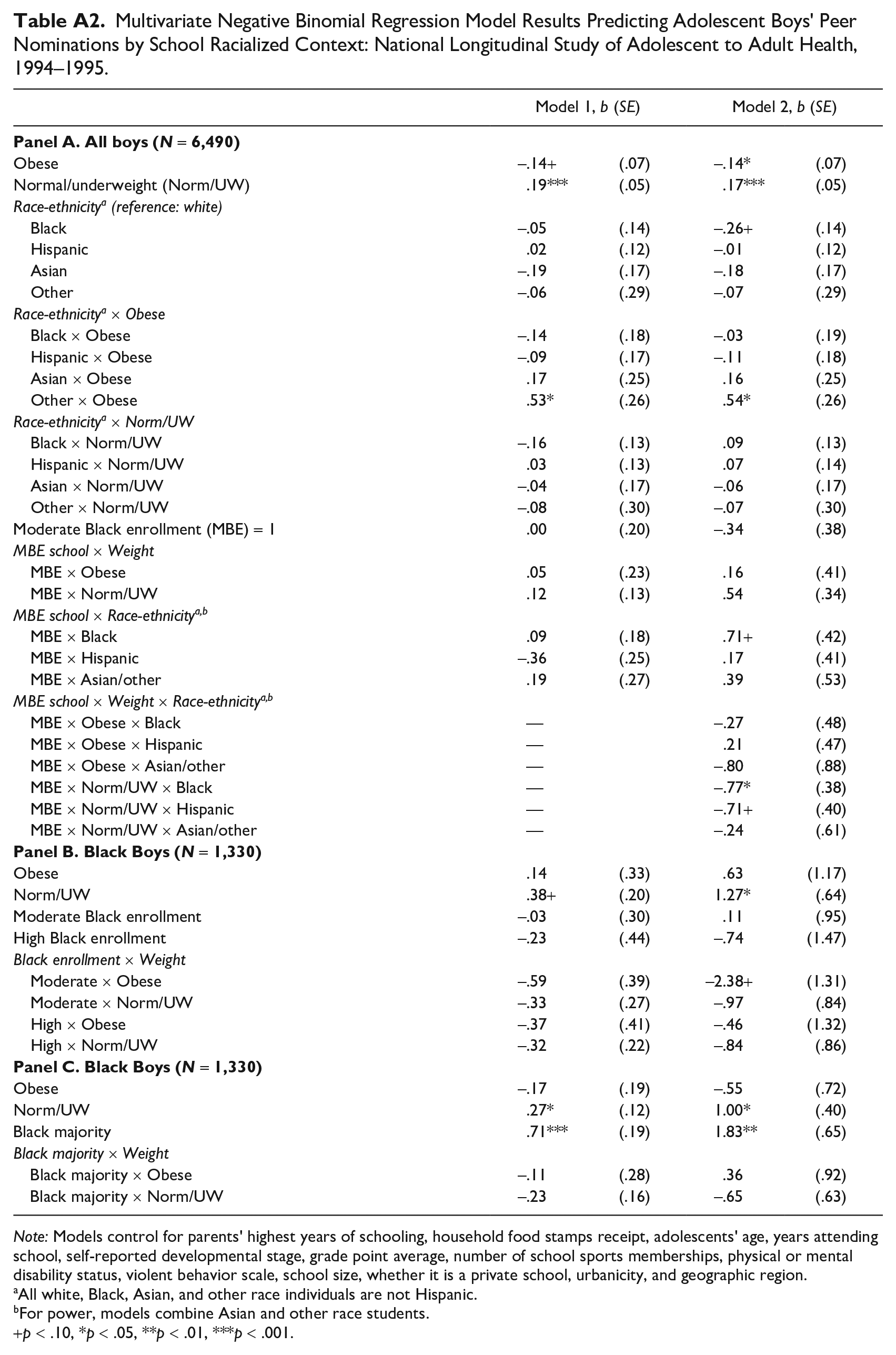
Given our theoretical ideas and prior research, we focus on the results for girls but present model estimates for a similarly constructed sample of boys in Table A2. We do not expect the school’s racial composition to alter boys’ weight-related friendship patterns given the relative racial-ethnic uniformity of male body norms privileging a large, muscular, lean frame (Cachelin et al. 2002; Demarest and Allen 2000).
Results
Table 1 provides weighted descriptive statistics for the multiply imputed analytic sample of girls. On average, girls receive 4.5 friendship nominations from their student peers. Approximately 14% of girls are overweight and 8% of girls are obese. Regarding friendship nominations across the weight categories (not listed in Table 1), girls with “normal” weight or underweight receive an average of 5.3 friendship nominations, girls with overweight receive an average of 4.0 nominations, and girls with obesity receive an average of 3.4 nominations. Regarding race-ethnicity, about 68% of the sample is white, 17% are Black, 9% are Hispanic, 4% are non-Hispanic Asian, and 2% are non-Hispanic other race. Finally, respondents attend schools where 55% of their schoolmates share their race-ethnicity, but this primarily reflects whites’ experiences given whites comprise, on average, 63% of students in respondents’ schools.
Weighted Sample Proportions or Means for Adolescent Girls (N = 6,620): National Longitudinal Study of Adolescent to Adult Health, 1994–1995.
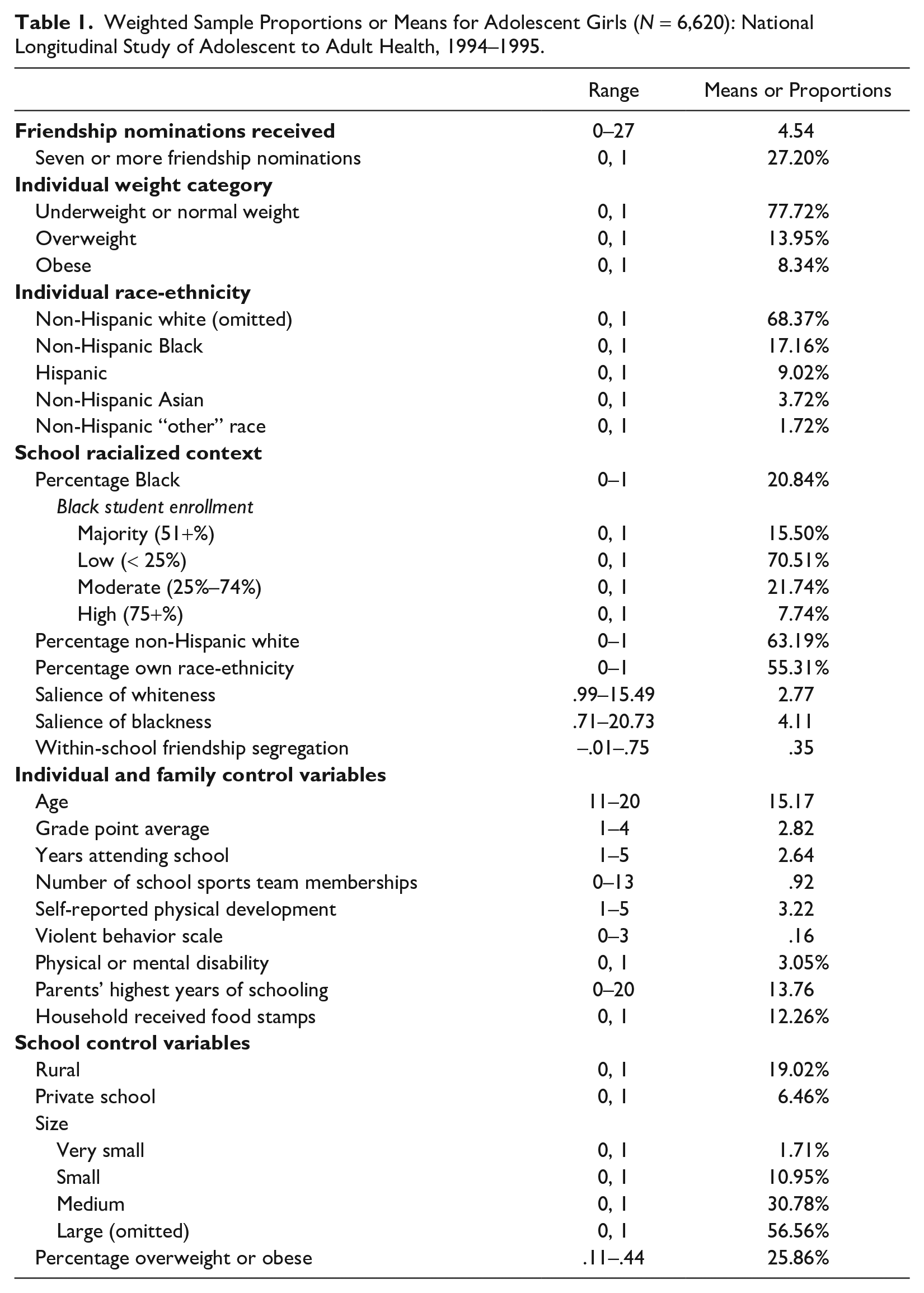
Given continued racial school segregation, respondents’ exposure to Black schoolmates varies tremendously, such that the weighted average Black school enrollment rate for Black, white, Hispanic, and Asian respondents in these data is 62%, 11%, 17%, and 19%, respectively. Furthermore, 82% of whites but 15% of Blacks attend schools with low Black enrollment. Among Black respondents, the proportion attending moderate or high Black enrollment schools is 45% and 40%, respectively.
We next draw attention to the skewed distribution of friendship nominations. For girls, the upper limit is 24, and the median is 4. Leveraging unweighted data from a listwise deletion sample, Figure 1 depicts the friendship distribution for girls in a series of box plots wherein the boxes capture the interquartile range, the vertical bar within the box displays the median, the whiskers display the upper and lower fences (i.e., maximums excluding outliers), and dots display outliers. For brevity, we combine non-Hispanic Asians and other girls. Similar to the weight-related mean differences noted previously, there is an inverse rank-order by weight category for median friendship nominations. In addition, for white and Asians/other girls, the upper quartile value is highest for girls with “normal” weight or underweight, followed by girls with overweight, and then girls with obesity. In contrast, the upper quartile value is not compressed for Black and Hispanic girls with overweight or Black girls with obesity. In summary, the distribution of in-school friendship nominations is highly skewed and overdispersed. Although the link between girls’ thinness and friendship nominations is generally strong, it appears particularly strong for white and Asian/other girls. Weight status and race-ethnicity appear to jointly modify the distribution of girls’ friendship nominations.
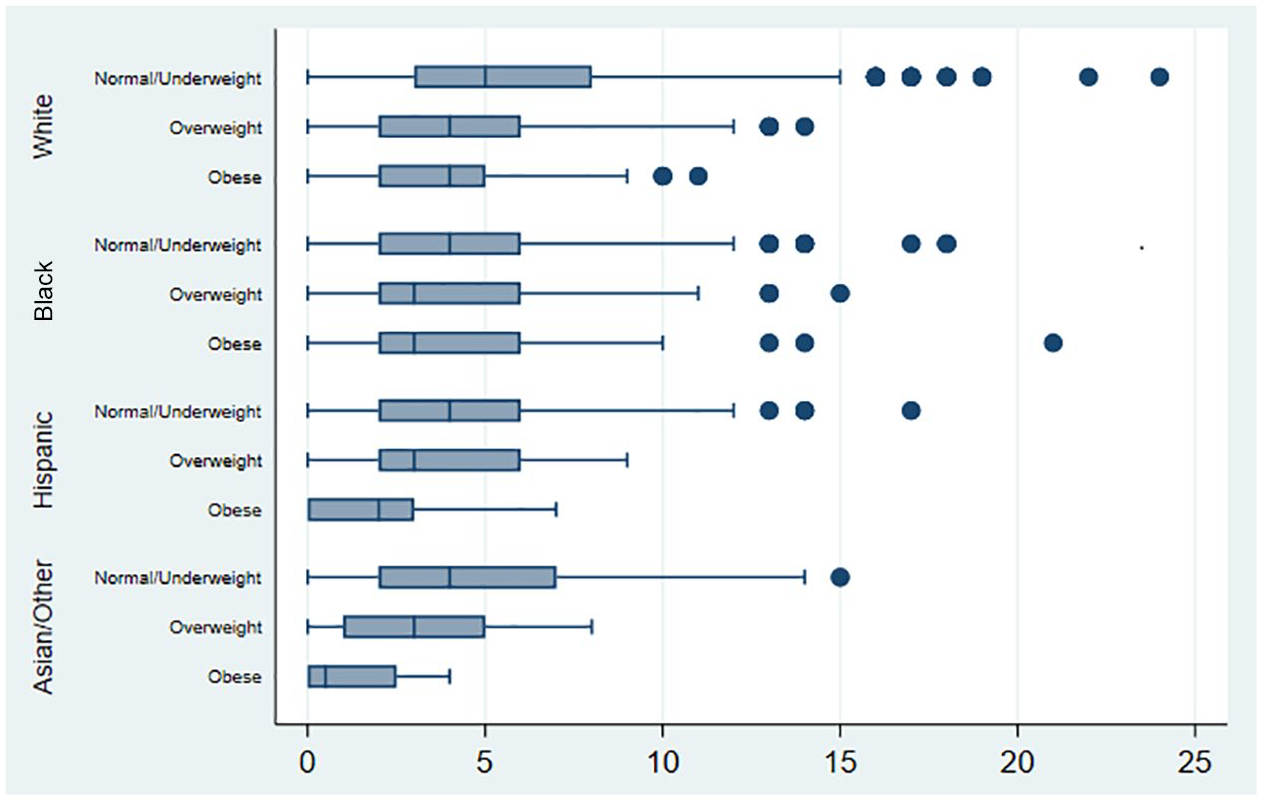
Girls’ Friendship Nominations.
Figure 2 displays the distribution of girls’ friendship nominations separately for those attending schools with low versus moderate Black student enrollments from an unweighted listwise deletion sample. Several patterns are worth noting. First, there are more extremely high friendship nominations for non-Hispanic white girls with “normal” weight or underweight in schools with low Black enrollments. Second, the upper quartile values for white and Black girls with overweight are greater in schools with moderate Black enrollments. Third, maximum friendship nomination values for non-obese Black girls are greater in schools with moderate Black enrollments. Regardless of whether the school has low or moderate Black enrollments, Black girls with obesity receive few friendship nominations, but there is more variation and a higher median number of friendship nominations for Black girls with obesity in schools with low Black enrollments (MLowEnrollment = 4; MModerateEnrollment = 2). Overall, Black girls’ weight-related friendship nomination distributions are similar in schools with moderate or high Black enrollments (results not shown but available on request). Finally, Hispanic girls with “normal” weight have more friends on average and a more overdispersed friendship distribution in schools with moderate Black enrollments, whereas Hispanic girls with overweight have more friends and a more compressed friendship distribution in schools with low Black enrollments. Thus, there appears to be some variation in weight-related friendship patterns across schools, particularly for girls with “normal” weight or overweight.

Girls’ Friendship Nominations in Low Versus Moderate Black Student Enrollment Schools.
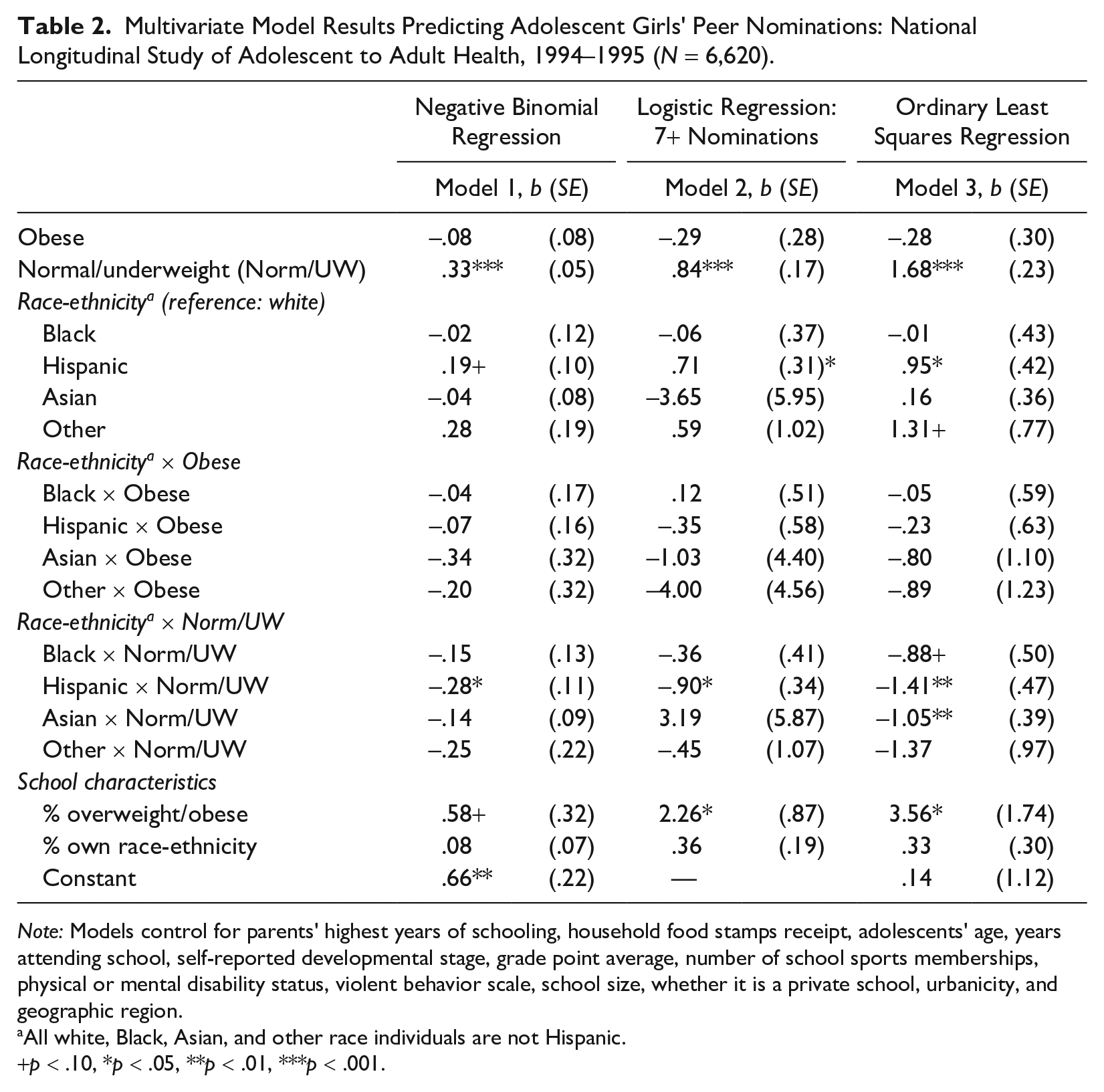
We next model sex and racial-ethnic differences in weight-related friendship nominations across all schools in Table 2. To appropriately account for the overdispersed friendship nomination distribution, while assuming linearity in the dependent variable, Model 1 reports results from negative binomial regression models. Dropping the linearity assumption, Model 2 presents results from a logistic regression model predicting whether the adolescent receives seven or more friendship nominations.
Multivariate Model Results Predicting Adolescent Girls’ Peer Nominations: National Longitudinal Study of Adolescent to Adult Health, 1994–1995 (N = 6,620).
Note: Models control for parents’ highest years of schooling, household food stamps receipt, adolescents’ age, years attending school, self-reported developmental stage, grade point average, number of school sports memberships, physical or mental disability status, violent behavior scale, school size, whether it is a private school, urbanicity, and geographic region.
All white, Black, Asian, and other race individuals are not Hispanic.
p < .10, *p < .05, **p < .01, ***p < .001.
We find that white girls with “normal” weight or underweight receive significantly more friendship nominations than their same-race peers with overweight (Model 1: b = .33; Model 2: b = .84; p < .001). In contrast, there are no significant differences in friendship nominations between white girls with obesity or overweight. Interestingly, and in contrast to Hypothesis 1, the social marginalization of overweight and obesity appears to be relatively similar among girls of color. This is true for all but Hispanic girls. Instead, Hispanic girls with “normal” weight or underweight are relatively less integrated (Model 1: b = −.28; Model 2: b = −.90; p < .05) than white girls with “normal” weight or underweight. Furthermore, in Model 2, Hispanic girls with overweight are more likely than white girls with overweight to receive at least seven friendship nominations (b = .71, p < .05). Thus, relative to other racial-ethnic groups, thinness is less socially beneficial overall, and overweight is less socially detrimental for receiving a high number of friendship nominations for Hispanic girls. These findings differ from prior research on racialized differences in adolescent girls’ weight-related friendship nominations (Cunningham et al. 2102), but this is entirely due to different modeling assumptions about the dependent variable’s distribution (see Model 3).
In supplemental models (available but not shown), the results are unchanged when we use ordinal logistic regression models to predict friendship tertiles or when we alternately add controls for Black enrollment rate, white enrollment rate, salience of whiteness, salience of Blackness, or degree of within-school racial segregation in friendship nominations.
Table 3 explores whether and how attending a school with moderate (vs. low) Black student enrollment alters weight-related friendship nomination patterns for adolescents of diverse racial-ethnic backgrounds. We present results from a negative binomial regression model because it is better powered to model cross-level interactions. Turning first to the results in Model 1 for girls attending schools with low Black enrollment, we again find no significant friendship differences between white girls with obesity or overweight, whereas white girls with “normal” weight or underweight are significantly more integrated than their same-race peers with overweight (b = .33, p < .001). Likewise, we find no differences in these weight-related friendship patterns for Black girls attending these schools. Yet, Hispanic girls with overweight are more socially integrated than white girls with overweight in schools with low Black enrollment (b = .21, p < .05), whereas Hispanic girls with “normal” weight or underweight are more marginalized relative to their same-weight white peers (b = −.28, p < .05) in these schools. Interestingly, white girls with overweight or obesity are not more socially integrated in schools with moderate Black student enrollment. Furthermore, girls of color, including Black girls, are not more integrated in schools with moderate Black student enrollment.
Multivariate Negative Binomial Regression Model Results Predicting Adolescent Girls’ Peer Nominations by School Racialized Context: National Longitudinal Study of Adolescent to Adult Health, 1994–1995 (N = 6,620).

Note: Models control for parents’ highest years of schooling, household food stamps receipt, adolescents’ age, years attending school, self-reported developmental stage, grade point average, number of school sports memberships, physical or mental disability status, violent behavior scale, school size, whether it is a private school, urbanicity, and geographic region.
All white, Black, Asian, and other race individuals are not Hispanic.
For power, models combine Asian and other race students.
p < .10, *p < .05, **p < .01, ***p < .001.
Model 2 explores whether dominant thinness norms are differentially applied depending on the girl’s race-ethnicity and the racial composition of the school. When we add the three-way interaction between the school’s racial composition, respondent’s race-ethnicity, and respondent’s weight status, only Hispanic girls’ experiences vary across schools with moderate versus low Black enrollment. Together, in accordance with Hypothesis 5, the results indicate that Hispanic girls with overweight (or obesity) are more integrated in schools with low Black enrollments (bHisp = .25, p < .01; bModBlack×Hisp = −1.86, p < .05), whereas Hispanic girls with “normal” weight or underweight are more integrated in schools with moderate Black enrollments (bHisp×Norm/UW = −.33, p < .01; bModBlack×Hisp×Norm/UW = 1.85, p < .05). We do not find support for Hypothesis 2, that Black girls with overweight or obesity experience greater peer integration in schools with moderate Black enrollments. Instead, Black girls’ weight-related friendship patterns are statistically similar to white girls with the same weight category in schools with low or moderate Black enrollments.
In supplemental models (available but not shown), the results are substantively similar with ordinal or logistic regression models, when we shift the threshold between low and moderate Black enrollment schools upward to 35%, or when we control for salience of whiteness, salience of blackness, or racial segregation in schoolmates’ friendship nominations.
Our final analyses in Table 4 focus on the experiences of Black adolescents across schools with different Black enrollment rates. Panel A classifies schools according to whether they have low, moderate, or high Black enrollment rates, and Panel B classifies schools according to whether Blacks are the numeric majority. Turning first to the results in Panel A, the negative binomial regression model finds that in schools with low Black enrollment, Black girls with “normal” weight or underweight receive significantly more friendship nominations than Black girls with overweight (b = .44, p < .05), but there are no significant friendship differences between Black girls with obesity or overweight. In schools with moderate (but not high) Black enrollments, obese (b = −.70, p < .05) and “normal” weight or underweight girls (b = −.59, p < .05) are relatively less integrated than Black girls with overweight. Interestingly, we do not observe any statistically significant differences in Black girls’ friendship nominations when we predict the likelihood of receiving seven or more friendship nominations (Panels A and B) or when we predict linear increases in Black girls’ friendship nominations conditional on whether the school has a Black majority (Panel B). Results in Panel A are unchanged when we use 35% as the threshold demarcating low versus moderate Black enrollment schools (results not shown but available on request). In sum, the results reject Hypothesis 2 and support the null hypothesis.
Multivariate Model Results Predicting Non-Hispanic Black Students’ Peer Nominations by School Racialized Context: National Longitudinal Study of Adolescent to Adult Health, 1994–1995 (N = 1,526).

Note: Models control for parents’ highest years of schooling, household food stamps receipt, adolescents’ age, years attending school, self-reported developmental stage, grade point average, number of school sports memberships, physical or mental disability status, violent behavior scale, school size, whether it is a private school, urbanicity, and geographic region.
p < .10, *p < .05.
Discussion
As documented both here and in prior research, adolescent girls with overweight or obesity receive fewer friendship nominations than their “normal” weight and underweight peers (Crosnoe et al. 2008; Simpkins et al. 2013; Strauss and Pollack 2003; Valente et al. 2009). Overall, youth with overweight or obesity are similarly marginalized. Yet, given documented Black–white differences in idealized feminine body norms, we questioned whether Black girls with overweight or obesity experience greater peer integration than same-weight non-Hispanic white girls.
Interestingly and contrary to prior research (Cunningham et al. 2012), we do not find that Black girls with obesity are more peer integrated than white girls with obesity once we account for the overdispersed distribution of friendship nominations. Furthermore, Black and white girls with overweight or obesity experience similarly low rates of peer integration such that, on average, they both have nearly one and a half (b = .33; eb = 1.4) fewer friends than their peers with “normal” weight. In the listwise deletion sample, this reduction is equivalent to a .4 SD reduction in friendships relative to the mean. This is particularly notable given the racial homophily among adolescent friendships (Quillian and Campbell 2003). Although Black adults (Cachelin et al. 2002; Chin Evans and McConnell 2003; Hebl et al. 2009; Kronenfeld et al. 2010; Malpede et al. 2007) and Black youth (Adams et al. 2000; Jones et al. 2007; Nollen et al. 2006; Thompson et al. 1996) are more accepting of larger, more curvaceous female silhouettes, this does not translate into greater acceptance of larger female peers.
Theoretically speaking, the differences between Black and non-Hispanic white girls’ weight norms do not appear to produce parallel differences in weight-related friendship patterns. We see two potential explanations for this similarity in friendship behaviors. First, this result could reflect the oft-documented finding that attitudes do not always translate into behavior (Fishbein and Ajzen 1975): The documented differences in feminine body norms between Blacks and whites may not lead to differential friendship behaviors. Second, there could be an important distinction between feminine body weight norms and feminine body shape norms. Although BMI-based weight categories can identify larger feminine forms, they do not measure body fat distribution. Prior research demonstrates that Black women prefer an exaggerated hourglass shape (Malpede et al. 2007; Overstreet et al. 2010), but BMI-based categories cannot distinguish between girls with an exaggerated hourglass shape and girls with an “apple”-shaped body. Unfortunately, Add Health did not measure body fat distribution. Thus, future research that can measure girls’ waist-to-hip ratios could arrive at different conclusions.
We also questioned whether weight-related friendship patterns would differ in Black schools. We speculated that Black schools might produce an alternative cultural model that diminishes weight stigma if self-reinforcing norms about the ideal feminine form aggregated up from individual Black students, akin to Goldsmith’s (2004) finding that Black schools have a distinct “normative climate” for academic achievement. Yet, we generally do not observe significant differences in girls’ weight-related friendship patterns in schools with higher Black enrollments. Black girls with obesity, as well as white girls with overweight or obesity, are similarly marginalized regardless of the Black enrollment rate. Although Black girls with overweight are slightly more integrated in schools with moderate Black enrollments, this improvement is not seen in schools with a Black majority or high Black enrollment. We caution against overinterpreting this lone finding given we did not hypothesize a curvilinear relationship between weight-related peer integration and Black student enrollment. Thus, it appears that Black (and white) schools are characterized by a cultural model that comports with the dominant valuation of thinness for girls. Supplementary analyses with boys buttress this conclusion. As shown in Table A2, the school’s racial composition significantly shifts Black boys’ weight-related friendship patterns. Given Black boys and girls have nearly identical sample sizes and distributions across different school racialized contexts, we have the statistical power to uncover school-level differences for Black girls were they present. Instead, the similarities in weight-related friendship patterns across school contexts signal the preeminence of thinness norms for girls.
We interpret this as clear evidence that differences in racial groups’ weight norms do not generate differences across these racialized organizational settings. Group-based differences in individual weight norms appear to be orthogonal to weight-related friendship processes in schools, even in racialized school settings where we might expect those group-based differences to be institutionalized. The theoretical suggestion of “alternative” feminine body weight norms across schools, as suggested by the insulation hypothesis, does not appear to hold with respect to girls’ weight, race-ethnicity, and school-based peer acceptance.
Why do dominant, “white” thinness norms prevail even in Black schools when Black youth have likely been exposed to norms that promote “curves” or “being thick”? We speculate about three potential explanations. First, white norms could permeate all schools because most school district policymakers and school leaders are white and thus set the schools’ normative tenor (Turner 2015). This explanation is limited, however, given research that found similarities in Black women’s body image and feelings about their weight among those attending HBCUs and PWIs (Goldsmith 2004). HBCUs better approximate the idea of a Black student “free space,” and Black individuals fill HBCU leadership ranks. Thus, the racial composition of the local leadership is likely not relevant.
A second explanation concerns the role of social class within organizations, here schools. American schools, regardless of their racial composition, reinforce middle-class norms (Lareau 2003). Furthermore, thinness is a class-based norm that grew alongside the rise of the middle class in the early nineteenth century (Farrell 2011). Heavier bodies were mocked as a signal of lower cultural sophistication and lower class (Farrell 2011). Lastly, middle-class norms are implicit in most organizational settings even when organizational members strive for inclusivity (Becker 1998; Ray 2019). Thus, another axis of privilege—social class—may be more meaningful for weight norms than race-ethnicity.
Alternatively, the intersection of race and class could prove important and produce unique environments for feminine body weight norms. In her study of Black adolescent girls, McClure (2017) found that Black girls from middle-class families were more likely to disparage fatness than Black girls from lower-class families. Extrapolating from McClure’s findings, we tested whether a predominantly Black, upper-middle-class school was downwardly biasing our results for Black girls attending high Black enrollment schools by dropping this sampled school in supplemental analyses. The results were unchanged. Unfortunately, we do not have the statistical power to delineate predominantly Black schools according to the students’ social class. Thus, we encourage future research to explore whether alternative feminine body weight norms emerge at the intersection of social class and race.
Finally, race is operant in social organizations above and beyond the composition of the constituent members. Prior scholarship finds that “white” norms are implicit in most organizational settings (Becker 1998; Ray 2019). Thus, ideas, behaviors, and norms that developed from a long history of racialization can be present as the common-sense, legitimate culture of organizations. American educational institutions are no exception, especially given that ideas of white dominance are deeply embedded in American schools (Blau 2003).
Furthermore, the normative desirability of feminine thinness was historically manufactured through the intentional, repeated contrasting of white and Black bodies (Strings 2019). The status of white women was elevated through the explicit denigration of Black bodies (Farrell 2011; Strings 2019). As Sabrina Strings (2019:21) recently argued, the stigmatizing power created at the intersection of race and weight “has been used to both degrade Black women and discipline white women.” Today, the racial valence of thinness norms is often obscured (Strings 2019) but potentially operative due to the implicit whiteness of most organizational settings (Ray 2019). Thus, the racial origins of dominant thinness norms make them salient to and powerful for all adolescent girls regardless of their personal racial-ethnic background or the school’s racial composition.
Due to their numeric infrequency in these data, we are not able to explore whether and how weight-related friendship patterns vary when Hispanic youth are the numeric majority. However, across all schools, the social penalty for being overweight is significantly weaker among Hispanic girls relative to white girls, whereas dominant (white) thinness norms are more socially relevant for Hispanic girls in schools with more Black students. Specifically, Hispanic girls with overweight experience greater peer integration in predominantly white schools and significantly less peer integration in schools with greater Black enrollments. We did not anticipate this significant shift, especially as the limited research about Hispanic girls’ weight norms suggests overall similarity to white girls. We consider several ad hoc explanations for our limited but interesting evidence. First, Hispanics’ norms regarding the ideal feminine form might exist between the normative positions of whites and Blacks. As such, Hispanic girls with overweight or obesity could be perceived differently in predominantly white or more racially mixed schools. Second, these results comport with Bonilla-Silva’s (2004) theory of a triracial society with whites, honorary whites, and collective Blacks. Depending on their skin tone, Hispanics could be either viewed as an honorary white or member of the collective Black group. Unfortunately, we do not have the statistical power to examine whether these weight-related friendship dynamics operate differently for white Hispanics versus Black Hispanics. Yet, in prior research, Hispanic whites are more likely to select white friends, and Hispanic Blacks are more likely to select Black friends (Quillian and Campbell 2003). Reflecting these racialized peer dynamics, Hispanics may orient to different idealized body norms depending on their race and racialized environment. Interestingly, a recent qualitative study found no differences in Hispanic and white girls’ body image and fat talk in a school in the American southwest (Taylor 2015). We encourage future research on this topic with samples of Hispanic youth drawn from multiple schools with different racial compositions.
Data limitations qualify our findings. Much of the theory surrounding peer reactions to adolescent obesity focus on stigma and labeling processes, which imply negative peer evaluations. However, Add Health did not ask who respondents dislike or about other negative ties. We are therefore careful to confine our findings to the concept of peer integration and not peer rejection, victimization, or stigmatization (Asher and Wheeler 1985). Future research with negative peer nominations would more closely align with predominant theories of weight stigma.
Second, Add Health did not collect clinical measures of body fatness. Given BMI is more problematic for measuring adiposity among Black and Asian youth (Freedman et al. 2008), measurement error could downwardly bias our results. Furthermore, it would be preferable to have waist-to-hip ratio measurements to assess respondents’ body fat distribution given evidence that more Black women prefer an exaggerated hourglass shape (Overstreet et al. 2010). Because BMI is unable to measure fat distribution, our classification of girls’ weight misses a key dimension of Black ideal feminine body norms.
Third, these Add Health data are now over 20 years old. As such, the results may reflect past but not current patterns. Given that media representations of the ideal feminine form have shifted only slightly over the past 20 years (Roberts and Muta 2017) and weight-related discrimination has actually increased since 1995 (Andreyeva, Puhl, and Brownell 2008), we speculate that weight-related differences in girls’ peer integration has remained unchanged or possibly increased regardless of race. Modern teens internalize popular media messages about body size and personal responsibility and continue to tease their overweight classmates (Taylor 2015). Regarding potential shifts across different racialized school contexts, it is important to note that Black–white school segregation has remained high and that Hispanic and Asian students have become more segregated from whites since the 1990s (Fiel 2013; Orfield and Frankenberg 2014). The potential protection from dominant, white thinness norms in minoritized, segregated schools is likely mitigated, however, by the growing adoption of thinness norms among minoritized teen girls. For example, on average, Black girls have become more dissatisfied with their bodies and thus more similar to white girls’ negative self-evaluations (Roberts et al. 2006). Furthermore, a recent study of Hispanic and white girls in the American southwest finds their attitudes and weight-related narratives are indistinguishable (Taylor 2015). Thus, the results presented here may provide an upper bound for the potential context-related differences for Hispanic and Black girls today.
Finally, we are unable to draw strong causal inference from our cross-sectional analyses. We interpret our findings as adolescent weight categories leading to friendship nominations, but the causal ordering could be reversed. For example, adolescents with low peer integration may be stressed and respond by eating more and gaining weight. Disentangling peer selection from peer influence processes is notoriously difficult and typically requires longitudinal network data and methods, peer randomization (e.g., roommate assignments), or a strong instrumental variable (Cohen-Cole and Fletcher 2008). Absent these conditions, we cannot rule out reverse causality in interpreting our results.
Despite these limitations, this study has several strengths and makes important contributions. First, we extend the original examination of weight-related differences in friendship patterns by race-ethnicity to adolescents with overweight. Second, by shifting the reference group to adolescents with overweight, we reveal similarities in friendship patterns between adolescent girls with overweight or obesity. Third, we attend to the overdispersed distribution of friendship nominations given the processes generating a Matthew effect. Finally, by leveraging Add Health’s unique school-based social network data for a racially diverse, nationally representative sample and controlling for a rich array of social characteristics related to adolescents’ peer integration, we can explore whether and how the school’s racial context alters the dominant cultural norms privileging thinness in socially meaningful ways. Although the data are old, this study would not be possible without Add Health; no other data contain these requisite features.
In summary, the social benefits of thinness are quite strong and pervasive. Even in schools with greater Black student enrollments, where we might expect dominant (white) thinness norms to be mitigated, it persists.
Footnotes
Appendix
Multivariate Negative Binomial Regression Model Results Predicting Adolescent Boys’ Peer Nominations by School Racialized Context: National Longitudinal Study of Adolescent to Adult Health, 1994–1995.
| Model 1, b (SE) | Model 2, b (SE) | |||
|---|---|---|---|---|
|
|
||||
| Obese | −.14+ | (.07) | −.14* | (.07) |
| Normal/underweight (Norm/UW) | .19*** | (.05) | .17*** | (.05) |
| Race-ethnicity a (reference: white) | ||||
| Black | −.05 | (.14) | −.26+ | (.14) |
| Hispanic | .02 | (.12) | −.01 | (.12) |
| Asian | −.19 | (.17) | −.18 | (.17) |
| Other | −.06 | (.29) | −.07 | (.29) |
| Race-ethnicity a × Obese | ||||
| Black × Obese | −.14 | (.18) | −.03 | (.19) |
| Hispanic × Obese | −.09 | (.17) | −.11 | (.18) |
| Asian × Obese | .17 | (.25) | .16 | (.25) |
| Other × Obese | .53* | (.26) | .54* | (.26) |
| Race-ethnicity a × Norm/UW | ||||
| Black × Norm/UW | −.16 | (.13) | .09 | (.13) |
| Hispanic × Norm/UW | .03 | (.13) | .07 | (.14) |
| Asian × Norm/UW | −.04 | (.17) | −.06 | (.17) |
| Other × Norm/UW | −.08 | (.30) | −.07 | (.30) |
| Moderate Black enrollment (MBE) = 1 | .00 | (.20) | −.34 | (.38) |
| MBE school × Weight | ||||
| MBE × Obese | .05 | (.23) | .16 | (.41) |
| MBE × Norm/UW | .12 | (.13) | .54 | (.34) |
| MBE school × Race-ethnicity a,b | ||||
| MBE × Black | .09 | (.18) | .71+ | (.42) |
| MBE × Hispanic | −.36 | (.25) | .17 | (.41) |
| MBE × Asian/other | .19 | (.27) | .39 | (.53) |
| MBE school × Weight × Race-ethnicity a,b | ||||
| MBE × Obese × Black | — | −.27 | (.48) | |
| MBE × Obese × Hispanic | — | .21 | (.47) | |
| MBE × Obese × Asian/other | — | −.80 | (.88) | |
| MBE × Norm/UW × Black | — | −.77* | (.38) | |
| MBE × Norm/UW × Hispanic | — | −.71+ | (.40) | |
| MBE × Norm/UW × Asian/other | — | −.24 | (.61) | |
|
|
||||
| Obese | .14 | (.33) | .63 | (1.17) |
| Norm/UW | .38+ | (.20) | 1.27* | (.64) |
| Moderate Black enrollment | −.03 | (.30) | .11 | (.95) |
| High Black enrollment | −.23 | (.44) | −.74 | (1.47) |
| Black enrollment × Weight | ||||
| Moderate × Obese | −.59 | (.39) | −2.38+ | (1.31) |
| Moderate × Norm/UW | −.33 | (.27) | −.97 | (.84) |
| High × Obese | −.37 | (.41) | −.46 | (1.32) |
| High × Norm/UW | −.32 | (.22) | −.84 | (.86) |
|
|
||||
| Obese | −.17 | (.19) | −.55 | (.72) |
| Norm/UW | .27* | (.12) | 1.00* | (.40) |
| Black majority | .71*** | (.19) | 1.83** | (.65) |
| Black majority × Weight | ||||
| Black majority × Obese | −.11 | (.28) | .36 | (.92) |
| Black majority × Norm/UW | −.23 | (.16) | −.65 | (.63) |
Note: Models control for parents’ highest years of schooling, household food stamps receipt, adolescents’ age, years attending school, self-reported developmental stage, grade point average, number of school sports memberships, physical or mental disability status, violent behavior scale, school size, whether it is a private school, urbanicity, and geographic region.
All white, Black, Asian, and other race individuals are not Hispanic.
For power, models combine Asian and other race students.
p < .10, *p < .05, **p < .01, ***p < .001.
Acknowledgements
This research uses data from Add Health, a program project directed by Kathleen Mullan Harris and designed by J. Richard Udry, Peter S. Bearman, and Kathleen Mullan Harris at the University of North Carolina at Chapel Hill, and funded by grant P01HD31921 from the Eunice Kennedy Shriver National Institute of Child Health and Human Development, with cooperative funding from 23 other federal agencies and foundations. Special acknowledgment is due Ronald R. Rindfuss and Barbara Entwisle for assistance in the original design. Information on how to obtain the Add Health data files is available on the Add Health website ( ). We thank Cynthia Colen, Michelle Frisco, Megan Lemmon, Susana Quiros, Shedra Amy Snipes, and Jennifer Van Hook for their helpful comments. We thank Nathan Walters for his research support.
Funding
The authors disclosed receipt of the following financial support for the research, authorship, and/or publication of this article: No direct support was received from Grant P01HD31921 for this analysis. This research was supported by grants from National Institutes of Health (R24 HD041025 and P01 HD062498). Opinions expressed reflect those of the authors, not those of the granting agencies.