



Abstract
Researchers and practitioners often extol the health benefits of social relationships and social participation for older adults. Yet they often ignore how these same bonds and activities may contribute to negative health behaviors. Using data from the Wisconsin Longitudinal Study (16,065 observations from 7,007 respondents), we examined how family characteristics, family history, and social participation predicted three measures of alcohol abuse between ages 53 and 71. Results indicate that, generally, greater social participation is associated with increased drinking days per month. We also found that religious participation and having ever lived with an alcoholic are each associated with reporting possible alcohol dependence but not with alcohol consumption itself. Lastly, we identified gendered associations between marital dissolution and drinking behavior. These findings contextualize the increasing rates of alcohol abuse among older adults by emphasizing the possible negative consequences of “linked lives” on health via relationship stress and group norms.
Alcohol is the most commonly abused substance among older adults, and the prevalence of this abuse continues to rise (Barry and Blow 2016; Grant et al. 2017). Unfortunately, comparatively little research has examined the correlates of problematic drinking behavior among older adults when compared with other age groups. This oversight is important because seniors are especially vulnerable to some of the negative effects of alcohol due to increased morbidity and a higher risk of mortality (Moore et al. 2006). More specifically, alcohol abuse in later life is associated with memory problems, liver disease, sleep disorders, and cancer, among other negative health outcomes (Blow and Barry 2012). Even with prior research suggesting possible benefits of moderate alcohol use, some scientists now caution there is no safe level of alcohol consumption—particularly for older adults (Griswold et al. 2018). Combined with population aging, older adult alcohol abuse has the potential to cause considerable burden to health care systems worldwide.
Studies that have examined the possible risk factors of alcohol abuse in later life have primarily focused on prior drinking behavior (Lemke and Moos 2003) or mental health diagnoses (Anton and Miller 2005), largely ignoring “linked lives.” That is, they have paid little attention to how social networks (e.g., family and friends) are central influences on health behaviors across the life course (Carr 2018; Elder, Johnson, and Crosnoe 2003). For instance, free time bestowed by retirement may amplify relationships and behaviors that are associated with high-risk alcohol consumption (Kuerbis and Sacco 2012). In addition, the ways in which social networks influence drinking behavior may differ in older ages as some friends and family members move away or become ill.
Research linking social ties to health behavior tends to emphasize the beneficial aspects of these relationships or simply label them “positive” or “negative” (Umberson and Montez 2010). Because of this, there is little understanding of how both facets may work in concert. In other words, do social relationships that are widely acknowledged as beneficial confer concurrent health risks? This question is particularly relevant for older adult alcohol use given that (a) empirical studies tying older adult social networks to substance abuse have focused on cigarettes (Thomeer et al. 2019) and prescription medicine (Kalapatapu and Sullivan 2010) and (b) research on social ties and alcohol consumption primarily emphasize adolescent group norms and behavior (Mundt 2011). The present study tests how family relationships and social participation—frequently associated with health promotion—may also be associated with alcohol abuse in mid- and later-life. We also consider how gender may shape the way family and social characteristics influence unhealthy drinking behavior.
Background
Family Characteristics and Alcohol Abuse
Scholars documenting how social relationships can both establish and modify health behavior often emphasize the influence of marriage and family (Carr 2018). But even marriage, which primarily protects health and encourages healthy behavior, likely has complex relationships with alcohol use and abuse. For example, Polenick, Birditt, and Blow (2018) found that alcohol consumption between spouses tends to converge during marriage, potentially normalizing alcohol abuse and increasing the risk of abuse for one spouse. We may not expect many married couples in their 50s and 60s to binge drink together, but daily routines offer regular and frequent opportunities to drink with “others” that align with marriage norms. Marriage can also negatively influence health behavior via life course disruptions and trauma. In particular, marital conflict and dissolution can expose stressors that indirectly encourage unhealthy behaviors as a coping mechanism (Umberson and Montez 2010). While most adults aged 50 or older are married, the risk of widowhood increases as people age, and among older adults (ages 65-plus), 34% of women (12% of men) are single due to the death of a spouse (Roberts et al. 2018). In addition, many adults in later life struggle with the consequences of divorces that occurred years prior. Whether due to widowhood or divorce, the trauma of marital dissolution can cause permanent changes in social support and financial resources, triggering secondary stressors (Pearlin et al. 2005) and potentially increasing the risk of alcohol abuse (Perreira and Sloan 2001).
Having children can also put considerable stress and pressure on parents, but it is less clear whether this leads to increased rates of alcohol abuse in later life. Instead, adult children likely provide social support to older parents and reinforce healthy norms, such as moderate alcohol consumption. Becoming a parent often increases social integration over the life course (Nomaguchi and Milkie 2003), and regularly seeing adult children can help prevent social isolation—a major risk factor for negative health behaviors (Shankar et al. 2011). In addition, social support from siblings may help protect against unhealthy behaviors (East and Khoo 2005). Unfortunately, most research on parenthood, sibling bonds, and alcohol abuse has focused on younger adults and new parents (O’Malley 2004).
Along with marital status and family structure, a family history and drinking culture likely shape the risk of alcohol abuse across the life course. For example, living with alcoholics often exposes individuals to ongoing trauma that can lead to recreating problematic behavior later in life (Rogers, Lawrence, and Montez 2016). Although studies have demonstrated that growing up in an alcoholic household increases the risk of substance abuse in adolescence (Chalder, Elgar, and Bennett 2006), much less is known about how it influences drinking behaviors decades later. As an analogous substance abuse example, one study found that a family history of living with smokers tended to have a bifurcated impact: It encouraged smoking initiation for some while leading others to fervently reject it (Thomeer et al. 2019). Based on these previous studies, we expect that:
Hypothesis 1a: Marriage is associated with drinking more frequently; but being formerly married is associated with greater at-risk drinking and alcohol dependence.
Hypothesis 1b: Regular contact with children or siblings is protective against alcohol abuse.
Hypothesis 1c: Ever living with an alcoholic is associated with increased risk of alcohol abuse.
Social participation and alcohol abuse
Although family is a fundamental influence on health behaviors, other aspects of linked lives, such as friends and social activity groups, also play vital roles (Wanchai and Phrompayak 2019). Reasons we expect these social groups to positively influence health behavior include (a) individuals upholding healthy values due to interpersonal attachment and (b) normative behavior guidance from others (Berkman, Kawachi, and Glymour 2014). Unfortunately, comparatively little research considers the negative health effects of social participation, especially as it pertains to older adults (Villalonga-Olives and Kawachi 2017). In the following, we outline why social participation may encourage alcohol abuse in mid- and later-life, with a focus on negative social influences (through social control and group norms) and negative social bonding (through self-selecting into activities involving alcohol consumption).
Although there is no consensus as to its definition, social participation frequently excludes family and instead focuses on “activities that provide interaction with others in society or the community”, which may be most evident by meeting and interacting with friends (Levasseur et al. 2010:2146). Meeting friends, however, is often not just “meeting” and includes other simultaneous activities (e.g., dining at a restaurant or hosting a party). Such events, even among sporadic or moderate drinkers, could increase the odds of more frequent alcohol consumption. Preexisting alcohol abusers, on the other hand, may even seek out or create such opportunities to drink among accepting peers, especially given that alcohol abusers tend to be friends with like-minded individuals (Mohr et al. 2001). Social activities that ostensibly have little to do with alcohol (e.g., going to the theater or meeting with a hobby group) may also have alcohol present, indirectly encouraging its consumption. Even activities that have consistent associations with “good health” could have complex relationships with alcohol abuse. For example, group exercise provides obvious health benefits, but research on college students has found it may encourage unhealthy drinking (Dodge, Clarke, and Dwan 2017). Possible reasons for this exercise-drinking association include (a) using exercise to compensate for other unhealthy behaviors and (b) certain personality types seeking out the “highs” of both alcohol use and exercise. While regularly drinking at social events or after exercise may present important health risks for older adults, this behavior does not necessarily reflect or lead to alcohol dependence.
Unique among social activities, religious participation often explicitly and implicitly discourages alcohol abuse. Prior studies have found that religious attendance is associated with both abstention and decreased consumption due to social control and social network selection effects (Ellison et al. 2008; Mellor and Freeborn 2011). Religious group norms may also persuade individuals to acknowledge problematic drinking behavior, leading to reduced alcohol consumption. For example, organized religion may encourage an admission of past transgressions while also serving as a destination for those with substance abuse disorders or in recovery programs (Kaskutas, Bond, and Weisner 2003). Based on this evidence, this study proposes the following hypotheses:
Hypothesis 2a: Social participation (other than religious participation) is associated with increased drinking frequency and increased at-risk drinking (but not alcohol dependence).
Hypothesis 2b: Religious participation is protective against alcohol abuse.
Gender, social relationships, and alcohol abuse
Compared with women, men tend to drink more frequently, binge drink more, and abstain less, even though these differences have narrowed in recent decades (Erol and Karpyak 2015; Satre, Bahorik, and Mackin 2018). If there are associations between family characteristics and alcohol abuse (Hypothesis 1), there are reasons to expect they vary by gender. For example, Reczek et al. (2016) found that although drinking tends to converge over the course of the marriage, it is women’s drinking that is more likely to increase. How associations between divorce and health behavior differ by gender is inconclusive (Amato 2010), but men may be more likely to use alcohol to cope with divorce (Pudrovska and Carr 2008). In addition, because women spend more time raising children, relationships between adult children and parents may matter more for women when it comes to influencing health behaviors.
Although little evidence suggests that social participation itself varies by gender, women tend to have richer social networks and are more likely involved in certain social activities, such as voluntary organizations and religious groups (Cornwell, Laumann, and Schumm 2008; Einolf 2011). In addition, women born in the first half of the twentieth century have experienced, and likely internalized, a well-documented history of gendered social drinking norms (Staddon 2015). As such, if social participation is associated with alcohol abuse (Hypothesis 2), women may be less likely to (a) abuse alcohol during these activities and (b) use social activities as an outlet or excuse to drink socially. In total, these considerations inform the following hypotheses:
Hypothesis 3a: The hypothesized increased risk of alcohol abuse for those no longer married (Hypothesis 1a) will be stronger for men (compared with women).
Hypothesis 3b: The hypothesized protective association between regular contact with children and alcohol abuse (Hypothesis 1b) will be stronger for women (compared with men).
Hypothesis 3c: Hypothesized relationships between social participation (other than religious participation) and alcohol abuse (Hypothesis 2a) will be greater for men (compared with women).
Operationalizing older adult alcohol abuse
Guidelines distinguishing alcohol use from abuse can be contentious, and there is some ambiguity in how to classify drinking behavior in health research (Livingston and Callinan 2015). This methodological issue may be amplified for older adults because drinking guidelines are rarely age-specific and the body has more difficulty processing alcohol as individuals age (Kuerbis et al. 2014). On the most extreme end, any alcohol consumption in later life could be considered a sign of alcohol abuse. That is, older adults are particularly susceptible to the ill effects of alcohol due to increased frailty, comorbidity, and possible dangerous interactions with medications (Han et al. 2017). A recent global study claimed the only safe level of drinking (for all age groups) is no drinking and that even low levels of alcohol intake are associated with cancer, injuries, and other diseases (Burton and Sheron 2018). In addition, in 2019, the Centers for Disease Control and Prevention (CDC) advised that no one should ever begin drinking based on “potential” health benefits. If there is a health risk for older adults consuming even moderate levels of alcohol, then the frequency of alcohol consumption is one way to measure alcohol abuse, with each cumulative drinking day adding to the risk.
Other, more lenient definitions of alcohol abuse involve terms such as at-risk (unhealthy) drinking and binge (excessive) drinking. Binge drinking is usually defined as consuming four or more drinks on one occasion for women (five or more for men; CDC 2019), although these guidelines are not age-specific and should likely be more stringent for older adults (Merrick et al. 2008). Older adult at-risk drinking, on the other hand, is typically defined as three or more drinks on any occasion and is likely responsible for more alcohol-related health problems among older adults than binge drinking (Kuerbis et al. 2014). Of course, being a regular at-risk drinker is not the same as being “alcohol dependent” or an “alcoholic.” For those diseases, the CAGE questionnaire, or equivalent, is the most common screening tool (Dhalla and Kopec 2007). This survey normally requires respondents to acknowledge negative life consequences due to prior or current drinking behavior, such as guilt or work-related problems.
Data and Methods
Data
This study employed the Wisconsin Longitudinal Study (WLS), a long-term survey of a random sample of 10,317 men and women who graduated from Wisconsin high schools in 1957 and were born around 1939 (Herd, Carr, and Roan 2014). After the original wave (W1) was collected a few months before respondents graduated high school, four follow-up waves (W2–W5) were completed in 1975, 1992, 2003, and 2011, when the modal age of respondents was 35, 53, 64, and 71 years, respectively. The WLS used in-person interviews for W1, mail surveys for W2, phone interviews for W3 and W4, and in-person interviews for W5. In addition, supplemental mail surveys were sent during W3 through W5. The response rates (for either the primary survey or the mail surveys) during W2 through W5 were 90%, 87%, 86%, and 74%, respectively (WLS 2018).
The WLS is broadly representative of non-Hispanic white Americans who have at least a high school education (Herd 2010). Moreover, about one fifth of the sample is of farm origin, consistent with estimates of Americans born in the late 1930s. We chose the WLS for this study because it provides numerous advantages when studying family context, social participation, and alcohol abuse. For example, the WLS incorporates a separate alcohol use module and asks several detailed questions with respect to social participation. In addition, unlike most longitudinal studies of older adults, the WLS includes survey items from adolescence that may be associated with later life alcohol abuse, including childhood family characteristics, high school extracurricular activity involvement, and IQ test scores. Lastly, WLS respondents—born around 1939—(a) represent the end of the Silent Generation, (b) were part of a “cohort of joiners,” and (c) were born in the Midwest—all attributes generally associated with social participation (Brand and Burgard 2008). Because this study’s hypotheses concern alcohol abuse in mid- and later-life, the baseline is W3 (mean age = 53)—the same year alcohol consumption questions were introduced. During W3, these questions were only asked to a random subsample, covering 79% of respondents. For W4 and W5, all respondents were asked these questions.
Some social participation activities were introduced during W3, and additional activities were introduced during W4. To account for this inconsistency, the WLS, during W4, asked respondents to retrospectively report W3 social participation for those new items. Therefore, our sample includes W3 respondents who also responded to the W4 survey (83.6% of the 10,440 W3 respondents). In addition, because the supplemental mail survey asked the social participation questions, we only include individuals who responded to both the primary survey and the supplemental survey (87.6% of those who completed the primary survey, across W3–W5). We considered the sensitivity of our results to these two sample adjustments (see Results section). In total, the final analytical sample consisted of 7,007 individuals who contributed 16,065 observations (mean = 2.29 waves per person). Table 1 presents descriptive statistics for the sample.
Descriptive Statistics, Wisconsin Longitudinal Survey (1992–2011).
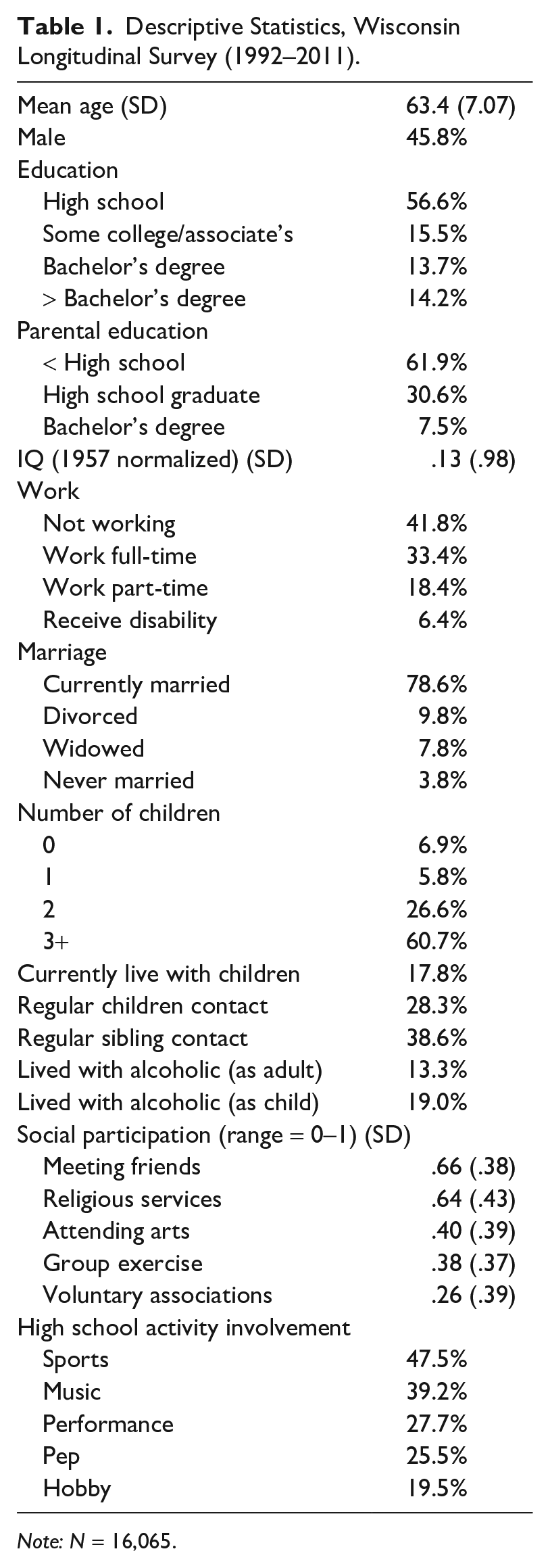
Note: N = 16,065.
Measures
Alcohol abuse
Given (a) the ambiguity of defining alcohol abuse for older adults and (b) that associations among family, social participation, and alcohol abuse may depend on how it is operationalized, we employed three alcohol abuse measures as our dependent variables. The first, drinking days per month, was the answer to the survey question, “During the last month, on how many days did you drink alcoholic beverages?” The second measure—whether the respondent was a regular at-risk drinker—was coded 1 if the answer to the question “What is the average number of (alcoholic) drinks you had on the days you consumed any alcoholic beverages in the past month?” was ≥3 and the respondent drank at least four times over the past month. The third measure—possible alcohol dependence—was based on the WLS’s version of the CAGE screening instrument (Dhalla and Kopec 2007). Respondents were coded as having possible dependence if they admitted to their drinking ever resulting in two or more of the following five consequences: guilt, criticism by others, work-related problems, family problems, or seeking help for their drinking. Descriptive alcohol abuse statistics can be found in Table 2, which indicate men reported more drinking days per month, regular at-risk drinking, and possible alcohol dependence than women. Between 1992 (mean age = 53) and 2011 (mean age = 71), drinking frequency increased, whereas the percentage of those classified as regular at-risk drinkers and having possible alcohol dependence decreased.
Descriptive Alcohol Abuse Statistics by Wave and Gender, Wisconsin Longitudinal Survey (1992–2011).

Notes: N = 16,065.
Family characteristics
Our operationalization of family context included three time-varying descriptive variables: marital status, number of children, and whether the respondent lived with a child. We also included four other variables that measure family ties and family history: (1) whether the respondent had contact with their children at least once per week, (2) whether the respondent had contact with siblings at least once per month, and whether the respondent had ever lived with a problem drinker or alcoholic (3) when they were growing up or (4) other than when they were growing up. In the WLS, contact is defined as meeting in person, talking on the phone, or writing emails.
Social participation
The five time-varying social participation measures included: meeting friends, attending religious services, group exercise, attending arts-related or cultural activities, and joining any of four types of voluntary associations (hobby, community, neighborhood, or civic). Leveraging the WLS’s nonbinary categories for social participation, each item was sorted into three categories (range = 0–1), representing no (0), moderate (.50), or high participation (1.0) in that activity—similar to other social participation studies using this data set (Greenfield and Moorman 2017; Vogelsang 2016). For items that asked for quantitative responses (frequency), the activity was coded into categories as suggested by the WLS codebooks and then adjusted to ensure consistency across waves. For example, the three categories for “meeting friends” represent individuals meeting friends zero, one to two, and three or more times during the past month. For religious attendance, these categories represent no attendance, once a year to once a month, and more than once a month. Because relationships between social participation and alcohol abuse may be shaped by adolescence and young adulthood (Lindström 2008), we also controlled for five high school activities. For these activities, respondents were assigned a 1 if their high school yearbook indicated any participation in the following school-sponsored extracurricular activities: sports teams (varsity, intramural, or club), music (e.g., band or chorus), performance (e.g., drama club), pep/spirit (e.g., cheerleading), or hobby clubs.
Demographic variables
Our analyses also included a number of basic demographic variables that are likely related to family characteristics, social participation, and alcohol abuse: sex (as a proxy for gender), education, parental education, employment status, and IQ. The entire sample graduated high school, so additional educational attainment categories included some college/associate’s degree, bachelor’s degree, and postgraduate degree. Respondent ages were not equal during each survey year, but the vast majority (97.8%) had ages within one year of the modal age. We employed a normalized IQ variable, which was previously found to be associated with alcohol use among WLS respondents (Molander, Yonker, and Krahn 2010). Our operationalization of marital status included currently married, divorced, widowed, and never married. Employment was categorized as unemployed, employed-full time, employed-part time, and disability (if the respondent was unemployed but received disability benefits). Because nearly all WLS respondents are white, race information is excluded from the public data set out of privacy concerns (Herd et al. 2014), the implications of which are discussed in the Limitations section.
Analytic Strategy
We tested for relationships between family characteristics, social participation, and alcohol consumption by estimating three-model sequences of random-effect multilevel regression models. These models—nesting observations (Level 1) within respondents (Level 2)—provide a number of key benefits, including (a) their ability to estimate subject-specific coefficients after accounting for unobserved heterogeneity (the random effect) and (b) allowing all participants to contribute to the estimates even in the case of missing observations (Rabe-Hesketh and Skrondal 2012). The random intercept is assumed to be independent across individuals but constant among multiple observations of the same individual.
We estimated three sets of these models—one for each dependent variable: drinking days per month (set A), regular at-risk drinking (set B), and possible alcohol dependence (set C). For drinking days per month, we employed negative binomial regression models (overdispersion models), which were most appropriate given the excess number of zeros (30.5% of the sample) and given that the mean number of drinking days (7.38) was substantially less than the count’s variance (95.52). For the two binomial dependent variables, we employed logistic regression. In each set, the first model (M1) was a baseline model, including basic demographic covariates that can confound associations among family characteristics, social participation, and alcohol consumption. Model 2 (M2) included all family characteristics, and Model 3 (M3) included all 10 social participation measures in order to test Hypothesis 1 and Hypothesis 2, respectively. We also separately estimated all models by gender to test Hypothesis 3.
Results
In Table 3 (drinking days per month), results are presented as incidence rate ratios (IRR)—which represent the estimated multiplicative change in drinking days given a one-unit increase in a predictor variable. For example, compared with respondents who are 53 years old, those who are 64 and 71 years old are estimated to drink 14% and 23% more days, respectively (M1-A). In M2-A, being divorced (IRR = .77) and never married (IRR = .43) were each associated with fewer drinking days per month than those who are currently married. Results of M3-A suggest that individuals who are socially active generally consume alcohol more frequently. In particular, meeting friends regularly (IRR = 1.30), participating in group exercise (IRR = 1.20), and attending arts/cultural events (IRR = 1.09) were each associated with greater drinking days per month, as was having participated in high school sports (IRR = 1.19) or pep groups (IRR = 1.09).
Incidence Rate Ratios for Drinking Days Per Month, Using Negative Binomial Regression, Conditional on Random Effects.

Note: N = 16,065; IRR = incidence rate ratio; SE = standard error.
Source: Wisconsin Longitudinal Study (1992–2011).
p ≤ .10, *p ≤ .05, **p ≤ .01, ***p ≤ .001 (two-tailed tests).
In Tables 4 and 5, results are presented as odds ratios (ORs)—which signify the multiplicative increase (for ratios >1.0) or decrease (for ratios <1.0) in the odds of reporting regular at-risk drinking and possible alcohol dependence, respectively. For regular at-risk drinking (Table 4), some M1-B results run counter to those for drinking days per month (Table 3). That is, although increased age and education were associated with more drinking days, they were associated with decreased odds of regular at-risk drinking. In M2-B, the only family characteristics associated with greater at-risk drinking were being divorced (OR = 1.73) or widowed (OR = 1.82). For social participation items in M3-B, meeting friends was associated with greater odds of at-risk drinking (OR = 1.88), whereas attending religious services (OR = .63) and attending arts/cultural events (OR = .40) were each associated with reduced odds.
Odds Ratios of Regular At-Risk Drinking, Using Logistic Regression, Conditional on Random Effects.
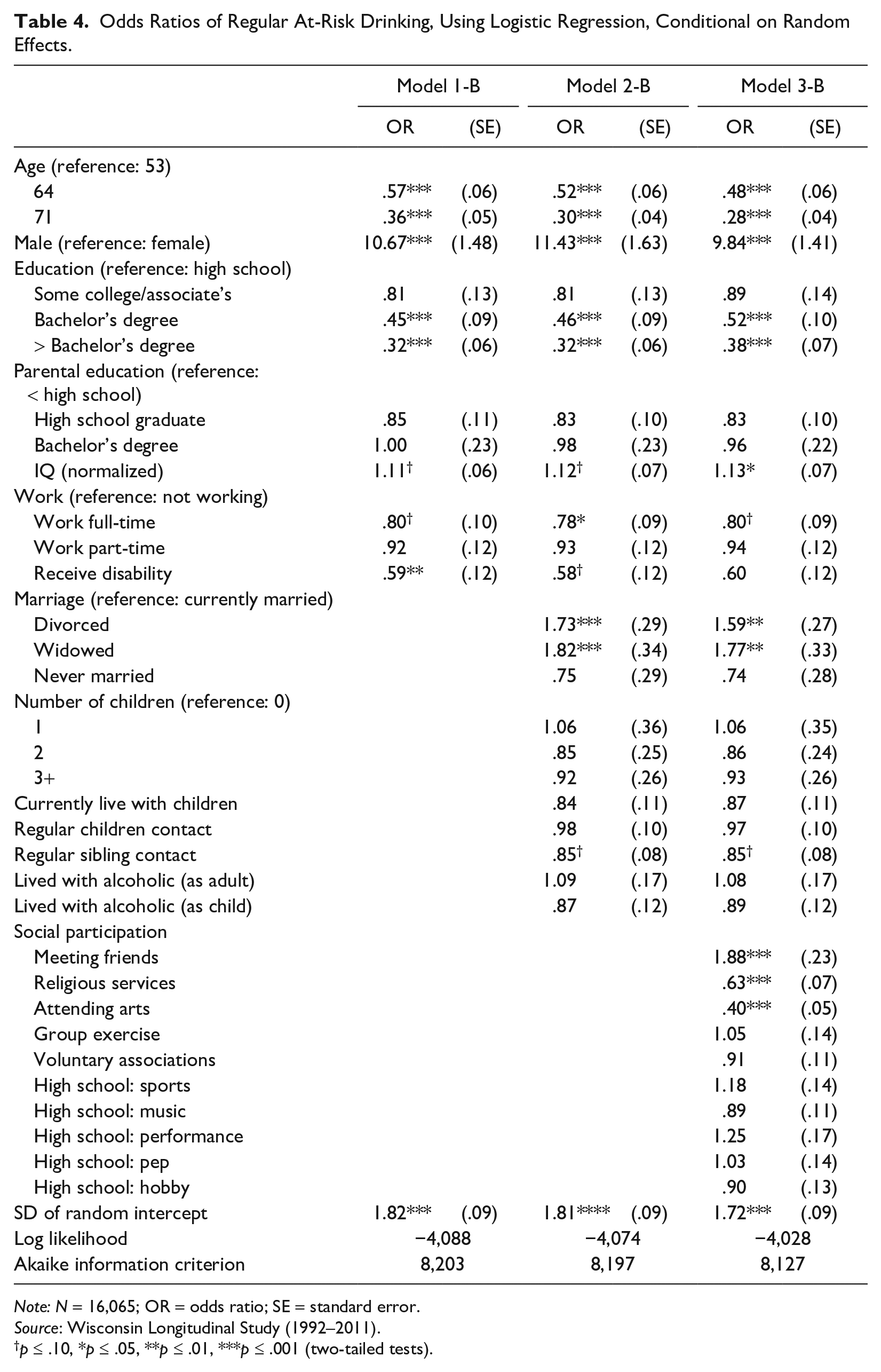
Note: N = 16,065; OR = odds ratio; SE = standard error.
Source: Wisconsin Longitudinal Study (1992–2011).
p ≤ .10, *p ≤ .05, **p ≤ .01, ***p ≤ .001 (two-tailed tests).
Odds Ratios of Possible Alcohol Dependence, Using Logistic Regression, Conditional on Random Effects.
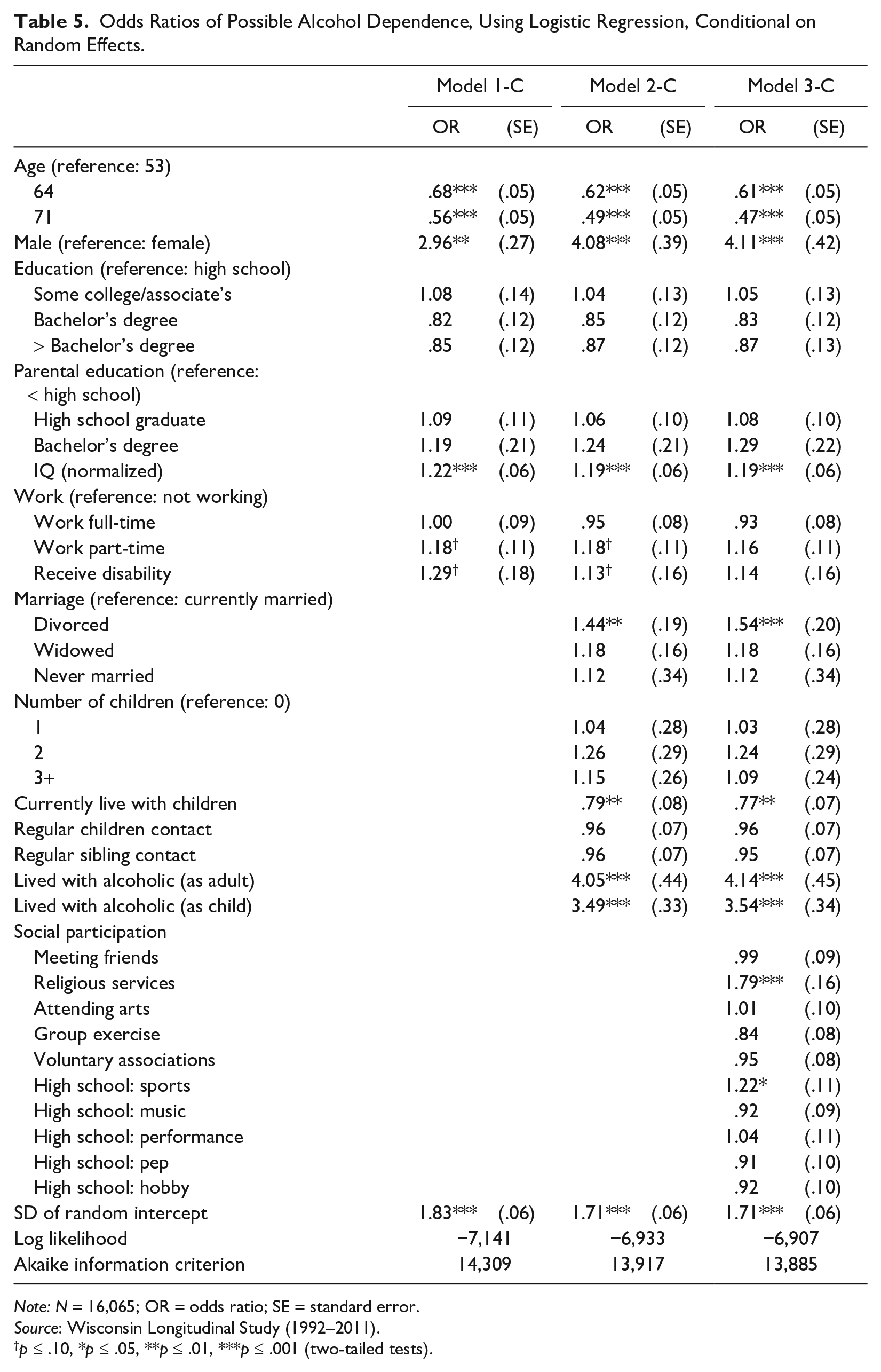
Note: N = 16,065; OR = odds ratio; SE = standard error.
Source: Wisconsin Longitudinal Study (1992–2011).
p ≤ .10, *p ≤ .05, **p ≤ .01, ***p ≤ .001 (two-tailed tests).
With respect to possible alcohol dependence (Table 5), being divorced (OR = 1.44) was associated with an increased risk of alcohol dependence in M2-C, as was ever living with a problem drinker/alcoholic—either as an adult (OR = 4.05) or as a child (OR = 3.49). In M3-C, two social participation items—religious attendance (OR = 1.79) and high school athletics (OR = 1.22)—were associated with possible dependence. In Tables 4 and 5, men had substantially greater odds of reporting at-risk drinking or possible alcohol dependence (OR = 9.84 and OR = 4.11) in M3-B and M3-C, respectively.
For all (M3) results from our tests for gender differences in associations between family, social participation, and alcohol abuse (Hypothesis 3), see Tables S1, S2, and S3 in the online version of the article. This analysis produced three important findings. One, the positive associations between regular at-risk drinking (Table 4) and four key variables—IQ, being divorced, being widowed, and meeting friends—were significant for men (OR = 1.24, OR = 2.07, OR = 2.75, and OR = 2.16, respectively) but not women (see Table S2 in the online version of the article). Two, the relationship between divorce and possible alcohol dependence (as identified in Table 5) was significant for women (OR = 1.80) but not men (see Table S3 in the online version of the article). Lastly, new negative associations emerged (not found in Table 5) between possible alcohol dependence and two social activities (group exercise and high school hobby groups) for men (OR = .71 and OR = .69, respectively) but not women (see Table S3 in the online version of the article).
Sensitivity Analyses
We conducted multiple tests that considered the robustness of our results. One, we found that those selected for the W3 alcohol subsample (79% of W3 respondents) were not significantly different than those not selected, with respect to any personal characteristics (recall the subsample procedure was only used during W3). Two, we considered the implications of missing data. Although item nonresponse in the WLS was rare, 12.4% of main survey respondents did not complete the supplemental mail survey (which included the social participation questions). To address these missing surveys and other missing data, we employed Stata’s multiple imputation procedures to create 20 additional data sets. Results averaged across these data sets were essentially identical to those presented here. In addition to multiple imputation techniques, concerns over attrition and nonresponse were mitigated by the following factors: (a) The WLS is recognized for its relatively high survey response rates (Herd et al. 2014), and (b) this group of high school graduates have been resilient. That is, out of the 6,875 respondents for the primary survey in W3 (when most participants were aged 53), 90.9% were still alive at W5.
Three, we examined multicollinearity with respect to the 10 social activities utilized in M3, particularly because meeting friends while taking part in other social activities may result in “double counting.” We examined maximum postestimation variance inflation factors (range = 1.09–1.25) as well as a correlation matrix (range = .01–.23), each providing evidence of weak multicollinearity between these measures. Four, we tested various alternative specifications for many of the independent variables used in these analyses, including: (a) expanding the “number of children” categories to four, five, and six; (b) treating education as a continuous variable; (c) including the gender of the respondent’s oldest child; and (d) including an interaction between wave (age) and number of children. Adding this last variable (d) slightly modified coefficients for age and living with a child since children were most likely to live with respondents at wave 3 (age 53). All other specifications and variables had no notable effects on our conclusions.
Lastly, we estimated two additional sets of models for regular at-risk drinking (Table 4) using slightly different operationalizations of the dependent variable. For the first of these, we used greater than moderate consumption (two drinks or more for women and three drinks or more for men; CDC 2012). Using this specification, more women (18.4%) than men (14.7%) would be considered an alcohol abuser. This definition also caused group exercise (OR = 1.23) and high school athletics (OR = 1.25) to be associated with increased odds of alcohol abuse due to some female athletes averaging two (but not three) drinks per occasion. Our second additional set of these models utilized monthly binge drinking as the dependent variable, which was coded as 1 if respondents drank five or more drinks on any occasion over the past month (17.3% of men and 4.6% of women). Results from this analysis were generally similar to those for regular at-risk drinking with respect to all key variables.
Discussion
Prior research has identified numerous health benefits of having strong family ties and being socially active (Umberson and Montez 2010). At the same time, social scientists have long recognized a corresponding “dark side” of linked lives that can lead to negative health consequences (Villalonga-Olives and Kawachi 2017). Unfortunately, this latter body of work has largely ignored how social relationships may influence the increasing problem of alcohol abuse in later life. Using data that followed the same individuals for more than 50 years, this study examines how multiple family characteristics and social activities shape alcohol abuse. In doing so, it makes four novel contributions. One, this is the first study to identify particular social activities—widely considered healthy—that may encourage or allow problematic drinking in mid- and later-life. Two, we consider how family-related stress and trauma may influence drinking patterns decades later. Three, we find evidence of gendered patterns in both social drinking norms and alcohol abuse after marital dissolution. Lastly, we demonstrate how relationships between linked lives and alcohol abuse depend on how researchers quantify abuse.
Family Characteristics and Alcohol Abuse
From parents and siblings to spouses and children, family likely remains the central social influence on health behaviors across the life course. Surprisingly, we found that being married was associated with increased drinking frequency when compared with divorced and never-married counterparts. One possible explanation for this is that marriage supports “consistent” socialization between couples (e.g., dinners and holidays), so drinking during those events may become normative. Conversely, we found that being married was protective for the other two operationalizations of alcohol abuse when compared with being divorced or widowed. Because marital dissolution is one of the key stressors that could negatively affect health behavior (Umberson, Crosnoe, and Reczek 2010), these results are less surprising. Future work examining the role that marriage plays in predicting alcohol abuse would benefit by emphasizing marital quality and marital satisfaction, which have been linked to alcohol consumption in midlife (Grzywacz and Marks 2000). Although not consistently surveyed across the WLS, a supplemental analysis of our data (for W4 and W5) revealed a relationship between marital satisfaction and possible alcohol dependence but not of alcohol consumption itself. Because we found that the associations between being divorced, being widowed, and two types of alcohol abuse differed by gender, further discussion is found in the following Gender subsection.
With respect to other family relationships, and contrary to our expectations, we found limited evidence that having children, living with children, meeting children regularly, and meeting siblings regularly were associated with alcohol abuse. Among these variables, the most notable association was that living with (primarily adult) children was associated with slightly less drinking frequency and decreased odds of reporting possible alcohol dependence. It may be that living with adult children acts as an unwitting social control, helping parents assume “role-model behavior” in front of their children. Overall, these limited findings were somewhat surprising given that having children has been linked to positive health behaviors (Umberson and Montez 2010). Future research should examine whether these associations change in subsequent cohorts given that more older adults will have had no children or just one child (fewer than 13% of our sample).
We expected that ever living with an alcoholic (either as a child or an adult) would be associated with all three alcohol abuse measures, but our results were inconsistent. That is, this history was associated with slightly fewer drinking days per month but much greater odds of reporting possible alcohol dependence (and no associations with regular at-risk drinking). It may be that those who have ever lived with an alcoholic are more cognizant of—and monitor—their drinking behavior. Alternatively, it may be that the power of these traumatic experiences to negatively influence drinking behavior weakens in older ages. With respect to the greater odds of reporting alcohol dependence, it is likely that prior trauma fosters guilt and sensitivity to the negative repercussions of alcohol even if it does not encourage its consumption. In other words, previously living with an alcoholic may change the threshold of reporting alcohol-related problems in the CAGE questionnaire, and this remains an exciting question for subsequent work. Future surveys would benefit by asking follow-up questions to the “ever living with an alcoholic” questions—including starting dates, length of spell, and details on the relationship between the respondent and problem drinker.
Social Participation and Alcohol Abuse
In an aging world, there is increasing emphasis on “productive engagement” in later life, including involvement with formal social activities (Morrow-Howell and Gehlert 2012). Matching expectations, results from this study suggest that many of these social activities, despite well-established health benefits, are associated with an increased risk of alcohol abuse in mid- and later-life. For example, we found that meeting friends was related to increased drinking frequency and increased odds of regular at-risk drinking. One explanation for this has to do with personality and disposition—a mechanism linking social relationships to health often ignored by sociologists (Umberson et al. 2010). For example, extroverts may have more friends and be more interested in meeting these friends, with prior research suggesting extroverts also tend to drink more (Fairbairn et al. 2015). In addition, individuals who are more emotionally vested in interpersonal relationships may be more susceptible to social control (receiving social pressure to drink) and more likely to promote drinking norms (applying social pressure to drink). Unfortunately, we find that prior literature on these possible explanations primarily focuses on adolescents despite evidence that cultural and social drinking pressure can occur across the life course (Mäkelä and Maunu 2016). Whether these linkages between meeting friends and alcohol abuse are primarily the result of (a) group norms or (b) instigation by preexisting alcohol abusers or (c) are simply a symptom of opportunity remains an important question.
We also found notable positive associations between alcohol abuse and (1) group exercise, involvement in (2) high school sports and (3) high school pep groups, as well as (4) art attendance. Despite fitting our expectations, results connecting the first two activities to alcohol abuse are disappointing given that exercise represents one of the few pathways that lead to health improvement among older adults (Vogelsang 2017). Besides drinkers using exercise to compensate for or excuse their behavior, some of these “group exercise” activities may involve drinking during or shortly after the exercise itself (e.g., bowling or golf). Although arts attendance was associated with increased drinking frequency, it was also associated with lower odds of at-risk drinking. This is understandable given that cultural events (e.g., theater shows and museum exhibits) frequently sell alcoholic beverages or host happy hours but do not promote or look favorably on multi-hour binge drinking. Mechanisms linking high school sports and pep/spirit groups to alcohol abuse decades later is less clear but likely has to do with personality, status consciousness, and socialization. In other words, regular interactions with peer groups during adolescence can shape lifelong patterns of social and health behaviors—including alcohol consumption.
One of the more notable results in this study concerned religious attendance and alcohol abuse. As expected, religious participation was associated with lower odds of regular at-risk drinking. However, it had no relationship with drinking frequency and was associated with greater odds of reporting possible alcohol dependence. These ostensibly contradictory results make sense in light of both group norms and selection effects often associated with religious organizations. On one hand, organized religion may generally discourage alcohol abuse via moral guidance, strong social networks, and time commitments (e.g., early morning services) that deter drinking. On the other hand, it may concurrently ask participants to acknowledge weaknesses related to these negative health behaviors. That is, confessing, regretting, and continuing to battle “past sins” are components of many religious principles—and the CAGE survey questions (unlike the drinking frequency questions) were not limited to a particular time period. In other words, someone who previously displayed signs of alcohol dependence and used religion to help change that behavior may be acknowledging prior problems. Subsequent research would benefit by incorporating qualitative interviews or supplemental questions to the CAGE questionnaire, which could help determine the timing and nature of prior alcohol-related problems.
Because of the WLS instrumentation and structure, we are limited in our ability to make causal claims about the direction of associations between social participation and alcohol use, and this remains an opportunity for future research. That said, we performed a supplemental analysis that estimated a set of cross-lagged models (for W4 and W5), incorporating lagged independent and dependent variables (from time t – 1). These results suggest that for our key independent variables, current status (time t) is more predictive of alcohol abuse than prior status, with the exception of religious attendance (see Table S4 in the online version of the article).
Gender, Social Relationships, and Alcohol Abuse
Contrary to expectations, a majority of this study’s results varied little by gender. The most notable exception was that being divorced and widowed were each associated with increased odds of regular at-risk drinking for men (but not women), whereas being divorced was associated with possible alcohol dependence in women (but not men). These results further support the concept of gendered coping styles when faced with marital dissolution (Pudrovska and Carr 2008). For instance, it may be that men are more likely to (a) revert to premarriage consumption levels, (b) turn to alcohol to manage life course disruptions, or (c) drink more when initiating postmarriage relationships. Women, on the other hand, may be more likely to internalize possible reasons for their divorce, placing some of that blame on alcohol. Another explanation is that married women are less likely than divorced women to report alcohol abuse, in part because they are more tolerant and accepting of marital drinking (Birditt et al. 2016).
As the only social activity to match our expectation of gender differences, we found that for men (but not women), regularly meeting friends was associated with increased drinking frequency. For WLS respondents, this result is likely attributable to a lifetime of gendered expectations, shame, and pressures related to regular alcohol use. Not related to our hypotheses, we encourage researchers to explore the implications of gendered alcohol abuse definitions—especially for “moderate” and “binge” drinking. The source of these guidelines is likely a complex interaction of physiological differences, social influences, and cultural expectations—all of which have important consequences in the identification and treatment of alcohol abuse disorders.
Limitations
Despite the obvious benefits of the WLS to explore questions about alcohol abuse, family characteristics, and social participation, its use comes with several important limitations. One, the WLS surveys, although thorough, are only administered approximately once every 10 years. Therefore, numerous fluctuations in this study’s dependent and independent variables may have occurred between waves. These large gaps make claims about the direction of associations more difficult, and this remains an important impetus for additional research. Two, because some social participation data for W3 were retrospectively reported during W4, certain responses may be susceptible to recall bias. Three, although alcohol use is, generally, socially acceptable, its abuse is often stigmatized, and this may have resulted in respondents underreporting their intake.
The WLS is only representative of non-Hispanic white high school graduates born around the start of World War II (Herd et al. 2014). As such, it is limited by its inability to explore how relationships identified in this study may vary by racial-ethnic groups or across cohorts. In addition, despite the WLS’s high survey response rates, estimates may be biased by (a) excluding those who did not graduate high school and (b) having W3 act as this survey’s baseline. Those not included in the original survey and those lost to survey attrition are much more likely to have been socially disadvantaged, and this disadvantage is exacerbated in subsequent survey waves (Pudrovska and Anikputa 2014). That said, this type of selection bias is no different than that found in similar aging and life course studies, which often begin by interviewing only those who have reached older ages. Furthermore, the relatively homogenous sample of the WLS may help temper the influence of unobserved variables associated with race and socioeconomic status that could otherwise bias the estimates (Herd 2010).
Conclusion
Perhaps because of the well-established health risks associated with isolation and disconnectedness, researchers have paid insufficient attention to how the dark side of social bonds can impact health in mid- and later-life. With this in mind, the present study highlights how relationships with family and friends can either promote or regulate the frequency and quantity of alcohol consumption after age 50. Adults in this age group may be particularly susceptible to these connections because of long-term drinking norms that may accompany these relationships, as well as their own well-established drinking history. Future work should continue to monitor these associations given that older adult social profiles—including family history (e.g., greater odds of being raised by a single parent) and social participation (e.g., decline in religious service attendance)—continue to evolve. These issues are salient at a time in which older adult alcohol abuse is expected to rise, and guidelines for “healthy” or “moderate” drinking, even among younger adults, are under increased scrutiny.
Supplemental Material
Supplemental_Material – Supplemental material for Let’s Drink to Being Socially Active: Family Characteristics, Social Participation, and Alcohol Abuse across Mid- and Later-life
Supplemental material, Supplemental_Material for Let’s Drink to Being Socially Active: Family Characteristics, Social Participation, and Alcohol Abuse across Mid- and Later-life by Eric M. Vogelsang and Joseph T. Lariscy in Journal of Health and Social Behavior
Footnotes
Supplemental Material
Tables S1 through S4 are available in the online version of the article.
Funding
The authors disclosed receipt of the following financial support for the research, authorship, and/or publication of this article: This research uses data from the Wisconsin Longitudinal Study, funded by the National Institute on Aging (R01 AG009775; R01 AG033285).

Author Biographies
References
Supplementary Material
Please find the following supplemental material available below.
For Open Access articles published under a Creative Commons License, all supplemental material carries the same license as the article it is associated with.
For non-Open Access articles published, all supplemental material carries a non-exclusive license, and permission requests for re-use of supplemental material or any part of supplemental material shall be sent directly to the copyright owner as specified in the copyright notice associated with the article.
