



Abstract
This article advances the field by integrating insights from intersectionality perspectives with the emerging literatures on structural racism and structural sexism—which point to promising new ways to measure systems of inequality at a macro level—to introduce a structural intersectionality approach to population health. We demonstrate an application of structural intersectionality using administrative data representing macrolevel structural racism, structural sexism, and income inequality in U.S. states linked to individual data from the Behavioral Risk Factor Surveillance System to estimate multilevel models (N = 420,644 individuals nested in 76 state-years) investigating how intersecting dimensions of structural oppression shape health. Analyses show that these structural inequalities: (1) vary considerably across U.S. states, (2) intersect in numerous ways but do not strongly or positively covary, (3) individually and jointly shape health, and (4) are most consistently associated with poor health for black women. We conclude by outlining an agenda for future research on structural intersectionality and health.
At the core of sociological research is the recognition that life chances are shaped by a constellation of social factors (Weber [1922] 1946). Thus, it is not surprising that intersectionality has become a foundational concept in contemporary social science research. Theoretical and empirical research on the topic has proliferated in recent years (Collins and Bilge 2020; Davis 2008). A key insight from the literature on intersectionality is that systems of oppression such as racism, sexism, and classism are interlocking, mutually constituted, and reinforcing (Collins 2000; Crenshaw 1991; Dill and Zambrana 2009). Thus, intersectional perspectives on stratification highlight the utility of examining the joint and potentially synergistic effects of multiple dimensions of inequality (Choo and Ferree 2010; McCall 2005).
Within the field of medical sociology, a large and influential body of work has developed using intersectional approaches to make important contributions to the understanding of population health. For example, prior research has shown that the effects of racial, gender, and socioeconomic stratification are nonadditive, resulting in the greatest racial inequalities in health among women and those with higher levels of socioeconomic status (Brown et al. 2016; Cummings and Jackson 2008; Warner and Brown 2011). Furthermore, higher levels of socioeconomic resources tend be less protective of the health of blacks compared to whites (Hargrove 2018; Veenstra 2013). A notable example is that the birth outcomes for black women with a college degree are worse than those for their white counterparts with less than a high school degree (Collins and David 2009). Collectively, this growing body of research illustrates how social hierarchies combine to shape health outcomes.
Although intersectionality conceptually reflects overlapping systems of inequality (Crenshaw 1991), the measurement of intersectionality has often focused on the individual level. For example, by comparing the health of black women, black men, white women, and white men to one another, scholars have inferred the effects of larger systemic inequalities on individuals. However, the emerging literatures linking population health to structural racism, structural sexism, and economic inequality point to promising new ways to more directly measure systems of inequality at a macro level. For example, recent research has found that structural racism—as measured by state-level racial disparities in variables such as political representation, economic conditions, and juridical treatment—is associated with increased risk of myocardial infarction (Lukachko, Hatzenbuehler, and Keyes 2014) and higher infant mortality rates among African Americans in the United States (Chae et al. 2018; Wallace et al. 2017). Similarly, Homan (2019) proposed a theoretical framework for structural sexism and health and developed state-level structural sexism measures that were then shown to be negatively associated with physical health among both women and men. In addition, the health disparities literature has shown that macro-level economic inequality—a key aspect of class oppression—is inversely related to health and longevity (Hill and Jorgenson 2018; Pickett and Wilkinson 2015). These lines of research have measured structural dimensions of racism, sexism, and economic inequality separately but have yet to consider how they may intersect. Thus, several scholars have recently highlighted the need for a synthesis of intersectional and structural approaches (Agénor 2020; Gkiouleka et al. 2018; Green, Evans, and Subramanian 2017; Pirtle and Wright 2021).
In this agenda-setting article, we develop a structural intersectionality approach to population health. We first summarize and distill core ideas of intersectionality. Next, we discuss how intersectional perspectives have made major contributions to the understanding of health disparities over the past few decades. We then describe how incorporating new structural approaches to population health can enhance quantitative intersectional health disparities research in ways that embody the core ideas of intersectionality. Although the primary aim of this study is to advance this nascent field conceptually, we also demonstrate a promising application of a structural intersectionality approach by using data compiled from a variety of administrative sources to examine variation in macro-level structural racism, structural sexism, and income inequality across U.S. states. We link these state-level measures to individual health and demographic data from the Behavioral Risk Factor Surveillance System (BRFSS) and use multilevel models to investigate how these dimensions of structural oppression affect population health. We conclude by discussing challenges and opportunities for future structural intersectionality and health research.
Background
What Is Intersectionality?
Over the last three decades, the concept of intersectionality has become widely used in sociology. Broadly, intersectionality is a framework and analytic tool to understand the impacts of overlapping systems of oppression such as racism, sexism, classism, and other forms of inequality (Collins 2000; Crenshaw 1991). Intersectional approaches involve several core ideas, including (but not limited to) social inequalities, intersecting systems of oppression, social context, and complexity (Collins and Bilge 2020). First, intersectionality highlights social inequalities in many facets of society (e.g., education, economics, politics, housing, health care, and criminal justice) across socially constructed groups based on race, gender, and class (among others)—and how these social inequalities are not caused by social statuses or identities per se but, rather, stem from systems of oppression involving asymmetrical power relations (Cho, Crenshaw, and McCall 2013).
Second, intersectional frameworks emphasize how social inequalities are shaped by confluence of multiple intersecting systems of oppression, which are often obscured by unidimensional approaches to studying stratification (Dill and Zambrana 2009; McCall 2005). For example, drawing on critical race theory and black feminist literature, intersectionality theorists have critiqued essentialism within conventional theories for treating race, gender, and class groups as monolithic and for examining the roles of racism, sexism, and classism in isolation (Collins and Bilge 2020; hooks 1984). Such unidimensional approaches fail to capture the unique experiences of women of color as well as how multiple forms of oppression jointly impact life chances (Bowleg 2012; King 1988; Weber 2010). Third, intersectional research underscores the utility of examining intersecting systems of oppression within and between social contexts (Choo and Ferree 2010). For example, investigating heterogeneity in the degree of structural forms of intersecting systems of oppression across U.S. states would help researchers to better understand variations in intersectional social contexts and how they affect population health (Gkiouleka et al. 2018; Homan 2019).
Finally, complexity is a core theme of intersectionality. Intersectional perspectives highlight the complex nature of the social world, and intersectionality research itself is characterized by its complexity. Indeed, intersectionality research covers a wide range of topics and approaches—qualitative and quantitative methods, examining oppression across multiple levels (i.e., macro, meso, and micro) and forms (i.e., structural, cultural, and interpersonal forms domination), and focusing on inequalities within and between groups (Choo and Ferree 2010; Collins and Bilge 2020; McCall 2005). Although these complexities present challenges for intersectionality scholars, the conceptual and methodological breadth and depth of intersectional research also provide useful frameworks and analytic tools across an array of sociological subfields, including medical sociology (Brown et al. 2016; Harnois, Bastos, and Shariff-Marco 2020; Roberts 1997).
Intersectionality and Health Disparities
Whereas the medical sociology literature has historically focused on the health consequences of a single dimension of inequality (e.g., race, gender, or class), in recent years, scholars have increasingly utilized intersectional approaches to investigate the joint health impacts of social inequalities across multiple dimensions (e.g., race, gender, and class). The literature on intersectional health disparities has shown that health is simultaneously shaped by an array of individual-level social positions (Brown et al. 2016; Hargrove 2018; Schulz and Mullings 2006). This body of research has revealed several major findings. First, health disparities at the nexus of race and gender are complex—in ways that are often masked by unidimensional approaches to studying health. For example, consistent with the intersectional proposition that black women experience distinct forms of marginalization (Collins and Bilge 2020), studies have shown that health disadvantages associated with being a black woman are greater than the sum of disadvantages associated with being black and those with being a woman (Cummings and Jackson 2008). Moreover, gender inequalities are racialized (i.e., health gaps between men and women are greater among blacks than whites), and racial inequalities are gendered (i.e., black-white health gaps are greater among women than men) for a range of health outcomes, such as self-rated health, hypertension, functional limitations, and body mass index (Hargrove 2018; Jackson and Williams 2006; Richardson and Brown 2016; Warner and Brown 2011).
Second, the relationship between socioeconomic status (SES) and health is racialized. Mounting evidence indicates that socioeconomic resources—including education, income, and wealth—are less protective for the health of blacks compared to whites (Assari 2018; Boen, Keister, and Aronson 2020; Colen, Krueger, and Boettner 2018; Hudson et al. 2013). Blacks’ diminished health returns to socioeconomic resources are hypothesized to stem from racism across multiple levels and domains and to operate through various mechanisms such as elevated exposure to stressors and other health risks (Assari 2018; Colen 2011; Pearson 2008), although studies on the topic rarely explicitly model the role of social context.
Third, health is jointly shaped by the interlocking axes of race, gender, and class stratification. Building on findings highlighted previously, intersectional research reveals intersecting racial, gender, and class inequalities in health. For example, studies show that (a) individuals who occupy positions at the top of each of these social hierarchies (e.g., white men with high SES) typically have the best health, (b) those who are in subordinate positions across social hierarchies (e.g., black women with low SES) tend to experience the worst health outcomes, and (c) the health of liminal race/gender/SES groups typically falls somewhere between these extremes (Ailshire and House 2011; Brown et al. 2016; Cummings and Jackson 2008; Veenstra 2013).
Importantly, despite intersectional frameworks placing an emphasis on the roles of societal systems of oppression such as racism, sexism, and classism, studies on intersectionality and health have rarely directly measured these intersecting systems. Rather, the vast majority of empirical research on the topic has examined individual-level social statuses (i.e., race, gender, and class categories) as proxies for racism, sexism, and classism. There are, however, notable exceptions. Indeed, a fourth key finding from the literature on intersectionality and health relates to the deleterious effects of intersecting forms of interpersonal discrimination. For example, several studies have shown that attributing perceived interpersonal discrimination to multiple social categories (e.g., race, gender, class, and others) is associated with worse health compared to those who do not attribute interpersonal discriminatory treatment to multiple social categories (Grollman 2012, 2014). However, measures of perceived interpersonal discrimination often fail to capture structural aspects of intersectional discrimination (Harnois et al. 2019, 2020). These methodological challenges and the fact that much of discrimination occurs at the societal level point to the importance of examining forms of oppression beyond interpersonal discrimination, such as intersecting structural inequalities (Agénor 2020; Gkiouleka et al. 2018).
Structural Inequalities and Health Disparities
Over the past two decades, health disparities research has increasingly focused on how “upstream” macro-level inequalities shape the distribution of health and illness. As a part of this trend, an emerging line of research has explored the health consequences of structural racism (Gee and Ford 2011; Krieger 2020), defined by Bailey and colleagues (2017:1453) as “the totality of ways in which societies foster racial discrimination, through mutually reinforcing systems.” In addition to long-standing evidence of the pathogenic effects of racial residential segregation (Sewell 2016), studies have shown that higher levels of U.S. state-level structural racism across numerous societal domains (e.g., educational, economic, judicial, and political) are associated with poor birth outcomes and higher odds of myocardial infarction among blacks in the United States (Bailey et al. 2017; Lukachko et al. 2014; Wallace et al. 2017).
Drawing on the insights from the structural racism literature, Homan (2019) advanced a framework for understanding how population health is shaped by structural sexism—defined as systematic gender inequality in power and resources. This study developed novel measures of U.S. state-level structural sexism and found them to be associated with worse physical health among both women and men. Other studies have found various measures of systemic gender inequality in U.S. states to be related to higher mortality rates/risk among both women and men (Kavanagh, Shelley, and Stevenson 2017; Kawachi et al.1999), higher depressive symptoms among women (Chen et al. 2005), and higher state infant mortality rates (Kawachi et al., 1999; Koenen, Lincoln, and Appleton, 2006). The importance of social context is also evident from a growing body of research on the health consequences of structural economic inequality—the way that the health disparities literature has typically studied class oppression (Pickett and Wilkinson 2015). Consistent with the idea that economic inequality undermines trust, social bonds, and the fabric of society (Wilkinson and Pickett 2009), a recent study shows that U.S. state-level income inequality (as measured by the Gini coefficient) is negatively associated with life expectancy among both women and men (Hill and Jorgensen 2018).
Taken together, these new structural approaches to inequality and health provide the conceptual and methodological tools to actually measure systems of oppression at a contextual level rather than using individual status variables as proxies. However, the literature has thus far remained siloed, with studies measuring a single dimension of oppression (e.g., structural racism or structural sexism) but not interrogating their intersections. Thus, developing a structural intersectionality perspective represents a vital next step for health disparities research.
Toward a Structural Intersectionality Approach to Population Health
Incorporating insights from structural approaches to inequality and health can enhance quantitative intersectional health disparities research in ways that are consistent with core ideas of intersectionality (e.g., social inequalities, intersecting systems of oppression, social context, and complexity). First, structural approaches typically highlight social inequalities in large-scale social institutions such as the labor market (e.g., black-white ratios of unemployment rates and women-men ratios of earnings), shifting the focus from individual-level social statuses (e.g., black woman) that demarcate lines of inequality to the power relations that cause inequalities (Collins and Bilge 2020; Homan 2019; Lukachko et al. 2014).
In addition, a structural intersectionality approach facilitates the conceptualization and measurement of intersecting systems of oppression (e.g., structural racism, structural sexism, and classism) and their joint effects on population health, which are masked by unidimensional structural approaches (i.e., structural racism only, structural sexism only or classism only). Next, incorporating a structural approach allows for intersectional work to more fully engage with social contexts because racism, sexism, and classism vary across time and place, and this variation can be leveraged to investigate how systems of oppression overlap and how they shape health. Related to this point, contemporary social structures and population health reflect the legacies of historical structural processes as well as more recent forms of oppression (Hicken et al. 2018; Jacoby et al. 2018).
Finally, structural approaches allow for complexity in effects both within and between groups. For example, black women vary in their exposure to structural racism, sexism, and classism, and this may result in within-group health inequalities. Between-group health inequalities are also likely because racism, sexism, and classism may not affect white women the same way they affect black women. By measuring both the degree of structural inequality and the individual status categories, one can examine the effects of inequality on not only marginalized groups but on dominant and liminal groups as well. This allows for the possibility of some groups reaping health benefits from oppression or being unaffected or for the possibility of universally harmful inequalities that undermine the health of all groups (although to varying degrees; Homan 2019; Lucas 2013).
In sum, synthesizing structural and intersectional perspectives has considerable utility for understanding social inequalities in population health. A structural intersectionality approach underscores the consequences of multiple systems of oppression, involving systematic subordination and exclusion of marginalized groups with respect to resources, opportunities, and freedoms in major social institutions. Intersecting systems of oppression are likely to shape health via an array of mechanisms, including differential access to economic and flexible resources (e.g., social capital, power, prestige, autonomy, self-esteem) and increased exposure to health risks such as social stressors, toxic living conditions, discrimination, stigma, and relative deprivation (see Krieger 2014; Phelan and Link 2015).
A structural intersectionality approach to population health needs to answer at least two key questions: (1) How do systems of oppression vary and relate to one another at a macro level? and (2) How do these structural inequalities jointly shape the health of various population groups defined by constellations of individual-level statuses (e.g., race, gender, class, sexuality, nativity, disability, etc.)? As an early foray into quantitative structural intersectionality and health research, in this article, we choose to focus on the classic axes of inequality: race, gender, and class. To answer the first question, we explore how measures of structural racism, structural sexism, and income inequality intersect in U.S. state-level environments. To our knowledge, no study has measured all three of these key types of structural inequality in U.S. states and investigated how they relate to one another. We might logically expect the types of structural inequality to be positively correlated if certain contexts are characterized by an egalitarian ethos and a commitment to inclusion and to enforcement of equal opportunity/antidiscrimination laws. Yet a handful of studies have examined the relationship between contextual-level racial inequality and gender inequality in earnings and found either a negative correlation or no correlation (Cotter, Hermsen, and Vanneman 1999; Szymanski 1976). These studies did not include other domains beyond the labor market (e.g., residential segregation, incarceration, political representation, reproductive freedom, etc.), so it remains an open question how the larger systems of racial, gender, and economic oppression overlap.
To answer the question about whether and how intersectional structural (dis)advantages and individual-level social statuses combine to shape population health, we examine the extent to which health effects of the three state-level structural inequalities are contingent on intersecting social statuses. Given the paucity of empirical research on the topic, it is unclear whether there are differential health consequences of overlapping systems of oppression across racial-gender groups. On the one hand, a “universal harm” perspective would suggest that structural inequalities have broad-based deleterious effects on population health (Metzl 2019; Wilkinson and Pickett 2009). Thus, structural inequalities would be expected to be deleterious for all social groups regardless of their positions within social status hierarchies. On the other hand, an intersectionality perspective would suggest that overlapping systems of oppression would be particularly harmful for groups who occupy subordinate social positions (e.g., black women), largely beneficial or inconsequential for the health of superordinate groups (e.g., white men), and moderate, mixed, or no health effects for liminal groups (e.g., black men and white women; Collins and Bilge 2020; Krieger 2014). It is also possible that some types of structural inequality are universally harmful while the effects of others differ more according to varied social positions. This study investigates these issues to provide a better understanding of how macro-level structural intersectionality affects micro-level health inequalities within race–gender groups.
Data And Methods
Building on recent research on structural racism, sexism, and economic inequality (e.g., Bailey et al. 2017; Hill and Jorgensen 2018; Homan 2019; Lukachko et al. 2014), we compiled statistics representing U.S. state-level environments in the years 2000 and 2010 using publicly available data from a variety of administrative sources, including the U.S. Census Bureau, the Bureau of Labor Statistics, the Bureau of Justice Statistics, the Center for American Women and Politics, and Guttmacher Institute. We produced a series of maps illustrating the variation in levels of structural racism, structural sexism, and income inequality across U.S. states. Next, we linked these state-level measures with individual health and demographic data from the BRFSS to assess how exposure to structural racism, structural sexism, and income inequality is associated with health.
Sample
The sample for this study came from the BRFSS. The BRFSS is the largest ongoing health survey system in the world, collecting health and behavioral data from residents of all 50 states in the United States annually. It is one of the only sources of publicly available health survey data that allows for analysis at both the individual and state levels. We used BRFSS data from 2000 and 2010 because these were the years for which structural racism measures (calculated from decentennial census data) were available. Our analytic sample consisted of 420,644 individuals age 25 and over, including 30,191 black women, 13,416 black men, 231,862 white women, and 145,175 white men. Relative to the samples of black women and men, the samples of white women and men were up to 17 times larger (depending on the specific groups compared), which allowed for much more statistical power to detect very small effects among the white samples. To be included in the analytic sample, BRFSS respondents must have had valid data for self-rated health and age 1 and resided in one of the 38 states for which structural racism measures were available. These 38 states included 99% and 93% of the U.S. black and white populations, respectively.
Dependent Variable
We focused on self-rated health because it is a global assessment of a person’s overall health and because it is among the most widely used measures of health. Self-rated health was measured on a 5-point scale where 5 was excellent and 1 was poor. Self-rated health is particularly useful in the context of studying structural inequalities that may limit health care access and lead to underdiagnosis of medical conditions. Although there is debate about whether self-rated health captures similar aspects of health across racial and gender groups (Assari, Lankarani, and Burgard 2016; Jylhä et al. 1998), the self-rated health measure has been shown to be reliable and valid among diverse samples (Brown et al. 2016; Chandola and Jenkinson 2000; Idler and Benyamini 1997), and a study by McGee and colleagues (1999) that included more than 90,000 black respondents found that self-rated health has roughly comparable predictive validity for black and white women and men. Consistent with other recent studies (Brown et al. 2016; Hart et al. 2019; Idler and Cartwright 2018), we presented ordinary least squares (OLS) regression models treating self-rated health as continuous for simplicity and ease of interpretation, but results using ordinal logistic regression were substantively similar (see Appendix Table 1 in the online version of the article).
Measures of Macro-Structural Inequalities.

Note: B = Black; W = White; CPS = Current Population Survey.
Independent variables
Building on recent research on structural racism (Lukachko et al. 2014; Mesic et al. 2018; Wallace et al. 2017), structural sexism (Homan 2019), and income inequality (Hill and Jorgenson 2018), we compiled state-level measures of these structural inequalities for the years 2000 and 2010 from a variety of survey and administrative data sources. The measures and data sources are listed in Table 1 We measured structural racism using nine different indicators representing black-white inequality across five different domains: economic, educational, judicial, political, and segregation. Indicators were standardized and summed to create a structural racism index (α = .67). We measured structural sexism following Homan (2019) using six indicators across four domains: economic, political, cultural, and physical/reproductive. Indicators were standardized and summed to create a structural sexism index (α = .64). We measured state-level economic inequality using the most common measure of income inequality, the Gini coefficient (Frank 2014). Although it would be ideal to have multiple indicators that would allow us to measure a type of “structural classism” that more closely parallels structural racism and structural sexism, the data and theory to accomplish this do not yet exist. This is a key area where future research is needed that we highlight in our discussion.
Individuals’ exposure to these macro-level inequalities is based on their state of residence at the time of the BRFSS survey (in 2000 and 2010). To simplify the range of possible structural intersections in the regression models, racism, sexism, and income inequality were each dichotomized at the median (following Lukachko et al. 2014). Thus, an individual person’s exposures were characterized as either below average on all three types of inequality (reference category), above the median on a single type, or any other combination (for a total of eight combinations). These possible intersectional structural inequality categories are shown in Table 2 and Figure 4. Although the choice to dichotomize resulted in a loss of some information, it was preferable to continuous variables with five-way statistical interactions in terms of both statistical power and interpretability—issues we return to in the discussion.
Sample Descriptive Statistics.

Note: Descriptive statistics use data from the Behavioral Risk Factor Surveillance System and other sources listed in Table 1.
Additional Covariates
To minimize the risk of confounding effects, our models adjusted for additional state-level factors that have been shown to be associated with health, including unemployment rate (obtained from census data), proportion of the population that is black (from census data), a dummy variable indicating whether the state is in the southern region of the United States, and a dummy variable indicating the year 2010. At the individual level, covariates included age, employment status (1 = employed), marital status (1 = married), education (less than high school, high school diploma, some college, college degree or more), and household income (treated as continuous in regression models but measured in the BRFSS using eight categories: less than $10,000; $10,000 to $14,999; $15,000 to $19,999; $20,000 to $24,999; $25,000 to $34,999; $35,000 to $49,999; $50,000 to $74,999; $75,000 or more).
Analytic Strategy
First, we presented descriptive statistics for the total sample and by individual-level intersectional race–gender categories. Next, we presented a series of maps and a correlation matrix to describe the variation in structural inequalities across U.S. states. Finally, to examine how these structural inequalities jointly shape the health of various population groups along race and gender lines, we estimated a series of multilevel linear models (N = 420,644 individuals nested in 76 state-years; for equation, see the Appendix in the online version of the article) predicting self-rated health as a function of intersecting structural exposures, with the models stratified by individual intersectional race–gender categories (i.e., separate models for black women, white men, etc.). For each group, Model 1 included structural intersections, state-level covariates, year fixed effect, and individual age. Model 2 added additional individual-level covariates for marital status and socioeconomic factors to examine the extent to which individual-level factors operate as downstream mechanisms through which upstream structural inequalities shape health. The Appendix in the online version of the article contains a series of additional analyses showing that our key results were robust to different modeling strategies (OLS vs. ordered logistic regression), different sample selection criteria and missing data handling, and the addition of social class such that our individual-level categories reflect race–gender–class intersections. 2
Results
Descriptive statistics for all variables in the analysis are shown in Table 2. Black women have significantly worse self-rated health than all other groups. Black men also have worse self-rated health than white men and women (who did not significantly differ from one another). Blacks are significantly more likely to live in the southern United States and are therefore generally exposed to less state-level structural racism and more structural sexism than whites on average. Compared to whites, blacks in the sample are younger and have lower income, education, and marriage rates.
Variation in Structural Inequalities across U.S. States
Figures 1 through 3 illustrate the variation in structural racism, sexism, and income inequality in U.S. states in 2010. Interestingly, the areas with the highest levels of structural racism tend to be different from those with the highest levels of structural sexism. Results presented in Figure 1 show that structural racism tends to be highest in midwestern and northeastern states, consistent with prior studies showing that these regions have especially high levels of racial inequality in educational, economic, housing, and judicial domains (Lichter, Parisi, and Taquino 2015; Massey and Denton 1993; Mesic et al. 2018; Muller and Wildeman 2016). Structural sexism, however, is highest in the southern and Rocky Mountain regions (Figure 2). Income inequality tends to be highest along both coasts and in states with large populations and major cities (e.g., New York, California, Florida, Texas; Figure 3).
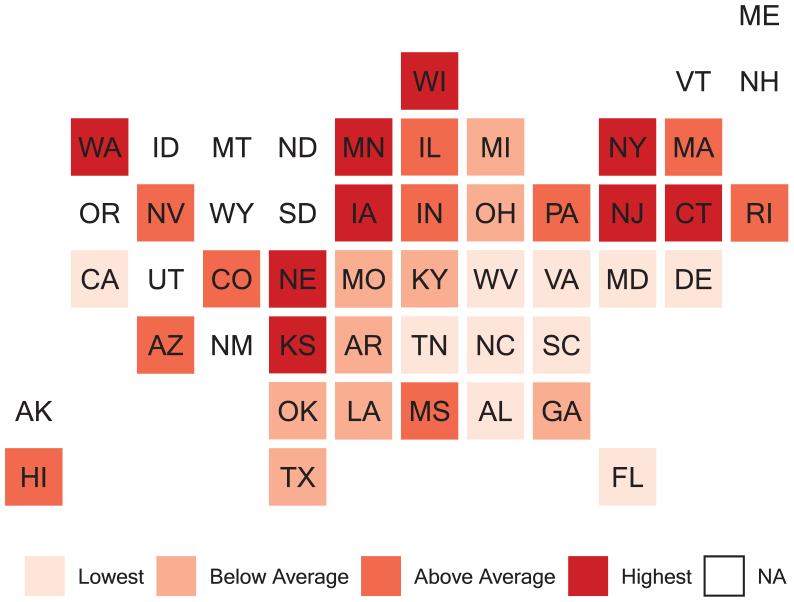
Structural Racism Index for U.S. States, 2010.
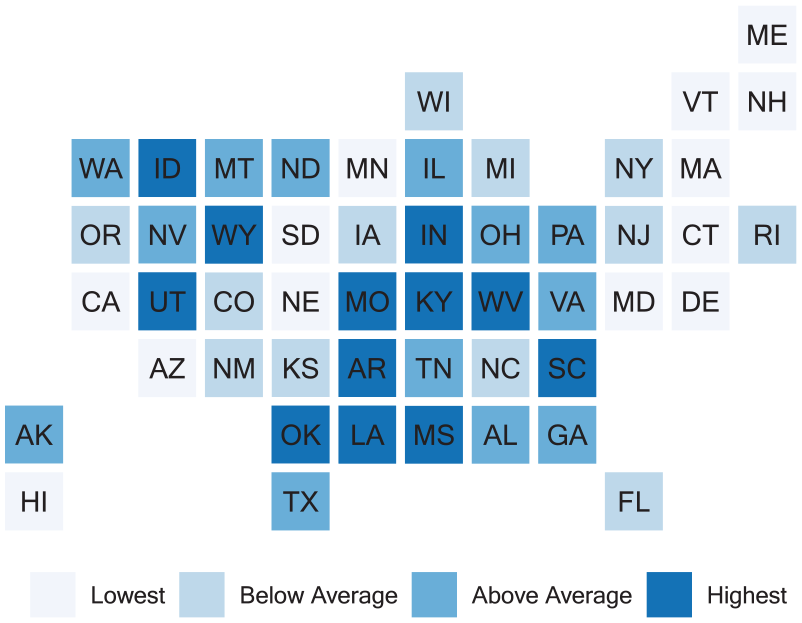
Structural Sexism Index for U.S. States, 2010.
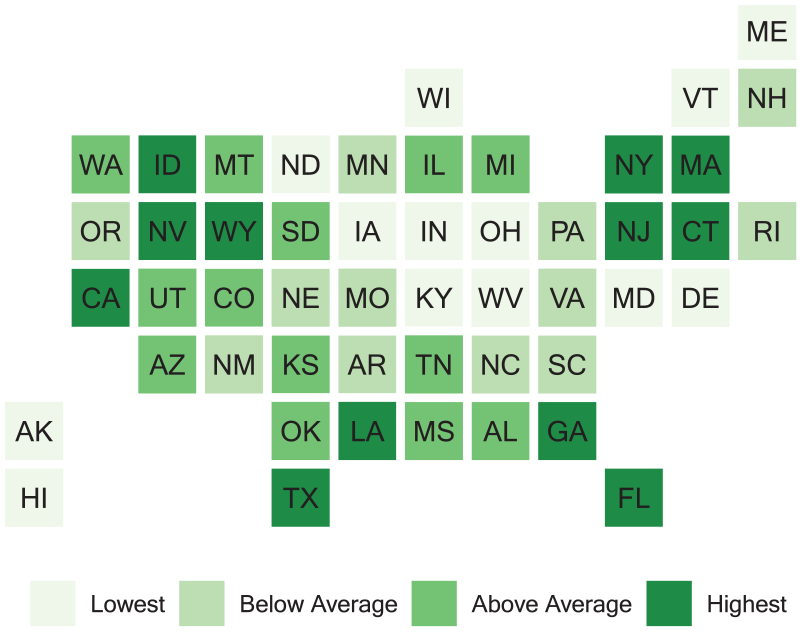
Income Inequality (Gini Index) for U.S. States, 2010.
Table 3 shows the bivariate correlations between the structural racism index, structural sexism index, and the Gini coefficient. Structural sexism exhibits a small to moderate negative correlation with both state-level structural racism and income inequality (rs = –.322 and .351, respectively). The correlation between structural racism and income inequality is close to zero (r = –.067). The inverse relationship between structural racism and structural sexism is consistent with the few existing studies of contextual-level racial and gender inequality in earnings (Cotter et al. 1999; Szymanski 1976).
Bivariate Correlations between State-Level Measures of Racism, Sexism, and Economic Inequality (N = 76 state-years).

Note: Please see Table 2 for data sources.
Intersecting Structural Inequalities and Population Health
Table 4 presents estimates from multilevel linear regression models predicting self-rated health as a function of intersecting systems of oppression. Separate models are shown for each intersectional race–gender category. Model 1 results show that exposure to various combinations of structural inequalities impact self-rated health net of age, year, and state-level covariates. To more clearly illustrate how structural racism, sexism, and income inequality combine to shape health among black women, black men, white women, and white men, Figure 4 displays the predicted self-rated health values for each group in contexts characterized by different combinations of high and low levels of the three types of structural inequality calculated based on Model 1. The figure shows that black women have the worst self-rated health and are most affected by the various types of structural inequality. Among black women, those exposed to high racism only, high sexism only, both high racism and high sexism, both high sexism and high income inequality, and high levels of all three types of inequality exhibit worse self-rated health than those exposed to low levels of all three types of inequality.
Results of Multilevel Regression Models Predicting Self-Rated Health.

Note: Models use data from the Behavioral Risk Factor Surveillance System and other sources listed in Table 2. Standard errors in parentheses.
p < .05, **p < .01, ***p < .001.
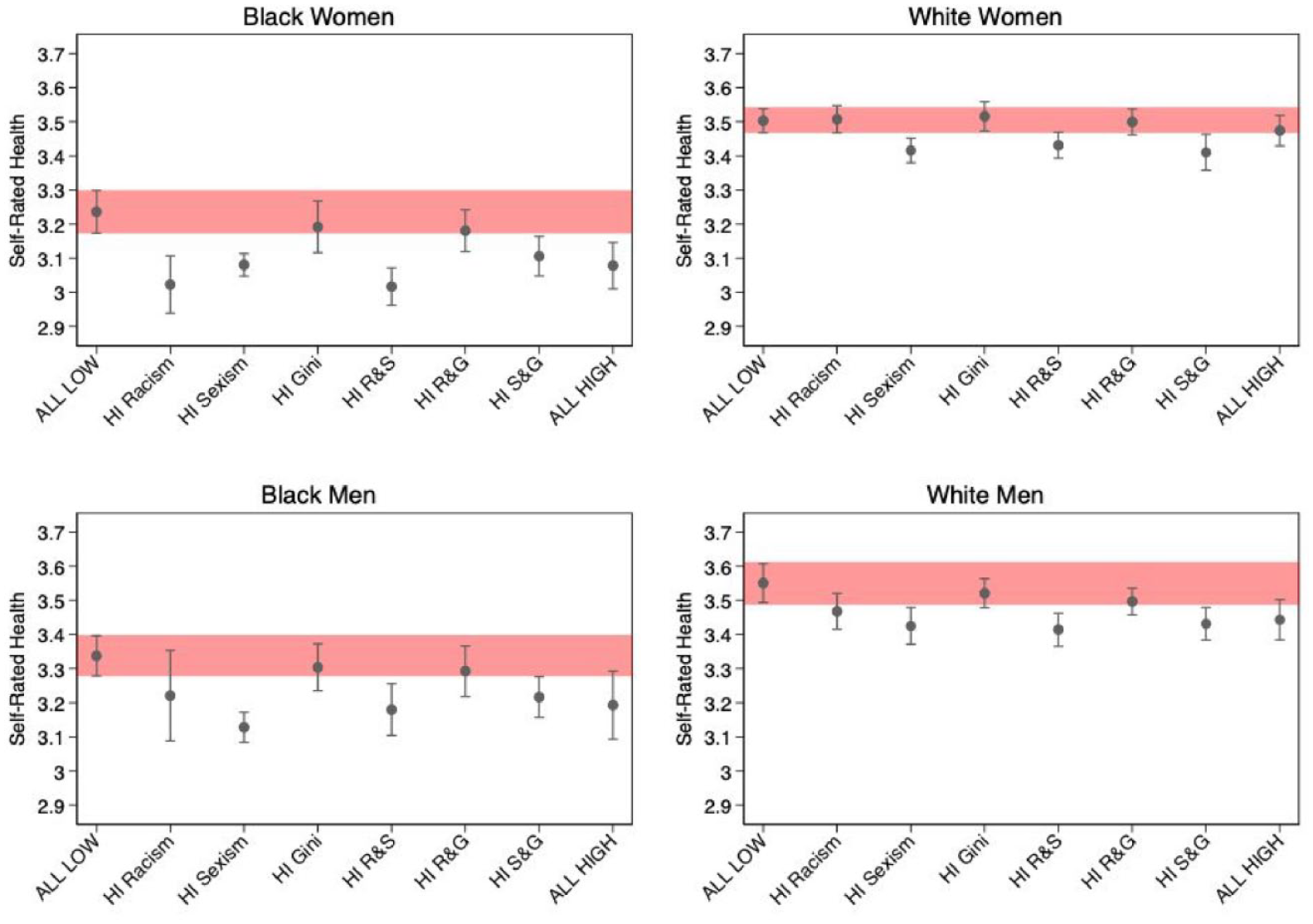
Predicted Self-Rated Health across Structural- and Individual-Level Intersectional Categories.
Results presented in Model 1 and Figure 4 also show that black men, white women, and white men who are exposed to high levels of sexism alone, both high racism and high sexism, or both high sexism and high income inequality combined have worse self-rated health than those exposed to low levels of all three inequalities. It is important to consider these results within the context of dramatic subgroup differences in sample sizes (and thus statistical power). For example, despite the fact that the sample of black men is less than one seventeenth and one tenth the size of the samples for white women and white men, respectively, estimates of the health effects of intersectional structural inequalities are similar across these groups. Furthermore, findings that intersectional systems of oppression are most consistently predictive of black women’s health are particularly noteworthy given that there was considerably less statistical power to detect effects of structural inequalities among black women compared to white women and white men. Finally, if we use the slightly more stringent significance criteria of p < .01 for the white samples given their very large sizes, we find that high sexism alone is the only structural intersection that significantly predicts worse self-rated health among white women, and none are significant among white men.
Results from Model 2 show that employment and higher levels of education and income are predictive of better self-rated health. In Model 2, some but not all of the structural intersectionality effects are attenuated, suggesting that individual-level resources may be an important downstream mechanism through which structural factors shape health. Supplemental analyses (available on request) show that adjusting for both education and income accounted for much of the attenuation of the impacts of intersecting structural inequalities, whereas adjusting for employment accounted for very little. Nevertheless, findings provide evidence that exposure to environments characterized by high levels of intersecting structural inequalities often leads to worse health net of personal socioeconomic resources.
Discussion
In this study, we have sought to advance the field of health disparities research by integrating insights from intersectionality perspectives and the emerging structural racism and structural sexism literatures—which point to promising new ways to measure systems of oppression at a macro level. We introduced a structural intersectionality approach to population health that extends beyond measurement implemented at the individual level using categories reflecting various constellations of individual statuses (e.g., black women vs. white men) to measure societal-level systems of oppression and their intersections across U.S. states. In addition, we examined how the intersection of societal systems of oppression shape health inequalities within racial–gender groups. In the following, we discuss key findings and how they relate to core intersectionality concepts (i.e., social inequalities, intersecting systems of oppression, social context, and complexity) and outline an agenda for future research on structural intersectionality and health.
First, systems of oppression—structural racism, structural sexism, and economic inequality—vary considerably across U.S. states. This suggests that states are important units of analysis for understanding systematic exclusion from (and subordination within) institutions across economic, judicial, political, educational, reproductive, and cultural dimensions. These systems of oppression along multiple axes of social inequality result in unequal distribution of risks, resources, opportunities, and freedoms. Second, findings show that there are relatively weak to moderate negative correlations among structural racism, sexism, and income inequality. This suggests that distinct processes are at work in generating these systems of oppression, at least in terms of their manifestations in U.S. state-level environments (Cotter et al. 1999). To the extent that these systems are interdependent, they appear to work in opposition to one another rather than in tandem—perhaps because increased subordination of black people may allow white women to advance in the “racial division of paid reproductive labor” such that they are free to move to more lucrative and higher status positions in the paid labor market because black men and women are employed in the lower paying “backroom jobs,” service occupations, and domestic labor that enable white women’s advancement (Cohen 1998; Glenn 1992).
Third, results reveal that state-level structural conditions individually and jointly shape health. Whereas intersectionality theory underscores the roles of societal-level systems of oppression, quantitative research on intersectionality and health has focused almost exclusively on how health is associated with individual-level social categories. This study is among the first to quantify the health consequences of intersecting systems of oppression at the macro level. In doing so, this study illustrates the importance of looking beyond individual-level statuses to also consider the health effects of broader social contexts. In particular, results show that U.S. states are institutional actors that influence population health (Montez, Hayward, and Zajacova 2019). Indeed, state-level policies and practices shape many aspects of the social world that affect health, such as education, employment, voting, real estate, crime and incarceration, health care, and taxes. Our findings contribute to a growing line of research documenting how state-level social, economic, and policy contexts affect adult health and mortality (Montez et al. 2017; Montez, Hayward, and Zajacova 2019; Montez, Zajacova, and Hayward 2016). Future research should build on this body of work by examining the extent to which overlapping systems of oppression at the meso level (e.g., counties, neighborhoods, and organizations) shape population health independently and jointly with macro-level structural forces. Ultimately, decisions about which spatial units to consider when investigating the impacts of intersecting structures should be based on theory and substantive issues related to a study’s research question(s).
Finally, overlapping systems of oppression intersect with race and gender statuses to shape health. Our results show that intersecting structural inequalities are most consistently associated with poorer health for black women. These findings are largely in line with intersectionality perspectives that emphasize the deleterious effects of overlapping systems of oppression, especially for groups who occupy (intersecting) marginalized social positions (Collins and Bilge 2020; Crenshaw 1991). Moreover, these results showing that the effects macro-level structural factors on micro-level health outcomes are contingent on the nexus of individual-level social statuses illustrate the complexity of intersectional research.
Our study highlights several challenges and opportunities for future research. First and foremost will be the challenge of deciding which and how many other intersecting systems of oppression to consider in any single study of structural intersectionality. The complexity of considering multiple axes of inequality simultaneously is always a challenge for intersectional scholarship, but it is magnified with a structural approach because there are intersections to consider at both the macro level and individual level. Our analysis represents five-way intersections. At the individual level, we chose to simplify our analysis by including only race–gender intersectional categories because initial exploratory analyses showed that the inclusion of many additional categories to reflect race–gender–class intersections did not produce meaningfully different results (for results, see Appendix Tables 3A and 3B in the online version of the article). However, this type of simplifying assumption may not always be justified. A key criteria for decisions of this kind is whether the substantive and theoretical payoff of additional complexity is consequential enough to justify its inclusion. Analysts must also take care to assess sample size sufficiency when deciding how to approach individual-level intersectional statuses. In this case, the sample sizes of college-educated black men exposed to various intersecting inequalities was small enough to cause concern (cell sizes between 100 and 300). The inclusion of individual education either as a control variable or as intersecting class categories is also theoretically problematic because exclusion from educational attainment is likely an important mechanism through which structural racism shapes individual health. Thus, future structural intersectional analyses should include careful consideration of individual-level intersections and controls.
At the macro level, we chose to focus on racism, sexism, and income inequality, but American society is characterized by many other inequities, including (cis)heterosexism, ableism, nativism, and ageism. Structural measures are most developed for racism (Groos et al. 2018), sexism (Homan 2019), and heterosexism (Hatzenbuehler et al. 2010) in existing health disparities literature, so more work must be done to create measures of the other types of structural inequities before their intersections can be considered. In addition to developing measures to capture new types of structural inequality, there is also opportunity to build on and broaden current measures in several ways. In particular, we relied on a relatively narrow conception of economic inequality measured exclusively by the Gini coefficient. Although there is a robust literature on macro-level income inequality and health (primarily using the Gini coefficient as we have done), this is only one of many possible dimensions of economic inequality. We were limited in this regard because neither a concept nor measurement strategy has yet been developed for the idea of “structural classism” in health disparities or stratification literature. A conception of structural classism that parallels structural racism and sexism (to the extent possible) would include a variety of other cultural and material aspects of class oppression. For example, the political dimension might involve examining the class background and/or social spending preferences of legislators. The criminal–legal dimension might involve laws related to cash bail. The segregation dimension could involve economic residential segregation and the concentration of poverty. Gathering these types of data and advancing theory and measurement for structural classism is a vital area for future research in stratification and health disparities.
Additionally, existing measures of structural racism and sexism can also be usefully expanded. Most structural racism and sexism measures focus on capturing area-based inequalities, but it is also important to explore the role of various discriminatory (or inclusive) laws, policies, and rules (e.g., voter disenfranchisement, stop and frisk, gerrymandering, and restrictive abortion laws; Krieger 2020; Taylor 2019). Moreover, to better understand the broad impacts of racism, future research should measure historical racism (e.g., lynching, redlining, racialized disinvestment) and cultural racism (e.g., antiblack attitudes, values, beliefs, and norms) and examine how they undergird contemporary structural racism and health inequities (see Hicken et al. 2018; Jacoby et al. 2018; Sewell 2016). Finally, structural racism measures have focused primarily on black-white inequality, so structural racism measures incorporating discrimination against Latinx and other nonwhite groups are needed.
There are also a number of methodological challenges and opportunities involved in conducting intersectional research on health disparities. For example, unbalanced sampling designs, characterized by unequal sample sizes across racial groups, often result in unequal and limited statistical power for examining inequalities within and between racial groups. Such unbalanced sample designs often privilege data on whites and mask the experiences of racial minorities (Brown and Hargrove 2018). Consistent with intersectionality theory’s emphasis on “centering the margins” (i.e., shedding light on the experiences of marginalized groups that are often invisible), balanced study designs that have similar samples sizes across race and gender groups (e.g., the Nashville Stress and Health Study) are well suited for studying within- and between-group inequalities (see Turner, Brown, and Hale 2017; Whitfield et al. 2008). Supplemental analyses employed a post hoc, balanced, “apples to apples” approach by using randomly selected subsets of BRFSS respondents to achieve parity in sample sizes and statistical power across race–gender subgroups, thus permitting a comparable assessment of the health consequences of overlapping systems of oppression among black and white women and men. These supplemental analyses yielded results that are largely substantively similar to those presented in the text and figures, with the exception that structural inequalities were rarely statistically significant predictors of white men’s self-rated health when using matched samples sizes. Similarly, when examining our primary results using a more stringent threshold for statistical significance of p < .01 among the large samples of whites, we again find few or no significant effects for white men. The field would benefit from further research on the utility and implications of balanced sampling designs as well as various strategies used to account for differences in sample sizes and statistical power across intersectional groups.
A further methodological concern is that to understand the effects of overlapping systems of oppression, it is essential that quantitative research on structural intersectionality use theoretically grounded and empirically sound statistical approaches. Intersectionality theory’s emphasis on the simultaneous and (potentially) nonadditive effects of social factors has led to the use of statistical interactions to test for multiplicative effects of social determinants of health (Brown et al. 2016; Hargrove 2018; Veenstra 2013). Indeed, studies using statistical interactions have provided useful insights into the nonadditive effects of social factors. However, as Ragin and Fiss (2017) note, relying on interaction tests to examine intersectional processes often involves a number of challenges and limitations, including extreme multicollinearity between main and interaction terms, as well as limited statistical power to detect interaction effects, and systematic underestimation of penalties associated with intersecting inequalities—all of which increase the risk of Type 2 errors. This is particularly true for structural approaches to intersectionality that cluster individuals within a smaller number of a Level 2 unit, such as states or counties. To minimize the risk of these issues, scholars have suggested using multichotomous (e.g., nexus) approaches to measuring the joint consequences of social factors (Ailshire and House 2011; Ragin and Fiss 2017; Warner and Brown 2011). This study uses this approach to characterize and examine the health consequences of an individual’s exposure to various configurations of intersectional structural oppression (i.e., high racism, sexism, and income inequality vs. all low). Relative to relying on interactions between three (or more) continuous measures, multichotomous configurational approaches are advantageous in terms of parsimony, data reduction, and interpretability (Ragin and Fiss 2020). Future quantitative research on structural intersectionality should investigate the relative advantages and disadvantages of various measurement and statistical approaches.
Another challenge for future intersectional research will be identifying pathways and mechanisms connecting upstream macro-level inequalities to individual health and well-being. Although this subject is beyond the scope of the present study, ecosocial theory and other health disparities research suggest a multitude of pathways through which structural inequalities get “under the skin” to influence health, including limited access to material and psychosocial resources (e.g., financial and social capital, power and prestige, gainful/satisfying employment, autonomy, self-esteem) and increased exposure to risks (e.g., social stressors, toxic living conditions, discrimination, low control, stigma, and relative deprivation; Braveman and Gottlieb 2014; Krieger 2014; Phelan and Link 2015; Reskin 2012). Documenting these pathways may be particularly challenging in an intersectional framework because downstream factors that serve as mechanisms for one axis of structural inequality may function like confounders for a different type of structural inequality. For instance, income is an example of a downstream personal resource that can be leveraged to benefit health, and one might want to differentiate its effects from structural-level income inequality, but personal income is also a mechanism through which racism and sexism operate to restrict life chances, and therefore, controlling for income removes upstream effects of interest. Thus, explicating the mechanisms connecting structural inequalities to individual health will require careful theorizing and practice.
Although we have undertaken a synthesis of structural and intersectional perspectives, applying a life course lens also represents an important opportunity for future research. Prior research shows the importance of integrating life course and intersectional perspectives to understand the impact of social factors at the individual level (Brown 2018), but very little is known about how structural inequalities vary over time and how their intersecting effects may vary across the life course. Are intersecting structural inequalities particularly harmful during certain stages of the life course (i.e., childhood, adolescence, young adulthood, midlife, or later life)? Are there lagged health effects of exposure to intersecting structural inequalities? Does duration of exposure matter? Future research should utilize life course perspectives and methods to address these questions as well as other issues of temporality with respect to the relationships between intersecting structural inequalities and health.
Finally, future research should investigate the effects of intersecting structural inequalities on a range of health measures. Health is multidimensional, and health outcomes vary greatly in terms of etiology. Thus, heterogeneity in the effects of structural inequalities across different health outcomes is likely. Furthermore, consistent with Aneshensel’s (2005) social consequences model, examining an array of health outcomes will provide a more comprehensive picture of the health consequences of intersecting structural inequalities.
Conclusion
Intersectionality has become a foundational concept in contemporary sociology, and over the past 15 years, it has generated major contributions to the field of medical sociology. In this article, we demonstrated how integrating insights from emerging literatures on structural discrimination and health can enhance quantitative intersectional health disparities research in ways that are consistent with core ideas of intersectionality (i.e., social inequalities, intersecting systems of oppression, social context, and complexity). We developed a structural intersectionality approach to population health and illustrated a promising application.
Our empirical analysis made several substantive contributions to the nascent literature on structural inequalities and health, showing that structural racism, sexism, and income inequality (1) vary considerably across U.S. states, (2) intersect in a variety of ways but do not strongly or positively covary consistently across states, (3) jointly shape health, and (4) are most consistently associated with poor health for black women. An important implication of our finding that health is undermined by intersecting structural inequalities is that efficacious interventions for improving population health should directly target overlapping systems of oppression at the structural level. Moreover, our findings that structural racism, structural sexism, and economic inequality jointly undermine health suggest that rather than simply targeting one of the structural inequities, improving the health of marginalized groups will require dismantling overlapping systems of oppression. A structural intersectionality approach aids the use of intersectionality as critical praxis (Collins and Bilge 2020) by demonstrating that health disparities are not reducible to individual behaviors or character and that social justice is a prerequisite of health equity. We hope that by highlighting research challenges and opportunities, this article helps chart a way forward for structural intersectionality as a new direction for sociological research on health disparities.
Supplemental Material
sj-pdf-1-hsb-10.1177_00221465211032947 – Supplemental material for Structural Intersectionality as a New Direction for Health Disparities Research
Supplemental material, sj-pdf-1-hsb-10.1177_00221465211032947 for Structural Intersectionality as a New Direction for Health Disparities Research by Patricia Homan, Tyson H. Brown and Brittany King in Journal of Health and Social Behavior
Footnotes
Acknowledgements
The authors would like to thank Lauren Valentino, Jordan Conwell, Rachel Hardeman, Steve Vaisey, Dawn Carr, the University of Minnesota MORhELab, the Florida State University ARCHI working group, and the Duke University Center on Health and Society for their support of this project.
Funding
The authors disclosed receipt of the following financial support for the research, authorship, and/or publication of this article: This research was supported by the Network on Life Course Health Dynamics and Disparities in 21st Century America via grant No. 2 R24 AG 045061-06 from NIA.

Supplemental Material
The Appendix is available in the online version of the article.
Notes
Author Biographies
References
Supplementary Material
Please find the following supplemental material available below.
For Open Access articles published under a Creative Commons License, all supplemental material carries the same license as the article it is associated with.
For non-Open Access articles published, all supplemental material carries a non-exclusive license, and permission requests for re-use of supplemental material or any part of supplemental material shall be sent directly to the copyright owner as specified in the copyright notice associated with the article.
