



Abstract
The COVID-19 pandemic precipitated a massive turn to remote work, followed by subsequent shifts for many into hybrid or fully returning to the office. To understand the patterned dynamics of subjective well-being associated with shifting places of work, we conducted a nationally representative panel survey (October 2020 and April 2021) of U.S. employees who worked remotely at some point since the pandemic (N = 1,817). Cluster analysis identified four patterned constellations of well-being based on burnout, work–life conflict, and job and life satisfaction. A total return to office is generally more stressful, leading to significantly lower probabilities of being in the optimal low stress/high satisfaction constellation by Wave 2, especially for men and women without care obligations. Remote and hybrid arrangements have salutary effects; moving to hybrid is especially positive for minority men and less educated men, although it disadvantages White women’s well-being.
One long-standing question in the social sciences is how the changing social organization of work affects people’s subjective well-being, thereby (re)producing social inequalities in human welfare (Marx 1964; Weber 1978). Historical evidence abounds on the material and subjective well-being impacts of industrialization (Marx 1964) and, with it, increases in bureaucratization and routinization (Weber 1978). Today we are again witnessing upheavals in the social organization of work; ratcheting intensification and extensification of paid work have concurred with globalization and digitalization (Brynjolfsson and McAfee 2016; Kalleberg 2018; Kelly and Moen 2021). This constitutes the underlying context in which the COVID-19 pandemic precipitated a sudden spike in home work, from just around 10% to 20% prepandemic (Mas and Pallais 2020) to as high as 60% at its peak (Brenan 2020).
Working remotely represents a fundamental social change in where and sometimes when and how work is done, but this has been a transformation in progress. After a sharp increase in mandated distance work, there was a gradual return of employees to their workplaces through the fourth quarter of 2020, when the trend began to stabilize (Bureau of Labor Statistics 2021). What are the subjective well-being implications of returning to the workplace or remaining remote after working from home during the pandemic? Are there patterned disparities—by gender and caregiving obligations and by race and class—in those experiencing not only changes in where they work but also changes in subjective well-being?
To begin to answer these questions, we conducted a panel (over a six-month period) survey of workers who spent at least some time working remotely following the onset of COVID-19. Our sample was drawn from a nationally representative panel, with two survey waves conducted in October 2020 and April 2021. After briefly charting patterned inequalities in who returns to the workplace and who remains remote, we examine two research questions. First, does ongoing remote work, returning to work, or a hybrid arrangement predict differential changes in subjective well-being over the six months between survey waves? Second, do well-being effects differ depending on workers’ intersectional structural locations—by gender, to be sure, but also gender intersecting with caregiving obligations, race-ethnicity, and educational attainment?
Our focus is on employees who worked from home at least some time since the pandemic onset, recognizing preexisting inequalities in both job loss and ability to work remotely. Women—especially those without a college degree and those with caregiving obligations—along with minority women and men were at greater risk of job loss (Landivar et al. 2020; Moen, Pedtke, and Flood 2020) and less likely to be in telecommute-capable jobs (Dey et al. 2020). This means that our sample of pandemic-driven remote workers underrepresents women, minority workers, and less educated workers, the implication of which we return to in the discussion.
Investigating the psychosocial impacts associated with pandemic-induced remote work and subsequent returns to the office contributes to new understanding of the changing twenty-first-century work/well-being interface. First, we produce timely new knowledge about whether the lived experience of shifting workplaces is stressful, thereby advancing understanding of the processes by which stress plays out in a changing world of work (Pearlin 1989, 2010; Wheaton et al. 2013). Understanding these processes is important because many have touted the opening up of remote work possibilities as a silver lining of the pandemic (e.g., Spiggle 2020), even as, after the initial spike, many were required to go back to office. Also unclear is whether there is, in fact, a “silver lining” of remaining working from home. Prepandemic research on the remote work/well-being relationship does not provide a clear picture, given the selective nature of those previously permitted to work remotely, mostly white-collar professional workers who were typically advantaged in ways predictive of emotional well-being (Kelly and Moen 2021; Mas and Pallais 2020). But the pandemic became an inflection point, necessitating all whose jobs could be done remotely to do so. For the first time, it is possible to examine the well-being impacts of potentially stressful continuities and changes in places of work among all employees whose jobs could be accomplished remotely.
Second, we draw on an intersectional lens (Collins and Bilge 2020; Crenshaw 1991) to examine whether and in what ways changes in well-being are stratified across remote workers in different intersectional structural locations. Existing telecommuting studies have largely drawn on unidimensional comparisons, typically gender differences, even as dimensions of inequality intersect in complex ways, resulting in unique social contexts that constrain the lived experiences of individuals. Higher socioeconomic status, for example, may condition well-being effects differently for women and men (Schieman and Glavin 2008; Schieman, Glavin, and Milkie 2009). Documenting unequal effects of broad social transformations on subjective well-being of individuals at the nexus of multiple social structural locations is essential for assessing (likely multiplicative) gender, racial-ethnic, and class disparities.
Background
Theoretical Approaches
In his conceptualization of stress process theory, Pearlin (1989) emphasizes the importance of macro-level structural arrangements and changes in them as contributing to disparities in the risks of stress exposure (Pearlin 1989; also see Fenwick and Tausig 1994; Moen 2022; Wheaton et al. 2013). Thus, stress process theory posits that macro-level contexts and changes can upend existing arrangements and needed resources, reducing well-being by eliciting discomfort and negative emotions (Pearlin and Bierman 2013). However, as Pearlin (2010:213) also observes, “macro change has been given little attention by stress researchers.” Further pointing to the need to understand inequalities in social change-precipitated stress processes, Pearlin (2010:213; italics added) argues that scholars need “not only to be attuned to the onset and unfolding of significant large-scale social and economic changes but also to be theoretically prepared to address what and for whom the consequences are or will be.” Directly responding to this call, we leverage the exogeneous shock of COVID-19 as a strategic research site to examine how shifting dislocations in where work is done might promote or reduce subjective well-being for different subgroups.
Stress process theory also underscores inequalities by social locational status (Pearlin and Bierman 2013). Accordingly, we theorize the social stratification of stress, that people in different social-structural locations not only experience inequalities in social changes like COVID-19 or the resulting move to remote work and returning to work, they also come to these evolving experiences constrained by structural stratification of personal and social resources and options. Cumulative dis/advantage can thus be accentuated in tumultuous times (Dannefer 2020). Importantly, stress process theory emphasizes the conjunction of (dis)advantages that accompany multiple social statuses. To capture this potentially multiplicative process, we adopt an intersectional approach (Collins and Bilge 2020; Crenshaw 1991) to identify subgroups of men or women who may be especially advantaged or disadvantaged by working remotely or by shifting back to the traditional workplace. We hypothesize different scenarios in the following but theorize gender, caregiving, race-ethnicity, and social class as key components shaping the stress process, given deep-seated cultural norms of what it means to be an “ideal worker” (Acker 1990; Williams 2000)—a worker (typically a White man) “whose life centers on his full-time, life-long job” while someone else (typically a woman) “takes care of his personal needs and his children” (Acker 1990:149).
Existing Evidence on Place of Work and Well-being
Prepandemic evidence is mixed on whether working remotely promotes or reduces distress or satisfaction (Allen, Golden, and Shockley 2015; Kim et al. 2020; Sullivan and Smithson 2007). On one hand, offering employees flexibility as to where they work reduces time pressures by cutting commuting time; it may also enable employees to better schedule their work hours around home demands (Gajendran and Harrison 2007; Golden, Veiga, and Simsek 2006), reducing stress by leaving more time for family life and other activities (Kelly and Moen 2021). Consequently, remote workers have been shown to experience enhanced job and life satisfaction (Gajendran and Harrison 2007; Golden et al. 2006; Kelly and Moen 2021). On the other hand, working from home is often geared to business rather than employee needs, blurring traditional spatial, temporal, and psychological boundaries (Chesley 2014; Kaduk et al. 2019; Kim et al. 2020) as well as the boundaries between work and home (Golden et al. 2006; Hill, Ferris, and Märtinson 2003; Schieman and Glavin 2008). This is supported by the prepandemic finding that remote working employees find it more difficult to turn work off, given communication technologies that drive expectations of 24/7 availability, a key pathway through which remote work can lead to increased stress and lower job satisfaction (Chesley 2014; Kelly and Moen 2021; Kim et al. 2020).
Two randomized field trials provide rare experimental evidence on the psychosocial effects of remote work. One experiment was conducted with call center employees in a Chinese firm (Bloom et al. 2015), where workers who volunteered to work from home were randomly assigned either to work from home or in the office. Those assigned to work remotely reported improved satisfaction, lower emotional exhaustion, and more positive attitudes compared with those randomized to stay in the office. Note, however, that this study relies on a selective sample, consisting of only those interested in working at home. Another randomized field trial among IT professionals in the United States similarly documented that voluntary work arrangements—whether remote or in person—promote emotional well-being (Kaduk et al. 2019; Kelly and Moen 2021; Moen et al. 2016).
This prepandemic evidence, especially that based on randomized trials, is suggestive of the well-being benefits of remote work. However, circumstances around remote work shifted drastically during the pandemic. Most notably, working from home during the lockdowns was “enforced” (Anderson and Kelliher 2020), and as such, remote workers may not perceive greater autonomy, possibly a key mechanism linking remote work and subjective well-being (Gajendran and Harrison 2007; Kelly and Moen 2021). In line with this reasoning, Möhring and colleagues (2021) draw on German panel data collected before (September 2019) and during (April 2020) the pandemic to show no effect on job or family satisfaction associated with the move to working from home, either for the overall sample or at the intersection of gender and parental status. However, a survey of more than 600 U.S.-based white-collar employees between late March and June 2020 shows reductions in stress and negative emotions concomitant with the move to working remotely, although family circumstances matter—those with children fare worse given childcare responsibilities (Bernstein et al. 2020). Recent qualitative studies reinforce the challenges of remote work for mothers of young children (e.g., Çoban 2022).
These mixed findings highlight the pandemic-era complexities of working from home but were conducted in the early days of COVID-19, when remote work was mandated and all aspects of life were changing at lightning speed. Focusing on the initial move into remote work may also conflate the stress resulting from the adjustment to homeworking, especially for those who had never done so. The largely nonrepresentative data used in prior studies additionally challenge their generalizability. The value added of our study is its national representativeness and our stress process framing, assessing both dynamics of and disparities in shifts in well-being associated with continuity in or shifts away from remote work.
Hypotheses
Given the historical uniqueness of contemporary transitions in place of work, we do not at this point have strong bases for theorizing how changes in where one works touch the well-being of former or current remote workers. Particularly unknown are the effects on those in specific intersectional social locations. Accordingly, we hypothesize alternative scenarios possibly amplifying or lessening well-being for various subgroups. But first we briefly hypothesize the potential interconnections and clustering of different dimensions of subjective well-being.
Constellations of Subjective Well-Being
Despite growing calls in the well-being literature to conceptualize well-being as a multidimensional concept spanning different domains (Page and Vella-Brodrick 2009), little research has actually done so. Based on the premise that groups of workers exhibit patterned levels and combinations of different indicators of well-being, we first identify constellations of well-being. Following Fox and colleagues (2022) in their meta-review of the well-being impacts of workplace interventions, we include three domains of well-being: work-specific, work–life, and a global sense of well-being. Burnout in the form of feelings of emotional exhaustion (Maslach, Schaufeli, and Leiter 2001) is often used to capture subjective responses to prolonged exposure to occupational stressors (two other aspects of burnout are depersonalization and reduced professional efficacy). Job satisfaction captures positive cognitive appraisals of one’s jobs. At the work–life interface, we look at work-to-life conflict, which assesses how well work fits or conflicts with family and personal roles and responsibilities. Work-to-life conflict is theorized and has been shown to be jumpstarted by work-related stressors such as job pressures, overload, and ambiguity (Kelly et al. 2014; Voydanoff 2007) and to a lesser degree by stressors associated with family and personal life. Because we are interested in the effects of potential stressors of continuity and change in place of work, we conceptualize subjective assessments of work–life conflict as a dimension of well-being, recognizing that it is also viewed as a stressor that reflects interrole conflict (for a discussion on the stressor/distress distinction, see Wheaton et al. 2013). 1 In addition, we include life satisfaction as a global dimension of well-being to capture workers’ overall cognitive evaluations of life that might reflect reassessments in the face of shifts in place of work.
Are there, indeed, patterned congruencies in these dimensions? We take as our starting point that these different positive and negative aspects of well-being may well co-occur in identifiable ways, producing distinct life-quality constellations. Employees experiencing low burnout and work–life conflict, for example, may well also report high job and life satisfaction. However, there is also evidence of the seemingly paradoxical co-occurrence of burnout and high satisfaction, possibly because workers love their jobs but have too much to do (Kelly and Moen 2021) or because employees who are satisfied with their jobs may want to repay the organization by working hard (Kelliher and Anderson 2010). A first important step to capturing shifting psychosocial disparities is to empirically identify constellations of well-being.
Potential Well-Being Effects of Returning Fully to Working at Work
More stress?
Compared with employees continuing to work remotely, those returning to the office may experience greater distress. Previous research shows that those who work in the office report less autonomy relative to their remote working peers as to how to do their job and less latitude in scheduling their work hours around home demands (Gajendran and Harrison 2007; Golden et al. 2006; Kelly and Moen 2021; Kossek, Lautsch, and Eaton 2006), a task that becomes all the more important during the pandemic given the closing of childcare facilities and the move to online schooling (Dunatchik et al. 2021; Igielnik 2021). Moreover, being required to go back to the office may be negatively perceived by employees as a lack of organizational support, leading to a deterioration in well-being (Thoits 2011).
Our intersectional stress process lens posits women shouldering caregiving responsibilities, women of color, and less educated women could be especially vulnerable when fully returning to the office. This aligns with previous research showing that employees with higher family demands or fewer resources have greater work–family strain and thus a greater need for flexibility policies, including remote work (Kelly et al. 2014; Moen et al. 2016). Additionally, given explicit and implicit workplace racial bias, discrimination, and microaggressions in conventional office environments (Ray 2019; Sue, Lin, and Rivera 2009; Wingfield and Alston 2014), returning to in-person work may come with greater psychological costs for minority and less educated workers, especially in intersection with gender, given women’s generally lower occupational status and gendered scripts rendering women more susceptible to the dual demands of work and home (Moen and Roehling 2005; Padavic and Reskin 2002; Williams 2000), made even more acute during COVID-19 (Dunatchik et al. 2021; Igielnik 2021).
Less stress?
Conversely, returning to the workplace may actually reduce distress relative to that experienced by those engaged in ongoing remote work. Much prior research on the positive effects of remote work was conducted among privileged employees who have had a choice over where to work. Working from home during the COVID-19 lockdown, however, was required of workers and likely construed as a constraint rather than a choice (see Anderson and Kelliher 2020), possibly exacerbating distress. Given the prevailing ideal worker norm—a White, male, middle-class model of commitment to paid work, including long hours at the workplace (Acker 1990; Moen and Roehling 2005; Williams 2000)—those who return fully to the office might be viewed as more committed, resulting in reduced distress. Employees who return to the office may also feel less distress in light of clearer distinctions between work and nonwork times and places in contrast to blurred work–home boundaries and “always-on” expectations when working remotely (Chesley 2014; Fan and Moen 2022).
Returning fully to the office, therefore, may alleviate at least part of the stress associated with expectations of instant response and intensifying job demands. This might be especially so for women shouldering caregiving responsibilities, women of color, and women with less education. Prepandemic research shows that despite its purported goal of promoting gender equality, homeworking does not challenge gendered divisions of labor. Women tend to use remote work to manage household responsibilities and childcare, whereas men’s remote work promotes increased job control (Sullivan and Smithson 2007). During the pandemic, teleworkers with childcare duties are the most likely to say balancing work and family has gotten harder than before COVID-19 (Igielnik 2021); many women caregivers also fear remote work may damage their careers in the long term (Çoban 2022). Less educated and minority women are more likely to be excluded from remote work in the first place; those who do move to remote work during the pandemic are apt to be in lower status jobs (e.g., administrative support) that are typically closely supervised and demanding (Zickuhr 2021), possibly deriving fewer emotional benefits from telework and accordingly experience well-being benefits from returning to the office. We additionally recognize that college-educated women may also benefit from returning given that bringing work home is found to predict especially higher work–home conflict among higher status workers (Schieman and Glavin 2008) as well as the expectation women face to manage the home front (Moen and Roehling 2005; Williams 2000).
Potential Well-Being Effects of Hybrid Work
Less stress?
Relative to fully remote employees, those in a hybrid arrangement may enjoy the benefits of both worlds—more autonomy in determining where, when, and how work is done; more in-person support from coworkers and managers; and less perceived need to be always on. An intersectional lens further suggests “some of each” may reduce the stress of fully remote work the most for women with family care needs and minority or less educated women, given the possibly close monitoring that comes with fully remote work—a risk disproportionately borne by disadvantaged women performing lower status jobs (Zickuhr 2021), the less-than-optimal work spaces on the home front for these workers, and women’s generally lower status at work (Padavic and Reskin 2002) combined with social expectations of women performing housework and childcare (Moen and Roehling 2005; Williams 2000).
More stress?
Alternatively, hybrid employees could experience stressors associated with both in-person and home work, engaging in effectively boundaryless work with little or no structure wherever they work. This might be especially the case for minority and lower socioeconomic status women or women with caregiving obligations. Minority and less educated workers, women in particular, likely work in hybrid jobs that come with little choice over schedules or which days they work remotely or worse, jobs whose expectations about where and when one should work change constantly with little predictability (Kossek, Gettings, and Misra 2021), resulting in greater distress compared with fully remote work. Such challenges of hybrid work may be especially palpable among women care providers, with unpredictable locations and schedules leading to heightened stress in seeking to align work and nonwork demands (Dunatchik et al. 2021; Igielnik 2021).
Clearly, evidence is needed on the disparate well-being effects of continuities and changes in where contemporary Americans work. This is especially important given that all three ways of working—remote, hybrid, and fully at the workplace—characterize the experiences of different segments of the contemporary workforce. We draw on panel data to test competing expectations as to how within-person changes in where one works predict changes in well-being constellations.
Data and Methods
Data
To capture stress processes around workplace transitions, we drew on the first two waves of panel data from the Remote Work Dynamics Panel Study, a nationally representative survey of remote workers fielded using Ipsos KnowledgePanel. KnowledgePanel is the largest probability-based online panel in the United States, which reputed research organizations such as Pew also utilize. We provide details on the sampling procedure in Appendix A in the online version of the article but note that this is a nationally representative sample of those who worked from home at some point since the beginning of the pandemic (ensured through a screening question).
The baseline survey, conducted in October 2020, consisted of 3,017 randomly selected respondents ages 18 and above working remotely at some point since the onset of COVID-19, regardless of their employment status or work arrangements at the time of the survey. These respondents were again surveyed six months later, in April 2021, with a follow-up rate of 76% (n = 2,286). Attrition analysis indicated that respondents who were younger, with lower household incomes or greater baseline burnout, and caregivers or non-Hispanic Blacks were more likely to be lost to follow-up. Attrition, however, was unrelated to respondents’ subjective well-being at baseline (other than burnout), their prepandemic remote work experience, or their baseline employment status, location of work, marital status, or sector. As described in the following, all regression models were weighted using a weight variable that takes sampling probability and attrition into account.
We removed respondents who were not employed when surveyed at Wave 2 or who spent at least three months in nonemployment between Wave 1 and Wave 2 (n = 171). We did not include these respondents in order to not confound well-being effects of shifting workplaces with shifting employment status. We additionally removed 274 respondents who were self-employed at either wave, even though including these workers led to similar results as reported here (not shown but available on request). The final sample size was 1,817 after removing 24 respondents with missing values on any variables used in our analysis.
Measures
To identify patterned clusters representing employees with distinct well-being profiles, we drew on four subjective well-being indicators—burnout, work–life conflict, job satisfaction, and life satisfaction. Burnout was assessed by the question “How often do you feel burned out by your work?” (1 = never, 4 = often). Work–life conflict was assessed by the question “How often do the demands of your job interfere with your family or personal life?” (1 = never, 4 = often). Job satisfaction was measured through the statement “In general, you are satisfied with your job” (1 = strongly disagree, 5 = strongly agree). Life satisfaction was measured through the question “All things considered, how satisfied are you with your life as a whole nowadays?” (1 = very dissatisfied, 5 = very satisfied).
Workplace arrangements
Respondents were asked what best describes their workplace arrangements when surveyed: (1) working mainly at home; (2) working mainly away from home at a fixed location (e.g., office); (3) hybrid (i.e., about equally at home and away from home); (4) working mainly on the road from a car, truck, train, plane, hotel, or motel room; (5) working at changing client or customer locations; (6) furloughed or laid off; (7) left my job voluntarily; and (8) other (e.g., retired, keeping house, student). Given small numbers in some categories, we combined Categories 2, 4, and 5 to create a “working away from home” category, consisting overwhelmingly of those working at the work site (91%). Because our analytic sample did not include nonemployed respondents (i.e., Categories 6–8) and given that we began with a baseline sample who spent at least some time working from home, we distinguished three workplace arrangements: ongoing remote (58% of the sample), moving to hybrid (9%), and returning to working at work (33%).
We compared results across various social locational groups, first by gender and then by gender in intersection with caregiving obligations, race-ethnicity, and college attainment—note that these contextual variables were included in all models we estimate. Caregiving obligations was coded 1 for those with minor children living at home or providing adult care and 0 for those without care responsibilities. Race-ethnicity distinguished between non-Hispanic White and minority employees (non-Hispanic Blacks, non-Hispanic other, and Hispanics); we did not differentiate across minority groups to ensure sufficient sample sizes when conducting intersectional analysis. College attainment distinguished those with a bachelor’s degree from those without.
In all models, we adjusted for respondents’ age. We also included a measure of couple status: (1) single (including a few respondents who had a spouse/partner but did not live with them), (2) spouse/partner working remotely, (3) spouse/partner working at work, and (4) spouse/partner not working. Additional covariates included sector (public, private for-profit company, and nonprofit organization), logged household income, self-assessed change in income between waves (increased, no change, and decreased), managerial status, and experience of remote work before COVID-19, coded 1 for those who had at least some experience working from home before the pandemic. To capture cross-state variation in severity of the COVID-19 pandemic and in policy responses, we adjusted for state-level COVID-19 case rate and policy stringency at Wave 2. State-level COVID-19 case rate was based on the seven-day cumulative cases per 10,000 population data collected by the Centers for Disease Control and Prevention; separately for each state, we averaged the case rate data over the Wave 2 data collection period. We measured state-level policy stringency using the stringency index from the Oxford COVID-19 Government Response Tracker data (Hale et al. 2021). The stringency index, ranging from 0 to 100, was calculated using policy indicators such as school closing, workplace closing, canceling public events, and stay-at-home requirements, with higher values indicating more stringent policies.
Analytical Strategy
We first used multinomial logit regression models to capture disparities in who stayed in a remote setting and who changed their work location. We then applied the k-means clustering method—a method designed to identify homogenous clusters of cases (Hastie, Tibshirani, and Friedman 2009)—on the Wave 1 and Wave 2 data to determine identifiable, patterned constellations of subjective well-being. Following convention (Hastie et al. 2009), we used the within sum of squares (WSS) statistics and the η2 coefficient (proportional reduction of the WSS for each cluster solution compared with the total sum of squares) to determine the optimal number of clusters. Both indicated that a four- or five-cluster solution provided the best fit of the data (see Appendix B in the online version of the article). An evaluation of the five-cluster solution, however, indicated that the additional group did not represent a distinctive one compared with the four-cluster model. The five-cluster solution also yielded small-size groups—the smallest group represented only 5% of our sample—we therefore used the four-cluster solution. We then applied multinomial logit regression models to examine whether respondents’ continuities or changes in workplace predicted their membership in each of the four constellations of well-being at Wave 2, controlling for their corresponding membership at Wave 1. All model estimates were presented using average marginal effects (AMEs) as opposed to odds to deploy the more intuitive metric of probability in our interpretation.
Given that significance of interaction terms in nonlinear models cannot be used directly to determine whether coefficient estimates indeed differ across groups, we presented intersectional findings in figures and used postestimation pairwise tests—both in the metric of probabilities—to showcase subgroup differences (Long and Mustillo 2018). Missing values were minimal (<1.5%), so we used listwise deletion to handle missingness. All models were weighted to yield findings that were nationally representative and robust to attrition.
Results
Descriptive Statistics
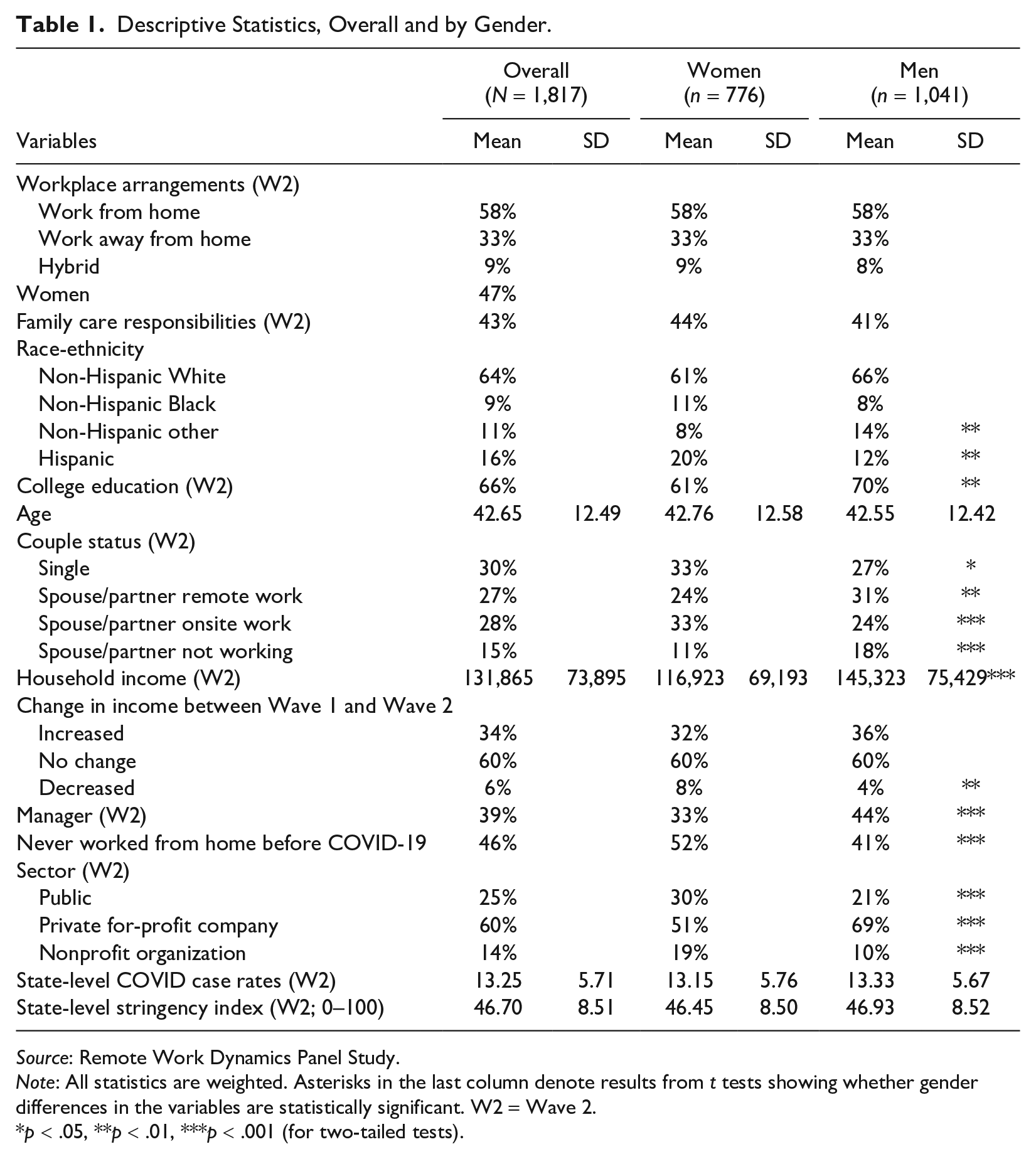
Table 1 presents descriptive statistics for variables used in our analysis, first for the overall sample and then separately by gender. Our sample, consisting of those who ever worked remotely since COVID-19 onset, has more men than women (47% women). For both women and men, around two out of five respondents have either childcare or adult-care responsibilities. About three in five respondents are non-Hispanic Whites (64%), followed by Hispanics (16%), people from other racial-ethnic categories (11%), and non-Hispanic Blacks (9%). The proportion of this sample who are Hispanics is higher among women (20% vs. 12%, p < .01) whereas the share of non-White, non-Black respondents (mostly Asians) is higher among men (14% vs. 8%, p < .01). About 66% of our sample have at least a college degree, especially among men (70% vs. 61%, p < .01), reflecting the types of occupations that could be accomplished remotely during the initial lockdown.
Descriptive Statistics, Overall and by Gender.
Source: Remote Work Dynamics Panel Study.
Note: All statistics are weighted. Asterisks in the last column denote results from t tests showing whether gender differences in the variables are statistically significant. W2 = Wave 2.
p < .05, **p < .01, ***p < .001 (for two-tailed tests).
Women in our sample are more likely than men to be single (33% vs. 27%, p < .05) or to have a spouse/partner who works at work (33% vs. 24%,p < .001), whereas men are more likely to have a spouse/partner who works remotely (31% vs. 24%, p < .01) or is not working (18% vs. 11%, p < .001). Household income is significantly higher among men ($145,323 vs. $116,923, p < .001). A third of respondents report an increase in personal income between survey waves, 60% experience no change, and 6% experience a reduction in income, especially among women (8% vs. 4%, p < .01). Women are less likely to be managers (33% vs. 44%, p < .001). Two in five respondents never worked from home prior to COVID-19, with the percentage higher among women (52% vs. 41%, p < .001). Most respondents (60%) in this ever-remote sample are employed by a private for-profit company, with 25% in the public sector and 14% in nonprofit organizations; women are more likely than are men to be in public or nonprofit sectors (p < .001).
There are clear inequalities in who remains remote and who returns partially or fully to working at work (Figure 1). Non-Hispanic Black women, women and men from “other” (non-Hispanic, non-Black, non-White) racial-ethnic groups, high-income men, and women and men working in private companies are more likely to remain in the remote workforce. Conversely, managers—women and men—are more likely to return, as are women and men who never worked from home before COVID-19. Care responsibilities slightly lower women’s probability of moving to a hybrid arrangement.
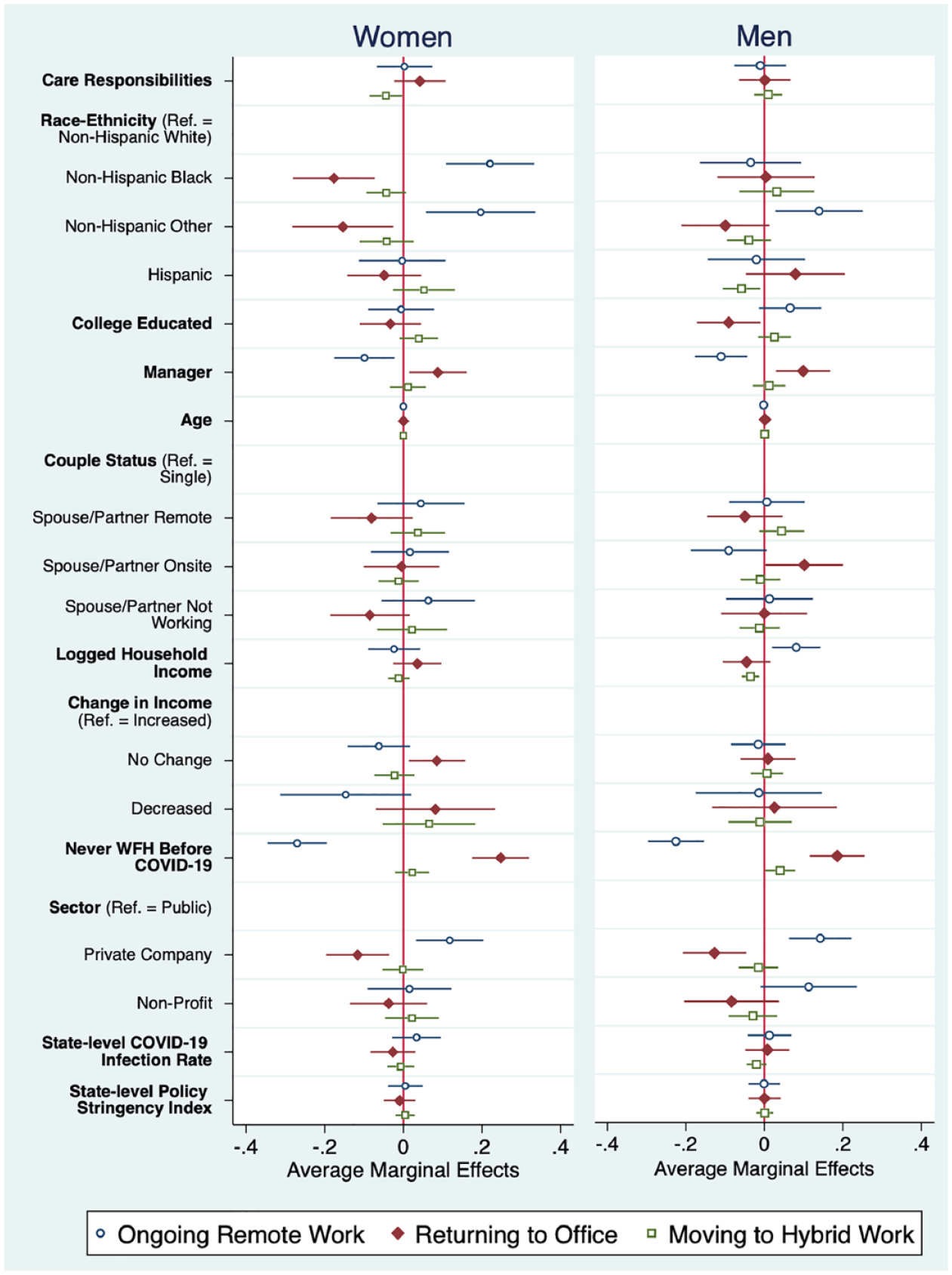
Estimates of Average Marginal Effects Predicting Changes in Work Locations from October 2020 to April 2021, by Gender.
Constellations of Subjective Well-Being
Recall that the k-means clustering method identifies four patterned clusters. In Figure 2, we depict the mean of each well-being variable for each of the four constellations. The first cluster, consisting of 14% of the sample, represents a “low stress/high satisfaction” group, as evidenced by their low burnout (1.72) and work–life conflict (1.00) and high job (4.25) and life satisfaction (4.04). Members in the second cluster are also characterized by low burnout (1.82) and high job (4.35) and life satisfaction (4.14), but their work–life conflict is at a moderate level (2.27). We label this cluster (33% of the sample) “some work–life conflict.”
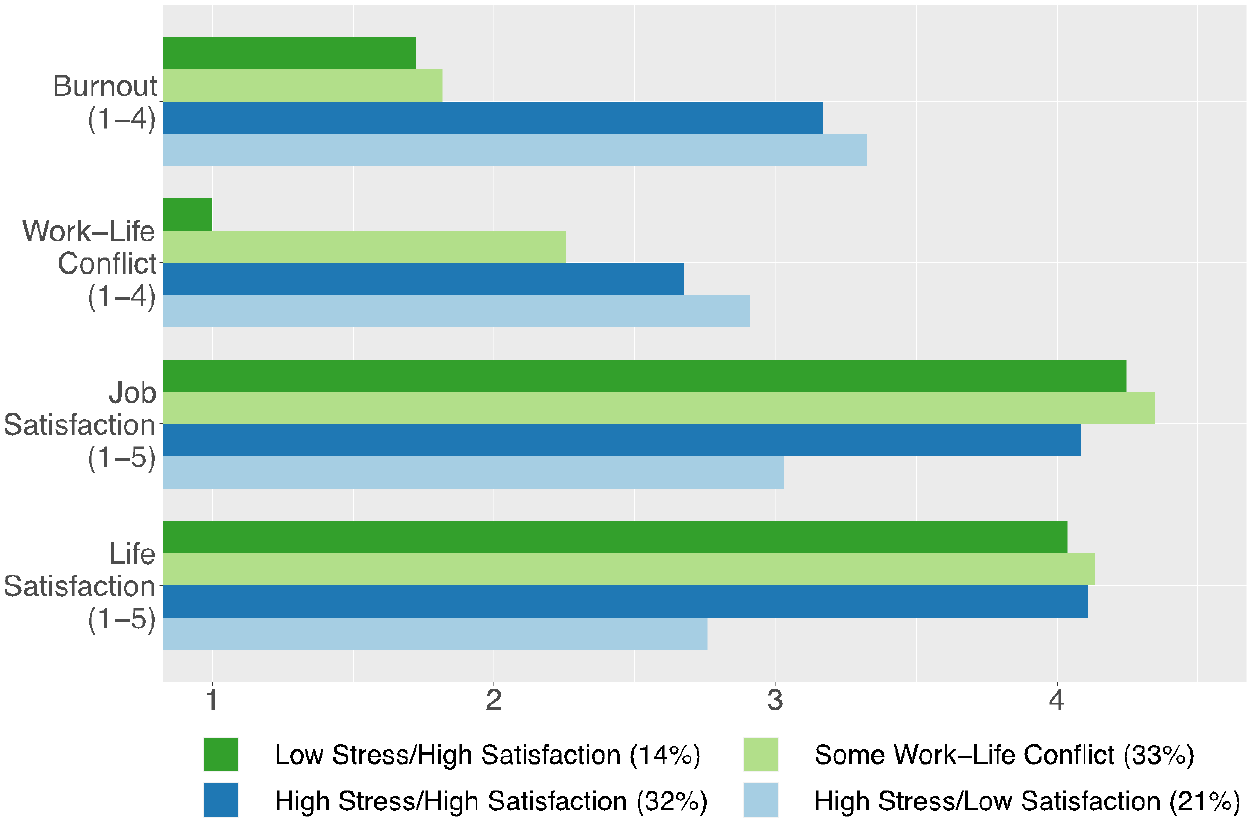
Means of Four Well-Being indicators, by Well-Being Constellation Membership.
Compared with the first two clusters, the next two exhibit much higher levels of burnout and work–life conflict even though they differ in reported satisfaction levels. Members in the third cluster—32% of the sample—have high burnout (3.17) and work–life conflict (2.67) but also high job (4.08) and life satisfaction (4.11). We name this counterintuitive constellation “high stress/high satisfaction.” By contrast, employees in the fourth “high stress/low satisfaction” cluster (21% of the sample) report the highest burnout (3.32) and work–life conflict (2.91) and the lowest job (3.03) and life satisfaction (2.76).
Changes in Place of Work and Well-Being over Six Months
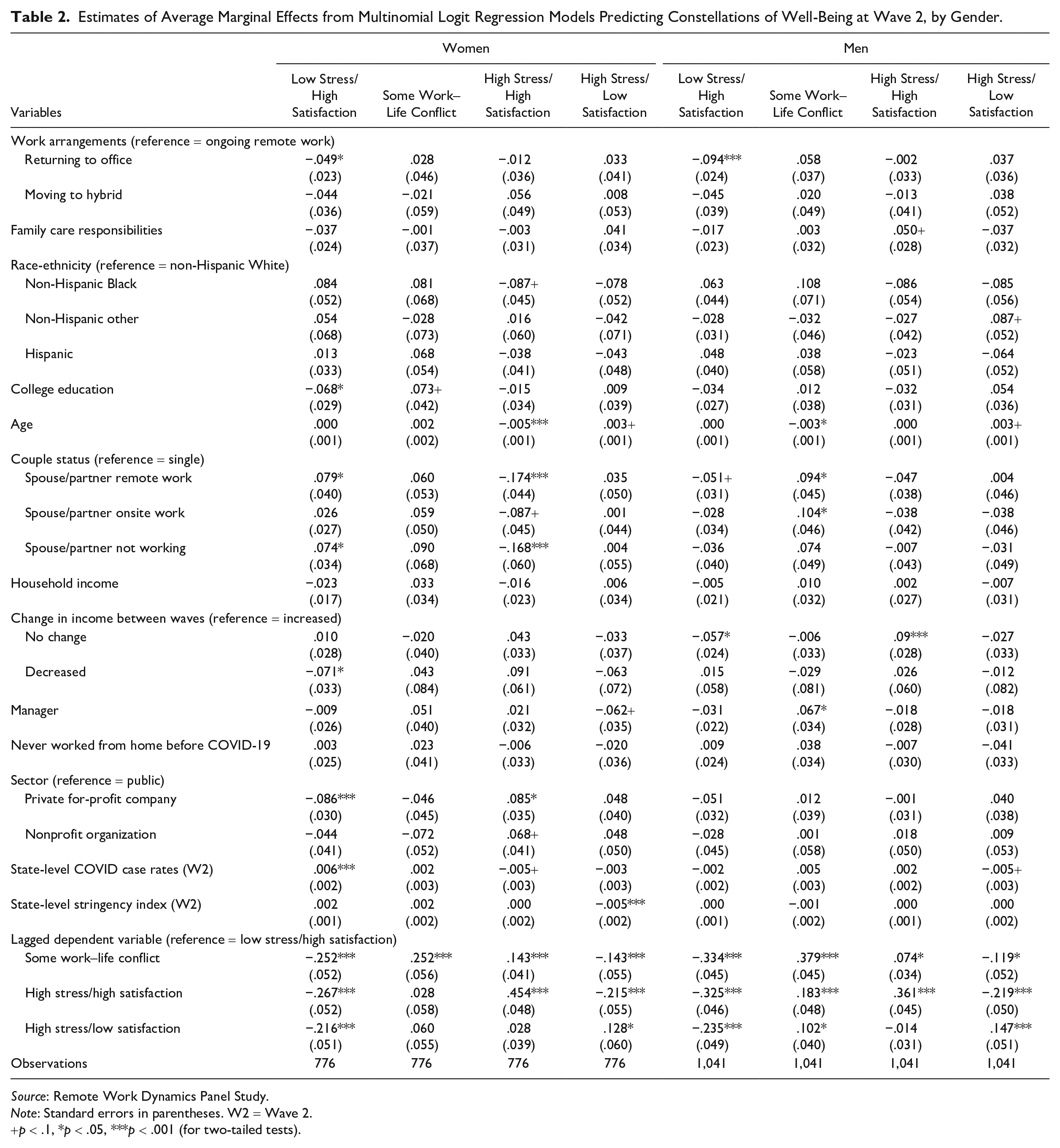
In Table 2, we present whether continuities or shifts in where one works predict corresponding changes in employees’ well-being constellations from six months into the pandemic (October 2020) to six months later (April 2021). We use as the reference group respondents who continue to work from home through April 2021. They constitute an ideal “counterfactual” group, suggestive of how well-being might have changed over time had there been continuous remote work across the two waves—that is, using this group as the reference allows us to control for secular trends in well-being that may apply to all respondents. Findings therefore approximate a difference-in-differences design, showing whether changes in well-being between waves are comparable across returnees, hybrid employees, and remote employees.
Estimates of Average Marginal Effects from Multinomial Logit Regression Models Predicting Constellations of Well-Being at Wave 2, by Gender.
Source: Remote Work Dynamics Panel Study.
Note: Standard errors in parentheses. W2 = Wave 2.
p < .1, *p < .05, ***p < .001 (for two-tailed tests).
Overall pattern
Recall that few respondents are in the optimal low stress/high satisfaction constellation (14% of the sample, see Figure 2). Table 2 shows that returning fully to the workplace as opposed to remaining working from home is associated with a significantly lower probability of being in this optimal well-being cluster by Wave 2 for both women (−.049, p < .05) and men (−.094, p < .001). Postestimation shows that the probability of being in the optimal well-being group is .14 for ongoing remote working women but only .09 for women returning to the office; for men, the corresponding figures are .16 and .07 (not shown in the table).
We next present in Figures 3a through 3c predicated probabilities of being in each of the four well-being constellations at Wave 2, contrasting returning to working at work (green bars) and moving to hybrid (orange bars) with ongoing remote work for subgroups at the intersections of gender and caregiving obligations, race-ethnicity, and educational attainment. We use arrows to denote subgroups that are significantly different from each other; our following discussion focuses on these statistically significant pairwise differences.
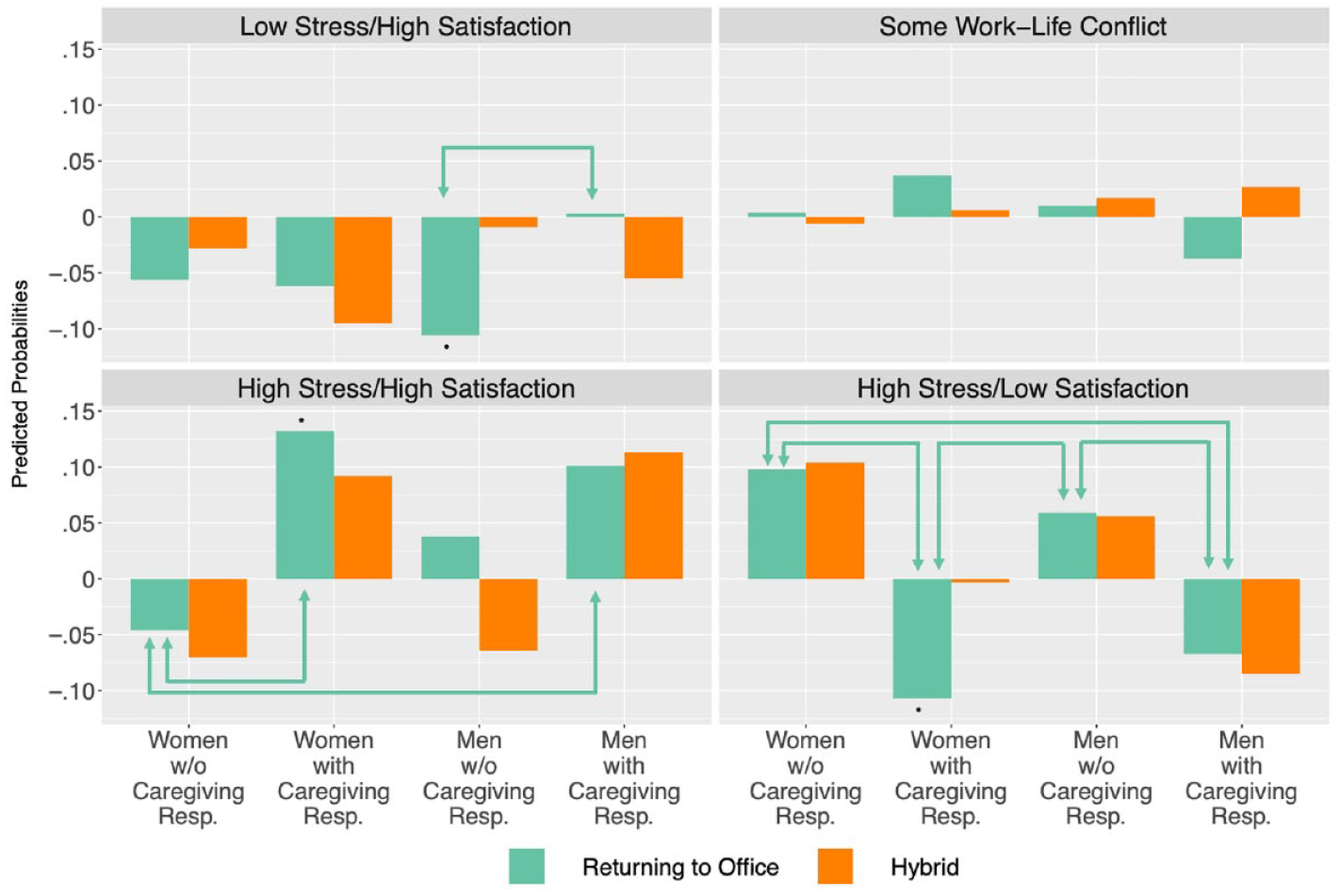
Predicted Probabilities of Membership in Different Well-Being Constellations at Wave 2, Returning to Office or Hybrid Relative to Ongoing Remote, by Gender and Caregiving Obligations.
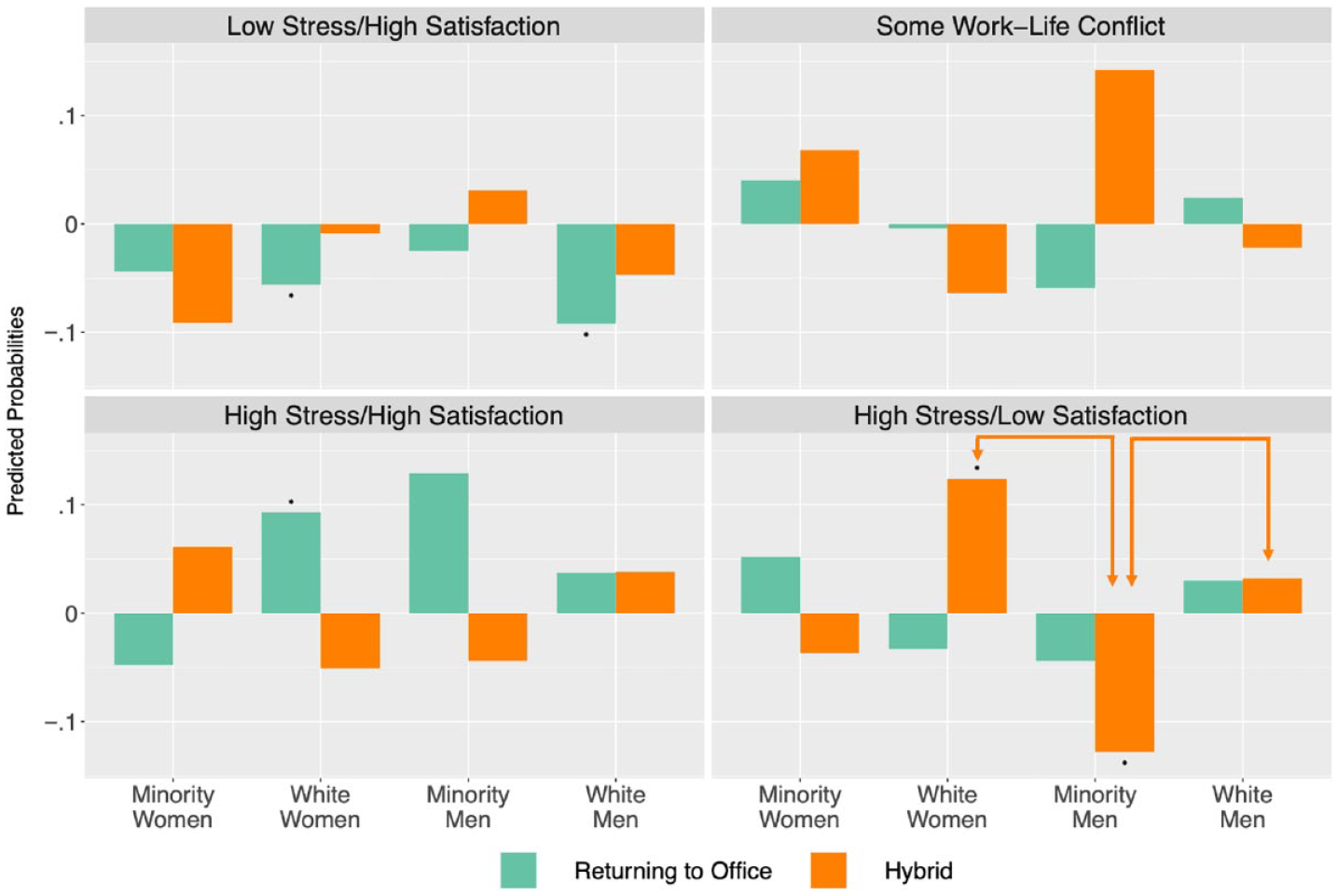
Predicted Probabilities of Membership in Different Well-Being Constellations at Wave 2, Returning to Office or Hybrid Relative to Ongoing Remote, by Gender and Race-Ethnicity.
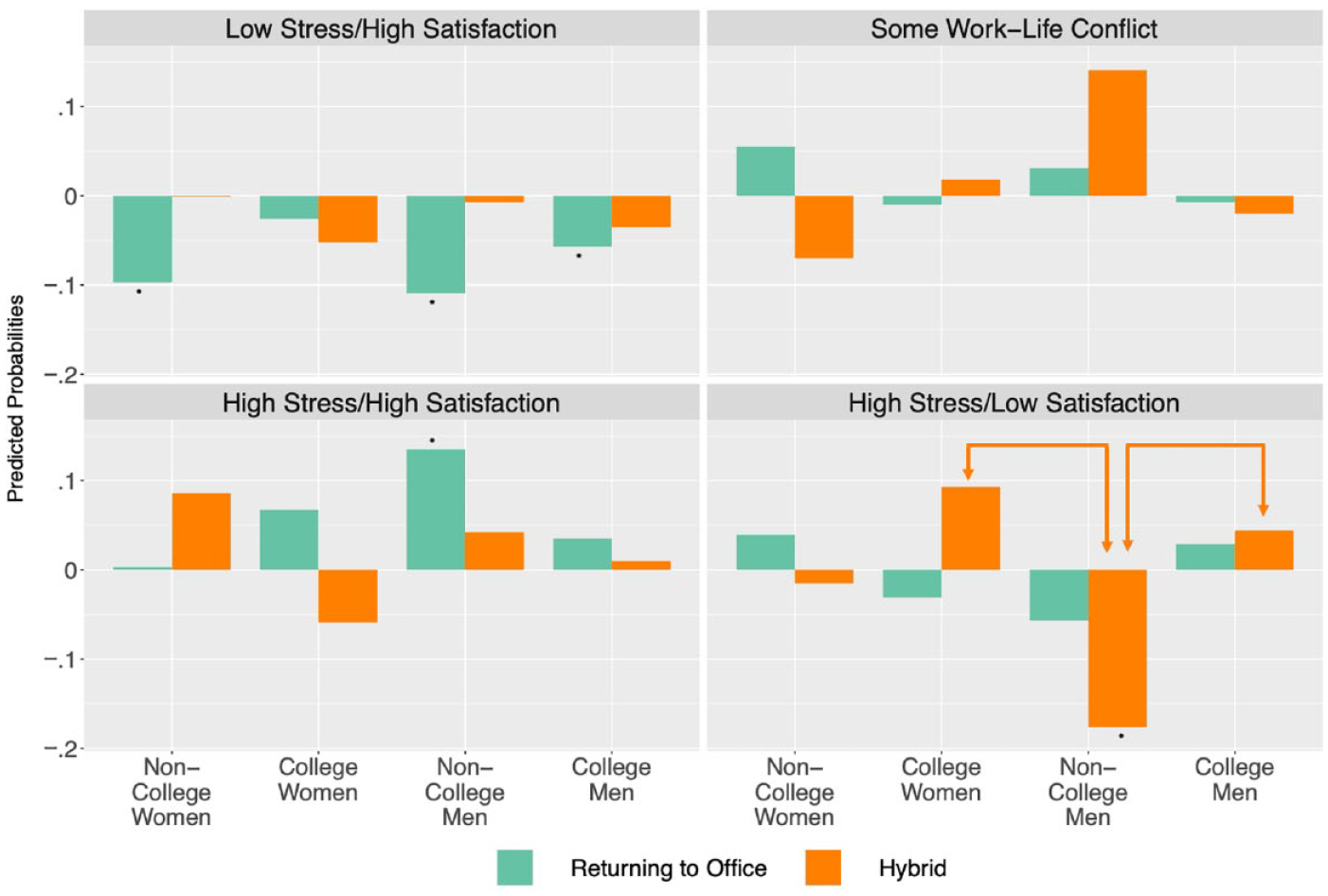
Predicted Probabilities of Membership in Different Well-Being Constellations at Wave 2, Returning to Office or Hybrid Relative to Ongoing Remote, by Gender and Educational Attainment.
Intersections between gender and caregiving obligations
Generally, women and men without care responsibilities tend to suffer the most from returning to working at work (Figure 3a). For example, among those fully back to the office, men without care responsibilities see the largest drop in the probability of being in the optimal (low stress/high satisfaction—top left quadrant) constellation. In addition, upon returning back to the office, women and men without family care responsibilities see significantly greater likelihoods of being in the low well-being (high stress/low satisfaction) group relative to women and men caring for children and/or aging relatives (see the arrows of the bottom right quadrant). Returning caregiving women are the most likely to report high work stress but also high job and life satisfaction (bottom left quadrant).
Intersections between gender and race-ethnicity
Moving to hybrid work predicts disparate well-being impacts at the intersections of race and gender. Given small sample sizes, we focus on a comparison between minority and White women and men, finding hybrid work increases the risk of low well-being (high stress/low satisfaction—lower right quadrant, Figure 3b) for White women but lowers the risk of being in this constellation for minority men. Note also that compared with those remaining remote, moving fully back to the workplace lowers the probability of being in the optimal well-being cluster (low stress/high satisfaction—top left quadrant) for White women and White men and increases the probability of having high stress and high satisfaction for White women (lower left quadrant).
Intersections between gender and educational attainment
Relative to other gender/education subgroups, men without a college degree experience the lowest risk of poor well-being (high stress/low satisfaction—lower right quadrant, Figure 3c) when moving to hybrid arrangements as opposed to continuing to work from home. In addition, total returns to the office predict lower probabilities of being in the optimal well-being (low stress/high satisfaction—top left quadrant) group for all except college-educated women; returning also predicts higher probabilities of high stress and high satisfaction for men without a college degree (lower left quadrant).
Discussion
The large-scale pandemic-driven reconfiguring where work is done has been framed as a possible “silver lining” of COVID-19 (e.g., Spiggle 2020), with remote work assumed to reduce stress and promote subjective well-being. However, working from home might not be a panacea, certainly not for employees who find themselves working remotely for business needs, not personal preference, or for those in historically disadvantaged subgroups. In this study, we assess the “silver lining” argument by comparing changes in subjective well-being of those who return—fully or partially—to the workplace with those who remain working from home during the pandemic. We draw on stress process and intersectional theoretical framings to capture the uneven stress of these dynamic shifts in place of work across overlapping social groups. Our study promotes understanding of the human meaning of these alternative places of working, illuminating disparities in the stress process in several important ways.
First, we add to extant literature by finding meaningful and distinctive patterned well-being constellations involving work-specific (burnout and job satisfaction), work–life (work–life conflict), and global well-being (life satisfaction). Despite long-held acknowledgment that different dimensions of subjective well-being operate in combination, there is insufficient evidence on the intraindividual patterning of multiple measures of well-being. Combining these measures is a particularly valuable approach in this study given that we only have single-item measures of different dimensions of well-being. The value of taking a patterned multidimensional approach is most evident in a cluster characterized by high burnout and work–life conflict but also high job and life satisfaction, an unexpected configuration we would have missed were the different well-being measures examined individually yet describes fully 32% of our sample. The existence of this cluster suggests that burnout and work–life conflict may not necessarily go hand in hand with lower satisfaction—employees who are satisfied with their job may work intensely to repay their organization (Kelliher and Anderson 2010). It is also the case that valued jobs typically come with high demands, increasing the stress of chronic overload even as workers enjoy the work they do and are pleased with their lives more generally (Kelly and Moen 2021). Future research on this important subset of workers who may love their jobs but want less on their plates is clearly warranted. Another noteworthy cluster has generally positive well-being except that work–life conflict is at a moderate level, indicating that work can interfere with nonwork domains even when burnout is relatively low. Taken together, these findings highlight the need to identify naturally occurring well-being constellations to better reveal the interconnections among and distribution of different dimensions of well-being.
Second, we contribute to stress process theory by emphasizing the shifting structural origins of stress; situating our study in a time of profound social change allows us to begin to address how large-scale societal changes, in this case, drastic shifts in where work is done, affect individuals living through them. We find clear evidence that for both women and men, returning to the workplace as opposed to remaining working from home by April 2021 set in motion a stress process leading to significantly lower probabilities of being in the optimal low stress/high satisfaction constellation. Consistent with the “silver lining” argument, remote work during the pandemic does appear to protect employees from experiencing more stress. This finding is all the more important given that working from home during the pandemic was largely required (at least in the early days). The fact that ongoing remote work promotes well-being despite choice being largely absent suggests homeworking may have certain inherent well-being-improving attributes. Identifying these attributes and examining the intervening mechanisms linking work place with well-being are lacunae to be addressed in future qualitative and quantitative research.
A third key contribution is our intersectional approach, revealing disparate stress process patterns not captured by single-dimension structural locational comparisons. Generally, we find fully returning to the office to be stress-inducing, especially for men and women without care obligations. Conversely, both hybrid and fully remote arrangements tend to promote well-being; hybrid work, in particular, advantages minority men and less educated men, although it appears to disadvantage White women. These findings show the value of an intersectional approach to reveal disparate structural processes at work. But intersectional analysis invariably adds complexity, leading to questions as to why some subgroups are more or less at risk of lower well-being depending on where they work. These complexities offer a suggestive research agenda for future in-depth qualitative studies of the unique experiences of particular segments of the workforce.
One example of the value of assessing the intersectional shaping of the stress process is the interface between gender and caregiving obligations. For both women and men, family care complicates the extent to which employees benefit from remote work in terms of subjective well-being. Indeed, we find it is generally women and men without care responsibilities who report salutary effects from continuing to be remote and stressful effects from returning to the office. Compared with ongoing homeworking, returning to working at work leads to the lowest probability of being in the optimal well-being group for men without care obligations and significantly higher risk of being in the high stress/low satisfaction cluster for men and women without care obligations. By comparison, results are more mixed for women with caregiving obligations—returning fully to the workplace predicts high burnout and work–life conflict but also high satisfaction; they are additionally less likely to be in the lowest well-being constellation (high stress/low satisfaction). It is likely a return to the office allows care-providing women time out from family care obligations and more time with coworkers, which could provide greater satisfaction. Future research is needed to better understand the challenges and benefits of remote work for women and men with family care responsibilities.
The values of examining overlapping structural locations in the social hierarchy can also be seen in the case of hybrid work, with minority men and less educated men the least apt to be in the worst (high stress/low satisfaction) constellation when moving to hybrid arrangements. Occupational segregation in particular industries may drive intersecting differences by gender and race-ethnicity or socioeconomic status in the experience of shifting work locations. Given that minority and less educated workers are more likely to hold jobs that are difficult to perform from home, those who do so and remain remote may have less autonomy over their tasks and time, in contrast to more privileged remote workers. But these subgroups do experience salutary effects from moving to hybrid work, possibly a case of some but not overwhelming supervision and greater latitude than either fully remote or fully at office. The distribution of job latitude and schedule control across different places of work for disadvantaged populations should be high on future research agendas.
In contrast, White women stand out as the subgroup who are the most vulnerable to hybrid work in terms of well-being. Women may be involuntarily moving to hybrid arrangements given their generally lower status (Padavic and Reskin 2002), what Kossek and colleagues (2021) refer to as “inflexible flexibility, whereby employees have little choice about schedules and which days they may work remotely.” The fact that only White women experience declines in well-being concomitant with the move to hybrid suggests some other processes are at work. Unlike their minority counterparts, White people tend to place more emphasis on the domestic expectations of women (Fan 2022), and White couples on average have a less equal division of household labor (Penha-Lopes 2006). For White women, therefore, a hybrid arrangement may feel like too little time for work and for home.
Our intersectional results also suggest circumstances under which different subgroups have similar outcomes. Consider, for example, the “some work–life conflict” constellation. There is no significant difference across workplace arrangements in the odds of being in this category for any subgroup. This suggests the absence of fit between jobs and personal lives for a third of our sample regardless of where they work. Capturing the circumstances, mechanisms, and scope conditions behind different well-being scenarios is another fruitful topic for future investigations.
This research on the dynamics of and well-being disparities associated with moving from or remaining in remote work in the time of COVID-19 is innovative but also has several limitations. First, we capture the impacts of returning to the workplace on employees’ subjective well-being only through April 2021. Given the still ongoing pandemic and uncertainties around workplace arrangements, future research is needed to shed light on longer-term impacts of returning to the office or remote and hybrid work on well-being. As life is returning to some semblance of normalcy with open schools and childcare facilities, a different picture regarding the work place/well-being nexus may be emerging.
Second is the issue of selection. Many workers in historically disadvantaged social locations are not in our sample because they lost their jobs or are in occupations requiring in-person work; missing as well are women no longer in the workforce because of heavy caregiving obligations. The well-being implications of unemployment, leaving the labor force, or in-person work remain key topics for investigation. To the extent that workers of color or less educated workers who are able to work from home—and thus included in our sample—are more advantaged than those no longer working or never working remotely, we may be underestimating well-being disparities by race or class. More systematic research is needed to investigate labor market disparities in this time of turbulent change. Third, even though we leverage four different indicators of well-being, they are each measured using single items, which may have introduced measurement errors.
Despite its limitations, this study promotes understanding of the dynamics of and disparities in patterned constellations of well-being when remote workers retain their distance work or return to working at work fully or partially. Exploiting an exogenous shock—the massive move to and away from working from home during the COVID-19 lockdown—permits the capturing of its dynamics and impacts for subgroups of workers differentially located in the social structure. Findings show uneven advantage and disadvantage in these tumultuous times but, as with most intersectional analyses, raise questions as to why there are subgroup variations. As Wheaton and Clarke (2003) have pointed out, similar transitions can have different impacts depending on both subjective assessments of them and the contexts in which they occur. Deeper, more qualitative investigations of particular populations are clearly required to tease out disparate stress processes. Future research is also needed to capture the longer-term psychosocial impacts of different working arrangements as the COVID-19 pandemic begins to wane and as even more workers are required to return to work in traditional office settings. To be sure, Americans are working—and living—in uncharted times.
Supplemental Material
sj-docx-1-hsb-10.1177_00221465221150283 – Supplemental material for Ongoing Remote Work, Returning to Working at Work, or in between during COVID-19: What Promotes Subjective Well-being?
Supplemental material, sj-docx-1-hsb-10.1177_00221465221150283 for Ongoing Remote Work, Returning to Working at Work, or in between during COVID-19: What Promotes Subjective Well-being? by Wen Fan and Phyllis Moen in Journal of Health and Social Behavior
Footnotes
Funding
The authors disclosed receipt of the following financial support for the research, authorship, and/or publication of this article: This research was supported by the National Science Foundation (Grant Nos. 2032639 and 2049125) and the UMN Life Course Center (NIA: P30AG066613). This research was approved by the Boston College Institutional Review Board.

Notes
Supplemental Material
Appendices A and B are available in the online version of the article.
Author Biographies
References
Supplementary Material
Please find the following supplemental material available below.
For Open Access articles published under a Creative Commons License, all supplemental material carries the same license as the article it is associated with.
For non-Open Access articles published, all supplemental material carries a non-exclusive license, and permission requests for re-use of supplemental material or any part of supplemental material shall be sent directly to the copyright owner as specified in the copyright notice associated with the article.
