



Abstract
Sociological research suggests that violent environments contribute to excess weight, a pressing health issue worldwide. However, this research has neglected extreme forms of violence, such as armed conflicts, a theoretically significant omission because armed conflict could reasonably lead to weight loss, not weight gain. I examine the weight-related, short-term consequences of the Mexican “War on Organized Crime.” I combine body mass index (N = 3,341) and waist circumference (N = 3,509) measures from the Mexico Family Life Survey with a novel data set on aggressions, confrontations, and executions between 2009 and 2011 (CIDE-PPD database) and exploit variation in the timing of the outcome relative to violent events taking place in the same residential environment. I find a robust and large positive association between armed conflict events and weight gain in adults and suggestive evidence of the behavioral, emotional, and physiological/biochemical pathways connecting those variables.
Excess weight has become a major global health concern. In 2016, The World Health Organization (WHO) estimated that approximately 39% of adults worldwide fell within the overweight range and 13% had obesity, the latter figure tripling since 1975. This upward trend is highly problematic because excess weight is a major risk factor for type 2 diabetes, cardiovascular disease, and other life-shortening diseases (WHO 2021). Individuals with obesity are also more at risk of morbidity and mortality from communicable diseases, most notably COVID-19 (Popkin et al. 2020). Given this importance, the scholarly search for predictors of weight gain has expanded in the last few decades to include features of the residential context, such as socioeconomic disadvantage and violence. In particular, living in unsafe environments can be a contributor to excess weight because violence can trigger emotional, behavioral, physiological, and biochemical responses as well as community-wide changes that can lead to increased caloric intake, physical inactivity, and fat deposition (Karb et al. 2012; Tomiyama 2019; Yu and Lippert 2016).
However, research on the relationship between unsafe environments and weight gain has not engaged with extreme forms of violence, such as armed conflicts. Despite growing interest in the causes and consequences of armed conflicts, wars, genocide, and human atrocities in general, these phenomena “continue to occupy a marginal place” in criminology and sociology (DiPietro 2019:75; see also Hagan and Rymond-Richmond 2008). This lack of engagement is unfortunate because armed conflict violence affects millions of people across the world but also because it is unclear how living in an environment with recent armed conflict events could affect people’s weight. Indeed, armed conflicts and wars often cause food insecurity through the destruction of crops and other resources and the disruption of supply chains, among other mechanisms (Collier 1999; Collier et al. 2003; Garry and Checchi 2020; Gates et al. 2012). Thus, armed conflict violence could be detrimental to health by causing starvation, hunger, and weight loss, not weight gain.
In this article, I extend research on unsafe residential contexts by examining the weight-related, short-term consequences of armed conflict violence. In so doing, I draw and integrate elements from research on social disorganization and armed conflicts and wars and leverage the methods recently refined and applied in the “environmental violence” literature (Schwartz et al. 2022; Sharkey 2010, 2018). I illustrate the utility of this approach with the case of the armed conflict created by the Mexican “War on Organized Crime” (WOC). I combine monthly data on WOC events (aggressions, confrontations, and executions) with anthropometric measurements of weight and compare the outcomes of adults living in the same residential context but who have experienced different levels of WOC violence in the last month due to the timing of their body measurements. I find a robust and substantial positive association between WOC violent events and weight gain. I also find evidence that these violent events are associated with increased caloric intake and blood pressure, decreased physical activity, higher perceived disorder and insecurity in the community, and higher levels of perceived safety in the home. These findings suggest that violent events are associated with related physiological, emotional, and behavioral responses and adaptations that could help explain the association between armed conflict violence and weight gain. The theoretical and methodological integration coupled with the novel context and type of violence examined make this application uniquely suited to enhance our understanding of the consequences of violence and the mechanisms connecting it to adverse health outcomes.
Background
Extreme Violence and Weight: Theoretical Pathways and Previous Findings
As research influenced by the social disorganization tradition in sociology has suggested, violent or unsafe environments can lead to excess weight through several mechanisms. Violence can increase fear, anxiety, and stress and diminish mental health (Shinn and Toohey 2003). The physiological, biochemical, and behavioral responses and adaptations to such stress and anxiety can in turn lead to overweight and obesity. A recent review of this research (Tomiyama 2019) summarizes these responses and adaptations. Stress activates the hypothalamic-pituitary-adrenal axis, secreting cortisol, a hormone that stimulates eating and fat deposition. Stress also releases other substances—such as the neurotransmitter dopamine, the peptide Neuropeptide Y, and most importantly, glucose—that similarly increase food cravings and/or fat deposition. The consumption of unhealthy foods high in sugar, fat, and calories satisfies these cravings and partially relieves stress, potentially locking individuals into an addictive feedback loop that rewards unhealthy eating. Stress can also disrupt sleeping patterns, in turn increasing weight by reducing physical activity and energy expenditure and increasing the opportunity and desire to eat more (see also Patel and Hu 2008).
Moreover, violent or unsafe environments where fear of crime is rampant can discourage outdoor activities or even leaving the house (Foster et al. 2014; Foster and Giles-Corti 2008). This is consistent with research examining how people react to violent environments. For instance, adolescents in Chicago who lived in unsafe neighborhoods with more social disorder averaged fewer hours of recreational programming than those living in safer, less disorderly neighborhoods (Molnar et al. 2004). Similarly, qualitative research has shown that fear of victimization restricts people’s movements outside their home and creates anxiety and stress about going out and, for those who are parents, having to constantly monitor their children (Clampet-Lundquist 2010; Rosenblatt and DeLuca 2012).
Violent places might also be characterized by disinvestment, infrastructural decline, socioeconomic disadvantage, limited employment opportunities, and out-migration (Yu and Lippert 2016). In such contexts, the availability and accessibility of healthy foods and the possibility of exercising/walking could be seriously limited (Foster et al. 2014; Foster and Giles-Corti 2008). Thus, through all these physiological, biochemical, and behavioral processes, violence in the environment can be associated with weight gain and other serious medical conditions.
Despite this theoretical framework, the evidence supporting a relationship between local crime or violence and weight gain is mixed. Research has generally shown that perceived neighborhood safety is inversely associated with weight outcomes in adults (for an exception, see Powell-Wiley et al. 2012; for an early review, see Lovasi et al. 2009). Perhaps the most robust evidence of this relationship comes from research conducted using the International Physical Activity and Environment Network Adult Study, a multicountry data collection effort that includes Mexico, Colombia, and Brazil. This work has found a negative association between perception of neighborhood safety and body mass index (BMI; Sallis et al. 2020). Similarly, Powell-Wiley et al.’s (2017) study of middle-aged and elderly people in six American cities uncovered an association between perceived neighborhood safety and lower BMI and waist circumference (WC) among men. An inverse relationship between neighborhood safety perception and weight outcomes in adults was also found in Flint, Michigan (Mathis et al. 2017); Los Angeles (Fish et al. 2010); Missouri (Catlin, Simoes, and Brownson 2003); Salt Lake City (Brown et al. 2014); and Perth, Western Australia (Christian et al. 2011).
However, research examining other indices of crime and violence has found mixed support. This is the case with research on perceived neighborhood disorder (e.g., Bell, Hamer, and Shankar 2014; Burdette and Hill 2008; Ortiz-Hernández and Janssen 2014) and, most notably, the small body of work that has used other sources of data beyond self-reported neighborhood safety or disorder in the United States (Yu and Lippert 2016). For instance, Powell-Wiley et al. (2017) did not detect an association between weight gain and police-recorded crime. Likewise, a study conducted in Chicago did not find an association between weight and objectively measured disorder, police-recorded crime rates, or the rate of 311 calls among women (Mayne et al. 2018). Nevertheless, official measures of crime and violence do appear to influence weight for some adult subpopulations. Using a national sample of the elderly population, Lee, Cagney, and Hawkley (2019) showed that women’s weight was sensitive to levels of burglary in the community but not men’s weight, a difference partly explained by perceptions of neighborhood danger. Stolzenberg, D’Alessio, and Flexon’s (2019) research on New York City showed that although the violent crime rate was not associated with BMI or obesity overall, this association did exist for Black and Hispanic residents.
Unlike most research in the United States using similar measures, a handful of studies on the relationship between official local crime and weight-related outcomes in Latin America have suggested a link between these factors, on average (for an exception, see Velásquez-Meléndez, Mendez, and Padez 2013). In Jamaica, violent crimes (homicides, shootings, robberies, aggravated assaults, and rape) were associated with increased mean WC among urban residents (Cunningham-Myrie et al. 2021). Similarly, in the cities of Belo Horizonte (Brazil) and Cali (Colombia), the homicide rate was positively related to weight outcomes (Martínez, Prada, and Estrada 2018; Mendes et al. 2013).
One important difference between the research using “objective” (i.e., not self-reported) measures of crime in the United States and Latin America is the types of crimes analyzed. Whereas Latin American research has focused on the most serious violent crimes, especially homicides, the literature in the United States mostly examines composite measures of crime. Some of the nonviolent crimes included in these composite measures might not be salient or impactful enough to prompt the aforementioned hypothesized responses (Foster and Giles-Corti 2008), diluting the general association between crime and weight outcomes. Following this logic, a connection between armed conflict violence and weight gain may be expected given the dramatic and extreme nature of such violence and the possibly higher likelihood that it might trigger strong emotional (anxiety, fear), physiological, and behavioral (overeating, inactivity) responses and adaptations.
However, the literature on local violence/crime and weight has not engaged with armed conflict violence, and thus the expectation of a positive association between these factors remains untested. In fact, the different intensity and nature of armed conflict violence vis-à-vis traditional violence is theoretically significant because it could also reasonably lead to short-term weight loss—not weight gain. Armed conflicts destroy resources (human capital, crops, businesses) and infrastructure (roads, hospitals, government buildings); disrupt or interrupt supply chains, government services, and aid; reduce public health funds by diverting them to the armed conflict; and often cause displacement (Collier 1999; Collier et al. 2003; Garry and Checchi 2020; Gates et al. 2012). All of these consequences can create food insecurity and put people at risk of undernourishment and starvation. Although limited and inconsistent (for a review, see Jawad et al. 2019), some international research suggests that armed conflicts have a negative impact on weight and can even increase the odds of becoming underweight (Delbiso et al. 2016; Gates et al. 2012; Kulenovic et al. 1996).
Despite its importance in describing potential pathways linking violence and weight, it is difficult to draw solid conclusions from prior sociological research. Most of the evidence in favor of a positive association between violence and weight comes from examinations of safety/disorder perceptions. Albeit meaningful, these self-reported measures do not necessarily capture the multiple ways in which local violence impacts people (Sharkey 2018). Moreover, the research examining objective crime has, for the most part, not focused on the most salient crimes and has completely neglected extreme forms of violence, such as armed conflicts. These limitations might explain the mixed results as well as the relatively small effects uncovered in this literature. Indeed, recent meta-analyses suggest that the influence of crime or violence on weight is likely to be small, if it exists at all (An et al. 2017; Won et al. 2016). Lastly, this literature is also limited methodologically because most analyses rely on research designs that are quite susceptible to selection bias, a possibility that is rarely examined (Yu and Lippert 2016; see also Sharkey 2018).
Present Study
In this study, I examine the relationship between armed conflict violence and weight. In setting the theoretical expectations guiding the analyses, I integrate elements from social disorganization—including the more specific literature on “environmental violence”—and transnational research on armed conflicts and wars. This integration offers a fuller theoretical understanding of the possible weight-related consequences of violence in residential environments and the pathways connecting them. In particular, social disorganization research would predict a positive relationship between armed conflict violent events in the residential context and weight, whereas the transnational literature would suggest a negative relationship.
I apply this theoretical framework to examine the case of the Mexican WOC. Incoming Mexican president Felipe Calderón launched the WOC at the end of 2006 to crack down on drug trafficking organizations. Since then, some regions in the country have been exposed to armed conflict violence, defined by intense, military-style confrontations and clashes between (and within) structured and powerful organized armed groups (e.g., drug trafficking organizations, militias, paramilitary groups) and state security forces (Casey-Maslen 2014; Lessing 2015). This violence is impactful and dramatic because it is often used to intimidate and terrorize rival criminal groups, the government, and the general public. It is often gruesome (beheadings, dismemberments, signs of torture) and displayed openly (corpses left in public places or hanging from bridges, street gun battles, attacks on police stations and other government buildings and infrastructure; Shirk and Wallman 2015). It is also far-reaching because it is not restricted to pockets of concentrated disadvantaged, as in the United States; rather, it extends across socioeconomic strata and cities (Shirk and Wallman 2015; Villarreal 2015, 2021; Villarreal and Yu 2017).
Given its extreme and dramatic qualities, armed conflict violence is likely to have acute consequences because people are more likely to remember and be affected by impactful crimes than less serious crimes (Warr 2000). It is also likely to resonate broadly, increasing fear, anxiety, and other mental health issues and prompting stress-related processes and behaviors, even for individuals not living in the immediate surrounding area or who are objectively unlikely to be personally victimized (Flores Martínez and Atuesta 2018; Villarreal and Yu 2017). Unsurprisingly, violence in this context has been shown to affect health outcomes closely associated with obesity, such as birth weight (Brown 2018), life expectancy (Canudas-Romo et al. 2017), and morbidity due to heart disease (Lee and Bruckner 2017).
Although more violent than many war zones, the WOC armed conflict generally lacks the political/ideological undertones typically found in civil conflicts and wars. This is because the WOC is a conflict of constraint (Lessing 2015). Unlike traditional civil wars, where rebels fight to conquer states and seize power, conflicts of constraint are characterized by nonstate actors that use violence to limit the activity of the state in a way that allows them to continue profiting from illegal enterprises. Thus, the WOC is similar to other conflicts of constraint that have involved drug trafficking organizations powerful enough to confront the state. Historically, numerous conflicts in Latin America have at least partly fit this description, such as those in Colombia, Brazil, Honduras, and El Salvador (Berg and Carranza 2018; Cruz and Durán-Martínez 2016; Lessing 2015). I hypothesize how the exact nature of the WOC might shape the results in the discussion.
Data and Methods
Data
I combined two sources of data in this article. The first source is the Mexican Family Life Survey (MxFLS), which currently consists of three waves of data collected in 2002 (MxFLS-1), 2005 to 2007 (MxFLS-2), and 2009 to 2012 (MxFLS-3). The baseline round (MxFLS-1) was representative of all Mexican households, and it collected information on members of more than 8,400 randomly sampled households in 150 communities (Rubalcava and Teruel 2013). Due to its rich set of variables, this data set has been widely used to examine weight-related issues (Brown 2018; Ortiz-Hernández and Janssen 2014; Schmeer 2012) and the consequences of crime and violence (Villarreal and Yu 2017).
I took the measurements for the main outcome of interest (weight) from the MxFLS-3. The most commonly used measure of weight is the BMI. Scholars and practitioners also often use the cutoff values established by WHO (2021) to define overweight (BMI ≥ 25) and obesity (BMI ≥ 30). However, the use of BMI and its cutoff values can be problematic because they do not necessarily track the actual risk of morbidity and serious or chronic illness related to excess weight. For instance, WC appears to be a better predictor of type 2 diabetes (Wang et al. 2005) and cardiovascular disease (Bastien et al. 2014) than BMI. In terms of the cutoff values, the risks of excess weight appear at different levels for different populations. For example, these risks emerge at lower levels of BMI for Asian and short stature populations and higher levels for Pacific Islanders (Hubbard 2000; López-Alvarenga et al. 2003). Moreover, health risks due to excess weight are better conceptualized as a continuum, and using cutoff values throws away important information and reduces variation, leading to reduced statistical power and increased measurement error (Hubbard 2000; Lovasi et al. 2012). To offset these issues with BMI and its cutoff points, I followed recent recommendations and used the continuous measures of both BMI and WC (Bastien et al. 2014; Powell-Wiley et al. 2017). Consistent with standard definitions, BMI is measured as the ratio of weight (kilograms) to height (meters) squared (kg/m2) and WC in centimeters, and both are based on anthropometric measurements.
I also examined other outcomes from the MxFLS-3 to tease out the potential mechanisms connecting extremely violent events to weight gain. First, I analyzed behavioral responses to stress and violence. These are indicator variables for soft drink and alcohol consumption at home and parties, respectively; exercising and participation in sports; and difficulty sleeping. Second, I examined a continuous measure of blood pressure levels (combined systolic blood pressure and diastolic blood pressure) to proxy for physiological and biochemical reactions to stress and violence. High blood pressure is associated with high levels of both glucose (Kuwabara et al. 2019) and cortisol (Kelly et al. 1998) in the blood stream, two substances involved in such reactions. Third, I analyzed indicator variables for the perception of disorder in the community (presence of abandoned buildings, houses, or businesses; gangs that gather frequently; prostitution; people drinking alcohol or taking drugs on the street; armed neighbors; and militias and paramilitary armed groups) and the presence of unsafe situations or events in the community. Perceptions of disorder and safety are important links in processes of community decay and social disorganization that could lead to weight gain (Skogan 1990; Yu and Lippert 2016). Finally, I examined an indicator variable for perception of safety in the home to tap into the possibility that people prefer to stay home when WOC violence is present.
The second source was the CIDE-PPD data set, which records WOC violent events between December 2006 and November 2011 (Atuesta, Siordia, and Madrazo Lajous 2019). This data set includes three types of events: aggressions, or attacks by organized armed groups directed at the government—its infrastructure, institutions, and personnel (army and police)—that are not repelled by authorities; confrontations, or clashes between authorities and organized crime groups or between different groups; and executions, defined as the homicide of two or more people using extreme violence (decapitation, incineration, mutilation) where either the perpetrators or the victims are members of a criminal group. This data set has been validated using different sources and has been used to study the WOC and its consequences before (Atuesta and Ponce 2017; Flores Martínez and Atuesta 2018), although not to study physical health. A total of 36,378 WOC events are registered in this data set. The main predictor in my models was the number of WOC events aggregated at the municipality level in the month prior to the weight measurements.
Lastly, I introduced socioeconomic and demographic individual and household controls from the MxFLS-3. At the individual level, I included age, gender, ethnicity (a binary variable for Indigenous status), marital status, education, employment, and health insurance coverage. At the household level, I included indicator variables for migration (at least one member currently living in the United States), wage (at least one adult earning more than twice the minimum wage per day), education (at least one adult with a middle school education or higher), employment (at least one adult employed), female-headed, and crime victimization in the previous two years (if a member has been the victim of kidnapping, harassment/sexual abuse, robbery/assault, or bodily injury or if the home, business, or plot/land has been broken into).
The analytical sample included nonpregnant and nonlactating adults (between 21 and 64 years old) living in small municipalities (lowest population tertile of the sample; <51,000 habitants) at the temporal intersection of the two data sources, namely, September 2009 through November 2011. Information to pinpoint the exact location of WOC events or the address of sampled individuals was not available. The analyses in this article used the lowest level of geographical aggregation available (municipality) to capture extreme violence in the residential environment. Although this is a limitation, previous scholarship has identified the municipality as the most appropriate level of aggregation to study the WOC (Villarreal 2021; Villarreal and Yu 2017). Thus, this operationalization is consistent with the recommendation to let substance and context guide decisions about the definition and measurement of residential environments (Sharkey and Faber 2014). I used small municipalities in the main analyses because a larger proportion of the community might be directly exposed to, know the people involved in, or find out about the violence through neighbors or heightened police/military presence than in larger municipalities. This can make violent events quite salient and impactful in these municipalities and any possible effect easier to detect and interpret. I explore how this decision shapes my findings in the results section.
After excluding 2.5% of observations with missing information on the control variables, the final sample size was 3,341 and 3,509 for the BMI and WC analyses, respectively. As expected, both measures were positively and strongly correlated (r = .86; p < .001). Only 14% of the adults in the analytical sample were living in a residential environment that experienced a WOC event in the previous month. This is consistent with the fact that many Mexican regions have not been exposed to the WOC and, even those that have, have not been so at the same time and/or with the same intensity (Shirk and Wallman 2015). For summary statistics for all the variables in the analyses, see Table A1 in the Appendix in the online version of the article.
Methods
The estimation strategy in this article was based on research that exploits variation in the timing of a given outcome relative to violent events taking place in the same environment, which can be plausibly exogenous to individual and household characteristics (Schwartz et al. 2022; Sharkey 2010). Specifically, weight measurements were collected in the same municipality across different months. This allowed me to estimate the short-term impact of armed conflict violence by comparing the weight outcomes of adults living in the same municipality but with different patterns of WOC intensity in the previous month due to the timing of the measurements. Formally, I estimated two sets of regression models using different operationalizations of armed conflict events:


where Weighti is defined as the weight-related outcome of interest (BMI or WC) for individual i; α t , γ m , and δ j are year, month, and municipality fixed effects; Χ′ i is a vector of individual and household controls; and ε i is the idiosyncratic error term. In Equation 1, WOCj equals 1 if there were one or more WOC events in municipality j in the month prior to the weight measurements and 0 otherwise. In Equation 2, WOC1j equals 1 if there was one WOC event, WOC2j equals 1 if there were two or more WOC events in municipality j in the month prior to the weight measurements, and 0 otherwise. The coefficients of interest—WOCj, WOC1j, and WOC2j—capture the impact of different levels of WOC intensity on weight using zero WOC events as a reference category. I used clustered standard errors at the municipality level in all the models.
This estimation strategy accounts for seasonal and yearly changes and eliminates systematic variation stemming from unobserved and time-invariant municipality characteristics that could be related to the WOC and the outcomes. The latter include poverty and inequality, institutional characteristics (e.g., quality of law enforcement agencies), “obesogenic” characteristics such as the availability of unhealthy eating options, and the lack or deficiencies of exercising and recreational resources and infrastructure, including features associated with the “walkability” of the residential context. Municipality fixed effects also account for governmental policies that could be connected to both violence and excess weight. In the results section, I explore the plausibility of the exogeneity assumption given this research design.
In additional analyses, I explored the mechanisms linking armed conflict violence to weight gain. Specifically, I used similar models with different behavioral (sleeping disruptions, soft drink and alcohol consumption, exercising and participation in sports), physiological (blood pressure), and perception outcomes (disorder in the community and safety in the community and at home).
Results
Main Analyses
I present the results of the main analyses in Table 1. The models show a consistent pattern supporting the positive relationship posited in the social disorganization literature. Models 1 and 3 show that the presence of any WOC event in the previous month is associated with statistically significant (p < .05) increases of 1.4 kg/m2 (BMI) and 2.8 centimeters (WC), on average. Models 2 and 4 suggest that these associations are mostly driven by the impact of multiple WOC events (>1). Living in a municipality with multiple events in the previous month is associated with average increases of 2.0 kg/m2 (BMI) and 4.7 centimeters (WC) (p < .01), using no WOC events as the reference category. However, the difference between one and multiple WOC events is not statistically significant in either model, suggesting that the size of the influence does not increase with repeated violent events once the WOC is present.
Models of Weight-Related Outcomes with “War on Organized Crime” (WOC) Events as Predictors.
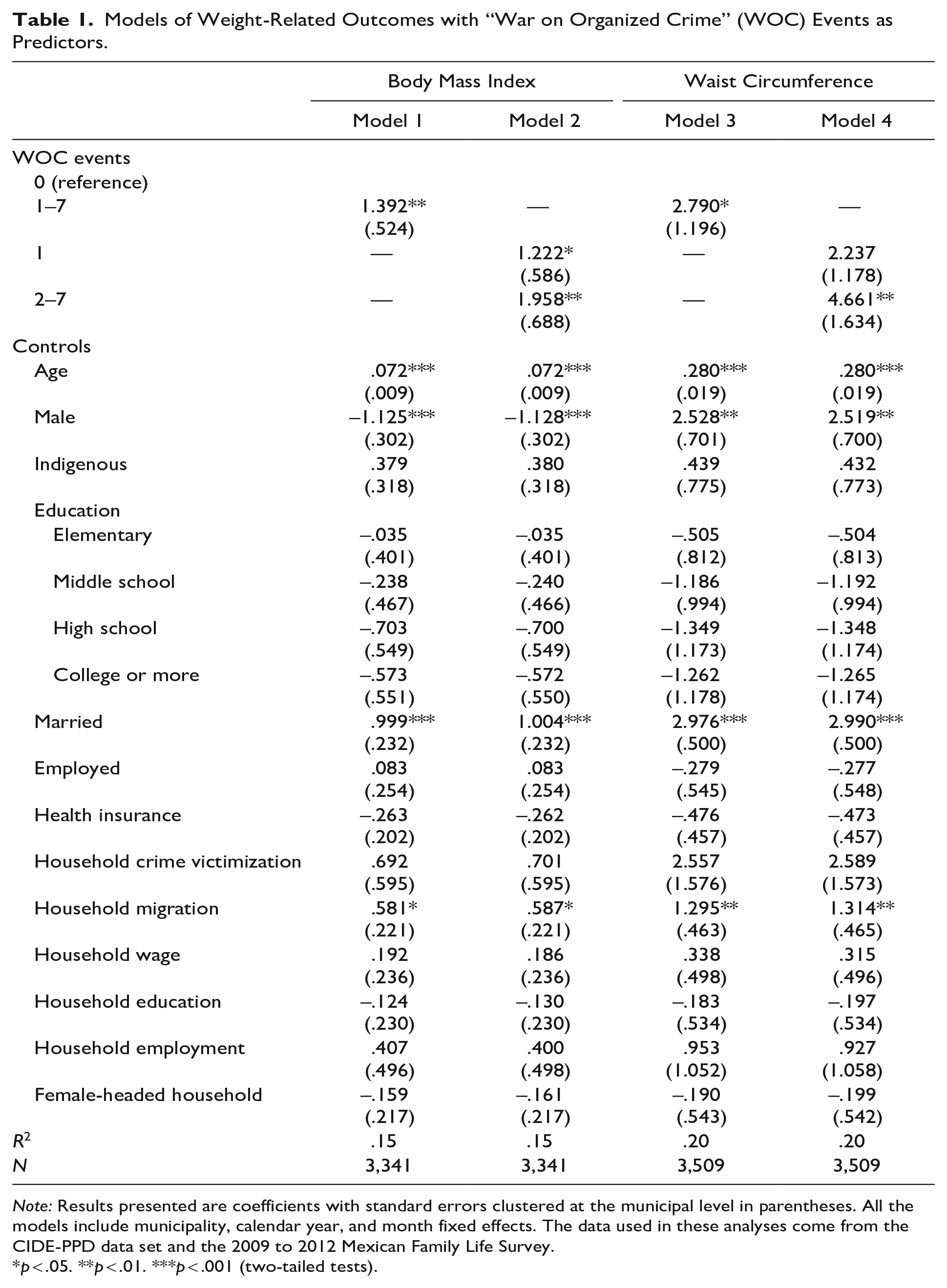
Note: Results presented are coefficients with standard errors clustered at the municipal level in parentheses. All the models include municipality, calendar year, and month fixed effects. The data used in these analyses come from the CIDE-PPD data set and the 2009 to 2012 Mexican Family Life Survey.
p < .05. **p < .01. ***p < .001 (two-tailed tests).
These associations are quite substantial, as a comparison with estimates of other well-known correlates of weight gain shows. Marriage (Schmeer 2012) and age (Weinheimer, Sands, and Campbell 2010) are two of these correlates. In my analyses, the coefficients of interest are similar in size—and often larger—than the association between marriage and weight gain. Additionally, the association between the presence of any WOC events and BMI and WC is 19 and 10 times larger, respectively, than the weight gain associated with an extra year of age. The association between multiple WOC events and weight gain is 27 and 17 times larger than the expected weight gain associated with an extra year of age.
The relevance of the WOC can also be shown by exploring its association with the widely used categories of overweight and obesity. Table 2 presents the results of logit models with overweight and obesity as dichotomous outcomes. For an individual living in a place with multiple WOC events in the previous month, the odds of being categorized as overweight or obese are 2.0 and 2.6 times as large as the odds for an individual without WOC exposure, respectively.
Logit Models (Odds Ratios) of Overweight and Obesity with “War on Organized Crime” (WOC) Events as Predictors.

Note: Results presented are odds ratios with standard errors clustered at the municipal level in parentheses. All the models include municipality, calendar year, and month fixed effects and the controls in Table A1 in the online version of the article, omitted here to conserve space. The data used in these analyses come from the CIDE-PPD data set and the 2009 to 2012 Mexican Family Life Survey.
p < .05 (two-tailed tests).
In Figure 1 (see also Table A2 in the Appendix in the online version of the article), I present the results of reestimating the main analyses using different population tertiles. Overall, the pattern of results with the second tertile is similar to the main findings (first tertile), but coefficients are smaller. By contrast, results with the third tertile are all insignificant and do not resemble the pattern in the main findings. This is consistent with the expectation that the impact of WOC events would most likely be detected in small municipalities. This localized association is also supported by analyses showing no evidence of a relationship between WOC violence aggregated at the state level and weight-related outcomes (Table A3 in the online version of the article).
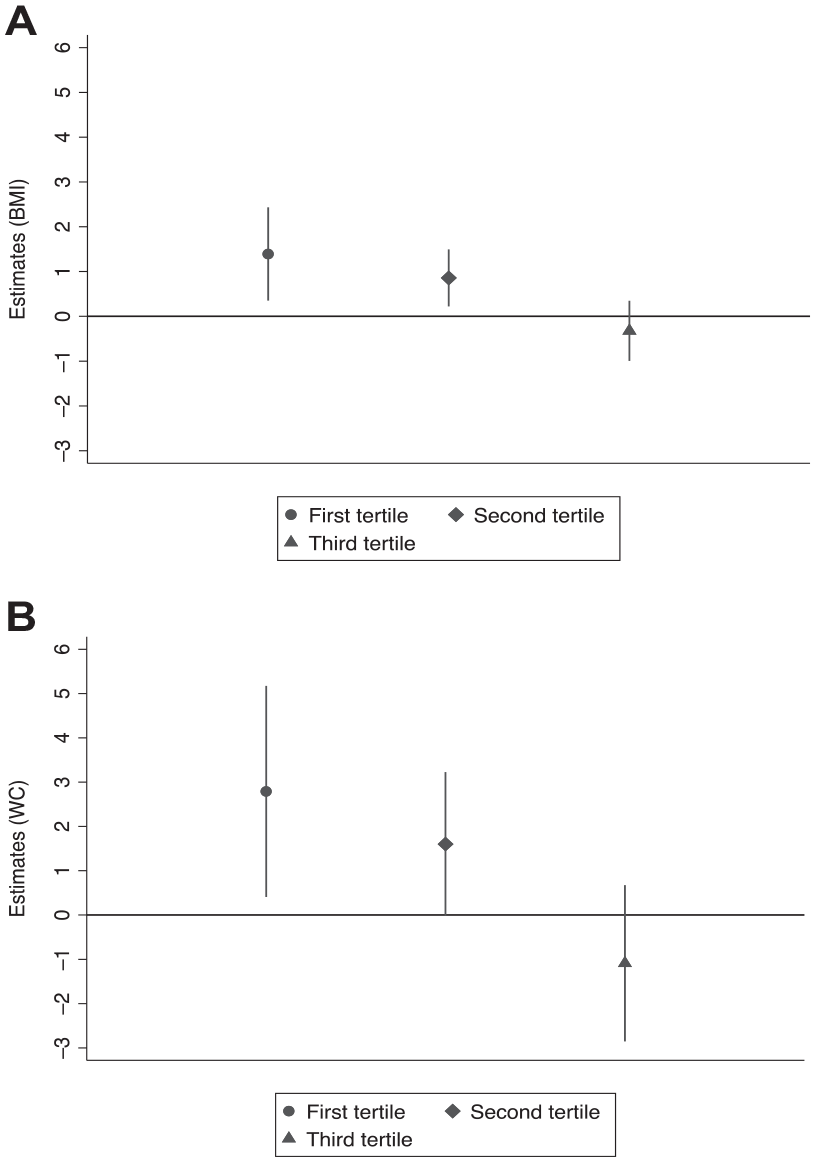
Estimates of “War on Organized Crime” (WOC) Events as Predictors of Weight-Related Outcomes by Population Tertiles.
Robustness Checks
The main results are robust to numerous identification threats, model specifications, and alternative research designs. The main assumption in my research design is that WOC events are exogenous. If this assumption does not hold, individual or household sociodemographic characteristics (including health and weight outcomes) might be systematically associated with the level of armed conflict violence in individuals’ environment, in turn potentially biasing the estimates. I explore if this assumption is plausible in two ways. First, I estimate a series of separate regression models similar to those in the substantive analyses but with the timing of the weight-related measurements (count of the month in the wave testing window in which the measurements were taken) and sociodemographic characteristics as the outcomes and WOC events in each municipality as predictors (Table A4 in the online version of the article). It could be, for instance, that WOC violence postponed or delayed the interviews where measurements were taken, confounding the impact of violence. In this scenario, we would expect positive and significant coefficients on the WOC violence variables. Second, I conduct placebo tests using similar models but with WOC events measured one month after the weight-related measurements were collected (Table A5 in the online version of the article).
The results from these two sets of tests suggest that the exogeneity assumption is plausible in this application. There is no evidence that WOC violence affects the month of the measurements (or the rollout of the interviews), and the outcomes are not affected by future WOC violence. Moreover, individuals living in municipalities with WOC violence in the previous month and those not exposed to WOC violence do not appear to be systematically different in terms of characteristics that may also be correlated with weight outcomes. 1 The exogeneity assumption is also supported by the short time elapsed between the measurements of WOC violence and the weight outcomes as well as the salience of WOC violence and the absence of other equally salient events or processes in that short time span, to my knowledge. This makes it unlikely that other events could be biasing the influence of the WOC.
I also explore if the results are sensitive to different model specifications and operationalizations of the outcomes and the main predictor. The results are robust to excluding individual and household controls (Table A6 in the online version of the article); adding the number of WOC events in the previous year (minus the first month), the number of homicides in the municipality in the previous month, and lagged values of the dependent variable as controls (Table A7 in the online version of the article); and using Municipality × Year fixed effects (Table A8 in the online version of the article), locality/community fixed effects (Table A9 in the online version of the article), outcomes standardized by gender (Table A10 in the online version of the article), and alternative operationalizations of the predictor, such as the rate of WOC events per 100,000 and the count and the rate per 100,000 of WOC-related homicides (Table A11 in the online version of the article).
Similarly, the results are robust to different sample restrictions. Specifically, I restrict the sample to individuals living in a municipality with at least one WOC event either the month before or the month after the weight measurements, excluding those in municipalities without WOC events or with WOC events both before and after (Table A12 in the online version of the article). I also exclude observations with BMI ≤ 18.5, considered to be the underweight threshold, because for this subpopulation, gaining weight could be beneficial (Table A13 in the online version of the article).
Finally, I present two additional sets of analyses to inspect the sensitivity of the results to different research designs. First, I conduct a set of difference-in-differences analyses using repeated cross-sections (by municipality-month) with leads and lags. I code the treatment indicator as 1 if there was WOC violence in the municipality in the previous month (month 0 in Figure 2) and 0 otherwise and add individual indicator variables for the two months before and after the measurement of WOC violence and the outcomes. Figure 2 shows that the treatment is associated with a statistically significant (p < .01) and positive effect on weight outcomes measured one month after, although the coefficients on the leads and lags are small (close to zero) and do not reach statistical significance. These analyses confirm the positive association between WOC violence and weight-related outcomes, the lack of pre-trends or systematic changes in weight-related outcomes prior to the measurement of the WOC (exogeneity assumption), and the short-term influence found in the main analyses.

Difference-in-Differences Estimates of “War on Organized Crime” (WOC) Events as Predictors of Weight-Related Outcomes with Leads and Lags.
Second, I leverage all three waves of the MxFLS to exploit its longitudinal nature using individual fixed effects. These models account for unobserved individual factors that remain constant across time and have a constant association with the outcomes (Allison 2009). Although the findings should be interpreted carefully because there is little longitudinal variation in the predictor, given that WOC violence is absent in the first two waves and relatively rare in the third one, they confirm the positive association between WOC violence and weight outcomes (Table A14 in the online version of the article).
Exploratory Analyses of Mechanisms
In this section, I explore multiple physiological, biochemical, emotional, and behavioral responses and adaptations that could help explain the association between armed conflict violence and weight gain found in the main analyses. In Table 3, I show the results of regressing indices of these responses and adaptations on WOC events. WOC events—in particular, multiple events—are significantly associated with higher odds of consuming soft drinks or alcohol and lower odds of exercising or participating in sports compared to zero WOC events (Models 1–4). However, there is no evidence that WOC violence is associated with difficulty in sleeping (Model 5). The results in Table 4 also suggest that WOC violence is associated with increased blood pressure (Model 1), higher perceived disorder and feelings of insecurity in the community (Models 3 and 6), but also higher levels of perceived safety in the home (Model 7).
Logit Models (Odds Ratios) of Weight-Related Behaviors with “War on Organized Crime” (WOC) Events as Predictors.
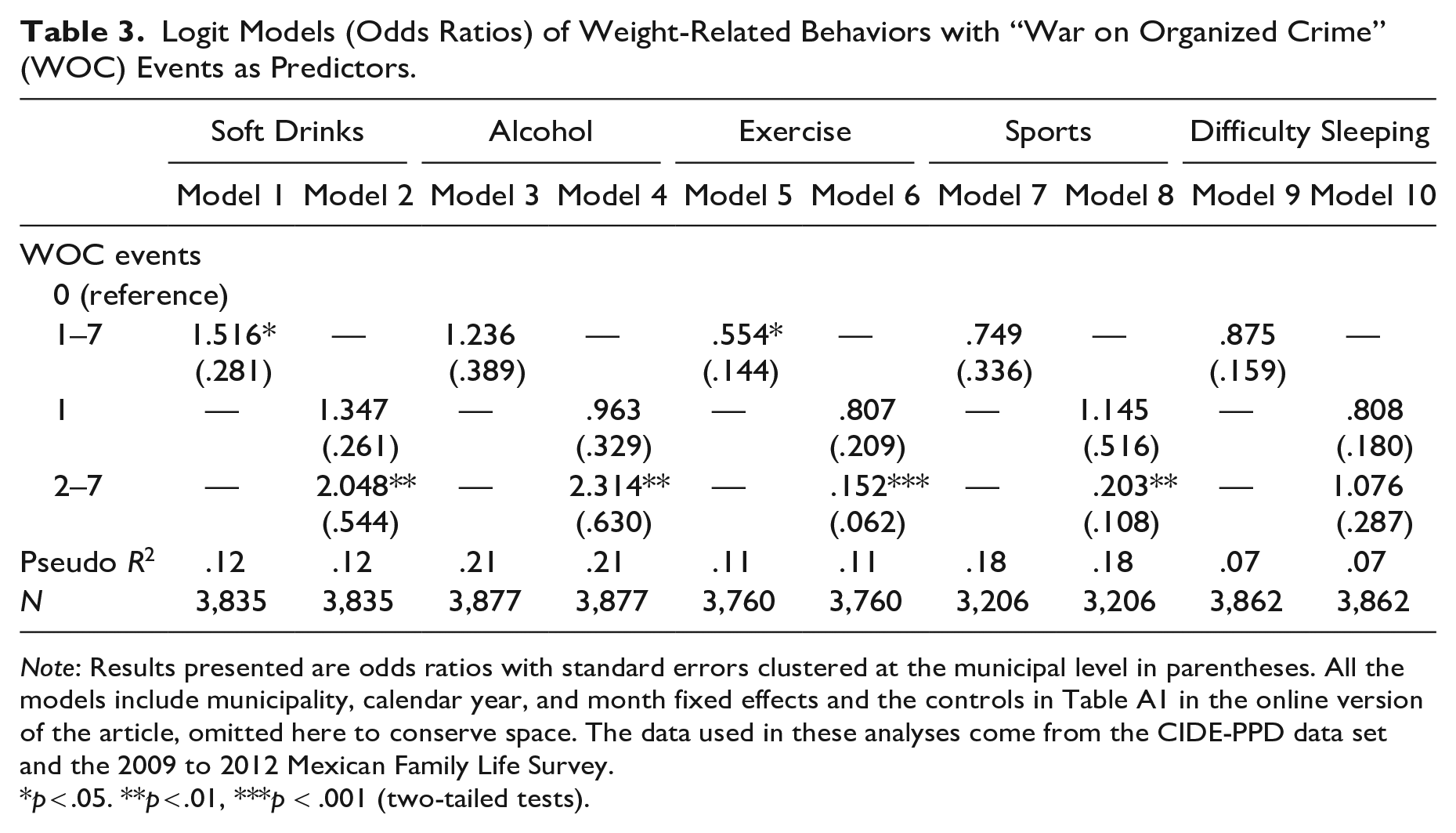
Note: Results presented are odds ratios with standard errors clustered at the municipal level in parentheses. All the models include municipality, calendar year, and month fixed effects and the controls in Table A1 in the online version of the article, omitted here to conserve space. The data used in these analyses come from the CIDE-PPD data set and the 2009 to 2012 Mexican Family Life Survey.
p < .05. **p < .01, ***p < .001 (two-tailed tests).
Models of Physiological Responses and Perception of Disorder and Safety with “War on Organized Crime” (WOC) Events as Predictors.
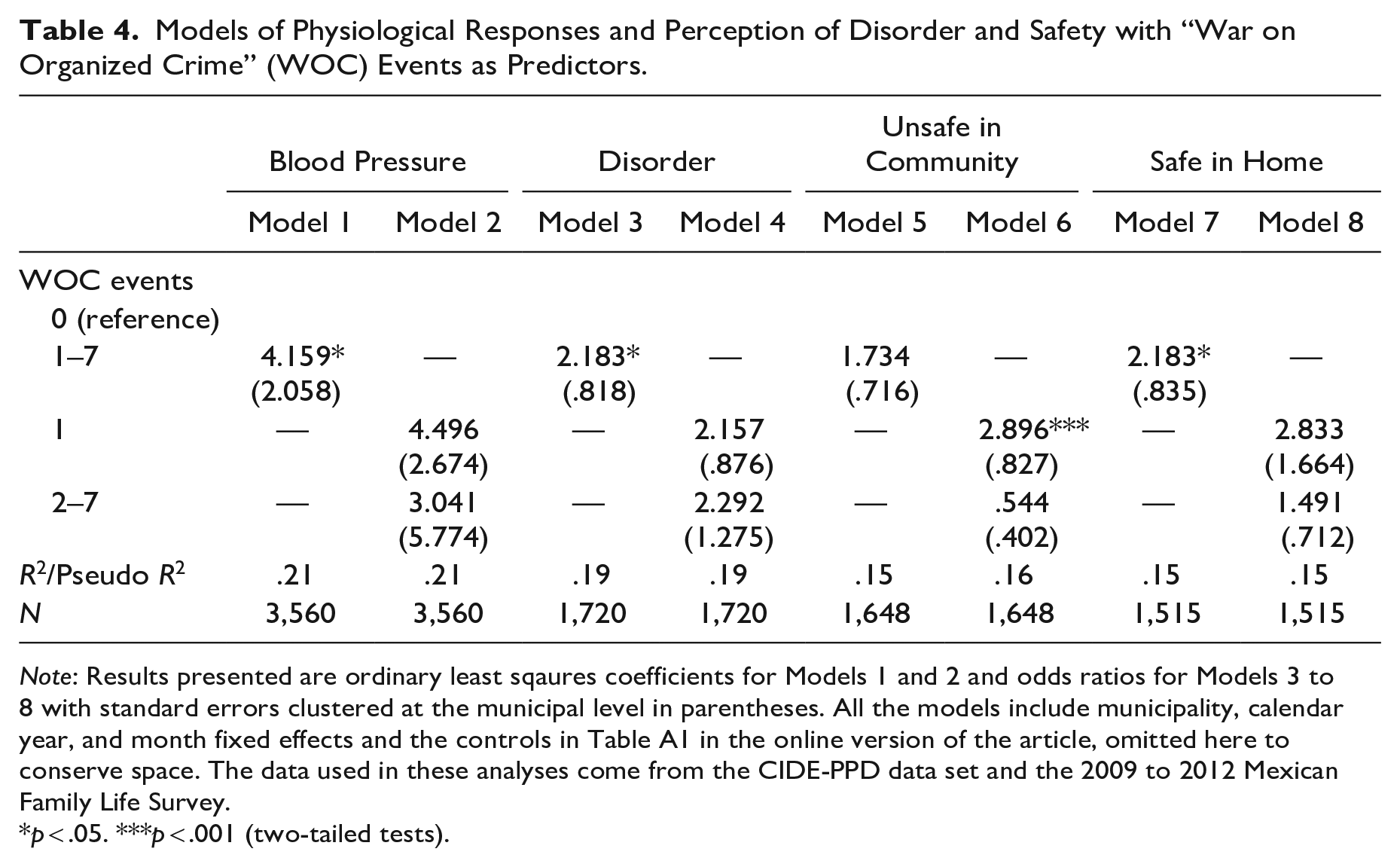
Note: Results presented are ordinary least sqaures coefficients for Models 1 and 2 and odds ratios for Models 3 to 8 with standard errors clustered at the municipal level in parentheses. All the models include municipality, calendar year, and month fixed effects and the controls in Table A1 in the online version of the article, omitted here to conserve space. The data used in these analyses come from the CIDE-PPD data set and the 2009 to 2012 Mexican Family Life Survey.
p < .05. ***p < .001 (two-tailed tests).
Overall, these results are important because they are consistent with the main analyses, that is, if the WOC leads to weight gains, the expectation is that it would also lead to increased caloric intake, decreased physical activity, higher blood pressure, and negative perceptions of the community. As discussed in the following, this consistency provides a fuller picture of the potential processes and mechanisms linking WOC violence with weight gain.
Discussion
A growing body of work has analyzed the relationship between violence in the residential environment and excess weight. This important research has found tentative evidence supporting a positive association between living in unsafe environments and weight gain. Yet this work has not engaged with armed conflicts, a significant limitation because it is unclear how living in a place with armed conflict violence could affect people’s weight. Research on international development has suggested that weight loss—as opposed to weight gain—might be a more likely consequence of wars and armed conflict.
In this article, I study the weight-related, short-term consequences of armed conflict violence associated with the Mexican WOC. Integrating theoretical insights from social disorganization and international development research on armed conflicts and wars to guide the analyses, I find a robust and large positive influence of armed conflict events on weight, even increasing the likelihood of having excess weight and obesity. My exploratory analyses of mechanisms suggest that people recently exposed to WOC violence also perceive their communities as more disorganized and less safe. Coupled with higher perceptions of safety in their homes, this could lead them to spend more time inside, a common adaptation to violent environments (Clampet-Lundquist 2010; Rosenblatt and DeLuca 2012). This adaptation limits exposure to environmental violence but also to opportunities for exercising and practicing sports while at the same time increasing the chances of higher caloric intake. The stress from both the violence outside and the isolation inside might reinforce these behaviors and increase the likelihood of other harmful responses, such as alcohol consumption. Although this complex situation brought about by WOC violence does not seem to disrupt sleeping patterns, it is associated with physiological and biochemical responses to stress that are indexed by blood pressure and increase food cravings and fat deposition (Tomiyama 2019). Thus, my main and ancillary findings provide a comprehensive understanding of how WOC violence is connected to weight gain.
Short-term effects such as those uncovered in this article are not rare in the environmental violence literature. For instance, the impact of crime and violence on cognitive performance appears to last a few weeks at the most (McCoy, Raver, and Sharkey 2015; Sharkey 2010). But the fact that these effects dissipate quickly does not undermine their significance because short-term weight gains are nontrivial and could have long-term repercussions. Research on children has shown that BMI increases are difficult to reverse (Sandy et al. 2011). Weight gain in adults—especially middle-aged adults—might be even more difficult to shed due to natural changes in body composition (Weinheimer et al. 2010). Thus, it is likely that the extra weight gained as a result of WOC violence will remain and accumulate, in turn increasing the risk of serious, life-shortening diseases.
These findings build on prior sociological and criminological work on violence in the social disorganization tradition, most of which has been conducted in developed countries. Despite strong theoretical grounding, the evidence in favor of a positive association between unsafe environments and weight gain is mixed, with much of the research failing to detect any relationship at all (see An et al. 2017; Won et al. 2016; Yu and Lippert 2016). One possible reason for this is that the measures used in much of this research do not capture all the ways in which impactful violent events can affect people’s lives. By providing evidence of a positive association of extreme and dramatic forms of violence with weight, this study both confirms the association and pathways theoretically constructed in the United States and other developed countries and extends them to a novel context with a different type of violence (armed conflict). This confirms previous findings in Latin America and suggests that these relationships could be the result of general mechanisms at work in numerous settings.
My findings also have important implications for research on armed conflict and wars. I find no evidence of armed conflict events leading to weight loss due to starvation or hunger, as international development research has suggested (Delbiso et al. 2016; Gates et al. 2012; Kulenovic et al. 1996). There are at least two potential reasons for this. First, the violence of the WOC has been intense and dramatic, but it has not been as destructive and disruptive as some wars and international conflicts, perhaps partly due to the specific nature of the conflict in Mexico (conflict of constraint). It is likely that the weight-related consequences of this type of armed conflict violence resemble those of traditional street crime violence (direction of association) but with a difference in magnitude (size of association) given the nature of WOC violence. My findings are consistent with this possibility.
Second, my results might also be influenced by the temporal scope of the analyses. I have focused on the short-term (one month) influence of armed conflict, whereas studies that have found a negative association between wars and weight loss have looked at longer periods (from one to several years; Delbiso et al. 2016; Gates et al. 2012; Jawad et al. 2019; Kulenovic et al. 1996). It is quite possible that the specific weight-related consequences (including the direction of the effects) depend on the time elapsed between the conflict and the outcomes.
This study also responds to calls in the literature for leveraging more robust research designs and exploring the plausibility of key assumptions (exogeneity; An et al. 2017; Powell-Wiley et al. 2017; Sharkey 2018; Won et al. 2016; Yu and Lippert 2016). I also build on a growing literature at the intersection of social disorganization and armed conflicts, wars, and mass atrocities (Hagan, Kaiser, and Hanson 2016; Nyseth Brehm 2017). I show that sociological and criminological insights can help explain the consequences of extreme forms of violence in a context (the Mexican WOC) and with an outcome (weight gain) previously unexamined in this small body of work.
Future research can extend this work in multiple directions, two of which I highlight here. First, it is important to look at armed conflict violence at different levels of geographic and temporal aggregation to compare the results with those presented here because my findings are sensitive to municipality size and time elapsed since the violent event. Second, conducting research in other armed conflicts similar to the Mexican WOC (conflicts of constraint) could help establish the generalizability of the findings in this article and clarify how this type of violence might affect weight compared to both traditional violence and violence from wars and international conflicts.
Social scientists have recognized the importance of residential environments for the health of individuals and have identified violence as a predictor of weight gain, one of the most pressing health issues of our time. By robustly examining the impact of armed conflict violence on weight, this work both strengthens and extends this previous research and paves the way to a more general theoretical and empirical understanding of these phenomena.
Supplemental Material
sj-doc-1-hsb-10.1177_00221465231163906 – Supplemental material for Extreme Violence and Weight-Related Outcomes in Mexican Adults
Supplemental material, sj-doc-1-hsb-10.1177_00221465231163906 for Extreme Violence and Weight-Related Outcomes in Mexican Adults by Miguel Quintana-Navarrete in Journal of Health and Social Behavior
Footnotes
Acknowledgements
I am grateful to Robert J. Sampson, Alexandra Killewald, Jocelyn Viterna, and Charis Kubrin for their invaluable feedback and support. I also thank the journal’s editor and anonymous reviewers for their useful comments and help.
Funding
The author disclosed receipt of the following financial support for the research, authorship, and/or publication of this article: This work was supported by graduate fellowships from Mexico’s National Council of Science and Technology (CONACYT) and Fundación México en Harvard. The funding sources had no involvement in the study design; collection, analysis, and interpretation of data; writing of the article; and the decision to submit it for publication.

Supplemental Material
Tables A1 through A14 are available in the online version of the article.
Notes
Author Biography
References
Supplementary Material
Please find the following supplemental material available below.
For Open Access articles published under a Creative Commons License, all supplemental material carries the same license as the article it is associated with.
For non-Open Access articles published, all supplemental material carries a non-exclusive license, and permission requests for re-use of supplemental material or any part of supplemental material shall be sent directly to the copyright owner as specified in the copyright notice associated with the article.
