



Abstract
Research on “the widowhood effect” shows that mortality rates are greater among people who have recently lost a spouse. There are several medical and psychological explanations for this (e.g., “broken heart syndrome”) and sociological explanations that focus on spouses’ shared social-environmental exposures. We expand on sociological perspectives by arguing that couples’ social connections to others play a role in this phenomenon. Using panel data on 1,169 older adults from the National Social Life, Health, and Aging Project, we find that mortality is associated with how well embedded one’s spouse is in one’s own social network. The widowhood effect is greater among those whose spouses were not well connected to one’s other network members. We speculate that the loss of a less highly embedded spouse signals the loss of unique, valuable, nonredundant social resources from one’s network. We discuss theoretical interpretations, alternative explanations, limitations, and directions for future research.
One of the most poignant and moving empirical findings in all of science is that spouses tend to die in relatively rapid succession (see Boyd and Solh 2020). It is established that mortality rates are higher among those who have recently lost a spouse. A meta-analysis of 123 studies found that the hazard rate of mortality for widowed individuals is, on average, 23% greater than that of their still-married counterparts (Shor et al. 2012). This phenomenon is referred to as “the widowhood effect” or “widowhood mortality” (e.g., Berntsen and Kravdal 2012; Dabergott 2022; Elwert and Christakis 2008; Ennis and Majid 2019, 2020; Gove 1973; Lillard and Waite 1995; Moon et al. 2011; Spreeuw and Owadally 2013; Subramanian, Elwert, and Christakis 2008; Sullivan and Fenelon 2014).
There are several potential mechanisms behind this phenomenon. One has to do with the profound stress of widowhood—that the death of a spouse is so grievous that it floods the body and its organs with stress hormones to such an extent that it causes acute cardiomyopathy. This is referred to as “broken heart syndrome” or “takotsubo syndrome” (e.g., see Parkes, Benjamin, and Fitzgerald 1969; Peters, George, and Irimpen 2015; Schwarz et al. 2017). Adding to this, sociological explanations focus on the negative impacts of social isolation and its associated loneliness (e.g., Rico-Uribe et al. 2018) and the fact that spouses tend to be embedded in shared social environments and engage in similar health-related behaviors. From the start, people have more exposure to and are attracted to others who engage in similar activities (e.g., particular sports or hobbies), thus increasing intermarriage (i.e., homogamy) among those who are bound to have similar health trajectories (e.g., see Elwert and Christakis 2008). With their spending many years in the same neighborhood and household environments, having the same family income, and eating similar foods and living similar lifestyles, it seems almost inevitable that long-married couples would share similar mortality risks.
In this article, we expand on this structural perspective by arguing that there is also some network structure behind this phenomenon. It might be due to more than just the emotional connection that exists between close partners—it could also have to do with the social network ties spouses maintain with others. Specifically, we explore whether one is more severely affected when one loses a spouse who had nonredundant ties to one’s own social contacts. It is well documented that as couples grow older, their social networks become more intertwined (see Cohn-Schwartz, Roth, and Widmer 2021; Greif and Deal 2012; Kalmijn 2003; Milardo 1982; Stadtfeld and Pentland 2015). It is possible that the widowhood effect is stronger when couples had not become so structurally equivalent. One reason to expect this is that less structurally equivalent spouses represent more irreplaceable, unique social contacts. Thus, the loss might be more stressful because it implies a greater loss of social resources. Such a loss might also be more difficult to manage logistically (e.g., having to coordinate memorial services and possibly estate business with people who do not know each other) and more likely to be experienced as a lonely, alienating experience that is not shared and commiserated over by mutual contacts. On the other hand, it is possible that losing a partner who is very well embedded with one’s other social network contacts amplifies the experience of bereavement itself simply by exposing one immediately to a greater number of close grieving people.
We use panel data from 1,169 older adults from the National Social Life, Health, and Aging Project (NSHAP) to test these ideas. Individuals were first observed in 2005—including assessments of their personal social networks and their partners’ involvement in them—then followed every five years thereafter. We begin by discussing the theoretical bases for exploring the widowhood effect and the potential role that a couple’s joint social network structure might play in shaping it.
Background
The fact that spouses often die close to each other in time—the widowhood effect—has been documented in a variety of settings and samples and among different age groups (e.g., Elwert and Christakis 2008; Gove 1973; Lillard and Waite 1995; Moon et al. 2011; Subramanian et al. 2008). Mortality is the most extreme of a broader set of consequences associated with the loss of a close partner. Studies have found significant associations between spousal bereavement and a variety of adverse physical and physiological health outcomes, including inflammation, cardiovascular risk, chronic pain, and broken bones (e.g., Boyd and Solh 2020; Ennis and Majid 2019; Peters et al. 2015). Many of these findings center around the effects of one form or another of distress. Research shows that anxiety, depression, and chronic stress increase one’s risk of a heart attack and stroke (Jackson, Sudlow, and Mishra 2018; O’Rand and Hamil-Luker 2005).
The increase in social isolation that comes with widowhood carries its own risks, some of which are linked to depression, anxiety, and loneliness (e.g., Das 2013; Yang and Gu 2021). The best known and perhaps most interesting phenomena in this vein is broken heart syndrome, which refers to the fact that the sudden flood of stress hormones that occurs at the onset of bereavement can create acute cardiac events among the recently widowed (e.g., Efferth, Banerjee, and Paul 2017; Spreeuw and Owadally 2013). So-called takotsubo syndrome or takotsubo cardiomyopathy, for example, involves a weakening of the left ventricle that increases the risk of cardiac events (e.g., see Amin, Amin, and Pradipta 2020).
Social-Structural Perspectives
The widowhood effect also has social-structural origins. People who are married to each other tend to have similar attributes (e.g., race-ethnicity family background) and experiences—partly due to the opportunity structures of marriage markets—which means that people who become married have already had similar kinds of historical and social-environmental stressors (e.g., see Lichter, LeClere, and McLaughlin 1991). And then after marrying, spouses also often come to adopt, over time, similar lifestyles, including exercise and eating habits (e.g., Ask et al. 2012). In addition, the longer married couples are together, the more they are exposed to the same neighborhood and household environments, which carry their own sets of risks that affect all inhabitants simultaneously. For example, if one spouse lives in a so-called “food desert” (e.g., Deener 2017), with little access to high-quality produce and other fresh foods, the other spouse usually does as well. Tied to this is the fact that spouses generally share the same household income and are effectively members of the same social class. Thus, they experience similar socioeconomic advantages and disadvantages with respect to things like access to quality health care and insurance.
There are several social factors that condition the widowhood effect. Much like the process of aging itself and health decline, the experience of widowhood varies greatly across sociodemographic groups. Research reveals racial-ethnic differences in the widowhood effect, given that some work suggests that it may be stronger for White people than for Black people. White people tend to have more gendered divisions of household labor and thus require more adjustment after death (Elwert and Christakis 2006). Other work points to the particularly deleterious consequences for Hispanic people (Liu, Umberson, and Xu 2020). Gender differences in widowhood are also well documented, with men being more immediately impacted by the death of their spouse than women (e.g., Dabergott 2022; Das 2013; Moon et al. 2014; Shor et al. 2012), partly due to men’s greater reliance on their spouses than vice versa. One meta-analysis finds that while the mortality risk for widowed men is about 30% greater than their still-married counterparts, the mortality risk for widowed women is about 10% greater than still-married women (Moon et al. 2011).
The literature illuminates several other clues that suggest that nuances in the social context in which widowhood occurs may affect the levels of stress one experiences during the ensuing bereavement process. Research shows, for example, that the nature of one’s spouse’s death affects depression (e.g., Carr 2003; Domingue et al. 2021). Case in point, spouses who were widowed due to the COVID-19 pandemic experienced higher than usual levels of depression and loneliness due to a combination of the suddenness of the disease, lack of access to the spouse during treatment, and the otherwise all-encompassing isolation during that period (see Wang et al. 2022).
We expand on this work by considering the possibility that the role one’s spouse played in one’s social network is an important element of context that shapes the widowhood effect on one’s risk of dying. Specifically, we argue that some of the stress that affects recent widows may be, in part, a reflection of the disruptions to one’s social network environment that come with the loss of a spouse.
The Role of Overlap in Couples’ Social Networks
There are several reasons to believe that spouses’ social networks figure into the aforementioned stress-oriented arguments. For one, because married partners tend to be a crucial part of each other’s personal social networks, losing them also has profound implications for one’s access to social and emotional support, social capital, social control, and other resources. These structural features are likely tied up with the psychological stresses and physiological processes (e.g., depression and isolation) that have been so well documented in this literature. We also believe that they present a unique source of distress. To explain, we begin by providing an overview of research on the structural positions that spouses tend to occupy within each other’s social networks. We then discuss some of the mechanisms by which the loss of spouses who occupy particular network positions might affect one’s health to the point of increasing mortality risk.
There is considerable research that examines the extent to which spouses’ social networks are interconnected, which is worth documenting briefly. A relevant concept is that of “dyadic withdrawal,” which documents increasing overlap in spouses’ social networks over time (see Cohn-Schwartz et al. 2021; Felmlee 2001; Kalmijn 2003; Milardo 1982; Roth 2021). Also pertinent is related research on “linked lives,” which examines the consequences of couples’ close interconnectedness (e.g., Ang 2021; Ermer and Proulx 2020). This work shows that spouses tend to become increasingly embedded in each other’s social networks as time goes on. The longer a couple is together, the more enmeshed they become in each other’s networks, gradually moving away from ties to people who are not in each other’s social orbits.
An illustration of a highly network-embedded spouse is provided in the left panel of Figure 1, which shows a hypothetical egocentric network that includes the ego’s spouse. There are many reasons why this kind of configuration is common, including the growth of family and children, increasing exposure to spouses’ friends and coworkers as time goes on, involvement in shared social foci, and the triadic closure (connections among one’s contacts) that comes with that (e.g., Feld 1981; Mollenhorst, Völker, and Flap 2011). Some research shows that intimate relationships last longer and are more satisfying when spouses’ social networks overlap. Embeddedness within a joint network enhances spouses’ sense of “couplehood,” decreases role strain, and increases the social costs of dissolving the relationship (Julien, Chartrand, and Bégin 1999; Kalmijn and Bernasco 2001; Stein et al. 1992; Youm and Laumann 2003).

Hypothetical Confidant Networks Illustrating High and Low Partner Embeddedness
We begin our analysis with open expectations. Two competing hypotheses regarding the widowhood effect seem to be relevant. These are spelled out in the following two sections, respectively.
The loss of a highly embedded spouse
On one hand, when one’s spouse was very closely connected to one’s other social contacts, it is reasonable to expect amplification of the widowhood effect that we described earlier. The process of increasing network closure intensifies as one’s health worsens, as the need for coordinated social support increases, and as communication among network members grows. These are particularly common experiences as couples grow old together. It is reasonable to expect, given these processes, that the loss of a spouse who is so embedded in one’s network will give rise to an extra layer of bereavement. In this sense, it is not just the loss of one’s spouse, but the loss of one’s equal. In social network analytic terms, spouses who have been connected for a very long time become “structurally equivalent” by virtue of their networks having folded into each other.
The loss of a highly embedded spouse could also simply compound the degree of grief and mourning to which one is exposed. There is inherent strain associated with attending to others’ anguish while simultaneously dealing with one’s own bereavement (e.g., see Morgan 1989). Thus, on balance, having a network that is saturated with one’s deceased spouse’s contacts could understandably increase the stresses of bereavement. Related social processes come into play here that could exacerbate the strain one experiences during this period. These are, for the most part, social-psychological mechanisms that have to do with the level of exposure one has to grief and bereavement.
There are also social-structural reasons to expect the loss of a highly embedded spouse to have a greater impact on one’s subsequent health. One might find oneself facing calls from close contacts to play roles that the recently deceased had played. Such a loss also implies the loss of a source of triadic closure that had provided unique forms of social capital (see Coleman 1988). For example, losing a highly embedded spouse reduces one’s ability to contact, coordinate among, and indirectly access information about shared network members (e.g., children). In later life, older spouses often have to care for each other, especially when there are situations involving chronic health conditions. (The ongoing effort to coordinate social support and care in these situations is one reason high spousal embeddedness emerges in later life in the first place.) When this capacity is lost, due to the death of a highly embedded spouse, one may experience a loss in one’s sense of control and channels of communication and coordination to which one had been accustomed.
The loss of a poorly embedded spouse
The scenarios just discussed would lead us to expect that spousal embeddedness in one’s network amplify health problems and mortality risk. But what about situations in which one’s spouse is poorly connected to one’s other network members, as illustrated in the right panel of Figure 1? This more radial kind of network structure is not uncommon among older adults, many of whom may prefer some independence from their spouses (Cornwell 2011). Low overlap between spouses’ social networks can sometimes be suggestive of a lack of integration between spouses’ respective social circles. Some research suggests that where spouses share few social ties, those partners are less close to each other, less capable of supporting (or coordinating support for) each other, less involved in each other’s social lives, and more independent of each other (e.g., see Fiori et al. 2017). Some spouses maintain completely different social circles, have separate friends, and attend different religious institutions, for example.
We might expect people in this situation to be better able to weather the loss of their spouse, in part because they are already accustomed to leading separate lives. An intriguing alternative hypothesis thus emerges when one considers the potential benefits of spouses leading somewhat separate lives. Likewise, having a spouse who has a set of separate, unique social contacts who one does not know as well presents opportunities to access nonredundant sources of social capital that one otherwise does not have (Burt 1992). This argument has been extended to research on older adults. In that context, it has been argued that maintaining ties to people outside of one’s close family circle helps to give older adults a sense of control and independence, which can have a variety of mental and physical health benefits for older adults (Huxhold et al. 2020; Jang et al. 2021; Li and Zhang 2015; Perry et al. 2021; Youm et al. 2014). This would support the view that one who has a spouse who is not embedded in one’s own social network benefits in general. And thus, when that spouse dies, one loses indirect ties to valuable resources. In these cases, the loss of one’s spouse represents—in addition to the personal loss—a loss of social resources that one cannot easily recover or replace.
There are also practical reasons to expect that the loss of a spouse who is less embedded in one’s own network could have deleterious health consequences. The bereavement process can be more complicated and more trying in this situation. There are fewer shared friends and family members who can help bear the burden of doing things like contacting the deceased’s friends and fewer shared ties to help coordinate social support for oneself. In short, the practical burdens that come with bereavement are likely greater in this circumstance.
Spousal embeddedness and network change
Widowhood also is intertwined with social network change. Those whose confidants died recently or are lost from their social circles for other reasons usually develop new confidants (Badawy, Schafer, and Sun 2019; Cornwell and Laumann 2018; Roth 2020a; Schwartz and Litwin 2018). This is in line with the literature on continuity and homeostatic tendencies within social networks (Atchley 1989; Cornwell, Goldman, and Laumann 2021; Lamme, Dykstra, and van Groenou 1996; Utz et al. 2002). The disruption to one’s network in the wake of such a loss poses additional stresses on already grieving individuals. This is likely to be particularly true if replenishing one’s network proves difficult (e.g., due to one’s own health problems) or if new connections are not available within one’s social environment for whatever reason. This might help to explain the finding that structural changes whereby one’s network either shrinks or shifts from expansive to restrictive—due to the loss of a spouse who served as a bridge to other social circles, for example—are associated with an elevated risk of mortality (see Cheng et al. 2022; Thomas 2012; Tzeng and Lee 2017).
In this light, one might consider the role that spousal network overlap plays in widow(er)s’ tendencies to form new intimate partnerships. On one hand, dating or remarrying following the death of one’s spouse may be a more awkward and thorny process, socially speaking, when one’s closest contacts were also close to one’s recently deceased spouse (e.g., see Osmani, Matlabi, and Rezaei 2018). This would impede network replenishment in the aftermath of spousal bereavement. On the other hand, there is the countervailing possibility that when one’s network members were close to both partners, one is more adept at identifying appropriate potential future friends or partners.
All of the aformentioned arguments are motivated by the assumption that the loss of one’s spouse is likely to have some kind of impact on one’s own health and mortality risk for social reasons above and beyond any physical or psychological effects. It is unclear, however, which of these social processes is most at play. Is it the case that one is more likely to be negatively affected by the death of a spouse who had been well integrated with one’s own network or by the death of a spouse who had been less connected with one’s other social contacts?
Data and Methods
Sample
We used data from the National Social Life, Health, and Aging Project (NSHAP), a nationally representative study funded by the National Institutes of Health and conducted by NORC at the University of Chicago. The NSHAP began in 2005 to 2006 by using a multistage area probability design to survey 3,005 noninstitutionalized older Americans (ages 57–85) about their health and social lives. (O’Muircheartaigh, Eckman, and Smith 2009). Respondents were recontacted to participate in Round 2 interviews in 2010 to 2011 and Round 3 interviews in 2015 to 2016.
To understand the link between time to death and the death of a spouse, we compiled an analytic sample covering 2005 to 2016 (Rounds 1–3), restricting respondents to those who were married or partnered at Round 1 (n = 1,861). A total of 461 (24.77%) respondents who were married/partnered at Round 1 were deceased by Round 3, excluding 50 respondents whose mortality status was unknown by the end of the study period. We further excluded 376 respondents due to nonresponse during the recontact and 316 respondents who had missing values on one or more of the following variables: partner network embeddedness (n = 295), race-ethnicity (n = 4), spousal relationship quality (n = 6), and/or spouse’s health (n = 12). The final analytic sample included 1,169 married/partnered respondents, contributing to 12,478 person-years from 2005 to 2016 in total. We followed these respondents until the Round 3 survey period ended in 2015 to 2016. 1
Dependent Variable: Time to Mortality
We examined time from the death of a spouse to mortality as the focal outcome variable. The analysis began with Round 1, when respondents entered the survey, and ended at the time of death, with censoring of those who were still alive at the end of Round 3. Mortality status was confirmed through proxy interviews with family members/friends or a public record search and was coded on the year of death. The cause of death was not asked, so we relied on a dichotomous measure of all-cause mortality in the analyses (1 = deceased, 0 = alive). For those who did not die until the end of the study period, their survival time was calculated by adding up the number of surviving years from 2005 until the last round used in this survey (2016). The survival time ranged from 1 to 11 years. A total of 186 (15.91%) respondents of the analytic sample were reported deceased by the end of the observation period.
Spousal Mortality
To study the effect of losing a spouse, we followed the married/partnered respondents until they reported themselves as either widowed (coded 1) or not (coded 0) at Round 2 in 2010 to 2011, five years after the initial survey. To gather data on how the spouse had been embedded in respondents’ networks, the spouse must have remained alive and respondents must have reported not being widowed until the Round 2 interview. A total of 101 (8.64%) respondents in the final analytic sample reported losing their spouses (widowed) by Round 2.2 Of these 101 widowed respondents, 26 (25.74%) died by the end of the study period, five years since the spousal death at Round 2 (more details on this are reported in Appendix Table A3 in the online version of the article).
Spousal Network Embeddedness
To gather egocentric social network data in each round, the NSHAP regularly asks respondents to name up to five confidants “with whom they most often discussed things that were important” over the last 12 months and records them in the network Roster A. If the married/partnered respondents did not name the spouse in Roster A, the NSHAP would record the spouse/partner in Roster B. It then asks the respondents to name any other especially close contact in Roster C, if any. Respondents were further asked how often they interacted with each of these network members and how frequently each one interacted with each of the others, including the spouse.
The level of spousal network embeddedness was therefore operationalized as the average frequency of contact between the respondent’s spouse and the other network members listed in Rosters A and C (a continuous measure ranging from 0 = have never spoken to each other to 8 = talk every day). A total of 56.44% of the widowed respondents reported having a spouse who talked less than once a week to their other network members, compared to 43.56% who reported that their spouses talked to network members on a weekly basis (for more details on this, see Appendix Table A2 in the online version of the article). We operationalized spousal network embeddedness as a continuous time-varying variable in the analyses.
Relationship Quality
Partner relationship quality is related to partner network embeddedness and may impact the extent of any widowhood effect. We first controlled how close respondents reported feeling to their spouse—from 1 (not very close) to 4 (extremely close). We also considered spousal support using three measures: instrumental support—whether respondents could rely on the spouse for help if having problems (1 = often, 0 = never/sometimes); emotional support—whether the respondents could open up to the spouse if they needed to talk about their worries (1 = often, 0 = never/sometime); and lastly, informational support, which concerned whether one can go to one’s spouse for help if one needs to make important decisions regarding medical treatment (1 = very likely, 0 = not/somewhat likely).
Health
Health problems also increase the risk of mortality and may also result in a more tight-knit network structure that may increase the level of spousal network embeddedness. We adjusted for health status by including an ordinal measure of self-reported physical health (1 = poor, 5 = excellent), a continuous index of functional health that assessed respondents’ ability to complete activities of daily living (α = .87), and a dichotomous, self-reported indicator of disability (1 = disabled, 0 = not disabled).
One’s spouse’s health is relevant as well. A more frail spouse who experiences serious health problems will have been at higher risk of death and also will have been less likely to participate in social activities. The NSHAP asks respondents to rate their spouses’ physical health as well as their mental health on 4-point ordinal scales, ranging from 1 (poor/fair) to 4 (excellent).
Sociodemographic Covariates
Because they have been shown to influence partner network embeddedness and mortality risk, we controlled for the following covariates: age (measured in three categories to allow for nonlinearity; 57–65, 66–75, 76+), gender (female vs. male), race-ethnicity (White, Black, Hispanic, or other race), and education (<high school, high school, some college, or ≥college). We also included social network size in the model because the degree of partner network embeddedness might depend on the total number of confidants in one’s network. These two variables were significantly correlated, although the magnitude was relatively small (γ = .28). All covariates were derived from the Round 1 interview and were considered time-invariant.
Statistical Models
We used survival analysis to model time to mortality. Person-year files were created for each one-year interval between 2005 and 2016. We prepared our data in long form for analysis, and we imputed missingness using the most recent observed values prior to the event of death, an ad hoc procedure called “last value carried forward” proposed by Allison (for a detailed description of the method, see Allison 2014). To mitigate attrition bias, this approach imputed missing values in the primary explanatory variable at risk, such as spousal network embeddedness, using the observed scores closest in time to the respondents’ death.
As described previously, our key dependent variable was time to mortality, with a focus on the time since the death of one’s spouse among married/partnered respondents. We first described the relationship between one’s spouse’s death and one’s own mortality using a Kaplan-Meier survival curve. We statistically tested the relationships by using log-rank and Cox tests for equality over strata of widowhood status and the level of partner network embeddedness. For multivariate survival modeling, we used Cox proportional hazards models to estimate the hazard of mortality.
We proceeded with a series of nested models. We first examined how spousal mortality relates to one’s mortality net of basic sociodemographic health covariates. Next, we introduced the partner network embeddedness variable. We then examined its interaction with spousal mortality, adjusting for covariates such as partner relationship quality. (Note that Schoenfeld and scaled Schoenfeld residuals indicated that our models did not violate the proportional-hazard assumption.)
Throughout, our analyses were weighted using NSHAP’s person-level weight (based on differential probabilities of selection into the sample with poststratification adjustments for nonresponse) and were adjusted for NSHAP’s complex survey design (e.g., strata). Using these weights helped to attenuate, but did not eliminate, selection bias due to nonresponse and other sources of selection bias. But note that similar findings held when not using weights at all, and results had marginal significance when using propensity score weighting. (For the propensity score models, sociodemographic and health variables were employed to predict whether the respondent was included in the final model or not.) We conducted several supplemental analyses to verify the robustness of the results, including switching coding schemes, using different modeling approaches, and considering different data sets and alternative measures of outcome. These are summarized at the end of the Results section. We estimated all models in Stata 15.1. and evaluated the fit of hazard models using the Akaike and Bayesian information criterion.
Results
Table 1 displays descriptive statistics for the total sample and by Round 2 widowhood status. Overall, 8.64% of older adults in the sample lost their partner/spouse at Round 2. A total of 15.91% (n = 186) of them had died by Round 3, about 10 years after the start of the survey. The prevalence of mortality is higher among those who lost their spouse by Round 2 (25.74%) than it is among those who remained partnered/married (14.98%) throughout the study period. Compared to respondents whose spouses survived the study period, those who had become widowed were more likely to be women (58.42%), African Americans (13.86%), less educated, and older and reported more health problems.
Weighted Baseline Descriptive Statistics and Mortality Data for the Analytic Sample, N = 1,169. a
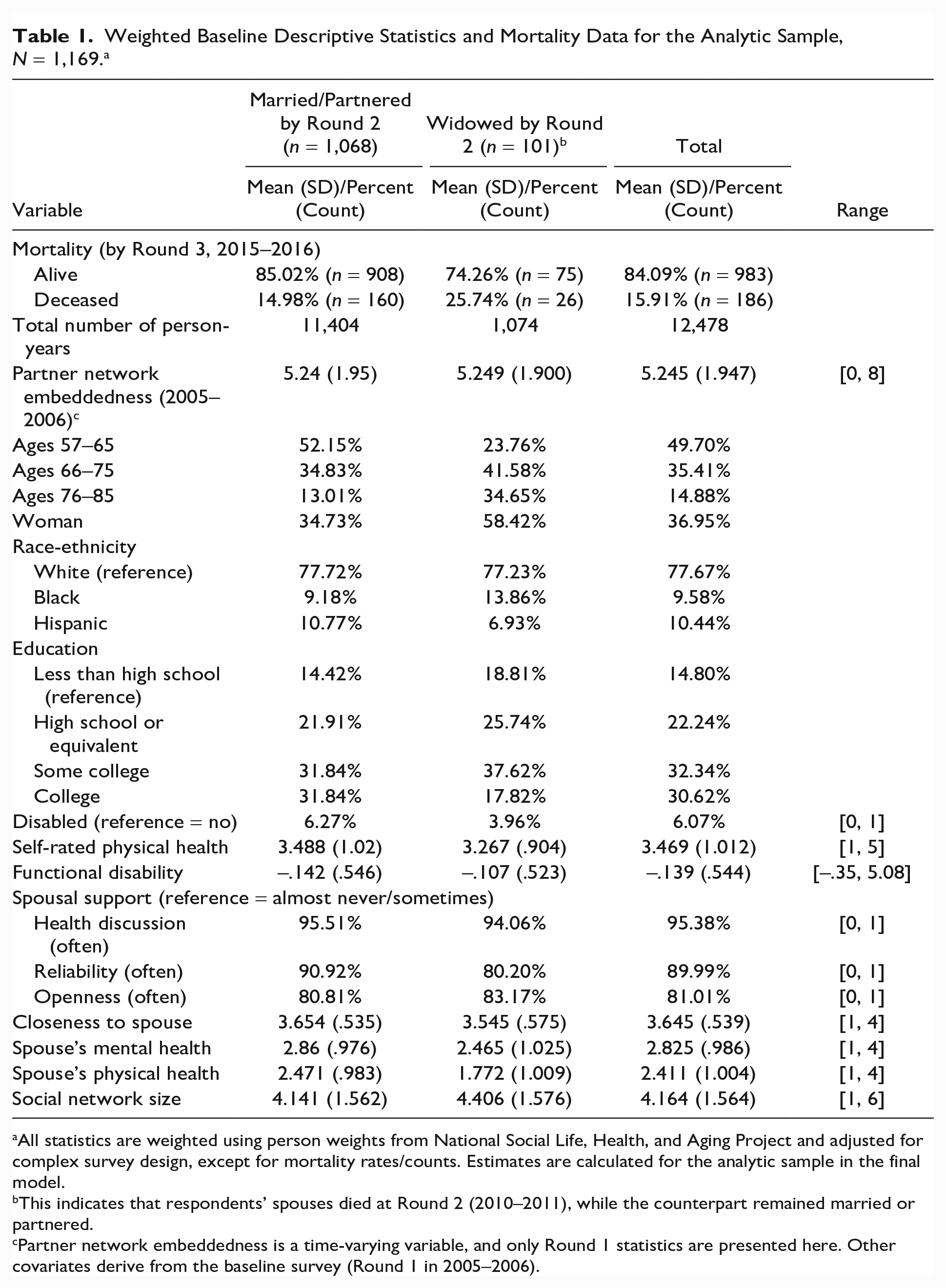
All statistics are weighted using person weights from National Social Life, Health, and Aging Project and adjusted for complex survey design, except for mortality rates/counts. Estimates are calculated for the analytic sample in the final model.
This indicates that respondents’ spouses died at Round 2 (2010–2011), while the counterpart remained married or partnered.
Partner network embeddedness is a time-varying variable, and only Round 1 statistics are presented here. Other covariates derive from the baseline survey (Round 1 in 2005–2006).
Respondents reported substantial spousal network embeddedness within their social networks at the baseline survey. The mean is 5.25, indicating that on average, respondents’ spouses talked to other confidants relatively often—translating into between several times a month and once a week. Approximately 6.24% of the sample reported that their spouses talked to their other network members on a daily basis, and about 10% of them reported a frequency of less than one a year (see Appendix Table A2 in the online version of the article). Spousal network embeddedness also declines each round for respondents whose spouses survived the study period (Ms = 5.24 in 2005–06, 5.15 in 2010–2011, and 4.84 in 2015–2016). Note that there appear to be no significant differences in Round 1 partner embeddedness between those who were widowed at Round 2 and those who were not, based on the t-test results (widowed: M = 5.24; partnered: M = 5.25, p > .05). This prompts us to consider partner network embeddedness as a moderator of the widowhood effect rather than a stand-alone explanatory factor producing the widowhood effect or mortality succession.
Evidence of the Widowhood Effect
The data confirm that losing a spouse in later life seems to accelerate mortality. The Kaplan-Meier survival curves shown in Figure 2 provide bivariate evidence of a lower survival rate among older adults who lost their spouse by Round 2 (dashed curve; n = 101; 9.71%) versus those who did not (solid curve; n = 1,001; 90.30%). In general, the dashed curve tracks below the solid curve. Both log-rank and Cox tests reveal significant differences in survival probabilities between these two groups (p = .01).
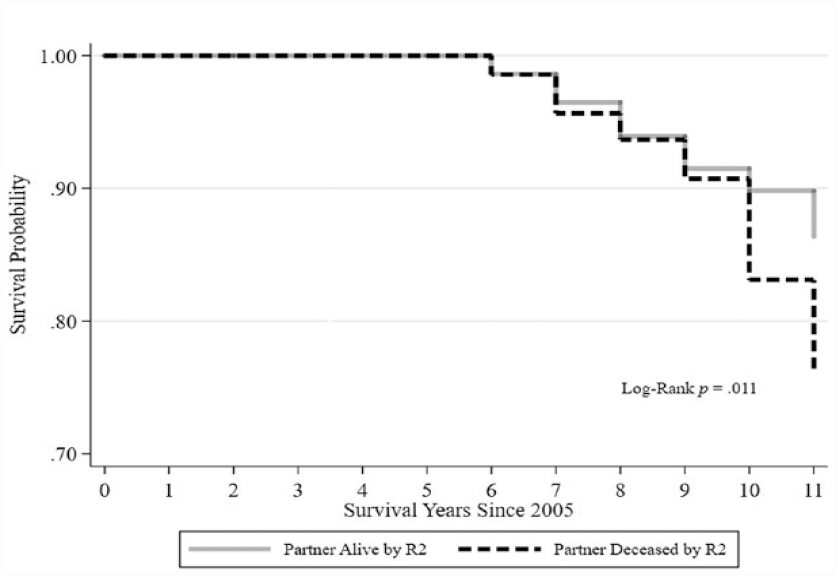
Kaplan-Meier Survival Curves by Widowhood Status at Round 2
Table 2 presents results from Cox proportional-hazards modeling of respondents’ survival time following the spouse’s death at Round 2. Model 1 shows that respondents whose spouses died had 1.79 times higher hazards of mortality (HR = 1.79, p < .05) in the next five years versus those whose spouses did not die, suggesting a significant widowhood effect.
Hazard Ratios from Cox Proportional Hazard Models Predicting Time to Death.
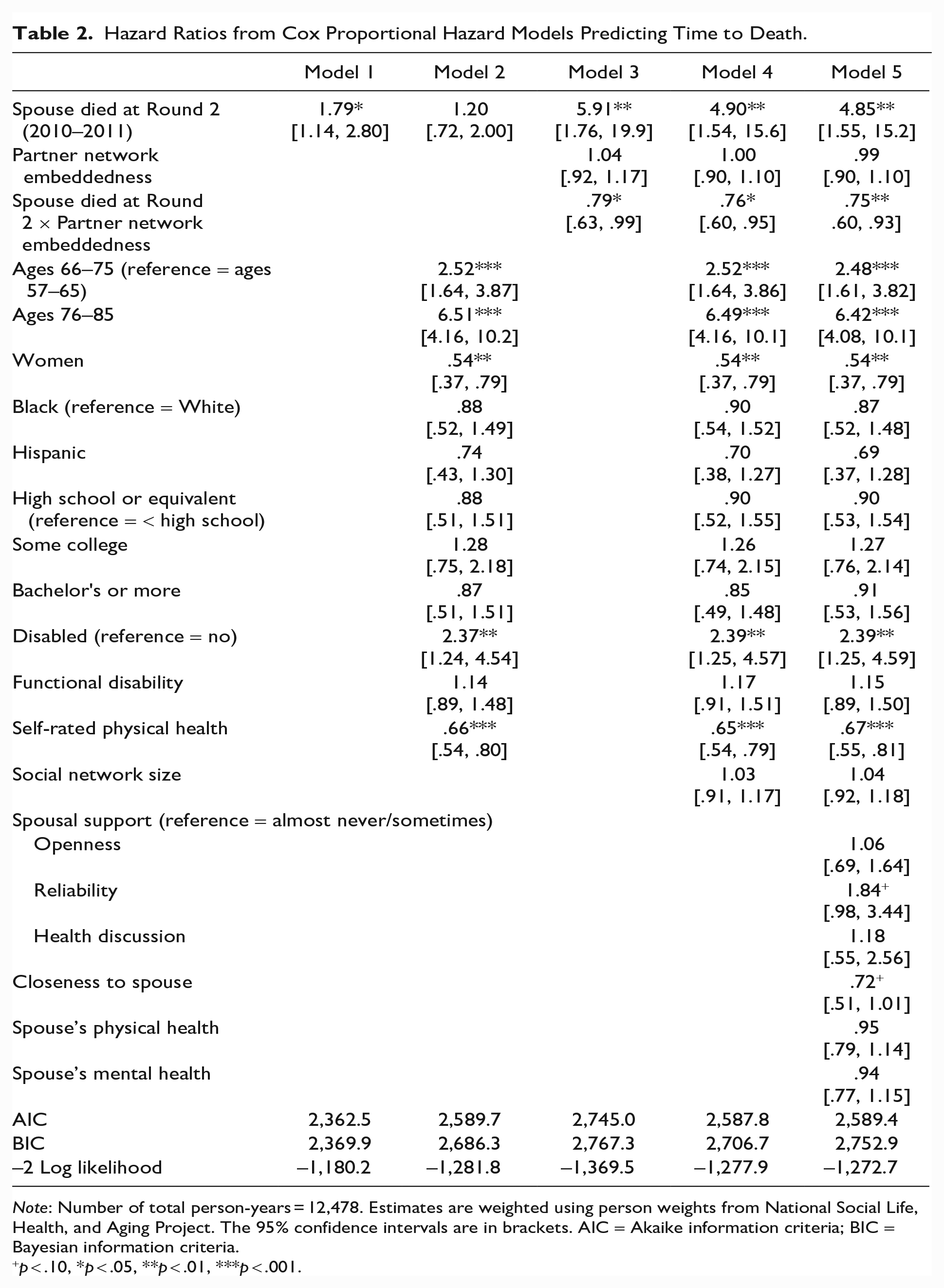
Note: Number of total person-years = 12,478. Estimates are weighted using person weights from National Social Life, Health, and Aging Project. The 95% confidence intervals are in brackets. AIC = Akaike information criteria; BIC = Bayesian information criteria.
p < .10, *p < .05, **p < .01, ***p < .001.
We now turn to a series of nested multivariate Cox models to examine the relationship between spousal mortality and older adults’ own mortality. After adding age in Model 2, alongside sociodemographic and health covariates, the significantly higher hazards of mortality among the widowed respondents are reduced and become nonsignificant (HR = 1.20, p > .05). (Spousal mortality is a consistently significant predictor at p < .05 in the models without controlling for age. Results are not presented here but are available on request.) As suspected, age matters a great deal. Compared with the older adults ages 57 to 65, the 66- to 75-year-old cohort has 2.52 times higher hazards of mortality (HR = 2.52, p < .001), and the 76- to 85-year-old cohort evinces a 6.51 times higher mortality risk (HR = 6.51, p < .001).3
Additionally, net of spousal mortality and other controls, women have significantly lower rates of death compared with men (HR = .54, p < .01). Better self-rated physical health is negatively associated with mortality (HR = .66, p < .001), and older adults who reported being disabled approximately double the hazards of death than their healthy counterparts (HR = 2.37, p < .01). Overall, the effect of age and self-rated health are rather strong compared to the risk of mortality induced by other socioeconomic factors.
The Role of Spousal Network Embeddedness
As we have argued, the risk of mortality following one’s spouse’s death might vary by how well the spouse is embedded in one’s own network. We dichotomize spousal network embeddedness into “spouse talked at least weekly” and “less than weekly” in Figure 3. Figure 3 shows Kaplan-Meier curves for respondents whose spouses were deceased (dashed curve) or survived (solid curve) by Round 2. The left panel represents respondents whose spouses were more embedded in the network (42.98%, where spouses talked to ego’s confidants at least once a week), and the right panel depicts those whose spouses were less integrated into the network (57.02%, where spouses talked to ego’s confidants less than once a week).

Kaplan-Meier Survival Curves by Partner Network Embeddedness and Widowhood Status at Round 2, 2005 to 2016
In the right panel of Figure 3, the dashed curve is consistently lower than the solid curve, suggesting that the survival rate for older adults whose spouses died by Round 2 is much lower than those whose spouses were alive if the spouse was not well embedded in the network. The log-rank test and Cox test of equality also reveal significant differences in survival between these two groups (p < .001). In the left panel of Figure 3, the log-rank and Cox tests show, however, that there is no significant difference between the married/partnered and the widowed respondents if their spouses were well connected to other confidants in the network (p = .95).
Focusing more directly on the main point of this article, Model 3 in Table 2 indicates a significant interaction effect between spousal mortality and spousal network embeddedness in predicting time to death. Older adults whose spouses talked more frequently with their other network members exhibited lower mortality risks (HR = .79, p < .05) than those whose spouses talked less frequently with their other network members. Model 4 further shows that the interaction between spousal mortality and spousal network embeddedness remains statistically significant (HR = .76, p < .05) net of social network size, sociodemographic variables, and health covariates. Each additional unit of partner network embeddedness (e.g., from “never talked” to “once in a year”) decreases the negative impact of a spouse’s death on mortality risk by 24% (1 – 1.00 × .76). Model 5 shows that the interaction effect remains significant after accounting for the partner relationship quality and spouse’s health.
To help illustrate this network-structural context, Figure 4 depicts different social circumstances that we observe in our data. The left panel of Figure 4 portrays the predicted survival curves for those whose spouse had died by Round 2, whereas the right panel shows the predicted survival curves of those whose spouses had survived to that point. In both panels, the blue area represents curves (with confidence intervals) for those possessing maximum partner network embeddedness (partners talked to other confidants on a daily basis). The red areas represent predicted survival estimates for respondents whose partners had never talked to their other network members, which implies low levels of spousal network embeddedness. Holding covariates around their means and based on Model 5 in Table 2, the mortality risk for widowed respondents whose deceased spouses were well integrated in their networks (e.g., talked every day) is .02 by Round 3, about five years after having become widowed. If those deceased spouses were poorly embedded (never talked), the corresponding respondents present a substantially higher mortality risk—at .11 by the end of the study period. The contrast here in survival between those who lost spouses (left panel) versus those who did not (right panel) is similar to the gap depicted in Figure 2.
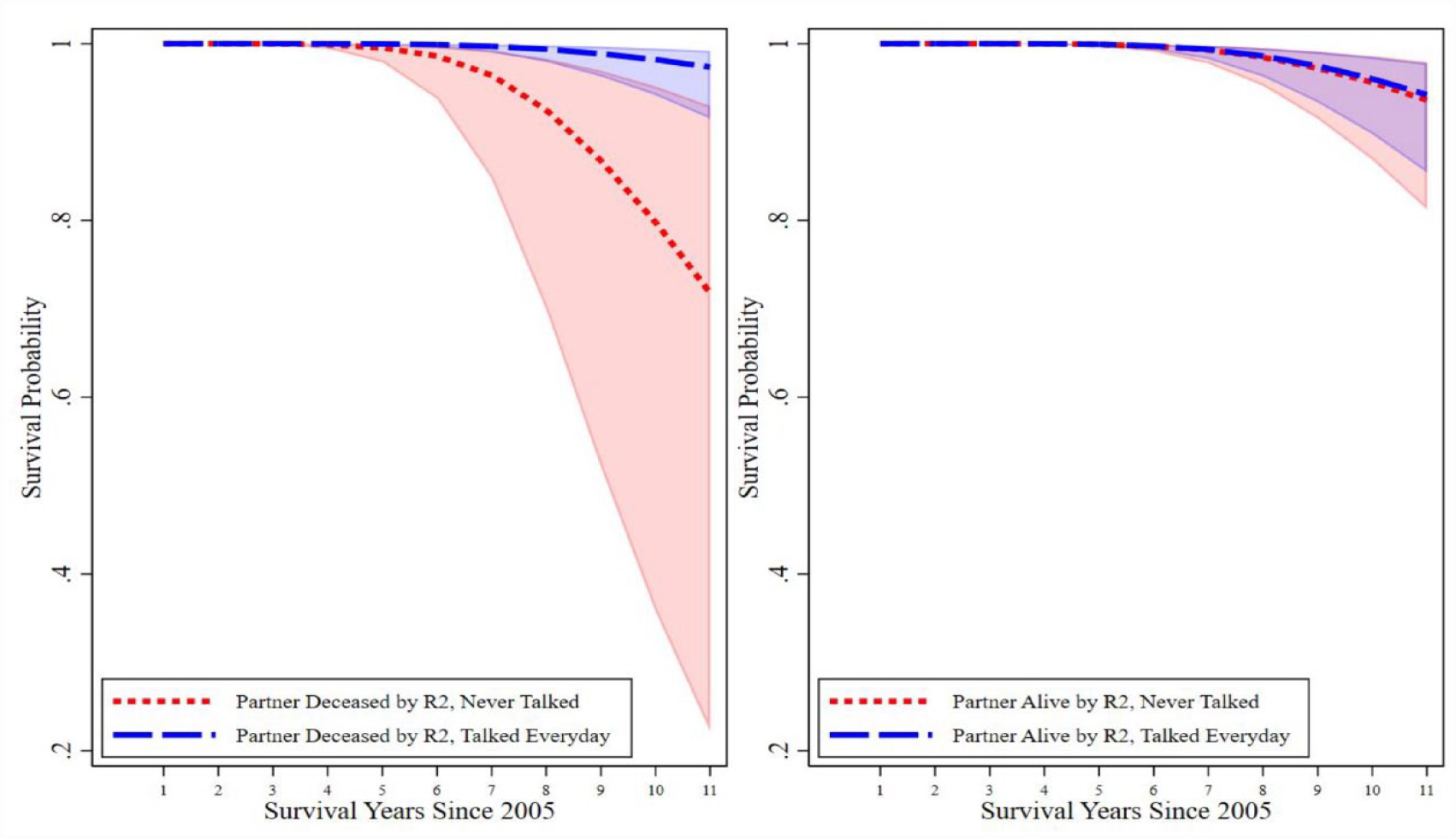
Predicted Survival Curves by Partner Network Embeddedness and Widowhood Status at Round 2, 2005 to 2016
The main finding that we are discussing here is represented in the left panel of Figure 4.4 Note the dropoff in survival among widowed respondents whose spouses never interacted with respondents’ own social network members. For example, for those widowed respondents whose spouses had daily interaction with their network members, the probability of survival was .95 10 years out, whereas the probability of survival is approximately 30% lower (at .72) among those whose spouses never talked to their other network members. Note that this contrast in the left panel of Figure 4 is similar to that depicted in Figure 3 when comparing survival rate between the widowed respondents whose spouses were more embedded in their networks (e.g., talked every day, at least weekly) versus those widowed who had a less connected spouse (e.g., never talked, less than weekly). Moreover, this difference appears to grow starker as time goes on. The difference in survivor rates also becomes sharper after accounting for covariates.
Selection, Robustness, and Sensitivity
An important concern regarding our analysis is the attrition that inevitably occurs when studying older adults, even though we have explicitly incorporated this source of heterogeneity as covariates in our models. We conducted several sensitivity analyses to address this concern. First, we ran additional models without applying any weights and used the exact partial-likelihood method (i.e., cases where two or more subjects experienced the event at the same recorded time) to handle “tied events” in the discrete-time context. We then reestimated the models using propensity score weights to adjust for nonresponse and attrition over the study period and to attenuate potential resulting selection bias in the sample. In both sets of analyses, we observed positive associations between spousal mortality and respondents’ own mortality risks and a decreased impact of being widowed through a well-connected spouse in the network. Moreover, we assessed an adjusted coding schema for the partner network embeddedness variable by assigning missingness to respondents who had only two network members instead of coding them “0.” No significant change in results was detected after using such a restrictive sample size.
We also tested the robustness of the results using alternative modeling approaches (see Appendix Table A1 in the online version of the article). First, we reran the analyses using the discrete-time hazard logistic models. We also r-estimated the survival analysis using parametric hazard models (e.g., accelerated failure time model) with different distribution assumptions (e.g., Weibull, generalized gamma). Last, we used a user-written package in Stata, “stmp2,” with robust standard errors, to estimate the flexible parametric models that plot counterfactual survivals, which also provided confidence intervals shown on our Figure 4 (Lambert and Royston 2009). These analyses yielded similar results to those presented in the main text in terms of the significance and direction of the key parameters.
We also conducted a sensitivity analysis using cardiovascular health as a proxy of mortality.5 Results were consistent with the primary analysis in the main text. Namely, widows whose spouses were less embedded within their social networks were more likely to present with higher cardiovascular risks, consistent with a more fatal version of broken heart syndrome.
Discussion and Conclusion
The death of one’s spouse is one of the most stressful, depressing, and heart-wrenching experiences that one can have (e.g., King, Carr, and Taylor 2019; Lee, Han, and Boerner 2021; Umberson, Wortman, and Kessler 1992). In this article, we have presented evidence that this experience is associated with increased mortality risk. Data from the NSHAP study confirm that time until death is significantly and substantially related to the recent death of a spouse. Furthermore, following social-structural perspectives, we examined the possibility that the extent to which this experience is related to mortality depends on the extent to which one’s spouse was embedded in one’s social network. Our analysis shows that when one’s spouse is less embedded in one’s network, their death will likely have a more deleterious impact on one’s own mortality rate.
To summarize our results broadly, we find evidence that mortality rates increase after the death of a spouse. This is known as the widowhood effect (Dabergott 2022; Elwert and Christakis 2008; Ennis and Majid 2020; Gove 1973; Lillard and Waite 1995; Moon et al. 2011; Spreeuw and Owadally 2013; Subramanian et al. 2008). Moreover, we find that this effect is amplified among those whose spouses were less well connected to one’s other social network contacts.
There are several plausible interpretations of this association. A potential explanation is that one whose recently deceased spouse had moved in separate social circles from oneself had likely contributed independent, nonredundant social resources to the partnership (in line with Cheng et al. 2022). That is, it is possible that losing a less embedded spouse amplifies the structural impact or other sense of loss that one experiences in the immediate aftermath of bereavement. These findings could also reflect that the loss was more difficult to handle due to the more complicated process of handling relatively unfamiliar contacts of the lost spouse and the coordination that comes with that challenge. Additionally, the loss of a spouse who is a frontline caregiver or kin keeper in charge of care coordination and health communication could be particularly detrimental because it cuts older adults off from social ties that might otherwise help buffer mourning and grief and perhaps provide access to other support. We explore these ideas using a basic measure of partner betweenness, which indicates whether a spouse/partner is more strongly connected to the respondent’s confidants than the respondent is to those confidants (Cornwell and Laumann 2011). However, we did not find a significant interaction effect between partner betweenness and spousal death on respondents’ mortality risks (p = .360). The spouse, instead of being merely a kin keeper, tends more to play a bridging role across different social circles and therefore provide access to various nonredundant resources and medical information that benefit the ego’s health. These interesting theoretical scenarios involving the spouse’s positions in the network suggest the need for more research on spousal networks and the widowhood effect.
There are several limitations in our analysis that impede broad generalization and therefore call for additional work. First, we acknowledge that while the interaction “effect” is significant, it is marginal (Benjamin et al. 2018). Our finding needs to be replicated using other data, ideally with a larger sample. Second, our estimates are likely biased by various forms of endogeneity and selection. Regarding endogeneity, the findings presented here may reflect some form of dual causation. Not only do networks affect one’s mortality risk, but the death of a loved one often reshapes one’s social network (e.g., Cornwell and Laumann 2018; Iveniuk, Donnelly, and Hawkley 2020.). When someone loses a close friend or spouse, people often rally around and reestablish social ties—providing, perhaps, a patch over new gaps in that network.
We also know that couples tend to have similar health issues, partly due to selectivity into marriage with similar others (homogamy); partly because they come to be embedded in the same household, neighborhood, and broader social environment; and partly due to direct and indirect social influence within the relationship (e.g., Kiecolt-Glaser and Wilson 2017; Smith and Zick 1994). Therefore, the fact that people die at a similar time and sometimes in similar circumstances as their spouses should not be altogether surprising. These insights all underscore that we should take care in making a causal interpretation of the link between one’s spouse’s death and one’s own. Likewise, the types of illnesses that often immediately precede death—such as cancer, heart disease, diabetes, and other chronic problems—can drastically reshape one’s social network (e.g., see Roth 2020b; Schafer 2013). As a result, the interaction that we have documented here might be an artifact of endogeneity—the onset of one’s severe health problems may have resulted in circumstances in which one’s spouse became more closely embedded in, or “withdrawn” into, a highly shared couple network.
One also needs to consider the possibility of endogeneity that arises from the fact that other factors may confound the relationship between spousal network overlap and health/mortality. Less spousal overlap could proxy for other life course circumstances that have implications for health, including active work status (which provides immediate access to ties outside of the household) and better preexisting health (e.g., greater functional mobility makes community involvement outside of the household easier), among others. While we have attempted to assess some of these possibilities (e.g., by including controls for work status, which did not change the findings), future work on this topic should closely scrutinize other potential explanations for these findings.
Regarding selection, because we are dealing with an older sample, we inevitably encounter a nontrivial amount of attrition. We know that this attrition is nonrandom, in part because mortality is directly related to social isolation and other structural effects that we discussed earlier (e.g., Alcaraz et al. 2019; Hodgson et al. 2020; Kawachi et al. 1996). We have tried to mitigate selection effects by using propensity-score weighting. But this cannot eliminate the modeling issues that exist around the selection. We are encouraged by the fact that our findings do not depend on weighting, but we cannot assume that our findings completely reflect a causal story.
Related to the issue of selection, it is possible that the higher mortality rate among those whose spouses were less connected to their other network members is related to issues that predated their widowhood and bereavement. This could happen for several reasons. For example, a couple who was not well interconnected may not have been as good at coordinating (or had shared contacts helping them to coordinate) their health care, insurance coverage, or other factors that affected their health many years earlier, thus leading to higher joint mortality risk. This warrants further study.
It is also worth noticing that there are potential gender differences in the processes described here. For example, for older women, the loss of a spouse is more likely to also equate to the loss of a breadwinner, which in turn would mean the loss of peripheral indirect social contacts more so than it would for older men. This is a social-structural aspect of this argument that is beyond the scope of this article but should be explored in future work.
Another issue that should not go overlooked involves limitations in the network data themselves. Egocentric data are valuable because they reflect respondents’ own perceptions of the social structure in which they are embedded. But in this case, we inevitably get only a one-sided view of each couple’s joint networks. While one’s spouse’s position within one’s network is certainly relevant and offers a reasonable proxy of ego’s potential bridging potential vis-à-vis their spouse, it does not capture the role that ego plays in their spouse’s network. This could be an equally important dimension of joint network structure in terms of assessing the uniqueness of the role played by the spouse in connecting ego to unique resources. More broadly, these particular data provide only a limited glimpse of couples’ networks, ignoring weaker ties, electronic networks, and indirect links via voluntary associations.
Finally, our models are not foolproof, but they are robust against several alternative specifications. For example, models that include fewer controls or use different weighting schemes or different survival models yield similar results in that the significance and direction of the key parameters remain intact. We are therefore confident in encouraging scholars to dig into these results and attempt to replicate them using other data. The possibility that mortality could be linked to spouses’ close social networks in this way likely provides opportunities for workable interventions.
Our findings hold important clues about the social-structural circumstances under which widowhood affects older adults’ well-being. The possibilities of alternative interpretations, as just discussed, all deserve further scrutiny. The very suggestion of these potential associations that exist among social networks, spouses, and health should prompt greater interest among scientists in the social-structural dimensions of mortality.
Supplemental Material
sj-docx-1-hsb-10.1177_00221465231175685 – Supplemental material for “I Love You to Death”: Social Networks and the Widowhood Effect on Mortality
Supplemental material, sj-docx-1-hsb-10.1177_00221465231175685 for “I Love You to Death”: Social Networks and the Widowhood Effect on Mortality by Benjamin Cornwell and Tianyao Qu in Journal of Health and Social Behavior
Footnotes
Acknowledgements
We wish to thank Erin York Cornwell, Louise Hawkley, Ed Laumann, Martha McClintock, Colm O’Muircheartaigh, Phil Schumm, Linda Waite, and the rest of the National Social Life, Health, and Aging Project team for providing useful suggestions that improved this article. The National Social Life, Health and Aging Project is supported by the National Institute on Aging and the National Institutes of Health (R01AG021487; R37AG030481; R01AG033903; R01AG043538; R01AG048511). The content of this report is solely the responsibility of these two authors and does not necessarily represent the views of the National Institutes of Health.

Notes
Author Biographies
References
Supplementary Material
Please find the following supplemental material available below.
For Open Access articles published under a Creative Commons License, all supplemental material carries the same license as the article it is associated with.
For non-Open Access articles published, all supplemental material carries a non-exclusive license, and permission requests for re-use of supplemental material or any part of supplemental material shall be sent directly to the copyright owner as specified in the copyright notice associated with the article.
