




Abstract

RESEARCH PROBLEM & DATA
What social policies can equalize the relationship between socioeconomic status (SES) and mental health?
Mental health problems are much more commonly seen in individuals who face the greatest social disadvantages. Yet this is not the case all over the world. We set out to investigate whether, why, and how different government choices about social policies could make a difference.
We identify two distinguishable theoretical pathways in government policy and spending that may intervene in the processes that link SES to mental health: Social Investment and Social Protection. Social investment policies focus on individual-level prevention of pathways leading to inequality and poverty such as poor education and labor market attachment. Social protection policies reflect reactive policies and are more responsive to immediate needs, for example, by transferring income or the provision of services when individuals cannot meet their needs from the labor market. We analyze Rounds 3, 6, and 7 of the European Social Survey and use a new application of the three-level hierarchical model that allows us to test both historical differences between countries and within-country change in the relationship. We argue that distinguishing within- and between-country differences is important because it represents the effects of historical continuity while also examining the impact of the direction of policy changes over time.
KEY FINDINGS
• Our main findings generalize the SES and mental health link across the effects of education, occupation, and income across 21 countries while demonstrating significant policy effects that alter this association.
• Our main policy findings suggest that Social Investment, rather than Social Protection, both generally and via specific disaggregated policies, reduces mental health inequalities between low and high individual status across countries.
• As shown in Figure 1, countries with higher levels of Social Investment report more equal levels of mental health across education, occupation, and income. This is reflected by the flattening of the differences between low and high status as investment increases.
POLICY IMPLICATIONS
We found that when governments choose to invest resources in Social Investment programs, they can almost completely break the unequal pattern of mental health differences in society. This finding shifts the responsibility of poor mental health from an individual-level problem toward the choices of policymakers. Our findings also offer policymakers specific policy levers to reduce the risks of poor mental health faced by low-SES individuals. Investing in policies that generally impact individuals earlier in the life course, including early childhood education and care, education, and active labor market policies, and caring for those in old age by investing in old age care reduced mental health risks the most.
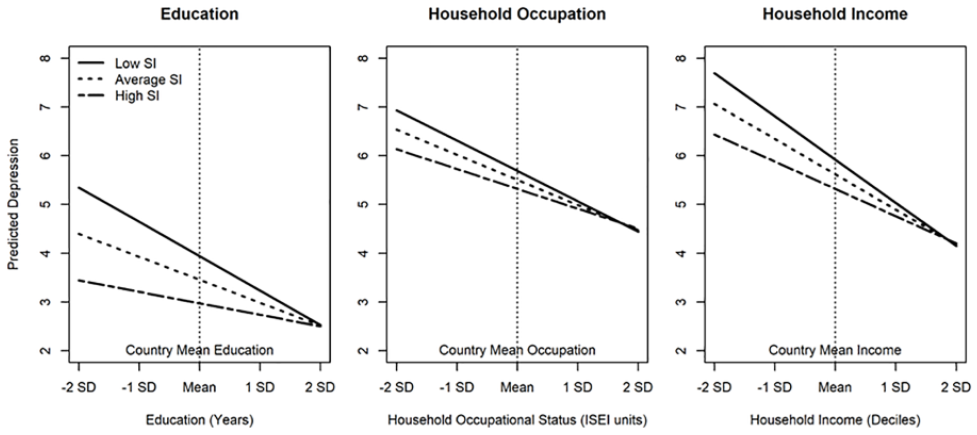
Between Country Moderating Effect of Social Investment Spending on Education, Occupation, and Income on Depression.