



Abstract
Ten undergraduate students from psychology classes were interviewed regarding their beliefs about the meaning of life (definition, goals, limitations to goals, sources of meaning, and development of meaning). Interviews were analyzed using consensual qualitative research. These interviewees all indicated that meaning differs across people and time. Typical sources of meaning were relationships, altruism, career, personal growth, pursuit of happiness, and religion. Participants indicated that parents and life-changing experiences triggered changes in their thinking about meaning of life. Specific changes involved shifting from superficial to more meaningful pursuits and thinking more for themselves. Implications for further research and developing programs for helping undergraduate students examine issues related to meaning of life are offered.
Having a sense of meaning of life seems to be integral to psychological functioning (O’Connor & Chamberlain, 1996; Zika & Chamberlain, 1992). As Frankl (1959) noted after surviving the Nazi concentration camps, a sense of meaning or purpose can enable people to survive extraordinarily difficult times. To establish a sense of meaning or purpose, people try to answer questions such as “Why are we here?,” “What do we live for?,” “What is the meaning of life?,” and “Do we find meaning or do we construct meaning?” These questions have intrigued people since the dawn of civilization, and clients often seek counseling and psychotherapy to discover their meaning of life.
We based our study on Yalom’s (1980) existential theory. Yalom conceptualized meaning of life as involving both a sense of coherence (or cosmic meaning, such that life and the universe follow some general pattern) and a sense of purpose (or terrestrial meaning, a quest for things that fulfill one’s purpose). He believed that human beings require meaning to have a sense of direction in life. He suggested that altruism, dedication to a cause, creativity, hedonism, self-actualization, and self-transcendence are all prominent sources of meaning.
Several researchers have developed self-report questionnaires that assess meaning of life: the Source of Meaning Profile (SOMP; Prager, 1996; Reker & Wong, 1988), the Meaning in Life Questionnaire (MLQ; Steger, Frazier, Oishi, & Kaler, 2006), the Purpose in Life Test (Crumbaugh & Maholick, 1964), the Life Regard Index (Battista & Almond, 1973), the Sense of Coherence Scale (Sammallahti, Holi, Komulainen, & Aalberg, 1996). Researchers using these self-report measures have found that people who felt that their lives were meaningful were less depressed and felt greater life satisfaction, more self-esteem, higher optimism, and more positive affect (Steger et al., 2006; Zika & Chamberlain, 1992). Interestingly, Steger et al. (2006) were able to distinguish presence of meaning from search for meaning, indicating that people could have a solid sense of meaning in their lives and yet be either interested or not interested in searching for further meaning. In addition, Prager (1996) found personal relationships and personal growth were the most important sources of meaning across the life span, although basic needs, leisure activities, and preserving values were also meaningful. Similarly, SOMP scores for a large sample of entering first-year students at the same university where the current study was conducted showed that the most endorsed sources of meaning were relationships, personal growth, basic needs, and leisure activities, whereas the least meaningful sources were acquiring possessions and hedonistic activities (Ziemer, Klingaman, & Lucas, 2013).
A major limitation to the above research is that the use of self-report measures for assessing meaning of life yields responses that are restricted to the questions asked. We argue that a qualitative approach is an alternative method for investigating meaning of life because participants have more opportunity to think about and construct their responses. Indeed, a few qualitative studies have been conducted on meaning of life. For example, Bhattacharya (2011) found that happiness was a central theme in young adults’ meaning of life. O’Connor and Chamberlain (1996) found that adults at midlife reported that nature and relationships were strong sources of meaning, whereas religion and political views were less important. Krause’s (2007) longitudinal investigation similarly revealed the importance of support in providing meaning for older adults. Finally, MacKinlay and Trevitt (2010) found that for elderly people with dementia, relationships (both familial and friendships) provided the most meaning. A common thread across the life span is that relationships provide meaning.
We were particularly interested in learning more about meaning of life for undergraduate students, as this is a transitional time of life when young people move from childhood to becoming adults. Their developmental task is to become independent, think about identity issues, and develop meaning (Arnett, 2011). Indeed, Zika and Chamberlain (1987) found that among various personality variables (locus of control, assertiveness, and meaning in life), having meaning in life was the best predictor of psychological well-being among college students.
The purpose of this study was therefore to examine undergraduate students’ beliefs about meaning of life using a consensual qualitative research (CQR; Hill, 2012) approach. More specifically, we had the following questions: How do students define meaning of life? What are undergraduate students’ attitudes about meaning of life (e.g., is meaning of life predetermined or constructed)? What life goals do undergraduate students have, and how are these goals constrained by perceived limitations (this question was asked because we thought that goals would reflect beliefs about meaning)? What are the sources of meaning of life for undergraduate students? How do undergraduate students develop their sense of meaning of life?
Method
Participants
Interviewees
Ten (9 female, 1 male; 5 European American, 2 Hispanic American, 2 Asian American, 1 African American, 18-21 years old, M = 19.40 years, SD = 1.26; 2 first-year, 4 second-year, 1 third-year, 3 fourth-year) undergraduate students at a large mid-Atlantic U.S. public university were interviewed. Six were majoring in psychology (with 1 having a double major in public health and 1 in criminology), 1 in dance, 1 in biochemistry, 1 in sociology, and 1 in nursing. Four indicated no religious affiliation, 5 were Christian, and 1 was Jewish. Participants received research credit for an undergraduate psychology course.
Research team
The primary team involved 10 (7 female, 3 male; 8 European American, 2 biracial [1 European American and Native American, 1 European American and Hispanic American]) psychology students (2 juniors, 6 seniors, 2 postbaccalaureate; 19-40 years old, M = 22.90 years, SD = 6.30; 4 Christian, 3 Jewish, 3 not religious) at the same large mid-Atlantic U.S. public university. These students, all of whom were enrolled in a psychology honors class about CQR led by the principal investigator, served as interviewers as well as judges. In addition, a 63-year-old-female, European American professor with no religious affiliation served as the principal investigator, an internal auditor, and a judge. Auditors were two female European Americans (55 and 38 years old; one in independent practice and the other an assistant professor at a religious university), one affiliated with no religion and one affiliated with the Church of Jesus Christ of Latter-Day Saints.
In terms of their motivation for participating in this study, the 10 undergraduate students had voluntarily enrolled in an upper level honors class led by the professor on CQR. The professor presented the idea for studying meaning of life to all students prior to their enrollment in the class, and all students agreed and helped to design and conduct the study.
Measures
Demographic form
Participants were asked for their age, sex, race, year at the university, major, and religion.
Interview protocol
The research team developed the interview protocol (see the appendix) by generating (based on readings and personal reflections) and then consensually selecting the most relevant questions. The protocol was revised based on several pilot interviews. The final 17-question protocol included questions about general beliefs about the meaning of life, the definition of the meaning of life, goals in life with and without limitations, specific sources of meaning in life (pursuit of happiness, work/career, religion, relationships, altruism, and self-actualization), development of meaning, and reactions to the interview. The beginning of the interview protocol was open-ended so that interviewees could say whatever first came to mind. However, we also asked about specific sources of meaning to ensure that everyone had a chance to think about the same possible sources. In an e-mail follow-up, participants were asked for clarification, changes in thoughts, and reactions to the interview. The interviews were semistructured, such that there were standard questions to be asked of everyone along with probes to elicit additional information.
Meaning in Life Questionnaire (MLQ; Steger et al., 2006) is a 10-item face-valid self-report measure assessing a person’s meaning. Through factor analyses, Steger et al. developed two subscales: Presence of Meaning (MLQ-P; e.g., “I have discovered a satisfying life purpose”) and Search for Meaning (MLQ-S; e.g., “I am seeking a purpose or mission in life”). The MLQ items are rated on a 7-point scale (1 = absolutely untrue; 7 = absolutely true). Meyersburg and McNally (2011) reported small to medium correlations between MLQ-S and measures of negative affect, depression, and neuroticism, as well as positive correlations between MLQ-P and measures of well-being and religiosity, supporting the validity of the scales. They also reported adequate internal consistency (.84 and .81, respectively) and test–retest reliability coefficients over 1 month (.73 and .70, respectively). Because of the small sample size, internal consistency was not calculated for the MLQ for this sample.
Sources of Personal Meaning Profile (SOMP; Prager, 1996; Reker & Wong, 1988) is a self-report measure with 16 items involving various sources of meaning (e.g., “Preserving human values and ideals”). Each item is rated on a 7-point scale (1 = not at all meaningful for me; 7 = extremely meaningful for me). Prager (1996, 1998) found that the SOMP was an internally consistent measure with test–retest reliability of greater than .70 (p < .01) in more than one study. For the present study, we report data for the 16 items rather than for the total measure because we were interested in the specific sources of meaning in relation to the qualitative results.
Procedures
Ethical considerations
The institutional review board of the university where the interviews were conducted approved the study. All participants (interviewees, interviewers, and auditors) signed consent forms prior to participating. No harmful repercussions were reported. Participant anonymity was protected through using code numbers rather than names for all the data.
Interviewer training
The team read and discussed several articles on the meaning of life (e.g., Baumeister & Vohs, 2002; Prager, 1996; Steger et al., 2006; Yalom, 1980) and Hill’s (2012) CQR book. They also wrote about and discussed their personal beliefs, biases, and expectations about meaning of life, and the importance of bracketing biases and expectations throughout the process (as did the auditors). The team, as a whole, then practiced using the protocol to interview one team member with coaching and feedback from the principal investigator. Subsequently, each team member individually conducted a pilot interview with an undergraduate volunteer. The principal investigator also modeled the interview for the class with a graduate student who had thought extensively about meaning of life.
Completion of measures by team members
The interviewers, the professor, and the two auditors completed the MLQ and SOMP prior to the interview process and data analysis.
Recruiting interviewees
Undergraduate students in any psychology class could sign-up via an online system for our study titled, “A Study on Meaning of Life.” Students had approximately 100 studies to choose from to fulfill course requirements. Potential participants had to be undergraduate students between the ages of 18 and 21 years to participate.
The interview
Participants signed an informed consent form and then completed the demographic form, the MLQ, and the SOMP. Next, each participant was introduced to an interviewer and led to a private room. The interviewer introduced herself or himself, turned on the audio recorder, and explained that the purpose of the study was to learn more about college students’ beliefs about meaning of life. Participants were assured that there were no right or wrong answers, that the questions might be difficult to answer, and that they could stop or move on at any time. For the interview, the research team asked each of the questions on the interview protocol (see the appendix) and included additional probes for clarification (e.g., “What do you mean by ___ ?”) and deeper understanding (e.g., “Could you please expand on that?”). Each interviewer conducted one interview, averaging 68.50 minutes (SD = 20.85).
Two weeks later, interviewees were contacted via e-mail for the follow-up. On completion of both the interview and the e-mail follow-up, interviewees received extra credit for the psychology class in which they were enrolled.
Data analyses
Team members transcribed their own interviews, including nonverbal behavior (e.g., laughter, silence), but excluding minimal repetitive verbal responses (e.g., “you know” or “mmm-hmm”). To ensure confidentiality, all identifying information was removed, and code numbers were used. All recordings were erased after transcriptions were completed.
The research team consensually drafted a list of domains (i.e., topics discussed during the interviews) by reading several transcripts aloud and suggesting and discussing possible domains until a stable list emerged. Seven domains emerged from this process (see Table 1). Rotating teams of judges met and consensually assigned domains to each separate thought unit in the transcripts.
Categories Within Domains for Beliefs About Meaning of Life.
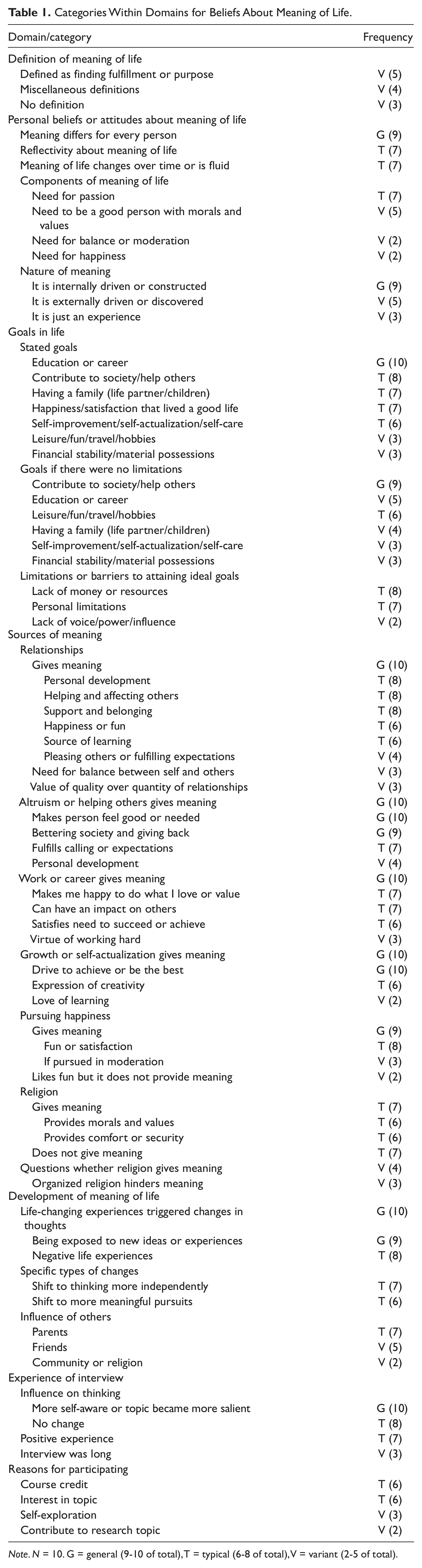
Note. N = 10. G = general (9-10 of total), T = typical (6-8 of total), V = variant (2-5 of total).
The entire research team constructed core ideas for the first two transcripts (with considerable discussion), with rotating pairs of judges constructing core ideas for the remaining transcripts. Each finalized set of core ideas was audited for accuracy by one internal student auditor and the principal investigator (and consensually revised as needed by the initial team), and then sent to the two external auditors for review (and consensually revised after considerable discussion by the team).
For the cross-analyses, the research team examined all the core ideas within each domain and looked for themes, consensually constructing categories and subcategories to represent the data. Rotating pairs of judges then consensually assigned categories to each unique core idea for the various domains. Two external auditors reviewed the cross-analyses, and the research team consensually (after considerable discussion) made revisions based on the auditors’ evaluations. As a final step, the professor reviewed all the cross-analyses again and then met with rotating members of the team to finalize the results.
Students worked together in teams to write drafts of the introduction, method, and results. The professor merged and revised all the drafts to provide a consistent voice across the article, added the discussion, and incorporated feedback on multiple drafts,
Results
The Research Team’s Reflexivity
To situate the results, we briefly describe the interviewers’ initial reflections about meaning of life. Given that biases and expectations were relatively similar, we report just biases.
Interviewers typically defined meaning of life as purpose. Regarding personal beliefs, interviewers typically indicated that meaning is both discovered and constructed (e.g., one stated, “I believe I am continuously discovering and constructing my meaning of life”). In terms of goals, interviewers typically indicated wanting both families and helping-related careers. If there were no limits, they typically indicated goals of contributing to society and traveling. For pursuit of happiness, interviewers typically indicated the importance of happiness, one stating that it is important for “any healthy, well-rounded individual’s life.” In terms of relationships, they typically emphasized the importance of companionship and of love for providing meaning. In terms of self-actualization, most described a drive to achieve and live life to the fullest. They also typically indicated the importance of altruism and bettering society. In terms of development of meaning, most stated that their parents had influenced their development. For limitations, work/career/vocation, and religion, no typical themes emerged. All mentioned that it was challenging to think about meaning of life, but writing about it helped them consolidate their thoughts. All attempted to limit the effects of their biases and remain as open as possible to understanding the data from the viewpoint of the participants.
Quantitative Data
Means and standard deviations for MLQ-P, MLQ-S, and the 16 items of the SOMP for the interviewees, interviewers, and auditors are shown in Table 2. In Table 2, we also present data on the MLQ collected in 2011 for 2,799 entering first-year undergraduate students (Raque-Bogdan & Lucas, 2012) and on the SOMP collected in 2010 for 1,417 entering first-year students (Ziemer et al., 2013) at the university where the present study was conducted. Effect size comparisons (difference between means divided by the pooled standard deviations between groups) were calculated. We required that differences be at least a medium effect (i.e., .50 or greater) to be considered meaningful.
Means and Standard Deviations for MLQ-Presence, MLQ-Search, and 16 Sources of Meaning From the SOMP for 10 Interviewees, 10 Student Researchers, and 3 Instructor/Auditors.

Note. MLQ = Meaning of Life Questionnaire; SOMP = Source of Meaning Profile. Norms for the MLQ-Presence and MLQ-Search were taken from the census data gathered in 2011 of 2,799 entering first-year students on campus (T. Raque-Bogdan & M. S. Lucas, personal communication, March 7, 2012). Norms for the SOMP items were taken from the census data gathered in 2010 of 1,417 entering first-year students on campus (Schaefer et al., personal communication, March 7, 2012).
No differences were found on the two MLQ subscales between the larger sample of 2,417 undergraduates and any of our three samples. A few differences did emerge, however, when comparing the SOMP data for the 1,417 first-year undergraduates with our three samples: (a) our interviewees rated hedonistic activities as less meaningful than did the larger sample of undergraduates; (b) interviewers viewed leisure activities, basic needs, financial security, hedonistic activities, and acquiring possessions as less meaningful, but rated personal growth and service to others as more meaningful than did the larger sample; and (c) auditors rated leisure activities, basic needs, relationships, social causes, preserving values, preserving culture, hedonistic activities, and acquiring possessions as less meaningful, but achievements as more meaningful than did the large sample of undergraduates. Thus, the interviewees appeared to be relatively similar to the larger sample of undergraduates, but the interviewers and auditors appeared to be less oriented to hedonistic and materialistic values than were the large sample of undergraduates. The interviewers (in contrast to the interviewees and auditors) were particularly oriented toward personal growth and service toward others.
Qualitative Data
The data fit into seven domains (definition, personal beliefs, goals, sources, development, experience of interview, and reasons for participating). Categories and subcategories were constructed for each of the domains. Based on recommendations for CQR (Hill, 2012), categories were considered to be general if they applied to 9 to 10 cases, typical if they applied to 6 to 8 cases, and variant if they applied to 2 to 5 cases. Categories applying to only 1 case were not included. Table 1 shows the general, typical, and variant results for the total sample. Only general and typical results are presented in the text, except in one instance related to definition of meaning of life where there was no typical finding.
Because there was only 1 male participant, we had some concern that his data might be different from that of the 9 female participants. A review of the data, however, showed no obvious differences. Hence, we did not exclude him from the data analyses.
Definition of Meaning of Life
No typical or general definitions emerged. Participants variantly defined meaning of life as finding fulfillment or purpose in life (e.g., “meaning in life is to find that purpose, or find what drives you so that you can be fulfilled in life.”). Overall, participants seemed to know intuitively what meaning of life was, but they had a hard time articulating their definitions.
Attitudes and Beliefs About Meaning of Life
Generally, participants believed that meaning of life is distinctly personal and differs for each person. One participant reflected, The meaning of life could mean anything for anyone. It could just mean like going to school, getting good grades. To someone else, it could mean obtaining happiness. To someone else, it could mean getting the job. I don’t know. So it could mean a lot of different things.
A typical category was reflectivity about meaning of life. Participants talked about the role of meaning in society, expanded on reasons for not reflecting very much on thoughts about meaning of life, or about people who had challenged their meaning in life. One person described her journey in thinking about meaning in life through studying philosophy, It seems like the more I learn the less I know. It’s kind of freaking me out. . . . Before I went into philosophy I thought I just kind of like knew everything and then through philosophy, I’ve learned that I really don’t know anything.”
Typically, participants also believed that meaning of life changes over time. One participant stated, “Our meaning of life continuously changes throughout our life. When we are children what brings meaning to our life is far different from when we are elderly.”
In terms of components of the meaning of life, the need for feeling good about oneself was typically expressed. For example, Helping people makes me feel good. For, let’s see, someone else, maybe a lawyer, they feel good about justice. Maybe a mother feels good about raising their child well. And maybe a father feels good about providing for their family.
In terms of the nature of meaning, participants generally communicated that meaning in life is internally driven or constructed. According to one participant, “You need to construct your meaning. If one isn’t in front of you and you don’t see a direct path, then you need to explore options and find one.”
Goals in Life
Stated goals
One goal (general) was education and career. One person hoped that by graduation, she or he would find a path “to take for my career.” Others were preparing for graduate school, to help them “have a successful career” and earn prestige. Future career plans involved a variety of areas (e.g., nutrition, psychology, dance, business), although not all the participants had decided on a career (e.g., one participant wanted to be an actor but could see being a singer, poet, or artist).
A second goal (typical) was contributing to society or helping others. One person planned a trip to a “very poor town [to] help them build schools and build roads.” For others, helping was more of a general goal. For example, I want to make my mark on the world, some way, somehow, something really important I want to be remembered for. Not just, not just for anything cliché, I want to impact the world in such a way that people are improved.
Typically, participants also wanted to start their own families, to get married, and have children (e.g., “I definitely think I need a family to feel like I’ve completely fulfilled my . . . life’s purpose.”), although not necessarily right away (e.g., “I’m not ready to settle down and have kids when I’m like 23. I wanna live first.”). One person felt that through children, she or he could leave a legacy and be remembered, “produce another generation and pass down my thoughts and my beliefs . . . teaching them to be, how to be good people.” For another participant, having children was a way to correct her parents’ mistakes, “I want my kids to know that I can be there for them if they need me to be.”
A fourth goal (typical) was the desire to feel happy and satisfied about having lived a good life. One person talked about the future and the desire to “lead a long, happy, healthy, joyful life.” Others talked about “being able to look back and be satisfied” with their lives.
Participants also typically discussed goals of self-improvement, self-actualization, and self-care. They wanted to reach their full potential. For one participant, this meant, “Working on myself, spiritually keeping, making sure that my spiritual self is balanced. And mentally, just staying away from things that I feel would hinder my personal development.” Another participant was more focused on developing his or her character and growing into self, There are so many quotes that are like “life isn’t about finding yourself, it’s about creating yourself,” so, it’s kind of like that. It’s not like you’re living like trying to seek who you are, you are living life trying to like create who you are.
Goals if no limitations
When asked about what their goals in life would be if there were no limitations, the order of goals shifted somewhat. Interestingly, the goal of contributing to society and helping others was now generally endorsed, whereas the goal of education and career was only variant. According to one person, “If I’m very well off. . . . I can take time out of my schedule to go to like a homeless shelter and teach the kids there how to dance and give them some fun.”
Some participants affirmed the intrinsic value of current career paths. One participant still wanted to “be a surgeon.” Another spoke of how he or she would still attend college even if there were no limitations, “I still would . . . because I’ve seen now how beneficial college is . . . education is very important to me.” Other participants, however, spoke of alternative careers they would pursue, particularly careers in the field of medicine.
If there were no limitations, participants also more often indicated leisure goals of fun, travel, living in tropical climates, hobbies, and other recreational activities (now typical whereas with limitations it was variant). When talking about traveling, participants mentioned that they wanted to “experience other cultures and other people and see the world,” or gain “insight on the ways in which people think and how they view the world, and how I view their view of the world.” Some participants mentioned fantasies, such as living on an island with beaches everywhere or traveling in time.
Limitations/barriers
When asked what kept them from going after their fantasized goals, participants typically cited a lack of financial resources. They viewed a lack of money as a struggle for everything from attending graduate school to being able to pay for vacations for their children-to-be. One participant, whose ideal meaning in life would be to dance, expressed that dance would not provide enough money to support a family: It’s virtually impossible to support the people that you love . . . as much as I wish I could be a dancer . . . if I’m going to have a family I want to be able to not be just getting by paycheck to paycheck.
Participants also typically mentioned a variety of personal limitations that prevented them from achieving their fantasized goals. Personality traits (e.g., being “almost too open-minded”), poor performance in school, physical characteristics (e.g., being “too short”), not having enough time, and not having had relevant opportunities as a child were all cited as limiting the ability of participants to achieve their goals.
Sources of Meaning
Participants spoke both spontaneously about sources of meaning and also responded to questions about six specific sources of meaning. No differences were found in the spontaneous versus elicited results, so they were combined. Although results were general for five of the six sources, relationships and altruism are presented first because participants spoke at greater length about these sources than the others.
Relationships
All participants indicated that relationships provided meaning for them by contributing to their personal growth and development. They talked about how relationships were essential to “building your character, like what kind of person you are.” Some participants described their relationships as motivating them to continue improving themselves, to strive to be their best. For example, Just letting them feel like they matter to someone, it gives them purpose and it shows them that they should want better by themselves. They should want to do better things in life for people . . . they love.
Typically, participants also spoke about their relationships as a way to help and affect family, friends, and peers. One participant talked about helping her family, stating, I know right now that my parents depend a lot on me . . . [It] makes me feel like my meaning in life is to get a good education in order to help my family in the long run.
A third way that relationships typically provided meaning was by giving participants a sense of support and community in their lives. One participant expressed that her family “help me get through things and they’re there for me whenever I get in a problem or in a situation that I can’t handle by myself.” Another participant spoke more about the belongingness that accompanies close friendships, saying that the “relationship you have with people is very important, because it allows you to [feel] fulfilled and like [know] that you belong with others, kind of knowing that you matter to other people.”
The fourth way (typical) in which participants described their relationships was as a source of happiness or fun. Relationships brought joy, love, happiness, knowledge, learning, and experiences. For example, one participant described the joy that relationships can bring to various activities: You can go a lot of places, travel the world, but when you’re with someone it makes it that much more special. Even like a trip to the beach three hours away, if you bring the right people it can be really awesome.
A fifth way (typical) in which relationships provided meaning was through learning. Participants believed that relationships allowed them to take certain lessons from their experiences. For example, one participant said, “my family taught me to love, to believe in my dreams, to do good, to have faith and live each day to the fullest.”
Altruism
All the participants discussed altruism as a source of meaning in their lives. They felt passionate about affecting others in a positive way, indicating that helping others made them feel good. One person stated, “I just feel good when I feel that I’m helping others, that I’m making a little difference for at least for a minute in their lives.”
The participants also described (general) altruism as a way to better society and give back to others. One participant said, “I just find [meaning] by helping other people, and then hopefully by putting them in a better place in their lives they can continue down that path and help more people.” Although all participants agreed about the importance of giving back, they wanted to do so through a variety of activities that reflected their abilities and interests (e.g., volunteering in psychiatric wards, preventing deforestation, providing entertainment through dance, nursing).
Another way that giving back contributed to meaning was by providing participants with a sense that they were fulfilling their calling or others’ expectations (typical). One participant was studying psychology and public health because, “I feel like I’m meant to do something to help people.” Other participants described this purpose more as an obligation, “You need to help others. . . . It’s the basic rule [of life] I guess.”
Career
Participants generally said that work or career would be a source of meaning in their future lives. Typically, participants expressed hope that their future career plans would provide them with meaning by making them happy. They hoped to pursue their passions in life through their studies and their work. One participant described this philosophy stating, “If you love your job you’ll never have to work a day in your life. . . . It’s going to be surprising that they pay you to do it because you like it so much.” Other participants expressed this same sentiment but acknowledged the need to find a balance between happiness and financial stability (e.g., “It’s important that you do something that you love . . . because a lot of people sacrifice the happiness for the money or vice versa.”). Participants recognized that while doing what you love is meaningful, it helps if it also pays well.
A second way (typical) in which work/career provided meaning was by enabling participants to have an impact on others. This idea was reflected in their career choices, as participants typically mentioned pursuing a vocation in a helping profession. Participants saw their future career plans as a way to benefit those around them, to make the world a better place. One participant summarized this concept, To me, life’s meaning is brought by loving and caring for others. The reason why I chose to study psychology is because I believe it is the career that will help me fulfill my life’s main goal, which is to help others.
A final typical way in which work/career provided meaning was by satisfying the participant’s need to succeed or achieve. One participant stated that succeeding in her or his future career would be meaningful because, “It’d make me happy that I worked so hard from the bottom to the top.”
Self-actualization and personal growth
All participants expressed that self-actualization and growth contributed to their meaning of life. They spoke of the drive to achieve or to be the best they could be as providing them with meaning. One participant described self-actualization as the pursuit of hopes and dreams, By the time you die in order to be, to feel, that you’ve had a meaningful life, you have to be self-actualized. The few that do [feel self-actualized] are the ones that did what they wanted to do and kind of followed their dreams.
The chance to express themselves creatively was another way (typical) in which the participants described self-actualization. According to one participant, Art definitely gives me a sense of purpose in life . . . every time I make art or see art or talk about art . . . I kind of see this visionary, this imaginary almost life, and I kind of get this alternate purpose in life. It helps me make sense of purpose in real life . . . I would always want to be able to express myself through some form of art.
Pursuing happiness
Generally, participants indicated that pursuing happiness contributed to their meaning of life. They typically said that pursuing happiness provided them with fun and life satisfaction, important components of meaning of life. When asked how pursuing happiness related to meaning of life, one participant simply stated, “You have to enjoy every minute you got.”
Religion
Religion and spirituality as a source of meaning evoked ambivalence in this sample. Typically, participants both stated that religion contributed to their meaning of life and that religion did not contribute to meaning of life. Thus, they seemed somewhat confused and contradictory in what they said. Several participants had been raised in religious homes, but rebelled and distanced themselves from their parents’ religion and struggled to determine for themselves what they believed.
When talking about how it contributed to their meaning of life, participants typically stated that religion provided morals and values, or laid an ethical groundwork for teaching lessons. One participant said, “You learn right from wrong . . . basic messages that everyone should learn and uphold hopefully.” Participants also noted that religion provided them with things such as comfort, security, direction, alleviation from fear of death, and approval (e.g., “It like gives me a track, which I feel is right . . . the religious goal of ultimately going to heaven.” Another participant talked about church, saying “When I’m in church I feel good, kind of, and like I’m not alone . . . think a lot about life and death and the afterlife. . . . It gives you comfort, knowing that it’s real.”).
However, participants also typically responded that religion did not contribute to their meaning of life. According to one participant, religion had very little to do with her or his life, “I don’t really think that God gave me this calling, I mean, I’m not totally against the idea, but I don’t . . . incorporate it into my daily life, or practice.”
Development of Meaning of Life
All the participants described life-changing experiences that triggered thoughts about meaning of life. One general subcategory was being exposed to these new ideas and experiences. For example, one participant felt that moving around a lot as a child “helped a lot with me not being too attached to one place” and “form[ing] friendships with new people.” Another person had witnessed injustice in impoverished countries, “I saw things that were just unfair, like kids asking for money . . . stealing, doing drugs at 13,” which pushed the participant “to try to make a difference.” A second typical subcategory was negative life events (e.g., loss, trauma, discrimination). After one participant experienced a medical problem, he or she was able “to be more empathetic” to others in similar situations.
Participants typically made two specific types of changes in the course of their development. First, they shifted from superficial to more meaningful pursuits. According to one participant, As a child I cared about toys, play time, going to the beach, being with my friends, pets, and family. While I still care very much and value time spent with those I love, I also find particular meaning in being there for others, doing things that may not be fun for me but will aid others and bring hope and joy to them.
Second, they typically moved from relying on others’ thoughts to thinking for themselves. For example, one participant said, “I need to decide on my own what I think is right and wrong.”
When discussing the influence of others on their development of meaning in life, participants typically cited their parents as significant contributors. Some participants explained how their parents introduced them to their vocational interests (e.g., nursing, nonprofit work). Another participant, however, indicated that her parents’ absence, “My parents never went to anything of mine . . . unless it was ridiculously important,” affected her feelings about herself and her meaning of life.
Experience of the Interview
Participants generally reported that the interview made them more self-aware and that it made the construct of meaning of life more salient. For example, one participant mentioned being able to walk away feeling “a little more conscious of what people and goals are important” because of the interview. However, participants also typically stated that their thoughts about meaning in life were the same as they had been prior to participating in the interview. Reactions to the interview process were typically positive; participants said it was interesting being able to explore and make sense of their thoughts, especially since meaning of life is not often discussed.
Reasons for participating in the study
Participants typically reported that they participated because of course requirements. In addition, students typically reported that they participated because the topic interested them (e.g., “It just looked like the most interesting out of the choices that there were.”).
Discussion
For these college-aged students at a large pubic U.S. university, meaning of life was an engaging and important topic. Although they often had a hard time articulating their ideas and defining meaning of life, interviewees were eager to share their thoughts. Specifically, they believed that meaning is individually and uniquely constructed, is important to think about, and changes over time depending on life stages and circumstances. They also believed that people need to be happy and have passion for what they do, as well as have morals, values, balance, and moderation in their lives. These results indicate that participants valued finding and having meaning in their lives.
Because of the transitional nature of undergraduate life, topics such as meaning of life are often salient to young adults. It is a time during which many students are exposed to new ideas and ways of thinking. They dream about the future, with the hope that a university education will allow them to fulfill their dreams. Similarly, Zika and Chamberlain (1987) found that meaning in life was important for the psychological well-being of college students.
In terms of goals, all participants wanted a satisfying career. In addition, most wanted to help others, have a partner and children, live a good life, and engage in self-improvement. Having a career, having a family, and self-improvement declined in importance, however, whereas contributing to society and leisure activities increased in importance if participants imagined not being limited by financial stresses and personal liabilities (e.g., not having the talent needed for a particular career). Thus, although these students were intellectually gifted enough to be attending a selective public university, they clearly faced obstacles to achieving their goals in life.
Several sources of meaning seemed particularly salient for these interviewees. They generally (all or all but one) indicated that relationships, helping others, career, personal growth, and pursuing happiness were important sources of meaning. Religion was less uniformly endorsed as providing meaning but was still typically mentioned. Thus, the sources that Yalom (1980) cited (altruism, dedication to a cause, creativity, hedonism, self-actualization, and self-transcendence) were somewhat applicable to this sample but not entirely. In this sample, there was more of an emphasis on relationships and less of an emphasis on dedication to a cause, hedonism, and self-transcendence. Differences may have emerged because Yalom based his thinking on philosophical theories and experiences with adult clients in psychotherapy, whereas our interviewees were 18- to 21-year-old university students in psychology classes.
We were particularly struck by the findings related to contributing to society and helping others. These students seemed to be eager to help others, but they were not sure about the feasibility of supporting themselves and families in a helping profession. Given that helping others often does not pay a lot of money and it is extremely competitive to gain entrance into graduate school, students often have to make decisions about competing values in choosing a career path.
Another intriguing finding was that changes in thoughts about meaning of life appeared to have been triggered by life-changing events, with parents playing an important role in helping participants integrate these experiences. The typical developmental changes involved a move from superficial to more meaningful pursuits and to thinking for themselves about what they believed. Hence, if students experienced the death of a significant other or traveled to a new country with different customs, they were compelled to reevaluate their assumptions of a just and fair world and their beliefs about meaning of life. These findings remind us of the literature on posttraumatic growth and resiliency (e.g., Pat-Horenczyk & Brom, 2007), suggesting that traumatic experiences can help people grow and rethink their constructs.
Furthermore, it seems relevant to note that interviewees all expressed that participating in the interview gave them an opportunity to reflect on a topic not usually discussed in daily life. They stated that they became more self-aware, and the topic of meaning of life became more salient as a result. Similarly, the interviewers indicated that having the opportunity to be in a class that focused on meaning of life helped them think more deeply about the topic. Such experiences are not typical at large selective public universities, but may be particularly useful in helping students think about what they want in life.
Finally, a comparison of these 10 interviewees with the interviewers and auditors is informative. Our interviewees rated hedonistic activities as less meaningful than did the larger sample of undergraduates, perhaps because these students were interested in psychology. The differences between the interviewers and the large sample of students were even greater, perhaps reflecting that the interviewers were older (seniors as opposed to first-year students) and were all psychology honors students planning on going into helping professions. The auditors were even more distinct from the other groups, probably because the auditors were older, established in psychology careers, and deeply invested in personal reflections about meaning of life.
Limitations
These results need to be considered within the context of the sample. The participants were all between 19 and 21 years old and were students at a large public American university. As such, these bright young people were at the beginning of their adult lives and looking forward to what they could do in the future. In addition, it is important to note that the participants appeared to be similar in terms of their beliefs about meaning of life to two large samples of students at the same university, indicating that these findings were fairly representative of students at this university and perhaps of similar universities.
Most of the interviewees were female undergraduate students from a range of ethnicities enrolled in psychology classes. They typically participated because of course requirements as well as interest in the topic of meaning of life.
An additional limitation is the difficulty related to accessing thoughts about meaning of life. Many of the participants noted that it was not easy to articulate their thoughts, particularly those related to definitions and attitudes. This limitation is probably related more to the difficulty of speaking coherently about such an abstract construct, although it is possible that the questions were not worded well enough to facilitate deep discussion. We had hoped that completing the paper-and-pencil measures immediately before the interview would prime interviewees to think about the topic, but it could be that more preparation would have helped even more. Indeed, one interviewee who had just heard a lecture on meaning of life in a social psychology class seemed somewhat more prepared to talk about the topic.
The interviewers were all upper level undergraduate students, which was advantageous in that they were close in age to the participants and able to establish rapport. A disadvantage of using undergraduates, however, was that, although they were carefully trained in interviewing skills during the class, they were not experienced interviewers who might have been able to probe more deeply. In addition, most of the interviewers were European American and female, and thus were not representative of the diverse population at the university. Furthermore, as with the participant sample, interviewers self-selected to participate in the course, and therefore, their thoughts on meaning of life may not be representative of students who did not elect to enroll in the course. To increase awareness about their biases, interviewers talked extensively about meaning of life in class, wrote about their biases and expectations, and practiced the interview protocol several times, but undoubtedly these biases and expectations had some influence on the interview process. Interviewers and auditors attempted to bracket their biases and expectations, but the results of this study should be considered within the context of the particular sample.
Implications
The results point to several areas that merit further investigation. First, the connection between meaning of life and religion could be explored in more depth. Some participants mentioned finding their meaning, morals, and values through religion, whereas others noted that religion was not meaningful to them in any way. With declining participation in formal religion in this country and others, it is interesting to speculate that relationships and helping others have to some extent replaced religion in terms of providing meaning.
Second, the role of traumatic experiences in stimulating thinking about meaning of life begs further exploration. How is it that these experiences shape thinking? Equally interesting would be to understand why some students never think about meaning of life, whereas others think about it frequently. Given the findings that thinking about meaning is psychologically adaptive and leads to improved mental health (Steger et al., 2006; Zika & Chamberlain, 1992), perhaps we could provide experiences that would help young people think about meaning.
In addition, understanding more about how helping others provides meaning would be enlightening, as would understanding the apparent conflict participants experienced between wanting to help others and needing to support themselves financially. Examining how people balance strivings to find meaning of life with personal limitations is also worthy of future investigation.
Perhaps most important, we hope to stimulate thinking about how to work therapeutically with people who have concerns about meaning of life. Given that interviewees and interviewers enjoyed talking about meaning of life, gained in self-awareness, and appreciated the opportunity to sort out their thoughts, it might be interesting for university counseling centers to provide structured discussion groups wherein students could discuss this topic with appropriate support. Such groups might involve values clarification exercises (Rasheed, Allmon, & Cornick, 2011) along with exploring meaning of life and its sources. This type of discussion may provide an alternative method to reach clients who might be otherwise intimidated by engaging in psychotherapy or clients who want alternatives to “illness-focused” therapy (Fossey, Harvey, Mokhtari, & Meadows, 2012). Therapists should also be aware of the importance of discussing this topic within therapy to help people explore and gain insight into their thoughts about meaning of life. Given the reality of mortality, helping people think about and prepare for existential concerns might, as Yalom (1980) suggested, enable them to live more fully.
Footnotes
Appendix
Declaration of Conflicting Interests
The author(s) declared no potential conflicts of interest with respect to the research, authorship, and/or publication of this article.
Funding
The author(s) received no financial support for the research, authorship, and/or publication of this article.