




Abstract
A paucity of research explores both negative and positive changes for family members supporting a loved one with dementia, especially when communication by speech and awareness of others diminishes. This qualitative study sought the views of family groups concerning their experiences over the past 10 years supporting a loved one with dementia. A focus group sought negative and positive subjective interpretations of this phenomenon. One superordinate theme: Synthesis of Meaning emerged from the data using interpretative phenomenological analysis. This overarched two subordinate themes: (a) Steps backward—encompassing those times when relatives hovered uncertainly, missed opportunities to engage due to advancing dementia, and felt regret and (b) Steps forward—encompassing moments of unexpected rewards, acceptance, self-forgiveness, and empathic connection with others on a similar journey. This study highlights that although often fraught with distress, positive aspects of the dementia journey are possible and offer opportunity for psychological growth and well-being.
Introduction
The psychological impact of supporting a loved one living with dementia is increasingly recognized. What is poorly understood is the barrier that diminishing awareness and speech presents to family relationships. It is possible that family supporters experience traumatic distress on the journey with dementia, as they struggle to make sense of this unwelcome visitor in their lives. Conversely, it may be that despite distress, individuals can experience psychological growth over time from this lived experience. Following an earlier study on reciprocal family interactions when living with nonspeech dementia (Walmsley & McCormack, 2014), this exploratory study sought subjective interpretations from family members regarding their dementia experience. In particular it was interested in positive as well as negative sense making of their experience of dementia.
Not without reason, has the journey with dementia been described as the “long goodbye.” Often extending up to 10 years (Anderson, Lolk, Martinussen, & Kragh-Sorensen, 2010; Xie, Brayne, & Matthews, 2008) it is a journey marred by anticipatory grief (Shuter, Beattie, & Edwards, 2014) as family members—healthy and diagnosed—engage in a drawn out dance of coping, letting go, interacting, planning, and readjusting social worlds (Rando, 1986). Ambiguous loss also accompanies the journey, whereby relatives experience a false closure as they mourn the loss of a member physically present yet psychosocially absent (Boss, 2004; Frank, 2010; Shuter et al., 2014). Grief is also disenfranchised on the journey when significant others underestimate the grief involved for family (Betts Adams & Sanders, 2004; Boss, 2004; Doka, 2002). Similarly, accompanying grief is a sense of supporter burden commonly involving fatigue, worry and low mood, disturbed sleep, and relational strain (Australian Institute of Health and Welfare [AIHW], 2012). Although most dementia family supporters (73%) endure dissatisfaction in supporting a loved one, some (19%) experience feelings of satisfaction (AIHW, 2012). This highlights the possibility of concurrent psychological well-being, despite grief and burden, for family members travelling the journey with dementia.
Despite initially relieving burden, aged care placement is also one of the most difficult and distressing decisions facing families on the journey with dementia (Bauer & Nay, 2003; Bramble, Moyle, & McAllister, 2009). Despite offering visiting relatives astonishing moments of lucidity and intimacy with their loved one, it can also generate a feeling of aloneness that is magnified by disconnection from family and friends (Meuser & Marwit, 2001). For some, the journey with dementia may even be experienced as a series of traumatic events. Trauma represents an unexpected event both uncontrollable and unpredictable that presents experiences beyond the existing hermeneutic boundaries of an individual’s world view (Joseph, 2011). Subsequent disruption to world view highlights a distressing search for meaning and meaning making, the intensity of which varies by the gap between subjective world view and new traumatic information (Joseph, 2011; Joseph & Linley, 2005). Typically encompassing violent assault, disasters, military combat, severe accidents and chronic illness, suffering and death of a loved one (Breslau & Kessler, 2001), trauma may also include witnessing helplessly as a loved one succumbs to dementia. For some family supporters, the transitional distress of aged care placement is cumulative on the earlier distress of a dementia diagnosis (Bauer & Nay, 2003; Scott, Lewis, Loughlin, & Chambers, 2005).
Furthermore, dementia interferes with social worlds. Stigma leaves many spouses feeling isolated (AIHW, 2012; Alzheimer’s Society, 2012) with few social outlets for support (Sanders, Ott, Kelber, & Noonan, 2008). Some also face difficulty reentering social worlds as a single-yet-married person owing to the ambiguity of their loss (Harris, Adams, Zubatsky, & White, 2011). Reciprocity and pleasant activities between couples may ebb (Gallagher-Thompson, Dal Canto, Jacob, & Thompson, 2001), while frustration with taking on household chores and decision making escalates (Harris et al., 2011). Partners may be seen as child-like (Harris et al., 2011) and relational intimacy can wane with increasing daily support (Svetlik, Dooley, Weiner, Williamson, & Walters, 2005).
However, research indicates that adversity can in fact facilitate and coexist with psychological growth (Joseph, 2011; McCormack, Hagger, & Joseph, 2011; McCormack & Joseph, 2013; McCormack & Sly, 2013; Park, Cohen, & Murch, 1996; Tedeschi & Calhoun, 1996, 2004). Encompassing transformative positive change, psychological growth refers to greater well-being that emerges over time following adversity (Joseph, 2011). It encompasses three aspects of change after traumatic distress: (a) personal change such as new personal strengths, greater wisdom, and more compassion; (b) philosophical change, including new priorities in life and enhanced spiritual beliefs; and (c) relational change comprising new approaches to relationships and greater appreciation of others (Joseph, 2011). Although immunological change is possible (Cruess et al., 2000; Milam, 2004) this study is particularly concerned with psychosocial change following the adversity of dementia. Furthermore, converging studies (Joseph, 2011; Joseph & Butler, 2010; Joseph & Linley, 2006) indicate that people may be “hard-wired” for psychological growth. As such, traumatic distress marked by the intrusion and avoidance of trauma-related cues is increasingly considered a normal search for comprehension and existential significance following adversity, rather than a mental disorder (Joseph & Linley, 2005). In fact, more recent growth theories posit that for successful integration of trauma-related information at a personal level, an individual must find personal significance and comprehensibility in their current life (see, Joseph & Linley, 2008). As such, both independent dimensions, positive and negative assessment of any adversity must be acknowledged if growthful adaptation is to occur (Aldwin, Levenson, & Spiro, 1994; Fontana & Rosenheck, 1998; Schok, Kelber, Elands, & Weerts, 2008; Spiro, Schnurr, & Aldwin, 1999). This search for meaning and meaning making appears to play a role in coping with adversity (Janoff-Bulman, 1992; Joseph & Linley, 2005; Lepore & Revenson, 2006; O’Leary & Ickovics, 1995; B. W. Smith et al., 2008), such as the burden of caring for a loved one with dementia.
Positive change in the dementia experience for family members may also include supporter satisfaction (AIHW, 2012). Spouses may enjoy greater physical intimacy and emotional connection owing to past reciprocity and closeness (Harris et al., 2011; Steadman, Tremont, & Davis, 2007). Adult-children may encounter closer sibling relationships, new outlooks on life and ageing, and greater relational appreciation (Meuser & Marwit, 2001; Ott, Sanders, & Kelber, 2007). In light of returning past favors, adult-children also describe enhanced self-worth (Meuser & Marwit, 2001).
However, psychological growth requires openness to existential challenge particularly if a supportive social world promotes autonomy, self-efficacy, and meaningful relationships (Joseph & Linley, 2005; Ryan & Deci, 2000). Indeed, a curvilinear relationship is suggested between distress and growth whereby the greater the distress the greater the opportunity for growth (Joseph, 2011). Once positive meaningmaking takes hold, distress ultimately declines (Butler et al., 2005; Linley, Joseph, & Goodfellow, 2008). This has implications for family members “quality of care,” and “quality of life” for declining relatives. Quality of life for those with dementia is believed to rely on positive moment-to-moment experiences (Nuffield Council on Bioethics, 2009). However in dementia families, quality of life also relies on relatives’ judgments that positive moment-to-moment experiences are possible. As such, the reciprocal impact of family supporters’ dementia experience on meaningful family relationships is poorly understood. Thus, this qualitative study sought subjective “lived” experience over time of family supporters on the dementia journey. It aimed to understand both positive and negative interpretations of their experiences and thereby contribute to our understanding of the relational journey supporting a loved one with dementia. By choosing a qualitative method this exploratory study aimed to compliment positivist investigations by contributing to theory concerning communication and awareness in dementia, particularly as they affect family support and dynamics.
Method
Participants
Following university human ethics clearance, four dementia family groups from the earlier pilot study (see Walmsley & McCormack, 2014) were approached to participate in a focus group. Of the five dementia family supporters who had participated in the earlier study, two declined, one due to poor health. Provided with details of the study, the remaining participants Gary, Susan and Richard offered consent. At the time of the focus group, Gary aged 74 years and his 66-year-old wife Susan had supported Gary’s mother Helen until her death, aged 97 years, 6 months prior. During the focus group, Gary and Susan also spoke of their adult-son Jason aged 39 and his daughter Emily aged 7. Richard aged 74 years was supporting his 73-year-old wife Deborah. Gary, Susan, and Richard were considered a suitable sample size owing to the sensitive nature of the topic and intent that all participants remained engaged in the focus group discussion. Pseudonyms were used throughout.
Procedure
Participants were contacted by e-mail with information about the study. The focus group was conducted by the researcher at the relatives’ aged care facility at a time convenient to participants. The semistructured focus group was digitally recorded and lasted 1 hour and 50 minutes. The focus group discussion was guided by semistructured questions tunneling down to the topic of interest. The questionnaire encompassed interpretations of the “lived” experiences of dementia, both positive and negative: (a) thoughts, feelings, and priorities; (b) world views; (c) relationships and communication skills; (d) human dynamics; (e) spiritual beliefs; (f) life going forward from their experience. The focus group remained flexible, allowing participants to engage in the double hermeneutics of the dialogue with freedom and spontaneity to reveal the phenomenon of interest. Owing to the small focus group, participants engaged willingly with little need of prompting. Demographic information was collected, including age and length of time supporting their loved one.
Epistemology
Epistemologically, this study sits within a critical realist paradigm. From this vantage it sought to describe the way in which the world is socially constructed, interpreted, and understood. It adopted a phenomenological and interpretative hermeneutical approach, which offered a platform for phenomenological exploration of a complex topic via understanding, interpretation, and critical reflection of a real world where unobservable realities exist (Blaikie, 1991). Owing to the critical realist perspective, access to the world is always mediated, thus it is also a comfortable fit with symbolic interactionism. This is concerned with (a) the way people act toward things based on the meaning those things have for them, (b) meanings derived from social interaction, and (c) the variable and uncertain nature of meaning and how it is modified by interpretation. Similarly, a critical realist view encompasses hermeneutic enquiry, whereby people continuously interpret and make sense of their world so they know what to do (Gadamer, 1983). This hermeneutic stance surpasses the dissent between objectivism (there is only one valid perspective for meaning making) and relativism (perspectives are alien from each other) to foster multiple ways of interpreting experience (Bernstein, 1983).
Credibility
We sought to enhance the credibility and trustworthiness of our findings in various ways (Smith & Osborn, 2008; Spencer & Ritchie, 2012; Yardley, 2008). The primary author conducted the focus group session and transcribed the data set. Through a process of interpretive phenomenological analysis (IPA; Smith, 1996) the two researchers independently completed an initial thematic audit of the data. They then met to check analyses and verify interpretations (see Smith, Michie, Stephenson, & Quarrell, 2002). Independent interpretations were reflected on and robustly debated to arrive at agreed rich thematic evidence supported by vivid extracts (Smith, 1996). Unlike nomothetic research, the authors did not aim to produce causal evidence or produce a satisfactory interrater reliability score. Instead, the audit sought to provide the reader with one account of the data that systematically achieved internal coherence and presentation of evidence.
As such, a detailed audit trail was produced (Smith, Flowers, & Larkin, 2009; Spencer & Ritchie, 2012). The audit trail encompassed the audio recording of the raw data, the transcript, description of how themes were developed and a description of interpretations (including notes, diagrams, preliminary, and final thematic definitions). Rich extracts from the data set grounded the results in the selected themes, and provided links to existing theoretical constructs for interpretative rigor.
First Author’s Perspective
The double hermeneutic process of IPA is influenced by what researchers bring to interpretation (Smith, 1996). However, our preconceptions enable interpretation, and further interpretation refines our preconceptions (Heidegger, 1927/1962). The first author has experience of supporting a family member living with dementia. He now works as a clinical psychologist supporting families on the journey with dementia. In this study, every attempt has been made to externalize such preconceptions and bring credibility to interpretation through robust discussion and independent audit.
Analysis
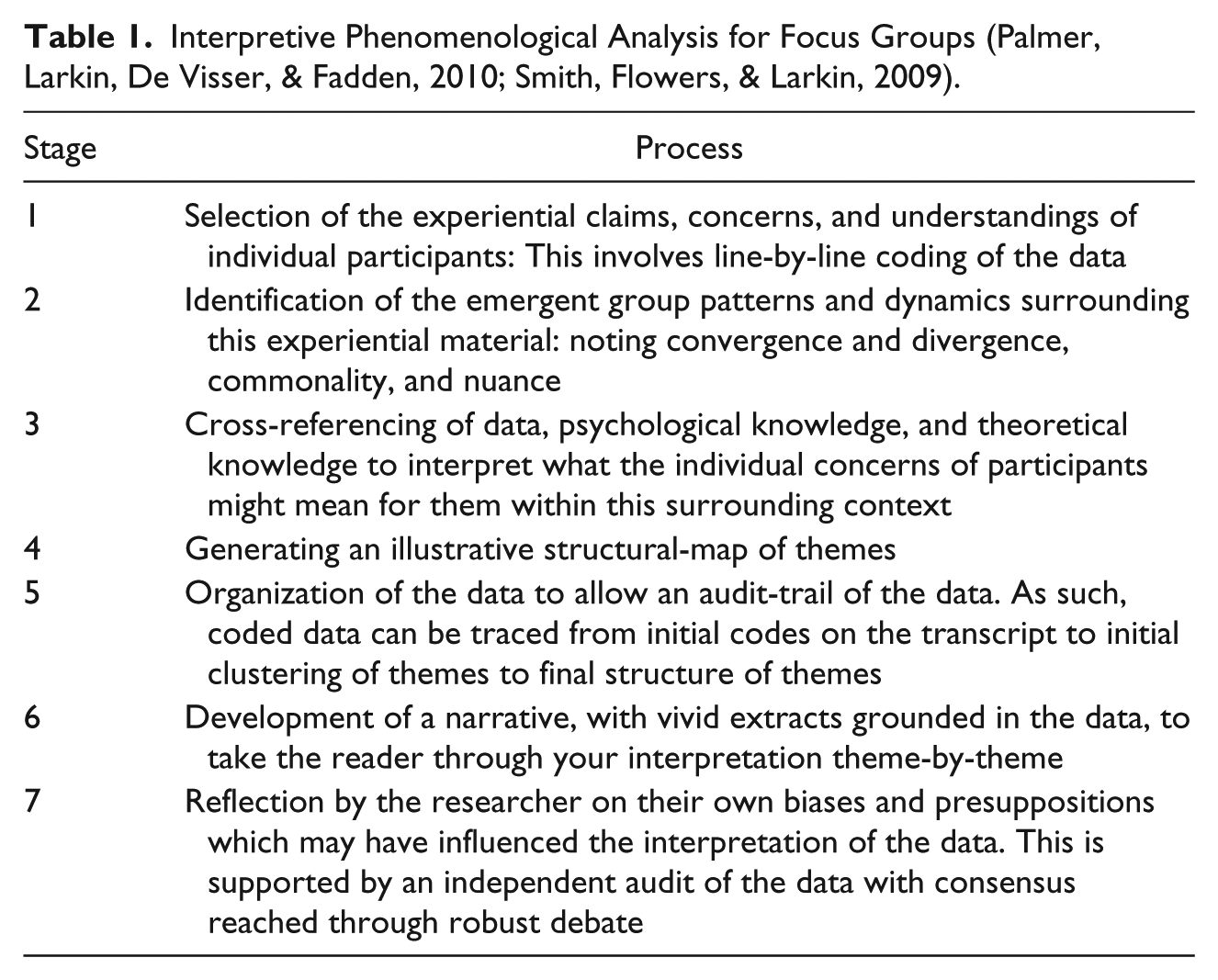
Data collection through a focus group was considered an effective way of bringing together a purposive sample to investigate a complex topic (Wilkinson, 2008; Willig, 2013). The focus group dialogue was transcribed verbatim and analyzed through IPA (Smith, 1996; Smith, Flowers, & Osborn, 1997; Smith & Osborn, 2008), a well established analytic approach to psychology research (Brocki & Weardon, 2006; Larkin, Watts, & Clifton, 2006). With the shift from objectivist and restrictive biomedical views of disease (World Health Organization, 2002), IPA offers an analytic approach that recognizes the “constructed” biopsychosocial nature of illness and the importance of subjective “lived” experience (Brocki & Weardon, 2006). It also encourages analysis “beyond the text to a more interpretative and psychological level” (Smith, 2004, p. 44). Calling for close interaction with the data, the underlying meaning making of participant dialogue is accessed by a method of reduction to specific interactions, statements, and themes in search for all possible meanings. It engages a double hermeneutic process whereby researchers draw on their own “interpretive resources” (Smith, Jarman, & Osborn, 1999, p. 223) in an attempt to make meaning of the participants’ interpretative process. Biases and preconceptions are a conscious challenge to interpretative phenomenological researchers and if not bracketed risk influencing interpretation of the data (Gadamer, 1983; Heidegger, 1927/1962). Analysis followed the seven-stage process for using IPA in focus group research (Palmer, Larkin, De Visser, & Fadden, 2010; Smith et al., 2009). Table 1 provides the step-by-step analytic process.
Interpretive Phenomenological Analysis for Focus Groups (Palmer, Larkin, De Visser, & Fadden, 2010; Smith, Flowers, & Larkin, 2009).
Results and Analysis
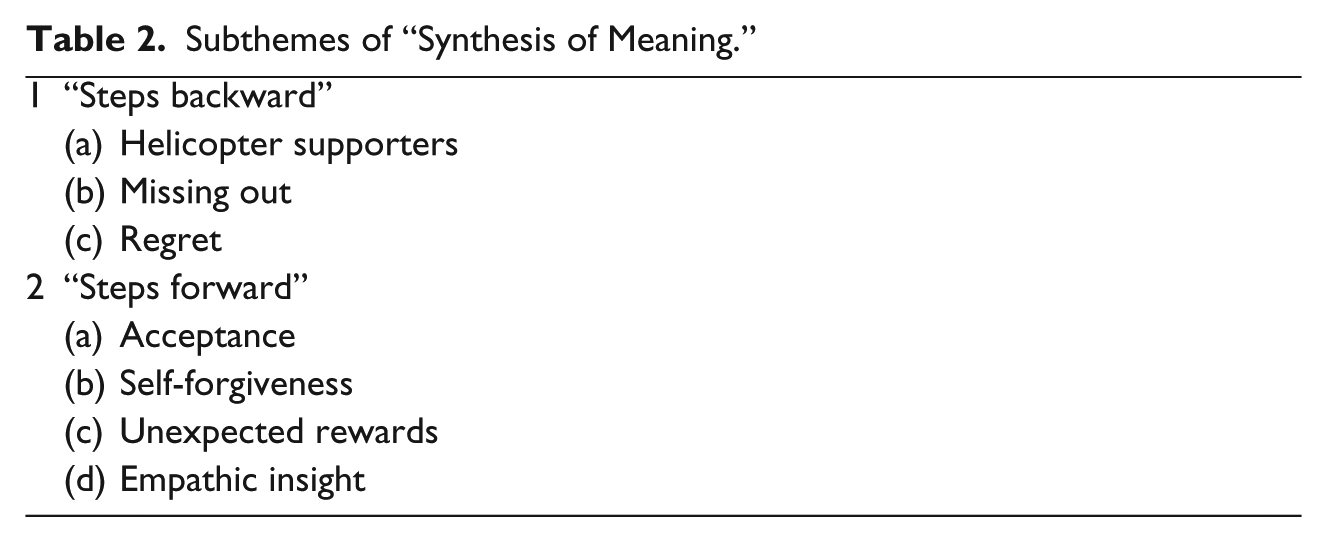
One distinct superordinate theme, Synthesis of Meaning, was identified. This described family supporters’ ongoing change in meaning making as they redefined new holistic perspectives of dementia. It encompassed two subordinate themes of (a) Steps backward: representing negative change marked by the subthemes of helicopter supporters, missing out, and regret, and (b) Steps forward: reflecting positive change characterized by the subthemes of acceptance, self-forgiveness, unexpected rewards, and empathic insight (Table 2). These subthemes represent the complexity of the journey with dementia as described by the participants. 1
Subthemes of “Synthesis of Meaning.”
Steps Backward
Steps backward described negative change characterized by family members struggling to keep pace with change in their loved one and makes sense of their journey with dementia. It describes how family members felt trapped in a process of engaging and disengaging unable to accept the unexpected journey of dementia. Discordant interactions and distress appeared to be a necessary catalyst for meaning making and potential psychological growth. The subthemes that captured the domains of Steps backward included helicopter supporters, missing out, and regret.
Helicopter Supporters
This subtheme described shifting consciousness as family members tried to make sense of what they were observing and began to hover anxiously around declining loved ones. As the hovering increased, a game of hide and seek commenced as the declining relative tried to hide failing competencies and the family members carried out risk assessments surreptitiously. Facing a decaying illusion of control both Susan and her father-in-law were drawn inevitably toward loss and change:
He’d have the house all nice . . . but — towards the end . . . we’d realised that the burnt curtains were because she’d put something on the stove and it had burnt. (Susan)
Growing concern, even fear crept into Gary’s awareness of change in his mother:
I watched her attempt to wash the electric kettle — in the sink, still plugged in. This is a worry. (Gary)
Furthermore, Richard’s hovering meant that his life became subjugated to Deborah’s every need. Thinking back he recognized how guilt and discomfort led him to place his life on hold while he adjusted to life without Deborah at home:
If I had gone away for holidays, and I arrived back here at 11 o’clock . . . (that way) I’d be in here for lunchtime. (Richard)
Promises made in the early days overwhelmed the participants as the years rolled by. The enormity of the task of supporting on the dementia pathway left loved ones exhausted with their own lives on hold:
He promised Dad that we would look after Mum, that was no problem, but sometimes it gets a bit difficult. (Susan). We’ve had an eleven day break in seven years. (Gary)
Recognized as counterproductive, the hovering eventually decreased. A relational turning point highlighted how old conflicts gave way to new ways of communicating:
She knew that she was losing the ability to do things, and in my trying to help her, I was reminding her that she didn’t have that ability, and she snapped, but after that there was never anything negative. (Susan). No, she was good. (Gary)
Missing Out
This subtheme described the loss and sadness as relational opportunities diminished as dementia advanced. Less able to reciprocate and unable to comprehend the change in his grandmother, from a “very strong woman who played golf and ran the household,” Jason made a hasty retreat:
Everybody came in, in their wedding gear to show her. . . . he was so shocked. . . . he just said “Mum I can’t see her. I can’t see Nanna like that.” (Susan)
Shattered expectations confronted adult-grandchildren and adult-children:
She turned to him and said “Do you have any children?” and his face — just. . . . she didn’t connect those children with (him); that’s what broke his heart. (Susan)
and,
To see her mother walk in, in and not sort of interact and say “Oh wonderful” you know “Who’s this baby”? (It) really hit home. (Richard)
Regret
Feelings ranging from remorse to hurt are reflected in this theme. Remorse was commonly expressed, as was guilt over broken promises and aged care became the only option:
You’re going against a promise that you’ve made to this person, you just make a rod for your own back, which makes it that much harder for you to emotionally cope with what really is an extremely difficult situation. (Richard)
Hurt was never far from these participants’ experiences:
She turned around to me and said to me “What are you doing here?” and I got so upset and I walked off into another room. (Susan)
Redefining the experience of hurt positively assisted the journey of support:
Don’t take it personally. She’s not reacting to you; she’s reacting to inner turmoil and once I realised that that was right, I just went back and sat down beside her. (Susan)
Steps Forward
In contrast to steps backward, insightful moments of meaning making marked positive change, as well as flexibility to change, as participants drew meaning from their journey with dementia. Engaging and disengaging began to be experienced more easily. Acceptance of the dementia pathway gave opportunities for psychological growth and reciprocal quality of life emerged for all family members despite the inevitable outcome of dementia. The subthemes that captured the domains of steps forward included acceptance, self-forgiveness, unexpected rewards, and empathic insight.
Acceptance
This subtheme reflected being-in-the-moment with whatever occurred daily on the dementia pathway. Persuasion was recognized as counterproductive. Desire for control gave way to new ways of interacting:
If she didn’t want to cooperate, it was easier just to walk away, and give her space, and come back later. (Susan)
Accepting repetitive conversation as a way of being connected maintained relationships:
Then he’d go through it all again. (Gary). But, that’s fine. (Susan). It didn’t matter. (Gary). We don’t put any pressure on him at all. We don’t ask him questions. (Susan)
This turning point in acceptance kept family members connected:
We were just familiar faces, and that’s a bit hard to, to come to terms with, but once you do . . . then that’s OK. . . . we do know that we’re important to her. (Susan)
Self-Forgiveness
Self-forgiveness brought resolution of regrets. What helped was a consciousness that they remained connected as families supporting a loved one with dementia:
I don’t think we could have done any more. I know there are residents here that never see anyone. (Gary)
Similarly, accepting effort and intent rather than craving awareness and reciprocity allowed past mistakes to be viewed more kindly:
I don’t think it had any impact on her, and at the time you know I just thought I was doing the right thing. (Richard)
Self-forgiveness allowed Richard to live fully again:
Whereas now if I arrive back now at 11 o’clock and I’ve just had an overnight flight from Hong Kong. . . I think “stay home.” (Richard)
Unexpected Rewards
This subtheme described unexpected positive interactions and interrelational moments that connected the family group despite the intrusion of dementia. It seemed that the participants began to be grateful for what emerged in the moment:
The children themselves, she interacted with exceptionally well. . . . that’s all they could remember of this lady. . . . it was great! (Gary)
They also redefined dementia behaviors with historical meaning:
When younger children are around . . . it boosts their whole life. . . . It’s obviously a part of their life . . . that stays there . . . in some shape or form. (Richard). Because that was there life . . . They were the stay at homes. (Susan)
Although described as a “pleasure for both them and me” by Richard, such interactions lead to mixed emotions for Susan:
(It’s) a really lovely thing, but it was—it is sad, that they don’t recognise their grandchildren. (Susan)
Positively, memory loss also erased old conflict:
We didn’t get on well — she and I. . . . but when she came here and into care we were the best of friends. . . . I was a familiar face who would talk to her, and take her to things . . . and suddenly I was her very best friend. (Susan)
Empathic Insight
This subtheme described the reciprocity of empathic concern, compassion, and wisdom between families struggling with dementia:
It broke my heart because he feels that he’s being judged by people he knows, but we don’t, and it’s because we’ve lived with Mum. (Susan)
Inner strengths were recognized as directly related to the dementia experience:
My ability to assess and accept the situation as it exists and respond to that — rather than wishing it didn’t happen or getting bogged down in thinking about what should have been and trying to correct it. (Richard)
Reflexive dialogue illuminated compassion and understanding:
I mean that’s all it is! You really only have to listen! — But you listen in the context of knowing where (families are) coming from. (Richard)
It became apparent that the dementia experience offered these participants the opportunity to become more compassionate individuals as they moved away from struggling to hold on to past ways of being with their loved one and project forward:
One of the things I do . . . the Alzheimer’s Association in the region here has a men’s support group . . . I’ve been coordinating that for now probably 10 years. (Richard)
Richard’s “satisfaction” at making “things easier for others in a similar situation” was described as offering the opportunity to grow and contribute back to life from their experience. They found that they began to see life differently as a direct consequence of having experienced a long journey with dementia:
Life is a circle. They look after us when we’re small and we look after them as they get older. That has rattled around in my brain so often. . . . and I’d think it’s so different feeding a 12-month-old baby than it is feeding a 90-year-old woman . . . but when I think about what he said, I think “Yes it is the natural order of things. This is okay.” (Susan)
Discussion
This qualitative study has highlighted that despite the traumatic distress of journeying with dementia, psychological well-being and a positive redefinition of self in the world can emerge for family members. It also indicated that similar to many relational journeys, there can be a process of engaging and disengaging as revealed in the literature elsewhere (see Rando, 1986; Shuter et al., 2014). Indeed, at times of great distress games of engaging and disengaging emerged within the family groups of this study. For example, a game of “hide and seek” emerged early on as the declining relative tried to hide failing competencies and family members carried out risk assessments surreptitiously. Ultimately, family members began to recognize that the dementia pathway to death in the loved one offered the opportunity for personal growth in their own lives.
Findings from this study recognized that meaning making was an oscillating process seeking personal significance and comprehensibility in their current life. For example, when relational interactions were dissonant, relatives hovered uncertainly, missed opportunities to engage due to the advancing nature of dementia, and felt regret. When relational interactions were positive and brought insight and meaning, participants experienced unexpected rewards, acceptance, self-forgiveness, and empathic connection with others on a similar journey. Each family member’s struggle to make sense of their dementia experience was unique. Similarly, patterns of meaning making illuminated converging themes across the data set.
Various responses to distress were illuminated and supported Joseph and Linley’s (2005) theories of individual differences in reactivity to traumatic distress. For example, Helen’s decline in awareness and communication distressed Jason who expected his “very strong” grandmother to effusively congratulate him on his wedding day. Surprisingly, the younger family members appeared confident of positive moment-to-moment experiences. As such, search for meaning and meaning making appeared to play a role in coping with adversity (Janoff-Bulman, 1992; Joseph & Linley, 2005; Lepore & Revenson, 2006; O’Leary & Ickovics, 1995; Smith et al., 2008).
Furthermore, psychological growth appeared to positively affect quality of care and quality of life. Individual coping styles in Gary, Susan, and Richard appeared to transform over time from that of a helicopter supporter to one characterized by acceptance, self-forgiveness, and empathic insight. A sense of regret and missing out were increasingly accompanied by awareness of unexpected rewards as their journey progressed. As psychological growth took hold, family members increasingly found positive meaning in their adversity (see Butler et al., 2005; Linley et al., 2008). As such, Gary, Susan, and Richard appeared to adjust more flexibly to whatever occurred daily with fewer feelings of guilt, regret, worry, and disappointment.
In addition, preexisting relational patterns continued to shape the lived experience of family members in the early years. Past discord appeared to magnify distress in some family members when support was offered or rebuked, and feelings of guilt surfaced in light of broken promises. However, over time new insights gave way to relational turning points (e.g., “suddenly I was her very best friend”) which allowed past discord to be replaced with greater understanding and appreciation of self and others. From a hermeneutic perspective the challenge for family members was to reintegrate perspectives with their declining relative without abandoning predementia assumptions (for understanding requires preunderstanding; Heidegger, 1927/1962).
In fact, new ways of communicating appeared to follow times when family supporters could disengage from the daily demands and traumatic distress of their dementia journey. These short breaks appeared to offer family supporters the time to face existential challenge and connect insights, reminding them of their autonomy and self-efficacy. Thus, they moved beyond self-absorption to reconsider mutual views and reengage on common ground (see Gadamer, 1983). Although distressing, it appeared to offer leaps in understanding (see Khun, 1970). For example, in redefining her experience of hurt with Helen, Susan was able to continue supporting Helen for longer on the dementia journey. Furthermore, the reflexive nature of the focus group itself appeared to give Richard the time to recognize his inner strengths, greater wisdom, and new outlooks on life. In reflexive dialogue with Susan his meaning making appeared to ignite when he exclaimed “I mean that’s all it is! You really only have to listen! — But you listen in the context of knowing where (families are) coming from.” However, these moments of psychological growth appeared to emerge over time as a result of past distress. Susan’s reflection that an aged care nurse’s empathic insights “rattled around in my brain for so often” appeared to offer further support for the view that psychological growth is elusive during the daily struggle with dementia.
Although past research has identified “cascading consequences” along the dementia journey that contribute to supporter distress and caregiver burden (see, Meuser & Marwit, 2001; Nay & Garrett, 2010; Shuter et al., 2014), a synthesis of meaning relates to an ongoing journey of autonomy and self-efficacy rather than isolated efforts to positively cope. In fact, the distress of dementia on family members offered them positive transformative opportunities for life. For example, this study reveals the journey with dementia as a pendulum of steps forward and steps backward. While it is an accumulation of past and present traumatic events cascading through the journey, these participants experienced intrinsic drives to redefine their life positively out of the dementia journey. Though this may complicate comprehensibility and significance the possibility of psychological growth despite distress adds a new dimension to our understanding of dementia. For example, Susan’s ongoing support of Helen appears possible through her synthesis of individual moments of meaning, which include (a) understanding that her offers to support may have confronted Helen with her decline; (b) attributing Helen’s rebukes of support, as her dementia advanced, to “internal turmoil” rather than taking it personally; (c) reconciling Helen’s apparent unawareness of family relatedness with her great granddaughter, yet recognizing that Emily was important to Helen and in fact allowed an “important” aspect of Helen’s identity to reemerge; (d) accepting Helen’s friendship despite interpreting her and Gary as being “just familiar faces” to Helen; and (e) reconceptualizing her support of 90-year-old Helen with eating as in fact reflecting the “natural order of things.” Thus, individual moments of meaning now appeared interconnected and understandable in light of Susan’s new holistic meaning making. For Susan, and also Gary and Richard, this synthesis of meaning appeared to allow both distress and psychological growth to emerge, and the discovery of purpose and meaning from the journey with dementia.
Limitations
As a qualitative study, this study did not seek to offer cause and effect or offer generalizability. It aims to enhance our understanding of families’ journey with dementia and thus offers subjective insights for two family groups. It sought to enhance our understanding of relational interactions on the journey with dementia following earlier findings by the authors (Walmsley & McCormack, 2014). Furthermore, we sought a purposive sample. The small focus group encouraged multiple interpretations of a complex and sensitive topic across time, through reflexive and spontaneous dialogue.
Conclusions and Recommendations
This phenomenological investigation offered new insights on psychological growth while supporting a loved one living with dementia. It described the subjective interpretations both negative and positive of individual family members exposed to dementia. Importantly, the coexistence of distress and growth, as families strive to make meaning of the adversity they face supporting a loved one on the long journey with dementia, is of interest in this study. In particular this pilot study reveals the journey with dementia as a pendulum of steps forward and steps backward. Although it is an accumulation of past and present traumatic events cascading through the journey, these participants experienced intrinsic drives to redefine their life positively out of the dementia journey. Psychological growth over time was reported as participants found a synthesis of meaning. Thus, future research offers the opportunity for exploring the accumulation of past and present traumatic events unique to the dementia journey and shifts in communication within families as they attempt to reconcile past wounds and prepare for death despite diminishing awareness and communication in their loved one. In particular, seeking to support families on this journey may depend on closer examination of the changes in communication that occur as individuals progress through moderate and severe levels of dementia. Similarly, the input of nonfamily professional supporters as they observe families on this journey may bring further insight. This research challenges traditional medical model approaches to dementia and lends weight to family inclusion in supportive models of care.
Footnotes
Acknowledgements
We would like to acknowledge the generous contribution of the participants.
Declaration of Conflicting Interests
The author(s) declared no potential conflicts of interest with respect to the research, authorship, and/or publication of this article.
Funding
The author(s) received no financial support for the research, authorship, and/or publication of this article.