




Abstract
This study investigates the use of imaginative role-play games to sponsor positive development in young adult moral reasoning. Twelve college students participated in six approximately 4-hour gaming sessions using a customized game system based on Dungeons & Dragons™ (D&D, 1974, 4th ed.). The games contained embedded social/moral dilemmas (e.g., whether to torture a prisoner for information) that participants encountered and had to work through as a group. Significant growth in moral development, as measured with the Defining Issues Test and the Self-Understanding Interview was demonstrated in the gaming groups, but was not replicated in two control groups, who did not participate in the gaming sessions. This suggests that imaginative role-play gaming structures can function as an engaging, interactive “moral training ground,” a medium that promotes moral development, and highlights the difference between antisocial and prosocial violence.
There has been considerable public discussion about the impact of “gaming”—both in the form of imaginative role-playing and video games—in adolescents’ and young adults’ lives, the dominant concern being that they promote antisocial and/or immoral behavior. These concerns are not without empirical support. For example, violent fantasy play in children has been found to correlate with poor cognitive measures, antisocial behaviors, lower empathy, and greater conflict with friends (Dunn & Hughes, 2001) and young boys who play violent video games display more aggression toward physical objects during free-play and interpersonal aggression during social conflicts (Irwin & Gross, 1995). Adolescents who play violent video games are more likely to endorse norms condoning physical aggression (Krahé & Möller, 2004); exposure to video-game violence predicts later physical aggression (Möller & Krahé, 2009), and aggressive behavior and violent video game playing are mutually reinforcing, leading to more aggressive behavior over time (Slater, Henry, Swaim, & Anderson, 2003).
While the bulk of these negative findings have involved video games specifically, imaginative role playing games—like Dungeons & Dragons (D&D; Gygax & Arneson, 1974)—have also been the subject of controversy. Some argue that they are dominated by violent fantasies and lead to antisocial behavior (Grant & Leithart, 1988; Schnoebelen, n.d.). They have also been held responsible for abductions, runaways, suicides, and murders. The controversy even led to the creation of a film (“Mazes and Monsters,” 1982, which was based on Raffe, 1981, but see also Dear, 1984; Waters, 2004) that depicted the alleged dangers involved with role-playing games. These concerns have also affected public policy: recently, D&D materials were confiscated from a prisoner in Wisconsin on the grounds that it would “. . . lead to gang behavior and fantasies of escape” (J. Schwartz, 2010) and the Israeli Defense Force developed a policy of refusing high security clearance to D&D players on the grounds that they were easily influenced and that the hobby indicated a “weak personality” (Greenberg, 2005).
Yet despite public concern, there have also been a range of studies that have failed to find a connection between different forms of gaming and negative outcomes. Specifically, researchers failed to find a relationship between video games and violence—whether in the form of increased hostility in teens (Ferguson et al., 2016), decreased prosocial behavior (Tear & Nielsen, 2013), or reductions in empathy (Ferguson et al., 2015). Nor have solid links been found between the increased popularity of violent video games (measured in sales) and more serious forms of aggression, such as aggravated assault and homicides—indeed, if anything, increased sales was found to precede decreases in serious violence (Markey, Markey, & French, 2015).
Likewise, there is little empirical evidence for the negative effects of imaginative role-playing games. Studies have found no evidence for increased antisocial behaviors or emotional instability in imaginative role-players (Simon, 1987, 1998). Furthermore, others have claimed that the game has therapeutic value—for example, Blackmon (1994) used D&D as a form of treatment for a suicidal youth, arguing that such gaming structures provide patients with the opportunity to “explore their mental dungeons and slay their psychic dragons” (p. 631).
We are interested specifically in whether imaginative role-playing games can function as a medium for moral development. Given what is known about cooperative pretend play and role-playing in general, there is reason to think it can. For one, cooperative pretend play allows children to engage in the co-construction of shared social meaning and understanding (Farver, 1992; Howes, 1992; Verba, 1993) and the autonomous negotiation of social rules (Curran, 1999; DeVries & Kamii, 1975; Rakoczy, 2008). Pretend play is associated with positive emotional expression/regulation and social interactions, reflecting a pattern of prosocial behavior (Fein, 1981; Garvey, 1990) and increased social competence (Uren & Stagnitti, 2009). And, due to the paradoxical nature of pretend play, children must explain the situation and distinguish between fantasy and reality, facilitating mental-state awareness and perspective taking (Hughes & Dunn, 1997; Lillard, 1993), which is associated with reduced egocentricity and increased empathy (DeVries & Kamii, 1975; Li, 1985; Papastathopoulos & Kugiumutzakis, 2007; Sutherland, 1985). Like cooperative pretend play, imaginative role-playing games generate communities of players that have to work together to achieve the goals, maintain/protect the values, and uphold the commitments generated/identified by the group. This encourages morally relevant interaction at two levels: first, the group members must cooperate and otherwise behave in ways that are supportive of and loyal to their fellow-group members and second, to the extent that the game itself involves morally relevant decision making (e.g., should we try to negotiate peacefully with members of an out-group or just attack them?), it requires a collective discussion and negotiation of social and moral norms and active moral decision making within the context of the game.
Both these have been shown, in nonimaginative formats, to facilitate moral development. For example, studies have shown that active discussion, perspective taking, and role-playing with respect to social/moral dilemmas with one’s peers can lead to improved moral decision making (Arbuthnot, 1975; Blatt & Kohlberg, 1975; Comunian & Gielen, 2006; Lind, 2000; Mason & Gibbs, 1993; Matefy & Acksen, 1976; Self, Olivarez, & Baldwin, 1998; Walker, 1980). And studies conducted with school-based “just communities,” where students are encouraged to work together in groups to deliberate about and resolve issues that arise in their schools, have shown that student-driven democratic deliberation results in the development and defense of shared norms and the adoption of personal responsibility for the goals, commitments, and values of one’s group (Power, 2004; Power & Higgins-D’Alessandro, 2008; Power, Higgins, & Kohlberg, 1989).
Studies have also found positive developmental effects for video-game playing (Ferguson, 2010). Sherer (1994, 1998) found that computerized simulation games facilitated moral development in adolescents along several dimensions. And Gentile et al. (2009; see also, Saleem, Anderson, & Gentile, 2012a, b) found that children and adolescents who frequently play video games with prosocial content (e.g., helping others) behaved more prosocially in the moment (under both observational and experimental conditions) and 3 to 4 months later. While this research is promising, it is limited in scope—for example, the prosocial games used did not control for the level of violence (e.g., fighting)—and no one that we know of has explored D&D as a potential moral training ground.
The flexibility and range of gaming structures like D&D make them exceptional instructive tools and a natural vehicle for moral development (Matefy & Acksen, 1976; Sherer, 1998). Games in general are developmentally powerful, teaching new paradigms of thought, principles of logic, and cooperative practices (Piaget, 1948; Sherer, 1998). Imaginative fantasy games like D&D provide the additional benefit of allowing players to experience social interactions that go beyond their normal range of experiences—for example, giving them opportunities for large-scale diplomatic solutions, economic transactions, and missions of mercy. Such games create opportunities for the players to actively work through morally relevant scenarios, many of which they are not likely to encounter in their daily lives, helping to activate different levels of moral understanding (Narvaez & Bock, 2002; Narvaez & Lapsley, 2009).
Players must act in concert with others, creating opportunities for ethical dialogue and debate—something that has been shown to foster development in moral decision making by helping people to shift from “personal interest”–centered reasoning to more principled (postconventional) moral reasoning (Blatt & Kohlberg, 1975; Narvaez & Lapsley, 2009). Role-playing games like D&D may likewise be able to foster development through the exploration of social/moral dilemmas in an imaginative fantasy context. This context allows for a richer engagement, one in which characters come alive with personalities and life-narratives are developed, narratives that include the interweaving of positive and negative moral attributes and within which the moral dilemmas encountered become less hypothetical and more realistic and concrete. This not only brings to the surface the underlying moral schemas most salient for the individual players—schemas that function as lenses through which players interpret and negotiate the scenarios they encounter—but it also provides a rich and meaningful context within which to explore the consequences of these schematic perspectives, providing the potential for shifts in perspective and comprehension (Narvaez, 2001; Narvaez & Bock, 2002; Narvaez, Gleason, Mitchell, & Bentley, 1999).
Imaginative role-playing also allows for the development of and interaction with embodied “heroes/heroines” and “villains/villainesses” whose narratives evolve during the course of the game, allowing the players to explore how particular character traits (virtues and vices) interact with features of a given environment to produce morally relevant actions—including whether those actions, when they involve violence, count as prosocial (e.g., fighting to save innocent lives) or antisocial (e.g., fighting to wipe out a village to take over their land). Starting around adolescence, young adults often grapple with understanding the relationship between violent actions such as fighting and heroism (McCrary, 1999) and exploring “hero/heroine” narratives has been found to facilitate shifts in perspective in their interpretation/understanding not only of what constitutes a “hero/heroine” (White & O’Brien, 1999) but also how those qualities are reflected in their own life narratives (Conle & Boone, 2008).
Recent research in moral development has used personal life narratives to identify the role of people’s value-orientations in their moral functioning. This research suggests that for most of us valuing the promotion of our own self-interest and valuing the promotion of other’s interests often come into tension with one another, with the former typically dominating the other. For moral exemplars, on the other hand, these two “opposing” value-orientations become reconciled—and, thereby integrated into one coherent motivational structure (Frimer, Walker, Dunlop, Lee, & Riches, 2011). College students who displayed morally appropriate behaviors also displayed a greater degree of value-orientation integration (Frimer & Walker, 2009). In other words, these studies suggest that mature moral functioning is not achieved through the devaluing of one’s own self-interests relative to the interests of others, but rather through the achievement of an “enlightened self-interest,” which involves the integrated pursuit of both sets of interests (Frimer et al., 2011; Frimer & Walker, 2009).
Imaginative role-playing games require players to make decisions that promote both their own (and their characters’) self-interests at the same time as promoting/protecting the interests of their imaginative teammates, alongside the often competing interests of other characters encountered during the gaming sessions. In addition, it requires players to develop and maintain a unique individual character identity, while at the same time co-creating a meaningful group identity that possesses its own evolving characteristics. Insofar as the gaming experience allows them to practice the balancing of their own character’s interests with those of the other characters in the game in order to achieve (morally relevant) mutually beneficial ends, it seems ideally placed to help promote the sort of personal agency and community value integration that facilitates moral development.
The recreational nature of role-playing games provides an additional benefit. Research examining the effectiveness of training programs has found that those structured around “intrinsically motivating activities” are by far the most effective and that the intrinsic motivation of enjoyment prevents attrition and motivates matriculation into a program (Ward, Hodges, Starkes, & Williams, 2007). At the same time, people are less guarded and more open to change during game-play. Together, these factors make imaginative gaming ideal for introducing different perspectives (Sherer, 1998).
With this in mind, we hypothesized that participating in an imaginative role-playing game that contained embedded social/moral dilemmas would foster participants’ moral development, beyond the level of development we might expect through education and maturation (Rest & Thoma, 1985). This study represents a first attempt to explore this hypothesis. More specifically, we expected to see two things: (1) some degree of advancement in participants’ moral reasoning, as reflected in a reduction in lower level schema reasoning and/or an increase in mid- and higher level schema reasoning (as measured by the Defining Issues Test–2 [DIT-2]) and (2) a shift in participants’ value-orientation away from their own “unmitigated” self-interest and toward the interests of others—and, at least to some degree, a sign of the integration of these competing interests (as measured by the Self-Understanding Interview [SUI]).
Method
Participants
For the game condition, two groups of participants were selected: one during the fall semester (4 males, 2 females; all Caucasian; 1 freshman, 3 sophomores, and 2 juniors) and another during the spring semester (4 males, 2 females—with 1 male participant having to withdraw after the first session, leaving 3 males and 2 females; 1 African American, 4 Caucasian; 1 freshman, 1 sophomore, 1 junior, and 2 seniors). Combined together, 43% of the males and 75% of the females in the gaming group were underclassmen (freshmen/sophomores). Of the gamers, three from the fall semester and three from the spring semester had some previous experience playing role-playing games (e.g., D&D), the others had none.
There were also two nongaming groups in the fall (3 males, 9 females; all Caucasian; 2 freshman, 2 sophomores, 4 juniors, and 4 seniors) and two in the spring (8 females; 2 African Americans, 6 Caucasian; 2 freshman, 3 sophomores, 2 juniors, and 1 senior). Combined together, 33% of the males and 47% of the females in the nongaming group were underclassmen (freshmen/sophomores).
All participants were undergraduates at a southern university that were recruited by campus e-mail and posted advertisements and received financial reimbursement for their participation (the gaming participants received $200 for the semester, the nongaming participants either $20 or $50, depending on the group).
Materials
All gaming participants were provided with a 30-page instruction booklet, which contained a discussion of the gaming rules, a map and the background history of the fantasy world involved, and a breakdown of the characteristics necessary for developing a gaming character. During the gaming session, all participants used a standard D&D 20-sided die (which was used to introduce an element of randomization) and a “battle map” was used during gaming combat encounters.
All gaming and one set of nongaming group participants also engaged in weekly online journaling, which asked them open-ended questions either about that week’s gaming experience (gaming group) or about that week’s college experience (nongaming group). Specifically, the gaming participants were asked questions about (1) their level of enjoyment and engagement in the game, (2) their relationships with their own (how they feel about their character) and with other characters in the game, (3) specific positive/negative encounters with other characters they had during the game, and (4) session-specific questions. The nongaming participants were asked questions designed to mirror as closely as possible those asked of the gaming students, so they were asked questions about (1) their level of enjoyment and engagement in their classes and daily life, (2) their relationships with themselves (how they feel about themselves) and with their friends and family, and (3) specific positive/negative encounters with other people they had during the week. In short, the journaling sessions for both groups were designed to encourage participants to reflect on themselves and their relationships with others, either within the context of the game (as their characters) or the broader context of college life. The second nongaming group did not participate in the weekly journaling.
In addition, all three groups completed surveys that included the measures discussed below both at the beginning (presurvey) and at the end (postsurvey) of the semester. Both groups committed in writing to complete their journals and surveys in a private location, free from distractions as a part of their contract to participate in the study and then reconfirmed the time/location of the completion of their surveys and weekly journals at the time of completion. We also monitored participants’ IP addresses, to verify that they were using their own private computers to complete the online materials (not computers located in public locations, such as the college library).
Measures
Moral Reasoning
Moral reasoning was measured using the DIT-2 (Bebeau & Thoma, 2003; Rest, Narvaez, Thoma, & Bebeau, 1999), the reliability and validity of which has been well established (for details, go to http://ethicaldevelopment.ua.edu/about-the-dit.html). The DIT-2 provides scores on several different levels of moral reasoning: the Personal Interest schema (23-score), which measures people’s tendency to focus on personal interests and the maintenance of relationships when making moral decisions; the Maintaining Norms schema (4P-score), measuring the focus on maintaining the “status quo” (i.e., existing norms, laws, roles, and organizational structures); the Postconventional schema (P-score), measuring the focus on consensus-producing procedures, protecting rights, and society-transcending moral ideals; and the N2-score, measuring the degree to which people prioritize higher level reasoning (P-score) and deprioritize lower level reasoning (23-score).
Moral development, according to this view, involves a reduction in Personal Interest schema reasoning, where one’s cognition is dominated by one’s own personal interests, and an increase (around adolescence) in Maintaining Norms schema reasoning, which involves an appreciation for the importance of social norms/rules and cooperation, and ultimately the use of Postconventional schema reasoning, which uses principled reasoning that incorporates universally shared ideals and full reciprocity.
In addition to scores on the specific schemas people employ, the DIT-2 also provides a Type score, indicating the developmental profile people’s moral reasoning best exemplifies. It includes not only which schema is most dominant in their reasoning but also whether their reasoning is “consolidated” or “transitional” (i.e., clearly distinguishes between the schema-typed items available to them or not). For example, people who display consolidated Postconventional reasoning are more developmentally advanced than people who display transitional Postconventional reasoning. 1
The DIT-2 was administered to all participants both at the beginning of the semester, before the gaming and/or journaling sessions began, and then again at the end of the semester. We administered the DIT-2 through an online survey that included the DIT-2 along with a variety of other questionnaires (we did this to mask the purpose of the survey) and then their answers were transferred to the DIT-2 bubble-sheets and sent in for coding by the Bebeau & Thoma (2003). The online version of the DIT-2 was designed to look as much like the paper version of the DIT-2 as possible. Participants were required to fill the surveys out in a private location (using their own personal computers), free from distractions.
Value Orientation
We used the SUI (Frimer & Walker, 2009), which is a newly developed adaptation of work by Damon and Hart (1988), McAdams (2001), and S. H. Schwartz (1992), to gather participants’ qualitative narratives about themselves, their lives, and their values. As a part of the pre- and postsurvey (gathered at the same time as the DIT-2), we asked participants to answer 15 questions (see Appendix A).
These qualitative responses (on average between 23 and 59 words per question) were coded separately by the first author and another research assistant, according to the Values Embedded in Narrative coding manual (which reports overall Cohen’s kappas [κs] of .70 for their interviews—ranging between .57 and .79 for each coded value—can be found here: http://www.jeremyfrimer.com/research-downloads.html; Frimer, Walker, & Dunlop, 2009), for evidence of agency and community values within their narratives. In particular, we used the Promoting Interests Scheme, which measures S. H. Schwartz’s (1992) value-orientations of “self-enhancement” (agency) and “self-transcendence” (community). Self-enhancement coded for the presence of two values (power/achievement) related to people’s motivation to enhance/promote their own interests (which manifests in narrative themes of desire for social power, dominance, material wealth, and achievement); Self-transcendence coded for the presence of two values (universalism/benevolence) related to people’s motivation to enhance/promote the interests of others (which manifests in narrative themes of benevolence, interpersonal concern, social justice, and ecological preservation).
We coded for the presence of all four of these values (1 = present, 0 = absent) in each question. Under the rare circumstances that more than one distinct example of a value appeared in the same question, we coded for that value more than once (e.g., if a participant cited both their competitiveness and their love of material possessions, this would be coded as a “2” for the value of “power”). We then combined the scores for each value across all 15 questions to create a composite score for each value. Finally, we combined the “power/achievement” value scores to generate a Self-enhancement (agency) score and the “benevolence/universalism” for a Self-transcendence (community) score. Our interrater coding reliability was strong, ranging from α = .73 to .90. Examples of coding are included in Appendix B.
When Self-enhancement and Self-transcendence were both scored for in the same question, this was coded as their Integration score (their level of integration of agency and community). This gave us tallies for the frequency with which participants expressed agency, community, and integrated values. To further explore the degree to which they displayed an integration of agency and community values, we calculated a Conditional Probability score (Frimer et al., 2009), which divided their Integration score by their total values score, indicating the degree to which the participants integrated their agency and communion values relative to the number of opportunities that they had to do so. We also calculated a Deviation score (Frimer et al., 2011, Note 6), which subtracted participants’ Integration score from their expected integration (the expected integration being participants’ overall levels of agency and community multiplied together and divided by the number of questions). Finally, we created an Unmitigated Agency score, which subtracted participants’ Integration score from their Self-enhancement score (Frimer & Walker, 2009). 2
Procedure
Participants were gathered through advertisements e-mailed through student list-serves and posted across campus. For the gaming part of the study, students were informed that the project was to study “group and individual decision making and identity formation in imaginary role-play contexts” and were invited to attend an evening informational session. At the session, they were given a book detailing the game rule set and the fictional world. A custom rule set was used to minimize the significance of prior gaming experience and to make it possible for new players to master the system quickly. The system used was based on a simplification of the rules used for D&D 4th edition, with changes made to ensure that inexperienced players would be able to participate and to avoid infringement on the intellectual property of Wizards of the Coast™. Participants were informed that the fictional world of the game would have them becoming members of the Northfield Adventuring Company (Northfield being the largest city north of Co-Ul, the capital of the Co-Ul Empire in the magic world of Aetherun), hired as independent contractors to perform tasks that required their “special talents.”
Everyone interested in participating in the study submitted a developed character proposal online by a given deadline, which involved the development of a gaming character along the eight parameters established in the instruction booklet (race, nationality, religion, statistics, class, background, equipment, appearance). As an example, options available for “race” were Dragonborn, Dwarf, Eladrin, Elf, Half-elf, Hafling, Human, and Tiefling. Statistics involved characteristics such as strength, grace, toughness, awareness, intelligence, and presence. Class involved the choice of power source: martial arts, divine, arcane (magic), and stealth. Character classes were designed to be of equal power, and all characters were of the same level at all times to prevent power differentials from presenting a complicating hierarchy. Formal alignments were not used, though players were encouraged to play characters who perceived themselves as “good” under guise of the game master believing that evil characters typically produce bad stories.
The character proposals received were rated along their integration into the world background and their ability to fulfill tactical roles missing in the party construction, blind to participant identity. To maximize the diversity of party structure, characters with qualities already chosen by other members were not considered. From the remaining candidates, the best fitting group of characters for the game were chosen and then informed of their acceptance. The gaming session schedule was then determined (on the basis of participant and experimenter availability). The gaming sessions for both semesters were conducted on Saturdays in the first author’s research lab. There were six 4-hour long gaming sessions each semester. The second author served as the D&D gaming master, running each of the sessions so that they included encounters with several predetermined social/moral dilemmas. Some of the dilemmas participants encountered were (1) Do we delay completing a job we’ve been paid to do in order to help a plague stricken village? (2) Do we torture a prisoner for information that may save lives later on? (see Appendix C for a transcript excerpt of this dilemma being encountered in one of the gaming sessions), (3) How do we treat creatures of lower intelligence than us? (4) What should happen to a man who provided information to bandits in order to provide medicine for his wife? (5) Is native inhabitance a sufficient claim for land ownership?
Lunch was provided for the gaming participants during every gaming session. Gaming sessions were videotaped by a digital camera set up behind a one-way mirror, and audiotaped by a digital recorder in the room in which the sessions took place. Before the first gaming session (and after the last), the participants were e-mailed a link to the online survey that included the DIT-2 and the SUI, in addition to a few “filler” surveys designed to help mask the purpose of the survey. In addition, each week after the gaming session, they were sent a link for the online journal, which they were required to fill out before the next gaming session began (the details of which were described above).
Students not accepted as or able to be gamers were offered the chance to participate in the nongaming group (they were told it was a different study). These students made up a large percentage of our nongaming group. The remainders were contacted in the same way as the gaming students—through e-mails sent out on student list-serves and through posted advertisements on campus. For the nongaming part of the study, students were informed that we were collecting information about “the attitudes, reasoning, and reflection” of students’ college experiences and that they could sign up for either a “survey only” study, which would involve filling out an online survey at the beginning and end of the semester ($20), or a “survey + journaling” study, which would involve filling out an online survey at the beginning and end of the semester and engaging in weekly online journaling sessions ($50). Participants signed up by sending in an e-mail to the research lab, after which they were sent all the necessary survey links by e-mail.
Results
Given the small sample size of our gaming and nongaming groups, our analyses were a bit underpowered (the recommended sample sizes ranged from 15 to 25 per group). Thus, we decided to report results with p values slightly elevated above the norm (α < .06) as long as they also had medium to large effect sizes (Cohen’s d = .5+; see Moore & McCabe, 1998). To improve the power of our inferential tests, we pooled the data from the two gaming groups together and the nongaming groups were also collapsed into a single nongaming condition because we found no significant pre/post differences between the two groups.
Moral Dilemma Participation
Though the qualitative analysis of the 48 hours of intervention audio/video coding is ongoing, there are a few interesting facts that we can report here. The first is that the participants who had the highest presurvey Postconventional reasoning scores (Ms > 50) were the active discussants (i.e., were most strongly involved in the moral debates). Interestingly, those who showed the most dramatic pre-to-post change in their Post conventional reasoning scores (range 16 to 25 points) and their Type category (2s to 6/7s) were also very active discussants. Our least active discussants actually showed no change to a decrease in their Postconventional reasoning (range 0 to −20 points).
At this early stage of coding, we do not yet know the differences between the participants in their moral language usage when debating the morally appropriate thing to do, though there is clear appeals to (and questioning of) expert and religious authority, as well as appeals to personal autonomy. There are also frequent appeals to utilitarian justifications for action/nonaction. There is also very little evidence of refusal of responsibility, downplaying of evidence, dehumanization—though there is some use of euphemistic language in participants’ attempts to make hard moral decisions (e.g., killing individuals suffering from plague to prevent it spreading to other villages) more palatable. More definitive details about the qualitative aspects of these moral dilemma debates will be forthcoming once we have acquired the necessary resources to complete the coding.
Moral Reasoning (DIT-2)
First, a difference score for each DIT-2 measure was created, which was calculated by subtracting their presurvey (beginning of semester) score from the postsurvey (end of semester) scores. This allowed us to examine the relative change in moral reasoning over the course of the semester and to test whether it was greater in the gaming condition than in the nongaming conditions. It also helped to control for initial differences in the presurvey DIT-2 values between the gaming and nongaming conditions—in particular in their Personal Interests scores, which were higher (though not significantly so) for the gaming group than the nongaming group—suggesting a possible self-selection bias, though for which group it would be difficult to say.
Independent-sample t tests were then conducted on the difference scores, revealing a significant difference between the two groups in their Personal Interests difference scores, with the gaming group showing a greater reduction in the use of personal interest reasoning than the nongaming group. The pre-to-post difference effect sizes (Cohen’s d) for the shift away from personal interest reasoning was 1.1 for the gaming group and .2 for the nongamers. There was also a significant difference between the groups in their Maintaining Norms difference scores, with the gaming group showing an increase in the use of norm maintenance reasoning, while the nongaming group showed a (nonsignificant) decrease. The pre-to-post change effect size into norm maintenance reasoning was .5 for the gaming group.
There was no difference between the two groups in either their Postconventional and N2 difference scores—it would appear that both groups experienced comparable amounts of growth in their Postconventional reasoning (Table 1 & Figure 1). However, an examination of the difference in developmental Type between the presurvey and postsurvey DIT-2s revealed that, while only 24% of the nongaming group made a transition into a Postconventional Type (6/7) from a lower Type (1-5), 56% of the gaming group did. The gaming group shifted from only 4 participants (36%) classified as Type 6/7 for the pretest DIT-2 to 9 participants (82%), while the nongaming group shifted from 13 participants (65%) to 17 participants (85%). The Wilcoxon test revealed this shift to be significant for the gaming group, Z(11) = −2.4, p = .025, but not for the nongaming group, Z(20) = −1.6, p = .10, suggesting that the gaming participants did actually experience more postconventional development than the nongaming participants.
Independent-Sample Comparison of Pre- and Post-DIT Scores.
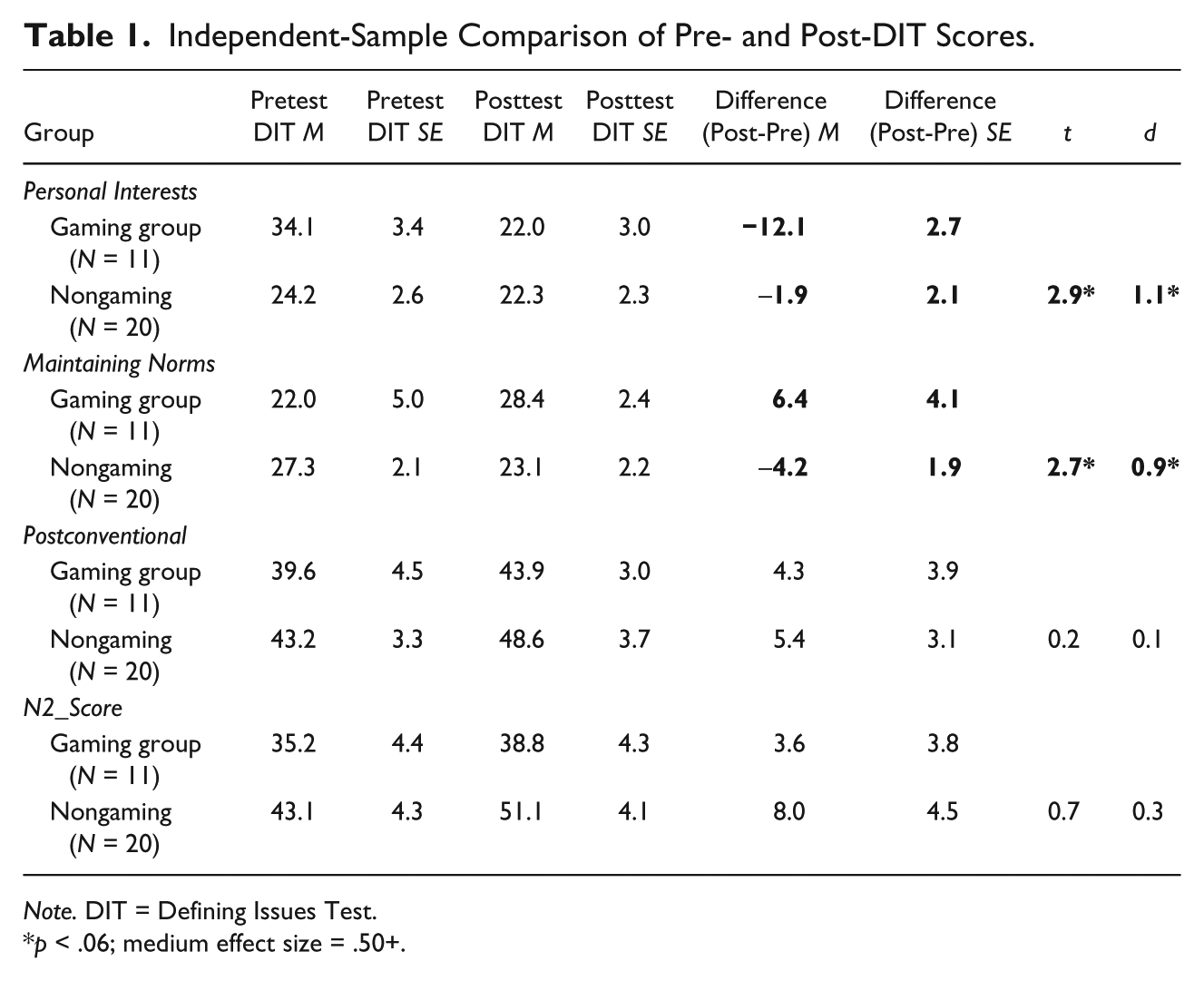
Note. DIT = Defining Issues Test.
p < .06; medium effect size = .50+.
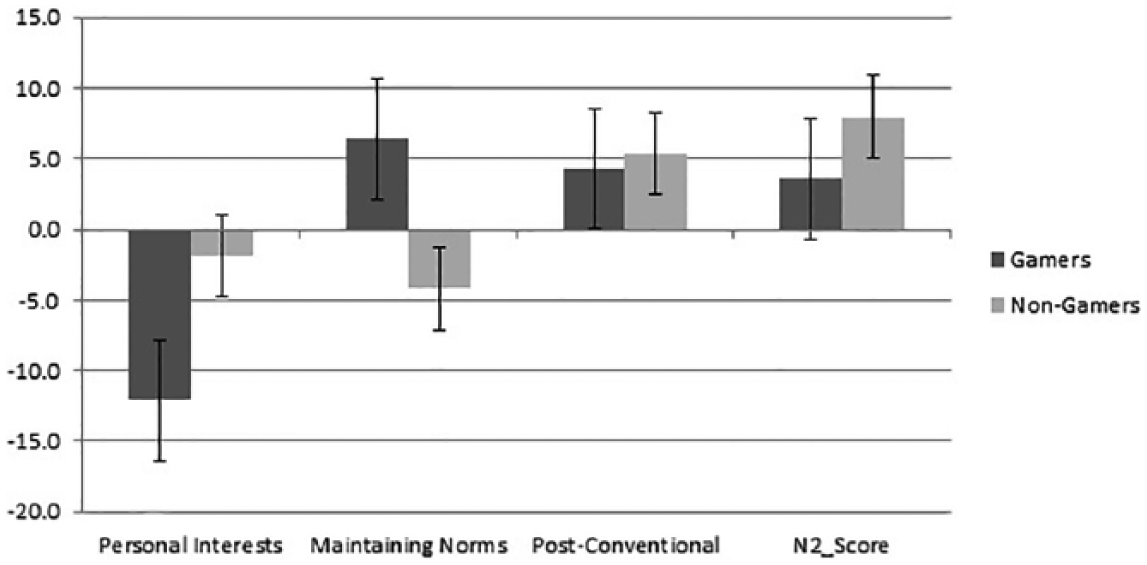
Posttest–pretest differences in Defining Issues test (DIT) for gamers and nongamers.
Value Orientation (SUI)
We used independent-sample t tests to compare participants’ pre- and postsurvey Self-enhancement (agency), Self-transcendence (community), and Integrated scores across the gaming and nongaming groups. This revealed that the gaming group had a higher presurvey Self-enhancement score than the nongaming group, 3 but this difference was no longer present in the postsurvey—while the gaming group’s Self-enhancement score decreased between the pre- and postsurvey, it increased for the nongaming group, and this difference was significant. In addition, the nongaming group also showed a reduction in their Self-transcendence scores, while the gaming group did not. This means that the gaming group’s value-orientation displayed a similar shift as was seen in their moral reasoning. Specifically, the gaming group showed a shift away from their own personal interests, as seen in the decrease of both their use of Personal Interests reasoning and the promotion of their own self-interests. The nongaming group, on the other hand, displayed a shift toward the promotion of their own self-interests and away from the promotion of others’ interests (Tables 2 and 3; Figure 2).
Independent-Sample Comparison of Pre- and Post-SUI Scores.
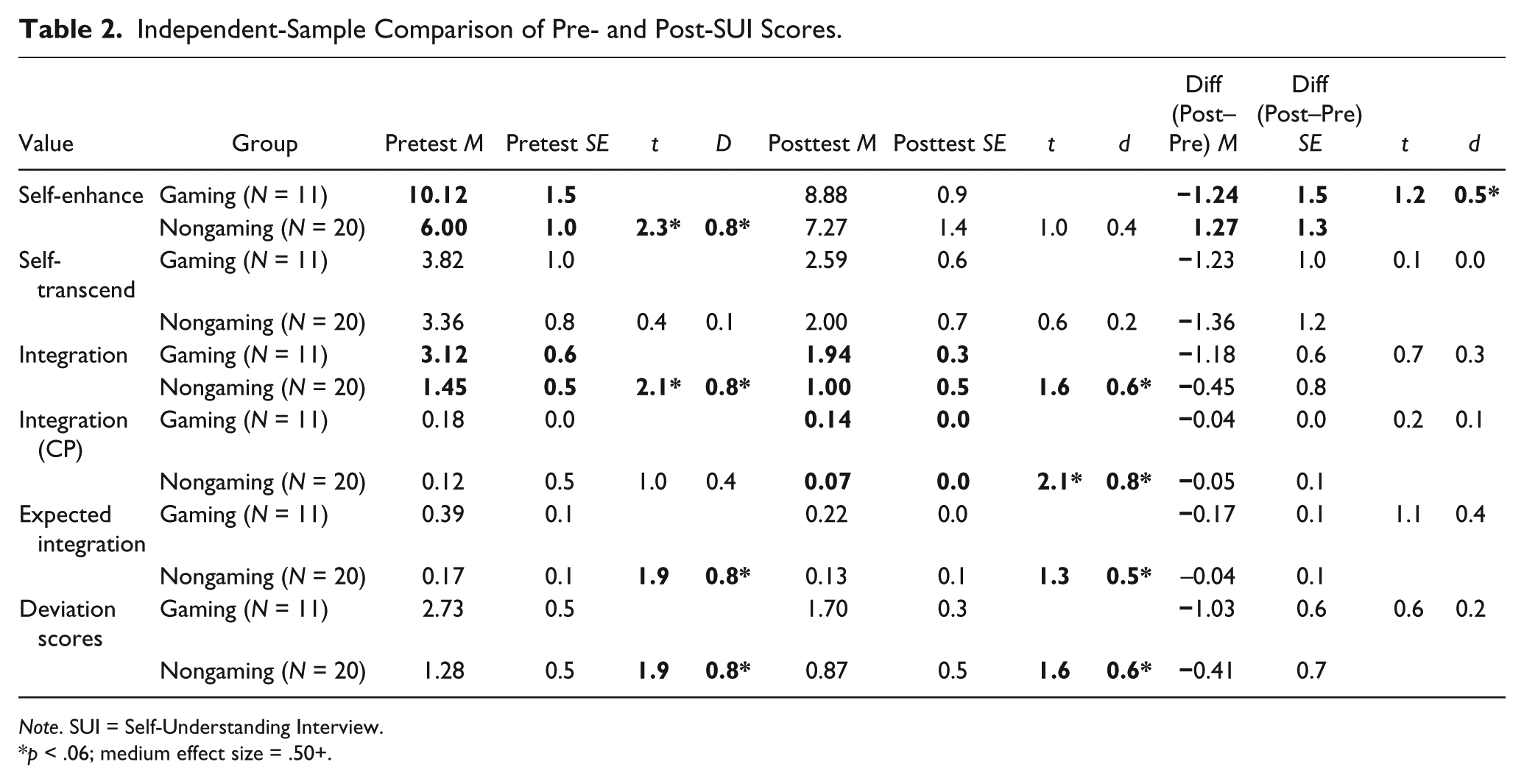
Note. SUI = Self-Understanding Interview.
p < .06; medium effect size = .50+.
Paired-Sample Comparison of Pre-SUI and Post-SUI Scores.
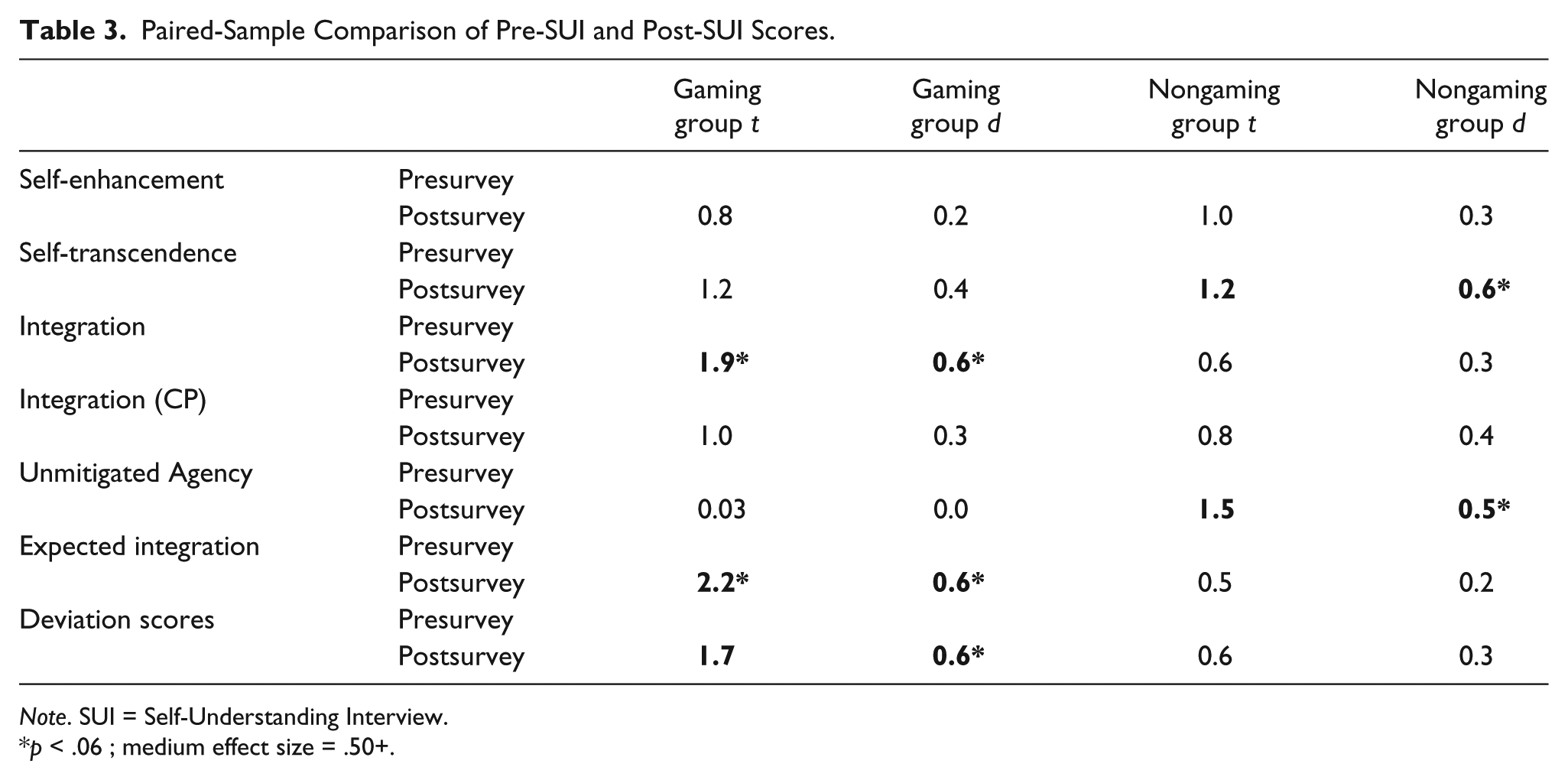
Note. SUI = Self-Understanding Interview.
p < .06 ; medium effect size = .50+.
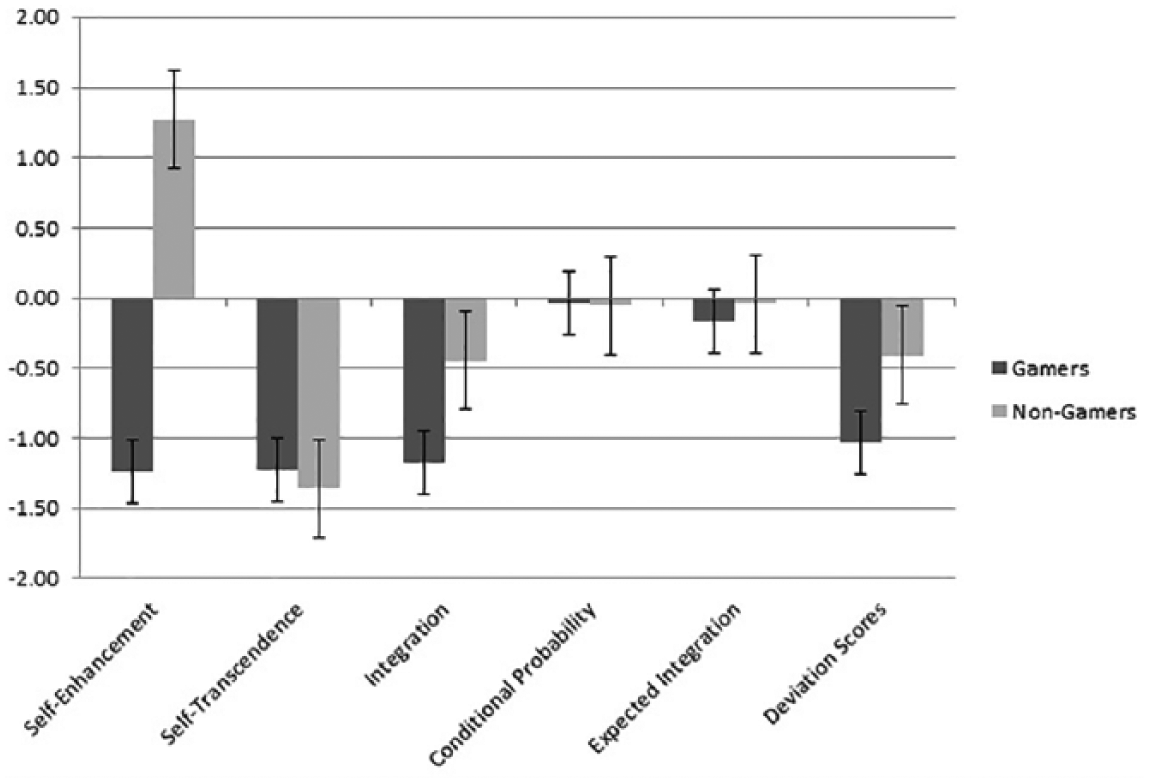
Posttest–pretest differences in Self-Understanding interview (SUI) for gamers and nongamers.
Interestingly, when measured in terms of frequency, the gaming group also showed higher levels of both presurvey and postsurvey integration than the nongaming group. And paired-sample t tests comparing the presurvey to postsurvey differences in Integration scores for both groups revealed that the gaming group (but not the nongaming group) showed a reduction in their Integration scores (Tables 2 & 3; Figure 2). This finding runs contrary to our original hypothesis: Though it does show the gaming group to be higher in their level of integration, this does not appear to be a function of the gaming (and, indeed, they display a decrease—not an increase—in integration at the end of the study).
Of course, this reduction could be a side-effect of a parallel reduction in their Self-enhancement scores—with fewer expressions of agency values, there would likewise be fewer opportunities for integration. And this interpretation finds support in an examination of the Conditional Probability score. The gaming group showed greater postsurvey integration (relative to their opportunity to do so) than the nongaming group. Even more important, not only did the gaming group have higher Deviation scores (i.e., a higher level of integration than was expected) than the nongaming group in both the pre- and postsurveys, but their degree of integration was also significantly higher than expected in both the pre- and postsurveys, while the nongaming groups’ degree of integration was only higher than expected in their presurvey—by the postsurvey, their level of integration was not different from expectation (Table 4). What is more, comparing the Unmitigated Agency scores for both groups revealed that, while the level of unmitigated agency increased for the nongaming group, it remained stable for the gaming group (Table 3).
Comparison of Actual With Expected Integration.
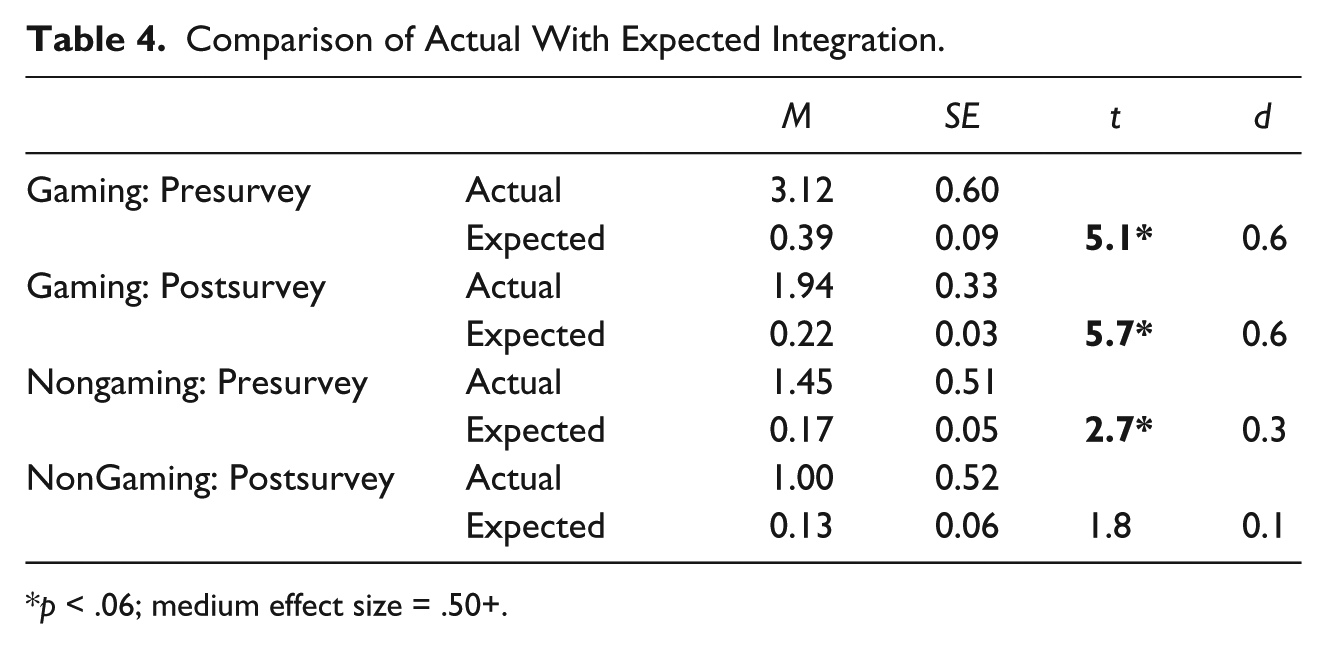
p < .06; medium effect size = .50+.
Discussion
The shift in Personal Interests and Maintaining Norms reasoning scores, alongside the shifts in value orientation, indicates that the imaginative role-play gaming group experienced a degree of moral growth not displayed by the nongaming group. At the heart of this growth is the gaming group’s display of less interest in low-level (personal interest) moral reasoning and values. While the gaming group (especially those without previous gaming experience) showed a higher level of personal-interest reasoning and value orientation at the beginning of the study than did the nongaming group, by the end of the gaming sessions, they were on par. The upward shift in norm maintenance reasoning indicates that the gaming group also used more mid- to high-level moral reasoning than the nongaming group, displaying a shift away from concern for their own interests and individuality to an increased concern for their connection to others through shared group norms and values. Finally, both groups displayed comparable upward movement in their postconventional reasoning, with the gaming group displaying a greater shift into a postconventional developmental category than the nongaming group.
Of course, the increase in moral integration we had hypothesized did not materialize. While the gaming group did display—and maintain—a higher level of integration (both in absolute and relative terms) than the nongaming group, they did so from the beginning, suggesting that the gaming itself did not increase it. Yet while we found no evidence that integration increased as a function of the gaming experience, we did find evidence that (unlike the nongaming group) the gamers’ level of integration and unmitigated agency remained stable. This suggests that the gaming experience may have served a protective, rather than a developmental, function—namely, one of buffering the gamers’ integration from a natural backward shift experienced by the nongaming participants. As Frimer and Walker (2009) discuss, the tension between agency and community values ultimately requires a developmental resolution, one trajectory of which leads to unmitigated agency. It is possible that gaming provided a buffer against this outcome, especially during a life-stage when people are particularly vulnerable—recent studies suggest that college students are particularly vulnerable to ego-inflation, self-esteem, and narcissism, and that the rates of narcissism, as measured by the Narcissistic Personality Inventory, have increased over time (Twenge & Crocker, 2002; Twenge, Konrath, Foster, Campbell, & Bushman, 2008).
In summary, our findings—though preliminary—support the contention that imaginative role-playing games can serve as an enjoyable medium for promoting (and protecting) moral growth. In particular, gaming that involves the encounter of morally relevant situations appears to facilitate a shift away from concern for one’s own personal interests and toward the interests of others, both in one’s reasoning about moral scenarios and in the expression of one’s values. In addition, gaming may also facilitate stronger development in postconventional reasoning, especially for individuals who are developmentally immature (relative to their relevant demographic group).
While the reason why the gaming group displayed an initially higher personal interest reasoning and value-orientation (as well as less postconventional development) than the nongaming group is unclear 4 it nonetheless suggests that imaginative gaming structures may be particularly effective as interventions for “at-risk” youth, who typically display lower levels of moral reasoning and higher disregard for the interests of others. We are working with a local nonprofit organization that serves at-risk children and adolescents to test this hypothesis.
The impact of imaginative role-play gaming structures on adult moral development is consistent with the skill model of virtue ethics (Annas, 1995; Narvaez & Lapsley, 2009), which treats virtue as something that can only be developed through practice. Imaginative role-playing games can serve as a form of moral practice—the gaming group made greater advancements while gaming than the nongaming group did without it. These findings are consistent with general themes in skill acquisition (Ericsson & Ward, 2007). Finally, this study demonstrates that the presence of violence, in the form of fighting and intergroup conflict, is not always a negative thing—that, when encountered and used with potentially prosocial motives (fighting against evil forces), or even within the context of genuine moral dilemmas (using torture on an enemy to gain important information), it can promote (or at least not interfere with) moral growth.
Of course this study had important limitations. For one, it examined the influence of imaginative role-playing games in an “unmediated” context only, so we do not yet know whether the same effects could be achieved through an interactive, online format (such as an online version of D&D)—though previous research on the potential prosocial effects of online games (Gentile et al., 2009; Saleem et al., 2012a, 2012b) suggests that it could, especially if the format allowed for (1) real-time interaction with team members and (2) a meaningful integration of game play and moral content (Raphael, Bachen, Lynn, Baldwin-Philippi, & McKee, 2010). In addition, our study had a small sample size and unequal gender distribution. Though most studies have shown no gender differences in DIT-2 results, some have shown gender differences in student populations (Herington & Weaven, 2008). Also, for practical reasons, it was not possible to randomly assign participants to either the gaming or the nongaming group, making the design of the study not purely experimental (though few real-world interventions are). This means we can only draw our conclusions with caution. Future research will be needed to address these limitations. Nonetheless, our findings provide preliminary evidence that imaginative role-playing games can function as an engaging, interactive “moral training ground” capable of promoting moral development.
Footnotes
Appendix A
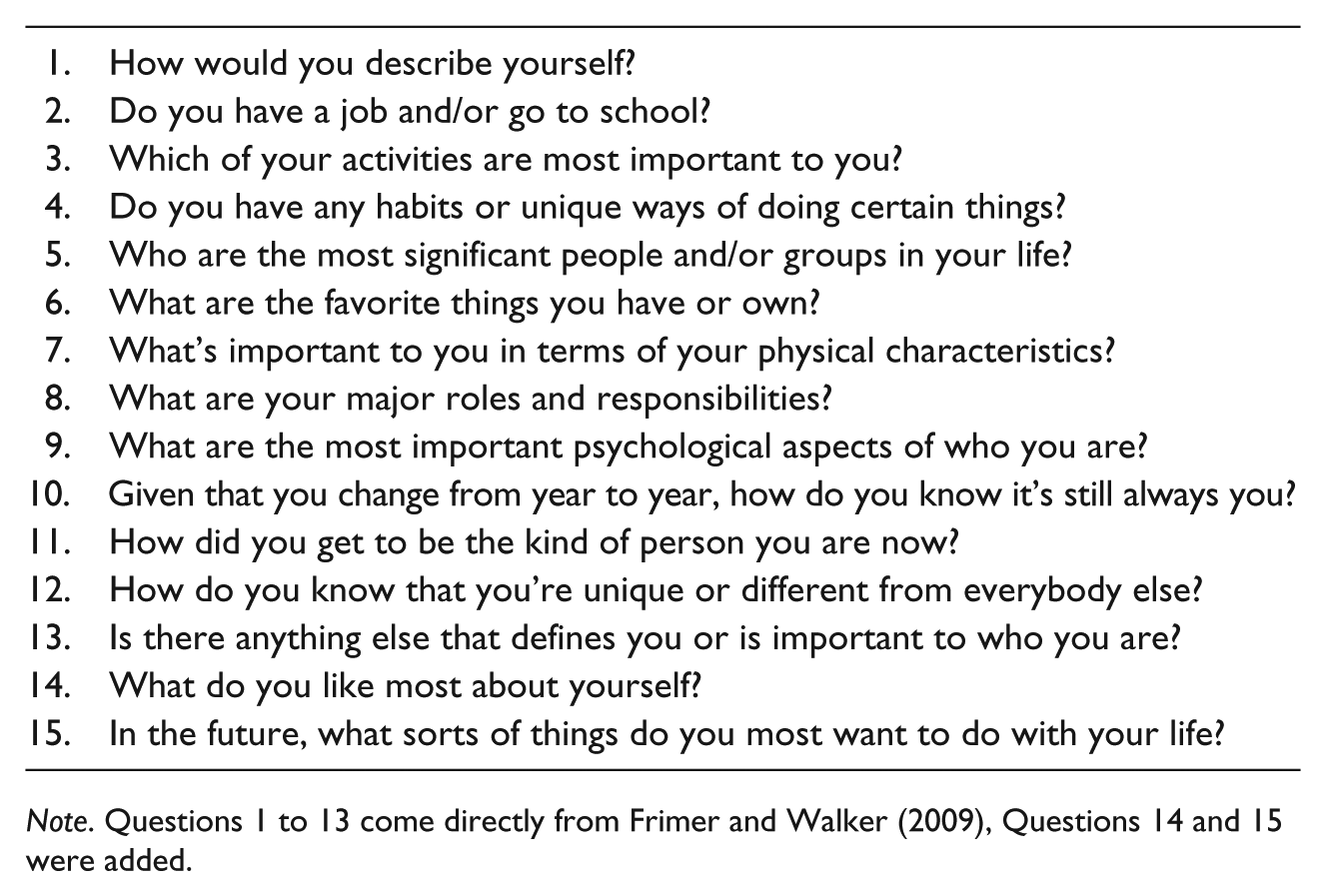
| 1. How would you describe yourself? |
| 2. Do you have a job and/or go to school? |
| 3. Which of your activities are most important to you? |
| 4. Do you have any habits or unique ways of doing certain things? |
| 5. Who are the most significant people and/or groups in your life? |
| 6. What are the favorite things you have or own? |
| 7. What’s important to you in terms of your physical characteristics? |
| 8. What are your major roles and responsibilities? |
| 9. What are the most important psychological aspects of who you are? |
| 10. Given that you change from year to year, how do you know it’s still always you? |
| 11. How did you get to be the kind of person you are now? |
| 12. How do you know that you’re unique or different from everybody else? |
| 13. Is there anything else that defines you or is important to who you are? |
| 14. What do you like most about yourself? |
| 15. In the future, what sorts of things do you most want to do with your life? |
Note. Questions 1 to 13 come directly from Frimer and Walker (2009), Questions 14 and 15 were added.
Appendix B
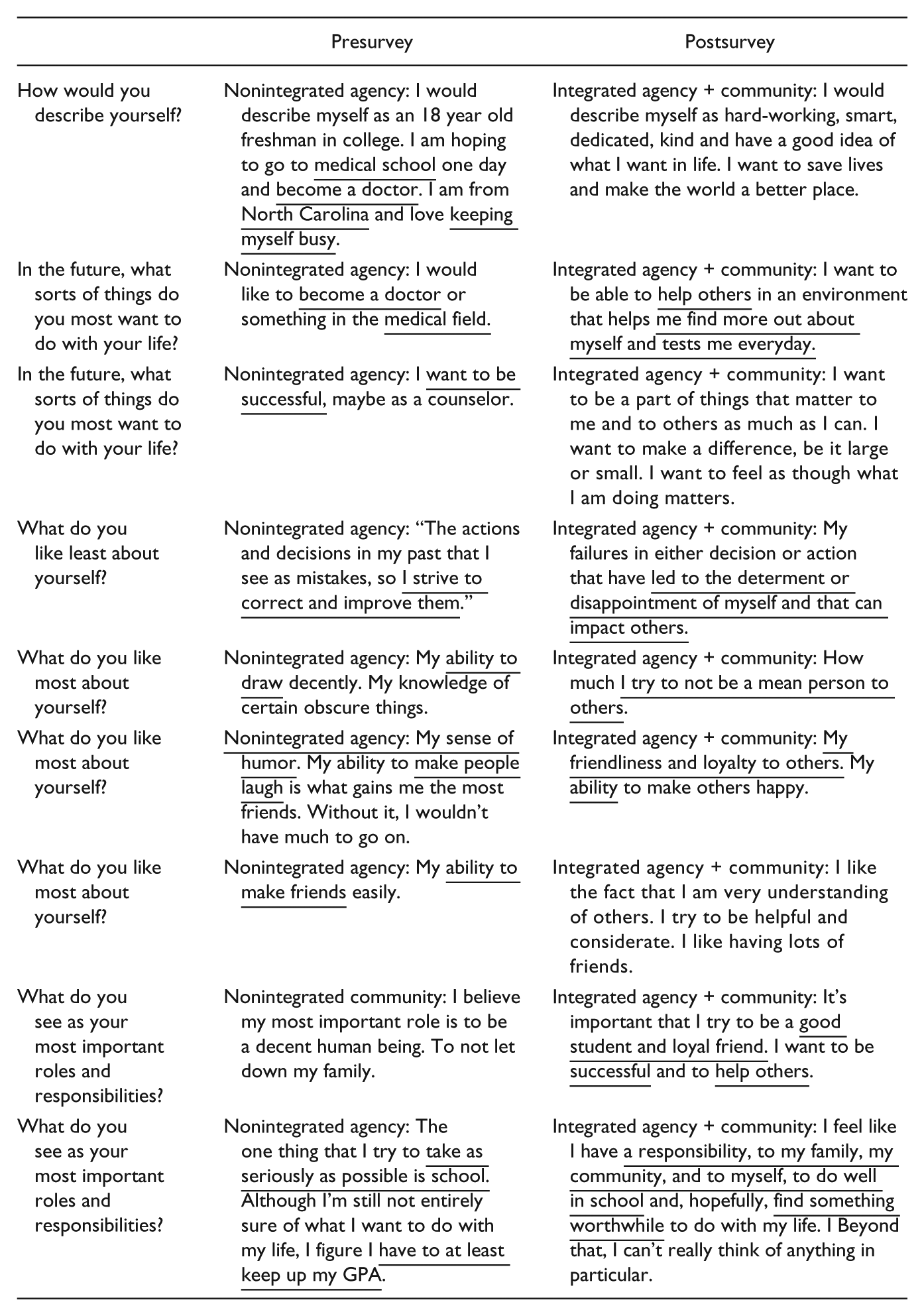
| Presurvey | Postsurvey | |
|---|---|---|
| How would you describe yourself? | Nonintegrated agency: I would describe myself as an 18 year old freshman in college. I am hoping to go to |
Integrated agency + community: I would describe myself as hard-working, smart, dedicated, kind and have a good idea of what I want in life. I want to save lives and make the world a better place. |
| In the future, what sorts of things do you most want to do with your life? | Nonintegrated agency: I would like to |
Integrated agency + community: I want to be able to |
| In the future, what sorts of things do you most want to do with your life? | Nonintegrated agency: I |
Integrated agency + community: I want to be a part of things that matter to me and to others as much as I can. I want to make a difference, be it large or small. I want to feel as though what I am doing matters. |
| What do you like least about yourself? | Nonintegrated agency: “The actions and decisions in my past that I see as mistakes, so |
Integrated agency + community: My failures in either decision or action that have |
| What do you like most about yourself? | Nonintegrated agency: My |
Integrated agency + community: How much |
| What do you like most about yourself? | Integrated agency + community: |
|
| What do you like most about yourself? | Nonintegrated agency: My |
Integrated agency + community: I like the fact that I am very understanding of others. I try to be helpful and considerate. I like having lots of friends. |
| What do you see as your most important roles and responsibilities? | Nonintegrated community: I believe my most important role is to be a decent human being. To not let down my family. | Integrated agency + community: It’s important that I try to be a |
| What do you see as your most important roles and responsibilities? | Nonintegrated agency: The one thing that I try to |
Integrated agency + community: I feel like I have |
Appendix C
Declaration of Conflicting Interests
The author(s) declared no potential conflicts of interest with respect to the research, authorship, and/or publication of this article.
Funding
The author(s) received no financial support for the research, authorship, and/or publication of this article.