



Abstract
Spirituality is a basic human drive with diverse forms of expression that make for unique thinking and as such, it is the ultimate end of human development. Constituents of spirituality may best be delineated by the humanistic perspective as it readily meets the demands of the not-so-religious today. The proposed Humanistic Spirituality Inventory is based on the humanistic spirituality model, which captures spirituality’s content domain. The inventory contains three scales corresponding to the three model components: (1) Self-actualization, which implies a mature perception of reality, spontaneity, creativity, peak experiences, personal growth, detachment, Gemeinschafsgefühl, and profound interpersonal relations; (2) Transcendence, which implies belief in the supernatural reality, self-transcendence, and a holistic approach to Being; and (3) Ultimate Meaning in Life, which entails the awareness of faith-inspired directedness and ontological significance of life. The current study (N = 331) explores the development and psychometric properties of the instrument, that is, its content and construct validity as well as internal consistency and test–retest reliability. The results of the study support the good psychometric properties of the Humanistic Spirituality Inventory and suggest that it can be used as a proper measure in the assessment of this phenomenon.
Introduction
Although empirical studies on the role of spirituality in human experience have received due attention and increased in number during the past few decades, disagreement continues about the nature of spirituality per se. Descriptions and definitions of spirituality may lead to confusion as authors often fill the term with their own meaning. Shields, Edwards, and Sayani (2005, p. 8) argue that spirituality “functions as an epistemology. That is, spiritualities are systems of explanation providing the framework for people to interpret their own life-world and formulate knowledge and truths from their experiences.” Spirituality may also be viewed as a basic human drive, albeit with diverse forms of expression that make for unique thinking and as such, it is the ultimate end of human development.
This article builds on one particular spirituality perspective, the humanistic spirituality, as we believe this approach best meets the demands and realities of the not-so-religious today. It could be argued that of all the current perspectives, the humanistic stance is best suited for delineating the constituents of spirituality. Schneider, Bugental, and Pierson (2015) note that the humanistic approach with its emphasis on human development and the emerging trends of humanistic neuropsychology, humanistic eldercare, and an evolving dialogue with cognitive science and technological culture is now a growing influence from Europe to Asia. This approach is influencing the new emphasis on personal factors and the burgeoning attraction to the psychology of well-being and spirituality (Schneider et al., 2015). Schneider et al. (2015) also state that humanistic psychology “remains a powerful force for psychospiritual wholeness, for the larger view, and for the depth of inquiry that few singular disciplines attain” (p. xvi). These are not incontestable words of course, but they inspire humanistic theorists to work toward a comprehensively humanizing perspective, one that resists the fragmentary and embraces the whole. Moreover, as Vasconcellos (2015) puts it, whereas the first American Revolution established our right to self-determination, the next revolution demands self-actualization. “Simply said, the humanistic view of the self must become the organizing vision and ethic of our times and of our lives” (pp. xiii-xiv).
Importantly, humanistic spirituality is often conceptualized as a rather secular approach which nonetheless allows integration of personal theistic beliefs and gives a new meaning to the essence of spirituality: Most emphasis herein is laid on the transcendence dimension and a person‘s ability to develop mature relationships with the self, other people, nature, and the Universe. In view of all this, the purpose of this article is to (1) explore the current models of spirituality, (2) present a new humanistic model of spirituality, (3) present a new measure of humanistic spirituality, and (d) explore its psychometric properties.
Current Models of Spirituality
Historically, Western culture has viewed spirituality and religion as going hand in hand but this tendency may be changing as often it does not reflect the reality of many people who would say that traditional religion has failed to meet their spiritual needs and would call themselves spiritual, though not religious. While a growing number of researchers contend that religion and spirituality are related but different constructs (e.g., Hill et al., 2000), the two terms are often treated as synonyms and used interchangeably and/or presented as a conceptual fusion “religion/spirituality” (MacDonald, 2009). Religion is generally seen as relating to beliefs, doctrines, and practices associated with membership in a religious institution (Plante & Sherman, 2001). Spirituality, in contrast, is considered to entail an experientially grounded sense of connection with the “sacred,” “transcendent,” “numinous,” or some form of higher power or intelligence (Elkins, 1998; Grof & Grof, 1990). Thus, religion and spirituality today are studied as discrete entities, all because of increasing secularization in Western culture (Zinnbauer, Pargament, & Scott, 1999). This tendency has resulted in the increase in popularity of secularized views. McSherry and Cash (2004) note that there may be two main forms of spirituality: the historical or “old” traditional form based on religious and theocentric descriptors and the new “postmodern form” emerging as a result of cultural change. The latter contains an infinite number of descriptors that may be phenomenologically and existentially determined, such as meaning and purpose in life, creativity, and relationships.
Although there is no single conceptualization and definition of spirituality, it is still possible to create a common understanding of this phenomenon from its diverse definitions. For example, spirituality is defined as the deepest values and meanings by which people seek to live, it implies some kind of vision of the human spirit and of what will assist it to achieve full potential (Sheldrake, 2007); spirituality is experienced as a source of inspiration which gives direction to one’s life (Waaijman, 2002). Spirituality could also be viewed as psychological growth and emotional maturity, in this sense, it is the antithesis of pseudoinnocence as it entails the capacity to see life as it is—wholly, including the existential realities of evil and suffering and to love life nonetheless (Diamond, 1996).
There is also a considerable degree of variability in the models of spirituality and its measures (see Kapuscinski & Masters, 2010; MacDonald, Kuentzel, & Friedman, 1999), some of which treat spirituality as a one-dimensional construct (e.g., Corrington, 1989; Kass et al., 1991) and others as a multidimensional one (e.g., Elkins et al., 1988; Howden, 1992; MacDonald, 2000). Within the latter models, which have become more prominent in spirituality research since the 1990s, the number of dimensions range from 2 (Ellison, 1983) to 18 (World Health Organization, 1998), with only some obvious correspondence in their content. To help the reader appreciate the diversity of possible conceptualizations of spirituality, Table 1 presents the components of six different models available to date. Importantly for the current study, one of the models (Elkins et al., 1988) is based on the humanistic approach to spirituality. It includes nine components and views spirituality as different from an affiliation with traditional religion.
Multidimensional Models of Spirituality.
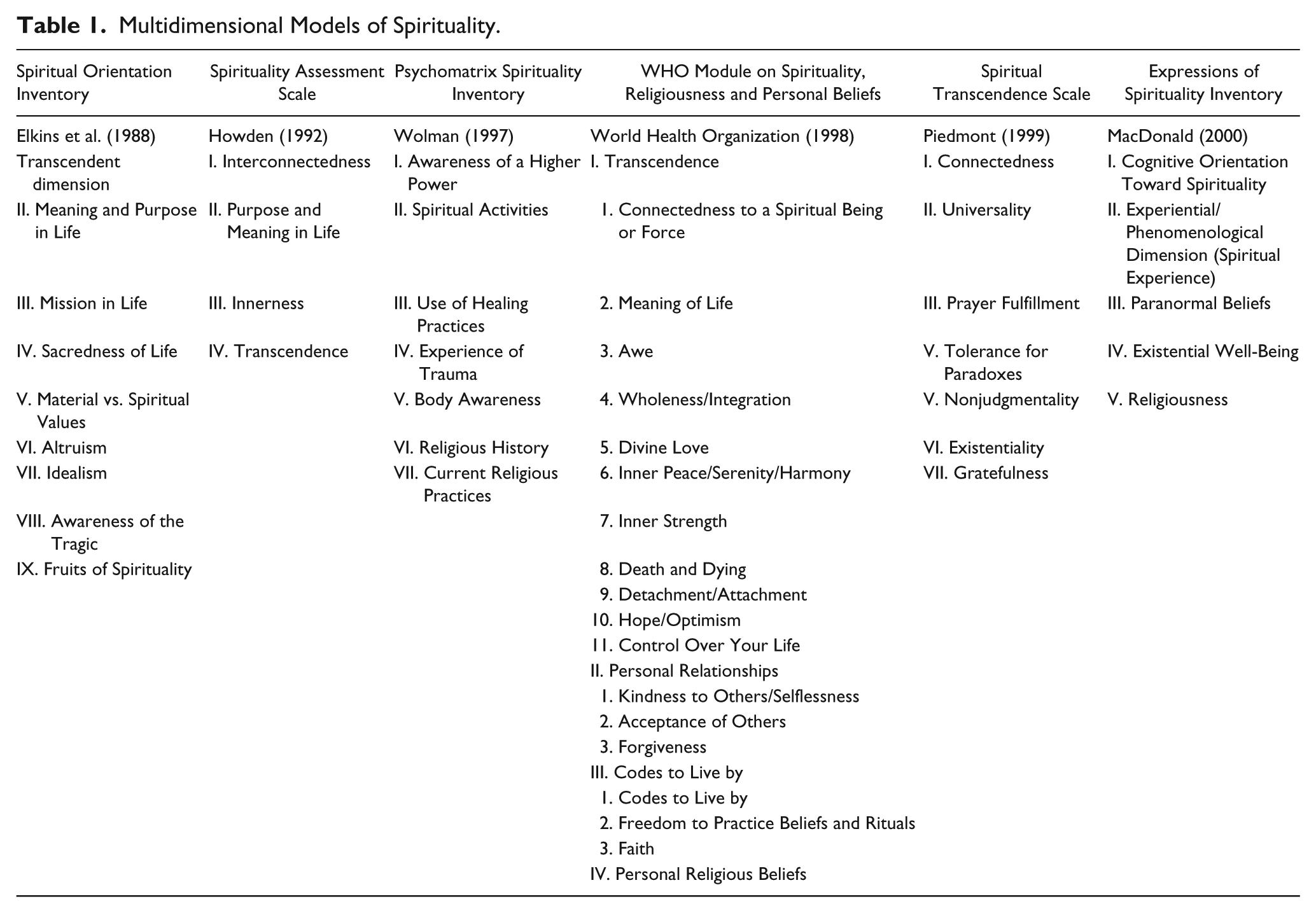
Apparently, there is only some overlap in the number and content of composite dimensions or components in the proposed models, which explains why there is no single unifying definition of the construct. On the other hand, it may be contended that the availability of a variety of models is to the benefit of science since it permits to discern common denominators in the diverse conceptualizations of spirituality, thereby arriving at a deeper understanding of this phenomenon.
One such commonality shared by all the proposed views is belief in the higher power, even though it is called differently in the models, for example, the transcendence dimension (Elkins et al., 1988), transcendence (Howden, 1992), prayer fulfillment (Piedmont, 1999), awareness of a higher power (Wolman, 1997), religiousness (MacDonald, 2000), or connectedness to a spiritual being or force (World Health Organization, 1998).
Another component present in four of the six models is meaning in life, though in the World Health Organization model, it is not a separate component but a subcomponent of the transcendence domain, whereas in MacDonald’s model, it is referred to as existential well-being. Other dimensions and components of spirituality are viewed rather differently and capture the aspects of innerness, selflessness, self-fulfillment as well as depth, broadness, and maturity of thinking. All those necessary ingredients are included in the humanistic spirituality model presented in the next section of this article.
The Proposed Humanistic Spirituality Model
Our model captures the content domain of spirituality as each of its components embodies a substantive and indispensable aspect of the construct. The model is theory driven and provides an enlarged definition of spirituality which does not equate it merely with narrow religious beliefs or practices but includes the dimension of psychological health. It rests on the writings of Abraham Maslow (1944/1970, 1971/1993, 1961/1999), David Elkins (1998, 2015; Elkins et al., 1988), Merold Westphal (2004), and others. The model envisions the spiritual becoming of the human enabled by self-actualization and transcendence, which make for the formation of a meaning in life that is ultimate and inspired by one’s inner harmony and belief in the higher power. Hence, the model contains three major components: self-actualization, transcendence, and ultimate meaning in life as presented below.
The first component of the humanistic spirituality model is self-actualization. As it is commonly known, the construct of self-actualization has been developed in the humanistic approach to describe successful and functioning individuals, that is, people who are mentally and psychologically healthy. Abraham Maslow (1971/1993) referred to self-actualization as a syndrome—the kind of pattern that seemed to fit certain individuals who shared similar qualities. Importantly, self-actualizing people are “simultaneously very spiritual and very pagan and sensual” (Maslow, 1944/1970, p. 179). According to Maslow, The so-called spiritual or value-life, or “higher” life, is on the same continuum (is the same kind or quality of thing) with the life of the flesh, or of the body, i.e., the animal life, the material life, the “lower” life. That is, the spiritual life is part of our biological life. It is the “highest” part of it, but yet part of it. The spiritual life is then part of the human essence. It is a defining characteristic of human nature, without which human nature is not full human nature. It is part of the Real Self, of one’s identity, of one’s inner core, of one’s specieshood, of full humanness. (1971/1993, p. 314)
Paradoxically, our “highest nature” is also our “deepest nature,” and the so-called spiritual (or transcendent, or axiological) life is clearly rooted in the biological nature of the species. “It is a kind of ‘higher’ animality whose precondition is a healthy ‘lower’ animality, that is, they are hierarchically integrated (rather than mutually exclusive)” (Maslow, 1971/1993, p. 315).
Maslow (1971/1993, p. 42) describes self-actualizing individuals, who have reached this highest life, who are driven by metaneeds and live by Being-values (seen as gratifications of metaneeds and also the highest pleasures or happinesses that we know of), as “very fine and healthy people, strong people, creative people, saintly people, sagacious people” involved in a cause outside their own skin, in something outside of themselves. They are working at something that is very precious to them—some calling or vocation in the old sense, the priestly sense, so that the work–joy dichotomy in them disappears. They devote their lives to the search for the aforementioned “Being” values (“B” for short), the ultimate values which are intrinsic and cannot be reduced to anything more ultimate. 1 Unlike the biological needs, B-values are not hierarchical in and of themselves. One is as important as the next and each one can be defined in terms of all the others: truth, for example, must be complete, aesthetic, comprehensive, and even funny. In addition, B-values are not separate piles of sticks, but rather the different facets of one jewel and they behave like metaneeds, whereas their deprivation breeds certain kinds of metapathologies—the sicknesses of the soul which come, for example, from being deprived of truth and, consequently, not trusting anyone.
Self-actualization is also a matter of degree, or little accessions accumulated one by one. Maslow (1944/1970) ascribed 15 most important, whole characteristics to a self-actualizing person, these are a more efficient perception of reality and more comfortable relations with it; acceptance of self, others, nature; spontaneity, simplicity, naturalness; problem centering; the quality of detachment and the need for privacy; autonomy, independence of culture and environment, will; continued freshness of appreciation; the mystic experience, the peak experience; Gemeinschaftsgefühl (social interest); interpersonal relations; a democratic character structure; discrimination between means and ends, between good and evil; a philosophical, unhostile sense of humor; creativeness; resistance to enculturation.
Thus, a partial list of features which characterize a self-actualizing person includes involved, motivated, concerned, constructive, imaginative, confident, enriched, happy, responsible, democratic, accepting, tolerant, humble, integrated, and successful (Shostrom, 1964).
When developing the humanistic spirituality model, we strove to capture all the features of self-actualization pertinent to spirituality and delineate the content area and boundaries of this component. After a careful review of relevant writings on self-actualization, three main facets of this component were identified (openness to experience, self-fulfillment, and interpersonal relationships) as well as eight facet-delineating indicators and 17 empirical manifestations of the indicators (see Table 2).
Explication of the Components of the Humanistic Spirituality Model.

The second component of the humanistic spirituality model is transcendence. Transcendence may manifest in the traditional belief in the supernatural, the higher power, the “more than what is seen.” It can also be described as “God, the absolute, Mystery, the Other, the other as other or as alterity” (Stoker, 2011, p. 5). As Westphal (2004, p. 230) notes, “the voice of transcendence” is necessary to become “what I most immediately am not, one who loves God and neighbor.” Within the humanistic perspective, transcendence is also understood as a dimension to life whose actual content may range from the traditional view of a personal God to a psychological view that this dimension is simply a natural extension of the conscious self into the regions of the unconscious or Greater Self (Elkins et al., 1988).
As noted earlier, Maslow (1971/1993) used the concept transcendent as synonymous to spiritual and axiological and viewed transcendence as an extension of self-actualization, since self-actualization is a prerequisite for but not the final step in the becoming of an individual whom Maslow called the “transcendent self-actualizing man” (p. 260). Maslow also stated (1971/1993) that transcendence refers to the very highest and most inclusive or holistic levels of human consciousness, behaving and relating, as ends rather than means, to oneself, to significant others, to human beings in general, to other species, to nature, and to the cosmos. (p. 269)
It is a loss of self-consciousness, of self-awareness, and of self-observing, the same kind of self-forgetfulness which comes from getting absorbed, fascinated, and concentrated. In this sense, meditation or concentration on something outside one’s own psyche can produce self-forgetfulness and loss of self-consciousness; thus, it is transcendence of the ego or of the conscious self.
Transcendence also allows to further a cause beyond the self (this may involve service to others, devotion to an ideal or a cause, and/or a desire to be united with what is perceived as transcendent or divine; Koltko-Rivera, 2006) and to experience a communion beyond the boundaries of the self through peak experience; this, according to Maslow (1987, p. 165), is a “tremendous intensification of any of the experiences in which there is loss of self or transcendence of [self]” and may involve mystical experiences or experiences with nature, aesthetic experiences, sexual experiences, and/or other transpersonal experiences.
Transcendence necessarily implies self-transcendence, or, as Westphal (2004) says, it is in strict correlation with human self-transcendence. Self-transcendence entails the ability to go beyond a prior form or state of oneself, to transcend a purely egoistical approach to or preoccupation with oneself and thus surpass current limitations in one way or another, physically or mentally, to become closely involved with the external world and, ultimately, with the transcendent God. In Maslow’s words (1971/1993, p. 259), such a transcendence in the metapsychological sense is “transcending one’s own skin and body and bloodstream, as in identification with the B-values so that they become intrinsic to the Self.” It is rising to the Being cognition, when bitterness, rebelliousness, anger, and resentment disappear, when one embraces the past and the future, transcends his ego, lower needs, selfishness, and so on, and becomes reconciled with the necessity of death and pain, thereby accepting the natural world, remaining clean even in the midst of filth, and ascending to the level of synergy.
The development of this component yielded two main facets, transcendence to the supernatural reality and rising to the realm of Being as well as three facet-delineating indicators and seven empirical manifestations of the indicators (see Table 2).
The third component of the humanistic spirituality model is ultimate meaning in life. A person’s understanding of meaning in life determines for the most part his or her interpretation of the most important questions in life (the nature of life and death, the meaningfulness of suffering and pain, etc.) and, hence, the course and trajectory of his/her spiritual development. It goes without saying that meaning in life could be defined in myriads of ways. Existential psychologist Viktor Frankl (1992, p. 112) even argued that to put the question of what constitutes meaning in life in general terms would be comparable with the question posed to a chess champion: “Tell me, Master, what is the best move in the world?” However, within the framework of the humanistic approach, the question of meaning in life should not be viewed so relativistically as it draws on the Kantian philosophy among others, according to which the categorical imperative expresses a general, unavoidable requirement for everyone to follow, thereby affording a universal understanding of meaning in life that is sculpted by highest spiritual values, the Being-values. If we neglect these, we fail to create an ultimate and pure meaning in life and tend to fall into what Maslow called metapathology, a pathology which is the direct result of deprivation at the spiritual level.
The becoming of the highest values one’s innermost essence enables maturity of personality and spiritual growth, or, in other words, self-actualization and transcendence to spiritual heights and depths of the soul, which allows the creation of an ultimate and pure meaning in life. This also enables one to sense what James (2009 [1902]) called the unseen order, which breaks into our consciousness through mystical experiences, religious conversions, or deep spiritual inspirations. Stated differently, the quality of one’s meaning in life depends on how loaded it is with sacred experience (see Elkins, 1998), which could be defined in numerous ways—Rudolph Otto (1961) called it the feeling response of the believer, the numinous experience, mysterium tremendum et fascinans; Mircea Eliade (1961) called it hierophany, or something sacred showing itself to us, which is recognized as something of a different order, a reality that does not belong to our world, something wholly different from the profane, that which is the “really real”; Martin Buber (1970) called such experience the sacred I–Thou relationship, in which Thou could be not only an object or a person but also God, the Eternal Thou and in which through grace and eternity intersecting time one touches the sacred and has his soul dance and change his approach to life; Maslow (1971/1993) associated sacred experience with peak experiences—times of intense bliss, joy, ecstasy, and awe, which transport the person out of the ordinary consciousness to the realm of Being, to the opening of the soul and ability to see the close and the remote in a sacred light, to the opening of transcendent reality and a deep perception of Being-values that constitute the meaning of life for healthy people; David Elkins (1998) calls the sacred a powerful dimension of life which manifests itself through poignant moments, the aforementioned peak experiences, or mystical encounters. If these sacred experiences nurture the human soul continually, a natural outcome is spiritual growth.
Thus, it could be stated that such perceptions of the spiritual dimension of sacredness and transcendence expressed through the belief in the supernatural and the higher power (God) pave the way to personal meaning matrices, whereby a person finds strength in the inner light that directs him in the face of any adversity. Ultimate faith-inspired meaning in life provides a coloring to every relationship and every event in life and helps one to envision the highest purpose in life, which is spiritual growth and becoming.
The development of this component yielded one main facet, highest meaning making, as well as one facet-delineating indicator and three empirical manifestations of the indicators (see Table 2).
The humanistic spirituality model served as the basis for the creation of a measure of humanistic spirituality, the Humanistic Spirituality Inventory (HSI). One of the purposes of the present study was to explore how well the measure captures the broad scope of the phenomenon in question and validate it.
Method and Results
The validation of the HSI consisted of several phases. The first phase addressed the development and content validity of the inventory, the second, its construct validity, while the third focused on the internal consistency and test–retest reliability of the instrument.
Phase 1: Development and Content Validity Testing
Procedure
Initially, 121 items were constructed to capture the facet indicators and empirical manifestations of the three core components of the humanistic spirituality model, between two and four for each manifestation, with some reverse-coded items when relevant. Four judges, two experts who have contributed greatly to the field of spirituality research in Lithuania and two other experts, a catholic monk and a yoga teacher both involved in spiritual practices, were asked to judge the appropriateness of the items according to their accuracy in characterizing each of the indicators and manifestations as operationalized within the framework of the model; the judges also gave suggestions for refinement of the item pool.
Results
After a careful analysis and deliberation, 56 items were selected which met criterion and, hence, were retained in the inventory: 34 for self-actualization, 14 for transcendence, and 8 for ultimate meaning in life. There was a 100% agreement among the judges on more than three quarters of these items. This considerable amount of agreement that the selected items accurately reflect the three key constructs of the HSI suggests an adequate content validity of the inventory. Responses to each of the items are made on a 7-point Likert-type scale ranging from strongly disagree (1) to strongly agree (7). The HSI yields four separate scores for each participant: a total HSI score and scores for self-actualization, transcendence, and ultimate meaning in life. The higher the score, the greater the appraised level of each. Other psychometric properties of the inventory were analyzed in the following phases of the study.
Phase 2: Construct Validity Testing
Participants
The next phases of the study used data collected from 331 participants, 137 (41%) males and 194 (59%) females, with a mean age of 31.2 years (SD = 14.2, range: 18-71 years); 165 participants were undergraduate students from different study programs at Vilnius University, the other 166 participants were not university students and mostly older in age, 134 of them (40.5% of the total sample) had university degrees. All the participants were recruited using convenience and snowball sampling methods and were debriefed about the aims of the study following participation.
Procedure 1: Factor Analysis
To explore the construct validity of the HSI, first a confirmatory factor analysis was conducted. In particular, the principal component analysis with Varimax rotation was used to see if, based on the findings of the study, the items of the inventory can be ascribed to those scales which they should make up according to the logic of the model. The Kaiser–Meyer–Olkin measure of the sampling adequacy yielded the value of .867 (Bartlett’s criterion p = .000), indicating that the factor analysis was relevant to our data. The three factors which emerged explained 36% of the total variance. It was decided to keep items with loadings slightly lower than .4 (.39) since otherwise the content validity of the scales could have been compromised. Thus, at this stage of analysis, 14 items had to be eliminated because their loadings were too low (less than .39). Another two items were dropped because they markedly decreased the internal consistency reliability of two of the three scales (see the section on reliability testing), leaving 40 items in total (the final version of the HSI is provided in the appendix).
The first factor with the eigenvalue of 10 accounts for 19% of the total variance and expresses transcendence. It comprises 10 out of the initial 14 items whose loadings were higher than .4. However, one of those items, “I feel I have to please God or He will reject me” later had to be removed from the instrument as it substantially decreased its reliability. Thus, in the final version of this scale, 9 items were retained.
It must be noted that three more items which belong to the other two scales loaded higher on this factor (“Sometimes I have moments of intense wonder and awe, when I feel as if elevated to a higher realm of being” [self-actualization]; “My meaning in life is inseparable from my belief in the higher power [God] and love” [meaning in life]; and “My faith allows me to see meaningful ties among things which are not directly related” [meaning in life]). However, it was decided to retain them in the initial scales in order to preserve the structure of the model, the more so that this was afforded by the sufficiently high loadings on their factors (.495 vs .410; .527 vs .452; .781 vs .601). Perhaps these items had higher loadings on the first (transcendence) factor because the first item measures peak experiences, which have a high degree of overlap with transcendence, whereas the other two items probe not only meaning in life but also faith, which is inseparable from transcendence, too.
The second factor characterizes self-actualization. It has the eigenvalue of 4, explains 11% of the total variance and contains 24 out of the initial 34 items whose loadings were higher than .39. The other 10 items had lower loadings not only on this but also on the other two factors, therefore they were eliminated from the inventory.
One item (“I often feel as if I transcend myself and become aware of much deeper aspects of reality”), which belongs to the Transcendence Scale, loaded higher on this factor (.592 vs .469) but it was decided to retain it in the initial scale to preserve its unity. Finally, even though one item (“One is more likely to empathize with those who empathize with him”) had a sufficient loading (.404) on this factor, it was removed from the inventory because it markedly decreased the reliability of the Self-Actualization Scale. Hence, the final version of the Self-Actualization Scale contains 23 items.
The third factor with the eigenvalue of 3 explains 6% of the total variance, includes all the 8 items of the initial Ultimate Meaning in Life Scale with loadings higher than .4 and depicts meaning in life, though, as noted above, two items loaded higher on the first factor, perhaps because they probe the connection between meaning in life and faith.
Thus, 16 items were eliminated from the inventory and the selection process yielded 40 items (see appendix) that were retained and further analyzed.
Procedure 2: Convergent Validity Testing
The next stage of the study rested on the prediction that if the HSI is a valid measure of self-actualization, transcendence, and ultimate meaning in life as constituents of spirituality, these three scales should be significantly related to other measures of the same constructs. In view of this, the convergent validity of the inventory and its separate scales was tested by calculating their correlations with other three widely recognized measures of the same constructs.
Participants
The instruments were completed by the same sample of participants (N = 331) who took part in the previous stage of the study.
Measures
The HSI validated in the current study. The inventory consists of 40 items, 16 of them scored in the reverse direction; 23 items measure self-actualization (SA; e.g., “I believe that even the biggest blows in life would not break me”), 9 items measure transcendence (Tr; e.g., “I often engage in deep reflection, meditation, and/or prayer”), and 8 items assess ultimate meaning in life (UML; e.g., “My faith allows me to see meaningful ties among things which are not directly related”). Items are rated on a Likert-type scale ranging from 1 (strongly disagree) to 7 (strongly agree).
The Short Index of Self-Actualization (SISA; Jones & Crandall, 1986), a measure of self-actualization which contains 15 items (e.g., “I do not feel ashamed of any of my emotions”) constructed in a 6-point Likert-type format anchored by strongly disagree to strongly agree.
The Spiritual Transcendence Scale (STS; Piedmont, 1999), a 24-item scale with three 8-item subscales: Prayer Fulfillment (e.g., “I meditate and/or pray so that I can reach a higher spiritual plane of consciousness”), Universality (e.g., “I feel that on a higher level all of us share a common bond”), and Connectedness (e.g., “I am concerned about those who will come after me in life”). The instrument employs a Likert-type scale ranging from 1 (strongly disagree) to 5 (strongly agree).
The Meaning in Life Questionnaire (MLQ; Steger, Frazier, Oishi, & Kaler, 2006), which examines two dimensions of meaning in life: presence and search. It includes 10 items rated on a 7-point Likert-type scale ranging from absolutely untrue to absolutely true. The Presence Scale (MLQ-P) evaluates the extent to which participants perceive their lives as meaningful (e.g., “I understand my life’s meaning”). The Search Scale (MLQ-S) measures the extent to which respondents are actively seeking meaning or purpose in their lives (e.g., “I am looking for something that makes my life feel meaningful”). Only the MLQ-P Scale is relevant for our purpose as we hypothesized that individuals who are advanced in their spiritual development have already found their meaning in life, hence they should not score high on the search for meaning (the MLQ-S Scale).
Results
The Kolmogorov–Smirnov test revealed that the total scores of the HSI and its Self-Actualization (SA) and Transcendence (Tr) scales as well as the SISA scores were distributed normally, whereas the distributions of scores of all the other scales were not normal. The obtained bivariate Pearson and Spearman correlations between the total HSI and the other three measures (see Table 3) show that the total inventory scores are significantly and moderately or rather strongly related with scores on the SISA (r = .430, p < .01), MLQ-P (r = .487, p < .01), and STS (r = .789, p < .01). Correlations between the separate HSI scales and the scales of the three instruments with values ranging from .401 to .814 are also significant and quite robust, which further proves the convergent validity of the inventory. Analysis of these correlations reveals that the weakest, even though statistically very significant, is the association between the HSI Ultimate Meaning in Life and the MLQ Presence (r = .401, p < .01). It could be that this association is not particularly strong because the HSI items, differently from those of the MLQ Presence, measure not only the presence of meaning in life, but also how much it reflects one’s belief in the higher power and the striving for spiritual advancement. The correlations between the HSI Self-Actualization Scale and SISA (r = .628, p < .01), and especially between the HSI Transcendence and STS (r = .814, p < .01) are markedly stronger, therefore it could be concluded that there is a high degree of overlap in the content of constructs measured by the HSI and the other three instruments used in this study, although they are also sufficiently independent and distinct.
Relationships Among the Humanistic Spirituality Inventory, the Meaning in Life Questionnaire, the Short Index of Self-Actualization, and the Spiritual Transcendence Scale.

Note. HSI = Humanistic Spirituality Inventory; HSI (SA) = HSI Self-Actualization Scale; HSI (Tr) = HSI Transcendence Scale; HSI (UML) = HSI Ultimate Meaning in Life Scale; MLQ-P = Meaning in Life Questionnaire–Presence of Meaning Scale; MLQ-S = Meaning in Life Questionnaire–Search for Meaning Scale; SISA = Short Index of Self-Actualization; STS = Spiritual Transcendence Scale; STS (PF) = STS Prayer Fulfillment Subscale; STS (U) = STS Universality Subscale; STS (C) = STS Connectedness Subscale.
p < .01.
Phase 3: Reliability Testing
Procedure 1: Internal Consistency Reliability Testing
In the next stage of the analysis, internal consistency of the final version of the whole instrument and its scales was measured based on data collected from the same sample of 331 participants.
Results
The following Cronbach’s alpha estimates were obtained: α = .873 for the overall HSI, α = .717 for the Self-Actualization Scale, α = .801 for Transcendence, and α = .804 for the Ultimate Meaning in Life Scale. All these values are higher than .7, therefore it can be stated that the final version of the instrument manifests acceptable internal consistency reliability.
Procedure 2: Test–Retest Reliability Testing
Finally, the test–retest reliability of the instrument was assessed. A total of 109 participants of the 331 who took part in the first stage of the study completed the instrument 2 weeks later. Following this testing session, the participants were again debriefed about the purpose of their participation.
Results
The testing sessions over the 2-week period yielded the following statistically very significant (p < .001) reliabilities: r = .92 for the total HSI, r = .864 for Self-Actualization, r = .915 for Transcendence, and r = .880 for Ultimate Meaning in Life. All the values are remarkably high, which indicates that the inventory has good test–retest reliability.
Discussion and Conclusions
Spirituality, according to Sheldrake (2007), is the construct whose meaning everyone claims to know until they have to define it. Drawing on multiple views of spirituality it can be stated that spirituality as the ultimate end of human development is a complex multidimensional phenomenon which is conceptualized in diverse ways, although today there exists at least one shared tendency to see it as separate from religion but inseparable from faith. This is reflected in the commonality among all the major models of spirituality to include in them a major component of belief in the higher power. Importantly, this belief today is often equated with transcendence. Spiritual transcendence is different from, albeit closely connected with, religiosity. Piedmont (2010) views transcendence as a personality trait and religiosity as a sentiment, that is, a phenomenon which emerged from personality traits but is not one of them.
Most models of spirituality also include the component of meaning in life, although its content often is not specified; other dimensions and components of spirituality are viewed rather differently and may include innerness, selflessness, self-fulfillment, depth, and broadness and maturity of thinking.
Our model of humanistic spirituality, according to which spirituality comprises self-actualization, transcendence, and perception of ultimate meaning in life, is to a large extent coincident with the comprehensive definition of spirituality proposed by De Jager Meezenbroek et al. (2012), according to which the phenomenon of spirituality implies one’s striving for and experience of connectedness with oneself, with others, nature, and the transcendent. A review of spirituality measures performed by De Jager Meezenbroek et al. (2012) suggests that most current instruments of spirituality measure universal experiences such as connectedness with nature, compassion, gratitude, mystical experiences, and self-actualization, and the essential element of spirituality is connectedness or relatedness. This is also reflected in the definition of spirituality proposed by Reed (1992), according to which spirituality is the propensity to make meaning through a sense of relatedness to dimensions that transcend the self in such a way that empowers and does not devalue the individual. This relatedness may be experienced intrapersonally (as a connectedness within oneself), interpersonally (in the context of others and the natural environment) and transpersonally (referring to a sense of relatedness to the unseen, God, or power greater than the self). (p. 350)
Indeed, relatedness with oneself, others, and nature (which in our model corresponds to the component of self-actualization) is manifested through authenticity, inner harmony, serenity, conscientiousness, self-awareness, compassion, care, wonder, and a deep sense of meaning in life (Chiu et al., 2004). Relatedness to what is transcendent is the connection with something beyond that which is merely human, for example, the universe, the transcendent reality, the Higher Power or God. This is manifested through awe, hope, and holiness (De Jager Meezenbroek et al., 2012) and makes for the formation of the perception of ultimate meaning in life, the ability that is acquired through meditation, prayer, and/or deep reflection (constituents of transcendence) and contingent on the level of internalization of the highest Being-values.
The present study (N = 331) aimed to explore the psychometric properties of a measure of humanistic spirituality as conceptualized in the proposed model, the Humanistic Spirituality Inventory. The study findings indicate good validity and reliability of the instrument. First, a high degree of agreement between the experts who evaluated the initial items of the inventory bespeaks its adequate content validity; second, the three factors that emerged from the factor analysis and that were much in line with the Self-Actualization, Transcendence, and Ultimate Meaning in Life scales attest to good construct validity of the inventory; third, statistically very significant correlations with other measures of the relevant constructs ranging from .401 to .814 show good convergent validity of the scales; fourth, the Cronbach’s alphas of .87 for the total HSI, .72 for the Self-Actualization Scale, .80 for the Transcendence Scale, and .80 for the Ultimate Meaning in Life Scale prove the internal consistency reliability of the instrument; fifth, the remarkably high value of .92 of the test–retest reliability coefficient for the total scores over a two-week period suggests a good test–retest reliability of the measure.
In view of all this, it could be stated that the HSI demonstrates respectable psychometric properties and may be used as a research tool in the investigation and enhancement of spirituality and related phenomena in a variety of settings. We believe that the proposed HSI and the humanistic spirituality model on the basis of which the inventory was developed capture the main facets of spirituality and reflect the experiences of individuals with diverse religious affiliations in Western cultures, in which most people now tend to come in contact with the divine within themselves and purify their sense of meaning in life not through dogmas and rules from the outside but through personal spiritual quests, which makes for the ultimate advancement of personality.
Footnotes
Appendix
The Humanistic Spirituality Inventory.

| Instructions. For each of the following statements, write in a number on a 7-point scale (1 = strongly disagree, 4 = neither agree nor disagree, 7 = strongly agree) which best describes how much that statement applies to you. Choose answers by how they convey your experience and not by how you think things should be. There are no right or wrong answers in the inventory, please give your immediate responses to the items and be sure not to omit any of them. | ||||||
|---|---|---|---|---|---|---|
| 1 (Strongly disagree) | 2 (Disagree) | 3 (Slightly disagree) | 4 (Neither agree nor disagree) | 5 (Slightly agree) | 6 (Agree) | 7 (Strongly agree) |
| 1. _____ I often think that everything in life follows a harmonious order. (Tr) | ||||||
| 2. _____ I feel that life is invariably significant. (UML) | ||||||
| 3. _____ I feel scared rather than attracted by the unknown. (SA) R | ||||||
| 4. _____ I could say that I am inventive, e.g., when needed, I easily find original solutions. (SA) | ||||||
| 5. _____ Often it is difficult for me to act naturally since others may not accept it. (SA) R | ||||||
| 6. _____ Your wish to be straightforward justifies your lack of tact. (SA) | ||||||
| 7. _____ I believe there is a meaning even in the darkest experience. (UML) | ||||||
| 8. _____ My meaning in life is inseparable from my belief in the higher power (God) and love. (UML) | ||||||
| 9. _____ What gives meaning to my life is my striving for personal growth and well-being of those close to me, rather than spiritual advancement. (UML) R | ||||||
| 10. _____ I often engage in deep reflection, meditation, and/or prayer. (Tr) | ||||||
| 11. _____ Sometimes I have moments of deep serenity, fulfillment, and ecstasy—as if I lose my personal self. (SA) | ||||||
| 12. _____ I am still not capable of rising above my egocentricity, ambitions, and self-scolding. (Tr) R | ||||||
| 13. _____ I often feel that I have to do what others expect from me. (SA) R | ||||||
| 14. _____ I have very close relationships with people whose values are the same as mine. (SA) | ||||||
| 15. _____ I could not say that I love my job (studies) and what I do. (SA) R | ||||||
| 16. _____ One day I will start living my real life, different from what I have now. (SA) R | ||||||
| 17. _____ People’s weaknesses get noticed a lot more readily than their strengths. (SA) R | ||||||
| 18. _____ I am not afraid to stand out from others when I have to defend the truth. (SA) | ||||||
| 19. _____ I believe that even the biggest blows in life would not break me. (SA) | ||||||
| 20. _____ I could say that my relationships with other people and the whole world are inspired by my belief in the higher power. (Tr) | ||||||
| 21. _____ I often feel a connection with the higher power (God). (Tr) | ||||||
| 22. _____ I believe that God will always give me strength. (Tr) | ||||||
| 23. _____ I do not think there is some higher plane of existence: I was just born and I will die. (Tr) R | ||||||
| 24. _____It upsets me that a big part of my life is spent in vain. (SA) R | ||||||
| 25. _____ It is difficult for me to accept all the trials life throws my way. (SA) R | ||||||
| 26. _____ My faith allows me to see meaningful ties among things which are not directly related. (UML) | ||||||
| 27. _____ Sometimes I have moments of intense wonder and awe, when I feel as if elevated to a higher realm of being. (SA) | ||||||
| 28. _____ Meditation, prayer, and/or reflection enable me to feel the highest values of truth, goodness, and beauty. (Tr) | ||||||
| 29. _____ I often feel as if I transcend myself and become aware of much deeper aspects of reality. (Tr) | ||||||
| 30. _____ I could say that I feel closeness to all people. (SA) | ||||||
| 31. _____ I am sensitive to the feelings of others. (SA) | ||||||
| 32. _____ I find it difficult to endure loneliness. (SA) R | ||||||
| 33. _____ I am capable of loving even if my love is not returned. (SA) | ||||||
| 34. _____ We inevitably wear masks in life. (SA) R | ||||||
| 35. _____ I do not think I have a duty to help others. (SA) R | ||||||
| 36. _____ In general, I could not say what my purpose in life is—it depends on the situation. (UML) R | ||||||
| 37. _____ I do not try to see a deeper meaning in events which seem accidental to me. (UML) R | ||||||
| 38. _____ Whatever I do, I do it with an inner drive. (SA) | ||||||
| 39. _____ I know I will achieve something important and special in life. (SA) | ||||||
| 40. _____ To me, meaning in life is more about spiritual growth than striving for material well-being, acknowledgement, and even a happy family. (UML) | ||||||
Note. UML = Ultimate Meaning in Life; Tr = Transcendence; SA = Self-Actualization; R = reverse coded.
Declaration of Conflicting Interests
The author(s) declared no potential conflicts of interest with respect to the research, authorship, and/or publication of this article.
Funding
The author(s) received no financial support for the research, authorship, and/or publication of this article.