




Abstract
We outline a context-centered therapy approach to helping clients cope with the coronavirus pandemic. Context-centered therapy is a constructivist approach that emphasizes shifts in an individual’s contexts as the best way to generate therapeutic change. Contexts are defined as sets of presuppositions that shape a person’s experiences. We examine how two very common contexts, mind and self, can inform therapists’ understanding of how their clients are responding to the coronavirus pandemic. The mind consists of a person’s defensive and protective postures in the face of perceived threat, whereas the self takes a broader perspective and emphasizes human connections and interrelatedness. Therapists can use several mind/self contrasts—blame versus responsibility, insufficiency versus sufficiency, being at effect versus being at cause, and avoidance versus mastery—to assist people who are struggling in the face of the coronavirus pandemic.
Never bear more than one trouble at a time. Some people bear three kinds—all they have had, all they have now, and all they expect to have.
In response to the novel coronavirus pandemic, mental health professionals have been quick to offer suggestions for mitigating the mental distress that people are experiencing. They have encouraged tackling new projects, revisiting hobbies, updating family scrapbooks, inventing new games, taking long walks, and calling old friends. There is nothing inherently wrong with any of those suggestions and many people have found comfort in them. Nonetheless, we suspect that sometimes these recommendations miss the mark, especially when they serve as an “avoidance” strategy intended to diminish or circumvent feelings of distress. Adding insult to injury, some people may interpret these recommendations as obliging them to be inventive, resilient, and productive in the face of adversity. Consequently, many folks on the receiving end of such guidance continue to feel immense levels of sadness and worry—perhaps heightened by an additional dollop of guilt because of their self-perceived inability to rise to the occasion. As the comic strip Calvin and Hobbes warned, “There’s no problem so awful that you can’t add some guilt to it and make it even worse” (Watterson, 1986).
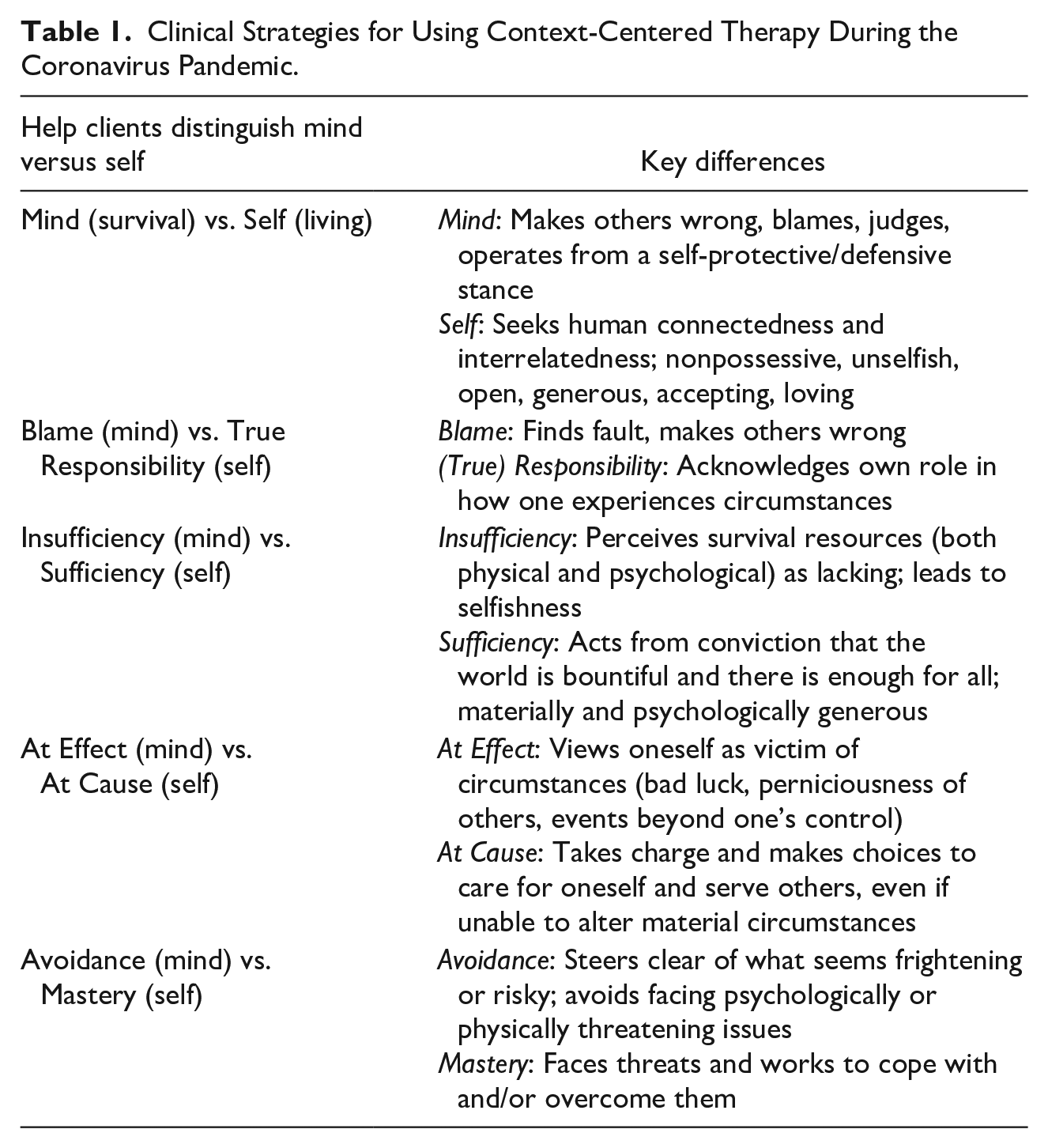
From the perspective of context-centered psychotherapy—a constructivist approach—the coronavirus pandemic offers a “playground for the mind” in which people’s defensive and self-protective postures are amplified. Thus, the most useful strategies are apt to involve recognizing this reality rather than attempting to downplay or sidestep it. In what follows, we offer context-centered advice for psychotherapists during the pandemic. This guidance is also succinctly summarized in Table 1.
Clinical Strategies for Using Context-Centered Therapy During the Coronavirus Pandemic.
Context-Centered Therapy
Context-centered psychotherapy draws from a variety of constructivist theories (Raskin, 2002)—most notably radical constructivism (Efran et al., 1990; Maturana, 1988; Maturana & Varela, 1992) and personal construct psychology (Fransella, 2003; Kelly, 1991a, 1991b). Like humanistic–existential perspectives, constructivist viewpoints emphasize the importance of meaning making, relationships, and experience, while offering holistic and antireductionistic approaches to psychotherapy (Epting & Leitner, 1992; Lincoln & Hoffman, 2019; Neimeyer & Raskin, 2000; Raskin & Efran, 2020; Schneider et al., 2015). Constructivist clinicians stress the local, situated, and contextual aspects of each individual’s unique meaning making and believe that attending to these factors is critical to effective psychotherapy (Neimeyer & Mahoney, 1995; Raskin & Bridges, 2008).
In keeping with such principles, context-centered therapists assert that helping clients shift contexts is the most efficient method for generating psychological change (Efran & Soler-Baillo, 2008; Raskin & Efran, 2020). Contexts are the sets of presuppositions that shape our experience. These often involve socially shared concepts (such as marriage, ethnicity, and gender), but they can also can be composed of uniquely personal frameworks of belief. By definition, contexts both frame and constrain how we comprehend and experience life. They are the structures that underpin how we understand ourselves, others, and the world around us; the casings we use to organize, encapsulate, and make sense of our experience.
Contexts are digital because they are composed of information rather than physical entities. Thus, they can come into being, dissolve, or shift in the blink of an eye. Consider, for example, that it takes a mere instant for an individual to go from being single to being married, from being employed to being out of work, or from being a student to being a graduate. Such contextual transitions, although instantaneous, can hold a lifetime of implications. Getting married, for example, immediately recontextualizes all of one’s relationships (not just those involving one’s spouse), even though the psychological ramifications reverberate for the rest of one’s life. Furthermore, it should be noted that contexts are mutually exclusive; they preclude each other. One cannot simultaneously be single and married or employed and unemployed. Nonetheless, people regularly change contexts, transitioning from one to another in the course of daily life—even regularly flipping back and forth among contexts with the same person, as appropriate. For instance, somebody might operate from the context of “boss” during the workday, “friend” when meeting up with a buddy for a drink afterward, and “spouse” on arriving home for dinner. Of course, sometimes navigating incompatible cross-contextual demands leads to contradictions and conflicts. It is when the resulting distress of these transitions becomes untenable that many people seek psychotherapy.
The goal in context-centered psychotherapy is to help people resolve context-based conflicts, often by encouraging the reorganization of experience at a broader contextual level—one that reframes or eliminates the conflict. Cybernetic thinkers Humberto Maturana and Francesco Varela (1992) put it this way: “The solution, like all solutions to apparent contradictions, lies in moving away from the opposition and changing the nature of the question, to embrace a broader context” (p. 135).
Mind and Self
Context-centered therapists have identified two broad contexts that tend to dominate the struggles of people seeking treatment. Let’s call them “mind” and “self.” Unfortunately, because those terms are invoked in many areas of psychology and have entered our everyday vernacular, it is important to clarify how they are used in context-centered therapy.
Mind
The mind consists of all of a person’s survival mechanisms and maneuvers (Efran & Soler-Baillo, 2008; Gregson & Efran, 2002; Raskin, 2017; Smothermon, 1980). When operating from the context of mind, a person aims to avoid risks, preserve safety, maintain control, and be perceived as “right.” The mind finds danger lurking around every corner and selfishly monitors its own needs and interests to account for what it perceives to be shortages, insufficiencies, and hazards in the world at large. That is why when people first learned of the coronavirus pandemic, they raced to hoard toilet paper; from the mind’s vantage point, this is a dog-eat-dog world where resources are scarce and we must compete to survive. Of course, in terms of evolution, the mind has served some important functions. Its self-protective posture helps us identify and cope with threat—both real and imagined. Yet the mind’s focus is extremely narrow. It does not care whether we are happy or satisfied; it is only concerned with safety and survival. It always wants to win (or, at least avoid losing), to be right (or, at least avoid being wrong), and to dominate and control (or, at least avoid being dominated and controlled). The old joke about two people who encounter an angry bear while hiking through the woods nicely captures the mind’s defensive and selfish point of view. The first person suggests running away. “You can’t outrun a bear,” cautions the second person. “I don’t have to,” replies the first person. “I just have to run faster than you.” When confronted with a pandemic, it is only natural that one’s mind springs into action.
Self
The self is a broader and more comprehensive context for living than the mind. It has interests that go beyond sheer survival. Instead, it is attuned to the value of human connections and interrelatedness (Efran & Soler-Baillo, 2008; Raskin, 2017; Smothermon, 1980). As such, the self is less possessive, less selfish, and less defensive; it is a more open context in which love and acceptance prevail and acts of magnanimity can flourish. In some ways, the term “self” is misleading and paradoxical because when we operate from the context of self, we behave selflessly, placing the welfare of others and the wider world ahead of our own narrow self-interest (Efran & Soler-Baillo, 2008).
Clients typically seek therapy at times of distress. These are times when the person’s mind is in ascendancy—sounding alarm bells about threats to the individual’s physical and/or psychological well-being. Under such circumstances, the voice of the self tends to get lost in the din. For instance, we recall a client who sought help, fearing that his wife would leave him and he would be left homeless and penniless—revealed to the world as a failure in both business and the business of life. Of course, he soft-pedaled the role of his extramarital affairs in weakening the bonds of his marriage. Moreover, although he was quick to complain about how he was treated by others, there was virtually no mention of his wife’s well-being or level of satisfaction. Working with such clients requires that they shift from their near-exclusive preoccupation with the concerns of the mind to a more inclusive view of life that takes into account the perspectives of others. From this perspective, preserving one’s marriage needs to be about more than self-protection. It requires finding ways to foster the growth, development, and fulfillment of one’s partner. The take-away message is that enlarging the context to include the concerns of the self generates new and powerful options that are unavailable from the mind’s narrower purview.
An important method for enabling clients to shift from the limited perspective of mind to the broader perspective of self is to show them how to identify, observe, and accept the operation of the mind at work. Paradoxically, whenever you observe the mind, you automatically strengthen the self. Being the larger perspective, the self is the only place from which the mind can be observed. To fully appreciate the picture of life that the mind presents, you have to be able to step outside the frame it creates.
Importantly, the goal in fostering this more inclusive awareness is not to stop the mind, avoid its reactions, or banish its impulses. That would be both impossible and counterproductive. As the old saying goes, “anything you resist persists.” The corollary, equally significant, is that “anything you let be, lets you be.” Attempting to squelch the mind merely ensures that it will work that much harder to “win,” “defend,” and “protect.” Instead, the strategy is to notice the mind, “thank it for sharing,” and recognize that it is trying to be of use even though it has a tendency to be “single-minded” and go overboard in issuing system alerts. Coming from the observations the self-permits, clients are often able to grasp the irony that the mind, in its eagerness to ensure our survival, tends to destroy most of what makes surviving worthwhile.
Mind and Self in the Midst of a Pandemic
The mind’s influence can be strong in the best of times, but during a pandemic its pull is greatly amplified. Understandably, a pandemic triggers the mind to seek safety at all costs. Consequently, the coronavirus pandemic provides a “playground for the mind.” In dealing with the mind in this hypervigilant state, it is useful to differentiate among several mind/self contrasts—blame versus responsibility, insufficiency versus sufficiency, being at effect versus being at cause, and avoidance versus mastery.
Blame Versus Responsibility
When the mind sounds the alarm, it indulges in one of its classic maneuvers—declaring itself right and others wrong. Thus, it is no surprise that throughout the coronavirus crisis we have witnessed a great deal of blaming. The President has blamed the governors, and some of the governors have returned the favor. Of course, there is often a reality basis for the mind’s accusations—it is easier for the mind to argue from truths or partial truths than outright fantasies. However, over the long haul, getting stuck in cycles of blame and recrimination does little to advance the cause. When you make someone wrong, you motivate them to make you wrong in return.
The alternative to the blame-game is what context-centered therapists label “true responsibility”—the self-based acknowledgment of the core role each of us plays in creating our experiential reality. This is not to be confused with those times when people use the word “responsibility” as a synonym for blame, such as when someone hurls an accusatory “you are responsible for this” at us. True responsibility is not about being right or wrong, and it can never be foisted on us from the outside. True responsibility is the simple acknowledgment that you are who you are and that you create your own unique experience of the universe. This form of responsibility is non-judgmental and does not imply that you should change or that things should be different.
Importantly, drawing attention to true responsibility is not the same as saying that people are “responsible” for their circumstances. As the coronavirus pandemic has made abundantly clear, we are often at the mercy of events beyond our control. True responsibility, an aspect of the self, should not be confused with blaming, an activity of the mind. For example, people of color who have been disproportionately affected by the coronavirus pandemic are not “truly responsible” for their plight. To suggest as much is to unfairly engage in mind-driven blaming. True responsibility refers instead to our responsibility for how we experience circumstances, not to us being responsible for the circumstances themselves. Low-wage supermarket workers compelled to place their safety at risk out of economic necessity may be victimized by an oppressive state of affairs, but how they contextually make sense of themselves and their experience is something no set of circumstances can take from them.
By encouraging clients to distinguish between blame and true responsibility, therapists help them harness the power of self. For example, during a telehealth session, a twentysomething-year-old client sheltering-in-place at his mother’s house resented her criticisms of his messy room and erratic sleep patterns. This inevitably produced emotionally exhausting family feuds. However, when the client was able to see that these were just self-perpetuating right/wrong battles—pitting mind against mind—he was able to back off and take a different role. Recognizing how much his unanticipated return home had upset the family routine, he promised to be a better “house guest.” This lessened the tension enough for his mother to acknowledge that her son, who had lived on his own for several years, was now used to being treated as an independent adult rather than a mischievous child.
Insufficiency Versus Sufficiency
The mind’s assumption that there is probably a shortage of resources has already been mentioned. It encourages the person to hoard physical possessions, such as money and toilet paper, as well as psychological assets, such as love and adulation. The mind—coming from the context of insufficiency—is never satisfied. It always wants something more, better, or different. It seems to operate on the principle that “you can never have too much of what you don’t really need” (Efran & Soler-Baillo, 2008, p. 97). Incongruously, people’s minds may even crave applause and approval from those whom they neither like nor admire.
By contrast, the self starts from a posture of sufficiency—assuming a bountiful universe with plenty for everyone. Thus, when Governor Kate Brown of Oregon sent 140 of her state’s ventilators to help an overwhelmed New York cope with an explosion of COVID-19 cases, she acted from self. Her remark that “we are all in this together” exemplifies the self’s core qualities of generosity and love (Perry, 2020). On the other hand, college students going to the beach during the pandemic, despite knowing that this places lives at risk, illustrates the power of the mind’s craving for immediate gratification and approval.
At Effect Versus At Cause
In the mind’s quest to avoid blame, it often portrays itself as the victim of overpowering circumstances—what context-centered therapists call being “at effect.” Problems and mistakes are attributed to bad luck, the perniciousness of others, or events beyond our control. Of course, we all sometimes experiences ourselves as being “at effect” in connection with factors we do not like and did not anticipate—for instance, a snow storm that leads to cancelling a favorite outing or the loss of a job because of corporate mismanagement. The coronavirus is a particularly powerful “at effect” event; just about everyone feels victimized by it in some way. The danger is that when we consistently view ourselves as victims, our sense of self is diminished. We wallow in self-pity and fault-finding rather than engage in more creative problem solving.
The self’s alternative to being at effect is being “at cause.” The first author’s daughter, Ari, is an actress. When the coronavirus situation struck, she had just made her Off-Broadway debut. As a result of the pandemic, the show was closed. Would she deal with this situation by being “at effect”—cursing her miserable karma and throwing things—or could she shift to being “at cause”—actively taking care of herself and preparing for the next steps in her career? Like most of us, she did a bit of both. First, she experienced a period of “mourning” for what had been lost, not just in terms of her own career but in terms of the suffering of other cast members, producers, stage hands, and so on. Then she shifted into a more active recovery mode, staying in touch with friends and cast members via the Internet; watching (and rewatching) some of her favorite theater performances, TV programs, and movies; and performing portions of her favorite shows for an audience of family members. Again, we are not proposing that those first mind-dominated (at effect) stages be skipped or overlooked. Why not take advantage of such a perfect opportunity to feel sorry for oneself? However, recognizing that self-pity is only a part of the story prepares the individual to adopt a broader perspective—especially one that includes finding opportunities to be of service to others. A ballerina whose dance company had closed for the rest of the season due to the pandemic went back to her hometown and, after a few weeks of feeling lost, found a way to keep in touch with the world of dance by providing online classes for the students at the ballet school where she herself had trained (Greene, 2020).
Avoidance Versus Mastery
Finally, it is useful to distinguish between problem-solving strategies that rely on avoidance (the mind’s preference) and those that have mastery as the goal (the self’s penchant). From the mind’s point of view, why take unnecessary risks? Stay away from anything threatening, whether the threat is physical or psychological. Why ask for a favor and risk rejection? This strategy can prevail in the most trivial situations and the most profound. Years ago, a skilled tennis player gave up the sport because he realized he might not make it to the city finals. Why play if you might lose? There was a time in the history of medicine when research on syphilis was stymied because people were unwilling to utter the word or acknowledge the scope of the problem. Of course, this is not very different from much of President Trump’s handling of the coronavirus pandemic. The game plan is to minimize, discount, and distract as much as possible.
Consistent with the mind’s suppressive tendencies, many of our clients have denied being upset by the pandemic or, at the very least, have been annoyed with themselves for feeling upset and overwhelmed. They have pointed to media messages tutoring them take their minds off the situation—to be resilient, productive, and creative. From the context-centered perspective, this omits step one—a full recognition of the mind at work. Thus, in working with our clients, we are urging them to celebrate their minds as magnificent instruments of protection—always on the job and cleverly inventing vivid scenarios of doom and gloom. Here is the paradox: The more credit you freely give to your mind for its tireless vigilance—the more you “let it be”—the more space there is for the self to be heard. Let’s not put the cart before the horse. Let’s have a few hours or a few days of self-indulgence before we move on to wholesome projects and acts of good cheer. It seems that the counterintuitive approach—noticing mind before moving to self—is ultimately the more efficient pathway. Furthermore, while we are in the mind mode, strong feelings can be expressed—the full gamut from anger and shock to fear and sadness. To quote a Dylan Thomas (2004) line somewhat out of context, “Do not go gentle into that good night.” Give the mind a chance to do its worst. This is one of those occasions it has been waiting for, when some of its dire warnings actually have a firmer basis in real-world concerns than usual.
One of our clients, a college professor, found herself feeling a range of powerful emotions after her university moved classes online and sent faculty and students home for the rest of the semester. She was flooded with a mix of grief and rage, which she branded “excessive” and “not normal.” We reassured her that this was indeed “normal” and was not only to be expected but applauded. All systems were a go—everything was working just fine. We challenged her to spend a few hours without allowing any hopeful or optimistic thoughts to spoil her pity party. The next time we spoke to her, a few days later, she laughed and admitted she had trouble keeping those more salubrious thoughts from making an appearance.
Conclusion: There’s No Way to Not Mind a Pandemic
The media is filled with news coverage of how the coronavirus pandemic has brought out the best and worst in people. We agree and see this as reflecting our minds and selves in action. For every unscrupulous vendor engaged in price gouging, there are doctors and nurses making astonishing sacrifices to care for those who are ill. For every “covidiot” refusing to practice social distancing because it interferes with the mind’s desire for immediate gratification, there are people staying home for the greater good even though it means long-term separation from loved ones. For every politician playing “mind” games with the public by exploiting fears and stoking anger about our current predicament, there are others who have provided comfort and aid even when doing so might complicate their political futures.
The thing to remember is that all of us continually vacillate between the contexts of mind and self. As such, none of us are above our mind’s occasionally getting the best of us. It happens, and we should not expect otherwise or kick ourselves when it does. By encouraging clients to appreciate the mind and be aware of how it works, therapists can help them strengthen the self and operate from it more readily—even during distressing periods that feed the mind’s worst impulses, such as the one we find ourselves in right now. It is helpful to remember that the mind’s reactions are transient and forever changing. At the end of the darkly comic and touching movie JoJo Rabbit (which takes place in Nazi Germany, another challenging period in recent history), director Taika Waititi (2019) quotes the poet Rainer Maria Rilke: “Let everything happen to you: beauty and terror. / Just keep going. No feeling is final” (Rilke, 1996, p. 88). Perhaps this can serve as a mantra for all of us during these arduous and unsettling times.
Footnotes
Declaration of Conflicting Interests
The author(s) declared no potential conflicts of interest with respect to the research, authorship, and/or publication of this article.
Funding
The author(s) received no financial support for the research, authorship, and/or publication of this article.
