



Abstract
College years are a time when individuals often have newfound independence, are forging their identity, and are making decisions that will affect their life beyond graduation. Existential anxiety (EA) is a psychological reaction to existential threats (e.g., freedom, death, isolation, and meaninglessness). EA has been shown to be positively correlated with externalizing behaviors in college students, and recent research has identified a significant increase in EA after the emergence of COVID-19. Extant research is lacking an in-depth, qualitative presentation of EA in college students. The present study aimed to acquire nuanced, personalized accounts of college students’ experiences with EA in their everyday lives and during COVID-19. Six focus groups were conducted where college students discussed themes related to EA. Thematic analysis revealed themes regarding college students’ experiences including: desiring connection in relationships, making responsible choices independently, craving structure amid newfound freedoms, choosing how to create meaning and purpose, and feeling uncertain about the future. Focus groups identified protective factors against EA including focusing on the present moment, creating structure, and following a belief system. General feedback on the focus groups revealed that students felt less alone after hearing their classmates’ experiences and felt EA should be talked about more often.
Introduction
The College Years
Emerging adulthood, which includes the college years, has been distinguished as a distinct developmental period between the ages of 18 to 25 characterized by identity exploration and independence. While in college, individuals explore their identity through embracing worldviews or belief systems that may differ from the ones they grew up with (Arnett, 2000). College students form deeper relationships with others and learn how to balance a newfound independence with the responsibility of making decisions that will affect their life trajectory (e.g., selecting a major) (Arnett, 2000).
College is also a time where individuals report heightened anxiety. Students’ anxiety concerns range from test anxiety to deep philosophical issues. Data from the fall 2021 ACHA–National College Health Assessment (NCHA) III, which surveyed 23,600 students across 41 institutions, show that 33.7% of undergraduates (within the last 12 months of being surveyed) reported anxiety impeding their academic experience. Anxiety was the most diagnosed mental illness in the past year (27.3%) (American College Health Association, 2022). The emergence of COVID-19 has only intensified the mental health crisis among college students (Chen & Lucock, 2022).
Existential Philosophy
Existentialism is a philosophy that deals with intangible concerns rooted in human existence (Williams, 2014; Yalom, 1980). Furthermore, it is a practice that often focuses on the moment(s) where an individual is struck with the realization that they exist. While feelings of wonder and joy might follow this realization, feelings of powerlessness and fear about one’s existence can also follow (Blomme & Bornebroek-Te Lintelo, 2012). Existential scholars offer different perspectives on existentialism (Frankl, 1985; Greenberg et al., 1986; Krug, 2009; Lutzen & Ewalds-Kris, 2013; May, 1953; Pitchford, 2009; Priest & Due, 2002; Schneider & Krug, 2017). This study is guided by Irvin Yalom’s existential framework (Yalom, 1980).
Existential Anxiety
Yalom’s (1980) existential framework focuses on humans’ confrontation with the “givens” of existence, which Yalom identifies as freedom, death, isolation, and meaninglessness (Yalom, 1980). Freedom refers to someone’s responsibility in designing their life amid a universe that has no defined structure. While this sense of freedom can be liberating, anxiety can stem from a sense of groundlessness or realization of absence of structure (Yalom, 1980). Isolation refers to the “unbridgeable gap” between self and others. The idea that each human’s existence is separate conflicts with desires of connection and community. Within this framework, death deals with the core conflict between the knowledge that death is inevitable and yet humans still desire to “be.” Meaninglessness refers to the human desire to create meaning in a world that does not have any universally defined meaning. Meaning and purpose can only be created when an individual engages with their life (Yalom, 1980). Yalom (1980) argues that existential anxiety (EA) is a psychological reaction to confronting these existential concerns. The college years are not spared from confrontation with existential issues and may in fact provide a unique context for existential issues to be unveiled.
Existential Anxiety and COVID-19
Often, individuals are not consciously aware of existential concerns unless there is an optimal set of circumstances in which they are forced to confront them (Yalom, 1980). For example, a close encounter with death or a life transition might create these conditions. Courtney et al. (2020) labeled the COVID-19 virus as a global contagion of mortality that affected every human being. The COVID-19 pandemic created circumstances in which students were forced to confront existential concerns (increase in death, lack of freedom in choices, social isolation, search for meaning, etc.). Kira et al. (2021) found that COVID-19 is positively associated with death-related thoughts and anxiety. In addition, since the pandemic, there has been research conducted specifically looking at the relationship between COVID-19 and EA. Tomaszek et al. (2022) found that EA among college students, along with academic fear and academic burnout were strongly associated with higher posttraumatic stress symptoms during the pandemic. There are also additional studies that did not investigate EA solely in college students, but the studies have been conducted with samples that most likely included college students. Scrima et al. (2022) views the pandemic through the lens of Terror Management Theory (TMT) (Greenberg et al., 1986). TMT is an existential theory that is similar to Irvin Yalom’s theory, but narrowly focuses on the existential concern of death. According to TMT, individuals act out of a need to alleviate fears surrounding death, specifically through investing in social and cultural structures that provide a stronger sense of self and meaning (Routledge et al., 2013). Scrima et al. (2022) affirms that fear of COVID-19 is positively related to EA through the lens of TMT. In addition, Todorova et al. (2021) found that the pandemic fostered EA about illness and mortality. Alliegro (2021) collected data looking at existential concerns in college students before and after the emergence of COVID-19. Analyses of this data show that existential concerns significantly increased after the emergence of COVID-19. The pandemic heightened the need to conduct in-depth research about EA in college students (Alliegro, 2021).
Researching Existential Anxiety in College Students
While university professionals are working to address college students’ mental health, there are few contexts in which EA is assessed in this population (Watkins et al., 2012). Research that focuses on EA solely in college students is limited, although it is growing. Previous research has looked at topics in college students that relate to EA or have existentially based facets as a focus of interest. For example, Miller and Rottinghaus (2014) looked at meaning in life and career indecision using an existential framework. Shumaker et al. (2020) examined the relationships between EA, personality type, and therapy preference. Alliegro (2021) studied the relationship between existential concerns and risky behavior in college students. These studies all used quantitative, validated measures to quantify EA. While these quantitative measures have offered researchers a way to assess EA, they lack the ability to reflect an individual’s unique experience of EA in everyday life (van Bruggen et al., 2017). This is especially true considering that the degree to which an individual confronts any of the existential concerns depends on their own life experiences (Alliegro, 2021). Existential topics are nebulous and abstract, and often elicit nuanced responses from individuals who confront such concepts. Quantitative analyses, although useful and structured in their ability to adhere to high quality research standards, are subsequently limited in the response quality they can capture on any given existential topic. For example, it is difficult to measure how someone might be experiencing existential isolation in their subjective experience- the concept that we are inherently separate from others- in a written questionnaire (van Bruggen et al., 2017; Yalom, 1980). Todorova et al. (2021) used qualitative research methods in a study looking at existential topics during the pandemic. However, the sample in this study was not specific to college students. Consequently, there is a need to better understand the nuanced, individualized ways in which college students confront existential concerns (Alliegro, 2021; van Bruggen et al., 2017). To address these limitations in empirical existential research, and to further understand how the pandemic affected college students regarding EA, researchers can employ qualitative methods to allow individuals to elaborate on their unique lived experience. Qualitative methods, for example, focus groups, give participants the space to share how and if they encounter EA.
The Present Study
We conducted a qualitative examination of how EA manifests in college students. The aim of this study was to better understand how college individuals generally experience EA in their everyday lives, while gaining an in-depth understanding of how the COVID-19 pandemic influenced the ways college students interact with this topic. We generated our qualitative data through a series of focus groups with a sample of college students. Focus group discussions were guided by the following existential concepts (Yalom, 1980): Freedom & Responsibility, Isolation, Death, and Meaning & Purpose.
Method
Participants
Eighteen students at Colorado State University (CSU) who were enrolled in the undergraduate research pool participated in one of six focus groups and completed pre- and post-focus group surveys (83% female, 89% White, 17% Hispanic, Latino, or Spanish origin, Mage = 19.5). Table 1 presents participant demographic information. Eligibility criteria included: CSU student, English-speaker, and between the ages of 18 and 65. This age range was used because CSU requires students to be between the ages of 18 and 65 to register for university courses, with special circumstances taken into consideration. Sociodemographic information and relevant measures were collected from participants.
Study Demographic Information.

Procedure
This study was approved through the Colorado Multi-institutional Review Board at CSU (Protocol ID: 1732). Participants were enrolled in the undergraduate research pool at CSU, and upon signing up for the study, they gained the opportunity of earning 1 credit hour of research to fulfill their class research participation requirement. Participants were recruited separately and did not know each other before the focus group. Per the recommendation of Krueger and Casey (2015), after participants enrolled in the study, they received two reminder notes via email including logistical information for how and when to attend the focus group.
We conducted a total of six focus groups (M = 3.1 participant/group, range 2–4) across 2 months. Guest et al. (2017) suggests that focus group studies run three to six focus groups to allow for about 90% of prevalent themes to be identified in analyses. Toner (2009) also suggests that smaller focus groups (three to four participants in each group) allow for more participant perspectives to be shared in the discussion. Focus groups were semi-structured and lasted about 60 minutes. To uphold COVID-19 safety precautions, and to make the focus groups as accessible as possible, all focus groups were conducted through the online platform Zoom (zoom.us). The Zoom license used to conduct the focus groups was compliant with the Health Insurance Portability and Accountability Act (HIPAA). Woodyatt et al. (2016) explains that online focus groups differ from in-person focus groups on the format of data collection, but the actual content of data collected is extremely similar. Their findings ultimately argue that data from both formats can be considered as one source (Woodyatt et al., 2016). Boland et al. (2022) explains that technical complications could potentially affect the quality of data collected in online focus groups. Few internet complications arose during the study. Any responses that were compromised because of technical issues were either clarified later in the focus group or excluded from data analysis (Boland et al., 2022). Each group was co-facilitated by the first and second authors. After the facilitators introduced themselves, they explained the purpose of the discussion, set expectations of mutual respect and confidentiality among the participants, and communicated resources for additional psychological support if needed. The facilitators then integrated a psychoeducational component before starting the discussion, as many participants did not know what EA was prior to the study. A psychoeducational component included explaining existentialism as a philosophy and distinguishing EA from other types of anxiety that participants might be more familiar with (i.e., social anxiety, test anxiety, generalized anxiety, etc.). The discussion was then guided by the concepts: Freedom & Responsibility, Isolation, Death, and Meaning & Purpose. Yalom (1980) deemed these concepts essential to understanding the human experience. Facilitators guided the discussion through asking questions such as: At face value, freedom is an extremely positive idea and something that we all desire and strive to attain. There is however an underlying source of anxiety that freedom can generate. Freedom is after all, an absence of structure. In this context, we are not talking about political or ideological freedom; this is more about our responsibility to make choices about who we are. Making choices can be stressful. Who we choose as our peers, what our major will be, what career path we will choose, what moral code we choose to follow, what our political beliefs are. . . These are all big decisions that we must make and the possibility of choosing incorrectly can be scary. Can anyone relate to that? The idea of existential isolation is a bit different from being physically isolated from others. This is the idea that even if we are surrounded by other people all the time, we are isolated within our own subjective experience. No one else can ever truly feel what we feel or fully understand us because they too are isolated in their own subjective experience. This concept is a bit more abstract, but it can lead many people to feel like no matter how socialized we are, we are fundamentally alone as we navigate our lives. What are your thoughts and experiences? For most of us, death is perhaps the most salient source of our existential anxiety. Many of us have had to consider our own mortality through the death of a friend or a family member. Others may have had to deal with life threatening illness or have endured other kinds of near-death experiences. How many of you have found yourself considering the certainty of your own death? How would you describe those thoughts and feelings? What do you think it would look like to find true purpose and meaning in your life?
All focus groups were audio recorded and transcribed by Zoom.
In a post-focus group survey, we asked participants about their reaction to the focus group and allowed them to answer in free response. We asked participants what they learned in the focus group, if they would change anything about the group, and what they found interesting.
Overview of Data Analysis
Qualitative data were generated through analyzing transcripts of the six focus groups. The first and second authors performed the thematic analysis. Thematic analysis is a method used to identify, analyze, and interpret patterns of meaning (themes) in qualitative data (Clarke & Braun, 2017). This method of qualitative research allows for an organic approach to coding, with the researchers playing active roles in the process and is often used to analyze qualitative data sets such as interviews and focus groups (Clarke & Braun, 2017). A contextualist method was used when conducting the analysis, which acknowledges the ways in which the participants were interpreting their experiences while also holding these experiences up against the context of EA (Clarke & Braun, 2006). Researchers used an inductive approach to coding, which is recommended for under-researched areas to allow for optimal exploration of the research question(s) (Clarke & Braun, 2017). First, researchers read the transcripts carefully to identify meaningful units of information. Then, researchers condensed the meaning units into a code. Codes were then grouped into categories where researchers determined the final themes in the data set. The coders met after separately analyzing the data to come to a consensus on the dominant themes. As recommended for under-researched areas by Clarke and Braun (2006), researchers analyzed the transcripts in a manner that offers thematic descriptions of the entire data set, rather than providing detailed information about one theme. Although the discussion was guided by prompts, it is important to note that the focus group responses were not coded under the existential concepts mentioned above (freedom & responsibility, isolation, death, meaning & purpose). The coders analyzed each focus group response based on the words the participant said rather than classifying their response under priori concepts. Instead of grouping individual responses under concepts, coders analyzed each participant’s unique response to the presented questions. Themes were generated on a latent level, meaning researchers identified underlying ideas that shaped the words in participant responses. For example, the theme feeling uncertain about the future was applied to the response below, which did not explicitly contain the words “uncertainty” or “future” (Braun & Clarke, 2006): Adjusting moving away from home [. . .] can come from this change in lifestyle. You can start thinking “okay this is the next chapter of my life, what’s the next one, what’s the next one after that, what am I supposed to do with the rest of my life?
Results
Qualitative Analyses: How College Students Experience Existential Anxiety
Thematic analysis revealed complex ways in which participants experienced EA and generated five general themes: desiring connection in relationships, making responsible choices independently, craving structure amid newfound freedoms, choosing how to create meaning and purpose in one’s life, and feeling uncertain about the future. Themes are described below (see Figure 1).

Focus Group Responses: How College Students Experience Existential Anxiety.
Desiring Connection in Relationships
When discussing existential isolation and the notion that each human’s existence is separate, most participants talked about their relationships. Some felt overwhelmed by the idea of existential isolation: [. . .] I’m really close to my mom and [. . .] now thinking about it [. . .] “Am I actually?” [. . .] it’s hard [. . .] to know that you’re just one alone person.
Others talked about their struggle to understand others in their relationships as well as to be understood: [. . .] I kind of see this play out in my relationship when [. . .] [we] will be [. . .] arguing about something. [. . .]. I’m like “oh I can’t really [. . .] explain it. He’s not totally going to [. . .] understand or get it, because he’s not like me, he doesn’t really [. . .] know how this feels. He can imagine it, but he doesn’t really know for sure.” [. . .] no matter how close I get to someone they’re still [. . .] not living my life or [. . .] they’re still not going to know everything I’m thinking, [or] everything I’m feeling. And [. . .] I’m never going to know [. . .] what another person is thinking or [. . .] feeling because [. . .] no matter how close you are, you still have your own lives to lead.
Participants also expressed the desire to have close relationships in college, yet they found it hard to create close connections with others, especially during the pandemic: [. . .] I came here last year [. . .] during the peak of COVID [. . .]. It was really hard for me to meet new people [. . .]. I thought to myself, all the time, like “when, am I going to meet people who [. . .] understand me and that I get along with really well and that I can see being friends with [. . .] for life?” [. . .]. [. . .] When it comes to [. . .] college, everyone is like “you’re going to find your people” [. . .] but then you realize, you have to find your people by yourself. [. . .] I think that is another [. . .] existential thought. [. . .] How am I going to make the right choices to find the right people who are going to be my people? [. . .]. It’s so hard, because you see other people that just like automatically have like their big friend groups. [. . .] You go into that dining hall and everyone’s in their little group and [. . .] you’re like “Why can’t I have that? How did they just get it so easily?.”
Finally, participants emphasized the importance of connection in relationships despite individual experiences of suffering: [. . .] People go through [. . .] individual problems and it’s our life that we’re living. It’s no one else’s [and] no one else [is] in our shoes and is going through the exact same problems. But at the same time, I feel like it’s really important to have [. . .] a support system. [. . .] I don’t really think you can go through life [. . .] literally alone. [. . .].
Making Responsible Choices Independently
When reflecting on the college years, participants described the difficulty of making the “right” choices on their own. Some of these choices related to creating healthy and responsible routines regarding lifestyle and academics: [. . .] You have [. . .] the freedom, if you want to go out and [. . .] hang out [. . .] instead of studying and then you end up getting a bad grade, and that was kind of the consequence of having the freedom to go out [. . .]. [. . .] I can do so much more stuff now like my parents aren’t [. . .] watching me but it’s also kind of [. . .] wanting to do good in school as well [. . .]. [. . .] You have more freedom to do [. . .] what you want, but also [. . .] you have to learn how to [. . .] take care of yourself, or [. . .] live by yourself and do all the things that normally were [. . .] provided for you [. . .].
Some participants described the heavy weight of other choices they had to make in college regarding their life as a whole: [. . .] I’m [. . .] staring my life down [. . .]. and there’s all these different choices and options and [. . .] crossroads. [. . .] This choice impacts this [. . .] and that can bring up some anxiety because [. . .] what am I [. . .] supposed to be doing or what should I be doing? [. . .]. [. . .] You can start thinking okay like this is the next chapter of my life like what’s the next one? What’s the next one after that? What am I supposed to do with the rest of my life? [. . .]. [. . .] I have so much freedom to do anything and [. . .] plan out my entire life and that’s scary because [. . .] sometimes I have an idea of what I want to do, and what I want to be and sometimes [. . .] I don’t know what I want to do. That gives me anxiety a lot [. . .]. I hate thinking about the future. [. . .].
Participants also explained how COVID re-defined responsible decision-making in college regarding pandemic safety, and how COVID highlighted life decisions, in general: [. . .] I have a couple of [. . .] immunocompromised people in my house back at home. [. . .] I was always being a little bit extra cautious because I definitely don’t want to bring it in and then have it first affect them [. . .]. [. . .] During COVID [. . .] I really [. . .] got a sense of [. . .] my choices and [. . .] how I’m going to decide to live my life [. . .].
Craving Structure Amid Newfound Freedoms
Many participants described that while the freedom to create their own routine and to make their own choices was refreshing, they still craved structure: [. . .] I was thinking about just the transition of coming to college because I’m a first year and [. . .] I didn’t have my parents’ rules [. . .] and then now I have my own structure that works really well for me. [. . .] It kind of was that slap in the face [. . .] like yeah “Here you are and how you deal [. . .] is [. . .] your decision.” [. . .] I’m also a very structured person and I need [. . .] a lot of order in my life, and [. . .] being a college student or being an adult in general, you have a lot of freedom that you like aren’t used to [. . .]. I’m [. . .] always afraid that I’m [. . .] picking the wrong thing because I have so many options [. . .].
Choosing How to Create Meaning and Purpose in One’s Life
Participants did not claim to know the purpose of life. If anything, participants expressed how their individual purpose is constantly changing: I just don’t know [. . .] the purpose of my life, I feel like it changes all the time. [. . .] The fact that there could be [. . .] potentially so many [. . .] purposes out there, depending on what you believe, [. . .] I guess that [. . .] is [. . .] anxiety provoking.
Participants did however explain their efforts in creating meaning and purpose in their lives. Many participants explained that they created meaning and purpose through doing things that made them “happy” and brought them joy: [. . .] Life is [. . .] about making yourself happy. [. . .] Don’t try and make other people happy before yourself [. . .]. [. . .] Do stuff that like makes you happy. [. . .] Get outside [. . .], go in nature [. . .].
Other participants created meaning and purpose in their lives through helping others: [. . .] We’re all going to be on this earth anyways and we’re all going to be living anyways so [. . .] I might as well try to help other people [. . .] have the best lives that they can on this earth [. . .]. [. . .] I just try to be [. . .] kind and understanding to people and help make people’s days better, but I have no clue [. . .] where my life is leading.
Feeling Uncertain About the Future
Participants expressed uncertainty about the future regarding the college experience in general. More specifically, participants expressed uncertainty regarding death. The unknown factors of death including when it will happen, how it will happen, and what happens when death occurs were noticeable responses when talking about death as an existential concern: It’s [. . .] not really that scary to me unless I put it in the [context of] [. . .] “oh, I could die tomorrow without really accomplishing what I want to.” I guess that part is scary [. . .]. [. . .] The idea of [. . .] death itself isn’t [. . .] scary but the idea [. . .] of what happens after [. . .] “are you just like not like a thing anymore?” [. . .] You’ll just be gone [. . .]. [. . .] The concept of death is something that is so simple, but so big that it’s really hard for me to grasp. [. . .] [I have] deep rooted physical feelings of discomfort because the unknowns of death are [. . .] tough [. . .]. [. . .] Our world is so scary and [. . .] messed up and [. . .] so many people are [. . .] murdered every day and [. . .] that’s what I think about. [. . .] Like “Oh my gosh like what if I’m just gonna get shot [. . .] out of nowhere?.” [. . .] I try not to think about it, though [. . .].
When discussing uncertainties around death, the fear of losing other people was also a prevalent theme. Often participants expressed that they were less scared of dying themselves, and more scared of losing others to death. Some even mentioned that COVID heightened this concern: [. . .] I’m not afraid of dying because it’s just going to happen. [. . .] I do have more anxiety about [. . .] other people close to me dying, especially with COVID. That [. . .] made it worse, probably for a lot of people [. . .]. [. . .] I would prefer to [. . .] die before the others because I don’t want [. . .] to experience [. . .] them dying. [. . .] I would rather die myself than have them die because I think it’d be really hard [. . .].
When considering the uncertainty of death, participants expressed avoidance in not wanting to think about death or even consider what it meant to “not exist” anymore: [. . .] The idea of [. . .] not existing [. . .] I just can’t comprehend that as a person because it makes me so anxious. [. . .] I would just rather not think about it [. . .]. [. . .] I know that it’s inevitable, and I know that it’s going to happen one day and so I try my hardest just not to think about it, because if I do, then it [. . .] ruins my day [. . .].
Qualitative Analyses: Protective Factors Against Existential Anxiety
Focus group discussions also provided clarity into several protective factors against EA (see Figure 2). These protective factors were organized into three themes: focusing on the present moment, creating structure, and following a spiritual or religious belief system.
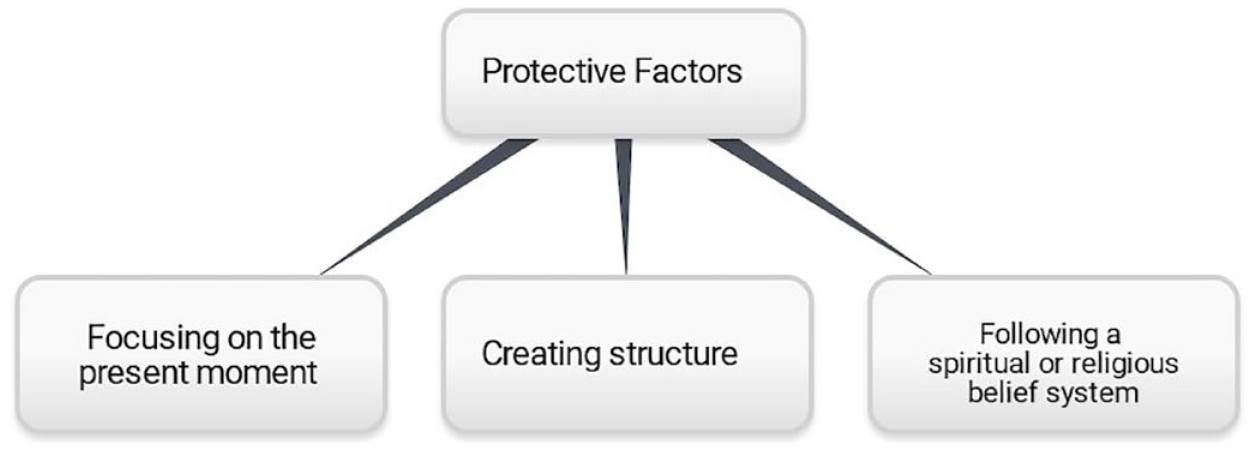
Focus Group Responses: Protective Factors Against Existential Anxiety.
Focusing on the Present Moment
Mindfulness is a flexible state of mind characterized by attention and awareness of the present moment, and it might be helpful in attenuating existential concerns (Fletcher & Hayes, 2005; Langer, 2000; Nilsson & Kazemi, 2016). Further lending support to this research idea, many participants mentioned focusing on the present moment to lessen EA: I think just make sure you take one day at a time and just focus on your happiness. I feel like for me I’m not super afraid of dying. [. . .] I try my best to [. . .] live in the moment. [. . .] I think that it’s really important to [. . .] focus on the present and what you’re doing right now to make your life beneficial. [. . .] When it’s your time it’s your time and all you can do is [. . .] live for the now and do what makes you happy [. . .].
Creating Structures
Throughout the focus groups, it was evident that participants valued structure. Beyond craving structure amid newfound freedoms, participants took actionable steps to create structure in their overall life plan as well as throughout their daily routine to feel more in control of their lives: I need structure. [. . .] Going to college [. . .] feels like you’re getting all this freedom, but if you [..] don’t have the structure [. . .] it starts to feel overwhelming [. . .]. [. . .] I have everything planned out [. . .] in my life. [. . .] It’s just comforting to have a little bit of a life plan.
Following a Spiritual or Religious Belief System
Participants across focus groups talked about their faith as a protective factor against EA. Faith acted as a remedy to desiring connection, fearing uncertainties of death, and creating meaning in one’s life: [. . .] I’ve been getting more connected with my faith. [. . .] I’ve kind of been struggling with the idea that [. . .] everybody is their own person and [. . .] no matter how much [. . .] love, or [. . .] empathy I can show [. . .] someone [. . .] they’ll never actually know [. . .] exactly who I am. [. . .] Faith kind of ties into that just because [. . .] there is a creator who knows exactly who I am. [. . .] Faith has always been a part of my life. [. . .] I’ve [. . .] always known and [. . .] believed what [. . .] will happen after I die [. . .].
Participant Reactions Post-Focus Groups
As mentioned in our methods we asked participants for their reactions to the focus group. Some notable responses include the following: [. . .] I had no idea that this would strike so close to me, but I realized I had been feeling it without having a word to describe it. I think everything is super, super interesting [. . .] I think it was interesting to have existential anxiety broken down into four categories and having them be explained. I found that I associated closely with some of those descriptions and realized that even though I didn’t know it, I was experiencing hints of existential anxiety all the time, especially with wondering if people will ever know me or questioning what the meaning or purpose of life is. I liked that everyone related to my situations and how I felt. It was nice to not feel alone and have people I could relate to. I found it interesting that most of us had similar views, and that I am not alone in what I am thinking or feeling. I wish there were a few more people so I could hear more perspectives about the topic.
Discussion
The aim of this study was to collect qualitative data to acquire nuanced personalized accounts of how college students experience EA in their everyday lives, while also further understanding how the pandemic influenced the ways in which college students experience EA. We recruited college students who attended one of the six focus groups to share how they experience EA. Thematic analysis of focus group data identified five general themes.
Desiring Connection in Relationships
In our results, participants reportedly experienced EA through the pull between desire for connection in relationships and isolation of individual experiences. Yalom (1980) argues that there is not a relationship that can eliminate isolation. He does, however, explain that isolation can be shared with others in a way that allows love to alleviate pain from isolation, emphasizing the benefit of helping college students create and maintain close relationships (Yalom, 1980).
Making Responsible Choices Independently
In the focus groups, participants communicated having anxiety especially around making responsible decisions for themselves, as they understood that their choices have consequences. While the freedom found in college to craft one’s own life can be liberating, this absence of structure also highlights how choices have consequences (Yalom, 1980). As such, participants conveyed attempts to create routines in order to shape their lives and aid in responsible decision-making.
Craving Structure Amid Newfound Freedoms
Participants explained their need for structure during the college years to succeed academically and emotionally when discussing EA. This relates to Prokopcáková’s (2015) findings, which show that a personal need for structure is positively correlated with anxiety.
Choosing How to Create Meaning and Purpose in One’s Life
Frankl (1972) explains how meaninglessness is the paramount existential stress. Uncertainty around the meaning of life and viewing purpose as ever-changing was common among participants. Many participants also explained that they found meaning in doing things that made them “happy” which aligns with the broader research as positive affect is a predictor of meaning in life (Tang et al., 2013). Other participants created meaning through helping others, which Klein (2017) has associated with a greater sense of purpose. In addition, research shows that emerging adults who have a low presence of meaning in their life, but a high search for meaning demonstrate poorer psychosocial functioning (Dezutter et al., 2014). It has also been found that there is a positive relationship between the search for meaning and emotional exhaustion (Garrosa et al., 2016). This finding is consistent with other literature. Tomaszek et al. (2022) explains that emotional exhaustion is a characteristic of burnout, and defines it as having chronic feelings of fatigue, uneasiness, and overwhelm. Tomaszek et al. (2022) conducted a study where findings demonstrated that EA played a mediating role between academic burnout and posttraumatic stress disorder (PTSD) during the pandemic. Garrosa et al. (2016) explains that while the search for meaning might be fulfilling for one’s life, ruminating on the search for meaning day to day can be more exhausting. In their search for meaning and purpose, while attending college during a pandemic, students might experience emotional exhaustion, or in the context of this study- EA.
Feeling Uncertain About the Future
Participants expressed uncertainty in many forms throughout the focus groups. The most predominant form, though, was feelings of uncertainty surrounding death. Death anxiety peaks among both men and women in their 20s (Russac et al., 2007). Overall, a common response to uncertainty surrounding death in the focus groups was avoidance. Yalom (1980) describes how a great portion of someone’s life is consumed by the denial of their own death. In addition, Boelen (2010) found that an intolerance to uncertainty is involved with emotional distress following loss. Clinicians should take note that these data show that college students are thinking (or trying not to think) about death.
Protective Factors
Protective factors were also identified in the focus groups that seemed to lessen participants’ EA. While discussing existential concerns, participants talked about focusing on the present moment to lessen anxiety. Present moment-awareness is often taught through mindfulness-based interventions (Nasser & Przeworski, 2016). This protective factor suggests that some forms of mindfulness might be helpful in attenuating existential concerns. This is consistent with the finding that mindfulness-based practices can help with meaning-making skills (Garland et al., 2007). In the context of choosing how to create meaning in one’s life, mindfulness practices might be helpful in combating EA. Creating structure through actions like planning or holding oneself accountable academically, also lessened feelings of EA. It has been found that a structured view of the world creates meaning and lessens mortality concerns (Landau et al., 2004). This is consistent with the finding that people with a higher personal need for structure demonstrated lower death anxiety in the face of mortality salience (Routledge et al., 2013). Finally, many participants referred to their faith and belief system as something that helped in lessening EA. Basset and Bussard (2021) found that strength of religious views is associated with lower death anxiety and Kandasamy et al. (2011) found that spirituality plays an important role in the quality of life. Clinicians might consider these protective factors when working with clients struggling with EA.
COVID-19 and Existential Anxiety
There were some notable findings related to the COVID-19 pandemic. Participants expressed difficulty in creating close relationships in college, particularly during the pandemic. This finding is consistent with what researchers found in a study that gathered qualitative data about experiences during COVID-19 across 15 countries. Their results demonstrated COVID as being associated with isolation and a time that disrupted close relationships (Todorova et al., 2021). In addition, participants felt that COVID-19 redefined responsible decision-making in college related to pandemic safety. Todorova et al. (2021) also found that people experienced anxiety related to following the rules during the pandemic and experienced a lack of freedom in their choices (Todorova et al., 2021). Finally, in this study, participants expressed a heightened concern around losing someone they loved during the pandemic. Todorova et al. (2021) found that people had intense worries about the health of others.
Since the pandemic, researchers have found a positive association between EA and the COVID-19 pandemic, and this study is in line with these findings (Alliegro, 2021; Scrima et al., 2022). When understanding this association, clinicians might wonder what specific protective factors could be recommended in the context of the pandemic. Tomaszek et al. (2022) found that college students were exhibiting traumatic symptoms when they were in a state of burn out, EA, and academic fear. The healing process for these college students with traumatic experiences included reconstructing one’s meaning in life and their sense of self, as well as fostering a sense of self-belief that they could cope with any university-related stresses (Tomaszek et al., 2022). This finding is in line with Todorova et al.’s (2021) study where participants explained that EA was made meaningful through people learning how they could grow from the experiences they went through in the pandemic. This research shows that from a meaning-making lens, college students can better cope with their EA during the pandemic (Todorova et al., 2021).
Contributions
Empirical existential research was lacking in qualitative perspectives of how college students experience EA in their everyday lives. The novel study design allowed for better insight into how college students might be experiencing EA, while also gaining more information about how the COVID-19 pandemic related to experiences of EA in this population. The focus groups not only provided insight into our research questions but they also acted as a space of connection among participants. Participants were able to learn about EA with each other and learn that they are not alone in confrontation of existential concerns. Responses in the post-focus group survey (written above) show that while these focus groups were not group psychotherapy sessions, there were therapeutic benefits experienced by participants in connecting with others.
Social connectedness is defined as a subjective feeling of interpersonal closeness with an individual or a group, and it is extremely important to a student’s success, especially because it is a protective factor against risky behavior (Wheele et al., 2023). Senter (2023) explains that college students who were isolated from their peers and faculty, specifically during the pandemic, were more likely to express mental health concerns compared with those who felt connected to others. Environments where students can participate in rich social connection are greatly beneficial to their academic and emotional lives (Senter, 2023). In addition to contributing to existential theory by emphasizing the relevance of EA in college students during the pandemic, this study also builds on theories related to social connectedness. Most importantly, this study exemplifies the benefits of creating environments of social connection when discussing existential topics. Fostering spaces for connection and validation might help with concerns of EA in the college student population.
Limitations
Mitigating researcher bias is a challenge and concern across various research methods, in both quantitative and qualitative domains. Investigator bias, which can be defined as bias resulting from a conflict of interest arising from passionate beliefs held by the investigators, limited the quality and objectivity of this study. This study was structured from Alliegro’s (2021) dissertation on EA in college students. Both investigators of this study hold strong beliefs that EA is a prevalent topic in college students. These beliefs might have affected the facilitation of the focus groups through investigators subtly conveying the results that they expected to see.
Other limitations of this study are the lack of diversity and generalizability of the data. Most of the sample identified as White female students in their first year of college. Only three male-identifying college students participated in the study out of 18 participants. While there is not strong evidence that there are sex differences in the way individuals experience existential concerns, there is a lack of balanced representation of sex in the sample. In addition, the sample is not racially or ethnically diverse with only 16.7% of participants identifying as being from Hispanic, Latino, or Spanish origin. No other participants identified as being from Black/African American, Asian, American Indian/Alaskan Native, Middle Eastern/North African, or Native Hawaiian/Pacific Islander origin. Similar to sex, there is not strong evidence that there are racial or ethnic differences in experiences of existential concerns, but this is also because most samples in existential research consist of predominantly White participants.
Conclusion
The COVID-19 pandemic created a unique platform for emerging adults to be confronted with existential concerns they may have otherwise been unaware of. This study offers a qualitative examination of EA in college students’ everyday lives during the pandemic. This study contributed to empirical existential research and offered a more in-depth, nuanced perspective of EA in college students; a perspective that allowed us to dive deeper into the subjective and collective experiences of the emerging adult population. The findings of this study can be helpful for practitioners who work with this population. Incorporating an understanding of EA into their conceptual framework offers the potential for more meaningful therapy work that expands the client’s ability to understand their own lived experience and understanding of their anxiety. For college students, this work provides insight into shared concerns among peers, which can ease the feelings of “aloneness” around their struggles. It also demonstrates to both students and clinicians alike that college students are consciously and unconsciously working to cope with issues related to EA through employing certain protective factors.
Moving forward, future qualitative studies might seek to understand how college students are experiencing EA “post-pandemic” with COVID guidelines like social distancing and virtual classes being less enforced due to the distribution of the COVID vaccine and lower COVID numbers (World Health Organization, n.d.). Pérez et al. (2023) found that the perception of symptoms of severe anxiety and depression for university students in Spain did not change even when classes resumed face-to-face. College students were a uniquely positioned group during the height of the pandemic. One question that may arise is if the pandemic had a lasting effect on the ways in which college students experience EA in their everyday lives, and if so, how does this lasting change influence their mental health and decision-making moving forward.
Footnotes
Author’s Note
Megan E. Brown is now affiliated to Keck School of Medicine, University of Southern California, Los Angeles, CA.
Declaration of Conflicting Interests
The author(s) declared no potential conflicts of interest with respect to the research, authorship, and/or publication of this article.
Funding
The author(s) received no financial support for the research, authorship, and/or publication of this article.
