



Abstract
Eating disorder recovery is a widely studied topic in the field of psychology, and our knowledge base is still evolving today. In part, this is because there are many ways these issues can manifest in a person’s life, and therefore, many ways recovery can unfold. The concept of recovery is rooted in the medical model of illness and healing, which focuses on observable and measurable changes such as weight and behavioral change. Although important parts of the process, these factors alone do not fully capture the changes to a person’s sense of self that can occur in the recovery process. The current study illustrates a qualitative approach to understanding recovery by examining how a person’s self-identity, including its sociocultural dimensions, changes throughout an eating disorder. Twelve participants were interviewed, and the data were analyzed with reflexive thematic analysis. Themes reflecting the participants’ recovered self-identity include self-identity loss and reconstruction, embodied selfhood, and social isolation and reconnection. This study contributes to our understanding of what helps people more fully engage with life and feel liberated from the restrictions of their eating disorder.
Introduction
Eating disorders (EDs) are complex phenomena that exist at the intersection of many influencing factors, including but not limited to perfectionism, gender roles, low self-esteem, diet culture, and trauma (Allison et al., 2021; Bardone-Cone et al., 2020; Tozzi et al., 2003). Although EDs have been studied for decades, there are no singular stories about their origins, and in turn, no universal narrative of recovery (LaMarre & Rice, 2021; Lewke-Bandara et al., 2020; Musolino et al., 2016), which has implications for both those who struggle with EDs and their treatment providers. Historically, there has been a large focus on biological and behavioral markers of ED recovery, which is understandable given the medical complexities of these struggles. However, past qualitative research has shown that that these emphases can overshadow the psychological aspects of recovery—in this case, the way one’s self-identity may change in significant ways (Bowlby et al., 2015; Cruzat-Mandich et al., 2017; Jenkins & Ogden, 2012; Weaver et al., 2005). This study builds upon past research analyzing how a person’s self-identity can change over time through the process of eating disorder recovery (Amianto et al., 2016; Bardone-Cone et al., 2018; Conti, 2018; Eli, 2018; Rich, 2006; Vartanian et al., 2018; Williams & Reid, 2012). By taking a qualitative approach, more nuanced understandings of what healing can look like are gained, and as well as better insight about who experiences EDs and to what extent they are being helped in our current treatment models.
There are several types of EDs including anorexia nervosa, bulimia nervosa, binge eating disorder, and avoidant/restrictive food intake disorder. The participants in our study primarily experienced anorexia nervosa along with a mix of subtypes and/or secondary diagnoses. The hallmark features of anorexia nervosa include an intense fear of gaining weight, restrictive food intake (below one’s minimal caloric needs for basic functioning), disturbances of body self-perception, and negative evaluations of one’s self-worth based on weight and body shape (American Psychiatric Association, 2013). Orthorexia is another category that many of our participants endorsed but is not currently recognized in the DSM-5 (Bhattacharya et al., 2022). Orthorexia is characterized by rigid rules a person creates around the “purity” of the food they allow themselves to eat (e.g., only eating “clean,” or cutting out entire food groups deemed to be unhealthy) (Lewthwaite & LaMarre, 2022). EDs have historically been viewed as mainly affecting young, White women (Capodilupo & Forsyth, 2014) and although this is the population most identified and treated in the United States, several other populations have been underrepresented in past research as well as access to treatment, including cisgender men, transgender persons, African-Americans, Hispanics, and Asian Americans (Ahlich et al., 2019; Becker et al., 2010; Burke et al., 2020). To broaden the research base and learn about EDs in the context of race, gender, and other salient aspects of self-identity, we specifically asked our participants about these contexts as they related to the development of their ED and subsequent recovery.
Medical Model and Eating Disorder Recovery
The meanings attributed to the concept of recovery are myriad, yet it is foundationally rooted in a medical model that defines healing as the absence of symptoms and a return to a pre-illness level of functioning (Bardone-Cone et al., 2018; Gremillion, 2003). In the treatment of EDs, some of the markers of recovery that are informed by the medical model include behavioral change (e.g., cessation of food restriction), biological markers (e.g., stabilized heart rate and reaching a certain BMI), and evidence of cognitive and behavioral changes as measured by clinical scales such as the Eating Disorder Inventory-3 (Garner, 2004). Each of these measures contribute in critical ways to our understanding of recovery, especially given the potential for serious long-term health consequences (Dawson et al., 2014) and the fact that anorexia nervosa has the highest death rate of any psychiatric disorder (Westmoreland et al., 2022). Yet what is missing when we rely exclusively on these outcome measures are the meanings a person attributes to their weight, body size, relationship to food, and recovery process. For instance, some may experience recovery as opening themselves up to others and creating more space in their lives for supportive relationships (Allison et al., 2021; Arthur-Cameselle et al., 2014; Weaver et al., 2005). Others may experience recovery as gaining voice, agency, and increased self-worth (Björk & Ahlström, 2008; Conti et al., 2021; Eiring et al., 2021). And others have challenged the biomedical connotations of recovery with the expectations of linearity and questioning if “full recovery” is possible in a society that continues to stigmatize bodies that do not meet a thin-ideal (LaMarre & Rice, 2016; Musolino et al., 2016).
We were also interested in examining recovery in the context of temporality. Recovery narratives often include transitions that demarcate who the person was before the illness, and who they became after (as well as during) demarcating turning points in the life narrative (Bury, 1982; Frank, 1995; Jowsey, 2016). The medical model might predict a recovery trajectory akin to what Frank (1995) calls a “restitution narrative,” with the implication that the person essentially returns to the same sense of self after an illness experience. However, past research shows that less linear paths of healing exist for both physical illness and psychological distress, complicating the notion that we might so easily return to the pre-illness self after adversity (Adame & Hornstein, 2006; Charmaz, 1993; Emery et al., 2023; Hannum et al., 2016). We see these patterns in the ED literature as well. Although the same person goes through the ED experience, there are often significant shifts in their perception of self and others as other studies looking at ED recovery through a temporal lens have found (Eli, 2016; McGannon & McMahon, 2019). When we look at the growing body of literature examining the meanings of ED recovery from a qualitative perspective, we see definitions that complement, expand upon, and sometimes counter prevailing conceptualizations of recovery (Conti et al., 2016; Shelburne et al., 2020).
Self-Identity Change in Eating Disorder Recovery
As EDs come to define so much of the person’s life, it also comes to influence the person’s sense of self—who they are, what they value, and what they orient their lives around. As Rebecca Lester (2019) writes, Eating disorders are not simply a collection of behaviors, body weights, lab values, or cognitive distortions. Eating disorders are physically and emotionally devastating conditions where food and eating become the vectors and means by which deep existential concerns are made manifest and struggled out. (p. 9)
EDs are often described as ego-syntonic (particularly anorexia), meaning that a person is not necessarily distressed by the presence of their ED thoughts and behaviors as they are in accord with the way a person views oneself (Marzola et al., 2015). This congruency can be strengthened by social approval for one’s behaviors such as dieting or weight loss. As Lester’s quote above indicates, there can be more deep-seated existential anxieties underlying these ego-syntonic qualities that may point to insecurities in self-identity, low levels of self-compassion and self-worth (Bachner-Melman et al., 2007; Granek, 2007), as well as intolerance of uncertainty (including health and death anxiety) (Bardone-Cone et al., 2018; Buckingham et al., 2012; Castellini & Ricca, 2019; Eriksson et al., 2023; Le Marne & Harris, 2016; Renjan et al., 2016).
There have been many studies that show how an ED can serve as a metaphorical “life jacket” as Eaton (2020) described in a qualitative meta-analysis. Participants described, “ED as a coping strategy that provided control, isolation, security, and identity. While the ED symptoms remained distressing and destructive, individuals who were trapped in the ED felt that the disorder’s rituals were integral to their survival and identity” (p. 380). A qualitative study by Weaver et al. (2005) underscored this point by describing EDs as “perilous self-soothing” (p. 191) phenomena for women who felt insecurities in their sense of self. In this study, the participants used ED behaviors to gain emotional regulation, social validation, as well as greater self-esteem. However, this external focus on others’ expectations only exacerbated their deep-seated insecurities and conditional sense of self-worth. In other words, the metaphorical “life jacket” eventually becomes too constraining, and what was once a coping mechanism takes on a more destructive nature.
Several researchers have investigated the changes that occur at the level of self-identity in the ED recovery process (Koskina & Schmidt, 2019; Stockford et al., 2018; Williams et al., 2016). For example, the participants in Lamoureux and Bottorff’s (2005) study described a process of “finding the real me” by challenging core beliefs about not being worthy of love and acceptance, setting healthy boundaries with others, and recognizing ways anorexia took them away from what they cared about most. Conti (2018) interviewed a group of women 3 times over a 10-year period about their recovery from anorexia. Conti found that recovery was less about symptom reduction or a return to a pre-illness self, and more of a process of identity reconstruction; striving to make sense of a life without anorexia and honoring what these struggles taught them about themselves. This shift from medical recovery to identity-based work enabled the women to explore what purpose anorexia played in their life with self-compassion, and eventually, “letting go” of their ED and constructing “an identity to move on with” (p. 82).
Finally, research shows that people are more likely to reestablish social connections in recovery (Allison et al., 2021; D’Abundo & Chally, 2004; Stockford et al., 2018). For example, initial trust and support may begin with the therapy relationship (Jenkins & Ogden, 2012; Smethurst & Kuss, 2018), or through the support of others going through similar experiences (Arthur-Cameselle et al., 2014; Tozzi et al., 2003). As people become more comfortable opening up to others, they may also find that social support is a helpful way of coping with emotions (Björk & Ahlström, 2008), feeling seen and heard (Eiring et al., 2021), and finding purpose and meaning in community (Bowlby et al., 2015). Over time, the person has less need to rely on previous behaviors as they find more support, sense of belonging, and sense of identity apart from the ED (Jenkins & Ogden, 2012; Wetzler et al., 2019). In this study, we aimed to explore how a person’s self-identity, including sociocultural dimensions, can change in the process of ED recovery.
Methods
Researcher Reflexivity Statement
Throughout each stage of the analysis, the research team engaged in a process of reflexive dialogue and journaling to interrogate the ways our own life experiences influenced our interpretation of the interviews. Much of the first author’s past qualitative research has focused on narratives of mental health recovery and she and the second author conceptualized the focus of this study. The remaining co-authors were new to recovery research and were brought in the early stages of the project and assisted with the development of interview questions, background research, data analysis and theme building. Two out of the five authors have lived experience of ED recovery, and although their combined lived experiences helped to inform many aspects of the study, and they also benefited from having members of the research team without lived experience to point out other aspects of recovery that were relevant for consideration. The three researchers without lived experience each knew people with EDs and observed how our society’s unrealistic body ideals played a role in their development.
Participants
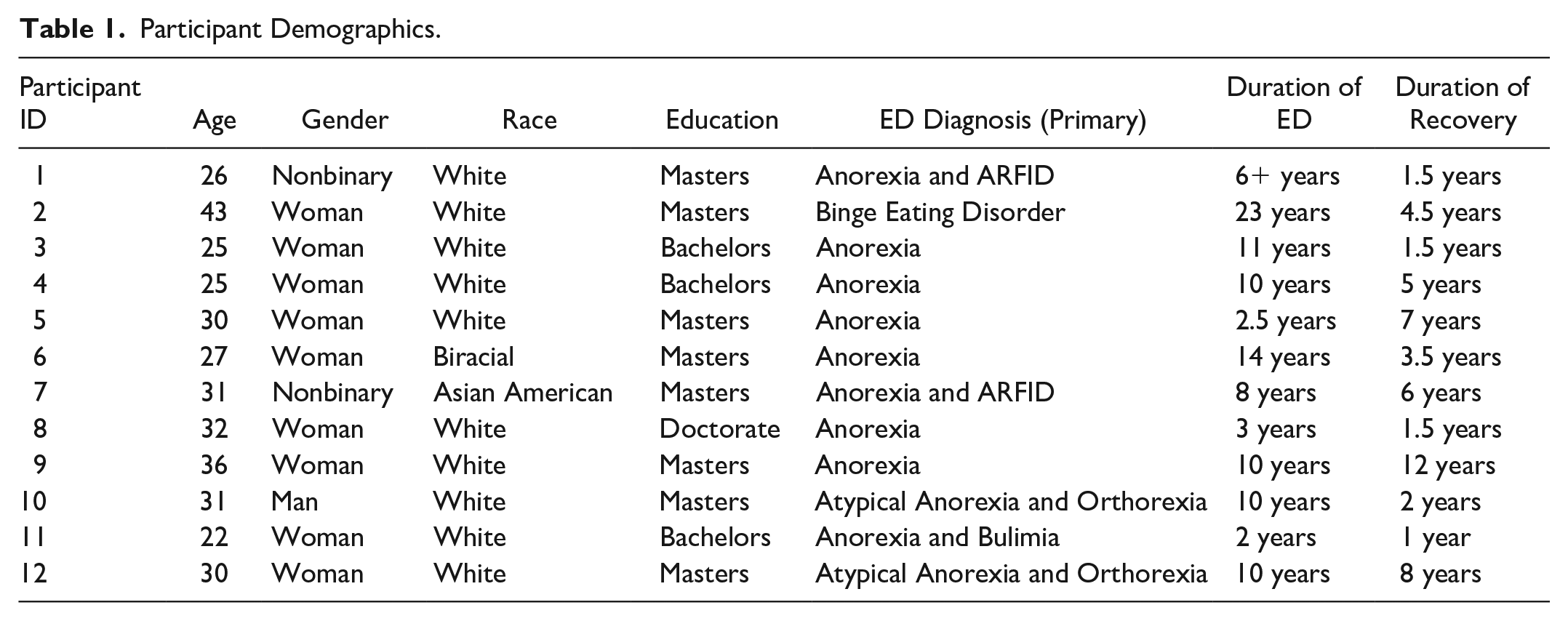
Twelve participants were recruited via email invitations to eating disorder recovery support groups, treatment centers, and social media posts. To be included in the study, participants had to self-identify as having struggled with an ED in the past, could not currently be in residential treatment or partial hospitalization, or actively be experiencing symptoms of disordered eating at the time of the interview. We did not recruit for any specific type of ED and hoped to get a range of different experiences by having this inclusion criteria open-ended. Participants had to self-identify as being recovered or in recovery from an ED to be included in the study. The average length of ED recovery across participants was 4 and half years (ranging from 1 to 12 years). A full summary of the participant-supplied demographic information can be found in Table 1.
Participant Demographics.
Study Design and Data Collection
The goal of our study was to explore recovery as an identity journey, and we designed our interview protocol to explore how the person felt their self-identity changed over the course of time. We approached the data from a critical realist (Bhaskar, 2020) perspective, which posits that there is an independently existing reality “out there” to observe, however our subjective interpretation of that reality is influenced by our unique standpoint, historical and sociocultural contexts. We structured our interview questions according to three distinct time periods in a person’s life including the time before their ED, the time of their ED, and the time after their ED. For example, we asked how you would describe the person you are today after recovering from your ED? What, if any, aspects of your life or sense of self changed? We then directly asked about the social-cultural contexts that were salient to each person’s self-identity and asked how they might have shaped their ED and/or recovery experience. For instance, we asked how their race, gender, sexual orientation, religion, socioeconomic status, disability status, or any other salient aspects of self-identity related to their recovery process. Finally, we asked about the meaning of recovery in a general sense and what factors contributed to that process. This last question allowed for various narratives to be told about a person’s relationship to their ED experience ranging from ones that reflected the traditional medical model of recovery to those that questioned if a recovery framing was useful at all.
The study received full ethical approval from the Seattle University Institutional Review Board. The first author conducted the semi-structured interviews with each of the 12 participants during 2021–2022. We conducted the interviews over a secure video platform and recorded separately from the online platform on a digital audio recording device. Data collection occurred during the COVID-19 pandemic, which is the reason we chose to conduct the interviews online rather than in-person. Before each interview, the first author sent each participant an informed consent form, demographic form, and the interview questions. The participants returned the demographic and informed consent forms prior to the interview and were asked again for verbal consent to participate as well as to be recorded before the interview began.
Data Analysis
We analyzed our data using reflexive thematic analysis (Braun & Clarke, 2022). The research team first read through each of the transcripts to familiarize themselves with each participant’s ED and recovery experiences. Next, each transcript was open coded in its entirety by the first author, using the track changes function on Word to note units of meaning in their most succinct form, as well as short, direct quotes that seemed important to maintain in vivo. After this round of open coding, the entire research team read each of the open coded transcripts and met to review our initial impressions and devised a strategy for the next stage of analysis.
To address our research question of how people’s self-identity changed over time in recovery from an ED, we structured our thematic analysis in the following ways. First, we went back through each transcript and highlighted open codes that were directly related to the person’s self-identity prior to their ED, during their ED, and in recovery. This step also allowed us the opportunity to re-read and refine our coding labels to better approximate the meaning of the participants’ experiences. We went through this coding process twice per transcript and discussed the consistency of our coding processes to understand how each researcher interpreted the text.
Next, we created a Word document where we cut and pasted each participant’s codes for a focused analysis of self-identity change over time. In the interviews, we structured our questions into 3 time periods, and we initially wanted to preserve these distinct periods of the person’s self-identity narrative in the way we analyzed the data. Next, we created three separate columns titled: Self-Identity Experienced Prior to ED, Self-Identity Experienced During the ED, and Self-Identity in Recovery. We identified open codes associated with the participants’ self-identity before the onset of the ED and inductively analyzed that data apart from the other points in time and repeated this process 2 more times for the remaining time periods. After this stage of analysis, we looked for meaningful patterns across the codes and various time periods and grouped those into larger categories to be analyzed in the next stage for their potential to be themes.
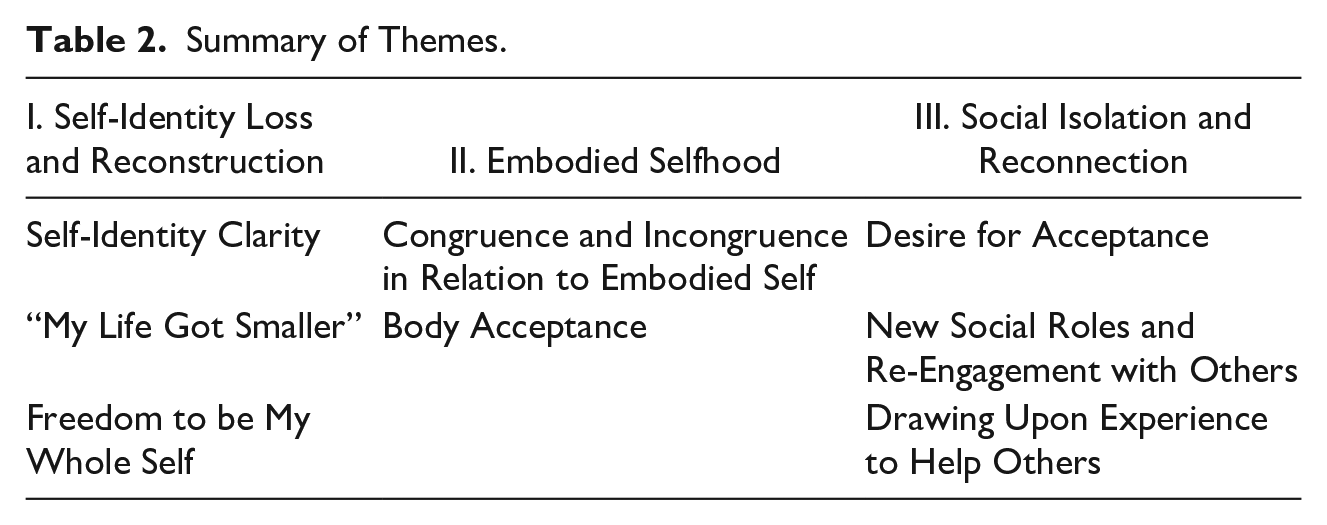
The first author presented the candidate themes for multiple rounds of discussion with the research team. After integrating this feedback, the first author then wrote descriptive summaries of the candidate themes and brought this back to the research team for consideration. The first author also contacted each participant to share the candidate themes and descriptive summaries, and asked at those times if they had any feedback to share. There were no editorial notes from the participants, and we received several supportive comments about our findings. We also compared our findings with past literature, including qualitative studies and theoretical articles on ED recovery, and found many points of overlap. After several more rounds of this iterative, collaborative process of analytic refinement, the team reached consensus on the final themes, which can be found in Table 2.
Summary of Themes.
Results
We constructed three themes to reflect the process of self-identity change in ED recovery: (I) Self-Identity Loss and Reconstruction, (II) Embodied Selfhood, and (III) Social Isolation and Reconnection. Each of the themes encapsulate how the participants experienced themselves in the time periods before, during, and after their EDs and reflect significant shifts in how people experienced themselves and related to others.
Self-Identity Loss and Reconstruction
The first theme focuses on the ways a person’s sense of self-identity was profoundly affected by their ED, as well as the process of growth and reconstruction of a self in recovery. Many of the participants were grounded in a clear sense of self-identity prior to their ED (as will be described further in the first subtheme) but life events such as loss, trauma, or a change in social status resulted in instability to their sense of self-identity. The second subtheme delves into that period of instability further and the insecurities that many of participants struggled with during their ED. Finally, the third subtheme describes the numerous paths participants took on their recovery journeys to reestablish a clear sense of self-identity, guided by newfound purpose and meaning in their lives.
Self-Identity Clarity
Many participants expressed clarity in who they were and what they cared about in life prior to the onset of their ED: “I kind of felt like I knew who I was, where I was and what I wanted to do.” (Participant 5). Some were engaged in activities tied to social roles and gave them a sense of belonging and validation. Participant 3 said, I was always a person that had hobbies and was involved in things. And, you know, loved being with my family and friends. Like, I love art and I’m very athletic and all that kind of just went away.
Self-identity clarity was experienced by others as a drive for perfection and Participant 9 explained, “I think through achieving and being perfect. Yeah, that was largely my identity.” They tended to excel in areas with clear markers of external validation such as grades, sports, social approval, or body aesthetics. In some ways, this clarity in focus helped them to achieve a great deal prior to their ED, but as will be later discussed, also fueled the obsessional nature of their ED in more harmful ways. This example illustrates how identity clarity is not necessarily “good”; either single-minded perfectionism or having one’s entire sense of self predicated by a single activity or community has downsides as well. Finally, some participants found identity clarity through athletic involvement. Several were involved with sports that had additional weight standards or aesthetic elements such as cheerleading, running, and equestrian, and many of the athletes formed support systems in communities of other athletes and teammates, which provided validation in their sense of themselves as athletes with shared goals and identities.
Although most of the participants described self-identity clarity, a few experienced a lack of clarity in the years prior to their ED and noted how they often felt anxious and self-conscious. Family, peers, and other communities conveyed powerful messages about what was acceptable or not (in many domains including gender, sexuality, morality, and body size) and for many of the participants, these messages led to rigid standards for what would make them a “better” or more socially acceptable person. Eventually, these tendencies contributed to the onset of their EDs when attempts to fit in became more and more focused on controlling their bodies.
“My Life Got Smaller”
Nearly all participants described a self that was eclipsed by their ED once it took hold as is exemplified by the quote: “my life got smaller.” This quote from Participant 10 described the ways his ED robbed him of relationships, spontaneity, school, health, and so much more. Participant 3 remarked that as her body got smaller, her life shrunk in turn and she became a “boring, shallow person.” Some of the participants described losing their sense of self as akin to being a distant spectator observing and not fully engaged in their own lives: Yeah, personality wise, I think that the eating disorder just sort of make me feel like I was like further away, like I was present, but I just like watching it from further away more like keeping it more at a distance. (Participant 10)
Most of the participants articulated a significant change from how they experienced themselves before and many used the word “lost” to describe the sense of deep insecurity they went through. Some of the participants were athletes, and along with injuries, being cut from their team, and other factors that disrupted their sport, they felt completely adrift after losing their core sense of identity. When Participant 5 was cut from cheerleading in college, she said, “I felt like I lost my identity and I lost kind of my control because it wasn’t my choice to lose, you know, like everything I ever cared about.”
Freedom to be My Whole Self
The counterpoint to the ways an ED seized control over the participants’ lives was the subtheme we called: freedom to be my whole self. We emphasize the notion of “wholeness” in this theme, because so many participants talked about denying parts of themselves to achieve acceptance from peers, romantic partners, family, and society. In the process, they denied important aspects of their self-identity, such as gender, sexual orientation, class status, and life goals that got compartmentalized, denied, and unexpressed. Participant 11, who identifies as a cisgender woman, explained that recovery has also given her the freedom to explore the meanings of femininity outside of rigid beauty standards to which she once forced her body to conform. Today she feels “like a powerful woman who takes up her space and knows her worth and knows where she belongs and knows that she like deserves to not be little anymore; just be her full self.”
A component of “freedom to one’s whole self” was finding meaning and purpose outside of the ED. Participant 7 described therapy as a process of identifying their values and recognizing how the ED was taking them away from living them fully: . . . a lot of the work that helped me the most was really like, what do I truly stand for? What am I passionate about? What do I want to bring to the world? And how are these behaviors taking me away from all of that?
Being in recovery helped to restore participants’ capacity to participate in the activities they care about. Having more capacity often had to do with nutritional restoration and rest, so in one sense, this finding was closest to some of the medical connotations of ED recovery. Most participants described utilizing that newfound energy and focus to participate in activities they cared about—from advocacy work, being a therapist, playing with nieces and nephews, spending time with friends, and thinking creatively.
The last component of this subtheme was how the participants felt more at ease and content than they did during (and in some cases prior to) their ED. Many said they developed better emotional regulation and coping skills, and this helped them to gain more stability in their lives. Participant 8 said, “if something goes wrong, I can take a breath and feel like this isn’t going to last forever.” Participants still had ongoing challenges in their lives, so it is important to emphasize that recovery did not equate to a life without emotional distress or the even the reoccurrence of ED related thoughts and behaviors. However, by being liberated from the restrictions of their ED, they were better able to live in authentic ways, and greater ease and comfort within themselves.
Embodied Selfhood
Self-identity was often described as an embodied construct by the participants, sometimes influenced by aspects of the participants’ gender, sexuality, and racial identity. The second theme describes the various shifts the participants experienced over time in relation to their physical bodies, or what we are calling their embodied selves. Akin to the previous subtheme of self-identity clarity, the participants felt varying degrees of comfort in relation to their embodied self prior to their ED. As the participants moved through the process of recovery, they each found ways to accept their body and generally felt more aligned rather than in opposition or endlessly trying to control it.
Congruence & Incongruence in Relation to Embodied Self
This subtheme was organized by two interrelated experiences of congruence and incongruence in relation to their bodies prior to their ED. Participants who had a congruent relationship to their embodied self, minimally attended to movement and eating habits and described a sense of comfort and ease with their bodies before the onset of their ED. Because of being a cisgender man, Participant 10 described feeling less social pressure to be thin and contrasted his experience to the impossible standards he sees women held to in society. However, having a congruent sense of self could also come with an underlying anxiety about the fragility of one’s body image. Participant 9 described being the “healthy” person in her family and was terrified that she might lose that identity. She explained, “what happened if I wasn’t that person anymore. I couldn’t allow that to happen.”
Participants who had an incongruent relationship with their embodied self, described an acute awareness of their bodies from a very early age, including how much food they ate and how much they exercised. These standards were communicated from media, family, and peers, and other influential relationships such as religious leaders or coaches. For Participant 10, religious beliefs about purity also intersected with moralizing messages about food and the body: “We were coming back from a retreat, and I was eating lunch and then, like my pastor, looked at what I was eating and said ‘Oh, our next talk series needs to be about gluttony’.” Similarly, Participant 9 internalized the message from her Catholic upbringing that a morally good body does not have many needs or desires. In both instances, self-denial, restriction, and ignoring one’s bodily needs (e.g., hunger) were influenced by such belief systems.
Race and gender identity also influenced several participants’ incongruent relationships with their bodies. Participant 6 (who is biracial) said that her conceptions of beauty were largely shaped by the “White, blond, skinny, and tall” girls that she knew, which was also like the experience of Participant 7 who grew up as one of the few Asian American kids in a predominantly White community. Participant 6 said, I was too Black to be in with the White kids and I was too White to be with the Black kids. So, it was just over and over and over trying to change who I was. And then it didn’t stop.
Both Participants 6 and 7 pursued these externally imposed beauty standards relentlessly, but until going through the process of recovery, were left feeling insecure about who they were and how things like race, gender, and sexual orientation factored into their self-identity. Some of the White participants said that prior to their EDs, they did not have much self-awareness about how race might influence the body ideals they adhered to, but in recovery they have become more educated on the racialized underpinnings of fatphobia and other types of beauty standards.
Body Acceptance
The subtheme, body acceptance, centered on the changes people experienced in relation to their embodied selves during recovery. Participant 6 explained, “recovery means an improved relationship between myself and my body and between myself and food.” To reconnect to their body in this way though took a great deal of time, patience, and ability to “find comfort in discomfort.” Most of the participants talked about a new way of relating to their bodies in the form of acceptance. However, acceptance did not necessarily mean body positivity. Most participants developed a neutral and trusting relationship with their bodies in recovery, which also reflected greater self-compassion and acceptance for all parts of themselves as was previously discussed. Participant 6 said she stopped forcing her body to adhere to others’ beauty standards by buying a larger clothing size instead of feeling at odds with her body because “I deserve to feel comfortable in my skin. I deserve to feel comfortable with what I put on my body.”
Social Isolation and Reconnection
The third theme describes the profound social isolation experienced by most of the participants during the time of their ED. In most cases, this was a marked shift from the social support of friends, family, teams, and other communities they experienced prior to their ED. The feelings of social disconnection are in some ways akin to the disconnection participants felt in relation to their own sense of self during their ED. Similar to the ways participants gained a new sense of connection and meaning in relation to their self-identities and embodied selves, they also described a process of social reconnection in recovery.
As previously noted, one of the central ways a person’s life become “smaller” and more constricted during their ED was the experience of social isolation. Most participants avoided opportunities to go out to restaurants with friends because it was hard to eat “healthy” or “clean.” Participant 3 said, I couldn’t go out with friends. I like—I wanted to go out for pizza and beer or go to that party or skip working out. But I just—I couldn’t. It took over my entire life and my entire life revolved around my eating disorder.
The experience of social isolation is stressful, and many described worsening feelings of sadness and anxiety as they pulled away from more and more people in their lives. This isolation was coupled with the profound changes to participants’ personalities as they became strangers to themselves and their loved ones. Participant 3 said, “Like my mom always said, ‘you just look dead in the eyes’. Like, ‘Yeah Mom, I pretty much am’.”
Another component of social isolation for many participants was concealing their struggles from others. Although the ED existed at the center of the participants’ awareness, this reality was often hidden (to varying degrees) from others. The hiding often involved lying to others, which compounded people’s feelings of guilt, shame, and isolation as they did not feel like they could be honest about what was happening. A nuance of this theme to note is that sometimes the “hiding” was unintentional. In the case of Participant 10, he felt like he flew under the radar with other people because he is a cisgender man, and his gender identity does not fit the stereotype about who struggles with EDs. This was also the case for Participant 6, who explained, “I remember for a very long time I was like, I don’t have an eating disorder because eating disorders only happen to rich White girls.” The loneliness and isolation caused by these sorts of struggles contributed to the ways an ED can alter one’s sense of self.
Desire for Acceptance
The desire for acceptance by others was a subtheme and it was primarily discussed in interpersonal (e.g., being liked and validated by others) and societal terms (e.g., meeting certain beauty standards). For Participant 7, who identifies as a nonbinary Asian American and grew up in a predominantly White neighborhood, the desire for acceptance became a large focus of their college experience. They attended a highly competitive university and noted the vast differences between them and their peers in terms of economic status as well as attaining a certain “look” in terms of their clothes and body shape. They explained that the need to fit in with peers was strong, but despite all their efforts, never found genuine acceptance or community: I felt very much like I was a square peg being forced into a round hole. All aspects of my life, the way that my body looked, the way I was presenting myself financially, just everything honestly.
To help offset these insecurities, they became “heavily invested in being an ambitious person” and strove to standards of perfection that went far beyond the achievements of their peers. They also applied these perfectionist tendencies to food restriction and explained that “normal people eat everyday” but they transcended those needs and pushed themselves to another level of being.
New Social Roles & Re-Engagement With Others
The second subtheme marks the positive interpersonal changes participants experienced during their recovery process, that in turn shaped the ways people regard themselves. We see this subtheme as being interrelated with the first theme, freedom to be my whole self, as participants described opening up in new, fulfilling, and more authentic ways, and felt better able to enter fully into relation with others. Specifically, they described renewed social connections with friends and loved ones as well as taking on new social roles, such as wife, husband, mother, and these connections helped keep participants motivated to maintain their recovery. This subtheme also stands in contrast to the isolation participants experienced during their EDs. Participant 2 talked about the relief of no longer feeling like she had to keep her binge eating a secret, and experienced consistent support from her spouse after disclosing her struggles. Many participants spoke about the simple joy of spontaneously saying yes to social gatherings and having less of their lives taken up by ED behaviors. Participant 11 summed it up by saying: “I just felt less alone.”
Drawing Upon Experience to Help Others
The last subtheme describes the ways participants drew upon their ED experience to help others. This subtheme was likely reflective of the numerous therapists and health care providers that we had among our participants. Those who are now therapists who specialize in EDs saw themselves as a role model for their clients, and strove to undo harmful messaging about weight, size, and beauty standards in their work. Participant 1 is a therapist and noted that their critiques of fatphobia and diet culture seem to be taken more seriously now that they are a mental health professional (although they found this problematic as well and emphasized that having a degree is not the only way a person can be an expert), and uses this as a motivation to “stay in recovery and like really commit to this work and use my privilege to do that.” Many participants described the shift in self-identity—as someone with the wisdom of lived experience who can now be a support for others—as empowering in their own lives and recovery as well.
Discussion
The current study explored how self-identity, including sociocultural dimensions, can change in the process of ED recovery. Once defined by their EDs, the participants in our study re-storied their identities in accord with their own values rather than those imposed by others or by the ED. Importantly, none of the participants said they returned to the person that they were before their ED. These struggles marked their lives in impactful ways, and even for those who reconnected with denied aspects of their self-identity, they were now living in very different ways than before. Vartanian et al. (2018) designed an empirical study that resonates in some ways with our own qualitative findings. They investigated a theory of ED development called the identity disruption model to better understand the relation between early adverse experiences and how they can affect the clarity of a person’s sense of self. This model posits that a lack of internal self-clarity can then lead to external standards that dictate what a person deems to be a “good” self. In the case of EDs, this is how sociocultural messages of health, beauty and ideal body types are incorporated into a person’s sense of self via upward and downward social comparisons.
As we noted in our findings, there were many ways in which participants internalized messages—from family, friends, and society, about the ways they ought to be, and this led to various changes in their relation to their bodies, food, and important aspects of self-identity. Further, they frequently noted the ways they were validated based on their supposedly “healthy” habits, which further reinforced the ED. As has often been noted in past ED research, the societal narrative that thin bodies are “good” bodies certainly plays a role in what standards people internalized (Almenara et al., 2017; Rubin et al., 2004). Further, there are clear moral overtones about such body standards that map onto values such as temperance, self-control, a strong work ethic, and individual responsibility for health (as well as equating health with body size) (Lewthwaite & LaMarre, 2022; Musolino et al., 2015). However, once in the process of recovery, most found these markers of validation as no longer congruent with their self-identity. Many of these messages about health, beauty, purity, and wellness we heard from the participants were rooted in discourses of Western individualism, Whiteness, heteronormativity, and ableism. In a past study by Holmes (2016), the participants understood the origins of their EDs as being tied to their gender and/or sexuality in various ways. Holmes explains, “the stories articulated by the respondents were often presented in terms of a negotiation with—rather than a simple conformity to—what was perceived to represent dominant femininity: an identity that was white, slim, ‘‘feminine’’ and heterosexual” (p. 473). This is an example of self-identity negotiation in the context of culture, and we appreciate how Holmes frames the body-self as not simply a blank canvas that societal messages are projected onto, but a complex interplay of environmental and psychological factors that varies between individuals.
If internalizing these self-incongruent messages might be thought of as a process of learning, then recovery might be thought of as a process of unlearning— deconstructing what was once accepted and now seeing the harm in those messages. Unlearning is an active process—pushing back, challenging, turning toward different ways of being that are more congruent with one’s self-identity. One of the participants noted something called “passive” recovery, which is reaching goals like weight restoration, or the cessation of binge/purge behaviors, but not being fully recovered. This is where many spend months, even years in what is known as quasi-recovery. Participant 4 said, “quasi recovery is better than being dead but not normal life.” Other researchers (LaMarre & Rice, 2020; Richmond et al., 2020; Wetzler et al., 2019) have noted the lack of focus, both in ED treatment and research, on the psychological work that remains to be done when medical markers of recovery such as nutritional restoration is achieved. We had this issue specifically in mind as we developed the current study and hope that our findings contribute to the growing body of literature describing the work of self-identity change that occurs throughout the recovery process.
Limitations
Although we spent several months recruiting participants across the United States, one limitation of the study is that most of our participants identified as White, cisgender women. Future ED research should continue to focus on the recruitment of diverse populations, including along the lines of sexual orientation, gender identity, race, socioeconomic status, and disability status, to ensure that researchers do not tell singular narratives about the recovery process. The participants who identified as non-White, non-binary, and/or LGBTQ+ spoke a great deal in their interviews about the influences of race, gender, and sexual orientation had on their EDs, highlighting the importance of understanding these struggles in intersectional contexts. In addition, most of our participants has a primary diagnosis of anorexia nervosa, which is historically over-represented in the ED literature, even though binge eating disorder and bulimia nervosa affects large numbers of people but are more often goes unrecognized and undertreated (Keski-Rahkonen, 2021). Many of our participants described secondary difficulties with binging and purging, but only one participant primarily struggled with binge eating disorder and one other participant was dually diagnosed with bulimia. Future research may focus on how a wider range of EDs impacts self-identity to see if there are any unique ways different types of struggles manifest and how recovery is conceptualized.
Another limitation of this study was the concept of recovery itself, which has distinct medical connotations, implying a linear process of change (e.g., I was sick, then got treatment, and now I am recovered). Past critiques (LaMarre & Rice, 2021; McDonald et al., 2021) of the limiting nature of the concept of recovery was an inspiration for the development of this study’s particular focus. The participants related to the concept of recovery in a range of ways. On one end of the spectrum, we had a few who described their recovery in accord with the medical model and described themselves as 100% recovered. One of the participants who defined their recovery in this way (Participant 7) specifically cited the work of Carolyn Costin (Costin & Grabb, 2012), to frame their experience. Other participants felt that 100% recovery was not a possibility for them and challenged medicalized definitions of recovery. These participants tended to conceptualize their struggles as more directly tied to sociocultural factors rather than individual psychopathology. For instance, Participant 1 explained that even if they were in a better place with body image personally, our society still values a thin-ideal and harmful anti-fat bias. A related point brought up by these and other participants was whether recovery is an endpoint or ongoing process, especially if anti-fat biases continue to exist in our society. For them, the personal was inextricably bound with the political and full recovery did not seem possible in a society that continues to perpetuate the conditions from which their ED manifested.
Future Directions
A future direction of this research would be to investigate the relationship between self-identity change and other types of mental health difficulties. For instance, Polacsek et al. (2022) studied self-identity change for older adults experiencing depression. They found that as participants developed a more positive self-concept, they in turn took steps to live in accord with meaningful personal values, and these empowering changes led to an overall greater sense of well-being. Given the intersection of identity change and values-driven change, Acceptance and Commitment Therapy (Sandoz et al., 2011) would be a logical framework of treatment to further develop in the treatment of EDs. Narrative therapy (White & Epston, 1990) has historically been another popular modality in the treatment of EDs that facilitates opportunities for self-determination and empowerment in its approach to recovery, as well as explicit connections to the sociopolitical dimensions of EDs. These and other approaches could be further integrated into ED approaches to help balance a person-centered focus in addition to behavior change. We believe that humanistic and existential approaches could also help to complement existing treatment models. There has been some research focused on the treatment of EDs in the humanistic-existential framework (e.g., Lac et al., 2013; Shelburne et al., 2020; van Doornik, 2023), but relative to other types of struggles, there is relatively less evidence to inform for therapists working with EDs from these orientations.
Conclusion
This study contributed to scholarly literature by exploring how self-identity changes in the process of ED recovery. It also expanded upon past research by considering contextual aspects of self-identity, such as race, gender, and religion as essential to our holistic understanding of ED recovery. By taking an individualized approach, our study contributes to a growing understanding of what helps people more fully engage with life and feel liberated from the restrictions of their ED. Future research should continue to explore recovery from the perspective of those who have done so, as well as building treatment practices that meaningfully incorporate these valuable insights.
Footnotes
Declaration of Conflicting Interests
The author(s) declared no potential conflicts of interest with respect to the research, authorship, and/or publication of this article.
Funding
The author(s) disclosed receipt of the following financial support for the research, authorship, and/or publication of this article: The first author received a summer faculty fellowship in 2022 from Seattle University in support of this project.
