




Abstract
To improve our understanding of skill requirements and skill formation, this article tracks long-term skill changes in the tiling sector of the Sydney construction industry from the 1950s to 2009. It examines how and why management changed the labour process and upgraded or degraded the skills and autonomy of employees. The late 1980s marked a dividing point in the circumstances and terms of employment for skilled tile-layers in this sector. Since then, a new component in the contractual chain has been established, that of ‘middlepersons’. Middlepersons have become the employers of tiling workers and, in contrast to prior comprehensive skilling of tiling workers, have implemented a subdivided and lower-skilled system of employment. This article reveals that management adjusts skill requirements and skill formation to the prevailing employment relations system, in this case, deploying new migrant workers to enhance profits.
Introduction
Workers’ skill requirements have been examined through the lens of labour process theories, with the service sector and call centres forming a particular focus of more recent, new economy ‘knowledge work’ (Grugulis and Lloyd, 2010; Nickson et al., 2003; Thompson, 2004). Although these studies have elucidated key aspects of the labour process, there is scope for further understanding of the interrelations between employment relations, skill requirements and skill formation. Generally, management deploys and adapts the skill requirements of workers within the parameters of the prevailing employment relations systems to maximise surplus value. Building on this fundamental principle, this article contributes by identifying how modifications to employment relations in the commercial (unionised) tiling sector in the Sydney labour market affected long-term skill change throughout the period from the 1950s to 2009. This task is approached through analysis of a ‘traditional’ industry – construction – and deploys a conceptual frame that draws particularly on the work of the original contributors to what has become known as labour process theory.
In the Sydney commercial (unionised) tiling sector prior to the late 1980s, subcontractors engaged skilled tile-layers possessing comprehensive skills, attained via formal and institutional programmes at a Technical and Further Education (TAFE) college. Such workers were a significant means of profits for subcontractors within a permanent and piecework-based employment relations framework. During this era, highly skilled tile-layers (tradespeople) undertook all the tasks involved in tile-laying. However, since the late 1980s, driven by lower contract rates of pay from subcontractors, the system of subcontracting has become increasingly pyramidal in nature. In order to maintain adequate profits, middlepersons, a new contractual layer between building subcontractors and tiling workers, have preferred to employ more semi-skilled and low-skilled workers and have implemented an informal wage system and huge wage differentiation while expecting ‘self-taught’ off-the-job training. (Middlepersons are a self-employed, bilingual layer of subcontractors between higher-level subcontractors and workers, who assemble, deploy and manage tiling labour, usually on a casual employment basis.) This article tracks long-term skill changes in the tiling sector of the Sydney construction industry over six decades to 2009.
The article examines changes to the labour process, and changes in skills and autonomy of employees. First, we review the debates concerning the labour process and skills, which are of relevance to the empirical focus. Second, we explain the methodology chosen for this research. Third, we explore the traditional structure of employment, skill requirement and skill formation. In the fourth section, we outline the introduction of pyramidal subcontracting and identify why and how management has extended the division of labour and wage differentiation. This leads, in the fifth section, to an explanation of the increase in informal skill formation, and a final evaluation of the insights afforded by labour process theory in relation to changes in this industry sector.
Labour Process: A Conceptual Frame
Changes to technologies and work arrangements, and their impact upon the labour process, have produced considerable debate among academics. One of the key issues at national, industry and workplace levels has focused on skill requirements becoming more upgraded, deskilled or polarised (Connell and Burgess, 2001). Braverman’s (1974) deskilling thesis, as modified by Burawoy (1979) and Friedman (1977), and extended by recent contributions concerning the concept of ‘skill’ (Grugulis and Lloyd, 2010) and the network organisation (Marchington et al., 2005), provides a useful framework for understanding the experience of Australian tilers. Braverman’s (1974) labour process theory analysed the managerial control strategy that divorced the conception of work from its execution, by deskilling craft workers. He developed a deskilling perspective by analysing Tayloristic work practices, arguing that capitalists achieved this through the division of labour and mechanisation. Braverman (1974: 63) argued that this transition required employers to reduce the uncertainty of the labour process by divorcing the conception of work from its execution. He noted that the process of deskilling resulted in a polarisation of the labour market, with the majority of workers deskilled and a few employees retaining a range of specialised skills. Deskilled workers were characterised as being in a weak position in the labour market, easily replaceable in low-paid, insecure jobs; hence, they moved in and out of work as part of the reserve army of labour. Only a few workers were able to retain specialised skills and, because their skills were in demand, they were highly paid and enjoyed employment security.
Braverman’s development of labour process theory and the deskilling perspective sparked much debate, including extensive criticism of his 1974 book Labor and Monopoly Capital. Other labour process theorists, in particular Friedman (1977), Edwards (1979) and Burawoy (1979), challenged Braverman’s determinism on deskilling. They outlined the characteristics of the labour process as a dialectic of conflict–consent, control–resistance and bureaucracy–creativity. Consistent with Braverman, they noted that the division of labour and deskilling represented management efforts to maximise profits, but argued that this was only one type of managerial control strategy found in firms.
Friedman’s (1977) ‘responsible autonomy’ perspective stressed the importance of management control strategy and workers’ resistance. Friedman (1977) asserted that where workers are strong and united, management responds by adopting a responsible autonomy strategy, which gives workers a degree of control over the labour process. Where workers’ resistance is weak, a ‘direct control’ strategy is commonly adopted (Friedman, 1977). Edwards (1979) argued that in response to workers’ militancy, three forms of management control have evolved: simple, technical and bureaucratic. Reflecting each of these forms of control are three labour market segments: the secondary, subordinate primary and independent primary (Edwards, 1979). Furthermore, Burawoy (1979) argued that Braverman’s analysis of the labour process was defective because it suggested that surplus value is extracted from workers purely through coercive ways. Burawoy (1979: 27) noted that management styles gradually changed because their coercive styles were met with resistance. Thus, he added the concept of worker consent: that workers consent to (as well as, at times, resist) transformation of the labour process by management. Managers eventually realised that this form of control needed to be used in order to maintain or increase profits.
In contrast to the deskilling perspective, ‘post-Fordists’ (Piore and Sabel, 1984) argued that the dominant trend of skill demand has been in the direction of upskilling. Empirical analysis across various industrial sectors (Ackroyd and Procter, 1998; Kalleberg, 2003) and the re-conceptualisation of ‘skill’ to include many generic traits (emotions, aesthetics and personal attributes) in addition to technical know-how (Grugulis and Lloyd, 2010; Grugulis et al., 2004) confirm a complicated picture of skill polarisation: skill upgrading occurs concurrently with deskilling. Grugulis and Lloyd (2010: 102) warn that expanding the meaning of skill obscures the existence of a large number of jobs that are routine, repetitive, highly controlled and learnt in a short space of time. Given the clear shift to skill differentiation and degradation in the Sydney tiling sector – the distinct change from formal to informal skill development and tightly exercised, contractually embedded managerial control – the ‘low end’ of skill polarisation is most relevant. These expanded understandings of skill are situated amid inquiry into new organisational forms, including network organisations, which arise from the fragmentation of work that has blurred organisational boundaries (Marchington et al., 2005).
Classic labour process theory intersects, in this study, with the concepts of ethnic and class resources. ‘Co-ethnic resources’ are resources that business-owners from the same ethnic background can use to derive benefit for their businesses, such as financial aid, business advice or job training (Light, 1984). ‘Non-co-ethnic resources’ are where such resources are used by those who are not of the same ethnic/cultural background. Non-English-speaking-background (NESB) immigrants’ labour market disadvantage often forces them to work in occupations in which co-ethnic members have established businesses. Such small business-owners commonly employ their family members, friends, friends’ children and people with similar ethnic bonds (Collins, 1996). Micro or small businesses have long been an alternative to unemployment or inferior employment for NESB immigrants to Australia. ‘Class resources’ are available to a segment of an ethnic group whose social and economic position in society enables them to invest in human capital or to be endowed with these resources from their parents. Class resources may be education, wealth, and occupational skills and experience, and can exist in every ethnic community (Yoon, 1991). An example is technical college attendance by immigrants’ children (second-generation immigrants) to learn the tile-laying trade.
As will be shown later, Braverman’s (1974) deskilling thesis, as modified by Friedman’s (1977) and Edwards’s (1979) control strategy and Burawoy’s (1979) concept of worker consent, in conjunction with the concepts of skill polarisation (Ackroyd and Procter, 1998; Grugulis and Lloyd, 2010; Kalleberg, 2003) and class and ethnic resources (Light, 1984; Yoon, 1991), provides a useful framework for understanding change within the Sydney tiling sector. We turn to this after an outline regarding matters of method.
Methodology
The tiling sector in the Sydney construction industry was chosen because significant changes to employment relations and the labour process were apparent in this sector, which corresponded with an influx of migrant workers of a particular ethnic concentration, in this instance, Korean. The official (Australian Bureau of Statistics (ABS)) number of floor- and wall-tilers increased by 6000 from 1986 to 2001 (up 128%), including sizeable increases for most of the major overseas birthplace regions and an ‘overwhelming increase for tilers born in Asia’ (Morgan, 2004a: 22). In 2001, official migrants represented 40% (4266) of tile-layers Australia-wide (Morgan, 2004a: 15). Migrant workers comprised a particularly high percentage of the Sydney tiling workforce, estimated to be 80% in 2005 (Korean Tilers Association (KTA), 2005: 2). 1
The research for this study incorporated semi-structured in-depth interviews and direct participant involvement, which provided insightful findings on Korean tiling workers’ division of labour, informal wage system, skill requirements and skill formation. The study of the tiling sector involved 62 semi-structured interviews with respondents from a wide range of positions and organisations, including: two apprentices; 22 Chinese, Italian and Korean tile-layers; 13 Chinese, Italian and Korean middlepersons; 12 Italian and Korean subcontractors; a former President of the Australian Tile Council; as well as one Italian supervisor. Two TAFE teachers, one previous official of the Tile-layers Union of New South Wales (TUNSW) and one Management Committee Member of the Construction, Forestry, Mining and Energy Union, Construction and General Division, New South Wales Branch (CFMEU) were also interviewed. Other interviewees included CFMEU Korean tiling sector organisers, one each from the NSW and Victorian Branches; one Korean construction union official; three Korean working holidaymakers; and an officer from the Korean Working Holiday Supporting Centre.
A small number of interviews, such as with Italian tile-layers, involved recall of circumstances or events from some time ago. While long-term memory recall inevitably entails risk of nostalgia, the job that these workers did – tile-laying – remained constant over several decades. Thus, changes to surrounding parameters, such as the ethnic origins of others who worked in the sector, how subcontracting was carried out and sources of alternative competition to the services they offered, could be reported with a seemingly strong degree of authenticity. Several of these respondents held multiple roles (tile-layer plus union official or union committee member) and/or had extended family (father/uncle) experience in the sector and, as individuals, could draw from multiple roles or perspectives. Wherever possible, such information was triangulated, for example, against interviews with contemporary CFMEU officials/organisers, a TAFE teacher’s reports of past events and documentary sources. Written sources for the study included: industrial agreements and awards; union and industry publications; government publications (including statistics); plus newspaper articles.
In addition, the first author has had experience in the sector and the opportunity to gain empirical data from tile-layers, management and union officials. The first author’s work as a construction labourer for five years (1988–1992) in the Sydney construction industry provided the opportunity to understand the industry in depth. His subsequent participant involvement positions (as coordinator for the Korean Tilers Division of the CFMEU from 1999 to 2009; a campaigner for legalising ‘undocumented’ Korean-born tile-layers in 2000; and the special Korean community delegate of the CFMEU from 2000 to 2009) also contributed knowledge of the issues associated with the tiling sector. The second author, whose role was that of a traditional researcher-analyst, has educational and research experience in the construction industry and, concurrent with the case study reported here, conducted wider research on structural change, education and staffing in the industry.
Traditional Structure of Employment, Skill Requirements and Skill Formation
In the period from the post-war construction boom to the late 1980s, tiling was undertaken primarily by skilled Australian and migrant Italian tradespeople, under two successive systems of payment, initially as permanent, direct, waged employees and then (from the early 1950s) as pieceworkers. Subcontractors preferred direct, permanent employment relations (interview, previous official of the TUNSW, 28 May 2005) because higher skill was the key element for increased profits (interview, former president of Australian Tile Council, 14 June 2010). Indicative of this, by government definition, a tiler was a craftsperson with ‘mastery over tools and materials … use[d] … with skill and honesty’ (Commonwealth of Australia, 1947: 1). The tile-layers of this period enjoyed relative autonomy and controlled many aspects of the labour process (interview, member of CFMEU Management Committee, 30 May 2005). The tiling sector played a significant role in the stability and reproduction of higher-skilled workers.
However, shortage of higher- and multi-skilled tile-layers limited tiling subcontractors’ ambition to increase their profits. To overcome this limitation, business persons, including tiling subcontractors involved in the purchase, sale, supply and fixing of wall and floor tiles, established the NSW Wall and Floor Tile Association (NSWWFTA) in September 1948 (Healy, 1988: 24). With their strengthened power, subcontractors (tiling companies) introduced a piecework (performance-based) payment system. From the early 1950s, they gradually increased their employment of new migrant Italian tile-layers to minimise labour costs (interview, previous official of the TUNSW, 28 May 2005). Piecework was introduced without strong opposition from tile-layers because of the easily calculable nature of tile-laying tasks (Shin, 2002: 160) and skilled workers’ short-term increased payment opportunities (Bulmer, 1989: 7). This was aided by technological developments including new tools (tile-cutters, mixers and grinding tools) and new materials (glues and grouts that enabled introduction of a new glue-down method), making tile-laying work much easier (Building Workers' Industry Union (BWIU), 1966: 2; interview, member of CFMEU Management Committee, 30 May 2005). Furthermore, in the period until 1957, the construction unions inadvertently contributed to the growth of piecework by following the maxim ‘if we ignore it, it will go away’ (Sutton, 1979: 120), which allowed piecework to freely grow and become firmly entrenched within the construction industry (Alston, 1986: 22).
Government immigration policy in the 1950s attracted Italian-born, multi-skilled tile-layers into the Sydney metropolitan labour market. The majority were trained in either Italy or Australia. Some had attended construction courses in Italian technical colleges and held a range of skills including tile-laying, concreting and bricklaying (interview, Italian tile-layer 1, 19 May 2005). Despite tiling unions’ antagonism to the introduction of piecework, more than half the multi-skilled tile-laying craftspeople consented to the subcontractors’ piecework-based reorganisation of the labour process (interview, member of CFMEU Management Committee, 30 May 2005; interview, previous official of the TUNSW, 28 May 2005). As multi-skilled self-employed workers, they believed that their profits would be substantially higher than those of permanent wage workers – a realistic appraisal during the post-war construction boom (Freeland, 1972: 265).
Traditional formal employment classifications and key roles of tiling sector workers

Source: CFMEU (1997: 3).
Extensive union amalgamation from the late 1980s (Rimmer and Hose, 2002; Tomkins, 1999; Wooden, 1999) garnered more resources for fewer, larger unions, as former, commonly craft-based, unions could not cope with increasing managerial power. During this era of relatively strong unionism and within the institutional framework of awards and EBAs, the subcontractors’ power was insufficient to change the fundamental structure of subcontracting. This led them to adopt an upskilling control strategy and grant a fairly high degree of autonomy to the tile-layers (Friedman, 1977). Through these mechanisms, profits produced during the post-war housing boom were shared between tiling subcontractors and skilled tile-layers.
Pyramid Subcontracting and a New Division of Labour
From the late 1980s, the employment system in the Sydney tiling sector changed from one of direct engagement of skilled, formally trained tiling tradespeople of Australian/European background remunerated via the formal wages system to a more elongated sequence of employment relations in which subcontractors engaged what became known as ‘middlepersons’, who in turn deployed teams of more narrowly skilled, clandestine, casual, 4 predominantly Asian immigrants. Union power and heightened competitive pressures were key influences that saw contracting arrangements, wages, skill formation, ethnic relations and the underlying dimensions of control and autonomy substantially reshaped.
Several elements contributed to this transformation. Sydney was awarded the 2000 Olympic Games and during the decade-long prior construction phase, demand for construction labour and wages increased. Accordingly, the issue of skilled tile-layers needed to be addressed from the 1990s to meet the demands of the construction boom. The lengthy time to become a highly skilled tile-layer (four years’ apprenticeship plus two years’ post-apprenticeship) combined with the small numbers of graduating apprentices (Cass, 1991) led to a shortage of highly skilled tile-layers. Some Korean tile-layers came to Sydney in 1987 with the expectation of receiving permanent residency due to a proposed immigration amnesty, which was to be part of Australia’s bicentennial celebration in 1988; however, the amnesty did not occur. Many Korean-born undocumented workers, including tile-layers, finally gained permanent residency, due to less stringent government immigration policies, in the early 1990s.
The Olympics boom in Sydney coincided with two other key influences: the 1997–2000 Asian Financial Crisis, which propelled Asian emigration, and the increased promotion of Australian tourism, which made it simpler to obtain Australian tourist visas. Ironically, while there was strong demand for skilled tile-layers, difficulties in gaining recognition of overseas trade skills made it hard for skilled tradespeople to immigrate to Australia but relatively easy for the skilled or unskilled to obtain (and not uncommonly overstay) a tourist visa. The financial crisis in Korea stimulated the arrival in Sydney of approximately 2000 Korean-born tile-layers with tourist visas, seeking employment in the pre-Olympic construction projects (Shin, 2002: 146).
Competitive pressures in the 1990s and early 2000s drove an industry-wide shift to pyramid subcontracting in construction, despite resistance by unions and agreement with employer organisations to prevent this (BWIU, 1979; McGrath-Champ and Rosewarne, 2009; Productivity Commission, 1999). 5 In the tiling sector, enduring downward pressure on the price of contracts issued to subcontractors rendered continued payment of mainstream, formal wages impossible. Middle-Eastern, particularly Lebanese, subcontractors introduced and expanded pyramid subcontracting from the late 1980s, going against the CFMEU policy and breaking the above-mentioned building and construction industry agreement and EBAs. Through these breaches, they avoided paying the standards of minimum contract pay rates and workers’ entitlements (including superannuation, redundancy and site allowances), thus gaining opportunities to accumulate profit unfairly and increase their financial power in the tiling sector.
Employment classifications and key roles of male tiling workers under pyramidal subcontracting arrangements
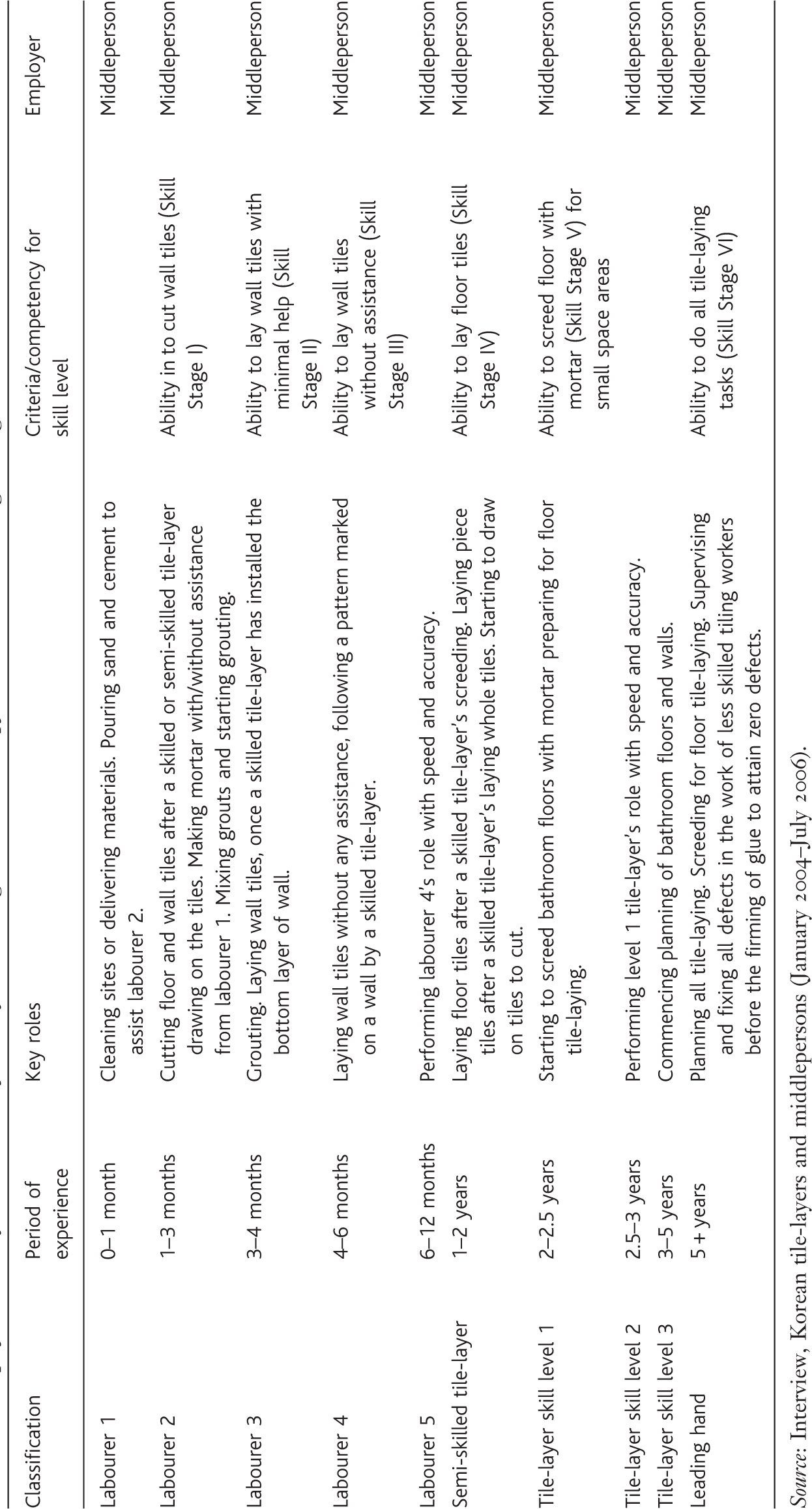
Source: Interview, Korean tile-layers and middlepersons (January 2004–July 2006).
To overcome this crucial problem, a new layer of ‘middlepersons’ possessing English–Korean language skills was created. These bilingual middlepersons could liaise with subcontractors and with Korean-only-speaking tiling workers, and assembled and deployed groups of narrowly skilled, casually engaged workers who undertook tiling work that had previously been done by multi-skilled tradespeople. The non-co-ethnic and class resources strategy (Kim, 1999; Yoon, 1991) enabled tiling subcontractors to introduce and expand pyramid subcontracting by deploying Korean skilled, semi-skilled and low-skilled tiling workers via middlepersons, even though the EBAs permitted engagement only of skilled tile-layers, apprentices and labourers directly as employees. This distinct shift from Italian-migrant tiling companies’ prior practice of employing only, or mostly, co-ethnic resources (Italian-speaking tilers) became the prevailing arrangement. Such changes also gave Korean middlepersons the opportunity to upgrade their class status by becoming micro tile-laying business-owners.
To further maximise profits in the commercial sector, the subcontractors retained the planning and marketing aspects but sublet, mainly to Korean middlepersons, the ‘controversial’ tile-laying aspect to avoid dealing with potential defects, the responsibility for quality control and physical tile-laying tasks. As team leaders and employers, the middlepersons employed a few skilled and semi-skilled tile-layers and several levels of low-skilled tiling workers on a casual basis, to create a team. Given lower contract rates of pay from subcontractors, in order to make profits, the middlepersons also subdivided the tile-laying process into several sub-tasks by narrowing each tile-laying worker’s role, as shown in Table 2, and implemented hugely differentiated wages between skilled and low-skilled workers. Intense competition between Korean middlepersons and the emergence of competition from Chinese middlepersons and their even lower-cost tiling teams forced middlepersons to successively seek ways to cheapen labour. 7 In some cases, middlepersons in turn sublet some tile-laying tasks even further, such as the screeding, floor tile-laying and wall tile-laying and grouting 8 (interview, Korean tile-layer 1, 19 April 2005; interview, Korean middleperson 2, 5 April 2005).
This degradation and fragmentation of skill influenced workers’ incomes and payment, expanding profits for the middlepersons and providing good wages for the highly skilled workers. This process has led to far greater wage differentiation between Korean skilled, semi-skilled and low-skilled tiling workers. For example, in 2009, the wage difference between the lowest-level labourer (AU$500 per five days, cash-in-hand) and leading hand (minimum AU$1750) could be more than AU$1250 per week (Koh, 2010). This represents extreme wage differentiation compared to the difference of AU$560 between labourers (AU$920) and leading hand (AU$1480) in the 2010 EBAs. Workers in these teams sought to maximise their earnings via maximising working hours and did not value formalised mechanisms of skill development.
The gendered division of labour was a further feature of the tiling labour process. The Korean tiling workforce was male-dominated. However, not uncommonly on major commercial tiling projects, Korean middlepersons employed female grouting specialists on a highly casual basis, believing that female grouting specialists, with delicate and skilful hands, can make the last task, grouting, look better and can fix minor defects made by tile-layers. Paid poor wages (AU$100–200 per day) (interview, Korean tile-layer 1, 19 April 2005; interview, Korean middleperson 2, 5 April 2005), female grouting workers also became part of the now heavily fragmented and wage-differentiated contractual system.
Although this new system in the unionised sites breached the EBAs, the union was not able to stop the practice because of a decline in membership and sectoral power. Whereas European-immigrant construction workers of the earlier era usually had Australian citizenship or permanent residency and were comfortable being union members, a significant (but indeterminable) number of Korean workers who were undocumented immigrants could not risk being detected by joining a union, and the heavily cash-in-hand payment system made both documented and undocumented alike difficult for the union to identify. Most Korean tiling workers consented to the subcontractors’ labour process change because of the language barrier, and Korean middlepersons welcomed the changes because of their desire to be small business-owners. Thus, despite having strong EBAs that specified wage rates, skill acquisition and associated parameters, these proved hard for the union to implement in the tiling sector. From 2005, the CFMEU’s (and other unions’) power was diminished by the federal Coalition (Howard) government’s ‘Work Choices’ legislation (Cooper and Ellem, 2008). Its resources and attention were increasingly diverted to a major campaign opposing this, leaving fewer resources to quell the flourishing, non-conforming employment practices in the tiling sector. Under these circumstances, subcontractors were successful in introducing a reorganisation of the labour process without resistance.
Skill Requirements, Skill Formation and the Impact of Informal Skill Formation
This transformation of contracting and employment relations is closely entwined with training provisions, which are elaborated in the following.
Formal Skill Formation
Completions of formal TAFE-based tiling training, NSW, 1987–1991
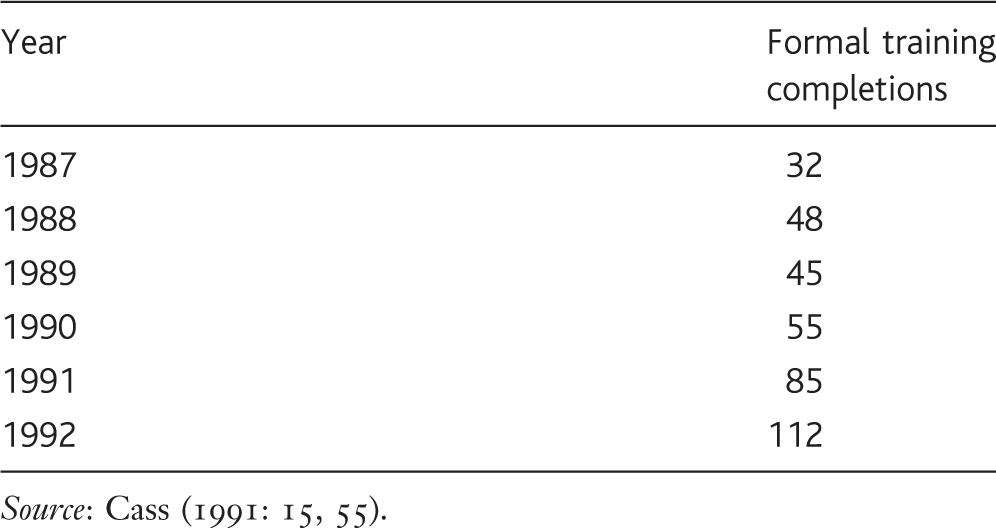
Source: Cass (1991: 15, 55).
Tile-laying apprentices enrolled and graduated in NSW in 2006 (four-year course)

Source: Cass (2006a: 32).
Informal Skill Formation and its Effects
The informal wage system and diminished skill requirements under pyramidal subcontracting have provided an opportunity for tiling subcontractors to sidestep formal and institutional skill formation to cut training costs, while encouraging informal and ‘self-taught’ skill formation. Many Korean middlepersons permanently employ only one or two highly skilled tile-layers (who perform roles as team leaders or leading hands), and engage larger numbers of semi-skilled and low-skilled tile-layers on a casual basis. Korean middlepersons perceive highly skilled tile-layers as expensive. When these tiling workers reach the skilled tile-layers’ level, they charge over AU$350 per day (in 2009) and want to perform only tile-laying and not provide grouting and cleaning services (interview, Korean tile-layer 1, 19 April 2005). Therefore, the middlepersons have to pay an additional AU$100 per day (2004 costing) to a tiling labourer for site-cleaning, which is an extra financial burden (Shin et al., 2004: 25). Given this trend, there are now relatively few tiling workers with higher-level skills.
In addition, difficulties in enforcing training ratios embedded in the EBAs have contributed to the deterioration of training across the sector. The CFMEU traditionally promoted formal skill training through accredited training providers (e.g. TAFE), and continuously campaigned for subcontractors (tiling companies) to employ more tile-laying apprentices. The union prescribed a ratio of one apprentice to every five tradespersons in the private sector, and one to four in the public sector on the major commercial (unionised) sites (CFMEU, 1997: 7, 1999: 10). The CFMEU succeeded in inserting a clause into the EBAs to ensure that these ratios automatically applied to subcontractors. However, the EBA clause was applicable to tiling subcontractors who employed 20 or more employees on a continuing basis (Classic Tiles Pty Ltd and CFMEU, 2001: 25; Fifa Group Tiles Pty Ltd and CFMEU, 2004: 27), excluding most subcontractors on unionised sites from employing apprentices since they allow employment numbers to fall below this threshold. For example, a subcontractor who had an EBA with the CFMEU explained: ‘Our company employs approximately 20–25 tiling workers. The tiling workers comprise 10 to 13 direct employees … and 10–12 tiling workers are employed by a few Korean middlepersons’ (interview, Italian subcontractor 1, 6 May 2005). The contractual relationship with the middlepersons meant that the number of tile-layers directly employed by the company (just 10 to 13 people) was less than the requisite 20 employees, allowing the company to achieve free-rider benefits through not investing in training.
Likewise, middlepersons do not want to provide on-the-job training for their workers who might then go to other employers. After becoming skilled tile-layers, most such workers want to become self-employed contractors or middlepersons, rather than waged workers, creating more competition in the tiling tendering process. Also, the majority of young workers from Asian ethnic communities do not want to attend institutional training centres, but prefer to learn tile-laying skills through on- or off-the-job training in order to gain higher wages than apprentices, and to become middlepersons (interview, CFMEU NSW Branch tiling sector organiser, 7 September 2005). Not uncommonly, workers engage in self-initiated, offsite training. For instance, those wishing to perfect their screeding go to a beach and practice on the wet sand, as screeding is a benchmark needed to become a skilled worker. In some cases, tiling workers build a sample model of a wall and floor in their own backyards in order to practice tile-laying work. They engage in this voluntary extra practice because they cannot take time off to practice their skills under the pyramidal subcontracting system, as middlepersons do not allow skilled tile-layers to stop work in order to train unskilled and less-skilled tiling workers. The middlepersons believe that stopping work for training is simply losing money, not an investment (interview, Korean tile-layer 1, 19 April 2005). These circumstances have led to a shortage of highly skilled tile-layers and resulted in low-quality tile-laying work.
Cass (2006b: 178) argues that there has been a gradual deskilling in the tiling trade, in particular, the skills to wet fix tiles to walls and floors with cement and sand mortar. Informal skill formation has created negative outcomes such as higher levels of complaint about tile-laying work. The substandard quality of tile-laying caused by semi-skilled and low-skilled tiling workers has become a problem in the tiling sector (interview, former President of Australian Tile Council, 14 June 2010). As early as 1991, Cass (1991: 17) pointed out that although the average tiling cost was approximately 4% of the whole cost of a new home, 16% of the complaints to the Building Service Corporation of New South Wales (BSCNSW) pertained to the tile-laying trade. Tile-layers themselves reported in interviews that tile-laying quality has been further downgraded since the late 1980s because of the expansion of pyramidal subcontracting arrangements, informal employment, informal skill formation and the narrow subdivision of labour and tasks in tile-laying teams (interview, Korean middleperson 1, 11 January 2004; interview, Korean middleperson 3, 10 May 2005).
A further issue is the increasing popularity of porcelain tiles, which are larger, heavier and harder to lay than ceramic tiles (Tile Today, 2001: 39; interview, former President of Australian Tile Council, 14 June 2010). Many skilled and lower-skilled tile-layers, self-taught through informal methods, do not have the necessary skill to lay such tiles, giving rise to increased complaints (Cass, 2005: 8). Complaints about the broader work of tile-layers, including waterproofing and bathroom renovation, are over three times more frequent than complaints about carpentry and joinery (Cass, 2008: 48), bearing out the adverse effects on quality and product of pyramidal subcontracting and the attendant training system that has emerged.
Discussion and Conclusion
This article has shown how, within the tiling sector, management adjusted skill requirements to change employment relations for the purpose of enhancing profits. It revealed that the interrelations between employment relations, union power and workers’ consent and resistance, key dimensions enunciated by labour process theorists, influenced management’s implementation of a control strategy of deskilling or upskilling.
The pre-1980s’ tiling era in Sydney was founded on the high-level skill of predominantly Italian tradespeople, supported by immigration policy that endowed post-war migrants with citizenship (and concomitant union membership). These mechanisms preserved the quality and wholeness of worker skill, which were central to subcontractors’ profit. Within relatively strong unionism and prevailing permanent and piecework employment relations, management deployed an upskilling control strategy that gave tiling workers responsibility, autonomy and shared profits, consistent with Friedman’s (1977) conceptualisation.
However, from the late 1980s, this system crumbled. Pyramidal subcontracting, characteristic of a wider fragmentation of previous organisational boundaries (Marchington et al., 2005), and declining union strength enabled subcontractors to apply a deskilling strategy, sidestepping institutional skill formation to achieve ‘free-rider’ benefits by non-investment in training for tile-laying workers. The influx of Korean migrants resolved the sector’s Olympic labour shortage, but the new layer of management (middlepersons) required to solve the associated language barriers, combined with lower contract rates of pay from subcontractors, underpinned modification of ethnic relations and the dimensions of control and autonomy within the sector.
Changes in the sector have redefined the status and power of management, subcontractors and middlepersons, and skilled and low-skilled tiling workers in the pyramidal subcontracting labour process, illustrating clearly the skill polarisation thesis of Grugulis and Lloyd (2010) and earlier theorists. Skilled tile-layers have had the power to control the tile-laying process as their skills are fundamental in a team, but their labour cost means that they have become relatively few in number, with adverse effects on product quality. Middlepersons have ceded responsible autonomy (Friedman, 1977) to the skilled tile-layers, but taken on close and direct control of semi-skilled and low-skilled workers. In some cases, the middlepersons and the highly skilled workers shared their power and autonomy, resulting in craft control over the semi-skilled workers and tile-laying labourers, while female grouting workers and low-skilled workers’ autonomy and power were severely diminished.
The middlepersons applied deskilling practices to achieve bureaucratic and craft control of the labour process by exploiting their team members, particularly lower-skilled tiling workers, and producing segregation into primary and secondary labour market segments (Edwards, 1979). This division of labour process and derogation of skill are consistent with Braverman’s (1974) deskilling thesis. Burawoy’s (1979) notion of worker consent assists in explaining the apparent picture of acquiescence to the somewhat exploitative employment circumstances that this study revealed, and is illustrated by at least two junctures: the consent to piecework by the pre-1990s’ highly skilled craft workers; and the unchallenged acceptance by Korean immigrants of fragmented, deskilled roles created by the co-ethnic middlepersons. Further, the role of tiling workers in the subdivided tasks confirmed the skill polarisation concept (e.g. highly skilled tilers as core workers; low-skilled workers and women as part of the periphery) argued by Kalleberg (2001, 2003) and Ackroyd and Procter (1998).
The case study has wider relevance in understanding the reconfiguration of the labour process and the ongoing dynamic of ethnic relations within and beyond the construction industry. A further contribution lies in uncovering detail of the interrelationship of government immigration policy and employment relations, which stands to inform the government as well as unions and other policy stakeholders in the tiling sector and the wider construction industry. Further research that compares the Sydney tiling sector with the tiling sector in other cities or countries, or cross-sectoral comparison, will extend the findings of this necessarily bounded study.
Footnotes
Acknowledgements
Advice from Al Rainnie, Helena Liu and two anonymous referees is gratefully acknowledged.
Funding
This case study and the wider research project with which it is associated were funded by an Australian Research Council Linkage grant (LP0348736).