




Abstract
It is generally assumed that multinational companies will, to some extent at least, adapt their practices to host country environments. However, recent work suggests that this process of adaptation is yet more complex and uneven. It is our contention that subsidiary policy on labour relations is not simply the product of adaptation from and to home and host institutional environments but is in fact shaped by the multiple power relations that characterize multinational company subsidiaries. This three country comparison between Argentina, Canada, and Mexico shows that a policy of strong engagement with trade unions requires the presence of actors that can mobilize power resources. It is when both management and workers have power resources that subsidiaries are more likely to develop a policy of strong engagement with trade unions.
Keywords
Introduction
The balance of power between capital and labour over the last three decades has shifted significantly in favour of capital. Multinational companies (MNCs) are central to this shift. MNCs are active in shaping globalization through the control of their transnational value chains but also through their capacity to frame the broader agenda for economic and social development. Governments everywhere, including the major international organizations of economic governance, orient state policy to favour foreign direct investment (FDI), and similarly encourage trade unions and other civil society actors to do likewise in the interests of enhanced economic development. This shift in the balance of power has reinforced the capacity of MNCs to shape labour relations according to their interests and preferences, seemingly irrespective of institutional setting.
This paper is concerned with how this apparently broader trend in favour of MNCs translates into their subsidiaries’ labour relations policy. Our focus is on Argentina, Canada, and Mexico. These three countries offer two intriguing pairs of comparison. Mexico and Canada are partners with the U.S. in the North American Free Trade Agreement (NAFTA). While the three economies are intertwined, their relationships are quite asymmetric because of the economic dependence of both Canada and Mexico on the U.S. In 2011, Canada's trade with the U.S. accounted for 74% of its exports and 50% of its imports. Similarly, 79% of Mexico's exports and 50% of its imports were with the U.S. in 2011. However, the two countries combined (Canada and Mexico) accounted for just 32% of U.S. exports and 26% of U.S. imports in 2012 (Villarreal and Ferguson, 2014). The stock of U.S. FDI in Canada and Mexico displays a similar disparity with U.S. FDI in Canada and Mexico accounting for more than half of the overall stock of FDI in each of these two countries, whereas Canadian and Mexican investment in the U.S. was just 8.5% and 0.56%, respectively, of FDI in the U.S. Although the Mexican and Canadian industrial relations systems differ in significant ways, they share a number of common features, notably that collective bargaining in the private sector is quite decentralized and takes place at the workplace level.
Argentina is an important member of MERCOSUR, the regional free trade pact in South America. Even though FDI from the U.S. is an important feature of its economy, Argentina's FDI is more diversified (Novick et al., 2011). Argentina and Mexico have often been seen to be similar both because of their comparable histories of state corporatism (Schmitter, 1982) and because of their embrace of neo-liberal policies (Bensusán, 2013; Murillo, 2000). However, since early 2000, Argentina and Mexico have followed different paths. Whereas Mexico has remained attached to neo-liberal labour policies, the “left turn” in Argentina meant that a range of mechanisms to encourage social dialogue and social protection in the labor market were implemented and trade unions demonstrated far greater autonomy than in Mexico (Bensusán and Moreno-Brid, 2012). In contrast to Mexico and Canada, collective bargaining in Argentina is also more centralized, with bargaining taking place at the level of both sector and workplace (Palomino and Trajtemberg, 2012).
The institutional differences in these three countries could conceivably give rise to different MNC subsidiary policies on labour relations. The core argument in this paper is that subsidiary policy on labour relations is not simply the product of adaptation from and to home and host institutional environments but that it is in fact shaped by the multiple power relations that characterize MNC subsidiaries. These power relations are within the MNC, with the host environment and with other interlocutors (Dörrenbächer and Gammelgaard, 2011; Ferner and Tempel, 2006). It is especially important to take account of and to integrate into the analysis worker power (Anner, 2013; Lévesque et al., 2013; Wright, 2000).
Drawing on data collected from senior managers in 459 subsidiaries of foreign MNCs in Argentina, Canada, and Mexico, the paper considers four propositions to understand how both management and worker power shape subsidiary policies on labour relations.
Power dynamics within MNCs
Labour relations and, more broadly, employment relations are often a neglected subject in the study of MNCs even though they can contribute to a better understanding of MNCs’ functioning. Collings (2008) argues that employment relations can make a distinctive contribution by introducing consideration of power, which is echoed elsewhere in the literature (Edwards and Bélanger, 2009; Hardy, 1996). Ferner, Edwards and Temple (2012) emphasize the importance of power and the dynamic interplay between MNC headquarters (HQs) and their subsidiaries. At both levels, they make a distinction between the power of process, the power of resources, and the power of meaning. Dörrenbächer and Gammelgaard (2011) highlight the importance of strategic capabilities, such as bridging and networking in understanding power relations within MNCs. We draw on this strand of literature to understand power dynamics but also integrate more fully workers structural and associational power into the analysis (Anner, 2013; Herod et al., 2007; Wright, 2000). The focus is on four dimensions of power in subsidiary labour relations policies: the power of meaning in MNCs, subsidiary capabilities and resources, worker structural power, and worker associational power.
The power of meaning in MNCs
The literature on the labour relations practices of U.S. subsidiaries suggests that they are less likely to engage with trade unions (Almond and Ferner, 2006; Gunnigle et al., 2005; Tempel et al., 2006). Union avoidance has been linked to the dominance of individualistic values, to the idea that the employer should be the unique supplier of employee welfare and to the hostility of employers towards the involvement of “third parties”, such as trade unions, in labour relations (Godard, 2009; Jacoby, 1997). Temple et al. (2006) suggest that these values provide a legitimizing frame for U.S. MNCs to exercise pressure on local managers to implement union avoidance practices. We thus expect that U.S. MNCs through their legitimizing frame of union avoidance will favour non-engagement with trade unions in their subsidiaries.
Subsidiary capabilities and resources
Even though MNCs are powerful actors that can ostensibly exercise tight control over their operations, they are also seen to be a contested arena characterized by tensions between competing actors (Edwards and Bélanger, 2009). Far from being monolithic organizations, coalitions of actors within MNCs pursue different goals and deploy their power resources to attain them. Local managers are not simply passive agents following the directives and policies established by HQ. They draw on resources from various levels and use their distinctive capabilities to advance their own agenda and pursue their specific interests. In a study of MNC subsidiaries in Canada, Bélanger et al. (2013) explore how the organizational capabilities of subsidiaries enhance their discretion to pursue subsidiary-specific policies. In their influential study, Kristensen and Zeitlin (2005) show how local actors strategize in order to reinforce the position of their subsidiaries within the corporation by developing collaborative action within the local economy, within the MNC but also with trade unions. In particular, they show that local managers and trade union representatives work together to increase the margin of manoeuvre of the subsidiaries vis-à-vis the HQ. The crucial point is that managers need to mobilize their resources and use their capabilities to engage with trade unions in this global game.
In a study of flexibility arrangements in an MNC with operations in Canada and Mexico, Lévesque and Murray (2011) highlight the importance of strategic capabilities of managers, as local actors mobilize their resources to establish workplace autonomy vis-à-vis the HQ. Drawing on a study of MNC subsidiary recognition practices in three different national contexts, Lamarre et al. (2013) find that subsidiaries characterized by a higher degree of discretion over employment relations practices are more likely to have unions present in their operations.
Workers’ structural power
HQ power over subsidiaries is further constrained by worker power. Despite the asymmetry of power between workers and employer, workers always retain some power to resist and to influence employer decisions. Worker power can be derived from many sources, notably their structural power (Wright, 2000). The structural power of a workplace trade union needs to be understood in relation to its role and location within the organisation of production and services, be it in terms of representing scarce skills or the potential they have to exert effective pressure on the flow of goods and services (Coe et al., 2008; Herod et al., 2007). Structural power is a key consideration for MNC strategies focused on the optimal distribution of activities along their global value chains (GVCs) (Gereffi et al., 2005). Accordingly, workers may be more vulnerable to competitive pressure or have more leverage over the bargaining of working conditions (Herod et al., 2007). This observation applies to their particular sets of skills, to the kinds of value-added activities in which they work and the variability of production cycles.
Workers’ associational power
Associational power stems from the collective organization of workers. According to Wright (2000), associational power includes unions and political parties but also a variety of other forms, such as legal recognition of trade union action or the institutional representation of workers on boards of directors or work councils. It is thus related to the institutional arrangements that generate collective resources for workers. Institutions may be constraining or facilitating, both limiting prospects for change but also providing resources that can enable actor agency to reshape patterns of relations (Campbell, 2004; Kristensen and Morgan 2012). Workers’ associational power is therefore a resource on which trade unions in MNC subsidiaries can draw but it is embedded in the history of relations between actors and institutions in each national setting.
Labour law provides a good illustration of this interplay between actors and institutions in the three national cases in this study. Formal legal requirements might suggest that it is easier to create a trade union in Mexico than in Argentina or Canada. 1 However, this more favourable legislation for workers on union recognition in Mexico does not reinforce worker power because companies, often with the support of the official unions, can use different methods (both legal and otherwise) to limit the presence of independent unions and to enhance that of subordinated trade unions. Workers’ associational power in Mexico thus remains extremely weak (Bensusán et al., 2011). Moreover, unlike many of the other Latin American political economies since the early 2000s, Mexico has not moved away from its embrace of neo-liberal labour market policies (Bensusán, 2013). Political changes over the last 15 years have not diminished the complex legal and administrative controls regulating wages, contract negotiations, strikes, and union registration. In this authoritarian corporatist regime, official unions continue to play an important role within the state administration in return for their cooptation in industrial and political matters. The labour courts, with their significant decision-making powers in the determination of union representativeness, the registration of unions and the legality of strikes, provide a telling example. Official unions, notably the Confederación de Trabajadores de México (CTM), also support the government economic strategy which rests on low wages and flexible workplaces as a basis of international comparative advantage (Bensusán and Middlebrook, 2012; Caufield, 2004). Hence, the institutional environment in Mexico does not provide significant associational power resources to workers.
Argentina offers an interesting contrast to Mexico. Over the last two decades, the relationship between trade unions, the State and political parties, notably the Peronist Party, experienced significant changes. The adoption of neo-liberal policies impacted the social structure and the political system, and altered the strong ties that prevailed for most of the second half of the 20th century between trade unions and the State. Following the economic and social crisis in 2001–2002, numerous labour policy reforms favourable to workers dealing with income distribution, social security, and legal protection were adopted. These reforms went hand-in-hand with increases in the employment rate, union density, collective bargaining coverage, and unions’ capacity to mobilize their membership. Workers’ associational power in Argentina is therefore much stronger now than it was a decade ago (Etchemendy and Collier, 2007; Palomino and Trajtemberg, 2012; Spaltenberg, 2012; Trajtemberg et al., 2010).
In Canada, despite a decline in private sector union density, unions have remained quite strong with union density around 30% of the labour force. Unions in Canada are also strongly resourced and have a long history of bargaining success. Irrespective of varied geography and variations in provincial legal regimes, the focus for union action is at the level of the workplace. In the private sector, there is generally only one union per workplace and bargaining takes place and applies only to that workplace (Murray and Verge, 1999). Employers are compelled to deal with unions once representation rights have been secured. The union is then the exclusive bargaining agent for all workers in the workplace covered by the union certification and the employer is compelled to bargain in good faith with the union (Godard, 2011). Despite continuing labour market and political pressures in different provincial jurisdictions, the labour legislation regime has remained intact and, moreover, the core precepts of collective labour action have even been reinforced by a series of Supreme Court decisions that confirm the basic right of association (Fudge, 2008).
In contrast with Mexico, the institutional environment in Argentina and Canada provides greater associational power to workers.
Research method
This paper draws upon data collected by three national teams in Argentina, Canada, and Mexico in the context of a larger international research initiative (INTREPID) looking at the relationship between MNCs and their subsidiaries. 2 The questionnaire was designed for the most senior human resources (HR) manager, i.e. the person ultimately responsible for the management of all the firm’s employees in each country. Each national survey population included all domestic- and foreign-controlled MNCs having at least 500 employees worldwide, with a minimum of 100 employees in the host country and a minimum of 100 employees in other countries. In each country, the challenge was to identify this population of MNC subsidiaries, which was not readily available.
In Canada, a wide variety of sources (Dun & Bradstreet and other company rankings) and means (telephone survey and case-by-case verification through Internet searches) were used to identify 1398 MNCs. A paper copy of the questionnaire was sent by mail but respondents were also offered the possibility to complete an electronic version. By the end of 2006, 208 respondents had completed a questionnaire. 3 Of this total, 165 respondents are from foreign-controlled and 43 from Canadian-controlled companies.
In Mexico, the sample frame was built with public and private directories and data bases, including the FDI data from the Ministry of Economy. A census telephone survey identified 1746 MNCs from which a sample of 922 was selected to control for key variables (size, country of origin, sector, and region). The questionnaire was administered through face-to-face interviews in 2008–2009. Out of the 922 firms selected, 171 completed the questionnaire. Of this total, 144 are foreign-owned subsidiaries and 27 are Mexican-owned.
In Argentina, the research was conducted by the Ministry of Labour, Employment and Social Security (MLESS) in 2009. Through directories from the MLESS and other sources, a population of 577 MNCs operating in the manufacturing and service sectors was identified (natural resources and construction were excluded from the definition of the population in Argentina). The field work involved face-to-face interviews with senior HR managers in 155 subsidiaries stratified by sector, size, and the MNCs country origin. Of the 155 valid responses, 150 are foreign-controlled and five are Argentinean-controlled MNCs.
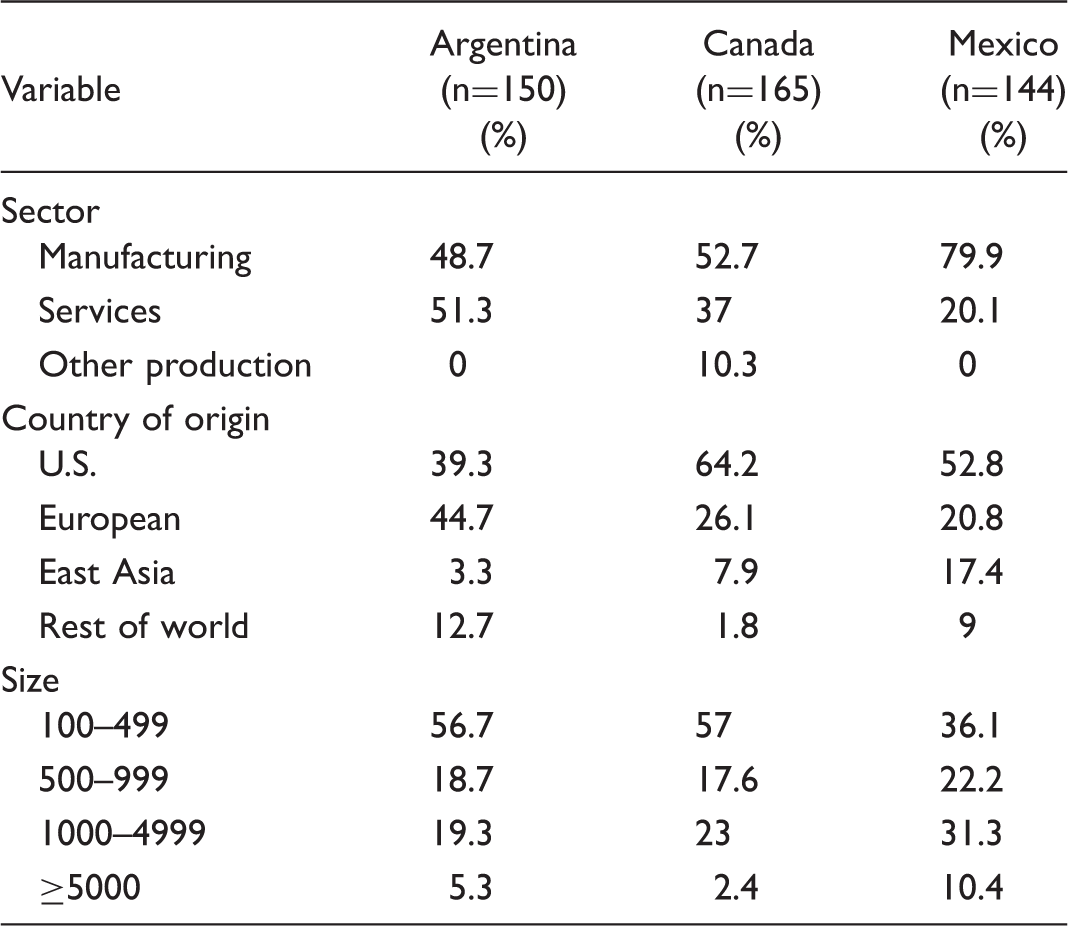
Descriptive statistics of national surveys.
Measurement of dependent and independent variables.

Descriptive statistics and bivariate correlations.

p < .05.
Discriminant analysis with subsidiary policies on labour relations as the dependent variable.
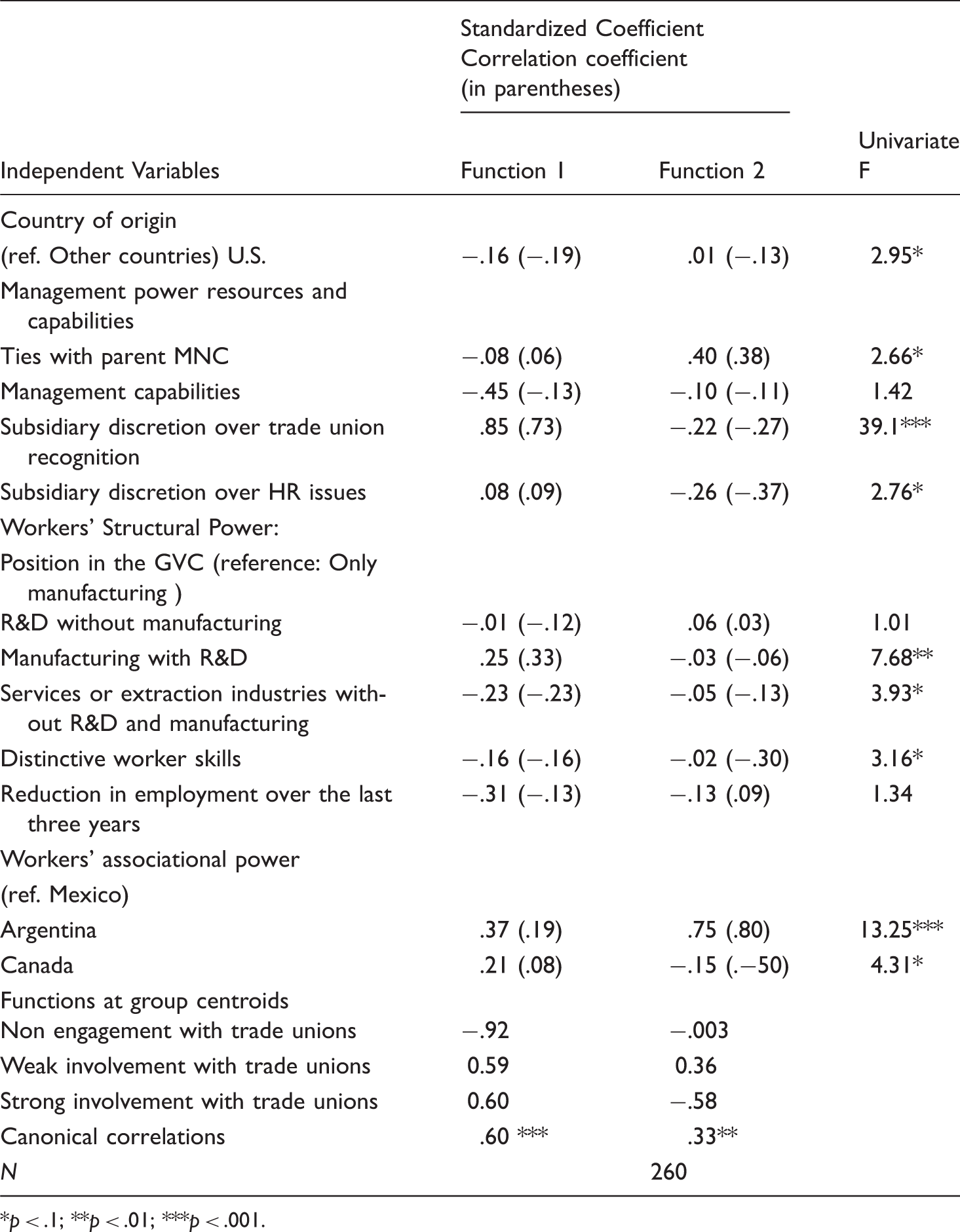
p < .1; **p < .01; ***p < .001.
Results
Subsidiary policy on labour relations is measured by combining two indicators: the presence or absence of unionized workers in the subsidiary and the degree of trade union involvement in decisions related to employment issues (see Table 2 for details). This yields three patterns of management engagement with unions: non-engagement (49%) where unions are not present in the subsidiary, weak engagement (33%) where unions are present but weakly involved in decisions related to employment issues, and strong engagement (18%) where unions are strongly involved in decisions related to employment issues.
In order to identify the factors associated with subsidiary policy on labour relations and to test our four propositions, we performed a discriminant analysis (see Table 4). Both discriminant functions are statistically significant (p < .005) and the overall canonical coefficient correlations reach .60 for the first function and .33 for the second function.
Our first proposition with regards to the effect of country of origin is supported by the findings. U.S. subsidiaries display a distinctive policy on labour relations in comparison with subsidiaries originating from other countries. U.S. subsidiaries are less likely to engage with trade unions.
The second proposition focuses on management capabilities and resources. Our results suggest that subsidiary discretion over union recognition, subsidiary discretion over HR issues, and ties between the subsidiaries and the parent MNC are all related to subsidiary policy on labour relations. While subsidiary discretion over union recognition and over HR issues seem to favour engagement with trade unions, strong ties with the parent MNC work in the opposite direction. Internal management capabilities are not associated with the subsidiary policy on labour relations.
The third proposition concerns worker structural power. Fluctuations in levels of employment are not associated with subsidiary policy on labour relations while both the distinctiveness of worker skills and the subsidiary position within the value chain are positively and significantly associated with subsidiary policy on labour relations. Subsidiaries are more likely to engage with unions when workers have distinctive skills and when the subsidiaries have both manufacturing and R&D functions, as opposed to only manufacturing. Subsidiaries are less likely to engage with unions when they are only involved in services or in resource extraction industries.
The fourth proposition is related to workers’ associational power. Our results confirm that subsidiaries in Argentina and Canada are more likely to engage with trade unions in comparison with subsidiaries in Mexico.
To better understand these results, we need to locate the patterns of subsidiary policy on labour relations according to both discriminant functions and to identify the direction of the association between the independent variables and the discriminant functions. Figure 1 shows the results of the classification process. A policy of non-engagement has a high negative score on the first function (–.92 on the vertical axis) and a very low positive score on the second function (–.003 on the horizontal axis). Non-engagement is thus located on the lower-left of Figure 1. Policies of weak and strong engagement have a high positive score on the first function (the vertical axis) with scores of .59 and .60, respectively. This locates these two policies at the top of Figure 1. However, they are located in opposite quadrants because they have contrasting scores on the second function on the horizontal axis (.36 for weak engagement and –.58 for strong engagement).
Variables associated with subsidiary policy on labour relations.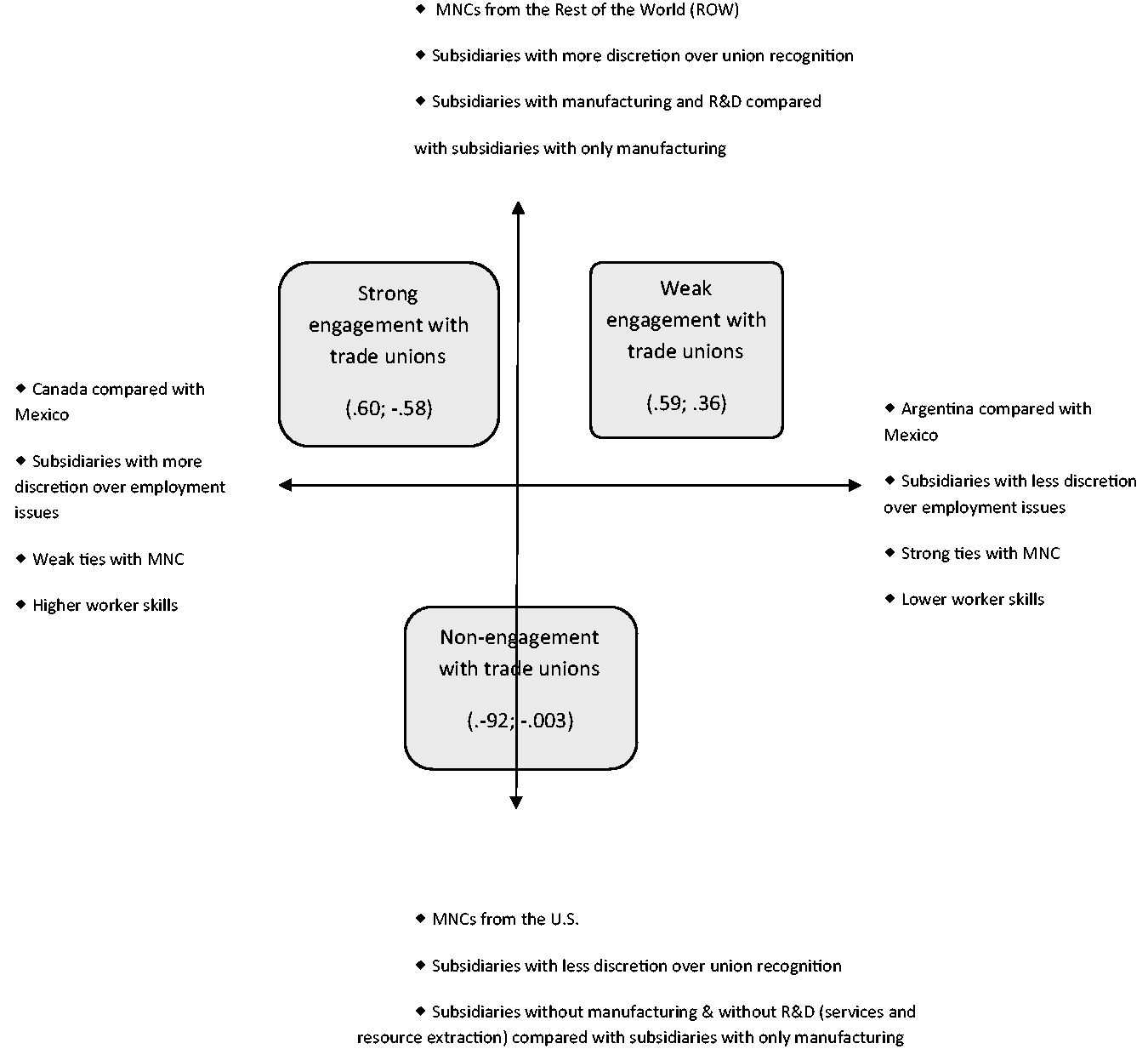
Three sets of variables are associated with the first function (the vertical axis) and therefore contribute to explaining a policy of non-engagement as opposed to weak and strong engagement. These are country of origin, discretion over union recognition and the subsidiary position within the value chain. In terms of country of origin, it is MNCs from the U.S. that are associated with non-engagement, whereas MNCs from other countries are associated with a policy of either weak or strong engagement with trade unions. For subsidiary discretion, less discretion over union recognition is associated with non-engagement, while more discretion is associated with weak or strong engagement. Finally, as regards workers’ structural power, as measured by the type of activities conducted by the subsidiary, subsidiaries with both manufacturing and R&D were more likely to feature some form of union engagement (weak or strong) in comparison to those only involved in manufacturing. Moreover, subsidiaries not involved in either manufacturing or R&D (i.e. in services or resource extraction industries) were more likely to favour non-engagement compared with subsidiaries involved only in manufacturing.
Four variables are associated with the second function (the horizontal axis) and contribute to differentiating policies of weak and strong engagement. These are subsidiary discretion over employment issues, strength of ties with the parent MNC, distinctive worker skills and workers’ associational power. First, when subsidiaries have more discretion over employment issues, they are more likely to pursue a policy of strong engagement with trade unions. The contrary also holds since less subsidiary discretion on employment issues is equated with weak engagement. Second, subsidiaries that have weaker ties to their parent MNCs are more likely to report a policy of strong engagement with trade unions whereas subsidiaries that are strongly embedded in MNC networks are more likely to report weak engagement with trade unions. Third, subsidiaries where workers have distinctive skills are more likely to report strong engagement with trade unions while those where worker skills are less distinctive display weak engagement with trade unions. Finally, compared to Mexico, subsidiaries in Argentina are more likely to report weak engagement whereas subsidiaries in Canada are more likely to exhibit a policy of strong engagement with trade unions.
We can now examine the three patterns of policy on labour relations more closely. As highlighted in Figure 1, non-engagement with unions combines mainly the sets of variables on the lower end of function 1 (the vertical axis). Non-engagement is thus associated with MNCs from the U.S. that report less discretion over union recognition and whose activities are concentrated in the service and primary sectors. In other words, non-engagement with unions characterizes subsidiaries from the U.S. where both managers and workers have fewer resources. Managers have few power resources since their subsidiary appears to enjoy less discretion while the role or scope of subsidiary activities (neither manufacturing nor R&D) appears to place workers in a more vulnerable position on the labour market.
In contrast, in examining the upper quadrants of Figure 1, a policy of weak or strong engagement with trade unions is associated with a combination of variables from both the vertical and horizontal functions. These variables work in both similar and different directions. The variables that push in the same direction include: MNCs from countries other than the U.S.; greater subsidiary managerial discretion over union recognition; and workers’ structural power in terms of a wider range of value-added activities conducted by the subsidiary (manufacturing and R&D). The variables that push in different direction, i.e. that distinguish between the degrees of subsidiary engagement (weak or strong) with trade unions, are: subsidiary manager discretion over HR issues, ties to MNC HR networks, distinctive worker skills, and workers’ associational power.
A policy of strong engagement with trade unions is more likely in subsidiaries in Canada (as opposed to Mexico) where managers have more discretion on HR issues and are less embedded in parent MNC HR networks and where workers have distinctive skills. Conversely, a policy of weak engagement is more likely in subsidiaries in Argentina (as opposed to Mexico) where managers have less discretion, closer ties to MNC HR networks, and where workers have lower levels of distinctive skills. The combination of management power resources and worker structural and associational power therefore helps to distinguish between weak and strong engagement with trade unions.
Discussion
Our findings suggest that the power of meaning exerted by MNCs, as captured though country of origin, shapes subsidiaries policies over labour relations. Subsidiaries from the U.S. are more likely to pursue a union avoidance policy compared to MNCs from other countries. They are also more likely to report that decisions over union recognition are centralized. These results add to a growing body of research suggesting that U.S. MNCs are not only hostile to trade unions but also exert tight control over decisions concerning union recognition (Almond and Ferner, 2006; Ferner et al., 2013; Lamare et al., 2013; Temple et al., 2006). This policy of non-engagement does not appear to be sensitive to workers’ associational power. This anti-unionism orientation and the vision that the employer should be the unique guarantor of employee welfare appear to provide a legitimizing frame for subsidiary managers to implement a policy of non-engagement with trade unions.
Our results also suggest that other forms of power shape subsidiaries policies of engagement with trade unions. Three findings stand out in this respect.
First, both structural and associational power resources are associated with subsidiaries policies. Subsidiaries evolving in a context where workers have structural power, as measured by the nature of value-added activities in the subsidiary, are more likely to engage with trade unions. When this dimension of structural power is combined with distinctive worker skills, subsidiaries are more likely to pursue a policy of strong engagement with trade unions. In contrast, where workers have less structural power (the subsidiary activities are concentrated in the service sector or resource extraction), subsidiaries are more likely not to engage with trade unions. These results speak to a growing body of labour geography literature that underscores the active and constitutive role of workers within the study of power dynamics within MNCs and their production networks (Coe et al., 2008; Herod et al., 2007).
It is the combination of both forms of power resources—structural and associational—that explain the difference between weak and strong engagement with unions. A policy of weak engagement is more prevalent within subsidiaries in Argentina and where workers have structural power, as measured by the nature of the value-added activities of the subsidiary, but do not have distinctive skills. In contrast, a policy of strong engagement is more widespread within subsidiaries in Canada and where workers have structural power in terms of both the value-added activities of the subsidiary and their distinctive skills. The institutional context of greater or lesser associational power appears critical for union involvement. There is a marked contrast between the policies of non-engagement that typify Mexico, on the one hand, and Argentina and Canada, on the other hand. In these latter two cases, where the institutional context is characterized by stronger associational power, subsidiaries are more likely to pursue a policy of some form of engagement with trade unions, be it weaker or stronger. These results underscore the importance of taking into account both workers’ associational and workers’ structural power when seeking to understand labour relations within MNCs (Anner, 2013; Lévesque et al., 2013; Wright, 2000).
Second, management power resources also make a difference in subsidiary policy on labour relations. The degree of management discretion over decisions on HR issues appears to be a critical ingredient in the development of a policy of strong engagement. This finding suggests that to implement a policy of union engagement, subsidiary managers need a margin of maneuver to adapt HR decisions to the context and to cope with or modulate trade unions demands and needs. This takes the form of subsidiary discretion over both union recognition and also over a range of HR issues. Intriguingly, diluted or weaker links with MNC HR networks are also part of the local manager resources associated with trade union engagement (see also Bélanger et al., 2013). When these three conditions are met, not only is the subsidiary more likely to have a policy of union engagement, but it is more likely to be a strong engagement. Conversely, where managers have less discretion over HR issues and subsidiary managers are strongly tied into MNC HR networks, the policy is more likely to be one of weak engagement with trade unions. These results certainly speak to a growing body of research that highlights that local managers need power resources to establish distinctive policies within their subsidiaries (Bouquet and Birkinshaw, 2008: Dörrenbächer and Gammelgaard, 2011; Kristensen and Zeitlin, 2005; Lamare et al., 2013).
Finally, when power resources from both management and workers are combined, a clearer picture of the factors associated with subsidiary policies on labour relations emerges. Within MNCs characterized by strong engagement with trade unions, both actors have power resources. Workers can rely on both structural and associational power while, at the same time, local managers have more discretion over HR decisions. In contrast, in subsidiaries where there is a policy of weak engagement with trade unions, managers have altogether less discretion. These findings suggest that a policy of strong engagement requires the presence of actors that can mobilize power resources. It is when both management and workers have power resources that MNC subsidiaries are more likely to develop a policy of strong engagement with trade unions. For trade unions, it may be quite difficult to be involved in the decision-making process when local managers do not have discretion. This may seem trivial but, in our view, it is crucial. It means that to have some form of influence within the workplace trade unions need to rely on resourceful managers. In contrast, when both actors are weakly resourced, the dominant scenario is non-engagement with unions. In other words, and perhaps this would not come as a surprise to many experienced trade unionists, our results indicate that trade union representatives in MNC subsidiaries would appear to be better off with stronger rather than weaker subsidiary managers.
Conclusion
This article has sought to understand how the integration of both management and worker power can enhance our understanding of subsidiary policies on labour relations. The analysis is of course subject to the limits of cross-sectional, single-respondent surveys when attempting to grasp the complex power dynamics at work within MNCs on labour relations policy. However, the effort to operationalize actor power resources and capabilities at the level of both the MNC parent and at that of the subsidiary yields a number of distinctive analytical findings.
First, the power of local actors within MNCs is often assumed to be weak. Even though such an assumption requires some qualification (Dörrenbächer and Gammelgaard, 2011; Hardy, 1996), our results lend support to it. Within U.S. subsidiaries, particularly in the service and extraction industries, decisions over union recognition are often centralized and local actors appear to lack the autonomy to shape subsidiary labour relations policy. In these subsidiaries, both local managers and workers appear less able to alter the union avoidance strategy pursued by headquarters. Even if they were inclined to do so, they do not seem to have sufficient resources to resist the anti-union legitimizing frame put forward by the U.S. MNCs.
Second, introducing workers’ resources into the equation enhances our understanding of power dynamics within MNCs (Edwards and Bélanger, 2009; Ferner et al., 2012; Lévesque et al., 2013). Structural power, measured in terms of position within the value chain, seems to favour a policy of engagement with trade unions as distinctive worker skills are associated with a policy of strong engagement with trade unions. Associational power, as captured through macro-institutional resources embedded in traditions of state labour law and policy, are also closely linked to subsidiary policy on labour relations. Weaker institutional resources, as in Mexico, appear to favour a policy of non-engagement with trade unions. In Argentina and Canada, where workers’ associational power is stronger, subsidiaries are more likely to engage with trade unions. In other words, our results suggest that institutional resources make a difference in the labour relations policies adopted by multinational subsidiaries and it is important for future research to better elucidate this process.
Third, it is the combination of both workers’ and subsidiary managers’ power resources, which helps disentangle power dynamics within the subsidiaries. A policy of strong engagement with trade unions appears more likely in subsidiaries where both local managers and workers have sufficient power resources. Even though relations between workers and employers are characterized by a structured antagonism, the presence of resourceful local managers is not detrimental for trade unions. In fact, as highlighted by other studies (Kristensen and Zeitlin, 2005), it may even be a necessary condition for the development of a subsidiary policy of strong engagement with trade unions. There is thus a need to distinguish between different levels of power dynamics to understand subsidiary policies on labour relations.
These three analytical points have two important consequences for the analysis of power dynamics within MNCs. First, it is important to take into account the various types of resources and capabilities and their interaction at different levels within the MNC. Second, there is clearly a need to take into account more fully the power resources deployed by workers and managers at the local level in order to get a better understanding of the factors that shape subsidiary policy on labour relations.
Footnotes
Declaration of conflicting interests
The authors declare that there is no conflict of interest.
Funding
Each national team secured funding for the collection of data in their respective country. In Argentina, the research was funded by the Ministry of Labour, Employment and Social Security with the support from United Nations Development Programme-UNDP (Office Buenos Aires), in Canada by the Canadian Social Science and Humanities Research Council and the Fonds Québécois de la recherche sur la société et la culture, and in Mexico by the Consejo Nacional de Ciencia y Tecnología (Proyecto Colef-Conacyt 55210). The authors wish to acknowledge the following colleagues who contributed to the research in the three countries: Jacques Bélanger, Joanie Boivin, Analía Erbes, Redi Gomis, Pierre-Antoine Harvey, Patrice Jalette, Héctor Palomino, Cecilia Senén González, and Gabriel Yoguel.