



Abstract
The growth of income inequality is now recognized to be one of the most important developments in employment relations of our time. While inequality has increased in many parts of the world, it has been most pronounced in the United States. We review the factors that have been suggested to cause the growth in inequality and, given these multiple causes, suggest a set of actions that might begin to reverse this trend. We give special attention to the changes in the employment relationship related to labor market institutions – including unions and other forms of worker representation, wage regulations and enforcement, and safety net policy – while also accounting for explanations and proposals that focus on technology, skills and education, and globalization. Additionally, we argue that emerging forms of organizational restructuring are becoming increasingly important to the study of inequality and its remedies.
Keywords
Introduction
The growth of income inequality is now recognized to be one of the most important developments in employment relations of our time. While inequality has increased in many parts of the world, it has been most pronounced in the United States. In this article, we will review the factors that are suggested to cause the growth in inequality and, given these multiple causes, suggest a set of actions that might begin its reversal, with particular emphasis on the employment relationship and labor market institutions. While we focus mostly on the US, we place the discussion in a broader global context.
Trends in inequality in the US
The most widely used indicators of the growth in income inequality in the US come from Piketty and Saez (2013). Using detailed tax data from the US Internal Revenue Service, the authors show a remarkable pattern of income transfer – of over 15% of national aggregate income – from the bottom 90% of the income distribution to the top 10% over the past three decades (Figure 1). Even within the top decile of the income distribution, it is the top 1% that realized disproportionate gains, accounting for almost 60% of income growth between 1976 and 2007. In contrast, income growth of the bottom 90th percentile was relatively flat (Figure 2).
Top decile income share in the United States, 1917–2014. Source: Piketty and Saez (2007 [2015]). Decomposing the top decile US income shares into three groups, 1917–2014. Source: Piketty and Saez (2007 [2015]).

A second widely used indicator focuses specifically on long-term trends in compensation and labor productivity (Figure 3). For three decades following World War II real compensation (wages and fringe benefit costs) moved roughly in tandem with productivity. From 1979 to 2014, however, productivity grew by approximately 63%, while real compensation for hourly workers in the US increased by only about 8% – meaning productivity increased about eight times faster than wages and benefits despite the rise in workers’ education levels during this period.
The growing gap between productivity and workers’ hourly compensation, 1948–2014. Source: Economic Policy Institute analysis of data from Bureau of Economic Analysis' National Income and Product Accounts and the Bureau of Labor Statistics' Consumer Price Indexes and Labor and Productivity Costs (Bivens and Mishel, 2015).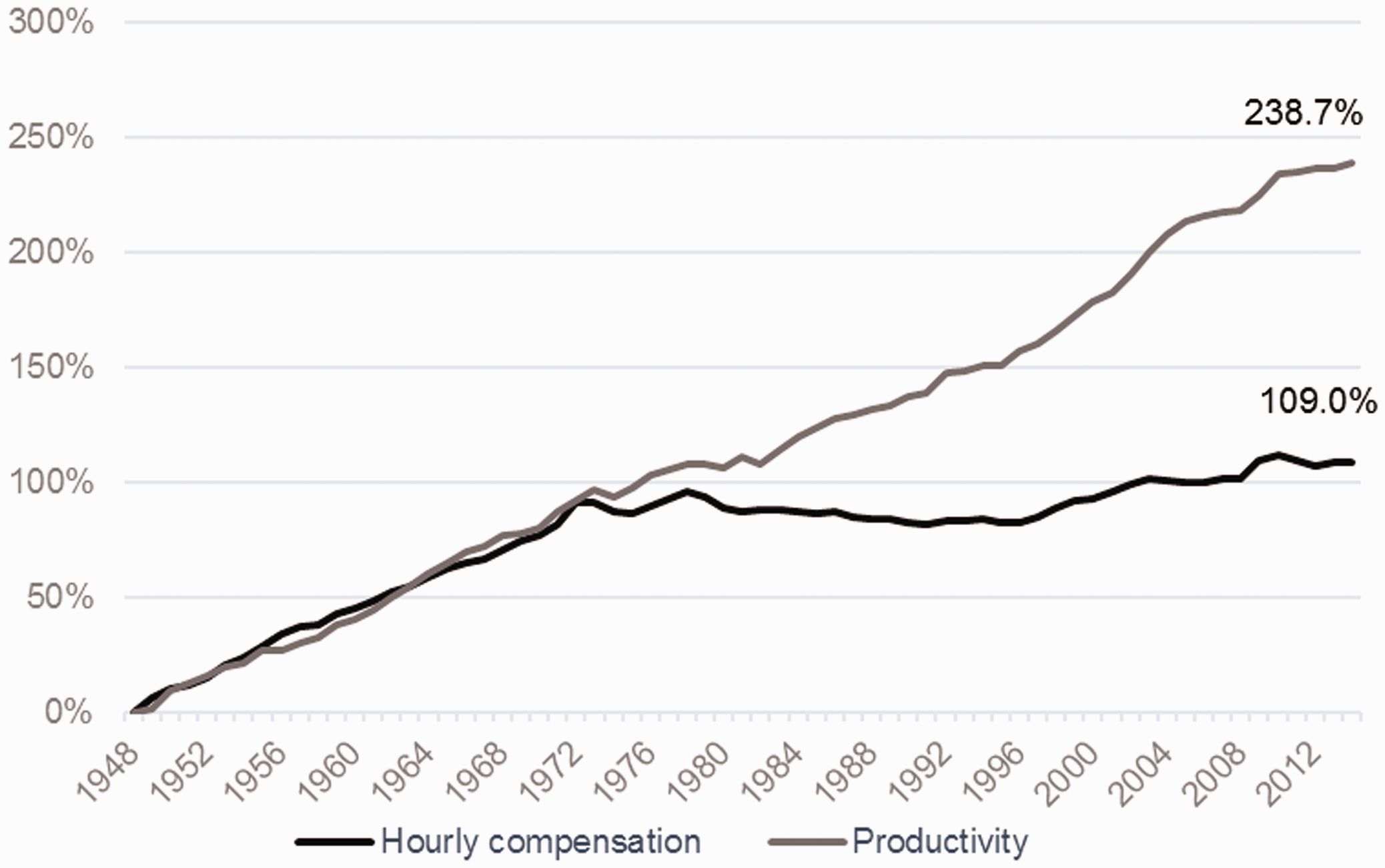
A third indicator of growing inequality is the shift in labor’s share of national income. Since 1970, labor income share has declined overall, even when accounting for income sources such as health and pension benefits. Labor share measured by salary and wages only has deteriorated more sharply, falling nearly nine percentage points over this period (Figure 4).
Declining shares of labor compensation and wages, 1955–2014. Note: Compensation includes all forms of remuneration, including wages and salaries and employer contributions (to employee pension and insurance funds, as well as government social programs). Wages and salaries do not include any such contributions. Source: US Bureau of Economic Analysis, Table 1.12: National Income by Type of Income. Last revised: October 29, 2015.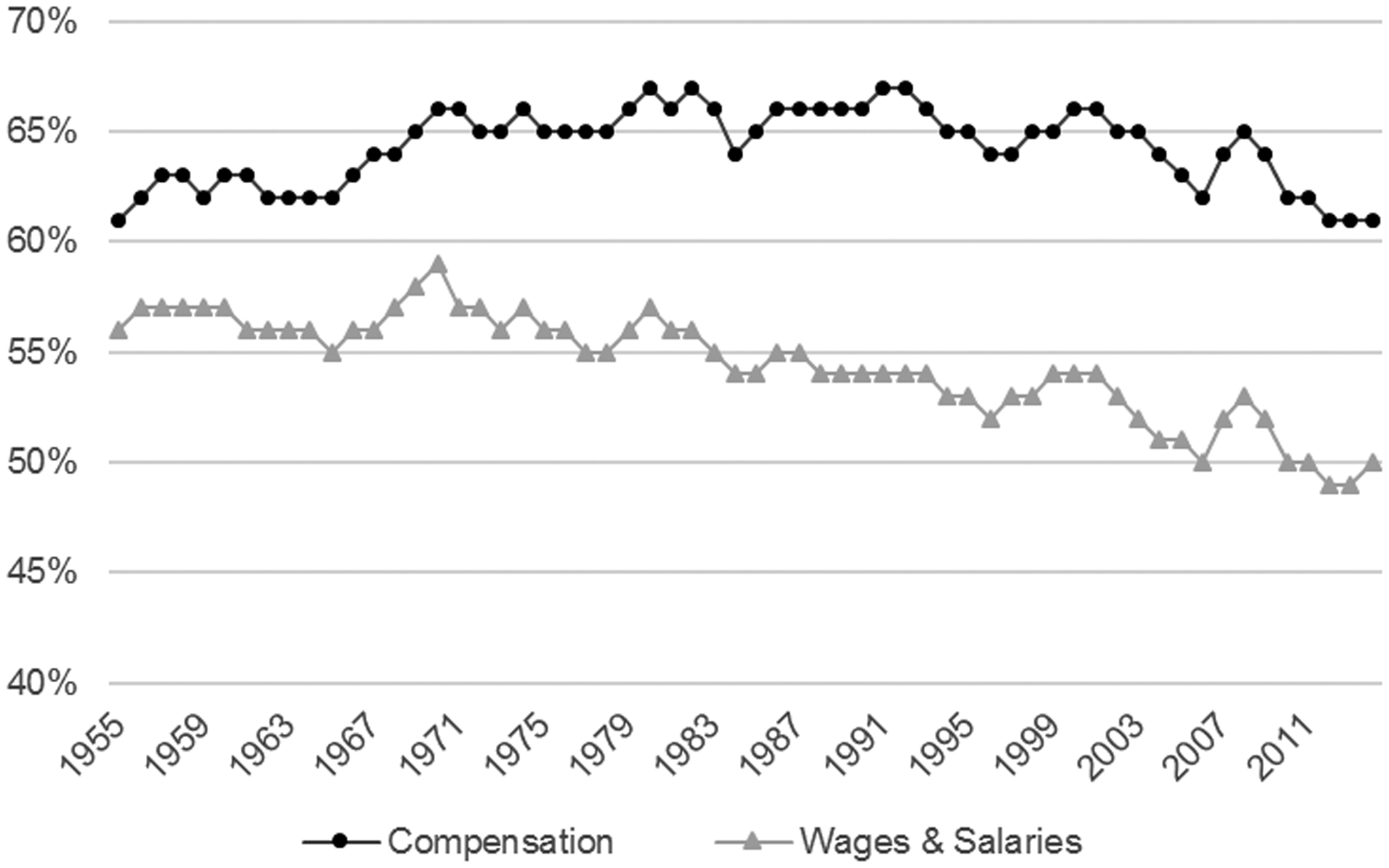
The shift from labor- to capital-intensive industries is part of the reason for this shift, but also important is the growing decline of labor share within industries – especially those where profits have grown tremendously, such as in finance (International Labour Organization (ILO), 2015) and the simultaneous accumulation of capital income by the very top of wage earners.
Global trends in inequality
The US is not alone in experiencing growing inequality over recent decades. Many industrialized countries – such as Japan, Canada, and those in Europe – have followed a similar trajectory. In particular, dramatic growth patterns at the very top are observed in other English-speaking countries such as the United Kingdom and Canada, although to a lesser degree, while in other countries such as Japan and those in Europe such accumulation is not as pronounced (Alvaredo et al., 2013). Scholars attribute these observations to a convergence in labor market institutions in countries such as the US and the UK – the decline of collecting bargaining, for example, or the declining real value of minimum wages (Gosling and Lemieux, 2004) – but also point to significant change in bargaining among CEOs and other top executives in large companies (Bivens and Mishel, 2015). Still, there is concern that as countries seek to mimic US-style compensation structures and labor market policies, their patterns of inequality will become more closely aligned with that of the US, as has been the experience in the UK (Gosling and Lemieux, 2004). Although these concerns are widespread across countries, we focus here on the causes and consequences of wage inequality in relation to the employment relationship in the US, as it is the country with the most extreme growth in inequality and the one for which we have the most expertise. (It is important to note that here we focus primarily on income inequality due to wage inequality, not other sources such as differences in property ownership and capital income. Wages account for approximately 80% of total income in the US and 70% in Europe (ILO, 2015).)
Explanations for income inequality
Not surprisingly, the growth in inequality has gained significant attention and been the source of considerable debate among researchers from multiple disciplines. We review the evidence generated by this research in the following, starting with traditional explanations in economics focused on the external market and technological change before turning to institutional and organizational factors that arise from various disciplines. In so doing, we aim to arrive at an explanation of inequality that reflects the fundamental ways in which the organization of the employment relationship has changed.
Skill-biased technological change
One of the first factors economists turned to in explaining inequality is skilled-biased technological change (SBTC), in which inequality is posited to rise when new technologies generate demand for highly-skilled workers (Card and DiNardo, 2002). This rise in inequality is argued to occur in two ways: first, through demand for skilled workers who are needed to fill more technologically advanced jobs yet who are in short supply, and later, by the displacement of lower- and middle-skilled workers, which intensifies competition for lower-wage jobs (Autor, 2010; Autor et al., 2008).
The increase in the college-to-high-school wage premium in the 1980s was the first indicator that led researchers to examine this issue in detail. In 1980, this premium was 39%; by 1990, it had risen to 54%. However, during the 1990s, the growth in the college-to-high-school differential slowed and stood at 61% by 2000, where it approximately remains today (Goldin and Katz, 2008; James, 2012). This stagnation, along with the failure to explain differences in educational returns by demographic factors such as age, gender, or race, led a number of scholars to critique the theory of SBTC as incomplete at best (Card and DiNardo, 2002; Lemieux, 2008).
Still, however, the debate around SBTC persists. Current arguments regarding SBTC have shifted focus from skills measured by education to the changing composition of tasks in technologically changed work (Acemoglu and Autor, 2011). This emphasis led to the emergence of the ‘job polarization’ thesis: namely, that a ‘hollowing out’ of middle-skill jobs is occurring at the same time that jobs characterized by low- and high-skill levels (and corresponding low- and high-wage levels) are growing (Autor, 2010). Empirical evidence challenges this idea: Holzer (2010), for example, finds that middle-skilled jobs in the US are actually projected to grow in the near future. Others argue that the job change patterns in the most recent decade fail to reflect the job polarization thesis, notably as job growth in low-wage sectors has outstripped that of high-wage sectors throughout the 2000s. Using a comparative perspective across various countries, still others show that institutions affect the degree to which the job polarization hypothesis bears out (Fernandez-Macias, 2012).
Globalization
The next favorite explanation was globalization and the related decline of the American manufacturing sector: since 1980, the US has lost just over one-third of its manufacturing jobs. A number of studies have shown that workers displaced from manufacturing jobs who regain employment experience wage reductions of 20% or more (Holzer et al., 2011: 125). A different study documents numerous negative effects – declining wages, significant increases in income transfer payments, higher unemployment, and larger reductions in labor force participation – experienced in communities exposed to increased import competition from China (Autor et al., 2013). These community effects are more persistent than economic theory would predict: the same study found relatively little geographic mobility among those displaced. More recently, offshoring undertaken by US firms during the 2002–2008 period has been shown to advantage higher-skilled (and higher-paid) workers who undertake relatively more abstract and communication-dependent tasks in their jobs (Oldenski, 2014).
Composition of the labor supply
Finally, we briefly note that growing inequality is also attributed to the changing demographic composition of the labor supply. These arguments primarily revolve around gender, immigration, or education levels – the influx of women, for example, or immigrants into certain sectors is argued to drive down wage levels. Research has challenged such findings (Lemieux, 2008), while also situating the disparity in outcomes among different demographic groups in the context of labor market institutions, as described more fully in the next section.
Labor market institutions
Scholars in various disciplines have established linkages between labor market institutions – such as wage laws, labor unions, and regulatory regimes – and patterns of growing wage inequality. Below, we review the main labor market institutions that we deem important to understanding inequality.
Minimum wages
The first institutional feature thoroughly examined was the decline in purchasing power of the national minimum wage. The current US$7.25 per hour federal minimum stands at about 25% below the purchasing power of the minimum wage at its peak in 1968, which, had it kept up with inflation, would currently stand at approximately US$10.94 per hour.
The decline of the federal minimum wage’s real value is particularly deleterious to those at the bottom of the wage distribution – historically, this has been especially so for women, who were less likely to be employed in unionized industries upon their entrance to the labor market in the 1980s (DiNardo et al., 1996; Lee, 1999; Lemieux, 1993). Fortin and Lemieux (1997) estimate that had the real value of the minimum wage in 1979 been maintained in 1988, the variance in female log wages would have increased by 32.1% less than it actually did, compared to the 24.2% lesser increase in men’s wage dispersion under the same conditions. These trends changed markedly during the 1990s and 2000s, when explosive growth of top incomes became the primary driver of disparity in income (Lemieux, 2008). Even so, the minimum wage is still an important institutional feature affecting inequality, particularly among those at the bottom of the US wage distribution.
Decline in unions and bargaining power
More recently, scholars have recognized that decline in unions and worker bargaining power account for a sizable portion of the problem. By 1980, union membership had been declining slowly for two decades, and international competition was eating away at unionized manufacturing firms. Membership’s abrupt and steep decline in the early 1980s – initiated by the Federal Reserve’s efforts to break the back of rampant inflation; a harder management line against unions, signaled by President Reagan’s firing of striking air traffic controllers; a deep recession; and the growth of non-union domestic competition – persisted for the following three decades.
Wage change regressions: 1957–1984.
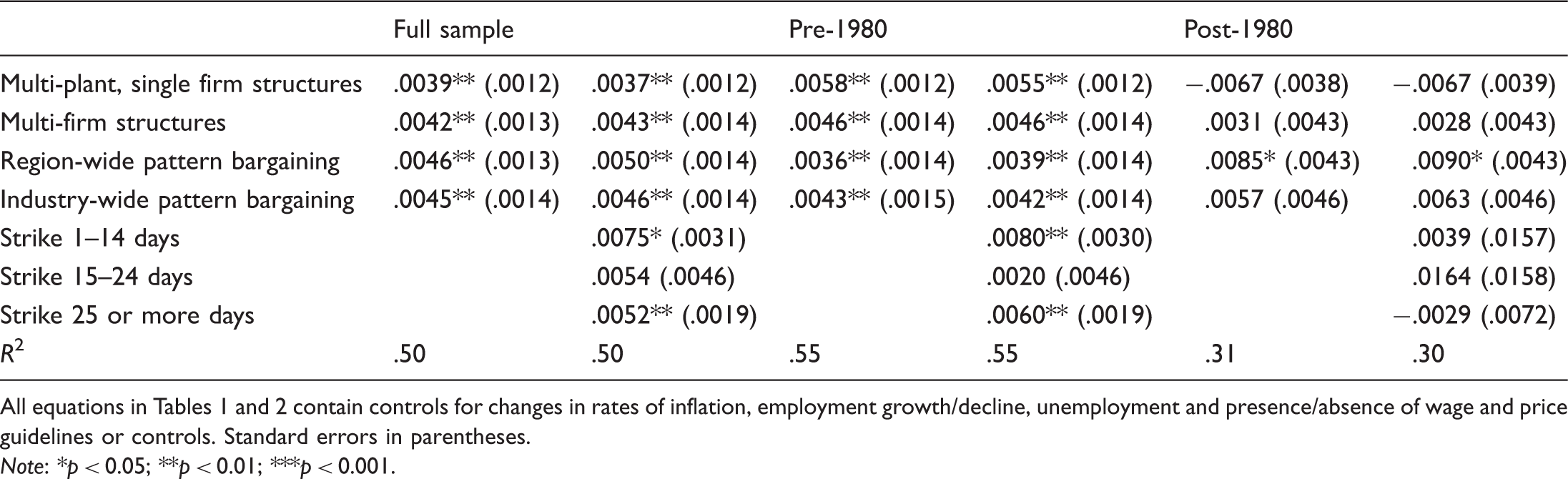
All equations in Tables 1 and 2 contain controls for changes in rates of inflation, employment growth/decline, unemployment and presence/absence of wage and price guidelines or controls. Standard errors in parentheses.
Note: *p < 0.05; **p < 0.01; ***p < 0.001.
Over-predictions of post-1980 wage changes using pre-1980 model.

The data in Table 2 show that overall, the model of wage determination under collective bargaining that dominated in the 1957–1979 time period over-predicted wage settlements in the early 1980s by 1.35% and, consistent with the results shown in Table 1, over-predicted wage changes more in units with centralized bargaining structures and intra-industry pattern bargaining traditions. Thus, the key sources of power that unions used to increase wages and spread these gains within industries had declined. This decline is substantial: extrapolating from these findings, if the magnitude of these wage outcomes persisted in bargaining, the 1.35% estimate would account for nearly 20% of the difference in growth of productivity and wages from 1980 through 2015. Although imprecise, this is in the same range as more recent studies of the effects of union decline.
Similarly, Erickson (1992, 1996) documents the demise in the 1980s of specific union contract clauses that had helped maintain pattern bargaining within and across the aerospace, automobile, and agricultural implement industries. Freeman (1980, 1982) also shows that leading up to the 1980s, unions played an important role in reducing wage inequality within organizations, finding that the dispersion of wages within unionized organizations of different industries ranged from 5% to 50% lower than that found within non-unionized organizations.
Using more recent data, Western and Rosenfeld (2011) estimate the decline in unionization accounts for as much as 20% to 30% of the rise in wage inequality since the 1980s. The impact is strongest among less educated and blue collar men – a group for whom unions reduced inequality prior to the 1980s by mitigating the deleterious effects of a falling minimum wage (Freeman, 1993; Western and Rosenfeld, 2011).
Deteriorating labor enforcement regimes and safety net
The absence of unions has yet a different effect in low-wage sectors, where they have traditionally acted as a deterrent against wage theft and other labor standards violations that contribute to inequality (Wright and Brown, 2013). A 2008 survey of over 4000 low-wage workers in the cities of Chicago, Los Angeles, and New York found that approximately 67.5% of respondents – who worked in non-union car washes, retail and food service, and domestic work, among other sectors – faced wage reductions through violations in the prior week. These included underpayment of wages, lack of overtime pay, or working off the clock, and cost them nearly US$3000 in wages over a year of full-time work (Bernhardt et al., 2013).
Compounding the problem is weakened enforcement capacity of the state, an issue that has been observed in many countries (ILO, 2006). In the US, the number of workers and establishments covered by the Fair Labor Standards Act has risen steadily over the last two decades, yet the number of inspectors in the Department of Labor has simultaneously declined (Weil, 2014). Enforcement of wage standards is also hindered by the fact that 70% of wage and hour investigations result from worker complaints (Weil, 2008), even though evidence suggests there is a mismatch between industries where complaints are made and where violations are most commonplace (Weil and Pyles, 2005).
US social policy relevant to the safety net – as measured by social insurance and the payroll and income tax systems, both of which grant access to safety net programs through employment – is the weakest among Organization for Economic Co-operation and Development (OECD) countries. By 2000, the US was spending the least among this group in income transfers and cash social transfers for the non-elderly (Smeeding, 2005). These weak safety net programs indirectly affect growing inequality, as observed through the lack of paid family leave (Ray et al., 2009) or work-sharing (Appelbaum, 2012), or the low rates of take-up of unemployment insurance (DeNavas-Walt and Proctor, 2014; Schaefer, 2010).
Organizational and employment relationship changes
Increasingly, scholars are beginning to turn their attention to the role of organizations and their employment relationships as explanatory factors driving specific dimensions of inequality. Increases in income inequality have been documented in organizations within and across industries (Groshen, 1991), between large and small firms (Davis and Haltiwanger, 1991), and among individuals within establishments (Barth et al., 2014). Next, we point to two factors that explain at least part of this organizational story: the changing environment and interests of firms as they relate to financialization, and organizations’ growing use of ‘fissured’ employment relationships.
Financialization of corporate behavior
A number of researchers have documented the rise of financialization, that is, the growing importance of maximizing shareholder value, in corporate behavior that began in the 1980s (Appelbaum and Batt, 2014; Jacoby, 2004; Kochan, 2016; Lazonick, 2009). The argument is that this shift has persisted since then as (1) new debt instruments (often referred to as junk bonds because they were offered at high-interest rates with little collateral) became available to support highly leveraged and sometimes hostile buyouts and takeovers of firms (Appelbaum and Batt, 2014; Lazonick, 2009), (2) new models for pricing stock options became available, leading firms to increase the portion of CEO pay tied to share price improvements (Black and Scholes, 1973; Merton, 1971), and (3) finance considerations dominated in corporate decision-making as the pressures from Wall Street agents increased and the countervailing power of unions declined (Jacoby, 2004; Useem, 1993). These developments in turn led to growing inequality as gains were diverted from the full labor force to shareholders and corporate officers. Although estimates vary, economists calculate that the current ratio of CEO to average hourly worker pay is now approximately 300:1, compared to only 20:1 in the 1960s (Mishel and Davis, 2015).
Fissurization of employment relationships
One result of financialization and increased focus on shareholder value can be observed through the restructuring of organizations from the vertically integrated, bureaucratic enterprises of the past to more networked, horizontally organized firms of today. Increasingly, these arrangements are reflected in the notion of ‘fissured’ work which includes not only contingent arrangements (e.g., temporary labor or contract workers), but also organizational structures resulting from subcontracting, outsourcing, and franchising (Weil, 2014).
The common thread throughout all these forms of fissured work is that they introduce external considerations into the firm–employee relationship, often placing the employment relationship outside its formal borders. When a Silicon Valley technology firm, for example, contracts out its janitorial positions, those jobs – and decisions regarding their wage levels – are no longer included in an enclosed system characterized by norms of internal equity among workers who labor for the same employer. Rather, the external, competitive market of janitorial contractors becomes a reference point through which wages are set as janitorial contractors vie for business.
The clearest illustration of how this contributes to inequality comes from a 2010 study of subcontracting of janitorial and building service workers in the US (Dube and Kaplan, 2010). Between 1983 and 2000, the occupational percentage of building security guards working for subcontractors increased from 40.1% to 49.7% and of janitors from 16.4% to 21.6%. This growth in contracting was accompanied by simultaneous wage loss: janitors experienced a US$1.33 wage penalty per hour (and earned 14% less than directly employed workers in the same occupation) and guards a penalty of US$2.34 per hour (earning 21% less). Similar trends in subcontracting have been reported in the petrochemical industry (Kochan et al., 1994), call centers (Batt et al., 2004), hotels (Hertz, 2010), and school cafeterias (McCain, 2009).
It is worth noting that the fissurization of work presents additional challenges to various other institutional factors we have identified as important to inequality. For instance, jobs in subcontracted arrangements are subject to greater risks of injuries and accidents (Kochan et al., 1994) as well as violations of labor law (Bernhardt et al., 2013), as the triangular employment relationship escapes regulatory checks on compliance through ambiguous legal standards defining workers’ employer of record (Zatz, 2008). Union organizing also becomes more difficult in settings where there is ambiguity over which employer is responsible for managing and controlling employees, and where there are workers misclassified as independent contractors (Kalleberg et al., 2000). Studies in other countries have likewise demonstrated that a range of human resource practices typically found in firms are either less likely to exist or to be constrained by the same uncertainty of which employer is responsible for managing the workforce in networked organizations (Marchington et al., 2011).
Limited adoption and diffusion of high-road business models
A large body of empirical research has documented the positive effects of sets of workplace practices labeled ‘high-performance work systems’ on productivity and other indicators of organizational performance (Appelbaum et al., 2011). These work systems in turn are supported by so-called high-road business strategies that compete on the basis of achieving high productivity and service quality rather than by minimizing and tightly controlling labor costs. The evidence on the relationship among these strategies and practices and wages is, however, somewhat mixed (Osterman, 1994): positive wage effects are more likely to be experienced in unionized than non-unionized firms (Bailey et al., 2001). Moreover, while there are case examples in almost all industries of high-road firms that pay above-average wages (e.g. Appelbaum et al., 2000; Cascio, 2006; Hoffer Gittell, 2003; Kochan et al., 2009; Ton, 2014), the reality is these strategies have not widely diffused across American industry. The mental model that labor is a cost to be minimized continues to dominate the behavior of many business decision-makers and analysts. If the hypothesis is correct that these high-road strategies and workplace practices are necessary conditions for achieving the high productivity needed to support high and increasing wages, the limited diffusion of these strategies and practices may serve as another cause of wage stagnation.
Options for reversing trends in inequality
While there is now widespread public recognition and concern about income inequality and persistent wage stagnation, action at the national policy level is slow in coming, largely because of deep political gridlock that blocks efforts to reform prevailing labor and employment policies (Kochan, 2016). There has, however, been increased activity at local levels, both by city and state-level governments and by private sector firms and unions. In this section, we review actions that have either been proposed or are underway that seek to address one or more of the aforementioned causes of inequality.
Education and skills
While SBTC has lost some of its power as the primary explanation for growing inequality, there is little doubt that one long-term effect of technological change is to increase demand for skills and education. Thus, education is a critical starting point – a necessary but far from sufficient solution for reversing these trends.
A highly educated, skilled, and innovative workforce is essential to generating the technological breakthroughs and improvements needed to drive productivity and to support a high-wage economy. Yet there is considerable evidence that the US educational system needs significant reforms to produce a workforce with both the technical (science, technological, engineering, and math or so-called STEM) and behavioral (communications, problem-solving, and coordination/negotiations) skills employers indicate they need both today and in the future. There is, however, considerable momentum in the US focused on addressing these challenges, starting with efforts to expand access to early childhood education. The Obama Administration’s and equivalent state-level pressures and incentives for reform and increased funding have generated a wave of innovation aimed at, among other things, promoting collaborative teacher–union–school district improvements (Bluestone and Kochan, 2011; Rubinstein and McCarthy, 2014), diffusion of a new common core of curriculum standards, and expansion of the school day or year.
There also is a growing recognition of the need to strengthen community colleges, vocational schools, and labor-management apprenticeships and other training programs that focus on building technical or so-called middle skills. The key actions needed are to better coordinate middle-skill educational and training programs with other labor market intermediaries, employers, and labor organizations that constitute what are now popularly described as the ‘eco-system’ for workforce development and training (Weaver and Osterman, 2014).
Globalization and trade
Globalization of economic activity will undoubtedly continue and generate benefits for the aggregate global economy, both for workers in developing economies and for those with the skills needed to compete in high productivity, innovation-based workplaces. This implies that efforts to promote high-productivity high-wage economies and business strategies must feature prominently in the approach taken to deal with globalization in the US and other advanced economies.
The major globalization-related policy issue currently under debate in many countries is the Trans Pacific Partnership trade agreement. It is highly controversial because some estimates of its likely impact on domestic employment and income suggest it will most likely favor corporations and those in the higher parts of the income distribution, while possibly reducing job opportunities of lower income workers (Rosnick, 2015). The Trans Pacific Partnership does, however, have stronger explicit provisions for minimum labor standards than those in prior multilateral trade agreements, including minimum wages, the right to form unions and collectively bargain, prohibition of forced labor, and limitations on use of export zones exempt from labor regulations.
Despite these standards, enforcement of labor protection provisions of trade agreements requires complementary strategies of national governments, multinational companies that monitor and work with their global suppliers, local and transnational non-governmental organizations and unions on the ground, and international labor organizations (Locke, 2013). Building these multi-stakeholder systems is critical: global trade will continue to create risks to both lower-wage and low-skilled workers in advanced economies. The Obama Administration has taken steps in this direction by creating and funding a set of advanced manufacturing institutes which support development of next generation technologies and products with investments in education, training, and promotion of high-road business strategies. Yet the need to promote high-road strategies goes beyond the next generation manufacturing firms, and there is no consensus strategy for doing so. Certainly, continued efforts to educate business leaders and investors about the strategic choices open to them and the consequences of their strategies for job and career quality need to continue.
Employment and labor policy initiatives
These educational and high-road strategies need to be complemented with government policies that bring up minimum labor standards to reduce the incentive to compete on the basis of minimizing labor costs and provide incentives to compete with high-productivity high-wage strategies. Here, we review examples of such initiatives and emphasize the role of local policy efforts in institution-building.
Minimum and living wages
Starting in the 1990s, advocates have relied on minimum and living wage campaigns to raise the wage floor in localities, cities, and states. By many measures, these have been effective both in raising wages for those paid at the minimum and those directly above them in the wage structure (Wicks-Lim, 2006). Twenty-nine states currently have minimum wage levels that are higher than the federal minimum; of these, 15 have indexed their minimum wages to inflation. A growing number of cities – such as San Francisco, CA and Seattle, WA – have followed suit, and have recently passed or are pursuing legislation to increase their local minimum wage to US$15 per hour over a number of years. Advocates also increasingly rely on living wage campaigns; currently, over 140 cities and counties have enacted such laws (Bernhardt and Osterman, 2016). Despite their spread, however, many of these policies cover a limited range of jobs – often work purchased or in other ways regulated by local governments or part of local economic development efforts – and thus have limited capacity to generate large-scale patterns of change.
Yet, in a hopeful sign, demands for change to the federal minimum wage are flourishing at the national level. In many respects, these demands have been led by workers and labor unions. The now-international ‘Fight for 15’ is one such example, rooted in early efforts among fast-food workers to increase wages and realize the right to organize in fissured work settings. Such efforts have effectively brought worker voice and demands addressing wage inequality front and center within the Obama Administration and among candidates of the upcoming 2016 US presidential election.
Wage standards enforcement and administrative action
Paired with campaigns to raise the wage floor are innovative approaches to enforcing wage regulations. For instance, advocates in San Francisco, CA successfully created a new city entity, the Office of Labor Standards Enforcement (OLSE), in 2001. The OLSE uses innovative cross-agency information-sharing and enforcement strategies to address wage violations and other labor standards infractions. To date, it has recovered over US$17m in back wages and collected over US$2m in employer penalties (Dietz et al., 2014). Notably, the OLSE also increases the effectiveness of enforcement activities by directly engaging with community-based and worker organizations, a best practice documented in the literature (Fine and Gordon, 2010).
At a national level, the Obama Administration has proposed increased coverage of salaried workers for overtime work, while also issuing a clarifying administrative letter detailing the criteria for worker classification as an employee or an independent contractor (which determines coverage under wage and overtime rules). The National Labor Relations Board has likewise issued a recent decision broadening the definition of ‘employer’ for the purpose of determining whether subcontracted work is covered under the nation’s labor relations statute, and similar cases concerning companies such as Federal Express and Uber are being considered in federal and state-level courts. Scholars are also increasingly documenting enforcement theories built on leveraging fissured, supply chain relationships among firms, often referred to as strategic enforcement (Weil, 2008; Wright and Brown, 2013).
Government contracting rules
One area of considerable discussion is whether the federal government can or should use its power as a purchaser of goods and services as a means of enforcing and improving employment standards. The model for doing so comes from the US experience in enforcing and promoting the 1964 Civil Rights Act, which prohibits discrimination in employment on the basis of race and sex, among other protected groups. A subsequent Executive Order required government contractors to demonstrate steps they take to achieve affirmative actions. Later research demonstrated the efficacy of these requirements in promoting non-discrimination and equal opportunities (Leonard, 1990). The question under debate in government and academic circles is whether this model could be applied to promote diffusion of high-productivity high-wage practices among government contractors. This remains to be seen. President Obama signed an executive order, effective in 2016, that requires contracting firms to disclose their records of compliance and violation of labor and employment law. Some suggest expanding this order by inserting high-productivity high-wage criteria in the specifications used to select competing bidders for government contracts – a strategy that may substitute for the role of pattern bargaining discussed earlier.
Next generation unions and sources of power
One of the biggest open questions facing both the US and to some extent other countries is what will fill the void left by union decline. While reproducing unions and collective bargaining in the mirror image of their past is neither likely nor viable, alternative means are needed to reinstate voice and bargaining at work. Indeed, unions are pursuing new strategies to this end, such as non-traditional organizing of freelancers and supporting organizing efforts targeting large employers in low-wage, union-scarce sectors, such as those in fast food as well as with the retailer Walmart (Bernhardt and Osterman, 2016).
The crisis in worker representation has also sparked considerable innovation in labor and community group coalitions, and among an expanding number of networks at local, national, and global levels. These range from religious-based groups (Bobo, 2009); to students mobilizing against sweatshop conditions; and to international coalitions of non-governmental organizations (NGOs), governments, international agencies, employers, and unions aimed at upgrading conditions in global supply chains (Locke, 2013). One of the most promising organizing strategies comes through worker centers, which are typically organized around specific, often low-wage industries such as restaurants or construction. By some estimates, there are currently 225 such organizations throughout the country, up from only five in 1992 (Fine, 2011). Perhaps most importantly, the federation of many local worker centers within fragmented industries – such as restaurants, domestic work, and taxi transportation – is establishing larger scale, more effective organizations (Fine, 2011).
Alternative wage-setting criteria and norms
As noted earlier, the tandem movement of productivity and real wages and compensation in the pre-1980s era was driven by, among other factors, union agreements that aligned productivity gains and cost of living clauses into collective bargaining contracts. New approaches to wage setting at the level of the enterprise will be needed to ensure that those who work together to generate productivity and profits have a fair chance of sharing in the gains produced. Profit sharing, productivity gains sharing, and broad-based employee stock ownership plans (Blasi et al., 2014) are alternative ways of embedding this principle in the wage-setting processes within specific enterprises.
New federal rules will soon require publication of salary ratios between CEOs and average workers in corporate reports. Whether this effort to increase transparency will be powerful enough to change corporate practices remains to be seen. Corporate boards may need stronger pressures to change the ways CEOs are paid (such as changes in marginal income tax rates; Piketty, 2014), given the embedded roles that compensation consultants play in spreading CEO compensation patterns across firms and industries.
Labor policy
While each of the options reviewed can contribute to stimulating wage growth and reducing inequality, sustained progress will require a fundamental change in national labor and employment policy. There are a number of dimensions to such change: updating minimum wage laws and clarifying the definition of the employer in fissured work settings, as described earlier, are two glaringly necessary changes. Expansion of safety net programs – such as the Earned Income Tax Credit, the Affordable Care Act, and paid family and medical leave – can provide low-income workers better access to employment opportunities while promoting overall economic growth (Lower-Basch, 2014). Additionally, updating current laws that govern collective bargaining is yet another step towards fundamental change, particularly since current law cannot provide union representation coverage to all workers who want it (Ferguson, 2008). It remains to be seen whether changing labor relations policy is possible, given that, both historically and recently, it has been the most difficult aspect of US employment policy to change (Kochan, 2016).
Conclusion
The widespread recognition and growing public debates over income inequality are producing a growing body of research on the causes of wage stagnation and options for addressing it within private and public realms. Until recently, most of the academic debate has focused on the relative importance of technology and globalization as underlying causal forces, and on education – and to a lesser extent, trade policies – as remedies. More recently, however, attention has turned to institutional factors including minimum wages, unions and their bargaining power, and employment policies and their enforcement. We extend this literature here to focus on some of the key changes in employment relationships and organizational practices that affect wages and related employment conditions at the enterprise level.
It is clear that these causal forces are closely interrelated and that no single change in policy or organizational practice will suffice to reverse long-term trends in wages. Investments in education are a necessary but far from sufficient component of a broader strategy. So too are more direct efforts to build next generation manufacturing industries in ways that support and sustain high-wage jobs. Equally important, however, are actions aimed at bringing up the floor of the wage structure through raises in minimum wages and better enforcement of employment standards, modernization of labor policies that allow workers to build new sources of bargaining power consistent with the modern economy, and organizational changes that challenge the financialization of corporations and encourage broader diffusion of firms that embrace high-road business strategies and workplace practices.
The historical trends in inequality, and particularly in productivity-wage growth patterns, suggest two final points. The current situation is the product of trends of over 30 years’ duration and therefore it will take a sustained period of wage growth to make up for lost ground. But the fact that turning points as clear as the ones that reversed the high level of inequality in the US observed just prior to the passage of the New Deal labor legislation in the 1930s and the beginning of the productivity-wage gap around 1980 suggest that a broad-based, systematic strategy that is well informed by research can change these long-run trends and put the economy on a different path. Doing so again is the defining challenge facing our field today.
Footnotes
Declaration of conflicting interests
The author(s) declared no potential conflicts of interest with respect to the research, authorship, and/or publication of this article.
Funding
The author(s) received no financial support for the research, authorship, and/or publication of this article.