



Abstract
Work performed under cash-for-care programmes is based on a relationship between several parties, including, at a minimum, the workers providing the services, the care recipients and the public authorities that manage and fund these programmes. Labour law studies have pointed out that the labour relations regulation is not adapted to this type of non-standard employment relationship since it has been founded on the norm of the integrated firm and bilateral employer–employee relations. Based on a case study of a cash-for-care programme in Quebec, Canada (i.e. the Service Employment Paycheque plan), our socio-legal analysis confirms the weak protection of collective labour rights provided to Service Employment Paycheque plan workers. It also describes how the application of the legal regulation of labour relations to this organizational model fails to take into account the power exercised by the public authorities and demonstrates the impact of this failure in terms of precarization of work and its gendered devaluation.
Keywords
Introduction
One of the modes of organizing and funding home support services is based on cash-for-care programmes, also referred to as consumer-directed programmes. These programmes come under the public health system and are based on cash payments or a given number of state-funded hours of services that users can buy rather than receiving it directly. The workers providing services under the cash-for-care programme may or may not be family members of users, depending on the regulations in place (Ungerson, 2004).
The various cash-for-care programmes in Europe and North America are all based on the principles of self-determination and free choice (in choosing the services provider) put forward by the disability rights movement from the 1970s onwards (Eustis, 2000). Another goal associated with cash-for-care programmes varying depending on the long-term care policies in place is to increase the effectiveness of services and reduce their costs (Timonen et al., 2006). However, the way these programmes are organized in various national contexts differs according to their place in the organization of home support services and the legal status of the workers.
In some countries, the cash-for-care programme represents the main form of organizing home support services. This is the case in Italy, where formal care services provided in institutions or at home are marginal (Da Roit and Le Bihan, 2010). It is also the case in France, where the cash-for-care programmes are the only form of organizing services regulated by public authorities (Martin and Le Bihan, 2007). In other countries such as Germany, where only basic needs are covered by the public health system, cash-for-care programmes are one of the available options (Da Roit and Le Bihan, 2010), whereas in countries such as Sweden, these programmes are a very marginal part of the home support services system (Burau et al., 2007).
In some countries, such as Italy, Germany and Austria, no formal legal status exists for the workers providing services under the cash-for-care programme (Da Roit and Le Bihan, 2010). In France, the introduction of this programme ultimately formalized and professionalized the work. However, high levels of staff turnover still persist due to difficult and unstable working conditions (Martin and Le Bihan, 2007). In the UK, the work is formalized, but the cash-for-care programme does not contain adequate protections for workers with regard to requirements to work beyond what is specified in their contract and with health and safety risks (Yeandle and Stiell, 2007). Moreover, in the United States and in certain provinces of Canada, such as Ontario, workers are formally employed as independent contractors, a status that excludes them from the protection of employment and labour rights (Cranford, 2005; Smith, 2008).
This article examines cash-for-care programmes within the framework of current debates in industrial relations and labour law concerning new organizational forms and the situation of non-standard workers with regard to the protection of labour rights and working conditions. They highlight the fact that the legal regulation of employment and labour relations remains profoundly marked by principles pertaining to the industrial model of the integrated firm and the standard bilateral employment relationship. This type of employment relationship involves an employee under the subordination of an employer. In network-based organizational forms – like those based on contracting out, franchising or cash-for-care programmes – the production is fragmented among different entities. Therefore, the employment relations are multilateral, involving various organizations and the workers. In the cash-for-care model, the employment relationships involve the user and the public agency that manages and funds the programmes and the workers providing the care. In some cases, they even entail a fourth party: associations providing users with support in managing the work (Martin and Le Bihan, 2007).
Legal experts have observed the inadequacy of this legal regulation with regard to network-based organizational forms and multilateral employment relationships, in different national jurisdictions (Fudge, 2006a; Morin, 2005; Stone, 2004). This inadequacy has resulted in a reduction of the legal responsibility regarding labour and employment of some entities involved in these employment relationships. The situation has led some scholars to speak of ‘strategies for “externalizing” the employer's responsibilities’ (Vallée, 2005: 77, transl.).
This article presents a socio-legal analysis of the difficulties involved in protecting the labour rights of workers who provide home support services under a cash-for-care programme. It focuses in particular on the fundamental right (Fudge, 2014) to organize and bargain collectively, and the effects that the difficulties involved in protecting this right have on wages and working conditions and in terms of gendered devaluation of work. This analysis is based on a case study of the employment situation of workers hired through a cash-for-care programme in the province of Quebec, 1 Canada, known as the Service Employment Paycheque plan (SEP). This government programme is based on a payment mechanism that allows people to hire a person of their choice, except family members, to provide them with home support services. Each worker can work for more than one user on the same day or during the same week.
We will first review the theoretical labour law debate on network-based forms of organization and multilateral employment relationships. We will then explain the conceptual elements used to analyse the empirical reality of the power relations in this organizational model drawn from Appay's (2005) sociology of work studies. Second, we will present our research methodology. Third, we will identify the main phases in the historical development of home support services in Quebec and cash-for-care programmes. Fourth, we will examine how the legal regulation of labour relations is applied to the use of the SEP programme in the home support services networks. We will investigate the extent to which the right to organize and bargain collectively of the workers involved in this programme is protected. Fifth, we will present an empirical analysis of the power relations at play in these multilateral employment relationships. We will then examine the effects on working conditions of the failure to take into account the power exercised by the different parties involved in management in applying the legal regulation of labour relations. We will end with a discussion of the findings.
Multilateral employment relationships, legal regulation of labour and power
The network-based organizational model – that we define as a coordinated grouping of several legally autonomous entities involved in a particular production – differs from the industrial model of the integrated firm on which the current labour law was based. Some labour law scholars think that this situation causes a ‘conceptual and normative crisis of the scope of labour protection’ (Fudge, 2006b).
When it comes to identifying the legal employer of the workers employed in certain segments of the networks, a gap appears between the legal conception and the current reality.
The legal conception used to establish the existence of an employment relationship is based on the notion of ‘legal subordination’, which identifies a management power that ‘coincides in a correlative and general manner with the unilateral predominance of the employer in his power to fix and keep/amend the terms and conditions set out in the contract’ (Goldin, 2006: 120). However, in the productive decentralization processes involving several contractually linked entities in a same network, various entities can exercise the managerial functions, appropriate the results of the work, and so on (Goldin, 2006: 114). The traditional conception is problematic because ‘the legal starting point does not begin by holding each of the entities jointly and severally responsible for the employees; instead it searches for a contract with an employer as the basis for ascribing employment-related obligations’ (Fudge, 2006a: 301).
The enduring industrial conception used in the legal treatment of employment relationships pertaining to network-based organizational forms ‘allows (and, perhaps, invites) firms to shift the risks associated with employing labour’ (Fudge, 2006b: 624).
This transfer of risks towards external organizations and, ultimately, to the workers at the end of the line, has concrete consequences for the protection of the latter's labour rights, whether minimum labour standards (De Tonnancour and Vallée, 2009), health and safety rights (Lippel et al., 2004) or other types of labour rights.
Several legal experts have explored approaches ‘to go beyond contract and the corporate form, and adopt a relational and functional approach to ascribing employment-related responsibilities in situations involving multilateral work arrangements in employing enterprises’ (Fudge, 2006b: 636). To this end, the transdisciplinary method suggested by Morin appears to be particularly relevant. As an example of manifestations of power other than the control of work in these inter-firm relationships, she cited ‘the specific requirements pertaining to quality, delivery deadlines, training, etc., which can directly impact working conditions without entailing any responsibility whatsoever on the part of the prime contractor’ (Morin, 2005: 12). Drawing on Teubner's studies (Teubner, 1993), Morin suggests examining the ‘contractual or financial relationships between firms in order to retrace the chain of responsibilities’ (Morin, 2005: 15). Thus, the aim is to take inter-organizational relationships into account ‘to determine each firm's respective share of responsibility for such events as may occur over the course of the employment relationship’ (Morin, 2005: 15).
We applied the method suggested by Morin to analyse the multilateral employment relationships specific to home support services networks involving women workers 2 in the SEP cash-for-care programme in Quebec. We thus compared the reality of these employment relationships as grasped by the legal regulation of labour relations with their sociological reality. To analyse the latter, we constructed a theoretical framework mainly based on the work of Appay (1998, 2005). This sociologist of labour analysed the transformations of production that took place in the 1980s and 1990s in France and the United Kingdom in various sectors (public works and construction, education, retail, etc.), referring to a new mode of production conceptualized as ‘controlled autonomy’. This concept ‘expresses a contradictory process involving increasing centralization juxtaposed with the development of more localized, autonomous and flexible units' (Appay, 2005: 69, transl.). These units can be situated within the boundaries of a single organization (teams, departments) or outside of it. Controlled autonomy is based on a process of ‘cascading subcontracting’ which takes the form of ‘relations between the contract givers and those who execute the contract, involving several levels of subcontracting, from the larger units down through the smaller units, right down to the individual workers themselves, whether they be salaried employees or not’ (Appay, 2005: 45).
Faced with growing globalized competition and pressure from financial markets, fragmenting production at the local, national and international levels constitutes a strategy chosen by firms for their own expansion, thereby enabling them to become ‘brain firms’ (Appay, 1998).
According to Appay, the main way that power is exercised by the brain firm in the network is through the exercise of ‘strategic power’. This form of power differs from the bureaucratic power that characterizes large firms, although the latter coexists with it to some extent. Strategic power consists in indirect control since its exercise is contingent on the autonomy and cooperation of organizations and individuals, even though the latter's room for manoeuvre is limited: It is a form of power that excels in indirect control, while having the means to focus when necessary (…). It operates within a tense system of extreme sanctions geared to survival. If the ‘machine is running’ and the system of threats and risks is strong enough, it can limit itself to making ‘recommendations’, indicating the targets to be achieved rather than imposing them. (Appay, 2005: 77–78, transl.)
One of the examples given by Appay to describe the process of controlled autonomy is the relationship between some government departments and Colleges of Further Education in the United Kingdom, which she studied in the 1980s. The budget cuts imposed by the Department for Education on the local authorities in charge of funding these colleges threatened their very survival. These colleges had to give up control over the content of the professional training programmes they were offering in order to obtain funding for programmes defined by a government agency under the Department for Employment: The colleges, like subcontracting firms, represent the controlled and ‘autonomous’ pole in this relationship. The government represents the dominant pole, in control of an essential part of the financial circuit. Although it is the true ‘contract giver’, it appears only to be making recommendations. (Appay, 2005: 83, transl.)
Appay argues that ‘this system functions even better when the workers’ jobs are precarious and their wages depend on the level of activity of the institutions paying them' (Appay, 2005: 85, transl.).
The withdrawal of the brain firm from direct management of the work, based on the network-based organizational model, leads to economic precarization and weakens the collective power of workers while also entailing a precarization of social protection. The latter occurs through the ‘bypassing of the relation of subordination on which legal labour regulation is based’ (Appay, 2005: 153, transl.). This global social precarization process leads to economic insecurity.
The precarization entailed by controlled autonomy can also be characterized by a specific form of gendered devaluation of work. In some highly feminized segments of production, such as the work of cashiers in major retail outlets, work time is structured by the demand for permanent availability, as in the sphere of domestic work. However, this permanent availability is organized around the just-in-time model used in lean management and is based on ‘part-time, fragmented and flexible work schedules, with variable and extended working hours, for minimum wage’ (Appay, 2005: 227, transl.).
Lastly, it should be noted that we decided to investigate one type of employment and labour rights, namely collective labour rights. As will be seen, an examination of the historical development of home support services in Quebec brings out the importance of the exercise of these rights in the process of professionalizing the work of the women providing these services in the public sector. Also, we must specify that the case of Quebec was chosen based on its ‘theoretical representativeness’ (Hamel, 1997), as illustrated by its empirical characteristics. The home support services involving the SEP programme in Quebec appear to be emblematic of the complexity of this network-based organizational form and the many parties involved in the employment relationships. The next section presents our research methodology, situating it in the context of home support services in Quebec.
Research methodology
Home support services are provided to elderly people with decreasing autonomy and to people who are disabled, ill or convalescent. According to the ministère de la Santé et des Services sociaux (Quebec Ministry of Health and Social Services, hereafter the MSSS), these services include the following subcategories: personal assistance (personal hygiene, help with eating, mobility and transfer in the home, etc.), home help (housework, meal preparation, laundry, etc.) and community activities involving civic-support services (assistance in budget management, filling out forms, etc.) (MSSS, 2004: 41). Our research focuses in particular on workers providing personal assistance services, the majority of whom are women. In many cases, these workers also perform housework. It should be pointed out that the official definitions of these tasks are often restrictive. In practice, however, the ‘informal’ list of required tasks often includes, for example, providing socio-psychological support to care users and sometimes their families and loved ones (Cognet and Fortin, 2003: 161).
The administration and delivery of health services and social services (home support services figure in this latter category) come under provincial and territorial jurisdiction in Canada. The federal government contributes to financing these services through the Canada Health and Social Transfer programme. They can be organized in different ways in each of the 10 provinces and three territories but these services have to respect the standards defined in the Canada Health Act. Home support services are delivered by the public sector in four provinces and two territories of Canada (Canadian Healthcare Association (CHA), 2009).
This article presents the results of a case study which was part of a broader research project on the multilateral employment relationships in home support services networks in Quebec. The latter entailed two other case studies also conducted in 2011 and 2012, one focusing on workers employed by social economy enterprises (non-profit organizations) and the other on workers employed by employment agencies (Boivin, 2015).
The data for our case study were collected from different types of sources and were triangulated. The first data source was the interviews conducted with different actors in a local services network (two SEP women workers, the home support services programme manager in the public sector, the representative of the public sector union and the director of a disability rights advocacy association helping users by managing the work). Although only one local network was involved in our case study, the study of the multipartite employment relationships operating therein may have more general scope. The modes of organization of the SEP programme in all 95 local services networks of Quebec are determined centrally, at the provincial level, by the MSSS. This local network was located in a non-urban region of Quebec; it was chosen for practical reasons related to access to the site. For the purpose of confidentiality, none of the individuals or organizations that collaborated in our case study have been identified in this article. Interviews were transcribed verbatim in French. Their content was then coded and analysed. The excerpts presented in this article were translated from French to English by a translator who aimed to faithfully convey the interviewees' meaning.
Another data source was the content of 11 court decisions rendered between 2003 and 2011, namely the factual content of 10 decisions delivered by the Commission des lésions professionnelles/Occupational Injuries Board and the factual and legal content of one decision rendered by the Commission des relations de travail/Quebec Labour Relations Board (CRT). All these decisions involving SEP workers, which we reviewed, came from the CanLII and Portail SOQUIJ databases. Based on the results found by searching for the keywords used in the content of the decisions, we determined that our review was exhaustive. A third source of data was the factual content of complaints filed with the Commission des normes du travail/Quebec Labour Standards Commission (CNT) 3 by SEP workers. The Commission's classification system was based on broad categories (codes of economic activities), making it impossible for us to conduct an exhaustive review of SEP workers' complaint files among tens of thousands of other types of complaint files. We were able to find a total of six complaint files processed between 2003 and 2011, including those found by drawing upon the memory of the Commission lawyers undertaking legal actions against employers. We also analysed government documentation (MSSS, 1998, 2004, 2010, 2011) as well as a document from a group of disability rights advocacy associations (Alliance Québécoise des Regroupements régionaux (AQRIPH), 2010).
The factual content of the data collected from these various sources was coded and analysed using NVivo qualitative data analysis software. Coding was based on the analytical categories contained in our theoretical model. Other categories were identified inductively during the process and were used to refine our theoretical model.
In the next section, we will examine the main phases of the historical development of home support services in Quebec, including two models of the cash-for-care programme. We will also historically situate the process of professionalizing the work of the public sector workers providing these services.
Historical development of home support services in Quebec
A home care policy was first introduced in the province of Quebec in 1979. Public home support services were subsequently implemented to address an increase in the need for assistance among an ageing population and decrease the institutionalization of elderly citizens. These services were centralized in local community services centres (CLSCs), local public agencies deployed across the various territories of Quebec.
The creation of public home support services was accompanied by the professionalization of the services provided by the workers, referred to as family and social assistants. Although their work was not regulated in the same way as that of nurses, their occupational qualifications were henceforth recognized by the state.
This was made possible, on the one hand, through the unionization of these workers and the centralized collective labour rights regime specific to the public sector, resulting in their work being enriched through their integration into multidisciplinary teams (Bélanger et al., 1987). Their professionalization by the state also derived from the creation of an occupational training programme that began to be taught in public secondary schools from 1983 onwards.
The professional qualifications of the family and social assistants in the public sector allowed them to break with the gendered devaluation of their work, which tended to be identified with unpaid work in the home and to be seen as a ‘female vocation’ (Bourque, 1991).
Starting in the late 1970s and continuing through the 1980s, CLSCs began to use private for-profit and non-profit external providers to deliver some home support services, including under a cash-for-care programme called the ‘Direct Allowance Program’. The latter was created in 1978 and allowed the user to hire a person of his or her choice. Under this first model of the cash-for-care programme in Quebec, the work was informal.
As of the mid-1990s, federal transfer payments to the provinces in the fields of health, social services, social assistance and postsecondary education were reduced by 30% (Yalnizyan, 2005). During this same period, the MSSS conducted a major restructuring of health services and social services in Quebec. This process reduced the number and length of hospital stays, which in turn increased the need for home support services and the use of external providers to deliver some of these services. It was in this context that the ‘Direct Allowance Program’ was transformed, in 1997, into the SEP programme. The objectives of the MSSS were to formalize the work and to increase workers' social protection (MSSS, 1998). Another likely objective was to reduce workforce costs (Coalition Solidarité Santé (CSS), 2001).
Until 2004, women workers providing personal assistance under the SEP programme, as all the employees having the legal status of ‘caregivers’, were excluded from the protection of the Act respecting labour standards, which regulates, in particular, the determination of working conditions (wages, hours of work, absence, leave, holidays, etc.) and employment protection. Now caregivers benefit from the protection of the law, except with regard to the right to an increased wage rate for overtime and the right to reintegrate their workplace, in particular, in the event of a dismissal without just and sufficient cause. Moreover, SEP workers, as all workers having the legal status of caregivers, were excluded until 2002 from the protection of the Act respecting occupational health and safety and the Act respecting industrial accidents and occupational diseases. They have only recently come under the protection of the latter pursuant to a regulation pertaining specifically to employment under the SEP programme.
A new legislative reform in the organization of health and social services was launched in 2003 by the Liberal government. This reform aimed to structure the services around 95 local networks, each coordinated by one local authority, namely the health and social services centre (CSSS), born out of the merger of public institutions in each local territory. Each local network ‘integrated’ both public agencies and private providers.
In line with this reform, the new Home Support Policy (MSSS, 2004) provided for the production of home support services in local networks to be coordinated by the CSSSs and split among public agencies and private providers. These latter consist of employment agencies, social economy domestic help enterprises – non-profit associations or cooperatives – and also workers hired through the SEP. The official data on the SEP relating to the period during which our study was conducted show that, in March 2012, some 10,036 employees (94% women) were registered on the payroll service of the SEP programme in Quebec 4 (MSSS, 2010).
In 2016, at the time this article was written, a new reform in the organization of health and social services, including home support services, was being launched in Quebec. Its modes and effects are still to be analysed.
We will now examine how collective labour rights apply to the complex employment relationships in the local services networks that use the SEP programme.
The collective labour rights of SEP workers
Modelled on the American Wagner Act, the general collective labour regulation applicable in Quebec is based on the granting of a monopoly on worker representation, following a public certification procedure, to the employee association that has obtained the support of a majority of employees in a given group (a bargaining unit). This group can be made up of all employees of the same employer or, as is most often the case, employees working in a single establishment of this employer. When the union certification is granted, the union obtains the legal power to represent all employees in the bargaining unit, whether or not they are members of the association. The employer targeted by the certification has the obligation to negotiate with the certified employee association in order to conclude a collective agreement which will contain the effective (rather than minimum) working conditions applicable to the unit's employees.
Our analysis of the application of the Quebec labour relations legal regulation to employment relationships involving SEP workers is based on an examination of the decision by the Commission des relations de travail (CRT, Quebec Labour Relations Board) 5 in the Memphremagog Health Centre case, 6 in 2003. This was the only decision of a Quebec court relating to collective labour relations that dealt specifically with an employment relationship involving SEP workers.
The motion was brought before the CRT by the union of a public institution (a CLSC). The CRT was asked to determine whether SEP workers were included in the certification unit of the CLSC's union. Thus, the CRT had to determine which entity exercised the attributes of an employer. It should be specified that, under the Quebec regime, certification can only be granted to a union representing employees of the same employer, since certification for multiple employers is not legally possible.
After examining the motion, the CRT concluded that the CLSC did not hold the attributes of the employer of the SEP workers, but that the user did. To reach this decision, the CRT used the method based on the ‘comprehensive approach’ stemming from the 1997 Supreme Court of Canada decision on Pointe-Claire City, 7 which had become an authority for decisions relating to multilateral employment relationships. According to the Supreme Court, the ‘comprehensive approach’ must be applied according to the factual situation. It consists in applying the criterion of legal subordination, identifying the single legal entity – ‘real employer’ – that exerts the greatest control over the employee's work. This approach incorporates additional criteria – namely the day-to-day control over the work – which, however, do not carry the same weight as the legal subordination. These criteria relate to the selection process, hiring, training, discipline, evaluation, supervision, assignment of duties, remuneration and integration into the business.
The CRT recognized that the SEP workers performed practically the same tasks as the family and social assistants employed by the CLSC. It also recognized that the MSSS was involved in various ways in the organization of the work by determining the conditions of access to the programme, granting budgets, assessing needs and the services required, managing payroll and, in some cases, providing support to care users for terminating the employment relationship when they were not satisfied. However, the CRT deemed that, considering the dimensions of recruitment, selection, hiring, supervision of the work, determining work schedules, and the decision to terminate the employment relationship, the legal entity exercising the greatest control over the work was not the CLSC but rather the care user.
The CRT did not deem the public authority (the CLSC in this case) but rather the user as the employer within the employment relationship involving the SEP because the legal approach remains marked by the traditional model of the integrated firm. Its goal is to ‘determine and isolate, in the triangular relationship, the binary segment which corresponds, as closely as possible, to the traditional (and still predominant) model of the direct employer-employee relationship’ (Bich, 2001: 264, transl.). In the next section, we will see that this interpretation framework overshadows the empirical reality of the power relations operating in the employment relationships that characterize the SEP.
The chain of responsibilities
The following section analyses what Morin identified as ‘the contractual or financial relationhips between firms in order to retrace the chain of responsibilities’ (2005: 15).
Three types of responsibility exercised by the entities involved in the employment relationship within the organizational model involving SEP workers emerged from the empirical data. These relate to the financial aspect, the organization of service production and work, and the indirect control of the work exerted throughout the network. They are illustrated in Figure 1.
The various entities involved in the employment relationship and the public authorities' responsibilities.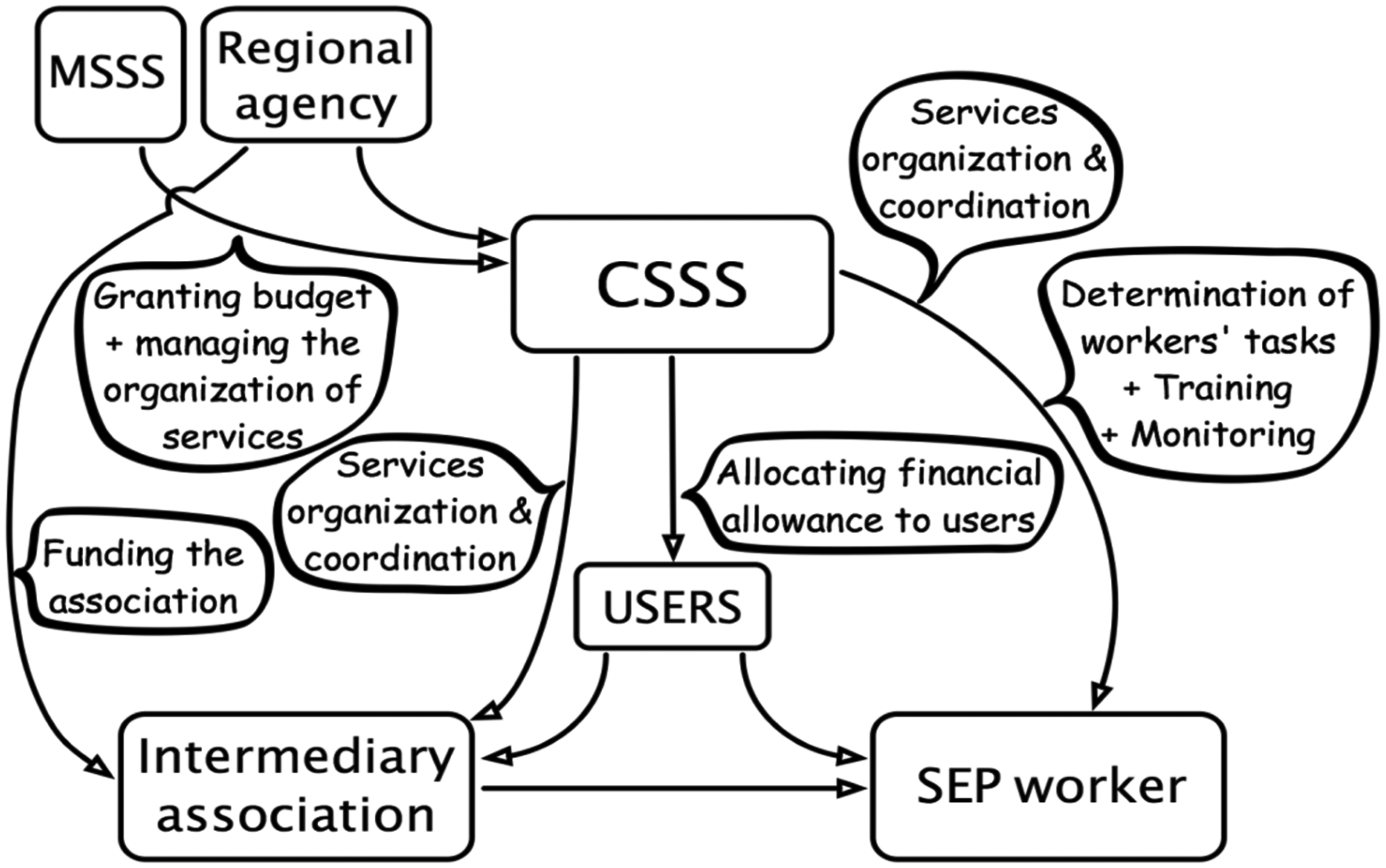
As regards the financial aspect, the MSSS is responsible for granting the budgets used by the CSSSs (in which the CLSCs are integrated) of each local network to fund the SEP. The local CSSS is then responsible for allocating a financial allowance to users after their needs have been assessed, which is managed by a processing centre at the provincial level (MSSS, 2004). In the local home support services network examined here, a disability rights advocacy association acted as an intermediary association between these users, the CSSS and the SEP workers and was funded by the regional public health and social services agency, according to the content of an interview with the director of this association. 8 Despite the central role played by the MSSS in funding the work, the MSSS considers that it has no legal employment relationship with the SEP workers, based on the representations made in the Memphremagog Health Centre case and our content analysis of the complaints filed by the workers with the Quebec Labour Standards Commission (CNT).
The role of managing the organization of service production and work falls first to the MSSS, which defines the responsibilities of each entity through its Home Support Policy (MSSS, 2004). This policy specifies that services provided to care users whose physical or mental health is stable and who need long-term services are to be delivered by SEP workers or social economy domestic help enterprises (MSSS, 2004: 25).
In addition, several forms of indirect control of the work by the public authorities can also be seen. Thus, the determination of the content of SEP workers' tasks largely depends on the service plan drawn up by the CSSSs, as confirmed in official documents (MSSS, 1998: 8) and the content of the interview with the director of the disability rights advocacy association. The service plan for each user shows, for example, the proportion of tasks to be devoted to baths, housework and meal preparation, as well as the daily and weekly time to be devoted to each of these tasks. 9
The content of the interview with the home care services programme manager in the local CSSS also shows that specific practical training on the use of some equipment is given to SEP workers by CSSS workers at the users' homes: Other, more specific training, like, say, how to use a lever to lift Mr. [last name], because it's a particular model and everything, well, in those cases, an occupational therapist will give the training – you know, when equipment is sent to the home, someone has to be trained to use it because it has special features.
The content of one complaint filed with the CNT and of a decision 10 of a specialized court, the Commission des lésions professionnelles (Occupational Injuries Board), also show that these types of training exist.
Moreover, in the local network studied, the CSSS's involvement in monitoring the quality of services was evident in the process used to manage conflicts between workers and care users. According to the content of the interview with the director of the disability rights advocacy association, when this centre has recruited a worker and there is a conflict with the user, it could always get in touch with the CSSS's ‘pivot worker’ to discuss the situation. This interviewee also mentioned that, in conflictual situations where her association was not present, the CSSS was directly involved: When they have a problem, they often call their pivot worker here at the CLSC [i.e. CSSS], saying something like ‘it's actually my neighbour eight doors down and it's not working out, she's never there’. So a link is made that way [with the CSSS]. (CES, Interview. 3).
Another example of quality monitoring emerged from the comments of an SEP worker in the local network, who stated that the CSSS worker came to the user's home to ask her to change the way she performed some tasks. A complaint filed with the CNT also showed that a CSSS worker reproached an SEP worker for her behaviour at work, following comments made by a user to this CSSS worker.
Based on our empirical study, we thus set out the ‘chain of responsibilities’ in local home support services networks where SEP workers are employed. Our analysis shows that the public authorities exercise predominant power in these networks and have an impact on the work through their involvement in the financial aspect, the organization of service production or the exercise of indirect control over work. These results contrast with the identification of the care user as the legal employer in the application of the collective labour regulation to employment relationships involving SEP workers. In the next section, we will examine the practical consequences and effects of this legal disregard.
The impact on collective labour rights and working conditions
This section analyses how the gap between the legal regulation of labour and the empirical reality of intra-network power relations has an impact on the protection of the labour rights and on the working conditions of the SEP workers.
A first practical consequence is that unionization becomes impossible for SEP workers. Since the recognized certification unit is the home and the recognized employer is the care user, this unionization would require the workers to file an application for certification for each of the homes in which they work. If SEP workers did succeed in becoming unionized, the negotiation of their working conditions would have to take place with each of the users to whom they provide services (or with their family members), regardless of the latter's health status or social and economic vulnerability. As the user does not pay the wage and does not decide the type of tasks and number of work hours to be performed each week, what would be left to be negotiated with the unionized worker(s)?
It is not plausible for SEP workers to exercise their collective labour rights effectively, given the form of service production into which they are integrated and the legal regulation currently in force. The comments of an SEP worker whom we interviewed for our case study illustrate the difficulties in accessing unionization: Along with some other people, we consulted [name of the union organization]. (…) We had several meetings. I think [name of an individual] also came to these meetings with workers here. Until they told us about that decision. You know, we feel sort of trapped, or cornered.
Not being able to negotiate collectively has an impact on these workers' working conditions. For tasks that are often similar to those of unionized workers in the public sector, the work performed by SEP workers is largely devalued; in 2011, when we collected these data, they were receiving a wage of $11 per hour (except in Montreal where the hourly wage was $11.74), representing only 64% of the public sector workers' average hourly pay (MSSS, 2011), not to mention the fringe benefits (government employee pension plan, group insurance plans) and job security that SEP workers do not have. Furthermore, as their travel time was not paid and their gasoline and automobile operating expenses were not reimbursed, their real wage did not always reach the legal minimum wage set at $9.65 per hour in 2011 in Quebec.
Our interviews and the content of the decisions of the specialized labour courts and complaints filed with the CNT show that SEP workers are employed on a part-time basis and that their work schedules are broken up (without financial compensation) over several periods of the day, starting early in the morning and finishing late in the evening. They may also be called upon to work unexpectedly, may have to spend time which is not scheduled in the service plan and is therefore not paid for, and often have difficulty finding people to replace them when they are ill or wish to take time off. Despite the fact that SEP workers' work requirements are demanding (e.g. they are often required to listen and provide moral support to users, who can be isolated, depressed or ill), their required training consists of a mere 15–60 hours depending on the private or public institution providing the training (the training is called Principles of Safe Patient Handling), compared to the 975 hours home-based assistance training generally required for jobs in the public sector. The MSSS does not fund professional development courses for SEP workers (AQRIPH, 2010: 29). The contradictory comments of the CRT commissioner in the Memphremagog Health Centre case also illustrate the devaluation of these women's care work. The commissioner noted that these workers performed tasks that were similar to those performed by workers in the public sector, but asserted further on that ‘the tasks required are relatively simple and do not need any training per se’ (para. 134, trans.).
In the next section, we will discuss our research findings.
Discussion
Collective labour regulation can be considered to be a basis ‘for remedying the inequality characteristic of the wage-earning class in relation to employer power’ (Verge et al., 2006: 86, transl.). However, as has just been shown, the legal conception underlying this regulation, and the consequent interpretation approach of the tribunals, do not take into account several dimensions of the relations of power underlying multilateral employment relationships such as those involving SEP workers. Our findings relating to the impossibility for SEP workers to exercise de facto their collective labour rights are consistent with those already established by labour law scholars. In our view, the case of services networks that integrate the SEP illustrates in a striking way what Verge and Dufour call the reduction of the ‘space for collective representation’ (Verge and Dufour, 2003: 22).
When examining the ‘chain of responsibilities’ (Morin, 2005) in the local home support services networks in which SEP workers are employed, we saw that public authorities constitute the ‘brain-firms’ (Appay, 1998) and exercise ‘strategic power’ (Appay, 2005) through their involvement in the financial aspects, the organization of service production and the exercise of indirect control over work. The invisibility of this strategic power in the conception of the employment relationship underlying the collective labour rights regime has an impact on working conditions. These case study results are consistent with those of a study on the outsourcing of care services in the UK, which showed that the contractual arrangements between the public organizations and the subcontractors entailed weak employment protections for the latter's employees (Rubery and Urwin, 2010).
According to Appay's analysis, the breakup of workers' collective power leads to a transfer of economic and social risks from the ‘brain-firm’ to external organizations and ultimately to the workers situated at the end of the chain. This is precisely what we found among SEP workers, who are saddled with low wages, economic insecurity and heavy responsibilities with regard to the needs of users. We also found that a gendered devaluation of work manifests itself through the implicit requirement for workers to be permanently available according to a just-in-time logic. This requirement is expressed through part-time, broken up, variable and unpredictable schedules aligned with the variable needs of users and through some work time that is unpaid but nevertheless subject to the constraints of work organization.
Moreover, the degree of professionalization of SEP workers is considerably less than that of public sector workers carrying out similar home support tasks. The latter's professionalization can be especially attributed to an effective protection of their collective labour rights.
We will now conclude by identifying some limitations and practical implications of our research.
Ineffectiveness of fundamental rights
The main limitation of our case study is that it involved a cash-for-care programme only on jurisdiction, Quebec. It would be interesting to expand it to other jurisdictions in Canada or other parts of the world, such that the possibility of an ‘analytical generalization’ (Yin, 2003: 37) could be better determined.
Our study highlights the fact that the regulation of collective labour rights in the jurisdiction where the research was conducted does not take into account the power exercised by the public authorities as parties in the multilateral employment relationships experienced on a day-to-day basis by cash-for-care workers. Although formally the SEP workers have the right to organize, bargain collectively and strike, in reality they cannot exercise these rights. Yet the latter are fundamental labour rights (Fudge, 2014) which are supposed to give workers leverage in the unequal relationship inherent in the employment relationship. These collective rights, and the improved working conditions that they can help to obtain, are particularly important since care work has traditionally been devalued (Rubery and Urwin, 2010).
To conclude, our study results highlight the responsibility of the state with regard to the precarization and the gendered devaluation of work performed under cash-for-care programs. This responsibility lies with the state as a legislator producing legal labour regulation and the regulation governing these programmes and the organization of home support services. Moreover, it also falls on the state as one of the parties involved de facto in the employment relationship.
Footnotes
Acknowledgements
The author would like to thank the anonymous JIR referees and Guylaine Vallée, professor at the École de relations industrielles, Université de Montréal, who supervised the author's doctoral thesis, which the case study presented in this article was part of. She also wants to thank Ellen Murray and Chau Nguyen for their rigorous translation.
Declaration of conflicting interests
The author(s) declared no potential conflicts of interest with respect to the research, authorship and/or publication of this article.
Funding
The author(s) disclosed receipt of the following financial support for the research, authorship, and/or publication of this article: This research was supported by the Social Sciences and Humanities Research Council of Canada and the Interuniversity Research Centre on Globalization and Work (CRIMT).