




Abstract
The use of external labour such as temporary agency workers in the general workforce has increased in recent decades, but comparatively little is known about their impact within the aged care workforce. This article analyses quantitative data from a census of aged care facilities and a large-scale survey of their workforce regarding the use and impact of temporary agency workers on internal workers. It demonstrates that employing temporary agency workers helps address labour shortages generally and skill shortages in particular. However, it has a negative impact on the job satisfaction of internal personal care workers – a predictor of an increase in intention to leave. In contrast, there was little impact on internal nurse satisfaction. The use of temporary agency workers could therefore create a paradox: increasing personal care worker numbers in the short term, but negatively impacting on their retention in the long term. Given the need for an expanded and sustainable aged care workforce, this finding has important implications for organisations, policy and unions.
Policy makers in Organization for Economic Co-operation and Development (OECD) countries have increasingly become concerned about workforce sustainability in aged care (Fujisawa and Colombo, 2009). In Australia numerous reports have highlighted actual and projected skill shortages (e.g. Productivity Commission, 2008, 2011). Demographic changes mean that the demand for aged care services – and hence aged care workers – outstrips the supply of workers who are qualified, available and willing to work in the sector. Consequently, attention has turned to understanding the drivers of turnover and recruitment in the aged care workforce (Howe et al., 2012; Montague et al., 2015). Strategies for increasing workforce numbers have routinely focused on enhancing recruitment and improving workforce retention. However, the relationship between these two facets of workforce sustainability is rarely analysed. What if, for example, a selected recruitment strategy increases attrition, thereby placing further recruitment pressure on organisations?
One option for filling vacancies and skills shortages has been to use external labour, such as independent contractors or temporary agency workers (TAWs). In Australia around 6% of the workforce in the Health Care and Social Assistance sector, which includes nursing homes, are TAWs compared to 1.5% of the workforce more broadly (Australian Bureau of Statistics (ABS), 2011). However, evidence from other industries suggests that the recruitment of TAWs could be problematic for internal workers, who can experience increased stress and decreased job satisfaction (Bryson, 2013) – important predictors of intentions to leave (ITL) an employer (King et al., 2013).
Following a review of the literature on the use of TAWs in the aged care workforce and the impact of using TAWs on internal workforces, three research questions were identified: Q1: To what extent is the proportion of TAWs employed associated with internal workers’ perceptions of job satisfaction? Q2: To what extent is the proportion of TAWs employed associated with internal workers’ perceptions of work stress? Q3: To what extent do internal workers’ intentions to leave (ITL) vary by proportions of TAWs in the organisation?
The research is a rare large-scale study of the impact of using TAWs in aged care, and the findings illustrate a potential paradox: that employing TAWs may increase dissatisfaction and ITL for internal workers. However, this only holds true for personal care workers, not nurses, demonstrating the need to distinguish between categories of workers when conducting analyses of aged care workers. In contrast to other studies, the research also suggests that it is not so much the presence of TAWs that can create issues for retention, but the proportion of TAWs in a workplace. Given the potential for the recruitment of TAWs to increase pressures on the retention of internal workers, there is a need for government, industry and unions to expand the scope of the aged care workforce to include external workers. Without acknowledging their role in workforce dynamics, the employment of TAWs could well exacerbate, rather than help resolve, problems affecting workforce sustainability.
TAWs and the Australian aged care workforce
The employment of TAWs in the Australian aged care sector takes place within a problematic set of workforce agendas. Workforce management strategies in aged care have long been criticised for being unresponsive to labour and industrial relations regulation, including collective representation (Kaine, 2009). Rather than lead to increased wages, labour shortages in aged care have barely had an impact; even with the majority (around 75%) of aged care workers being covered by Enterprise Agreements, these are closely aligned with underlying awards (King et al., 2012; United Voice, 2016: 13). The dominant role of the Australian Government in aged care funding and workplace relations has meant that there is a relatively high level of uniformity in employment conditions across the aged care workforce. These have not, however, generally been in favour of workers (Kaine, 2012). Indeed, a key criticism of aged care work has been its poor pay, lack of career opportunities and invisibility (Productivity Commission, 2011, 2012), all of which are exacerbated by the feminised nature of the work. In a context in which ‘legal and policy frameworks and workplace strategies are not practically effective in recognising or redressing gendered disadvantage’ (Charlesworth and McDonald, 2015: 377) – for example in aged care work – the employment of TAWs into the aged care workforce could create even further disadvantage in the working conditions of internal employees. Arguments for developing industry-specific labour regulation through the accreditation framework and/or the Australian Aged Care Commission that might protect aged care employees and improve their working conditions (Kaine, 2012; United Voice, 2016) have not gained traction in government policy or the aged care industry.
In 2012 there were more than 147,000 internal employees working in direct care roles in nursing homes (King et al., 2012). Within this workforce, personal care attendants (PCAs) accounted for 68% of employees, and nurses (including nurse practitioners, registered nurses and enrolled nurses) accounted for 26.6%, comprising the two largest occupational groups (King et al., 2012) which are the focus of this research. While providing mainly personal care, PCAs generally have a certificate qualification and may undertake tasks such as administering medication when they have undertaken relevant training. Nurse practitioners and registered nurses are degree qualified and often hold management and supervision roles as well as having medical oversight of residents; enrolled nurses have a minimum diploma-level qualification and provide mainly direct care. PCAs report having slightly higher overall satisfaction with their work than nurses (King et al., 2012).
External workers in aged care may be self-employed, brokered (similar to labour ‘banks’) or, by far the most popular option in Australia, employed as TAWs (King et al., 2012). Australian research shows that TAWs are mainly used to meet demand for labour and to address skill shortages in a targeted and specific way, rather than as a broad workforce strategy (Knight and Wei, 2015). At times, the Australian government has explicitly encouraged the use of TAWs in order to overcome skill shortages (Audit Commission, 2001), echoing the situation in other countries where the recruitment of external workers is becoming more central to the ongoing sustainability of the aged care workforce (Bourbonniere et al., 2006; Castle, 2009; Castle et al., 2008). Skill shortages are a pressing matter in the Australian aged care sector. In 2012 just over 76% of nursing homes reported skill shortages in the previous year, of which 33% had vacancies for registered nurses, while 36% had vacancies for PCAs (King et al., 2012). More than half of nursing homes responded to skill shortages through the ‘greater use of agency staff’, second only to requiring the ‘existing workforce [to work] longer hours’ (King et al., 2012).
In investigating the use of TAWs to address skill shortages, Knight and Wei (2015) found that nursing homes were more likely to use TAWs to supplement rather than substitute their internal workforce, but that some nursing homes had a higher propensity than others to use agency workers. For example, higher usage of TAWs was found in nursing homes (a) with skills shortages; (b) with higher full-time vacancies; (c) with more employees or which were part of a larger organisation; (d) which were metropolitan based; or (e) which subcontracted or outsourced services (Knight and Wei, 2015: 227–232). Furthermore, they argue that the use of TAWs is ‘encouraged’ by aspects of the managed market funding in aged care, the ‘market-making’ activities of labour hire firms and cost-savings in terms of labour recruitment.
Percentage of Australian residential facilities using external workers in the designated fortnight, by occupation and type of worker in 2012.
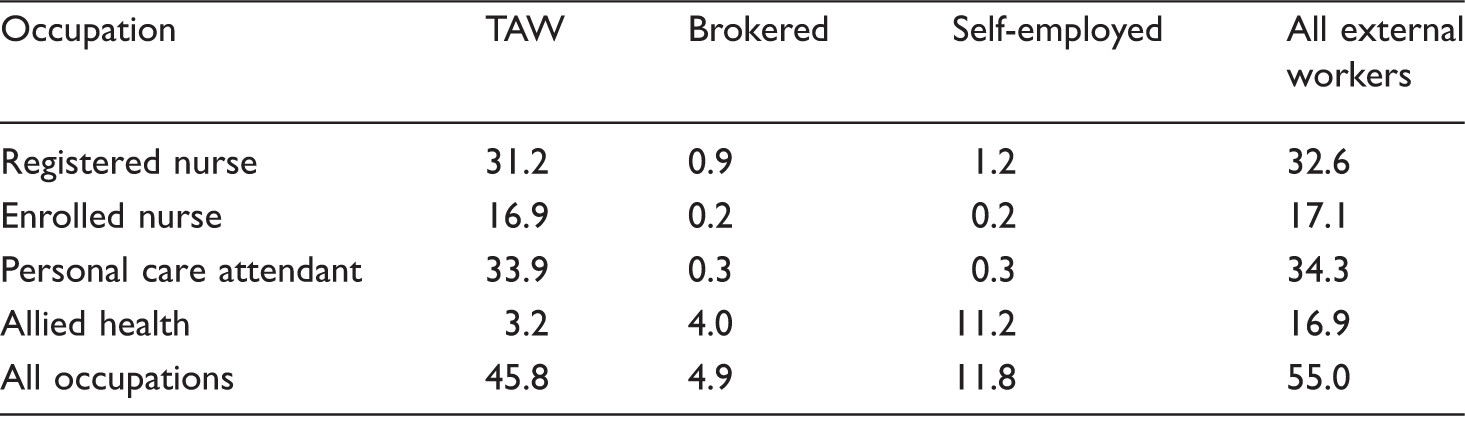
Source: King et al. (2012).
TAW: temporary agency worker.
Number of external workers in residential facilities in the designated fortnight and the number of shifts they covered by occupation, 2012.

Source: King et al. (2012).
The majority (72%) of aged care workers in nursing homes are employed on a permanent part-time basis and so are covered by national employment standards that provide paid leave for sickness, holidays and long service (paid after 10 years’ service). Casual workers comprise 19% of the direct care workforce and, while partly compensated by higher hourly rates, they face more uncertainty with regard to rostered hours of work (King et al., 2012).
TAWs are a significant proportion of the direct care workforce, comprising nearly 10% of all direct care workers in the survey fortnight. As seen in Table 2, PCAs formed the largest group of TAWs as they do in the internal aged care workforce, while TAW nurses work a higher number of shifts per worker than other occupations (King et al., 2012).
TAWs and the internal workforce
Historically, TAWs have been viewed as a reserve army of low-skilled labour, carrying out peripheral work to facilitate numerical flexibility through which employers can increase or decrease staff numbers in relation to changing demand (Davis-Blake et al., 2003; Purcell, 1998; Rogers, 2000). More recently the use of TAWs has been viewed as a skills supply strategy enabling organisations to remain viable (Håkansson et al., 2013; Holst et al., 2010). TAWs are found in an increasing number of industries, in blue and white collar occupations, and in both the core and periphery of client organisations (Bidwell, 2009; Håkansson and Isidorsson, 2012; Lautsch, 2002).
The boundaries between internal and external workers have shifted over the past 25 years. Previously, the definition of external workers was based on geographical distance between the TAW and the organisation and the duration of the employment contract, but these criteria have been challenged (Cappelli and Keller, 2013; Svensson et al., 2014). The definition of external employees now refers solely to where administrative control lies, that is, who the ‘employer’ is deemed to be. TAWs, for example, are external employees because they are hired by one organisation (the temporary work agency) in order to be hired out to another organisation (client organisation) at a profit. While administrative control is with the agency, the client organisation supervises and directs the work carried out by a TAW.
Despite the hourly rate for TAWs often being higher than that of a comparable internal employee (George, 2003), they are routinely used to meet organisations' workforce needs, primarily to achieve numerical flexibility and adjust to business cycle fluctuations that create altered demand for outputs or services (Kalleberg et al., 2003; Ono and Sullivan, 2013). Using TAWs can allow organisations to circumvent laws on employment security and, therefore, make it possible to lay off staff at short notice (Burgess and Connell, 2006; Hall, 2006), or screen TAWs as potential employees on the assumption that labour laws make it hard to dismiss employees once hired on a permanent basis (Houseman et al., 2003). Evidence from different regulatory and national contexts demonstrates that TAWs are also employed to fill vacancies. Externalising labour as a strategy to address skills shortages in a number of industries appears to be gaining ground across the world. This may be short term, where employees are on leave or to fill unanticipated vacancies until a regular employee is hired (Houseman et al., 2003; Olsen and Kalleberg, 2004; Tailby, 2005), or to adapt to long-term skill shortages (Audit Commission, 2001; Castle, 2009).
While TAWS may meet management’s needs, they can negatively impact on the work experience of internal employees. Previous studies have found that the introduction of TAWs into a client organisation can cause internal employees to feel their employment security is threatened, especially when they do similar work (Broschak and Davis-Blake, 2006). Other studies have found that internal workers perceive a status threat from TAWs, whether based on majority–minority group relations (Broschak and Davis-Blake, 2006) or social identity theory (George, 2003; George et al., 2012). Underlying these arguments are assumptions that TAWs are hired to meet the need for flexibility and that they strive to become internal workers. Indeed, de Cuyper et al. (2009) found that while status threats and job insecurity increase when TAWs can easily transfer to internal worker status, this was not the case when the reason for hiring TAWs was skill shortages.
Different categories of internal workers will respond differently to the introduction of TAWs. Purcell et al. (2004) suggest that the presence of TAWs had a stronger impact among employees engaged in work that is highly socially interdependent, in which efficiency and productivity requires teamwork among staff or where the social relationship between staff and clients is paramount to the delivery of services. Aged care work entails both aspects of social interdependence. The amount of social interdependence in the work carried out by PCAs (focused on direct care) is likely to be higher than that of nurses (incorporating management and administration). Davis-Blake et al. (2003), for example, found that the negative effect of introducing TAWs was smaller among internal workers with supervisory responsibilities, because these workers are less likely to perceive the extra training and supervision of TAWs as unfair compared to those who do not normally have such responsibilities.
Where TAWs lack organisation-specific knowledge, research has found that internal workers take on higher workloads and informally ‘supervise’ TAWs, thereby increasing workload and stress (Hoque and Kirkpatrick, 2008; Purcell et al., 2004; Ward et al., 2001). The presence of TAWs can therefore generate negative feelings among internal employees and cause a deterioration in relations between co-workers, as well as between workers and management (Allan, 2000; Chen and Brudney, 2009; Davis-Blake et al., 2003). Ultimately, this has a negative impact on internal employees’ job satisfaction (Banerjee et al., 2012; Bryson, 2013).
Research on various professions and national contexts has consistently found that factors such as stress and job satisfaction are crucial to an employee’s ITL. This association is found in longitudinal data (Castle et al., 2007; Clark, 2001; Clark et al., 1998) and cross-sectional data (Blaauw et al., 2013) and has been replicated for employees in organisational contexts as diverse as fast food workers (Ryan et al., 2011), nurses (Van der Heijden et al., 2009) and retail banking employees (Chen et al., 2010). Australian research on PCAs in aged care also found that ITL was related to low overall job satisfaction, with casual employment and personal worker characteristics (financial dependents, older workers, rural location and speaking/using a language other than English in the workplace) all being significant explanatory factors (King et al., 2013).
Although some studies report that the introduction of TAWs into a workplace is associated with increased ITL among internal workers (Broschak and Davis-Blake, 2006; Davis-Blake et al., 2003), and qualitative case studies suggest that the hiring of TAWs yields increased turnover among internal staff (Hoque and Kirkpatrick, 2008; Purcell et al., 2004; Ward et al., 2001), research in this area is scant, particularly in relation to aged care.
Methodology
In examining the blending effects of incorporating TAWs into the internal aged care workforce, data from the National Aged Care Workforce Census and Survey 2012 (hereafter referred to as NACWCAS 2012) are used to investigate the three research questions.
The NACWCAS 2012 is the third census and survey – conducted over a period of nine years: 2003, 2007 and 2012 – commissioned by Australia's Commonwealth Department of Health and Ageing. The 2003 survey was prompted by concerns that it was increasingly difficult to find the number and quality of staff required (Richardson and Martin, 2003). The same concerns were expressed in 2007. Although no crisis in workforce shortage was revealed, problems were identified, and in 2012 additional questions were asked about skill shortages, working conditions and experiences of work (King et al., 2012). These data have been widely used by many organisations to inform decisions about workforce planning and development.
The NACWCAS 2012 included a census which went out to all nursing homes and a survey directed at a sample of internal workers in each facility (TAWs were not surveyed). The NACWCAS 2012 therefore primarily provides information about the employed, internal workforce in direct care roles in aged care. Data regarding individual attitudes were collected in the survey directed to the workers, whereas data on the proportion of TAWs in the aged care organisations were collected at the facility level, reported by managerial representatives. While this does not allow comparisons of the TAW and the internal workforce, the data are sufficient to understand the impact of employing TAWs on the internal workforce. Workers were provided with information in 10 languages and offered assistance through an interpreter service. The response rate was high: 96% (2481 responses) from the organisations and 54% (8568 responses) from workers. The data were weighted and analysed to provide a comprehensive snapshot of the national aged care workforce as reported in The Aged Care Workforce, 2012 (King et al., 2012).1
In addressing Q1 and Q2, we conducted multivariate regression analysis examining the impact of engaging TAWs on internal employees' views of job satisfaction and stress. The measures of job satisfaction have been used in other mainstream surveys (e.g. the Household, Income and Labour Dynamics in Australia (HILDA) survey in Australia and the British Household Panel Survey (BHPS) in the UK) and were directly derived from the relevant questions in the NACWCAS, 2012. This method of measuring job satisfaction has been widely reported in the literature (e.g. Clark, 2005; Dickey et al., 2011; King et al., 2013; Wooden and Warren, 2004). We estimated the impact on overall job satisfaction as well as its seven separate facets (pay, job security, work, hours, opportunities, support and flexibility), all of which were measured on a scale of 1–10 (1 = totally dissatisfied and 10 = totally satisfied). We then extended this to assess the impact on views of employees at work on whether they have enough time to care, whether they have the skills and abilities required, whether they use their skills and abilities, whether they have a lot of freedom, whether they are under pressure, whether the job is stressful, whether they receive respect, manager–employee relations and whether they have adequate training. These were measured on a scale of 1–7 (1 = strongly disagree and 7 = strongly agree). As the variables were continuous, an OLS model was used for estimation.
Explanatory variables consisted of the proportion of TAWs (where 0 = none and 1 = 100%), as well as control variables for personal, household and workplace characteristics that have been identified by previous literature as important predictors of ITL (Howe et al., 2012). These included gender, age/age2, country of birth, qualification, health, household financial situation, job tenure, contract type, role at work, on-the-job training, region and sector of the care providers and whether the facility is part of a larger organisation.
In investigating Q3, we used similar model specifications to estimate the impact of using TAWs on internal employees’ ITL. The dependent variable of ITL took the value of 1 if an individual did not expect to be working for this employer in 12 months time and 0 otherwise. In addition to the control variables listed earlier, overall job satisfaction, stress, skills use and feeling respected at work were added, reflecting previous research. Given that ITL was measured as a binary variable, a probit model was used to estimate the probability of care workers intending to leave their jobs in the next 12 months. Marginal effects were then generated by the probit analysis to provide an indicator of the magnitude of change in intentions to leave associated with the use of TAWs in aged care facilities (Wooldridge, 2006).
Estimations were carried out for all (PCAs + nurses) and then separately for PCAs and nurses. Not all data are reported. To reduce the number of tables, only the coefficients and standard error of proportion of TAWs in an organisation have been reported for individual aspects of job satisfaction and work conditions for nurses and PCAs in Q1 and Q2. Given the findings, only the results for PCAs are provided for Q3.
The collection of data for the independent variable of main interest (proportion of TAWs) and the dependent variables have been collected from different sources; therefore, common method bias (Charlwood et al., 2014; Podsakoff et al., 2003) should not be an issue in the analyses presented here.
Limitations of the data
The NACWCAS 2012 data is the most comprehensive and robust dataset available on the Australian aged care workforce. Nevertheless, it has two main limitations in relation to the analysis of TAWs. First, there are no data from the TAWs themselves. This means that we could not examine whether there was an occupational dimension to our findings – for example, did it matter if the TAWs were PCAs or nurses? Nor could we look at whether there was a demographic (age, gender, ethnicity) or time dimension. Did it matter if the TAWs were engaged on a short- or long-term basis? Nor could the reasons for the impact of TAWs on internal workers be discerned, including whether there were nuances not detectable via survey data. Second, the cross-sectional nature of the data meant that we could not make any causal statements about the link between engaging TAWs and the impact on internal workers. We could not tell, for example, whether internal employees in nursing homes using TAWs were more or less satisfied with their work prior to the presence of TAWs.
Results
Work characteristics
OLS regression: Overall job satisfaction and facets of job satisfaction regressed on proportion of TAWs in facility. a
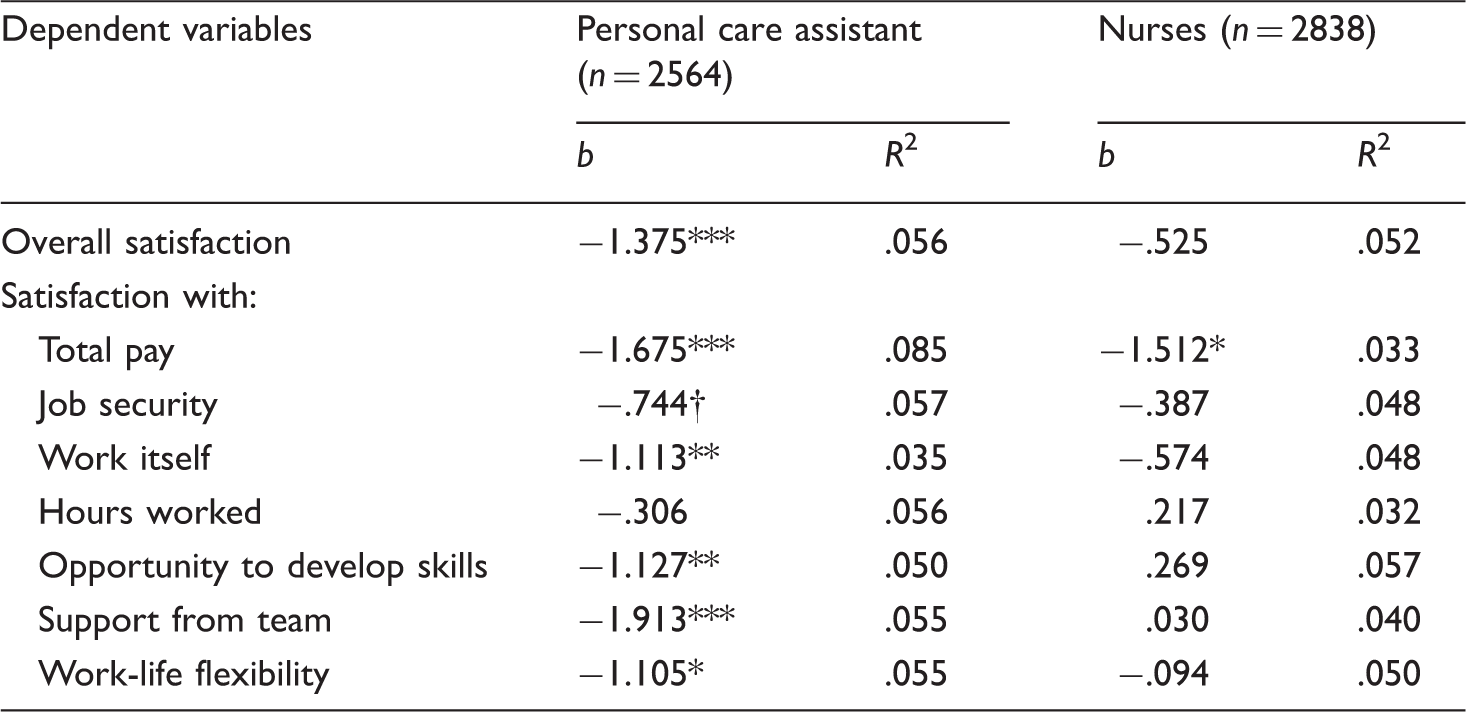
p < .10; *p < .05; **p < .010; ***p < .001.
Controlling for: managerial position, gender, age, job tenure, Australian born, level of qualification, type of employment contract, employee health, having financial dependents, received on-the-job training, whether facility is part of larger organisation, geographical location, whether facility is for profit, whether facility is public or private.
OLS regression: Job stress, making use of skills in work and earned respect in work regressed on proportion of TAWs in facility. a
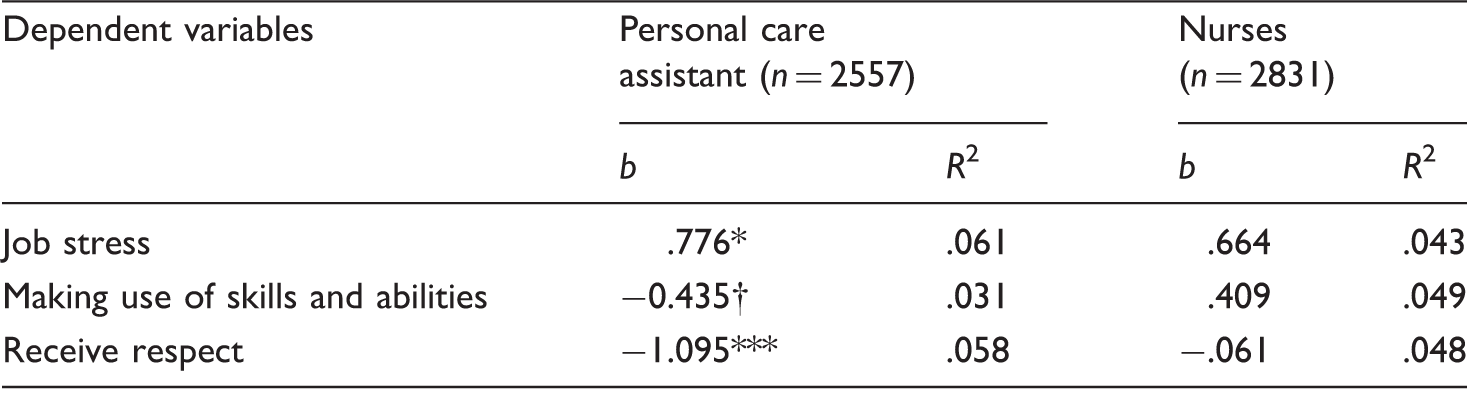
p < .10; *p < .05; **p < .010; ***p < .001.
Controlling for: managerial position, gender, age, job tenure, Australian born, level of qualification, type of employment contract, employee health, having financial dependents, received on the job training, if facility is part of larger organisation, geographical location, whether facility is for profit, whether facility is public or private.
In addition to PCAs’ satisfaction with opportunities to develop skills being negatively related to the proportion of TAWs (see Table 3), Table 4 shows that internal PCAs also experience fewer opportunities to use their skills.
These results address Q1 and Q2: the introduction of TAWs into the internal workforce of nursing homes is associated with decreased job satisfaction and increased job stress. Importantly, there are differences between nurses and PCAs.
Probit regression: The effect of the proportion of TAWs on internal PCAs’ intention to leave.

Note: Robust standard errors in parentheses.
TAW: temporary agency worker.
p < 0.001; **p < 0.01; *p < 0.05.
Discussion
Our results are generally in line with previous studies of ‘blending effects’ (Davis-Blake et al., 2003) of external workers on the internal workforce regarding job satisfaction (Bryson, 2013) and job stress (Allan, 2000; Hoque and Kirkpatrick, 2008; Purcell et al., 2004). Given the reported status divisions and social tensions that have been found in organisations that mix internal and external workers (Byoung-Hoon and Frenkel, 2004; Lautsch, 2002; Pedulla, 2013; Smith, 1994), the negative relation between the internal PCAs’ perceptions of received respect and the proportion of TAWs in the organisations is unexpected. However, it is not possible to identify whether the respondents' perceptions of respect refer to respect from management or from co-workers, and therefore this result should be interpreted with care. In line with Davis-Blake et al. (2003), a decrease in job satisfaction was found to be positively associated with ITL.
The results presented in Table 3 reinforce Bryson's (2013) findings that the use of TAWs in organisations is negatively associated with the overall job satisfaction of internal employees. This holds true even when various facets that make up the job satisfaction scale are focused upon. The presence of external employees in general, including TAWs, in client organisations has been found to result in a decrease in internal employees’ perceived job security (de Cuyper et al., 2009; Kraimer et al., 2005; Pedulla, 2013). However, de Cuyper et al. (2009) argue that such effects might be related to the reasons organisations use TAWs. When the primary reason is due to skill shortages, the TAWs may not be perceived as a threat and there is no effect on internal employees' perceptions of job security. In the case of aged care in Australia, it is reasonable to assume that the reason for hiring TAWs is due to skill shortages rather than as a flexibility strategy (Knight and Wei, 2015). It is therefore not surprising, given the results presented by de Cuyper et al. (2009), to find that the negative effect for perceived job security as reported in Table 3 is not significant at the .05 level. For the same reason it is, however, a bit unexpected that the negative effect is significant at the .10 level. Since this is a result that holds good for PCAs and not for nurses, a possible explanation could be that organisations employ external PCAs and nurses for different reasons. This finding calls for a refocusing in future studies of job satisfaction on the context of work externalisation. Given previously reported findings that the presence of TAWs in client organisations results in poorer relations among staff and status divisions among internal and external workers (Allan, 2000; Broschak and Davis-Blake, 2006; Byoung-Hoon and Frenkel, 2004), the negative effect of the use of TAWs on internal PCAs’ satisfaction regarding support from the work team could be expected.
While there are no previous studies that specifically address different facets of job satisfaction in relation to work externalisation, some studies contribute to understanding the results. Houseman et al. (2003), for example, argues that the use of TAWs might be a strategy to keep the wages of internal employees down. As noted earlier, wages for aged care work in Australia have been historically low and remarkably resistant to improvement, despite strong demand for workers. The finding that internal nurses’ and PCAs’ satisfaction with the level of pay is negatively related to the proportion of TAWs in the organisation needs further investigation to ascertain whether the decreased satisfaction stems from an actual decrease in pay or from other factors.
The difference in results for nurses and PCAs is in line with the arguments proposed by Purcell et al. (2004) regarding the impact of TAWs when work is highly socially interdependent. While their work is exploratory in nature and largely anecdotal, the results from our study show that the impact of TAWs on internal employees’ attitudes differs between categories of internal employees and, as such, lends valuable empirical support to Purcell et al.’s (2004) arguments. The issue of social interdependence was taken into account in the analyses since being in a managerial position implies administrative work and a greater distance from care work; hence, this was controlled for. Nurses in aged care work more by themselves to manage PCAs and often hold posts of administrative responsibility. The actual form of care being carried out by nurses and PCAs is therefore different: in contrast to nurses, direct care work is central to PCAs’ role and requires a high degree of teamwork. Teamwork has been found to be an important workplace resource (Clausen et al., 2011), and effective teamwork usually implies shared norms, values and practices that have been generated by experience in working together. External care workers would not have the opportunity to develop shared norms, values and practices and this may make teams less cohesive. Furthermore, patient care is crucially associated with job satisfaction for care workers (King, 2012; Morgan et al., 2013). If the presence of TAWs disrupts the teamwork on which patient care depends, it is likely to decrease job satisfaction. However, further study regarding the reasons why blending impacts more on work that is socially interdependent is required. In particular, future studies could include separate reasons as to why client organisations choose to hire TAW PCAs and TAW nurses.
Conclusion
There are few previous studies on the effect of mixing external workers into internal workforces in aged care, and most of those that have been carried out have been exploratory case studies with a small number of respondents. The present study, with data from 2481 organisations and over 5000 internal employees, is therefore a valuable contribution to this field of research. While the cross-sectional data do not permit any causal conclusions to be drawn, the results from this study demonstrate a strong relationship between the use of TAWs and a decrease in the job satisfaction of internal PCAs together with increased ITL. If organisations therefore intend to use TAWs as a strategy to quickly overcome skill shortages, our findings suggest that they may get caught up in a vicious circle: the ‘quick fix’ of utilising TAWs runs the risk of increasing internal employee turnover and, as such, of perpetuating a cycle of skill shortages.
In addition, this study demonstrates that it is the proportion of TAWs that is of relevance in analysing the impact of TAWs on internal workers. The relationship between the use of TAWs and internal employees’ job satisfaction has previously been investigated using large survey studies (Bryson, 2013) in which TAWs have been analysed as an either/or (presence of TAWs = 1, No TAWs = 0) relation. However, the present study shows a negative relation between the job satisfaction of internal employees and the increasing proportion of TAWs. Previously, only one study on TAWs controlled for job satisfaction (Davis-Blake et al., 2003), but again the use of TAWs was analysed as an either/or relation rather than in proportional terms. As job satisfaction was found to be an important predictor of ITL, the present study contributes to the research in this area showing that (holding job satisfaction constant) the proportion of TAWs in the client organisations is related to an increasing ITL in the internal workforce.
Given the relatively high proportion of external workers in the aged care workforce, the results of our study draw attention to the need for these workers to be incorporated into both industry-wide workforce development strategies and the policy and regulatory framework within which aged care operates. Untangling the relationship between the proportion of TAWs in nursing homes and increased pay dissatisfaction for internal workers could provide insights into whether this is due to an explicit strategy of wage containment on behalf of employers, an effect of comparing the relatively higher wages of TAWs to those of internal workers, or the reason why employers cannot attract internal workers in the first place. Such information could provide another dimension to the reasons why, even despite high demand for aged care workers, wages in the sector remain comparatively low.
There is also a gap in knowledge about the types of agencies that deliver TAWs into aged care: their size, mode of operation, regulatory controls and ownership structure. The market-making strategies of these agencies have been particularly successful in aged care (Knight and Wei, 2015), suggesting that there is something about the aged care labour market and/or funding regime that has made their use a logical option for aged care providers. While the agencies might have captured a significant proportion of this labour market, our research raises questions about whether this is a sustainable strategy, given the relationship between the proportion of TAWs in a nursing home and low job satisfaction, high stress and ITL for internal PCAs.
Footnotes
Declaration of conflicting interests
The author(s) declared no potential conflicts of interest with respect to the research, authorship and/or publication of this article.
Funding
The author(s) disclosed receipt of the following financial support for the research, authorship, and/or publication of this article: The authors acknowledge the Australian Government Department of Health and Ageing (now Dept. of Health) which funded the data collection upon which this research is based.