



Abstract
The rise of precarious and non-standard working arrangements has received substantial attention in recent times. In Australia precarious work has been particularly associated with the phenomenon of casual work, defined as employment without the leave benefits provided by the National Employment Standards. Casual employment status is at the employers' discretion. It may be long term and involve short shifts of less than 4 hours. In the recent Modern Awards Review by the Australian Fair Work Commission, the Australian Council of Trade Unions submitted proposals to limit employers' ability to unilaterally determine the employment relationship and to reduce the degree of precariousness associated with casual employment. The Australian Council of Trade Unions sought the right for long-term casuals to convert to permanent employment and to extend minimum hours for shifts. This article surveys the evidence, primary and secondary, regarding the extent and nature of Australian casual employment, including its impact on flexibility, earnings security and productivity. In this context, we explore the implications of the Australian Council of Trade Unions claims and Fair Work Commission decision, and present data from a survey of casual employees regarding employment preferences. Whilst some employees prefer casual status, we find that many would benefit from protective regulations, and that most casuals support such regulation.
Introduction
The rise of precarious working arrangements has received substantial attention in recent times amongst academics and practitioners, especially trade unions. In Australia the phenomenon of casual employment has received particular attention recently. Casual employment typically involves workers being deployed on an ad hoc basis, with minimum engagements on a daily basis only, and no guarantee of future work regardless of the period of employment. It also lacks the paid leave benefits associated with other more ‘permanent’ employment. The lack of security and standard benefits is notionally compensated in all modern awards (statutory instruments designating minimum wages and conditions in particular industries) by a casual employment ‘loading’ of 25% on top of the base wage. However, there have otherwise been few restrictions on the ability of employers to define an employment relationship as ‘casual’, or indeed on the length of time over which an employee may be considered to be ‘casual’. Particular concern has been raised about casuals who remain as such over extended periods of time, so-called long-term casuals; and about the minimum hours for which a casual should be paid for a single shift.
Casual employment was one of the major issues covered by a recent review by Australia's Fair Work Commission (FWC) of industrial awards. The Fair Work Act 2009 requires the FWC to undertake a review of all modern awards every 4 years (s.156), considering submissions from employers and unions. The first 4 Yearly Review of Modern Awards commenced in March 2014. Historically, awards, or determinations, of the FWC and its various predecessor tribunals and state tribunals, have underpinned the Australian system of labour market regulation since the beginning of the 20th century. Awards prescribe minimum wages and conditions covering all workers in an industry or occupation. Under the current Fair Work Act, before ratifying an enterprise agreement the FWC must apply a test of whether workers are better off overall in comparison with the relevant award (the ‘BOOT’ test); 23.9% of the workforce rely solely on awards to determine their wages and conditions. Since 2010 this proportion has grown from 15.2% (Australian Bureau of Statistics [ABS], 2017) because employers have increasingly sought termination of collective agreements so as to revert to minimum conditions in the award when impasse is reached in enterprise bargaining (Australian Senate Education and Employment Reference Committee, 2017; Workplace Express, 2017b).
The Review included consideration of a small number of ‘common issues’, consisting of proposals for significant variation of core provisions in most or all awards. One such proposal from the Australian Council of Trade Unions (ACTU) sought to limit employers’ ability to unilaterally and arbitrarily determine the employment relationship to be ‘casual’, and to reduce the degree of ‘precariousness’ associated with casual and part-time work. The claims included efforts to make permanent part-time work more stable and less ‘precarious’ as well as other provisions related to labour-hire workers; however, we focus specifically on three elements relevant to casual employment (FWC, 2017):
Insertion of a model casual conversion clause in 88 awards lacking such a clause and a further 17 which already contained such a clause. The model clause sought would allow long-term, regular casual employees (defined as working on a regular basis in the same job for 6 months or more in most cases, or 12 months in fast food and retail) to elect to convert to permanent full-time or part-time employment and be informed of this right by employers. Alteration of existing casual conversion clauses in five awards to allow for long-term, regular casual employees to be ‘deemed’ as permanent employees after 6 months (with the possibility of extension to 12 months by agreement in vehicle building, repair and services). Four of these awards were also the subject of a similar application by the Australian Manufacturing Workers’ Union; the fifth was for the Higher Education Industry (General Staff) Award. A minimum term of engagement for casual and part-time employees of 4 hours per engagement in most awards.
The ACTU proposals were opposed by employer groups. Advocates for casual employment – including employer groups in particular – have typically cited its benefits for flexibility, both from the perspective of productivity and the economy, and for employees managing their work–life balance. The Australian Chamber of Commerce and Industry (ACCI) (2016: 94) similarly contended that ‘the flexibility of casual employment for employers is highly significant in determining the productivity in the economy’, and these sentiments were echoed by the Australian Industry Group (Ai Group) (2016: 28). In an expert report for the ACCI, Withers et al. (2016) similarly contended that labour productivity is increased by the contingent deployment of workers. Employers also claimed that employees frequently preferred casual work because of the flexibility it provided, especially for those with caring responsibilities, including many women (ACCI, 2016; Ai Group, 2016; FWC, 2017). However, as shown in the following, critics – including both unions and academics – have questioned these claims, both in terms of the alleged productivity benefits, and more particularly the idea that casual employment necessarily enhances employee-oriented flexibility. They contend that employers are the primary beneficiaries of much casual employment, while employees find themselves deployed at the employers’ whim and suffering from precarious earnings and employment (e.g. Biddington et al., 2012; Markey et al., 2015a).
The FWC ultimately partially granted conversion rights, though in a heavily modified form, but did not increase minimum engagements to 4 hours in awards that did not already prescribe this minimum. It did, however, create 2-hour minimum engagements for awards that did not currently have a set minimum. In this article, we examine the context and potential impact of the ACTU proposals in the Modern Award Review, focusing on the position of casual employees. We also appraise the employer arguments against the proposals. We examine these issues within a broader context of casual work in Australia. In the following section, we discuss our methods, drawing on a range of secondary and primary sources to examine the contours of casual employment and the implications of the FWC decision. We then provide an overview of the extent and nature of casual employment before evaluating the employer arguments against the ACTU proposals. We examine the effects of casual employment on worker health and wellbeing, on their income and security, and on productivity. In doing so, we assess the extent to which a less regulated regime of casual employment is likely to provide the kinds of flexibility needed by employees and for facilitating productivity. Subsequently, we focus on the ACTU proposals themselves, primarily with a view to appraising the desire for such changes amongst employees. Finally, we draw some conclusions about the likely impacts of the FWC decision.
Method
We explore the extent and nature of casual employment in Australia, the extent to which it represents employee choice, the impact of short shifts, and the implications of the ACTU claims and FWC decision using a number of sources. We review the extant literature on casual employment, focusing on the Australian context, and draw on three primary data sources. One is widely available data from the ABS. Further data are analysed from wave 13 of the Household Income and Labour Dynamics in Australia (HILDA) survey, a nationally representative panel survey with a focus on income, employment and other family and social issues, as self-reported by participants. The survey is funded by the Australian Department of Social Services and managed by the Melbourne, Institute from the University of Melbourne and is used under licence.
Whilst the ABS uses lack of leave entitlements as a proxy for casual employment, we have used self-identified casuals in our analysis of HILDA data; however, the proportions are broadly equivalent. Of the 9330 workers in the wave 13 sample, 2036 (22%) identified as casual, which is broadly consistent with ABS proportions, while 68% were permanent and 10% were on a fixed term contract. Consistent with ABS data, self-perception of being casual is aligned with self-identification of leave benefits in 96–97% of cases.
We also analyse a survey commissioned by the ACTU to inform a report by the authors to the FWC, where one of the authors appeared as an expert witness. The ACTU survey gauged casual workers' preferences in terms of minimum hours and casual conversion, their reasons for working as casuals and their experiences as casuals. An independent organisation, Survey Sampling International (SSI), administered the survey in April–June 2015. Respondents included 838 casuals, 43 labour hire workers and 215 permanent workers. Our analysis of the responses focuses exclusively on casual workers due to the low relative proportion of permanent workers and labour hire workers. The latter also make up only around 2% of workers in the HILDA data.
The survey sample was chosen by SSI on a quota basis from its panel of respondents who met the demographic distribution specified by the ACTU on our advice. Some limitations of panel quota sampling of this kind include the facts that each stratum is based on a convenience rather than random sample, and respondents are compensated for participation, which may encourage regular responses to such surveys. However, the limitations imposed by these characteristics are balanced by the facts that the survey is professionally managed, those who respond often are filtered out of the survey frame, and respondents are more likely to understand response scales if they have prior survey experience (Zikmund et al., 2017).
Most importantly, the survey sample was constructed to broadly represent the ABS demographics for casual employees, in terms of gender, age and industry sector–though older workers were somewhat over-represented. However, the survey is almost exclusively of part-time casuals, with 95% of the casuals in the sample working part-time hours, as opposed to 71% in the ABS figures. A further specification was that the sample should be broadly representative of all employees in being made up of a large majority of non-unionists, in this case 84%. No weighting of results was undertaken.
The extent and nature of casual and precarious employment in Australia
Precarious employment and its regulation
Precarious employment is widespread in Australia. Casual employment is the most common form, but fixed-term employees, contractors and employees of labour hire firms are all substantially precarious. Together these account for about 37% of the total Australian workforce (ABS, 2014b, 2017d). All experience job insecurity and many experience working-time and income insecurity (Biddington et al., 2012). Most of these groups also lack other entitlements and protections enjoyed by non-precarious employees. Independent contractors, for example, lack access to minimum wages and have to make provision for their own workers’ compensation insurance and superannuation; many are in reality employees whose relationship is misrepresented by employers in order to avoid employment entitlements, a phenomenon known as ‘sham contracting’ (Biddington et al., 2012: 16). This phenomenon has particular implications for the emerging so-called gig economy, which are still being resolved.
Casual employment has traditionally meant employment that is discontinuous, informal, irregular or intermittent (Biddington et al., 2012; FWC, 2017). However, in reality this intermittent nature of casual employment has not been deemed to be an essential feature. Casual employment has no statutory definition and is generally not defined by the relevant award or enterprise agreement. A casual employee may simply be defined as someone employed ‘as such’, but ultimately the defining feature of casual employment has been the absence of leave, holiday, or termination and redundancy benefits provided under the National Employment Standards (NES), which expressly exclude casuals (Campbell, 2004, 2010). This particularly insecure form of employment contrasts with temporary employment in much of Europe, which includes a designated end point, minimum weekly hours and other restrictions (Tweedie, 2013).
Specialised legislation has attempted to regulate aspects of precarious employment. Home- or outworkers engaged in supply chains in the textile, clothing and footwear sector have been ‘deemed’ as employees to fall within the jurisdiction of standard labour regulation, at the state level commencing with New South Wales (NSW) in 2001 and at a federal Australian level since 2012. Although the federal legal obligations on retailers are not currently practically enforceable, legislation stimulated voluntary ethical retailer codes of practice subscribed to by all major retailers that require record keeping and disclosure of supply chain details (Nossar et al., 2015). Between 2012 and 2016 the federal Road Safety Remuneration Tribunal set pay, conditions, and health and safety standards for road transport drivers, both employees and contractors, with jurisdiction over employers, hirers and other supply chain participants (Johnstone et al., 2015). This federal Labor government initiative was abolished by the subsequent federal Liberal/National Party coalition government. However, at the state level in NSW, legislation has enabled regulation of pay and conditions in road transport for owner-drivers with one hirer since 1979 (Rawling and Kaine, 2012). More recently, state governments in Queensland, Victoria and South Australia have moved to regulate labour hire companies through licensing (Workplace Express, 2017a).
Unions had previously gained a casual conversion clause for NSW state awards in 2006. Unions NSW, the state branch of the ACTU, successfully applied before the (then) NSW Industrial Relations Commission for a general right for casuals to elect for permanent employment after 6 months (Secure Employment Test Case, 2006). In that test case the clause was inserted into three state awards for storemen and packers, and unions were able to apply for its insertion into other awards subsequently.
However, this success was short lived because federal legislation established a more unified national workplace relations system, first under the Commonwealth ‘Work Choices’ legislation (Workplace Relations Amendment (Work Choices) Act 2005) and consolidated by the Fair Work Act 2009. As part of this process the FWC (as the federal tribunal was called from 2013) undertook a process of ‘award modernisation’ during 2008–2009, replacing 1560 state and federal awards with 122 Modern Awards by January 2010 (Bray, 2011). In this process, there was no opportunity to implement the NSW gain of 2006 more generally, and even in the ‘modernised’ award for storemen and packers the casual conversion clause was not retained. The recent Review process thus represented an important opportunity to regulate casual employment federally for the first time.
Characteristics of casual workers
The level of casual employment in Australia is amongst the highest in the Organisation for Economic Co-operation and Development (OECD).
At the time of the FWC modern award review around one-quarter (24–25%, 2013–2016) of Australian employees did not have leave benefits (a proxy for casual employment) (ABS, 2014a, 2017a). The overall level of casual employment has stabilised since 2005, after rapid growth from the mid-1980s, but most of the jobs created in the 1990s were casual (Watson, 2013).
Growth in the proportion of casual employees was most pronounced amongst male workers, from 9% in 1984 to 24% in 2001, before hovering between 20 and 22% from 2005. Female casual employment was already at 26% in 1984 and peaked at 32% in 2002, before declining a little to 27% in 2016. Women, however, remain a majority of casual workers, at 54% (ABS, 1985–1988, 1989–1997, 1998–2013, 2017a). Industries with the highest proportion of casuals include Accommodation and Food Services (65%), Administrative and Support Services (40%) and the Retail Trade (39%) (ABS, 2014a, 2017a), all of which have high proportions of female workers, ranging from 55% (Accommodation and Food Services; Retail) to 49% (Administrative and Support Services) (ABS, 2017c). Casual employment has been a highly gendered issue, therefore, although it is less so now than previously (Campbell et al., 2009).
Casuals have different demographic characteristics from workers with leave benefits, but these differences should not be exaggerated. On average, casual employees are younger than permanent workers, though workers under the age of 25 nonetheless represent a minority overall. Around 38% of all casual workers are aged 15–25, compared to 12% for permanent workers. Casuals are much more likely to be dependent students than permanent workers, but this is nonetheless a small minority of 19% of casuals. This proportion of dependent students is smaller than the 26% of casuals who are parents with dependants (ABS, 2014a, 2017a).
The gender differences are also stark in relation to the distribution of full-time/part-time status amongst casuals. Overall 71% of casuals work part-time. However, males are disproportionately represented amongst full-time casuals at 69%, and conversely, 64% of part-time casuals are female; 44% of male casuals work full-time, compared with 16% of female casuals (ABS, 2017a).
Almost half of all part-timers work 20 or less hours per week (ABS, 2017b). Biddington et al. (2012) cite ABS data showing that up to 37% of all part-time workers have no minimum number of hours of work. Some awards do specify minimum engagements, but these have been as low as 1 hour, as in the Home Care and Disability Services Industry Award 2010. Whilst all part-time workers are affected by these conditions, casual workers are particularly affected since they make up a disproportionate number of part-time jobs compared to full-time. Nearly 54% of all part-time jobs are casual, as opposed to around 10% of full-time jobs; and 71% of casuals work part-time, compared with only 19% of permanent workers (ABS, 2014a).
Flexibility and productivity
As previously indicated, over the course of the FWC Review employers and employer groups attempted to couple casual employment with the need for ‘flexibility’ in the labour market, which they linked to improved productivity (ACCI, 2016; Ai Group, 2016; FWC, 2017). They claimed that tighter regulation of casual employment would undermine these productivity benefits. These claims are worthy of examination. The kind of flexibility advocated by business groups and facilitated by casual employment can broadly be called ‘numerical flexibility’–as distinct from ‘functional flexibility’, which is ‘the ability of firms to reallocate labo(u)r in their internal labo(u)r markets, relying on training that allows personnel to carry out a wider range of tasks’ (Zhou et al., 2011: 943). Evidence that numerical flexibility necessarily delivers productivity gains is scant, and indeed much of the evidence runs in the opposite direction. Links among job insecurity, sickness absence and mental health consequences reduce productivity over the long term (D'Souza et al., 2006). Employee commitment has been linked to labour productivity (Hodgkinson, 2003), but this can be undermined by casual employment (Day and Buultjens, 2007; Smith, 2013).
While functional forms of flexibility offer gains for innovation, numerical forms may actually have a negative impact (De Spiegelaere et al., 2014). Because functional flexibility will be facilitated by investment in employees (including training), there is likely to be a trade-off between this and numerical forms – the disposability of employees associated with numerical flexibility reducing the tendency for such investment (Kleinknecht et al., 2014). A substantial international literature in labour economics and human resource management suggests that productivity, innovation and competitive advantage of organisations are impacted by the level of on-the-job training undertaken by employees, through development of ‘human capital’ (Aghazadeh, 2004; Becker, 1964; Konings and Vanormelingen, 2015).
The HILDA data show much lower access to training among casuals compared to permanent workers. Only 22% of casuals had completed work-related training in the past year, compared to 40% of permanent workers. Part-time permanent workers had rates of training comparable to their full-time counterparts, while rates of casual training remain low regardless of whether full-time or part-time. Further investigation of HILDA data by Withers et al. (2016) shows that casuals are consistently less likely to have completed training in the last 12 months regardless of age, educational attendance and occupation (except for full-time sales workers and part-time labourers), though the magnitude of this lower training experience varies slightly, particularly by industry (Withers et al., 2016). Lack of access to training by casual workers has been attributed to a combination of factors, including not only irregular schedules making attending training difficult, but marginalisation of casuals and lack of investment in training them (McGann et al., 2012; Pocock et al., 2004).
A number of studies have examined the link between employment regulation more generally and productivity. Storm and Naastepad's (2009) study of 20 OECD countries over 1984–2004 found that countries with more stringent labour market regulation had stronger productivity growth than those with less regulated, more flexible labour markets. They concluded that ‘further deregulation and flexibilisation of OECD labor markets may lead to deteriorated productivity performance, because it fails to effectuate the contribution that workers can make to the process of organizational and technological innovation which raises productivity’ (Storm and Naastepad, 2009: 649). Similar results were shown in a study from Norway, which found that both productivity and wages were negatively affected by numerical flexibility, while positive effects were observed with functional flexibility (Van der Meer and Ringdal, 2009).
Moreover, the evidence that greater numerical flexibility is associated with better employment outcomes is at best inconclusive. Some studies associate greater labour market flexibility with lower unemployment (Bernal-Verdugo et al., 2012). However, a number of studies using comparisons across countries over time suggest that employment protections have neutral or positive effects on employment (e.g. Avdagic, 2015; Storm and Naastepad, 2009). In its final report on the workplace relations framework, the Productivity Commission (2015) also concluded that the evidence for the impact of the workplace relations system on productivity, employment and economic performance was inconclusive.
These findings on economic effects, and productivity in particular, have been questioned by employer groups and expert witnesses but not with the support of empirical findings. In their report to the FWC, for example, Withers et al. (2016) included econometric modelling, which appeared to show a decline in productivity and economic growth as a result of the ACTU's proposals. However, the academic rigour of their results has been questioned because the modelling contained assumptions of negative effects on productivity, employment and economy. This effectively imposed a result on the model, meaning that it served only to quantify a result contained within the inputs to the model itself (O'Brien, 2016). The Ai Group (2016) also submitted the results of a survey of members in which it was claimed that the proposed changes would result in reduced staff and other negative effects, but these claims may be seen as simply assertions by parties interested in limiting regulation. Ultimately, the FWC (2017) drew no conclusions about productivity effects of casual conversion from the evidence presented to it.
Flexibility for employees?
In this section, we examine the claim that casual employment facilitates employee-oriented flexibility and better work–life balance. It is true that many employees desire a degree of flexibility in working hours to manage work–life balance and care responsibilities (Heron and Charlesworth, 2012). Most casuals in a qualitative study by Keuskamp et al. (2013) had freely chosen casual employment, and experienced positive effects on their health and wellbeing, which they associated with casual employment. Keuskamp et al. (2013) have suggested that freely chosen and beneficial casual work is more likely where the worker possesses in-demand skills and qualifications, as well as access to sources of capital or income independent of their (casual) wage.
However, for many casuals the opposite effect is felt, as they feel on call and at the mercy of employers, loathe to turn down work due to fear of reprisal and the precariousness of their employment position (McGann et al., 2012; Pocock et al., 2004). Casuals report short notice for beginning times and frequently no notice for end times, for shifts which vary from very long to very short (McGann et al., 2012). This hinders the ability of casuals to plan their lives and exercise their own flexibility. Heron and Charlesworth (2012: 216) argue that ‘basic employee entitlements to regular and predictable hours, and a say in whether and how these conditions can be changed’ are ‘crucial to accessing specific employee-oriented flexibility’.
Much of the evidence concludes that casual work is often controlled by employers – with hours largely dictated to employees (Biddington et al., 2012; Bohle et al., 2011; Heron and Charlesworth, 2012; McGann et al., 2012; Pocock et al., 2004). Figure 1, based on the ACTU survey, shows that 40% of casuals indicate having very little say over their working hours, while only 26% indicate having a lot of say. A higher proportion of men (48%) than women (36%) reported having very little say, while women (29%) were more likely to report having a lot of say over hours than were men (21%). This was fairly consistent across industries. Analysis of HILDA data also shows that casual employees had significantly lower average satisfaction with hours worked than permanent employees. These themes of a lack of control over working times, short notice, fear of reprisal and inability to properly plan were all raised by casual worker witnesses during the process of the FWC Review (2017).
Casual employees, degree of say over hours by gender.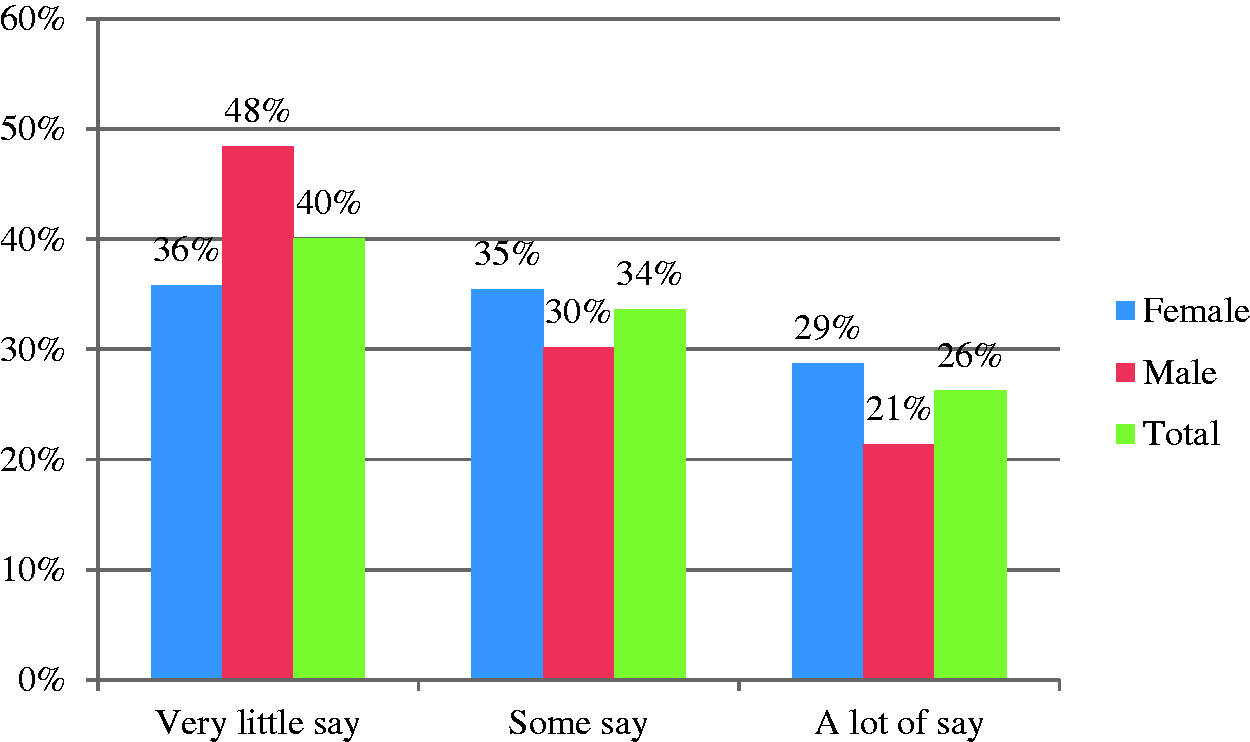
Any benefits to employees regarding flexibility and managing work–life balance largely depend on total hours of work, more than on the weekly variance often inherent in casual work. Many casuals desire part-time hours, but would prefer to avoid the unpredictability of working time and income which often accompanies casual status (Hosking and Western, 2008; Pocock et al., 2004). Variability and lack of control over hours can actually contribute to higher work–life conflict (Bohle et al., 2011; Pocock et al., 2004). Work–life interference is particularly prevalent with ‘unsocial’ hours worked at nights and weekends (Skinner and Pocock, 2014), and casuals are among the most likely to work at these times (Daly, 2014). The available evidence suggests that casual employment offers no advantage for work–family conflict when total hours are accounted for (Hosking and Western, 2008; Skinner and Pocock, 2014). While genuine negotiation over hours can mitigate negative effects, this tends to be exceptional and dependent on individual employer practices (Pocock et al., 2004). For many workers, permanent part-time work would better facilitate flexibility and work–life management.
It is unsurprising, then, that casual employment has been linked with a range of negative impacts on mental and physical health and wellbeing. Casualised and precarious employment relationships have generally been linked with intensified stress and anxiety in the workplace. This is particularly associated with a lack of control over hours of work and the employment relationship more generally (McGann et al., 2012; Pocock et al., 2004). Casual employment has also been linked to feelings of powerlessness and fear, and a lack of voice in the workplace. Many employees feel unable to report difficulties, including health and safety concerns, due to fear of reprisals (Burgess et al., 2008; McGann et al., 2012; Pocock et al., 2004). Financial hardship also leads to employees delaying health care, not only because of expense, but because missing work to take care of health needs means a loss of income which the employee cannot afford; and this leads some workers to come to work when sick (Biddington et al., 2012; Green and Leeves, 2013; McGann et al., 2012; Pocock et al., 2004). Whilst Richardson et al. (2012) purport to find no effect of casual employment on mental health, this is only to the extent that the study ‘controls’ for financial stress. The findings in fact suggest that negative effects associated with casual employment identified in other literature are likely to operate at least in part through the effects of casual employment on financial stress, which we discuss in the next section.
In the FWC Review employers claimed that some employees who expressed dissatisfaction with casual status had expended little effort finding alternative employment, and expressed job satisfaction (ACCI, 2016; FWC, 2017). However, that employees enjoy the intrinsic aspects of their jobs, and perceive relatively few opportunities for permanent positions within the same industry, does not contradict the notion that they may be dissatisfied with their casual status. Indeed, one disability support worker stated that she greatly enjoyed her job and believed that ‘I make a great deal of difference to the people that I work with’, but lamented that the only problem with the job was its ‘casual nature’ and ‘uncertainty’ (ACCI, 2016: 29). This worker had not requested a more permanent status because ‘this would not be looked upon favourably by my employer’ (FWC, 2017: 78).
Earning security
Casuals are among the lowest paid employees (Buchler et al., 2009; McGann et al., 2012; Pocock et al., 2004). Around 70% of casual employees earn less than $700 per week, with median weekly earnings at $425, compared with $1052 for permanent employees (ABS, 2014a). This difference occurs even amongst part-timers: part-time casuals earn a median of $300 per week, around half the $600 per week earned by permanent part-time staff. Full-time casuals also earn less ($950 median) than their permanent counterparts ($1,197). Analysis of HILDA data suggests that differences in weekly earnings occur even within industries.
Variable and often short hours contribute to the differences in weekly incomes. Some casual employees desire reduced hours for work–life balance, but many desire more work hours, leading to the phenomenon of ‘underemployment’ (Buchler et al., 2009; Burgess et al., 2008; Campbell et al., 2013). Figure 2 shows preference for more, fewer, or the same hours among casual and permanent employees, based on the HILDA survey. Casual part-time employees have by far the highest propensity for wishing to work more hours – 43% of casual part-timers would prefer to work more hours, and further analysis (beyond what is shown in Figure 2) shows that 18% of casual part-timers would prefer to work hours equivalent to full-time (35 hours or more).
Preference to work more, fewer, or same hours by employment contract.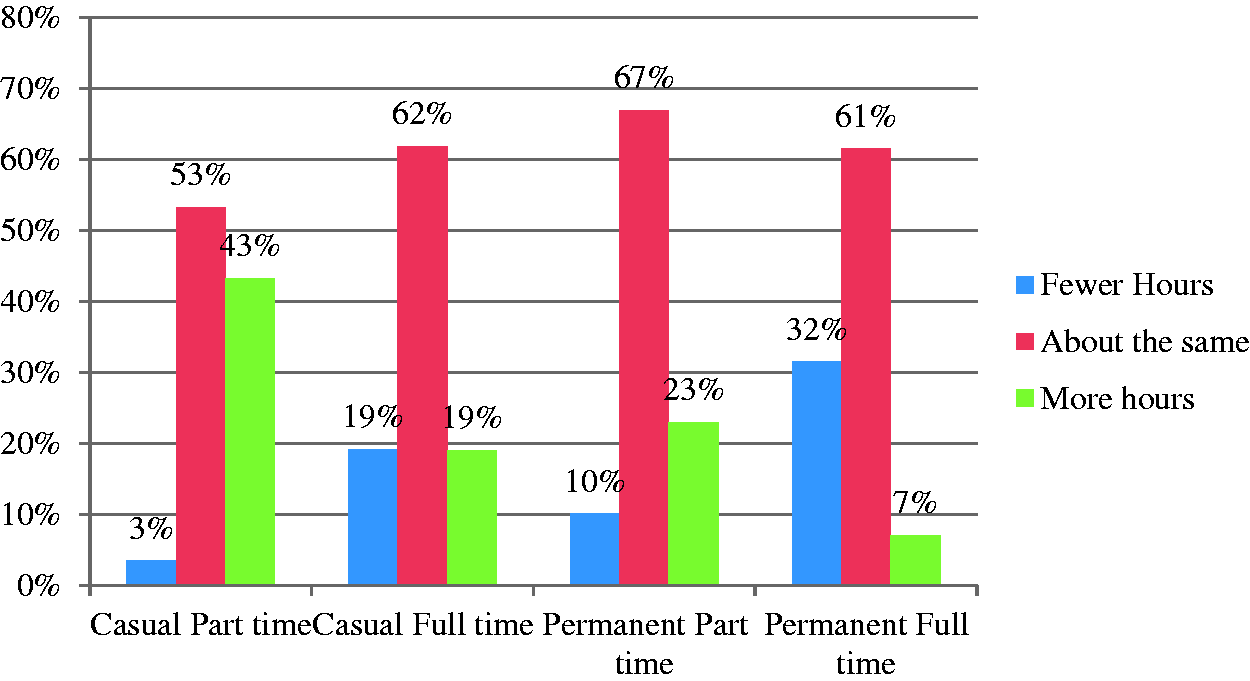
Low and variable hours are not the only source of casuals' earnings insecurity. The ability of the 25% casual wage loading to compensate for the absence of leave rights and benefits associated with casual employment is limited. There is also some question over the extent to which casual loading is being paid. The ABS (2014b) found that while 23% of workers self-reported being casual in 2013, only 14% reported receiving casual loading, with 8% unsure. While sometimes this may simply represent employees' lack of knowledge, it may also indicate a major area of non-compliance by employers.
Even to the extent that the loading is paid, it may not adequately compensate for the benefits forgone, as found with most casuals' estimation in Pocock et al.'s (2004) study. This especially occurs where permanent workers receive over-award payments through collective agreements that casuals may not (Campbell, 2004). Several workers giving evidence in the Review also claimed that they would rather receive leave benefits than the casual loading (FWC, 2017). In opposition, several employers claimed that the great majority of their employees would not wish to forego the casual loading (FWC, 2017). However, employers are unlikely to be an accurate source of information on employees' preferences. The ACTU survey found that only 3% of casuals indicated that the casual loading was a principal reason for their remaining casual.
More fundamentally, the equivalent full-time or permanent worker, on whose wage the casual loading is based, may be near non-existent in some occupations (Campbell, 2004). Pocock et al. (2004) also suggest that many casual employees may be purposefully under-classified by employers given their skill levels and tasks, so that their wage, while nominally receiving a ‘loading’, often was ultimately lower than that of permanent workers performing the same work. Campbell (2004: 93) characterises casual loading as ‘at best a rather tattered fig leaf, which fails to conceal the true nature of relations between employers and casual employees’.
Ultimately, it appears that the insecurity associated with variability is exacerbated by lower hourly wages for casuals, as shown by various analyses of HILDA data. Withers et al. (2016) demonstrate that within most occupational and industry groupings, casuals generally earn lower hourly wages than their permanent counterparts, despite casual loading. Watson (2005) found that casuals with equivalent jobs and demographic characteristics earned an hourly premium of 10% for men and 4% for women compared to permanent full-time workers, but that this becomes a discount of 12 and 17%, respectively, when a 20% assumed ‘loading’ is accounted for. Mooi-Reci and Wooden (2017) show that (controlling for a range of job-related and other factors) casual employment attracts a wage penalty of 15.4%, though this is higher for men (18.5%) than for women (11.7%), compared with permanent workers. They also analysed the longitudinal career wage effects of periods of casual employment compared with permanent employment, and found that differences persisted but reduced over time, except for men in casual employment aged 36–44 at the beginning of the period, for whom the gap worsened (Mooi-Reci and Wooden, 2017). These factors have the potential to undermine the safety net contained within the NES, because employers may prefer casual employment for the purposes of reducing wage costs. These findings are also consistent with international evidence that ‘compared with permanent workers, temporary workers face substantial wage penalties, earnings instability and slower wage growth’ (OECD, 2015: 137).
The negative factors associated with casual employment may be mitigated for some casuals for whom casual employment is undertaken as part of a pathway to later, more permanent employment. This may include students working in an industry unrelated to their desired future careers while they pursue their studies, and others working as casuals in the industry of their chosen career in the hope that they may gain stable employment later. For many underemployed casuals who would prefer to be in a full-time job, however, casual employment may not be a path to greater security, and many remain trapped in insecure employment for extended periods (Buddelmeyer et al., 2006; Pocock et al., 2004; Watson, 2013; Welters and Mitchell, 2009). McVicar et al.’s (2017) longitudinal study found that ‘trap’ pathways were roughly as common as ‘bridge’ pathways for casual employment. Systemic factors are important influences: employees are particularly less likely to move to permanent positions when employed in low-paid industries where casual density is high, such as Retail and Accommodation and Food Services; and employment in economically disadvantaged regions will also tend towards more persistent casual employment (Watson, 2013). With the exception of those working while studying full-time, education matters little in facilitating a transition to full-time employment (Watson, 2013). Prolonged casual employment may also sap the confidence of employees in seeking permanent positions (Pocock et al., 2004). The problem is particularly acute for women; Buddelmeyer and Wooden (2011) actually found that unemployed women were more likely to obtain full-time work than women employed as casuals, while McVicar et al. (2017) also found that women were particularly likely to follow ‘trap’ pathways. Beyond lacking access to transitions to permanent employment, casual employees are also at greater risk of transitioning into periods of unemployment than other workers (Buddelmeyer et al., 2006; Green and Leeves, 2013), exacerbating their financial disadvantage.
The combination of unpredictable work hours, insecurity and low pay affect the ability of employees to manage finances, and hinder financial planning for the medium to long term (Biddington et al., 2012; McGann et al., 2012; Pocock et al., 2004). Casual employees are at particular risk of not meeting financial commitments and affording basic costs of living, such as bills and rent or mortgage. This can make it difficult to secure loans (Biddington et al., 2012; Buchler et al., 2009; Green and Leeves, 2013; McGann et al., 2012; Pocock et al., 2004), which was a consistent theme amongst a number of witnesses in the FWC proceedings. Even securing rental accommodation can be problematic for casuals (Biddington et al., 2012; Campbell et al., 2013). These difficulties are not explainable by personal financial knowledge and capability, but are associated with the insecurity of employment itself (Gray, 2014). These financial issues are consistent with problems associated with underemployment (Campbell et al., 2013), and the greater likelihood of transitioning to unemployment. This cycle is likely to lead to lower wealth accumulation over time (Green and Leeves, 2013).
Minimum engagements
Employers and employer associations, either seeking reductions in minimum engagements or resisting union claims, made a number of counter-arguments to notions that minimum engagements needed to be increased. Their most consistent claim was that short shifts were an operational necessity, determined by the amount of work available (FWC, 2017). A number of employers admitted that they may be able to redeploy workers into other areas where a shift in one area was less than 4 hours, but emphasised the difficulty of this, and that it may require reducing hours of other employees working longer shifts. A number of employers also contended that an increase in minimum engagements to 4 hours would cause them to reduce employment. Research is needed on the effects of different minimum engagements on employment to assess the veracity of these claims; there is, to our knowledge, no such extant research.
Some employers also claimed that short shifts suited some of their employees' own flexibility needs (see FWC, 2017). However, no employee testimony corroborated these claims, and nor were they supported by research. Such claims constitute mere assertions about the interests of parties whom the proposed regulation is designed to benefit by a party otherwise opposed to the regulation. It is particularly notable that among those asserting that short shifts suited the needs of employees were employers in the Accommodation and Food Services sector. In the ACTU survey, 0% of casual respondents in that industry who had worked shifts of 3 hours or less disagreed that minimum shift lengths should be longer.
Heron and Charlesworth (2012) suggest that minimum engagements enhance flexibility for employees by ensuring a better balance between time spent at work and travelling and preparation. They argue that a failure to protect workers’ minimum hours undermines, rather than facilitates, flexibility for workers, as well as undermining their income security (Charlesworth and Heron, 2012; Heron and Charlesworth, 2012). Short shifts, often performed at short notice, eat into the time economy and net earnings of work, especially when travel and preparation is taken into account (Bohle et al., 2011; Heron and Charlesworth, 2012). Econometric analysis of data from the Australian Workplace Relations Survey (AWRS) demonstrates that a substantial proportion of costs associated with employment during any particular shift are ‘fixed’ costs (Markey et al., 2015b). ‘Fixed’ costs in this case refer to costs that accrue to the same amount whether the shift worked is 1 hour or less, or several hours. Particularly for casual employees, a substantial proportion of costs associated with factors such as transport and childcare were found to be ‘fixed’, while additional costs associated with each additional hour worked were relatively smaller. Women were particularly affected by childcare costs. A number of witnesses in the Award Review proceedings expressed their dissatisfaction with issues related to short shifts (FWC, 2017). One witness, a disability support worker, reported working shifts of as little as 30 minutes. Another witness, a permanent part-time community support worker under an award with no minimum shift, described days of work where 5 hours of employment would be spread over 12 hours, in which she would sometimes sit in her car for 45 minutes between shifts with no remuneration. Being sent home after 2 or 3 hours, even after a longer shift was rostered, was also a problem identified by witnesses. A consistent theme amongst the casual witnesses in particular was that they were loath to turn down any shift due to fears for their job security. Union officials also noted that casuals had expressed concerns to them about short shifts that they were afraid to raise with their employer for fear of reprisals.
The problem of working relatively short shifts seems widespread. A number of witnesses in the Award Review reported regular scheduling for such shifts. Between one-third and one-half of casuals in the ACTU survey had worked such a shift in a number of industries, just under two-thirds in ‘Other Services’. Overall, 37% of the mainly part-time sample of casuals had worked short shifts of 3 hours or less, and only around 21% had worked shifts at a minimum of 7 hours or more. Short shifts of 3 hours or less were particularly prevalent amongst workers aged 45–54, 65+ and 21–24 years, though in the latter case no worker reported working as little as 1 hour. This was by no means restricted to sectors with high base rates of pay: in Accommodation and Food Services 42% and in the combined Wholesale and Retail sectors 37% had worked such shifts.
Problems with minimum engagements are particularly acute in jobs disproportionately undertaken by women. The ACTU data show that females (38%) were more likely than males (34%) to have worked a short shift of 3 hours or less. This is particularly notable in the care sector, where award provisions specifying minimum engagement provide relatively little protection for workers. The Social, Community, Home Care and Disability Services Industry Award 2010 provided for a minimum engagement of just 1 hour for home care workers and 2 hours for disability support workers and ‘others’ not specified by the award, as well as 3 hours for other community workers. The award also does not provide for any minimum number of hours per day or per week (Charlesworth, 2012). These jobs are often low paid in addition to being highly gendered. The related Aged Care Award, in a similarly ‘feminised’ industry, also provides only 2 hours as a minimum engagement (Charlesworth and Herron, 2012). Charlesworth and Heron argue that, far from presenting women with favourable circumstances to manage their own needs, this lack of protection reflects persistent devaluing of female-dominated work.
Most casuals in the ACTU survey who worked shifts of 3 hours or less supported longer minimum engagements. The highest levels of agreement can be found in industries such as Health Care and Social Assistance (70%), Accommodation and Food Services (63%), Manufacturing (61%), and Arts and Recreation Services (60%). 1 The Retail Trade sector is also notable at 53%. Meanwhile, in no industry does disagreement exceed agreement, and overall levels of disagreement are consistently very low. This was also true across gender and age group categories.
The FWC (2017: 181) ultimately rejected the ACTU's claim for a 4-hour minimum engagement across (nearly) all awards. According to the FWC, it had not been established that any daily engagement below 4 hours was ‘necessarily unfair and exploitative’. It also accepted employer arguments that longer minimum engagements may have the effect of reducing employment and inhibiting ‘flexible modern work practices and the efficient and productive performance of work’. However, the FWC (2017: 181) also accepted that the evidence pointed to a need to review minimum engagements in some (unspecified) awards, concluding that ‘there was some evidence of short shifts being worked in a manner which verged on being exploitative’. It accepted that the operational needs of employers needed to be balanced against the need to protect employees from exploitation, and that minimum engagements were an important tool in achieving this. This informed its decision to create a 2-hour minimum engagement for those awards that did not currently provide this.
Conversion for long-term casuals
The ACTU proposal would meet the preferences of a significant number of employees and make casual employment a more meaningful choice. A survey of casuals conducted by the ABS in 2007 found that around half (52%) would prefer permanent work with leave benefits (ABS, 2010). Casuals were explicitly warned in this survey that they would lose the additional income from casual loading if employed permanently, but many valued the stability of income associated with stable work. This finding is echoed in the 2015 ACTU survey: 49% of casuals indicated that they worked as casuals because it was the only work available–more than the 44% who indicated freely working as casual because it was more flexible or convenient, and dwarfing the 3% who did so in order to earn the casual loading. Those who preferred to remain casual could in any case choose to do so under the ACTU proposal. The same survey found that 28% of casual respondents with tenure of 6 months or more desired to convert to more permanent employment within their current job. The fact that this figure was lower than for those expressing a preference for permanent work in the aforementioned ABS study is likely at least partly to reflect the fact that some of those who desire more permanent employment desire this in another job or industry, rather than through converting their existing job. While a minority, the number of employees who desire to convert is potentially quite large.
According to HILDA data, the majority of casuals are currently likely to be eligible for conversion under the ACTU proposal. Figure 3 shows the distribution of tenure for casuals, by gender. Overall, around 73% of casuals had worked for their current employer for 6 months or longer, with around 60% having worked for their current employer for 1 year or longer. Average job tenure for casuals was 3 years, slightly lower than the 4-year average turnover found by other analysis of AWRS data (Markey et al., 2015b). Results from HILDA were similar between men and women, and in all industries a majority of casuals had worked for their current employer for 6 months or longer. Whilst a proportion of these may have been ‘irregular’ casuals, it nonetheless demonstrates that a significant proportion of casual workers are employed as such within one organisation for extended periods.
Tenure of casuals with their current employer, by gender.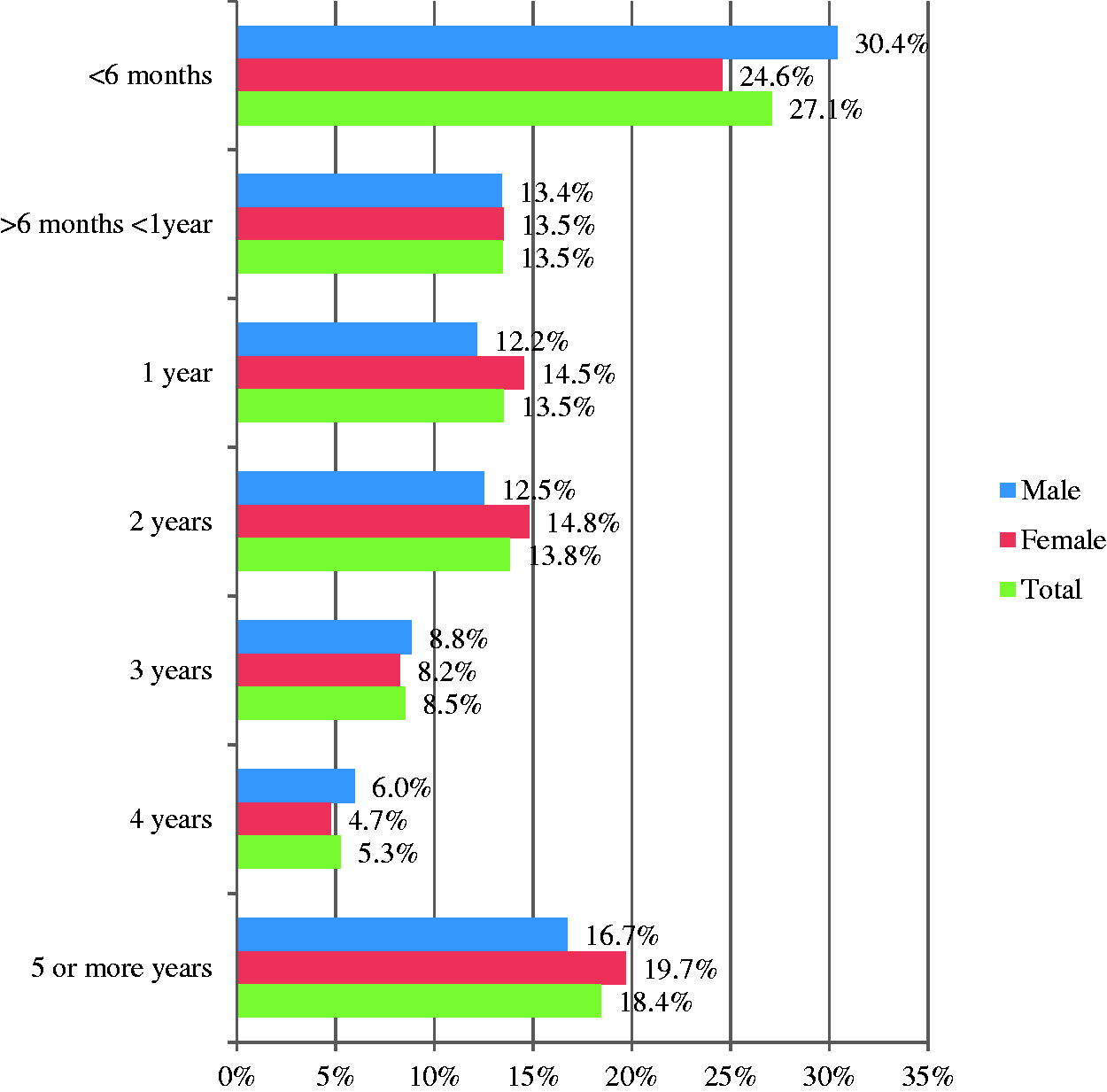
There is evidence that the notification of a right to convert to casual employment may increase the propensity of employees to make such requests, while increasing the likelihood that those who have not done so are content with their current arrangements as casuals. In the ACTU survey 19.8% of all casuals had made a request to convert. Of those who had not requested conversion, less than half (48.3%) indicated that this was because they were satisfied with their current arrangements. The remainder indicated that they were afraid to ask their employer because of job security concerns (10.0%), that they believed permanent status was not available (25.1%), that they were not convinced their employer would allow them to change (8.3%), or other reasons. Of the 27.0% of the total sample who had received notification, 40.3% had made a request to convert – roughly double the rate of all casuals in the survey. Those who had received notification were more likely not to have sought conversion because they were content with current arrangements (69.6%), and less likely not to have done so because of job security concerns (5.3%), not believing permanent status would be available (6.2%), or not believing that employers would allow them to convert (1.3%). This indicates that notification is likely to have the effect of increasing employees' knowledge of their rights, while also increasing employees' confidence in making such requests without the risk of negative consequences.
However, the requirement to notify may be insufficient to properly realise employee choice in their form of employment. Commentators and researchers have attributed the limited use of conversion clauses thus far to the lack of power perceived and experienced by casuals and difficulties associated with pursuing the conversion, including ‘employers’ discretion to refuse conversion, the rise of labour hire and the expense of taking Federal Court proceedings to secure employment’, as well as ‘the fact that so many low paid workers are in such fear of losing their jobs’ (Biddington et al., 2012: 33; also Owens, 2002). The ACTU survey figures indicate that between 13 and 43% of respondents (dependent on whether there is notification) who have not requested conversion to casual status have not done so because of reasons related to a perceived lack of power and/or fear of negative consequences. According to Owens (2002: 225), ‘The notion that a worker must “contract in” to enjoy the protections of the safety net, rather than gain its entitlements automatically as a matter of status, weakens the protection the law is supposed to offer to the most vulnerable’. This analysis supports the notion that ‘deeming’ clauses setting out a maximum period of casual employment would more clearly support employee choice in their conditions of employment. Hence the ACTU claim for including ‘deeming’ clauses in the five awards with existing conversion clauses.
The FWC (2017) ultimately accepted that there were a significant number of casual employees who had worked for their current employer over a long period of time with a reasonably regular work pattern and were dissatisfied with their casual employment status. It accepted the proposition that while many casuals freely choose casual employment, many others ‘may be said to acquiesce to the employer's designation of the employment as casual’. It thus concluded that ‘the permanent denial to the casual employee of the relevant NES entitlements at the election of the employer in those circumstances may … deprive the NES element of the safety net of its relevance and thereby give rise to its unfairness’ (FWC, 2017: 159).
However, the FWC determined that employers should have a greater right to refuse than proposed by the ACTU, and specified the criteria in such a way that conversions should not necessitate ‘significant adjustment’ to the ‘pattern of hours’ worked by the employee. The conversion rights granted thus differed in important respects from what the ACTU had proposed. Whilst the ACTU sought a right of an employee to ‘elect’ to have their employment converted to permanent status after 6 months (or for some awards to simply be ‘deemed’ to be in permanent employment after this period), the FWC granted the right to ‘request’ conversion, with the request allowed to be refused on a number of grounds. These include if conversion to permanent status would require a substantial adjustment to the employee's hours of work, or if it is reasonably foreseeable that the hours, nature or existence of the job would need to change. The FWC also increased the qualifying period to 12 months, to allow for seasonal work.
Conclusions
Casual employment has highly variable effects on workers. It seems to be a choice for a significant number of casuals who find benefits in terms of their own flexibility. However, a substantial proportion would prefer to be in permanent employment, or at the very least to have more hours and greater certainty over hours. Underemployment is also a problem for many casuals, who desire full-time work but are unable to find it. For these employees casual employment is not a choice, but a consequence of employer desires for numerical flexibility. Many such workers do not experience increased flexibility, and find that their casual status impedes their own flexibility. This is in addition to the low and variable incomes associated with casual employment.
The FWC's decision to expand minimum hours regulations to industries not previously covered by such provisions, and its acceptance of the principle that such minima are necessary to prevent deployment of labour in a manner which may be exploitative, is a modest but arguably important step in the direction of facilitating greater employee-oriented flexibility, certainty and security. In an interview following the decision, Associate Professor Jill Murray of LaTrobe University pointed out that this would set a principle preventing the use of ‘zero hours’ contracts and the division of daily work to a ‘really severe degree’ (Workplace Express, 2017c). However, the survey evidence evaluated here suggests that most part-time casual workers would prefer longer minimum hours. The notion that such an increase in minimum engagement would have substantial negative effects seems an empirical question requiring further investigation, and the area of minimum engagements remains an under-explored facet of employment regulation in the literature.
As ACTU secretary Sally McManus stated, the decision to include conversion provisions in most awards has plugged ‘one small hole’ in the job market (Workplace Express, 2017d). For many employees who are effectively ‘permanent’ workers in all but their employment contract and relative power, there is now a much clearer regulatory pathway for them to be able to convert their employment into a more secure form that enjoys the benefits of the NES. The effectiveness of this pathway will be determined in its implementation: in the determination on a case-by-case basis of which employees meet the criteria, in the extent to which employers resist compliance with the terms, and in the effectiveness of the recourse for employees unfairly and illegally denied their rights under the provisions.
However, there remain problems associated with long-term, involuntary casual employment, which this provision is ill equipped to resolve. The requirement that the general pattern of hours be maintained limits the potential to benefit underemployed workers, including in particular those whose work hours are provided on an irregular and intermittent basis. What labour market interventions may be needed to help these workers, who are arguably amongst the most insecure and precarious, remains to be seen. This case also highlights the difficulties of regulation of precarious work more generally, as the pre-eminence of the employment relationship upon which labour market regulation is mainly based continues to decline.
The case highlights long-standing issues about employer attempts to blur distinctions among employee choice, managerial prerogative and the avoidance of employment regulation. Employers have frequently couched arguments against regulation not in terms of profitability, but with respect to the asserted interests and preferences of employees. While many employees state that they prefer casual employment, it is not clear what aspects of casual employment facilitate this preference. The importance of the casual loading seems to have been exaggerated by employer witnesses – managerial prerogative and the desire for flexibility appear to be the two most important reasons for taking up casual employment. Whilst employers present the flexibility issue as a trade-off between protection and flexibility, a challenge for future policymakers will be to facilitate (especially employee-oriented) flexibility without excessively compromising workers’ rights, protections and job security. This may involve changes to both ‘casual’ and ‘permanent’ employment.
This also presents issues with respect to the ability of employers to unilaterally determine the nature of the employment relationship and systematically undermine and avoid protective employment regulation. This was a consistent theme not only of the Review discussed here, but of a recent report into Corporate Avoidance of the Fair Work Act by the Australian Senate's Education and Employment References Committee (Australian Senate, 2017). The Committee noted this in relation to not only casual work, but the use of labour hire, ‘sham contracting’ and the emerging ‘gig economy’. The Committee noted that it had ‘seen clear evidence of a system that has become unbalanced with substantial power vested in employers’, and made a number of broad recommendations with a view to ensuring that ‘all workers have the protections of the (Fair Work) Act and access to the labour standards, minimum wages and conditions established under the Act’ (Australian Senate, 2017: 113, xii). We have noted in this article a number of specific initiatives to address aspects of precarious work. These are innovative, but as with the casuals case examined here, they represent a piecemeal approach to the issue of precarity. As argued by Johnstone et al. (2012), a more wholesale rethinking of the legal regulation of work is required, including consideration of contract and property law, so as to address the fundamental disparity in power relationships that underlay precarious work arrangements.
Footnotes
Declaration of conflicting interests
The author(s) declared no potential conflicts of interest with respect to the research, authorship and/or publication of this article.
Funding
The author(s) received no financial support for the research, authorship and/or publication of this article.