




Abstract
Despite the vast amount of scholarship covering the progressive turn in unions in the US and in Europe and a widespread recognition that it has been driven by the staff working for reformed unions there has been no examination of the causes, beliefs, and identities that new generations of staff bring into the labor movement. The question asked in this article is how personal projects – defined as a motivational narrative for social action – held by progressively minded union staff can impact inclusiveness in unions. A key focus is how staff's personal projects interact with organizational structures and practices. The study finds that personal projects vary in terms of the way that staff construct role boundaries in their jobs to invest more in certain roles than, others which also affected their investment in skills development. These strategies have theoretical implications for understanding the nexus between staff careers and organizational outcomes in unions in particular and in ‘social movement organizations’ more generally. Results also have practical implications for skills development and knowledge transfers within and across organizations, as well as for union capacities to deal with competing goals.
Keywords
Unions in general, and American unions in particular, have not always been beacons of progressivism – many have historically focused on relatively narrow economic interests and job control (Barbash, 1984; Kochan et al., 1986; Perlman, 1966). Early commentators observed that the American labor movement ‘has never been profoundly ideological, nor has it provided a particularly easy entry to a political career’ (Bok and Dunlop, 1970: 55). But unions have once again become associated with social justice as recent efforts to revitalize have involved allying with community groups and anti-poverty organizations and incorporated social movement strategies (Clawson, 2003; Fantasia and Stepan-Norris, 2004; Fantasia and Voss, 2004). This has drawn into American unions, whose staff have historically been socially conservative and focused on ‘bread-and-butter’ issues (Barbash, 1967, 1984), new staff who associate union work fundamentally with social change and social justice (Fantasia and Voss, 2004; Rooks, 2004). Observations of the progressive reforms that have galvanized American unions have emphasized that professional staff in these unions led the radical innovations that have successfully revitalized these organizations and the labor movement (Fantasia and Voss, 2004; Milkman, 2004; Milkman and Voss, 2004; Rooks, 2004). Despite the vast amount of scholarship covering the progressive turn in unions in the US and in Europe (Clawson, 2003, Heery et al., 2003; Hyman, 2009) and a widespread recognition that it has been driven by the staff working for reformed unions (Bronfenbrenner and Hickey, 2004; Fantasia and Voss, 2004; Milkman, 2006a, 2006b; Milkman and Voss, 2004) there has been no examination of the causes, beliefs, and identities that new generations of staff bring into the labor movement. The employment relationship between unions and socially progressive staff has implications for the sustainability of union revitalization, as well as more broadly for understanding the relationship between organizations seeking to do social good and their employees.
The question asked in this article is how personal projects – defined as a motivational narrative for social action – held by progressively minded union staff can impact inclusiveness in unions. A key focus is how staff's personal projects interact with organizational structures and practices. The American labor movement's revitalization has been attributed by many scholars to some unions' abilities to recruit from outside the labor movement and especially from immigrant communities (Bunnage, 2014; Fantasia and Voss, 2004; Milkman, 2006a, 2006b; Rooks and Penney, 2016). Hence, examining the question of how unions can foster diversity of social activism is imperative. Yet, to date, scholarship on union revitalization has focused disproportionately on institutional revival (Gunawardana, 2011; Hurd et al., 2003) and union strategy (Clark, 2009; Frege and Kelly, 2004).
The Service Employees International Union (SEIU) offers an opportune context in which to study how personal projects brought into a union by staff interact with union practices. The SEIU is currently the second-largest union in the US, representing approximately two million workers. It has been one of only a few unions in recent decades to be credited with organizing immigrants and ensuring that minorities are represented in the ranks of the union (Bronfenbrenner et al., 1998; Getman, 2010; Kelley, 1997; Mort, 1998; Yates, 1998). The union has been known for recruiting outsiders into its ranks (Ganz et al., 2004; Shaw, 2010), establishing linkages with activist groups on college campuses in the past two decades (Rooks, 2004; Van Dyke et al., 2007), and incubating innovative projects based on staff ideas (Yu, 2008). The SEIU has been credited for leading the movement for unions to transition to a more militant organizing strategy (Frege and Kelly, 2004). When the national union federation, the AFL-CIO, was reticent to do so, the SEIU led seven unions into a new federation: the Change to Win (Fletcher and Gapasin, 2008). Innovative organizing has engendered a doubling of SEIU's membership in the 10 years before 2008, while other unions experienced membership decline (Milkman, 2006a, 2006b). The SEIU has also expanded the role of unions outside the workplace and in the areas of politics and policy, influencing state and national elections as well as regulatory change through such initiatives as the $15 minimum wage campaign (Rolf, 2016; Stern, 2016). Staff working for the SEIU have inspired new sociological categorizations (Fantasia and Voss, 2004) and have been noted for being creative, ‘most acclaimed’ (Yeselson, 2017), and ‘genius’ (Fantasia and Voss, 2004).
Simultaneously, the union has been criticized for being single-mindedly focused on its vision of growth at the expense of internal democracy (Erem, 2001; Moody, 2007), and for relying on paid staff to build the movement (Early, 2009; Erem, 2001; McAlevey, 2012, 2016). Recent conflicts, such as desertion among Change to Win unions and internal battles with local unions seeking to break away from the union, have been attributed to the SEIU's arrogance (Early, 2009; Yeselson, 2017) and lack of tolerance for dissent (Early, 2009; Tait, 2005). These criticisms indicate that the SEIU embodies the complex challenges faced by unions that seek revitalization in an increasingly hostile environment (Clawson, 2003; Fairbrother and Yates, 2003; Frege and Kelly, 2004). By examining the plurality of personal projects brought into the SEIU by staff, this study aims to contribute to a deeper understanding of how unions successfully negotiate conflicting goals, such as member representation versus external organizing, as well as democracy as an ideal versus market power.
In the rest of the article, I present data collected from interviews with staff in the building services division of the SEIU, focusing on the origins of personal projects brought in by staff and the implications that harboring different projects has for how staff respond to union practices. I show that different personal projects impacted staff's selection of roles, modes of skills development, and career progression in the union. I discuss the implication of different personal projects for revitalization through inclusive unionism.
Inclusive unionism and the SEIU
Extant theories on union revitalization have focused on strategies for revitalization – including strategies that foster member participation (Clark, 1992), membership growth (Bronfenbrenner et al., 1998), political power building, restructuring, and international solidarity (Frege and Kelly, 2004) – with little regard to whether these strategies result in inclusion or exclusion. Although recent work on unions' adoption of social identity claims (Yu, 2012), representative unionism (Bronfenbrenner and Warren, 2007) and grassroots union leadership (McAlevey, 2016) has touched on similar themes, inclusiveness has not been explicitly addressed in the revitalization literature.
Inclusiveness (Boehm et al., 2013; Härtel et al., 2013; Nishii, 2013) reflects the realization that diversity itself does not necessarily lead to positive outcomes unless it is combined with organizational practices that enable people of diverse backgrounds to collaborate effectively. Within the diversity management literature, inclusiveness in organizations is fostered when organizational practices enhance learning and integration among socially different groups, as opposed to practices that foster competition, reproduce status and power differences, or unilaterally favor historically disadvantageous groups (Nishii, 2013). Drawing on this literature, I define inclusive unionism as a model of unionism that is open to integrating women, racial and ethnic minorities, immigrants, and sexual minorities into the union's organizational realm through organizational practices. As pointed out earlier, the theoretical model of American unions has hinged on ‘bread and butter’ unionism. While immigrants and racial and ethnic minorities have played an important role in the history of unionization, unions in the US have generally shunned ideology, and economic issues, not social problems, have been accorded priority (Barbash, 1967, 1984; Buhle, 1999; Perlman, 1966). Empirical studies have documented racial and gender exclusivity in most craft unions affiliated with the AFL as well as key unions in manufacturing such as the UAW and the Steel Workers Union (Needleman, 2003; Stepan-Norris and Zeitlin, 2003). The relative lack of attention to inclusiveness in American unions in current scholarly debates is concerning, especially in light of studies that suggest that inclusiveness has been a significant factor in union revitalization. For example, Lichtenstein (2002) argued that historically US labor was in a position of strength when it was inclusive and affirmed racial and ethnic pluralism than when it did not. Fantasia and Stepan-Norris (2004) made a similar argument, connecting waves of progressivism in the US labor movement to increased inclusiveness. The current juncture, where by one count 37% of union households and the majority of White working-class voters cast the vote for Trump in the 2016 elections (Bruno, 2017; Klein, 2017), motivates an examination of ways in which inclusive unionism can be achieved despite external and internal pressures against inclusion. A further motivation is that unions remain, despite recent declines in union density, the largest organizations of women and color. Membership of racial and ethnic minorities and women in unions is larger than membership in NOW, La Raza, NAACP and LULAC combined (Bronfenbrenner and Warren, 2007). Hence, what unions do (or not) to integrate women and minority workers into their fold impacts hundreds of thousands of individuals.
While there has been a long-standing distinction in the labor literature between economic and social unionism as models of unionism (Fantasia and Stepan-Norris, 2004; Fantasia and Voss, 2004; Perlman, 1966; Piore and Safford, 2006), there is a need to move beyond abstract conceptualizations to examine key dimensions of inclusiveness empirically. This article does so by investigating how diverse ideational projects carried into the union by staff interact with union practices. As Hyman (1979) and others (e.g. Carter et al., 2012) have argued, staff, their behaviors, and the social relationships they forge are crucial factors in determining whether unions are bureaucratic oligarchies removed from the daily lives of members (Michels, 1911/1959) or whether they are vehicles to activism and democracy. Hyman (1979: 62) pointed out that given the need for unions to build economic power in expanding markets and to understand employer preferences, activism and democracy in unions are ideals that are always achieved ‘against the odds’ due to the efforts of union officials.
Both the proportion of staff relative to members in unions and the recruitment of ‘outsiders’ into the labor movement have increased in recent decades (Clark, 1992; Fantasia and Voss, 2004). John Sweeney, formerly of the SEIU, drafted many reformists whose views were shaped by the civil rights movement into the labor movement during his presidency of the AFL-CIO (Aronowitz, 1998; Mort, 1998; Piore, 1994; Tillman and Cummings, 1999). Fantasia and Voss (2004) argued that these staff represented a new type of unionists that they labeled militants, distinguishing them from previous templates, namely bureaucrats, who managed the workforce for employers, and strongmen, who built personal empires (Fantasia and Voss, 2004: 116–117). It was noted that many militants worked for a single union, the SEIU (Fantasia and Voss, 2004). Studies have shown that staff entering unions from different social movements have invigorated unions (Foerster, 2003; Ganz, 2000; Martin, 2007; Rooks and Penney, 2016) with ‘strategic vision and militant sensibilities’ (Bunnage, 2014: 72). Yet unions on the whole have been known as ‘greedy institutions’ (Franzway, 2000) that often neglect the high workload and emotional toll that staff undergo (Erem, 2001; McAlevey, 2012; Rooks, 2004) and provide little to no formal training and mentoring, resulting in high staff turnover and disenchantment (Rooks, 2004). Hence, despite the central importance placed on progressive staff as the drivers of ‘social movement unionism’ (Johnston, 1994), we know surprisingly little about staff and their actions and aspirations.
Personal projects and value-driven careers
To understand the motivations and guiding principles of staff who think of union jobs as conduits for social causes, I draw and build on the literature on meaningful careers. Social identities and ‘core’ values have been shown to matter for how a person interprets the rewards and challenges of one's career (Baker and Aldrich, 1996; Mische, 2003). Personal sources of continuity in careers also include a ‘core identity’ (Hall, 1971, 1986) that represents a motivational narrative guiding one's career trajectory and provides the tenet for determining authenticity (Ibarra, 1999; Ibarra and Barbulescu, 2010). Drawing on the concept of core identities as career anchors, I define a personal project as a motivational narrative for social action (Emirbayer and Mische, 1998; Mische, 2003) that guides an individual's career. In theories of agency, one's project is one's account of where one wants to go, why, and how (Ibarra and Barbulescu, 2010).
The choices of those who pursue personal projects at work have important effects on job design and commitment, as well as on the employment relationship. Research on employees harboring personal causes has shown that they select workplaces based on whether they can be effective vehicles for realizing their mission (Cardador et al., 2011). Moreover, these individuals engage in proactive behaviors to make their work more meaningful. For example, they may select lines of work that facilitate their cause (Dik and Duffy, 2009) and alter the design of their work in order to expand tasks and relationships supporting their cause (Wrzesniewski and Dutton, 2001). Followers of a cause sacrifice themselves in the pursuit of their duties, sometimes foregoing higher pay and better job opportunities, or volunteering for difficult and dangerous tasks (Bunderson and Thompson, 2009; Serow, 1994). Those who are following a cause may also demand more from their employers and peers and hold them up to higher standards (Bunderson and Thompson, 2009; Cardador et al., 2011; Thompson and Bunderson, 2003). In an employment relationship, these individuals may remind their organization of its own commitment to social causes, intervene to steer organizational attention to these matters, and protest when an organization's commitment to the cause is breached (Thompson and Bunderson, 2003). Scholars have argued that employees harboring personal commitments to a cause are likely to exercise voice rather than exit when personal causes come into conflict with organizational goals, seeking to change the organization through ‘principled dissent’ (Bunderson and Thompson, 2009; Graham and Organ, 1993). However, exit is also a possibility when personal projects can no longer be reconciled with organizational practices. For example, Ganz et al. (2004) demonstrated that labor leaders in California who held personal projects for social reform left their unions when their union jobs no longer allowed them to pursue social change. Importantly, personal projects interact with organizational and institutional settings (Barley, 1989; Gunz and Jalland, 2000). Hence, examining the conditions under which personal projects are nurtured and protected inside unions and how they interact with organizational role structures and cultures is called for. To address this question, I examine how personal projects impact role and task selection as well as staff approaches to voice and exit (Hirschman, 1970). Finally, this study asks what unions can do to integrate personal projects into union strategy and practice.
Methods
Building services and the justice for janitors in the SEIU
Since the 1980s, the SEIU's property services unit, which serves 250,000 workers, has maintained a high profile among activists seeking a career in social justice through the success of its organizing campaigns for office janitors – ‘Justice for Janitors’ (JfJ) – and security guards (Erickson et al., 2002; Fantasia and Voss, 2004). The JfJ campaign is an opportune context in which to examine staff personal projects as the success of the campaign in more than two dozen cities over two decades in improving the lives of some of the most disadvantaged workers drew into it a large number of committed staff from diverse backgrounds. Even within the SEIU, the JfJ stands out for having brought into the union staff and members from a variety of ethnic, racial, and social backgrounds. Many studies have pointed to this campaign as the epitome of activist unionism (Clawson, 2003; Fantasia and Stepan-Norris, 2004; Fantasia and Voss, 2004; Milkman, 2006a, 2006b). The JfJ originated from experimental organizing that SEIU staff conducted in the 1980s to address rapid decline in unionization in the office cleaning sector prompted by the contracting out of cleaning services (Erickson et al., 2002; Milkman, 2006a, 2006b). As a result of deterioration in working conditions, a workforce that was once predominantly African-American was replaced with an immigrant workforce, many of whom were undocumented (Milkman, 2006a, 2006b). The campaign espoused several ingenious innovations designed to circumvent difficulties in traditional NLRB workplace elections, including market research that identified employer vulnerabilities, union recognition by card check, and public relations campaigns against building owners (Chun, 2005; Erickson et al., 2002).
Within the union, staff fulfilled roles that were distinguished by key tasks – organizing and servicing members, research, external outreach, and managing staff and organizational resources. Organizers mobilized members and non-members, conducted market research, and built and maintained relationships needed to demonstrate workers' support for unionization in new markets. Organizing typically involved building a coalition with community-based groups that helped instill workers' trust in the SEIU and put moral pressure on employers (Erickson et al., 2002). Service representatives were responsible for building activism and leadership among union members, representing members in grievance procedures, and bargaining labor contracts with employers. Both organizers and service representatives were promoted into manager positions. Managers in the union had reporting as well as hiring and firing responsibilities for subordinate staff. A small branch office typically had a small number of organizers, service representatives, and managers. Researchers and external outreach officers were only present in large branches or in regional offices. While the JfJ arose as a product of specific circumstances in the industry, the increase in staff mobility between unions and other social movements confers theoretical validity to the questions asked in this study beyond the immediate environment that instigated this campaign.
Sample and data collection
Interviewee characteristics.
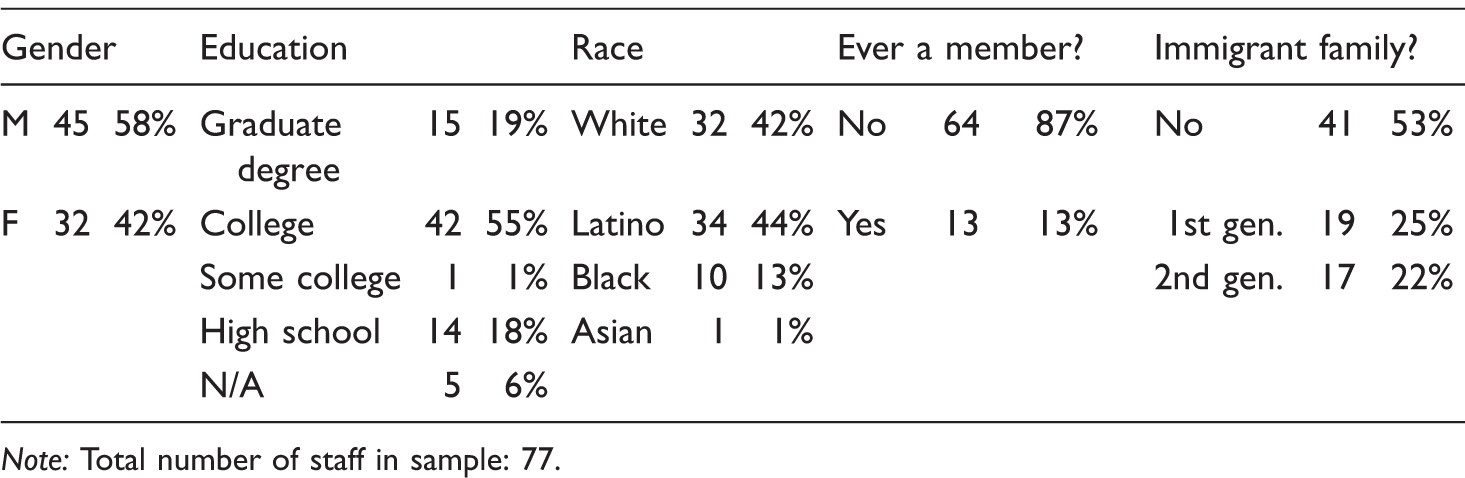
Note: Total number of staff in sample: 77.
Each interview lasted approximately 1 to 2 hours. Interviews obtained biographic and work histories, and inquired about reasons for choosing to work with, and in some cases, leave the SEIU. Particular attention was placed on gathering interviewees' accounts of what working for the union meant for them personally, the importance they placed on different tasks, and interviewee attitudes towards their roles. Interviewees were also asked about their reactions to union policy and practices. Interviews were recorded and transcribed. Field notes were also transcribed, usually during the same day and always within two days. Interviews and observation notes were coded using Atlas-ti, a qualitative data analysis software.
Analysis
Data analysis was conducted in stages. At a preliminary stage, I determined that most but not all staff interviewed (71 out of 77) could be discerned as pursuing personal projects, defined as perceiving work as a moral duty in the advancement of a social cause (Bunderson and Thompson, 2009; Elangovan et al., 2010). Interviewees’ accounts of why they chose to work for a union, career goals, and answers to questions such as ‘What is the best thing about your job?’ were taken as indications of personal projects. For the remaining six individuals, work was mostly a means of self-advancement and/or a source of financial reward (Wrzesniewski et al., 1997). Therefore, given the research question examined here, further analysis was limited to a theoretical sample (Strauss and Corbin, 1990: 176) consisting of the 71 staff members who had personal projects in the union.
An early motivation for examining personal projects was provided by a ‘native’ (Van Maanen, 1988), in this case a high-level union executive, who explained that staff in the union distinguished between ‘Popes’ - those who built the union, for example by becoming branch presidents, and ‘missionaries,’ – those who ‘wake up every day and worry about building a movement’. These tips from informants in the field (Van Maanen, 1988) were used as initial indicators of personal projects. A first-order coding (Strauss and Corbin, 1990) was performed to identify the types of causes that respondents explained motivated their work as well as the core identities (Hall, 1986) they described as defining their selfhood. Second-order coding (Strauss and Corbin, 1990) then aggregated and abstracted away from first-order coding to identify theoretical constructs that specified the properties of personal projects more generally, resulting in the final categories of personal projects, Movement Building, Institution Building, and Social Activism. Using these categories, it was determined that 26 staff members were primarily drawing on the Movement Building project at the time of this study, 22 drew predominantly from the Institution Building project: and 17 drew mainly on a Social Activism project. I also coded the types of actions staff undertook to ‘design the job’ (Wrzesniewski and Dutton, 2001) in order to fulfill their personal projects. Examples of codes identified in this stage include ‘select roles involving direct mobilization’ and ‘mediate conflict’. The most salient grouping of codes was around how staff selected roles and modified them to enable their personal projects; of these codes, ‘role separation’, ‘role integration’, and ‘sojourning’ were each associated with movement building, institution building, and social activism, respectively.
A second step in data analysis coded the data for the types of skills that staff following different personal projects believed were important, and whether these skills were specific to work in the SEIU. Subsequently, I focused on the relationship between the personal projects identified and specific actions taken with regard to organizational practices that highlighted the tension between different goals in the union and were seen as potential challenges to inclusiveness. This analysis identified key differences between how Movement Builders, Institution Builders, and Social Activists dealt with tensions between idealism and union practice.
Findings
Origins of personal projects
The roots of personal projects brought into the union by staff typically lay in their biographies, whether growing up as a child of undocumented immigrant workers or becoming radicalized through Teach for America. For many staff, identification with economic hardship and lack of social mobility was based on direct experience, not least for the 36 interviews who came from immigrant families. For example, a service representative whose parents were Mexican immigrants described an intimate knowledge of poverty as the reason for working for the labor movement: We didn't have vacations. We had a pair of new shoes in a year. It's not like we were unhappy. That leads to why now I've chosen to do this type of work. Just because I know what people go through. We never had any medical insurance, any dental insurance, none of that. It was like, go off to TJ [Tijuana, a Mexican border town] and go see a doctor if it was really getting that bad. Other than that there was home remedies, and hope for the best.
Union work had deep personal meaning for staff who saw their own kin in the low-wage workers movement. Paradoxically, staff were passionate about their work with the union because they did not think of their work as ‘working for a union’: I go down to the field and see the workers and see them obtain their benefits, so rewarding. Because I see them and I see my parents. I don't think I'm working for a union. When I go out there and I see the workers it could be my Aunt or my Mom, their livelihood.
Movement builders
A subset of respondents could be distinguished for their zeal in developing the labor movement over commitments to other social causes. They explained their rationale for having joined the JfJ primarily in terms of improving workers’ lives by protecting their right to decent conditions and voice at work. Movement Builders were attracted to the JfJ for its ‘state of the art’ and ‘cutting edge’ strategies; they believed it represented hope in an otherwise bleak labor movement.
Movement Builders separated out roles and tasks that directly related to developing the labor movement – such as mobilizing non-union workers, building activism among union members, and organizing protests – from all other work, and focused on the former. Although organizing roles in the union provided more opportunity for these tasks, several service representatives were also following the movement building project. These staff engaged in a highly nuanced classification of roles in the union in order to focus on those that directly benefited the low-wage workers’ movement. For example, within organizing, adopters of this personal project further distinguished between organizing that benefited low-wage workers and organizing that did not. They opted to stay out of what they called ‘elitist organizing’: The only thing I didn't do was health care but I really didn't want to do healthcare. Based on what I had heard, health care was sort of the prestige organizing, and generally, again, it was local white organizers. They considered it professional organizing [… Only selected people were put in this team, so they were kind of elitist]. To me, I can say do I spend a lot of time and energy getting people to attend meetings versus attend rallies, where's my emphasis going to be? I do, I mean, we do mailings here to get people to come out to the meetings, but the important thing is we need people to come out to go attack this building owner that just cut us. I have to say that the more I worked around the JfJ the more I wanted to work on the JfJ and that's really not the same as saying that I want to work on external organizing. It's just that I wanted to work with that program. I think this is the job for me; I never want to leave. This job kicks my ass every day, I learn something new I push myself and grow and learn. The industry changes so quickly that you can't stay still.
Institution builders
For a second group of staff, it was important that organizing campaigns resulted in a community that workers could thrive in, where members came together socially as well as in solidarity for the next fight and where they developed into the next generation of union leaders. This group of staff, which I labeled Institution Builders, strived to build a union that could be a vehicle for such a workers' community. Institution Builders embraced the diversity of roles in the union, and did not confine themselves to roles directly related to mobilization. Hence an implication of this personal project was role integration, the analytical opposition of role separation. Whereas Movement Builders were disinterested in union administration, staff employing an integrative approach saw management roles as necessary for protecting idealism. Where managing the union came into conflict with serving union members or developing the movement, these staff tried to resolve the conflict in the best interest of those involved but were mindful of preserving the union as an institution.
Those who adopted the institution building project typically came to recognize its value through personal and professional learning experiences. For example, Nadia came to realize the downsides of constant organizing while she was assigned as an organizer in the Washington DC JfJ campaign, one of the fiercest battlegrounds in the campaign's history. Crews of organizers swept through the city in wave after wave of the campaign, and she came to believe in the need for a stable organization: ‘The national staff were always in and out. But once the workers became members, it became more difficult since they wanted to be part of the local [union].' She took a leadership position in the fledgling local union that emerged from the campaign and garnered respect as an institution builder. Around this time, she married a fellow activist in the union and started a family, which restricted the couple's mobility. In recognition of her expertise in union management, she was promoted to incrementally higher positions in the union's East Coast operations.
In contrast to Movement Builders, who eschewed the union bureaucracy, Institution Builders recognized potential advantages (as well as weaknesses) of the central union bureaucracy. The general sentiment was expressed by one local union administrator, who justified tolerating bureaucracy and hierarchy for the power that an efficient organization bestowed: […] the reality is that it also helps us organize faster, win more and win better rates and benefits for our members. We have trade-offs. For one, we're a bureaucracy so when you want to get something done out of [recently merged local] it's very difficult, it's plodding, it's like moving a giant ship, a cruise liner or whatever. It takes a long time to move that sucker. But once you move it then it goes; it's like a tank – just plow the water and it's very powerful. It's a constant tension because there is no other source of money for organizing than the members [membership fees]. But members want service, it's inescapable. But at the same time there is an ethos and culture in the union that the union is all about improving the lives of members. Underlying this culture is an assumption that members don't care about the process by which that happens. But in [this city], it turns out that that doesn't always hold true.
The institution building project called for difficult decisions that required balancing principles of union democracy with the union's central agenda. An example of such situations was local branch elections where union members ran against candidates favored by the central SEIU office. The SEIU aggressively campaigned against what it characterized as dissident member groups, inviting criticism that the union did not respect internal democracy. Institution Builders defended union actions based on their knowledge of the situation: It wasn't a case of the big bad union squashing workers' democratic movement. Journalists who say that are writing out of their politics. They don't know that the opposition group was only supported by a minority [of union members]. All in the eighties [a Midwest local union] started unraveling and no one wanted to draw a line in the sand and they just started letting the contracts go and didn't enforce anything. I went up there, I'm not claiming that I discovered it, but I'm the one who started yelling at it, and raising the issue that it went f___ing part time.
Social activists
As mentioned previously, the JfJ attracted a disproportionate number of staff from outside the labor movement, including those with backgrounds in community activism, electoral politics, or the immigrant rights movement. These staff, whom I have labeled Social Activists, typically harbored a broader perspective towards the JfJ and the labor movement, seeing them as vehicles for not only workers' empowerment, but also for changing societal power structures as well as policy and regulation. They regarded their stay in SEIU as a sojourn and placed effectuating social change well above serving organizations.
Similar to Movement Builders, Social Activists were uninterested in upward mobility within the SEIU. However, while Movement Builders showed a high level of commitment towards the SEIU, Social Activists were not a priori convinced that the SEIU was uniquely effective and never quite assimilated into the strong culture of the SEIU. Social Activists cross-fertilized union practices with knowledge and experience from other fields and organizations. As indicated by the statement ‘I could see myself working here for a while’ in the quote below, Activists typically saw their stay in one organization as temporary, bracketed by the skills and insight it allowed them to gain and the impact they were able to have: Before I started working with labor directly I had a lot of experience with labor through coalition and alliance work so I already had a sense of the terminology, how processes work and all of that. […] For me, I'm just a bit different cuz I'm involved in more than the janitors campaign and I can see this spiralling into so many things, not just the end of this campaign which hopefully will be over in the next couple of months. I could see myself working here for a while. (emphasis added) I think that people who get the opportunity to move between those different worlds [labor and electoral politics] are really bridge builders. Additionally, I think you can contribute a lot to whatever place you're in when you've had the experience in those other spheres of social economic justice work and so that's what I've been wanting to do.
Switches and exits
Although the personal projects described were relatively stable in predicting role selection and associated behaviors, some staff had changed projects during their stay at the SEIU and others had left the organization. Changing projects was associated with life cycle and career considerations, as well as realization of the negative effects of constant mobilizing, such as burnout and staff turnover. I identified eight instances of ‘switches’ in personal projects. All instances pertained to those who had previously adopted a Movement Builder project changing to that of Institution Builder, suggesting that Social Activism as a personal project embodied a distinctive category.
The movement building project – which focused on front-line mobilizing roles in the union – proved hard to sustain for many people. Organizers in particular tended to throw themselves into their roles, sacrificing sleep, personal life, and health, which is consistent with predictions of personal sacrifice in workers following a calling (Bunderson and Thompson, 2009). Organizing required moving from one campaign location to another in highly uncertain and stressful circumstances, often resulting in burnout (Bunnage, 2014; Erem, 2001; Rooks, 2004). Burned-out Movement Builders usually left the union to re-chart their career. As one switcher pointed out, ‘Organizers are very young for the most part and it's just that not many people can make a career out of it’.
While Movement Builders usually complied with normative pressures to sacrifice personal lives for the movement, costs to family and dependants were cited as reasons for reconsidering their choices. Wary of constant relocation to the next ‘frontier’ of the movement, staff with family-based constraints, such as parents who wanted stability for growing children, sought out ‘desk’ jobs. Furthermore, as in Nadia's case, staff who started out as organizers in a particular location became invested in building the local SEIU branch and sometimes transitioned to managerial positions in the branch. For these staff, the reasons for changing their personal project were associated with wanting to institutionalize the movement after having built power through growth.
Personal projects interacted with organizational practice in consequential ways, explaining why and how some staff opted to stay with the SEIU while some decided to leave. As previously discussed, the SEIU's strategies for rapid expansion and its preference for centralized command and standardized operations generated tensions with union members who desired better representation as well as with some members of staff (Voss and Sherman, 2000: 340; Yu, 2008). I identified three areas of union practice where conflicting goals came head-to-head, highlighting the need to reconcile the ideals of inclusiveness with building power across geographic markets. The first of these concerned inter-organizational collaboration. Especially for Social Activists, the union's instrumental treatment of smaller organizations in the movement was seen as problematic. Centralization of organizational structures also challenged staff who believed in grassroots union democracy. To complement ‘strategic organizing’, which the union defined as rapid industry-wide mobilization in markets selected for mobilization potential, the union proposed merging smaller local unions into ‘mega’ locals that could wield greater power in negotiations with employers (SEIU Organizing Department Collection, 1986–1992). Staff who prioritized workers’ participation in union democracy as much as their economic empowerment viewed these moves as diminishing worker voice in a union increasingly led by outside professionals (Erem, 2001; McAlevey, 2016). Finally, organizing practices provided another point of tension. The need to rapidly expand the movement instigated standardized processes driven by ‘how-to' manuals developed by researchers at the national union that left little room for engaging local workers and their communities, and sometimes even local staff. Some staff protested that ‘heart’ and ‘passion’ were no longer part of the way the SEIU operated: You can take the campaign plan and try to implement it, but without genuine interest of the community or people who believe in it and who believe it'll make a difference in the community, without the heart and the passion, then there's a big missing component of it.
Discussion
This article has examined how union staff come to harbor different personal projects for social change and how these projects interact with organizational practice in unions. It has found that personal projects vary in terms of the way that staff construct role boundaries in their jobs to invest more in certain roles than in others, which also affected their investment in skills development. These strategies have theoretical implications for understanding the nexus between staff careers and organizational outcomes in unions in particular and in ‘social movement organizations’ (McCarthy and Zald, 1977) more generally. Results also have practical implications for how unions can motivate and retain progressive staff and how they might deal with multiple and competing goals.
As seen in this study, ‘core identities’ (Hall, 1986) influence the types of personal projects that staff brought into unions and shape one's outlook on the labor movement. I have shown how senses of injustice formed early in life inspired movement building projects, and epiphanies about the need to build community-motivated institution building projects, while one's background in non-labor social movements explained broader social activism projects. Importantly, and reflecting the background of many of the staff in my sample (see Table 1), cutting across these different types of personal projects was the unequivocal imprint of the immigrant experience that increasingly shapes second generation immigrants’ motivations for dedicating themselves to campaigns such as the JfJ (Piore, 1979).
Not only do staff strategies have career implications for the individual, they matter for skills development and knowledge transfers within and across organizations as well as for union capacities to deal with competing goals (Hyman, 1979; Milkman, 2006a, 2006b). Given Movement Builders’ exclusive focus on roles that have immediate relevance to personal projects, those following this strategy are likely to invest in organization-specific skills. Hence, the movement building project lends itself to knowledge accumulation over time in a focused area of expertise in one organization. On the other hand, the institution building project lends itself to skills in conflict resolution and reconciling organizational goals with social causes. Like tempered radicals, whom Meyerson and Scully (1995) described as employees who sought to introduce opportunities for enacting social justice in their workplace, these employees seek to integrate ideological progressivism with economic rationality. Institutional Builders thus transfer knowledge within the organizational hierarchy, promoting understanding across levels. Finally, Social Activists are likely to value learning that can be applied across multiple organizations in service of social change; therefore, as seen here, Social Activists are likely to invest in developing general and portable skills in lieu of organization-specific skills. Those workers who exit the organization due to ideological conflict may broker and disseminate knowledge and practices across a variety of organizations, thereby contributing to field-level innovation (Hargadon and Sutton, 1997). These individuals may function as ‘gurus’, translating protocols and practices across different domains and legitimating them (Suddaby and Greenwood, 2001: 938).
The skill that these staff bring to the union and their dedication to fostering diversity in the union suggest that the ability to recruit and retain staff with personal projects is a key to inclusive unionism. By virtue of having recruited these staff into the union, the SEIU has gone farther than most unions in adopting inclusiveness. However, current findings also suggest further steps that could be taken towards deepening inclusiveness and dealing with ongoing challenges to it. Below I discuss implications of the current study for union strategies to enhance inclusiveness (Boehm et al., 2013; Nishii, 2013), focusing on two aspects: fostering learning from diversity and integrating personal projects into union practice.
Given the diversity in backgrounds and values as well as skills represented across the three types of personal projects studied here, inclusive unions may face a challenge in ensuring that diversity leads to enhanced mutual learning rather than increased conflict (Ely and Thomas, 2001; Nishii, 2013). One implication rising from the current findings is that learning may be induced in unions not only when personal projects are matched to appropriate union roles, but also when persons holding diverse personal projects work together in an environment supportive of diversity. Thus, one can expect synergies in bringing together the perspective and skills of a person experienced in building the union movement with those of an Institution Builder who would build a community out of the movement and those of a Social Activist who would connect the union campaign with other social movements and communities. Findings suggest that bringing together and fostering learning among individuals following different personal projects may help unions to reconcile the competing goals of organizing versus representation and idealism versus economic rationality (Hyman, 1979; Milkman, 2006a, 2006b) and thereby increase the chances for union revitalization (Bunnage, 2014). As commentators have pointed out, traditional face-to-face organizing is becoming increasingly unrealistic in today's era of fragmented workplaces and part-time jobs (Ferguson, 2008; Yeselson, 2017), whereas petition-based movements such as the recent campaign to achieve a $15 minimum wage are equally limited in achieving worker empowerment (Rolf, 2016). Pluralistic unionism, such as the model that the SEIU aspires to, represents a realistic medium.
The SEIU, and other unions, could do more to integrate personal projects into union practice. Findings suggest that even in an innovative union such as the SEIU (Piore, 1994), staff struggle with a high workload as well as the emotional strains of constant organizing (Bunnage, 2014; Erem, 2001; Rooks, 2004). Moreover, relatively few opportunities exist for development and training that would help staff resolve conflict arising from reconciling different goals in the union. This confirms that the ‘sink or swim approach’ that Eaton (1995) found in unions two decades ago still applies to some roles in the union. The tensions that staff were managing on a daily basis, with little guidance or recognition, originated from the relatively top-down and centralized approaches that the SEIU has been criticized for (Clawson, 2003; Early, 2009: 229–230; Moody, 2007). Instead of understanding and addressing the concerns of Social Activists who left the union, it was more common to see them referred to as ‘deserters’. Explicitly articulating the work needed to balance growth with internal democracy and empowering the staff doing that work with resources and processes may be steps that unions can take towards inclusiveness.
Although scholarly commentaries referred to the important role played by union staff in the resurgence of ‘social movement unionism’ in the US (e.g. Fantasia and Voss, 2004), we lacked a detailed analysis of the motivations and actions of union staff in reformed unions. This study has argued that staff and their commitment to social change are crucial to building inclusive unionism. Supporting staff in their personal projects would include designing organizational practices and cultures to embrace and allow for core identities of staff from diverse backgrounds to be integrated into union practices. It would also entail promoting an understanding of different staff motivations for skills development in the union as discussed, and facilitating knowledge transfers within the union and with other organizations.
Footnotes
Declaration of conflicting interests
The author(s) declared no potential conflicts of interest with respect to the research, authorship, and/or publication of this article.
Funding
The author(s) received no financial support for the research, authorship, and/or publication of this article.