



Abstract
There has been considerable research and policy debate over the enforcement and decriminalization of occupational health and safety legislation, particularly regarding its capacity to deal with serious harm. Reference has been made to community attitudes to work fatalities, but the perspectives of those most directly affected, the bereaved families, have received little attention. Drawing on evidence from detailed interviews with 44 Australian family members, this article seeks to rectify this omission. Findings highlight the importance of investigative and prosecutorial processes to bereaved families who seek justice, some assurance that culpable behaviours are not condoned, and the implementation of measures to prevent a recurrence. However, reinforcing previous research critical of the degree of enforcement and advocating for a more readily implementable offence of industrial manslaughter, the vast majority of those interviewed were critical of the processes that occurred. Far from assisting, these processes generally left families very dissatisfied with their experiences.
Keywords
Introduction
On 17 January 2014, 55-year-old miner Michael Welsh was asphyxiated by a sudden inrush of mud while operating a front-end loader at the Mount Lyell mine of Copper Mines of Tasmania (CMT) on the Tasmanian west coast. A month prior to the incident, two other miners, Craig Gleeson, 45, and Alistair Lucas, 25, fell to their deaths at the same mine when a platform they were working on collapsed. CMT pleaded guilty to failing to maintain a safe workplace in relation to the December 2013 deaths and was fined $225,000 in December 2016. Alastair's father expressed disappointment, believing the mine should have been fined $1.5 million – the maximum fine under the legislation (ABC News, 2016). In relation to Michael Welsh's death, CMT pleaded not guilty.
At the committal proceedings before the Burnie Magistrates Court in north-west Tasmania, the mine's legal counsel mounted several arguments directed at the Director of Public Prosecutions’ (DPP) key witness, an experienced Tasmania-based consulting mining engineer. These arguments included that the engineer had an inappropriately close professional relationship to the Chief Inspector of Mines (Tasmania has a small mining community) and, more pivotally, lacked the specialist technical knowledge to provide the expert evidence critical to determining the case. The latter argument was accepted by the presiding Magistrate, at which point the DPP abandoned the prosecution. Michael Welsh's family had sat in court through days of committal proceedings, hoping to learn how and why he had died, and his wife Sandra told the media outside that she was ‘devastated’ by the decision (ABC News, 2017). Mr Welsh's death will be the subject of a coronial inquest, which may answer some of the family's questions, if not appease their anger and grief.
With regard to work-related fatalities, the events above are by no means rare. For each affected family the tragedy is personal and, as available evidence indicates, the economic, emotional/psychological and social consequences are profound (Matthews et al., 2012a, 2012b). While there has been considerable debate and research regarding the enforcement of occupational health and safety (OHS) legislation, especially in relation to serious breaches resulting in severe injury and death, there has been little research into how these legal processes are perceived by or impact affected families. Unlike crimes of violence or road-related fatalities, work-related death more typically involves a large power imbalance between the perpetrator and the victim and raises wider questions around the work practices of (often large) employers or others in control of workplaces. When these crimes are committed by corporations, further questions can emerge about whether governments are doing enough to prevent, investigate and punish breaches of human rights, including the right to healthy and safe work (United Nations, 2011), and whether the approach to using criminal law should be reconstructed (see Johnstone, 2003b). This article examines how families affected by workplace death view and describe their experiences of the legal processes and practices following the death.
In Australia, approximately 200 people are killed in fatal work incidents each year (Safe Work Australia, 2016). Many of the deaths arise out of contraventions of the duties of care in OHS statutes and warrant criminal prosecution under those statutes (for a study of the UK regulator's response to fatalities see Almond, 2006, and for a study of OHS prosecution in Australia see Johnstone, (2003a, 2003b)). Some involve recklessness and possible prosecution for manslaughter (Johnstone, 2013a). The question of how the criminal justice system should respond to OHS offences, and particularly to work fatalities, has generated much debate. While there is wide recognition of the need for an array of measures to enforce OHS statutes (ranging from advice, education and persuasion to prosecution), the evidence shows that the regulatory response historically has made insufficient use of prosecutions, effectively decriminalizing OHS law (Carson, 1979; Johnstone, 2013b).
Regulation and enforcement to minimize serious harm at work
Since the 1980s, there have been regular calls for the ‘re-criminalization’ of OHS offences, including greater use of prosecutions, substantially higher pecuniary penalties and new, non-pecuniary, sanctions in the OHS statutes (Gunningham and Johnstone, 1999), plus reforms enabling corporations and corporate officers to be prosecuted for industrial manslaughter (Johnstone, 2013a). The primary argument supporting more stringent enforcement has been that it would improve prevention through deterrence and corporate rehabilitation.
Academic and policy debate regarding the legal response to work fatalities has been complicated by the two uses of criminal law to respond to OHS offending – what some refer to as ‘regulatory’ OHS law and ‘mainstream’ criminal law. The OHS statutes (regulatory OHS law) take a functional and instrumental approach to the use of the criminal law, and generally create ‘inchoate’ offences, which focus on the creation of unacceptable risk at work rather than on the outcome (Almond, 2006; Haines and Hall, 2004; Hall and Johnstone, 2005). OHS law aims to prevent injuries, disease and death at work by requiring organizations to take systematic measures to remove or at least minimize risks at work. Offences are ‘absolute’ or ‘strict’ liability, meaning that proof of guilt is determined in relation to action and conduct (or the actus reus) rather than knowledge and intent (or mens rea) (Almond and Colover, 2012; Jamieson et al., 2010). Nevertheless, OHS offences are criminal offences that can be prosecuted and penalized, despite a lack of intention to injure.
To lawyers schooled in traditional criminal law concepts, this is controversial because ‘the guilty mind provides the measure of fault or moral culpability society has deemed proper for conviction of most traditional criminal offences’ (Hall et al., 2004: 8). OHS legislation is considered to be ‘ambiguous’ (Almond, 2006), or ‘not really criminal’ (see Carson, 1980), because of the absence of mens rea, and its focus on eliminating or reducing risk, securing compliance with legislation and preventing further offences, rather than retributive justice (Hawkins, 2002; Sarre and Richards, 2005).
Some writers (see Johnstone, 2003a) argue, however, that this traditional view of criminal law should be reconstructed to take account of the complexities of offences committed by business organizations and the systems of work they establish and implement. It can, for example, be argued that there is ‘intention’ in the sense that systems of work are deliberately established and implemented without due consideration for the health and safety of workers. For commentators like Carson and Johnstone, the challenge is to bolster the criminality of OHS offences (Johnstone, 2013b).
Critics also claim that inadequate enforcement of OHS regulatory law fails to adequately establish the accountability of parties, both individuals and organizations (Gobert, 2005; Johnstone, 2003b; Tombs and Whyte, 2007; Wells, 2001). As Almond and Colover (2012: 1002) claim: … there can be little doubt that breaches of regulatory law are under-enforced, that many culpable failures to control health and safety risks go unpunished, and that regulatory law still fails to prevent a significant number of deaths and injuries each year.
Another sense in which OHS law is decriminalized is during the sentencing of OHS offenders who have been found to have breached OHS legal standards. A study by Johnstone (2003b) examined 200 Victorian OHS prosecutions over a 12-year period, revealing that when it actually occurs, and the charges are proved, the sentencing process undermines and trivializes OHS offences and further contributes to their decriminalized status. Johnstone shows that the ‘event focus’ of prosecutions enables a concentration on the minute circumstances of the incident leading to the prosecution and removes the incident from the wider context of work organization and OHS management. This enables the defence counsel, in their submissions in mitigation of penalty, to use ‘isolation techniques’ – such as blame shifting (especially onto workers), submissions that the incidents are ‘one-off’ or ‘freak accidents’ – to de-contextualize, individualize and sanitize the event and then to use the defendant's good record, cooperativeness, remorse and subsequent improved OHS performance to reduce the perceived seriousness of the offence and to exculpate the defendant, usually resulting in a low financial penalty.
Prosecution rates and levels of penalties
Statistics from Australia and the UK reporting on prosecution rates and levels of penalties confirm the persistence of an advise and persuade strategy of enforcement and the consequent decriminalization of OHS statutes (for recent UK figures see Almond, 2006: 894). Of the number of work fatalities that occur each year in Australia, only a fraction of cases are prosecuted. It is difficult to determine exact figures regarding the prosecution of work fatality cases because each of the State/Territory OHS regulators only records successful prosecutions, where the charges have been proved and a penalty has been imposed. Available data from the jurisdictions’ websites indicate that in 2015, only 28 work fatality cases were prosecuted in Australia: New South Wales (13); Australian Capital Territory (1); Victoria (6); Queensland (2); South Australia (1); and Western Australia (5). Of these prosecutions, 27 were under the various OHS statutes, and one, of Peter Colbert, was for manslaughter under the ‘mainstream’ criminal law in South Australia.
In general, a delay of 3–5 years occurs between a work fatality and a prosecution. All prosecutions under the OHS statutes ‘succeeded’ with a fine, ranging from AU $8500 to $1.1m. In the two Queensland cases the charges were proved, and the defendant technically convicted, but a conviction was not recorded - an option available for offences the court deems to be in the lower range and where the defendant does not have a prior conviction. Not recording a conviction removes the potential adverse effects a criminal record can have on the individual's future employment prospects, capacity to obtain a loan, or to rent. In the one manslaughter prosecution, the company director was imprisoned for 12.5 years (ABC News, 2015)
When a person dies at work in Australia, the fatality is usually investigated by the relevant jurisdiction's OHS regulator. The investigation determines whether the circumstances causing death constitutes a breach in OHS legislation, and whether any party may be criminally liable for the breach. Depending on the findings of the health and safety investigation, a senior manager within the regulator, or a specialist prosecution unit within the regulator, will decide whether prosecution is warranted (Matthews et al., 2014). In common with all enforcement measures, prosecution following work-related fatalities is a ‘discretionary action’ (WorkCover NSW, 2012) because no regulator has the resources to prosecute all contraventions of the OHS statutes. The decision-making process is complex and includes consideration of whether a prosecution is in the public interest, as well as the strength of evidence towards a conviction (Hawkins, 2002; Safe Work Australia, 2011; Snell and Tombs, 2011).
Complexity with OHS prosecutions following a work fatality
Prosecution following a fatality is complex in that it sits awkwardly in the middle of two contradictory impulses in OHS regulation and enforcement. On the one hand, OHS law, backed by criminal sanctions, aims to prevent harm at work so the focus is on whether business organizations have institutionalized systematic OHS management to eliminate, or at least reduce, risk at work. On the other hand, most people see the invocation of the criminal law as involving punishment for wrongdoing, especially when harm has been inflicted on individuals. Logically, mainstream criminal law is the best legal response here – but the use of mainstream crimes, such as manslaughter, are hamstrung by technical legal issues that make it difficult to attribute criminal liability to corporations unless the requisite conduct and state of mind of a very senior person in the organization can be proved and attributed to the corporation (Tesco Supermarkets v Natrass [1972] AC 153 and R v AC Hatrick Chemicals Pty Ltd [1995] 140 IR 243). This means that convictions for corporate manslaughter are only likely to be sheeted home against sole proprietors or very small corporations. It is also unlikely that corporate officers will be successfully prosecuted for manslaughter, because the prosecutor must prove that the director owed a ‘civil law duty of care’ to the deceased that was grossly breached, and that the breach caused the death, and that an ‘act’ of the officer caused the death (R v Adomako, 1995). These are very difficult to prove, and very few corporate officers have been successfully prosecuted for corporate manslaughter (Johnstone, 2013a).
The model Work Health and Safety Act 2010, implemented since 2011 in all Australian jurisdictions except Victoria and Western Australia (now introducing), establishes offences for violations of health and safety duties by persons conducting a business or undertaking, which includes employers. These statutes potentially enhance the criminality of OHS offences as they provide for higher penalties, imprisonment of individuals for offences involving recklessness, and flexible non-pecuniary sanctions (Johnstone, 2013a). Similar developments have occurred in the UK, with the introduction of the Health and Safety (Offences) Act 2008 (Goldman and Lewis, 2009), and Canada, where Bill C-45 was promulgated following the Westray Mine explosion in 1992 (Bittle, 2012). In Australia and elsewhere, there have also been reforms of mainstream criminal law allowing for the prosecution of industrial manslaughter, or ‘corporate killing’, evidencing a perceived need to ascertain criminal corporate liability for work-related fatalities.
In Australia, the Australian Capital Territory enacted the Crimes (Industrial Manslaughter) Amendment Act in 2003, which created new offences of ‘industrial manslaughter’ for employers and senior officers (Johnstone, 2013a; Sarre and Richards, 2005). In 2017, Queensland amended its Work Health and Safety Act 2011 to add a new Part 2A which introduced the ‘persons conducting a business or undertaking’ and senior officers' offences of ‘Industrial Manslaughter’ for criminal negligence causing death, with maximum penalties of over $12m for a corporation, and the possibility of a maximum of 20 years imprisonment for individuals. Corporate homicide/industrial manslaughter laws have been introduced in the UK and some other European countries (Almond and Colover, 2012; Sarre and Richards, 2005; Tombs, 2013). These laws not only address the problems of attributing liability to corporations and to corporate officers (Haines and Hall, 2004; Johnstone, 2013a), but also render a moral judgement, which is considered by many commentators and public perception to be a necessary response to work-related fatalities (see Haines and Hall, 2004: 269).
A study by Almond (2008), also described in Almond and Colover (2012), examined public attitudes regarding the punishment of parties liable for work-related fatalities. Refuting the assumption that the opinions of members of the public would be influenced solely by their drive for retribution, or what Almond refers to as ‘populist punitiveness’, the study revealed that rational views highlighting prevention underpin public perceptions of appropriate punishment. Despite the valuable insights provided by Almond's (2008) findings, none of the participants in that study had direct experience of industrial death.
Almond's observations do, however, raise several important questions. How do families who are directly affected by a workplace fatality view the role of prosecution and punishment of those culpable for their loved ones’ deaths? Do their views, as those most directly impacted, accord with ‘popular punitiveness’ or ‘appropriate punishment’ or do they reveal a more nuanced and complex set of views? Beyond the question of culpability and punishment, are there other aspects of the criminal prosecution process that are of concern to families? Should these families be viewed as victims of crime (see Snell and Tombs, 2011), or at least victims of flaws in the regulatory process? Do these findings add new and important aspects to the enforcement debate? The remainder of the article tries to address these questions. However, before doing this it is important to examine prior research on bereaved families and the justice system.
Bereaved families' perspectives on the justice system
As the foregoing implies, families of workers who die at work are an important but unrepresented and frequently ignored voice regarding punitive responses to work-related fatalities. Sometimes referred to as victims of crime themselves (Snell and Tombs, 2011), little is known about families’ experiences of the justice system following work-related fatality, although previous research points to serious deficiencies and frustration concerning communication, involvement and securing justice (Matthews et al., 2012a, 2012b, 2014; Snell, 2017; Snell and Tombs, 2011). As Tombs and Whyte (2007: 13) claim, ‘The criminal justice system denies almost all occupational injury victims and bereaved relatives an admission of culpability by the guilty parties or a day in court’.
Although next of kin and families value the legal processes that they believe will deliver justice concerning the death (Matthews et al., 2016), their attitudes are influenced by their experiences with the criminal justice system and its administrators (Wemmers, 1996). Families' perspectives and expectations tend to change when they realize that their interests are not a priority to the system (Clark, 2010), when they are not kept informed about developments in their case, and their perspectives about restitution are not valued (Wemmers, 1996). Lack of information about the law and the legal arguments used in court gives a clear message about the limited status of families and victims in the legal system (Clark, 2010; Koss, 2006). Many feel discredited and further alienated when legal technicalities or plea bargaining result in lesser penalties for the accused (Clark, 2010; Malone, 2007; Oldam and Nourse, 2006). As McFarlane (1996: 263) notes about society's ambivalence to its rights and obligations to victims: … it is reasonable to hypothesise that this ambivalence may be reflected in the administration of the law, in the decisions of judges and in the behaviour of lawyers … One way of investigating this question is to examine how victims experience the legal process and whether it delivers the justice it proposes or whether it becomes a vehicle for institutionalising social prejudice about victims and protecting the rights of those with political power and wealth.
Methods
Participants
Descriptive characteristics of participants by Australian jurisdictions.
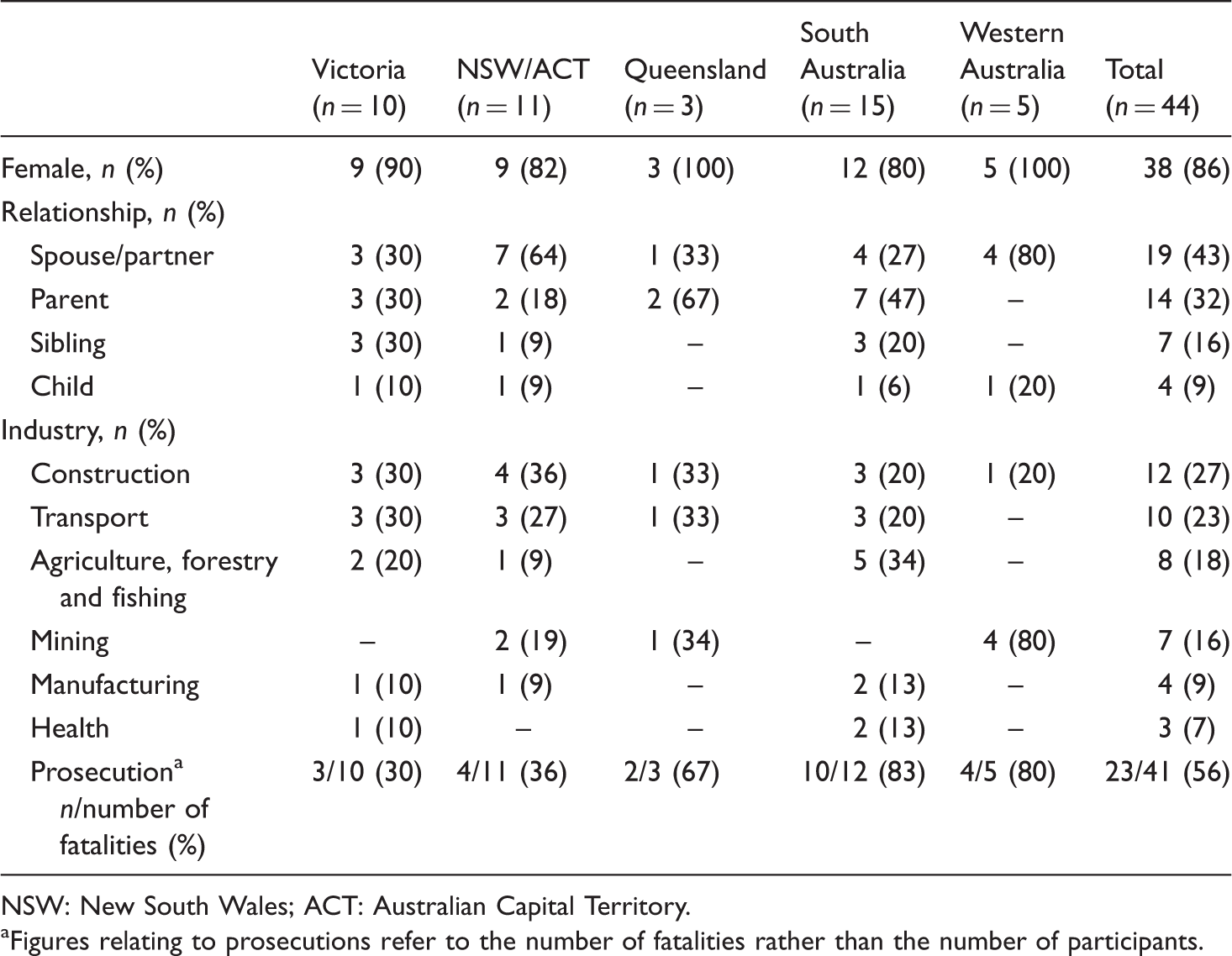
NSW: New South Wales; ACT: Australian Capital Territory.
Figures relating to prosecutions refer to the number of fatalities rather than the number of participants.
Procedure
Participants were recruited through a family survey conducted for the larger project. At the end of the survey, respondents could indicate their preference to receive information about follow-up interviews. Information about the survey was circulated (1) to well-established industry and community support networks and trade unions for posting on websites, (2) by the use of Twitter and Facebook announcements, and (3) by advertising in regional and local newspapers, via industry newsletters and at relevant conferences. To be eligible to participate in the study, participants needed to be related to the worker who died and be aged over 18 years. Of the 84 survey respondents who requested information about the interviews, 55 consented to be interviewed (65%). In total, 11 interviews were conducted with participants in Canada (8) and the USA (3); however, these results are not presented in this article.
Following consent to participate, participants were contacted by phone or email to organize a time and venue for the interview. Four jurisdictions were visited to conduct face-to-face interviews (n = 29); participants outside of these jurisdictions (and those remotely located) were interviewed by phone (n = 14). Semi-structured interviews of between 40 minutes and 2 hours were conducted by a PhD-qualified researcher with extensive experience in trauma and loss.
A specific qualitative method of semi-structured interviewing was used in this study. This method has been recognized as well suited to bereavement or trauma-focused research and potentially beneficial to participants (Kentish-Barnes et al., 2015), despite ostensible ethical issues (Buckle et al., 2010; Rosenblatt, 1995). An interview schedule – developed to elicit specific information about families' experiences of the fatality and post-death formalities – included questions about the information and support families were provided, the participant's experience of the investigation, prosecution and coronial inquest, and their interactions with the authorities. The research protocol for the larger project was approved by (institutions) The University of Sydney's Human Research Ethics Committee prior to the commencement of the study.
Data analysis
With signed consent, interviews were audio-recorded and transcribed verbatim. Any personally identifying information was removed to protect participant confidentiality and anonymity. Initially three interviews were read and analysed independently by two researchers from different disciplines. Recurring themes and concepts were then examined and discussed by the two researchers to reach consensus about how each theme or concept should be interpreted and described. This preliminary process enabled any differences in interpretation or categorization to be discussed and resolved collaboratively. Furthermore, it helped to reduce bias in identifying thematic codes, to increase inter-coder reliability and to improve the construct validity of the identified themes (DeSantis and Ugarriza, 2000). A thematic analysis of the interview data was then conducted using QSR International's qualitative research software NVivo (Richards, 1999), which enabled a more focused analysis in which recurring patterns of responses within and across categories were mapped and synthesized. Related themes were then included in larger concepts, resulting in key themes relevant to the aims of the study.
Findings
The overall objective of this study was to examine bereaved families' experiences of the OHS judicial and legislative processes following a work-related fatality. The findings are reported using the three themes that encapsulate those experiences: prosecution, penalty and prevention. Participants' experiences of the prosecution process, and their views regarding penalties, contributed to their beliefs about whether justice was achieved. For many participants, prevention became an important goal of the legal process and constituted a significant element, but not the sole element, of achieving this justice.
Prosecution
Participants discussed the process of laying charges and deciding on prosecutions. They also discussed their experiences of the prosecution process, including issues such as delays, the impersonal nature of the legal system, perceptions of lawyers, exclusion from participation, information and communication, and support.
The decision to prosecute
One area of concern raised by participants was their belief that the decision to prosecute was primarily determined by the prospects of a successful prosecution rather than the need to penalize safety negligence: ‘They'll only make that call if it's beyond reasonable doubt that they'll get a prosecution. If it's iffy, they won't’ (#43). A decision not to prosecute even where there seemed to be blatantly unsafe practices was a source of concern for participants who struggled with the lack of punitive consequences: ‘They issued fines … Why didn't they take the next step and prosecute? I don't know’ (#12).
Expectations that the evidence of action and conduct used in mainstream criminal law would be given priority over the determination of intent required for OHS prosecution was experienced by families as marginalizing their experience, even resulting in secondary victimization: ‘[Safety Inspectorate], don't even go there, I’m not happy with them at all … No one got charged. With [safety inspectorate], it was like, someone died, big deal’ (#25).
The prosecution process
The lack of victim representation in the prosecution process was evident in the responses from our participants and suggests the need for a system that ensures victim representation and participation throughout the process.
Participants expressed frustration at having no voice in the prosecution process: ‘I'd love to see families having some legal presence in a prosecution … I do think that that should be their right’ (#31). Rather than reassuring family members, court proceedings and the objectified treatment of the worker had the opposite effect on participants. Lawyers were frequently perceived as negative, including those prosecuting, but the harshest criticism was directed at the defence counsel who were seen as disrespectful to the victim and intent on using obfuscating tactics to protect their client: ‘The [defendant's] barrister, like she'd just throw confusion, like it was her job just to confuse the jurors … All [the barrister] was there doing was like devaluing any evidence that came from professionals’ (#11).
For many participants, the prosecution became a battle waged against culpable but affluent employers fighting convictions: ‘I was warned that the usual thing with companies like [company name] that have very deep pockets is that … they can afford to take it as far as they can’ (#42). When families used the one mechanism they have available to them in the prosecution — submission of a Victim Impact Statement – this process did not guarantee that they would be ‘heard’: ‘I had written one of course, but they didn't let me read it and that was very hurtful’ (#14).
Although most participants were dissatisfied with the provision of information and communication, several expressed more positive views and pointed to the helpful role played by some court personnel and safety inspectors: ‘She [from safety inspectorate] used to come with us to the court and we always met with the legal prosecutor before the court if we wanted to ask any questions … They were very good’ (#39).
Overall, the legal process was unsupportive of families and meaningless in terms of achieving justice. Few had access to legal representatives or a support person to explain what was happening in the court and how the outcomes were reached: ‘The company just went, oh yes, we're terribly sorry, and walked away and went back to work the next day… It was a let-down … We all walked away feeling like it wasn't resolved’ (#38).
Penalties
If a conviction occurs, the outcome can be a recorded or unrecorded guilty conviction, a fine, an enforceable undertaking or, in rare instances (overwhelmingly traffic incidents), a jail sentence. The opinion of most participants was that the court outcome and subsequent penalty did not meet the requirements of a penalty; it did not adequately punish, prevent reoffending, protect the community or recognize the harm done. Penalties were inadequate and essentially disrespectful to the families and the workers who had been killed. All wanted those found responsible to be held accountable and to pay a penalty that ‘fit the crime’. Consistent with points raised at the outset of this article, convictions were perceived by participants as necessary retributive outcomes. Yet their experience was of seeing authorities responsible for issuing a penalty tending to opt for lower range penalties, and those identified as culpable not taking the penalties seriously.
The decision for the accused to plead not guilty (when they were) extended the duration and strain of the prosecution process. Suspended or downgraded sentences fuelled anger, and several concerns were raised regarding fines, including the derisory amounts or reductions, lack of payment and the limited value placed on a human life. Others were unimpressed by the ‘discounted’ fine associated with a guilty plea: ‘There was a fine of $45,000 for the loss of four men and one man is still disabled, disfigured. It was a disgrace, absolute disgrace’ (#8). One participant complained that the penalty for a fatality can be less than compensation for an injury: ‘It's cheaper to kill a man than lame a man’ (#17).
Participants were incensed when they compared the insignificant amount of the fine to other costs, particularly the ability of larger organizations to spend ‘10 times more than [the fine] on their lawyers’ (#31). Others were bitter about the use of so-called ‘phoenix companies’ to evade penalties. Like Alistair Lucas’ father (see the Introduction), participants were generally dissatisfied with the fines imposed, apart from the few instances in which the maximum penalty had been given: ‘He was fined I think it was $200,000 for each charge, so that was $400,000, and ordered to pay the family compensation … He had to also notify all of his employees that that had happened’ (#32). A strongly held view among participants was that financial penalties should be used in a meaningful way to improve workplace safety or assist bereaved families, rather than be paid to industries or government agencies.
A few participants differed on the value of jailing those convicted. Those questioning its value largely based their view on the incapacity of jail to bring their loved one back. However, for others jail was an essential element of holding culpable parties accountable and the only appropriate means of justice: ‘I think the only way that you can ever truly change things is by penalizing somebody, by taking away their freedom. Because really, that's what's happened to the people that live with this’ (#31). Even if views on jailing differed, participants commonly called for more severe charges relating to work-related fatalities and for them to be treated and penalized as real crimes.
Prevention
Although coronial inquests are more typically associated with recommendations for improving prevention, families expressed a strong interest that penalties and prosecutions would lead to changes to enhance OHS so something positive emerged from their loss. One theme from interviews was that increased penalties and prosecution rates would have a deterrent effect: If you don't put a penalty on something, then it'll reoccur. Other employers would say he got away with that, you can do whatever you want, you don't need safety stuff … Let's prevent it. I mean, what's the point of having all these regulations if they're not going to follow it and no one cares? (#4)
Nevertheless, the necessity of penalties and prosecutions for ensuring prevention was asserted by participants. Some considered that prevention could only be guaranteed through the harsh penalty of jail time. However, others discerned the irrelevance of monetary fines, criminal prosecution or sentencing, and considered that justice could only be fully served through an ethical commitment to prevention: ‘How long in jail is going to un-kill the person? … How much money do they need to be fined to make it okay? … True remorse is born out of changing things, because the last time it went horribly wrong’ (#2).
Some participants reported changes in legislation, regulations or codes of practice in industries being made based on recommendations. These OHS changes contributed towards a sense of justice for families; however, participants were critical of the time taken to change work practices, of similar accidents recurring, and of not being advised that recommendations had been actioned: ‘There were two exactly the same things, one in [city], one in [another city], within a week of each other. It still continues to happen’ (#16).
Participants expressed outrage that people doing ordinary jobs (unlike the military or police) were risking life and limb by being exposed to potential causes of workplace incidents that were almost entirely preventable. To this end, participants called for improvements in work health and safety regulation and enforcement: ‘I want them to clean up the building sites. And not just building sites, every workplace … There's no point in having safety standards if we're not going to follow it through’ (#4).
Discussion and conclusion
In the introduction, we reviewed the complex history and policy debates surrounding the use of prosecutions under the OHS statutes and for manslaughter under the mainstream criminal law. We concluded that OHS prosecutions are hamstrung by the general reluctance of OHS inspectorates to prosecute and the process of individualization and de-contextualization of issues when prosecutions are conducted, so that fines imposed by the courts in successful prosecutions tend to be regarded by the community as inadequate. Prosecutions for manslaughter are rare, because of the legal technical difficulties that make it very challenging to prosecute corporations, corporate officers and individual managers for manslaughter.
These criticisms about the failure of OHS laws and enforcement align closely with the views of families of those killed at work who were interviewed in this study. Recurring references were made to the reluctance to prosecute, the narrow nature of the prosecutions that did occur, the obfuscation of issues and objectification (even commodification) of those killed, the victim-blaming during proceedings by lawyers and better-resourced employers, and the ineffective nature of penalties levied if a conviction was secured. Families felt disengaged and largely ignored – something that was not rectified by the capacity of some to make Victim Impact Statements. Several of those interviewed openly questioned the effectiveness of the law in reflecting the value of preserving the lives of workers.
In key respects, our findings reinforce arguments made by Almond (2008), namely that the community demand for more active prosecution of those deemed culpable of causing the death of workers is not simply grounded in notions of retribution, but represents a rational response to deaths the community deems both unacceptable and preventable. This study indicates that families want matters thoroughly investigated, and where appropriate, prosecuted. If a conviction occurs, they want a penalty imposed that has both deterrent value and, where fines are issued, prevention value, by the funds being used to improve safety or to assist families. Not all families were entitled to workers' compensation, notably where the worker was self-employed, and a priority would be to assist these families (Quinlan et al., 2015a).
However, affected families’ views went beyond just questions of retribution, social signals and punishment-based deterrence. This study found family members wanted to know precisely how and why their loved one died and to be reassured that specific preventative measures would be taken so that incidents would not recur and others need not experience such grief and loss. Here many felt let down by an investigative and prosecution process that they saw as too opaque, subject to sentencing ‘deals’ and dictated by narrow concerns with securing a conviction, not identifying all areas or aspects of fault/wrong-doing or events leading to the incident, and where limited attention was given to specific actions to prevent a recurrence. In other words, prevention was not just about deterrent punishment. Similar views have been reported by victims of trauma and other crimes, including families surviving a fatal work incident (Clark, 2010; Malone, 2007; Matthews et al., 2012b), as well as others involved in work fatalities, such as union officials, government inspectors, family support groups and coronial officers (Matthews et al., 2016; Quinlan et al., 2015b). It might be argued that coronial inquests can provide answers to how/why a fatality occurs and also recommend preventative measures. The effectiveness of this has also been questioned and does not address how to best integrate this with preventative measures under OHS legislation through means like enforceable undertakings or targeted enforcement (Matthews et al., 2016).
Like Almond's (2008) point about the rationality of community views about workplace deaths, this study of the views of those most directly affected, namely bereaved families, are not driven only or even primarily by a desire for retribution but represent a rational response that considers not just punishment but a desire for understanding and actions that will prevent similar tragedies. Some of the issues that aggravate the experience of families of those killed at work (and other victims of crime), notably delays and the opaque and adversarial nature of court proceedings, may be seen as unavoidable (Clark, 2010; Malone, 2007; Snell and Tombs, 2011). Even so, there is evidence of concerns raised by other parties, including those in government, with regard to the growing role of corporate law firms in defending OHS cases (Matthews et al., 2014). There is also the question of styles of defence discussed at the outset of this article, which seek to fragment and obfuscate the process very reminiscent of and consistent with those identified by Mathiesen's (1980) study of the North Sea Oil Industry (Johnstone, 2003a: 206–239). Further, recognition of delays and adversarial relations does not address concerns raised by families about the degree of communication with government officials where some were able to point to more positive experiences. In sum, examining the views of bereaved families, we would suggest, adds an important, indeed missing, dimension to a long-running debate over OHS regulation.
Regarding the above observation about positive experiences, some important contextual factors not part of this study but dealt with elsewhere need to be acknowledged. First, research has identified the valuable role that unions can play in assisting bereaved families to obtain information and secure their legal entitlements, along with organizations representing families, such as Workplace Tragedy Family Support Group, Voices of Industrial Death, GriefWork, and the Interim Consultative Committee for Work-related Fatalities (Matthews et al., 2012b; Quinlan et al., 2015b). The latter groups perform several support and advocacy functions in the same way as victims' rights groups elsewhere. Second, at the same time the progressive de-collectivization of industrial relations has weakened the reach of unions to assist families or affect OHS more generally (see e.g. Quinlan and Johnstone, 2009). From an industrial relations perspective, these observations are important even if they were not a focus of the current article.
This study used an outreach method for recruitment in the absence of a national database that records all worker deaths and the deceased workers' next of kin details. Some families who did not know about the study may have had experiences that differ from those reported here. Future research that partners with each jurisdiction's OHS regulator (to better access families on their databases) may add further depth to the knowledge about families' experiences of OHS legislative processes. Nevertheless, responses were received from bereaved family members across Australia, from metropolitan and rural/remote locations, and from all high-risk industries in Australia. The fact that families and victims of other types of violence and sudden deaths report similar challenges with the legal processes, and in particular, prosecutions, penalties and prevention of further incidents (Clark, 2010; Malone, 2007; Oldam and Norse, 2006; Wemmers, 1996), suggests that the findings from this study are reasonably representative of families' and victims' experiences of this system. It also strongly suggests that changes are needed in legislative processes and practices to improve the experience of families, especially when these processes can take up to 8 years or longer to finalize. Laws that improve the ability of families to have representation in the process, to participate in proceedings and to claim reparations would go some way towards providing mechanisms that allow families to obtain justice. One international model, the International Criminal Court, is well known for the victim provisions its processes present to victims and families (Moffett, 2014), and offers an existing set of processes on which to model new laws.
Most importantly perhaps, the evidence reported in this article reinforces concerns about the effectiveness of the legislation, the generally low level of enforcement and prosecution, and the often-paltry penalties imposed – all raised by participants and all (along with resourcing) raised by others' studies in the ongoing debate over OHS law. Combined, the evidence strongly suggests it is time for a high-level review of the legal procedures that follow a fatality in the workplace and for this to be followed by more concrete interventions to prevent a recurrence of similar types of fatalities.
Footnotes
Acknowledgement
We would like to acknowledge Cath Finney Lamb for her assistance with initial data analysis and management.
Declaration of conflicting interests
The author(s) declared no potential conflicts of interest with respect to the research, authorship and/or publication of this article.
Funding
The author(s) disclosed receipt of the following financial support for the research, authorship and/or publication of this article: This research was supported by a grant from the Australian Research Council (DP120103377).