




Abstract
The gig economy has captured public and policy interest and is growing as an area of academic inquiry, prompting debate about the future of work, labour regulation, and the impact of technology and job quality. This special issue provides a timely intervention into that debate with this article providing an introductory overview, positioning the articles within a comprehensive literature review of existing scholarship on the gig economy. These articles add to our understanding of the organisation and experience of work in the digitally enabled gig economy in a variety of national settings. They explore aspects such as job quality, forms of collectivity, identity development, and algorithmic management and control. This article also delineates avenues for further research regarding conditions for gig workers, the impact of gig work and information, technology and gig work.
Introduction
The fragmentation of work facilitated by gig economy business models that reduce labour costs by deeming workers ‘independent contractors’ (thereby avoiding employment-related liabilities such as insurances and paid leave) has come under close scrutiny around the world (Josserand and Kaine, 2019). It has been argued that such fragmentation reflects a more general trend, now known as the ‘fissuring’ of work (Weil, 2014) characterised by ‘extreme flexibility, shifting of risks to workers and income instability’, and that these features ‘have long become a reality for a portion of the workforce in current labour markets that goes far beyond the persons employed in the gig economy’ (De Stefano, 2016b: 6). The disaggregation of the ‘workplace’ in both crowdwork and on-demand gig work is significant as it potentially creates a disconnected, individualised experience of work.
Accordingly, there is increasing international public and policy interest in the digitally enabled economy – alternatively referred to as the platform economy, on-demand economy or gig economy, despite limited and conflicting information about its scope (Minifie and Wiltshire, 2016; Organisation for Economic Co-operation and Development (OECD), 2019; Prudential, 2018). Work within that economy has generally become known as ‘gig work’ and denotes ‘task-based’ and ‘electronically mediated jobs’ (US Bureau of Labor Statistics, 2018) that allow for online platform or smartphone app-based connection between those offering to perform services or tasks and those requesting services. Within this broader definition of ‘gig work’, two categories have been identified: ‘crowdwork’ and ‘work on demand’ (De Stefano, 2016b, 2016b; Kaine et al., forthcoming (a)). The first category refers to cloud-based crowdwork that is generally undertaken in a worker’s own home, and can be further divided into two sub-categories. First, crowd-based platforms trade largely in ‘microtasks’ that ‘co-ordinate the use of human intelligence to perform tasks which computers are unable to execute’ (Scholz, 2017: 20) (such as Amazon Mechanical Turk). The second sub-category leverages specific professional expertise to deliver work online (Kaine et al., forthcoming (a)). On-demand gig work differs from crowdwork in that it involves ‘real-world’ (Stewart and Stanford, 2017) rather than virtual tasks. Common examples, which are the focus of the various contributions to this special issue, include point-to-point transport and food delivery services. Other examples are handyman and cleaning services – with the variety of services offered through on-demand services also expanding into personal care, personal beauty and pet care services (www.gigwatch.com).
Regardless of its actual scope, the development of the gig economy has provoked intense debate about its impact on the experience of work and labour standards, both for those undertaking gig work and for those with more traditional jobs that might be undermined by new, unregulated labour market participants (although the contribution to this issue by Ford and Honan (2019) raises some interesting questions about the role of gig work in creating more formalised and potentially regulated work in some contexts). While there have been concerns raised about the implications of its growth on the nature of work, minimum labour standards and prospects for worker voice (Johnston and Lands-Kazlauskas, 2018), the potential attraction of ‘portfolio’ or freelance work has also been recognised (Manyika et al, 2016; Prudential, 2017). Despite media and public interest, academic research in the area is still relatively scarce, possibly due to the recent development of its current digital form.
The articles included in this special issue contribute to our understanding of the organisation and experience of work in the digitally enabled gig economy in a variety of national settings exploring aspects such as job quality, forms of collectivity and identity development. Specifically, Goods et al. (2019) explore the concept of job quality in the ‘gigosphere’ using a multi-dimensional framework to examine how Australian food-delivery workers experience their work. They note that perceptions vary depending on methods and levels of evaluation, highlighting the ‘messiness’ in assessing job quality. Ford and Honan (2019) provide an account of the growth of point-to-point transport (car and motorbike ride-sharing) services in Indonesia and note an important contextual difference to the development of this sector in other countries. Rather than acting as another means of fragmenting the workforce, ride-sharing in Indonesia has assisted in formalising this type of work, not least by creating an organisational focus for worker resistance. Additionally, the authors assess the varieties of collectivism engaged in by ride-share drivers, concluding that the mutual-aid style of collectivism that has emerged is unlikely, of itself, to be able to resist the power of gig economy ‘pseudo-employers’.
The remaining two articles also explore ride-sharing, but in very different contexts and through very different lenses. Josserand and Kaine (2019) investigate the ‘sub-entrepreneurial’ status of ride-share drivers and study the personal narratives to uncover how those drivers make sense of their ambiguous occupational identity. Wu et al. (2019) consider the control strategies employed by ride-share giant Uber during its operation in China (it has since withdrawn from the Chinese market). In particular, the authors identify three key strategies, those being incentive pay structures, customer ratings and flexible work arrangements.
This introductory article sets the scene for presenting this collection by conducting a systematic and comprehensive review of the literature on the gig economy in general and on working in the gig economy in particular. This literature review (aided by Leximancer analysis software) identifies three key themes from the extant literature on work in the gig economy. These are conditions for gig workers (including contract, risk, income, regulation and resistance), the impact of gig work (on workers’ experience, on skills and on job quality) and information, technology and gig work (personal information, social media and algorithmic management). In addition to providing a thematic overview of the literature, this article identifies where the articles collected in this special issue make a unique contribution to that body of work and suggests avenues for further research.
Method
To conduct our systematic literature review, we used text mining, defined as a form of unstructured ontological discovery that provides detailed conceptual insights by shifting the level of analysis from authors and their citations to the actual words used by authors to provide a systematic, unbiased, and content-driven review of the literature (Randhawa et al., 2016: 754)
Data collection
In order to collect focal scholarly literature in the field of gig work, we initially defined a set of relevant keywords around topics related to gig work. To do so, we reviewed a set of 21 reports (see online Appendix A), constituting the most recent outputs on gig work (period 2016–2019). The list of keywords used to select the initial sample of articles were as follows: ‘gig economy, work/labour’; ‘on-demand economy, work, labour’; ‘platform economy, work, labour’; ‘digital work, worker’; ‘micro-tasking’; ‘crowd economy, work, labour’; ‘uberization of economy, work, labour’; ‘uber work, labour’, ‘collaborative economy, work’, ‘ride-sharing’; and ‘amazon mechanical turk’.
In a second step, we leveraged Scopus as the main database source to identify scholarly publications on gig work. More particularly, we collected articles, conference papers and reviews published between 2009 and 2019 that included one of the aforementioned keywords either in the title, abstract or keywords section. Thus, we ensured that articles that did not primarily focus on gig work but still addressed it in some way were included in the sample. This search eventually resulted in a total of 329 documents.
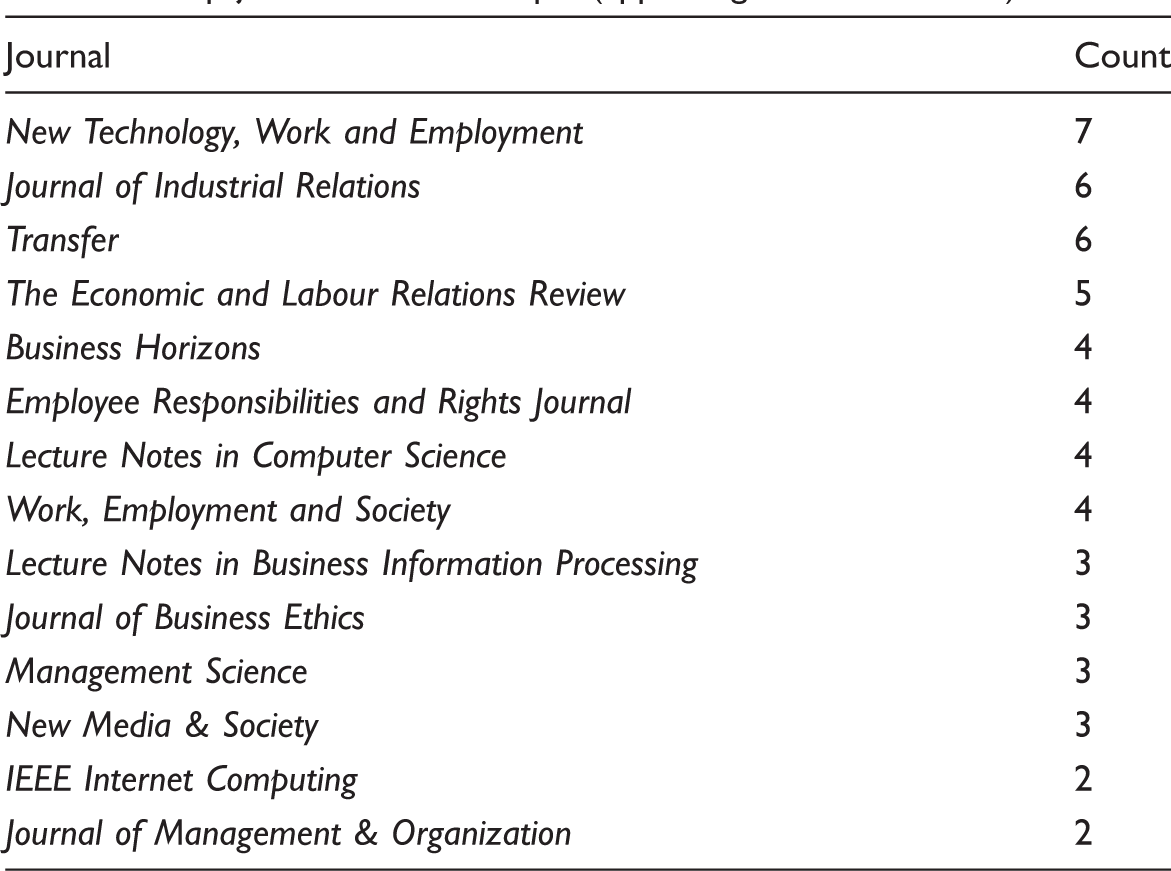
Top journals in our sample (appearing more than once).
Data analysis
A suitable text-mining software to support us in this process was Leximancer 4.51. Leximancer’s algorithm detects the most frequent concepts as well as their relationships with each other (Randhawa et al., 2016). Running the analysis with Leximancer results in a concept map which reflects key concepts as well as their connections. The closer the concepts are placed to each other, the stronger their relationship (Campbell et al., 2011; Rooney, 2005). Additionally, Leximancer clusters concepts into themes and visualises them with coloured baubles. As Leximancer’s output is a ‘heat map’, the colour-coding of these themes gives an indication of its relevance in the dataset (Randhawa et al., 2016). The most important theme is red, then orange and then continuing as depicted in the colour wheel (Leximancer, 2018; Phi, 2019).
We ran Leximancer on our corpus of 140 articles on gig work, which led to a first concept map. We then investigated citations that referred to the identified concepts to understand their meanings. This allowed us to question whether or not concepts were relevant despite their high number of hits. Indeed, some concepts were generated by a frequent use of a specific word in research articles but were not relevant to our research topic. An extreme example of this phenomenon was the emergence of the concept ‘data’, which appeared frequently in titles such as ‘data analysis’ or ‘data collection’ and therefore created a risk of misleading interpretation. Cleaning the dataset by removing such concepts led to the final Leximancer concept map as shown in Figure 1. Following Randhawa et al. (2016), we then regrouped the themes to create ensembles that were coherent from a research perspective, including concepts that would constitute a coherent research agenda. This led us to define the three key research areas delineated on Figure 1: conditions for gig workers, the impact of gig work and information, and technology and gig work.
Leximancer concept map and clusters.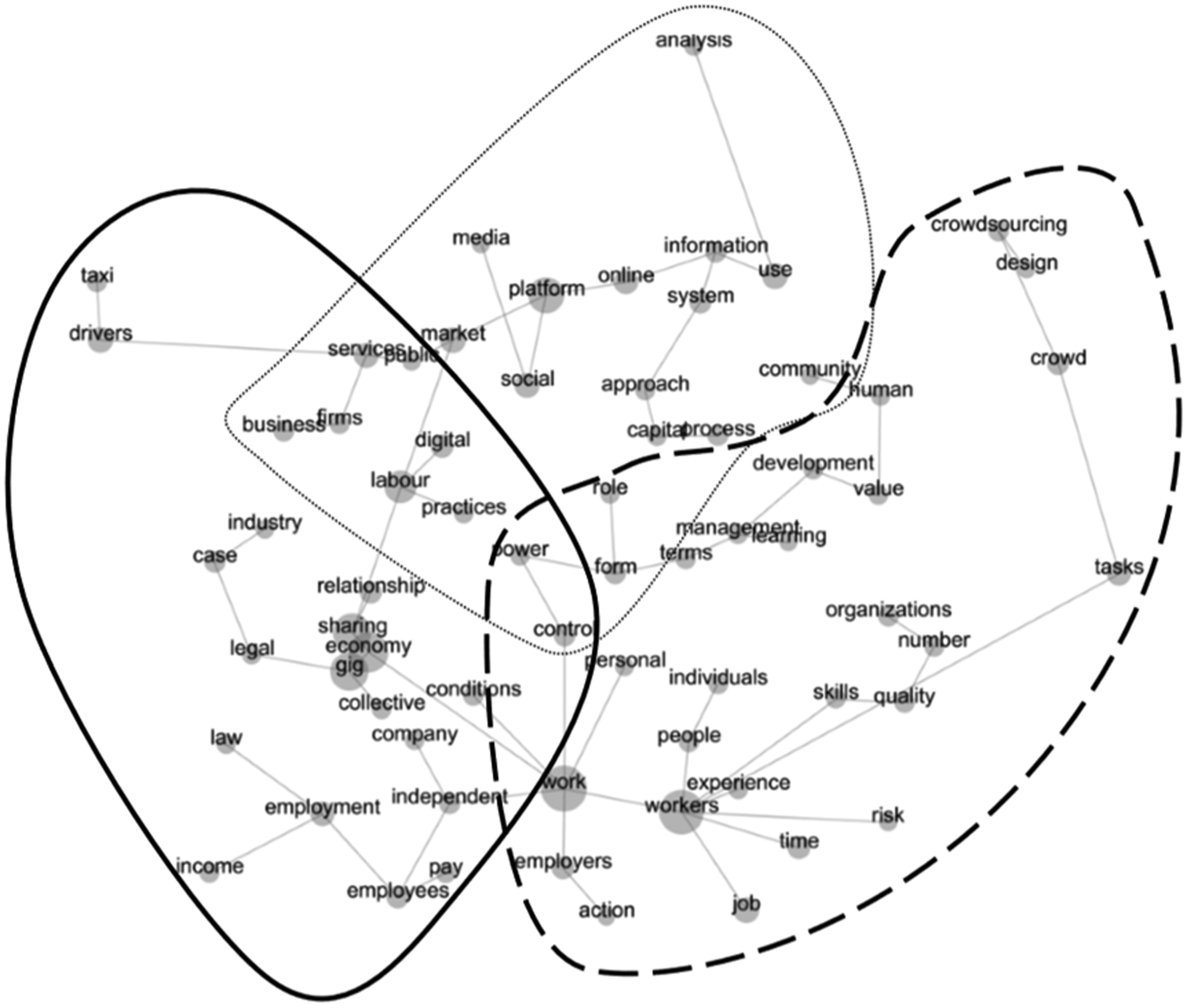
Our results present the main themes that constitute these three research areas further broken down into key concepts, providing the structure of the following sections. Under each main areas, we report on the findings of the systematic literature review, then present the contribution of the special issue to that area and finally propose related research avenues.
Conditions for gig workers
The question of the conditions for gig workers is one of the three key areas of research that emerged in our systematic literature review. A key theme is the status of gig work as direct employment or independent contracting. This is connected to the actual conditions experienced by gig workers, making it a risky business where management of income and hours is difficult. Possibilities of remediation include regulation, notably around the question of classification of workers and collective action.
The contract is core to gig work
The concept of ‘contract’ is central to research on the conditions of gig workers and is mainly related to five other concepts: employment, employer, employee, terms and independent. Although the research points to the pursuit of a common definition and classification of gig work (Howcroft and Bergvall-Kareborn, 2019), the boundaries around types of work are not easily delineated (see also section on regulation). While some take for granted the classification of gig workers as entrepreneurs, it is often difficult to find a justification for that categorisation (Ahsan, 2018). Many platforms construct their contracts around self-employment, giving them the capacity to avoid labour regulations applied to direct employees (Howcroft et al., 2019). This situation is compounded by a lack of awareness among workers regarding the status of their contract (MacDonald and Giazitzoglu, 2019).
Research relating to the concept of ‘contract’ also deals with the design of gig work contracts (Shafiei Gol et al., 2019; Stewart and Standford, 2017) and, to a degree, how to improve these (Byrne and Pecchenino, 2019; Cachon et al., 2017) and the implications of the configuration of contracts as a whole, or of specific clauses. For instance, Stewart and Stanford (2017) conclude that Uber contracts are ‘unfair’ because they give Uber the right to change terms unilaterally at any time. Other characteristics include dynamic prices and pay rates that aim at eliminating capacity rationing (Cachon et al., 2017). Byrne and Pecchenino (2019) discuss extensively the future value that the firm and the worker can, respectively, derive from a specific contract, contrasting the situation of high-end consultants with that of Uber drivers.
Gig work as a risky business
The concept of ‘risk’ is linked mainly to those of ‘conditions’, ‘terms’ and ‘power’. There is limited research on the risk of using gig work for the platform companies, focusing on the need to create appropriate risk assessment/management frameworks (Fox et al., 2018) but also referring to the risks associated with growing resistance from employees (Bergvall-Kareborn and Howcroft, 2014).
The key focus in terms of ‘risk’ concerns risks on the workers’ side. A first category of risk results from the often precarious nature of gig work that does not offer the safety net associated with more traditional forms of work (Chen, 2018); in the absence of training, health or retirement benefits, the risk of operation is shifted from the employer to the worker (Bajwa et al., 2018). Another source of risk lies in the fact that workers provide capital in the form of tools or equipment, support the fluctuation of business and income, or can be ‘deactivated’ from an app (Stewart and Stanford, 2017). Given the lack of health insurance benefits or a workplace health and safety programme (Fox et al., 2018), there is an increased health and well-being risk but also a safety risk, in particular in activities such as ride-sharing (Christie and Ward, 2019). Risk is also approached in a more subjective manner with research on how employees perceive and tolerate job risk; but there is an objective risk due to a lack of income predictability (Doucette and Brandford, 2019), uncertain project frequency and uncertain work hours (Gandhi et al., 2018).
The difficult management of income and hours
The concept ‘income’ is core to this category and is connected to the other key concepts of ‘time’, ‘hours’, ‘industry’ and ‘pay’. Research on this topic recognises a contrast between, on the one hand, a minority of gig workers who engage in highly specialised occupations, which result in flexible and autonomous jobs, and on the other hand, the less favourable situation of a majority of gig workers (Ahsan, 2018). For most, earnings are less than those of their peers in traditional work (Friedman, 2014) with long working hours (Carmody and Fortuin, 2019; Graham and Anwar, 2018).
The question of how gig workers manage their engagement with their occupation and their income, especially for those earning less, is important. Sun et al. (2019) analyse the daily decisions on whether and how to participate in work depending on hourly income rates. An individual’s capacity to earn, for instance in the case of crowdwork, depends on their online reputation, with no guaranteed weekly or monthly income; also, they need to factor in healthcare costs and savings for leave in their calculation of income (Arenas et al., 2018). Low and unpredictable earnings or limited hours mean that gig workers often need to engage in multiple occupations (Doucette and Brandford, 2019) and/or have to work at different times than formal work, for instance during weekends, holidays, etc. (Arenas et al., 2018).
Regulation of the gig economy?
The two concepts of ‘legal’ and ‘law’ constitute a clear and distinct category in this literature review. In view of the ambiguity of the classification of gig worker, the question of the regulation of gig work is salient in the literature. A first consideration is the notion that, due to being deemed by platforms as self-employed, gig workers will miss out on entitlements and be excluded from the social welfare safety net (Hawley, 2018). This leads to a call for ensuring that gig work does not create a situation where what are considered basic work conditions are denied to workers (Stewart and Stanford, 2017).
A key question is whether a specific regulation is needed rather than the extension of existing regulation. Todoli-Signes (2017) argues that ‘tailormade’ regulation is needed since individuals that work for online platforms are subject to risks that are specific; that is, because of the characteristics of gig work, traditional regulations such as fixed salaries and minimum wages could be difficult to apply (Todoli-Signes, 2017). Stewart and Stanford (2017) provide an overview of this debate and propose five regulatory options: enforcement of existing laws, clarifying or expanding definitions of ‘employment’, creating a new category of ‘independent worker’, creating rights for ‘workers’, not employees, and reconsidering the concept of an ‘employer’. While offering details around each of these options, Stewart and Stanford’s (2017) key argument is that the development of on-demand gig platforms requires ‘regulatory innovation’ so that ‘the blurring of the relationship between intermediary and worker that has been a central feature of most platform-based business models’ does not undermine labour protections (p. 432).
The difficulty and potential of collective action
This category regroups the two concepts of ‘collective’ and ‘action’. We found that the literature addresses two main questions on the topic of collective action. First, an important question is that of the bargaining rights of gig workers. Indeed, if they are independent contractors, there is a tension between bargaining rights and considerations of competition law. For instance, Schiek and Gideon (2018) underline the reluctance of the courts to recognise bargaining rights for gig workers. This question of the capability of gig workers to collectively negotiate is essential for the negotiation of work conditions (Schiek and Gideon, 2018).
Second, considerations of the barriers to collective bargaining in the gig economy are also important. A significant concern is that their categorisation as independent contractors makes it unlikely that gig workers will push for legal recognition of the conditions associated with the status of employee (Wood et al., 2019). There is indeed only limited evidence that workers engage in collective action (Veen et al., 2019). However, research also points towards an increase in collective action triggered by working conditions and/or wages judged unacceptable by some categories of workers (Poon, 2019); Bergvall-Kareborn and Howcroft (2014), for instance, refer to growing resistance from workers.
Conditions of gig workers: Contribution of the special issue and future research
The development of the digitally enabled economy has increased existing trends towards self-employment and fragmented work to the detriment of more stable forms of employment. In some cases, fragmentation has been extreme, where small, poorly remunerated, unitary tasks are competitively offered to an internationally fragmented workforce. Altogether, this defines a gig economy that has been both denounced as one of the worst forms of workforce exploitation and heralded as providing ultimate flexibility and freedom. Regulation and collective action can contribute to constructing a gig economy that contributes more to the latter than to the former. Contributions to this special issue enhance this important debate on both regulation and collective action.
Goods et al. (2019) further our understanding of the difficulties to regulate, notably due to the specificities of gig work. They describe for instance ‘multi-apping’, where workers are engaged by multiple platforms concurrently, and describe the implications in terms of which platform would be the employer and the associated questions of responsibility. Multi-apping makes regulation especially complex and the application of classic employment regulation difficult. The authors suggest that new voice mechanisms or imposing new obligations on platforms through existing or new courts might be ways to regulate gig work, and propose the introduction of mandatory conditions for workers in areas such as worker protection and compensation, training and minimum wage or earnings.
Ford and Honan (2019) further explore the modes of resistance and collective action that gig workers are able to activate. They study the case of app-based transport workers in Indonesia and show how local mutual aid, mutual associations and unions supplement each other and can constitute an arrangement that might resist the domination exerted by platform companies. However, while platform companies operate as a vector of formalisation for resistance, barriers still exist, either strategically put in place by these companies or in the form of tensions between workers’ organisations.
This special issue thus directly contributes to filling some of the gaps in the emerging literature on the conditions of gig workers. However, there remain a number of aligned areas that require further research. A first area of potential research could bring together the contractual and regulatory issues. Current literature offers useful descriptions of the nature and ambiguity of existing contracts and legal classifications; it also provides an interesting overview of the possible regulation of gig work. However, we still have a very limited knowledge on actual implementation of regulation ideas. Research should explore and describe initiatives that have been implemented in this area and their impact on gig work. Comparative studies – for instance between industries or countries – but also possibly simulations and modelling – could be useful in order to better understand the regulatory and contractual leverage that various actors can use. While current literature tends to focus on labour law, an important consideration is whether other regulatory avenues – for instance other legal instruments or stakeholder co-regulation – could be explored. The experience of the regulation of ride-sharing by the city of New York is a good illustration of regulating gig work through mechanisms other than labour law, leading to the imposition of minimum earnings (Josserand and Kaine, 2018). This shows that there is room for innovative approaches to the issue. Future research could contribute to renewing the way we think about the regulation of work.
The question of risk is also an important one. Indeed, in the tech-enabled economy, many organisations are ‘asset light’. They are making money through providing access to goods and services by making connections between ‘micro-providers and consumers’. This means that, in some parts of the platform economy, the amount of capital being provided by ‘workers’ is much larger than it has been in the past, but those workers do not attract the ‘goodwill’ which is accrued by the platform provider and cannot then be onsold by the worker/independent contractor. This is especially the case for models that integrate some aspects of the sharing economy, in particular those in which workers provide their own assets, whether it is a car, a bike or a truck. This important topic requires further investigation, in particular in terms of industrial relations: What are the implications of this shift for existing industrial relations institutions? What does it mean in terms of representation? Aside from a few exceptions, unions have not commonly been in the business of representing the ‘owners of capital’. How will the power imbalance between large multinational platform providers and ‘disaggregated asset owners’ be managed? Another important risk about which little is known is that of the health and safety consequences of gig work (Bajwa et al., 2018).
The less benevolent implications of the growth of the platform-enabled economy have given rise to a variety of responses by gig workers, consumers and investors. While research has started documenting the possibilities of resistance by workers (including in this special issue), we know less about how consumers and investors can participate in a fairer gig economy. Interesting research avenues include efforts to reform some services around initiatives such as worker cooperatives and worker equity in ‘platform’ services and the development of other forms of cooperatives and mutuals. Another ensemble of responses is direct resistance by workers and workers groups with the emergence of service interruptions, strikes and new worker guilds. What potential do these have to counter the deleterious impact of the platform economy on work? One of the questions that this special issue leaves open is that of the articulation between labour organisations at different levels.
The impact of gig work
The second research area that emerged from the analysis of our corpus of articles is that of the impact of gig work: on workers through how they experience their activity, on the workforce in terms of skills and on society through the creation (or destruction) of jobs.
Dealing with the anxiety of gig work
The key concept of this category is that of ‘experience’, which is related also to the concepts ‘personal’ and ‘individual’. There is an emerging body of literature that deals with the emotions and challenges of gig workers, for instance their emotional labour (Gandini, 2018). While, Ashford et al. (2018) underline that gig workers find themselves energised by the variety of work, overall findings from this stream of research tend to emphasise negative emotions associated with gig work. For instance, gig workers in crowdsourcing platforms can feel devalued by the perception that their work is not considered important (Sheehan and Pittman, 2019). More generally, they tend to struggle with anxiety linked to precariousness and volatile income flows, leading to what has been described as emotional oscillation (Ashford et al., 2018; Petriglieri et al., 2019). Challenges that can contribute to such emotions include poor communication with the platform when issues occur (Carmody and Fortuin, 2019), career uncertainty (Schwartz, 2018) and fear of losing their jobs/gigs (Ashford et al., 2018).
Further studies explore some mechanisms that can help workers deal with such negative experience, mainly by creating social connections. Wood et al. (2018) show, for instance, that while face-to-face communication is typically scarce, online communities can contribute to the gig worker experience. Petriglieri et al. (2019) show that gig workers tend to build ‘holding environments’ to mitigate overwhelming emotions that come with the absence of a physical workplace. Altogether, as gig workers lack the more stable social connections that characterise traditional work, they must thus exert agency to construct relationships, building ties with other independent workers, clients, supporters and employer/s (Ashford et al., 2018).
The varying impact on skills
In this category, the key concepts of ‘skills’ and ‘learning’ are related to the other concepts of ‘experience’, ‘development’ and ‘future’. Given the broad spectrum of activities that can be captured under gig work, the consideration of skills, experience and learning opportunities is quite varied. On the one hand, gig work is associated with new opportunities to learn, where gig workers develop new skills through gig work (Ashford et al., 2018). In that sense, each contract or each client can bring an opportunity to learn new routines and skills (Ashford et al., 2018), leading to the conclusion that crowdworkers may accumulate a rich experience by being exposed to different types of clients and projects (Arenas et al., 2018).
On the other hand, there is considerable discussion about how workers can develop their skills in/for the gig economy. One idea is that gig workers should develop portable and adaptable skills (Ashford et al., 2018) by themselves, for instance relying on online training resources (Schwartz, 2018). Furthermore, they should work on relevant and re-deployable skill sets that help them adapt to constantly changing demands (Abhinav et al., 2017; Ashford et al., 2018). The emerging picture is that of on-demand learning to match the on-demand labour needs of platform companies (Means, 2018).
Quality jobs or precarity?
This category regroups the research relating to the key concepts of ‘job’ and ‘quality’, which are also related to the concept of ‘value’. The question of whether the gig economy is creating quality jobs, or whether it is creating jobs at all, is one that has been pregnant in public debates and is also captured in our literature review. It is important to consider job quality in the gig economy since it produces an important contingent of low-skill jobs where the question of quality is problematic. In some contexts, the conditions are such that the job quality, as perceived by workers, is very low. For instance, Chen (2018) shows how the work conditions of app-based taxi drivers in China lead workers to qualify their job as a ‘life struggle, creating exhaustion and health problems.
Wood et al. (2019) present a more nuanced picture of the work of online workers in Asia and Africa in the form of a trade-off. On the positive side, these jobs offer flexibility, autonomy, task variety and complexity, while the negative characteristics include low pay, social isolation, unsocial and irregular hours, overwork, sleep deprivation and exhaustion (Wood et al., 2019). A positive aspect of gig work is the advantages it presents for different groups such as stay-at-home parents or elder caregivers, even in some instances providing new employment possibilities for the disabled and the elderly (Jiang et al., 2015).
The impact of gig work: Contribution of the special issue and future research
Extant literature has started to explore the impact of gig work. However, more research is needed on the parameters of gig work, its implications for society and the actual experience of different categories of gig workers. The contributions to this special issue help fill this gap on the two important questions of how gig workers are experiencing their activity and how job quality for gig workers is conceptualised and understood.
Josserand and Kaine (2019) study the identity work of ride-share drivers in Australia. They show how ride-share drivers struggle to maintain a coherent sense of self when confronted with the discrepancies between their occupational identity and its materiality. Through identity work, drivers tend to accept that their occupation is a trade-off between freedom, material gain and social experience on the one hand and low expectations in terms of conditions, investment requirements, an incentive structure limiting their freedom and an uncertain future on the other. Confronted with this trade-off, drivers construct self-narratives of their identity, which include insisting on a brighter future, the temporary aspect of their activity, being entrepreneurs or disenchantment. An important conclusion is that overall drivers only partially integrate the rhetoric provided by the gig platforms and conduct identity work that helps them make sense of their activity as temporary or marginal. They thus discard ride-sharing as a full-time activity, which raises questions on how platform companies can maintain quality of service in the long run.
Goods et al. (2019) offer an insightful investigation of the quality of jobs in the bike courier industry in Australia. In doing so, they provide an integrative framework that helps analyse the intricate concept of job quality in terms of individual, labour market and socio-political fit. At an individual level, job quality can be approached with a contextualised subjective lens. Fit resulted from the individual circumstances of workers, meaning that job quality was acceptable for specific categories of workers such as young, temporary migrants with limited command of English. It is important to note that jobs were considered acceptable because most workers had exit strategies.
Goods et al. (2019) and Josserand and Kaine (2019) reveal how gig workers perceive and make sense of their own ‘gig’ experiences. However, similar studies in other sectors would allow for comparative analysis that might provide the empirical foundation to a generalisable understanding of the breadth of experience of gig workers in different sectors and types of activities (Ticona and Mateescu, 2018). Many other areas connected to the experience and impact of gig work remain unexplored and are worthy of deeper consideration. While notable exceptions include Renan-Barzilay and Ben-David’s (2017) consideration of the gender pay gap in the gig economy and Flanagan’s (2019) analysis of gig work in the home-based service sector, a key research gap relates to the gendered experience of gig work. Kaine et al.’s (forthcoming (b)) overview of gender and ‘Future of Work’ debates specifically points to the significance of further research in this area, asking whether digital platforms are ‘agents for a new era of de facto male privilege’ (p. 13) and suggesting the need to investigate the methods through which platforms – despite claiming ‘gender blindness’ – might operate to entrench gender inequality.
Burbano’s (2019) exploration of the non-pecuniary motivations of gig workers suggests another important research question – how platform ‘employers’ might influence the drive and commitment of their gig workforce beyond the obvious extrinsic motivator of remuneration for their services. A related question that has not yet been adequately answered is what the emergence of gig work means for skills acquisition and career development. The maintenance of skills has been identified as ‘essential’ for self-employed knowledge workers (Leighton, 2016), but there is little understanding of how this might vary across different sectors of the gig economy, nor is there much analysis of the preferences of different groups of gig workers around career development.
Overall, while there have been some interesting and necessary foundations laid (including the contributions to this issue), the study of the lived experience of diverse groups of gig workers and the macro-economic and social implications of gig work is still in its developmental stage and would benefit greatly from further research.
Information, technology and gig work
Given it is based on platform intermediation, information and information technology play a key role in gig work. This is addressed in the literature through three broad categories: the management and usage of personal information, the role of social media and controversial algorithmic management practices.
Managing and using personal information
This category focuses on the concept ‘information’ and the related concepts of ‘personal’ and ‘individual’. Research in these areas underlines how the gig economy relies on the collection of individual information about gig workers. The information can be very extensive and includes such things as customer ratings, skills and capabilities, financial information, but also a picture of criminal records in some activities.
Research explores the different functions performed by this information, depending on the industry and context. Individual information is connected with the management of the workforce through rating systems (see below), but it also allows for the management of trust where the rating is the basis for entrusting anonymous workers with performing a task (Schiek and Gideon, 2018). However, in other contexts, anonymity is not possible or desired where it might raise suspicion from clients (Wood et al., 2018). This is especially the case when personal information is made available to clients to assess the capabilities of workers and their capacity to perform a specific task (Cabanillas, 2016; Wood et al., 2018). The management of such information raises important risks and issues in terms of confidentiality, fairness and management of such data, leading to a need of regulation (Thorne and Quinn, 2017; Zhang, 2019).
Social media, the new gig
The core concepts in this category are ‘social’ and ‘media’, with a connection with the two related themes ‘online’ and ‘community’. Social media plays an important role in the gig economy, with two main functions: community building among gig workers and directly facilitating gig work. Social media allows gig workers to share information and communicate; this is especially important since gig work platforms often do not offer such possibilities (Chan, 2019; Chen, 2018; Wang et al., 2018). Such worker-led communities can be very active and share work-related information, such as in the case of ride-share drivers' online forums (Chan, 2019). Beyond being a tool for knowledge exchange, research shows that social media has played a central role in workers’ resistance to platform organisations, thus becoming the most important channel for strikes and collective activism (Chen, 2018).
The second possible role of social media platforms is that they can become, at least in some industries, the preferred platform to facilitate gig work (Wang et al., 2019). This is because social media platforms can support the display of relevant and rich information about gig workers (Carr et al., 2017), thus supporting the signalling of skills and knowledge (Chan, 2019). They also serve a function in identity verification and matching (Ticona and Mateescu, 2018). Professional freelancers and other gig workers already use social media as support for ‘self-branding’ (Ticona and Mateescu, 2018)
Controversial algorithmic management
The core concepts in this category are ‘performance’ and ‘management’, which are related to the concepts ‘human’, ‘control’, ‘system’, ‘technology’ and ‘data’. Algorithmic management, which can be defined as the management of labour by machine, is a key preoccupation for researchers on the gig economy (Goods et al., 2019). Attention of scholars is focused on the functioning of existing models but also on their evolution and improvement (Salinesi et al., 2018). Algorithmic management is based on the constant data collection that happens through the rating system and the collection of data on individual workers (Adams et al., 2018). Algorithmic management covers at least three main functions: first, discipline and control that aims at reinforcing compliance and is based on the panoptic properties of the technologies implemented (Adams et al., 2018; Gandini, 2018; Shafiei Gol et al., 2019; Veen et al., 2019); second, performance management, notably through customer ratings but also by providing incentives to drive performance (Adams et al., 2018; Gandini, 2018; Shafiei Gol et al., 2019); and finally, by providing legitimation for decisions to terminate gig workers (Chan, 2019).
Research into algorithmic management raises several issues that come with the practice. It points to asymmetries of information that constrain workers' choice and favour the platform companies (Cheng and Foley, 2019; Schwartz, 2018; Veen et al., 2019). This means that workers lack sufficient information about the performance management and incentive system (Veen et al., 2019). Despite this, research shows that gig workers try to use ‘gaming strategies’ (Chan and Humphreys, 2018) that are ‘cynical efforts to manipulate the rankings data without addressing the underlying condition that is the target of measurement’ (Sauder and Espeland, 2009: 76).
Innovation, technology and gig work: Contribution of the special issue and future research
The question of algorithmic management is probably among the most debated, in both academia and practice, with more work needed on the topic. The article by Wu et al. (2019) in this special issue contributes to a better understanding of what might be the future of management. In particular, they investigate how quality of service can be ensured through these new labour control tools, focusing on the combination of incentive pay schemes and platform evaluation systems. They show that these systems impact in a very different manner for different categories of workers. For example, full-time drivers lost most of the autonomy promised by the platform because of the impact of the bonus systems put in place. This is an important assessment of the strength of algorithmic management and how difficult it is to resist.
Future research avenues related to information, technology and gig work are numerous and varied. Many of them are associated with quite serious issues for policy and practice. The first of these relates to platform governance challenges arising from the ‘temporary, large scale, distributed and mediated’ nature of crowdwork (Shafiei Gol et al., 2019: 1) and on-demand work and the potential for technologies such as blockchain to decentralise governance (Shafiei Gol et al., 2019) and control of crowdwork.
The second area of related research that is deserving of further attention is algorithmic management. Given its associations with control, and current concerns about worker exploitation and deskilling through gig work, there will undoubtedly be more analysis using a labour process lens (Gandini, 2018; Veen et al., 2019; Wu et al., 2019).
However, other aspects such as ‘algorithmic competency’, which describes a willingness by platform users to ‘experiment, manipulate and make sense of the algorithm’ have also been highlighted as worthy of examination (Cheng and Foley, 2019). The forms that ‘algorithmic competency’ might take prompts the question of its capacity to become part of the gig workers' repertoire of resistance, and the related questions of whether there are differences in algorithmic competency between industries and occupations and how platform businesses respond to the development of such competency (Cheng and Foley, 2019).
An underexamined aspect of the development of the gig economy is the impact it has had on the practice of HR. There are obvious non-technological questions linked to this, including: what are the implications for the management of performance and reward of a non-direct workforce (Josserand and Kaine, 2019)? However, there are also some associated areas that combine more traditional HR concerns such as recruitment and selection and the efficient allocation of work with the better use of information and data. Ideas such as the development of data-enabled methods to improve the management of profiles, reputation and credentials have been identified as worthy of future research (Carr et al., 2017; Sarasua and Thimm, 2014) and reflect an increasingly vigorous screening process undertaken by businesses engaging gig workers (Daher, 2018).
The physical atomisation of work that is perpetuated by the gig economy has given rise to virtual communities of gig workers, as described earlier. Extant research has focused on the role of social media in knowledge exchange and the use of online communities as a means to build collectivism, but little is understood about the connections between platforms and those communities (De Vaujany et al., 2019). Neither has there been much consideration of the role that online communities of gig workers play in socialising newcomers to work in accordance with the standards (Chan, 2019) and demands of platforms.
Conclusion
This introduction to the special issue has set the scene for the articles that follow by systematically reviewing extant literature to identify central themes in gig economy research, namely conditions for gig workers, the impact of gig work and information, technology and gig work. Within each of these broad areas, key concepts emerged for which we have provided an overview that facilitates the identification of research gaps and avenues for further research.
What we have not explicitly included in our overview is the growing amount of grey literature on the gig economy generated by government inquiries across the globe and in various jurisdictions (however, we did consult these to assist with the initial determination of key terms). Neither have we included the growing number of reports by large management consulting firms. However, the proliferation of these inquires and reports signifies the intensity of public and policy interest in the ‘rise of the gig-economy’, which belies its actual size.
The OECD (2019) has recently estimated that gig economy platforms only constitute a small proportion of total employment. However, the strong media and research interest in the topic does suggest that there is something fascinating and provocative about digitally enabled gig work. It is not clear whether this is due to the effective use of propaganda by influential digital platforms that presents gig work as ‘micro-entrepreneurial’, extolling workers to ‘be their own boss’, or concerns of those who equate modern gig work to early piecework regimes, or the audacity of some platform founders who have deliberately and publicly flouted pre-existing regulatory regimes. Whatever the reason, academic curiosity has also been triggered, spawning new territory in the field of employment relations – though sharing boundaries with many existing interests. This special issue is positioned in that terrain. The articles it contains explore new, technologically enabled manifestations of self-employment, consider how to adapt existing notions of job quality to a world of both ‘multi-apping’ and insistence on the value of temporal flexibility, study options for collective resistance to the brazen market-positioning of platforms that insist on their own status as ‘technology companies’ rather than service providers, and examine how gig workers make sense of it all.
Footnotes
Declaration of conflicting interests
The author(s) declared no potential conflicts of interest with respect to the research, authorship and/or publication of this article.
Funding
The author(s) received no financial support for the research, authorship and/or publication of this article.