



Abstract
This article builds on the growing literature on migrant worker mobilisation by analysing how the temporary migrant workforce, employed in food production, interacts with two Australian trade unions alongside ethno-specific social media groups, offshore unions and community/religious organisations. The contribution of this article is twofold. Firstly, we demonstrate divergence in union strategies, distinguishing between (i) a ‘traditional self-reliant’ strategy, where unions recruit temporary migrant workforces by using established methods and their own resources and (ii) network collectivism, where unions also engage with temporary migrant workforces obliquely through external social media platforms and alliances. Our second contribution is to examine how the components of network collectivism interact as an integrated strategy for temporary migrant worker mobilisation.
Keywords
Introduction: Cross-border labour and network collectivism
This article contributes to the growing body of literature on new forms of worker mobilisation among cross-border workers. Specifically, it describes how network collectivism – a blend of union organisation, community organising, transnational union co-operation and ethno-specific social media – has begun to reach temporary migrant workers (TMWs) in Australian food production. While ideally this blend of ingredients might be expected to optimise the prospects of mobilising TMWs, the article provides evidence and critical argument to evaluate how well the elements of network collectivism combine in practice.
Accordingly, the article builds on two bodies of literature. First are studies of migrant worker mobilisation, which can be divided between examinations of union recruitment, and mobilisation by alternative agencies such as community groups. While permanent migrants have long been recognised as potentially fertile ground for union recruitment, the recruitment of TMWs has been viewed as problematic. Their precarious labour market position and the power imbalance between them and destination country employers breeds fears that union membership poses risks to job security, while their frame of reference is quarantined by social isolation, restrictive visas and limited citizenship rights which obstruct identification with destination country institutions and access to protective rights (Horgan and Liinamaa, 2017; Jiang and Korczynski, 2016; Oke, 2010; Preibisch, 2012; Ruhs, 2013). As a result, TMWs find alternative ways to mobilise outside the union movement (Bada and Gleeson, 2015; Fine, 2011; Tapia and Turner, 2013). The literature on TMW mobilisation is explored in the following section where we analyse the ingredients in the recipe for network collectivism.
Second are studies of exploitation in cross-border labour markets. As the pattern of movement from poor to rich countries has shifted from permanent to temporary migration (Mares, 2016), so too a class of vulnerable TMWs has been created. Research has documented many dimensions of vulnerability including undocumented status (Martin, 2003), restrictive visa conditions (Underhill and Rimmer, 2017; Yea and Chok, 2018), being bonded to a single employer (Preibisch, 2010), poor language and communication skills (Sargeant and Tucker, 2009), as well as the inherent precarity of TMW work (Kroon and Paauwe, 2013). While not confined to food production, TMW exploitation has been shown to be widespread in this industry, especially among harvest workers. Researchers have found coercive contracting, job insecurity, underpayment and health risks in Canada (Hennebry and Preibisch, 2010; Vosko, 2018), the United States (Marquis, 2017; Pena, 2010), Britain (Potter and Hamilton, 2014) and Australia (Underhill and Rimmer, 2015, 2016). Below, we detail the cross-border labour market for TMWs in Australian food production to show how the workforce has grown to include vulnerable groups, and how market pressures from supermarket duopolies and unregulated temporary agency employers (labour hire contractors) breed exploitation.
The article is organised into seven sections. The first examines the literature on migrant worker mobilisation, with a particular focus on TMWs, the variety of approaches to their mobilisation and the characteristics of network collectivism. The second section describes the cross-border labour market in Australian food production showing also how labour market regulation fails to protect TMWs from market forces driving exploitation. In the third section, we describe research methods that involved building upon our past studies of TMWs, including focus groups and surveys of TMWs, with a qualitative study of the trade unions which organise them alongside the social media groups and other alliances that contribute to network collectivism. The fourth section then deals with two contrasting cases of union organising among TMWs in food production – the traditional self-reliant methods of the Australasian Meat Industry Employees’ Union (Newcastle and Northern Branch) (hereafter AMIEU) and the network collectivism of the National Union of Workers (NUW). The fifth section considers external entities that combine with the NUW to constitute network collectivism. These are United Working Holiday Youth (United WHY) (a coalition of three ethno-specific, social media-based bodies), transnational union linkages to Hong Kong and Taiwan (two source countries for TMWs) and community groups. Sixth is a discussion section that analyses the contrasting characteristics of the two unions and the other elements of network collectivism, incorporating considerations around co-operation and division. Finally, the conclusion revisits the contribution of network collectivism to the literature upon TMW mobilisation and assesses the prospects for network collectivism in Australian food production.
Mobilising TMWs: Unions and network collectivism
Post-war European migrants to Australia arrived as permanent settlers, entering ‘Fordist’ jobs well suited to unionism (Hyman, 1994) where they were enrolled by strong pre-existing unions and protected by a powerful compulsory arbitration system. Migrants of this generation became committed trade unionists (Quinlan, 1983). However, the rise of neoliberalism has undermined this benign environment. Unskilled and semi-skilled workers are now brought in as TMWs without settlement or citizenship rights; various forms of precarious work have displaced ‘Fordism’ (Standing, 2011); union density has collapsed (Peetz, 1998) and compulsory arbitration has been emasculated (Bray and Underhill, 2009).
These developments in Australia parallel similar changes in other developed nations. Often, the growth of temporary migration is identified as especially problematic for unions. While studies continue to find that settled migrants can be organised, depending upon union attitudes towards them (Gorodzeisky and Richards, 2016; Marino et al., 2017), temporary migrants are more challenging. TMWs are not settled in particular worksites or countries, and they are perceived (sometimes wrongly) as willing to passively accept exploitative employment conditions (Berntsen, 2016). Furthermore, unions have not necessarily adapted to the specific needs and characteristics of these and other atypical workers (Alberti et al., 2013; Benassi and Vlandas, 2016; Gumbrell-McCormick, 2011) and to the new logics of union action that TMWs mandate (Connolly et al., 2014).
However, there are a number of cases where unions have defied the odds to mobilise migrants including TMWs by working with community groups. Prominent among these are the Justice for Janitors campaign to acquire a living wage in London (Holgate, 2009), the French ‘sans papiers’ movement (to regularise undocumented workers) (Tapia and Turner, 2013) and Change to Win’s warehouse workers’ campaign in California to recover stolen pay (De Lara et al., 2016). Common to these cases were alliances between established unions and community groups with access to migrants. Community organising has been widely discussed as a way forward for unions seeking to organise migrants (Heery et al., 2012; Holgate, 2015a; Tattersall, 2009). Equally, such alliances have yet to be shown capable of leading to a workplace presence on which enduring union power can be constructed (James and Karmowska, 2016). Further complicating the status of community organising are cases where it has developed into ‘Alt’ unionism (Ashby, 2018) where different objectives and cultures may obstruct sustained relationships with unions (Tapia, 2013). Thus, Fine (2015) describes how Worker Centers evolved in the United States in the 1980s as grass roots organisations focusing upon issues such as low pay and worker health, but with limited connections to unions. Today there is more cooperation, but they remain distinct and have built their own bureaucracies leaving little room for joint organising (Fine, 2011; Milkman, 2013). The conditions under which unions and community organisations can usefully co-operate remain a matter of debate (Alberti and Pero, 2018; Holgate, 2015b).
Another TMW mobilisation strategy involves transnational union action. Research shows that TMW hiring has become increasingly sophisticated through the creation of a supply chain of state and private agencies and brokers bringing labour from developing countries (Pittman, 2016). The position of source countries in these supply chains is essentially supine because they fear the loss of remittances (Locke, 2013), placing the onus on receiving countries, non-government organisations (NGOs) and unions to offer protection (Bronfenbrenner, 2007). While evidence to date is sketchy, cases exist where unions such as the German construction union have themselves gone back through the supply chain by establishing offices in TMW source countries (Gumbrell-McCormick, 2011).
In addition to the changes outlined above, there have been equally radical changes in communication technology with implications for TMW mobilisation. Notably, the potential of the internet to facilitate social movements – a power most graphically demonstrated in the Arab Spring and the Occupy movements in 2011 (Castells, 2012; Chomsky, 2012). At issue here is not the use of information and communication technology (ICT) by unions to communicate with existing or potential members, but the autonomous use of social media by activists seeking to build grass roots solidarity (Bryson et al., 2010; Burgmann, 2016; Diamond and Freeman, 2002; Geelan and Hodder, 2017; Wood, 2015). Examples of this kind seem uncommon in well unionised countries (where unions often take the initiative with ICT) but can be found among oppressed groups in less tolerant societies such as Singapore (Thompson, 2009). Uncoupled from union bureaucracies, such grass roots phenomena have been shown to develop different characteristics. Calling social media-based movements ‘friending relations’, Heckscher and McCarthy (2014) observe authority relations and policy platforms which contrast sharply with formal unionism. Social media networks are run by orchestrators rather than leaders, and their policies are more informal, fluid and diverse. Research has yet to examine the use of ICT to build friending relations among TMWs.
In this section we have described several means by which TMWs may be mobilised including union organising, community organising, transnational union action and social media-based movements. In introducing the concept of network collectivism, we aim to examine how these strands knit together into an integrated strategy. In this article, we identify the possible benefits and tensions arising from combining the ingredients in network collectivism, while also throwing light on those ingredients which remain relatively unexplored.
Cross-national labour markets for temporary migrants in Australian food production
Over the past 20 years, TMWs have emerged as a significant proportion of the labour supply in Australian food production. Under pressure from farm lobbying groups to combat labour shortages, in 2005 the Australian government introduced policies to encourage TMWs into rural work. Unlike high-income countries such as Canada, the United States, the United Kingdom and Nordic countries (Martin, 2003; Preibisch, 2010; Scott, 2013; Woolfson et al., 2014), Australia did not focus initially upon TMWs from developing countries, preferring instead to take advantage of the large number of young Anglo/European travellers visiting Australia after completing tertiary studies in their home country. Hence, most TMWs in food production are admitted under a working holiday maker visa (WHMs). These visas are available to young workers without dependents (aged 18–30 years) from 19 countries (mostly EU-member nations and a few Asian countries). The initial WHM visa is for 12 months, but WHMs can gain a second-year visa once they complete 88 days in that first year performing specified work (predominantly in horticulture and/or animal husbandry). Job duration under this scheme is limited to six months with a single employer. In the year ending June 2018, approximately 33,000 WHMs were granted a second-year visa (21% of those who had entered with a first-year WHM visa), almost all becoming eligible after completing harvest work (DIBP, 2018). While the largest proportion of second-year visa holders were from the UK (7716 persons), Taiwan (6698) and South Korea (3992) were also among the top five source countries. However, most Asian countries are not parties to this scheme. There are some differences in the work patterns of European and Asian WHMs. Those from the EU are most likely to work in food production only for the minimum 88 days required for a second-year visa. Those of Asian origin are more likely to be employed in food production for their entire stay, and are more likely to find employment through temporary agency employers (labour hire contractors) based in Australia, Taiwan and South Korea (Victorian Government, 2016). Once their visas have expired, around 80% of WHMs return to professional careers in their home countries while the remainder pursue other visa pathways to settlement in Australia (Productivity Commission, 2015).
Undocumented workers make up the second largest group of TMWs in food production. Mostly from developing Asian countries, they enter Australia on visitor (tourist) visas which expressly prohibit paid employment. They are frequently recruited at the village level by co-ethnic labour hire contractors who control them in Australia. While found in many industries, they now appear to be employed primarily in horticulture. Estimates of the number vary: the NUW suggested as many as 60,000 undocumented workers (including those on protective visas), mostly from Malaysia and Indonesia, may be employed in farm work (NUW, 2018). However, due to their status, it is impossible to know the exact number of these workers, their demographic characteristics or even how long they remain in the country. We do however know that a large majority of farmers are aware of the use of undocumented workers (Doyle and Howes, 2015). Often isolated in conditions of virtual slavery, undocumented workers are highly vulnerable to coercion, sexual harassment and exploitation, and any protest is muzzled since Australian authorities deport them as soon as they are found (Clibborn, 2015; Freedom Partnership, 2016). In the past several years, an increasing proportion of undocumented workers have transitioned to a protective bridging visa which offers work rights while their application for permanency is considered but then 95% are rejected (ABC, 2019). They gain temporary work rights while continuing to be subject to the same degree of co-ethnic exploitation (Interview NUW organiser, 23 July 2019).
Pacific islanders make up the third significant group of TWMs in food production. They were first admitted to Australia under the Seasonal Worker Programme introduced by the Australian government in 2010. This scheme was intended to fill labour shortages in Australia while returning remittances to poor Pacific Island nations. The scheme is highly regulated, requiring employers to be approved before acquiring labour after first demonstrating local workers are unavailable. They must then provide pastoral care and accommodation (the cost of which is deducted from workers’ pay), subsidise travel costs and pay legal minimum wages. Workers can stay for nine months in any year, and return the following year at the employer’s discretion. The high costs for employers arising from programme regulation resulted in only 6000 seasonal workers admitted in 2016–2017 (Curtain et al., 2018).
These three groups of TMWs constitute a multi-layered labour market in which workers are exposed to differential degrees of wage theft and exploitative conditions. Most vulnerable are undocumented workers whose employment entitlements cannot be claimed without risking deportation. Second are WHMs whose brief employment in horticulture and frequent lack of language skills increase vulnerability. Third and best protected are seasonal pacific island workers whose regulated conditions have discouraged their use. The condemnation of labour exploitation in Australian food production is evident in several government reports (Australian Government, 2016; FWO, 2016), academic research (Berg and Farbenblum, 2017; Reilly et al. 2018; Underhill and Rimmer, 2015, 2016) and media publications (ABC, 2015) which have exposed numerous examples of TMW vulnerability. The benchmark for exploitation is constituted by legally binding awards (fixing minimum wages and conditions) and occupational health and safety (OHS) legislation. Taken together, the evidence suggests widespread undercutting and inadequate enforcement of these standards.
One study found the mean hourly earnings of horticultural WHMs were below minimum legal wage rates (AUD$2 below when employed by growers; AUD$4 when employed by labour contractors) (Underhill and Rimmer, 2016). Similarly, a study of WHMs in all industries found 35% of them to be underpaid (FWO, 2016). A survey of WHMs in horticulture also found a high prevalence of low-level OHS incidents, including cuts, abrasions and musculoskeletal strain, but also frequent serious incidents ranging from dehydration (17.8%) and sunburn (26.5%), to death (Underhill and Rimmer, 2015). WHMs employed in meat processing are less likely to experience underpayment although there have been examples of poultry processors using pyramid contracting arrangements to avoid minimum rates of pay, and abattoirs using labour hire contractors to pay unskilled rates for semi-skilled work performed by WHMs (FWO, 2015; Underhill et al. 2018). Generalising across all industries, one survey found that the power imbalance between WHMs and their employers discouraged 59% of respondents from lodging complaints about their working conditions (FWO, 2016) – a finding echoed in other studies (Campbell et al., 2019).
Reinforcing exploitation in food production are market factors. Australian food growers and processors sell most of their output to Australian supermarkets who are highly concentrated with two chains owning 80% of all supermarkets and accounting for around 50% of all fresh fruit and vegetable sales (Underhill and Rimmer, 2017). As price-takers in this supply chain, growers and processors have their margins cut as the supermarket chains engage in price discounting at their expense. These cost pressures are transmitted into low wages as growers, faced with relatively fixed costs on other inputs, cut labour costs. Exacerbating the downward pressure on pay is the recent growth of labour contractors offering farmers a workforce at below minimum wages. The negative impact of labour hire contractors is associated with the lack of licensing arrangements (prior to 2018) and their operation in an under-regulated labour market. In this context, labour hire contractors have become a key factor shaping worker vulnerability in Australia (Victorian Government, 2016).
TMWs, both documented and undocumented, now play a numerically dominant and economically critical role in Australian food production. In this section, we have analysed variation in degrees of vulnerability of the three major groups – WHMs, undocumented workers and seasonal workers. All three groups enjoy the same employment rights at law. In practice, these legal entitlements are inaccessible for undocumented workers and rarely enforced for WHMs. The market environment plays a key role in undermining employment standards. Significant here are the power of the duopolistic supermarket chains and the rampant activity of unregulated labour hire contractors. In this context, mobilising TMWs to counter exploitation is important.
Data collection and data analysis
Exploration of the employment conditions and the mobilisation of TMWs in Australia drew upon a combination of primary data collection and secondary evidence. The extensive primary data collection process involved a fieldwork program conducted between 2013–2014 and 2016–2019. During this period, a triangulation process was designed around interviews, focus groups and an online survey. Focus group discussions were undertaken involving 96 TMWs in 13 focus groups. Nine focus groups involving 64 harvest workers located in Victoria, Tasmania and the Northern Territory were undertaken in 2013–2014. A further four focus groups (32 participants) were conducted in 2017, with Asian WHMs in urban and regional centres in Victoria. An online survey of 303 harvest workers (23.1% Asian) was undertaken in 2014; as well as semi-structured interviews with 40 backpacker hostel operators in all six states and the Northern Territory (detailed in Underhill and Rimmer, 2019). We draw upon focus group comments from these earlier studies to illustrate TMWs’ attitudes, and the barriers unions face in seeking to organise TMWs. However, the main findings from the 2013–2014 study relating to employment and health and safety outcomes have been previously published (and referred to above: Underhill and Rimmer 2015, 2016), and the detailed results of the 2017 focus group study are provided in Underhill et al. (2018). Both studies enabled the development of in-depth knowledge of TMWs, providing a context for understanding the key actors’ responses to TMWs which are discussed in this article.
From 2017 to 2019, material was gathered on unionism and network collectivism among TMWs through a series of interviews with key stakeholders involved with worker mobilisation in food production. These included the AMIEU (Secretary and Research Officer) and the National President, Secretary of the Victorian Branch and two organisers of the NUW. Representatives of an overseas trade union, the Hong Kong Confederation of Trade Unions (HKCTU), were also interviewed as were two representatives of the Australian Workers’ Union (AWU) (which formally covers harvest workers). The interviews focused on understanding the challenges facing union organisation of TMWs, and union responses to those challenges. In addition, interviews were undertaken with leaders of church and other community groups active in supporting TMWs (such as the Salvation Army and the Freedom Partnership) and with the orchestrators of the three ethno-specific social media groups that combine to form United WHY. All interviews were transcribed, and key themes agreed and analysed by the research team.
Secondary documentary evidence was also drawn upon extensively. There are numerous government and academic reports that highlight the vulnerability of food production workers, particularly those in horticulture (Australian Government, 2016; FWO, 2016; Underhill and Rimmer, 2015, 2016). Some of these secondary materials highlight how links between trade unions and community organisations might strengthen worker agency and minimise worker exploitation. Documentary evidence collected from Migrant Workers’ Centres and United WHY, and media materials from the AMIEU and the NUW were also reviewed and analysed.
Data analysis for the purposes of this article was governed primarily by a framework constructed around network collectivism. TMW interviews and surveys were framed to explore attitudes and activities associated with unions, community organising, social media and transnational linkages. Similarly, the interview programme was framed to gain input from officials, orchestrators and activists involved in this ‘collective’ network. To understand the role of unions in mobilising TMWs, a further analytical distinction was necessary to separate the ‘traditional self-reliant’ approach of the AMIEU from the ‘network collectivist’ approach of the NUW. These two types are examined in the following sections.
Union organisation of TMWs in food production
Australian trade unions have responded to the rapid expansion of TMWs in several ways. At a national level, the Australian Council of Trade Unions (ACTU), the peak body for Australian unions, has lobbied for changes to immigration laws to preference permanent over temporary immigration, and to better protect jobs for local workers, through mechanisms such as effective labour market testing as a precondition to allowing employers to sponsor immigrant workers (ACTU, 2018). However, the ACTU’s lobbying has focused primarily on skilled temporary migration rather than low and unskilled temporary migrants which are the focus of this article. This may, in part, be due to TMWs in horticulture coming in through the ‘side and back doors’ (Wright and Clibborn, 2017–2018) – going unnoticed until the extremes of exploitation were exposed by media outlets; to the pre-existing low level of union activity in horticulture (with only 3%–5% union density over the past decade, ABS, 2013, 2018) and to a widely espoused view by government and employers that the local labour supply was inadequate (Underhill and Rimmer, 2016; Wright and Clibborn 2017–2018). The meat processing industry initially experienced an influx of skilled TMWs as the mining boom drew local workers away from abattoirs; however, the AMIEU negotiated a Meat Industry Labour Agreement with the federal government which included market testing similar to that sought by the ACTU more generally (Interview, AMIEU Branch Secretary, 5 July 2017; IMMI, 2019). That market testing does not apply to low and unskilled TMWs in meat processing, and like horticulture, the influx of these TMWs has been through the ‘side door’.
Formal trade union coverage of working holiday makers employed in food production.
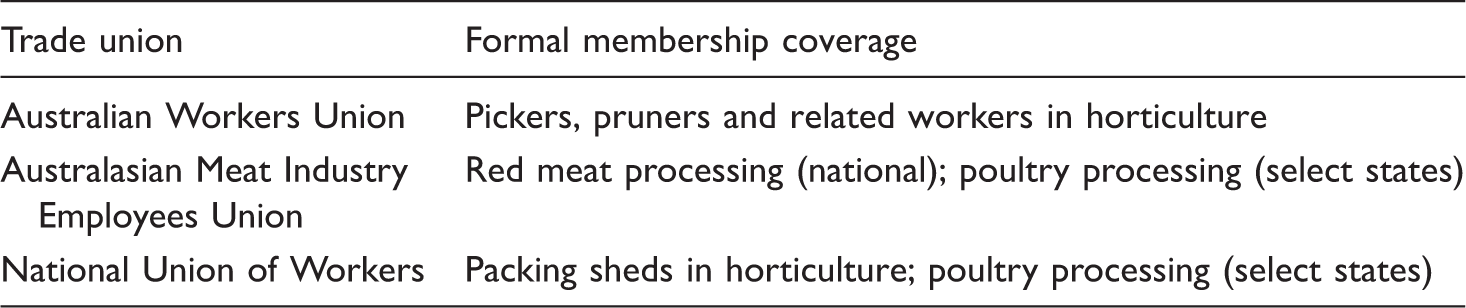
In this section we do not consider the AWU which has until very recently been inactive in recruiting WHMs. For example, an AWU organiser who focused on pacific islanders hired under the Seasonal Worker Programme described how when he visited farms with other types of TMWs, ‘the workers immediately run away as soon as I drive up … they think I am immigration official’. As the only union official within 400 kilometres, he found it impossible to organise these TMWs. They ‘move in and out of farms too quickly to access them … Workers move on before problems are resolved’ (Interview, AUW organiser, 8 February 2013). Instead we focus on the AMIEU and the NUW. Both unions share several key characteristics. As organisations registered under the Fair Work Act 2009 (Commonwealth), they have a strong formal role in collective bargaining and award enforcement. To support these activities, they are committed to recruiting members both to raise funds and to prevent ‘free-riding’. Committed to the organising model adopted by many Australian unions over the past 20 years, both charge reasonably high subscriptions, in excess of 1% of pay. For TMWs on short-term visas with instrumental attitudes to unionism (they expect to get back what they pay in), high subscriptions can be a significant disincentive to membership. However, pressure to introduce cut-price membership for TMWs has been resisted by food industry unions on the grounds that this would alienate existing Australian members.
The two unions differ in their approach to TMWs. The AMIEU has a strategy which we describe as ‘traditional self-reliant’. Possessing a long tradition of strong workshop organisation in both red meat production (which is seasonal) and poultry production (which occurs year-round), the union once enforced at the workplace level almost 100% membership in a workforce which was largely Australian. However, the industry has since undergone seismic change with a nationwide decline in union density to approximately 45% of the 55,000 workers in meat and poultry processing, and a shift away from Australian blue-collar workers (Jerrard and O’Leary, 2015; note official union density data are not disaggregated to food sectors within manufacturing) towards skilled visa holders from Latin America, and low-skilled Asian WHMs. Moreover, the industry has become consolidated under Brazilian, North American and Japanese owners, some of which are strongly anti-union.
The AMIEU was an important site for this study because of its reputation for actively recruiting and representing TMWs in Newcastle and Northern New South Wales. The union now embraces the migrant component of the workforce as the only way to hold membership and maintain minimum standards across the 16 meat and poultry processing plants which it organises. The AMIEU’s position on migrant workers is clear: ‘contrary to redneck hopes, we cannot stop migrants. What we want is proper regulation of employment conditions’ (Interview, AMIEU Branch Secretary, 5 July 2017). Over the past five years, the AMIEU claims to have recruited approximately 5000 WHMs, although high labour turnover (caused by short visa duration) means that the stock at any one time is considerably smaller and is at present unquantified. While TMW recruitment was originally driven by paid organisers, it is now assisted by strong shop floor organisation. The example was given of Baiada (Beresfield), a poultry processing plant with 1200 workers (85% unionised). Two-thirds of the workforce is made up of Australian working-class women, the remainder being TMWs. Racist attitudes initially blocked their recruitment by the union. However, over the past five years, media exposés revealed to local workers the full extent of WHM exploitation, and exclusionary sentiments turned to support (ABC, 2015; Ferguson, 2016; Interview, AMIEU Branch Secretary, 5 July 2017).
TMW recruitment depends on three traditional techniques similar to those used by Australian unions in the early post-war period (Quinlan, 1983). These methods entail the use of existing rank and file organisation in the workplace, employing organisers of the same ethnicity as TMWs (akin to the American approach of ‘like recruits like’), and using multi-lingual communication. To illustrate, since 2012, Taiwanese and Hong Kong Chinese organisers have been employed to organise workers from the same background, while a bi-lingual office manager offers additional translation skills. One organiser of Chinese origin was especially highly regarded after ‘going underground’ as an employee to uncover substandard employment conditions at two workplaces (Interview, AMIEU Research Officer, 5 July 2017). The union also makes active use of multi-lingual communication. In 2015, it commenced a national ‘Backpacker’ campaign to contact WHMs, a multi-lingual call centre was established by the federal office in 2014 and the AMIEU runs a multi-lingual website in five languages (English, Korean, Vietnamese, Chinese and Portuguese). These conventional methods have delivered some success, allowing the union to declare ‘we are proud of growing through international workers’ (Interview, AMIEU Branch Secretary, 5 July 2017). However, these methods are not new. Nor do they need to be because of the structure of meat production in large relatively stable workplaces, the longer duration of TMW jobs (TMWs often stay up to two years in one workplace when contractors evade the notional six-month visa limit on employment with a single employer) and because of existing union strength. These factors combine to render the old ways effective at netting TMWs as members.
While the traditional self-reliance of the AMIEU negates any need to draw upon the external ingredients of network collectivism, it does have some involvement with a Taiwan-based offshore training company (OJEA) which recruits WHMs to work in Australian meat production. The AMIEU videoconferences into OJEA training sessions to give briefings in Chinese to future WHMs about their employment rights and unionism, and provides an ‘expression of interest’ form on the OJEA website to enable WHMs to join the union (Interview, AMIEU Branch Secretary, 5 July 2017). However, this is the full extent of external networking.
In contrast, the NUW’s ‘networked’ approach to TMW mobilisation operates as a more comprehensive package. To a degree, this reflects the greater recruitment challenges facing the NUW which organises farm workers in packing sheds throughout Australia, and poultry processing workers in several states. Union membership was traditionally strongest among the more stable poultry workers and weakest in the packing sheds where a seasonal workforce was scattered on remote farms. However, growing awareness of the exploitation of pickers moving product into packing sheds contributed to the development of a more expansive view of union jurisdiction. The NUW now targets the entire food supply chain from farm to supermarket, irrespective of formal jurisdictional coverage by other unions. This ambitious plan to organise the whole food industry has taken it into areas of employment (notably harvest work) where there was no tradition of strong workplace unionism on which to build. Further developments encouraging this expansion include increased concentration of year-round factory farming among a handful of very large businesses supplying produce to Australia’s supermarket duopoly – a void where big businesses had operated union free (Schneiders, 2015). In addition, the union espouses an ideological commitment to recruiting and protecting all exploited workers, including undocumented workers for whom it is seeking an amnesty against deportation (Interview, NUW National President, 21 July 2017; NUW, 2018).
Early efforts to recruit TMWs in farm work resembled the ‘like recruits like’ approach of the AMIEU. The NUW first hired a Taiwanese WHM to organise fellow nationals in Western Australian packing sheds. In 2014, a second Taiwanese former-WHM was recruited, followed by additional WHM ‘member’ organisers in four states. These organisers were hired to recruit and translate but not to negotiate collective agreements. Due to visa restrictions, these initial WHM hires were casual appointments, employed for only 6 months. However, in 2015–2016, the NUW decided the old top-down approach (to hire translators and temporary immigrant organisers) was not sufficient, and invested heavily in what it calls the ‘Farm Team’. The aim of the Farm Team is to grow membership and enforce employment standards in an industry that lacks a union presence, and it now has the fastest growing membership of any part of the NUW. The Farm Team is headed by the National President and a State Secretary and has 10 full-time member organisers plus 20 part-time recruiters who also hold full-time food industry jobs. The latter are paid overtime rates by the NUW to recruit at night within their ethnic community. These organisers and activists reflect the ethnic mixing pot of TMWs and refugees found in the food industry workforce, including Sudanese, Somali, Afghan (Hazari), Cambodian, Vietnamese, Taiwanese, Hong Kong Chinese and Myanmar (Rohingya). In some cases, part-time recruiters have been developed into full-time organisers (Interview, NUW Secretary, 21 July 2017). This ambitious initiative is not without challenges, including resistance to TMW organisers by Australian working-class organisers and members.
Supplementing its own organisational resources, the NUW has extended its reach to TMWs through an innovative networked approach. Important here is the NUW’s relationship with United WHY, which comprises three social media-based groups covering Taiwanese, Korean and Hong Kong workers. The NUW hired one of the founders of the Taiwanese Working Holiday Youth (T-WHY) Facebook site (a former Taiwanese WHM) as an organiser, and also collaborates with United WHY on joint campaigns. This Taiwanese organiser also established a separate NUW Facebook site in Chinese which has 7000 followers, more than any other individual NUW site (Interview, NUW organiser, 21 July 2017). Forming alliances with social media groups has been described as offering tangible offline benefits to unions ‘reaching out to non-labour organisations and grassroots groups that already have a solid presence on social media’ (ETUI, 2018: 7). The highly itinerant nature of TMWs in Australia, and their low level of English language skills make these multi-lingual alliances critical to reaching many TMWs. The links into the WHM community via social media enable the NUW to reach out to Asian WHMs irrespective of their workplace location and access to the union. The NUW has also developed transnational union relations in two WHM source countries, employing an organiser to recruit members in Taiwan while working closely with the HKCTU which promotes NUW membership to outbound WHMs. The NUW’s aim is to build an offshore union organisation to recruit members ‘at the point of departure’ (Interview, NUW National President, 21 July 2017). Finally, the union has also developed alliances with Australian community groups, notably the Salvation Army, the Uniting Church in Australia and the Australian Catholic Religious Against Trafficking in Humans who share the fight against human trafficking and modern slavery. These network collaborators are discussed in the following section.
While this networked approach raises WHM awareness of the role of the NUW and provides them with a focal point for raising individual workplace grievances, it has yet to succeed across the board in recruiting large numbers of members which remains a key union objective. Evaluating the relative likelihood of WHMs, seasonal pacific workers and undocumented workers joining the union, the NUW now considers WHMs to be the most difficult group to recruit because of their instrumental attitudes and short duration visas. For example, one young Korean worker stated that ‘the purpose is not to stay long, but to stay [long enough] for the second visa … so there isn’t enough time to build a trade union’ (Warrnambool focus group, 9 December 2017). Another spoke of their sense of powerlessness ‘we are all here for the second-year visa; I need to get the 88 days asap … when we are facing the employment rights issue, all we can do is just let it go and leave’ (Robinvale focus group, 7 December 2017). An acceptance of enduring harsh exploitative conditions for the sake of earning a second year visa pervades WHMs. An Irish picker back in 2013 described how he considered his employment ‘kind of like slave labour for a second year visa’ (Mildura focus group, 7 February 2013). And little has changed since according to a Taiwanese picker ‘It’s [farm work] too far away from anywhere. Also, the cash-in-hand, undocumented workers network has already been set up. It’s impossible to fix it’ (Robinvale focus group, 7 December 2017). Yet, there is also evidence that WHMs will collectively protest wage theft when the loss of pay is sufficiently severe. A WHM described how ‘the contractor didn’t pay 40 people … They waited 5 hours in front of the contractor’s house, then contractor came with the money …’ (Maffra focus group, 23 January 2013). This ad hoc willingness to protest, however, has not translated into a widespread readiness to join a trade union. Responding to the difficulty of recruiting WHMs, the NUW has now strengthened its focus on pacific island seasonal workers and undocumented workers (including those who have transitioned to a protective visa) whose longer job duration is taken to mean they are easier to recruit (NUW, 2019).
Network collectivism: United WHY, global union federations and community groups
The non-union components of network organisation share with the AMIEU and the NUW a common objective to protect the employment conditions of TMWs. However, their organisational characteristics are quite different. They have no standing in formal processes of collective bargaining and award enforcement, they have limited resources, and most often, they do not recruit members. However, their advantage over unions is their capacity to gain access to TMWs by leveraging low-cost, same language immediate communication through community networks. This section analyses the three components of network organisation drawn upon by the NUW including ethno-specific social media groups, transnational union relations and community groups including churches.
The first component of the network approach is made up of three ethno-specific social media groups: T-WHY, Korean Working Holiday Youth (KOWHY) and Hong Kong Working Holiday Youth (HKWHY). Combined, these three form United WHY, a lobbying group that makes submissions to Governments, alerting them to the nature of WHM exploitation and the need for tougher labour regulation.
Most active of these social media groups is T-WHY, founded in 2014 by two Taiwanese WHMs aggrieved about their employment conditions. Relying upon a group of WHM volunteers, the T-WHY orchestrators are vulnerable to turnover as key individuals’ visas expire, creating a need for the ongoing recruitment of new activists or conversion to permanent residence. Only one of the original T-WHY activists now remains in Australia, although some returnees to Taiwan remain involved and T-WHY is well known and highly regarded among WHMs (Interview, NUW organiser, 17 January 2017; Underhill et al., 2018). In 2018, it received official recognition as an NGO in Taiwan, allowing access to Taiwanese funding to support activities such as information workshops in Australia. However, it still relies upon volunteer labour to maintain an active presence online. Its Facebook site currently has over 10,800 followers. The second group, KOWHY, was formed in 2015 by volunteers (one of whom had undertaken an internship with the NSW peak union body, UnionsNSW). Its Facebook site has over 1500 followers. HKWHY is the third and least active group, with 1870 followers. Formed in 2015, it has no local activists in Australia, operating instead from the offices of the HKCTU – the non-Beijing aligned union federation in Hong Kong.
All three social media groups operate active Facebook pages which provide translations of official information about employment standards. They also channel employment grievances to relevant unions, the Fair Work Ombudsman (FWO), community groups and even the local police. The T-WHY website publicises information sessions about Australian employment rights. Held in both Taiwan and Australia, these are run by T-WHY, the NUW and supported by the Taiwanese government. It also seeks to mobilise WHMs by publicising union rallies and activities. Likewise, KOWHY produces a Korean language Australian Employment Guidebook and holds consciousness/awareness raising seminars to induct WHMs into Australian working life. One such event in 2016 was funded by the Korean Embassy and brought in participants from the FWO, police, the NUW, UnionsNSW and the Australian Human Rights Commission. KOWHY too suffers from orchestrator turnover as activists’ visas expire. However, external organisations (including UnionsNSW) helped establish KOWHY while others (including the Salvation Army) are committed to finding fresh volunteers to continue its activities (Interview, KOWHY, 12 December 2016; Interview, Salvation Army officer, 12 December 2016). HKWHY’s main activities are to maintain a site publicising employment rights information, and to run information sessions in Hong Kong for outgoing WHMs. Like other social media groups, HKWHY also suffers orchestrator instability. In 2018, a second competing HKWHY Facebook site was developed by a TMW in Australia who has since returned to Hong Kong. The ease of setting up a social media platform has its drawbacks; neither of the competing HKWHY groups possesses sufficient resources to meet the needs of TMWs from Hong Kong, or achieve the level of activity demonstrated by T-WHY and KOWHY. Without strong local links, both HKWHY sites are primarily information providers rather than mobilising or servicing sites.
While United WHY and its three constituents are fragile bodies, their impact should not be discounted. Our focus groups found substantial evidence of reliance upon T-WHY and KOWHY among Taiwanese and Korean TMWs to locate information on employment rights. ‘The thing about [official] online information, is most are English, no one like to read it. I will use Facebook group [KOWHY] or Line group if I have any Working Holiday Visa related questions’ (Warrnambool Focus group, 9 December 2017). Poor English comprehension creates a major barrier, particularly for Taiwanese and Korean WHMs seeking support on employment problems in Australia (Underhill et al., 2018). These social media groups fill that communication gap, establishing links with those who cannot understand English-language information and services.
Transnational union relations make up the second component of network collectivism. Most Australian unions (including the AMIEU and NUW) take an interest in international industry-based union groups. However, the NUW goes beyond such tokenism and has built stronger ties with union activists in TMW source countries for the purpose of recruitment. Relations with the HKCTU are most developed. They began after a HKCTU official returned to Hong Kong following time working in Australia as a WHM. Critical of the conditions he encountered, he encouraged the HKCTU to provide information sessions for outgoing WHMs. These activities evolved into a relationship with the NUW which was consolidated further through the establishment of a Memorandum of Understanding (MOU) between the HKCTU and the NUW in 2015. Under the aegis of the International Union of Food Workers, this MOU constitutes an in-principal agreement for the NUW to assist Hong Kong WHMs (IUF, 2015). The HKCTU now issues workshop attendees with a free NUW green member card which entitles them to union assistance once in Australia (Interview, HKCTU organiser, 18 November 2016). While both the HKCTU and the NUW would like to see WHMs join as paying members, it is understood few do. The NUW has also placed an organiser in Taiwan to recruit outbound WHMs and educate them about employment conditions in Australia. This organiser first worked for the NUW in Australia and was retained on the expiration of his Australian WHM visa. Working with major labour hire companies in Taiwan, he co-organises pre-departure seminars where he recruits members and coaches them about their rights (Interview, NUW organiser, 17 January 2017). This arrangement has been sustained for four years, but is under review.
Community groups, including church groups, are the third ingredient in network collectivism. They also take an interest in the employment conditions of TMWs, arising from deeper concerns with human rights issues, especially the rise of modern slavery. A central development was the formation of the Freedom Partnership Campaign against modern slavery led by the Salvation Army working in conjunction with the Federation of Ethnic Communities Council of Australia (FECCA, 2016; Freedom Partnership, 2016). This alliance disbanded in 2018 following the enactment of anti-modern slavery legislation by the Australian government. However, an ongoing community collaboration survives in the form of the Migrant Workers’ Rights Network, which combines the Salvation Army, academics, unions and KOWHY to lobby for policy changes that affect TMWs. These community groups tend to operate at two levels. First, at a national level they lobby for policy and legislative change. Second, at a local level, churches and other community groups offer pastoral care to Asian TMW communities. TMWs often rely on churches for support over diverse issues including visa and employment rights. Focus groups and interviews found extensive evidence showing that local chaplains were widely accepted by co-ethnic TMWs as a rallying point for support, particularly in rural areas where workers are socially isolated. Overall, union collaboration with community groups and churches is ad hoc, disparate and fragile, driven by temporary shared interests in specific campaigns.
Discussion
This account of the methods used to mobilise TMWs in Australian food production has unearthed variation in what have been called ‘agency repertoires’ (Tapia et al., 2015), notably the non-union options available to reach TMWs. Reflecting its workplace strength and industry concentration, the AMIEU has demonstrated ‘traditional self-reliance’, showing little involvement with external bodies to communicate with TMWs. In contrast, the NUW, breaking new ground in organising harvest workers and lacking the organisational advantages of the AMIEU, exemplifies network collectivism through its alliances with social media groups, transnational unions and community organisations. Of these alliances, the NUW comments ‘… we don’t need to dominate – we are happy with an equal exchange, even though interests are more overlapping than identical’ (Interview, NUW National President, 21 July 2017). But how productive are these alliances?
Key characteristics of organisations and groups supporting TMWs in Australia.

AMIEU: Australasian Meat Industry Employees’ Union; HKWHY: Hong Kong Working Holiday Youth; KOWHY: Korean Working Holiday Youth; NUW: National Union of Workers; TMWs: temporary migrant workforces; T-WHY: Taiwanese Working Holiday Youth.
The NUW – unlike the social media groups, offshore unions and community church groups – possesses a formal role in industrial relations which empowers it to make collective agreements, and enforce award conditions and other employment rights. To support these roles, it possesses substantial financial resources which it seeks to augment by enrolling paying members and eliminating free riders. The other groups in network collectivism lack these formal roles and resources. In particular, they can only act by indirect means, referring aggrieved workers to the NUW and other agents. This is a limited power that is sometimes unwelcome by unions if they are expected to act for non-members. While social media and community groups may proselytise on behalf of unions, they do not vet grievances to eliminate those from non-unionists – a tendency which can cause friction with unions expected to devote resources to the grievance.
Nevertheless, the NUW sees virtue in maintaining these alliances, not least because of the capacity of its network partners to communicate with mobile, remote and often non-Anglophone TMWs. While the organisers and part-time recruiters in the NUW’s ‘Farm Team’ are well resourced to recruit, there are obvious benefits to embracing the supplementary communication paths offered by United WHY, offshore unions engaging with TMWs at source and community/church groups. In many instances, TMWs with workplace (and other) grievances will go first to these network partners because of their convenient accessibility.
However, the low cost of access for TMWs to social media and community groups stands in contrast to the NUW which is seen as remote and expensive. Both the NUW and AMIEU conceded that the high level of union dues was a major disincentive for TMWs considering union membership. Instrumental attitudes to unionism (TMWs expect a concrete return) obstruct recruitment, especially when the NUW cannot assure timely resolution of grievances because of lengthy delays in legal restitution processes and the short duration of TMW visas. Nor will Australian unions accept lower fee levels for TMWs. In contrast, access to social media groups and community/church organisations is free. This comparison does not assist union recruitment.
Despite these points of dissonance with network partners, the NUW has had to support some of them financially because of their fragility. This has been especially true for the links to offshore unions. The Taiwanese organiser is paid by the NUW to recruit members, and the HKCTU (a poor cousin) would like a similar appointment in Hong Kong. In terms of resourcing, this part of the edifice appears to rest upon how well the NUW regards offshore unionism and durability has yet to be assured. Conversely, however, the orchestrators of United WHY and the independent community groups cost the NUW nothing. These parts of network collectivism would appear to be a free good to unions and TMWs as long as common cause and volunteer efforts are sustained. Remarkably, despite turnover among orchestrators, the three components of United WHY are still operating four years after they were founded.
Conclusion
As elsewhere in the world, food production in Australia has become reliant upon highly exploited cross-border workers. This workforce possesses unique characteristics in Australia which lend it to abuse. WHMs are admitted under visa conditions which breed short-termism, resignation and compliance rather than voice, mobilisation and protest. Further, like elsewhere in the world, undocumented workers have no practical means of protesting without risking deportation. Despite this unpromising environment, the article demonstrates that contrary to much received opinion, these TMWs can be mobilised although such optimism must be qualified by recognition of the prevailing conditions of adversity.
Significant here is the role of two unions who in Australia possess a de facto (although not de jure) monopoly over the rights to collective bargaining and award enforcement. Unlike community organisation in some other countries, TMW mobilisation in Australia is not possible without the involvement of unions. Their approaches are not uniform, reflecting variations in the conditions in which these unions seek to recruit. Thus, the AMIEU can rely on traditional recruitment methods when mobilising workplaces with a large workforce and strong traditions of workplace organisation. Conversely, the NUW is obliged to take a different approach when breaking into the less well organised, more dispersed and volatile harvest workforce. Under these conditions, network collectivism has emerged as a way to reach potential members. The elements of network collectivism have been identified in other contexts – community organising, transnational union linkages to source countries (Gumbrell-McCormick, 2011) and the creation of friending relations (Heckscher and McCarthy, 2014). Less often observed is the way a union can develop a strategy that utilises all of these ingredients together. In what appears to be a pyramidal structure, unions occupy a position at the apex because of their key role in employment relations, the other partners in network collectivism relying upon their tangible/material resources to negotiate with employers and resolve workplace problems.
Ultimately, the article highlights new dimensions of conceptual complexity around migrant solidarity. First, it explores how the multiple constituents of network collectivism possess inherently different characteristics in comparison with established union organisations. Second, it shows that the fluidity inherent in this coalition does not create a barrier to engagement by transient TMWs, rather enabling them to participate on an ad hoc basis opening multiple avenues in native languages to important information about labour rights. Third, network collectivism reinforces the sense of community among TMWs by creating points of contact and representation. While this collectivism remains fragile because of the short-term nature of TMWs’ attachment to employment in Australia, it offers an approach that could be used to support other groups of vulnerable workers which unions also find difficult to reach.
Footnotes
Declaration of Conflicting Interests
The author(s) declared no potential conflicts of interest with respect to the research, authorship, and/or publication of this article.
Funding
The author(s) received no financial support for the research, authorship, and/or publication of this article.
