



Abstract
This article deals with the development of enterprise bargaining in Australia and considers whether the goals set out in 1992 by the then Prime Minister, Paul Keating, have been realised. The article focuses in particular on the evolution of the no disadvantage test and the better off overall test, in terms of both the statutory provisions themselves and how they have been applied in practice. The article describes the decline of enterprise bargaining in recent years, from both a quantitative and a qualitative perspective, and the failure to achieve the goals set out by Mr Keating. The article concludes with a number of proposed legislative changes designed to revive enterprise bargaining in Australia.
Keywords
Introduction
In 1993, the then Australian Labor Party (ALP) Prime Minister Paul Keating set out his vision for a future of industrial relations focused on enterprise bargaining. He placed industrial relations reform as a central element of a broader micro-economic reform agenda. That agenda was designed to increase the flexibility of the economy, boost productivity, and in turn increase living standards and reduce unemployment. It is uncontroversial to state that much of that micro-economic reform agenda has been delivered and many of the anticipated benefits have been realised. However, what is not so clear is whether the industrial relations reforms outlined by Keating have been achieved. There is no doubt that Australia’s system of wage determination has undergone dramatic change since the early 1990s. However, the original goals that enterprise bargaining would dominate pay fixation and that awards would become a mere safety net have not been fully realised.
This article outlines the increasingly limited reach of enterprise agreements, both in coverage and quality, and the continued pervasive influence of awards in the Australian industrial relations system. It concludes with some proposals for reform to bring the enterprise bargaining system back into line with the goals outlined by Keating in 1993.
Paul Keating’s grand vision
Between its election in 1983 and 1991, the Hawke Labor Government presided over a highly centralised wage-fixing system which sought to limit all wage increases to those provided for in a set of wage principles determined by the Australia Industrial Relations Commission (AIRC) in a series of National Wage Cases. The vast majority of employees were covered by either federal or state awards which contained detailed provisions governing wages and conditions of employment. While many private sector employees received some level of ‘over award’ pay, in practice the only wage increases permitted by the wage-fixing principles during this period were those contained in awards of the AIRC (or its state counterparts).
This centralised system was seen by its critics as diverting attention from relationships at the workplace level, thereby, amongst other things, impeding productivity growth (and thus higher living standards) as well as more generally contributing to rigidities in the Australian economy (see e.g. Industrial Relations Study Commission, 1989).
In 1991, in at least partial recognition of these criticisms, the ALP Government and its Accord partner, the Australian Council of Trade Unions, persuaded the AIRC to adopt principles for bargaining at the enterprise level. These were subsequently reinforced by changes to the legislation to create a new form of statutory workplace agreement (known as Certified Agreements).
In April 1993, weeks after the ALP Government had been re-elected, Prime Minister Paul Keating made a major speech to the Australian Institute of Company Directors (AICD; Keating, 1993). Setting out a programme of micro-economic reform, Keating said there was a need to accelerate industrial relations reform ‘so that all the other elements of flexibility in the economy can work in greater harmony’.
Keating described the model of industrial relations he said the government was working towards. It was, he said: a model which places primary emphasis on bargaining at the workplace level within a framework of minimum standards provided by arbitral tribunals. It is a model under which compulsorily arbitrated awards and arbitrated wage increases would be there only as a safety net. This safety net would not be intended to prescribe the actual conditions of work of most employees, but only to catch those unable to make workplace agreements with employers. Over time the safety net would inevitably become simpler. We would have fewer awards, with fewer clauses. For most employees and most businesses, wages and conditions of work would be determined by agreements worked out by the employer, the employees and their union.
Thus, the goals set by Keating included the following:
most employees would have their pay and conditions determined by enterprise agreements; there would be fewer awards, containing fewer provisions; and agreements would be comprehensive rather than being ‘add-ons’ to awards.
Legislation over the last 30 years
It is interesting to ask the question – to what extent have governments (of either political persuasion) legislated in line with the goals set by Prime Minister Keating?
Over the course of the last 30 years there have certainly been several major changes to the legislative framework governing industrial relations in Australia. All have retained an award system while providing scope for bargaining at the workplace or enterprise level. Nevertheless it is reasonable to infer that throughout this period the majority of employees remained covered by the provisions set out in the applicable award and that these continued to be legally enforceable unless overridden by means of a formal agreement (which generally required approval by an industrial tribunal or similar body). 1
1993 – ALP Government
In 1993, the ALP Government implemented the Industrial Relations Reform Act 1993, purportedly to implement the direction outlined by Paul Keating in his AICD speech.
It included provisions to facilitate enterprise bargaining – including a new industrial instrument, Enterprise Flexibility Agreements (EFAs), that were designed to allow non-union workplaces to make their own agreements to reflect their particular circumstances.
For agreements to have legal effect they had to be certified by the AIRC. Once certified or approved – in the case of EFAs – they could override award provisions or state laws governing pay and conditions such as annual leave that would otherwise apply – but the Commission could only approve them if it was satisfied that they passed the ‘no disadvantage test’ (NDT).
The AIRC was required to consider whether the certification of the agreement would result in the reduction of any entitlements or protections which the employees enjoyed under an award or under any other law that the AIRC considered relevant. If the AIRC decided that a reduction in a particular entitlement would occur, it was required to determine whether, in the context of the terms and conditions of the employees concerned as a whole, the reduction would be contrary to the public interest. If so, the agreement would be taken to fail the NDT.
The Explanatory Memorandum to the legislation explained that the objective of the provision was to balance on the one hand the capacity of the parties to an agreement to decide on arrangements about work and related matters, and on the other hand to ensure that such arrangements were not unfair to the employees concerned by reducing the employment standards that applied to them.
The AIRC was required to exercise its judgement to weigh up all the relevant factors. The AIRC was also given the power to accept undertakings from the employer if the AIRC thought that they were necessary to meet any concerns it had about whether the NDT was met.
The legislation provided for some minor tinkering with awards, but contained no provisions to achieve Paul Keating’s objectives of ‘fewer awards, with fewer clauses’.
1996 – Coalition Government
The Keating Government was replaced in March 1996 by a Coalition government with a commitment to further industrial relations reform. Individual statutory agreements (Australian workplace agreements – AWAs) were introduced and EFAs were replaced with a new form of ‘non-union’ Certified Agreements.
Both Certified Agreements (whether union or non-union) and AWAs were subject to the same, slightly revised, NDT. An agreement would fail the NDT if the agreement would result, on balance, in a reduction in the overall terms and conditions of employment under any relevant award or state legislation (Workplace Relations Act 1996, Part VIE).
A process of ‘award simplification’ was mandated by the legislation, though in practice most award provisions – especially those that had financial implications – were retained, and this process therefore had little effect on the operation of the NDT.
The Coalition Government introduced further legislative reforms (Work Choices) that took effect in 2006 (Workplace Relations Amendment Act (Work Choices) 2005). This legislation removed the NDT and replaced it with a set of legislated minimum conditions, the Australian Fair Pay and Conditions Standard. It also considerably broadened the scope of the federal system to include the vast majority of private sector employees.
While the legislation contained provisions to rationalise the number of awards and reduce award complexity, the process had to be initiated by the Minister – something that never occurred.
There was a major backlash against the legislation, particularly the abolition of the NDT, and the government revised the legislation in 2007 to provide for a ‘Fairness Test’ for employees earning less than $75,000 (Workplace Relations Amendment Act (A Stronger Safety Net) Act 2007). This required agreements to provide ‘fair compensation’ for applicable employees, in lieu of any changes made to award conditions that would otherwise apply. The test was administered – not by the Commission – but by a separate statutory agency, the Workplace Authority.
2007 – ALP Government
In 2007 the Coalition government was swept from office – partly as a result of the unpopularity of its industrial relations reforms. The Fairness Test was abolished, and the NDT reintroduced on a transitional basis by the Workplace Relations Amendment (Transition to Forward with Fairness) Act 2008 (2008 Act). With the passage of the Fair Work (Transitional Provisions and Consequential Amendments) Act 2009 (the Transitional Act) a ‘bridging period’ was established during which the AIRC resumed its role of applying the NDT.
However, under the subsequent Fair Work Act 2009 (FW Act) agreements made after 1 January 2010 had to be approved by the successor body to the AIRC, Fair Work Australia. The NDT was replaced with a new test – the better off overall test (the BOOT).
The only form of agreement recognised under the FW Act is that of enterprise agreements. Such agreements are made between an employer (or in some cases a number of employers) and its (or their) employees. Employers are obliged to negotiate ‘in good faith’ with bargaining representatives (including unions) appointed by employees, though there is no obligation on employees to appoint bargaining representatives. (Unions are ‘default’ bargaining representatives for their members.) There a number of procedural steps required before an agreement can be made and become legally enforceable. Inter alia, the tribunal must be satisfied that the agreement passes the BOOT, with some very limited exceptions. The tribunal, known now as the Fair Work Commission (FWC) can require the employer to provide undertakings if necessary, to ensure that the BOOT is met (FW Act, s190).
Under the BOOT the tribunal must be satisfied that each employee or prospective employee will be better off overall if the enterprise agreement applies instead of the relevant modern award that would have applied to that employee (FW Act, s193).
The 2008 Act provided for a process of award ‘modernisation’. ‘Modern awards’ would be created to come into effect from 2010 that would be ‘simple to understand and easy to apply’, be of ‘a safety net character’, would ‘promote flexible modern work practices and efficient and productive workplaces’, and be in a form that ‘promotes collective bargaining’ ([2008] AIRC 387 at [1]). The FW Act provided for a further 4-year award review process (FW Act, s156).
The process of establishing modern awards and then reviewing them was and continues to be a mammoth exercise. At the very least, it has certainly achieved Paul Keating’s goals of reducing the number of awards. Thousands of federal and state awards have been replaced with 122 modern awards.
However, it is less clear that the goal of making awards simpler, with fewer clauses, has been achieved. As an example, compare the award that until the nationalisation of the system under Work Choices probably covered more employees than any other award – the New South Wales Clerical and Administrative Employees (State) Award (NSW Clerical Award). As it stood at November 2006 it contained 34 clauses, plus two tables setting out Adult and Junior Wages, plus an extra table setting out and wages for telephone canvassers and another table containing various allowances. By comparison the modern award that replaced it, the Clerks – Private Sector Award 2010 (Clerks Modern Award) as it stood at the end of 2019, contained 33 clauses, together with eight schedules. This is even though a number of the provisions in the NSW Clerical Award (covering matters such as personal leave) are now in the legislated National Employment Standards. Moreover, employees who earned more than 15% above the highest rate in the NSW Clerical Award were exempted from most of the provisions of the award. This is not replicated in the Clerks Modern Award, though it should be noted that there are limited provision for ‘annualised salaries’ and ‘individual flexibility arrangements’.
It should be noted that while many award-covered employees receive ordinary rates of pay in excess of those set out in the award (for example, research conducted for the FWC in 2013 by the Workplace Research Centre at the University of Sydney Business School found that a mere 19% of private sector employees were paid only the award rate) that does not alter the obligation to comply with the provisions of the award (Wright and Buchanan, 2013). Those provisions typically cover a wide range of matters that substantially regulate the employment relationship, including classifications, types of employment and perhaps most importantly working time arrangements.
How have the NDT and the BOOT been applied in practice?
Given the significant roles they have played in the industrial relations system over most of the last 30 years it is important to consider how the NDT and the BOOT have operated in practice. The way in which these tests have operated has greatly affected the ability of organisations to make agreements that reflect their own circumstances rather than simply follow the arrangements set out in awards.
There has been some diversity of approach between different tribunal members – at least until late 2016 when the FWC adopted a more centralised approach to the agreement approval process (the ‘administrative triage’ process).
A number of issues have arisen in how to approach the application of the NDT or the BOOT. One concerns what weight, if any, should be given to the preferences of the employees covered by the agreement. A related issue is what weight one should give to the practical effects of any changes made to the terms and conditions of employment embodied in an agreement.
These issues can be demonstrated by considering the following example: take the fairly standard example of an award that has a ‘span of hours’ provision that provides that ordinary hours of work cannot commence before 6:00 a.m. Any hours worked before that time are not ‘ordinary hours’ and therefore attract overtime rates. Imagine a situation where the employees working for a particular employer would prefer to start work earlier than 6:00 a.m. (perhaps so they can finish their shift earlier in the afternoon). The employer in question is willing to start the shift at the earlier time, but is not willing to pay overtime rates, as this would be uneconomic. The employees and the employer make an enterprise agreement changing the span of hours so that it commences at 5:00 a.m., thereby enabling them to start their shift at that time. Let us assume there are no other differences between the agreement and the award. Should the FWC find that the agreement passes the NDT (or the BOOT)?
Under an approach that considers the preferences of the parties and the practical implications of the relevant agreement, the agreement in question would pass the NDT. When compared to the award, the only change is one that better meets the preferences of the employees, by enabling them to start work at 5:00 a.m. rather than 6:00 a.m. From their perspective they are ‘better off’, let alone not ‘disadvantaged’. I will call this approach the ‘evidence-based approach’ as it relies on evidence of employee preferences and/or the practical impact of the agreement on the actions of the parties involved.
Applying the BOOT in the example given might be more problematic. Even though the employees who made the agreement prefer to start work at 5:00 a.m., it is conceivable that a ‘prospective employee’ might prefer to start work at 6:00 a.m. The problem with ‘prospective employees’ is that they only exist in theory at the time the agreement is made – and there is no way of testing their preferences. One possible way around this might be a provision in the agreement that would allow any future employees to choose whether they wish to start work at the earlier time. Only if this is their preference (as opposed to something mandated by their employer) would they be paid at the ordinary rate.
This evidence-based approach gives weight to the preferences of the employees concerned as well as the practical effect of making the agreement – that the employer would be willing to start the shift at the earlier time in line with the employees’ preference if the enterprise agreement was approved. Under this approach the FWC would need to make an evidentiary finding that these are the facts.
However, there is an alternative approach. Under this approach one focuses simply on the text of the agreement and compares it to the text of the award. There is no regard to any evidence that may be available about the employees’ actual preferences or any practical effect of approving the agreement. This approach simply notes that under the award employees receive overtime rates of pay for time worked between 5:00 a.m. and 6:00 a.m., while under the agreement they receive ordinary rates. This is a disadvantage, and under this approach – if there are no other countervailing benefits – the agreement fails the NDT. I will call this the ‘text-based’ approach.
The evidence-based approach is consistent with a philosophy that the parties themselves are generally best placed to judge their own interests. Under this philosophy the role of the NDT (and/or the BOOT) is only to ensure that the employer is not able to use its power to force employees to make agreements against their own interests. Under this approach the issue before the tribunal with the change in the span of hours is an evidentiary one – is this something the employees actually want as opposed to being pressured into against their will?
Under the second, text-based approach the employees’ preferences are not considered to be relevant, nor are the practical implications of the agreement – that is, that the employees would now be able to start work at an earlier time. After all, as the proponents of this approach would point out, there is nothing in the text of the award that prevents the employer from starting work at 5:00 a.m. (even though it may not be willing to do so in practice).
In fact, both approaches have been used by members of the FWC at various times. However, it is the text-based approach that has generally been supported by full bench decisions and has come to dominate the way the FWC now deals with the BOOT.
One issue that has arisen that illustrates the differing approaches of Commission members (and the preference of the full bench for the second approach) is that of ‘voluntary additional hours’.
Many employers regularly need to find additional labour often at short notice, for a variety of reasons (for example, sick leave, unpredicted increases in workloads, etc.). Many employers will use casuals to perform such work (especially where the work is relatively unskilled) rather than giving it to their permanent workforce as overtime, because of the higher rate of pay that overtime attracts. This is despite the fact that members of the permanent workforce would in many cases like to be given the opportunity to work additional hours. It is simply cheaper for the employer to employ casuals rather than pay overtime to their permanent workforce, even though all other things being equal they might well prefer to give their existing employees the opportunity to earn more. One way of providing a solution to this dilemma that has often been suggested is by allowing for voluntary additional hours to be worked at ordinary rates of pay (while compulsory overtime is still paid at overtime rates). This makes it economic for employers to give the extra work to those in their permanent work force who wish to do that work.
This issue came before the Commission in 2003 in relation to the approval of a certified agreement for a group of security officers. Senior Deputy Polites approved the agreement at first instance. However, it was subsequently overturned by a full bench. In its decision (‘Security Officers’) the majority of the full bench said (at [79]) (footnotes omitted): We fail to see how the distinction between hours performed beyond ordinary hours at the employer’s direction and hours performed with the voluntary agreement of the employee is available for the purpose of applying the no-disadvantage test, given the terms of the Award. To the extent it was relied upon, Polites SDP relied on an irrelevant matter and misconstrued and misapplied the no-disadvantage test. That test is to be applied by reference to the terms and conditions of the competing instruments – the Award and the Agreement. (MSA Security Officers Certified Agreement, 15 September 2003, PR930723)
For example, in 2010, in Fanoka (Application by Fanoka Pty Ltd T/A Fairview Orchards & Anors, 1 March 2010 [2010] FWA 2139), Senior Deputy President Richards approved 102 single enterprise agreements in the agricultural industry which featured voluntary additional hours clauses. The agreements were subject to the NDT because they had been made during the ‘bridging period’ under the Transitional Act.
In considering whether the clauses met the NDT, Richards SDP heard evidence from employers that they limited employees to working 38 hours a week because slim margins prevalent in the sector meant they could not afford to pay overtime.
Employee evidence suggested that they would be keen to take on extra hours, even without overtime rates, provided it was up to them whether or not to take on the work.
Richards SDP found that, on balance, the clauses satisfied the NDT, taking into account that they would:
enable employees electing to work extra hours to earn more than they otherwise would, allowing them to offset periods where work was scarce; reduce transaction costs flowing from the need to move between employers to seek extra hours; increase flexibility in the hours when work must be performed; and protect employees from disadvantage because extra hours could only be worked at their initiative and, because employers strictly limited employees to 38-hour weeks, there were very few hours available at the overtime rate in any event.
Richards SDP focused on the practical effect of the agreements and the ability of the employees to exercise a voluntary choice about whether to work the additional hours. He said (at [49]): … the voluntary additional hours clauses in the agreements have tangible value to the employees to be covered by the agreements, particularly so where the arrangements are only able to be initiated by the employee and where there is no meaningful loss of an opportunity for paid overtime (for reason there is no demonstrable pattern of paid overtime in the industry sector in which these agreements are to operate). That is, the voluntary additional hours clauses only allow employees voluntarily to take advantage of hours of work which would otherwise not be accessible to them.
However, it was the text-based approach that was upheld by a full bench of the FWC later that same year in dealing with an appeal against a decision by Commissioner Smith not to approve an agreement involving BUPA Care Services (BUPA).
In its decision ([2010] FWAFB 2762) the full bench noted that the BUPA agreement contained a preferred-hours arrangement. Under the relevant clause employees might wish to work additional hours at particular times or on a continuous basis or during particular roster periods due to ‘personal circumstances’. Examples of personal circumstances were family and/or carers’ responsibilities and/or financial circumstances.
Under the clause in question an employee could at his or her initiative advise the employer in writing of the additional hours of work that he or she wished to be rostered to work. Where an employee requested to work additional hours on an available shift, the employer would endeavour to roster the employee to work on that shift. Employees would be paid at ordinary rates (plus any applicable shift penalties) for any additional hours worked at the employee’s request under the clause. Additional work at the employer’s request or direction would be paid at normal overtime rates.
The full bench, in upholding Smith C’s decision to refuse to approve the BUPA agreement, referred to the previous full bench decision in Security Officers. It said (at [25]): We consider the views of the majority in the Security Officers case are apposite to the appeal before us. Where there is a relevant reference instrument, the application of the “no-disadvantage test” requires a comparison of the terms and conditions of employment in the enterprise agreement against the terms and conditions of employment in any relevant reference instrument and an assessment of whether the terms and conditions in the enterprise agreement result, on balance, in a reduction in the overall terms and conditions of employment under any relevant reference agreement. The “no-disadvantage test” does not involve an analysis of matters other than the terms and conditions of the enterprise agreement against those in any relevant reference instrument. The effect the terms and conditions may have on the actions of the employer or employee is not relevant to the “no-disadvantage” test.
Interestingly, there are provisions in the Explanatory Memorandum to the FW Act which suggest that the evidence-based approach should be used in applying the BOOT. The relevant paragraphs relate to the application of the BOOT to individual flexibility arrangements (IFAs). IFAs allow employers and individual employees to make written agreements that can vary the application of awards (or enterprise agreements) if certain conditions are met, including that the employee must be ‘better off overall’ than under the applicable enterprise agreement.
Paragraph 867 of the Explanatory Memorandum gives the following example of an IFA that would pass the BOOT: an arrangement allowing an employee to start work early 2 days a week in exchange for giving up the overtime rates that work would normally attract. An illustrative example follows: Josh works as a membership consultant at a gymnasium. Under the enterprise agreement applying to his employment, the ordinary hours of work are 37 hours each week to be performed in a span between 8am and 6pm each day. Hours worked outside this span attract penalty rates. Josh’s employer usually requires membership consultants to work from 9am to 5.30pm. In his spare time, Josh coaches an under-12s footy team. To do this, he needs to be able to leave work at 4pm on Tuesdays and Thursdays each week. He wants to start work at 7.30am on these days, but usually this would attract a penalty under the terms of the agreement. The agreement allows the employer and an employee to make an individual flexibility arrangement that varies the terms of the agreement dealing with hours of work and penalty rates. Josh approaches his employer and asks whether the employer will make an individual flexibility arrangement with him under which the employer agrees that Josh can work from 7.30am to 4pm on Tuesdays and Thursdays. Josh agrees that he will not be paid a penalty on these days, even though he starts work at 7.30am. Josh is genuinely happy to agree to this arrangement because it enables him to balance his work and personal commitments. The employer agrees to this arrangement. The employer must ensure that Josh is better off overall under the individual flexibility arrangement than under the agreement. Often this will require the employer to make a comparison of the relevant financial benefits that the employee would receive under the agreement, and the agreement as varied by the individual flexibility arrangement. In Josh’s case, however, he has agreed under the individual flexibility arrangement to give up a financial benefit (penalty rates) in return for a non-financial benefit (leaving work early). It is intended that, in appropriate circumstances, such an arrangement would pass the better off overall test. Because the better off overall test is being applied here to an individual arrangement, it is possible to take into account an employee’s personal circumstances in assessing whether the employee is better off overall. Relevant factors in Josh’s case that suggest the individual flexibility arrangement is likely to pass the better off overall test are: • Josh initiated the request for the individual flexibility arrangement, suggesting that he places significant value on being able to leave work early to coach the footy team; • Josh genuinely agreed to the arrangement; the period of time falling outside the span of hours is relatively insignificant. It is only one hour out of the 37 hour ordinary week that Josh works. (Explanatory Memorandum, Fair Work Bill 2008 867)
While this discussion pertains to IFAs it is very hard to see why a similar approach should not be taken to applying the BOOT when dealing with applications for approval of enterprise agreements, at least where there is scope for individuals to exercise a choice. In particular it suggests that one needs to go beyond simply looking at the text of the relevant instruments and give weight both to employee preferences and the practical effect of the agreement on the actions of the parties involved.
Leaving aside the issue of the evidence-based approach versus the text-based approach, the BOOT is a significantly more prescriptive provision than the NDT. The difference between being ‘better off overall’ and ‘not disadvantaged’ is a relatively minor one. The biggest change introduced by the BOOT is that each and every employee who is covered by the agreement must be better off when compared to the award. Previously, under the NDT, it was open to the Commission to have regard to whether employees in general were disadvantaged by the agreement. Second, the BOOT must be met in relation not only to existing employees but also to any ‘prospective’ employee that is any employee who might be employed under the terms of the agreement. Both these changes, especially when combined with the adoption of the text-based approach, in practice make it very difficult to make an enterprise agreement that does anything more than ‘add on’ to awards.
The full implications of the BOOT only really became clear with the finding in 2016 by a full bench that an agreement made by Coles Supermarkets with the Shop Distributive and Allied Employees Association (SDA) failed the BOOT. This decision ([2016] FWCB 2887) focused primarily on the fact that at different times the rate of pay in the agreement was either higher or lower than in the award. [11] As one would expect as a matter of simple logic, the more hours that are worked during times when the Agreement rates are higher, the better off an employee will be. Conversely, the more hours worked when the Award rates are higher, the worse off the employee will be compared to the Award. In other words, if an employee works predominantly at nights or on weekends, the higher base rate under the Agreement will be counterbalanced by lower penalties payable under the Agreement at these times.
The National Secretary of the SDA, Gerard Dwyer, said at the time that this decision created a ‘new environment’ for bargaining. In particular by requiring, in effect, that the position of every single worker be better off at every single hour under an agreement, it effectively ended the widespread practice of using enterprise bargaining to ‘roll up’ penalty rates to secure higher base rates. This, he said, had been an effective avenue for securing superior wages and conditions for workers as the economy has moved away from the traditional 5-day working week (Workplace Express, 2016).
The evidence suggests that the BOOT, at least as applied by the FWC since The Coles decision, combined with the text-based approach, together with the adoption of the administrative triage process (which has ensured these approaches are applied consistently by the FWC) has made it increasingly difficult for organisations to make enterprise agreements that diverge significantly from arrangements set out in the underlying award.
Trends in enterprise agreement coverage
The goal set by Paul Keating of close to 100% of employees under federal awards being covered by enterprise agreements has never come close to being achieved.
The federal department responsible for industrial relations (currently the Attorney-General’s Department) publishes regular data on trends in coverage by federal enterprise agreements. The number of employees covered by current federal enterprise agreements indicated by this data is set out in Figure 1.
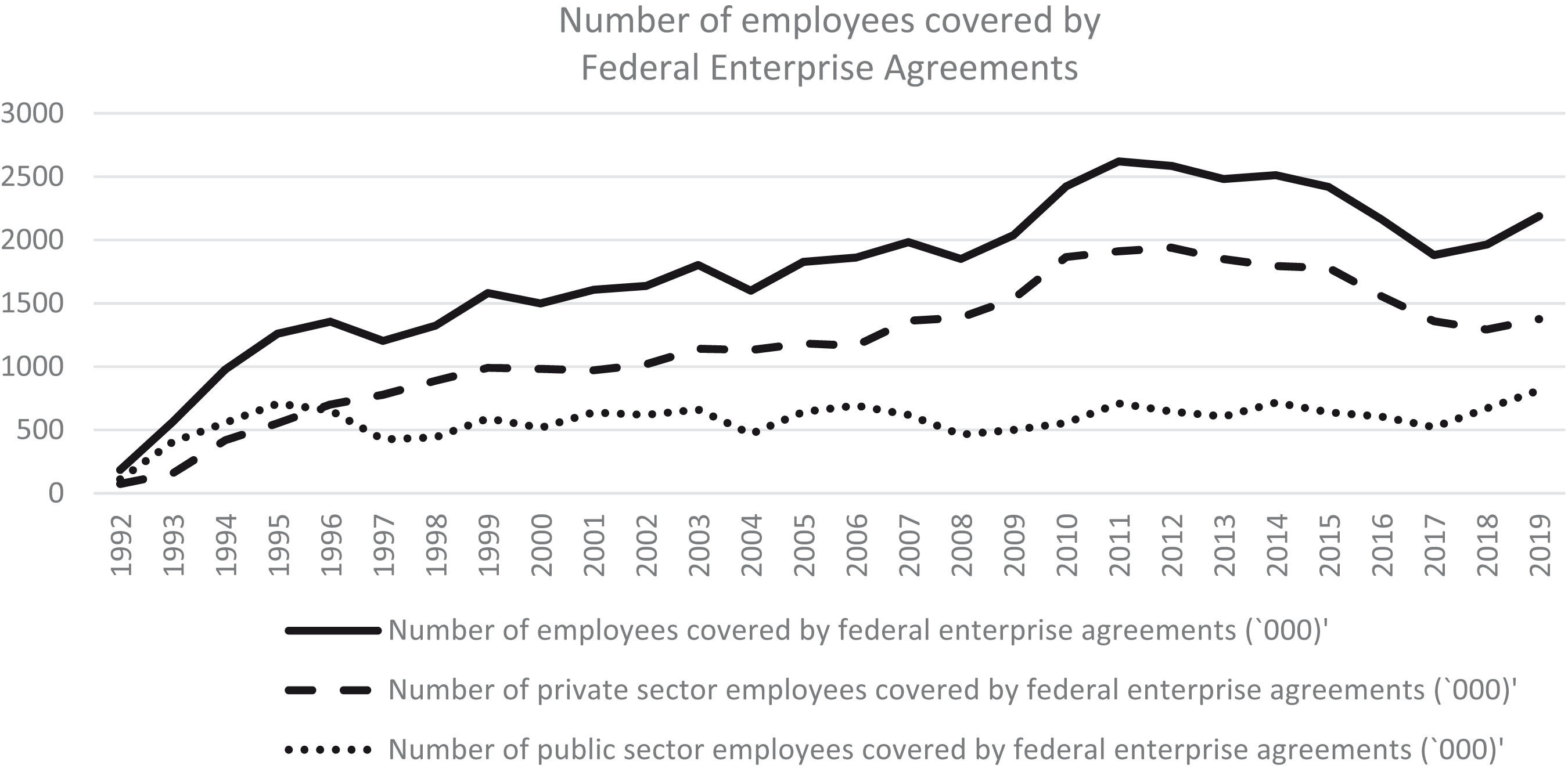
Number of employees covered by federal enterprise agreements.Source: https://www.ag.gov.au/industrial-relations/industrial-relations-publications/Pages/historical-table-current.aspx
This graph shows that enterprise agreement coverage rose consistently from the early 1990s, before plateauing from around 2010 to 2014, and has then been on a substantial downward trend. Total employee coverage is now at around the level it was 10 years earlier. It is worth noting that the total number of employees in Australia has grown throughout the period and was more than 60% larger in 2019 than it was in 1992 (Australian Bureau of Statistics (ABS) 6202.0 and 6203.0). Moreover, in the years immediately preceding 2010 Australia moved to a largely national system with the transfer of most employees from state systems to the federal system. This means that many state-based agreements were converted to federal agreements around 2009 and 2010.
The graph shows that the decline is primarily a private sector phenomenon. The number of private sector employees covered by federal enterprise agreements peaked in 2012 at 1,939,000 and is now around 30% lower at 1,375,000 – lower than it was prior to the introduction of the FW Act. Analysis conducted by Alison Pennington (2018) shows that the coverage rate for private sector workers (taking into account the growth in the overall number of employees during the period) fell from 19% in 2013 to 12% in 2017.
At the same time, the number of agreements that the Commission has found fail the BOOT – at least without the provision of undertakings – has grown significantly. This appears to reflect the more rigorous application of the BOOT in recent years (rather than any change in the nature of agreements being submitted for approval), especially since the Coles decision and the introduction of the triage process. While up until 2016 most agreements were approved without undertakings, since then over two-thirds of agreements have required undertakings to be approved (refer Image 5, FWC Annual Report 2018–2019). The effect of undertakings is often to require replacing provisions in the agreement with those set out in the award.
Concluding comments: Can enterprise bargaining be revived?
The evidence is that enterprise bargaining, at least in the private sector, is failing. The reduction in the number of agreements being made is undoubtedly due to a number of factors, including the decline in union coverage. However, the increasingly rigid application of the NDT and the BOOT is making it more and more difficult to make agreements that are anything more than ‘award add-ons’. This reduces the incentive – especially from an employer perspective – to make enterprise agreements.
Pennington (2018) suggests a range of reforms to revitalise collective bargaining. These include a shift to bargaining at the industry level, (further) restrictions on the ability to terminate agreements and increased union rights. Such changes might indeed increase the number of employees covered by agreements and would quite possibly lead to an increase in wages (Pennington’s main concern). However, they would do little to achieve the micro-economic goals set out in Keating’s AICD speech. In particular, they would do little to prevent agreements being simply ‘add-ons’ to awards.
A (possibly complementary) approach would be to revive enterprise bargaining by restoring the flexibility that the system was originally meant to encompass. In particular the BOOT should be replaced, and the NDT restored. The FWC should be able to use its judgement to approve enterprise agreements that overall do not disadvantage the employees. Whether in the text of the statute or in the accompanying explanatory memorandum and/or second reading speech, it should be made clear that the Commission should be able to have regard for evidence concerning the practical effects of the agreement for the employees as well as the preferences of those employees. Moreover, it should be made clear that the Commission should be able to make a judgement on the effect of the agreement on the employees as a collective – rather than insisting that every single employee be made better off. No doubt any such changes would be criticised by some as an attack on the safety net. However, I think it is much more likely that by making the system more flexible it will encourage the sort of ‘win--win’ agreements that can lead to increased productivity, increased wages and better conditions for workers.
Footnotes
Declaration of conflicting interests
The author(s) declared no potential conflicts of interest with respect to the research, authorship and/or publication of this article.
Funding
The author(s) received no financial support for the research, authorship and/or publication of this article.
