




Abstract
In the fields of labour market research and industrial relations research, there is increasing interest in post-colonial societies and the labour market outcomes of indigenous peoples. However, existing research has generally underexplored the Greenlandic labour market. This is particularly true for factors associated with the Greenlandic Inuit population's employment outcomes. In this article, we investigate barriers and potentials for labour market participation in Greenland, focusing on individual-level factors that promote or inhibit the likelihood of being employed. We use a unique, nationally representative survey of the working-age population and explore these factors through a series of logistic regression analyses. We find that educational attainment, positive self-assessed health, and the number of people in the household were positively related to employment. Our most important findings and contributions are that respondents who answered the survey in Greenlandic were less likely to be employed compared to those who answered it in Danish. Furthermore, if a respondent was born in Greenland, compared to being born in Denmark, it lowers the likelihood of being employed. We interpret this disparity as evidence of an ethnically segregated labour market with indications of discrimination.
Introduction: The peculiarities of Greenland's labour market and labour shortages
In the fields of labour market research and industrial relations research, there is increasing interest in post-colonial societies and the labour market outcomes and conditions of indigenous peoples, reflected in a number of publications on the topic in recent years (e.g. Charlesworth and Macdonald, 2015; Crinis and Parasuraman, 2016; Gillan and Thein, 2016; Kaine, 2017; Marshall et al., 2022; Schulze-Cleven et al., 2017).
The Greenlandic labour market and economy is no exception. In recent years, climate change, abundant resources, and geopolitical importance have brought Greenland into the limelight on the world stage. The attention directed towards this country reached a peak in August 2019, when US President Donald Trump demonstrated serious interest in purchasing Greenland from Denmark, sparking diplomatic dispute between Denmark and the United States.
Greenland is a former colony of Denmark and is presently a self-governing part of the Kingdom of Denmark. Global warming and the contracting ice cap have opened up access to the Northwest Passage for commercial shipping, exposed new potential offshore oil mining sites in the Arctic Ocean, and eased the logistics of accessing precious minerals. Hence, not only American but also Russian and especially Chinese companies have tried to gain economic footholds in Greenland and the seas surrounding it (Sejersen, 2016). The growing political and economic interests in Greenland have also sparked a strong domestic desire for more independence from Denmark. As a former colony, Greenland relies roughly on 550 million US dollars in annual subsidies from Denmark, which constitute about 55% of its annual budget. Stronger degrees of independence are closely tied to more self-sustaining economies based on private sector growth.
Greenland is a vast country, spanning 2,166,086 km2, with a small population of only 55,000 inhabitants, which are concentrated along the west coast. The country's geography and size make mobility and transportation challenging; thus, the Greenlandic labour market has been conceptualised as not a single labour market, but rather multiple isolated labour markets with notably close ties to the Danish labour market due to Greenland's colonial past. No roads connect Greenland's towns and settlements (small populated areas), making transportation by boat or air a necessity.
The country's economic development has been very positive in recent years, and Greenland was not severely affected by the COVID-19 outbreak or by politically imposed lockdowns. Public and especially private employers are experiencing labour shortages. According to the Labour Force Survey (LFS), Greenland's employment rates are extremely high compared to international rates (78.3% in 2019), and its unemployment rate is very low (2.6% in 2019) (Krogh and Høgedahl, 2022).
However, large parts of the working-age population are economically inactive (outside the labour market and unavailable for work). Internationally, the economically inactive are often involuntarily excluded from the labour market because of poor health, social problems, and inadequate skills. Greenland is no exception in this regard (Ravn, 2022; Høgedahl, 2022; Høgedahl and Ravn, 2022). In fact, strong lines of demarcation and division exist in Greenland's society and labour markets. Here it is important to note that we study paid work. However, other means of sustaining a living besides paid work are well-known in Greenland including social economy. Social economy or community economic development includes economic activities that are not state nor profit driven but based in ‘the third sector’ of civil society and are well-known in Northern societies including Canada (Southcott and Walker, 2009; Southcott et al., 2018). Greenland also includes a large subsistence economy based on especially hunting and fishing in addition to monetary wages creating a mixed economy (Arnaut, 2022). A large social and subsistence economy might affect the very meaning of work. When the notion of work is different from the general understanding, the concept of being ‘outside the labour market’ becomes equally different, as Hansen and Tejsner (2016) showed in a study of north-west Greenland. We point out that being unemployed in a Greenlandic context is not the same as not working; one may still be providing for oneself by hunting, fishing or by being engaged in social economy, even if not partaking in formal paid work. The modern notion of working or not working in terms of paid work is therefore closely related to Inuit culture. These notions of work are important to bear in mind when studying formal employment.
Greenland's economic inequality, measured using the GINI coefficient, is above the European average (Sondum and Hansen, 2016), its unemployment is higher in its settlements compared to in its towns, and more than half of the adult Greenlandic population has no schooling beyond lower secondary school (Lennert and Demant-Poort, 2021). Despite high female employment rates, the Greenlandic labour market is highly gender segregated as Nielsen (2021) show in her research. As is the case in most former colonies (Vivian and Halloran, 2022), Greenland's colonial history with Denmark as a colonial power naturally contributed to the creation of in-groups and out-groups and inequality. Unequal treatment in terms of pay based on country of birth (with Greenlandic-born individuals being paid less for jobs in the public sector) was established in legislature until the early 1990s, resulting in Danish-born people being paid higher wages (Saammaateqatigiinnissamut Isumalioqatigiissitaq, 2017b).
Apart from the growing international attention regarding Greenland in general, the population's apparent inequalities and divisions in relation to employment make the Greenlandic labour market a relevant field of study. However, only limited research has been undertaken regarding the Greenlandic labour market and factors that affect labour market inclusion and exclusion, with a few exceptions in recent years (cf. the review below).
To contribute to this small but growing literature, we performed a series of logistic regression analyses on data from a survey among the working-age Greenlandic population to explore supply-side factors associated with employment. In other words, we explore barriers and potentials for labour market participation in Greenland. Our most important findings and contributions to the literature are the following. Controlling for relevant covariates related to employment outcomes, people who answered the survey in Greenlandic (a proxy for having Greenlandic as your first language) have a lower likelihood of being in employment compared to those who answered it in Danish. Controlling for relevant covariates, country of birth seems to matter in relation to employment opportunities Greenland. Being born in Greenland lowers the likelihood of employment.
The article is structured as follows. First, we review a selection of the international and Greenlandic research on supply-side factors related to employment. Then, we describe the study's data and methods. After this, we present the results of our analyses, and we end by determining and discussing our findings.
Supply-side factors associated with employment: A review of Greenlandic and international research
Internationally, a large body of research has investigated supply-side factors (individual-level characteristics) influencing employment outcomes. However, very little research has been conducted with an explicit focus on Greenland. In this section, we review the existing research on supply-side factors associated with employment and unemployment in Greenland and internationally. The purpose of this endeavour is to generate hypotheses and select relevant covariates for inclusion in our regression models.
Educational attainment
In the existing literature, there are strong links between educational attainment and employment outcomes. In most Organisation for Economic Co-operation and Development (OECD) countries, unskilled workers and people with low educational attainment have worse employment outcomes than other members of the working-age population (OECD, 2015). Generally, as educational level increases, so does the likelihood of being employed. This pattern is also evident in Greenland, where the Economic Council of Greenland found that unemployment is virtually non-existent among people who have completed education beyond primary and secondary schooling (Economic Council of Greenland, 2018). Also focusing on the Greenlandic labour market (Ravn and Høgedahl, 2022) furthermore found a strong association between educational attainment and employment, controlling for age, gender, active participation in education, residence in a town or settlement, and residence in Nuuk or Sisimiut (Greenland's two most highly populated areas). Because of these empirical patterns, we hypothesise that educational attainment will be positively associated with employment even while controlling for other covariates in our regression model.
Age
Generally, there are clear associations between age and employment outcomes. Among the working-age population (typically defined as people 16–64 years of age), employment rates are lowest among the youngest and oldest age groups. The low employment rate of young people is often (partly) because they are enrolled in education or vocational training. However, their unemployment rates are also higher than those of prime-age workers (OECD, 2015). This can to some extent be explained by the fact that young people who are looking for work have less work experience than their older counterparts. Older workers also suffer from higher unemployment rates than prime-age workers (Qvist and Jensen, 2020) and an explanation for this empirical pattern is that employers prefer to hire younger workers, even if equally qualified older workers apply for jobs (SFI, 2016). This is also evident in the literature on ageism (stereotypes or discrimination against older people) (Cebola et al., 2021). Several field experiments have found evidence of age discrimination in the recruitment process (Baert, 2017; Lahey, 2008; Neumark et al., 2019). Furthermore, older workers with low educational attainment have a higher probability of exiting the labour force entirely compared to higher educated older workers (Mäcken et al., 2022). In the Greenlandic study by Ravn and Høgedahl (2022), age was not associated with employment in any way when controlling for the aforementioned factors. We, however, include age in our regression analyses because it is a relevant control variable that might be associated with employment.
Gender
Gender is an additional factor known to be associated with employment internationally, with women having lower employment rates than their male counterparts (OECD, 2012). This is known as the gender gap. The gender gap is, however, rather small in the Nordic countries because of extensive provision of childcare and eldercare, making employment possible for many women. Evidence also suggests that women have lower wages than those of men when they are employed (OECD, 2017; Pascall and Lewis, 2004). In the Greenlandic context, Nielsen (2021) found that the Greenlandic labour market is highly gender segregated, with men and women facing different obstacles and opportunities. Furthermore, Montgomery (2017) found that former colonies tend to exhibit elevated rates of gender inequality. Along these lines, Ravn and Høgedahl (2022) found an employment gap of eight percentage points in Greenland. Ravn and Høgedahl (2022), however, found that the employment gap vanished in their analysis when they accounted for active participation in education along with the aforementioned variables. Several authors highlight that current gender segregation in relation to employment and education were created through the ‘modernisation policies’ of the 1950–1980s under Danish colonial rule (Eistrup and Kahlig, 2005; Gaini, 2017; Nielsen, 2021; Poppel, 2005). The aim of the policies was to create wage earner mentalities, and the consequence was that women predominantly became wage earners, while the men (remained) fishermen. In relation wage earning, women were most often the ‘breadwinners’ of the family. Remnants of this might still affect gender employment outcomes today.
Active participation in education
In general, students’ employment rates are lower than those of the adult working-age population. In 2016, for instance, 54% of all students in Europe were not working at all while studying (Eurostat, 2018). To a certain extent, this is unsurprising because their focus is on completing their education. In Greenland, the incentive, or need, to work while studying is reduced by a generous monthly student grant paid to all students by the state. In fact, the Greenlandic student grant is rather high – even in a Nordic context (Studiestöd I Norden, 2019). Consequently, working is not a pre-requisite to make ends meet while studying in Greenland, making part-time work less attractive. The aforementioned study of the Greenlandic labour market supports this idea. They found that active participation in education (all forms form vocational education to higher education) lowers the likelihood of being employed, controlling for the aforementioned covariates. Overall, active participation in education correlates with not working, and we therefore include it as a covariate in our regression model.
Geography and place of residence
Place of residence naturally plays a role in relation to employment opportunities, and unemployment rates often differs across regions (Birch and Preston, 2022). Some areas have high unemployment rates and low labour demand, whereas others have low unemployment rates and high labour demand. Access to jobs is typically scarcer in rural areas (Détang-Dessendre et al., 2009) and job search intensity is often lower among people living in rural areas because job searching is more costly in rural areas than in urban areas (Kingdon and Knight, 2006). Furthermore, access to employment services is often restricted in rural areas, which impedes the employment prospects of the unemployed in rural areas (Lindsay et al., 2003). Greenland is rather unique in terms of geography and infrastructure. Due to the country's large size and its low population density, it is only possible to travel between towns and settlements by air transport or boat. These vast geographical distances result in Greenland having several isolated labour markets instead of a single labour market (Høgedahl, 2022). Evidence also suggests that the Greenlandic population's geographic mobility is extremely high compared to those of other countries’ populations, with many people moving across the country annually (Mobilitetsstyregruppen, 2010). However, evidence also suggests that these movements are not specifically job-related because mobility patterns do not reflect movements from high-unemployment areas to low-unemployment areas (Economic Council of Greenland, 2018). The aforementioned study by Ravn and Høgedahl (2022) also investigates the role of place of residence on labour market participation in Greenland. Controlling for the other covariates, they did not find a statistical effect of living in a settlement compared to a town/city. They did, however, find a positive effect of living in either Nuuk or Sisimiut (Greenland's two most highly populated areas). Likewise, we therefore include a covariate measuring whether the respondents lived in either a town or a settlement and a covariate measuring whether the respondents lived in either Nuuk or Sisimiut.
Children in the household
The influence of children in a household on adult household members’ employment and wage outcomes is well established in existing labour market research. The effect is typically negative, especially for women, signified through the term the child penalty (de Quinto et al., 2021). In fact, mothers may face systematic discrimination on the labour market (Carney, 2009). An extensive body of research has found that childbirth and children in the household have negative effects on female earnings and employment – both in the short term and throughout the life cycle (Adda et al. 2017; de Quinto et al., 2021; Fitzenberger et al., 2013; Kleven et al., 2019a, 2019b). The common explanations for the negative effects of having children on employment outcomes are human capital and career choices (Blau and Kahn, 2017), gender discrimination (Goldin and Rouse, 1997), childcare responsibilities (de Quinto et al., 2021), parental leave, and a lack of childcare provision (Olivetti and Petrongolo, 2017). Nevertheless, this might differ in a Greenlandic context. As mentioned in relation to gender, the Danish ‘modernisation policies’ and the industrialisation of Greenland entailed that the female Greenlandic population became wage earners in the industries, in addition to taking care of children and the household, while the men were at sea fishing (Eistrup and Kahlig, 2005: 204). Therefore, due to necessity and tradition, we might expect to see that employment might not be affected when children are present at household.
Marital and relationship Status
The research on the relationship between marital status and unemployment is ambiguous. In particular, the relationship between marriage and female employment has been investigated (Klaauw, 1996; Nomaguchi and Bianchi, 2004). Overall, marriage tends to decrease female employment; although it is difficult to decipher the effects of marriage primarily because of relationship status and marriage correlate with parenthood. Nevertheless, marriage and relationship status are an important covariate to include in our analysis. This is in particular the case in Greenland, because as mentioned, there is a longstanding social practice of female wage earner employment while being involved in a relationship or marriage.
Health
In relation to health, there is a vast body of research exploring the relationship between health and employment outcomes, particularly the role of self-assessed health. Unsurprisingly, poor self-assessed health is associated with unemployment (Sage, 2018; Böckerman and Ilmakunnas, 2009) and disability pensioning (Gustafsson et al., 2014), workforce withdrawal (Austen and Ong, 2013), and reviews of the literature have found that the event of unemployment has negative health consequences (Norström et al., 2014; Paul and Moser, 2009). Focusing on indigenous peoples, a great deal of research has found that indigenous peoples have poorer health than nonindigenous people, and poor health is related to both unemployment and poverty (Durie, 2003; Gracey and King, 2009; King et al., 2009). These variations in health outcomes in post-colonial societies are typically explained by the oppressive effects of social inequality and inter-group power imbalances (Vivivan and Halloran, 2021). In a Greenlandic context, this association also holds true. Inuit have poorer self-assessed health than Danes in Denmark (Anderson et al., 2016). Furthermore, a study on social inequality of health in Greenland found vast variations in health outcomes among Inuit in Greenland (Bjerregaard et al., 2018). Iniut in lower social groups, measured through educational attainment, employment, household assets, an indicator of sociocultural transition and urbanisation, have worse health than Inuit in higher social groups (Bjerregaard et al., 2018). As illustrated above, health is important for employment and unemployment outcomes. We therefore include a variable measuring the respondents’ self-assessed health.
Country of origin and main language
There is abundant international literature regarding ethnic and country-of-origin-based discrimination. These studies generally find that minorities face discrimination in the recruitment process, thereby hampering their employment prospects (e.g. Ravn and Bredgaard, 2021; Carlsson and Rooth, 2007; Lancee, 2021; Midtbøen, 2016; Zschirnt and Ruedin, 2016). Employment services may furthermore reinforce discriminatory recruitment practices (Raspanti and Saruis, 2022). In this regard, Greenland shares several similarities with Australia. Both are vast countries with very low population densities, and both countries have a settler/colonial history. In addition, both countries have an indigenous population facing disadvantage on the labour market. For instance, in Australia, Aboriginal and Torres Strait Islander peoples have much lower employment rates, and higher unemployment rates, than non-indigenous Australians (Kaine, 2017). For research on Australia see for instance Hunter and Hawke (2001) and Birch and Marshall (2018). Research furthermore finds that indigenous Canadians, including Inuit, are more often employment in non-standard work and suffer sizable earning disparities (Lamb and Verma, 2021). Indigenous workers are thus at a disadvantage in a country, besides Greenland, with an Inuit population. Disadvantage and discrimination are also highly relevant in a Greenlandic context due to Greenland's colonial history, with Denmark as its coloniser. Danish influence on Greenland should not be understated, including in terms of language. In fact, Greenland is a highly bilingual country, with 70% of its population speaking solely Greenlandic, 15% speaking solely Danish, and 15% being bilingual, speaking both Greenlandic and Danish (Saammaateqatigiinnissamut Isumalioqatigiissitaq, 2017a). That being said, there have been strong divisions and inequalities along the lines of race and country of origin in Greenland. One example is the so-called birth-place criterion introduced in 1964, which was abolished in 1989 to 1991. The birth-place criterion entailed that civil servants born in Greenland would receive lower wages and poorer working conditions than their Danish counterparts (Saammaateqatigiinnissamut Isumalioqatigiissitaq, 2017b). Place of birth, and indirectly race, was thus important for employment conditions. The Greenlandic public administration was predominantly Danish speaking. Although the birth-place criterion was abolished three decades ago, we expect to find remnants of it today in the Greenlandic labour market – in relation to not only employment in the public sector but also employment more generally. Relatedly, Poppel (2005) notes that during Danish colonial rule, in particular men who did not speak Danish, had difficulties obtaining work. Place of birth and language might still matter for employment prospects. We therefore include a variable measuring whether the respondents completed the survey in either Greenlandic or Danish to grasp the respondent's main language. We also include a variable measuring country of birth (Greenland and Denmark) of the respondent and how many of the respondent's parents were born in Greenland.
Data and methods
The data used stem from a representative survey of the Greenlandic population ages of 16 to 64 years. The survey includes questions from the LFS as well as questions from the module on work orientations from the International Social Survey Programme. The data were collected through telephone interviews in the spring of 2021. A total of 959 responses were collected, with a response rate of 35%. The survey is representative of the Greenlandic working-age population. We performed a representative test by comparing the data sample with register data from Statistics Greenland, which showed no serious skewness.
To investigate the relationship between the abovementioned covariates and employment, we performed a series of logistic regressions, with a dichotomous measure of being employed as the dependent variable. The measure of employment that we use in the analyses is in accordance with the LFS definition of employment. According to the LFS definition, a person is counted as employed if the person in question worked at least for 1 hour during the reference week. This allows us to examine inequalities in employment and to identify barriers and potentials for labour market participation in Greenland. To ease the interpretation of our results, we present the covariates’ marginal effects in our analyses.
We performed a variance inflation factor test (VIF test) to check for multicollinearity in the regression analyses. We found no evidence of multicollinearity, with the mean VIF being 1.31 and the largest VIF value being 2.03. To check for influential observations that might bias our logistic regression estimate, we have used the Hosmer, Lemeshow, and Sturdivant Δχ2 influence statistic, which reflects the decrease in the Pearson χ2 that occurs by deleting an observation or several observations with the same covariate pattern. Based on these analyses, we removed 21 influential observations from our regression models, reducing ‘n’ from 959 to 938 observations. Please confer Figures 1 and 2 in Supplemental appendix, to see a graph where we plot the Pearson χ2 goodness-of-fit statistic against the predicted probability of a positive outcome before and after removal of influential observations.
Empirical findings
In this section, we present our results. We start out by presenting a series of descriptive statistics of the relationship between the covariates and the dependent variable (employment). Afterward, we move on to the results of our logistic regression analyses. The descriptive statistics are shown in Table 1.
Descriptive statistics of relationship between the covariates and the dependent variable.
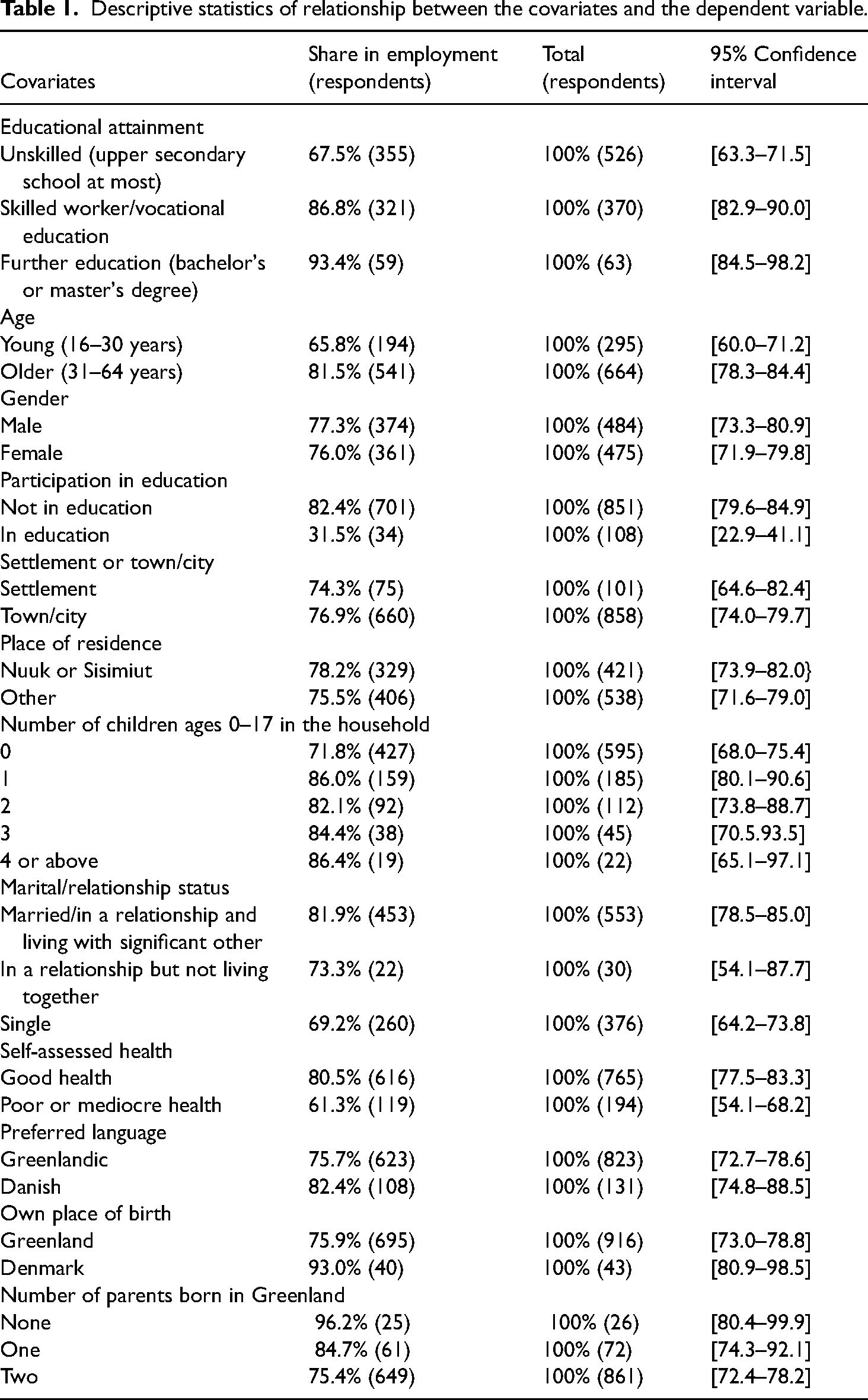
In relation to Table 1, we outline the most important points in relation to differences in labour market participation. First and foremost, it is important to note that there are rather large differences in the employment rate based on educational attainment. The unskilled have a much lower employment rate than the groups who have completed either a vocational education or further education (and the difference is statistically significant). Next, we also found rather large and significant differences in the employment rate for young and older people (roughly a 15 percentage point difference). There are, however, only very small and insignificant gender differences in the employment rate. Unsurprisingly, we saw vast significant differences in the employment rate depending on participation in education. Roughly, a third of those who are enrolled in education are employed, and more than 80% among those are not in education. We found rather small and insignificant differences in employment between those who live in a settlement and those who live in a town/city. The same is the case for the place of residency in either Nuuk or Sisimiut or another place of residence. In addition, we found that people who have children between the ages of 0 and 17 years also have a higher employment rate than those who do not have children in the household. The differences are significant between those who have no children in the household and those who have a single child in the household. As expected, there are also large and significant differences depending on self-assessed health. The employment rate of people who have a good self-assessed health is 20% higher than those who have a poor or mediocre self-assessed health. Focusing on the language used to complete the survey, we also saw substantial but insignificant differences between those who answered the survey in Greenlandic and Danish, respectively. We also found a relationship between the place of birth and employment. Focusing on the respondents’ own place of birth, those who were born in Greenland are, to a lesser degree, employed compared to those who were born in Denmark. The differences in employment rates are a vast 17% and differences are statistically significant. The pattern is the same concerning the number of parents born in Greenland, but we find no significant differences, between having either none, one or both parent born in Greenland.
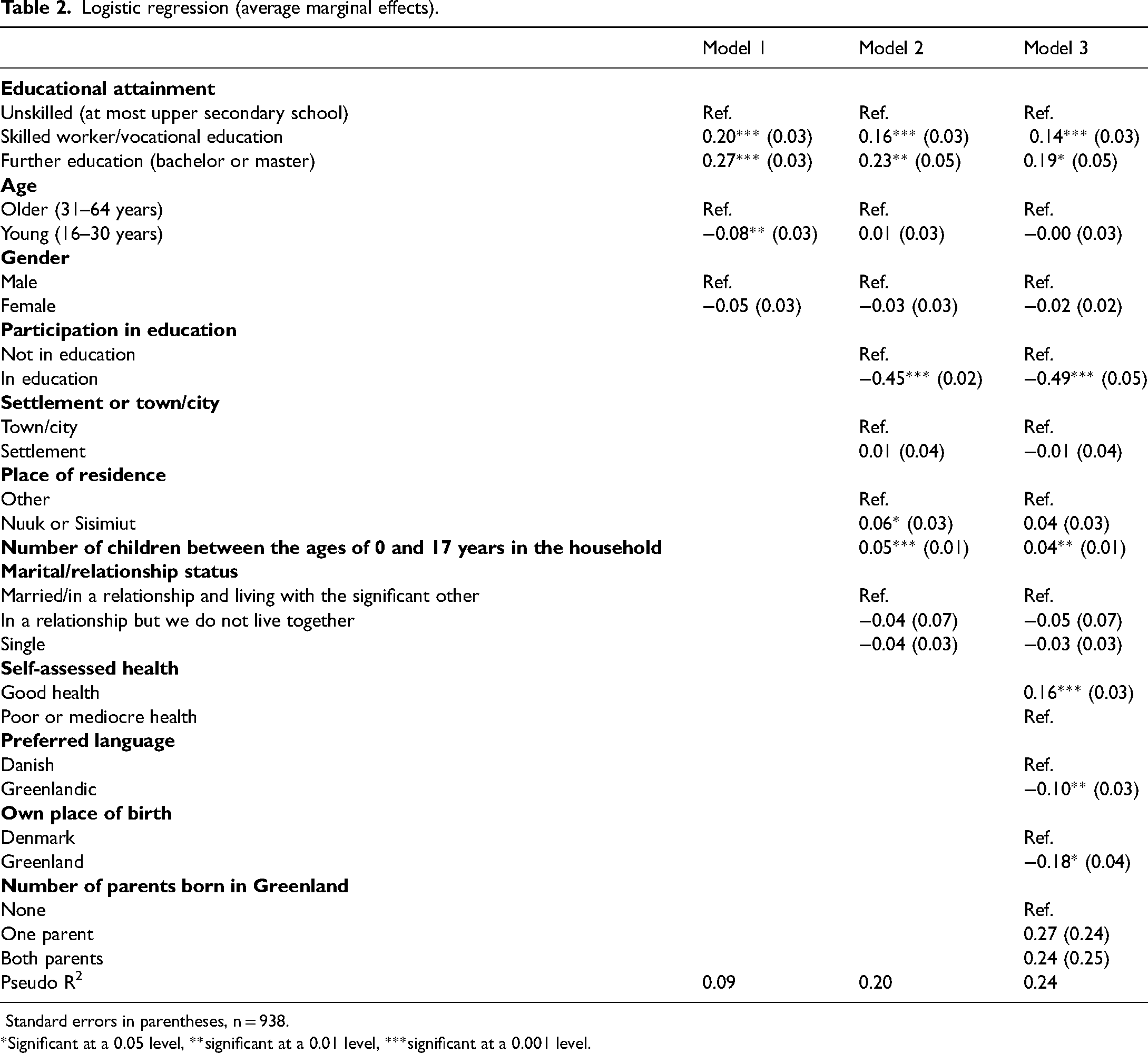
The above are merely binary relationships between the covariates and employment. These relationships might, however, vanish when taking account of additional covariates. For instance, young people might be employed to the same degree as older people when taking account of educational attainment of participation in education. We therefore performed three logistic regressions in Table 2, focusing on the average marginal effects of the covariates and building the final model gradually.
Logistic regression (average marginal effects).
Standard errors in parentheses, n = 938.
*Significant at a 0.05 level, **significant at a 0.01 level, ***significant at a 0.001 level.
In Model 1, we added three covariates: educational attainment, age, and gender. The average marginal effects are interpreted as follows. For educational attainment, being a skilled worker/having a vocational education increases the likelihood of being employed by 20 percentage points compared to having completed upper secondary school at the most. Having further education increases the likelihood of employment by 27 percentage points. Both educational attainment and age are statistically significant in Model 1. Being young lowers the likelihood of being employed. This is, however, not the case for gender.
In Model 2, we added five additional covariates to the model: participation in education, living in a town/city or settlement, living in Nuuk or Sisimiut or elsewhere, number of children in the household, and marital/relationship status. A few interesting changes are apparent from Models 1 to 2. Being young is no longer associated with a lower likelihood of being employed when taking account of the new covariates. However, we found that participation in education lowers the likelihood of employment by a staggering 45 percentage points. Living in Nuuk or Sisimiut also increases the likelihood of being employed by six percentage points compared to living elsewhere. Having children in the household increases the likelihood of employment. For each child between 0 and 17 years of age, the likelihood of employment increases by 5 percentage points. Marital/relationship status is not statistically significant. Educational attainment remains significant, but the effect is lowered slightly.
In our final model (Model 3), we added four additional covariates: self-assessed health, preferred language of answering the survey in, own place of birth, and the number of respondents’ parents born in Greenland. Our interpretation of Model 3 starts by focusing on the covariates from Models 1 and 2.
When controlling for the variables in Model 3, the effect of educational attainment is reduced further. The effects are, however, still large and significant. Having completed a vocational education or further education increases the likelihood of employment by 14 and 19 percentage points, respectively, compared to having at most upper secondary schooling. Based on the existing literature (cf. the review), this is logical because Greenland is in high demand of skilled labour, signified through almost full employment for people with further education (Economic Council of Greenland, 2018). There is no age effect, which is also unsurprising because we included variables about participation in education and educational attainment. Gender remains insignificant in the final model, signalling that women are not disadvantaged on the Greenlandic labour market when controlling for the other covariates. This is even the case when controlling for the number of children in the household, a factor that internationally impedes the employment of women. Female employment might only be hampered if children are present in the household. To investigate this, we included an interaction term between gender and children (not shown in a model), but the interaction term was not significant. However, as mentioned in the literature review, there is a longstanding social practice of female employment during motherhood. Therefore, the results concerning gender are rather unsurprising.
Living in a town/city or a settlement is not associated with a higher (or lower) likelihood of employment when taking account of the other covariates. The same is the case for living in the two economic power centres of Greenland (Nuuk and Sisimiut) compared to living elsewhere. This contradicts the findings of Ravn and Høgedahl (2022). In that analysis, they found that living in either Nuuk or Simisiut increases the likelihood of employment by six percentage points (the same statistically significant estimate as we found in Model 2). Taking account of health, language, and place of birth, however, makes the effect of living in Nuuk or Sisimiut insignificant.
Having children between the ages of 0 and 17 years in the house remains significant and has a rather large positive statistical effect on the likelihood of employment. As such, we found no evidence of a ‘child penalty’ in Greenland—neither for women. In fact, having children increases the likelihood of employment in a Greenlandic context, and one could even argue that our findings support a notion of a ‘child bonus’. We cannot provide an empirical explanation for the presence of a ‘child bonus’. However, different interpretations are feasible, of which we shall offer two. Firstly, the social security safety net as well developed and ‘generous’ as in the other Nordic countries (Pedersen et al., 2019). This might generate a stronger need for employment as the number of children in the household increases. Secondly, the longstanding social practice of female wage earning in Greenland might also influence this.
Marriage and relationship status do not exert a statistical effect in the likelihood of employment in our final model, and it is also unsurprising due to the contradictory findings in the literature. Most often, it is not marriage but having children that impedes employment for women, but it does not seem to be the case in Greenland.
Our findings also support the literature on the influence of health on employment outcomes. Self-assessed health is a crucial factor for employment outcomes internationally as well as in a Greenlandic context.
Next, we turn to our last findings. As seen in Model 3, having answered the survey in Danish (i.e. having Danish as your primary mother tongue) increases the likelihood of employment by 10 percentage points. Conversely, having answered the survey in Greenlandic (and having Greenlandic as your mother tongue in Greenland) reduces the likelihood of employment by 10 percentage points, even while taking account of educational attainment, health, age geography and so on. We cannot provide an empirical explanation for this observed pattern. Nevertheless, there are, however, a few plausible explanations that we will present in the following. One plausible explanation for this observed pattern can be that employers discriminate in the recruitment process. Employers might opt for a person speaking Danish, even if an equally qualified Greenlandic-speaking person applies for the job. However, in order to firmly test for discrimination, we would need employer data preferably with an element of experimental survey design, for example, vignette or a field experiment. A second explanation could be that the job functions require Danish language skills – for instance, because of trade with Denmark. A third plausible explanation has to do with the strong Greenlandic demand for labour that results in severe labour shortages. To fill vacant positions, especially in relation to skilled work and academic work, Greenland is forced to recruit labour from outside the country. In particular, skilled workers and administrative staff and academics are in demand and are often recruited from Denmark. These ‘migrant workers’ from Denmark were also part of the target group of the survey, and it is only natural that they are in employment because they have relocated to Greenland because of job opportunities, typically having an employment contract before leaving Denmark.
Country of birth is also related to employment outcomes in Greenland, controlling for the other covariates in Model 3. Being born in Greenland lowers the likelihood of employment by a vast 18 percentage points. Native-born people are, to a certain extent, disadvantaged in relation to getting a job in their own country. The plausible explanations for this observation could be explained with the above regarding the mother tongue (discrimination against the majority, demand for Danish skills, and import of skilled labour). However, it is striking that the difference in employment remains even while taking account of educational attainment. This highlights a strong need for further research investigating explanations for this discrepancy.
Lastly, in relation to the number of respondents’ parents born in Greenland, we find no statistically significant results.
Conclusion and discussion
In this article, we explored supply-side (individual) factors that are related to employment in Greenland. In other words, we investigated the barriers and potentials for labour market participation in Greenland. The labour market of Greenland has generally been underexplored in the current labour market research, with some exceptions in recent years.
There are challenges in relation to employment in Greenland. It is a vast country with huge geographical distances between populated areas, with no roads between towns and settlements, entailing that transportation by boat, planes, or helicopters is necessary (Høgedahl, 2022). The educational attainment of the population is rather low in an international perspective (Ravn, 2022) and health-related and social problems are prevalent among the population. Inequality measured through the Gini coefficient is higher than the European average and higher than in Canada, but it is not nearly as high as that of the United States (Grønland – Samfund, økonomi og politik, 2022). Nevertheless, employment rates are very high in an international perspective – among both the male and female population. The unemployment rate is also extremely low in international comparison, but a sizeable part of the working-age population is not part of the labour force and thus not available for work, particularly due to health-related and social problems, which is also the case in the other Nordic countries. Inequalities between in-groups and out-groups are strong in the Greenlandic society. The colonial history of Greenland contributes to divisions of the population.
Through regressions analyses, we explore these divides in relation to employment and find that many factors are related to employment outcomes.
Many of the typical variables from the international literature are also related to employment outcomes in Greenland. This is the case for educational attainment and self-assessed health. Controlling for several covariates, having completed a vocational education or further education strongly increases the likelihood of employment, compared to having at most upper secondary schooling. Having completed a vocational education or further education increases the potential of employment (it is a facilitating factor), whereas not having education beyond upper secondary schooling is a barrier for obtaining employment.
People in ‘good health’ are also more likely to be employed compared to people with poor or mediocre health. This is also the case in most of the international literature (Böckerman and Ilmakunnas, 2009). Poor health is thus a very significant barrier for obtaining employment.
We also have a series of positive findings from an equal rights perspective. We found no age differences in employment, when taking account of participation in education, and no differences depending on marital/relationship status. Having children in the household is even a factor that contributes to employment, accounting for our other covariates.
There are, however, some concerning findings in relation to equal rights and opportunities.
First, the preferred language of answering the survey is related to employment outcomes. In other words, the respondents’ mother tongue matters. People who answered the survey in Greenlandic have a lower likelihood of being in employment than people who answered it in Danish. This is the case, even though we controlled for educational attainment and participation in education. A limitation in this regard is that we solely used educational attainment in three categories. We cannot exclude the possibility that differences in the specific vocational education or further education explain the variation in employment. However, we do believe that it is unlikely that the differences are solely driven by these types of differences in specific educational attainment. Based on the survey, it is impossible to provide empirically based explanations for the observed differences in employment depending on the language. Nevertheless, there are some plausible explanations for this observed pattern. The first, and perhaps most obvious, is that Greenlandic-speaking people face discrimination. If employers have two equally qualified candidates for a job, they might opt for the Danish-speaking candidate. The second potential explanation relates to the demand for labour. Danish skills could be in demand and necessary for a given job position, and, therefore, jobs are more easily available for Danish speakers. The third explanation is also related to the demand of labour. Greenland faces a severe shortage of labour and is thus forced to import labour from other countries, particularly Denmark. All of these Danish ‘labour migrants’ will be in employment and may thus account for some of the observed differences. A fourth explanation might due to cultural assimilation (Kuhn and Sweetman, 2002) where Danish, or even Greenlandic employers, might have a conscious or unconscious bias preferring candidates with Danish cultural traits, for example, accent, social views, etc.. A local Danish employer might be inclined to believe that Greenlandic workers are less productive if they do not follow domestic daily routines as in Denmark. Thus, in this case, ‘assimilated’ Greenlanders would be preferred. A fifth explanation is historical and refers to the colonial legacy. According to Poppel (2005; 136): ‘Men who did not speak Danish found it difficult to find work and influence their own life situation, as well as the overall development in society’ (Translated to English). Such practices might have been (unconsciously) institutionalised affecting society to this day. Overall, it is most likely that a mixture of the five explanations is the most appropriate, not excluding additional explanations. Nevertheless, we strongly encourage further research to explore reasons for these discrepancies in employment rates.
In the following, we discuss the potential policy implications of our results. Three overall tendencies were evident in the analyses. Educational attainment, health and language/country of birth mattered a great deal for employment outcomes. Future policies and practices could potentially focus on getting as many young Greenlanders as possible to complete an education. As already stated, full employment is nearly a reality in Greenland for people who have completed further education (Economic Council of Greenland, 2018), and education is highlighted as the key to Greenland's future in existing research (Lennert and Demant-Poort, 2021). One potential strategy to pursue in this respect could be to better promote pupils’ wellbeing and skills in primary and lower secondary school, as well as ease the transition from lower secondary school to further education. In fact, many of the active labour market policies in Greenland have an explicit focus on getting people to obtain primary/lower secondary school diplomas through educational courses (VIVE, 2019). Even so, a series of obstacles will remain in relation to strengthening the educational attainment of young Greenlanders. Young people living in settlements are forced to move away from home at a rather early age to pursue schooling beyond lower secondary school. Upper secondary school is only available in Nuuk (the capitol), Qaqortoq, Aasiaat, or Sisimiut (larger towns), and it was first introduced after the 1970s (Lennert and Demant-Poort, 2021). The tradition of completing education in Greenland has not yet reached maturity, but the population's educational attainment is gradually increasing (Lennert and Demant-Poort, 2021). One additional barrier to increasing the population's educational level is that the availability of further education is quite limited, which is understandable due to the small population of 54,000 inhabitants. Consequently, young Greenlanders often need to move to Denmark in order to pursue specific types of vocational education and further education. The challenge in this regard is that only half of the Greenlanders who complete an education in Denmark return to Greenland within 10 years after graduation (Statistics Greenland, 2022).
An additional challenge is the health-related and social problems of the people outside the labour market (Dahl-Petersen et al., 2016). These types of problems are not easily overcome. Potential methods could include health-based interventions, treatment and health promotion programmes, and preventive measures starting at an early age.
In relation to the issue concerning language and country of birth, several things can be attempted. First, Greenlandic employers can contribute to solving the problem by recognising the issue and subsequently acting to minimise the practice of intentionally hiring a Danish-speaking candidate if a qualified Greenlandic-speaking candidate is available. Second, further attempts at reconciliation might be fruitful. In 2014, a so-called reconciliation commission was established to deliver a report to the Greenlandic Government in 2017 (Forsoningskommissionen, 2017). The purpose of the commission was to shed light on challenges in Greenlandic society due to tensions caused by the colonial past, to create an understanding of diversity in society, and to pave the way for reconciliation. Further attempts at reconciliation might contribute to creating a more equal society with equal opportunities for all in Greenland.
Supplemental Material
sj-docx-1-jir-10.1177_00221856231204486 - Supplemental material for Employment in a post-colonial society – The case of Greenland
Supplemental material, sj-docx-1-jir-10.1177_00221856231204486 for Employment in a post-colonial society – The case of Greenland by Rasmus Lind Ravn and Laust Høgedahl in Journal of Industrial Relations
Footnotes
Declaration of conflicting interests
The authors declared no potential conflicts of interest with respect to the research, authorship, and/or publication of this article.
Funding
The authors received no financial support for the research, authorship, and/or publication of this article.

Supplemental material
Supplemental material for this article is available online.
References
Supplementary Material
Please find the following supplemental material available below.
For Open Access articles published under a Creative Commons License, all supplemental material carries the same license as the article it is associated with.
For non-Open Access articles published, all supplemental material carries a non-exclusive license, and permission requests for re-use of supplemental material or any part of supplemental material shall be sent directly to the copyright owner as specified in the copyright notice associated with the article.
