




Abstract
This article challenges the assumed link between Hyman's theory of trade union identity (2001) and union positioning on just transition policies. Through a sectoral case study, we question the correspondence established in the literature between union identity and just transition when excluding the influence of contextual and sectoral differences. This analysis uses unions in the Canadian province of Quebec's construction industry to focus on differences emerging from organisational identities and internal structures. We compare the results with theoretical work and empirical ones studying union organisations in different countries and, or activity sectors. While some unions align with the literature, others exhibit a disconnect between identity and action. Notably, some market-oriented unions demonstrate an affirmative position on the just transition, while others remain indifferent. We also discuss the role of the state as perceived by unions as a pivotal entity in advancing just transition policies. The findings suggest that multiple factors beyond union identity influence trade union positioning on the just transition, necessitating further exploration to unravel these elements.
The capitalist system exposes workers to double dependency by making them reliant on their jobs to support themselves and the environment for their quality of life (Felli and Stevis, 2014; Räthzel and Uzzell, 2011). While they benefit from a safe natural environment, workers are also vulnerable to job losses from strict environmental protection norms. Workers’ high dependency on their jobs to ensure income puts them in a conflicting position where they participate in the destruction of their living environment, emphasising employment relationship asymmetry in favour of employers (Snell and Fairbrother, 2014). Likewise, non-unionised jobs in sustainable energy and green industries risk replacing high-quality unionised jobs in the fossil fuel industry (Felli and Stevis, 2014; Goods and Ellem, 2024; Mulvaney, 2014; Räthzel and Uzzell, 2011; Sicotte et al., 2022; Vona, 2019). Climate change adaptation measures can also place unions in contradictory positions when they oppose members’ jobs and socioeconomic transformations (Allan and Robinson, 2022; Goods and Ellem, 2024; Lethbridge, 2024; Mohr, 2025).
Trade unions benefit from their dual status as socially and politically engaged independent organisations while also being directly involved in workplace transformations. This unique combination of autonomy and influence allows them to play a pivotal role in the just transition towards a greener economy (Harvey et al., 2017; Mandelli, 2025; Wilgosh et al., 2022). Unions play a crucial role in challenging power imbalances and safeguarding workers’ rights against employers’ economic motivations, which often lead to the devaluation of workers and their environment as mere instruments of production (Hampton, 2015; Hyman, 2001). As such, they can play an essential role in adopting and applying environmentally friendly policies and practices that account for workers’ interests. The influence of institutional, national, local and organisational contexts must be taken into account when looking at union responses, as unions evolving in differing ideological contexts and material conditions will perceive policies and practices contributing to a transition in diverse ways (Clarke and Sahin-Dikmen, 2020; Dupuis et al., 2024; Mandelli, 2025; Pulignano et al., 2023).
To address the tension resulting from workers’ double dependency on employment and their natural environment, unions suggested a just transition (Felli and Stevis, 2014; Wang and Lo, 2021; White, 2020). The addition of the qualifier “just” aims to underline the importance of considering the potentially negative impacts the green or energy transition could have on workers (Cha, 2024; Goods, 2013; Wang and Lo, 2021). This term was coined by Mazzocchi, a union representative in the American energy sector, wishing to promote the idea that environmental and job protection are not irreconcilable (Cha, 2024). The just transition questions market-based solutions to climate change and supports industrial planning, union involvement and worker and local community participation in decisional processes (Flanagan and Goods, 2022; Galgóczi, 2020; Snell and Fairbrother, 2012). Furthermore, it promotes occupational and job reclassification accompanied by appropriate training for the workers holding jobs that are under threat of disappearing (Cha, 2024; Galgóczi, 2020). The notion of just transition is now embedded in various international agreements, such as the Paris Agreement of 2015 and the work of the Organisation for Economic Cooperation and Development (OCDE) (Cha, 2024; Keese and Marcolin, 2023).
The commonly accepted definition of the just transition is grounded in the International Labour Organisation's (ILO) seven guiding principles: social dialogue as part of the institutional framework; policies respecting fundamental principles and rights at work; measures addressing the gendered dimensions of environmental issues and opportunities; policies fostering the involvement of enterprises, workers, consumers and investors; initiatives promoting the creation of decent jobs; programs tailored to the specific conditions of countries; and the fostering of international cooperation (International Labour Organization, 2015: 5–6). While this framework provides a normative foundation, it is not universally accepted, as it was designed with prescriptive rather than analytical intentions. Governments mobilise various conceptions of just transition that reflect their political systems and power dynamics (Stark et al., 2023). Similarly, academic debates have generated multiple typologies that interpret just transition through distinct disciplinary lenses (Stevis and Felli, 2020; Wang and Lo, 2021).
Union identity as a determining factor for just transition positioning
The just transition is frequently analysed in the literature through the concept of union identity, using Hyman's geometry of unionism as an analytical framework (2001). Unions are understood as actors in tension between three orientations: market, representing the economic interests of current members; society, positioning unions as social actors supporting broader welfare and cohesion; and class, adopting a militant stance in defence of the working class. These orientations are based on unions’ internal conceptions of democracy, agendas and power resources (Hyman, 2001). Studies examining union positionings toward just transition and collective identity associate just transition types into three broad orientations corresponding to Hyman's framework, each encompassing a variety of discourses and strategic approaches. This literature is compared in the following paragraphs and synthetised in Table 1.
Literature comparison.
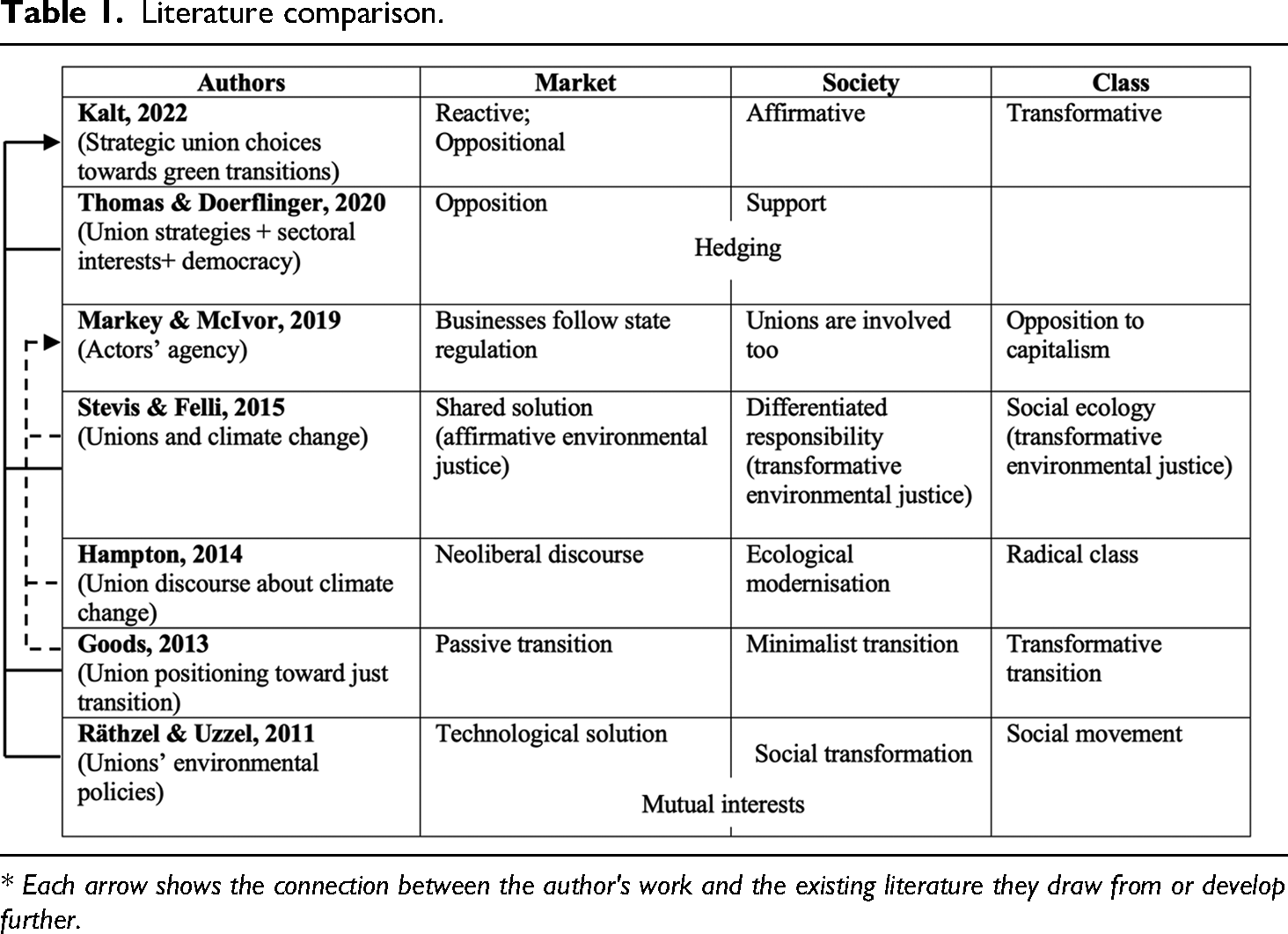
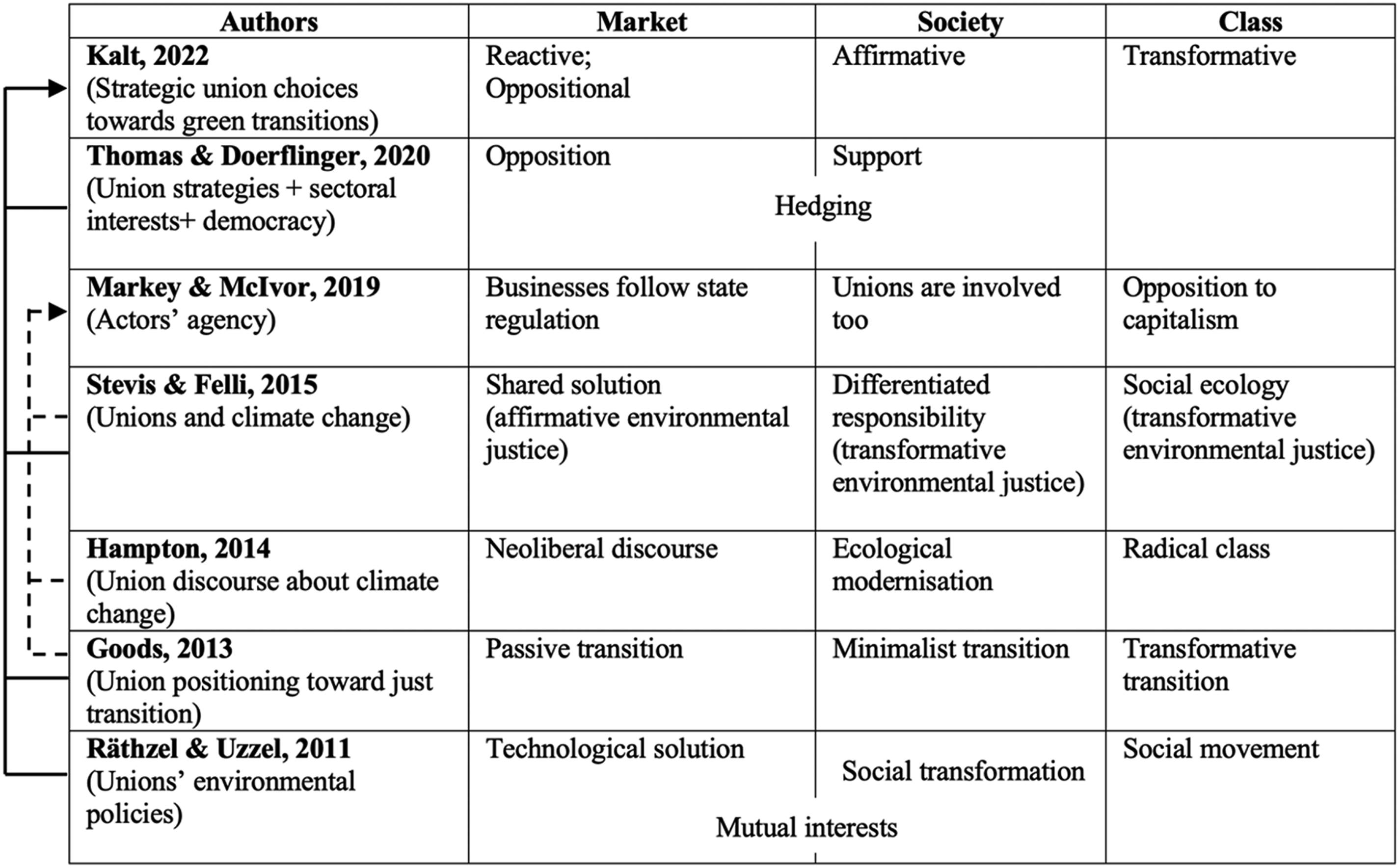
* Each arrow shows the connection between the author's work and the existing literature they draw from or develop further.
Market-oriented unions typically prioritise protecting existing jobs and organisational performance. This orientation aligns with Goods’ concept of the passive transition (2013) and resonates with Räthzel and Uzzell's technological fix (2011), where advanced technologies are expected to mitigate environmental impacts without fundamentally altering production processes. While Hampton (2015) argues that market-oriented unions adopt a neoliberal discourse founded on market-based solutions to protect their members’ jobs, Markey and McIvor's (2020) synthesis of trade union approaches to climate change policy suggest that these unions support a state-led transition where businesses will adapt to new regulations in the market. They also situate in this category Stevis and Felli's shared solution (2015) which advocates for a dialogue between international organisations and international trade unions and corresponds to Felli's (2014) deliberative strategy (Markey & McIvor, 2019). Similar positions are found in Thomas and Doerflinger's (2020) hedging strategy and Kalt's (2022) reactive strategy, both associating a market orientation with unions seeking to limit regulation in favour of a gradual, minimal withdrawal from fossil fuels supported by fair transition plans. They also tie market identities to an oppositional strategy resisting emission reduction policies and even denying their relevance (Kalt, 2022; Markey & McIvor, 2019).
The society orientation is linked to the gradual integration of environmental objectives with social dialogue and protections. Kalt (2022), building on Thomas and Doerflinger's (2020) support stance, describes an affirmative position that supports ecological modernisation and aligns with the society type by promoting green growth within capitalism. This perspective echoes Räthzel and Uzzell's (2011) mutual interest discourse, which redefines workers’ roles and social relations while avoiding direct confrontation with capitalism, aiming instead to safeguard existing jobs through social protection, retraining and worker consultation. Similarly, Markey and McIvor (2019) associate society-oriented unions with an ecological modernisation discourse that integrates Hampton's (2014) conception of ecological modernisation, Stevis and Felli's (2015) differentiated responsibility, and Goods’ (2013) minimalist transition.
Class-oriented unions adopt transformative approaches that challenge capitalist structures. Goods’ (2013) transformative transition, Hampton's (2014) radical class-based climate discourse, and Räthzel and Uzzell's (2011) social movement discourse all advocate systemic change and democratic control over production. Similarly, Markey and McIvor's (2019) opposition stance challenges capitalism and employers’ interests based on workers’ agency at the systemic level while Stevis and Felli's (2015) socio-ecological approach explicitly reject green capitalism, calling for new socio-economic systems that address both environmental and social exploitation. Kalt (2022) associates this transformative strategy with unions that mobilise their power resources beyond sectoral interests to advocate for systemic alternatives.
The literature also highlights how union responses vary across institutional, sectoral and national contexts. Comparative studies (e.g., Kalt, 2022; Thomas and Doerflinger, 2020) demonstrate that unions’ strategic orientations are not solely determined by identity but also shaped by sectoral interests, internal structures, coalitions and broader governance frameworks. Research contrasting international unions (Felli, 2014; Stevis and Felli, 2015) with national and sectoral unions (Goods, 2013; Hampton, 2015; Keil and Kreinin, 2022) shows that while some unions actively embrace transformative agendas, others remain confined to market-based strategies or incremental societal reforms.
Taken together, these studies reveal a spectrum of union approaches to just transition, ranging from market-oriented opposition to class-based transformation. While class-oriented responses consistently align with transformative agendas, market and society orientations encompass a broader diversity of positions – from technological fixes to socio-ecological modernisation. Table 1 synthesises these associations, aligning the main typologies (Goods, 2013; Hampton, 2015; Kalt, 2022; Markey and McIvor, 2019; Räthzel and Uzzell, 2011; Stevis and Felli, 2015) with Hyman's (2001) framework. This synthesis highlights overlapping concepts, terminological variations and the factors driving unions toward or away from transformative strategies, underscoring the complex and context-dependent nature of union engagement with climate change.
Research context and method
As a response to the variations in the literature, this study questions the assumption of Hyman's theory of trade union identity (2001) with positionings towards the just transition. Given the interconnectedness of different social systems, isolating one variable in a controlled environment is impossible. However, a sectoral case study involving trade union organisations representing members in the same industry, legislative framework, and timeframe makes it possible to limit the influence of differing contextual factors to highlight the contribution of trade union identity. Hyman's framework offers a valuable perspective for analyzing the multifaceted identities and strategies of unions in Quebec, serving as a heuristic to understand the strategic tensions inherent in union operations within capitalist systems (Frege et al., 2011). Despite its development for describing European union identities, this framework has proven its applicability across diverse contexts (Goods, 2013, Markey & McIvor, 2019; Bellido De Luna, 2022).
The analysis begins by verifying the articulation between union identity according to Hyman's orientations and the transition positioning of union organisations that represent workers in the same industry, during the same period, and in the same national and institutional context. We then compare these results to previous theoretical work (Flanagan and Goods, 2022; Kalt, 2022; Thomas and Doerflinger, 2020) as well as empirical ones comparing union organisations in different countries and, or activity sectors (Goods, 2013; Hampton, 2015; Kalt, 2022; Stevis and Felli, 2015; Keil et Kreinin, 2022). Departing from prior research, this empirical study uses cases sharing external conditions: political and socioeconomic contexts, public discourse on climate change and governance. The cases also share internal sectoral conditions, allowing us to focus on differences emerging from organisational identities and internal structures. Comparing those cases allows us to verify if the correspondence established in the literature between union identity and just transition is empirically founded when we exclude the influence of different local or national contexts and sectoral differences.
Methods and materials
The five trade unions representing construction workers in the Canadian province of Quebec and four of their local unions are used as case studies (Yin, 2003). Under the legal framework specific to Quebec, workers are obligated to join one of these unions to access work in the construction industry 1 . Union representatives from each union are involved in the joint bodies that govern the industry, particularly regarding sectoral collective bargaining and training. The analysis is based on the triangulation of documentary data from the unions and semi-structured interviews with union representatives in order to identify converging lines of research supporting the conclusions (Guittet, 2013; Yin, 2003). Given that French is the official language in Quebec, all excerpts from documentary data and verbatims were translated from French to English by the author. The documentary data included communications in the media, briefs in response to draft legislations, websites, newsletters, annual plans, internal policies and union congresses reports. The eleven interviews were conducted between 2021 and 2023 as part of two research projects on climate issues and construction trade unions. Among the nineteen interviews participants, four were sectoral union employees and 15 were elected representatives, eleven at the local union level and four at the sectoral union level (See Figure 1 for the structure). The participants were all white, non-immigrant men, except for one woman. This homogeneity is not surprising considering the industry's low diversity with only 3.27% of women, 5.5% of immigrants and 4.5% of non-Caucasian workers in 2021 (CCQ, 2023: 50–51, 2024: 4). The twenty-five trades and six occupations from the four sub-sectors were represented, as the three industry-based unions regroup all of them and the four local trade unions each represent a different trade (Bilodeau, 2012).
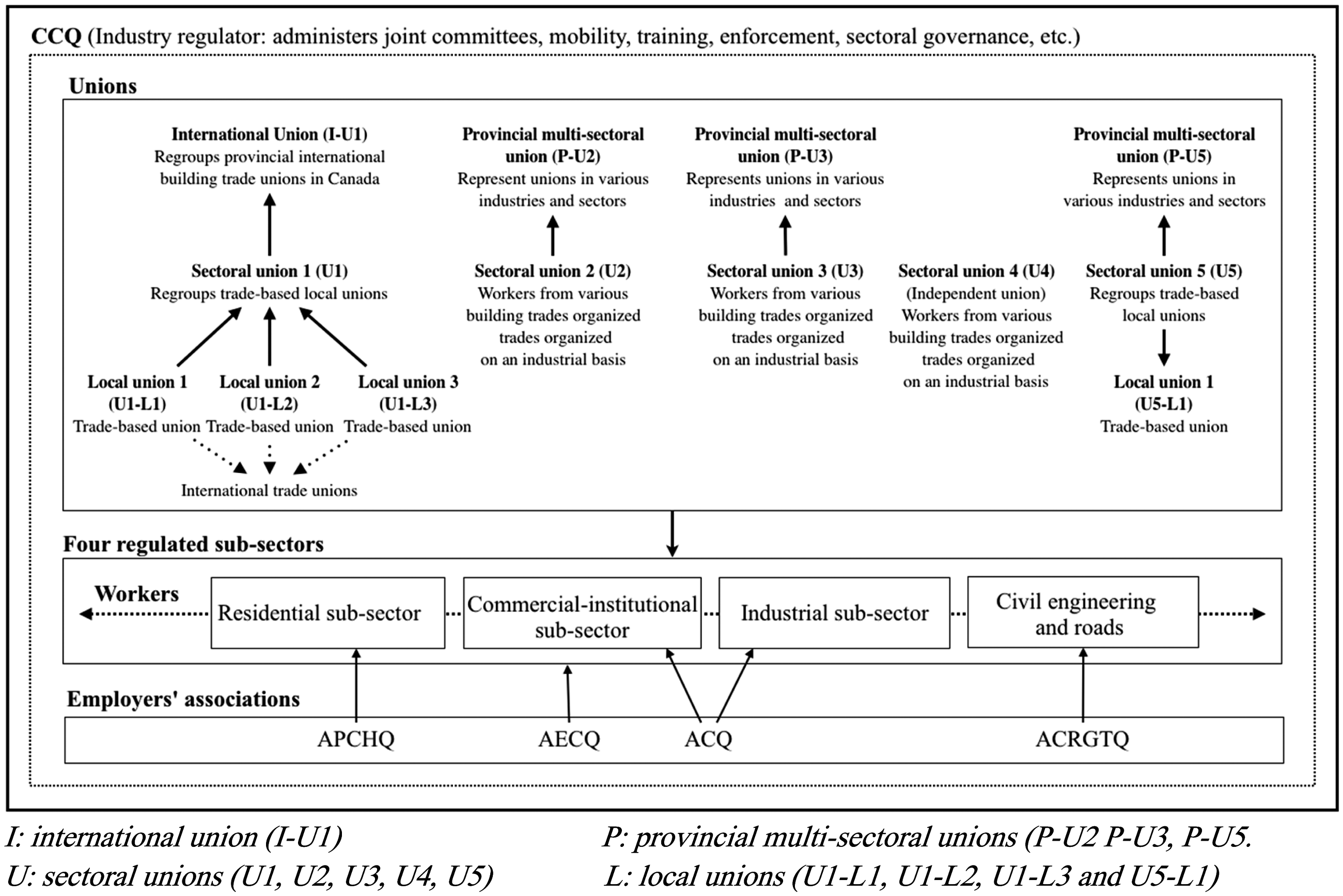
Institutional Structure of Labour Relations in Québec's Construction Industry (Act R-20)).
The interview questionnaire interrogated the participants on their organisation's priorities and interactions with members. It also sought to learn about the union’ perception of other actors and their relations with them, such as employers, the State and other unions. To identify their stance on just transition, the interview questioned the participants on their union's public and internal positions and actions. The level of political and social involvement was also assessed, particularly regarding political actions, union partners and those in the civic society. Next, we examined the organisation's involvement in the fight against climate change, its perception of the impacts of climate change on its members, and its positioning on major projects publicly debated for their environmental impacts. The interviews were contextualised in a neutral manner to mitigate potential social desirability bias, given the provincial context favouring environmental protection (Lee, 1993). Conversely, we sought to avoid eliciting defensiveness from participants whose unions had faced public criticism for supporting polluting projects, as this could have resulted in incomplete information. This approach involved explicitly acknowledging that unions must navigate diverse demands, with no inherently correct or incorrect positions, and that the objective was to obtain a comprehensive portrait of the situation.
To position our cases within Hyman's union identity framework, we analysed interview transcripts and documentary data using NVivo software and a deductive theoretical coding approach. A closed coding grid was developed based on the components of union identity (Hyman, 2001). This grid included main categories and subcategories capturing: the union's conception of unionism and its role (focused on current members’ socioeconomic interests, broader society, or the working class); its professional community of reference (how it defines its membership base – trade or industry – and perceives other workers as competitors or partners); its territorial community of reference (provincial, national, or international); and its view of members (as clients, collaborators, or activists). This coding also accounted for unions’ historical background, organisational structure, priorities, agendas, socio-political involvement, and their relationships with employers, other unions, workers, and the state. Based on this analysis, each case was positioned within Hyman's (2001) geometry of unionism triangle. In doing so, we recognise that according to Hyman, unions are typically situated between two orientations rather than occupying a single pole.
A similar closed coding grid was created for Kalt's (2022) just transition typology and applied to the same data. The categories were designed to capture different dimensions contributing to the identification of just transition types, rather than representing the types themselves. They included the roles attributed to unions, employers, and the state in the transition (passive, proactive, opposing); the level of union involvement and actions undertaken; unions’ definitions of just transition (at organisational, sectoral or societal levels); their views on its relevance (approval, cautious support, or rejection); preferred forms (technological, economic or social); favoured timeframes (never, progressive or rapid); and their public positions on environmental issues, particularly fossil fuel phase-out (opposition, minimal support, or proactive support). Using these dimensions, each case was classified into one of Kalt's (2022) four stances on just transition: opposition
The construction industry as a relevant analysis sector
Quebec's construction industry contributes to 7% of the province's GDP and 6.4% of its jobs (Gouvernement du Canada, 2023). This industry is also the third largest GHG emitter in the province, at 9.6% (Gouvernement du Québec, 2020). Overall, the construction and use of buildings contributes to around 50% of raw materials extraction, produces a third of waste and is responsible for almost 40% of global energy and process emissions (Commission Européenne, 2014; United Nations Environment Programme, 2019). Consequently, reducing buildings’ carbon footprint is a priority in order to reduce GHG emissions and energy consumption (Fei et al., 2021; Lima et al., 2021; Opoku, 2022). The industry is, therefore, affected by climate change adaptations, which are expected to create new job opportunities while, at the same time, other jobs disappear or undergo significant changes (United Nations Environment Programme, 2019).
The construction industry in the province of Quebec is a rich field in which to explore the intersections between unionism and the environment. In North America, this industry shows a significantly higher unionisation rate than the public sector at 56.9% compared to 23% in Quebec, 31,4% compared to 15,5% in Canada and 11,4% compared to 6,9% in the USA (Institut de la statistique du Québec, 2024; Statistics Canada, 2024; U.S. Bureau of Labor Statistics, 2024). The construction industry in Quebec operates under a labour relations regime unique in North America, founded on joint regulation and social dialogue. The Act of Labour Relations, vocational training, and manpower management in the construction industry (hereafter Act R-20) regulates all aspects of employment – including training, union representation, employer representation, mobility and collective bargaining – through a system that centralises decision-making at the sectoral level (see Figure 1). The Commission de la construction du Québec (thereafter CCQ) enforces Act R-20 and coordinates the various joint committees through which unions and employer associations participate in industry governance.
Act R-20 requires workers to belong to one of the five accredited sectoral unions (U1, U2, U3, U4, U5) in order to access employment in the industry. Every four years, workers may keep or change their affiliation during a dedicated representation vote. The latter precedes the collective bargaining of the four collective agreements, one for each sub-sector: industrial, institutional/commercial, civil engineering and roads, and residential. These agreements are negotiated centrally by the five construction unions and their counterparts, the employers’ association in the corresponding sub-sectors (APCHQ, AECQ, ACQ, ACRGTQ). Because collective agreements apply by sub-sector, workers may fall under different agreements over the course of a year, depending on the sub-sector in which each job is performed. In this coordinated system, all workers are covered by the same collective agreements and do not compete with non-union labour or non-union employers.
Although the five accredited unions operate under the same legal framework and have access to the same pool of workers, they differ in ways that influence workers’ affiliation choices. Structurally, two unions (U1 and U5) follow a trade-based model typical of North American construction, regrouping local craft unions (U1-L1, U1-L2, U1-L3, U5-L1) that each represent a single trade or closely related trades. In contrast, three unions (U2, U3, U4) follow an industrial model, representing workers from all construction trades and occupations within a single province-wide body. Whereas industrial unions centralise representation across trades, unions regrouping craft locals operate with a dual structure: a sector-level organisation handling province-wide issues and local trade unions specialising in technical, professional, and jurisdictional representation.
Externally, structural differences also arise from patterns of affiliation. One union (U1) is affiliated with an international building-trades organisation, while one (U4) is fully independent and unaffiliated with broader labour body. The remaining unions (U2, U3, U5) are affiliated with Québec-wide labour federations (P-U2, P-U3, P-U5) representing unions across multiple economic sectors. These structural distinctions shape organisational identities, internal governance, and relationships with employers and the state. They are further reflected in differences in political orientation, reputation for defending trade jurisdictions, quality of member services, hiring-hall effectiveness, regional presence, and support for ongoing training.
The double dependency relationship between employment and the environment (Felli and Stevis, 2014) is evident in this industry as employment is intermittent due to its very nature. Seasonal variations and economic fluctuations heavily influence the construction sector, prompting constant workforce redeployment following project timelines and emerging opportunities (Charest, 2008; Newman and Humphrys, 2019). It is also characterised by job insecurity due to the strong influence of climatic conditions and environmental standards on work and workers (Newman and Humphrys, 2019; Schaupp, 2024). Construction trade unions can benefit from a just transition when new infrastructure projects, such as renewable energy facilities or green retrofits, generate employment opportunities aligned with their members’ skills (Calvert, 2024). However, they may also be negatively affected if projects bypass certain trades, are unevenly distributed across regions, or lead to job losses in traditional construction sectors tied to fossil fuel industries (Bakhiyi et al., 2022; Nugent, 2011).
Empirical findings
This section presents the seven cases’ positioning on Hyman's identity triangle (2001) and their conception of the just transition based on Kalt's typology (2022). We begin with the four local unions that group workers based on a common trade or closely related trades (U1-L1, U1-L2, U1-L3 and U5-L1) and follow with the three representative associations organised on an industrial basis (U2, U3 and U4).
Trade unions
The first union (U1)is affiliated with an international union that groups together local trade unions. This study focuses on three of these local trade unions, U1-L1, U1-L2 and U1-L3, each with a membership rate of over 80% in their respective trades (CCQ, 2020). This quasi-monopolistic representation provides them with significant financial resources and symbolic power when interacting with employers. Their union dues are the highest in the industry, and they emphasise the quality and plurality of their services, such as legal assistance, training, and labour referrals. U1mainly handles social commitment and political representation, while local unions ensure daily union representation on worksites and skills development. Interviews and documentary data show that the U1 recognises the inevitability of the energy transition but is not proactively involved and still supports projects perceived as opposing it if they represent jobs for their members.
The first local union, U1-L1, has a market orientation since it prioritises current members’ skills development and job creation as stated by this union representative: “We offer support to members, occupational health and safety, enforcement of rights, skills development, in exchange for their membership fees. We defend their economic interests, establish working conditions and enforce the collective agreement. We balance power with employers (Participant C from U1-L1)”. The union considers that representing the interests of a single trade allows them to offer the best services as they avoid conflictual demands between trades with different needs. Their relationships with other unions and employers are easily conflictual, especially regarding job assignments. However, they still consider that they are in symbiotic dynamics with most employers due to their workers’ referral service, which provides them with a qualified workforce compensating for small businesses’ limited organisational resources.
The local union executive is interested in electrified transportation and sustainable energy development projects that contribute to the energy transition. They even requested training programs for the sectoral training committee to prepare their members for these projects requiring new working techniques. Instead of fearing for their trade, they consider that the work hours will shift from the fossil fuel industry towards sustainable projects, such as windmills and solar parks. Since their members are primarily active in the industrial sector, they also describe environmental upgrading of infrastructures and plants as new job opportunities “we want to support green projects because yes, they are good jobs, they are also less harmful than coal and nuclear” (Participant A from U1-L1). The state is conceived as a mediator whose responsibility is to maintain a power balance between employers and unions with minimal involvement. However, the representatives denounce a partial position in favour of employer, as the state is also the leading contracting authority of the industry.
Nonetheless, U1-L1 gives prominence to protecting members’ work hours independently of their environmental implications. According to the union representatives, environmental issues are not discussed by the members because their trade is less related to green constructions. They note that while environmental regulations may reduce certain types of work in their trade, these losses are likely to be offset by opportunities arising from new projects, prompting workers to shift toward alternative options. An official from U1-L1 explained, “We won't be able to go out against jobs just for the environment, we protect work, we're not environmentalists or scientists” . They consider it is the state's responsibility to drive the just transition by adopting a legislative frame conducive to environmental regulations, new skills development, and sustainable energy production. This frame must also protect those reporting environmental violations in order to be effective. In addition, the participants underlined that, as a contracting authority, the state must integrate environmental protection and low energy consumption in its quotation requirements. U1-L1 has a market orientation and adopts a reactive approach to the just transition by recognising its inevitability without being actively involved.
The second local affiliated with union 1, U1-L2, is also characterised by a market orientation since it prioritises the maintenance and development of member services: “A trade union protects workers in terms of working conditions, including health and safety, and negotiates collective agreements for our members” (Participant A from U1-L2). Defending the trade is their anchor point and their members’ reputation for competence is particularly valued, as evidenced by the terms “expertise” and “excellence” that are often used in official communications and during our interviews. Organised by trade, representatives are well-versed in the issues regarding their trade and ensure quality representation with employers. They perceive their relationship with employers as a win-win scenario: “We just want a fair share of the pie, that's all we want basically. We get along well with most entrepreneurs.” (Participant B from U1-L2). Union executives are politically active in commenting on draft legislation and economic developments that could directly affect their members. Their direct involvement is justified by their unique position in the industry as they are not affiliated with one of the major provincial unions: “we are a union that is only involved in the construction industry. We don't have unions like the [Union 5] or the [Union 3], who have central offices closely aligned with the [provincial] government and open to discussion. We are marginalised when it comes to submitting briefs to parliamentarians; we have to work hard to be able to represent ourselves” (Participant B from U1-L2). This local characterizes government involvement in labour relations as detrimental, arguing that the prevailing approach excludes meaningful community consultation, even though joint committees formally exist within the industry. As a result, the union representatives reported setbacks for workers’ rights, notably regarding modifications to the occupational health and safety law. They underline how the government's status as the industry's leading contractor undermines the credibility of the neutral positions held by its representatives on joint bodies. An elected official from U1-L2 explained: “Yes, it is the largest source of work, but that should be the extent of it; it should not have control or politicise matters”.
Since U1-L2 considers the just transition to be a slow progressive process, the union considers jobs related to preserving existing infrastructures and fossil fuels to be suitable employment opportunities. Participant C from U1-L2 justified the union endorsement of a pipeline project by underlining its necessity to our society: “We are criticised for this, but we believe it was the best thing to do at the time, because we still need it [gas]”. The interviewees describe this stance as a strategic move to maximise their members’ benefits, even if it conflicts with public opinion and other unions. They also support that relocating them to poorly regulated countries would have more severe global environmental consequences. Their members benefit from a significant versatility as their trade allows them to work in all four sub-sectors on various projects. More importantly, they describe their influence on green construction as limited, since their members repair and build in accordance with their clients’ decisions: “We are executors who carry out the plans, and the day those plans are better for the environment, we will be glad” (Participant B from U1-L2). The union's newsletters almost systematically present current, future and completed projects along with their estimated work hours and include pipelines, refineries, cement projects, and initiatives in biogas and electric transport. The local union U1-L2 thus presents a market-type union identity and a reactive positioning to the just transition by prioritising members’ immediate interests and not getting actively involved in the transition while, at the same time, acknowledging its relevance.
Similarly, the third local union affiliated with union 1, U1-L3, has a close market orientation as it primarily focuses its resources on members’ rights, defence and training: “We negotiate the specific working conditions of our profession and their application and develop training and professional development courses. We strive to improve our practices in order to make our profession safer.” (Participant C from U1-L3). Despite representing a high proportion of its trade, it is a small local union. The president expressed how training and promoting the profession are at the core of their activities: “We are always at the forefront with everyone else, there is an exchange of information and it will quickly be incorporated into our training”. They also maintain open communications with employers and suppliers as they consider their relationships to be mutually beneficial regarding hiring, training, and layoff management: “There is knowledge sharing and good communication with employer associations and suppliers, so there is a good exchange of innovations” (Participant C U1-L3). Union representatives view other trades as competitors since their tasks are often appropriated, and their main concern is that the rise in demand accompanying the just transition could further encourage such encroachments. On the social and political levels, U1-L3 is not involved in any issue that does not fall under their direct purview.
The double dependency is not an issue for local U1-L3 as its trade benefits from a strong interrelation with the just transition, making it a critical job growth opportunity for the members or even a broadening of their responsibilities. Union representatives are actively informing and raising awareness among members, employers, and the state on their members’ possible contributions. Thus, they offer inspections of businesses and government-owned buildings to demonstrate the possible cost reduction achievable through their members’ services. Local U1-L3 participates in political lobbying during provincial and federal elections, as it considers the state to be the central actor in establishing a legal framework to ensure a fair energy transition: “We want stricter regulations on [trade's expertise] to be adopted in the building code and enforced through systematic and rigorous inspections. This needs to be brought to the government's attention; it's part of our lobbying” (Participant B from U1-L3). The results indicate that local union U1-L3 combines a proactive stance on just transition with a market-oriented identity.
Sectoral Union 5 (U5) groups local trade unions in the province and is affiliated with a labour federation bringing together unions representing various industries in the province of Quebec. It was founded following a split of international trade unions in the early 1980s and brought together 42.1% of the construction industry's workers (Delagrave and Pilon, 2009). This union is very active in the just transition and adopted a just transition plan for the construction industry during the 2022 congress. This plan aims to guide the organisation's action to fight climate change in the industry through energy efficiency, low-carbon buildings, and material life cycles. The union assigned an employee to the matters relating to the just transition who presented the plan to union representatives and members to discuss their fears and to deconstruct misinformation. This affirmative position towards the just transition aligns with the provincial union it is affiliated with, which is actively involved.
Affiliated to Union 5, local union U5–L1 brings together most of the trade (CCQ, 2020). It is located close to the market orientation on the market-society axis, albeit further away than the first three cases described. The focus is on members’ socioeconomic interests, even if union representatives are involved outside the workplace. Similar to locals U1-L1, U1-L2 and U1-L3, U5-L1 highly values local trade unions compared to industrially-organised ones, given the union representatives’ in-depth knowledge and understanding of the trade. This argument is found several times in the documentary data, notably during periods of union organizing: “How can they [industrially-organised unions] defend the trades without discriminating against their members [of different trades]? It's simply impossible!” (Documentary data, U5-L1). Union representatives note mutual respect with employers, who aim to resolve problems by limiting sometimes unavoidable legal disputes. The president of U5-L1 explained their relationship as interdependent: “The union is there to redistribute the employer's profits. We have an interest in the well-being of the company; we want companies to run smoothly because we want our people to be well paid” (). Next, the state is described as a mediator that balances power between unions and employers, regulating in a way that serves the interests of the public at large. There is, however, a desire for greater union autonomy and to limit the growing grip of the state in labour relations as explained byan official : “[the state] interferes with our affairs through special laws. Moreover, when we are in negotiations, it directly influences our bargaining power; the employer digs in its heels and waits for its special law”(Participant B from U5-L1).
Regarding social and political involvement, local U5-L1 collaborates with the representative association (U5) and actively participates in developing briefs in response to proposed legislation affecting its members. Union representatives also work with local employment centres to familiarise newcomers and ethnic communities with the construction industry, their trade and facilitate their contact with inclusive employers. These social partnerships are mutually beneficial since the local union increases its visibility among potential future members and the individuals are supported to integrate the industry. Union representatives emphasise that their capacity for broader social action is constrained by a restrictive legal framework, which over recent decades has progressively confined their activities to the workplace.
Local U5-L1 adopts an affirmative stance towards the just transition. Its discourse and actions show that it is proactively attempting to adapt to current and future changes to ensure that members are adequately prepared. Documentary data and interviews show that it recognises the inevitable need for an energy transition that can benefit workers while also being concerned about how it will unfold. Protecting jobs influences its positions on fossil fuels, as illustrated by the public support for a gas pipeline project due to the importance and quality of potential jobs generated.
The local executive prioritises influencing the orientations of the sectoral union U5 and the provincial multisectoral union to which the latter is affiliatedP-U5, as they are the bodies responsible for the socio-political defence of the members as explained by an elected official: “It is not so much the local branch that will directly address this issue, but we will influence U5's major policies direction” (participant A from U5-L1). Local U5-L1 relays to these bodies the information about how their trade is and can be affected and shares the plan for the just transition on its website and in the newsletters. It is also dedicated to researching new technologies and informing members about green construction methods and products via the website, newsletters, and social media. The union representatives seek to connect with organisations specialising in green construction in order to raise awareness and inform members. Despite its inertia at the time of the interviews, a committee for technological innovation and sustainable development has been set up to highlight green projects involving members. Although these initiatives do not originate from the members, they have been positively received.
While U5-L1 is very active in matters related to the just transition, it underlines the regulatory power of the state to develop a fair transition plan that prevents sudden changes leading to inequalities. The just transition requires close collaboration between companies, trade unions and training institutions to develop relevant and accessible training programs under the leadership of the state. Data from the interview, along with two briefs submitted in response to draft laws directly affecting the industry, highlight U5-L1's firm stance on systemic issues undermining the transition. The prevalent lowest-bidder model – where contracts are awarded based on cost minimisation incentives – is explicitly identified as hindering energy-efficient and sustainable projects due to their higher upfront costs.
Industrial unions
In contrast to the previous unions, U2, U3 and U4 are provincial sectoral unions representing construction workers on an industrial basis. These organisations, now distinct and to some extent competing, share a common history, having grown out of a Canadian Catholic central labour body. The latter was founded in the 1920s on an ideology combining Canadian nationalism and the Church's social doctrine (Rouillard, 2004, 2022).While international trade unions had a clear market ideology, this Catholic confederation's political involvement shifted from a cautious posture prioritising moral authority and limiting partisanship to a more assertive and autonomous role as Quebec's sociopolitical landscape (Rouillard, 2004, 2022). This evolution underscores its enduring orientation toward societal responsibility and broad social reform, situating it near the society pole in Hyman's typology. It deconfessionalised in the 1960s and became the provincial union (P-U3) to which U3 is affiliated (Rouillard, 2004). Its stance on socio-political issues progressively radicalised between 1960 and 1980 as it attacked the deficiencies of the capitalist system and favoured an in-depth socioeconomic reform, effectively shifting its ideology from a society to a class orientation (Rouillard, 2004, 2022). Since then, it has gradually moved back closer to a society orientation. P-U3 now demands a just transition to adapt to climate change. It is part of two major provincial networks bringing together civil society organisations and advocating a just transition.
U3 adopts a society orientation and believes it has a role to play in protecting its members as citizens beyond the workplace. In its public documents, the organisation denounces the business-like operations of some unions in the industry, comparing them to corporate organisations that put workers in competition with each other rather than fulfilling their role as solidarity-building entities between workers and society. This is explicitly stated in many newsletters as this excerpt illustrates: “we believe that working in this industry does not mean being confined to the confines of a construction site. It also means being concerned about housing, food, leisure time, health, the environment, the world, education, culture, the future of our children and loved ones, and the plight of the most disadvantaged. All these areas require a political vision and cannot be reduced to the negotiation of a collective agreement” (Newsletter).
Union representatives demonstrate significant social engagement, such as advocating for social housing initiatives and opposing tuition fee hikes. Their communications consistently feature content addressing societal issues beyond the construction sector, distinguishing them among the studied cases.
Although Union 3 shares a commitment to social justice with its provincial class-society-oriented counterpart, it diverges in its approach. It also prioritises a collaborative relationship with employers and the state as expressed by this representative: “We are active, we submit briefs, we participate in various consultations. There is maybe more collaboration, less antagonism with the government. Without being confrontational, there is room for confrontation when necessary”(Participant A from U3). The union advocates for a tripartite system of industry regulation, emphasising the state's significant role in areas like training and labour referrals. Nevertheless, U3 seeks to limit the state's intervention in its internal affairs. The union's limited influence within the sector can be attributed to its low level of representation, which consequently impacts its dealings with employers. While employers are perceived as entities with conflicting objectives, they are ultimately considered reconcilable with union interests by U3.
Union 3 adopts a minimalist affirmative approach to just transition since the discourse and political positioning are very proactive, but its actions to prepare members are few. For more than ten years, some newsletters have highlighted the importance of environmental protection in natural resources exploitation projects and have claimed that green construction is the industry's future. The participants raise the impacts of climate change on construction workers, particularly the intense heat and its implications for health and safety. In addition, they sometimes call upon political parties to protect the environment on significant projects. For example, U3 publicly defended an environmentally responsible process for deconstructing a significant bridge in the Montreal region: “"The methods used to demolish the Champlain Bridge could have a significant impact on marine fauna and flora. At [U3], we believe that environmental representatives should be appointed to visit construction sites, similar to safety representatives, to ensure that environmental standards are being met.” (Media interview of union vice-president). In addition, this organisation suggested the adoption of an environmental charter to regulate construction sites in a brief for a bill: “We would also support the creation of an environmental charter to provide a framework and regulate work on all construction sites” (Media interview of union vice-president). Unexpectedly, it also publicly opposed a pipeline project in the province, even though it represented many potential working hours for its members. Therefore, the defence of a just transition took precedence over the creation of immediate jobs, a position rarely seen among construction unions in Quebec. However, they do not offer training and there is no documentation or guide to prepare construction members for a just transition. Nonetheless, it appears to be in motion as a committee responsible for the creation of a just transition plan was created at the 2023 congress.
Union 2 (U2) is associated with a market orientation. This is an industrial union that brings together workers in various construction trades and is affiliated to provincial multisectoral union P-U2. It was formed as a result of a division among members of provincial multisectoral union P-U3, who sought political neutrality in response to the radicalisation of the 1960s (Rouillard, 2004). This new society-oriented organisation retained the non-partisan, apolitical doctrine of the Catholic Church and brought together members who refused to become politically involved (Rouillard, 2004). An elected official explained this choice: “This institution is based primarily on the observation that [P-U3]'s leaders had very strong revolutionary rhetoric but were very weak in defending the interests of their members” (Participant A, U2). In this regard, Union 2 is notable for its low presence in public discourse and media as it refuses to get involved in issues that do not directly affect the members.
Concerning employers and the state, representatives of union 2 explain how they seek dialogue with employers and try to avoid conflict, even if the documentation data show its members have filed many grievances. Participant B from U2 specifies: “Dialogue does not mean complacency […] but we are less involved in conflicts, power struggles or political issues”. This union is also critical of the decline in union participation in joint bodies and the state's increasing attentiveness to employers. It describes the state's role as a regulator, ensuring compliance of labour relations rights and obligations under the supervision of unions. Similarly, union representatives conceive the just transition as a prerogative of the state, which must plan and regulate the economy while taking account of these issues. This is well illustrated in Union 2's criticisms about the reduction in environmental protections on some projects during public consultations on bills: “All that will be required is to pay financial compensation to the Minister for the Environment in order to encroach.” (translated by the author). Except for this brief in response to a bill, Union 2 has no public information or internal documentation concerned with environmental issues and the transition. This union expressed its support for a pipeline project due to the job creation potential however discreetly as expressed by a participant: “we didn’t make much noise around it, no positioning to prevent losing members, it's as far as we go” (Participant B from U2). Just as unions 5 and 3, union 2 is affiliated to a provincial union (P-U2) as part of Quebec's inter-union network for the just transition but does not get directly involved.
Closer to the market ideology position, union 4 (U4) is a unique union in the construction industry, as it is independent and only represents construction workers. Participant A thus details U4's position: “The workers’ interests are his working conditions […] We're good corporate citizens”. Like union 2, this organisation stems from a scission of union 3's provincial union and centres its resources around current members’ socioeconomic interests without pretence of political or social projects. However, it differs from U2 in that its motives are more focused on what is described as “a desire for a simpler structure, better capacity for change and internal control” (Participant A from U4). Since its foundation in the 1970s, union 4 has experienced the most significant membership increase in the industry, representing around one out of five construction workers at the time of this data collection. A union representative explained that the absence of a local union and formal trade division reduces internal conflicts and ensures a better representation. Although union 4 presents it unbureaucratic structure as a guarantee of adaptability and transparency, their business-like structure is openly criticised and used by competing organisations to cast doubt on its effectiveness.
While U4 occasionally supports not-for-profit organisations, it usually supports organisations that offer services that are likely to benefit their members as detailed in an interview: “Sometimes we support organisations defending the unemployed and small organisations. They are more specialised, so they offer a service to members and in exchange the union offers funding.” (Participant A from U4). The website, social networks and newsletters limit their content to matters relating to members’ working and employment conditions. The union describes itself as less politically active than other construction unions and often holds a dissenting position, both in documentary data and the interview. This focus causes the organisation to have a confrontational relationship with other unions in the industry, as exemplified in this website excerpt: “The [union 4] was surprised by the dissemination of certain allegations by two trade unions on social media and at construction sites.” (Documentary data, U4 website blog, 2019). At the same time, they base their relationship with employers on open and respectful dialogue in order to find common ground in the light of shared interests. In addition, the government is described as a necessary guardian of the rules who sometimes intrudes in industry discussions and issues. This is reflected in the briefs submitted to the National Assembly and the public positions taken, as exemplified with draft bill 4: “[bill 4] aimed to strip the CCQ of its autonomy and subject it to the rules governing state-owned companies, and to completely overhaul the board of directors, so we drew up a comprehensive brief” (Participant U4).
Union 4 does not have a position on the just transition. As explained by the union representative, this could be explained by the fact that most of their members work in the residential, commercial, and institutional sectors: “We are fortunate to be multi-skilled and not tied to polluting industries” (Participant A from U4). Nonetheless, there are no environmental policies, training or action plans in the organisation beyond the charging stations of electric vehicles for employees. This lack of consideration for the transition is consistent with the union's vision being limited to the workplace, as it does not consider climate change to affect the workplace. Instead, it is seen as the duty of the government to take action to promote, support, and oversee efforts aimed at safeguarding the environment to foster a shift in industry culture. Union 4 considers legislation and financial support as prerequisites: “Building code has evolved to make buildings more energy efficient. […] But if there are no subsidies granted, I don't think the industry will do it on its own” (Participant A).
As illustrated in Figure 2, U1-L1, U1-L2, U1-L3, U2 and U4 are close to the market ideology corner on the society-market axis. Conversely, U3 and U5-L1 are closer to the society-ideology corner, the former on the society-class axis and the latter on the market-society axis. Despite the similarities regarding the organisational ideologies, the cases adopt varying stances on the just transition. U1-L1, U1-L2 and U2 have a reactive position, U1-L3 and U5-L1 adopt an affirmative position, and U4 has no positioning.
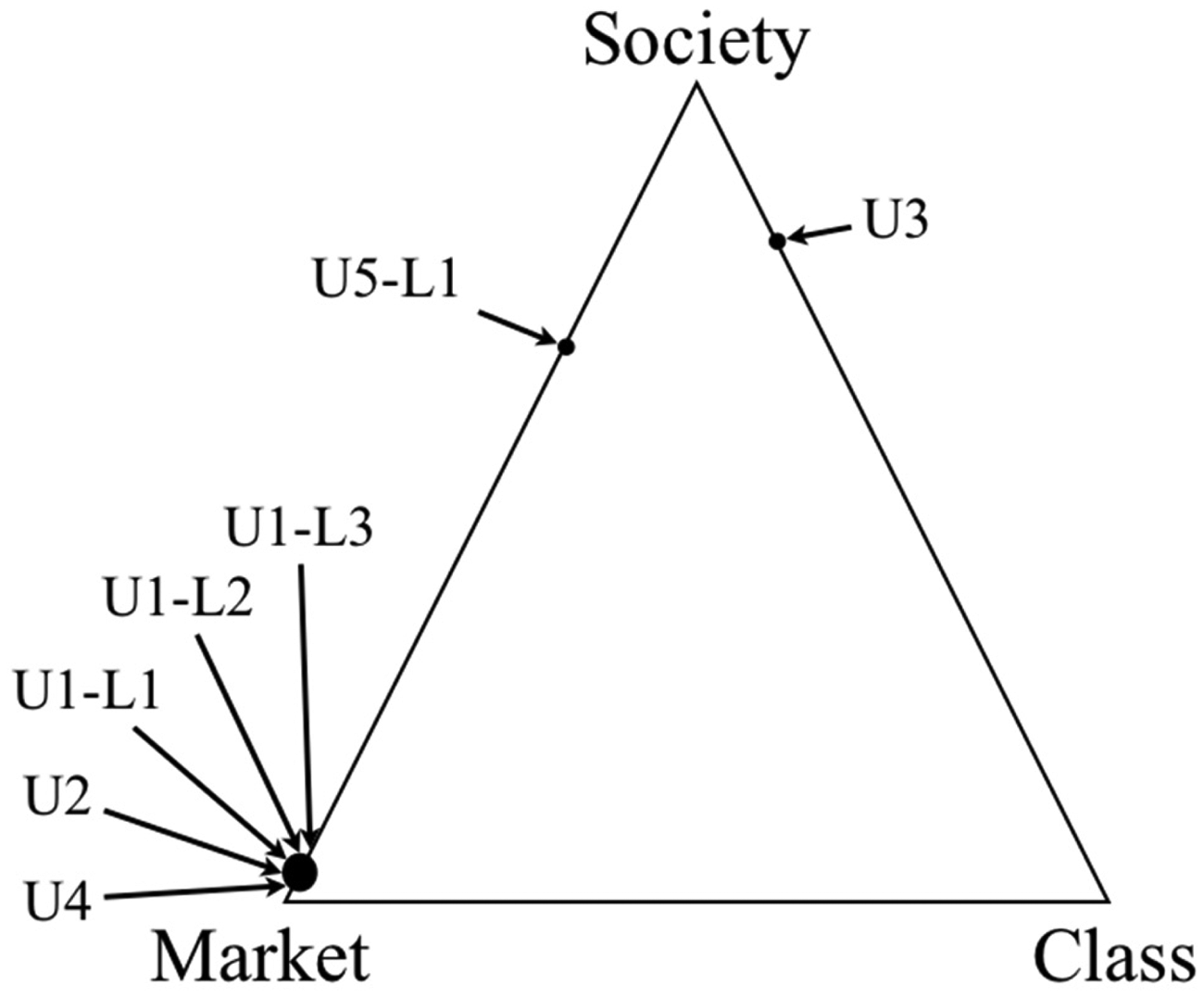
Cases positioning on Hyman’s triangle.
Discussion
The following section addresses the similarities and differences between union identities according to their positioning towards the just transition (see the results in Table 2). We begin with the affirmative cases and follow with the reactive ones in order to differentiate the union identities associated with them and compare them to the literature. We then discuss the specificities of union 4 and its indifferent position. We conclude by exposing the limits of associating Hyman's union identities with just transition positions and suggesting research avenues.
Union identities and positioning towards the just transition, comparison between the literature and our results.
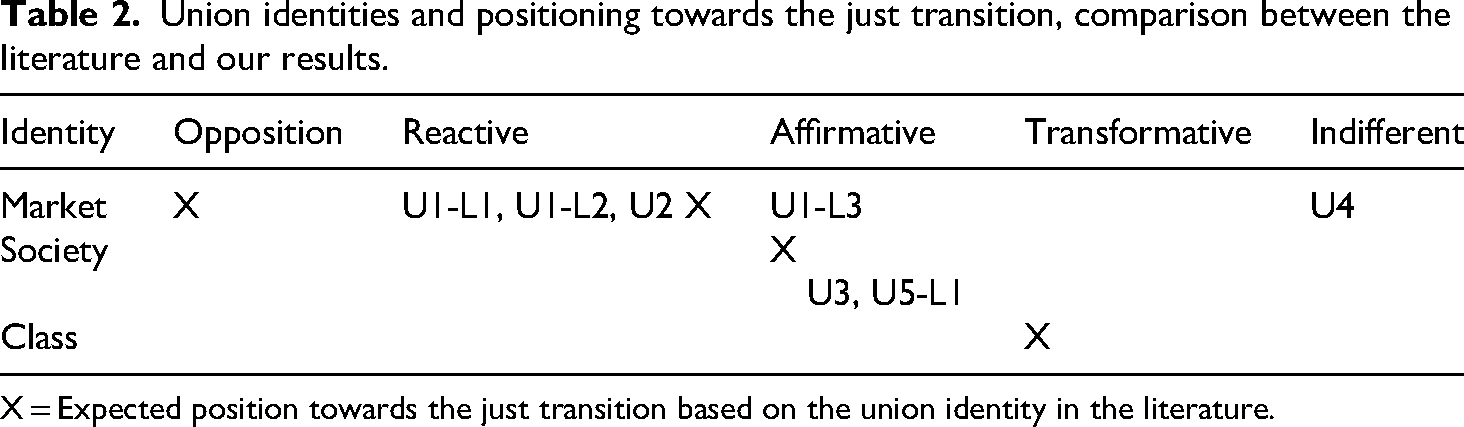
X = Expected position towards the just transition based on the union identity in the literature.
An affirmative position not limited to a society identity
The literature associates market identity with either reactive or oppositional positions, but U1-L3 and U5-L1 stand out as they adopt an affirmative one, as illustrated in Table 2. To better understand the alignment of a market identity and an affirmative position towards the just transition, we explore the specificities of each case. These local organisations both represent a substantial proportion of their respective trade workers, with 40% for U1-L3 and 40% for U5-L1 (Commission de la construction du Québec, 2020: 5). Nonetheless, they are affiliated with different unions, they do not represent the same trade and have different sizes, with U5-L1 representing almost twenty times more workers than U1-L3 (Commission de la construction du Québec, 2020: 7). The way they express their support also differs. For example, U1-L3 focuses on increasing awareness among employers and the state regarding their members’ potential contributions and providing training for them. In contrast, U5-L1 prioritises shaping its union organisation's orientation based on members’ needs and informing them about new methods and initiatives. It is worth noting that U5-L1 is closer to the society corner than all other cases, as it considers the social role of unions and is socially involved outside the industry.
Despite the above, U3 does align with the literature by combining a society identity with an affirmative position towards the just transition. It mainly takes the form of public and political positions supporting just transition and the gradual integration of its principles internally, including creating a committee responsible for developing a just transition policy. This case was also the only one to oppose a fossil fuel development project, even if it meant creating jobs.
The reactive position
Similar toU3, U1-L1, U1-L2 and U2 align with the literature by associating market identities with a reactive position. Here, the just transition is subordinated to the interests of current members. This manifests itself in the support of projects whether or not they are aligned with the just transition. These three cases do not include the just transition in their communications with members. These cases correspond to the results of the studies which associate a market identity with a reactive positioning regarding the just transition (Goods, 2013; Hampton, 2015; Kalt, 2022; Räthzel and Uzzell, 2011; Stevis and Felli, 2015). There is an exception, with Thomas and Doerflinger (2020) associating market identity with an opposition stance, which we do not find in this industry.
We find that the local organisations are not all forthcoming about supporting the fossil fuel industries, especially when social debates arise, with U1-L2 being more publicly active than U1-L2 and U2. These three organisations consider that they represent workers at the end of the construction supply chain, preventing them from acting as decisional actors in the transition. However, U1-L1 works to prepare the members through skills development and renewable energy training. These three cases also consider that working hours will shift from fossil fuel industries to environmentally friendly projects, believing their trades could benefit from just transition policies. While some types of projects may gradually decrease and disappear, they expect that new projects will emerge and generate alternative employment opportunities. Assuming these changes occur progressively, they do not prepare their members and focus on short-term job creation.
Impassive in a changing sector
Union4 corresponds to a no just transition position in the literature, as it lacks a clear stance. Its identity is strongly associated with the market corner since all the resources are focused on defending current members’ interests. This suggests it is not concerned with the transition and climate change adaptation issues. As an independent union, U4 is not internally influenced by a provincial labour union, contrary to what U2, U3 and U5-L1 report. Externally, U4 remains detached from public debates on industry change and refrains from engaging in political discussions on polluting projects. We propose recognizing an ‘indifferent’ stance toward the just transition to account for unions in this position rather than excluding them by default. This is particularly important, as their disengagement does not reflect an actual exclusion from the impacts of the just transition or climate adaptation policies in the construction industry; rather, it represents their perception of being immune.
Conclusion
From the works of Hampton (2014), Thomas and Doerflinger (2020) , Goods (2013, 2017), Stevis and Felli (2015), Kalt (2022), Markey and McIvor (2019), we have questioned the assumption of a direct link between Hyman's identity model and positioning to the just transition through a sectoral case study. By focusing on unions within a single sector operating under the same legislative framework and timeframe, this study minimizes contextual variation and clarifies the role of trade union identity in shaping just transition positions. Moreover, its insights remain valuable beyond sectoral bargaining contexts, as the findings demonstrate that union strategies on just transition are equally influenced by internal organisational dynamics and the role of the state, rather than identity alone.
This study suggests that there are major limitations to using union identity (Hyman, 2001) to predict just transition stance (Kalt, 2022). More specifically, our results align with the literature, combining market identity and reactive positioning in three cases (U1-L1, U1-L2 and U2) and society identity and assertive positioning in one case (U3). However, as illustrated in Table 2, two cases deviate by combining market identity with assertive positioning (U1-L3 andU5-L1), the latter being associated with a society identity in the literature. This study fills a gap in the literature by underscoring the need to move beyond examining only those unions already conscious of the positive or negative impacts of the transition on their members. This is especially relevant as transition-related policies and regulations are increasingly extending beyond traditionally studied sectors such as coal, energy, and forestry, making such union positions likely to become more widespread.
Whereas previous work selected unions engaging within the just transition discussion in their sector to understand the role of union identity in union's stance, including all unions within a sector characterized by union plurality highlights the importance of considering those who do not. Understanding indifferent organisations is critical in the current context due to the rapid multiplication of regulations, policies, and strategies in various sectors not typically associated with the transition. We also find that unions consider the state to be the central actor in promoting a just transition, describing it as responsible for establishing essential laws, regulations, and requirements that apply to companies employing union members. Further work is needed to increase our understanding of the factors that complement trade union identity in determining the positioning of trade union organisations concerning the just transition.
Footnotes

Ethics committee
This study was approved by Laval University ethics committees for research involving humans (CERUL) (approval # 2022-058 R-1 / 01-02-2023
Funding
This research received funding from the Social Sciences and Humanities Research Council and Fonds de recherche du Québec .
Declaration of conflicting interests
The author declared no potential conflicts of interest with respect to the research, authorship, and/or publication of this article.