



Abstract
Recent studies have shown that children with mathematics difficulties (MD) have weaknesses in multiple areas of mathematics. Andersson, for example, recently found that children with MD perform significantly worse than other children on clock reading tasks. The present study builds on this recent finding and aims at a more profound understanding of the difficulties that children with MD experience with telling time. Therefore, clock reading abilities of 154 children with MD were compared to the abilities of 571 average achieving children, and a qualitative error analysis was performed. The results of this study confirm the earlier findings of Andersson that children with MD perform worse on clock reading than average achieving children and also show that children with MD especially struggle with the combination of procedural and retrieval strategies that are needed to read complex 5-min and 1-min clock times. Children with MD make more errors, which reflects immature counting strategies and deficits in memory retrieval. This finding is in line with Geary’s theory of subtypes in MD, which argues that children with MD have problems with mathematical procedures and semantic memory retrieval.
A growing interest in children with mathematics difficulties (MD) in the past two decades has led to an increased number of studies on this topic (Geary & Brown, 1991; Geary, Brown, & Samaranayake, 1991; Gonzales & Espinel, 2002; Russell & Ginsburg, 1984; Swanson & Beebe-Frankenberger, 2004). These previous studies have shown children with MD to have profound difficulties with number knowledge, mathematical facts, and mathematical procedures (Butterworth, 2005; Geary, 1993; Ginsburg, 1997; Jordan & Montani, 1997; Russell & Ginsburg, 1984), resulting in a below average performance on a standardized achievement tests (Hanich, Jordan, Kaplan, & Dick, 2001). Although most of the studies of MD in children have focused on basic arithmetical skills (Geary, Hamson, & Hoard, 2000; Geary, Hoard, & Hamson, 1999; Ostad, 1997, 1998) and considerably less on other domains of mathematics (Fuchs & Fuchs, 2002; Hanich et al., 2001; Russell & Ginsburg, 1984), recent research has revealed that children with MD have weaknesses in multiple areas of mathematics (Andersson, 2008).
A new and important finding in the study of Andersson (2008) was that children with MD have substantial problems with telling time. Although the ability to tell time is an important life skill that allows us to plan our daily activities, to get organized, and to function in a society that is driven by time (Bock, Irwin, Davidson, & Levelt, 2003; Burny, Valcke, & Desoete, 2009; Friedman & Laycock, 1989), it has received only little scholarly attention, and consequently, little is known about the acquisition of clock reading skills in children with learning difficulties. Yet becoming able to handle time through conventional time systems such as clocks and calendars is an important goal for all primary school children. But as previous studies have shown clock reading to have many similarities with number knowledge, mathematical facts, and mathematical procedures (Friedman & Laycock, 1989; Siegler & McGilly, 1989; Vakali, 1991), it can be assumed that children with MD will experience difficulties in the acquisition of clock reading skills.
Geary and Hoard (2005) present a conceptual framework for studying MD in children, in which they state that the specific difficulties of children with MD with number knowledge, mathematical procedures, and mathematical facts are captured by three common deficits: a procedural deficit, a semantic memory deficit, and a spatial deficit. Most authors agree on the procedural and a semantic memory subtype within MD (Robinson, Menchetti, & Rogensen, 2002; Temple, 1999; Wilson, Revkin, Cohen, Cohen, & Dehaene, 2006). However, not all studies have found different profiles for these groups, and studies on the spatial deficit remain unclear (Landerl, Bevan, & Butterworth, 2004; Rousselle & Noel, 2007).
The procedural deficit in children with MD involves the use of immature strategies in solving mathematical problems and often results in difficulties with the sequencing of multiple steps in complex procedures. Regarding the role of procedural knowledge in clock reading, several studies have indicated that, in clock reading, children rely on a mixture of retrieval and procedural strategies that are similar to the strategies used in solving mental arithmetic tasks (Case, Sandieson, & Dennis, 1986; Friedman & Laycock, 1989; Siegler & McGilly, 1989). The procedural deficit in children with MD would be the result of executive dysfunction and characterized by a developmental delay in the acquisition of counting and counting procedures used to solve simple arithmetic problems (Wilson et al., 2006).
The deficit in semantic memory influences the ability of children with MD to retrieve information from long-term memory and results in difficulties with retrieving mathematical facts (Ashcraft, 1992; Geary, 2004; Geary & Hoard, 2005). The semantic memory subtype in children with MD would be the result of verbal memory dysfunction and characterized by errors in the retrieval of arithmetic facts (Wilson et al., 2006). Considering mathematical facts in clock reading, it can be argued that children have to acquire a set of facts to understand the basics of clock reading. For example, one should be aware of the fact that 1 hr consists of 60 min, that there is a scale for hours (1–12) and a scale for minutes (1–60) on a clock face, and so on. Moreover, fact retrieval plays an important role in automating clock reading abilities (Burny, Valcke, & Desoete, 2010): A rapid recognition of important landmarks on the clock face through a mental representation of the clock contributes to the automation of clock reading skills.
However, spatial deficits in children with MD also have been associated with misinterpretations of the numbers (Geary, 1993; Geary & Hoard, 2005; Russell & Ginsburg, 1984). The interpretation of numbers is especially difficult in clock reading, as (a) the clock does not make use of the base 10 structure, (b) the meaning of a number depends on which clock hand is pointing at it, and (c) reading a clock involves understanding of spatial, clockwise movements. Children with spatial deficits might therefore experience problems with the interpretation of analog clock times, where they have to interpret the upper and below part of the clock differently (in Dutch “10 past 8” [8:10] vs. in Dutch “10 to half 8” [8:20]) and where they also have to differentiate left from right (“to” vs. “past”).
Considering these earlier findings and linking them to the conceptual framework that was presented by Geary and Hoard (2005), it is argued that clock reading tasks are likely to be difficult for children with MD. Building on the recent finding of Andersson (2008) that 8- and 9-year-olds with MD experience substantial difficulties with telling time, the present study presents an in-depth analysis of the clock reading skills of children with MD by analyzing how children with MD perform in reading and writing analog clock times (A-tasks; e.g., 10 past 2), reading and writing digital clock tasks (D-tasks; e.g., 14:57), and transforming analog clock times into a digital format and vice versa (T-tasks; e.g., draw the clock hands for 3:15). Aiming at a profound understanding of children’s difficulties, children’s errors on the different subtasks in clock reading are analyzed. In addition, it is examined whether clock reading abilities are predictive for MD and children with MD experience more problems with A- or D-tasks.
Method
Participants
A total of 725 children (Grades 1–6) from eight different Flemish primary schools were tested on clock reading skills and mathematics ability. In this sample, 154 children were identified as having MD, and 571 children were identified as normal achievers in mathematics (NA). Children were classified in the MD condition when they scored lower than the 25th percentile on the standardized mathematics test and had at least average intelligence, which was considered to be the case if they scored at most 1.5 SD lower than the group mean of NA children of the same age. A score lower than the 25th or 30th percentile on a mathematics achievement test combined with a low average or higher IQ score is a common criterion for diagnosing MD (Geary et al., 2000; Gross-Tsur, Manor, & Shalev, 1996).
General Testing Procedure
Test administration was set up during the months of January, February, and March 2010. It took on average 90 min and was divided into two sessions of 45 min with a 15-min break in between. All children were tested with paper and pencil tests in their classroom. Testing was performed by one experimenter who presented all instructions regarding the tasks orally. The mathematics test was given by the teacher and fits in with the schools’ follow-up for pupils’ progress in mathematics.
Instruments
Mathematics achievement
The participants’ mathematics achievement was measured by means of a standardized mathematics test that is used in all Flemish primary schools, in the context of the pupil monitoring system. The LVS Mathematics Test (Dudal, 2002) consists of 60 items covering four mathematics domains: number knowledge, operations, measurement, and geometry, and a separate subtest about basic computational skills. The test is presented by the teacher during two sessions, following a standardized procedure for administering, scoring, and evaluating the test. The LVS Mathematics Test is a homogeneous test with good internal consistency showing a Cronbach’s alpha value of .91 in first, second, and third grade, .89 in fourth grade, .90 in fifth grade, and .89 in sixth grade.
Clock reading
To measure children’s clock reading abilities, four different clock reading tests were developed: a test for first graders, one for second graders, one for third graders, and a test for fourth, fifth, and sixth graders. Each test is aligned with the attainment level in clock reading that is expected in a particular grade. The first graders test consists of six items measuring the ability to read and record hour, half hour, and quarter past times on an analog clock (e.g., 6:30). This test showed an acceptable Cronbach’s alpha value of .74 (MD: α = .70, NA: α = .73). The second graders test includes eight items on reading and recording analog clocks up to 5-min precise (e.g., 10 past 7; Cronbach’s α = .60, MD: α = .60, NA: α = .61), and in the third graders test, children were asked to complete eight items on the reading and recording of both analog and digital clocks up to 1-min precise (e.g., 2 past 4; 11:42). Cronbach’s α for this test was .87 (MD: α = .82, NA: α = .85). The test for grades four, five, and six consists of 16 items on analog and digital clock reading of quarter past, 5-min, and 1-min clock times (e.g., 20 to 11; 3:36). Cronbach’s alphas for these tests were .84 in fourth grade (MD: α = .84, NA: α = .76), .84 in fifth grade (MD: α = .92, NA: α = .71), and .73 in sixth grade (MD: α = .80, NA: α = .62). A summary of descriptive information about the test administration of the clock reading test (see the appendix) is displayed in Table 1.
Means and Standard Deviations on Raven’s SPM, Clock Reading, and Mathematics Test for Each Condition in Each Grade
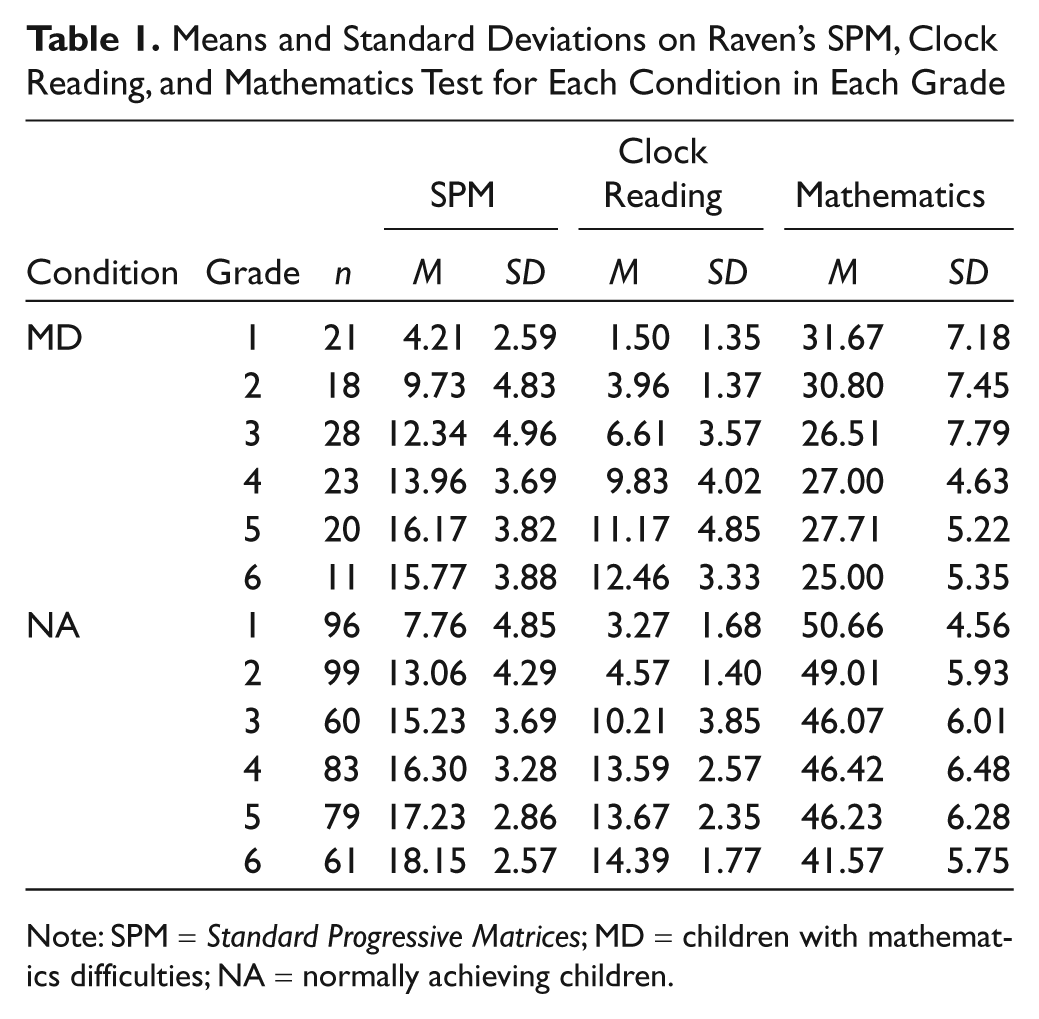
Note: SPM = Standard Progressive Matrices; MD = children with mathematics difficulties; NA = normally achieving children.
Intelligence
To determine the children’s nonverbal intelligence, Raven’s Standard Progressive Matrices (SPM) was administered. This test consists of a series of visual patterns with a piece missing. Respondents have to complete the pattern by selecting the correct piece from a number of options (six to eight) displayed beneath the pattern. The complete test includes five sets of patterns (A, B, C, D, E), each consisting of 12 items (Raven, Raven, & Court, 2003). To reduce testing time, only 21 items with high loadings on the visuospatial factor in Raven’s SPM were presented to the children (DeShon, Chan, & Weissbein, 1995; Lynn, Allik, & Irwing, 2004).
Results
Preliminary Analyses: Do Mathematics Difficulties Influence Clock Reading Abilities?
To define the influence of MD on clock reading abilities, a regression analysis was carried out, showing a significant effect of mathematics performance on clock reading in first grade, F(1, 120) = 24.39, p < .01, second grade, F(1, 111) = 15.83, p < .01, third grade, F(1, 89) = 55.89, p < .01, fourth grade, F(1, 100) = 50.53, p < .01, fifth grade, F(1, 102) = 29.71, p < .01, and sixth grade, F(1, 74) = 10.83, p < .01. Analysis of bivariate correlations between mathematics performance and clock reading skills shows a significant correlation of .41 in first grade, .36 in second grade, .63 in third grade, .58 in fourth grade, .48 in fifth grade, and .36 in sixth grade.
Clock Reading Performance of Children With and Without Mathematics Difficulties
The first research question in this study addresses the question of whether MD children indeed perform worse on clock reading tasks than their NA peers. Table 2 presents mean scores and standard deviations for each clock reading subtask for children with and without MD in each grade of primary education. ANOVAs were conducted with group (children with MD and NA children) as the independent variable and general clock reading skills as the dependent variable. A correction factor was added to correct for the number of comparisons (n = 6): Differences between groups are considered significant when p < .01. These analyses show that there is indeed a significant difference in clock reading performance between MD and NA children in Grade 1, F(1, 119) = 22.99, η2 = .16, p < .01, Grade 3, F(1, 104) = 19.482, η2 = .16, p < .01, Grade 4, F(1, 112) = 31.99, η2 = .22, p < .01, Grade 5, F(1, 101) = 11.87, η2 = .11, p < .01, and Grade 6, F(1, 73) = 8.95, η2 = .11, p < .01. In Grade 2 children with MD (M = 3.96, SD = 1.37) did not differ significantly from their age-matched peers (M = 4.57, SD = 1.40), but a trend was found, F(1, 111) = 3.70, η2 = .03, p = .06.
Mean Scores and Standard Deviations on Each Clock Reading Subtask for Children with Mathematics Difficulties (MD) and Normally Achieving Children (NA) in Each Grade
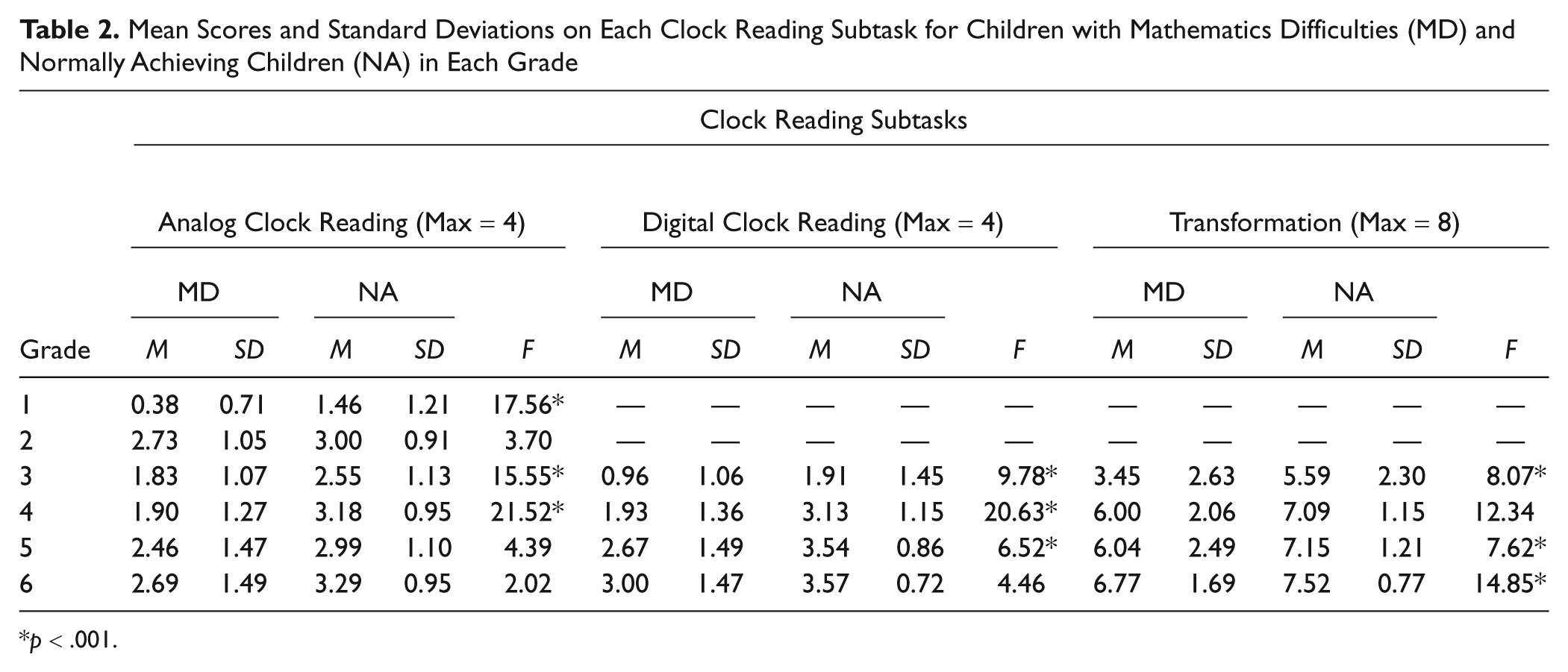
p < .001.
Performance of Children With Mathematics Difficulties on Different Subtasks
To look for the specific profile of children with MD, several ANOVAs and MANOVAs were carried out to compare their performance on different clock reading subtasks (A-, D-, and T-tasks) to the performance of children without MD in the same grade and to the performance of younger children (one grade earlier). An overview of the results of these analyses is presented in Table 2. It should be noted that in younger children only analog clock reading skills could be compared since children in Grades 1 and 2 did not yet learn to deal with D- and T-tasks. Within the analog and digital subtasks, analyses at the item level were carried out to define whether children with and without MD have different accuracy in reading simple hour and half hour clock times versus more complex 5-min and 1-min clock times. Given the large number of comparisons (n = 32), a Bonferroni correction was applied to the analyses (significance level: p < .001).
In Grade 1, children with MD perform significantly worse than their age-matched peers on analog clock reading tasks, F(1, 119) = 17.56, p < .001. Children with MD (M = 0.71, SD = 0.81) performed worse than average achievers (M = 1.53, SD = 0.78) in reading and writing hour times, F(1, 118) = 20.65, η2 = .15, p < .001, and half hour times (MD: M = 0.09, SD = 0.42; average achievers: M = 0.61, SD = 0.83), F(1, 117) = 8.61, η2 = .07, p < .001. No significant differences are found in reading and writing quarter past tasks, F(1, 117) = 1.85, ns, as neither average achievers (M = 0.16, SD = 0.37), nor children with MD (M = 0.08, SD = 0.28) were accurate in these tasks.
In Grade 2 children with MD (M = 3.96, SD = 1.37) did not differ significantly from their age-matched peers (M = 4.57, SD = 1.40) in reading and writing analog clock times, F(1, 111) = 3.70, η2 = .03, ns.
In Grade 3, children with MD (M = 1.83, SD = 1.07) did significantly worse than both age-matched peers (M = 2.55, SD = 1.13) and younger children with at least average mathematical skills (M = 3.00, SD = 0.92) on analog clock reading tasks, F(2, 211) = 15.55, η2 = .13, p < .001. An ANOVA at the item level shows that there is no significant difference between third graders with MD (M = 0.79, SD = 0.41) and average achieving third graders (M = 0.90, SD = 0.31) on reading half hour clock times, F(1, 114) = 2.00, ns, and quarter past tasks (MD: M = 0.66, SD = 0.48; NA: M = 0.83, SD = 0.38), F(1, 114) = 3.76, ns. Third graders with MD did perform lower on more complex 5-min tasks (e.g., 10:40), F(1, 113) = 4.24, η2 = .09, p < .001, and on 1-min tasks (e.g., 11:42), F(1, 113) = 6.83, η2 = .14, p < .001, on the analog clock. Considering digital clock reading, the analyses show that third graders with MD perform significantly worse on digital clock reading than their age-matched peers, F(1, 106) = 9.78, η2 = .08, p < .001, and also in transforming analog clock times into digital clock times, F(1, 115) = 8.07, η2 = .07, p < .001, and converting digital clock times into an analog format (drawing the arrows), F(1, 115) = 12.88, η2 = .10, p < .001, children with MD performed worse than average achievers in mathematics.
In Grade 4, children with MD (M = 1.93, SD = 1.27) did worse than average achievers in (M = 2.51, SD = 1.10) and younger children (M = 3.20, SD = 0.95) on A-tasks, F(2, 188) = 21.52, η2 = .16, p < .001. Analysis at the item level shows that fourth graders with MD performed worse than age-matched peers on complex 5-min tasks (e.g., 10:40), F(1, 124) = 37.38, η2 = .22, p < .001, and 1-min tasks (e.g., 11:42), F(1, 118) = 14.65, η2 = .20, p < .001, but not on quarter past tasks (e.g., quarter past ten) F(1, 124) = 0.665, ns. On digital clocks, fourth graders with MD perform at the same level as average achieving third graders (M = 1.91, SD = 1.45), but they are significantly less accurate in reading digital clock times than their age-matched peers, F(2, 196) = 20.63, η2 = .12, p < .001. Considering transformation tasks, children with MD were found to perform lower on both transforming analog clocks into the digital format, F(1, 126) = 12.34, η2 = .09, p < .005, and transforming digital clocks into analog clocks, F(1, 126) = 3.98, η2 = .03, p < .05, but these differences were not convincingly significant.
Fifth graders with MD (M = 2.46, SD = 1.47) slightly differed from younger children (M = 3.17, SD = 1.11) on analog clock reading tasks, F(2, 184) = 4.39, η2 = .05, p < .05, but did not perform significantly lower than their age-matched peers, F(2, 184) = 4.39, ns. On digital clocks on the other hand, children with MD did perform significantly worse than their average achieving peers (M = 2.97, SD = 1.10), F(2, 184) = 6.52, η2 = .07, p < .001, but there were significant differences only on complex 1-min clock times (e.g., 15:36), F(2, 192) = 4.93, p < .001, and not on quarter past times (e.g., 15:15), F(2, 192) = 2.64, ns, or 5-min tasks (e.g., 6:10), F(2, 191) = 2.12, ns. With regard to T-tasks, the analyses show children with MD to be less accurate in transforming clock times from a digital into an analog format (e.g., draw the arrows for 4:02) in Grade 5, F(1, 102) = 7.62, η2 = .07, p < .005, and Grade 6, F(1, 74) = 14.85, η2 = .17, p < .001, but not vice versa (e.g., 10:40) in Grade 5, F(1, 102) = 4.23, ns, and Grade 6, F(1, 73) = 0.08, ns.
For Grade 6, the analyses show a trend of differences between children with MD (M = 2.69, SD = 1.49) and average achievers (M = 3.29, SD = 0.95) on analog clock reading tasks, F(6, 294) = 2.02, η2 = .04, p = .06, and on digital clock reading tasks, F(1, 74) = 4.46, η2 = .06, p < .05. On transformation tasks, children with MD in Grade 6 (M = 3.15, SD = 1.14) performed lower than average achievers (M = 3.85, SD = 0.40) in transforming digital clocks into an analog format, F(1, 74) = 14.85, η2 = .17, p < .001, but there was no significant difference in accuracy in transforming analog clocks into a digital format between children with MD (M = 3.62, SD = 0.87) and average achieving children (M = 3.67, SD = 0.63), F(1, 73) = 0.08, ns.
Digital Versus Analog Clock Reading
As previous studies suggest that digital clock reading is easier for children than analog clock reading (e.g., Friedman & Laycock, 1989), it was tested whether children with and without MD indeed performed better on digital clocks was tested. This could be analyzed only for children from Grades 3 to 6, as younger children are not yet familiar with the digital clock format. Paired-samples t tests for the data for third graders show that both children with MD, t(28) = 4.70, p < .0005, and children with average mathematical achievement, t(86) = 4.68, p < .0005, perform better on analog clocks than on digital clocks. Means and standard deviations are shown in Table 2. In Grade 4, there were no significant differences in the test scores on analog and digital clocks in the MD condition, t(31) = 0.297, ns, nor in the group of average achievers, t(94) = 0.00, ns. Older average achieving children, however, performed better on digital clocks than on analog clocks in Grade 5, t(78) = −4.10, p < .0005, and Grade 6, t(60) = −2.43, p < .05, but children with MD performed similar on both formats, Grade 5 t(23) = −8.94, ns; Grade 6 t(12) = −1.08, ns.
Qualitative Error Analysis: Do Children With MD Make Different Mistakes?
Qualitative error analysis on the clock reading tasks presented in this study (see Table 3) showed that children made a variety of mistakes when reading analog and digital clock times. In general, it can be concluded that there are no differences between children with MD and average achieving children in the types of errors they make, but there are some differences in the frequency of these errors between both groups (Table 3). The most common errors in young children, which account for 44.83% of the errors of first graders with MD and 37.93% of the errors of average achievers in this grade, is denoted as “selective attention” and involves paying attention to only one clock hand (the minute hand or the hour hand) or one part of the display of a digital clock, which results in reporting just one number (e.g., 10 instead of quarter past 10) or deducting information about both the hour value and the minute value from a single source (e.g., quarter past 3 instead of quarter past 10). This error is still very frequent in second graders, where it accounts for 44.0% of errors in the MD condition and 33.33% of the errors of average achievers, but strongly decreases in frequency from Grade 3 on (see Table 3).
Frequency (% of False Answers) of Different Types of Errors on Clock Reading Tasks in Different Grades for Children With Mathematics Difficulties (MD) and Average Achievers in Mathematics
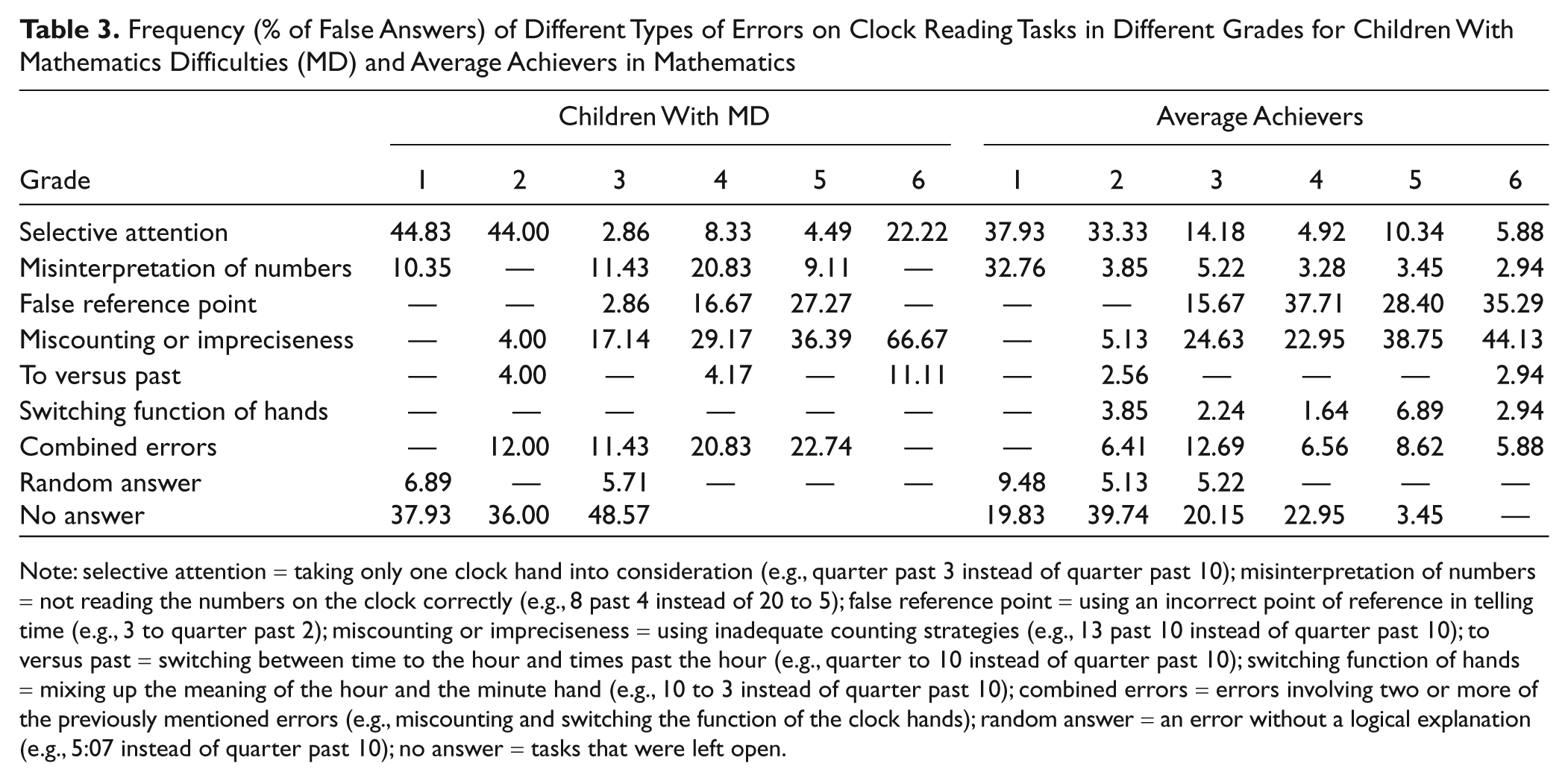
Note: selective attention = taking only one clock hand into consideration (e.g., quarter past 3 instead of quarter past 10); misinterpretation of numbers = not reading the numbers on the clock correctly (e.g., 8 past 4 instead of 20 to 5); false reference point = using an incorrect point of reference in telling time (e.g., 3 to quarter past 2); miscounting or impreciseness = using inadequate counting strategies (e.g., 13 past 10 instead of quarter past 10); to versus past = switching between time to the hour and times past the hour (e.g., quarter to 10 instead of quarter past 10); switching function of hands = mixing up the meaning of the hour and the minute hand (e.g., 10 to 3 instead of quarter past 10); combined errors = errors involving two or more of the previously mentioned errors (e.g., miscounting and switching the function of the clock hands); random answer = an error without a logical explanation (e.g., 5:07 instead of quarter past 10); no answer = tasks that were left open.
A second kind of error involves misinterpretation of the numbers on a clock: Children making this error have insufficient understanding of the meaning of the numbers and report, for example, the numbers 3 and 10 instead of writing quarter past 10. In average achieving children, this error is highly frequent (32.76%) in first graders but almost disappears in later years. In the group of children with MD, this type of error appears in Grade 1 (10.35%), Grade 3 (11.43%), Grade 4 (20.83%), and Grade 5 (9.11%).
A common error in solving more complex 5-min and 1-min clock times is to apply a false point of reference (e.g., 3 before quarter to 12 instead of 18 to 12). This error is common in average achievers in Grade 3 (15.67%), Grade 4 (37.71%), Grade 5 (28.40%), and Grade 6 (28.57%). In children with MD, however, this error occurs less frequently and arises only in Grades 4 (16.67%) and 5 (27.27%).
Fourth, children make errors in clock reading by simply miscounting or being imprecise in reading the hour or the minute value (e.g., 10:30 instead of 11:30 or 14 past 10 instead of quarter past 10). The frequency of this error increases as the clock reading tasks become more complex but equally occurs in children with MD and average achievers (see Table 3).
Other less frequent errors that are defined are mixing up the function of the hour and the minute hand (e.g., 10 to 3 instead of quarter past 10) and mixing up the terms “to” and “past” (e.g., quarter to 10 instead of quarter past 10). However, these errors rarely appear in their absolute form but more often appear in combination with other errors. These combined errors are more frequent in children with MD than in average achievers (see Table 3), and their frequency increases in this group when more complex 5-min and 1-min tasks are presented.
Predictive Value of Clock Reading Tasks
A discriminant analysis was performed with analog and digital clock reading as predictor variables for MD in all grades of primary school. MD children differed significantly from NA children on both analog and digital clock reading. A single discriminant function was calculated. The value of this function was significantly different for MD and NA children (χ2 = 83.92, p < .01). The correlations between predictor variables and the discriminant function suggested that analog clock reading is a better predictor for MD than digital clock reading. Overall, the discriminant function successfully predicted outcome for 67.8% of the cases, with accurate predictions made for 61.7% of the MD children and 69.6% of NA children.
In addition, Table 4 presents the results of a discriminant analysis on the test results of first to sixth graders. These results show that 79.2% of the MD children were correctly predicted based on their clock reading skills. In second grade, clock reading abilities correctly predicted 72.0% of the MD children to be in the MD condition, and in third grade 70.4% of the MD children were correctly assigned to the MD condition based on their clock reading performance. In Grades 4, 5, and 6, the predictive value of clock reading toward MD decreased from 64.3% in Grade 4 to 53.8% in Grade 6.
The Predictive Value of Clock Reading for Mathematics Difficulties in Each Grade
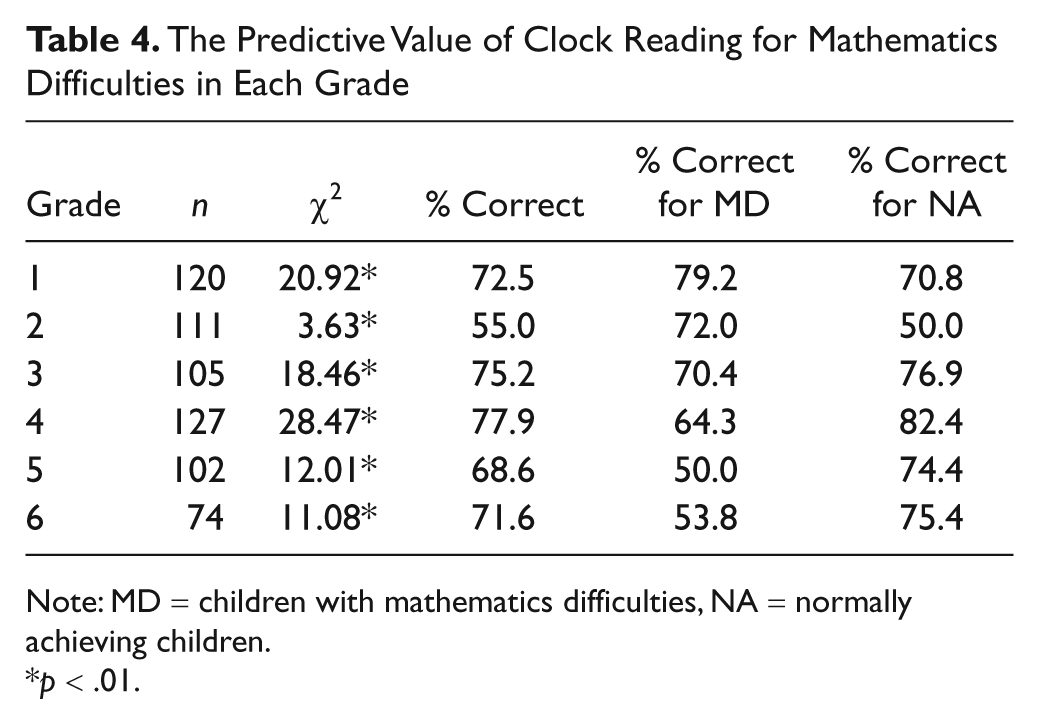
Note: MD = children with mathematics difficulties, NA = normally achieving children.
p < .01.
Discussion
Building on the recent finding of Andersson (2008) that children with MD not only struggle with mental arithmetic but also show weaknesses in other areas of mathematics, such as time telling, the present study aimed at a more profound understanding of the impact of MD on clock reading skills in primary school children. Unlike previous studies about clock reading, which focused on the definition of age-related stages in the development of clock reading abilities in NA children, the current study aimed at a better understanding of difficulties with clock reading in children with MD.
Revealing that children with MD perform worse on clock reading tasks in nearly every grade of primary education, the results of this study confirm Andersson’s (2008) finding that the acquisition of clock reading is indeed affected by MD and are in line with the recent finding of Van Steenbrugge, Valcke, and Desoete (2010) that time measurement is a difficult subject in primary mathematics for children in nearly every grade of primary education. Although children with MD have caught up with their peers by the end of primary education, the current results show that especially complex clock reading tasks—reading the clock to 5-min or 1-min precision—remain difficult for children with MD on both analog and digital clocks.
Although there is a significant correlation between mathematics performance and clock reading abilities in every grade of primary education, this correlation is only moderate. Especially in Grades 1 and 2, when children are taught the landmarks on an analog clock (hour, half hour, and quarter past and to), the correlation with mathematics achievement is rather weak. Nevertheless, the results of this study suggest that difficulties with the acquisition of this basic clock reading are predictive for MD. Teachers should thus be alert to children who already experience profound difficulties with the clock in first and second grade of primary education.
Problems with clock reading in children with MD seem to become obvious in Grade 3, when more complex 5-min and 1-min clock times are introduced. These difficulties start to disappear only in Grade 6. Since reading these complex 5-min and 1-min clock times demands the use of a mixture of procedural and retrieval strategies (Case et al., 1986; Friedman & Laycock, 1989; Siegler & McGilly, 1989; Vakali, 1991), it is not surprising that children with MD are struggling. As children with MD are experiencing difficulties with both mathematical procedures (e.g., procedural deficit) and retrieval strategies (e.g., semantic memory deficit), the interplay of both strategies in clock reading is extremely challenging: As children with MD have difficulties in retrieving mental representations from long-term memory (Ashcraft, 1992; Geary & Hoard, 2005), they cannot rely on retrieval strategies, and as such they do not gain any automation in clock reading. Consequently, children with MD heavily rely on procedural strategies to read complex clock times. Yet it is typical for children with MD to be less effective in the application of mathematical procedures (Butterworth, 2005; Geary, 1993; Ginsburg, 1997; Jordan & Montani, 1997; Russell & Ginsburg, 1984). Moreover, the mere use of procedural strategies to solve complex clock reading tasks leads to an increased cognitive processing load and as such results in an increased number of counting errors (Boulton-Lewis, Wilss, & Mutch, 1997).
A closer look at the type of errors children with MD make in reading complex clock times shows a high prevalence of misinterpretation of the numbers on the clock, miscounting, and combined errors in children with MD. Misinterpretation of the numbers on the clock suggests an interplay of procedural deficits and a lack of memory representations: When a child reports 10:04 instead of 10:20, he or she did not have sufficient knowledge of the fact that the number 4 on the analog clock is to be interpreted as 20 when it is pointed at by the minute hand (memory retrieval deficit); he or she applied an immature counting strategy by not counting by fives (procedural deficit). Miscounting too reflects a combination of the use of immature strategies and a lack of memory retrieval, and combined errors are the best example of how children with MD are struggling with multiple aspects of clock reading. For example, in reporting 6 past 10 instead of 10:40, a child paid attention only to the hour hand and as such had insufficient knowledge about the fact that the hour hand provides information only about the hour value (memory retrieval), and at the same time he or she switched between time to and past the hour (spatial deficit). It is important to note that the frequency of combined errors, that is, a combination of two or more errors reflecting a deficit in procedures, fact retrievals, and/or spatial competence, increases with age in the group of children with MD, whereas in average achievers, the frequency of this type of error decreases as children grow older. This might indicate that children with MD have a number of misconceptions with regard to clock reading that accumulate over years.
Furthermore, the finding that children with MD show a comparable number of problems with analog and the digital clocks, which are assumed to involve different processes, supports the idea that children with MD have problems related to both retrieving memory representations and counting procedures (Andersson, 2008; Friedman & Laycock, 1989). In previous research, it has been argued that digital clock reading is basically a matter of retrieving number names (Friedman & Laycock, 1989; Williams, 2004), whereas analog clock reading includes
attending to the numerals to which the hour hand points or, if necessary, has passed most recently to get the hour value, determining the minute value by counting clockwise by 5s from the top of the clock face until the 5-min mark pointed to or immediately preceding the minute hand pointing is reached, and, if necessary, counting the remaining hash marks by 1s. (Friedman & Laycock, 1989, p. 357)
Consequently, reading digital clock times is expected to be easier for children. The results of the present study show that average achieving children indeed perform better on digital clocks in Grades 5 and 6. Children with MD, on the other hand, do not profit from this lower complexity of digital clocks and do not perform better on digital clocks.
The current results provide little evidence for a specific spatial deficit in children with MD that causes difficulties with clock reading tasks. Although a number of errors reflect spatial difficulties (e.g., switching to and past, using a false point of reference), these errors are not made more frequently by children with MD.
Educational Implications
With regard to the teaching of clock reading skills to primary school children, the present study shows that clock reading is a complex cognitive skill that makes great demands on children and teachers. Given the finding that difficulties with clock reading in early grades could be predictive for MD, teachers should be alert for difficulties with basic clock reading in 6- and 7-year-old children. Furthermore, it seems worthwhile for teachers in every grade of primary education to make accurate error analyses when a child struggles with clock reading and to define what misconceptions are causing each specific error. As the results of this study show an increasing number of combined errors in children with MD when they grow older, it is important that teachers recognize children’s difficulties in a timely manner and that they address each misconception separately. Obviously, this recommendation applies to every child who is struggling with clock reading tasks.
A frequently adopted strategy by primary school teachers is to switch to digital clocks when a child experiences severe difficulties with analog clock reading. As children with MD do not experience digital clocks as easier than analog clocks, it should not be expected that this strategy will resolve all difficulties with clock reading. Yet it might be less confusing for struggling children when they can confine themselves to one format: analog or digital. Making a choice between both formats should then be driven by a solid analysis of errors and the child’s preference.
Conclusion
Children with MD perform worse on both analog and digital clock reading tasks in nearly every grade of primary education. It can be concluded that MD especially affects the acquisition of complex clock reading skills (reading and writing clock times to 5-min or 1-min precision). It is argued that these difficulties with clock reading result from a combination of procedural and semantic memory deficits: The combination of retrieval and procedural strategies that is necessary to accurately read complex clock times causes profound difficulties for children with MD. Based on the results of this study, it is recommended that teachers be vigilant for problems with clock reading in early grades and that they spend enough time making accurate error analyses.
Footnotes
Appendix
Declaration of Conflicting Interests
The author(s) declared no potential conflicts of interest with respect to the research, authorship, and/or publication of this article.
Funding
This research was funded by a PhD grant of the Ghent University Special Research Fund, nr B/09031/02