




Abstract
This study investigated the association among friendship, global self-worth, and domain-specific self-concepts in 102 university students with and without learning disabilities (LD). Students with LD reported lower global self-worth and academic self-concept than students without LD, and this difference was greater for women. Students with LD also reported that they had more stable friendships than students without LD. Students with LD were more likely to have higher global self-worth and self-perceptions of social acceptance if they had stable friendships and had relationships where they communicated spontaneously and frankly. None of the friendship variables predicted academic self-concept. Thus, having stable and intimate friendships is a protective factor in relation to global self-worth and social self-concept in university students with LD.
Self-concept is defined as the global appraisal of the degree to which individuals feel worthwhile and is a key predictor of child and adult social and emotional adjustment (Brown, Bifulco, Veiel, & Andrews, 1990; Harter, 1999). Individuals have differentiated perceptions of their competence in various domains. Harter (1985) conceptualized self-perception as involving six domains: scholastic, social, athletic, physical, behavioral, and a global self-concept, termed by her as global self-worth. Her model is in part based on Cooley’s (1902) theory of the looking glass self; Cooley claimed that the ability to evaluate one’s self is developed through a series of stages that begin with the awareness that others are observing and evaluating the self. Individuals ascertain significant others’ evaluations, internalize those evaluations, and incorporate them as part of the self. Self-concepts are domain specific. As such, when examined independently, they result in different scores (ratings). Of the six domains, the main concepts studied in students with LD are academic self-concept, social self-concept, and global self-worth.
Children, adolescents, and adults with learning disabilities (LD) have consistently been found to have lower academic self-concepts than individuals without LD (see meta-analyses by Bear, Minke, & Manning, 2002; Chapman, 1988). Most studies with children, however, have not shown differences between children with and without LD in terms of their perceptions of their social, physical, and athletic competence (Heath & Wiener, 1996). The data regarding self-concept in children are inconsistent, with some studies finding that children with LD have lower self-concept (Chapman, 1988) and others no differences between children with and without LD (Elbaum, 2002; Gans & Kenny, 2003; Grolnick & Ryan, 1990). This is likely because effect sizes are small (Bear et al., 2002). Some studies have found that community college students with LD have a lower self-concept and social self-concept than other adults (e.g., Kosarych-Coy, 1984). Nevertheless, university students with LD who received university support services for students with LD did not differ from university students without LD with respect to self-concept and their perception of their competence in nonacademic areas such as social self-concept and perceptions of physical appearance (Cosden & McNamara, 1997; Lewandowski & Arcangelo, 1994).
Friendship is a dyadic mutual relationship characterized by extensive companionship and intimacy (e.g., Bukowski, Hoza, & Boivin, 1994; Hartup & Stevens, 1996; Schneider, Wiener, & Murphy, 1994). Friends support each other and provide intimate and honest feedback to each other (Parker & Asher, 1993). Consequently, individuals’ global self-worth and self-perceptions of social competence are typically associated with the degree to which they have stable and intimate friendships (e.g., Keefe & Berndt, 1996). Therefore, the overall purpose of this study is to explore friendship predictors of global self-worth and domain-specific self-concepts in university students with and without LD.
Friendships and Social Relationships of Adults With LD
Major components of friendships include the number of friends, characteristics of friends, stability of friendships, and quality of friendships (Schneider et al., 1994). Children with LD have fewer reciprocated friendships (Margalit, Tur-Kaspa, & Most, 1999; Vaughn & Elbaum, 1999; Wiener & Schneider, 2002) and less stable friendships than children without LD (Wiener & Schneider, 2002). They report having fewer friends from their school, and parents and teachers report that they have more friends with learning problems than students without LD (Wiener & Schneider, 2002). Studies of friendship quality in children with LD show that their friendships involve less contact, less intimacy, less validation, lower levels of loyalty, lower support for self-concept, and higher levels of conflict than those of children without LD (Vaughn & Elbaum, 1999; Wenz-Gross, Siperstein, Untch, & Widaman, 1997; Wiener & Schneider, 2002).
In general, adults with LD have difficulty connecting with others and have fewer friends than other adults (Gajar, 1996; Shani, 1999; White, 1992). They are less involved in leisure activities of a social nature and less satisfied with their familial and social relationships. In addition, they are less independent and tend to rely more on their families of origin. Adults with LD, who had previously attended a private school for children with LD, reported several current social difficulties when interviewed in the context of a longitudinal qualitative retrospective study (Goldberg, Higgins, Raskind, & Herman, 2003). Several of the participants reported difficulty in trusting others in the workplace and during social or family outings and said they did not know where or how to meet new people or to create and maintain friendships. Many reported late development of romantic relationships and difficulties in their marriages and interpersonal relationships as a result of dependence and/or lack of reciprocity. They claimed that their need for help with certain activities was harmful to the balance of power in their relationships with significant others. At work, they reported having difficulty being assertive and getting along with colleagues.
Some adults with LD, however, are resilient in terms of their social relationships. Lewandowski and Arcangelo (1994), for example, found no differences between university students with and without LD in their ratings of their social adjustment in various domains including work, social or leisure, marital, parental, family, and economic. Goldberg et al. (2003) found that participants defined as successful based on a multidimensional success evaluation scale had active family lives and social ties and were involved in their communities. They reported having leadership roles at work and in the social groups to which they belonged. In addition, they demonstrated the capacity for reciprocity in relationships and reported having significant support networks. They claimed that their most difficult years were when they were children as a result of their low self-concept, difficulty forming friendships, frustration, and fear of academic failure, social humiliation, and being bullied. Adulthood brought greater control over their academic lives and enabled them to develop other interests and skills that led them to feel successful. In adulthood, they were better able to organize their lives and were not required to achieve in fields they found very challenging. Furthermore, they reported learning to accept their LD and adopt coping strategies (Goldberg et al., 2003).
Friendship and Self-Perceptions
Following Sullivan’s (1953) proposition that intimate friendships enhance the self-worth of early adolescents, attempts have been made explore the relationships between various aspects of friendship and self-perception among children and adolescents. Outside the realm of LD, several such studies report evidence of connections between the two, although the nature and interpretation of these associations is varied and appears to depend on specific measures and definitions of friendship and self-worth. Keefe and Berndt (1996), for example, reported correlations between friendship quality and self-concept among seventh and eighth graders, such that students with friendships characterized by more positive features also had higher self-perceptions of social acceptance and global self-worth. Having friendships with many positive features, however, did not predict changes over time in self-perception of social acceptance or global self-worth. Bishop and Inderbitzen (1995) found that ninth grade participants with at least one reciprocal friend had higher self-concept than those without a reciprocal friend. Research examining the association between friendship and self-perception in populations with LD is rare, particularly among adults. One study that does specifically address this relationship (Bear, Juvonen, & McInerney, 1993) showed that among boys with LD in third through fifth grade, having a reciprocal friend was associated with increased self-perception of social acceptance, regardless of actual social acceptance among classmates. Vaughn and Elbaum (1999) showed evidence that higher self-esteem, in both the social and academic domains, is associated with having supportive friendships. Furthermore, their findings suggest that in children with LD, academic self-concept continues to be related to perceived peer support throughout the school years. Given the solid association among mutual friendships, self-concept, and social self-concept in children with and without LD, and the importance of self-concept in adult development and adjustment (e.g., Harter, 1999), exploration of the association among self-concept, domain-specific self-concepts, and friendship in adults with LD is warranted.
Objectives of the Study
This study was guided by three objectives: The first objective was to compare university students with and without LD in terms of their global self-worth, academic self-perception, and social self-perception. The second objective was to compare university students with and without LD in terms of their self-reported friendships including number of friends, stability and duration of friendship, and intimacy of friendship. The third objective was to explore whether number, stability, and duration of friendships and quality of intimate relations with best friend predict self-perceptions in university students with and without LD. As developmental research has shown gender differences in various aspects of self-perceptions and social relationships (Kling, Hyde, Showers, & Buswell, 1999), gender was included as a variable in all of the analyses.
Method
Participants and Procedure
The participants were 102 first- through fifth-year students (ages 19–39) from university undergraduate programs and academic preparatory programs in northern and central Israel. There were 50 students (26 men, 24 women) diagnosed with LD and 52 students (24 men, 28 women) without an LD diagnosis. Most participants were born in Israel (LD = 92%, non-LD = 75%). Most students spoke Hebrew as a first language (LD = 88%, non-LD = 75%). The distribution of students with and without LD across academic departments was similar.
Participants with LD were recruited with the help of three clinical support centers for students with LD at three academic institutions in northern and central Israel, all nationally certified to diagnose LD. Students who had signed consent forms for participation in research were approached by phone or through advertisements, after being diagnosed with LD by the support center (based on either an approved previous assessment or an assessment conducted at the center itself). Interested students were asked to present their assessment report summaries and were included in the LD group if these reports confirmed one or more of the following LD: dyslexia, dysgraphia, or dyscalculia.
All assessments were based on nationally accepted criteria, including standard tests for diagnosing dyslexia (text reading, pseudoword decoding, phonemic awareness), dyscalculia (procedural knowledge, arithmetic ability), and dysgraphia (writing speed and quality). Clinical diagnosis was based on an integrative score that requires performance 1.5 or more standard deviations below the norm in one or more of the three fields and also incorporates developmental background.
All participants with LD had an IQ score at least in the average range. (Because of Israeli legislation regarding confidentiality, the researchers did not have access to IQ and achievement data.) Questionnaires completed by the students with LD indicated that 36.7% were first diagnosed during elementary school, 28.6% during secondary school, and 34.7% as adults. In all, 68% had a comorbid diagnosis of ADHD by a neurologist or a psychiatrist. Students with diagnosed nonverbal LD (many of whom were also diagnosed with Asperger syndrome) and specific language impairment were excluded from the sample. In all, 36.0% received intervention for their LD, 24.0% received psychotherapy, and 28.6% received medication (attention problems, 20.4%; depression or anxiety, 8.2%). All students with LD had been approved by their academic institutions to receive special exam accommodations, including one or more of the following: time extensions, computerized testing, and auditory presentation of test materials.
Measures
Five of the scales from the Self-Perception Profile for College Students (Neeman & Harter, 1986) were used to assess participants’ perceptions of their academic and social relationships: Intellectual Ability (e.g., “There are students that feel their intellectual abilities are very good/not good enough”), Scholastic Competence (e.g., “There are students that are very successful/not very successful at school”), Social Acceptance (e.g., “There are students that feel they are socially accepted by many people/that would like to be accepted by more people”), Close Friendships (e.g., “There are students that are successful/have difficulty in forming truly close friendships”), and Global Self-Worth (e.g., “There are students that are satisfied/not satisfied with themselves as human beings”). Each scale consists of four items, except for the Global Self-Worth scale, which has six items. Items are rated on a scale of 1 to 4, with higher scores representing higher self-perceptions. As the Self-Perception of Social Acceptance and Close Friendship scales were highly correlated (r = .63, p = .001), they were combined to create a Social Self-Concept composite. Similarly, the Self-Perception of Intellectual Ability and Self-Perception of Scholastic Competence scales were highly correlated (r = .61, p = .001) and were combined to create an Academic Self-Concept scale. The resulting three scales had internal reliability coefficients ranging from α = .81 to α = .86.
Friendship Questionnaire
A questionnaire was developed for the current study to collect quantitative information regarding characteristics of the participants’ friendships. Participants were asked to report the number of friends they had during elementary school, secondary school, military service, and currently. These numbers were added to obtain a nominated friends score. Friendship stability was assessed by participants’ indication of the number of nominated friends with whom they continued to have contact. Friendship duration was assessed using the following question: “What is the longest amount of time a good friendship of yours has lasted?” The friendship duration score was calculated as a percentage of the length of longest friendship divided by the participant’s age. Social activity was assessed by asking participants to report the number of times they “went out for fun in the past month.” Social life development was assessed by asking participants to indicate the best and worst time periods with respect to their social lives. Their responses were grouped in three age categories: elementary school, secondary school, and postsecondary (including military service).
Intimate Friendship Scale (IFS)
The IFS (Sharabany, 1994) measures quality of friendship of participants with same-sex best friends. The IFS, which was developed in Hebrew, consists of 32 items, 4 items in each of 8 dimensions: Frankness and Spontaneity (e.g., “I speak with her/him openly about almost anything”), Sensitivity and Knowing (e.g., “I know how s/he feels about things without being told”), Attachment (e.g., “I feel close to her/him”), Exclusiveness in the Relationship (e.g., “I do things with her/him that are fairly different from what s/he does with others”), Giving and Sharing (e.g., “If s/he wants something I give it to her/him even if I want it”), Imposition (e.g., “I can trust that I will get her/his help whenever I ask for it”), Common Activities (e.g., “Any time you see her/him, you can be sure to find me around”), and Trust and Loyalty (e.g., “I stand up for her/him when others say negative things about her/him”). Responses are recorded on a 7-point scale ranging from not true at all to completely true. For each of the eight dimensions, a mean score was calculated based on the four included items, and a Total Intimacy score was the mean score of all 32 items. The internal reliability of the general intimacy measure is strong (Cronbach’s α = .86). Two participants diagnosed with LD informed examiners that they did not currently have a good friend. They were asked to answer the questions with respect to a good friend they recently had.
Procedures
Participants with LD were recruited through a support center for students with LD at University of Haifa, to which adults from various postsecondary institutions throughout the country are referred for assessment. Students who were currently attending university and who had previously given written consent to participate in studies were contacted by telephone. In addition, an advertisement was placed at the support center and at a similar center in Israel. Students who responded were included in the current study. Additional advertisements were placed at universities to recruit participants without LD who were matched to the students with LD with respect to department of study.
The questionnaires were administered by the third author and another graduate student in groups of 2 to 10 participants. Participants were informed of study objectives, assured of anonymity, and given instructions for completing the questionnaires as a group, then moved to separate rooms to complete the questionnaires individually. The examiners answered questions during this time.
Results
Self-Perceptions
The first objective was to compare university students with and without LD in terms of their global self-worth, academic self-concept, and social self-concept. A two-way MANOVA (LD Status × Gender) was performed on the four composite scales of the Self-Perception Profile for College Students. There were significant LD status, F(1, 101) = 9.50, η2 p = .286, p = .000, and gender, F(1, 101) = .3.96, η2 p = .143, p = .005, main effects and a significant LD Status × Gender interaction effect, F(1, 101) = 3.14, η2 p = .117, p = .018. Post hoc analyses revealed that students with LD had lower global self-worth and academic self-concept than students without LD. The lower global self-worth among students with LD, however, was more pronounced for women. Women also had lower academic self-concepts than men (see Table 1).
Self-Perception: Means, Standard Deviations, and Two-Way MANOVA Results.

Note: LD = learning disabilities.
p < .05. **p < .01. ***p < .001.
Friendship
The second objective of the study was to compare university students with and without LD in terms of their self-reported friendships including number of friends, stability of friendship, and intimacy of friendship. A two-way MANOVA (LD Status × Gender) was performed for the four variables on the Friendship Questionnaire (nominated friends, friendship stability, friendship duration, and social activity). There were no main effects for LD status, F(1, 101) = 1.35, η2 p = .056, p = .26, or gender, F(1, 101) = 0.98, η2 p = .72, p = .42, and the LD status by gender interaction effect was not significant, F(1, 101) = 1.16, η2 p = .048, p = .33. A two-way MANOVA (LD Status × Gender) was performed for the Total Intimacy Scale and the eight dimensions of the Friendship Intimacy Scale. There were no main effects for LD status, F(1, 101) = 0.089, η2 p = .073, p = .52, or gender F(1, 101) = 0.68, η2 p = .056, p = .71, and no LD Status × Gender interaction effects, F(1, 101) = 0.40, η2 p = .034, p = .92.
Predictors of Self-Perceptions
The third objective of the study was to examine whether variance in adults’ global self worth, academic self-concept, and social self-concept would be partially explained by their LD status, gender, friendship intimacy, stability, and duration. A correlation matrix (see Table 2) showed that the following friendship variables correlated with global self-worth, academic self-concept, or social self-concept: intimacy total, frankness and spontaneity, sensitivity and knowing, common activities, friendship stability, and friendship duration. A hierarchical regression analysis was computed separately for each of the three self-perception variables. LD status and gender were entered at Step 1, friendship intimacy (intimacy—total, frankness and spontaneity, and sensitivity and knowing) at Step 2, and the friendship stability and friendship duration at Step 3. The results are shown in Tables 3 to 5.
Correlations Between Dimensions of Self-Perception and Friendship Variables.
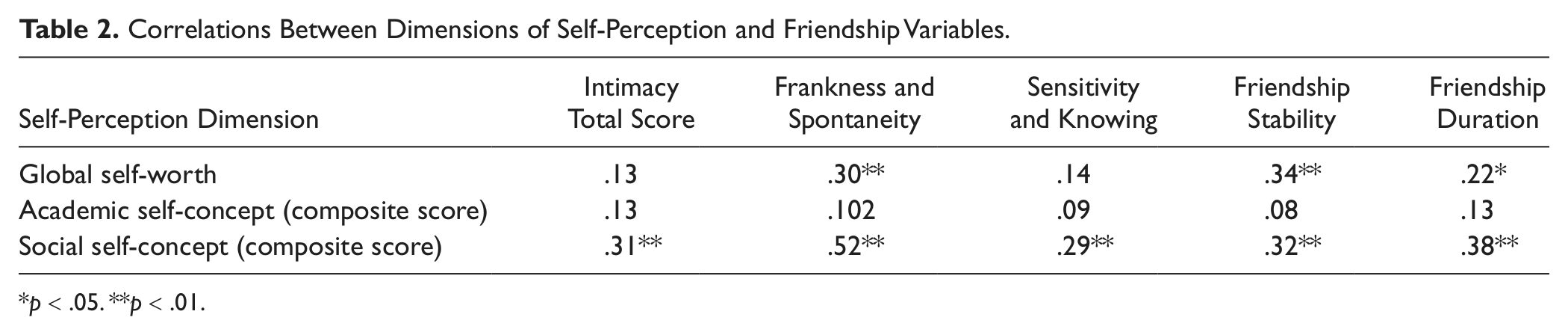
p < .05. **p < .01.
Summary of Hierarchical Regression Analysis for Variables Predicting Global Self-Worth.

Note: LD = learning disabilities.
p < .05. **p < .01. ***p < .001.
Summary of Hierarchical Regression Analysis for Variables Predicting Academic Self-Concept.
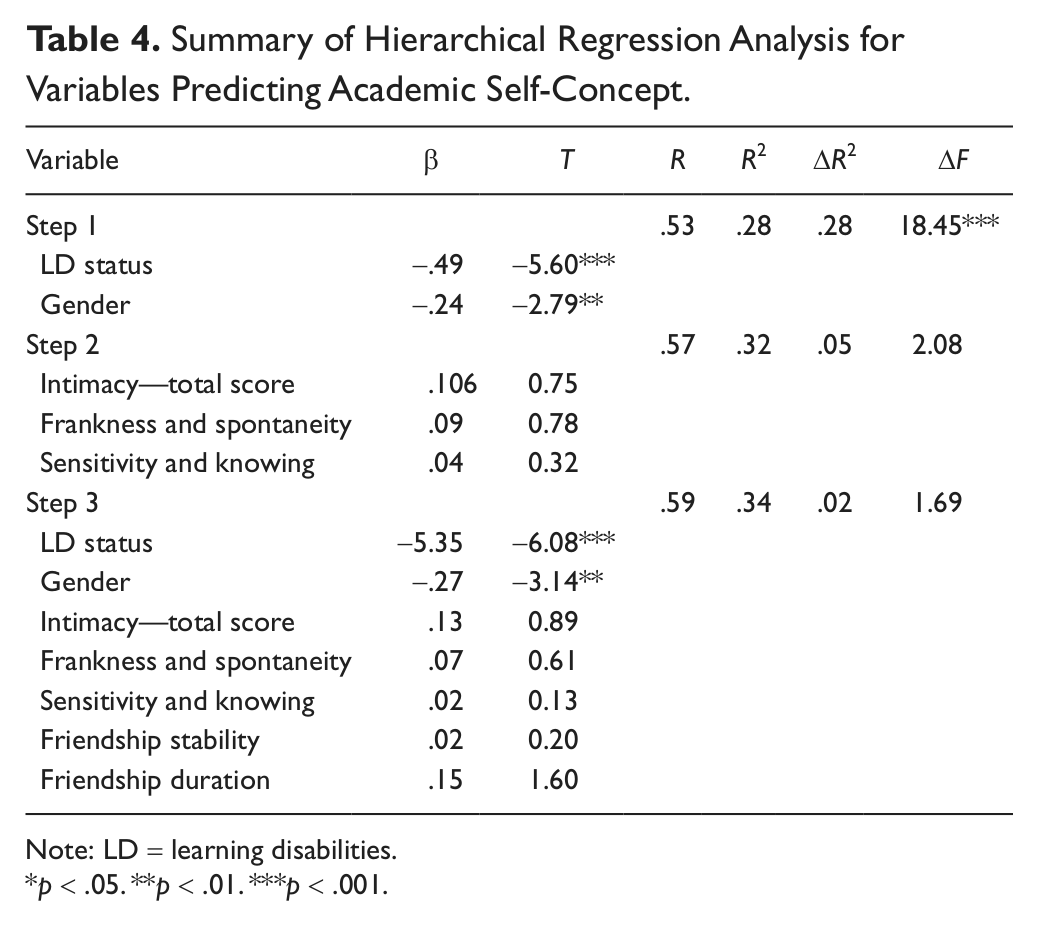
Note: LD = learning disabilities.
p < .05. **p < .01. ***p < .001.
Summary of Hierarchical Regression Analysis for Variables Predicting Social Self-Concept.

Note: LD = learning disabilities.
*p < .05. **p < .01. ***p < .001.
Global self-worth
LD status and gender explained 7% of the variance, showing that students with LD status had lower global self-worth than students without LD and that women reported lower global self-worth than men. At Step 2, frankness and spontaneity predicted an additional 12% of the variance, with higher frankness and spontaneity predicting higher global self-worth. At Step 3, friendship stability and duration added to the explanation of an additional 11% of the variance, bringing the total explained variance to 31%. In the final model, intimacy total, sensitivity and knowing, and friendship duration did not significantly predict global self-worth.
Academic self-concept
LD status and gender explained 28% of the variance, showing that students with LD had lower academic self-concept than students without LD and that women reported lower academic self-concept than men. Intimacy measures and friendship stability and duration did not significantly predict academic self-concept in the final model.
Social self-concept
At Step 1, LD status and gender did not explain significant variance. At Step 2, frankness and spontaneity predicted 31% of the variance, with higher frankness and spontaneity predicting higher social self-concept. At Step 3, friendship duration added to the explanation of an additional 12% of the variance, bringing the total explained variance to 43%. Intimacy total, sensitivity and knowing, and friendship stability did not significantly predict social self-concept in the final model.
Discussion
The overall purpose of this study was to examine the association among friendship, global self-worth, and domain-specific self-concepts among university students with and without LD. The first objective was to determine whether students with and without LD differed in global self-worth and domain-specific self-concepts. In accordance with considerable previous research (Bear et al., 2002), students with LD reported lower academic self-concepts than students without LD. This finding is noteworthy, however, because the current sample of university students with LD is relatively successful in terms of academic achievement when compared to other adults with LD.
Group comparisons also revealed lower global self-worth among students with LD as compared to students without LD. Previous studies of the global self-worth of adults with LD showed inconsistent results (Cosden & McNamara, 1997), raising the possibility that the relationship between LD and global self-worth is dependent on characteristics of the sample. Global self-worth is related to the way individuals perceive their abilities in the domains they perceive as important (Boetsch, Green, & Pennington, 1996). As academic achievement tends to be important to university students, students with LD, who may struggle more than other students (Cosden & McNamara, 1997), may feel this poignantly. Accordingly, their lower academic self-concept may affect their global self-worth. It should also be noted that inconsistent results among studies that compare global self-worth in individuals with and without LD may be the result of a small effect size in these comparisons (Bear et al., 2002). As the sample size in the current study was relatively large, we were able to detect small effects.
The results of the current study showed differential gender effects for both global self-worth and academic components of self-worth. The decreased global self-worth among students with LD was more pronounced in women than in men, and women in both groups had lower academic self-concepts than men. These results are in keeping with previous studies showing that men report somewhat higher self-concept than do women (Kling et al., 1999). Few studies have addressed gender differences in self-concept in populations with LD specifically. Although boys have been shown to have higher self-concepts than girls in a group of elementary school children with LD (Beltempo & Achille, 1990), it appeared that the gender effect was independent of LD status. The interaction reported in the current study may indicate that women with LD are particularly vulnerable to factors that negatively affect global self-worth.
The two groups were also compared with respect to social self-concept. As in another study of college students (Cosden & McNamara, 1997), students with LD did not report lower social self-concept than other students. Kupersmidt and DeRosier (2004) claimed that social difficulties among children and adolescents lead them to drop out of school and later to experience adjustment problems as adults. As such, it may be that students with LD who have strong social ties to begin with are more successful in school and are able to reach higher education. Furthermore, it is possible that those students rely on social support systems for guidance and direction even before reaching college. Thus, individuals with LD who reach higher education typically have the strongest social support systems (Cosden & McNamara, 1997), which may be comparable to those of students without LD.
The second objective of the study was to compare students with and without LD in several aspects of friendship. Students with and without LD did not differ in terms of the number of friends they reported having, the stability and duration of their friendships, the degree to which they socialized with their friends, and the level of intimacy they reported with their closest same-sex friend. Although most studies indicate that children with LD have fewer reciprocated friends, less stable friendships, and higher levels of conflict in their friendships (e.g., Vaughn & Elbaum, 1999; Wiener & Schneider, 2002) and that these issues continue into adulthood (Gerber et al., 1990; Goldberg et al., 2003), these studies and others also indicate that not all children and adults with LD have difficulties with social relationships (Goldberg et al., 2003; Lewandowski & Arcangelo, 1994). Thus, although LD puts children and adults at risk for social difficulties, it appears that some adults with LD are resilient in terms of their relationships. University students with LD, who have displayed relative strength by overcoming their disabilities and gaining acceptance to schools with high academic standards, are likely to be resilient when it comes to their social ties as well. It should be noted, however, that in this study we did not obtain data from the participants’ friends themselves, and thus it is not possible to conclude whether the friendships reported were actually reciprocal or “one-sided.” It is possible that there would be differences in reciprocal friendships in the LD group, as reported in children (Wiener & Schneider, 2002).
The third objective of the study was to examine the association among the components of friendship, global self-worth, and self-concepts in the academic and social domains. Hierarchical regression analyses showed that significant percentages of the variance in global self-worth and social self-concept were explained by a combination of LD status, gender, and intimacy and friendship measures. Academic self-concept was predicted only by LD status and gender.
In accordance with the pattern of group differences described above, LD status and gender explained a significant percentage of the variance in global self-worth and academic self-concept but did not have predictive value for social self-concept. With respect to intimacy and friendship measures, frankness and spontaneity explained an additional 12% of variance in global self-worth, and friendship stability and duration added a further 11%. Variance in social self-concept was also explained by frankness and spontaneity (31%) and friendship duration (12%), whereas none of the friendship variables predicted academic self-concept.
The frankness and spontaneity component of the IFS (Sharabany, 1994) purports to tap a form of self-disclosure regarding positive and negative aspects of oneself as well as honest feedback about the friend’s actions. Being a part of relationships that specifically involve this aspect of friendship appears to be associated with higher global self-worth and self-concepts of social acceptance. Increased stability and duration of friendship were also associated with higher global self-worth, a finding that is interesting to consider in the context of previous research showing that adults who had stable friendships as children reported higher global self-worth than those who did not (Bagwell, Newcomb, & Bukowski, 1998). It is possible that the maintenance of long-term, stable friendships from earlier years is beneficial to the global self-worth and social self-concept of university students.
Conclusion and Implications
Taken together, the results of this study highlight the possibility that intimate friendships may act as protective factors in relation to global self-worth and social self-concept. Although causal relations cannot be ascertained, the results of this study suggest that the maintenance of stable, intimate friendships among university students with LD is a protective factor in terms of global self-worth and social self-concept of university students with LD. Having close friends may contribute to their ability to function at a high level despite perceiving themselves at a disadvantage academically. To establish the causal relationships between friendship and both global and social self-concepts, it is important to perform longitudinal studies. Such studies should follow the friendship patterns of children with LD until they reach adulthood and examine the relationship between friendship and self-concept over time. Finally, contrary to Wiener and Schneider’s (2002) findings in children with LD, the current study did not reveal differences between students with and without LD with respect to duration and stability of friendships. This result may be related to the fact that reciprocity in the reported friendships was not examined, an issue that should be addressed in further research, possibly through the inclusion of qualitative data obtained from in-depth interviews.
Importance of the Study
Although university students with LD are relatively successful in terms of academic achievement compared to other adults with LD, they have lower self-concept of academic competence and lower global self-worth than other university students. In accordance with Harter’s (1999) model of the self, the finding that students with LD also have lower global self-worth despite equivalent social self-concept suggests that they view academic achievement as very important. Having low global self-worth, however, is a risk factor for depression and other mental health problems (Harter, 1999). Therefore, university students with LD, and especially women, may be at risk for these problems. The current study, however, suggests that having stable friendships and being able to disclose intimate feelings with friends are protective factors in terms of global self-worth for students with LD. They should therefore be encouraged to maintain their relationships with their friends because this social support seems to be crucial for fostering and maintaining global self-worth.
Footnotes
Declaration of Conflicting Interests
The author(s) declared no potential conflicts of interest with respect to the research, authorship, and/or publication of this article.
Funding
The author(s) received no financial support for the research, authorship, and/or publication of this article.